Building on the success of our 2013 conference to celebrate the centenary of ‘Tim’ Munby’s birth, ‘Floreat Bibliomania—Great Collectors and their Grand Designs’, we will be holding a second conference on 18-19 June 2016. This will be called ‘Mania and Imagination: Perils and pleasures of the private collector, present and future’, and will again be held in the Keynes Hall at King’s.
Please visit this page for further details, including a programme and registration form. We hope it will be as enjoyable as the first conference, and that readers of the King’s Treasures blog will be well represented!
We are also happy to announce the publications of the proceedings of the first conference in a special issue of the Transactions of the Cambridge Bibliographical Society. See here for full details.
To mark the 260th anniversary of the birth of Wolfgang Amadeus Mozart earlier this week, the Library mounted a small exhibition. For the benefit of those who cannot visit the exhibition in person, here are some selected highlights.
Leopold Mozart, Versuch einer gründlichen Violinschule. (Augsburg: Johann Jakob Lotter, 1756. Rw.38.43)
Leopold Mozart (1719-1787) was not just a pushy parent: he was also a composer, violinist and music theorist. This first edition of his Versuch einer gründlichen Violinschule, a treatise on violin playing, dates from the year of his son’s birth, and features a number of plates illustrating common errors. The frontispiece (above left) is a portrait of Leopold himself surrounded by his own compositions, and both images show the practice, common at the time, of playing the violin with a concave bow and without chin rest or shoulder rest.
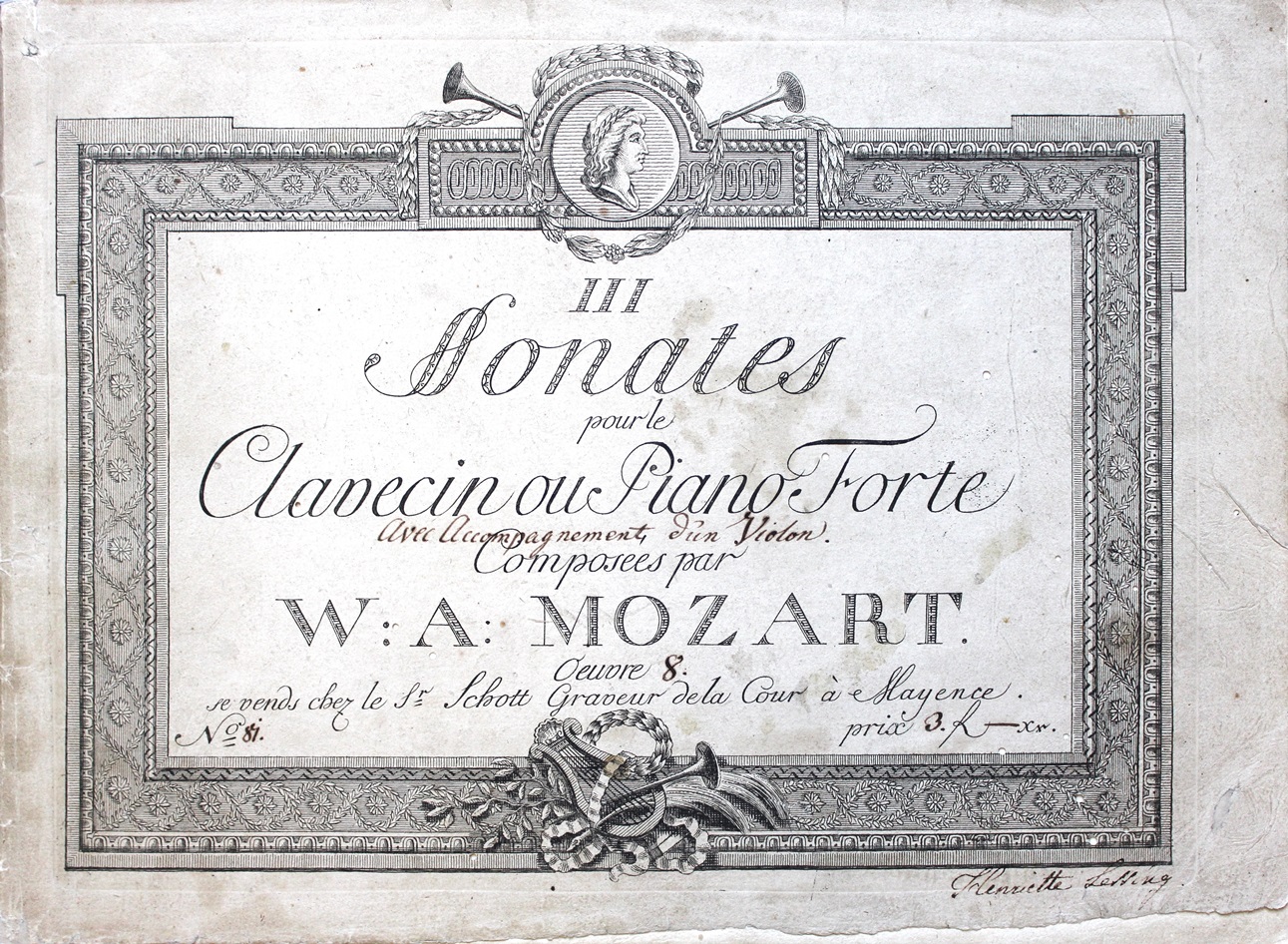
Wolfgang Amadeus Mozart, III sonates pour le clavecin ou piano forte, avec accompagnement d’un violon: œuvre 8. (Mainz: Schott, ca. 1789. Rw.13.88)
This set of parts for two sonatas for violin and piano, K.526 and K.481, and for the piano trio, K.496, was bequeathed to the College by Kingsman Andrew Raeburn (1933-2010, KC 1955). It dates from Mozart’s own lifetime, having been published around 1789. The title page bears the ownership inscription of Henriette Lessing. Further details of the item’s acquisition may be found on the College website here.
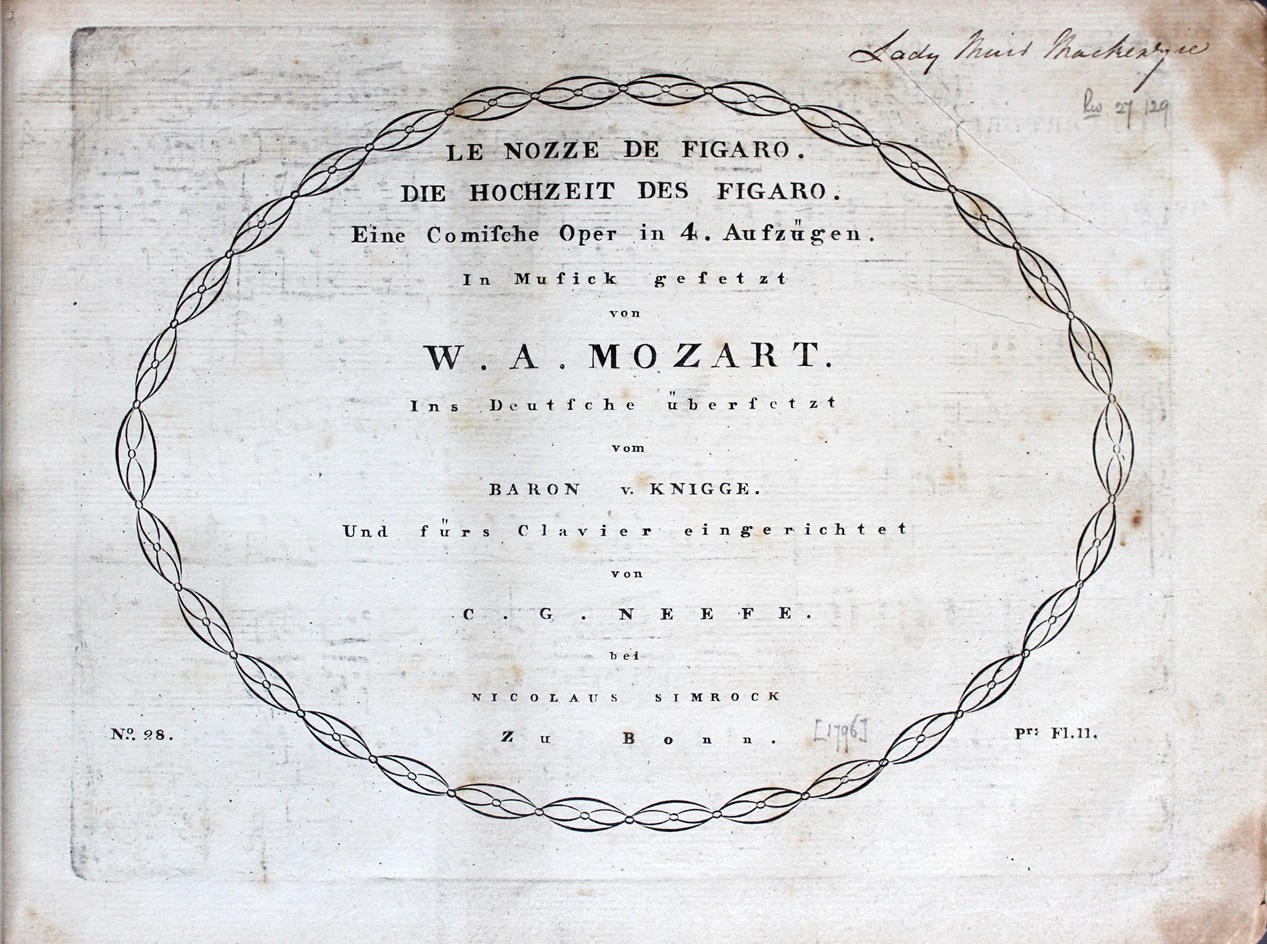
Wolfgang Amadeus Mozart, Le nozze di Figaro = Die Hochzeit des Figaro. (Bonn: Simrock, ca. 1796. Rw.85.209)
This German-Italian edition of Le nozze di Figaro, published in Bonn by the newly founded Simrock publishing house, was the first vocal score of the opera to appear in print. The title page of this copy bears the ownership mark of Lady Muir Mackenzie. This may plausibly be Georgina Muir Mackenzie (1833-1874), later Lady Sebright, a traveller and writer who, during a tour of the Austro-Hungarian Empire in 1858, was arrested as a spy with ‘pan-Slavistic tendencies’. She wrote about this experience and devoted much time during the following years to the promotion of Christianity in Turkey.
Wolfgang Amadeus Mozart, ‘E Susanna non vien! … Dove sono i bei momenti’ from Le nozze di Figaro. (Manuscript, late 18th century. Rowe Ms 198)
This manuscript, a contemporary transcription of ‘Dove sono i bei momenti’ from Act 3 of Le nozze di Figaro and its preceding recitative, is a relatively recent addition to the library’s collection, bought in 1981. In this aria, one of Mozart’s most exquisite, the Countess reflects on her marriage in the light of her husband’s presumed infidelity (‘Where are the lovely moments of sweetness and pleasure? Where have the promises gone that came from those lying lips?’). Naturally the opera ends with the blissful reunion of the Count and Countess.
Wolfgang Amadeus Mozart, Œuvres complettes. Cahier I, contenant VII sonates pour le pianoforte. (Leipzig: Breitkopf & Härtel, ca. 1798. Rw.28.84/1)
Unlike Johann Sebastian Bach, whose greatness was not acknowledged (and whose music was not disseminated) until long after his death, Mozart’s popularity was immediate and enduring, and it was as early as 1798, seven years after his death, that the German firm of Breitkopf & Härtel began publishing a 17-volume edition of what purported to be the composer’s ‘Œuvres complettes’ [sic]. This volume of piano music contains among other works the K.331 sonata, with its familiar ‘Alla Turca’ finale.
Programme for Cambridge Grand Musical Festival. (London: W. Glindon, 1824. Mn.22.7)
This programme for a Grand Musical Festival ‘for the benefit of Addinbrooke’s [sic] Hospital (Upon the Occasion of the Opening of the New Wards)’ gives details of three ‘Grand Miscellaneous Concerts’ in the Senate House and two ‘Selections of Sacred Music’ at Great St Mary’s to be performed on 2, 3 and 5 July 1824. The opening concert featured a performance of Mozart’s Jupiter Symphony, and is most notable for the participation of the composer Gioachino Rossini (1792-1868), making a rare appearance as a vocalist. The Times review remarked upon Rossini’s comic talent, observing that in the reprise of the Cimarosa duet that closed the first half his partner Angelica Catalani was ‘literally convulsed with laughter, and unable to proceed in two or three places’.
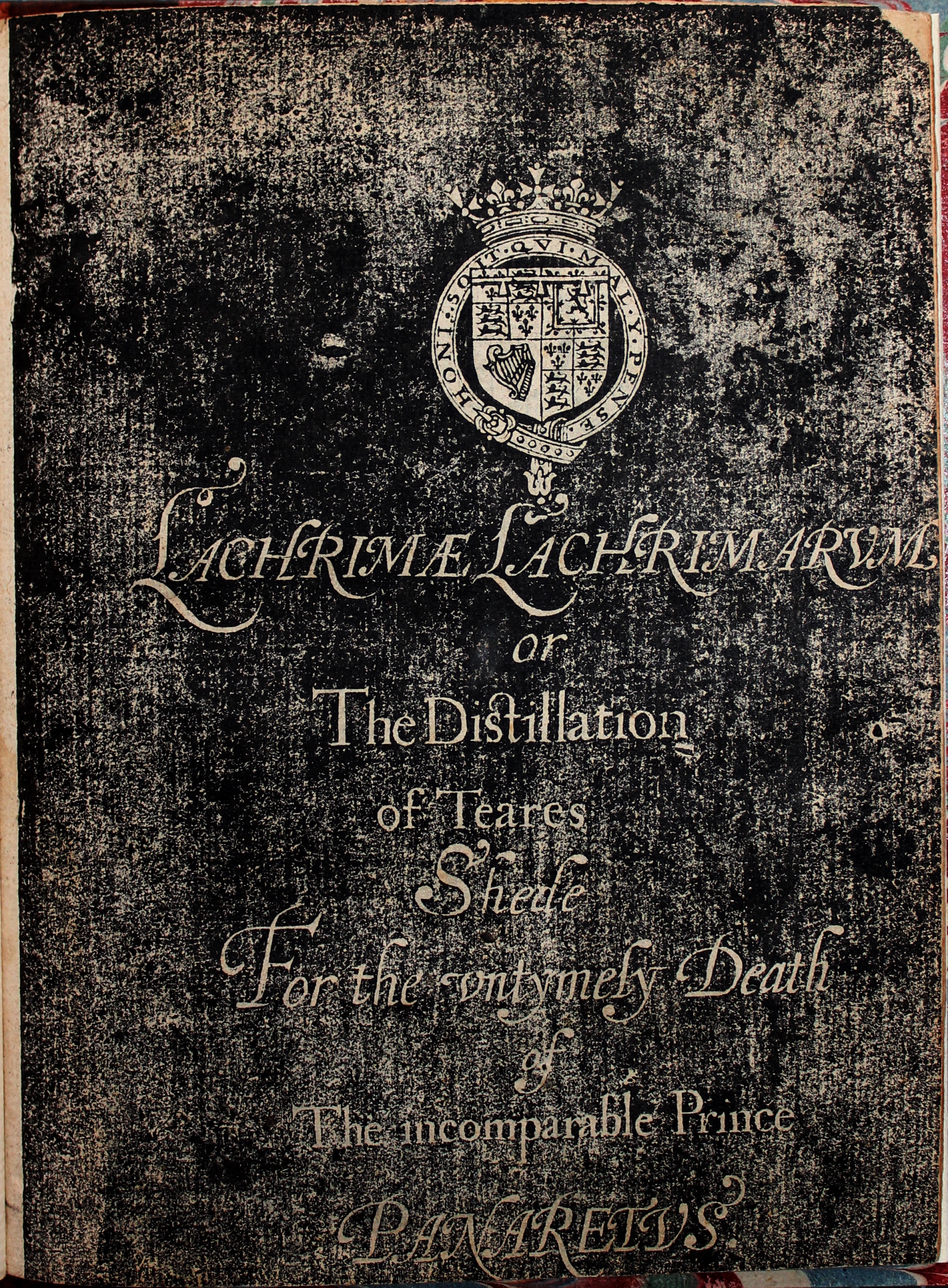
The untimely death of Henry Frederick, Prince of Wales was met with universal sorrow across the land in 1612. The national outpouring of grief is probably comparable to that witnessed in the aftermath of Princess Diana’s death in 1997. Prince Henry (1594-1612), the eldest son of James I and brother of the future King Charles I, was praised in life by authors including George Chapman, Sir John Davies, Michael Drayton, and Francis Bacon. There was a proliferation of mourning pamphlets and funeral sermons following the popular Prince’s death at the age of 18 from typhoid fever, and he was mourned by such luminaries as Thomas Campion, George Herbert, and Sir Walter Raleigh. Prince Henry was the patron of the poet Josuah Sylvester (1563-1618), who expressed his sorrow in Lachrimae lachrimarum (1612), one of the earliest examples of a book containing black mourning pages:
The tears of tears: title page of the first edition of Lachrimae lachrimarum; or, The distillation of teares shede for the untymely death of the incomparable Prince Panaretus (London: Humfrey Lownes, 1612; Keynes.C.12.8).
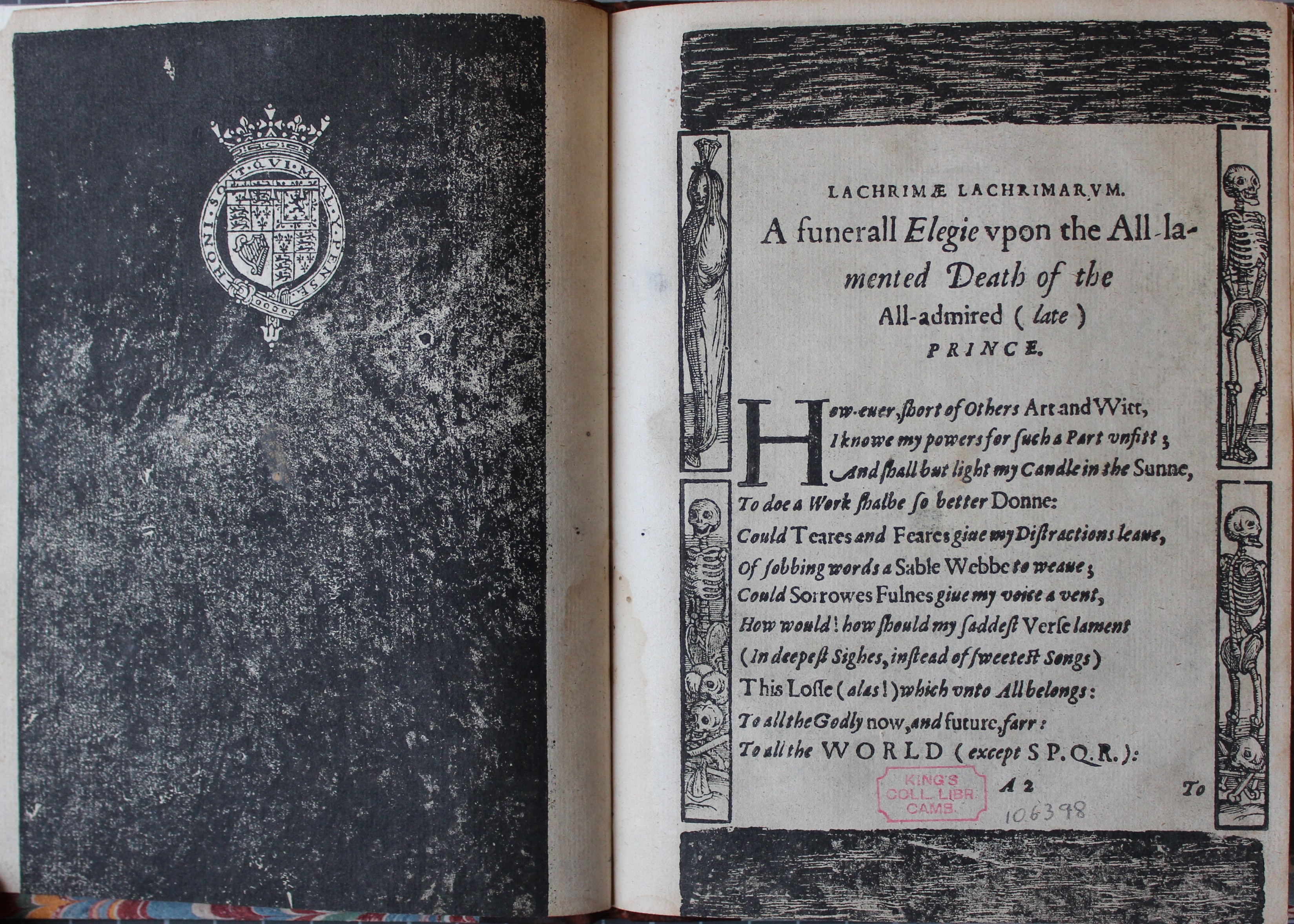
The sense of grief is compounded by a black page with a woodcut of the royal arms on every verso, and mourning borders with skeleton frames on each recto:
Lachrimae lachrimarum, leaf A2 recto and facing mourning page (Keynes.C.12.8).
The first edition includes elegies in English, French, Latin and Italian by the royal tutor, Walter Quin (1575?-1640):
Lachrimae lachrimarum, leaf D3 recto with an Italian sonnet by Walter Quin (Keynes.C.12.8).
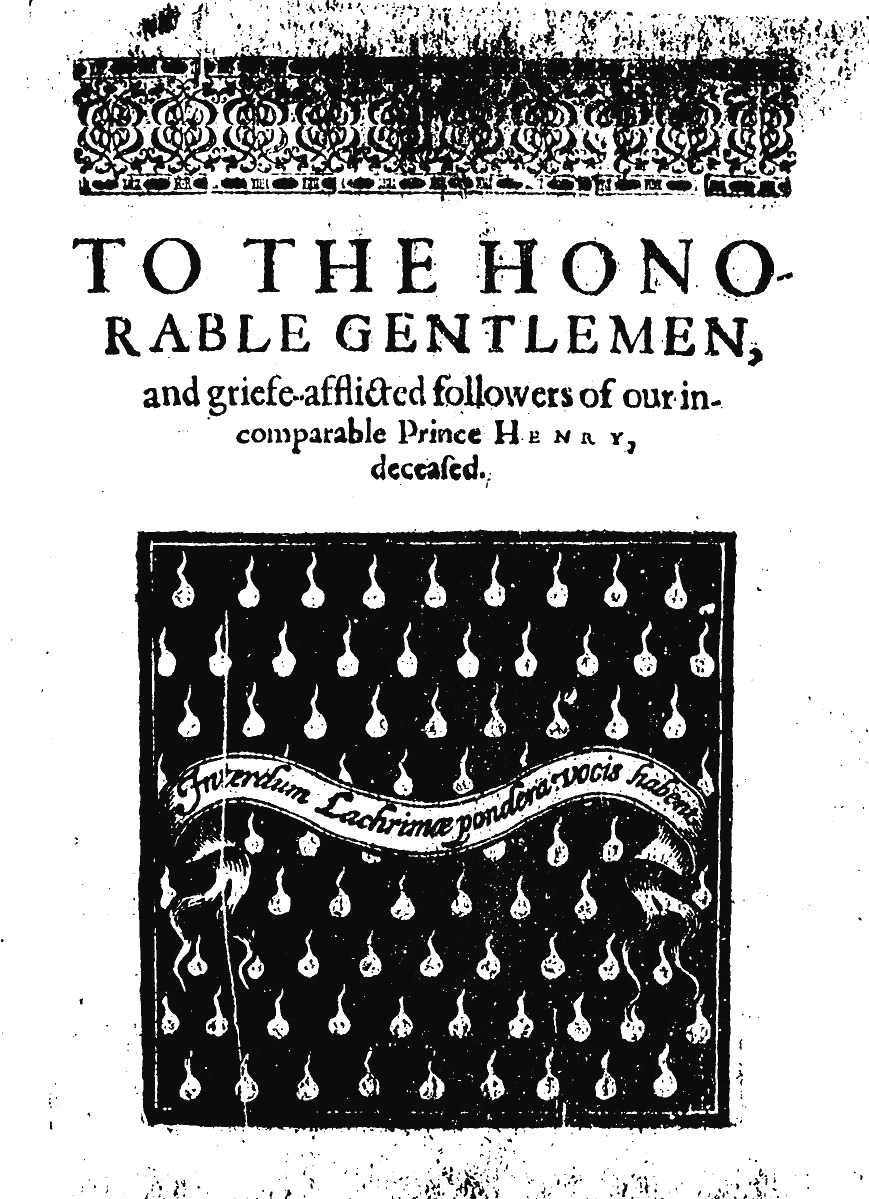
While tears are only mentioned in Sylvester’s book, these are shown explicitly in Christopher Brooke’s Two Elegies (1613), which features a pattern of tears with a quotation from Ovid’s Epistulae ex Ponto, 3.1.158: “Interdum lachrimae pondera vocis habent” (sometimes tears have the same weight as words):
Christopher Brooke, Two elegies, consecrated to the neuer-dying memorie of the most worthily admyred; most hartily loued; and generally bewayled prince; Henry Prince of Wales (London: Thomas Snodham, 1613; image from EEBO).
Variations on the black mourning page were used widely well into the 18th century. The premature death of John Churchill, Marquess of Blandford (1686-1703), who died here at King’s College on 20 February 1703, was lamented in William Congreve’s The Tears of Amaryllis for Amyntas (1703). The title page is framed within a mourning border of black blocks:
Title page of William Congreve’s The Tears of Amaryllis for Amyntas (London: Jacob Tonson, 1703; Keynes.C.5.6).
The black mourning page may be a technique that originated in the 17th century, but one of the most well-known examples of this practice is to be found in the 18th century, namely in Laurence Sterne’s novel Tristram Shandy (1759-67), which is revolutionary in its use of unconventional typographical devices such as blank and marbled pages. Yorick’s death in vol. 1 is followed by a black mourning page:
Alas, poor Yorick: black mourning page in the first edition of Sterne’s The Life and Opinions of Tristram Shandy, Gentleman (York: J. Hinxman, 1759; Keynes.Ec.7.1.15).
In order to protect his work from piracy, Sterne signed the opening chapter of the first and second editions of volume 5, as well as the first editions of volumes 7 and 9. He must have therefore autographed over 12,000 volumes:
Opening chapters of volumes 7 and 9 of Tristram Shandy, with Sterne’s autograph (Keynes.Ec.7.1.21 and Keynes.Ec.7.1.23).
Today is Blue Monday, allegedly the gloomiest day of the year, so we thought this would cheer everyone up. And let’s look on the bright side: if Prince Henry had lived to become King, he would have probably been beheaded during the English Civil War, as happened to his younger brother Charles I, so it looks like he had a lucky escape after all…
As we are all surrounded by illuminations at this time of the year (whether we like it or not), let’s have a look at another type of illumination, that of the vibrant colours and intricate decorations of initials and margins often found in medieval manuscript books. Such illuminations were also a feature of early printed books and can be regarded as a vestige of the manuscript tradition that persisted in the transition to the printing era. As Scrase and Croft point out in their book Maynard Keynes, “It is characteristic of the earliest period of printing that the book was conceived as a collaboration between the practitioners of the new art and the professional scribes and illuminators whose traditional involvement in book production went back for centuries” (Cambridge: Provost and Scholars of King’s College, Cambridge, 1983, p. 74). The illuminations were applied by hand following completion of the printing process, and the printer would leave blank spaces with or without guide letters for the illuminator:
Diogenes Laertius, Vitae et sententiae eorum qui in philosophia probati fuerunt (Venice: Nicolas Jenson, 1475; Keynes.Ec.7.2.9).
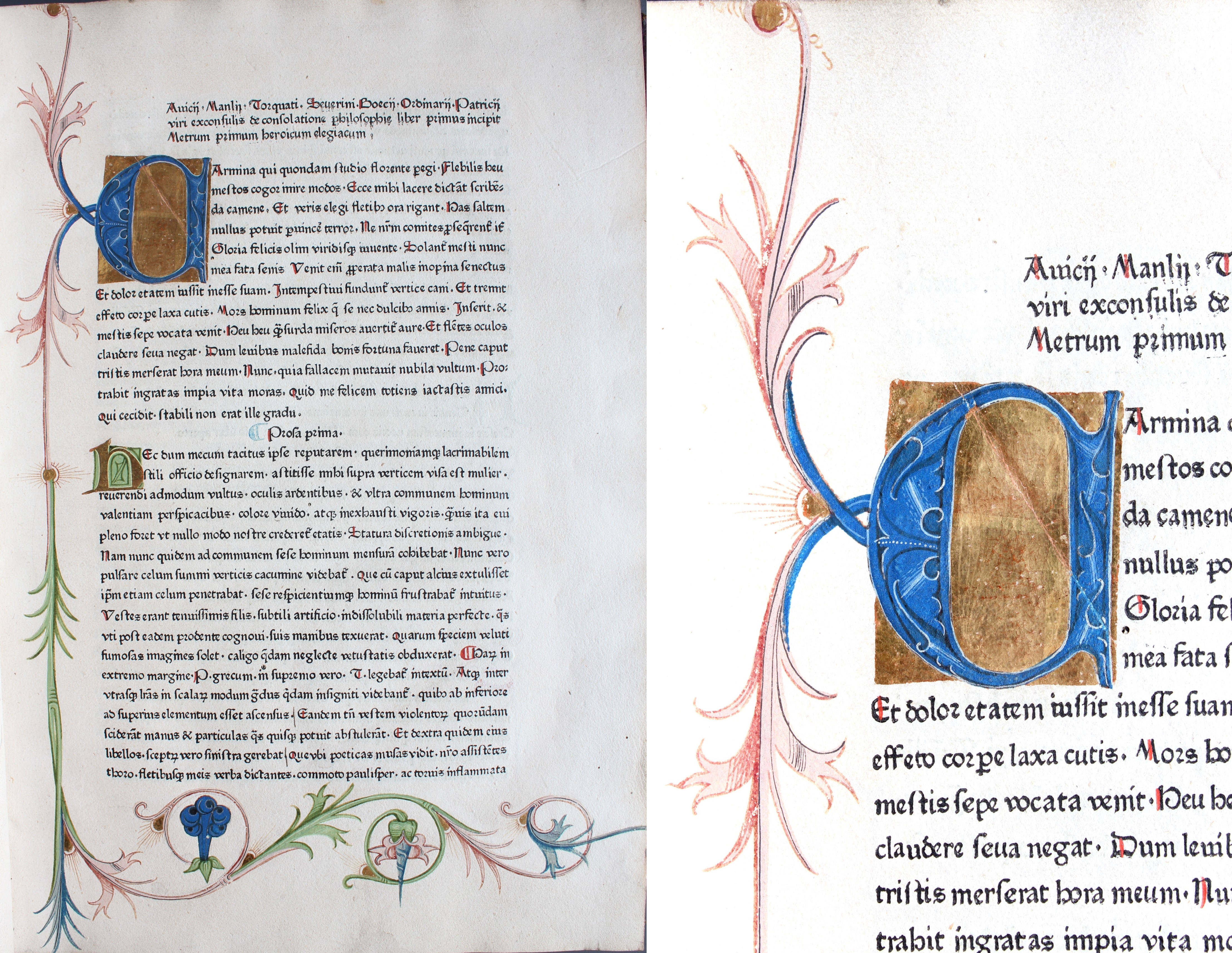
This 1476 copy of Boethius’s De consolatione philosophiae has the first initial of text illuminated in gold and blue, with a pink, green and blue decorative leaf border carried around the inner and lower margins:
Boethius, De consolatione philosophiae (Nuremberg: Anton Koberger, 1476; Keynes.Ec.7.1.4) with close-up of initial illuminated in gold and blue.
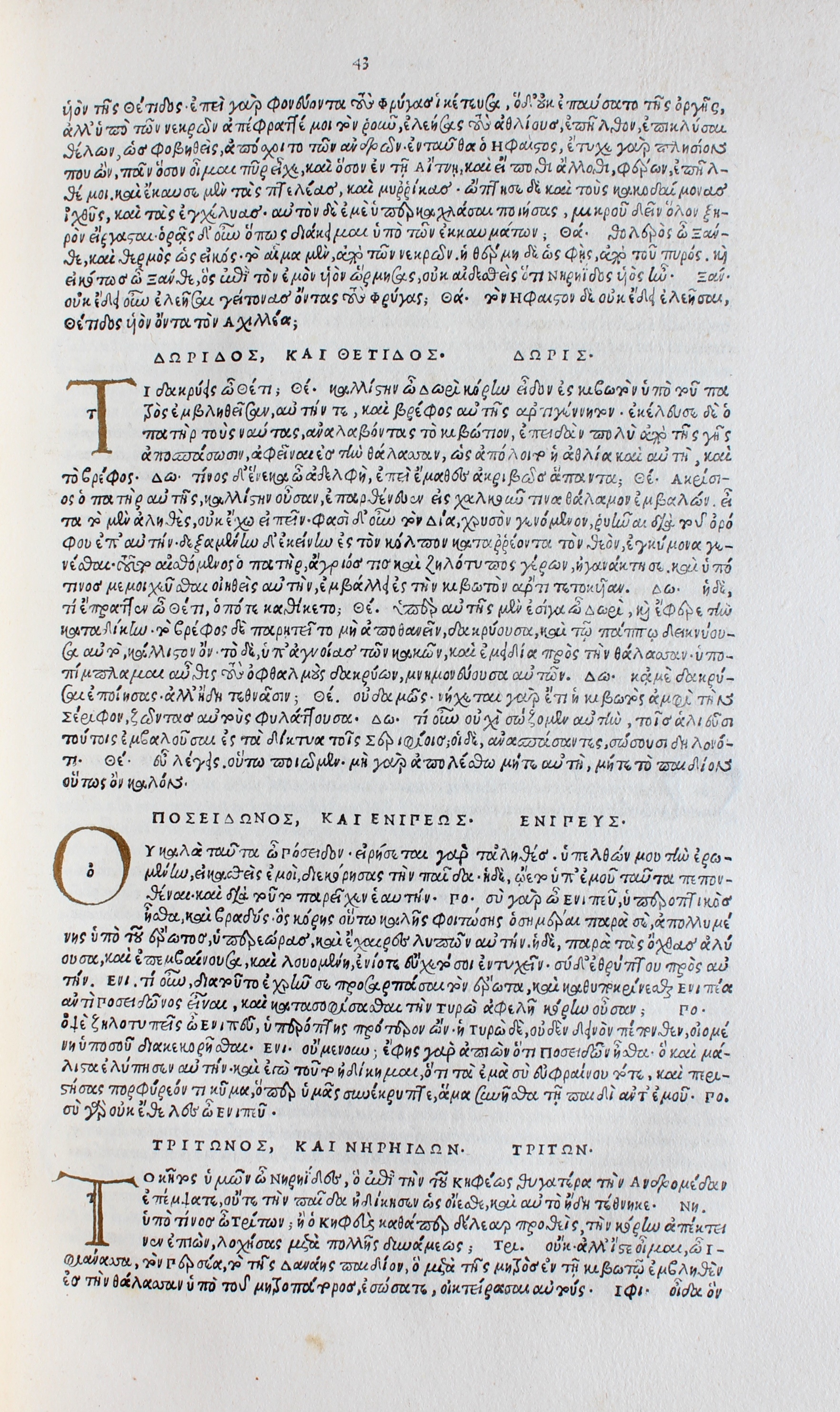
Sometimes, the initial letters were simply supplied in red, blue or gold, as in this copy of Lucian’s Opera (1503):
Lucian of Samosata, Luciani opera (Venice: Aldo Manuzio, 1503; Keynes.Ec.7.2.19).
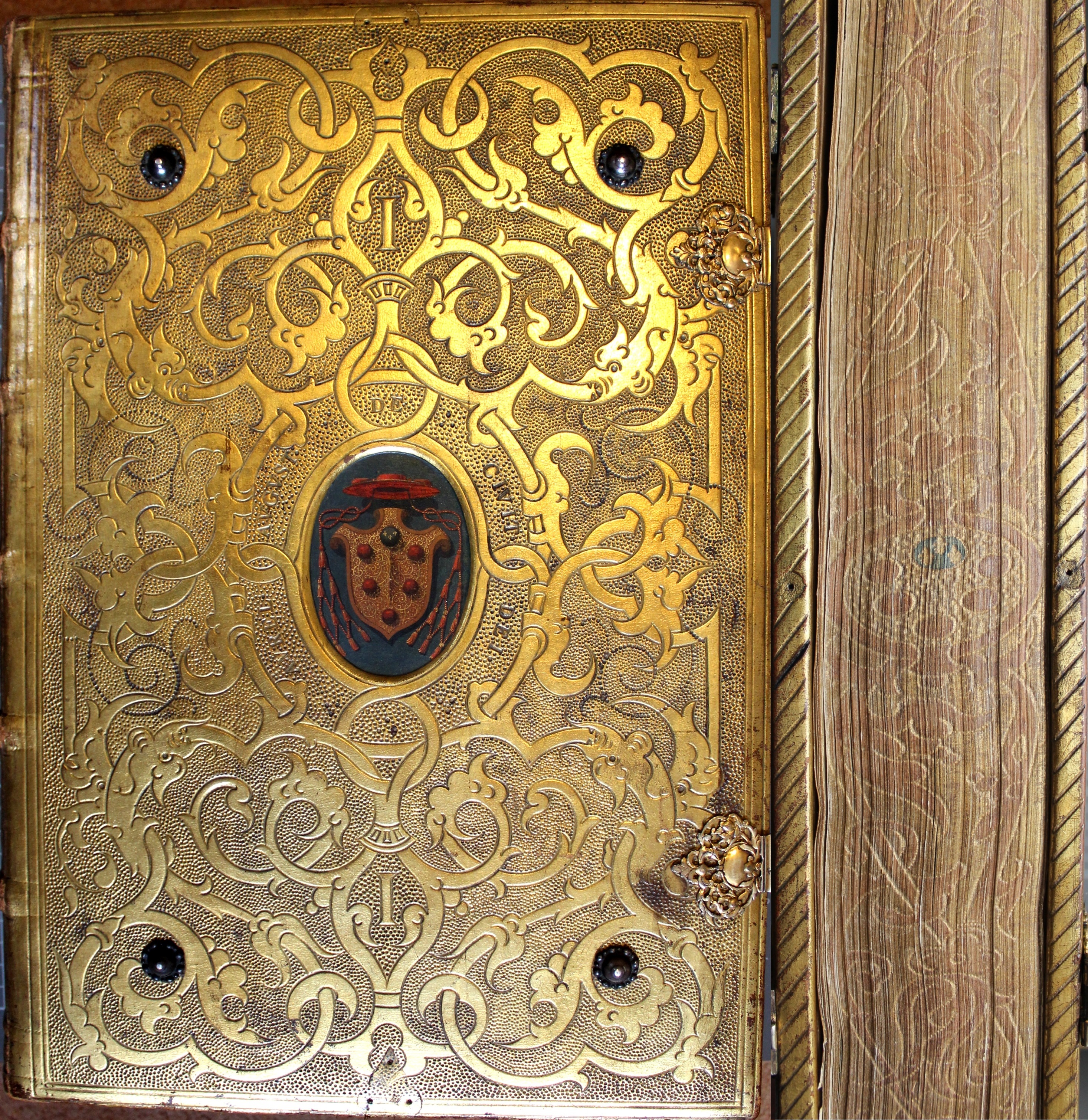
One of the most impressive illuminations in the incunabula in the Keynes Bequest is undoubtedly to be found in a copy of Saint Augustine’s De civitate Dei (1468), printed in Rome by two Germans, Konrad Sweynheim and Arnold Pannartz, who are credited with introducing the art of printing into Italy. The first page of text after the preliminaries features the initials “I” and “G” supplied in gold; both initials are embellished with a decorative white vine stem border defined in blue, pink and green with a pattern of white dots, which extends into the upper, inner and lower margins. In the lower margin is a painted coat of arms of Cardinal Medici within a green laurel wreath and a putto on either side:
Saint Augustine, De civitate Dei (Rome: Konrad Sweynheim and Arnold Pannartz, 1468; Keynes.Ec.7.1.2). The Medici arms are not authentic and were added by the forger Hagué.
Below is a close-up of the 15-line initial “I” and the 8-line initial “G”:
Saint Augustine, De civitate Dei (Rome: Konrad Sweynheim and Arnold Pannartz, 1468; Keynes.Ec.7.1.2); detail.
If you thought the illumination in this incunabulum was impressive, wait until you see the cover. This is a 19th-century binding entirely covered in gold produced by the French bookbinder and binding forger Théodore (aka Louis) Hagué (1822 or 1823-1891) in imitation of a 16th-century Italian binding purported to have been made for Cardinal Medici:
The book with the golden cover: calf over wooden boards; covers and spine entirely covered in gold with an elaborate interlacing ribbon/strapwork design; four metal bosses on each cover; arms of Cardinal Medici painted in an oval medallion at the centre of each cover. Detail shows gilt and gauffered edges with the Medici coat of arms in the middle, and the pattern of the decorations filled in with red.
Hagué was a master of forgery and produced fake bindings that were passed off as having belonged to popes, cardinals, kings and queens. And people fell for it hook, line and sinker. The sale catalogue description pasted on the fly-leaf reads: “Italian binding of the 16th century. This book is probably unique in its style of binding. It is of calf; tooled and completely covered with gilding. On each cover the arms of Cardinal Medici are painted…” For more information on Hagué, see Mirjam M. Foot, “Binder, Faker and Artist”, The Library 13.2 (2012), pp. 133-146, available here.
This is our last blog post before Christmas, so happy festive season from all of us at King’s College Library and Archives! We’ll be back in the New Year with more posts about the treasures in our special collections, so watch this space…
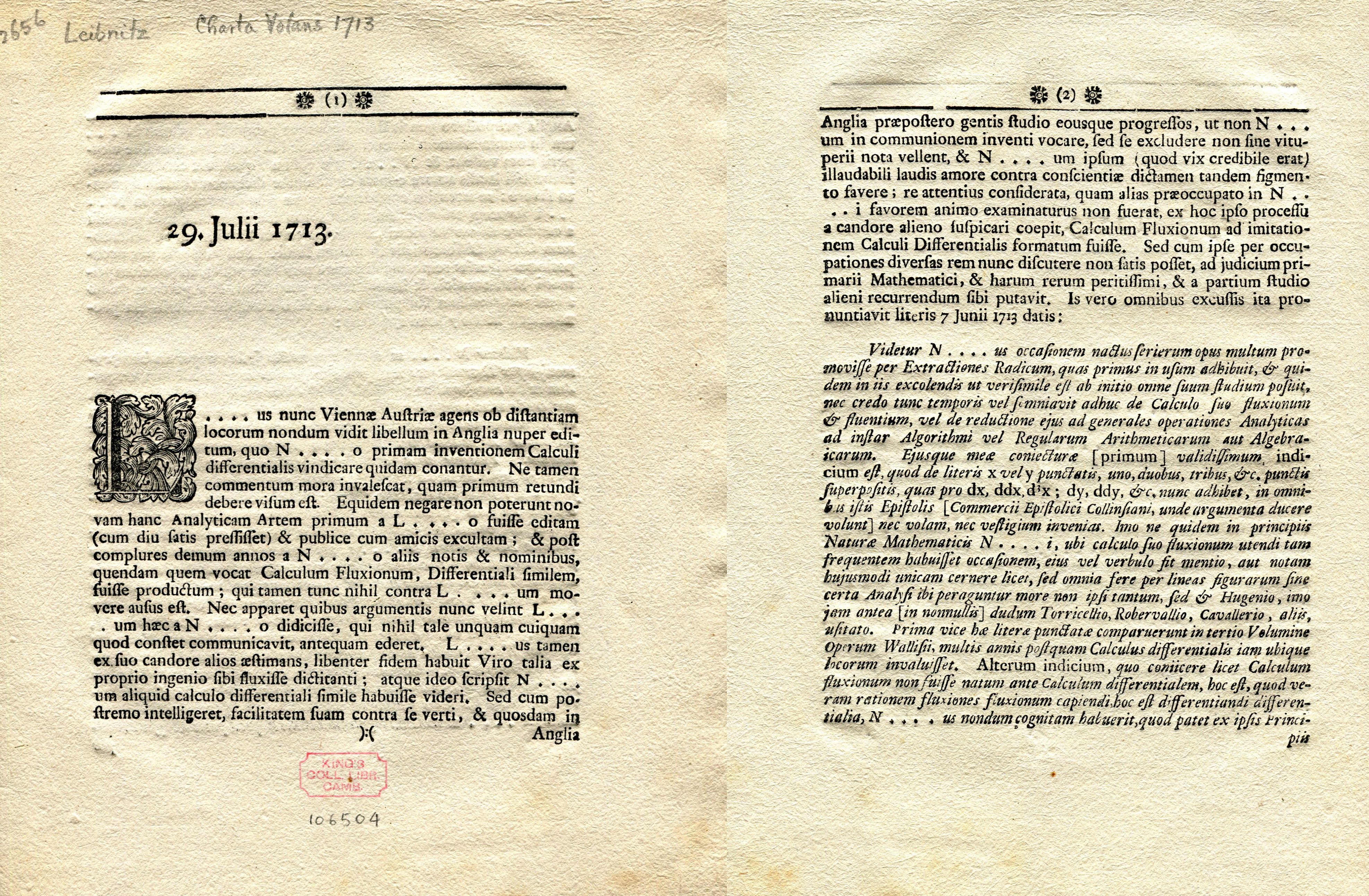
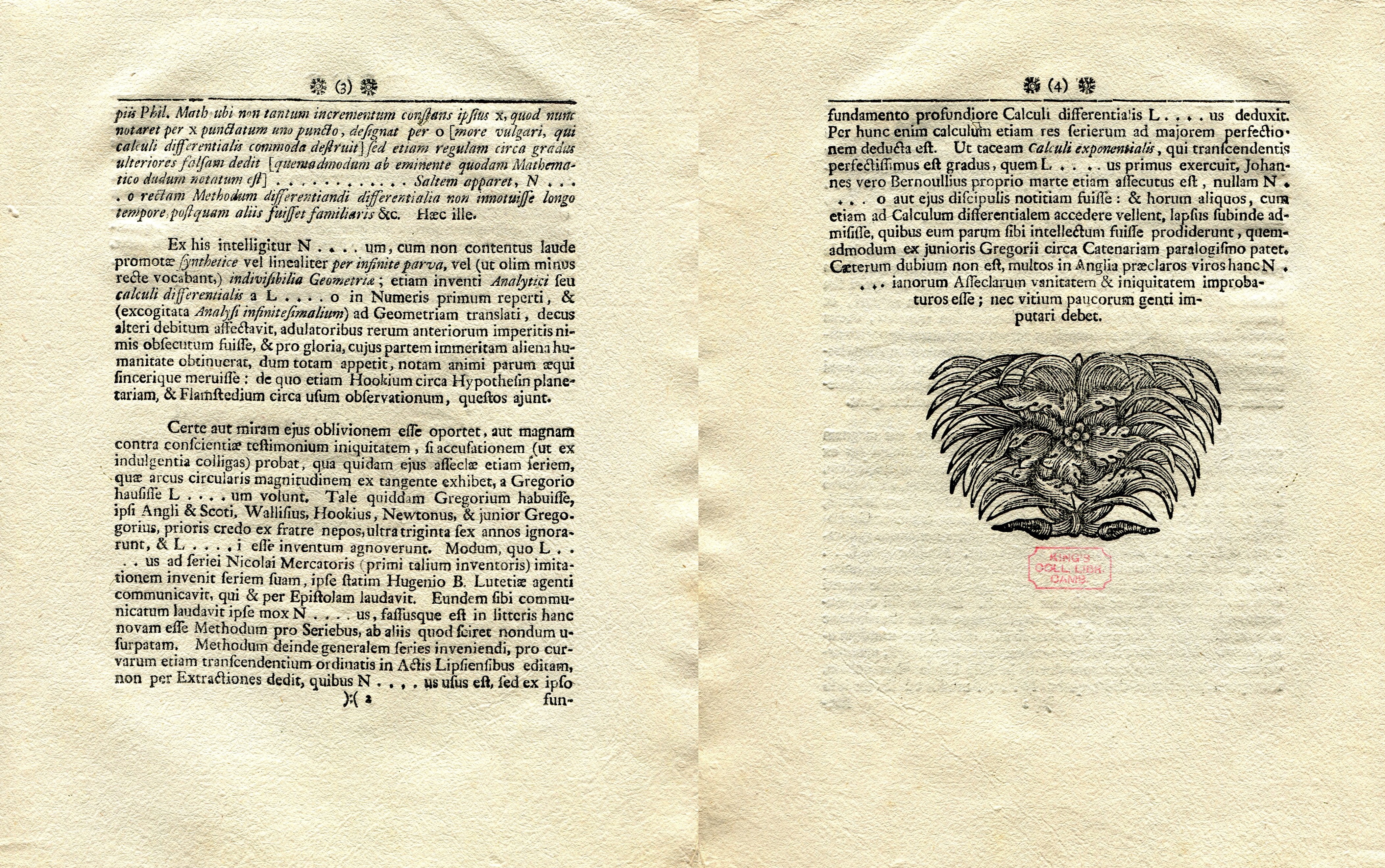
The Keynes Bequest is not merely a collection of books. Interspersed among first editions of Galileo, Descartes, Pascal, Hobbes, Kant and Locke are a number of pamphlets of historical, literary and scientific significance, ranging in size from one sheet to several pages. In the extensive collection of first and early editions of Isaac Newton’s works is an anonymous pamphlet with the caption “29. Julii 1713”. This is the so-called Charta volans (flying sheet), an important document written by Gottfried Leibniz during the bitter controversy between him and Newton over which of them invented the mathematical study of change, calculus. Given the rarity of this pamphlet (the only other copies are in Yale, Chicago and in the Burndy Library), and in the interest of scholarship, we provide a scan of all four pages:
Gottfried Leibniz’s Charta volans (1713), in which he argues that Newton had not published anything on calculus before him, adding that Newton’s fluxional method was in imitation of his calculus (Keynes.Ec.7.2.27)
Charta volans, pp. 3-4
Its acquisition history is also rather fascinating. Keynes had originally bought two copies of the pamphlet, and observed in a letter to K. G. Maggs when the latter offered to purchase the duplicate copy in May 1942 that he had done so “not because I wanted them, but because they were fastened together, never having been separated by a paper knife when issued. So far I have not had the heart to split the Siamese twins.” The correspondence between Keynes and Maggs throws an interesting light on his relationship with booksellers and how he went about augmenting his collection of rare books and pamphlets:
J. M. Keynes’s correspondence with K. G. Maggs, 15 May-18 May 1942
J. M. Keynes’s correspondence with K. G. Maggs, 28 May-29 May 1942
The “American library which specialises in Newton material” that bought the second copy of the Charta volans is almost certainly the Burndy Library, founded the previous year by the industrialist and historian Bern Dibner. Their copy is now at the Huntington Library in San Marino, California.
As the above correspondence reveals, the loss of one of the “Siamese twins” to the Burndy Library led to Keynes’s acquisition of another exciting “flying sheet”, namely a leaf from the Gutenberg Bible, the first book printed using movable type which marked the beginning of the Printing Revolution. The iconic 42-line Bible was printed in Mainz, ca. 1454-55, by Johannes Gutenberg. Of the about 180 copies printed, 49 are known to have survived, only 21 of which are complete. This leaf includes all of Jeremiah XX and part of Jeremiah XXI:
The first printed book: recto and verso of leaf 80 from the Gutenberg Bible (1454-55). Printed in two columns, one column on each side being defective; 2 initials supplied in red, chapter numbers in red and blue (Keynes.Ec.7.2.13)
The addition of a leaf from the Gutenberg Bible to Keynes’s collection means that the items in the Keynes Bequest cover five centuries of printing, from its very inception in the middle of the fifteenth century, right up to the middle of the twentieth.
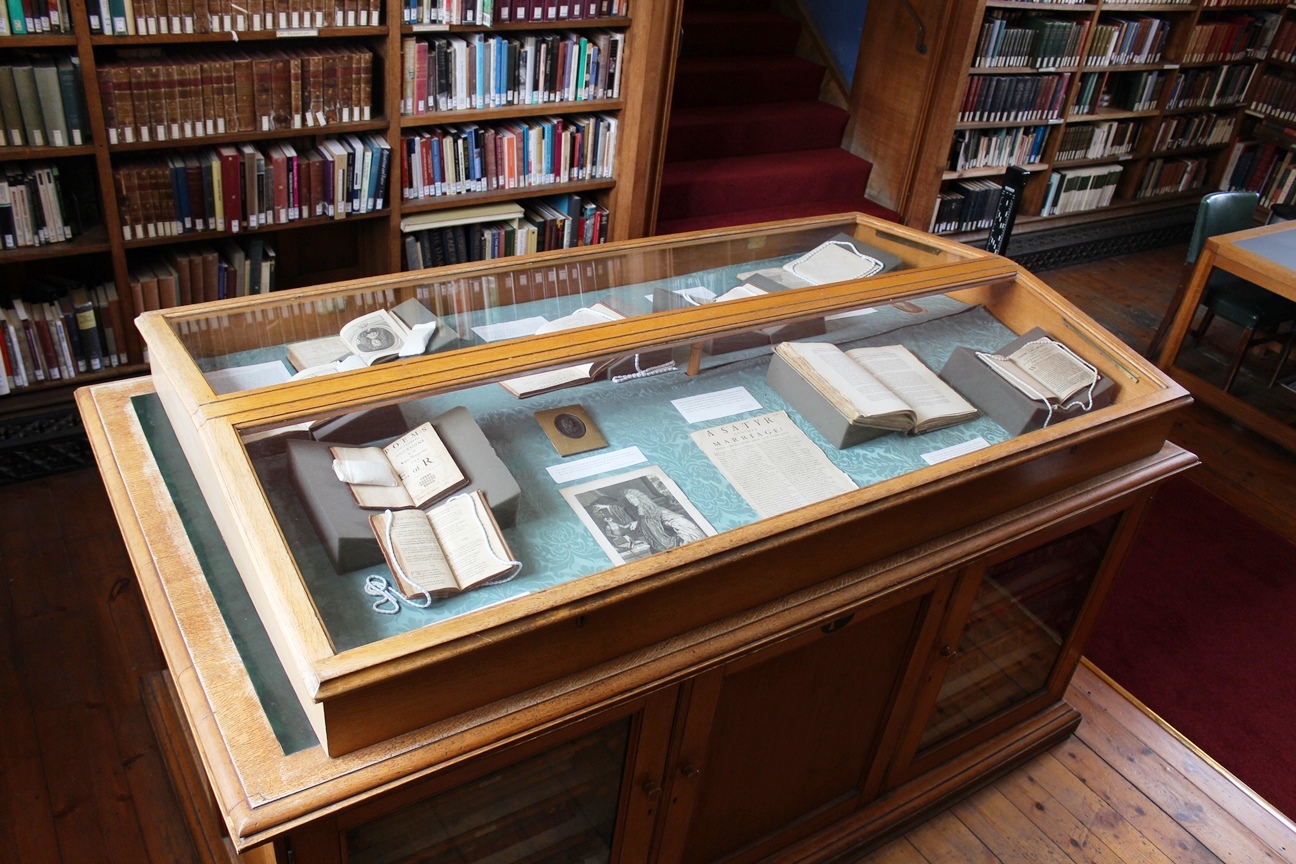
Last Friday King’s College Library and Archives hosted an exhibition for the Open Cambridge weekend, focusing partly on Kingsman John Davy Hayward (1905-1965) and his collection of early editions of the works of John Wilmot, Second Earl of Rochester (1647-1680). These are some selected highlights of the exhibition.
Poems on Several Occasions by the Right Honourable the E. of R- – – (Printed at Antwerp, 1680). Hayward Bequest, H.14.1
Poems on Several Occasions was the first anthology of Rochester’s poems published after his death in July 1680. The false imprint (it was printed in London) and lack of a publisher’s name permitted unrestrained lewdness of content. By November of that year Samuel Pepys had a copy which he kept in the right-hand drawer of his writing desk as he considered it ‘unfit to mix with my other books’, adding ‘pray let it remain there, for as he is past writing any more so bad in one sense, so I despair of any man surviving him to write so good in another’.
A Satyr against Marriage ([London], undated). Hayward Bequest, H.10.5
Only a handful of Rochester’s works were printed during his lifetime, mainly satires published as broadsides. The most famous was his ‘A Satyr against Mankind’ (1679) which is a scathing denunciation of rationalism and optimism that contrasts human wickedness with animal wisdom. His ‘A Satyr against Marriage’ is written in a similar vein.
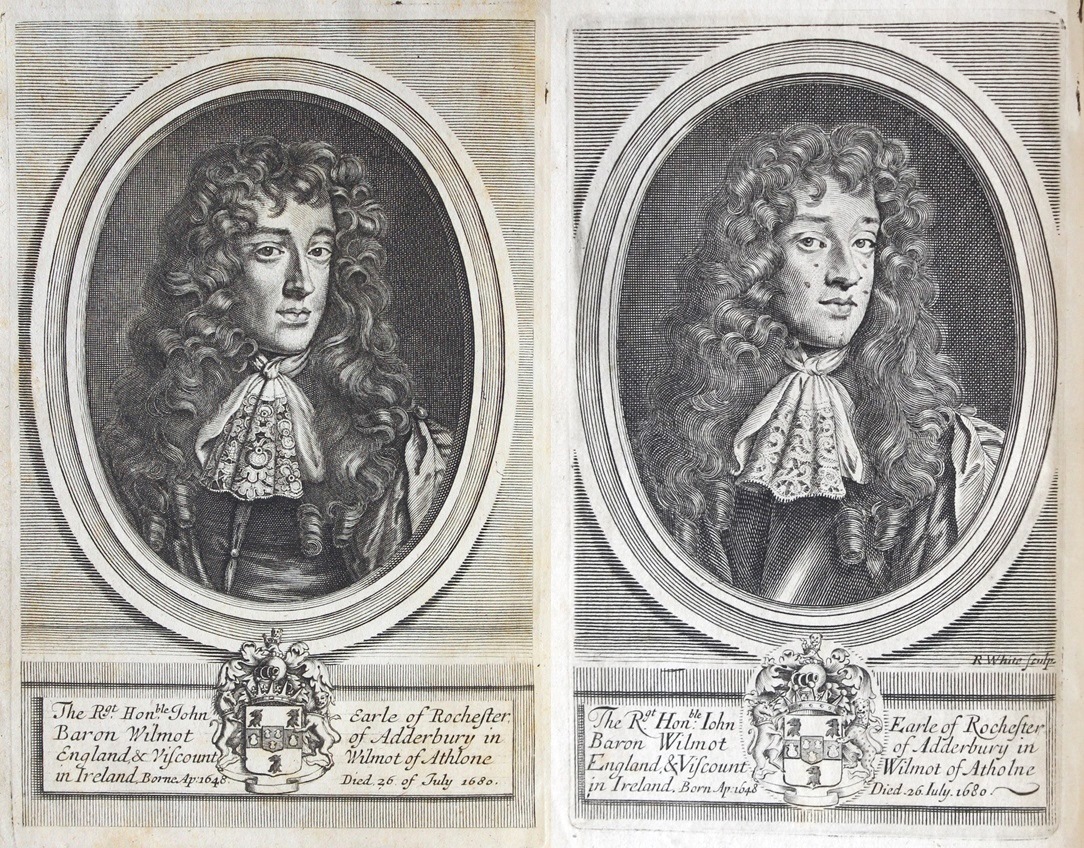
Frontispiece portraits from two editions of The Miscellaneous Works of the Right Honourable the late Earls of Rochester and Roscommon . . . by Mons. St. Evremont (London, 1707). Hayward Bequest, H.14.16 & H.14.17
Spot the difference: numerous editions of Rochester’s works appeared during the late seventeenth and eighteenth centuries, and their salacious content was gradually rewritten to reflect ‘respectable’ tastes. One of these portraits has been doctored, perhaps to suggest the venereal disease that would eventually lead to Rochester’s demise.
A Genuine Letter from the Earl of Rochester to Nell Gwyn. Copied from an Original Manuscript in the French King’s Library. Hayward Bequest, H.12.7
The actress Nell Gwyn, a long-time mistress of Charles II, is also believed to have been Rochester’s mistress, perhaps demonstrating his prominent position at court as well as his interest in the theatre. In 1673 Rochester had begun training Elizabeth Barry as an actress. She went on to become the most famous actress of her age and her relationship with Rochester produced a daughter. Whilst bearing all the hallmarks of Rochester’s style, some doubt the authenticity of this explicit (and anonymously published) letter from Rochester to Nell.
Engraving of Rochester crowning his monkey. Hayward Bequest, no shelfmark
Monkey business: this engraving is one of the best known images of Rochester, and provided the title for Graham Greene’s biography of the author, Lord Rochester’s Monkey. In ‘A Satyr against Mankind’ Rochester writes:
Were I, who to my Cost already am
One of those strange, prodigious Creatures Man,
A Spirit free, to choose for my own Share,
What sort of Flesh and Blood I pleas’d to wear,
I’d be a Dog, a Monkey, or a Bear,
Or any thing, but that vain Animal,
Who is so proud of being Rational.
Broadside circular ([London], ca. 1676), Hayward Bequest, H.12.15
In 1676 Rochester fell into disfavour with the King and fled this time to Tower Hill where he impersonated a physician, one ‘Dr Alexander Bendo’. Under this persona he claimed skill in treating many conditions including ‘barrenness’, apparently gaining him access to many young ladies.
WARNING: This blog post was not suitable for children.
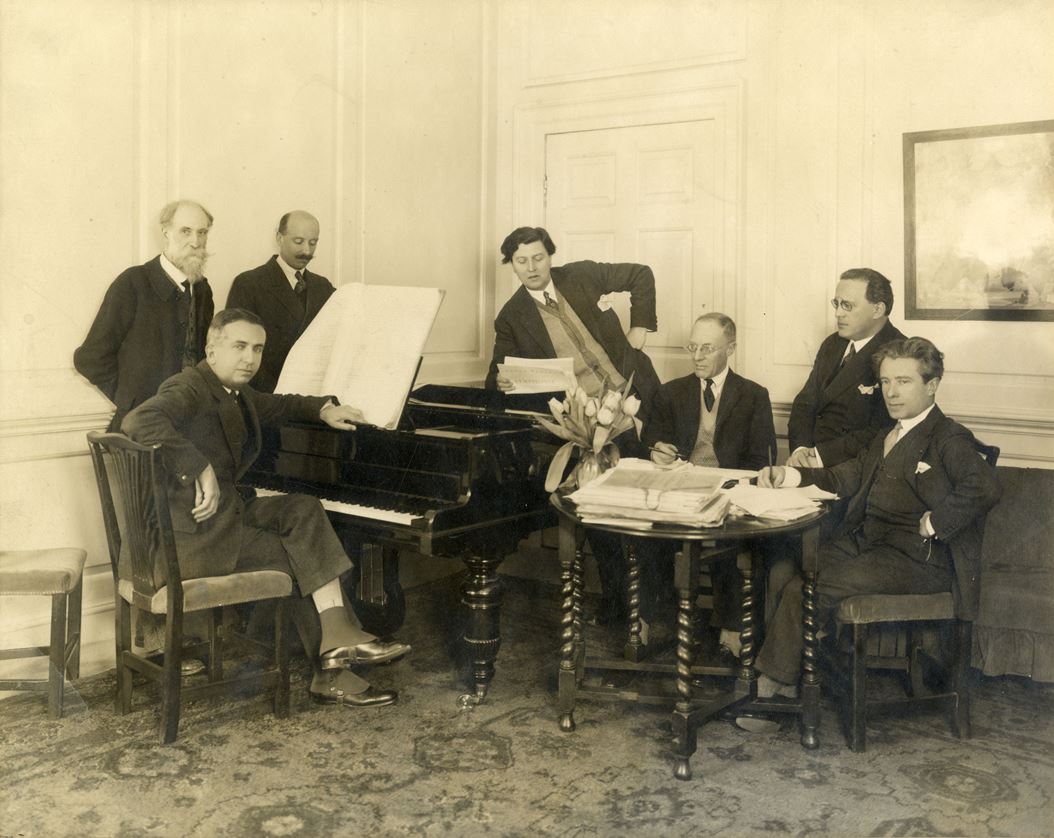
The first thing anyone notices on entering King’s College’s Rowe Music Library are shelves upon shelves of brightly coloured scores, and it is possible to be so beguiled by them that you fail to notice anything else; but there are pictures hanging on the walls that are just as interesting in their way. This, for instance:
The photograph was taken in January 1931, in the rooms of the musicologist E.J. Dent, a Fellow of King’s. Dent is the dapper, Wilfrid Brambell-esque figure seated at the table; alongside him, the Polish composer Grzegorz Fitelberg and the Belgian Désiré Defauw. At the piano is Alfredo Casella; standing behind him, Charles Koechlin and the conductor Adrian Boult. And in the middle, leaning on the piano, is Alban Berg. How did this man, one of the titans of twentieth-century classical music, come to be in Cambridge?
The occasion was a meeting of the jury of the International Society for Contemporary Music, which at that time consisted of Dent and the five composers (Boult serving in an advisory capacity). Dent had been President of the ISCM since its inception in 1922, and the purpose of the meeting was to determine which works would be performed at that summer’s Festival in Oxford and London, the first to be held in Britain.
Berg’s published letters to his wife tell the story. From 12th January:
So far I’ve only the impression of a provincial place, but not a German one. Sort of super-Deutsch-Landsberg.
Dent called for me, and we went on working in the College. Altogether this is the oddest town I’ve ever seen. More about that when I get back.
Dent, who is like a kindly nanny to me, made a splendid tea in the afternoon. We worked till about seven; and now the car is fetching me and taking me home to dinner. We had a very fine lunch at Dent’s, except that the food had no taste at all. In this country a pheasant tastes exactly like a turkey or a chicken.
A couple of days later:
I’ve been working hard all day, had a fine lunch (my ‘favourite’ roast lamb), home to dinner, played the gramophone afterwards, and went to bed early. It’s become colder. But thanks to all sorts of drinks, good warm pants and woolly vests and galoshes, I’m managing quite well and never catch cold. We all get on well on the jury, talking French almost all day – although we’re from six different countries: Italy, France, Belgium, Poland, Austria, England …
By 15th January, writing on his way to London, he had had enough:
Thank the Lord, Cambridge is over … not an hour more in that dull place.
In a letter to Arnold Schoenberg a month later, Berg wrote more frankly of his experience on the jury:
Of course the professional task at hand was very depressing since I, alone against 4, sometimes 5 opponents … was able to accomplish practically nothing worthwhile, as you can see from the concert programs of the Oxford Music Festival.
Thank heavens at least Webern will be heard!
The Webern performed that summer was his Symphony, Op. 21, the score of which Berg is seen holding in the photograph. Among the other works in the programme were Vaughan Williams’ Job: A Masque for Dancing, Gershwin’s An American in Paris, Hindemith’s children’s opera Wir bauen eine Stadt, and pieces by Szymanowski, Roussel, Roger Sessions, Egon Wellesz and Constant Lambert. Much of the Festival was broadcast by the BBC, which (alongside the Radio Times, at that time a publication of the BBC) made an effort to promote it with a series of articles and radio talks related to the music being performed.
While researching this post I had the opportunity of consulting Dent’s personal papers, housed in our Archive Centre. They include correspondence from several ISCM people, including a typed letter of thanks from Defauw dated 21st May 1931, to which is added a handwritten postscript referring presumably to the forthcoming Festival, to be held in July: ‘Cher Ami, je ferai tout mon possible pour venir en juillet – j’aurai une grande joie de vous revoir’.
Also in the Dent archive are several photographs dating from the foundation of the ISCM. This annotated photo, taken in Salzburg in 1922, features several composers of note, including Webern, Wellesz, Hindemith, Arthur Bliss (later Master of the Queen’s Music), and Ethel Smyth.
You can explore the Dent archive further by searching the catalogue on Janus here.
Bibliography
Brand, J., Hailey, C. & Harris, D. (eds.). The Berg-Schoenberg Correspondence: Selected Letters (Macmillan, 1987)
Doctor, J. The BBC and Ultra-Modern Music, 1922-1936 : Shaping a Nation’s Tastes (Cambridge University Press, 1999)
Grun, B. (ed.). Alban Berg: Letters to His Wife (Faber, 1971)
[The copyright holder of the 1931 ISCM photograph is unknown. We apologise for any inadvertent omission. Please contact us if you are the copyright holder.]
While most of the books in the Keynes Bequest have been acquired for their intellectual content, charting the history of European thought, there is one section in which the items have been collected primarily because of their physical characteristics, namely the binding. Every book bound before the early 19th century is a unique handcrafted object, so no two bindings can be genuinely identical. Recording the binding information when cataloguing a rare book is important as it gives us an indication of its provenance as well as how the book was used, regarded and circulated. Below is a selection of some of the most interesting items in the ‘binding’ section of the Keynes Library.
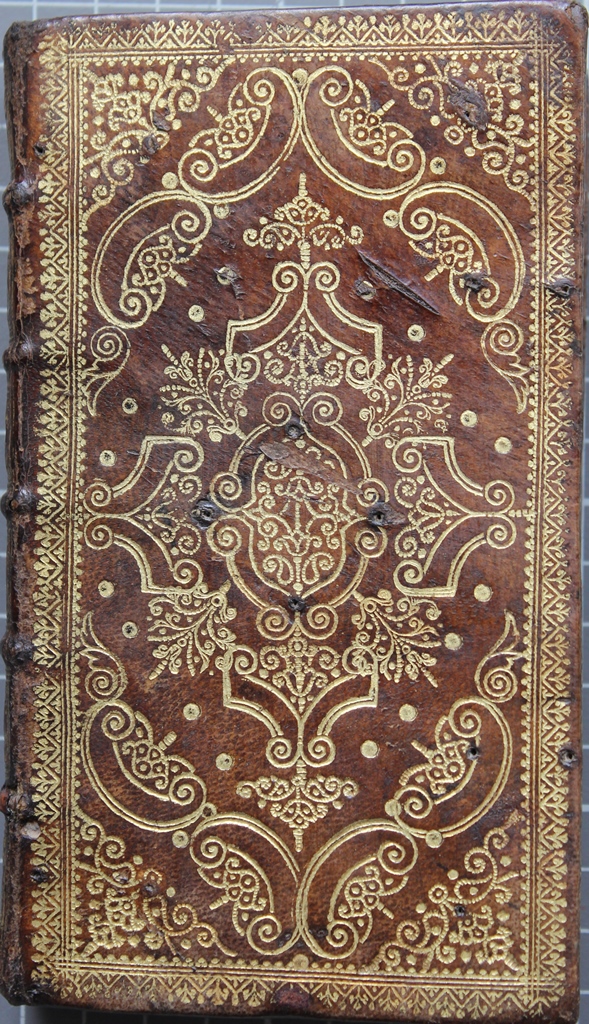
This copy of Les Pseaumes de David (1668) features an ornamental binding in goat-skin from the atelier de Charenton, characterised by corner-pieces and fleurons incorporating several pointillé motifs; on the board edges is a decorative roll in the style of the binder Antoine Ruette (1609-1669). Four stud holes are visible at the centre:
Keynes.Ec.7.4.11: Les Pseaumes de David mis en rime franc̜oise par Clement Marot, et Theodore de Beze (Charenton: Estienne Lucas, 1668).
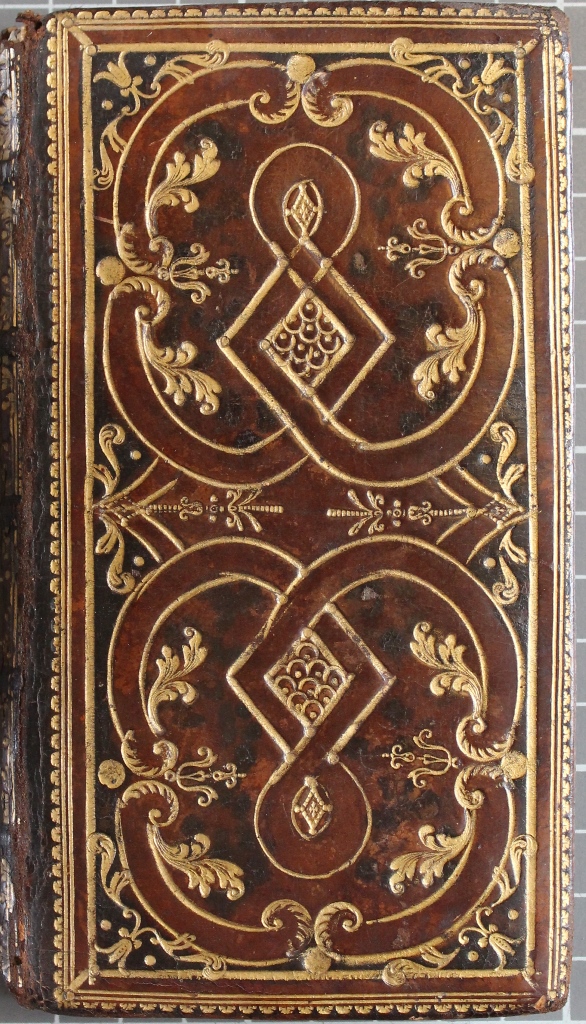
Keynes.Ec.7.4.13 is an example of a book judged solely by its cover, being a copy of an obscure Italian play on St. John the Baptist which seems to have been consigned to oblivion by literary history, but whose binding features an aesthetically pleasing symmetrical double-panel design with drawer-handle and leaf ornaments tooled in gold:
Keynes.Ec.7.4.13: Niccolò Lippi, La verità conosciuta, e non seguita: overo la decollazione del glorioso S. Gio. Battista (Naples: Eredi di Laino, 1721).
There are also a number of armorial bindings in this section with interesting historical associations. We have a copy of Notizie per l’anno 1759, a volume of a statistical and administrative annual printed in Rome from 1716 to 1849, the precursor of the Annuario pontificio. Again, the content of the book is probably less interesting than the binding, which features the arms of the book’s dedicatee Cardinal Carlo Rezzonico (1724-1799), nephew of Pope Clement XIII, gold-stamped at the centre, and corner-pieces with elaborate floral decorations:
Keynes.Ec.7.4.12: Notizie per l’anno 1759 (Rome: Chracas, 1759).
Going back to France, this copy of René Budel’s De monetis, et re numaria (1591) has the coat of arms of the noted French historian and bibliophile Jacques-Auguste de Thou (1553-1617) and of his second wife Gasparde de la Chastre blocked in gold at the centre of each cover. The fact that de Thou and his wife were already dead when this volume was added to their library is indicated by the addition of an urn above the two coats of arms. Underneath them, and on each spine panel, is the couple’s monogram IAGG. De Thou’s son François continued to add books to his late father’s library using this version of his coat of arms:
Keynes.Ec.7.4.6: René Budel, De monetis, et re numaria, libri duo (Cologne: Johann Gymnich, 1591). Detail from the cover and spine.
And finally something closer to home: a 16th-century English blind-stamped volume bound by Garret Godfrey of Cambridge (d. 1539), with a panel design formed by a roll containing a lion, a wyvern, and a gryphon; the floral ornaments feature the binder’s initials G. G. The metal clasps, catch plates and leather straps are intact:
Keynes.Ec.7.4.7: Petrus Comestor, Historia scholastica (Paris: Jean Frellon, 1513).
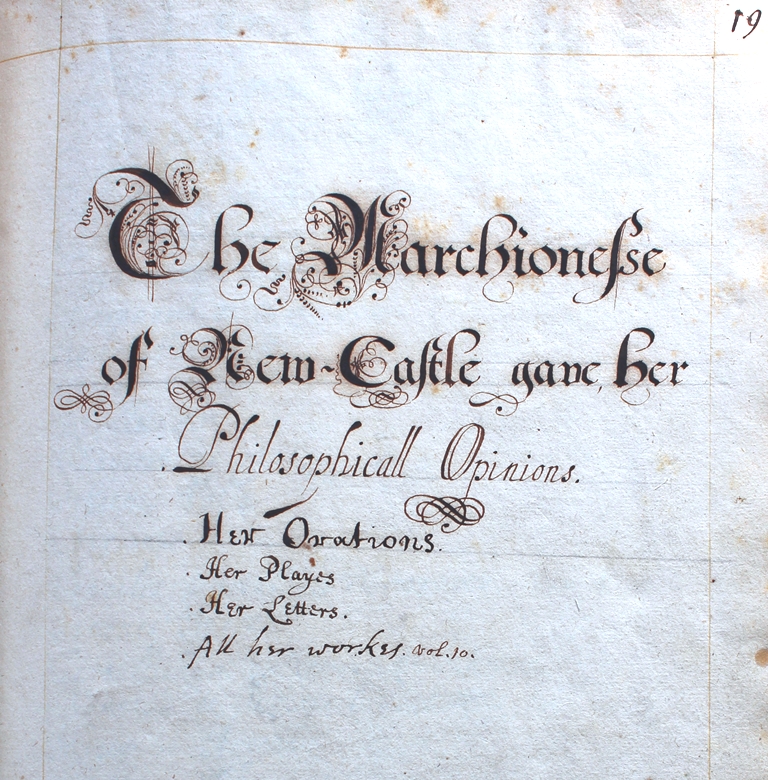
Engraved frontispiece portrait of Margaret Newcastle from The Philosophical and Physical Opinions, 1655 edition (Classmark: J.6.10)
About a year ago we catalogued in the Library a seventeenth-century book entitled Philosophical and Physical Opinions (1663) written by the Marchioness of Newcastle, Margaret Cavendish (1623-1673). We knew little about the book and the author when we first started cataloguing this volume, but we came across an intriguing manuscript note in ink when we opened the cover: “1663. The gift of the Marchioness her foolish selfe”. It seemed that the author herself had donated the book to the College. Following trails we discovered that indeed our Library held eleven volumes written by the Marchioness, published between 1655 and 1688, and donated by her to the College. Nevertheless, the question remained, who was this seventeenth-century prolific female writer and what is the importance of her collection? And, furthermore, why did the author herself give the volume, or set of volumes, to King’s?
Manuscript inscription on front pastedown of The Philosophical and Physical Opinions, 1663 (Classmark: J.6.11)
Margaret Newcastle (née Lucas) belonged to the English aristocracy of the seventeenth century. She worked as Queen Henrietta Maria’s maid of honour and fled to Paris in exile with the royals during the English Civil War. She married William Cavendish, later appointed 1st Duke of Newcastle, in 1645 and remained in exile until the Restoration due to her husband’s royalist political allegiance. This had a negative impact on William’s estate and on the economy of the family. The couple returned to England in 1660 and recovered part of their estate. They moved later to Welbeck Abbey in Nottinghamshire where Margaret died in 1673. Her body was reburied in Westminster Abbey in 1674.
Title pages of five of Margaret Newcastle’s publications held in King’s College Library.
During her life Margaret Newcastle became a controversial figure among the English aristocracy due to her writings and public persona. Since then she has been both praised and criticised, even to the point of mockery when referred to as “Mad Madge” or foolish in the bequest inscription. Among her works we can find diverse genres and topics such as poems, plays, orations, biographies, politics, philosophical treatises, and gender discussions. Unlike numerous other women of her time who chose to publish anonymously or pseudonymously, Margaret Cavendish signed her own works, challenging the traditional publication hierarchies. The topics discussed in her works made her prone to criticism by male intellectuals of the time who questioned her authority and education to address them, often disregarding her books. Thus, she was perceived as a threat for crossing the boundaries of the traditionally established roles for women in society and academia. This was emphasised by her appearances at public events where she wore vests and trousers.
Entry for Margaret Newcastle in the Donors’ Book. (Ref: KCAC/6/2/1/1)
Margaret often responded to these criticisms stating that she only wrote to pass the time and that her writings should not be taken seriously. However, she recurrently expresses in her books and letters her desire to become a famous intellectual. As such, despite being considered mad and mocked by academics, Margaret Cavendish, as found in our own Donors’ Book, indeed donated entire collections of her books to King’s and other colleges in Cambridge seeking for a place in history. Furthermore, in recent years her works and importance as an academic have also been vindicated.
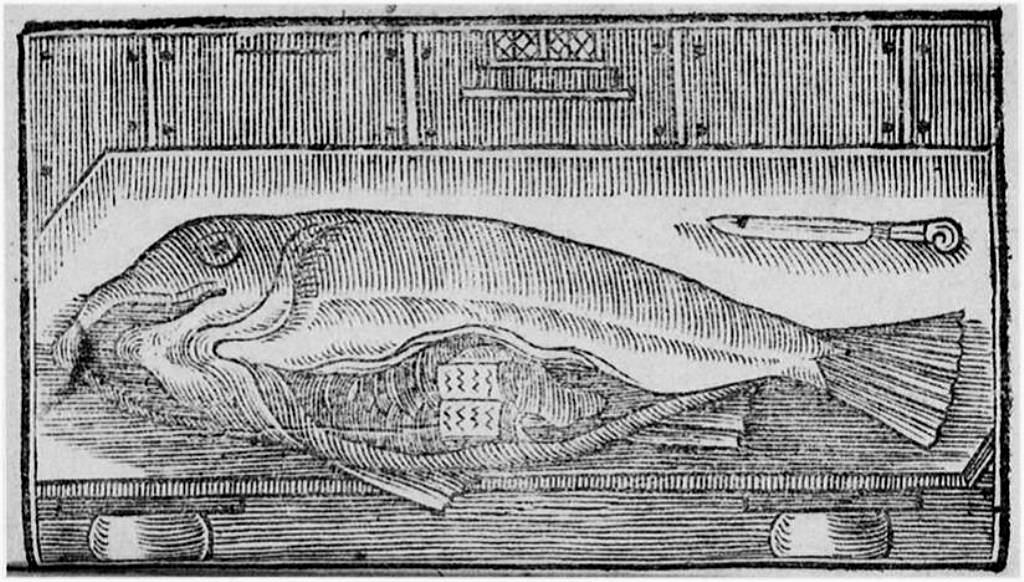
Among the more curious items in the Keynes Bequest is a book entitled Vox Piscis; or, The Book-Fish; Contayning Three Treatises Which Were Found in the Belly of a Cod-Fish in Cambridge Market, on Midsummer Eve Last, Anno Domini 1626 (1627). The title says it all. The circumstances surrounding this catch are detailed in the preface of the book, where we are told that “a codfish being brought to the fish-market of Cambridge and there cut up, … in the depth of the mawe of the fish was found wrapped in a peice of canvase, a booke in decimo sexto, containing in it three treatises bound up in one” (p. 8). The preface was written by the clergyman Thomas Goad (1576-1638), who became a Fellow of King’s College in 1596. In his will, he bequeathed his land in Milton to the College, “to the intent that the whole yearlie profitt thereof bee faithfullie emploied yearlie for ever in divinitie bookes for the librarie”. Many of these books bear the inscription “Legavit Thomas Goad”.
The voice of the fish: title page and frontispiece of Vox Piscis; or, The Book-Fish (Keynes.D.4.15). It is unclear how the book ended up in the fish’s stomach.
Joseph Mede (1586-1639), theologian and Fellow of Christ’s College, helped clean the bundle and decipher the content of the treatises. They were attributed to John Frith (1503-33), the Protestant reformer who was imprisoned in Oxford in a “darke cave, where salt-fish was then kept” (p. 19) and burned at the stake in London on 4 July 1533. Frith received his B.A. degree from King’s, so the book bears a close connection with the College. Incidentally, his tutor at Cambridge, Stephen Gardiner, later played a role in condemning him to death. That’s Cambridge supervisions for you. The Keynes Bequest has two other copies of Frith’s works: A Pistle to the Christen Reader (Antwerp, 1529) and A Boke Made by Iohn Fryth, Prysoner in the Tower of London (Antwerp, 1548), a reply to Sir Thomas More.
The second plate of Vox Piscis, wanting in King’s College copy; this is from the copy in the Cambridge University Library.
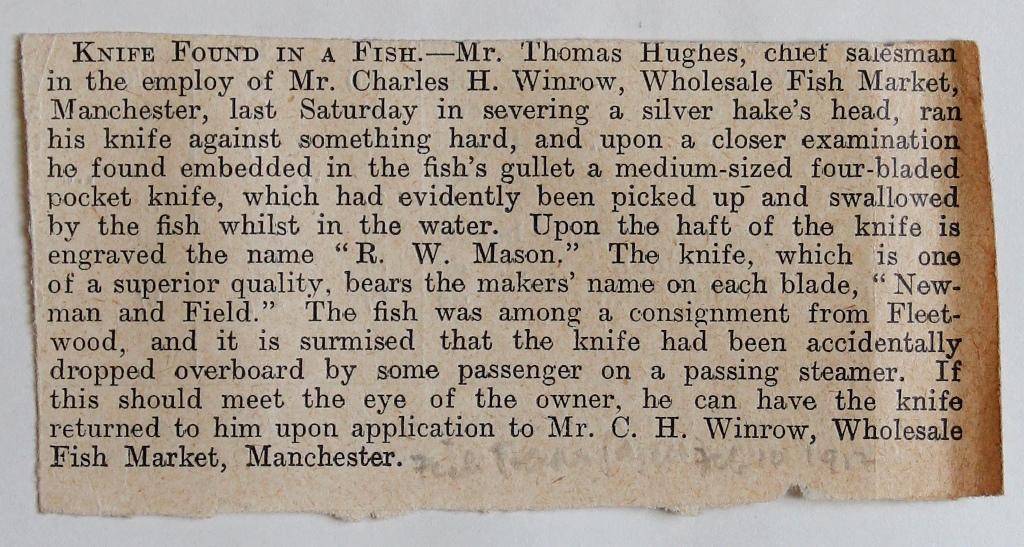
If you think this already sounds like something out of Pinocchio, there is more to come. Inside the book is preserved a newspaper cutting with the date “Feb 10 1912” pencilled in by a former owner. The short article recounts how a pocket knife was found inside a silver hake by Thomas Hughes, a salesman at the Wholesale Fish Market in Manchester. It then describes the knife, “one of a superior quality” bearing the makers’ name on each blade, “Newman and Field”, before inviting the owner to come forward and have it returned to them.
“Knife found in a fish”: newspaper cutting preserved inside the book.
Carrying such items is now probably illegal following the introduction of the Offensive Weapons Act in 1996, but if a knife that matches this description has been missing from your kitchen for the last century, now may be a good time to claim it back.