Tag Archives: Rylands Collection

Horses in fable, myth, story and legend

Welcome to the second instalment of our celebration of the arrival of the Lunar year of the Horse. This time the focus is on depictions of mythological, legendary and fictional horses, of which there are many.

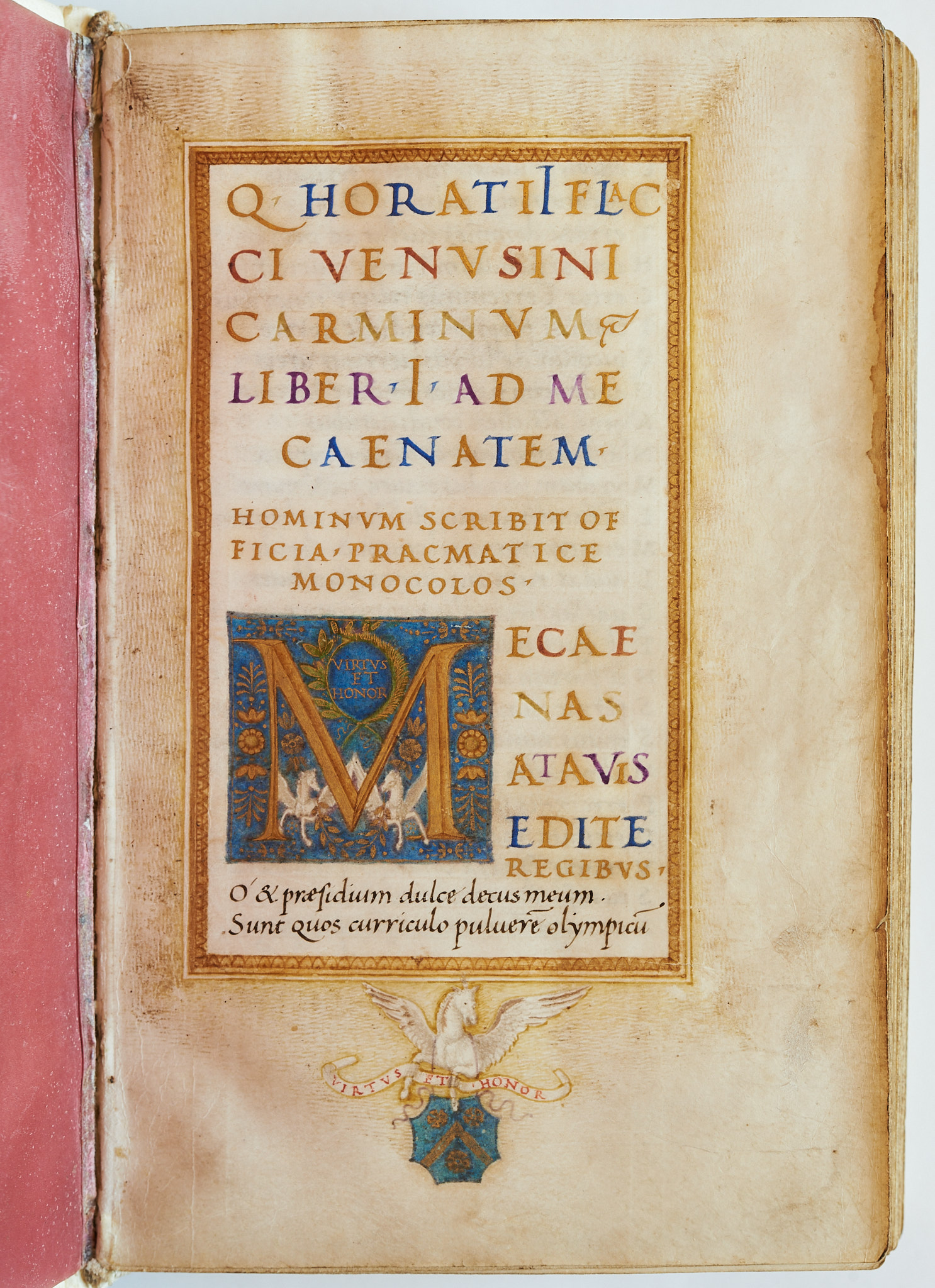
We begin with one of our illuminated manuscripts, a fifteenth-century edition of the works of Horace which features the mythological winged horse Pegasus on its first page. According to Ancient Greek legend, the hero Bellerophon flew on Pegasus in his victorious battle against the monstrous Chimaera. This formidable horse, who eventually became a constellation, has been depicted extensively in art over the centuries and is also a symbol frequently used in heraldry. The Horace manuscript came originally from the library of Cardinal Pietro Bembo (1470-1547), a Venetian scholar and nobleman. His coat of arms features on the first page, with Pegasus as a crest, and two Pegasi appear in the illuminated initial M above.

manuscript title page showing pegasus

Title page of MS 34. Photo © 2025 Sara Rawlinson at HeritagePhotographs.com 

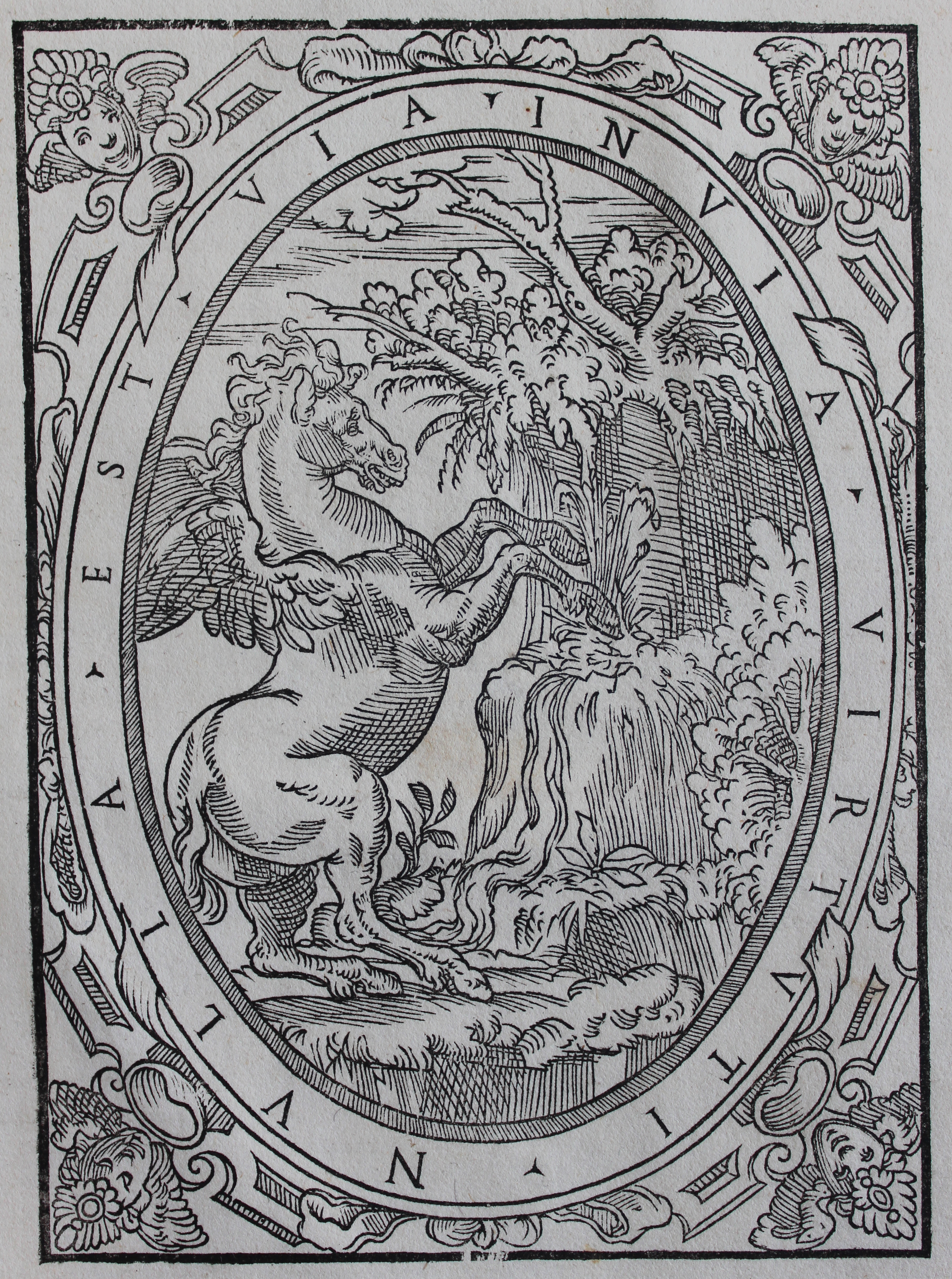
Pegasus also features in some printer’s devices, which were an early form of logo used by printers to distinguish their work and protect against forgery. The device below, associated with the Italian typographer Valerio Dorico (died 1565), depicts Pegasus alongside the Fountain of Hippocrene. According to legend, this was a spring on Mount Helicon that Pegasus created by striking his hoof to the earth. Hippocrene means “horse spring”.

Pegasus rears back on its hind legs next to a spring

Pegasus printer’s device on fol. L6 of Vrbis Romae topographia by Bartolomeo Marliani, Rome, 1544. Shelfmark: Bury.I.MAR.Urb.1544

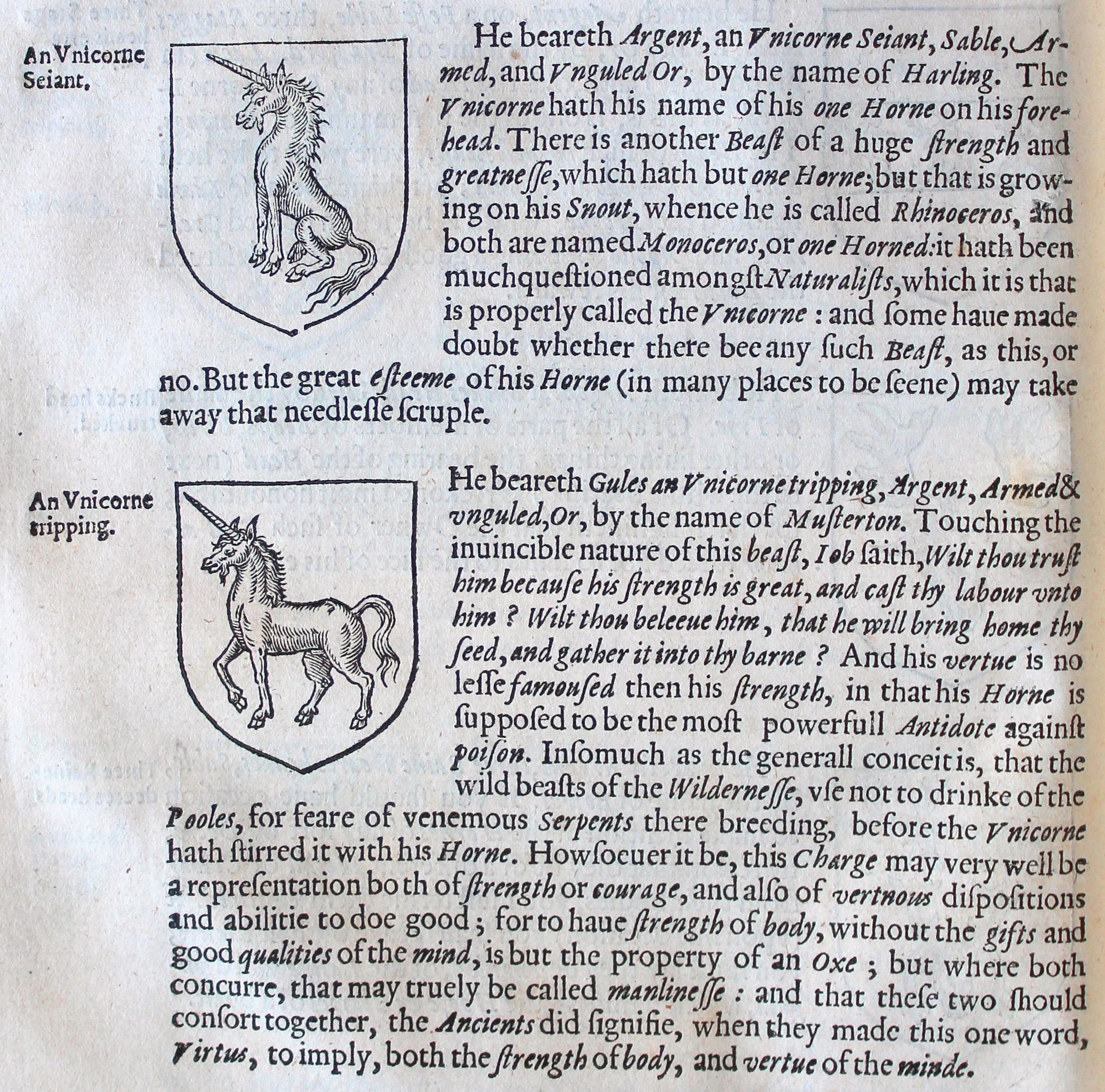
Another legendary creature often used in heraldry is the unicorn, a horse-like creature with a single large horn on its forehead. As can be seen in the early seventeenth-century illustrations below, unicorns are sometimes depicted with some of the attributes of goats, such as cloven hooves and beards. The accompanying text associates the unicorn with strength, courage and virtue and repeats the common belief that unicorn horns are an antidote to poison.

Shields showing a seated and a standing unicorn with accompanying text

Illustration and text from page 134 of A Display of Heraldrie by John Guillim, London, 1611. Shelfmark: H.17.39

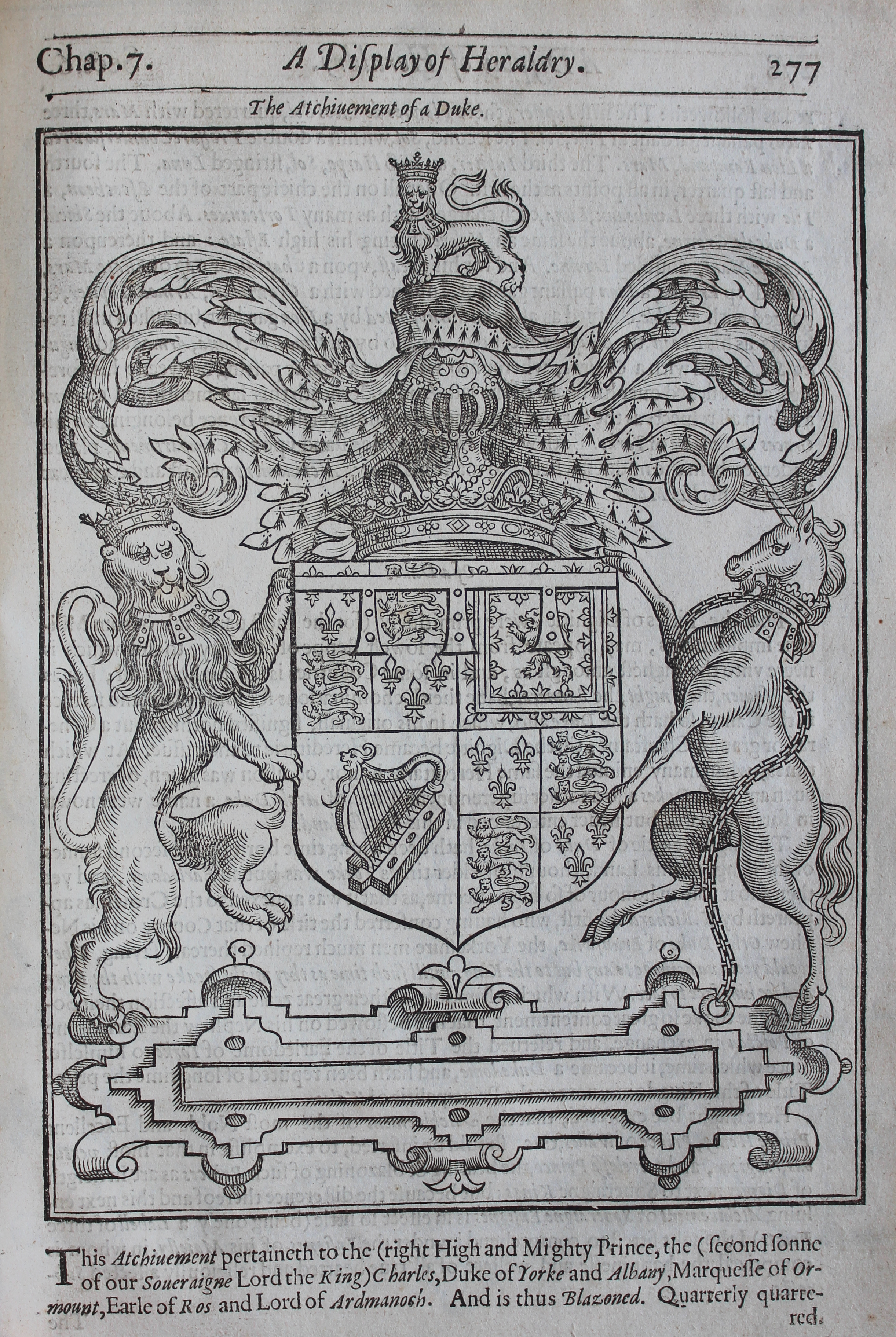
At the end of A Display of Heraldrie there are examples of regal coats of arms, including that of Charles, the second son of King James I, who was later to rule as Charles I. The lion and the unicorn flanking the shield still form part of the coat of arms of the United Kingdom, with the lion representing England and the chained unicorn representing Scotland. In Scotland, their positions are swapped and the Unicorn also wears a crown.

A large illustration of a coat of arms

Illustration and text from page 277 of A Display of Heraldrie

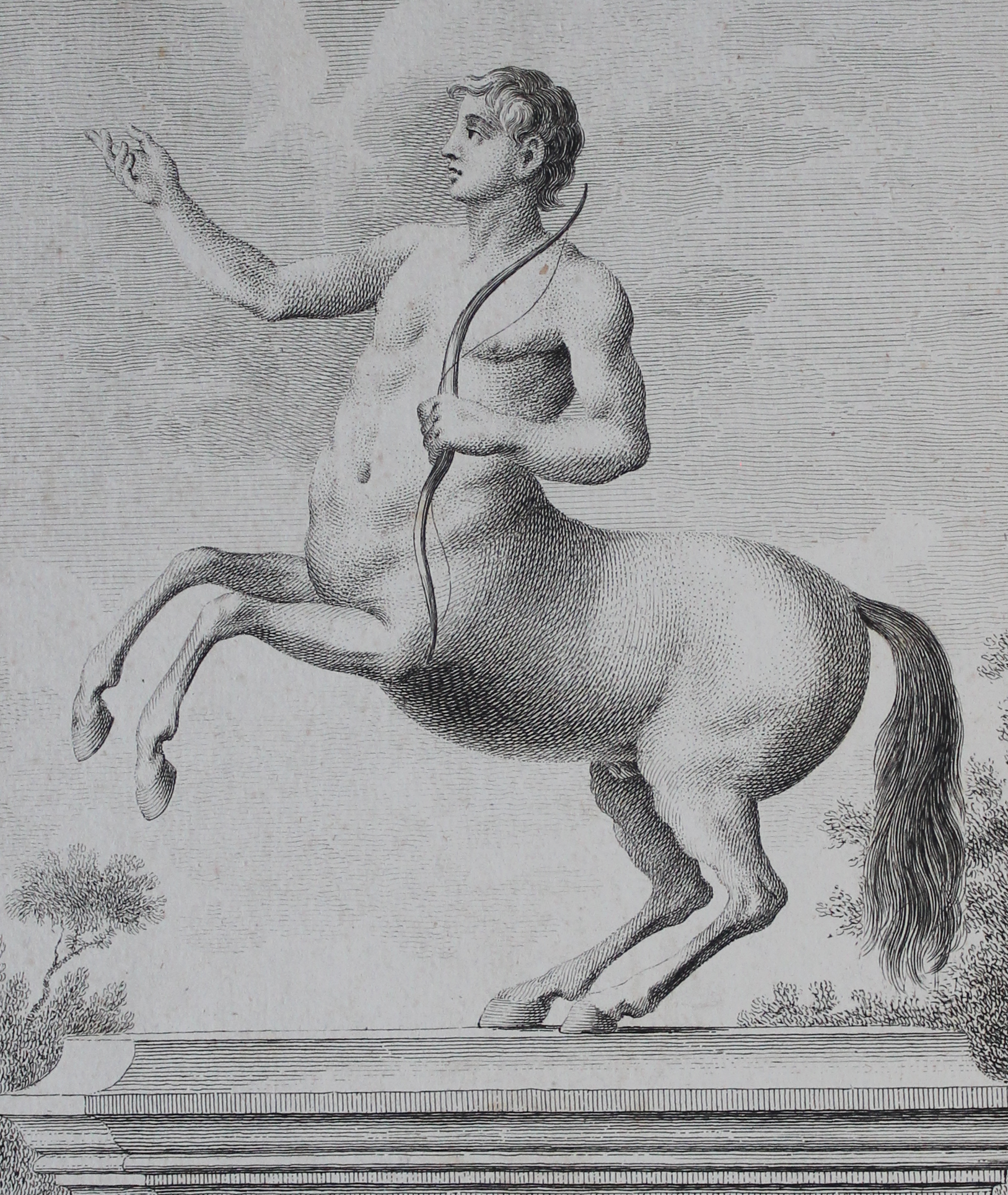
The frontispiece of Richard Berenger’s The History and Art of Horsemanship features a magnificent illustration of statue of a Centaur, a creature which is half horse and half human. In the text, Berenger eloquently expounds upon the symbolism behind the mythical beast:

The Centaur is the symbol of horsemanship, and explains its meaning as soon as it is beheld: for there is such an intelligence and harmony between the rider and the horse, that they may, almost in a literal sense, be said to be but one creature.

Engraving of a statue of a Centaur holding a bow and rearing back on his hind legs

Frontispiece of volume one of The History and Art of Horsemanship by Richard Berenger, London, 1771. Shelfmark: Bryant.M.10.17

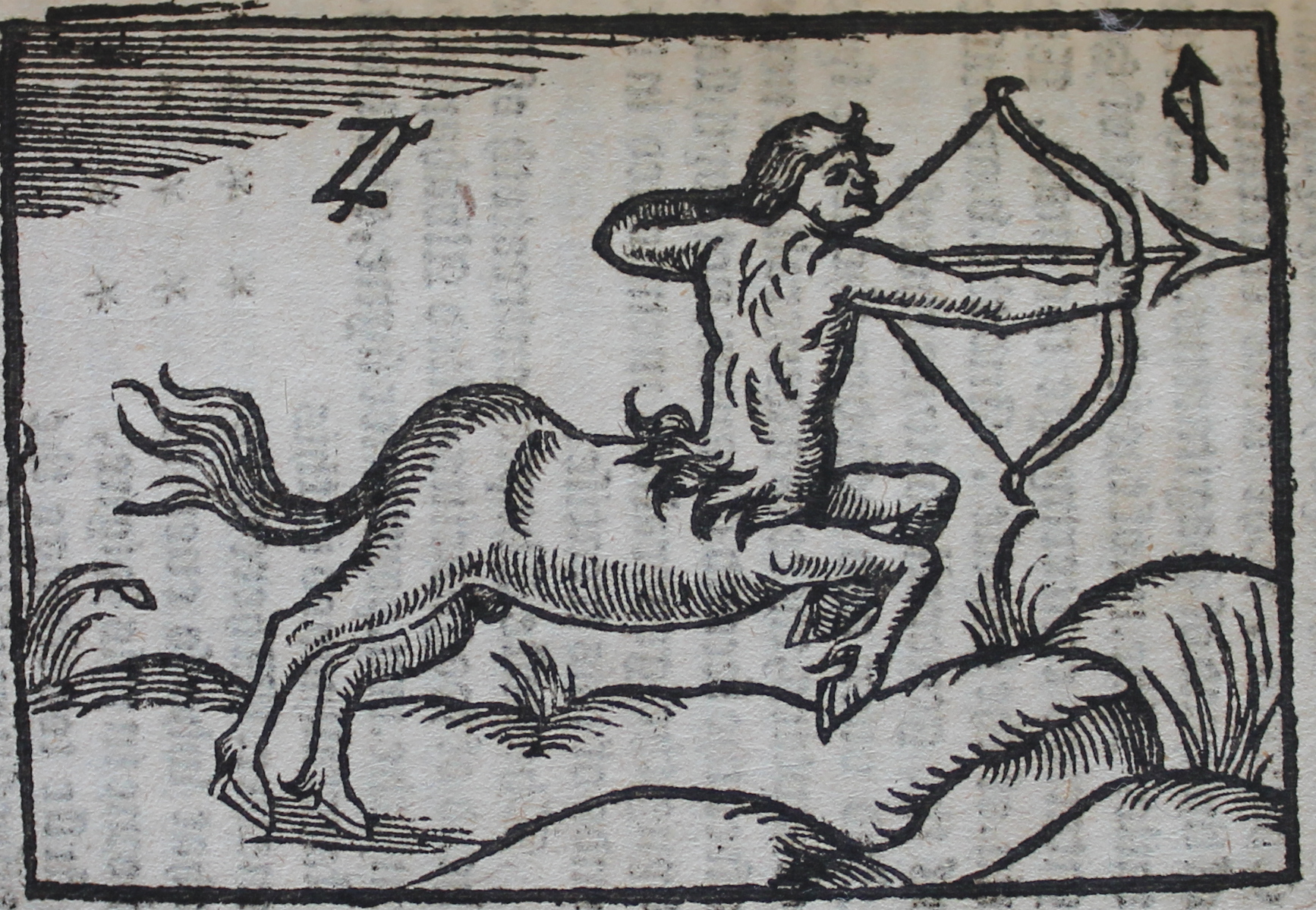
Sagittarius, the constellation and astrological sign, is often depicted as a centaur drawing a bow. One example is this lovely woodcut illustration from an English translation of a sixteenth-century astrological work by Frenchman Richard Roussat, writing under the pseudonym “Arcandam.”

Black and white woodcut showing a centaur drawing back a bow

Illustration of Sagittarius the Archer from fol. H6 of The Most Excellent, Profitable, and Pleasant Booke of the Famous Doctour and Expert Astrologien Arcandam or Aleandrin … translated by William Warde, London, 1562. Shelfmark: Chawner.A.9.11

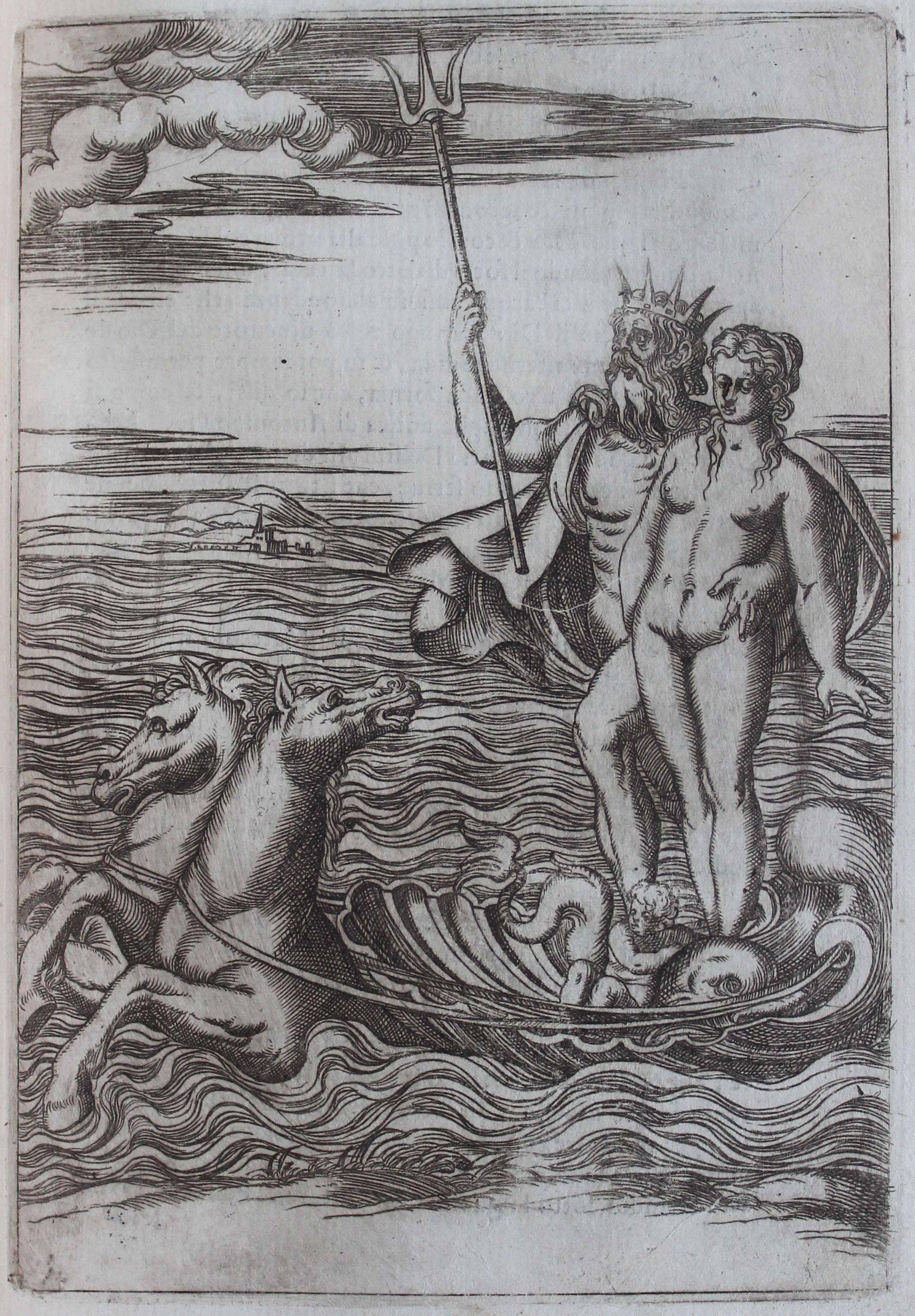
The Greek god of the sea Poseidon and his Roman equivalent Neptune were both said to have travelled in chariots drawn by Hippocampi, creatures which were half horse and half fish or sea monster. The illustration below comes from a work on classical mythology by Italian diplomat and mythographer Vincenzo Cartari (1531?-1590). It depicts Neptune in a sea-chariot with his consort the goddess Amphitrite and the young sea god Palaemon. They are being pulled through the waves by two Hippocampi.

Illustration from page 201 of Le imagini de i dei de gli antichi, nelle quali si contengono gl’idoli, riti, ceremonie, & altre cose appartenenti alla religione de gli antichi by Vincenzo Cartari, Venice, 1587. Shelfmark: Bury.CAR.Ima.1587

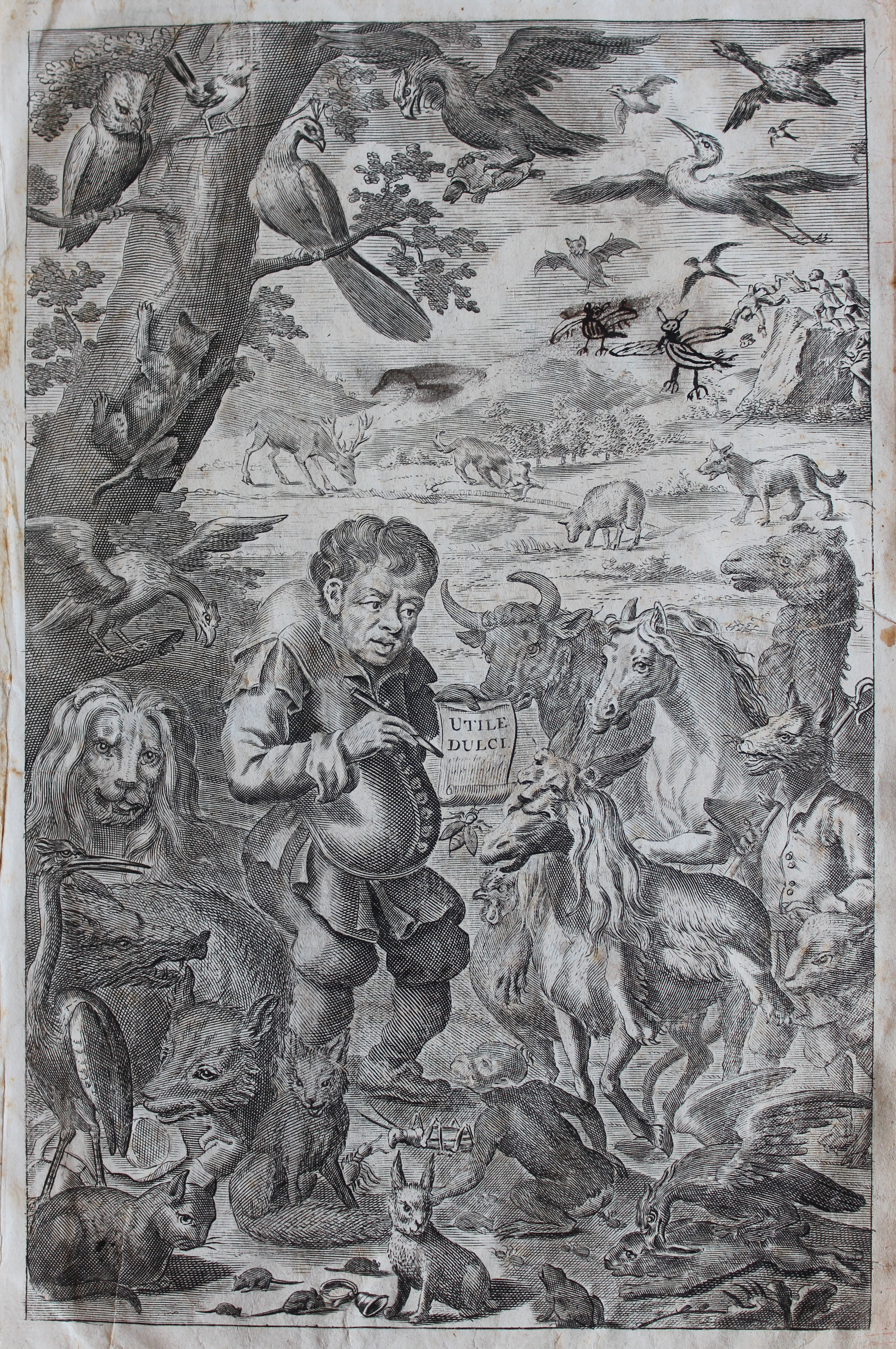
Horses make an appearance in numerous fables, including those of Aesop. The charming frontispiece below, depicting Aesop surrounded by animals and birds from the tales, comes from Fables of Aesop and Other Eminent Mythologists by Roger L’Estrange (1616-1704). If you look closely, you can see that two quirky bird-like creatures have been added to this copy in ink by an unknown hand!

Aesop in the centre surrounded by a multitude of animals and birds

Frontispiece of Fables of Aesop and Other Eminent Mythologists by Roger L’Estrange, London, 1694. Shelfmark: L.2.11

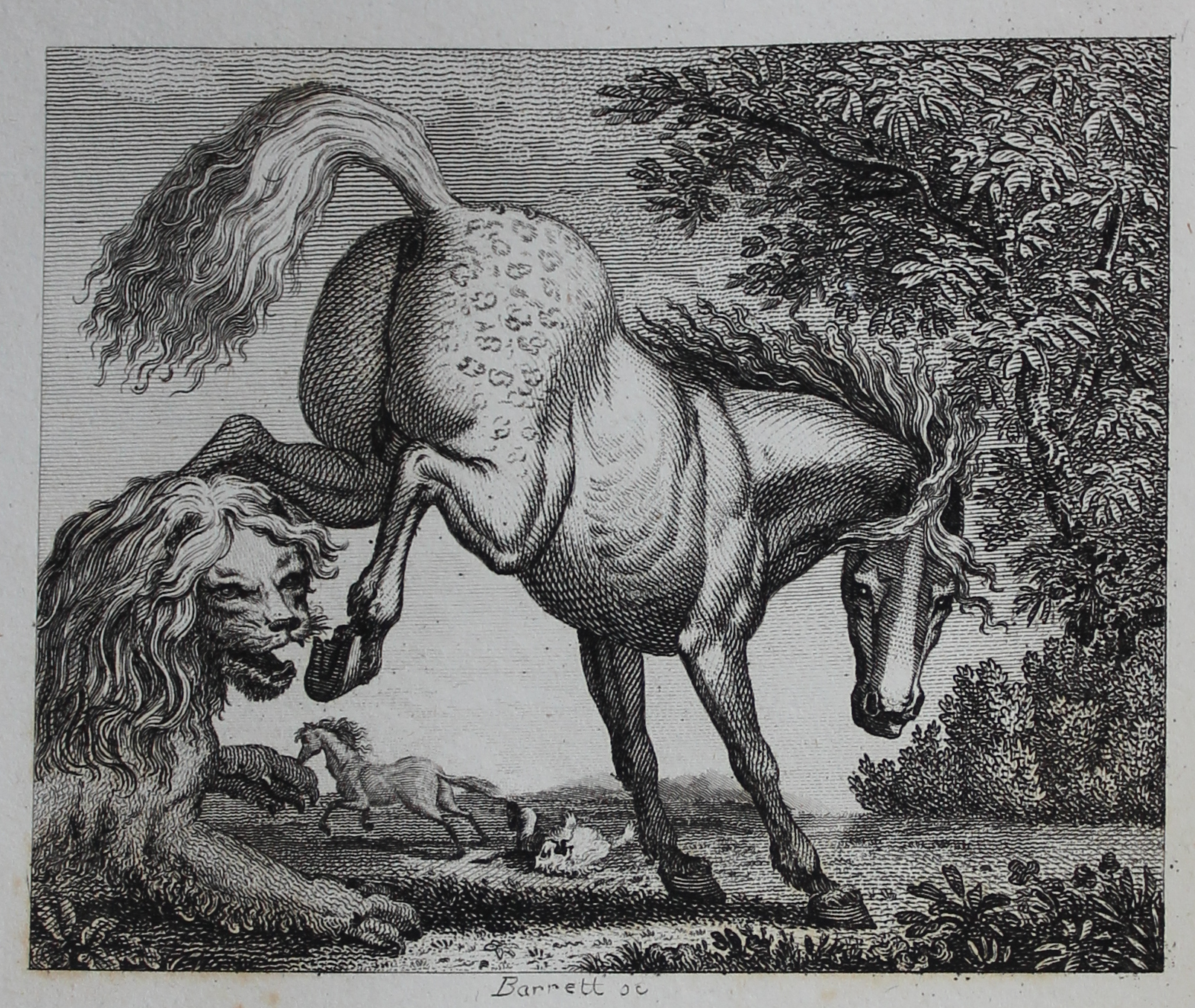
One of Aesop’s fables, The Horse and the Lion, tells of how a wily horse gets the better of a lion who is posing as a doctor in order to get close enough to eat him. Realising the deception the horse affects an injured leg then kicks the lion hard in the face, stunning him. The moral is that it is fine to repay trickery with trickery.

A horse kicking out with its back legs at a snarling lion

Plate facing page 31 from volume two of The Fables of Aesop translated by Samuel Croxall, London, 1793. Shelfmark: Thackeray.J.63.45

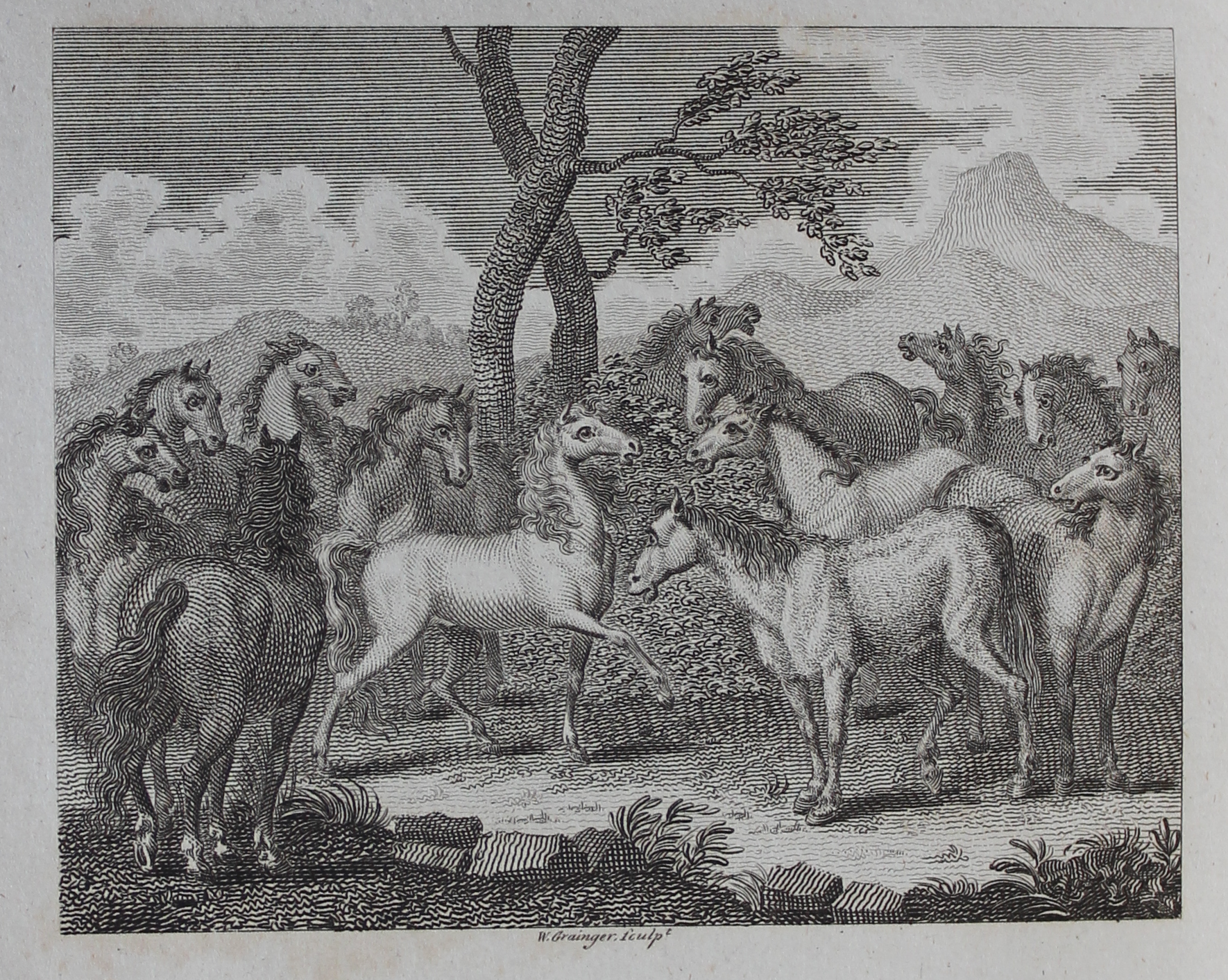
In 1727, the dramatist and poet John Gay (1685-1732) wrote his own collection of fables in verse. They were dedicated to Prince William, the youngest son of King George II, in the hopes of currying favour with the crown. Amongst the tales is one called The Council of Horses, in which a young colt addresses a gathering of horses and calls for them to throw off human control and claim their freedom:

Were we design’d for daily toil,

To drag the plough-share through the soil,

To sweat in harness through the road,

To groan beneath the carrier’s load?

How feeble are the two legg’d kind!

What force is in our nerves combin’d!

This call for mutiny receives wide support until an older horse defuses the situation by pointing out the mutual benefits to be gained from working for humans:

The toils of servitude I knew;

Now grateful man rewards my pains,

And gives me all these wide domains;

At will I crop the year’s increase,

My latter life is rest and peace.

A gathering of numerous horses

The Council of Horses. Plate facing page 191 from volume one of Fables by John Gay, London, 1793. Shelfmark: Thackeray.J.61.28

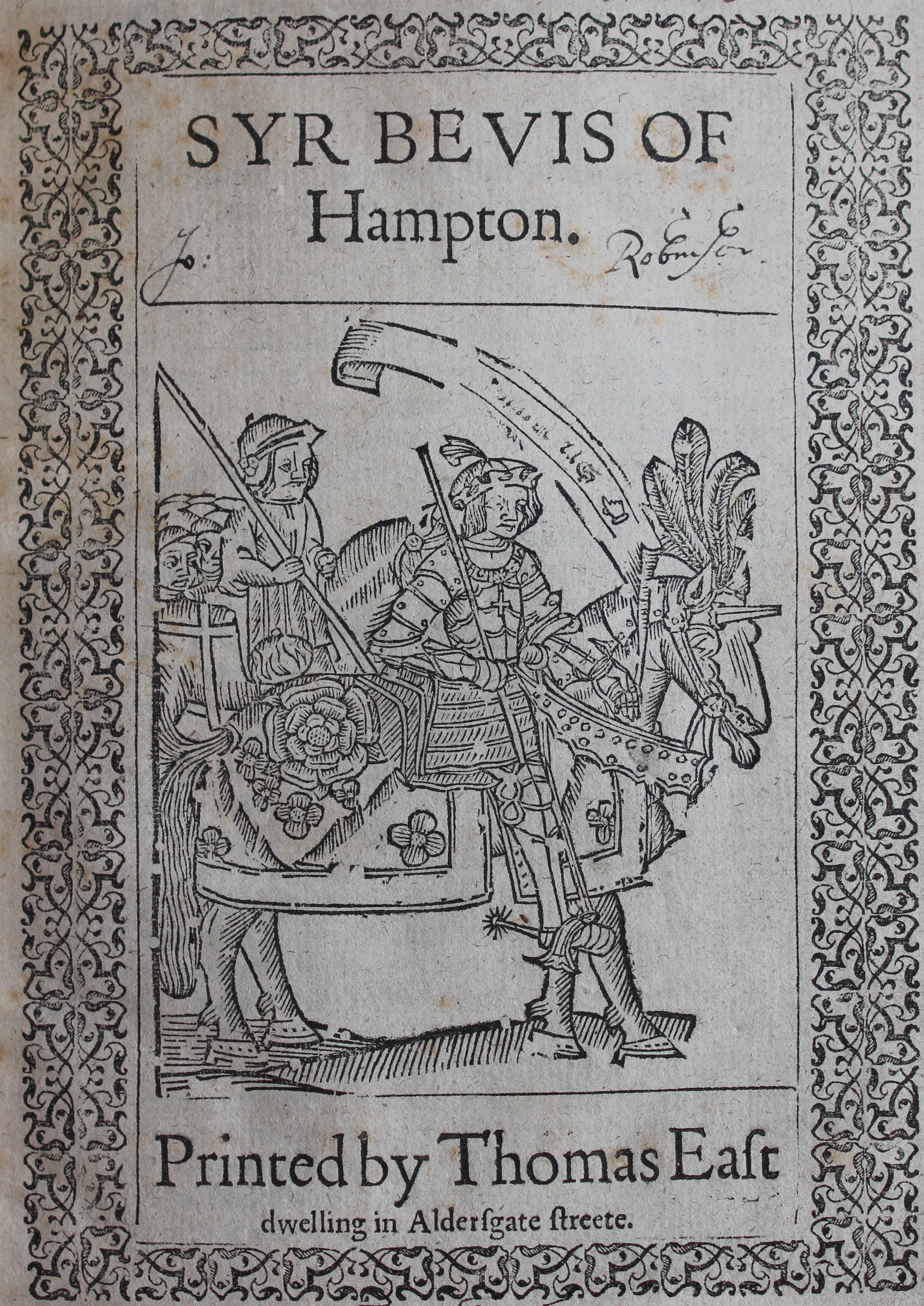
The eponymous hero of the Middle English romance Sir Bevis of Hampton is accompanied on his adventures by Arondel, his trusty steed. Arondel is so loyal to Bevis that he will not allow anyone else to ride him, kicking out at or throwing off anyone who makes the attempt. In turn, Bevis values Arondel so highly that he chooses exile rather than allow the horse to be executed for killing a prince who tried to steal him.

Title page showing Bevis astride Arondel

Title-page of Syr Bevis of Hampton, London, 1585. Shelfmark: M.29.13

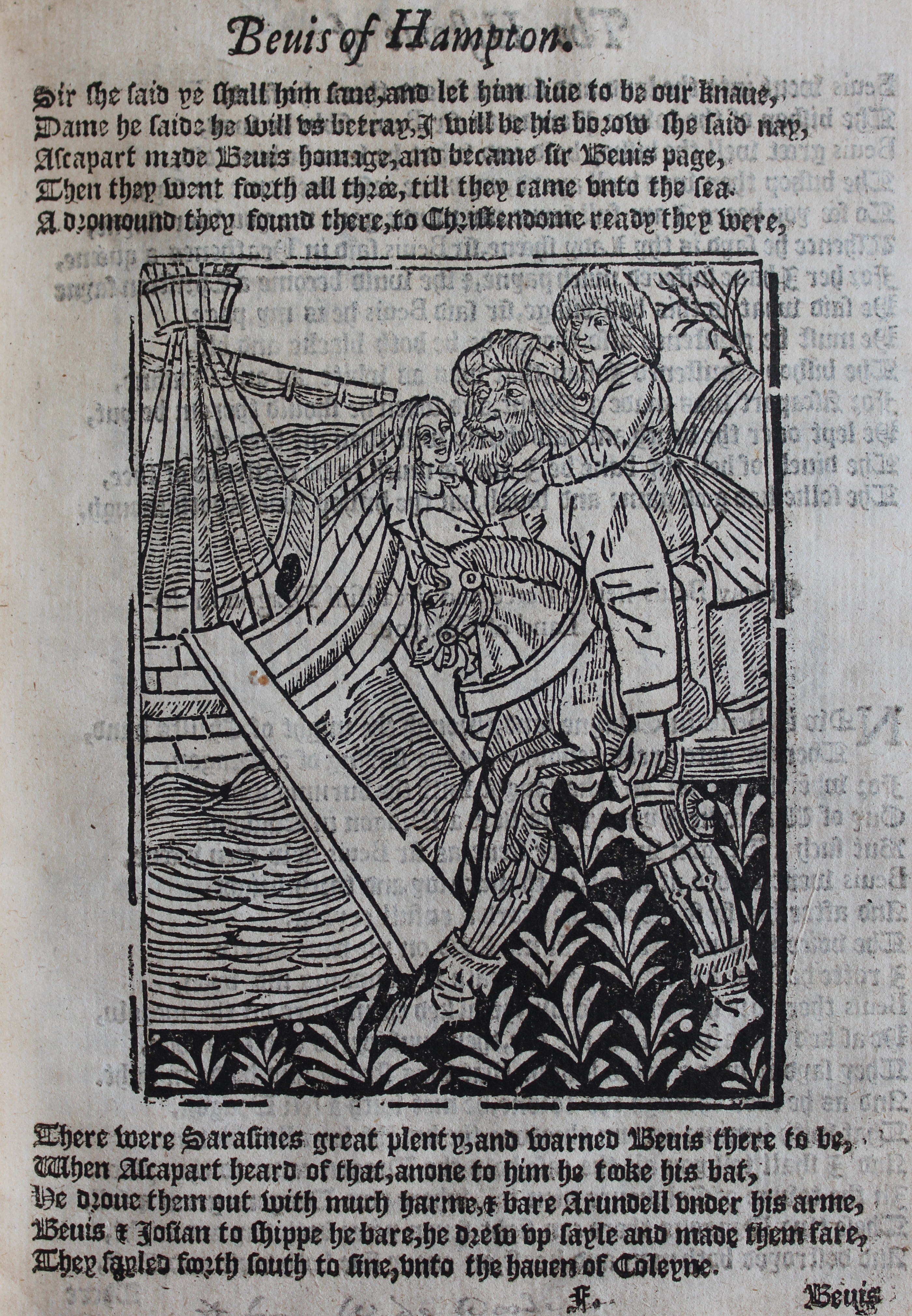
At one point in the story, Bevis subdues a giant called Ascopart who then becomes his page for a time. As can be seen below, Ascopart is so large he can easily tuck Arondel under his arm!

The giant is carrying Bevis, Arondel and his travelling companion aboard a boat

Fol. F1 recto from Syr Bevis of Hampton

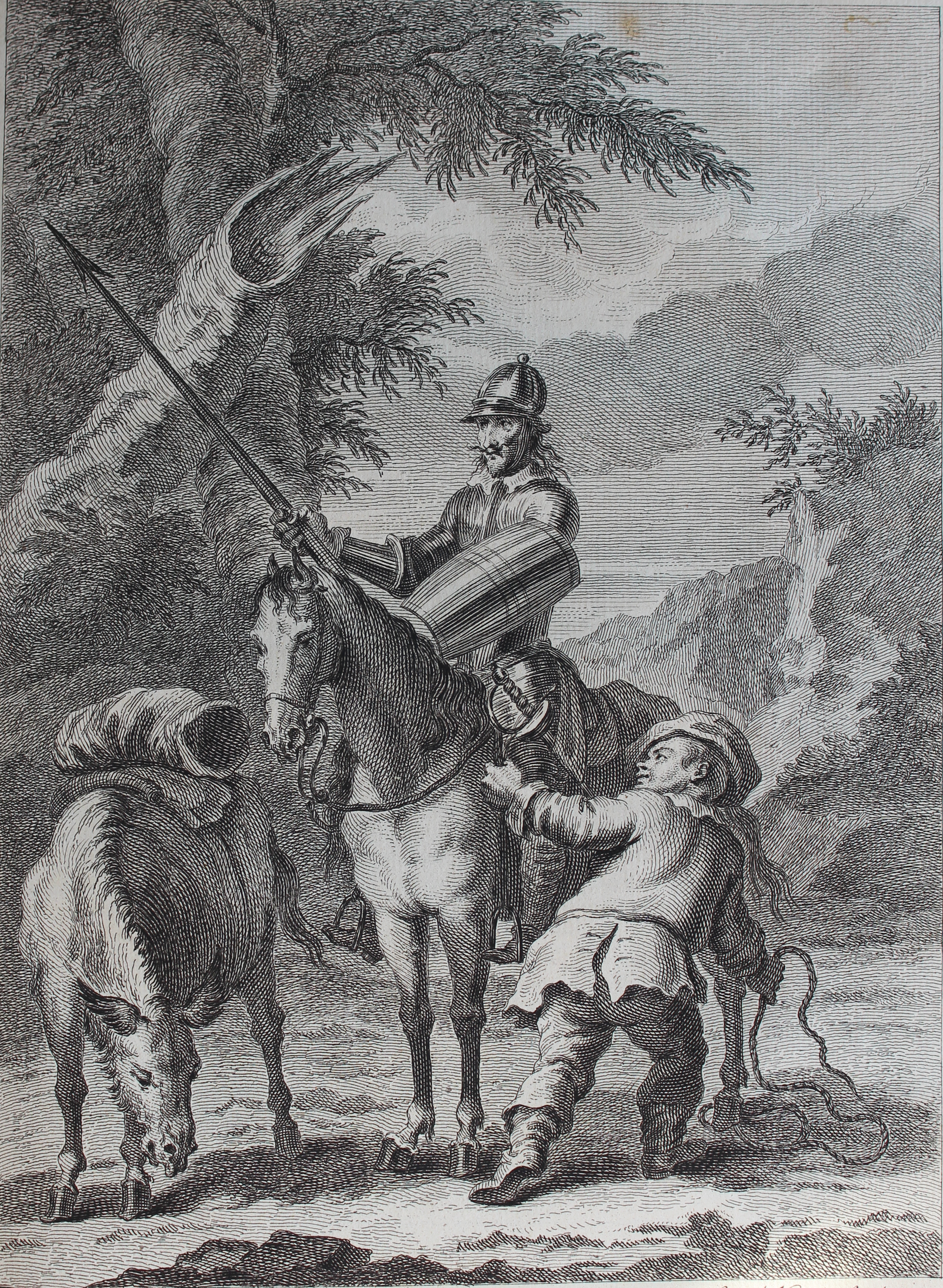
Rocinante, the horse ridden by Don Quixote on his delusional misadventures is a much more run-down creature than Arondel, a re-purposed workhorse, elderly and infirm. Nonetheless, he is a vital part of the tale and endures in popular memory alongside Quixote and his squire Sancho Panza. Our Library holds many editions of Cervantes’ satirical masterpiece, both in the original Spanish and in English translation. What follows is a selection of glorious illustrations from some of these editions, most featuring Rocinante front and centre.

We start with a seventeenth-century English edition of the tale. In the plate below, Sancho Panza ties Rocinante’s hind-legs together to stop Don Quixote haring off into the dark on another imagined quest.

Plate facing page 100 from volume one of The Life and Exploits of the Ingenious Gentleman Don Quixote De La Mancha, translated from the original Spanish of Miguel Cervantes de Saavedra by Charles Jarvis, London, 1742. Shelfmark: Glendinning.98/1

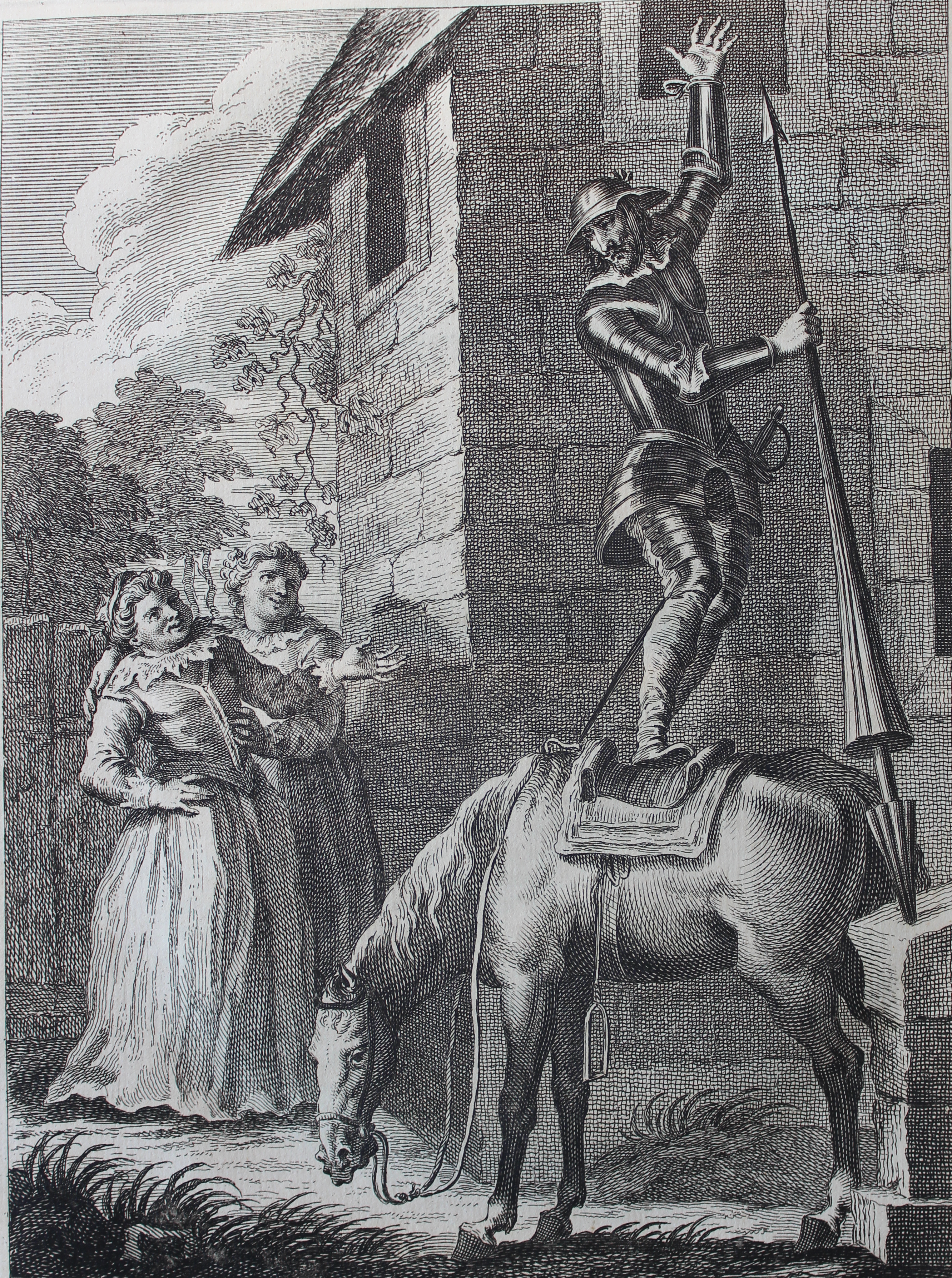
Below Don Quixote is tricked into being trapped standing on poor Rocinante’s back with his hand tied above his head.

Plate facing page 299 from volume one of The Life and Exploits of the Ingenious Gentleman Don Quixote De La Mancha

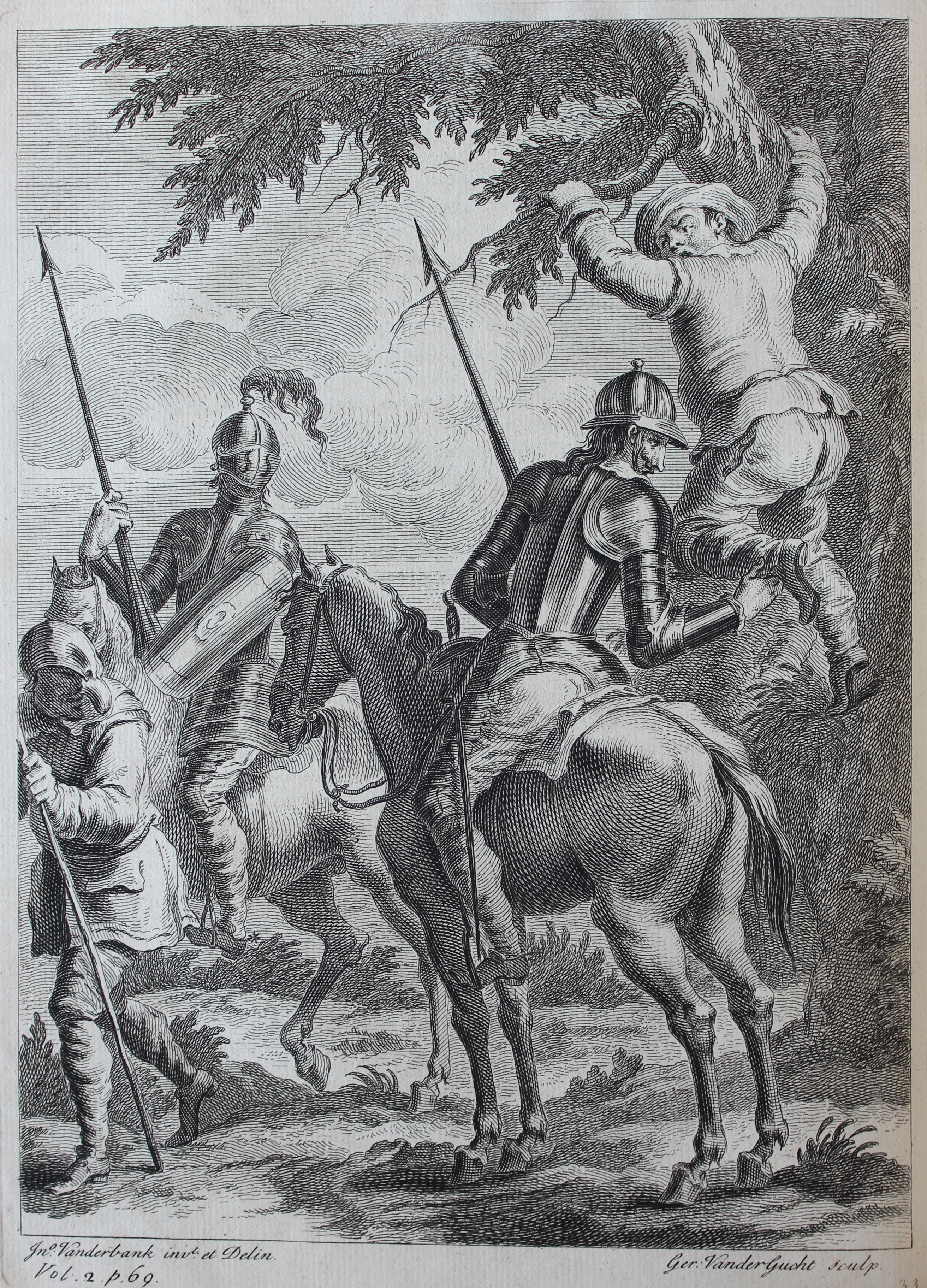
In the next scene Don Quixote launches Sancho Panza into a tree so he can avoid fighting a squire whose large nose scares him. This squire, who can be seen on the left of the picture, is actually wearing a mask.

Plate facing page 69 from volume two of The Life and Exploits of the Ingenious Gentleman Don Quixote De La Mancha. Shelfmark: Glendinning.98/2

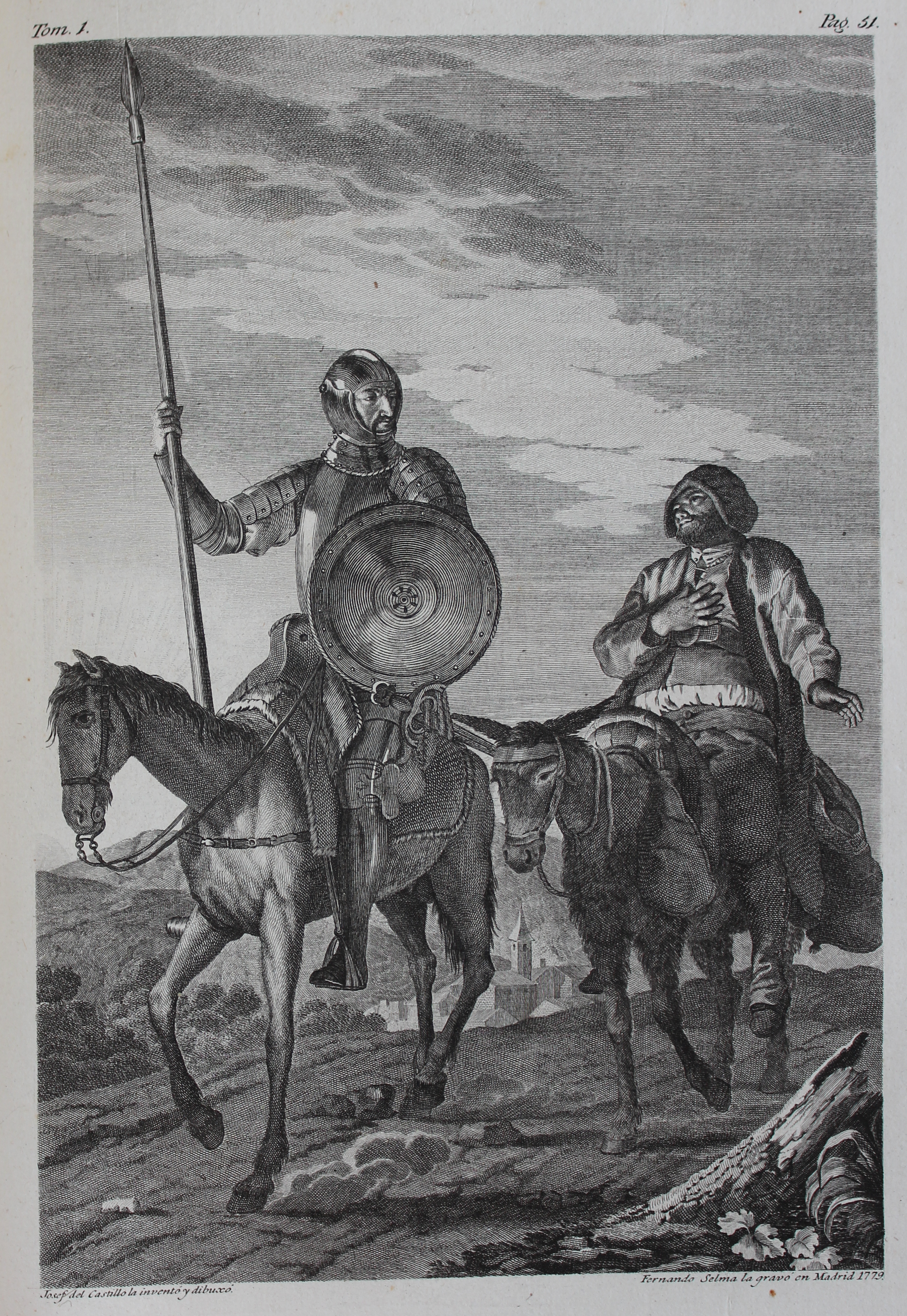
The following two illustrations come from a Spanish edition of the work from later in the same century. First we have a classic image of Don Quixote on Rocinante accompanied by his squire riding a donkey.

Plate facing page 50 from volume one of El ingenioso hidalgo Don Quixote de la Mancha by Miguel de Cervántes Saavedra, Madrid, 1780. Shelfmark: L.2.13

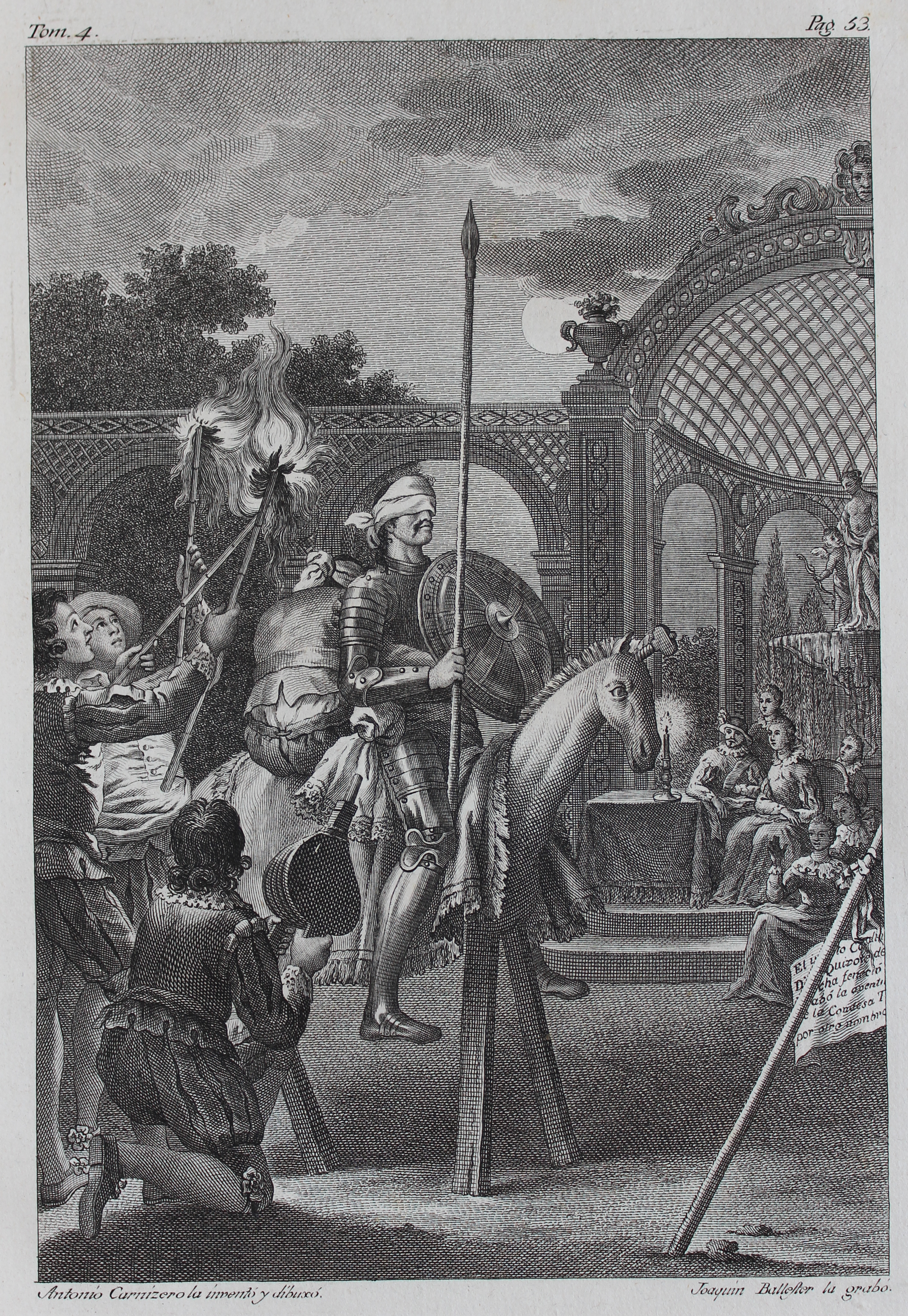
In the next illustration, Don Quixote is astride a wooden horse named Clavileño. He and Sancho Panza have been tricked into thinking they are flying on this horse, directing it via a peg in its forehead. Bellows and other props are used to make the “flight” more convincing.

Plate facing page 52 from volume four of El ingenioso hidalgo Don Quixote de la Mancha by Miguel de Cervántes Saavedra, Madrid, 1780. Shelfmark: L.2.16

We finish our look at Rocinante with some lovely images from this very colourful early twentieth-century English edition, illustrated by artist Walter Crane (1845-1915).

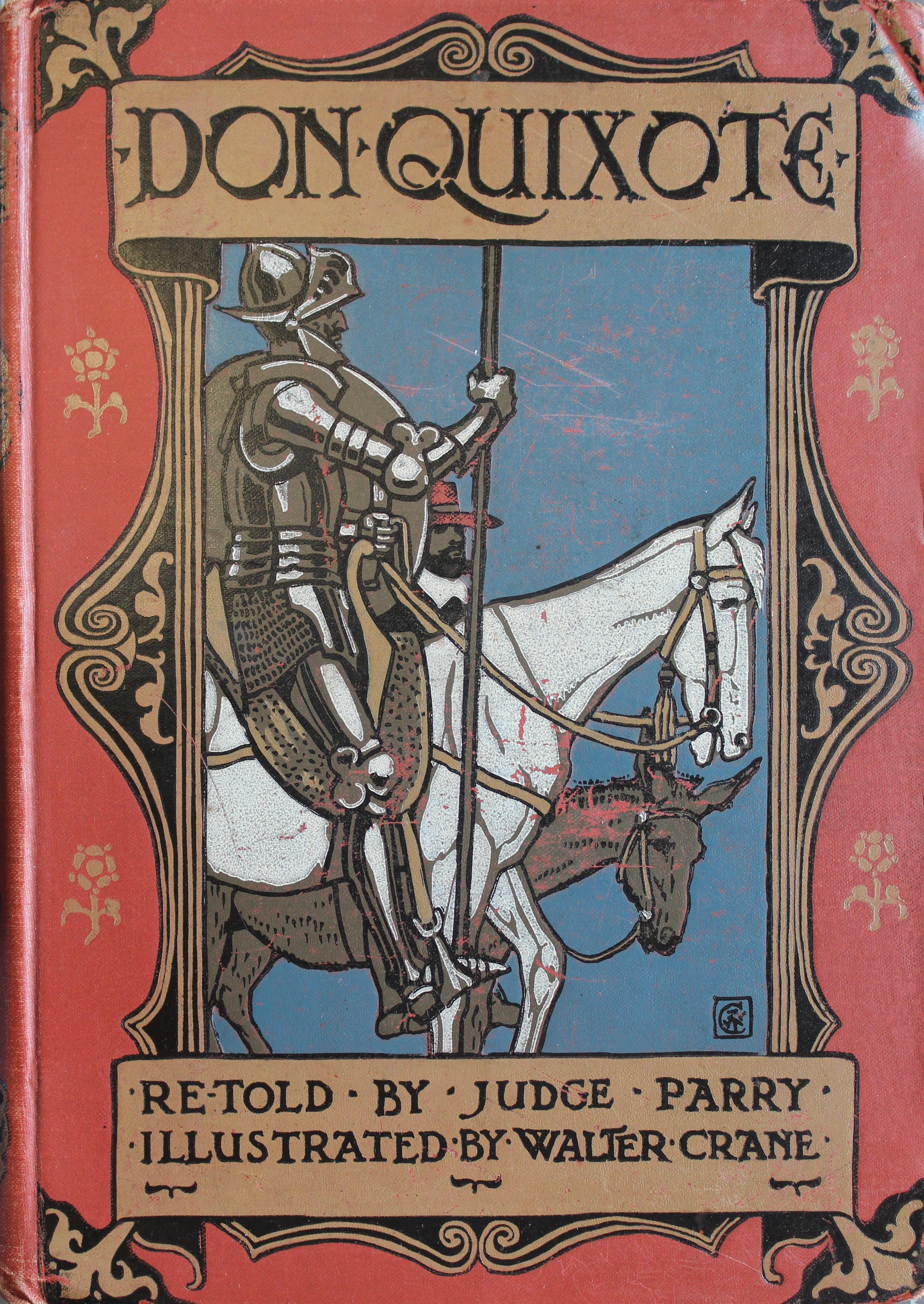
The cover has a red background with a central panel showing Don Quixote astride Rocinante

Cover of Don Quixote of the Mancha, retold by Judge Parry, London, 1900. Shelfmark: Glendinning.107

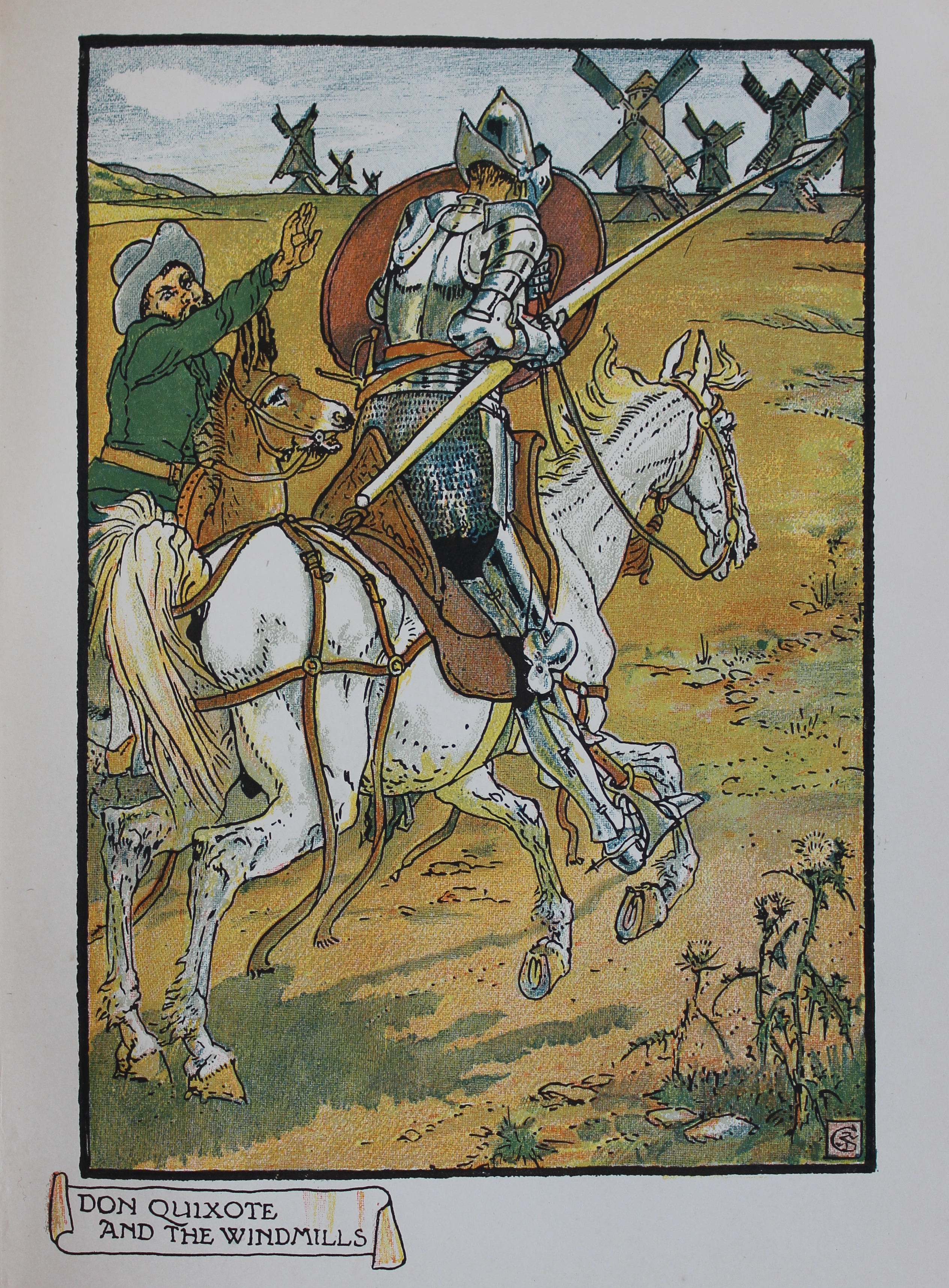
Below Don Quixote charges at windmills he believes are fearsome monsters.

Plate facing page 38 from Don Quixote of the Mancha

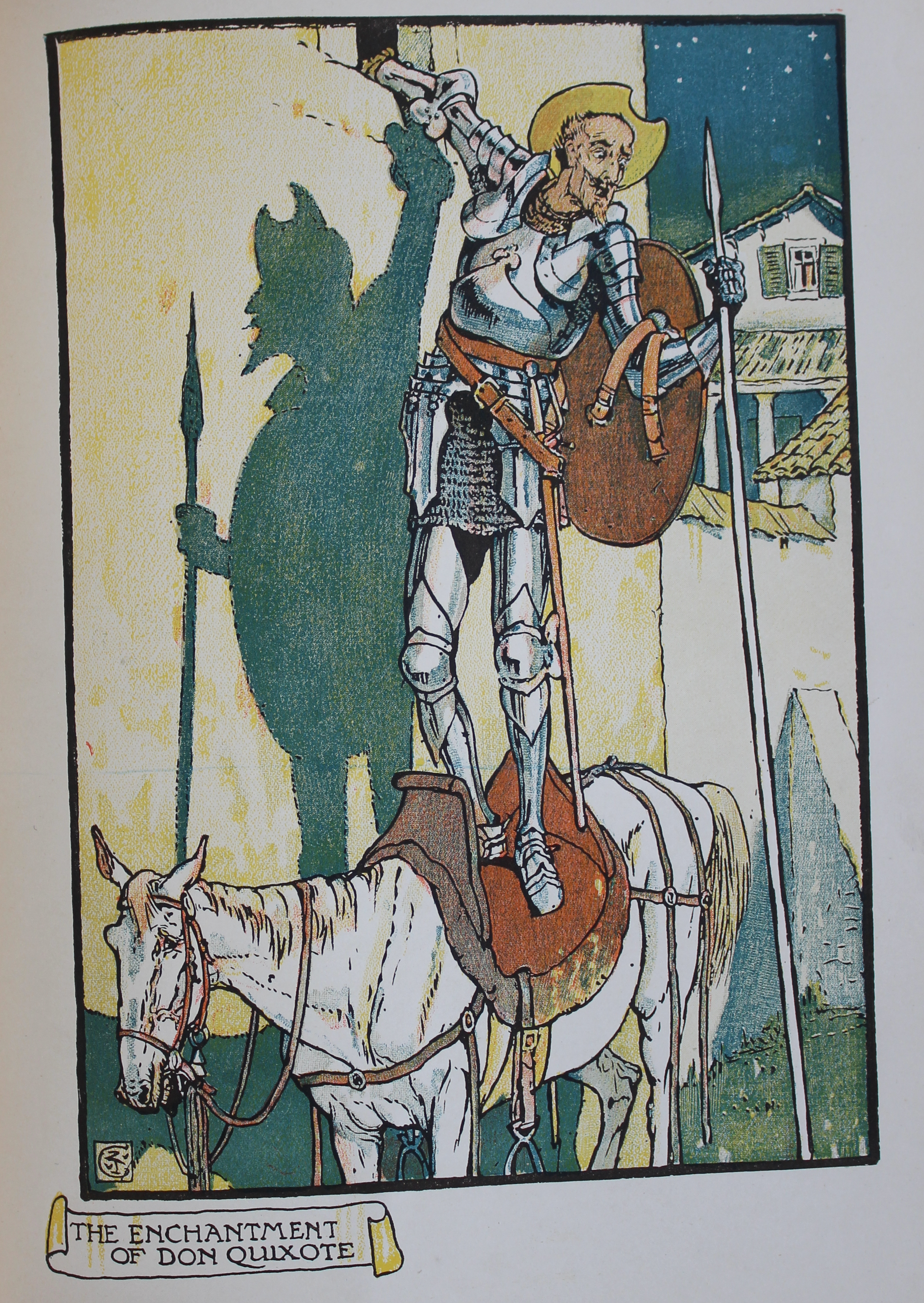
Finally, here is Walter Crane’s illustration of Don Quixote with his hand tied above him. In this version his shadow looks a lot like a devil!

Plate facing page 212 from Don Quixote of the Mancha

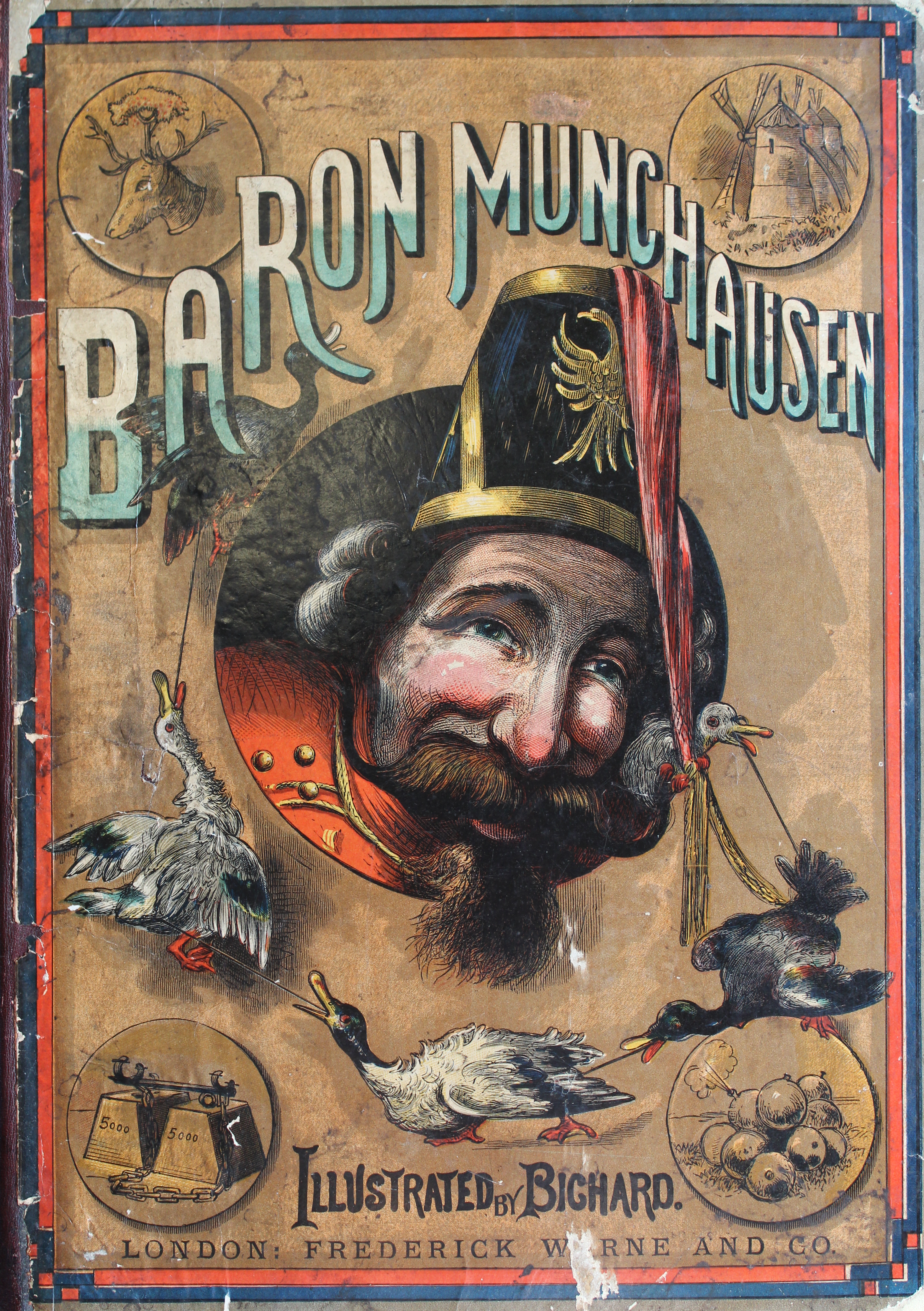
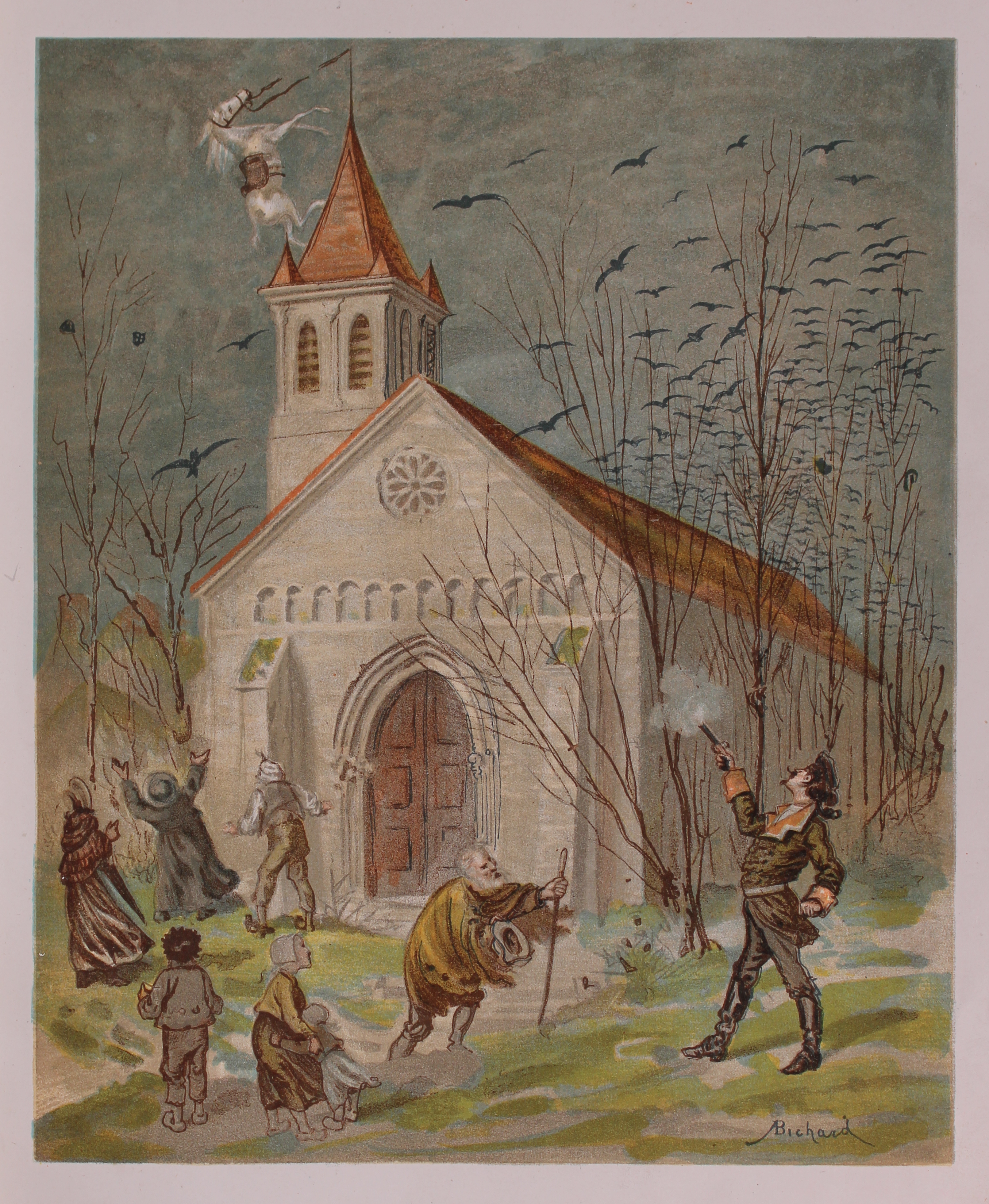
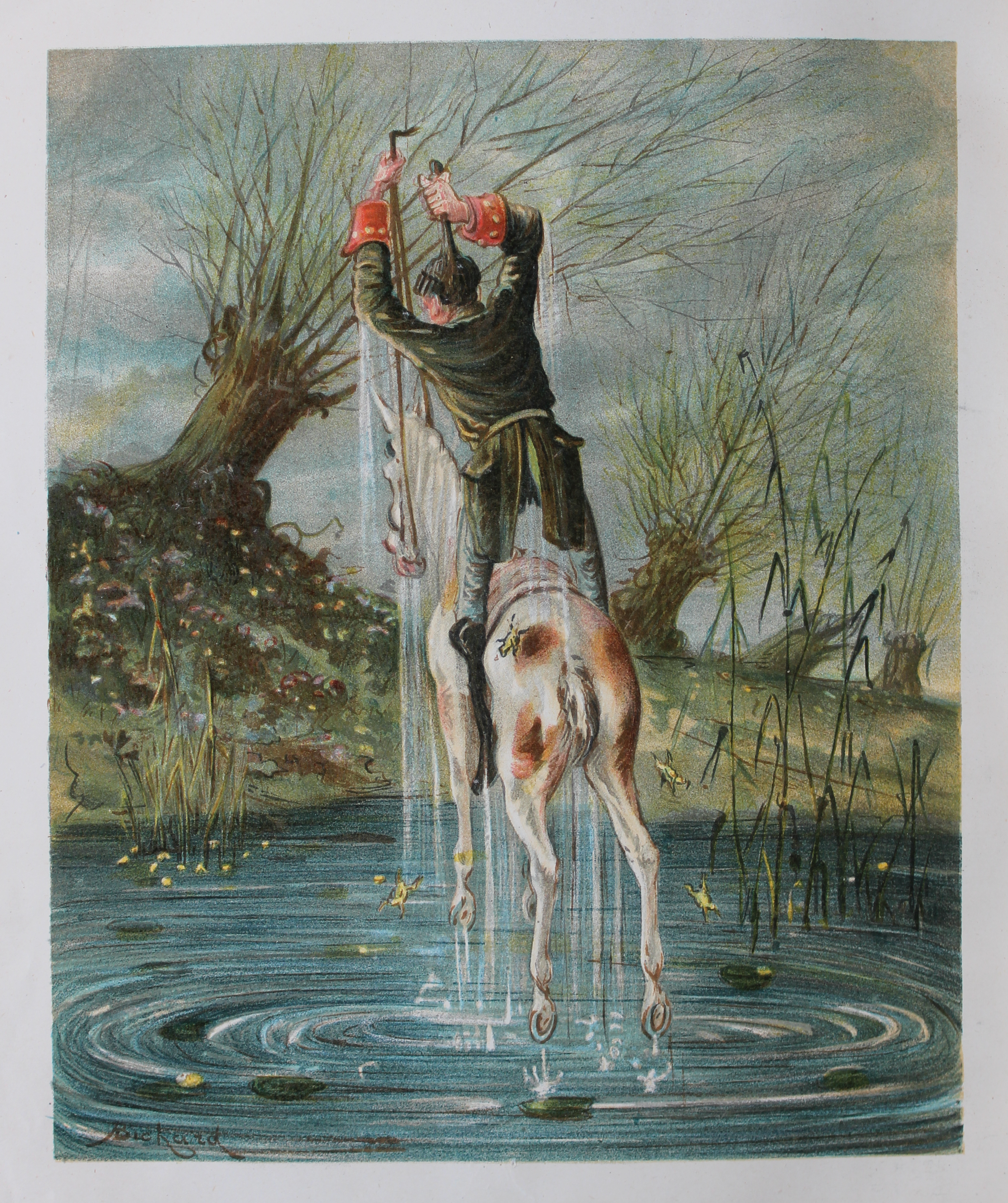
A late nineteenth-century edition of The Adventures of Baron Munchausen from our Rylands Collection of children’s books contains some wonderful colour illustrations by Adolphe-Alphonse Géry-Bichard (1842-1926). Although the Baron does not have a particular named horse accompanying him throughout, horses do feature in many of his tall tales. Included below are illustrations of the Baron shooting through his horse’s bridle to bring him down from where he has become attached to the steeple of a church, and of the Baron extricating himself and his horse from a pond by gripping onto his own hair and pulling!

Bright cover with the head of the Baron in the centre, surrounded by ducks

Cover of The Adventures of Baron Munchausen, illustrated by A. Bichard, London, c. 1880-1900? Shelfmark: Rylands.C.BAR

Plate before page 7 of The Adventures of Baron Munchausen

Plate facing page 89 of The Adventures of Baron Munchausen

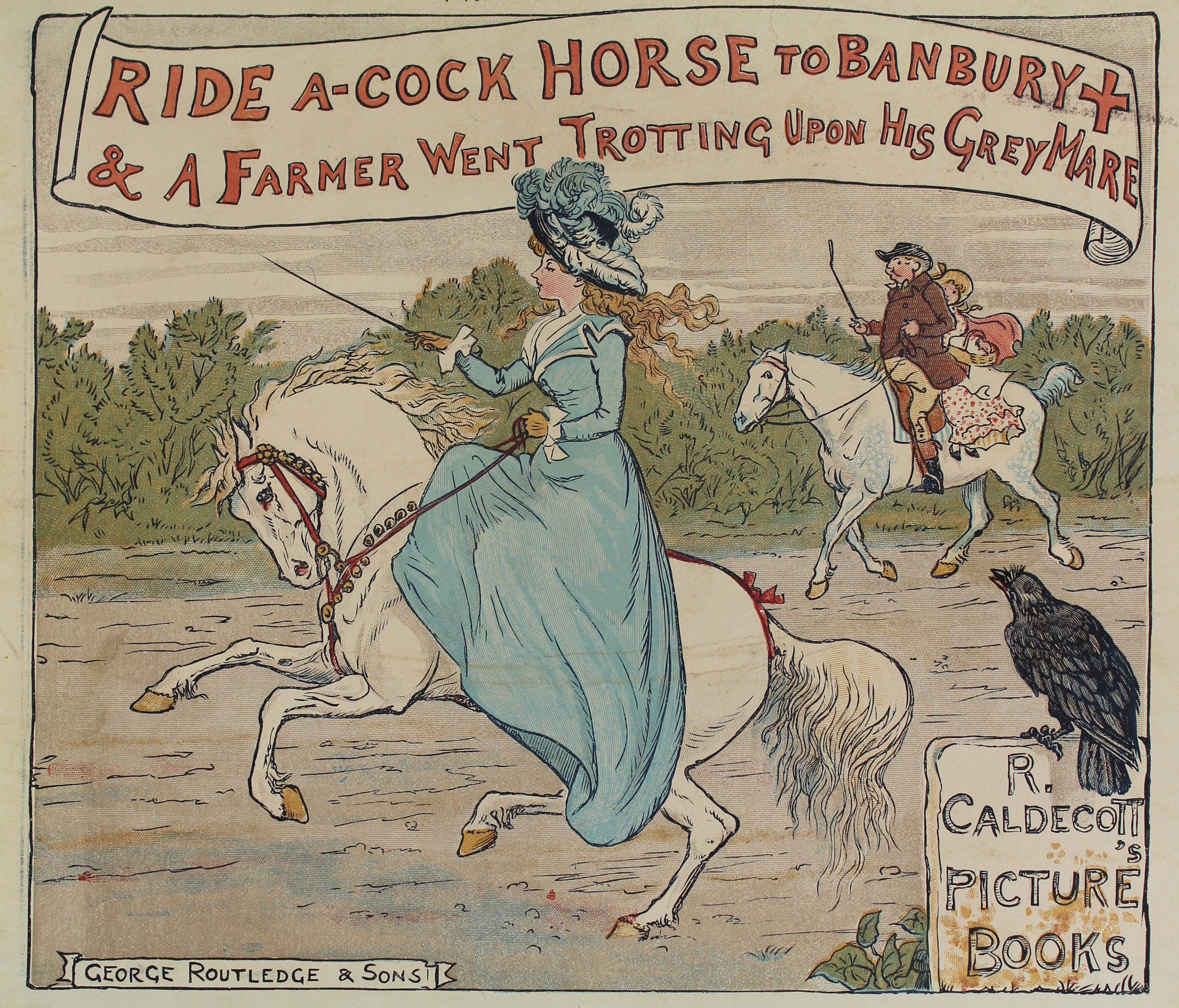
The Victorian illustrator Randolph Caldecott (1846-1886) loved horse riding and was a keen observer of countryside pursuits. It is no surprise therefore that horses crop up regularly in his work, not only in his picture books for children, but also in his comic illustrations and tales for the London weekly illustrated paper The Graphic. Below is the cover of one of a series of incredibly popular shilling toy books that Caldecott produced in collaboration with the engraver Edmund Evans (1826-1905).

A woman in a blue dress rides a white prancing horse in the foreground, and a farmer and his daughter ride a horse in the background

Front cover of Ride a Cock-Horse to Banbury Cross, London, 1884. Shelfmark: Rylands.C.CAL.Hey.1882/5

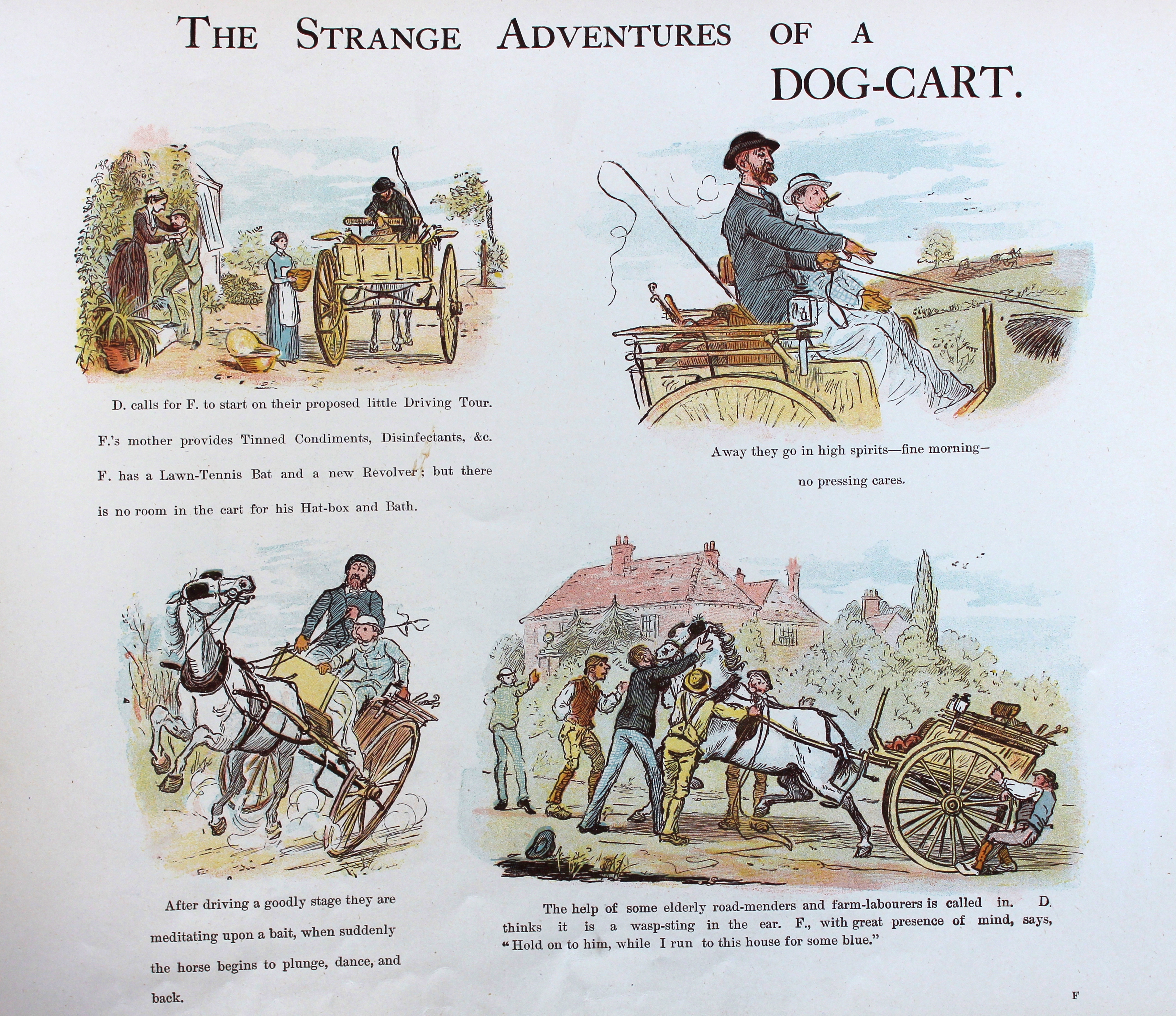
The Rylands Collection includes two collected volumes of some of Caldecott’s work for The Graphic, and they demonstrate his mastery of drawing horses in many different poses and situations. Below, the outing of two friends is temporarily disrupted when the horse pulling the cart is stung by a wasp.

Page 41 of Randolph Caldecott’s Last “Graphic” Pictures, London, 1888. Shelfmark: Rylands.C.CAL.Las.1888

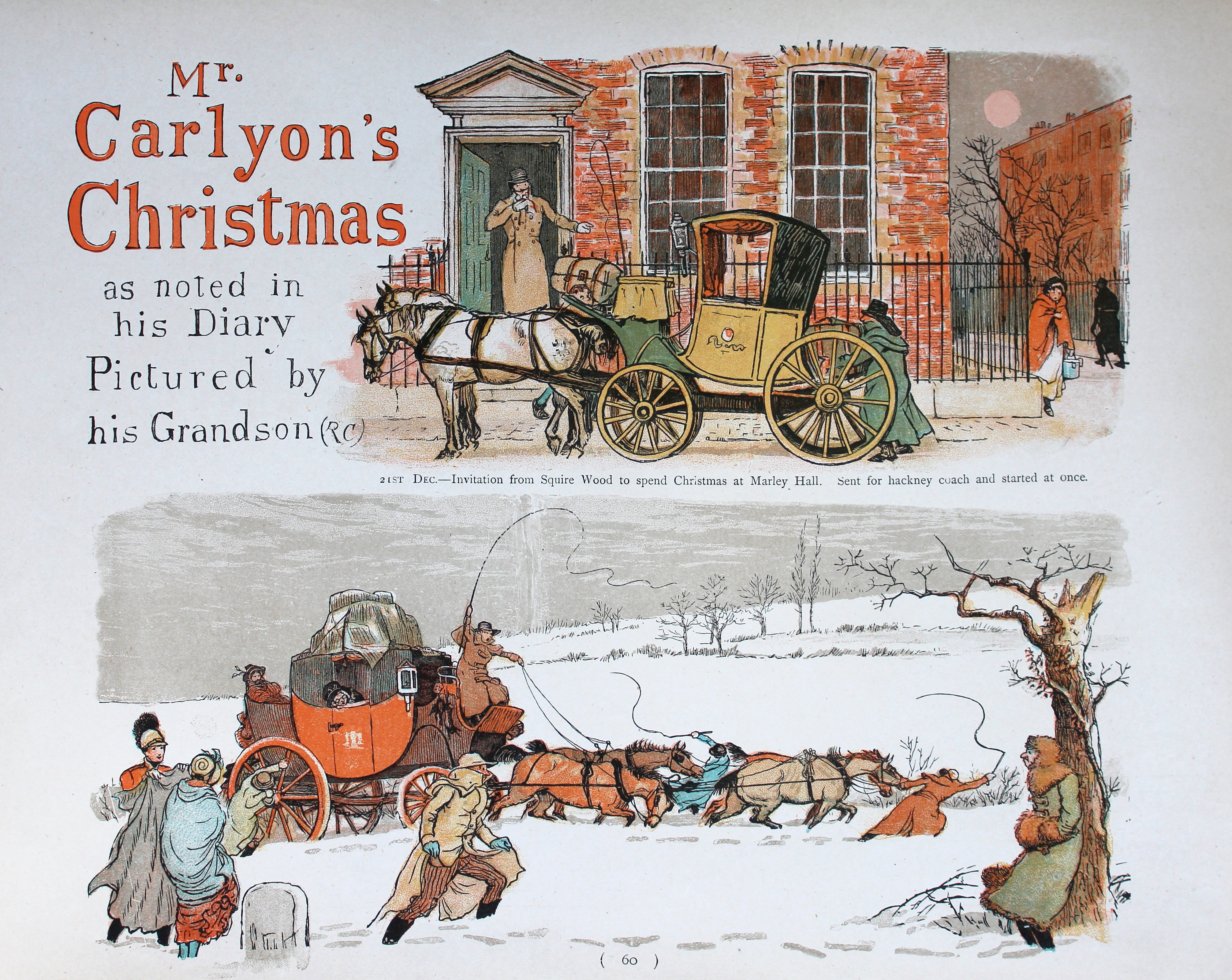
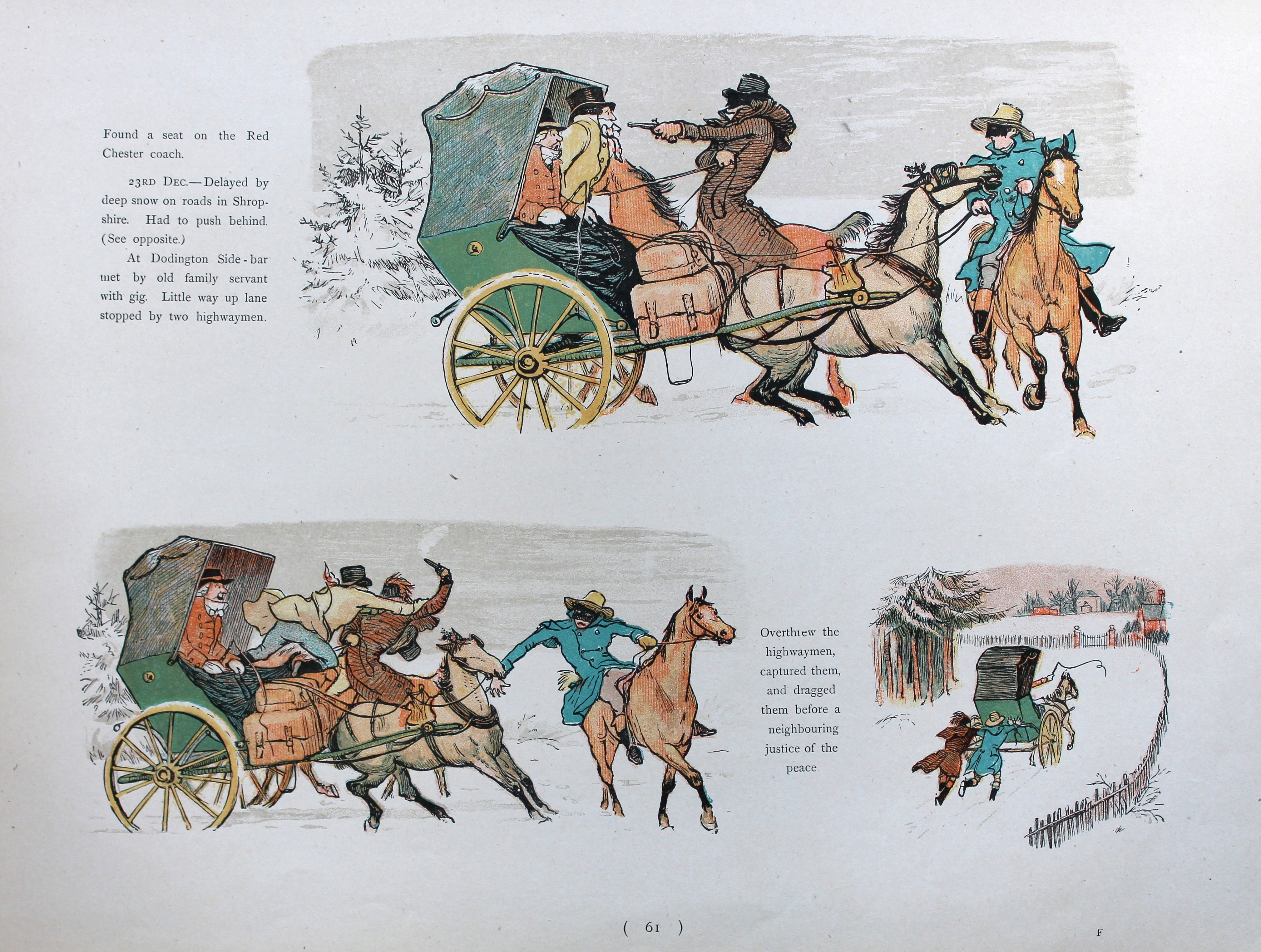
Next, a Christmas excursion is interrupted in even more dramatic circumstances, when the hero’s carriage is attacked by highwaymen! Luckily the miscreants are overpowered when Mr Carlyon (somewhat implausibly) launches himself out of the carriage at one of them and the other is bitten by one of the carriage horses.

Page 60 of Randolph Caldecott’s “Graphic” Pictures, London, 1898. Shelfmark: Rylands.C.CAL.Gra.1898

Page 61 of Randolph Caldecott’s “Graphic” Pictures

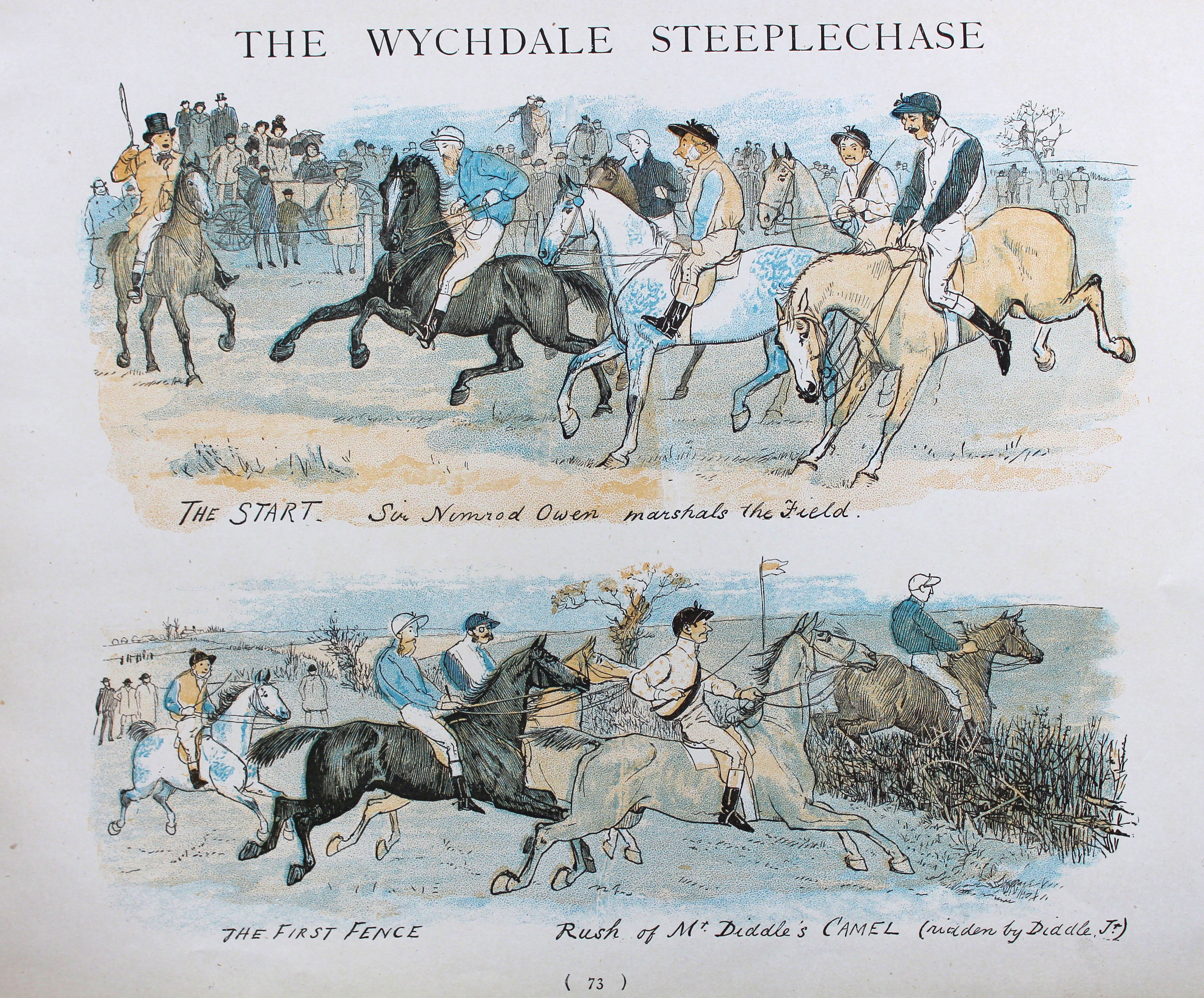
Another tale concerns a steeplechase race across the countryside, featuring many lively horses.

Page 73 of Randolph Caldecott’s “Graphic” Pictures

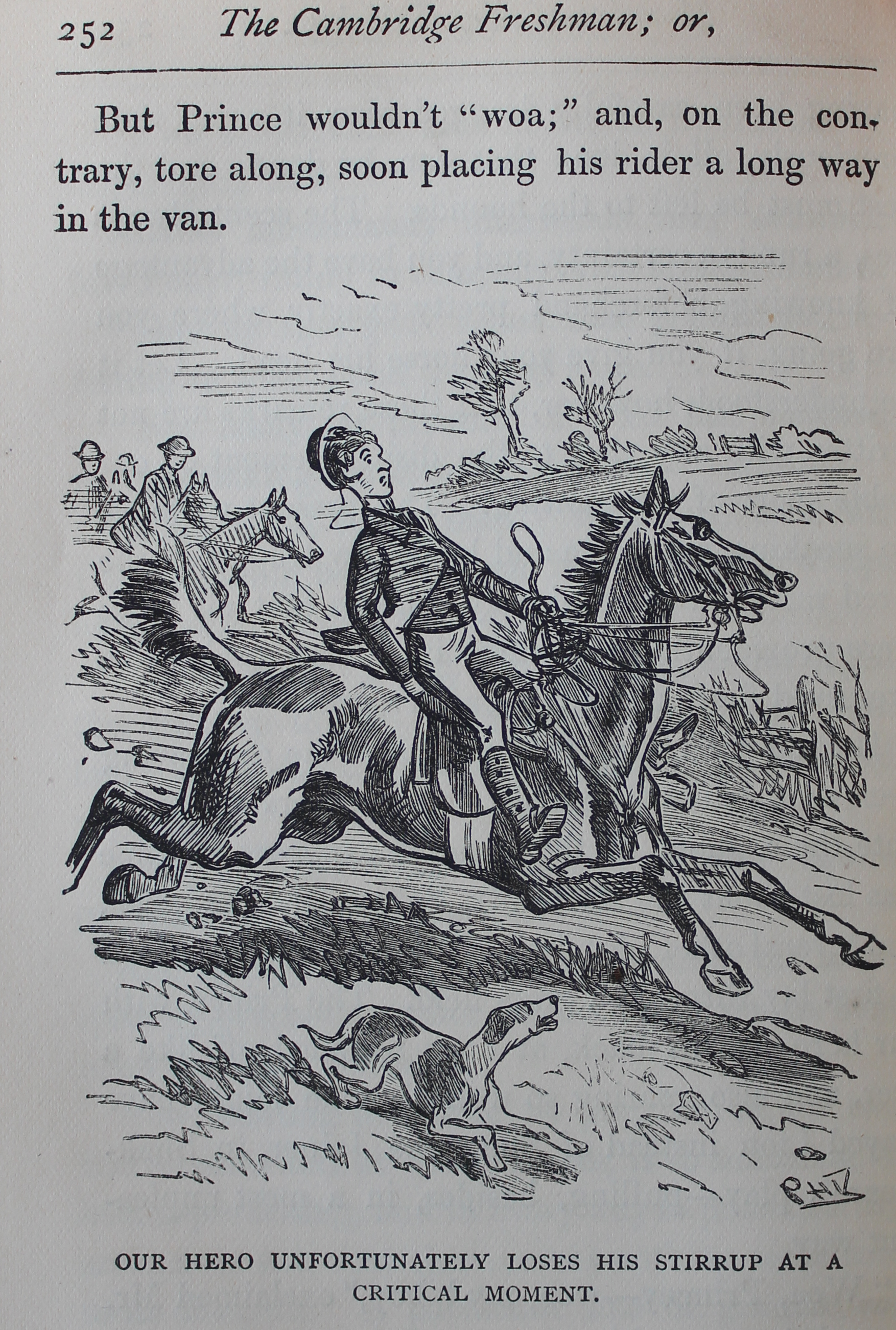
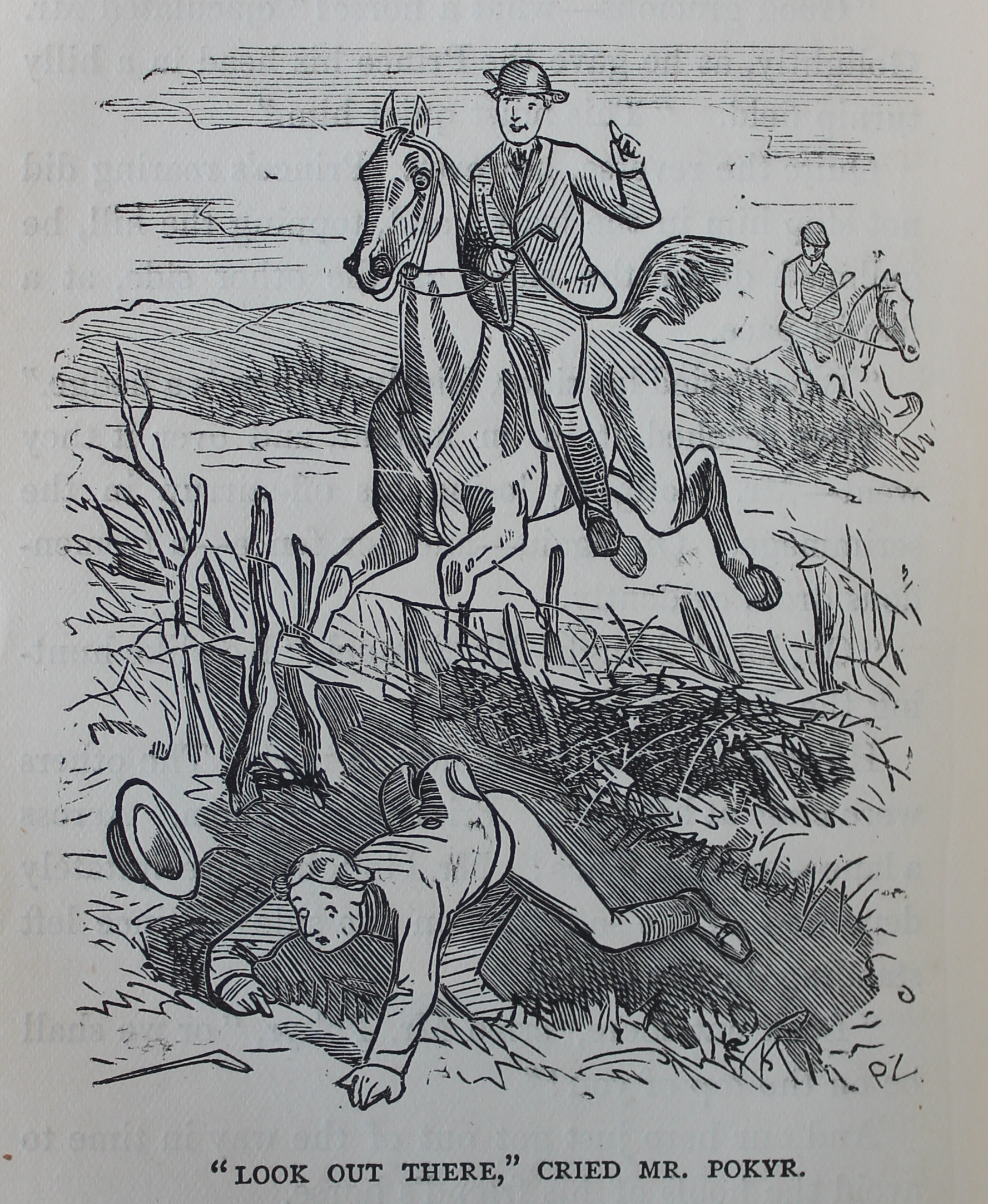
Our Local Collection includes the comic story of a Cambridge freshman, Samuel Golightly, who gets into various scrapes and adventures during his first year at the University. Below, Samuel participates in a drag hunt, where hounds follow a scent trail rather than a fox. His horse is somewhat too enthusiastic in pursuit, and he ends up tumbling to the ground, narrowly avoiding being trampled by another horse!

Page 252 of The Cambridge Freshman; or, Memoirs of Mr Golightly, by Martin Legrand, London, 1872. Shelfmark: NW CU JG 7P Leg

Page 254 of The Cambridge Freshman; or, Memoirs of Mr Golightly

There are many more horse illustrations in our collections, but all good things must come to an end, so we will take flight on Pegasus and bid you all farewell!

AC

References and further reading:

Pierre Grimal, The Dictionary of Classical Mythology, Oxford, 1986

Jennifer Fellows (ed.), Sir Bevis of Hampton, Oxford, 2017

Gary Lim, “‘A Stede Gode and Lel’: Valuing Arondel in Bevis of Hampton” Postmedieval Vol. 2, 1, 50-68, 2011

Rodney K. Engen, Randolph Caldecott: “Lord of the Nursery”, London, 1988.

Victorian railway excursions

In this second blog post marking 200 years of the modern railway, we focus mainly upon its arrival and early years in the Lake District, with a few other choice items from our collections making an appearance towards the end.

The arrival of the railway in the Lake District in the late 1840s markedly increased accessibility to a landscape that had been growing in popularity with tourists since the late eighteenth century. Here, just as in Cambridge, the guidebooks quickly adapted to reflect the new realities of travel.

Likely one of the earliest railway maps of the region is the Collins’ Railway Map of Westmoreland, a small folded map mounted on linen, which would have made it durable and easily portable for use by travellers.

Cover of map. Has a bright orange background

Cover of Collins’ Railway Map of Westmoreland, London, [circa  1847]. Classmark: Bicknell.233

The map is undated, but examination of the railway lines that are indicated on it in black suggests a publication date of around 1847, since it depicts the railway line extending to Lake Windermere which opened in 1847, but not the line to Coniston which arrived in the following year.

Map from Collins’ Railway Map of Westmoreland

Another nice map can be found in a tiny pamphlet guide from 1848, which this time has rail lines marked in red.

titlepage of guidebook

Title page of The Lakes, By Way of Fleetwood and Liverpool …, Manchester, Bradshaw and Blacklock, 1848. Classmark: Bicknell 243

Map

Map from The Lakes, By Way of Fleetwood and Liverpool …


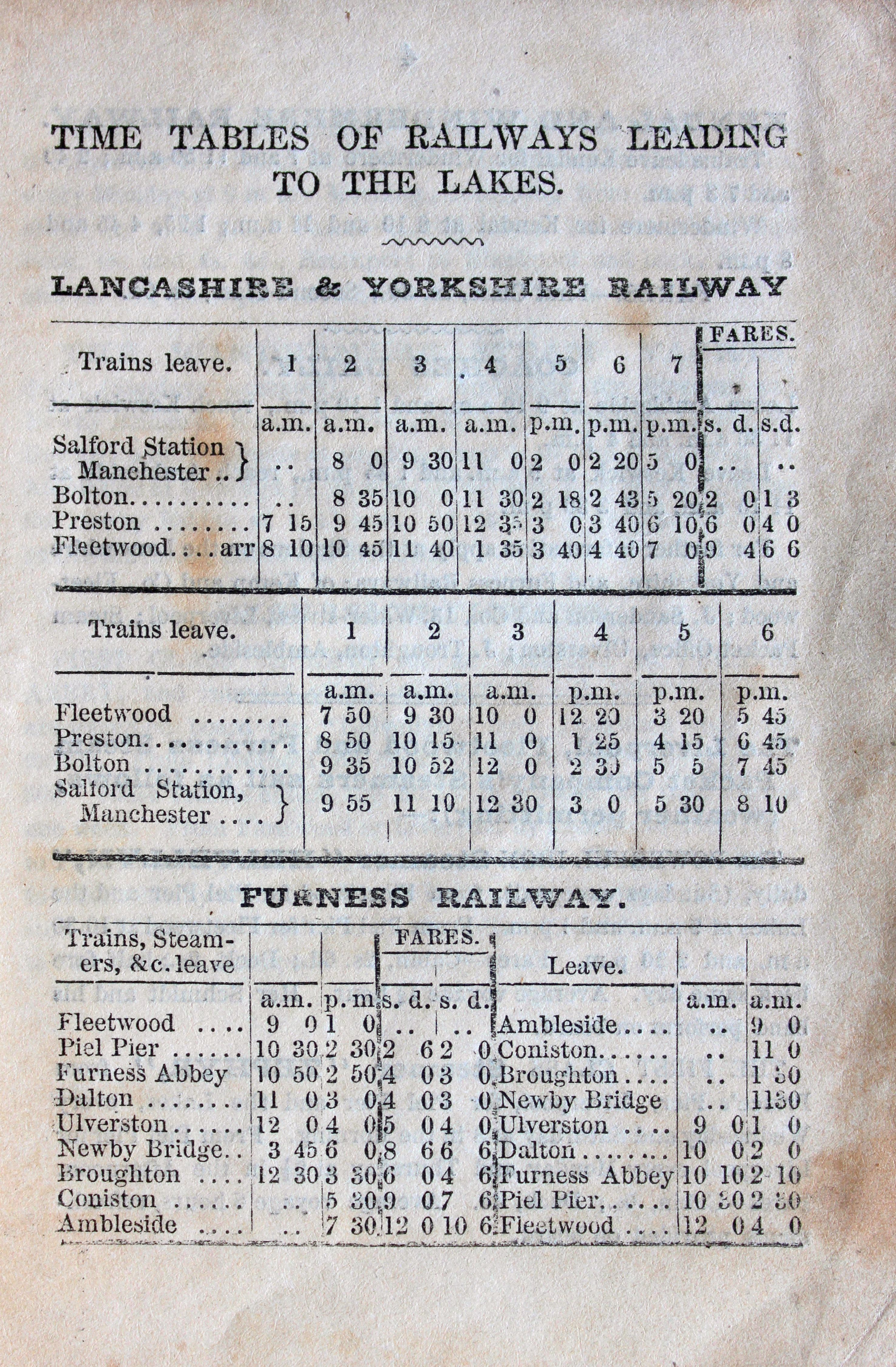
This guide includes timetables for steam ships and railways leading to the Lakes, alongside information about coaches to and from Keswick, which was not yet served by a rail line.

Railway timetables on page 03 of The Lakes …

Coach and steamer information, on page 04 of The Lakes …


Steamer information on page 05 of The Lakes …

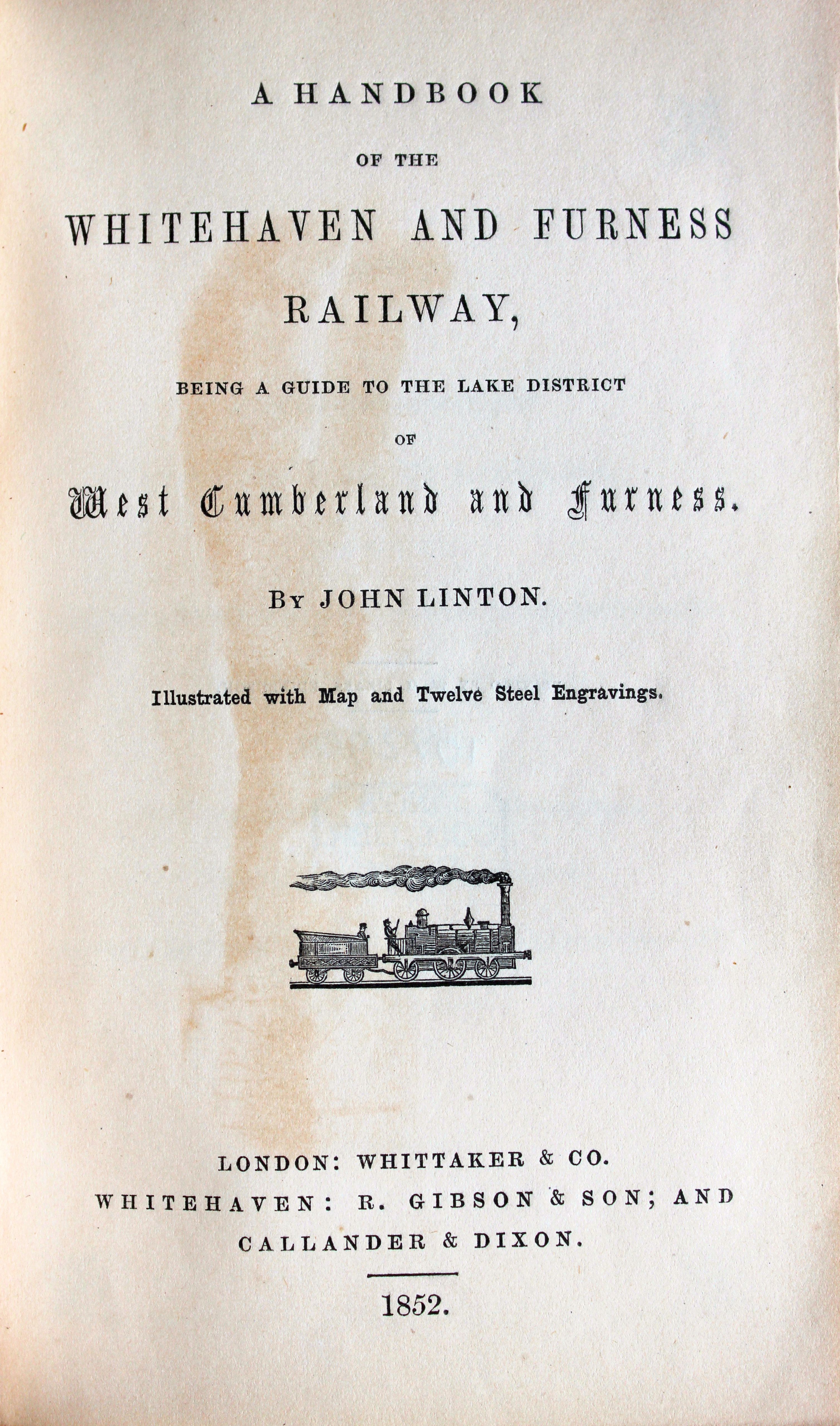
A slightly later guide focuses on areas made more accessible by the Whitehaven and Furness Railway, which opened in 1850. Note the sweet little title page vignette depicting a steam engine:

Ttile page, featuring a small illustration of a steam engine

Title page of: A Handbook of the Whitehaven and Furness Railway by John Linton, London, 1852. Classmark: Bicknell.107

The guide states its purpose clearly (if a little long-windedly) in the introduction:

Our object is merely to supply what, in consequence of the changes recently effected by railway travelling in the approaches to this district, has become a desideratum; – to point out the routes by which the greatly increased number of tourists and others … may arrive at various interesting points of the district; – and to give brief descriptions of several places, all within an easy distance of the railway we have taken as our starting point, which have hitherto, owing to the difficulty of approaching them, been much less frequented …

One such place is the vale of St. Bees, which is described as if viewed from a moving train.  The guidebook goes into raptures about its charms:

After emerging from the cutting, we are again at liberty to enjoy the beauties spread so abundantly on either hand, and it may with truth be said, that a more pleasant and enlivening scene is very rarely met with than that presented to the traveller through the vale of St. Bees. It is a scene of quiet and repose, and yet of the highest cultivation, combining the varied charms of dale and upland, grove and meadow, stately mansion and thriving farm.

If you look closely at the centre of the accompanying engraving (below), you can see a train travelling along the track, trailing steam behind it.

Black and white engraving of a valley with a church and small hamlet, and a train track running through the centre. A train is coming along the track

Plate facing page 24 of A Handbook of the Whitehaven and Furness Railway

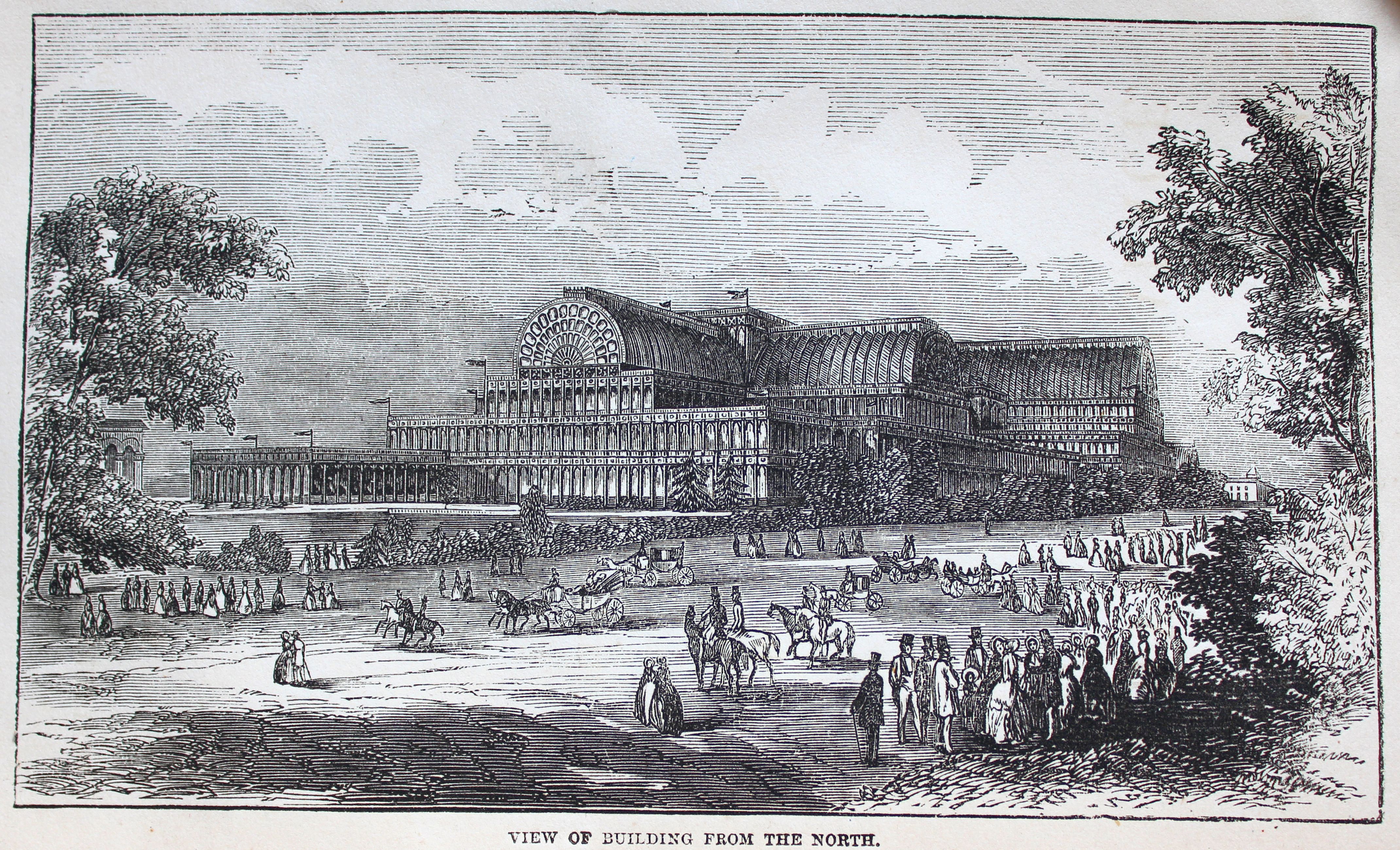
Rail access played an important part in the viability of many business ventures in the Victorian age. When the historic Great Exhibition in London’s Hyde Park, the world’s first international trade fair, closed its doors in October 1851, the future of the exhibition hall, the magnificent Crystal Palace, was initially uncertain. However, the designer Sir Joseph Paxton soon orchestrated the raising of enough private funds to purchase the building and have it re-erected in an adapted and enlarged form on a hilltop in Sydenham, in the south east of the city. An elaborate park was constructed around it and the site was opened to the general public in 1854 as a place for relatively cheap entertainment and recreation for the masses. Attractions included concerts, exhibitions, pantomimes, circuses and the delights of the building itself and the surrounding landscaped gardens. Vital to the success of the scheme was the construction, by the London, Brighton and South-Coast Railway Company, of a dedicated railway station for the site, which opened shortly after the park itself. Close co-operation with the railway was expedited by the fact that the chair of the railway company, Samuel Laing, was also chair of the new Crystal Palace Company. It also made commercial sense for the railway, since any big attraction would boost the growth of rail travel.

The illustration below comes from a little guidebook to the palace and park, published in its inaugural year. Our copy is part of the Thackeray Collection.

Black and white illustration showing the Crystal Palace building in parkland. It looks like a huge greenhouse.

Frontispiece from Guide to the Crystal Palace and Park by Samuel Phillips, London, 1854. Classmark: Thackeray.VIII.11.24

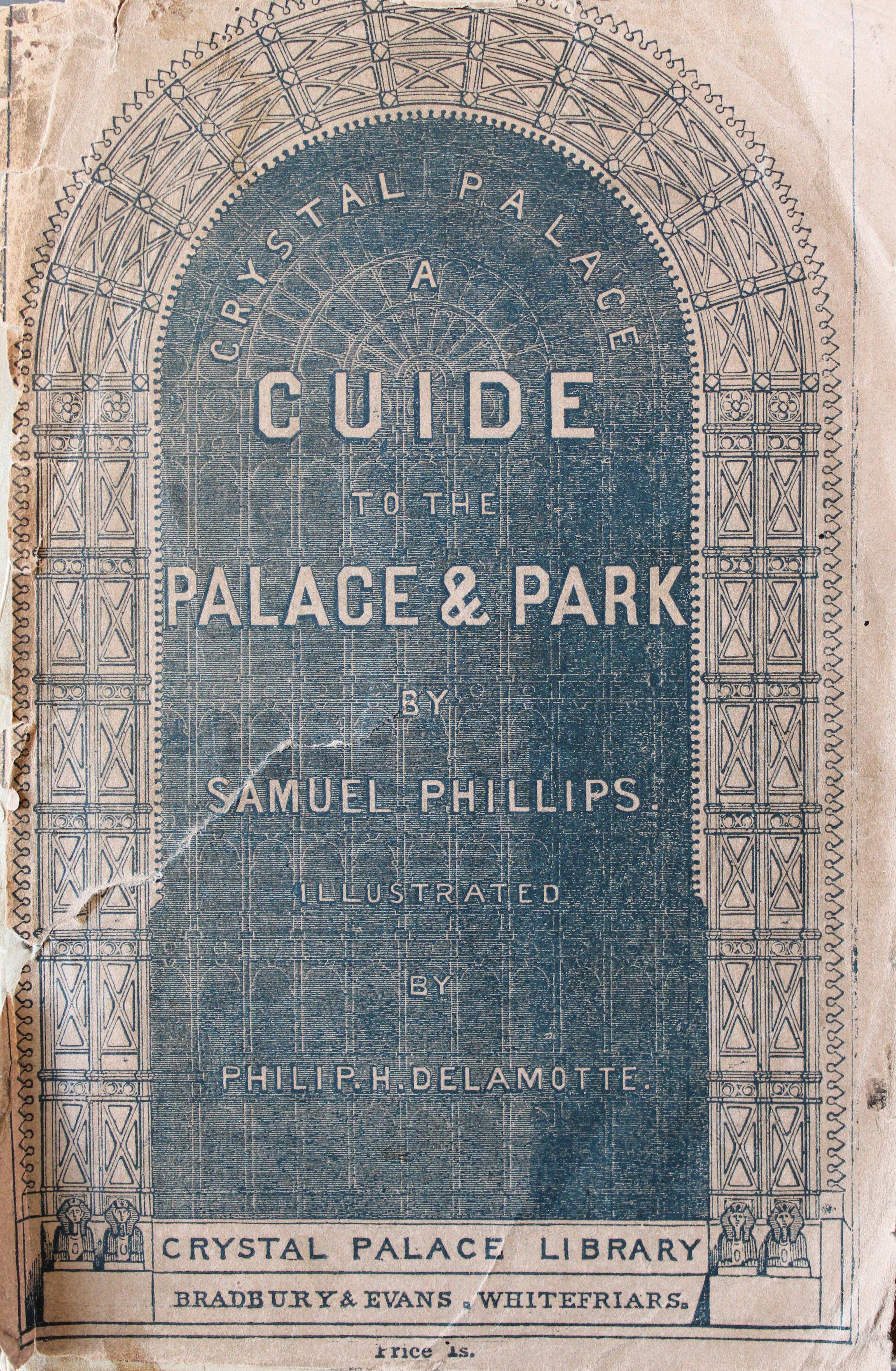
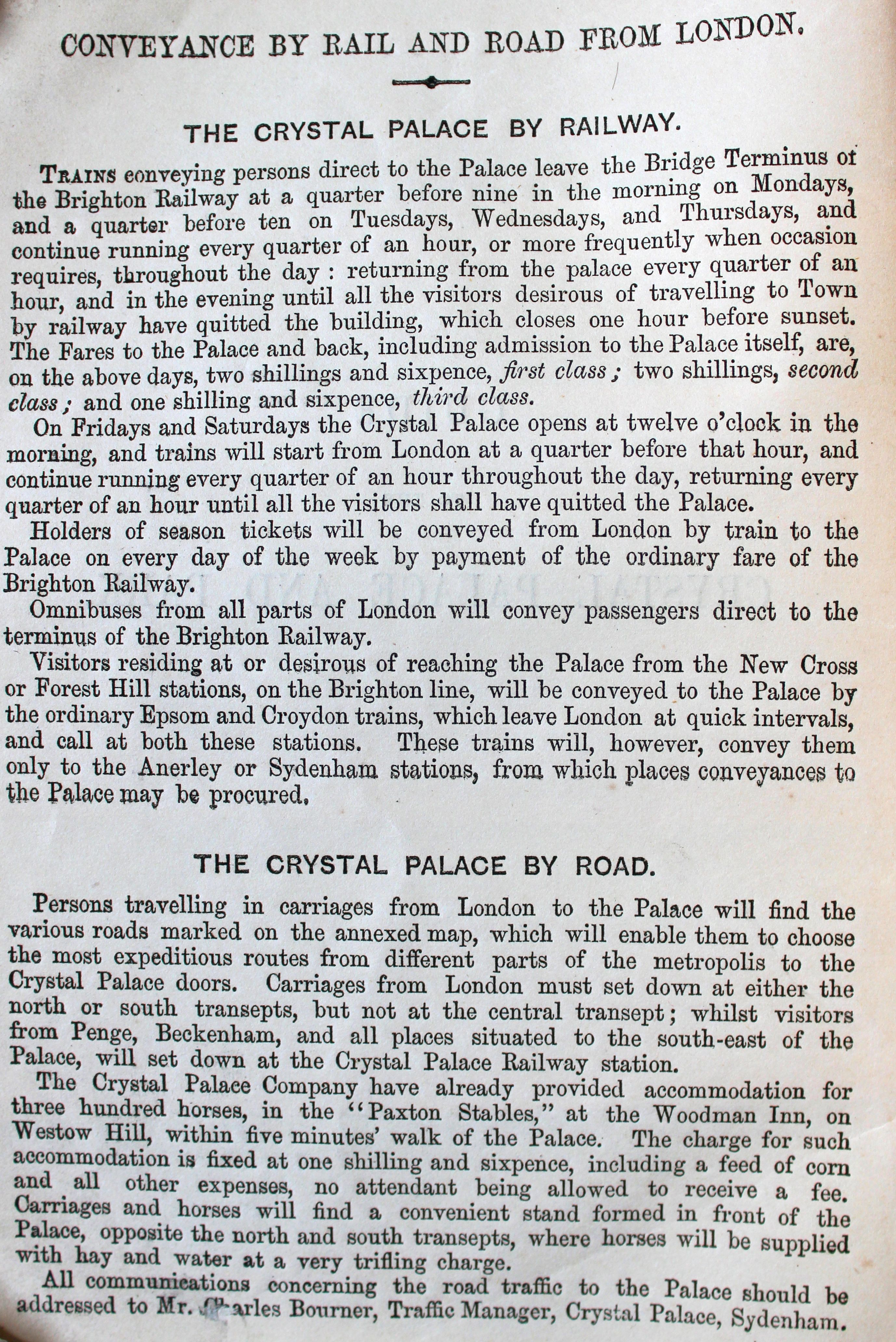
Detailed information on accessing the park by rail is provided inside the guide, revealing that the service ran at least every quarter of an hour and more frequently at busy times of day. Return tickets, which included admission to the Palace, were one shilling and sixpence for third class travel, rising to two shillings and sixpence for first class.

Cover of the guide. The title is depicted within an illustration of a large ornate archway

Front cover of Guide to the Crystal Palace and Park

Travel information

Travel information on the back of the half-title page of Guide to the Crystal Palace and Park 

Incidentally, this guide includes  an advertisement by the South Eastern Railway for what they refer to as: “tidal trains”, which offered a streamlined service between London and Paris. Passengers could board an express train to Folkestone, embark upon a waiting steamer ship and be met after the channel crossing by a direct train for Paris. Luggage would be managed from start to finish by the rail company. The same arrangements applied for a trip in the other direction. Not bad for the early decades of rail travel!

Advert

Page 47 of the Advertiser section of Guide to the Crystal Palace and Park

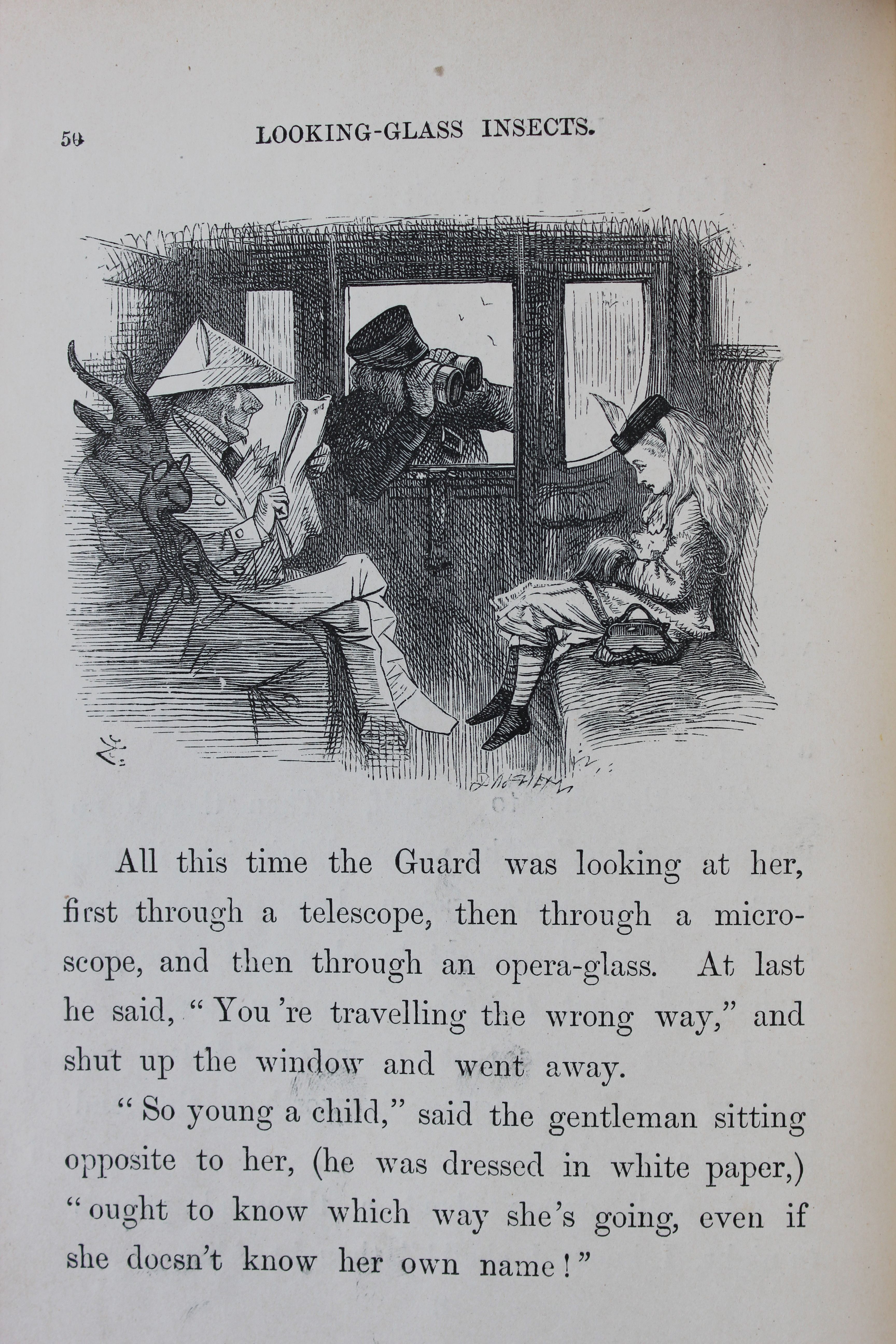
The final destination on our whistlestop tour of railway-themed material is our Rylands Collection of children’s books. An illustration from the first edition of Through the Looking Glass depicts Alice in a train carriage with some rather odd travelling companions.

Illustration within the text of Alice in a railway carriage with a goat and a man with a paper hat. There is a guard peering at her through binoculars

Illustration by John Tenniel from page 50 of Through the Looking Glass, and What Alice                                   Found There by Lewis Carroll, London, 1872. Classmark: Rylands.C.CAR.Thr.1872

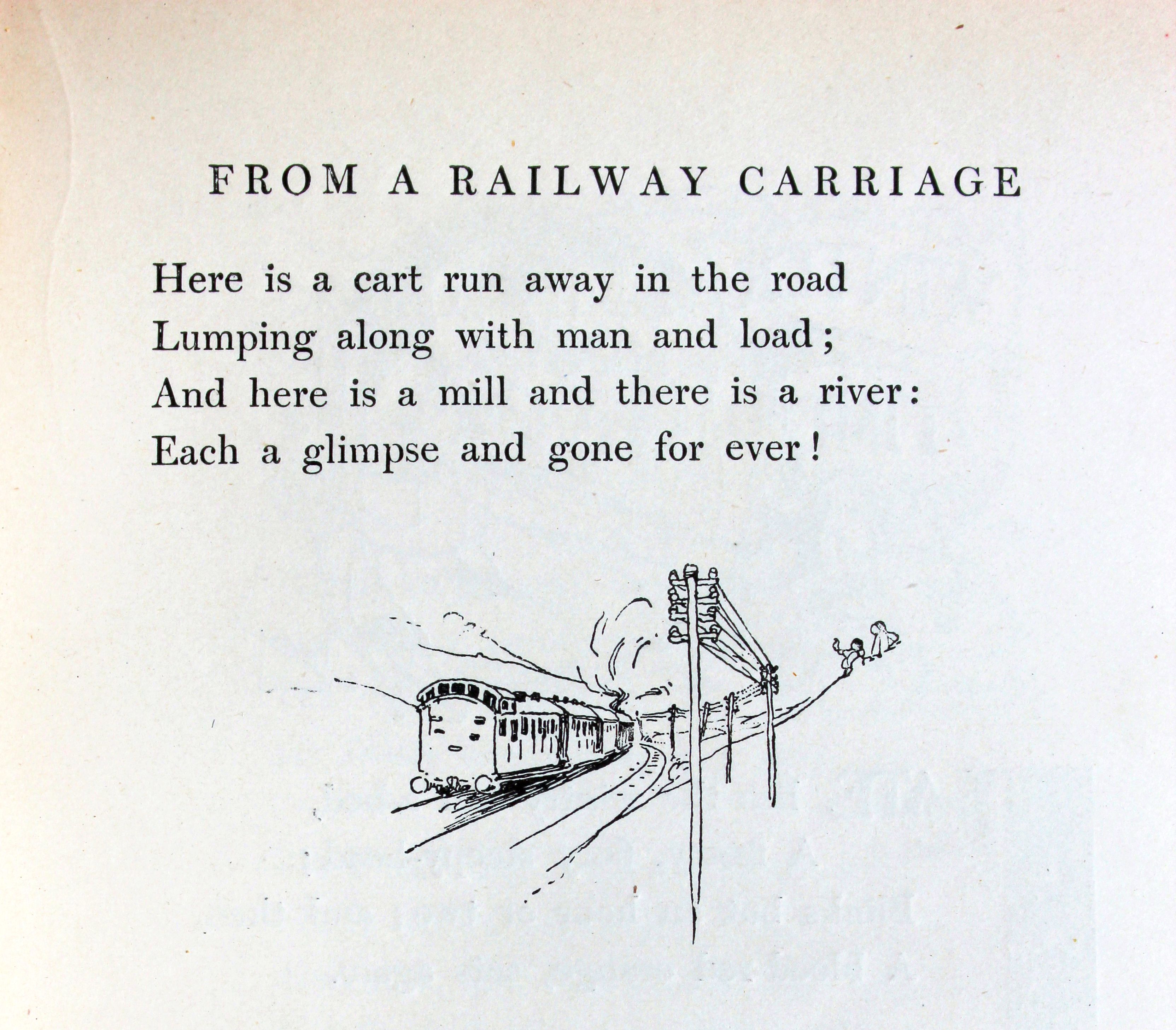
We also hold a copy of Robert Louis Stevenson’s A Child’s Garden of Verses, which includes this wonderfully evocative poem about a train journey.

The text of the poem, illustrated with a railway carriage

Page 68 of A Child’s Garden of Verses by Robert Louis Stevenson, London, 1896. Classmark: Ryland’s.C.STE.Chi.1896

The second page of the poem, with a small illustration of a retreating train

Page 69 of A Child’s Garden of Verses

We hope you’ve enjoyed this look at the early days of rail travel as reflected in our collections and that you enjoy any and all excursions you make this autumn and winter, whether by train or by any other means!

AC

References and further reading:

Railway 200 [accessed September 2025]

Lee Jackson, Palaces of pleasure: how the Victorians invented mass entertainment, New Haven, 2021

The Crystal Palace Foundation [accessed September 2025]

Hopping into the new year

Last year we marked Chinese New Year with images of ferocious tigers discovered within our collections. 2023 is the year of a less fearsome creature, the rabbit, whose natural habitat appears to be the pages of children’s picture books. As a way of welcoming in the new year, this post will share some of the images unearthed from the warrens of our stores.

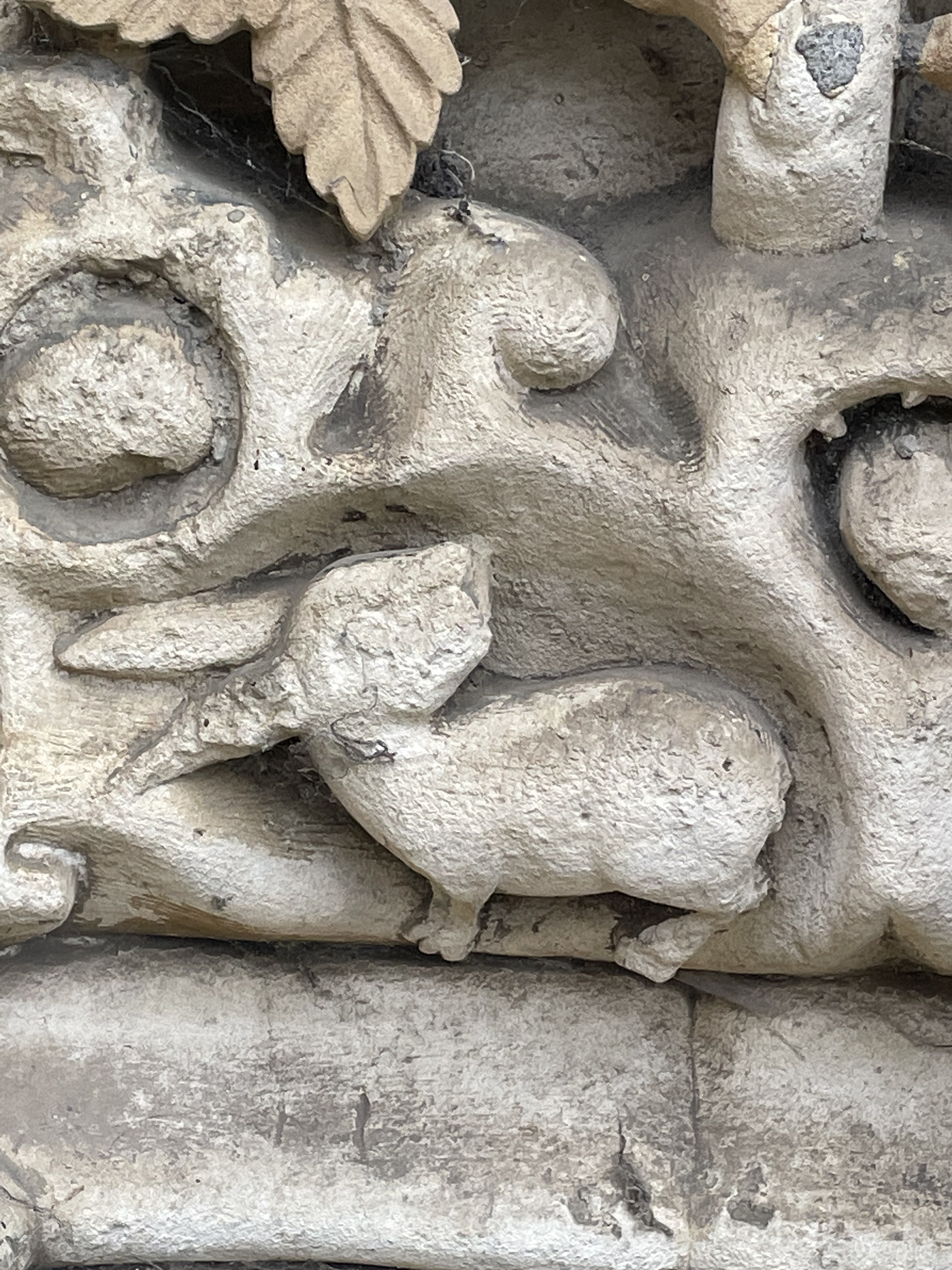
We start however, with a rabbit who has hopped his way into the very stonework of the College Chapel! Designed by master mason John Wastell, in the early 16th century, the jamb of the Chapel’s west door boasts an elaborate pattern of roses, crowns, leaves and stems, and at the base of one side can be found a dog playing hide and seek with a rabbit. The dog is now sadly weathered beyond recognition, but the rabbit is still very much visible, gazing up into the foliage above.

Stone rabbit in closeup

Close-up view of the rabbit on the jamb of the West door of King’s College Chapel, Cambridge

The stonework of the door jamb of the West door of King's College Chapel

The rabbit within the larger context of the decorative pattern on the door jamb

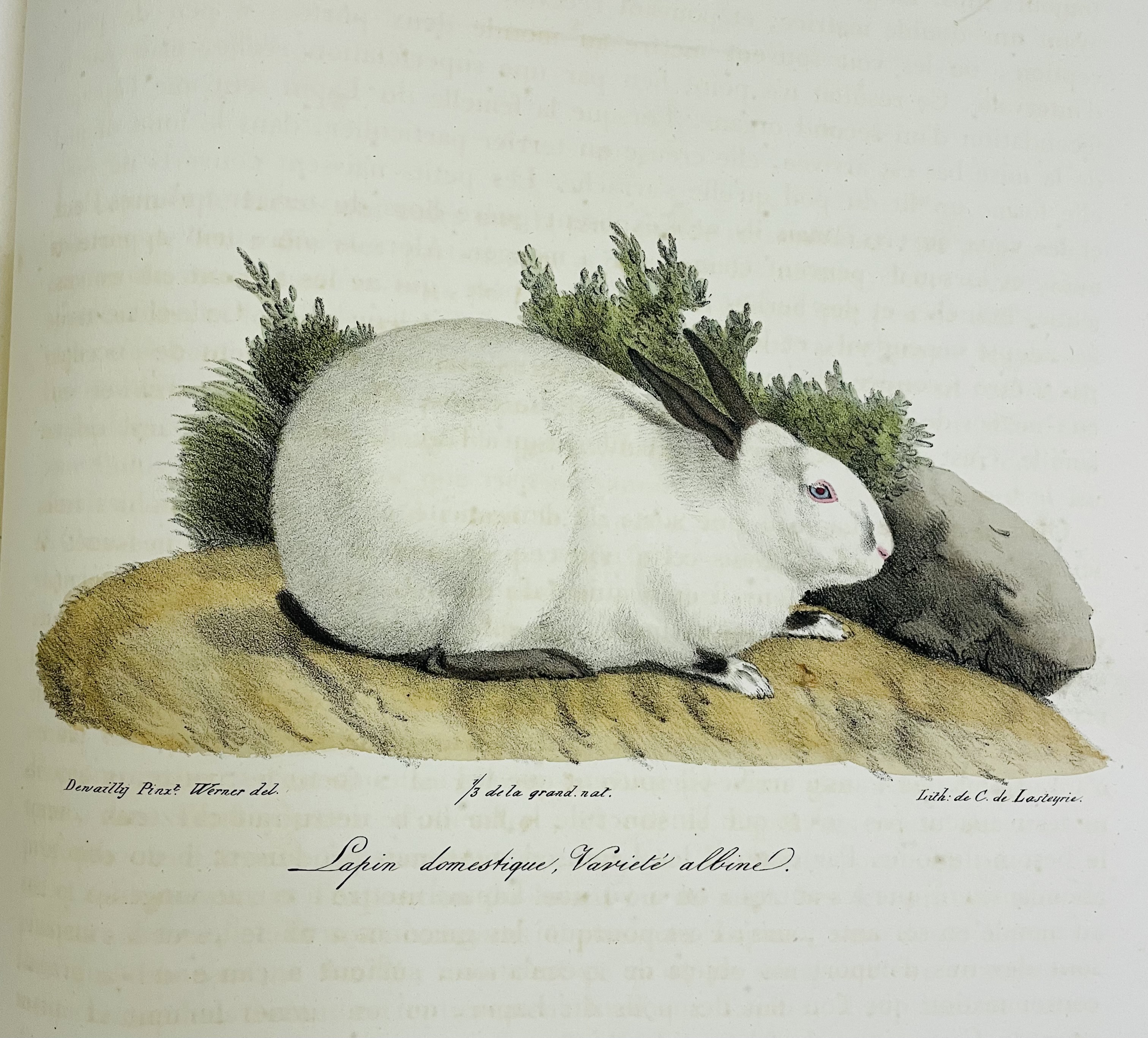
Next we have two illustrations from one of the early nineteenth century natural history titles featured in last year’s tiger post: Histoire naturelle des mammifères by Geoffroy-Saint-Hilaire and Frédéric Cuvier. These depict a familiar brown rabbit and one of the albino variety. 

Brown rabbit clutching a carrot

Plate from Vol. 2 of Histoire naturelle des mammifères, 1824, Shelfmark F.1.21

Albino rabbit

Plate from Vol. 2 of Histoire naturelle des mammifères, 1824, Shelfmark F.1.21

From here, we move into the realm of children’s books. The library holds an early edition of Alice’s Adventures in Wonderland by Lewis Carroll, which features a very famous rabbit, the White Rabbit, whom Alice follows down the rabbit-hole, thus beginning her strange and  eventful sojourn in Wonderland. The White Rabbit, complete with his waistcoat and pocket watch, is charmingly depicted by John Tenniel. 

The White Rabbit, dressed in a waistcoat, looking at this pocket watch

Illustration by John Tenniel from chapter one of Alice’s Adventures in Wonderland by Lewis Carroll, London 1874. Classmark: Rylands.C.CAR.Ali.1874

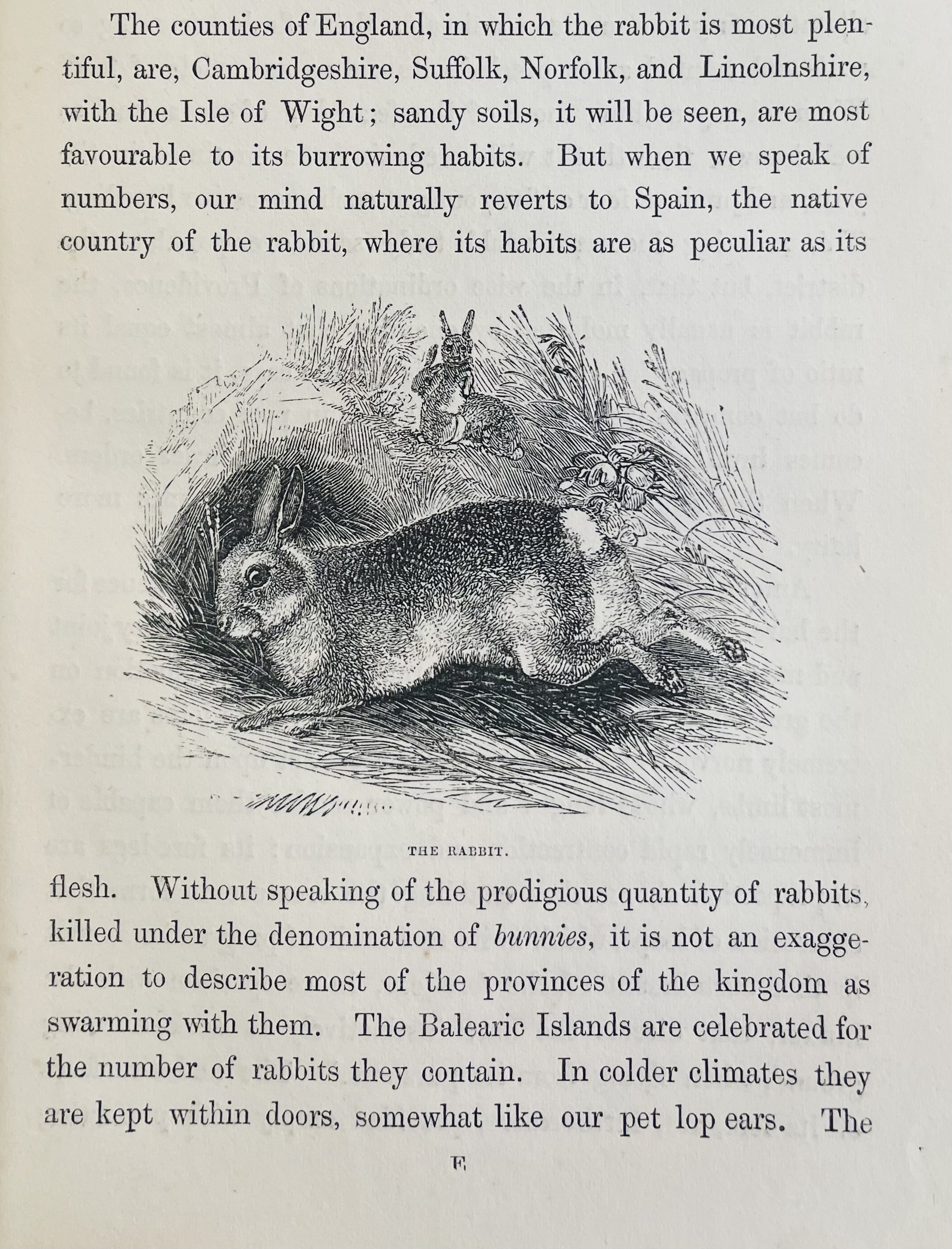
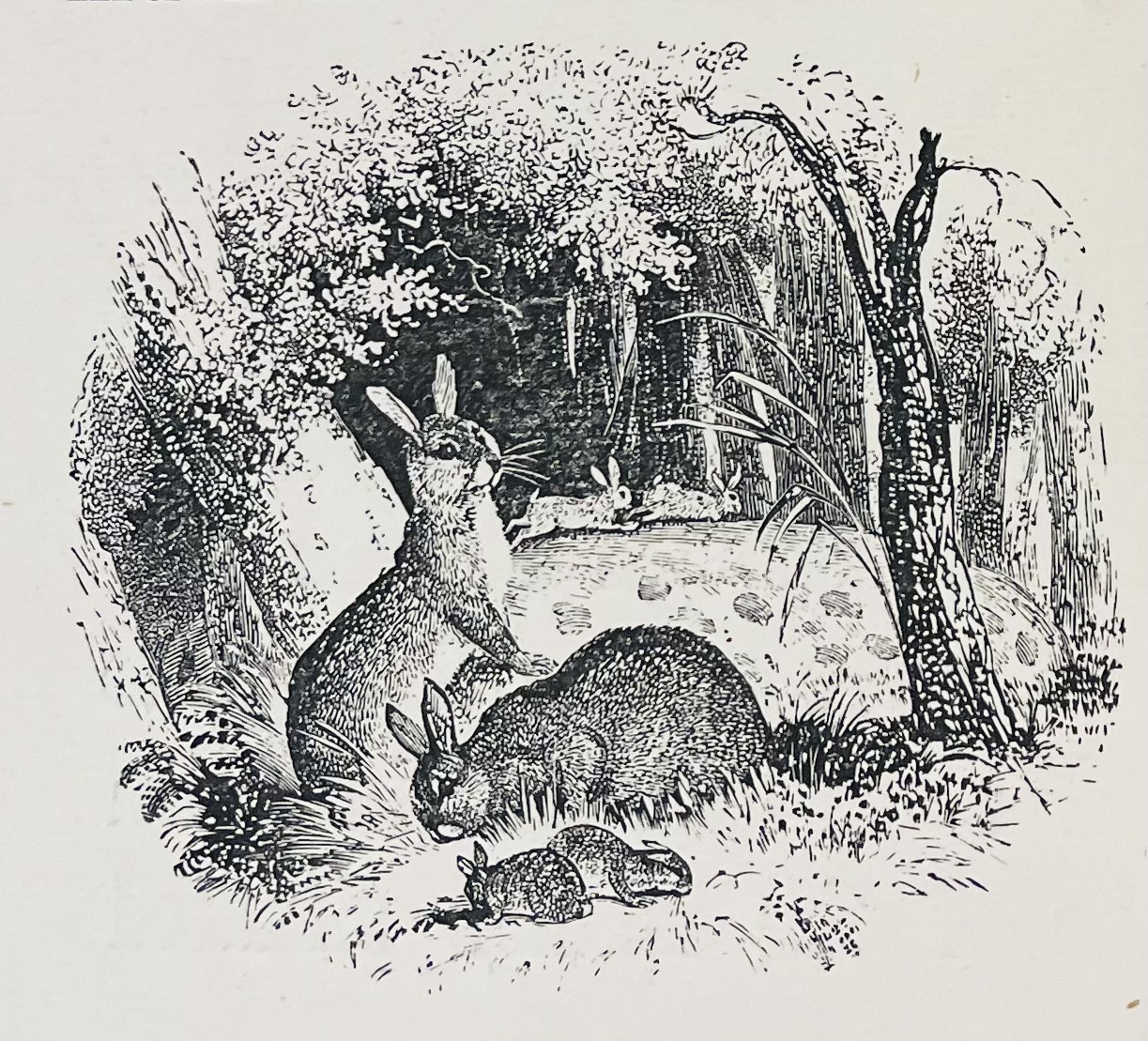
Rabbits also appear in books intended to educate children about the natural world and its inhabitants. My Own Annual: An Illustrated Gift-Book for Boys and Girls edited by Mark Merriwell, has a chapter entitled “Rabbits, hares and ferrets”which informs us that rabbits hail originally from Spain, and that Cambridgeshire is amongst the counties of England where they are most common.  

A rabbit bounding into its warren

Page 65 from My Own Annual: An IIlustrated Gift-Book for Boys and Girls edited by Mark Merriwell, London, 1847. Classmark: Ryland’s.C.MER.Ann.1847

Similar information is conveyed in The Pleasure Book of Domestic Animals by Harrison Weir, which has its own section on rabbits, accompanied by some attractive illustrations.

From The Pleasure Book of Domestic Animals by Harrison Weir, London, circa 1855-1870. Classmark: Ryland’s.C.WEI.Ple

From The Pleasure Book of Domestic Animals by Harrison Weir, London, circa 1855-1870. Classmark: Ryland’s.C.WEI.Ple

Finally, a very large and stately looking rabbit appears in full colour in Aunt Louisa’s Birthday Gift, dating from around 1875. 

Plate from Aunt Louisa’s Birthday Gift [by Laura Valentine], London, circa 1875. Classmark Rylands.C.VAL.1875

We hope you have a fruitful new year, and that, like the reproductive capacities of rabbits, your good luck grows and multiplies many times over! 

AC

References

King’s College Chapel: a History and Commentary by John Saltmarsh; edited by Peter Monteith and Bert Vaux. Peterborough, Jarrold, 2015.