Jane Austen at 250: An Online Exhibition

Today, 16 December 2025, marks the 250th anniversary of Jane Austen’s birth. Events have been held throughout the year to celebrate this occasion. As part of Open Cambridge on 17 September, King’s College Library mounted an exhibition featuring first editions of all of Austen’s novels, the autograph manuscript of her unfinished novel Sanditon, a manuscript letter to her publisher, a book from her library, early translations of her novels, and other rare items. The event was a great success and was attended by over 650 people who braved the wet weather to come and view the treasures on display, thus creating a “ceaseless clink of pattens” on the wooden library floor reminiscent of Lady Russell’s description of driving through Bath on a wet afternoon in Persuasion. We present below some highlights from the exhibition for those who could not visit in person.

One of the exhibition cases housing the treasures on display

Sense and Sensibility, Austen’s first novel to be published, was written in epistolary form around 1795 in Steventon under the title Elinor and Marianne. It was begun in its present form in autumn 1797 and revised and prepared for publication in 1809-1811 when Jane was living in Chawton.
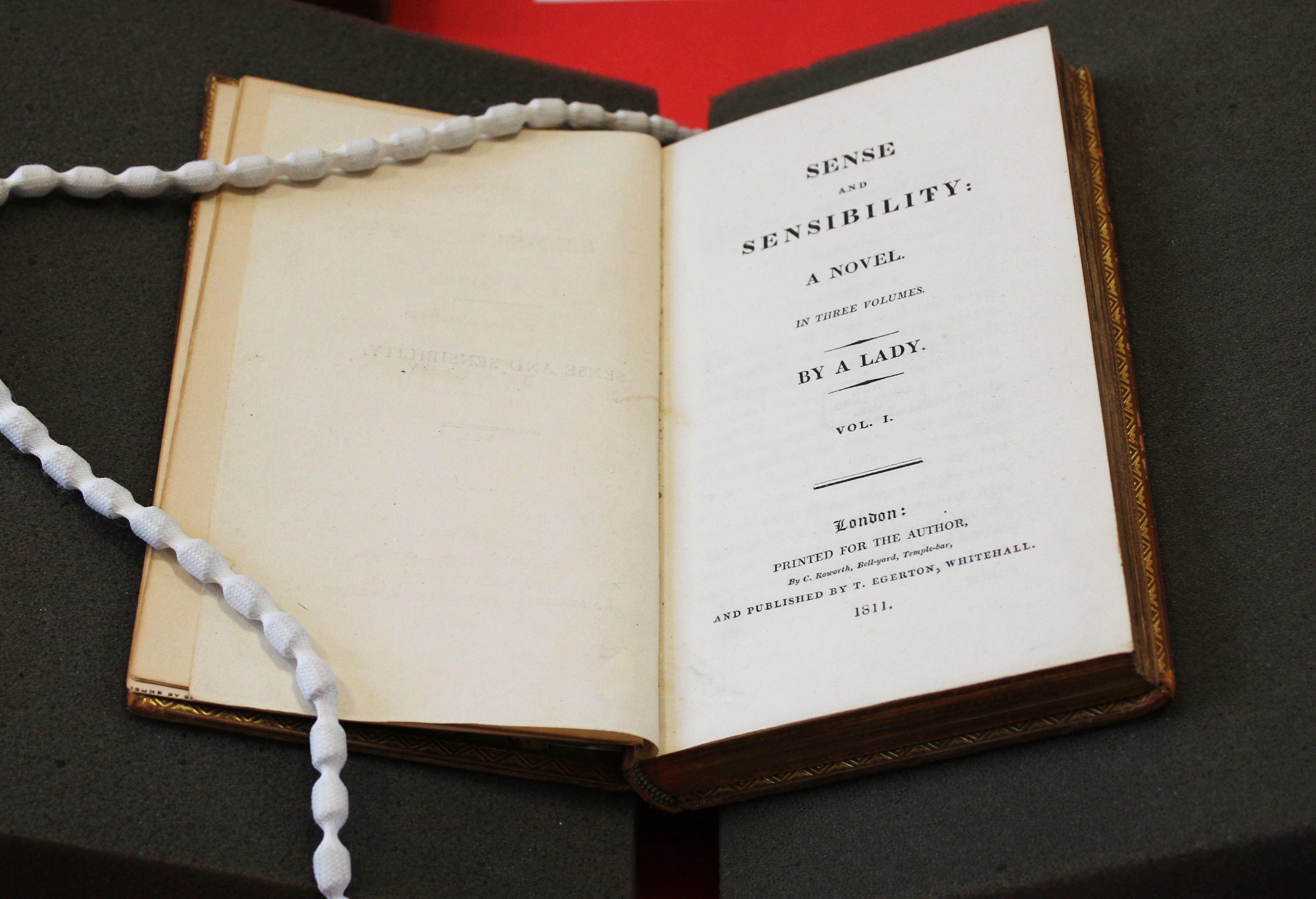
Jane Austen, Sense and Sensibility (London: Egerton, 1811), First edition
Warren.A.Se.1811/1-3

Pride and Prejudice, originally titled First Impressions, was offered for publication to the London bookseller Thomas Cadell, but the offer was declined by return post. The novel was subsequently published by Thomas Egerton under the revised title Pride and Prejudice. Upon receiving her copy of the first edition from the publisher, Jane wrote: ‘I have got my darling child from London’ (27 Jan 1813).
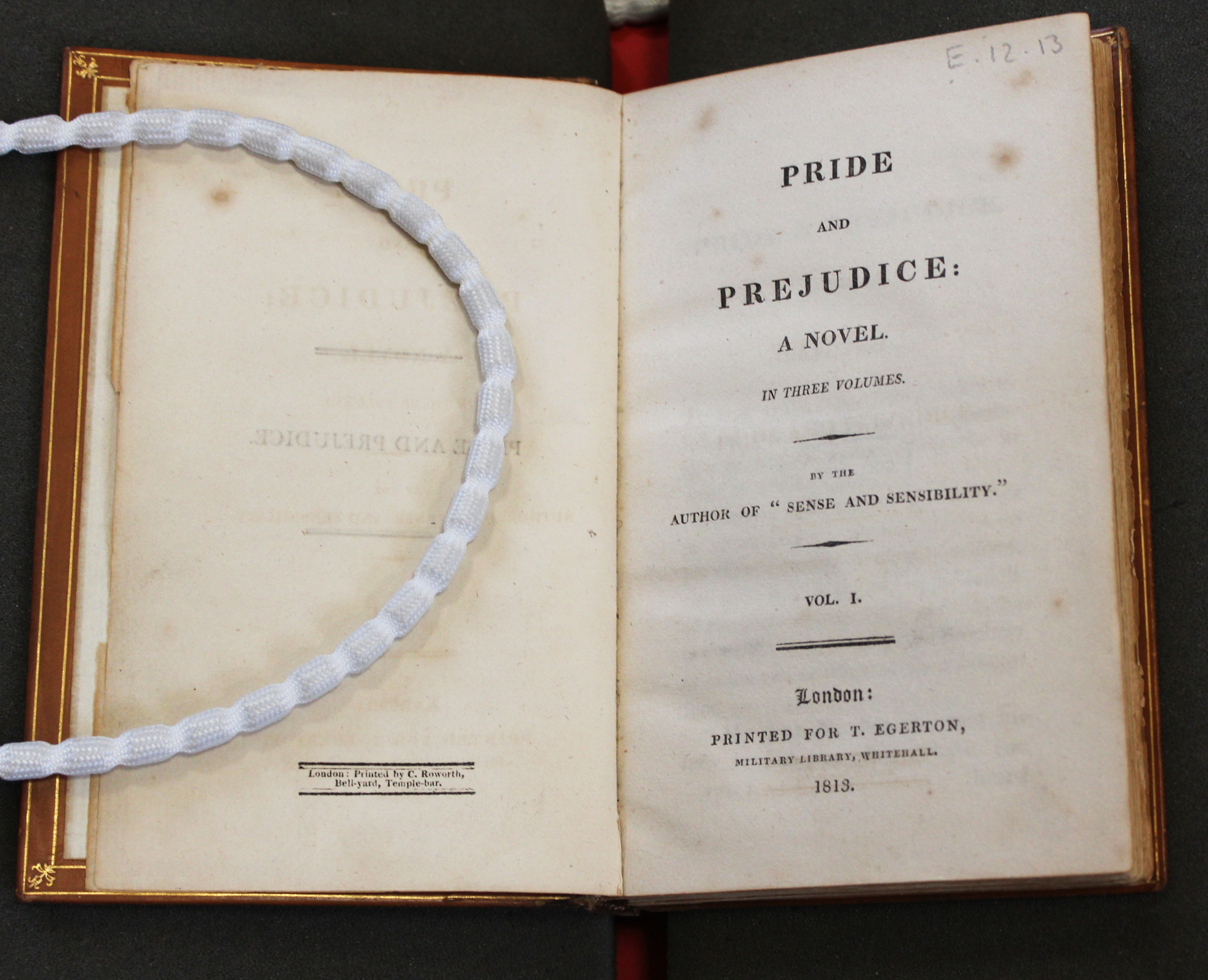
Jane Austen, Pride and Prejudice (London: Egerton, 1813), First edition
Warren.A.Pr.1813a/1-3

The Austen family lived in Bath between 1801 and 1806. Jane was familiar with the Pump Room, a venue for fashionable people, which is used as a setting in her novels Northanger Abbey and Persuasion. This image, from The New Bath Guide (1807), shows the Pump Room as it would have looked during Jane Austen’s time there.

Christopher Anstey, The New Bath Guide; or, Memoirs
of the B.N.R.D. Family in a Series of Poetical Epistles (Bath, 1807)
Warren.B.97.New.1807

Austen’s novels Persuasion (written 1815-16) and Northanger Abbey (written 1798-99) both appeared posthumously in a four-volume set in December 1817, although the title page states 1818. They are prefaced by a ‘biographical notice’ written by Jane’s brother Henry Austen in which Jane’s identity is revealed for the first time. She appears to have intended to publish Persuasion in 1818 but did not live long enough to do so.
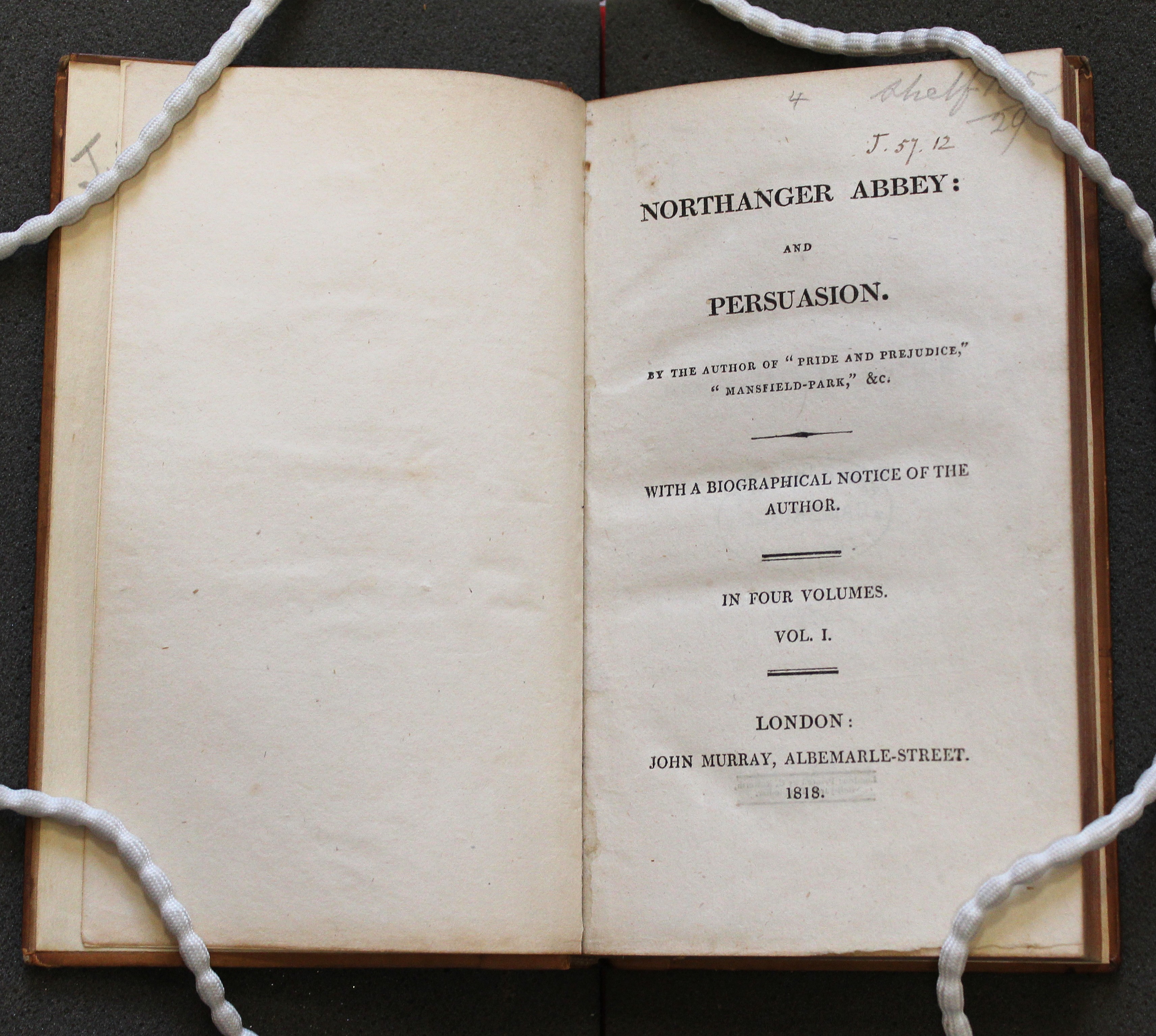
Jane Austen, Northanger Abbey, and Persuasion (London: Murray, 1818), First edition
Thackeray.J.57.12-15

In 1809 Austen’s brother Edward offered his mother and sisters a more settled life – the use of a large cottage in Chawton, near Alton in Hampshire. Whilst living in Chawton Jane published her first four novels. She also wrote Mansfield Park there between 1811 and 1813. It was first published by Egerton in 1814 and a second edition was published in 1816 by John Murray, still within Austen’s lifetime. It did not receive any critical attention when it first appeared.

Jane Austen, Mansfield Park (London: Egerton, 1814), First edition
Warren.A.Ma.1814/1-3

When Henry Austen was taken ill in London in October 1815, he was attended by his sister Jane and by one of the Prince Regent’s doctors who identified her as the author of Pride and Prejudice. The doctor reported that the Prince (later George IV) was a great admirer of her novels and she was invited to dedicate one of her future works to the Prince. Emma was the lucky work. Jane disapproved of the Prince’s treatment of his wife, but felt she couldn’t refuse, so she settled for a title page reading simply ‘Emma, Dedicated by Permission to HRH The Prince Regent’, though her publisher (John Murray) thought it ought to be more elaborate.

This copy of the first edition of Emma belonged to King’s Provost George Thackeray (1777–1850).
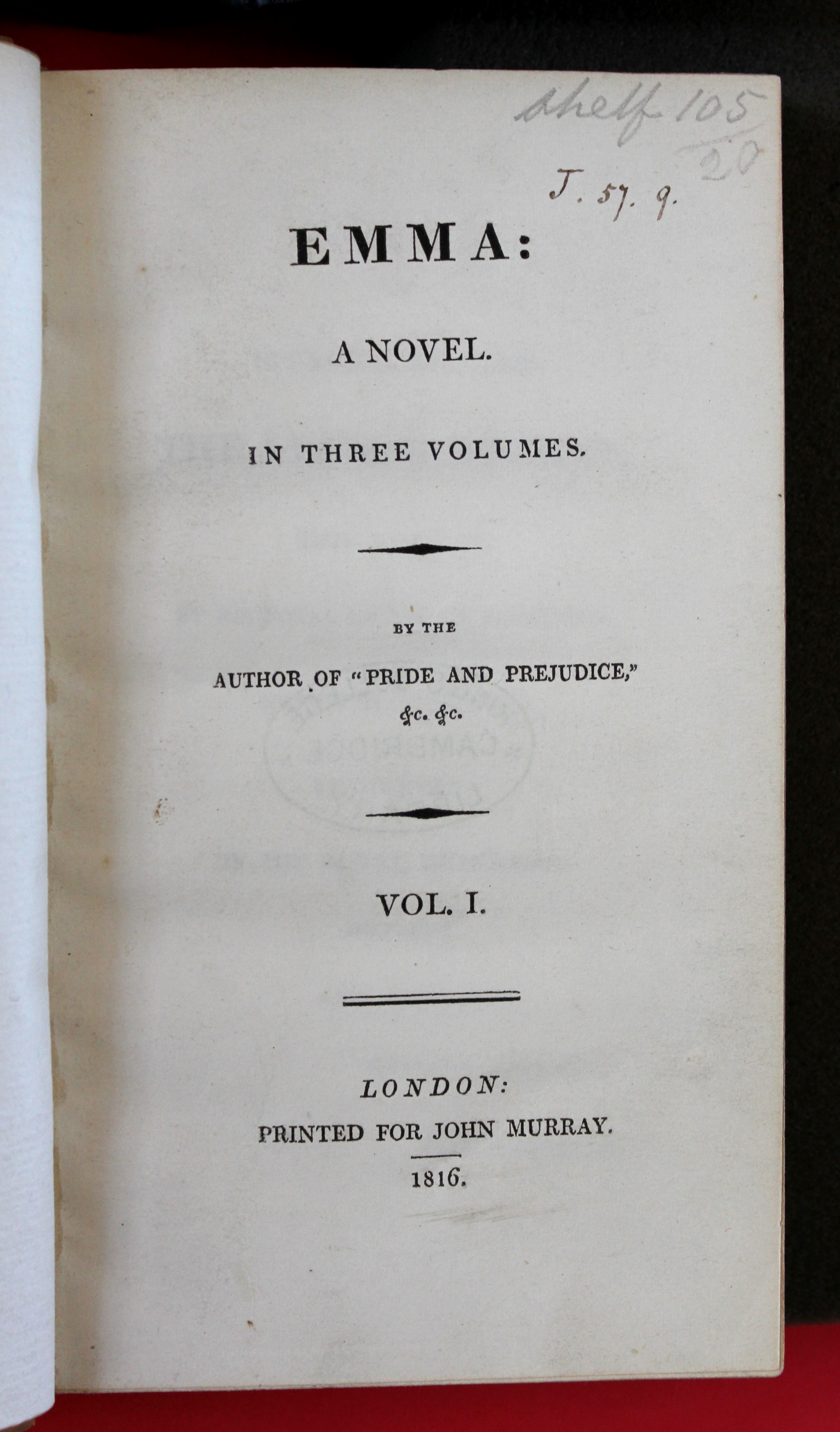
Jane Austen, Emma (London: Murray, 1816), First edition
Thackeray.J.57.9-11

Several months after the dedication of Emma, Jane wrote to John Murray and reported that the Prince had thanked her for the copy of Emma. In the same letter she notes that in a recent review of the novel, printed in The Quarterly Review (vol. XIV, 1816), the anonymous reviewer (later established as Sir Walter Scott) completely fails to mention Mansfield Park, remarking with regret that ‘so clever a man as the reviewer of Emma, should consider it as unworthy of being noticed’.

Jane Austen’s letter to John Murray, 1 April 1816 (NM/Austen/1)

Among the miscellaneous items on display was one of the few known copies of Sense and Sensibility in yellowback. Chapman and Hall’s series ‘Select Library of Fiction’ was closely associated with W.H. Smith, who carefully sought out copyrights, or reprint rights, of popular novels in order to publish yellowback editions for sale on his railway bookstalls. The series, which ran from 1854 until it was taken over by Ward, Lock in 1881, included at least thirty novels by Anthony Trollope, who had strong views on the poor quality of much railway literature.

Jane Austen, Sense and Sensibility
(London: Chapman and Hall, 1870)
Warren.A.Se.1870

One of the highlights of the exhibition was Jane Austen’s copy of Orlando furioso, signed by her on the fly-leaf, sold by the Austen-Leigh family, bought by Virginia Woolf, and inscribed by Woolf to John Maynard Keynes at Christmas 1936.

Ludovico Ariosto, Orlando furioso (trans. by John Hoole)
(London: Charles Bathurst, 1783)
Keynes.E.4.1

These Victorian editions of Mansfield Park, Emma, and Northanger Abbey were presented to E. M. Forster’s mother by his father, and were later inherited by Forster himself.

Copies of Mansfield Park, Emma and Northanger Abbey from the library of E. M. Forster (all London: Routledge, 18–)
Forster.AUS.Man; Forster.AUS.EMM; Forster.AUS.Nor

King’s College owns the manuscript of Jane Austen’s unfinished novel Sanditon, the last one on which she was working before she died on 18 July 1817. It is a rare surviving autograph manuscript of her fiction. It was given to King’s in 1930 by Jane’s great-great niece (Mary) Isabella Lefroy in memory of her sister Florence and Florence’s husband, the late Provost Augustus Austen Leigh who was a great-nephew of Jane. The booklets were made by Austen herself. The last writing is dated 18 March 1817. She died four months later.

The beginning of Sanditon

Below is the beginning of chapter 6, followed by the transcription in the printed version of Sanditon.

The beginning of chapter 6
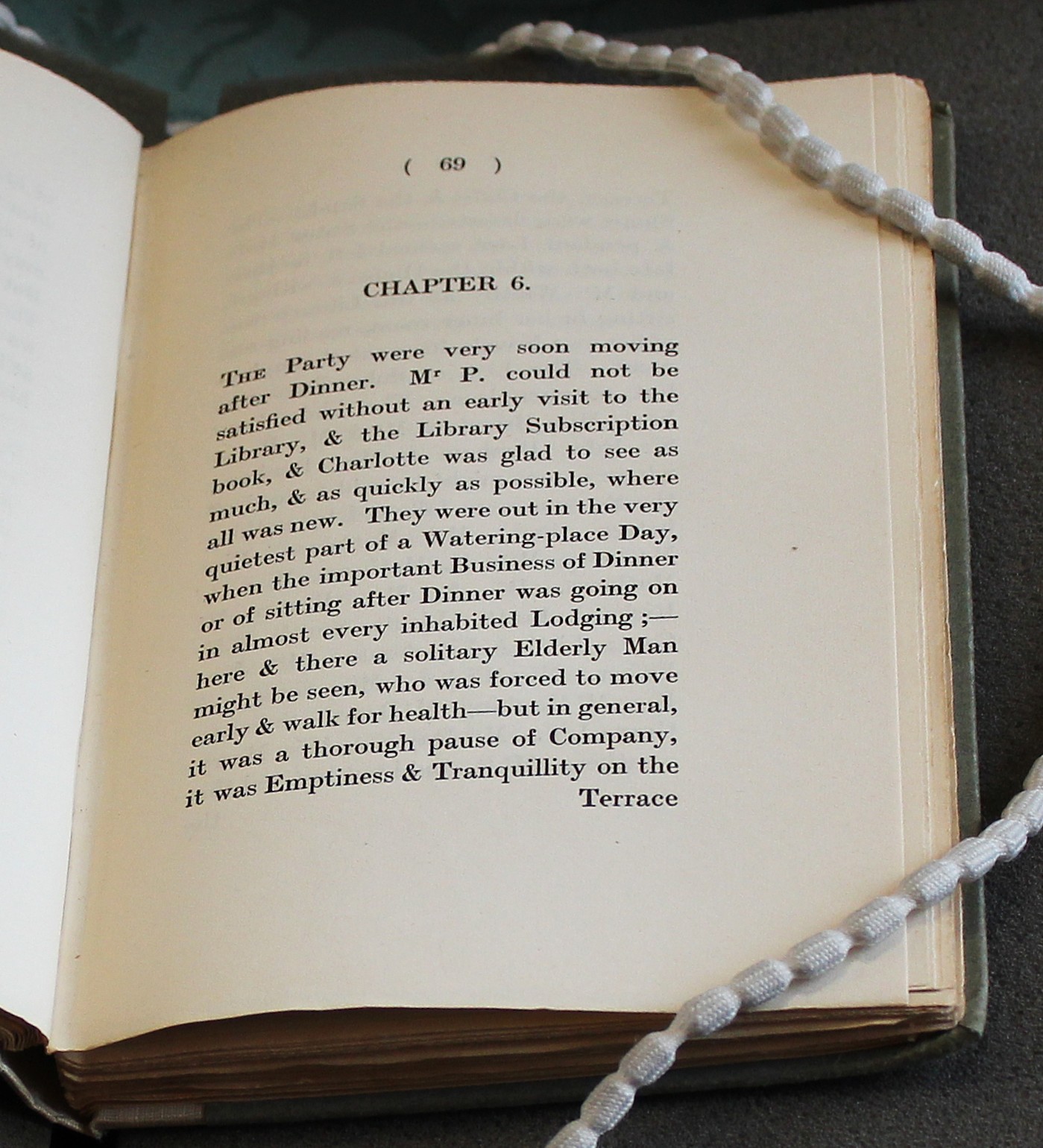
This copy of the first edition of Sanditon comes from the library of E. M. Forster.
Jane Austen, Fragment of a Novel (Oxford: Clarendon Press, 1925)
Gilson.A.Sa.1925a

During the summer, King’s College loaned one of the fascicles of Sanditon to Harewood House to be displayed there as part of their exhibition ‘Austen and Turner: A Country House Encounter’ where it occupied pride of place and was viewed and admired by thousands of visitors.

JC/IJ



A celebration of Orlando Gibbons (1583-1625)

This year at King’s we have been marking the 400th anniversary of the death of the composer Orlando Gibbons. Gibbons was born in Oxford in 1583 to a musical family who moved to Cambridge when he was an infant. He was admitted to King’s College in 1598 at the age of fourteen, though had apparently been a chorister at King’s for some years before that, and received a Bachelor of Music degree from the university in 1606. His later life took him to London, where his reputation as a composer and organist was established, and finally to Canterbury, where he died in June 1625 after a sudden illness. He is buried in Canterbury Cathedral.

Portrait of Orlando Gibbons by an unknown artist. Image from Wikimedia Commons.

An inspection of Gibbons items held by King’s College Library has revealed some treasures that may not have seen the light of day for many a year.

My own introduction to Gibbons came when I was about fourteen, singing his sublime five-voice madrigal ‘The silver swan’ with my school chamber choir. We can trace this work through the centuries using various editions held in the Rowe Music Library.

Few of Gibbons’ compositions were published during his lifetime, one notable exception being The First Set of Madrigals and Mottets, printed in 1612 by Thomas Snodham. This is a collection of 20 secular songs, the first of which is ‘The silver swanne’. At King’s we have a copy of the cantus partbook only (containing the part for the highest voice), purchased in 1996 with a gift from the widow of Sir Henry Lintott (KC 1928).

Title page and page 1 of Orlando Gibbons, The First Set of Madrigals and Mottets … (London: Printed by Thomas Snodham, the Assigne of W. Barley, 1612) Shelfmark: LU.50

‘The silver swan’ next appears in the Rowe’s collection as part of a 1673 edition of The Musical Companion, a collection by John Playford anthologising ‘dialogues, glees, ayres and songs’.

Title page of John Playford (ed.), The Musical Companion … [Book 2] (London: Printed by W. Godbid for John Playford, 1673) Shelfmark: LU.101

The madrigal here is arranged for three voices, sacrificing much of the richness of the inner parts. The three parts are presented as a double-page spread, the middle part printed upside down, presumably so that three singers could share a single book, the Cantus Primus and Bassus singers reading from one side, the Cantus Secundus from the other.

Pages 152-153 of The Musical Companion … [Book 2] (London: Printed by W. Godbid for John Playford, 1673) Shelfmark: LU.101

The rise of glee and catch clubs in late eighteenth-century Britain led to many publications like The Apollo, or Harmonist in Miniature, an 8-volume anthology probably dating from the early 1820s. The frontispiece features William Hawes, Master of Children at the Chapel Royal from 1817 and evidently the pin-up of catch club members at that time.

Frontispiece and title page of The Apollo, or Harmonist in Miniature … Vol. 3 (London: T. Williams, c. 1820) Shelfmark: Rw.112.48

This arrangement of ‘The silver swan’, essentially the same as Playford’s, is presented in a small format (18 cm high), which suggests that each member of the catch club would have had his own copy.

Pages 198-199 of The Apollo, or Harmonist in Miniature … Vol. 3 (London: T. Williams, c. 1820) Shelfmark: Rw.112.48

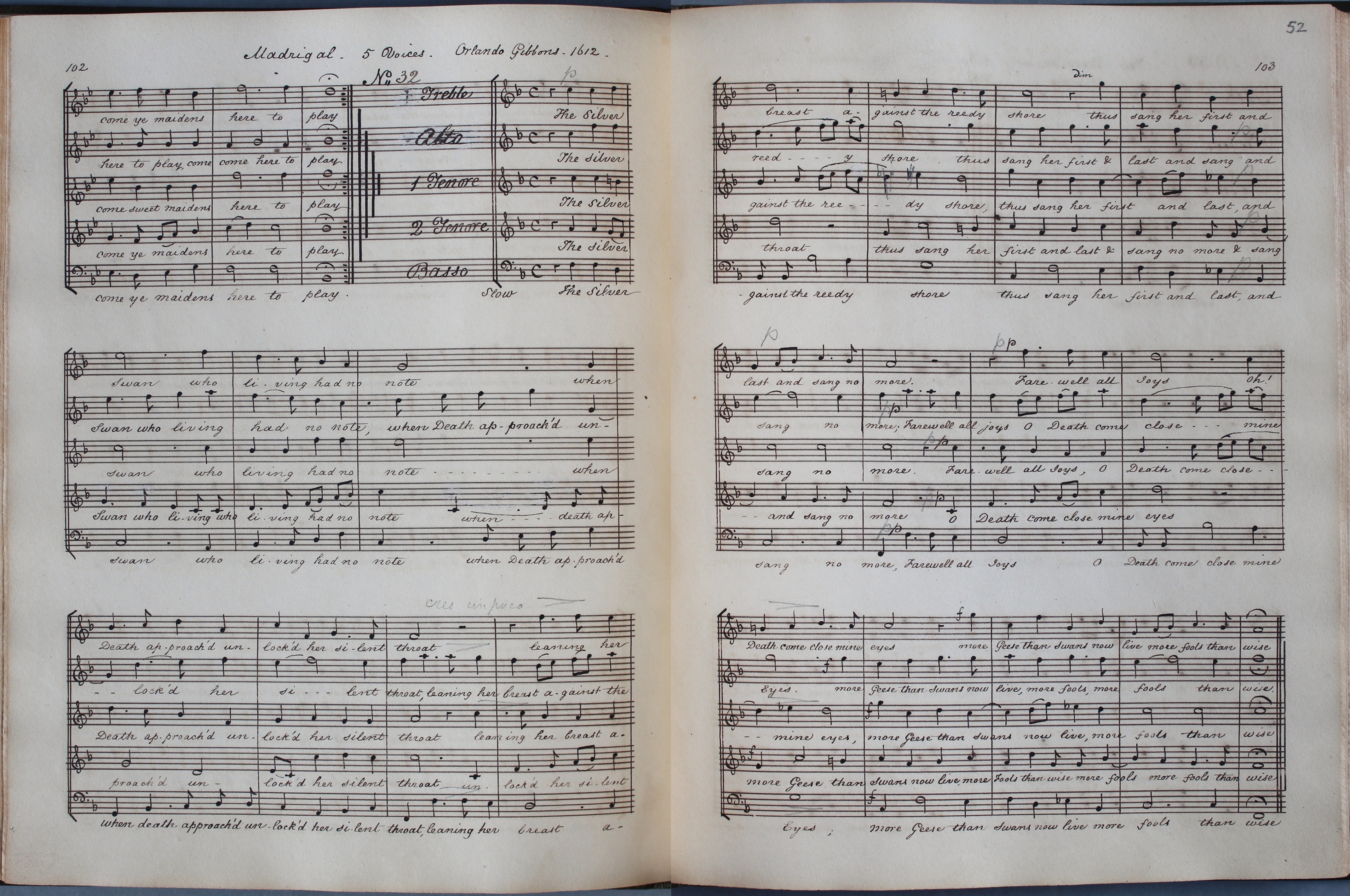
The Rowe Library’s MS 111 is a manuscript dating from 1834-5 in the hand of Thomas Oliphant (1799-1873), best remembered today for writing the lyrics of ‘Deck the hall with boughs of holly’. Oliphant had recently been elected Honorary Secretary of The Madrigal Society (still going today, and now admitting women), and the book may have been intended as his neat conductor’s copy of the 83 motets, madrigals and glees it contains, of which no. 32 is ‘The silver swan’.

Pages 102-103 of Rowe Music Library, MS 111

***

Naturally it is Gibbons’ sacred music that is heard most in King’s College Chapel, in the form of hymns and anthems. Gibbons’ reputation as a composer of hymn tunes rests on his contributions to George Wither’s 1623 publication The Hymnes and Songs of the Church, for which he wrote 17 original tunes still known today by the ‘Song’ numbers accorded them in this volume. A patent of King James I ordained that the book should be bound with all copies of the metrical Psalms sold, which may account for the early adoption of Gibbons’ tunes by church choirs.

Title page of G[eorge] W[ither], The Hymnes and Songs of the Church … (London: Printed by the Asignes of George Wither, 1623) Shelfmark: Keynes.C.5.17

‘Song 1’, which in this book accompanies Wither’s text ‘Now shall the praises of the Lord be sung’, is today more commonly sung to ‘O Thou who at the Eucharist did pray’ or ‘Eternal ruler of the ceaseless round’.

Opening of ‘Song 1’ from G[eorge] W[ither], The Hymnes and Songs of the Church … (London: Printed by the Asignes of George Wither, 1623) Shelfmark: Keynes.C.5.17

***

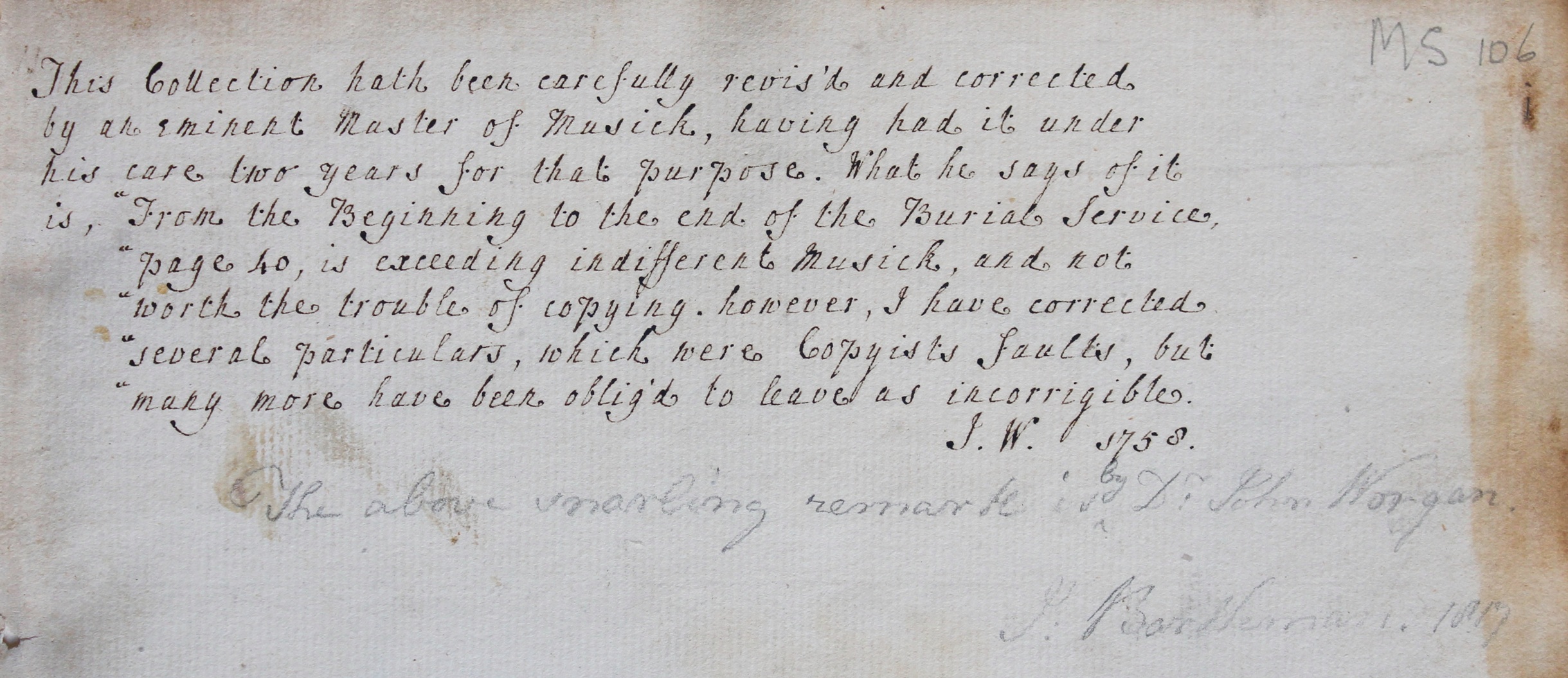
The Rowe Library’s MS 106 is an eighteenth-century manuscript containing anthems and services copied in several hands. A note on the flyleaf observes:

This Collection hath been carefully revis’d and corrected by an eminent Master of Musick, having had it under his care two years for that purpose. What he says of it is, ‘From the Beginning to the end of the Burial Service, page 40, is exceeding indifferent Musick, and not worth the trouble of copying. However, I have corrected several particulars, which were Copyists faults, but many more have been oblig’d to leave as incorrigible.’ J.W. 1758

A pencil addition notes:

The above snarling remark is by Dr John Worgan. J. Bartleman, 1817

Note on flyleaf of Rowe Music Library, MS 106

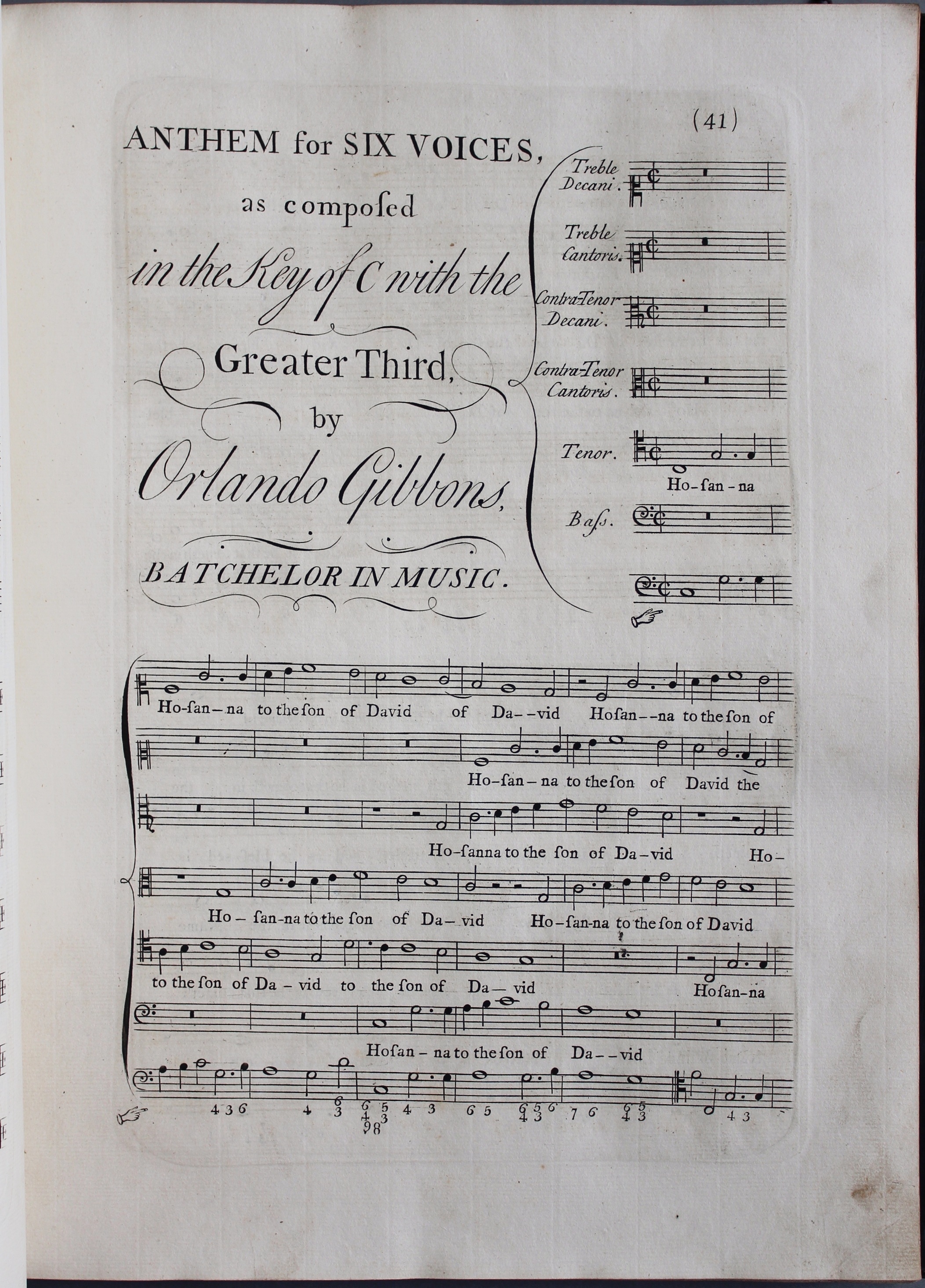
The one Gibbons work present in this volume is his six-voice anthem ‘Hosanna to the Son of David’, at the head of which is written a quotation from Sir John Hawkins’ A General History of the Science and Practice of Music of 1776 describing it as ‘one of the most perfect Models for Composition in the Church-Style of any now existing’.

Page 162 of of Rowe Music Library, MS 106

‘Hosanna to the Son of David’ is one of several Gibbons anthems anthologised in the second volume of Cathedral Music, edited by William Boyce (1711-1779), Master of the King’s Musick, and published in 1768 after a long gestation.

Page 41 of William Boyce (ed.), Cathedral Music … Volume the Second (London: Printed for the Editor, 1768) Shelfmark: Rw.115.12

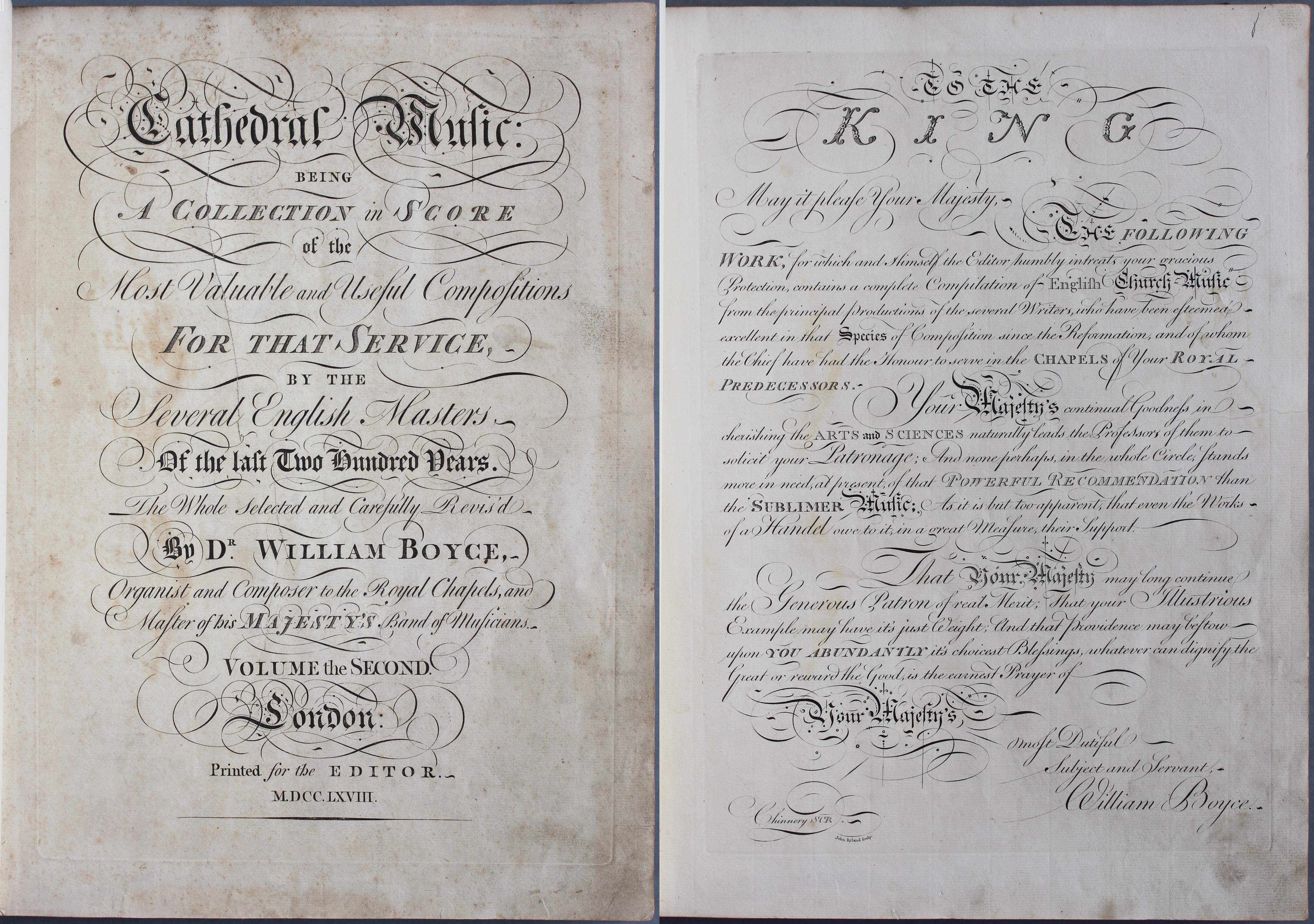
Doubtless partly due to the royal imprimatur, this volume was a swanky undertaking all round, bearing a title page boasting of ‘the most valuable and useful compositions … of the last two hundred years’, a dedication to King George III involving every typeface under the sun, and even an anthem ostensibly composed by George’s predecessor Henry VIII (‘O Lord, the maker of all things’, now usually attributed to William Mundy).

Title page and dedication from William Boyce (ed.), Cathedral Music … Volume the Second (London: Printed for the Editor, 1768) Shelfmark: Rw.115.12

The volume’s subscribers included not only the Provost and Fellows of King’s College, Cambridge (of course), but also such luminaries as:

The Rev. Mr. Heneage Dering, Chaplain to the Earl of Winchelsea.
The late Rev. Mr. Phocion Henley.
Bybie Lake, Esq.
Gervas Scrope, Esq. of Cockerington, in the County of Lincoln.
Messrs. Sharp, of Mincing-Lane, London. Two Sets.
The King.

Blank spaces at the end of anthems are filled with illustrations: usually flourishes and curlicues, but occasionally faces or, at the end of William Byrd’s ‘Bow thine ear, O Lord’, a complementary bird. Note also the snazzy manicules (pointy fingers) in the score to help the organist find his line. No such help for the choir, though the size of the book (42 cm high) suggests it may have been a publication meant primarily for the use of a choirmaster, from which choir parts could be copied in manuscript.

Various devices from William Boyce (ed.), Cathedral Music … Volume the Second (London: Printed for the Editor, 1768) Shelfmark: Rw.115.12

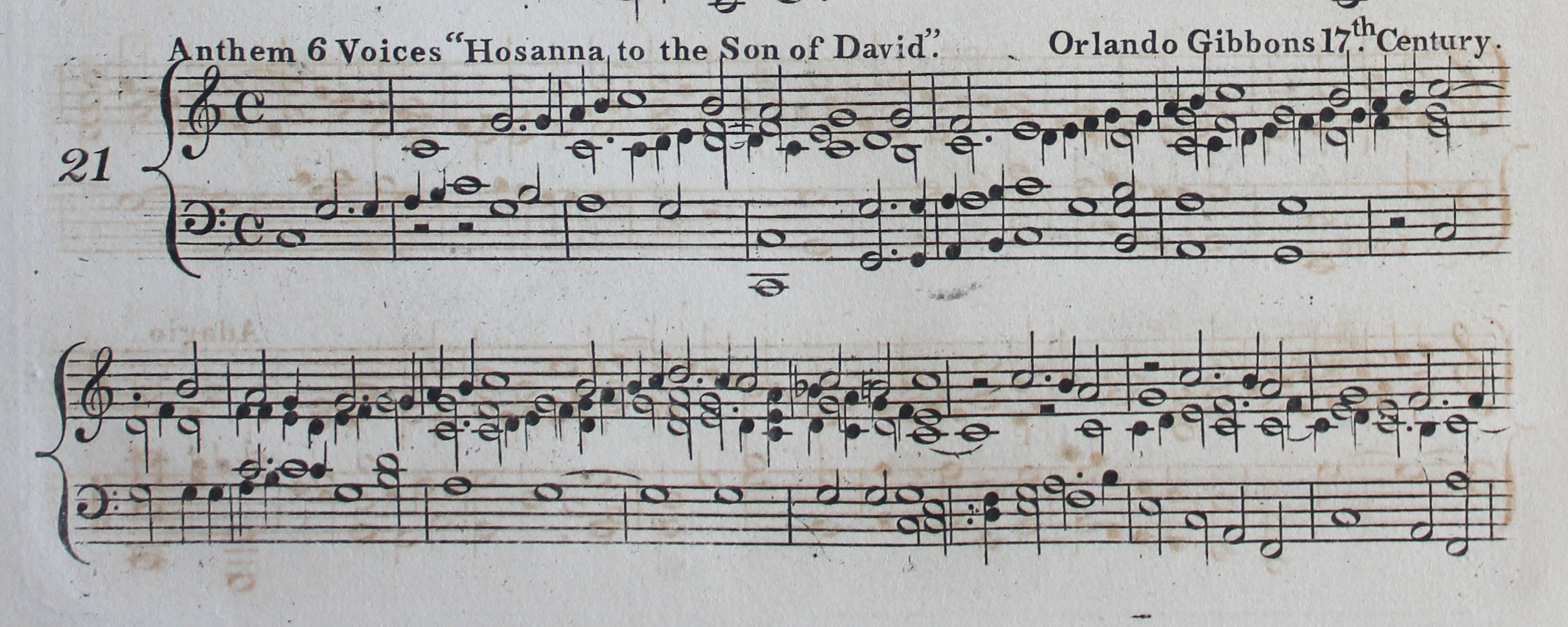
‘Hosanna to the Son of David’ also appears, albeit in short score, in the work known unpromisingly as ‘Crotch’s Specimens’, or more fully as Specimens of Various Styles of Music Referred to in a Course of Lectures Read at Oxford & London and Adapted to Keyed Instruments by Wm. Crotch, Mus.D., Professor of Music in the University of Oxford. The Specimens was a major work of scholarship, ‘encyclopaedic in scope and surprisingly forward-looking in its aim to combine academic example with practical purpose’, in the words of Grove. In a preface to this revised edition, Crotch writes:

The study of Orlando Gibbon’s [sic] works cannot be too strongly recommended. For choice of subjects, for skill in the management of them, and for the flow of melody in all the parts, this great master was inferior to none of his cotemporaries.

Opening of No. 21 from William Crotch, Specimens of Various Styles of Music … Vol. 2 (London: Printed for the Author … c. 1821) Shelfmark: Rw.54.14

It’s no surprise that Gibbons’ music has been an attractive proposition to Kingsmen looking to produce performing editions over the years. Twentieth-century editions of choral works by Gibbons held by the Rowe Library include those prepared by David Willcocks (KC 1939), John Whitworth (KC 1946), Philip Brett (KC 1955) and John Morehen (KC 1964).

***

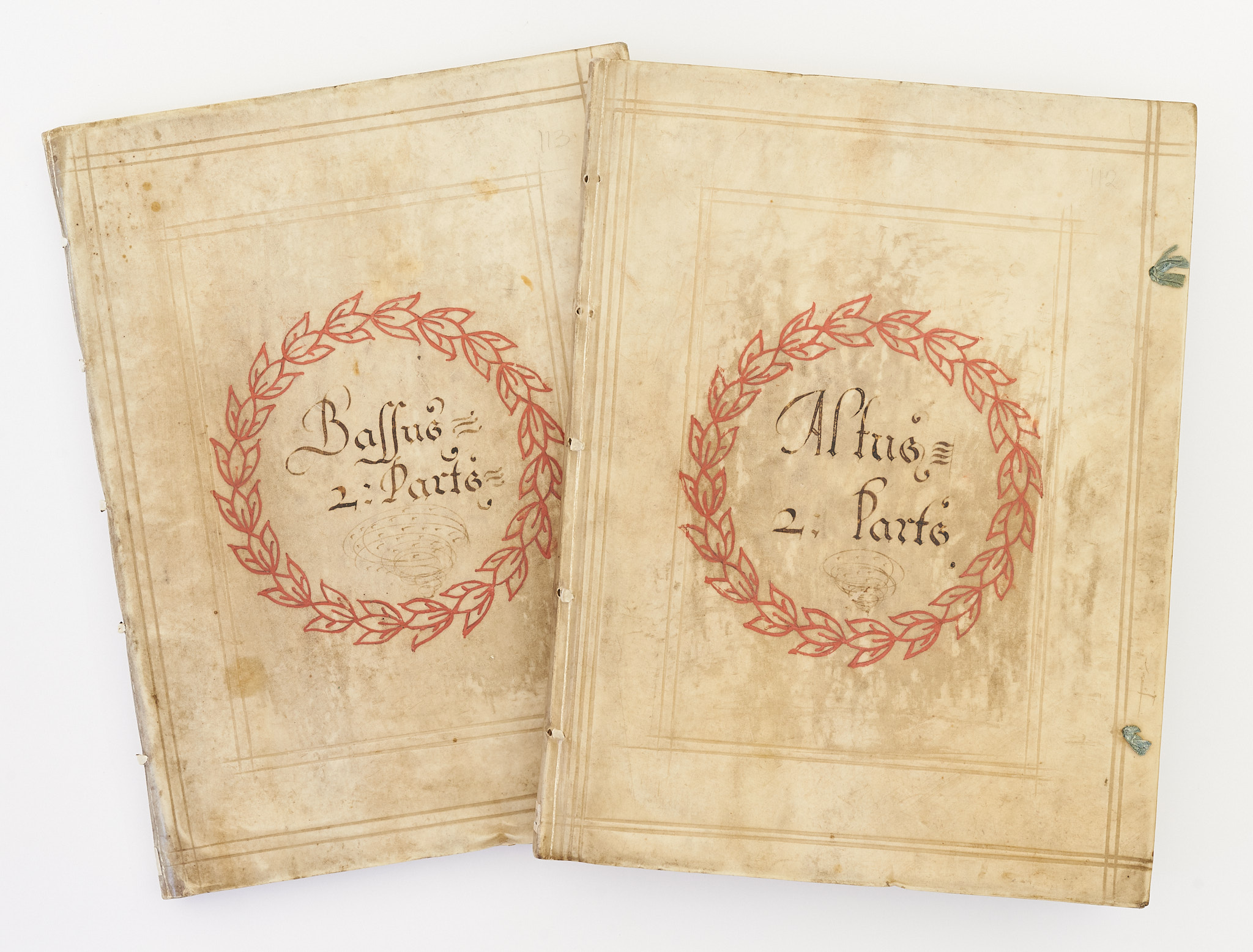
Finally, a pair of mid-seventeenth-century music manuscripts given to the college by John Maynard Keynes. MSS 112 and 113 are two partbooks for viols of fantasias and dances primarily by John Coprario, but also containing works by John Jenkins, William White and others.

Bindings of Rowe Music Library, MSS 112 and 113. Photo © 2025 Sara Rawlinson at HeritagePhotographs.com.

The works included by Gibbons are six fantasias for two treble viols, which are not preserved in manuscript elsewhere. These manuscripts were the property of John Browne (1608-91), Clerk of the Parliaments, and the Gibbons fantasias here are in Browne’s own hand.

No. 13 in Rowe Music Library, MSS 112 and 113

These fantasias have been published in many editions: they appear in the Musica Britannica volume of Gibbons’ Consort Music, and if you fancy playing them yourself you can browse several public-domain versions here.

GB

Victorian railway excursions

In this second blog post marking 200 years of the modern railway, we focus mainly upon its arrival and early years in the Lake District, with a few other choice items from our collections making an appearance towards the end.

The arrival of the railway in the Lake District in the late 1840s markedly increased accessibility to a landscape that had been growing in popularity with tourists since the late eighteenth century. Here, just as in Cambridge, the guidebooks quickly adapted to reflect the new realities of travel.

Likely one of the earliest railway maps of the region is the Collins’ Railway Map of Westmoreland, a small folded map mounted on linen, which would have made it durable and easily portable for use by travellers.

Cover of map. Has a bright orange background

Cover of Collins’ Railway Map of Westmoreland, London, [circa  1847]. Classmark: Bicknell.233

The map is undated, but examination of the railway lines that are indicated on it in black suggests a publication date of around 1847, since it depicts the railway line extending to Lake Windermere which opened in 1847, but not the line to Coniston which arrived in the following year.

Map from Collins’ Railway Map of Westmoreland

Another nice map can be found in a tiny pamphlet guide from 1848, which this time has rail lines marked in red.

titlepage of guidebook

Title page of The Lakes, By Way of Fleetwood and Liverpool …, Manchester, Bradshaw and Blacklock, 1848. Classmark: Bicknell 243

Map

Map from The Lakes, By Way of Fleetwood and Liverpool …


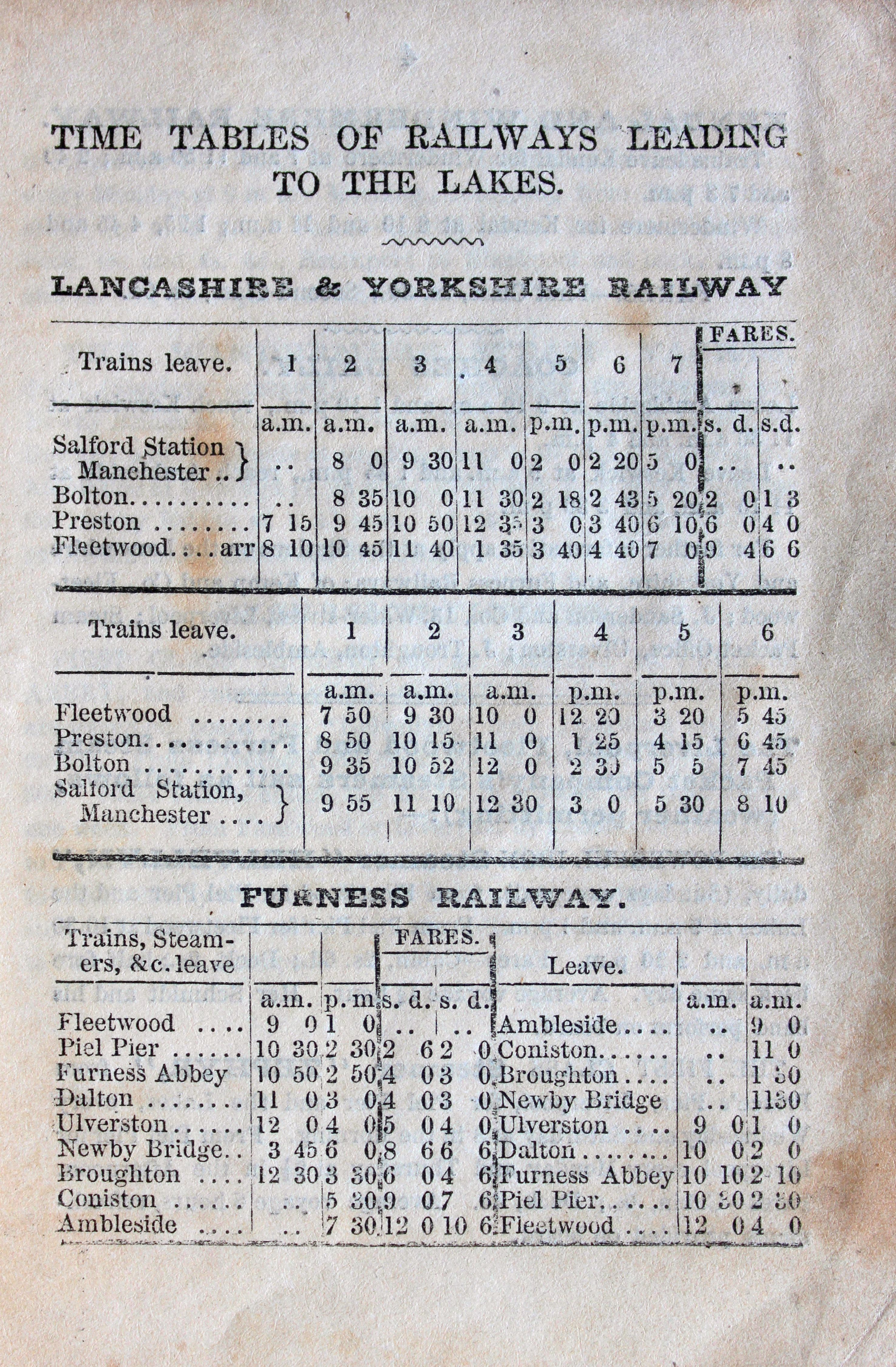
This guide includes timetables for steam ships and railways leading to the Lakes, alongside information about coaches to and from Keswick, which was not yet served by a rail line.

Railway timetables on page 03 of The Lakes …

Coach and steamer information, on page 04 of The Lakes …


Steamer information on page 05 of The Lakes …

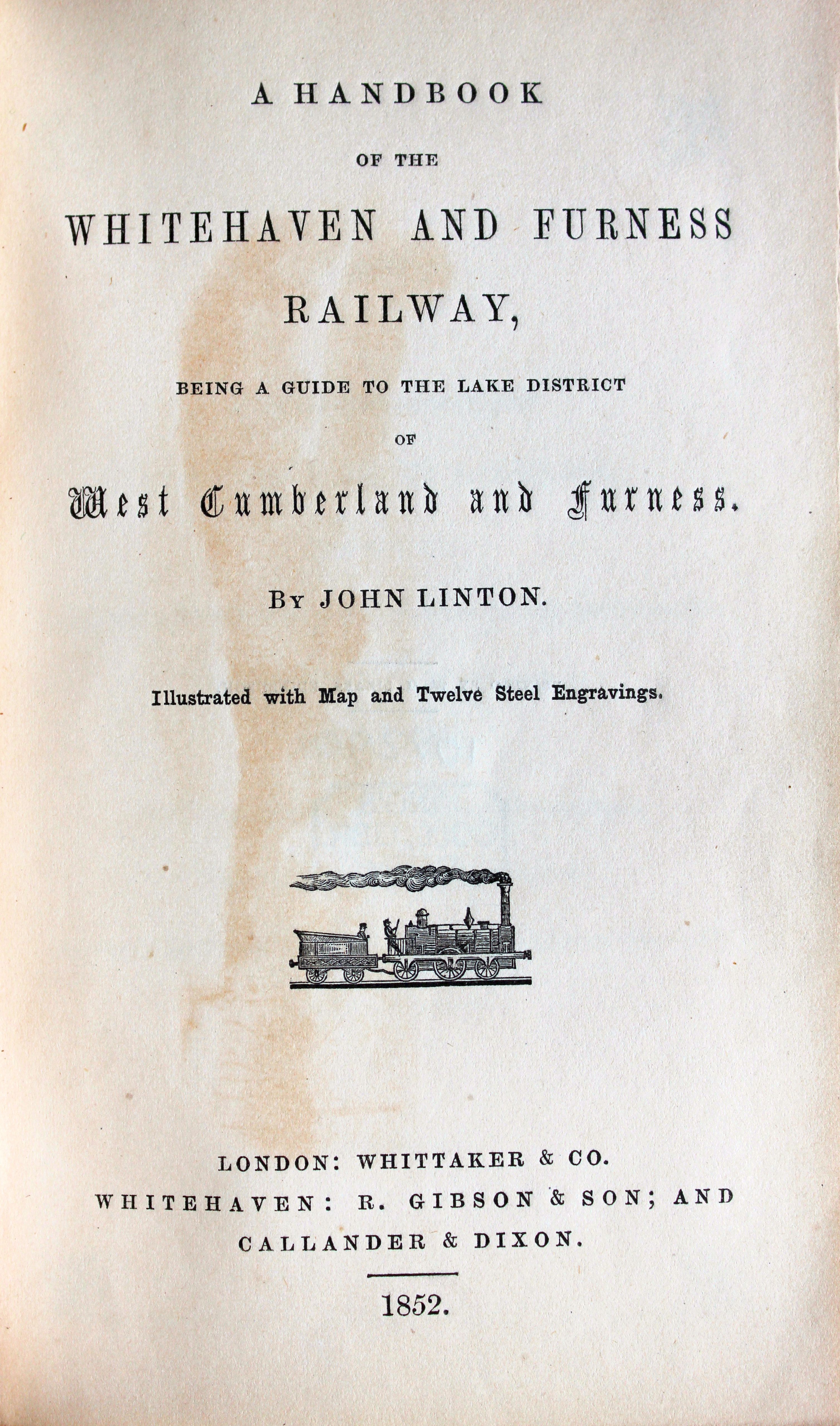
A slightly later guide focuses on areas made more accessible by the Whitehaven and Furness Railway, which opened in 1850. Note the sweet little title page vignette depicting a steam engine:

Ttile page, featuring a small illustration of a steam engine

Title page of: A Handbook of the Whitehaven and Furness Railway by John Linton, London, 1852. Classmark: Bicknell.107

The guide states its purpose clearly (if a little long-windedly) in the introduction:

Our object is merely to supply what, in consequence of the changes recently effected by railway travelling in the approaches to this district, has become a desideratum; – to point out the routes by which the greatly increased number of tourists and others … may arrive at various interesting points of the district; – and to give brief descriptions of several places, all within an easy distance of the railway we have taken as our starting point, which have hitherto, owing to the difficulty of approaching them, been much less frequented …

One such place is the vale of St. Bees, which is described as if viewed from a moving train.  The guidebook goes into raptures about its charms:

After emerging from the cutting, we are again at liberty to enjoy the beauties spread so abundantly on either hand, and it may with truth be said, that a more pleasant and enlivening scene is very rarely met with than that presented to the traveller through the vale of St. Bees. It is a scene of quiet and repose, and yet of the highest cultivation, combining the varied charms of dale and upland, grove and meadow, stately mansion and thriving farm.

If you look closely at the centre of the accompanying engraving (below), you can see a train travelling along the track, trailing steam behind it.

Black and white engraving of a valley with a church and small hamlet, and a train track running through the centre. A train is coming along the track

Plate facing page 24 of A Handbook of the Whitehaven and Furness Railway

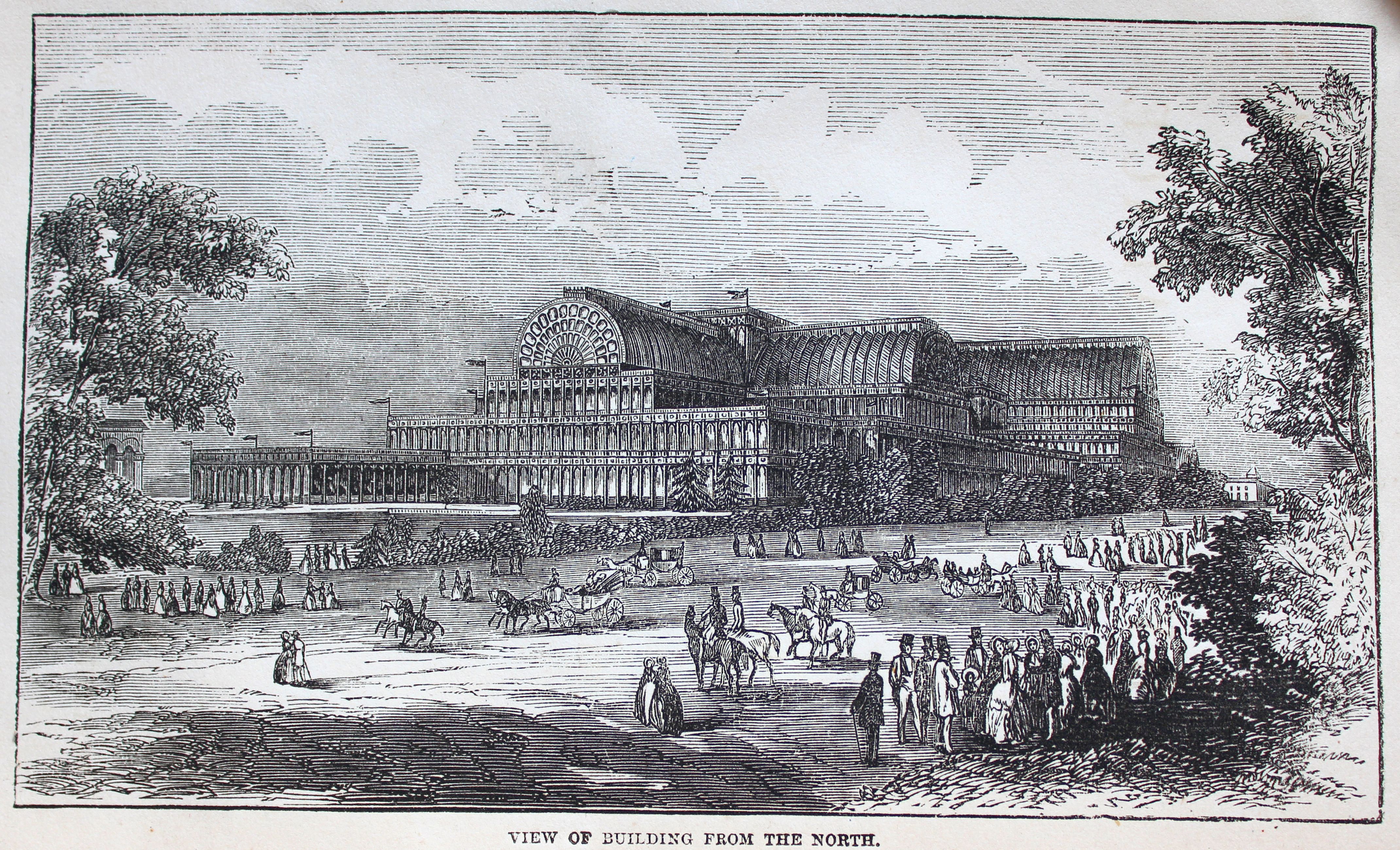
Rail access played an important part in the viability of many business ventures in the Victorian age. When the historic Great Exhibition in London’s Hyde Park, the world’s first international trade fair, closed its doors in October 1851, the future of the exhibition hall, the magnificent Crystal Palace, was initially uncertain. However, the designer Sir Joseph Paxton soon orchestrated the raising of enough private funds to purchase the building and have it re-erected in an adapted and enlarged form on a hilltop in Sydenham, in the south east of the city. An elaborate park was constructed around it and the site was opened to the general public in 1854 as a place for relatively cheap entertainment and recreation for the masses. Attractions included concerts, exhibitions, pantomimes, circuses and the delights of the building itself and the surrounding landscaped gardens. Vital to the success of the scheme was the construction, by the London, Brighton and South-Coast Railway Company, of a dedicated railway station for the site, which opened shortly after the park itself. Close co-operation with the railway was expedited by the fact that the chair of the railway company, Samuel Laing, was also chair of the new Crystal Palace Company. It also made commercial sense for the railway, since any big attraction would boost the growth of rail travel.

The illustration below comes from a little guidebook to the palace and park, published in its inaugural year. Our copy is part of the Thackeray Collection.

Black and white illustration showing the Crystal Palace building in parkland. It looks like a huge greenhouse.

Frontispiece from Guide to the Crystal Palace and Park by Samuel Phillips, London, 1854. Classmark: Thackeray.VIII.11.24

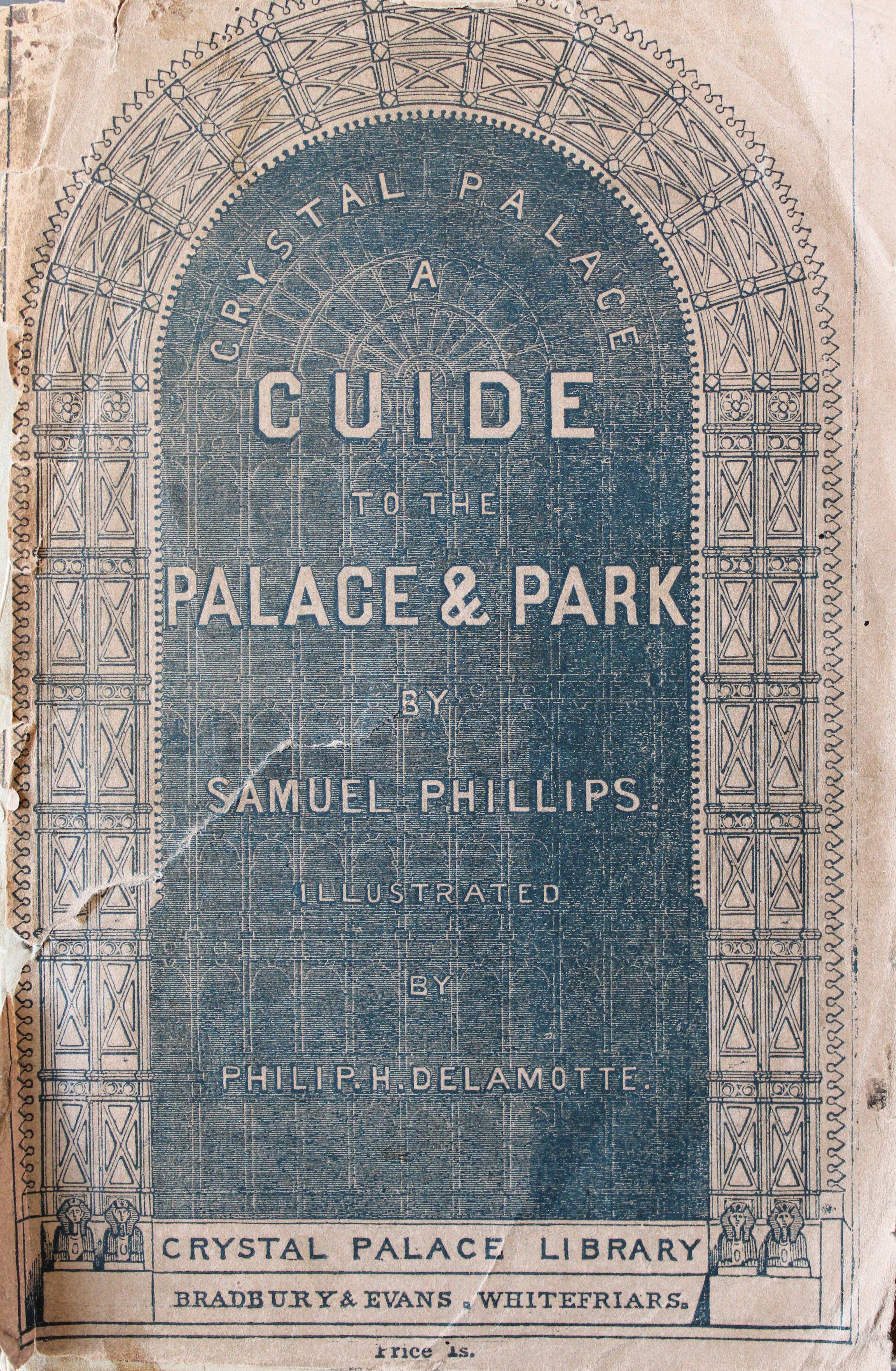
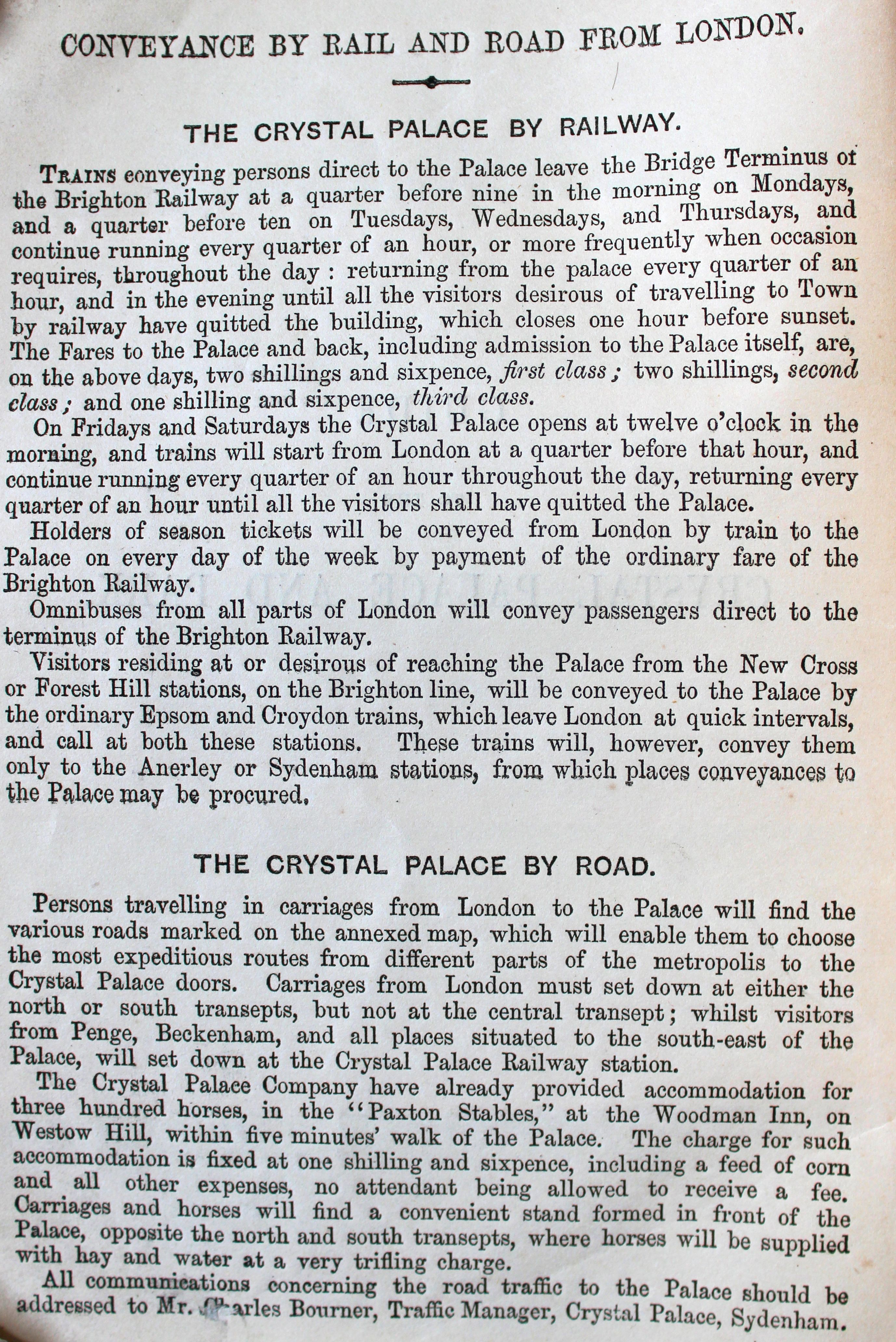
Detailed information on accessing the park by rail is provided inside the guide, revealing that the service ran at least every quarter of an hour and more frequently at busy times of day. Return tickets, which included admission to the Palace, were one shilling and sixpence for third class travel, rising to two shillings and sixpence for first class.

Cover of the guide. The title is depicted within an illustration of a large ornate archway

Front cover of Guide to the Crystal Palace and Park

Travel information

Travel information on the back of the half-title page of Guide to the Crystal Palace and Park 

Incidentally, this guide includes  an advertisement by the South Eastern Railway for what they refer to as: “tidal trains”, which offered a streamlined service between London and Paris. Passengers could board an express train to Folkestone, embark upon a waiting steamer ship and be met after the channel crossing by a direct train for Paris. Luggage would be managed from start to finish by the rail company. The same arrangements applied for a trip in the other direction. Not bad for the early decades of rail travel!

Advert

Page 47 of the Advertiser section of Guide to the Crystal Palace and Park

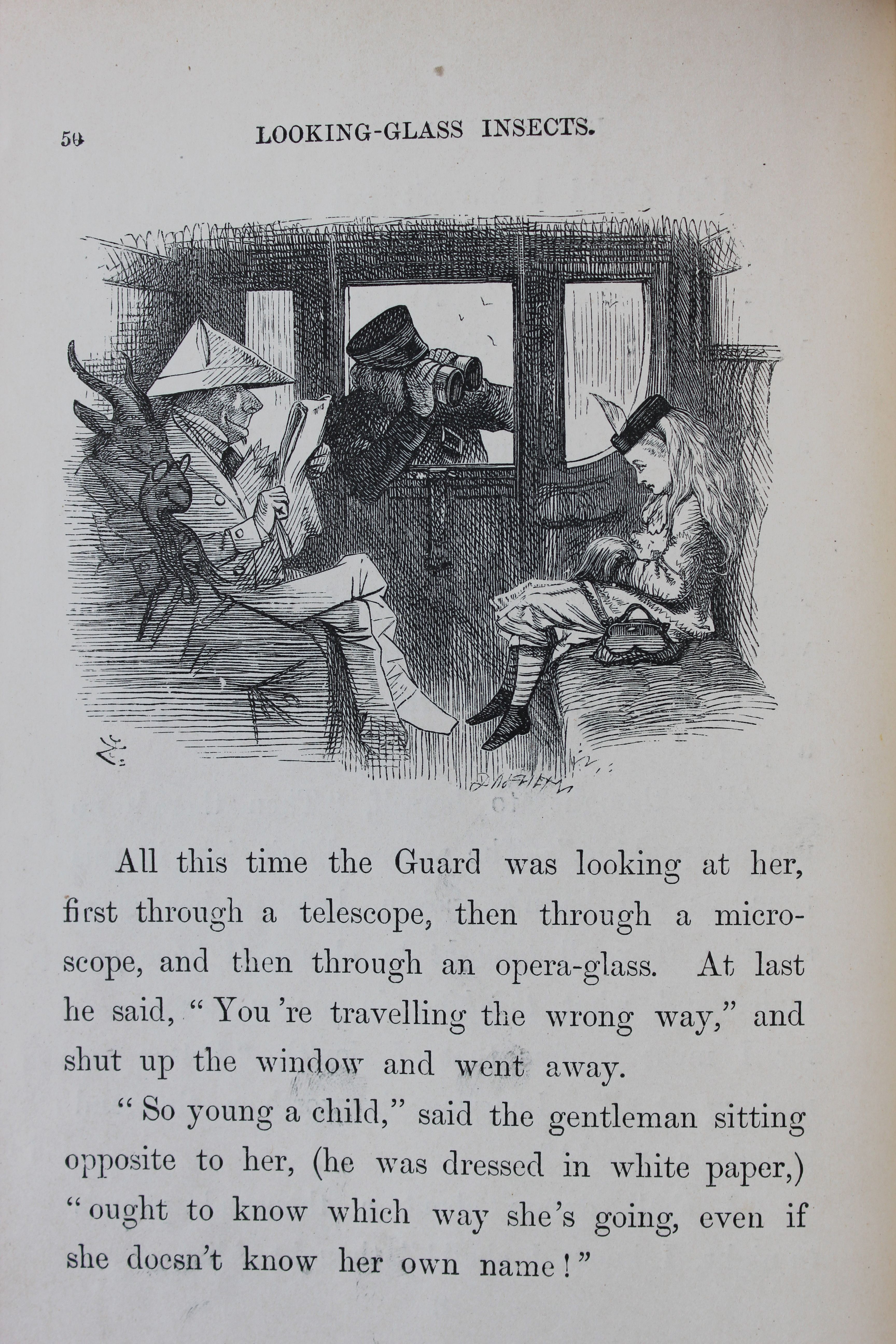
The final destination on our whistlestop tour of railway-themed material is our Rylands Collection of children’s books. An illustration from the first edition of Through the Looking Glass depicts Alice in a train carriage with some rather odd travelling companions.

Illustration within the text of Alice in a railway carriage with a goat and a man with a paper hat. There is a guard peering at her through binoculars

Illustration by John Tenniel from page 50 of Through the Looking Glass, and What Alice                                   Found There by Lewis Carroll, London, 1872. Classmark: Rylands.C.CAR.Thr.1872

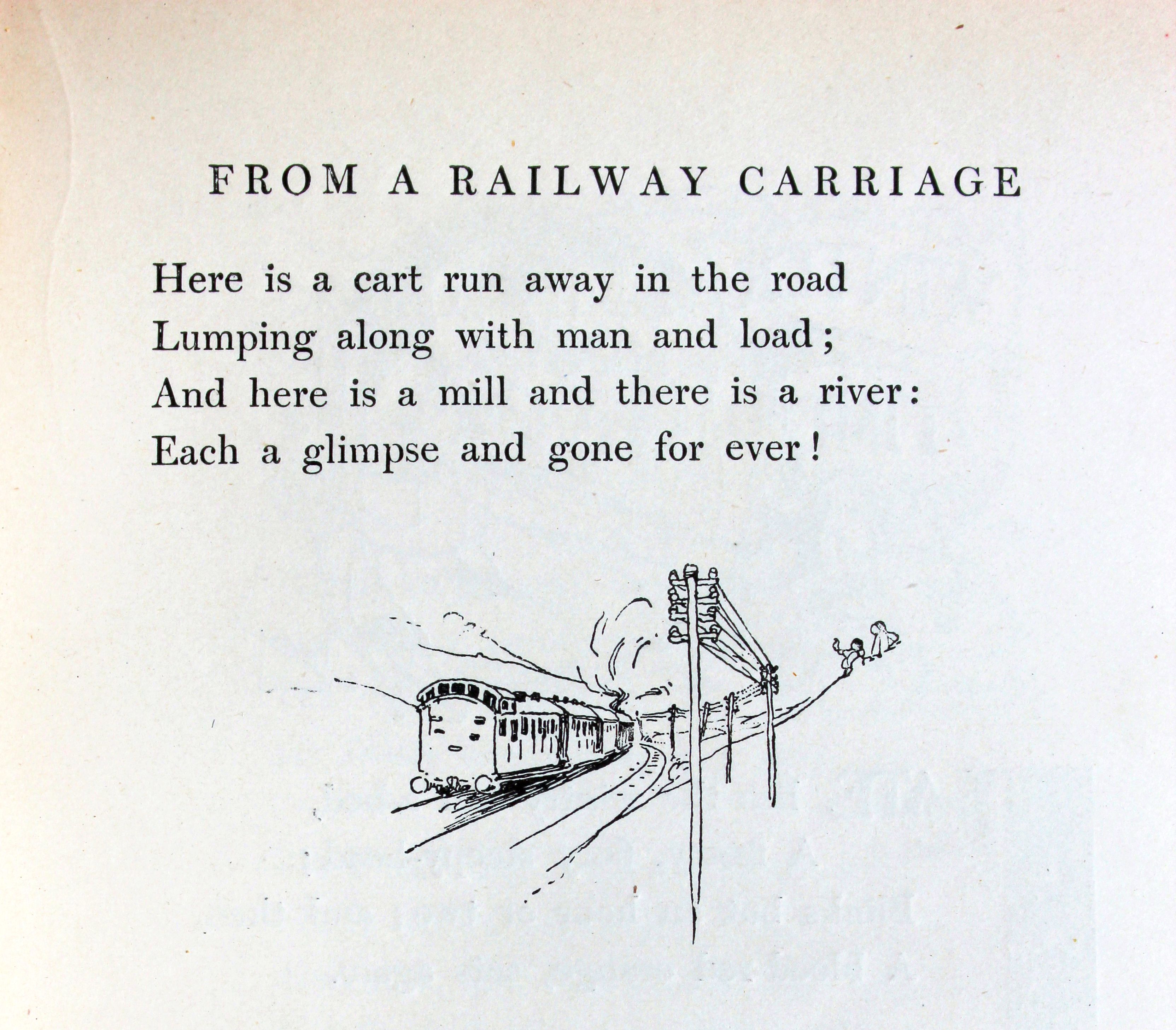
We also hold a copy of Robert Louis Stevenson’s A Child’s Garden of Verses, which includes this wonderfully evocative poem about a train journey.

The text of the poem, illustrated with a railway carriage

Page 68 of A Child’s Garden of Verses by Robert Louis Stevenson, London, 1896. Classmark: Ryland’s.C.STE.Chi.1896

The second page of the poem, with a small illustration of a retreating train

Page 69 of A Child’s Garden of Verses

We hope you’ve enjoyed this look at the early days of rail travel as reflected in our collections and that you enjoy any and all excursions you make this autumn and winter, whether by train or by any other means!

AC

References and further reading:

Railway 200 [accessed September 2025]

Lee Jackson, Palaces of pleasure: how the Victorians invented mass entertainment, New Haven, 2021

The Crystal Palace Foundation [accessed September 2025]

The railway arrives in Cambridge!

This year marks both 200 years of the modern railway and the 180th anniversary of the opening of Cambridge Station on 29 July 1845.  These anniversaries prompted us to search out and share some railway-related material from our various special collections. Enough material was found for two blog posts, so this first will begin close to home with Cambridge, whilst a second subsequent post will range further afield.

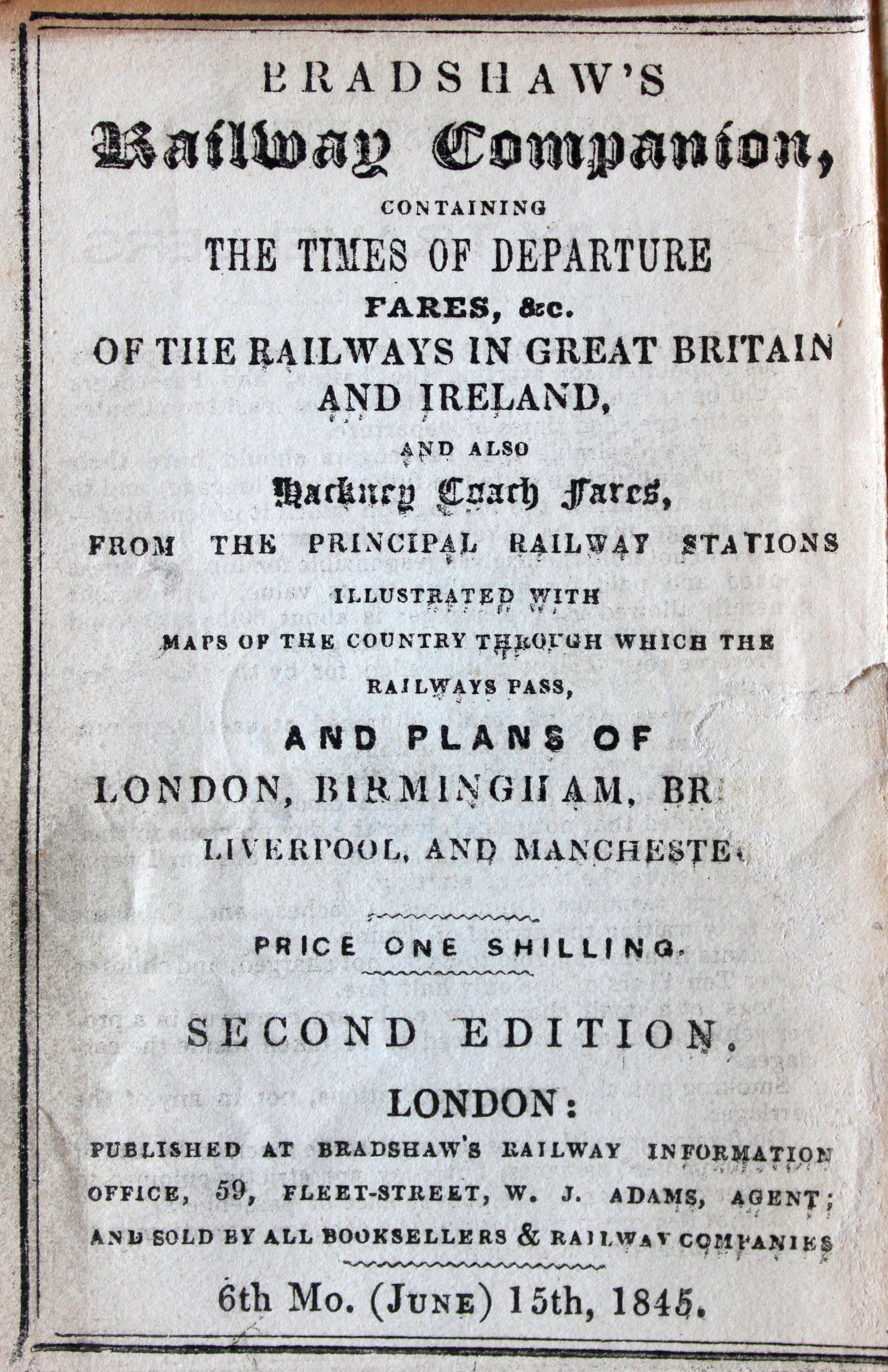
We happen to hold both a Cambridge guidebook published in 1845 and an edition of Bradshaw’s Railway Companion from the same year, both of which anticipate the imminent arrival of the station.

Titlepage of Bradshaw's railway companion from June 1845

Title page of Bradshaw’s Railway Companion, London, 1845. Classmark: N.26.33

Bradshaw’s guides were the first railway timetables ever to be published and were hugely popular in the Victorian era. They are frequently referenced in the literature of the day, including in Arthur Conan Doyle’s stories of Sherlock Holmes. Our copy dates from June 1845, when the closest  station to Cambridge was Bishop’s Stortford, but the timetable below is already labelled as: “Eastern Counties – Cambridge Line”.

A detailed timetable for the Eastern Counties Cambridge line, in dense, small type.

Timetable from Bradshaw’s Railway Companion

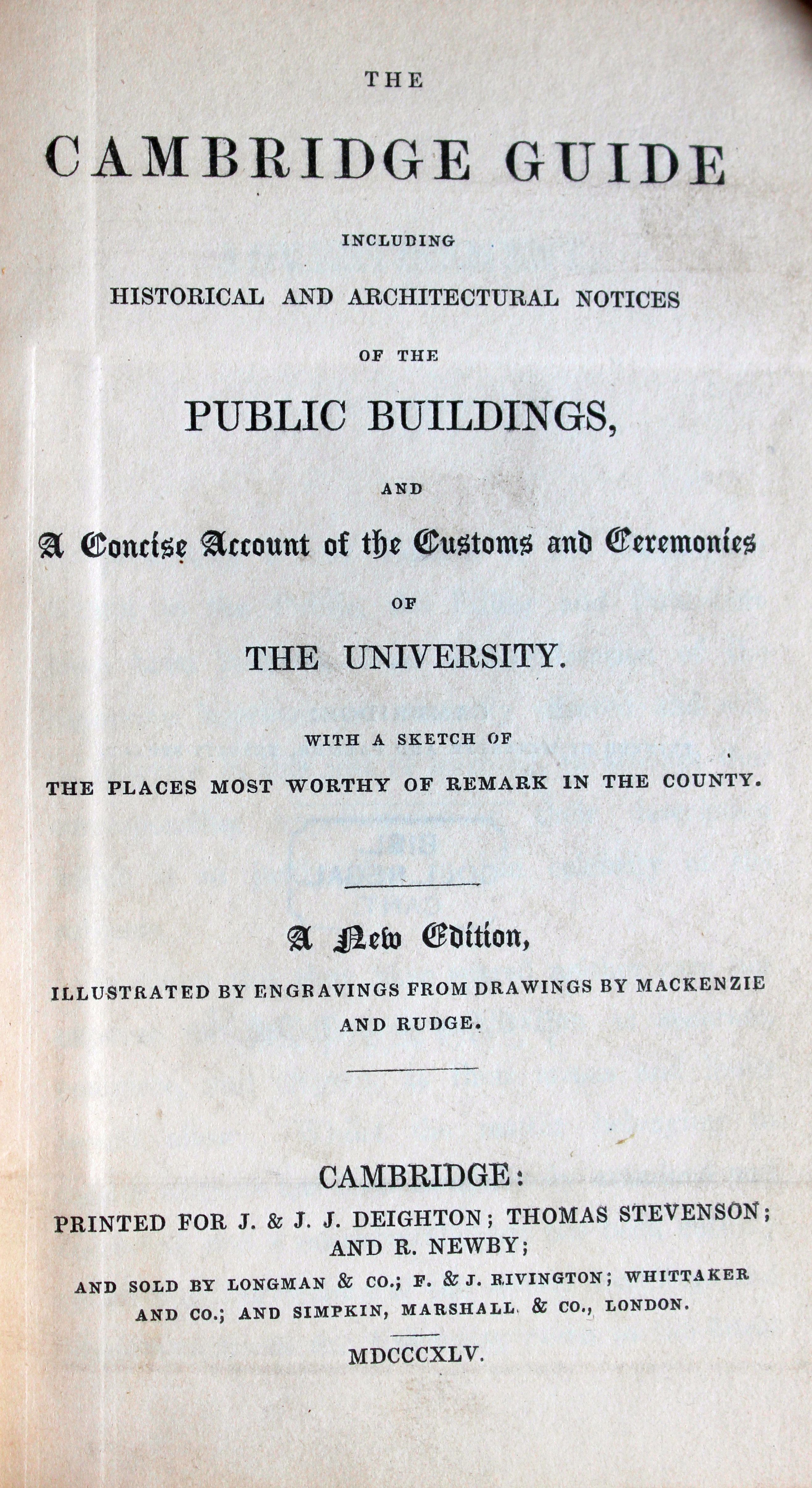
The Cambridge Guide published the same year has a map which already includes directions to the station, although the travel information provided at the rear of the guide still focuses on describing the numerous stagecoach routes between Cambridge and London. Many of these coaches travelled via the station at Bishop’s Stortford, presumably in order to provide onward travel to Cambridge for rail passengers alighting there.

Title page of "The Cambridge Guide"

Title page of The Cambridge Guide, Cambridge, 1845. Classmark: NW CAM 3ML Cam

Part of the folded, black and white city map from The Cambridge Guide

Section of the folded city map from The Cambridge Guide. The road in the bottom right-hand corner is labelled as leading to the station


Description of coach routes between London and Cambridge

Coach information from page 268 of The Cambridge Guide

In the course of describing the wider region, this guide explains that:

A rail-road is now in rapid progress from London by Cambridge, and extending by Brandon to Norwich; a branch is also contemplated from Ely to Peterborough, and so to the north of England.

Bradshaw’s Railway Companion also provides an interesting insight into the rules of the early railway. These include the very modern sounding prohibition: “Smoking not allowed at the Stations, nor in any of the carriages”.  This rule was in force across much of the rail network until Parliament passed a law in 1868 mandating that every train must have a smoking compartment.

List of rules for travelling on the railway

General instructions for railway travellers from Bradshaw’s Railway Companion

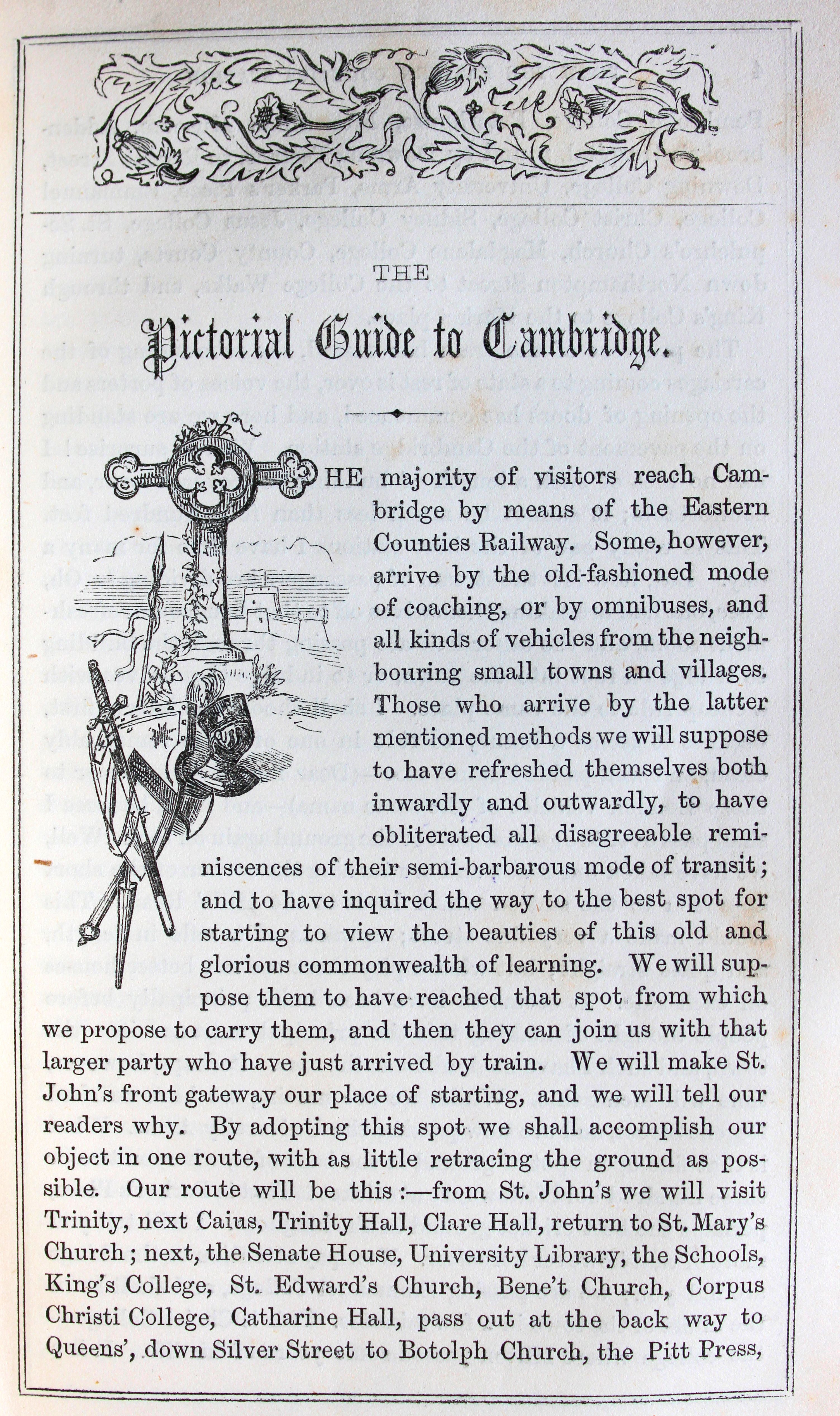
Once Cambridge station was open it soon became the natural starting point for many descriptive tours of the city, on the justified assumption that the majority of tourists would now choose to arrive by rail. The first paragraph of The Pictorial Guide to Cambridge, which adopts a very informal, discursive tone, states this clearly, and the author even disparages other forms of transport:

The majority of visitors reach Cambridge by means of the Eastern Counties Railway. Some, however, arrive by the old-fashioned mode of coaching, or by omnibuses … Those who arrive by the latter mentioned methods we will suppose to have refreshed themselves both inwardly and outwardly, to have obliterated all disagreeable reminiscences of their semi-barbarous mode of transit …

Introduction page

Introduction to The Pictorial Guide to Cambridge, Cambridge, [1853]. Classmark: NW CAM 3ML Pic

The Pictorial Guide goes on to hymn the glories of the new station and the convenience of  rail travel:

… here we are standing on the pavement of the Cambridge station. What a surprise! I had no idea of such a length of building, all covered over, and comfortable; it cannot be much less than four hundred feet. This really is one of the best stations I have seen for many a day. But, how is it that the stream of passengers are dividing? Oh, I see, one half are taking themselves off to that handsome refreshment room, and the other half are passing through the building to trudge on foot into the town, or to indulge themselves with a cheap ride to the same place.

You see the advantage of travelling by rail; whilst we breakfasted at home, and have come all this distance as fresh and clean as when we started, there are those less fortunate folks who left their homes by day-break this morning and arrived an hour ago, have hardly had time to make their first meal, and cannot possibly turn out in half such good trim as ourselves.

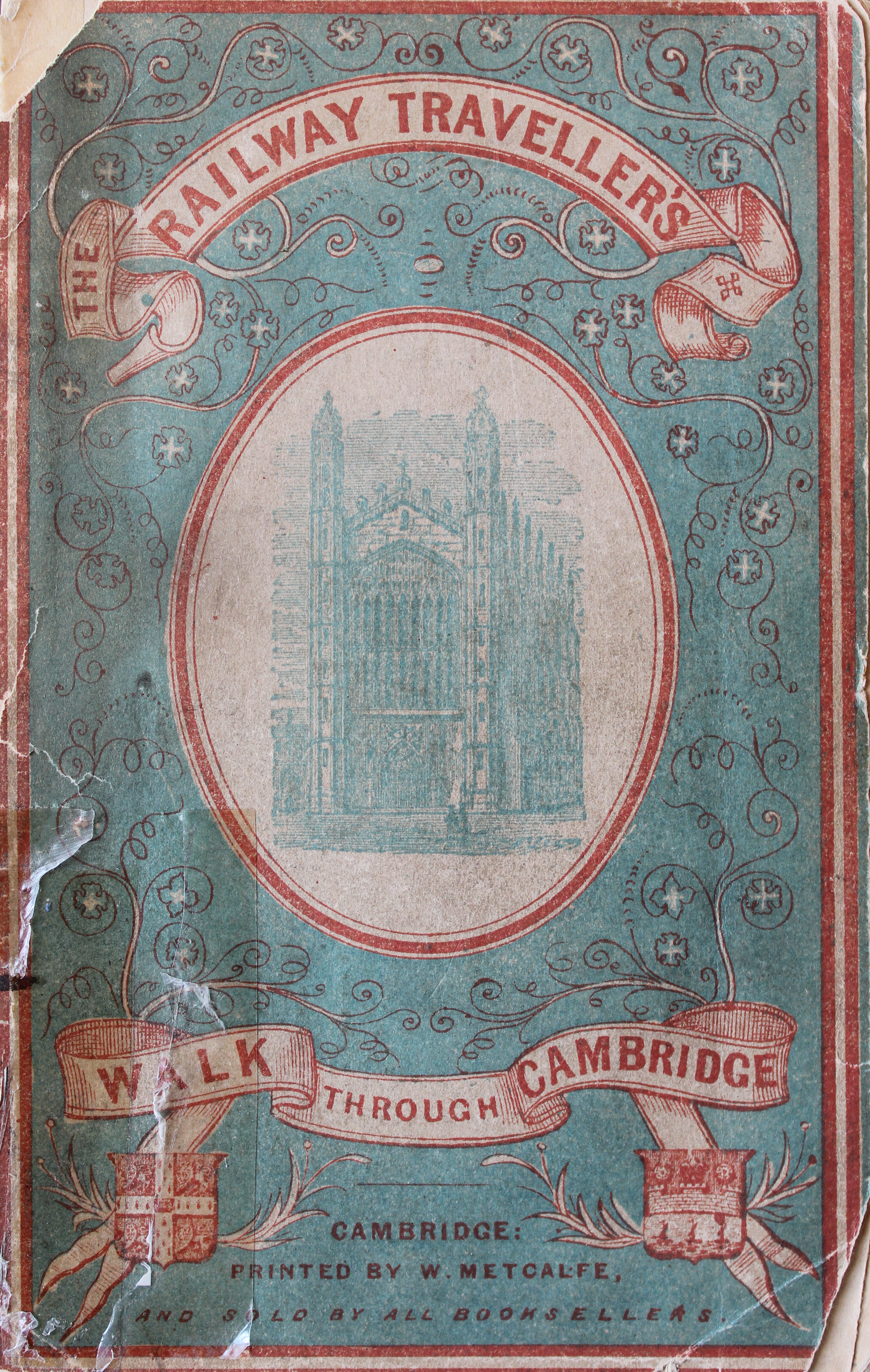
Another guidebook, from 1863, explicitly markets itself to rail passengers by using the title The Railway Traveller’s Walk through Cambridge. The station was completely remodelled in that year and the guide remarks approvingly that: “It now forms one of the finest on the line”. Naturally, King’s College Chapel is depicted on the guide’s cover.

Decorative blue and red cover with an illustration of King's College Chapel in the centre

Cover of The Railway Traveller’s Walk through Cambridge, Cambridge, 1864. Classmark: NW CAM 3ML Rai

A later edition of this guidebook from the 1890s, reissued under a different title, contains a useful fold-out map of the city, in which important buildings and the station are highlighted in red.

Map of Cambridge

Map from The Cambridge Visitor’s Guide, Cambridge, [1892]. Classmark: NW CAM 3ML Rai

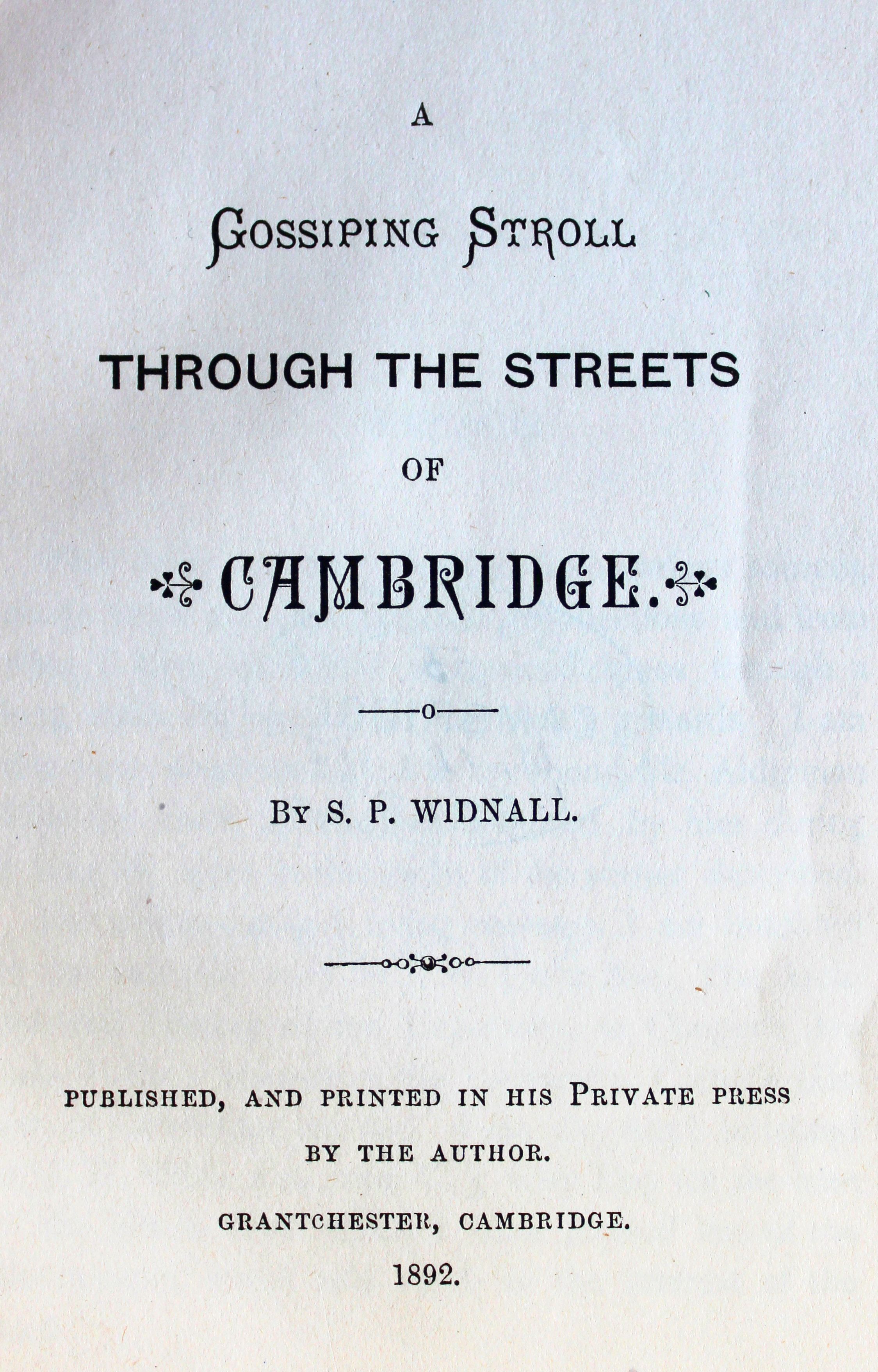
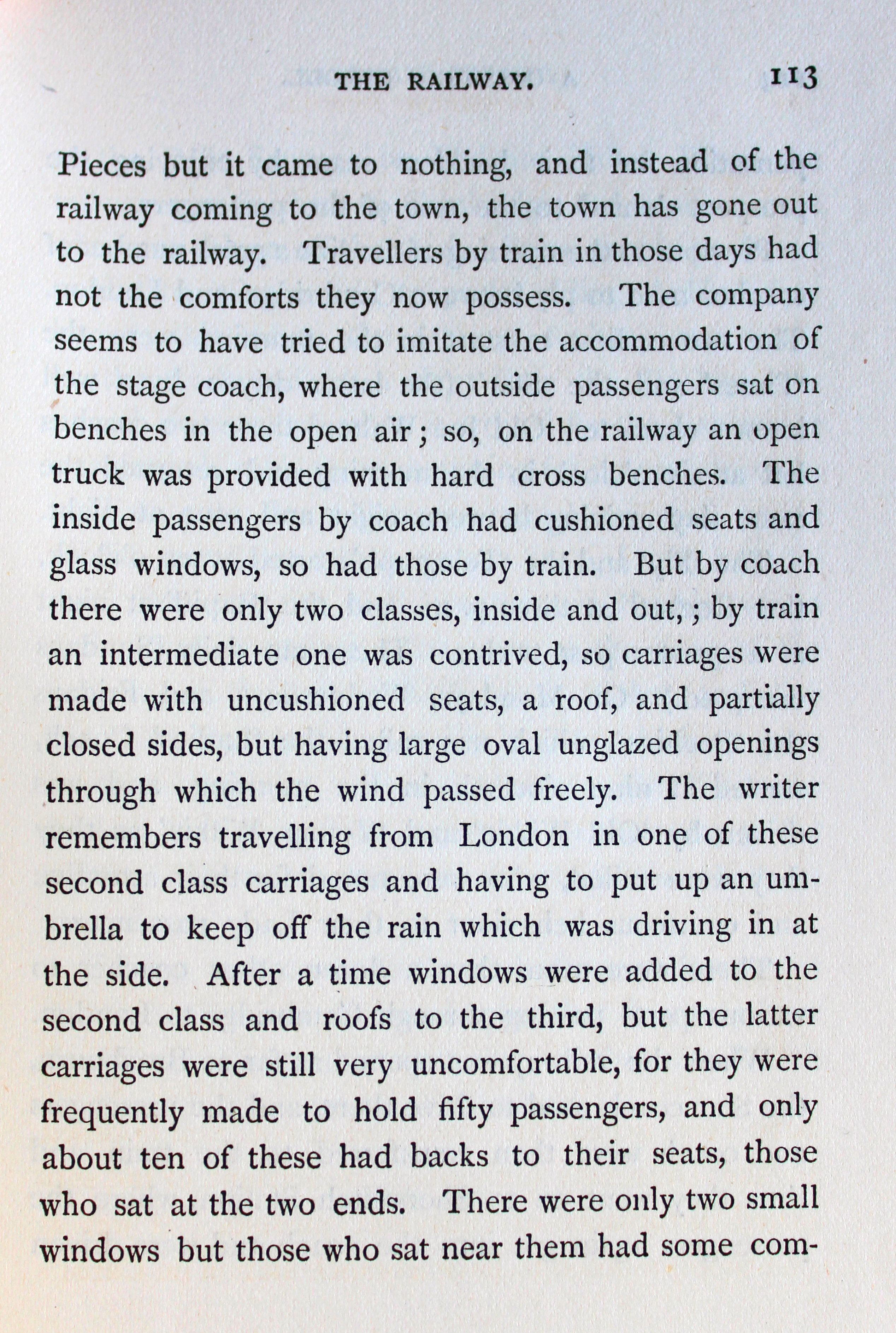
By this final decade of the nineteenth century, writers were already reminiscing about the privations of the early days of the railways, as can be seen in the amusingly titled guidebook A Gossiping Stroll through the Streets of Cambridge. The author, S.P. Widnall, recalls using an umbrella to keep off the rain when travelling in a second class carriage that had no glass in its windows!

Title page

Title page of A Gossiping Stroll Through the Streets of Cambridge, by S.P. Widnall, Cambridge, 1892. Classmark: NW CAM 3ML Wid

Page 113 of A Gossiping Stroll Through the Streets of Cambridge


Widnall also discusses the effect of the railway upon coaching routes between London and Cambridge, stating that:

When the railway was finished to Cambridge the coaches were of course driven off the road. Some people professed to dislike railways and to prefer riding behind four horses; this led to the attempt to keep one coach on the road, and for a short time the Beehive continued its journeys, when it arrived for the last time it was draped in black, as mourning for its own decease.

Additionally, he touches upon the location of the station, which is (and remains today) some way out of the city centre, remarking that:

We believe the Station would have been nearer the town had it not been opposed by the University authorities on account of the supposed disturbance to University pursuits.

Some modern histories of the Cambridge railway dismiss this as a myth, asserting that the area to the west of the eventual site was already too heavily built up for a more centrally located station to be either economically or practically feasible. Nevertheless, the belief that the University was to blame persists to this very day, especially among those who trudge wearily to the station every evening after work!

AC

References and further reading:

Reginald B. Fellows, London to Cambridge by Train 1845 – 1938, Cambridge, 1939

Cambridge: its Railways and Station  [accessed September 2025]

Railway 200 [accessed September 2025]

Moon Exploration: An Online Exhibition

We recently mounted a small exhibition on the subject of moon exploration, using items from our collections. In case you didn’t get to see it, here’s an online version of some of the exhibits.

First part of exhibition in display case

Second part of exhibition in display case

***

Johannes de Sacrobosco (born c.1195) was one of the most influential pre-Copernican astronomers, his treatise De sphaera mundi surviving in hundreds of manuscript copies dating from before the invention of the printing press. The earth is the centre of Sacrobosco’s model of the universe, with seven ‘planets’ (the moon, Mercury, Venus, the sun, Mars, Jupiter and Saturn in order) arrayed outwards from it. This 1581 print edition of the treatise features two volvelles (wheel charts with moving parts), this one depicting a lunar eclipse.

Johannes de Sacrobosco, Sphaera
Cologne: Maternus Cholinus, 1581
Shelfmark: Bury.SAC.Sph.1581

Volvelle in action from
Johannes de Sacrobosco, Sphaera
Cologne: Maternus Cholinus, 1581
Shelfmark: Bury.SAC.Sph.1581

***

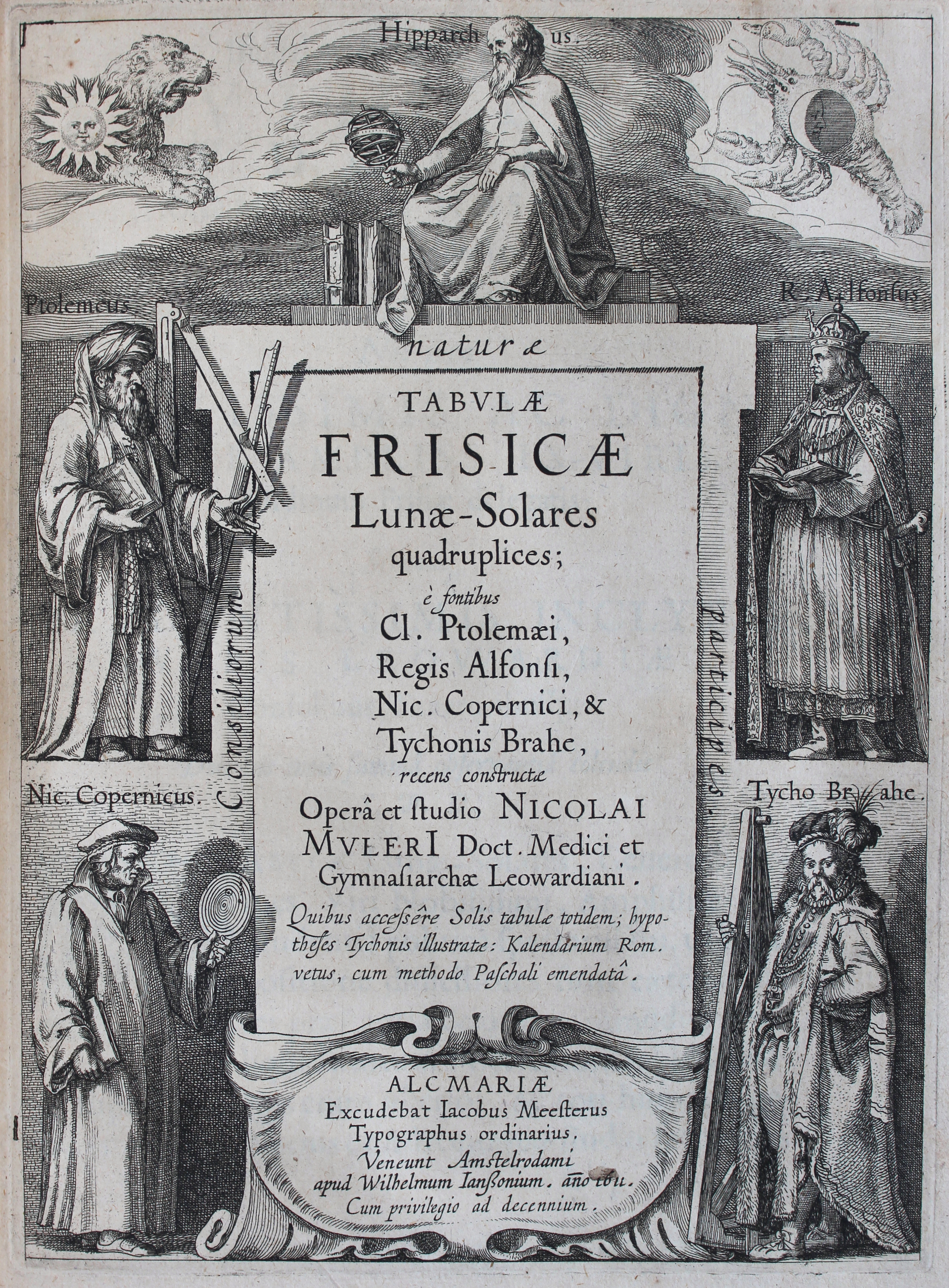
The Dutch astronomer Nicolaus Mulerius’ Tabulae frisicae lunae-solares quadruplices of 1611 is a collection of solar and lunar tables according to the calculations of Ptolemy (2nd century AD), King Alfonso X of Castile (1221-1284), Nicolaus Copernicus (1473-1543) and Tycho Brahe (1546-1601) respectively. The four great astronomers are depicted on the illustrated title page, with their illustrious forefather Hipparchus (2nd century BC) at the head.

Nicolaus Mulerius, Tabulae frisicae lunae-solares quadruplices
Alkmaar: Jacob de Meester, 1611
Shelfmark: Keynes.Ec4.1.3/2

***

Galileo Galilei’s treatise of 1610 Sidereus nuncius (Sidereal Messenger) was the first published scientific work to draw on the newly invented telescope, called by the Latin word ‘perspicillum’ in Galileo’s text, and contains the astronomer’s observations on the moon and hundreds of formerly unknown stars he had been the first human to witness. Though initially controversial, Galileo found a supporter in Johannes Kepler, who verified Galileo’s findings independently and published his own confirmation of them a few months later. This first London edition of the work, published in 1653, includes Kepler’s Dioptrice, a treatise on the telescope, as an addendum. The illustrations of the lunar surface on these pages are Galileo’s own.

Galileo Galilei, Sidereus nuncius
London: James Flesher, 1653
Shelfmark: Keynes.Ec4.1.5/2

***

The natural philosopher John Wilkins (1614-1672) was a man of many parts: founder member of the Royal Society, Master of Trinity College, Cambridge, and finally Bishop of Chester. In The Discovery of a World in the Moone, first published in 1638, Wilkins put forward 13 propositions, drawing partly on the recent testimonies of Galileo and Kepler, in support of his theory ‘that the Moone may be a world’, including:

  • That the strangenesse of this opinion is no sufficient reason why it should be rejected, because other certaine truths have beene formerly esteemed ridiculous, and great absurdities entertained by common consent
  • That a plurality of worlds doth not contradict any principle of reason or faith
  • That the Moone hath not any light of her owne
  • That as their world is our Moone, so our world is their Moone

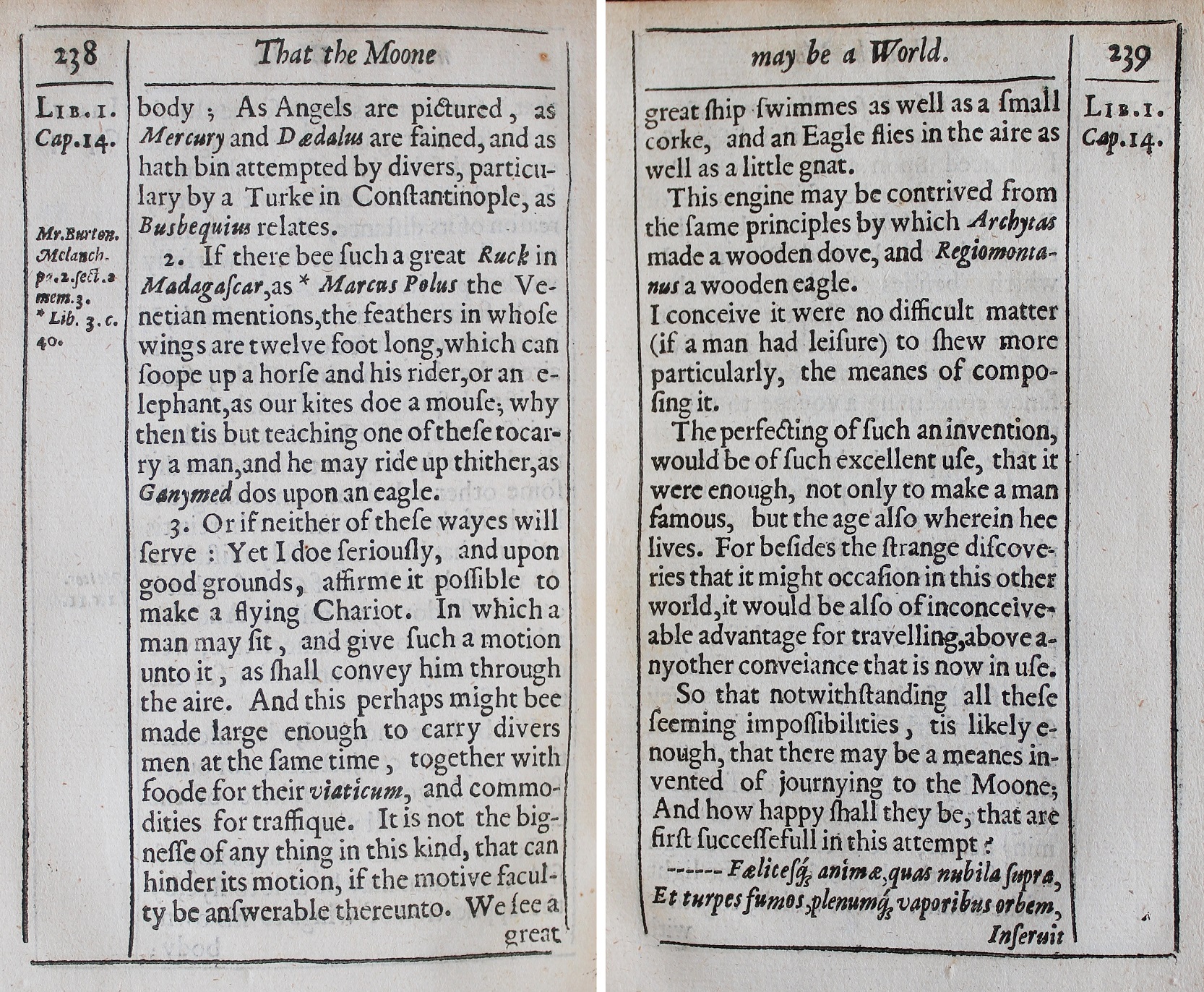
These two later editions contain an added fourteenth proposition, ‘That tis possible for some of our posteritie, to find out a conveyance to this other world; and if there be inhabitants there, to have commerce with them’, in which Wilkins suggests various possible methods of moon travel, including hitching a lift on a large winged animal (such as a ‘Ruck’, i.e. the roc, a mythological bird still believed in by many at the time) and inventing a flying chariot.

John Wilkins, The Mathematical and Philosophical Works of
the Right Reverend John Wilkins, Late Lord Bishop of Chester
London: John Nicholson; Andrew Bell; Benjamin Tooke; Ralph Smith, 1708
Shelfmark: Keynes.F.25.15

John Wilkins, A Discourse concerning a New World & Another Planet in 2 Bookes
London: John Maynard, 1640
Shelfmark: Keynes.D.5.69

***

The World in the Moon, a new opera staged in 1697 at the Dorset Garden Theatre in Whitefriars, by the Thames, featured songs by Daniel Purcell (brother of Henry) and Jeremiah Clarke. The opera’s book, by Elkanah Settle, was inspired by The Man in the Moone, a posthumously published narrative work by the Anglican bishop Francis Godwin (1562-1633) that purported to describe a ‘voyage of utopian discovery’ and is now considered one of the first works of science fiction. The stage directions in Settle’s text suggest the production must have been spectacular:

The Flat-Scene draws, and discovers Three grand Arches of Clouds extending to the Roof of the House, terminated with a Prospect of Cloud-work, all fill’d with the Figures of Fames and Cupids; a Circular part of the black Clouds rolls softly away, and gradually discovers a Silver Moon, near Fourteen Foot Diameter: After which, the Silver Moon wanes off by degrees, and discovers the World within, consisting of Four grand Circles of Clouds, illustrated with Cupids, &c. Twelve golden Chariots are seen riding in the Clouds, fill’d with Twelve Children, representing the Twelve Celestial Signs …

This song, ‘Smile then with a beam Devine’, is from the prologue of the opera, and contains a separate flute part at the foot of the page, common in music publications of the time, which could be used either to double the voice or to perform the song as an instrumental piece.

Songs in the New Opera, Call’d The World in the Moon
London: John Walsh; Joseph Hare, 1697
Shelfmark: Rw.85.1/9

***

Moon exploration has been a subject of science fiction for centuries, but properly took off (ha ha) in the 19th century with works such as Edgar Allan Poe’s short story ‘The Unparalleled Adventure of One Hans Pfaall’ (1835) and Jules Verne’s From the Earth to the Moon (1865).

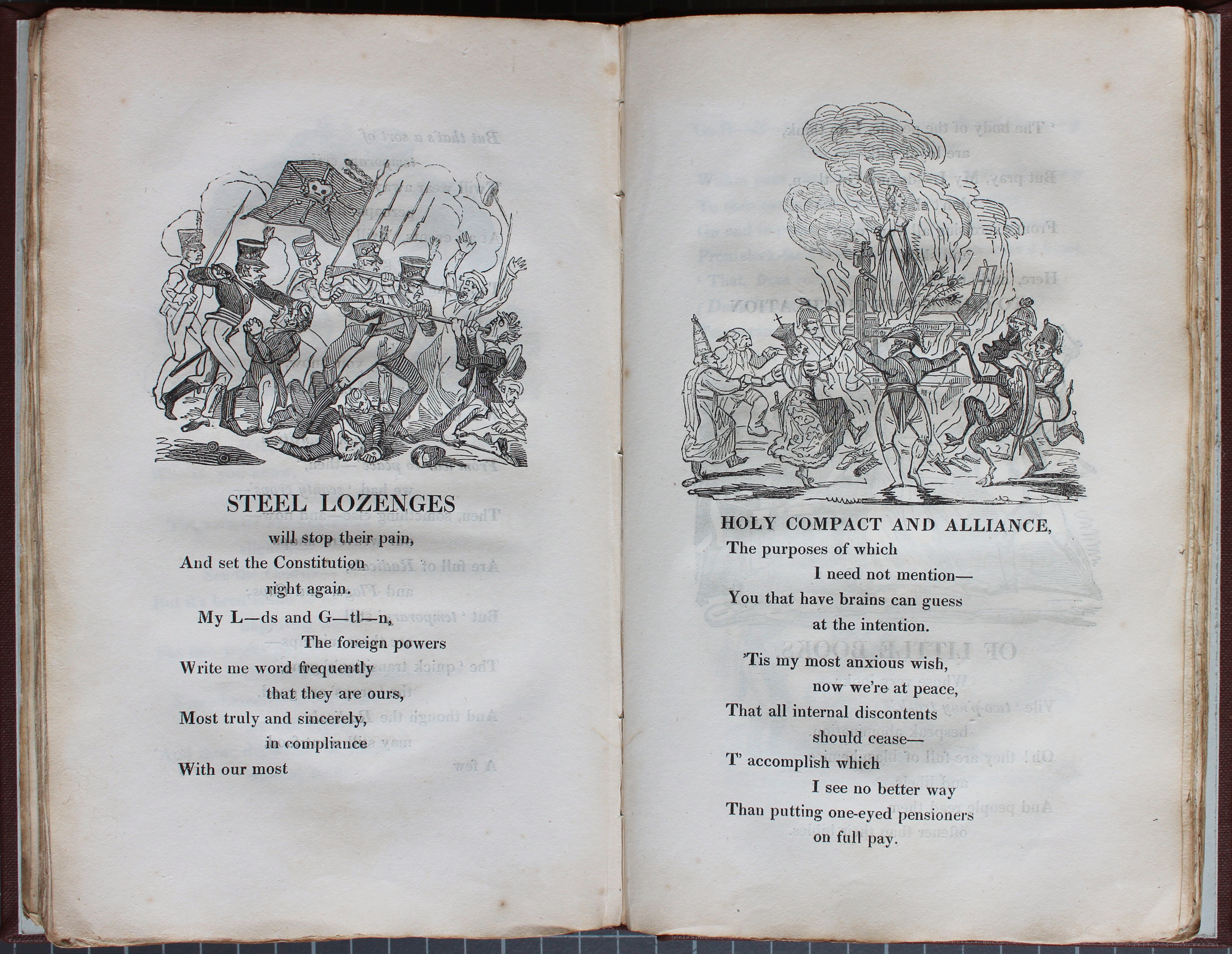
This radical political pamphlet of 1820, ‘The Man in the Moon’, by the satirist William Hone, employs the conceit of a man travelling to the nation of ‘Lunataria’:

I lately dream’d that, in a huge balloon,
All silk and gold, I journey’d to the Moon,
Where the same objects seem’d to meet my eyes
That I had lately left below the skies …

The resemblance of Lunataria to his home planet enables Hone to pass comment on the political events of the day, including on the left the Peterloo Massacre of 1819. The illustration on the right shows the Army, the Church, the Prince Regent and the devil linked in dance, in a parody of the Holy Alliance that arose in Europe following the fall of Napoleon. The illustrator is George Cruikshank, who was later a friend of Charles Dickens and provided illustrations to his early novels.

William Hone, Hone’s Select Popular Political Tracts
London: William Hone, [1820s]
Shelfmark: G.15.42

***

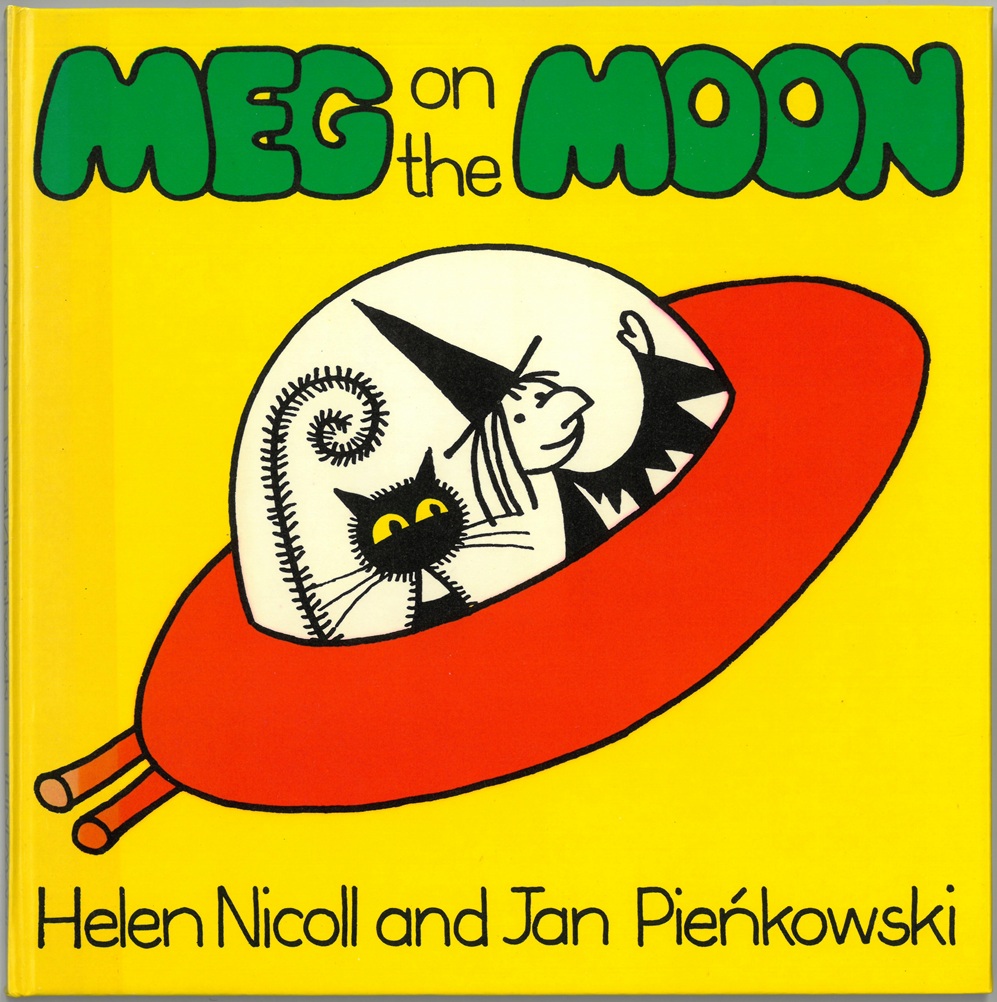
The most enduring creation of the illustrator Jan Pieńkowski (1936-2022, KC 1954) was the Meg and Mog series of books, which he wrote over a period of more than 40 years in collaboration first with the author Helen Nicoll and, after her death in 2012, with his partner David Walser. Meg on the Moon, an early entry in the series, tells the story of the witch Meg and her cat Mog going to the moon for Mog’s birthday treat.

Helen Nicoll & Jan Pieńkowski, Meg on the Moon
London: Heinemann, 1973
Shelfmark: Fiction K Pie/6

GB

Dante: An Online Exhibition

In November 2024 King’s College had the opportunity to host the annual doctoral and postdoctoral research conference “Dante Futures 2024: New Voices in the UK and Ireland”. For this occasion, an exhibition of rare early printed and manuscript materials relating to Dante was mounted in the library. As this year marks the 760th anniversary of Dante’s birth in 1265, we thought it would be timely to share some of these treasures in an online exhibition.

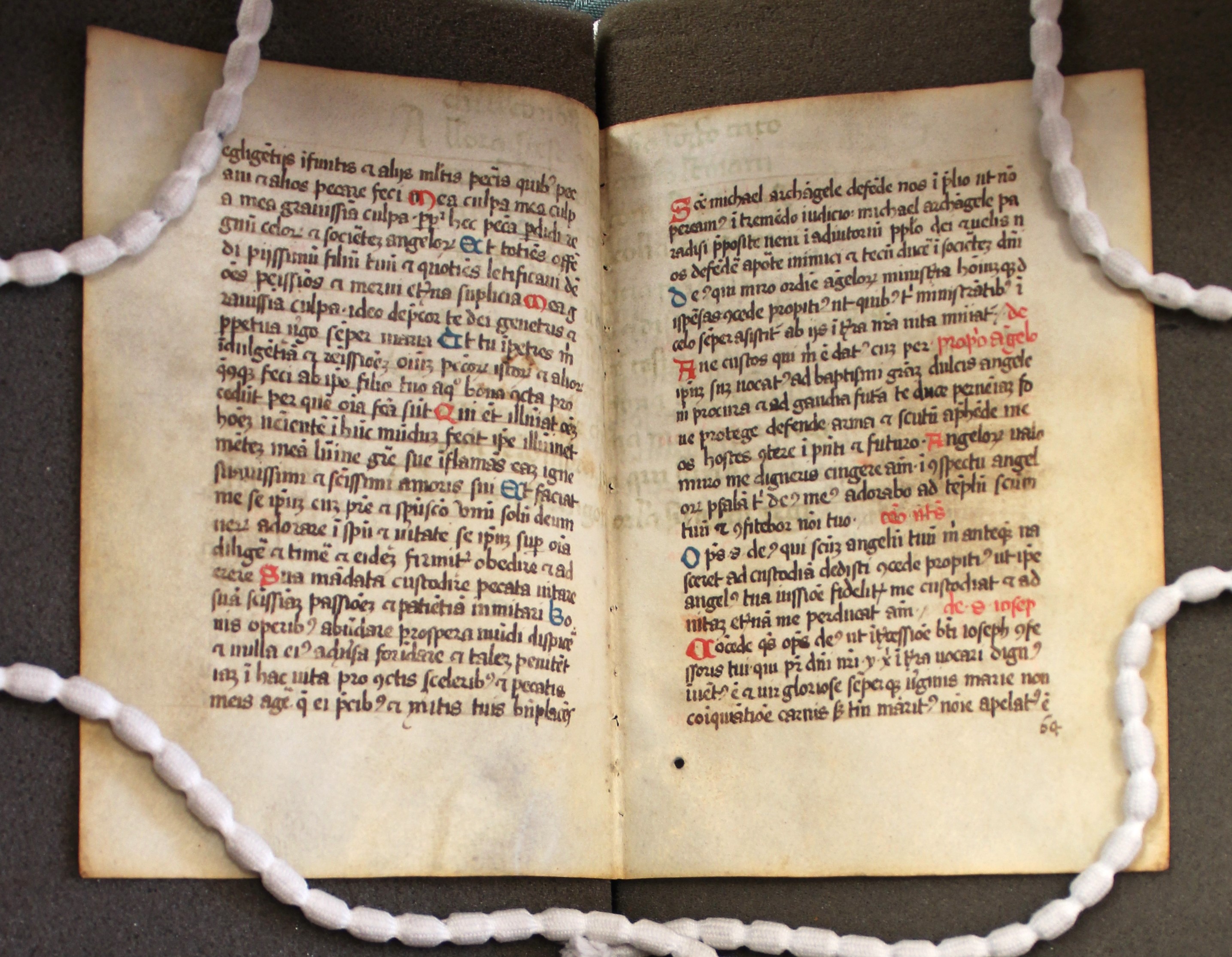
While there is no extant autograph manuscript of the Divine Comedy, many other fourteenth- and fifteenth-century manuscripts survive. Below is a fifteenth-century breviary written in an Italian hand on vellum. This is a palimpsest, namely a manuscript on which a piece of writing has been superimposed, effacing the original text. In this case the erased text is from Dante’s Inferno, one of the three parts of the Divine Comedy, which was written on at least 31 leaves used in this breviary. The vellum was not thoroughly cleaned when it was prepared for reuse, meaning Dante’s text can be seen by the naked eye in a number of places, apparently written in a fourteenth-century hand. Each leaf of the original manuscript was folded in two, vertically, to create two leaves (one bifolium). At the top of the page we can see lines 39-40 of Inferno VIII (spelling modernised):

ch’i’ ti conosco, ancor sie lordo tutto.
Allora [di]stese al legno ambo le mani

[for thee I know, all filthy though thou be.
Then toward the boat he stretched out both his hands]

Breviary (imperfect), fifteenth century, partly written on a palimpsest vellum of Dante’s Inferno, fourteenth century (Salt MS 3)

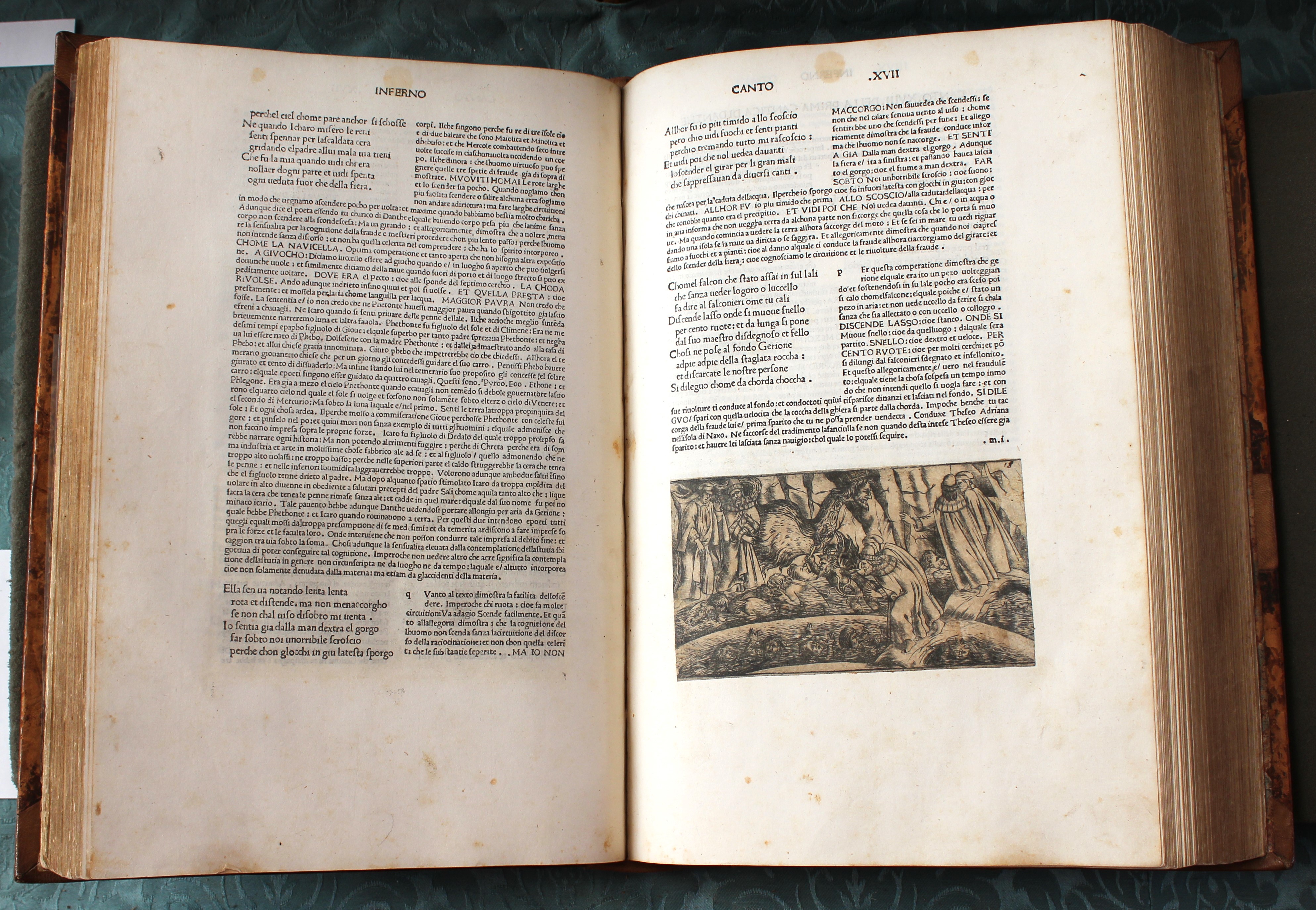
The first printed edition of the Divine Comedy appeared in 1472. This incunabulum from 1481 (a book from the dawn of printing, printed before 1501) includes the commentary of Cristoforo Landino with additions by Marsilio Ficino, and is the third edition of the work to be published. The engravings are attributed to Baccio Baldini after designs by Sandro Botticelli, eighteen of which are included in this copy, mainly pasted in spaces left by the printer for that purpose. Here we see the descent of Virgil and Dante into Hell, as they move to the circle of the fraudulent in the Malebolge, thanks to the mythological monster Gerion, who flies them down on its back. With the face of a just man, the body of a snake, the tail of a scorpion, and hairy paws, Gerion is an allegory of falseness and fraud, precisely because its human face displays a benign humanity while the serpentine and monstrous body reveals its evil:

Comento di Christophoro Landino fiorentino sopra
La comedia di Danthe Alighieri poeta fiorentino
(Florence: Nicholo di Lorenzo della Magna, 1481; Bryant.XV.1.4)

Aldus Manutius (c. 1449/1452–1515), founder of the Aldine Press in Venice, was one of the most important printers of the period. He was an advocate of the smaller, more portable book format, which is arguably the precursor to the modern paperback. His work also helped to standardise the use of punctuation.

Along with Greek classics, the Aldine Press also printed Latin and Italian works. At the start of the sixteenth century the Bembo family—a noble Venetian family—hired the Aldine Press to produce accurate texts of both Dante and Petrarch using Bernardo Bembo’s personal manuscript collection. Pietro Bembo worked with Manutius from 1501 to 1502 to undertake this work, resulting in this, the fifth edition of the Divine Comedy to be published. Here we see the well-known dolphin-and-anchor printer’s device used by the Aldine Press, adopted in 1502 and used for the first time in this publication:

Dante Alighieri, Lo ‘nferno e ‘l Purgatorio e ‘l Paradiso di Dante Alaghieri
(Venice: Aldus Manutius, 1502; M.71.15)

The Aldine Press published a second edition of the Divine Comedy in 1515 in partnership with Aldus’s father-in-law, Andrea Torresani “nelle case d’Aldo et d’Andrea di Asola suo suocero” (at the house of Aldo and Andrea of Asola, his father-in-law), with whom he had a professional relationship from 1506 until his death in 1515. Although the volume appeared just after his death, Aldus is believed to have prepared this second edition himself. The publication was dedicated to Vittoria Colonna (1490–1547), one of the most famous women of the Italian Renaissance, friend to the most important cultural figures of the age including Bembo, Castiglione and Michelangelo, and a poet in her own right. Below is the opening of the second part of the Divine Comedy, the Purgatorio:

Dante col sito, et forma dell’inferno tratta dalla istessa descrittione del poeta
(Venice: nelle case d’Aldo et d’Andrea di Asola suo suocero, 1515; Keynes.Ec.7.3.22)

Alessandro Vellutello (born 1473) produced an influential commentary on the Divine Comedy, published in 1544, which is a real gem in the collection of rare books bequeathed to King’s College by novelist E.M. Forster (1879–1970). This copy belonged to Bishop John Jebb (1775–1833) who gifted it to Forster’s grandfather, Charles Forster (1789–1871). The printer left spaces for 87 woodcut illustrations which were first used in this edition and subsequently in a number of other editions throughout the sixteenth and seventeenth centuries. They were considered some of the most beautiful Renaissance illustrations of the poem after Botticelli’s.

This is a depiction of Giudecca (named after Judas Iscariot), the very last region of Hell. The sinners are punished by being completely frozen in the lake of Cocytus, some upright, some upside down, some with their bodies bent double. Enormous in size, we see the top half of Lucifer in the lake, gnawing on the bodies of sinners:

La comedia di Dante Aligieri con la nova espositione di Alessandro Vellutello
(Venice: per Francesco Marcolini, 1544; Forster.DAN.Com.1544)

Cosimo Bartoli (1503–72) was a humanist, philologist and writer. He promoted the Italian vernacular as a language which could be used in scientific discussion as much as Latin, and Dante was regarded as an example of the heights the vernacular could reach. A friend of the famed Renaissance painter and architect Giorgio Vasari (1511–74), he also worked for the Medicis for most of his life. His Ragionamenti accademici sopra alcuni luoghi difficili di Dante takes the form of fictitious discussions held between Bartoli and his Florentine friends, to provide explanations of some of the most difficult passages in the Divine Comedy. A collection of some of the lectures he had given in the Accademia fiorentina between 1541 and 1547, it was published in Venice in 1567:

Cosimo Bartoli, Ragionamenti accademici di Cosimo Bartoli gentil’huomo et
accademico fiorentino sopra alcuni luoghi difficili di Dante
(Venice: appresso Francesco de Franceschi Senese, 1567; Bury.BAR.Rag.1567)

JC/IJ
 

Sinuous, slithery snakes!

As the Lunar New Year of the Snake gets underway, we’ve discovered that our rare book stores are teeming with these sinuous reptiles! They slither through the pages of bibles, travel books, natural history books, works of heraldry and more! Where is St. Patrick when you need him! What follows is a only a selection of the many serpents that have recently emerged, hissing, into the light of day.

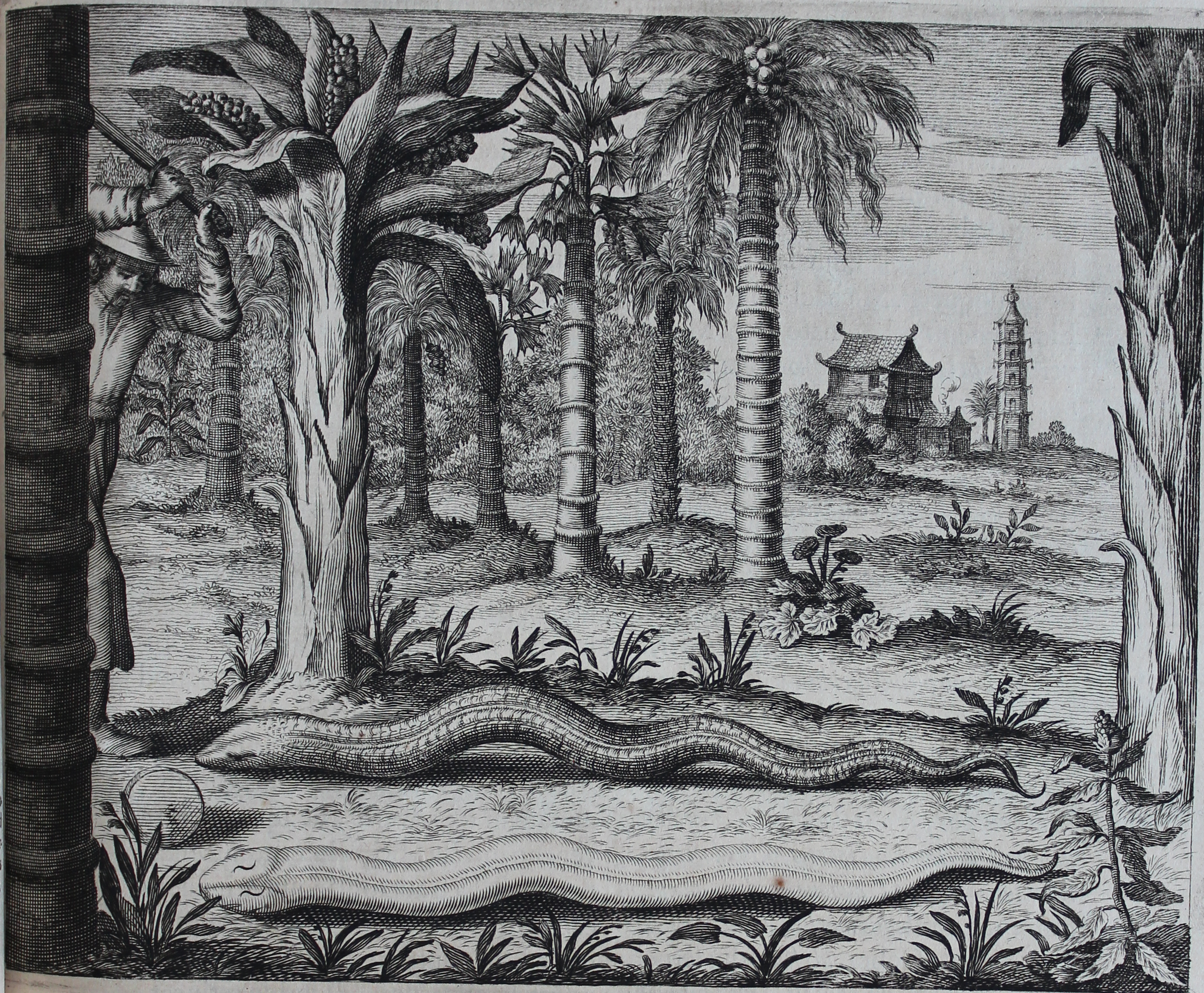
It seems appropriate to begin in China, with an illustration from a book on the country by Athanasius Kircher (1602-1680). Kircher was a German Jesuit and Renaissance polymath, who has been styled by some as the last man who knew everything. He had a long eventful life during which he published around forty books on a wide variety of topics, including ancient languages, music and geology. He was refused permission to become a missionary in China himself, but compiled the reports of many of his Jesuit colleagues to produce a magnificently illustrated volume on the country, encompassing zoology, geography, religion, botany, and much more besides. Below is one of the illustrations, featuring two large snakes, and a man in the corner apparently about to attack them with a stick!

Two large snakes slithering across the foreground, with trees and buildings in the background and a man with a hammer in the left hand corner

Illustration from page 81 of China Monumentis by Athanasius Kircher, Amsterdam, 1667 (Shelfmark: M.40.28)

From one of our early printed bibles comes this woodcut of Adam and Eve in the Garden of Eden, with the wily serpent coiled around a tree in the background. If you look closely, it appears to have a Mohican haircut!

Black and white woodcut showing Adam, Eve and the serpent in Eden, and also being ejected from the garden by a winged figure

Woodcut from fol. 1 of Biblia cum concordantiis veteris et novi testamenti et sacrorum canonum, London, 1522 (Shelfmark: Keynes.E.12.15)

A later depiction of Eden is found in one of our copies of John Milton’s epic poem Paradise Lost, which has glorious illustrations by Francis Hayman (1708-1776), one of the founding members (and first librarian) of the Royal Academy. Here, in an engraving placed at the beginning of Book 10, the serpent lurks in the corner while Adam and Eve beg forgiveness from God for their disobedience in eating the apple.

Adam and Eve

Plate facing page 221 of volume 2 of The Poetical Works of John Milton, London, 1761 (Shelfmark; Thackeray.J.60.19)

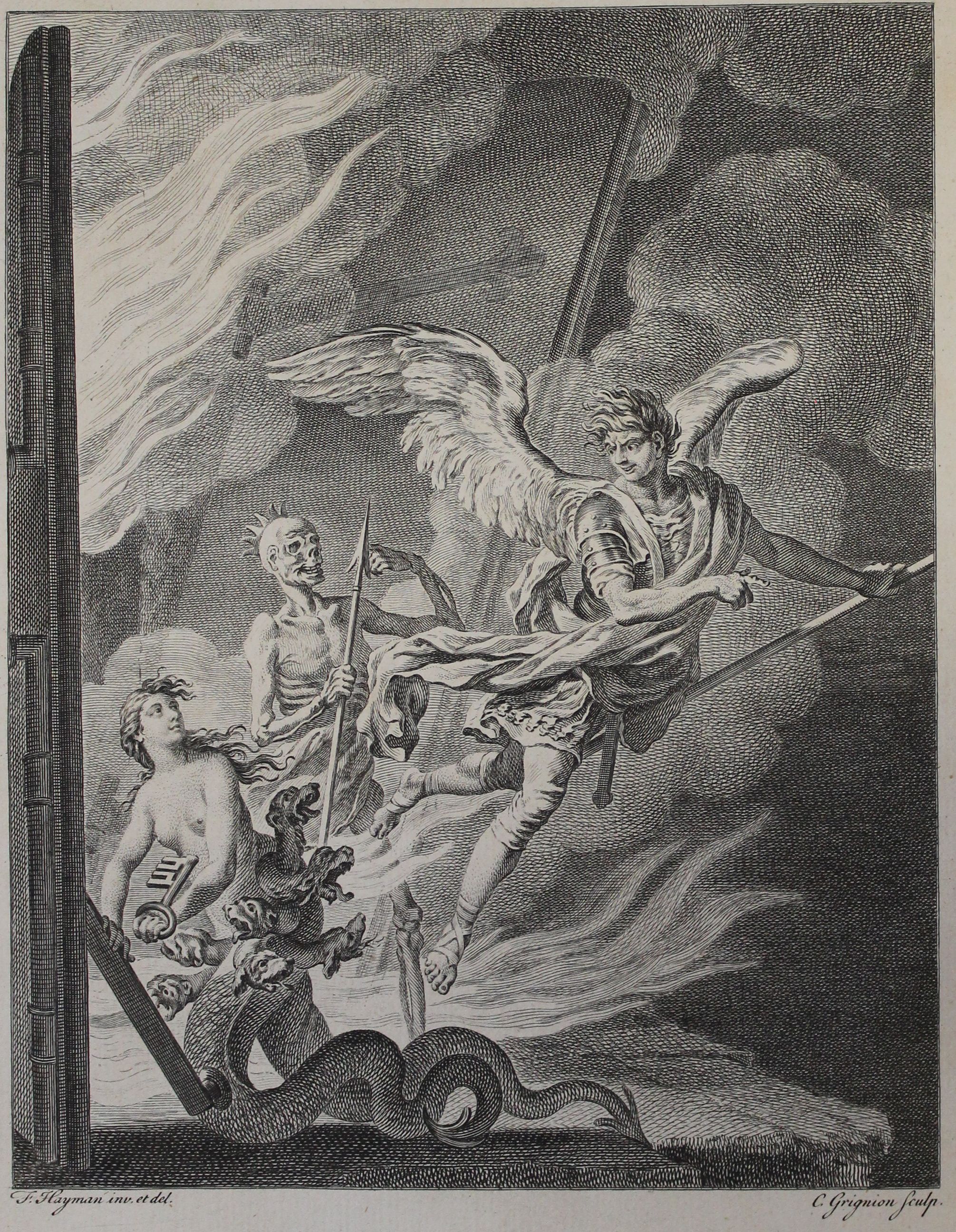
An earlier engraving from Book 2 of the same poem shows Satan at the gates of Hell, which are guarded by a skeletal figure in a crown, a many-headed hell hound, and a woman representing sin, who has a serpent’s coils instead of legs. The text describes it thus:

The one seem’d Woman to the waste, and fair [line 650]
But ended foul in many a scaly fould
Voluminous and vast, a Serpent arm’d
With mortal sting: about her middle round
A cry of Hell Hounds never ceasing bark’d

Satan at the gates of hell

Plate facing page 83 of volume 1 of The Poetical Works of John Milton, London, 1761 (Shelfmark; Thackeray.J.60.18)

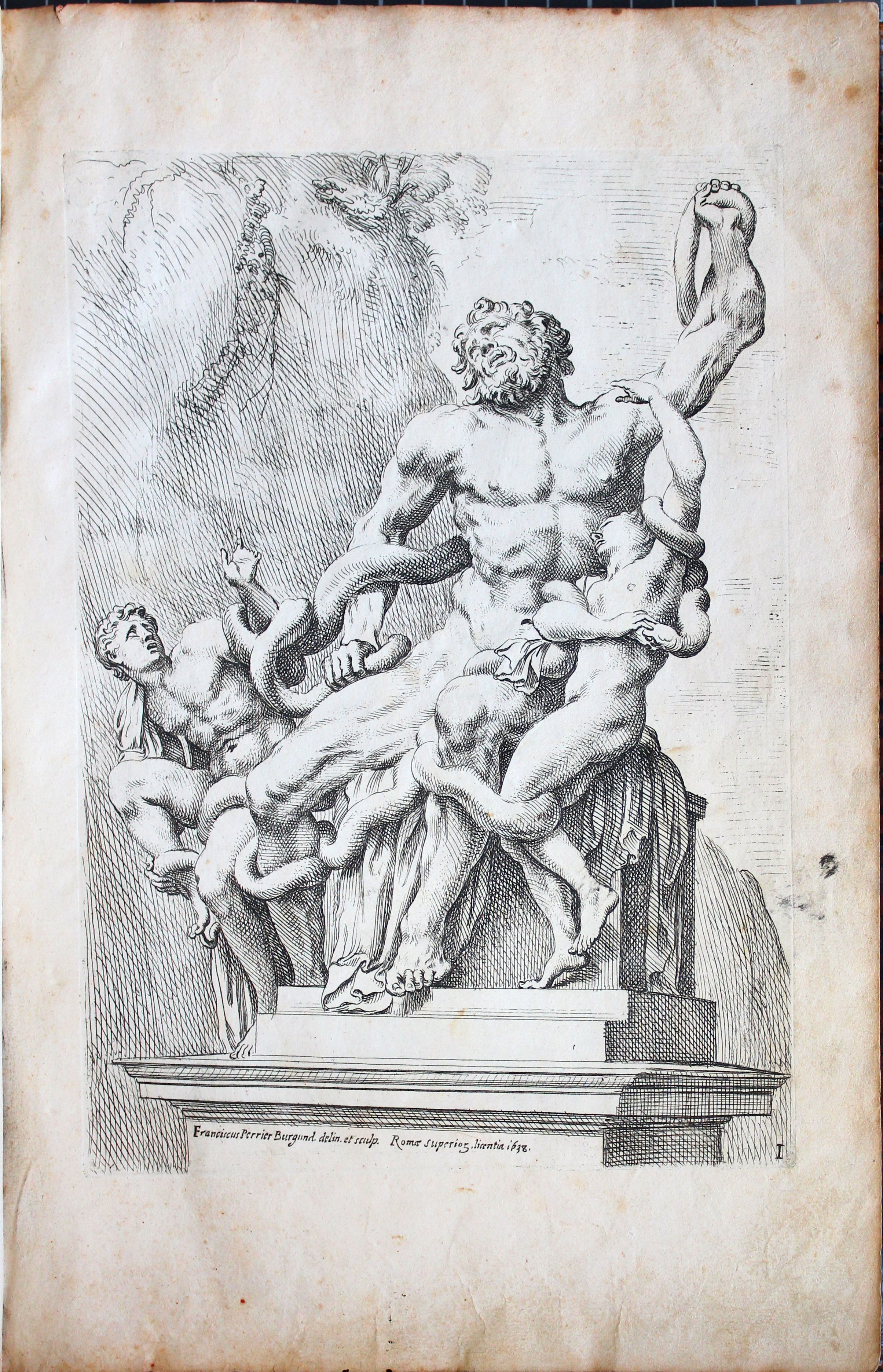
Next we turn to classical mythology and the story of Laocoön, a Trojan priest, who, along with his two sons, was attacked by venomous sea serpents. Reasons given for the attack vary, but Virgil’s version of the story goes that Laocoön was punished for attempting to alert Troy’s inhabitants to the grave threat posed by the Trojan Horse. From the Bury Collection, this seventeenth-century volume of sketches of classical statues includes a rendering of a Roman statue of Laocoön and his sons languishing in the coils of the serpents.

 Laocoön and sons being attacked by serpents

Plate 1 from Segmenta nobilium signora et statuarum by François Perrier, Rome, 1638 (Shelfmark: Bury.PER.Seg.1638)

Another engraving in the same volume depicts a statue of a Vestal virgin, with a snake draped over her shoulder.

A statue of a vestal virgin with a snake on her shoulder

Plate 65 from Segmenta nobilium signora et statuarum, by François Perrier, Rome, 1638 (Shelfmark: Bury.PER.Seg.1638)

Snakes are among the many different creatures that appear in printers’ marks or devices, which were a kind of early logo or copyright mark commonly found on the title pages of early printed books. Below is the printer’s device of William Jaggard (1569-1623), which features the ancient Ouroboros symbol of a coiled snake devouring its own tail.

Printer's device

Printer’s device from the title page of The Two Most Unworthy and Notable Histories Which Remaine Unmained to Posterity, by Sallust, London, 1609 (Shelfmark: Keynes.D.2.14)

In heraldry, snakes have often been used on coats of arms as symbols of prudence and subtlety, as this seventeenth-century book, A Display of Heraldrie by John Guillim (1565-1621) explains. Guillim was an antiquarian and officer of arms at the College of Arms in London.  His book references the Medusa myth, and notes a belief that if the hair of a woman is placed in manure it will transform into venomous snakes!

Explanation of the use of snakes in coats of arms

Illustration and text from page 153 of A Display of Heraldrie by John Guillim, London, 1611 (Shelfmark: H.17.39)

Later in the same book, an adder wrapped round a pillar is said to symbolize prudence combined with constancy.

Explanation of a snake wrapped round a pillar

Illustration and text from page 213 of A Display of Heraldrie by John Guillim, London, 1611 (Shelfmark: H.17.39)

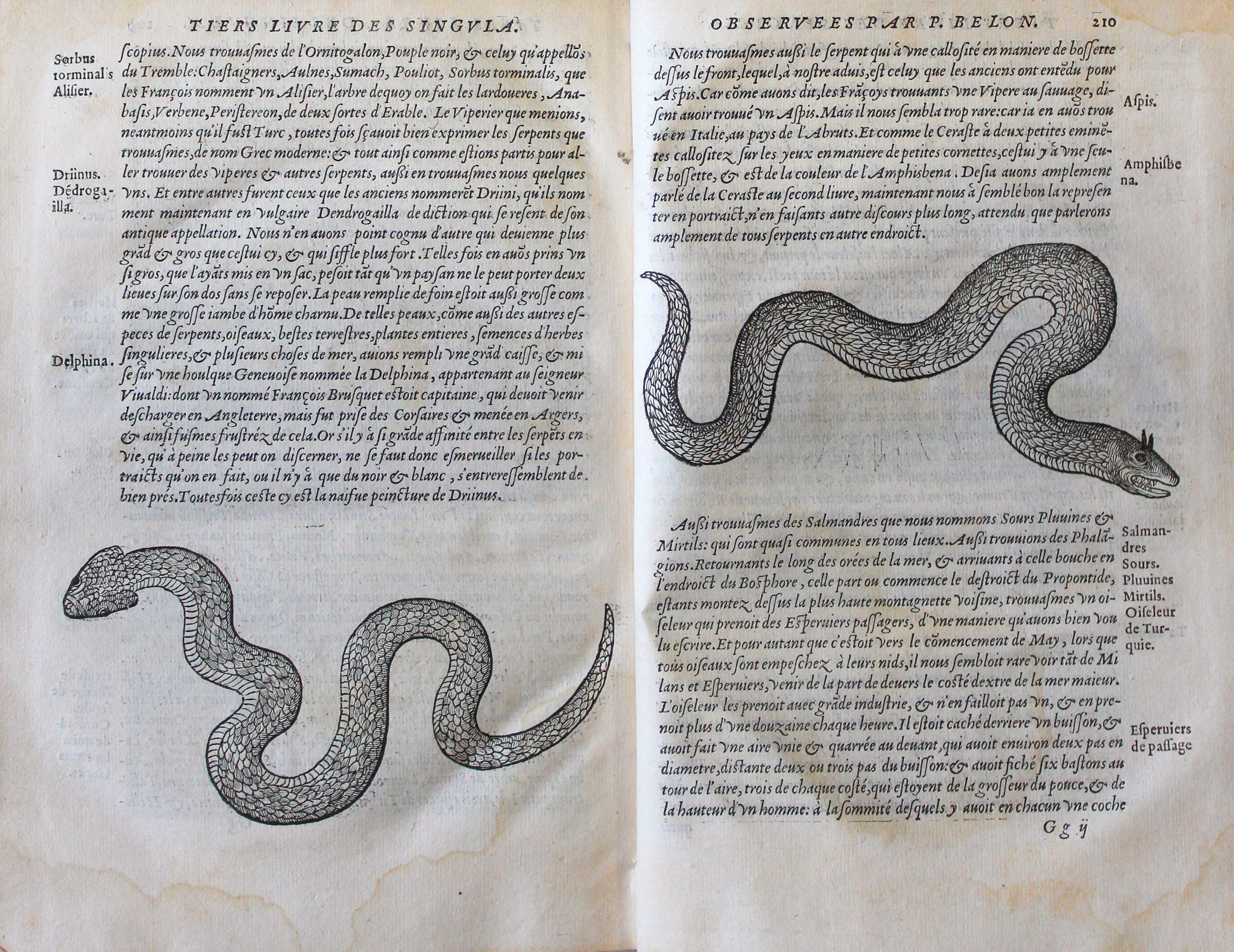
Moving into early works of natural history, we find an abundance of snakes. The sixteenth-century drawings below come from a work published by the traveller and naturalist Pierre Belon (1517?-1564).

Text in French and black and white illustrations of two snakes

Illustrations of snakes from pages 209 and 210 of Les Obseruations de plusieurs singularitez & choses memorables by Pierre Belon, Paris, 1555 (shelfmark: T.16.20)

Next comes an entire work dedicated to snakes by French apothecary Moyse Charas (1619-1698). Charas, whose work was first published in French in 1669 under the title:  Nouvelles expériences sur la vipère, was interested in the nature of snake venom and the ways in which extracts from snakes could allegedly be used to treat various ailments, such as smallpox and leprosy. Our library holds an English translation from 1670.

title page

Title page of New Experiments upon Vipers by Moyse Charas, London, 1670 (Shelfmark: Thackeray.VIII.11.12)

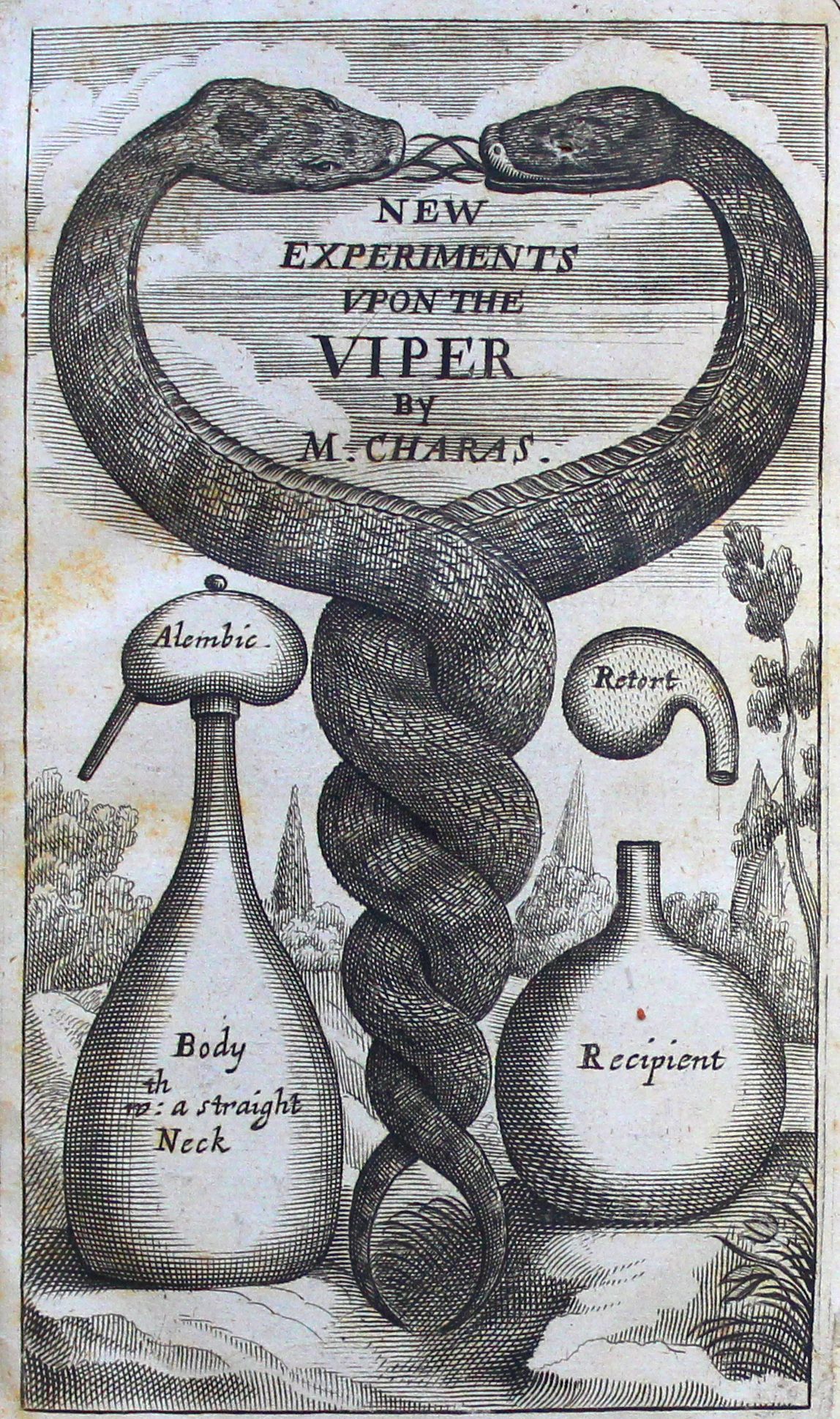
In addition to the main title page, it contains a glorious added engraved title page, showing entwined serpents.

Two entwined snakes, with the title in the middle

Added engraved page of New Experiments upon Vipers by Moyse Charas, London, 1670 (Shelfmark: Thackeray.VIII.11.12)

The book includes detailed anatomical drawings on folded plates at the rear, one of which is shown below.

folded plate showing illustrations of a snake's skeleton and various heads and skulls

Folded anatomical plate from New Experiments Upon Vipers by Moyse Charas, London, 1670 (Shelfmark: Thackeray.VIII.11.12)

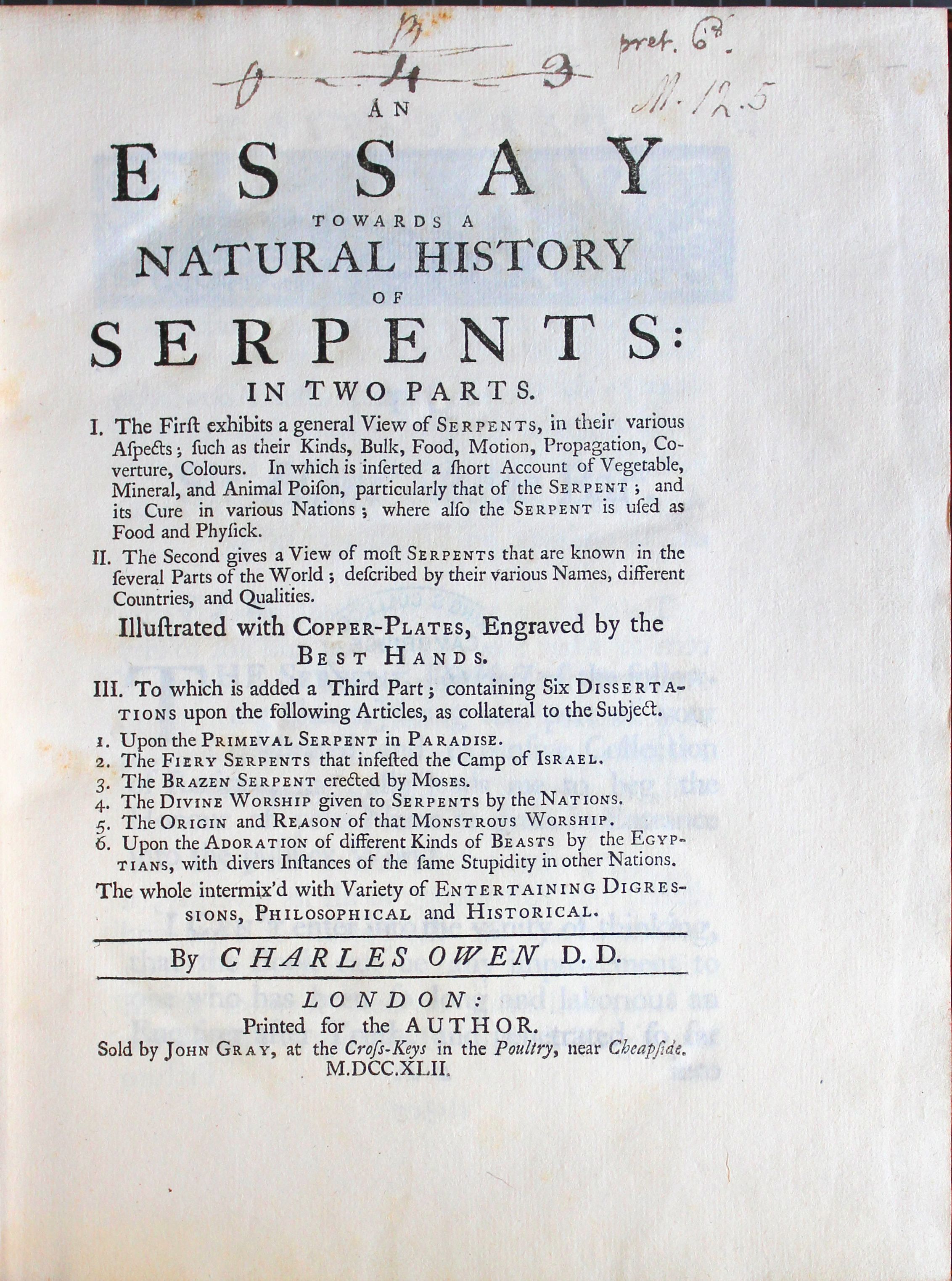
Another book focused entirely upon snakes is An Essay towards a Natural History of Serpents by Charles Owen (d.1746). Owen was a clergyman rather than a scientist, and his (often inaccurate) information is drawn from various biblical and mythological sources. The title page describes the contents in a fair amount of detail.

title page

Title page of An Essay towards a Natural History of Serpents by Charles Owen, London, 1742 (Shelfmark: Bryant.M.12.5)

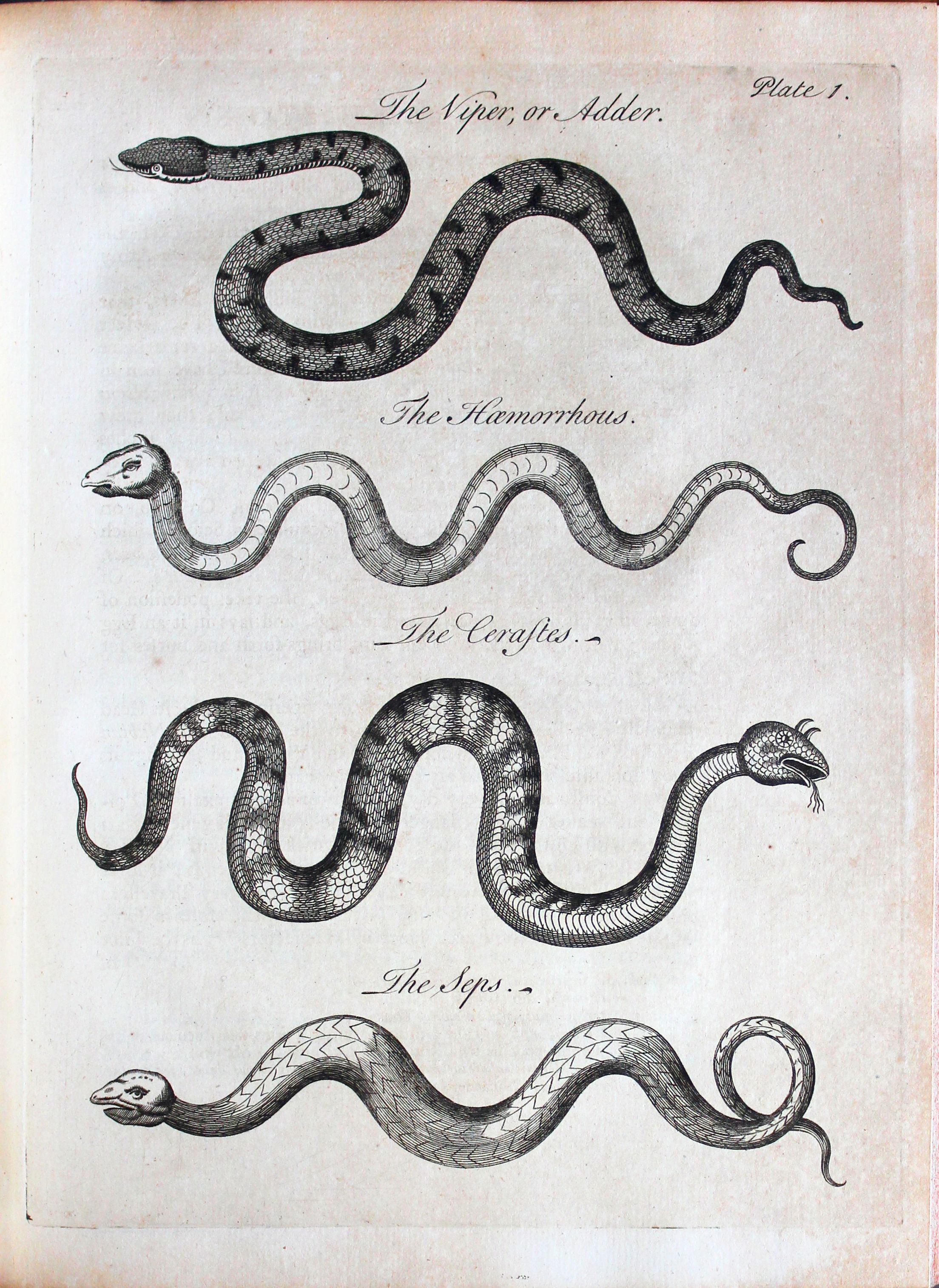
The illustrations in this volume are great fun, and very striking, as can be seen from the examples below. The snakes all have very expressive faces.

 four snakes

Plate 1 facing page 54 from An Essay towards a Natural History of Serpents by Charles Owen, London, 1742 (Shelfmark: Bryant.M.12.5)

four snakes, including a cockatrice

Plate 3 facing page 78 from An Essay towards a Natural History of Serpents by Charles Owen, London, 1742 (Shelfmark: Bryant.M.12.5)

The plate above includes the depictions of a mythical creature: the Basilisk (here conflated with the Cockatrice), which the text describes as the Little King of Serpents, hence the crown upon its head.

Four snakes

Plate 6 facing page 142 from An Essay towards a Natural History of Serpents by Charles Owen, London, 1742 (Shelfmark: Bryant.M.12.5)

Other natural history books provide beautiful colour images. Below is an illustration of a double-headed snake from a work chiefly devoted to rare birds, by noted English ornithologist George Edwards (1694-1773). Edwards widened the scope of his work to include other unusual creatures, including reptiles, and described this snake thus:

I did not propose at first in this Natural History to exhibit monsters, but our present subject (considered even with a single head) may be looked on as a natural production of a species little or not at all known to us.

We now know that this phenomenon comes about in some snakes in a very similar way to the development of human conjoined twins, and is not a sign of a separate species.

Colour illustration of a double-headed snake

Double-headed snake. From the plate facing page 207 of volume 4 of A Natural History of Uncommon Birds by George Edwards, London, 1743-51 (Shelfmark Keynes.P.6.11/1)

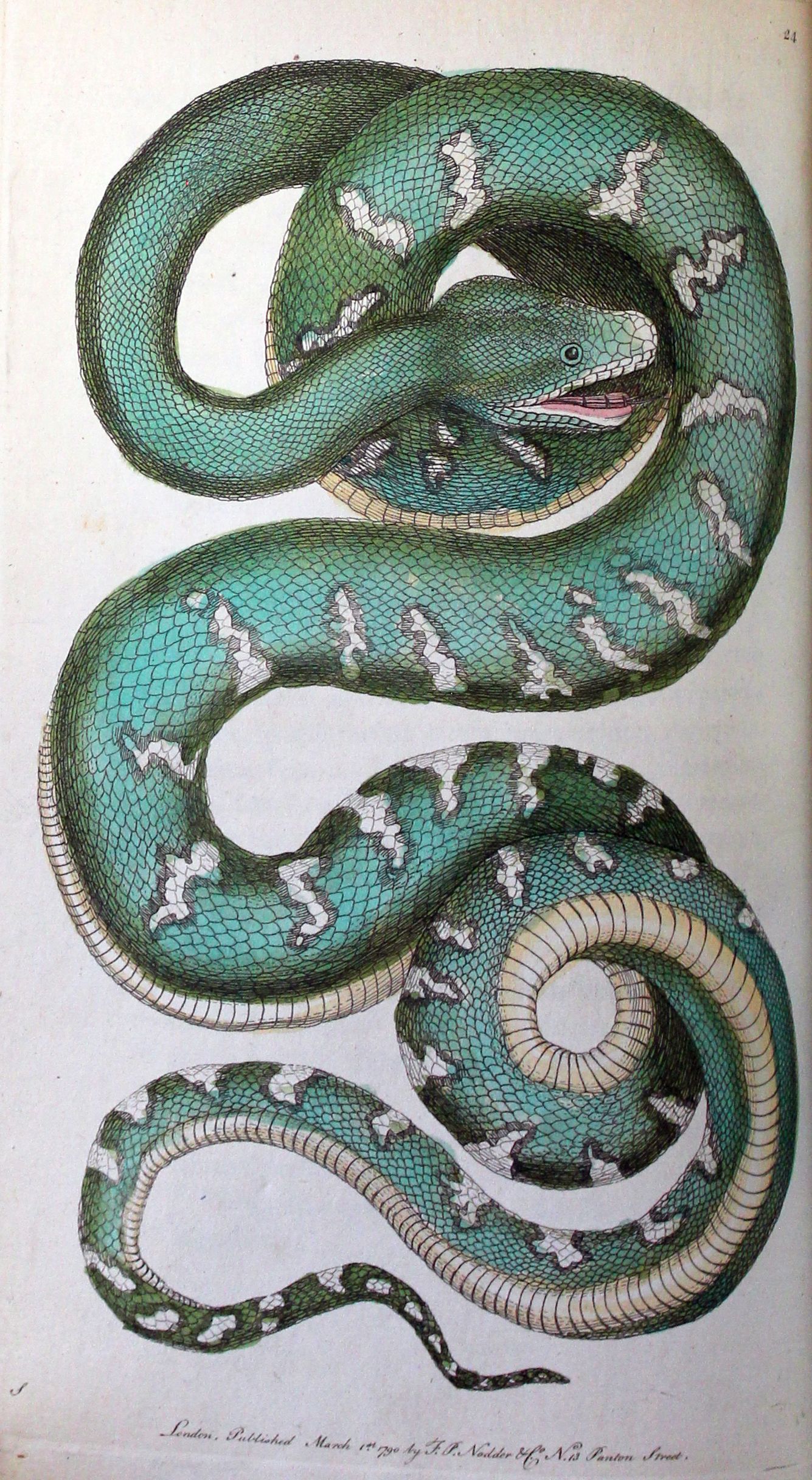
Leafing through a multi-volume miscellany of the natural world by biologist George Shaw (1751-1813), we were spoilt for choice for great images to highlight.  Shaw was a Fellow of the Royal Society and sometime keeper of the Natural History Department at the British Museum. He described many new species of amphibian and reptile. Below are just a few of the many vibrant illustrations of snakes contained within Shaw’s Miscellany.

Painted snake - orange with black spots

Painted snake. Plate facing fol. C2 recto in volume 1 of The Naturalist’s Miscellany by George Shaw, London, 1790 (Shelfmark: Thackeray.IV.2.2)

Large bright green snake with white spotches

The canine boa. Plate 24, facing fol. L4 recto in part 1 of The Naturalist’s Miscellany by George Shaw, London, 1790 (Shelfmark: Thackeray.IV.2.2)

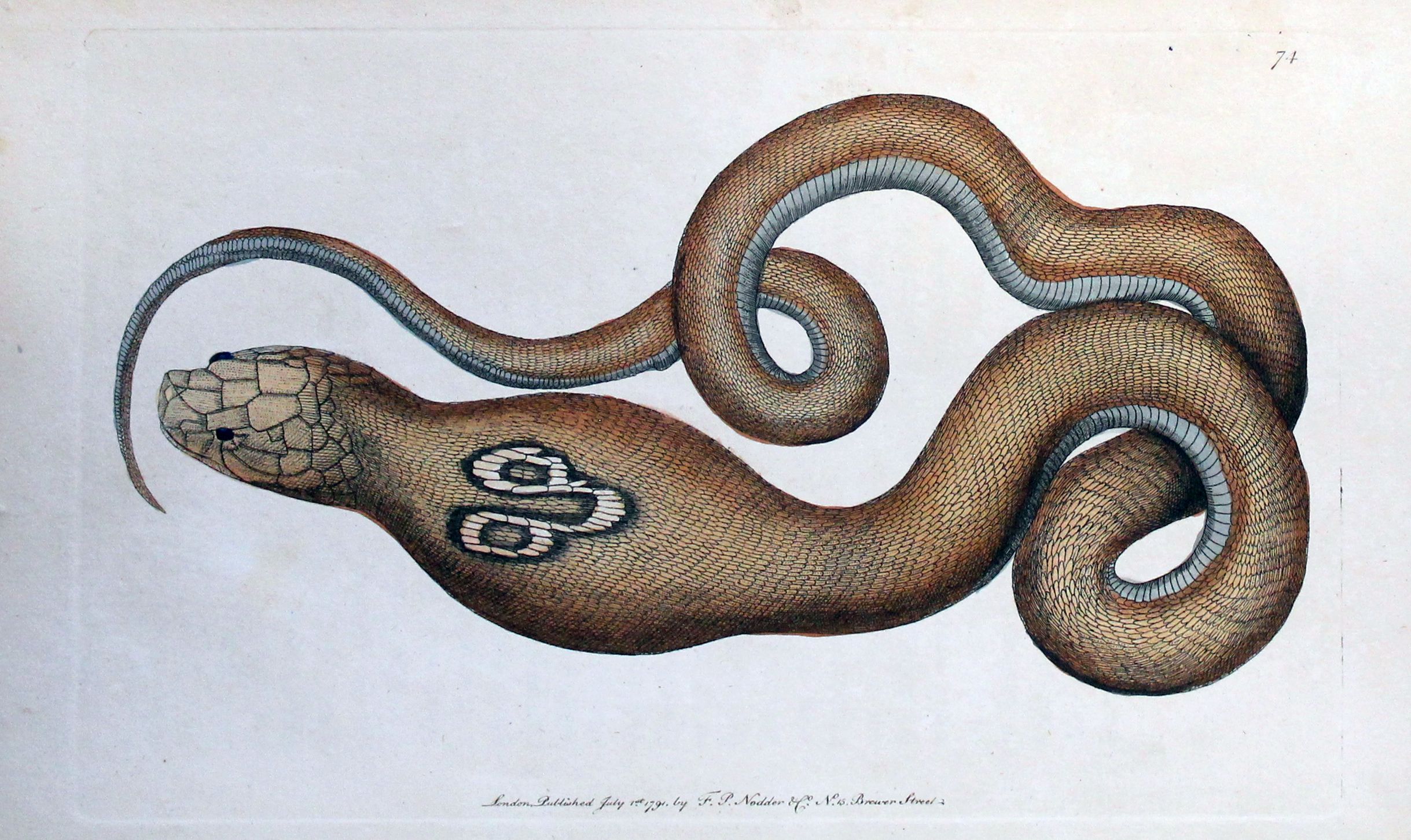
Large brown snake

The spectacle snake. Plate 74, facing fol. 2K4 verso in part 2 of The Naturalist’s Miscellany by George Shaw, London, 1791 (Shelfmark: Thackeray.IV.2.2)

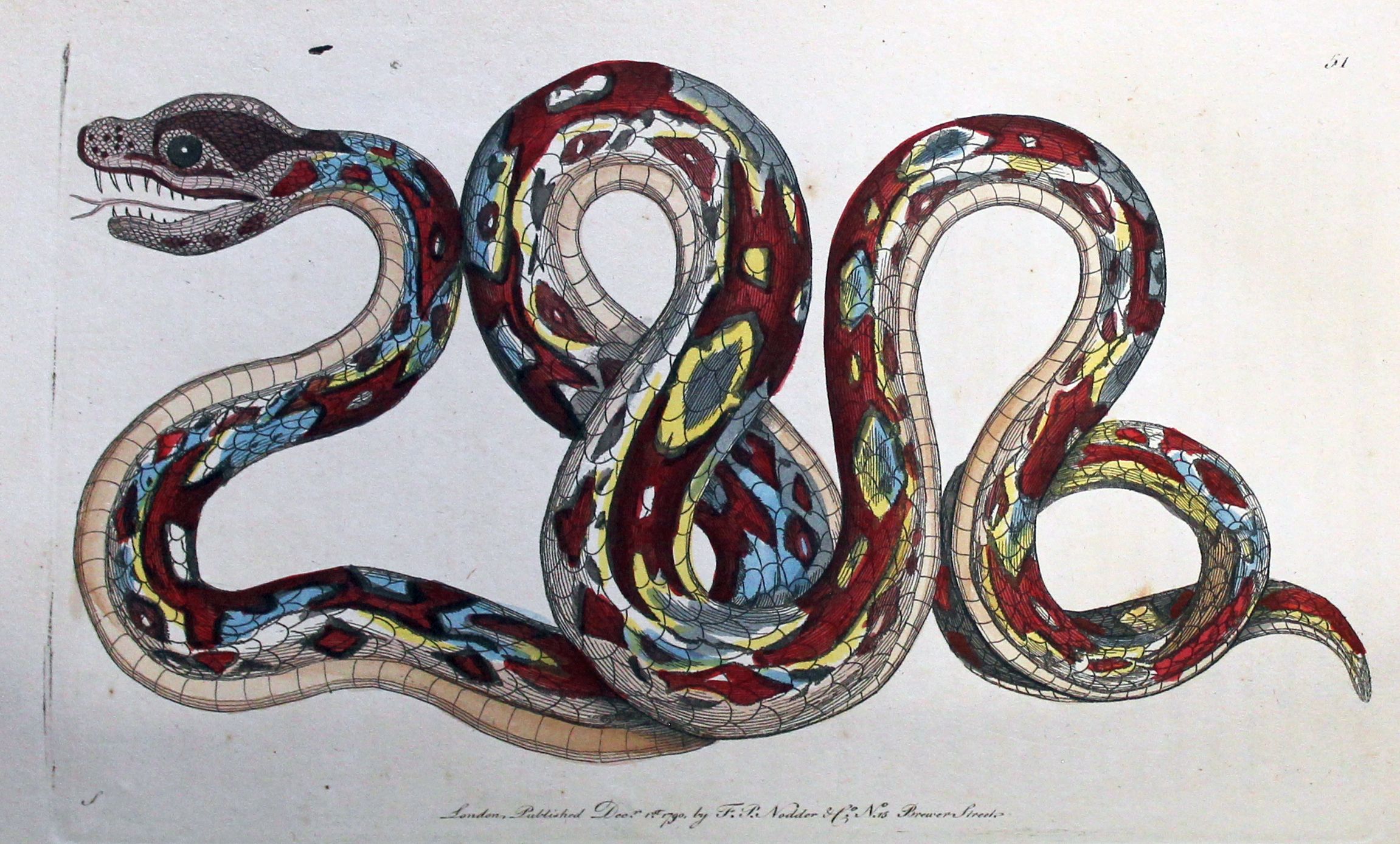
red, blue and yellow snake

The Great Boa. Plate 51, facing fol. Z5 recto in part 2 of The Naturalist’s Miscellany by George Shaw, London, 1791 (Shelfmark: Thackeray.IV.2.2)

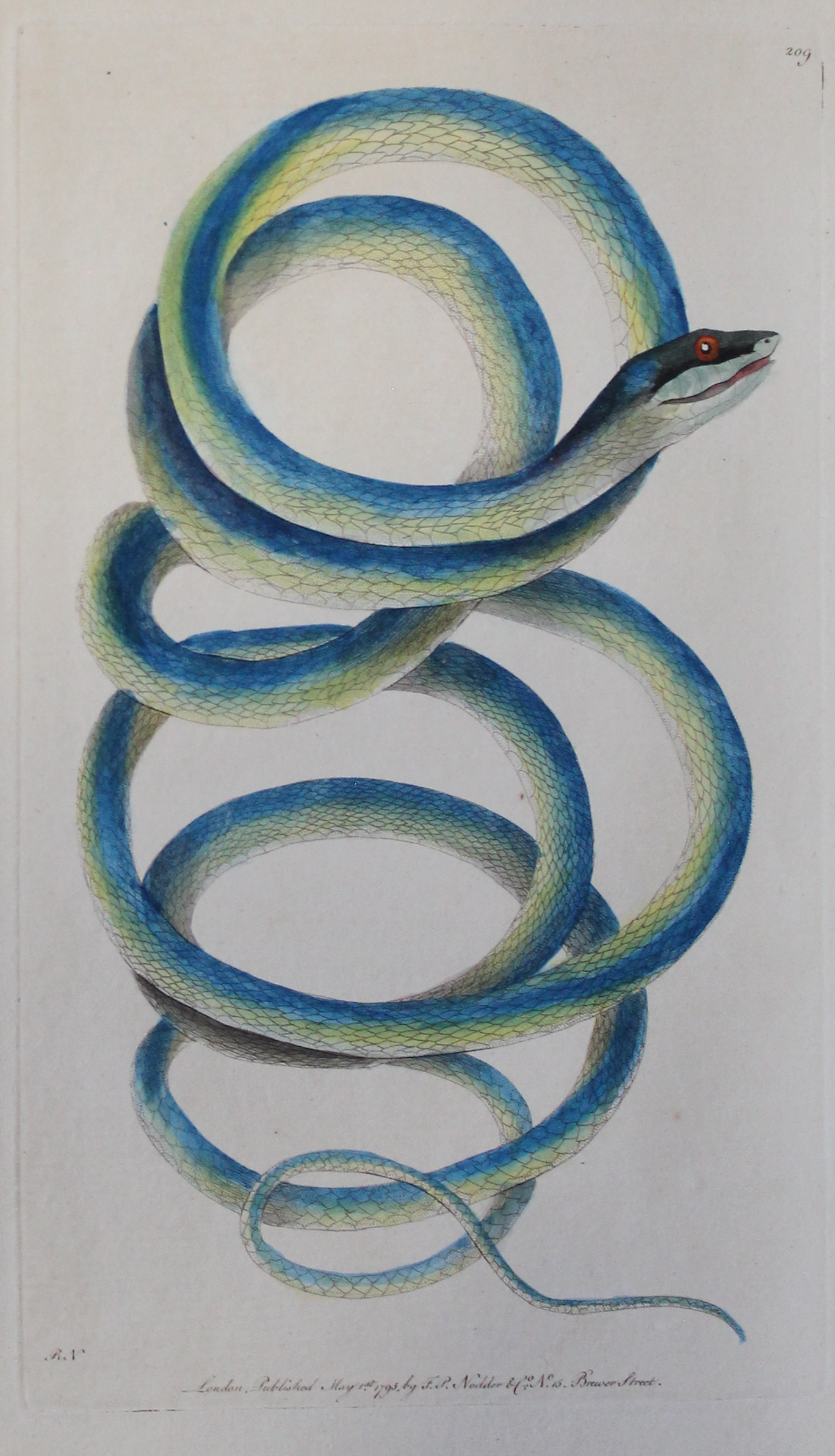
Long thin bluish green snake

The Gilded Snake. Plate 209, facing fol. O8 recto in part 6 of The Naturalist’s Miscellany by George Shaw, London, 1795 (Shelfmark: Thackeray.IV.2.4)

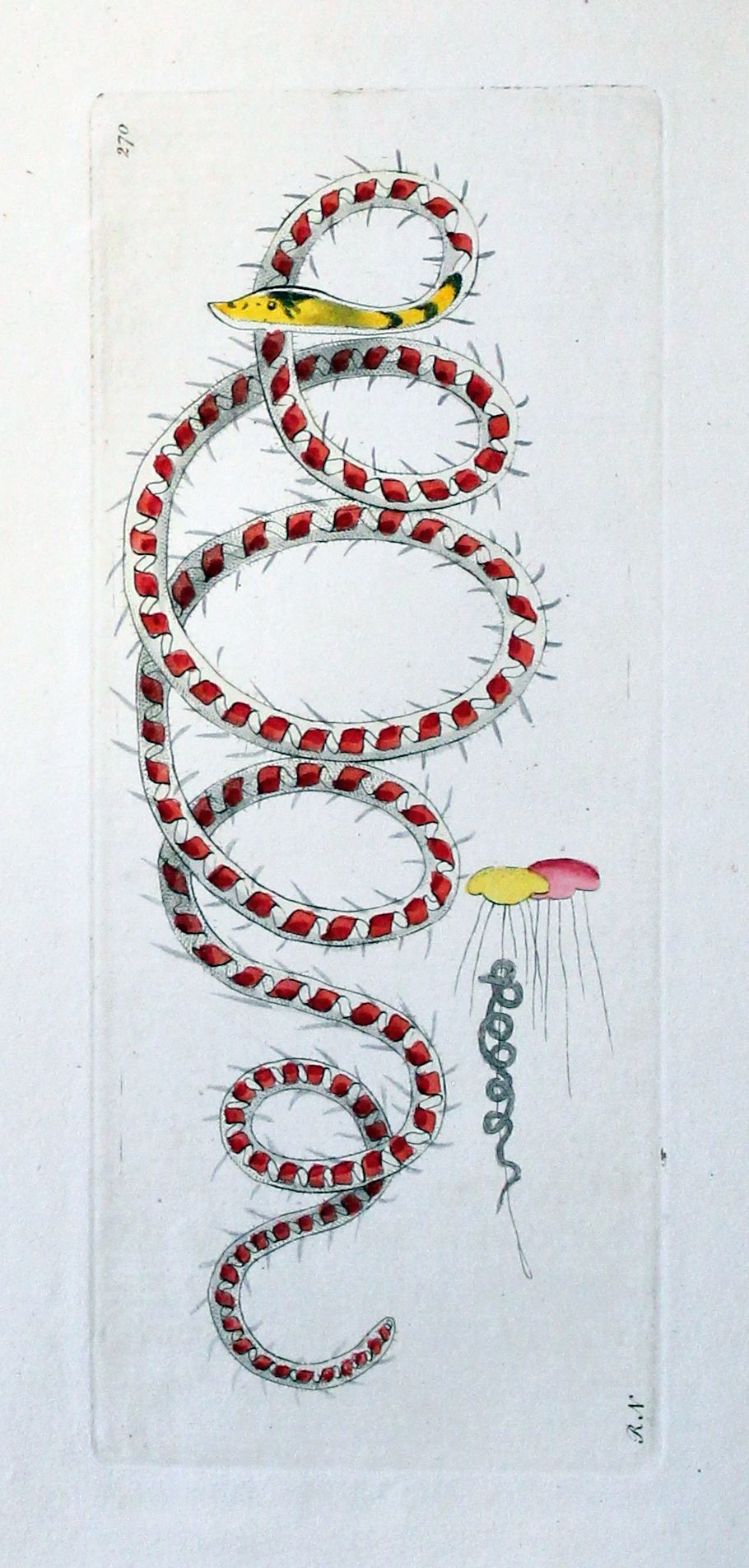
Strange thin red and white snake with bristles.

The Serpentiform Nais. Plate 270, facing fol. E4 recto in part 8 of The Naturalist’s Miscellany by George Shaw, London, 1796 (Shelfmark: Thackeray.IV.2.5)

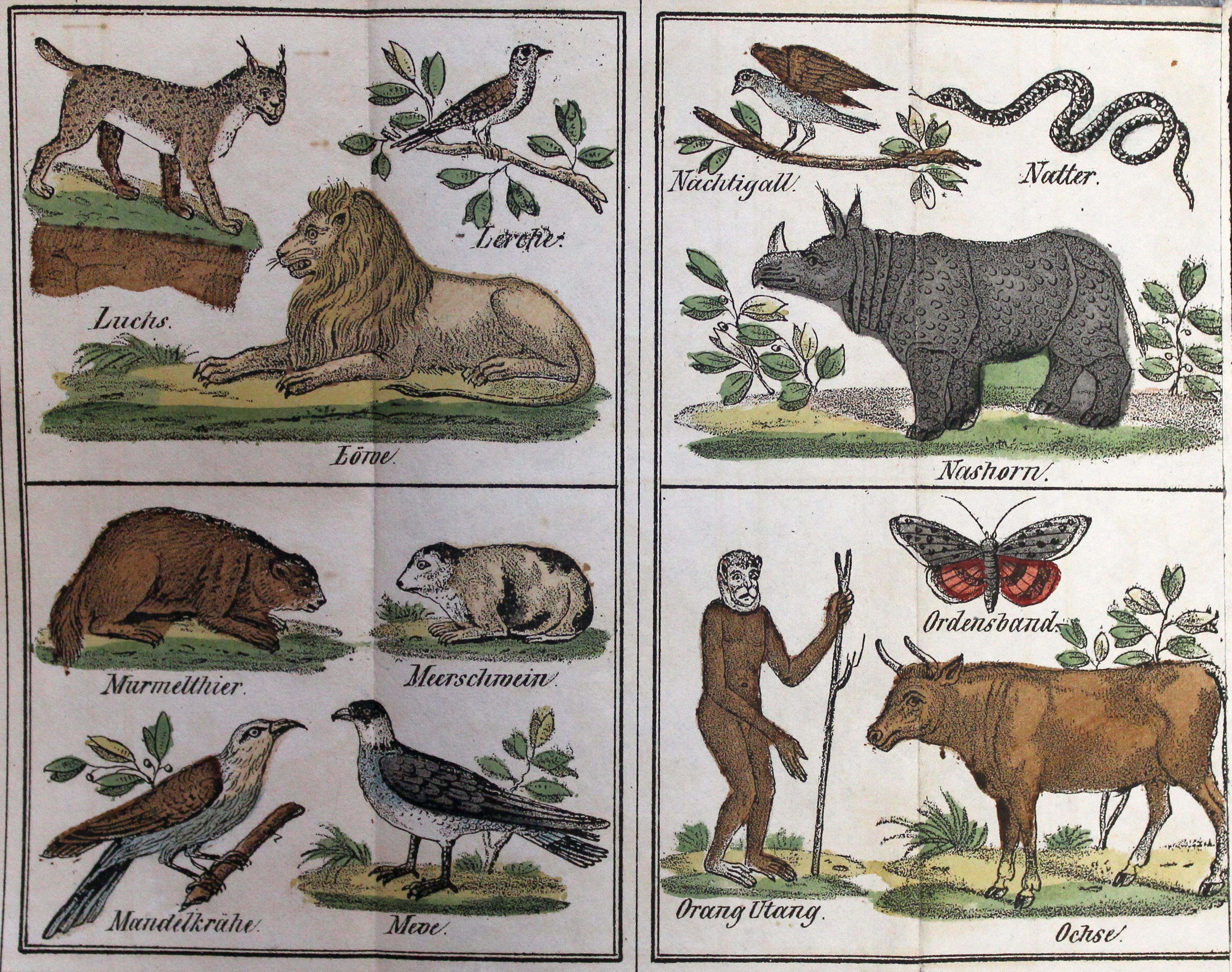
Finally, a little snake appears in a charming little German alphabet book from our Rylands Collection of children’s books. This tiny book, dating from the latter half of the nineteenth century, consists of three strips of paper stuck together and folded accordion-style. The German word for snake being “Natter”, the snake comes under the letter N in this sequence, alongside a Nashorn, or rhino, and a nightingale.

Illustrations representing different letters of the alphabet - a grid of four letters is shown. other animals shown include a lion, orangutan and an Ox

Section from Das ABC in Thieren, Neuruppin, circa late 19th century (Shelfmark: Rylands.C.ABC)

We hope you have enjoyed this survey of snakes within the pages of our rare book collections, and that you have a wonderful New Year!

References 

Joscelyn Godwin, Athanasius Kircher: A Renaissance Man and the Quest for Lost Knowledge , London, 1979.

Paula Findlen (editor), Athanasius Kircher: The Last Man Who Knew Everything, New York, 2004.

AC

Horticultural delights

The library holds a fascinating collection of books on horticulture given to us by Kingsman Richard Gorer (1913-1994), who was a scholar here in the 1930s. In later years Gorer himself wrote a considerable number of gardening books, and became a fellow of the Royal Horticultural Society.

The collection spans the 17th to the 20th centuries and includes some wonderful works, with equally glorious illustrations.

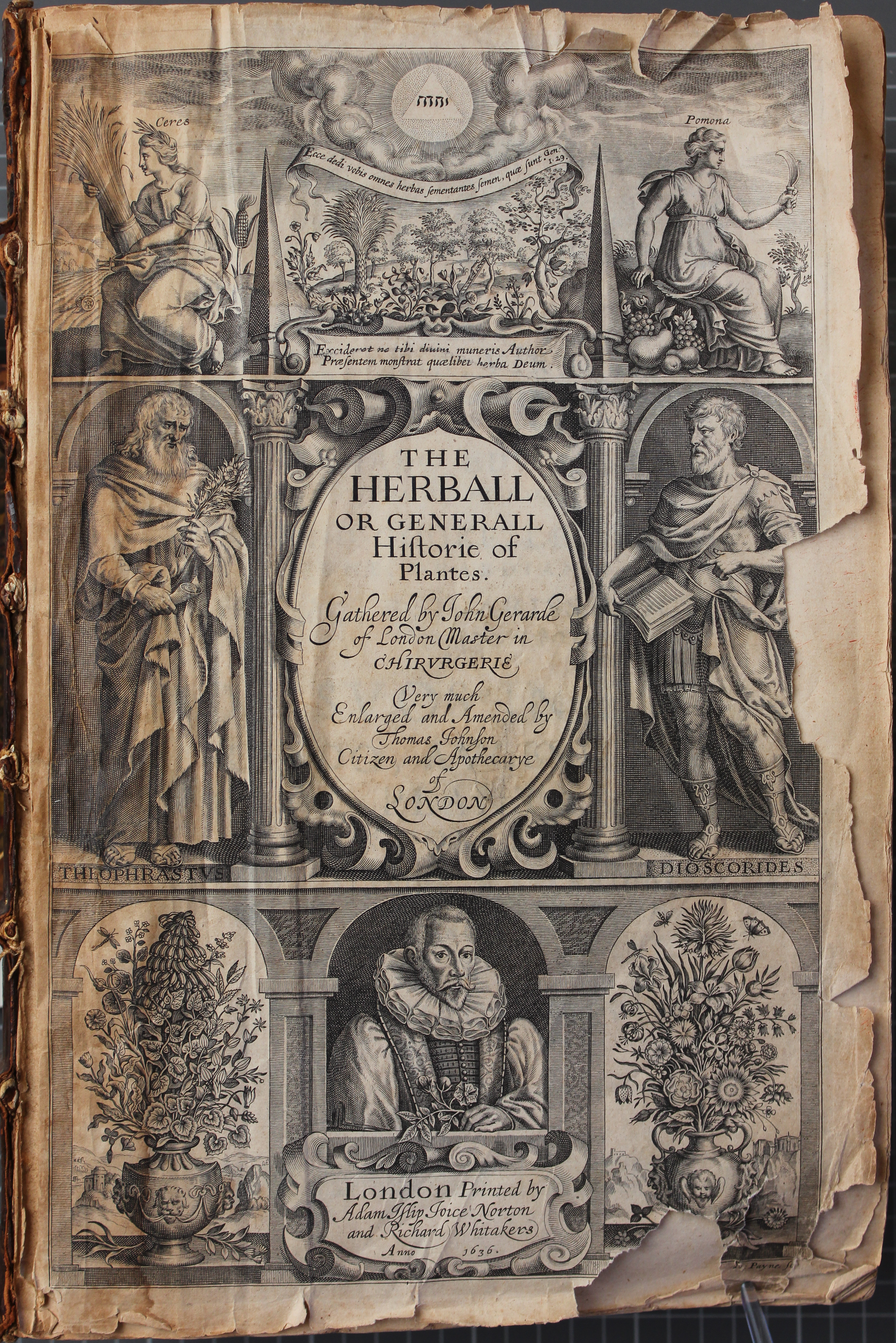
The oldest volume in the collection is The Herball or Generall Historie of Plantes. Prominent sixteenth-century English herbalist, John Gerard (c.1545-1612) published the first edition of this work in 1597. It was based almost entirely on the work of a Flemish botanist Rembert Doedens (1517-1585) with fanciful additions by Gerard. The work was then overhauled and expanded by Thomas Johnson (c.1595-1644), to produce a second edition in 1633, in which many of Gerard’s inaccuracies and fabrications were removed or corrected. The lavishly engraved title page of this second edition is pictured below, in a reprint dating from 1636. Gerard is shown in the bottom centre panel, holding a potato flower, the first image of this plant to appear in a work published in the Western world. Vases of exotic flowers and fruits appear either side of Gerard, and arrayed above him are figures from the ancient world associated with agriculture and plants, including, at the top left, Ceres, the Roman goddess of agriculture.

Engraved titlepage with mythical figures and plants

Title page of The Herball or Generall Historie of Plantes by John Gerard and Thomas Johnson, London, 1636 (Classmark: Gorer.50)

The revised Herball still contains some fanciful notions, including a description of the “Goose tree” which was believed to generate barnacle crustaceans that then developed into live geese! This was a myth of long-standing, featuring in various forms in medieval bestiaries and numerous other works over the centuries. It is thought to have originated, before bird migration was known about, as a way to explain why barnacle geese were never seen nesting, and to have been prompted by some perceived similarities in colour and shape between the barnacle and the geese. Barnacle shells were often seen attached to driftwood, which was mistaken for fallen tree branches.

A goose beside a branch full of barnacles

Illustration of a branch from a Goose Barnacle tree, page 1587 in The Herball (Classmark: Gorer.50)

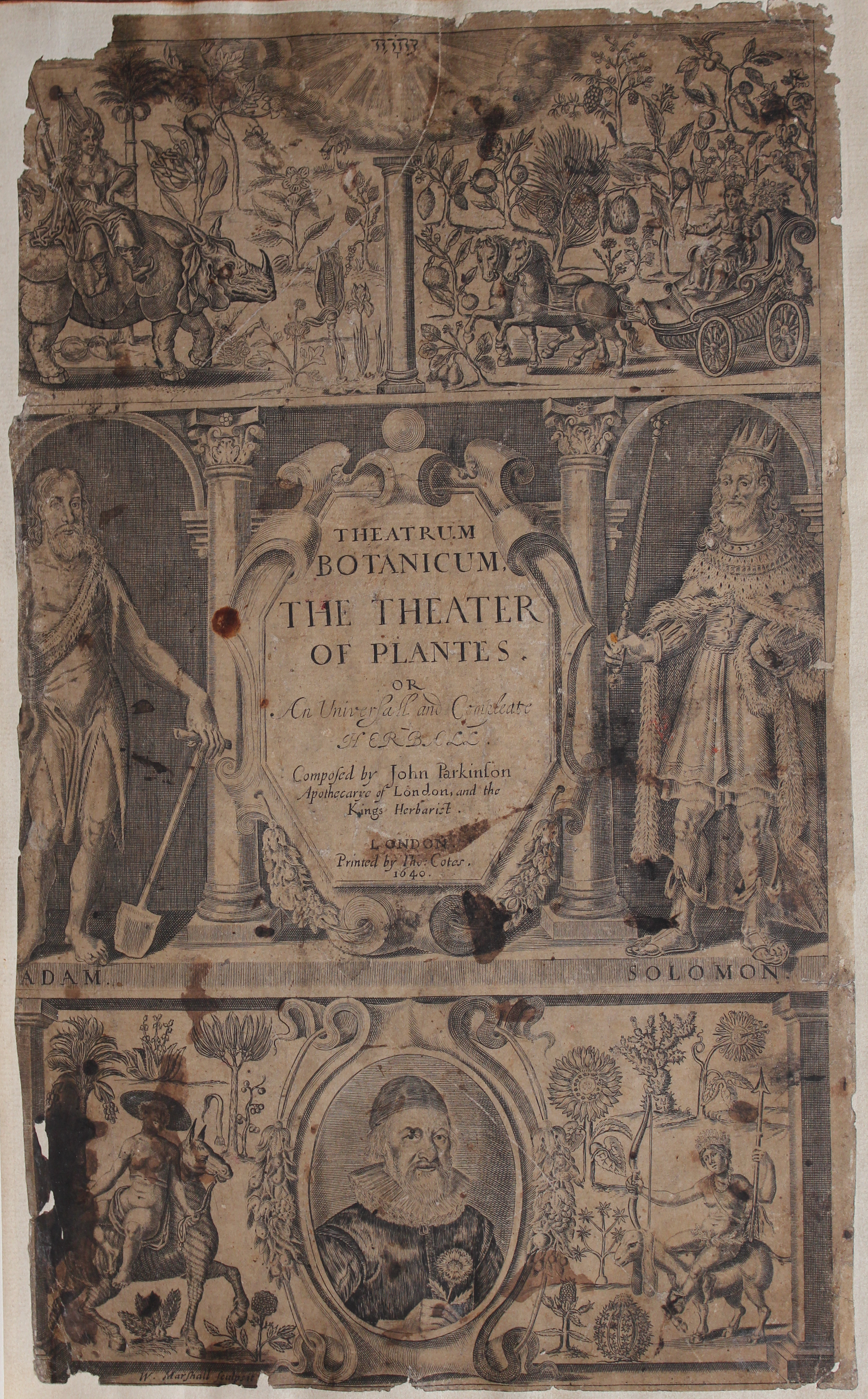
Another elaborate illustration is found on the added engraved title page of Theatrum botanicum by John Parkinson (1567-1650). The engraving is divided into the four quarters of the known world: Asia, Europe, the Americas and Africa. These are arranged clockwise from the top left. Each section depicts a woman riding an animal, or in the case of “civilised” Europe, sat in a horse-drawn carriage, and also shown are plants thought (often erroneously) to be native to each continent. Maize, for example, is depicted in the Asian quarter, since it was not yet known that it originated in the Americas. The European quarter has the most abundant selection of plants, highlighting the lack of in-depth knowledge of the other areas of the world. In the centre of the page are two figures: Adam, holding a spade, and Solomon, known for his wisdom. 

Detailed engraving depicting the four corners of the known world

Title page of Theatrum botanicum by John Parkinson, London,1640 (Classmark: Gorer.51)

Moving on to the latter part of the seventeenth century, we have a copy of The History of the Propagation & Improvement of Vegetables by clergyman and natural historian Robert Sharrock (1630-1684). Sharrock was a fellow of New College, Oxford and an associate of noted chemist Robert Boyle (1627-1691). He was also involved with the University’s Physick Garden, where he carried out some of his experiments with grafting.

Title page

Title page of The History of the Propagation & Improvement of Vegetables by Robert Sharrock, Oxford, 1660 (Classmark: Gorer.30)

The work’s only illustration, shown below, depicts the many different ways to carry out propagation via grafting.

Illustration of a stem with various methods of grafting shown

Page 60 and accompanying illustration from The History of the Propagation & Improvement of Vegetables 

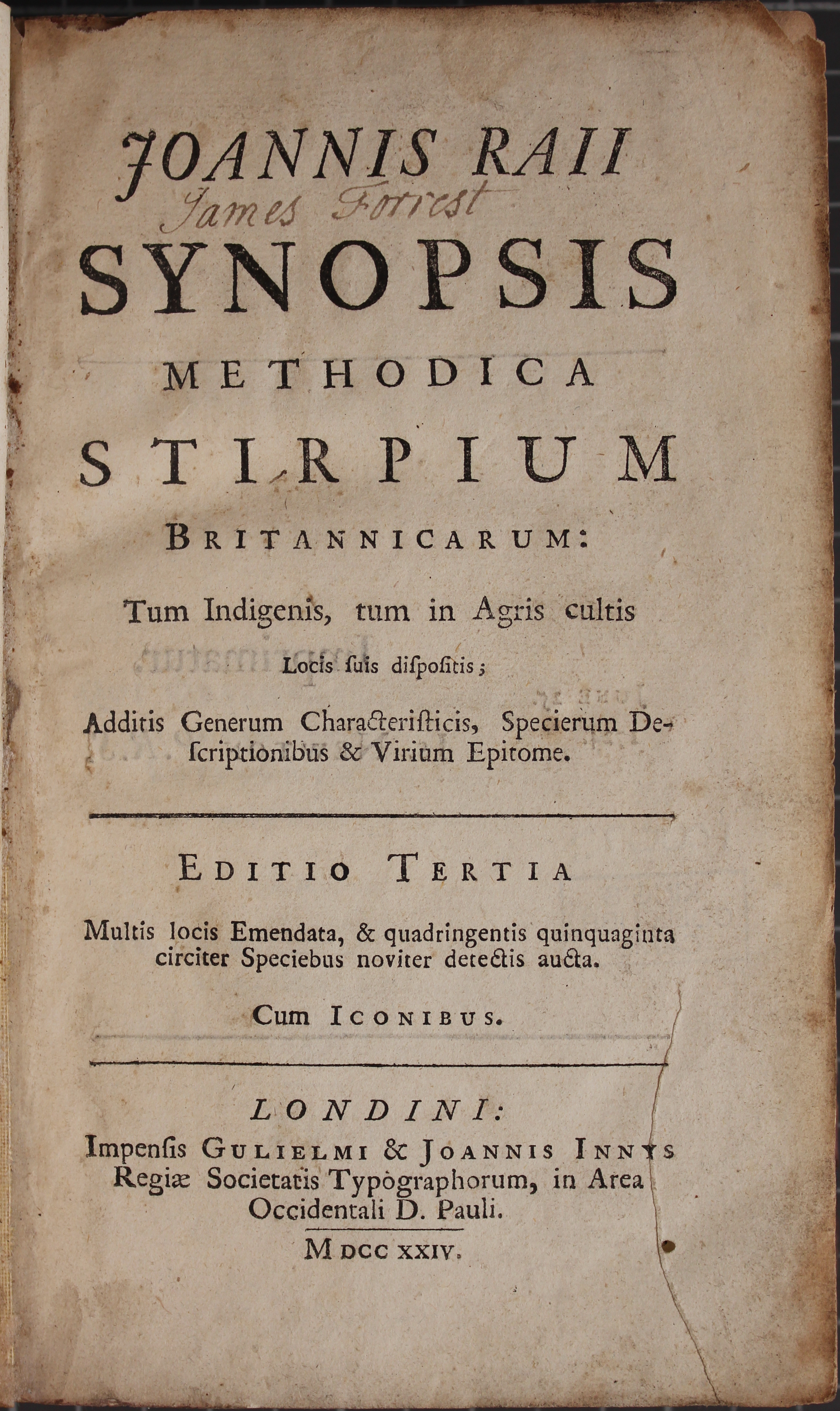
Next we have the third edition of Synopsis Methodica stirpium britannicarum by the famous naturalist John Ray (1627-1705). Originally published in 1690, this work became a hugely popular guide for amateur and professional botanists alike throughout the eighteenth century and beyond. It is now of great historical value, as it records many plants which were much reduced or lost entirely as a result of land enclosures, the expansion of cities and the Industrial Revolution.

Title page

Title page of Synopsis Methodica stirpium britannicarum by John Ray, London, 1724 (Classmark: Gorer.29)

tree illustration

Illustration facing page 477 from Synopsis Methodica stirpium britannicarum

Transitioning into the eighteenth century, the collection contains a 1754 edition of The Gardener’s Dictionary by botanist Philip Miller (1691-1771). Originally published in 1731, this work was based on Miller’s experience with plants from around the globe gained through his role as head gardener at the Chelsea Physic Garden. It is notable for its breadth of coverage and assured tone, which meant it sold well enough to be reissued in many subsequent editions across the century. The lavish engraved frontispiece depicts Britannia sitting in an orangery being gifted a cornucopia, or horn of plenty, by allegories of industry, science and nature.

Title page

Title page from volume 1 of The Gardeners Dictionary by Philip Miller, London, 1754 (Classmark: Gorer.27/1)


Engraved frontispiece

Frontispiece from volume 1 of The Gardeners Dictionary by Philip Miller, London, 1754 (Classmark: Gorer.27/1)

Arriving in the Victorian era, when gardening became a much more widespread pastime, we find books and periodicals containing an abundance of advice for amateur gardeners, often accompanied by vibrant colour illustrations.

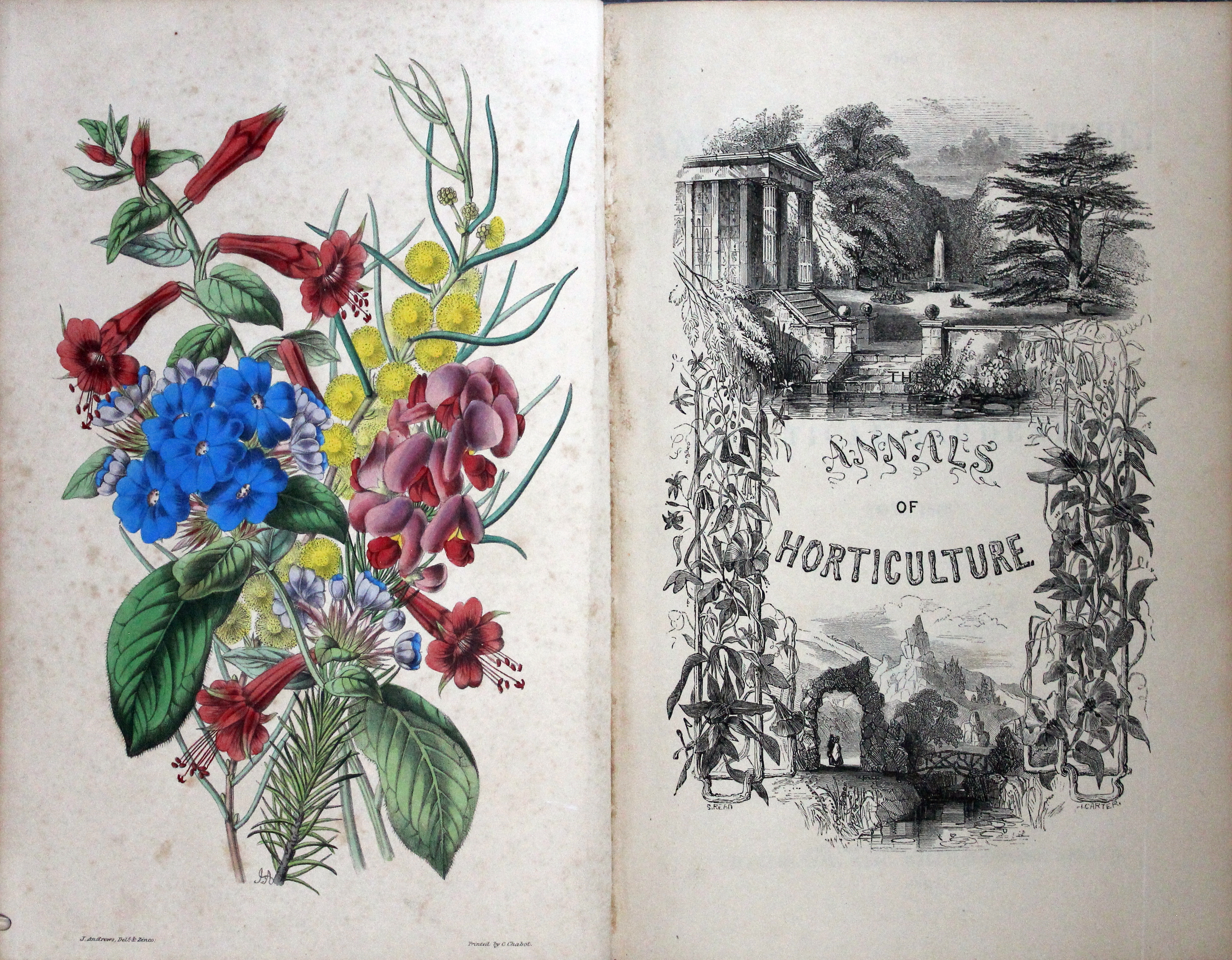
One such periodical, The Annals of Horticulture (1846-1850), first appeared monthly, and was then reissued in five annual collected volumes, of which the Gorer collection contains two. The illustrated title pages and frontispieces are very attractive.

Attractive colour frontispiece showing many different flowers and an illustrated titlepage

Frontispiece and engraved title page from The Annals of Horticulture, London, 1849 (Classmark: Gorer.32/1)

The subject matter of this periodical even extends to designs for summer houses, as illustrated below. These examples wouldn’t be out of place in a modern garden.

Pages showing summer houses

Garden architecture from page 449 of the 1849 edition of The Annals of Horticulture

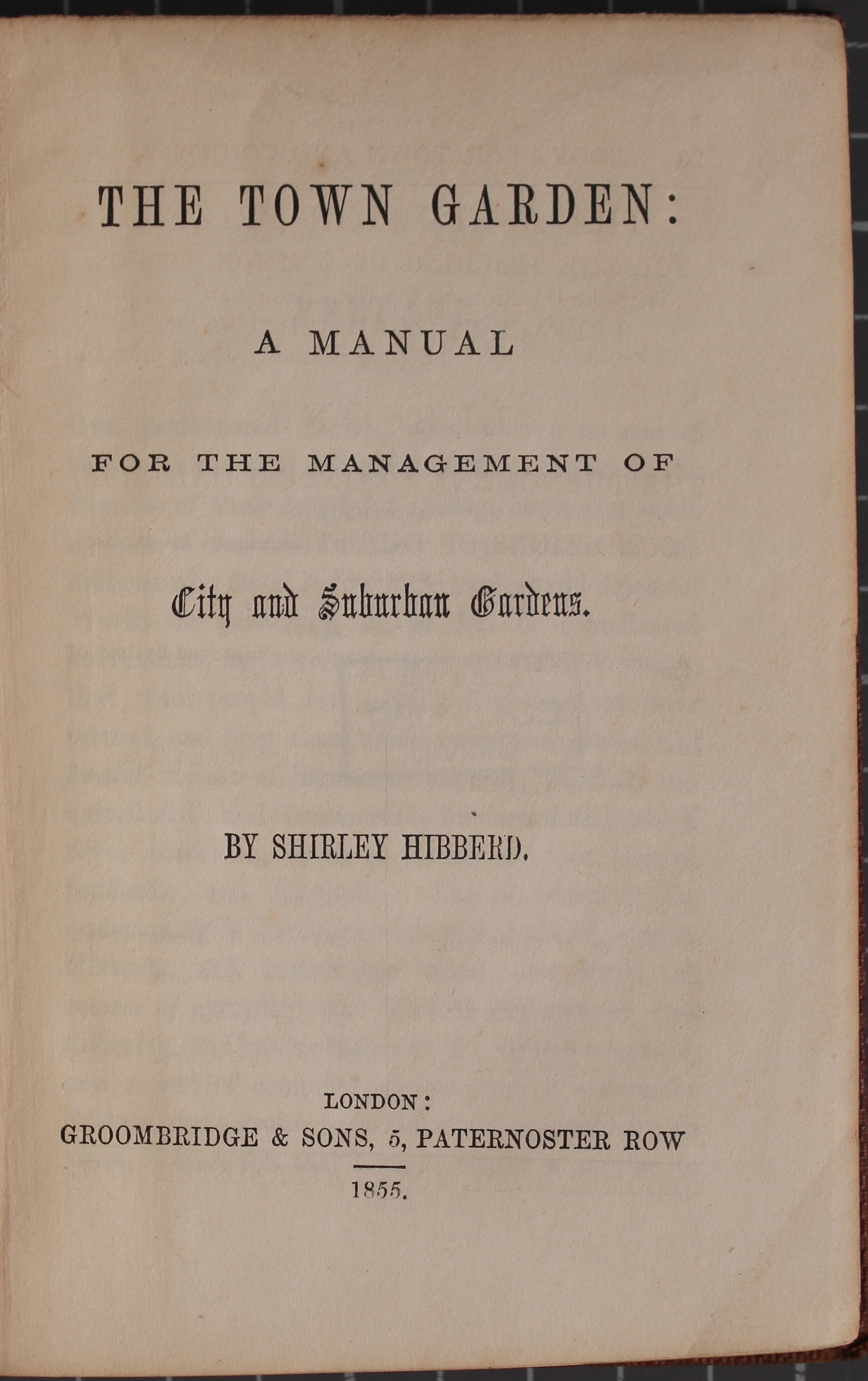
One of the most popular writers of the period was Shirley Hibberd (1825-1890), who tailored his advice particularly towards the requirements of those with urban and town gardens, rather than grand, sprawling country estates. His first gardening book, The Town Garden: A Manual (1855) was devoted to this topic. It also provided those new to gardening with tips on how to get going. In his writings, Hibberd drew upon his own experiences of hobby gardening, initially in a small garden in North London, and subsequently in various suburban settings. He was also a keen early environmentalist, and a strong opponent of cruelty towards animals and birds.

Title page

Title page of The Town Garden: A Manual by Shirley Hibberd, London, 1855 (Classmark: Gorer.10)

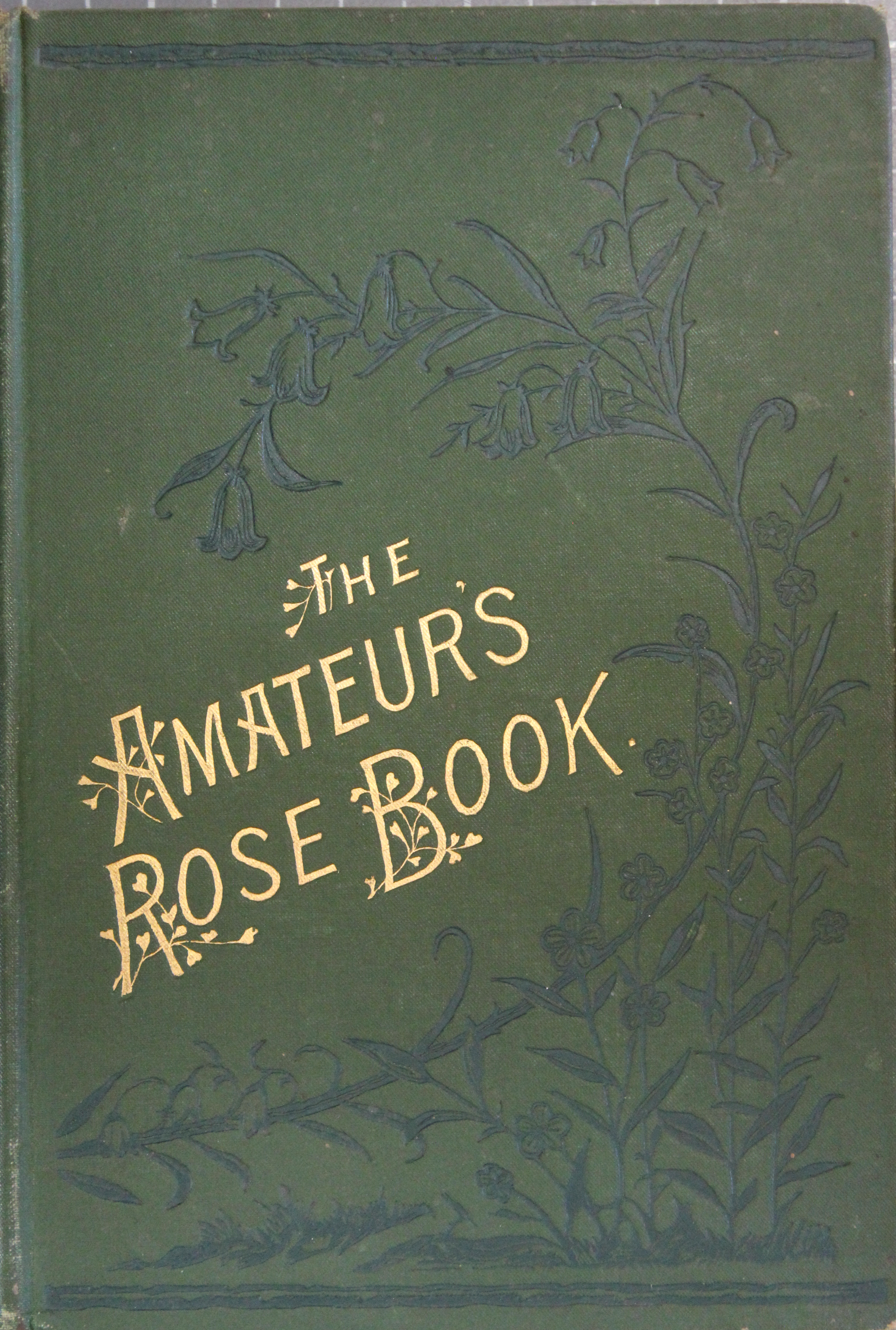
Hibberd went on to edit numerous gardening magazines and produce many more successful gardening books, often issued with attractive floral covers:

Attractive green floral book cover

Cover of The Amateur’s Flower Garden by Shirley Hibberd, London, 1871 (Classmark: Gorer.11)

Attractive green floral book cover

Cover of The Amateur’s Rose Book by Shirley Hibberd, London, 1885 (Classmark: Gorer.12)


Light brown floral book cover

Cover of Familiar Garden Flowers by Shirley Hibberd, London, 1879-1885 (Classmark: Gorer.14/1)

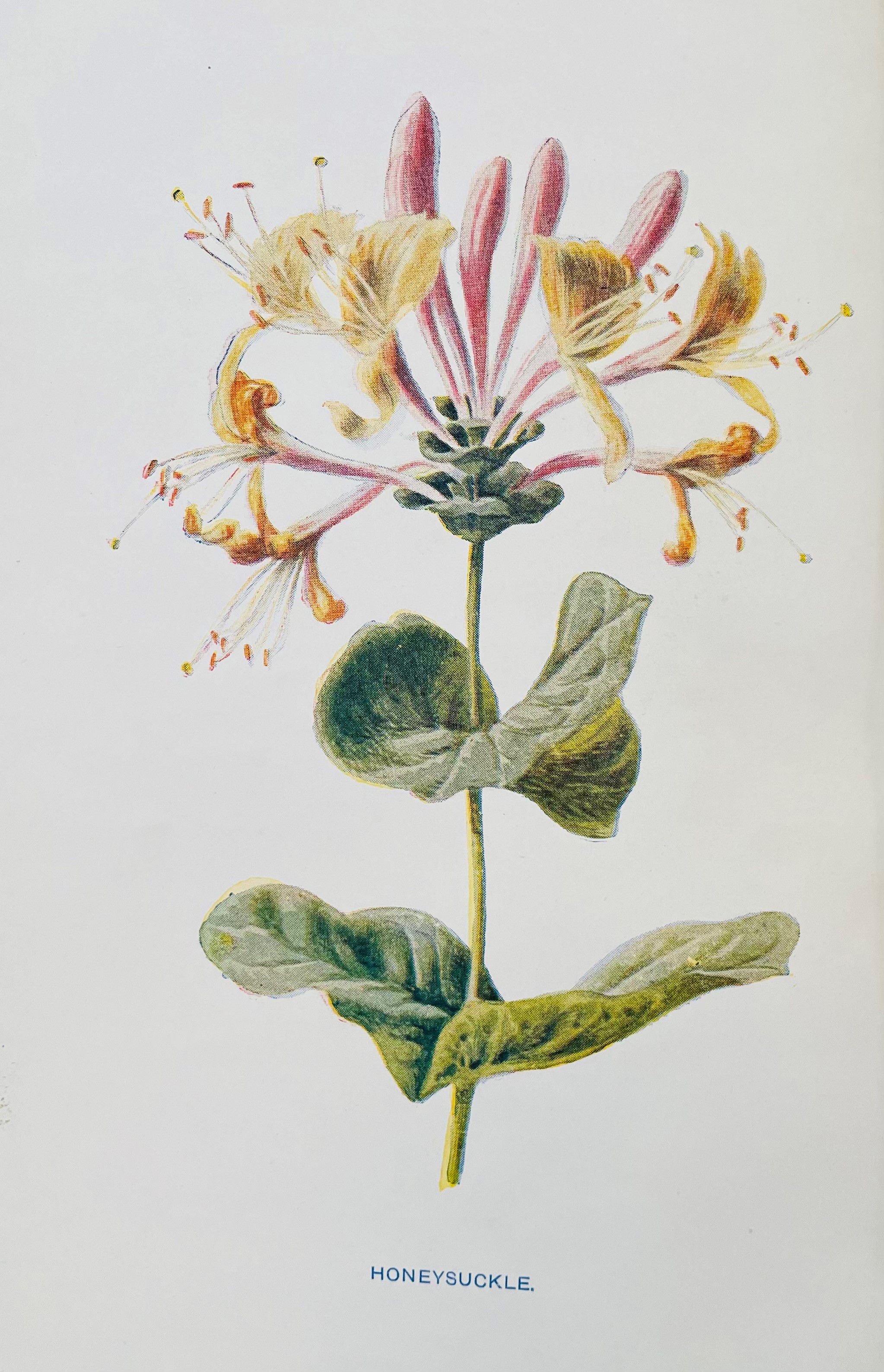
Familiar Garden Flowers, produced in five volumes between 1879 and 1887, contains particularly delightful colour illustrations, a selection of which provide a fitting way to conclude this post on gardening books through the ages. We hope you have gained some inspiration for your own gardens or flower boxes!

everlasting pea

Everlasting pea illustration facing p.105 in vol.1 of Familiar Garden Flowers (Classmark: Gorer.14/1)

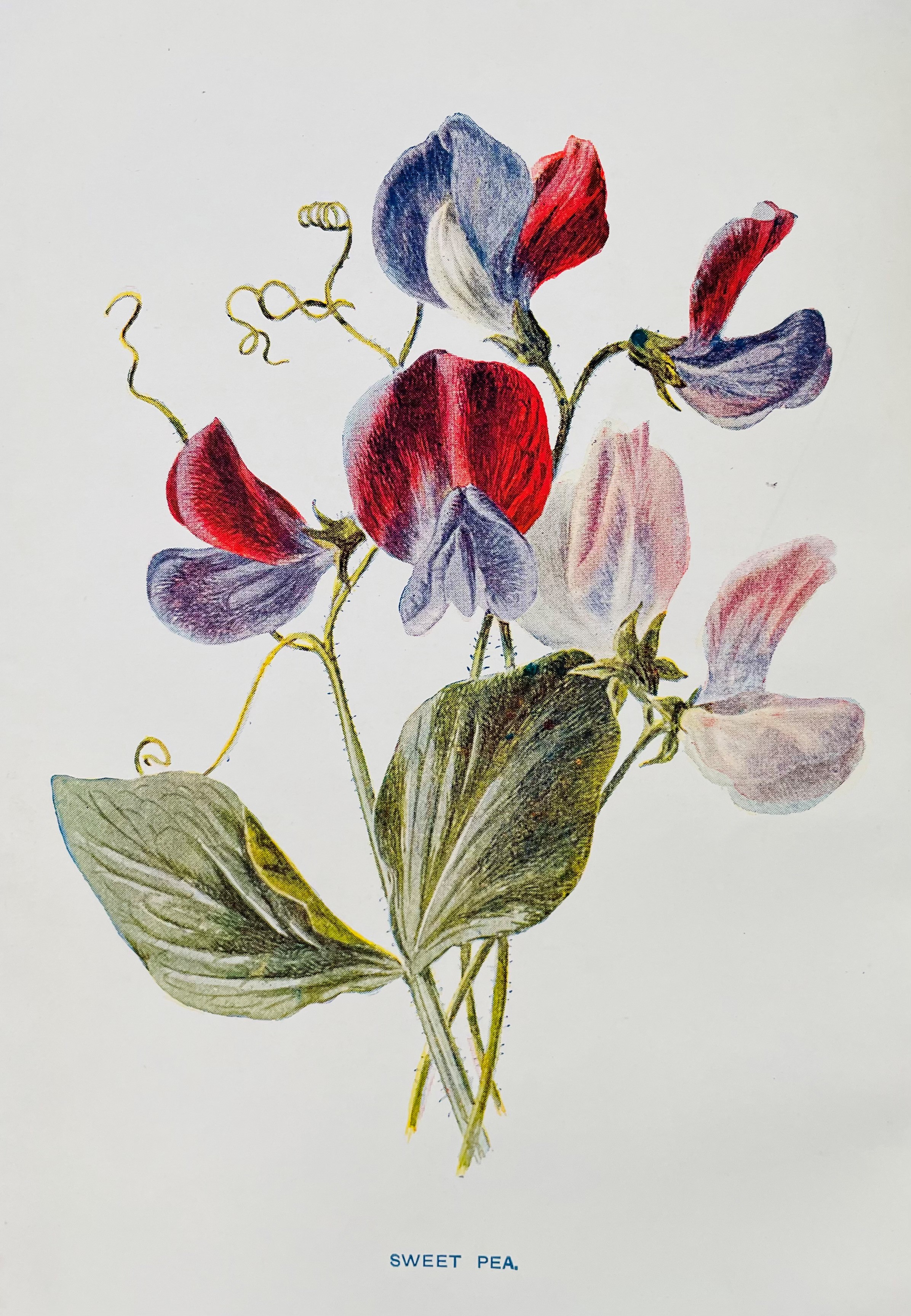
sweet pea

Sweet pea illustration facing p.113 in vol.1 of Familiar Garden Flowers (Classmark: Gorer.14/1)

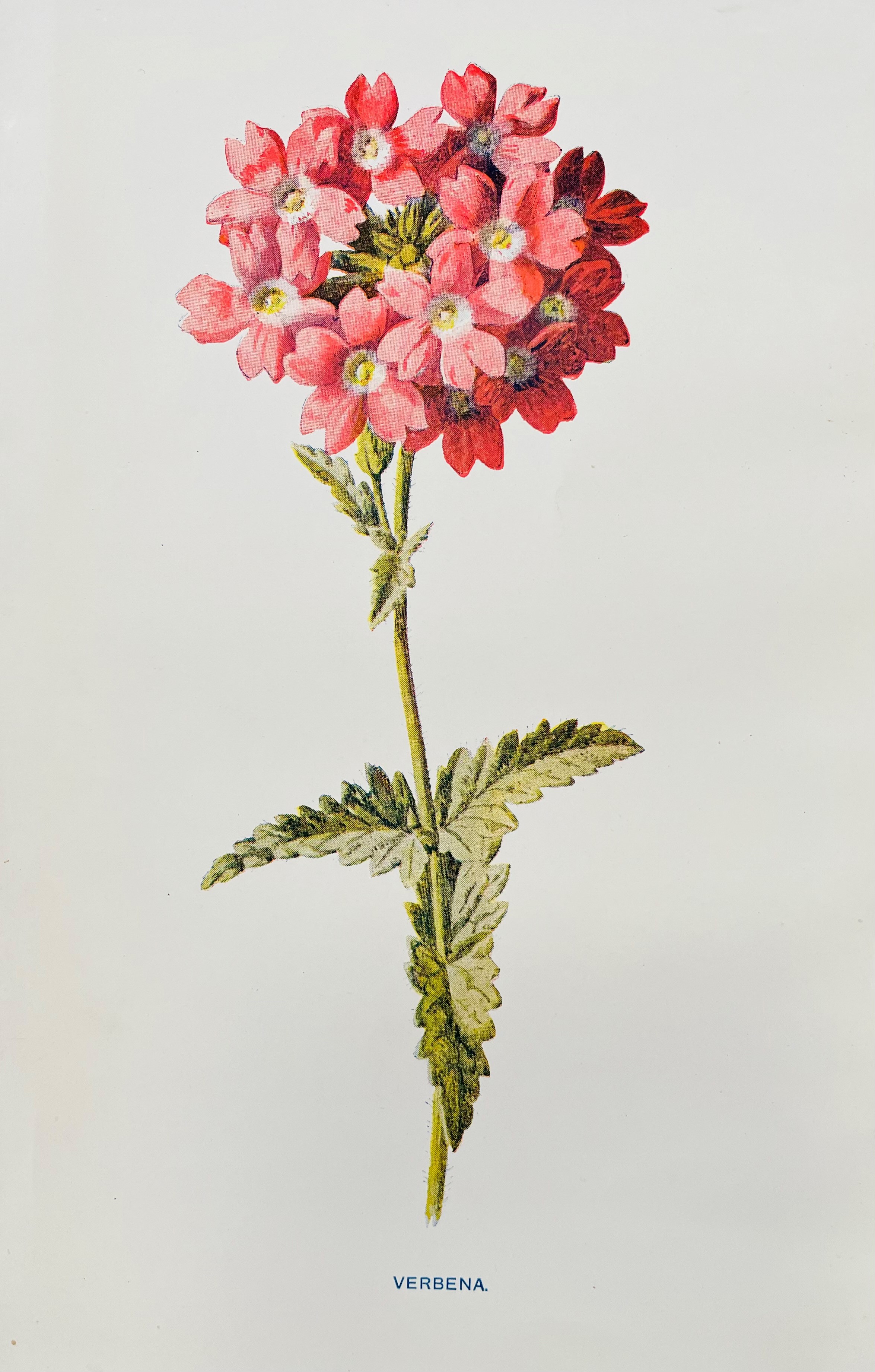
verbena

Verbena illustration facing page 105 in volume 5 of Familiar Garden Flowers (Classmark: Gorer.14/5)

wall flower

Wall flower illustration on frontispiece of volume 1 of Familiar Garden Flowers


Amethyst

Amethyst illustration facing page 5 in volume 5 of Familiar Garden Flowers

AC

References and further reading:

Richard Gorer: An English Jewish horticultural scholar and garden writer of the mid-twentieth century    [accessed September 2024]

John Gerard’s Herball   [accessed September 2024]

John Parkinson’s “Theatrum Botanicum” (1640) [accessed October 2024]

Synopsis Methodica Stirpium Britannicarum. John Ray   [accessed October 2024]

Robert Sharrock   [accessed October 2024]

A Botanical Wonderland Resides in the World of Rare and Unusual Books  [accessed October 2024]

Shirley Hibberd – the Father of Amateur Gardening    [accessed October 2024]

I Am Emperor of the French Still

While Ridley Scott’s biopic Napoleon has come and gone without too much fanfare or recognition during awards season, its release nevertheless reminded me that we have a volume in our rare-book collection that belonged to the French emperor, whose 255th birthday falls today (15 August 1769 – 5 May 1821):

Title page of Pierre Victor Jean Berthre de Bournisseaux, Histoire des guerres de la Vendée et des Chouans, depuis l’année 1792 jusqu’en 1815 (Paris: Claude Brunot-Labbe, 1819; M.37.116)

Napoleon’s ink signature is above the circular stamp: “l’Empereur Napoleon”. As he had been in exile on St Helena since October 1815, the book must have been shipped to him from France. The volume was sold at auction by Sotheby’s in June 1905 and was later donated to the College by Kingsman Alban Goderic Arthur Hodges (1893-1982):

Rear pastedown on which is stuck an advertisement for the Sotheby’s sale on 1-3 June 1905, including “Books from the library of the Emperor Napoleon I at St. Helena”. Next to it is a slip describing this book and its provenance: “Cachet of St. Helena and ‘L’Empereur Napoléon’ on title”.

While there are several items in King’s College’s collection that belonged to British monarchs, these are usually identified as such thanks to a royal cypher or a crest on the binding. This copy of the order of service performed at the coronation of George II (1727) belonged to his grandson George III (1738-1820), who was on the throne during Napoleon’s reign and exile:

The Form and Order of the Service that Is To Be Performed […] in the Coronation of their Majesties, King George II. and Queen Caroline (London: John Baskett, 1727; Thackeray.M.32.53)

The volume is bound in red morocco featuring an elaborate gilt panel design on front and rear boards with the crest of King George III at the centre and royal cyphers on each corner. This book did not come to King’s College as part of the large Thackeray Bequest, but was purchased in 1950. Though George III’s pre-1801 crest was identical to that of George II, the fact that Provost George Thackeray was chaplain in ordinary to George III suggests that he likely received it as a gift from the latter (who may have inherited it from his grandfather George II).

Gone are the days of gilt imperial bindings for the erstwhile French emperor: Napoleon can now only assert his ownership through a mere signature, like most other book owners. The contrast between the British monarch’s mark of ownership through this elaborate morocco binding and Napoleon’s ink inscription on the title page could not be starker.

One cannot help but draw a parallel between Napoleon’s predicament and that of the heroine in John Webster’s play The Duchess of Malfi (1623), loosely based on the life of Giovanna d’Aragona, Duchess of Amalfi (1478-1510):

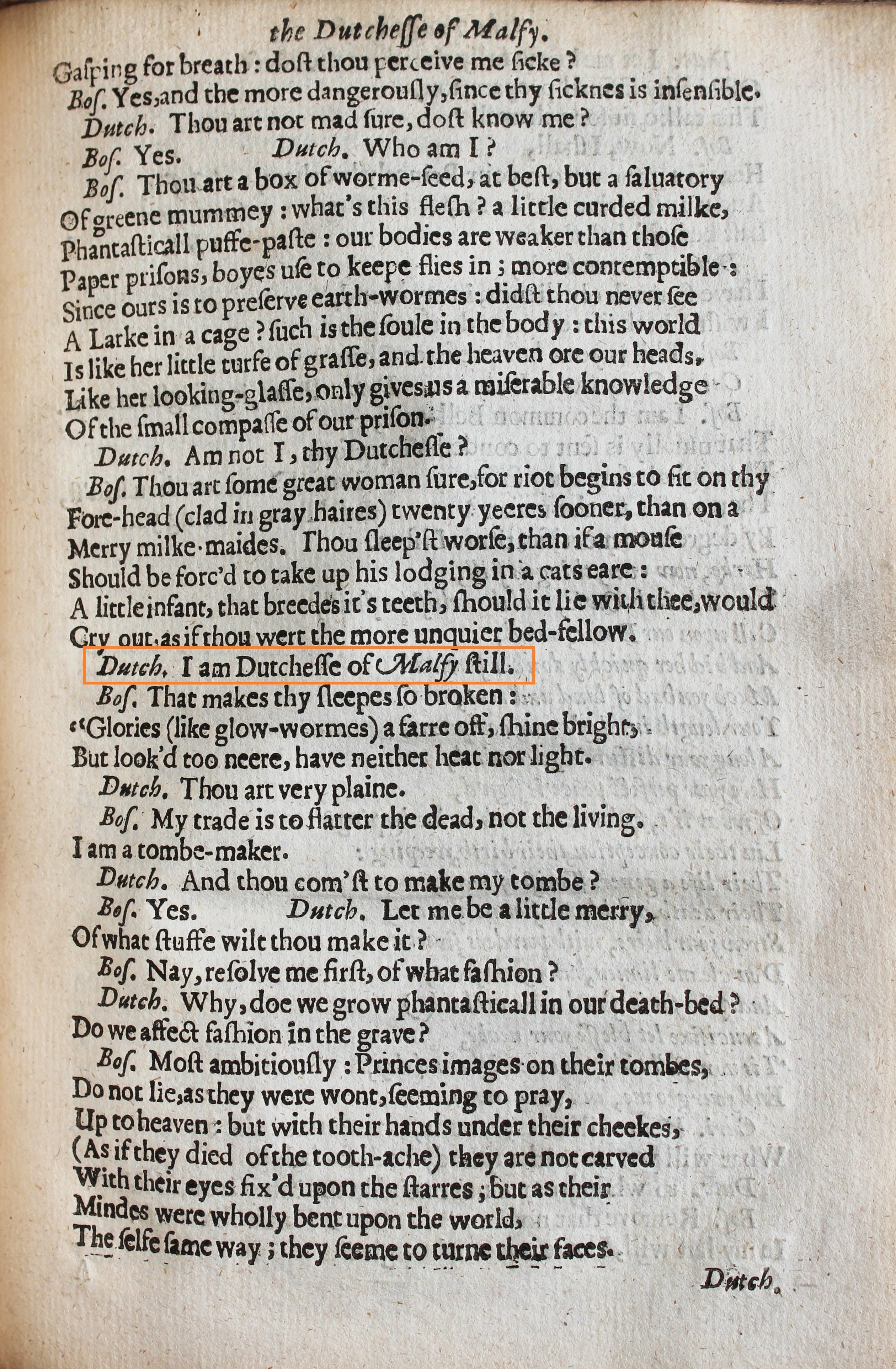
Title page of the second edition of John Webster’s The Dutchesse of Malfy: A Tragedy (London: John Raworth and John Benson, 1640; Keynes.C.6.27)

In the play, the widowed duchess secretly marries her lowly household steward Antonio and bears him three children, thus attracting the rage of her two brothers Ferdinand and the Cardinal who want to safeguard their inheritance. The duchess and her two younger children are murdered at Ferdinand’s behest in the fourth act. As she is about to be strangled by the executioners, she utters the famous words, “I am Duchess of Malfi still”:

Part of Act IV, scene ii (leaf G4 recto)

There is a sense of poignancy in the defiance shown by both the duchess and Napoleon as they cling to a former glorious past in the face of imminent death or a fall from grace. The difference is that Napoleon was technically no longer an emperor in 1819, while the duchess was still Duchess of Malfi, at least in name, when she died. In November 1818, Napoleon had been informed that he would remain a prisoner on St Helena for the rest of his life, and the island’s governor Sir Hudson Lowe had refused to recognise him as a former emperor. However, as this ownership inscription confirms, “Napoleon never considered forgoing ceremony or the recognition of his title. It was the only way he could assert his claim to being emperor in the face of the British insistence that he was a simple general. Much of his stay on St Helena was about constructing a space for himself in which he displayed his quality as an imperial sovereign”.[1]

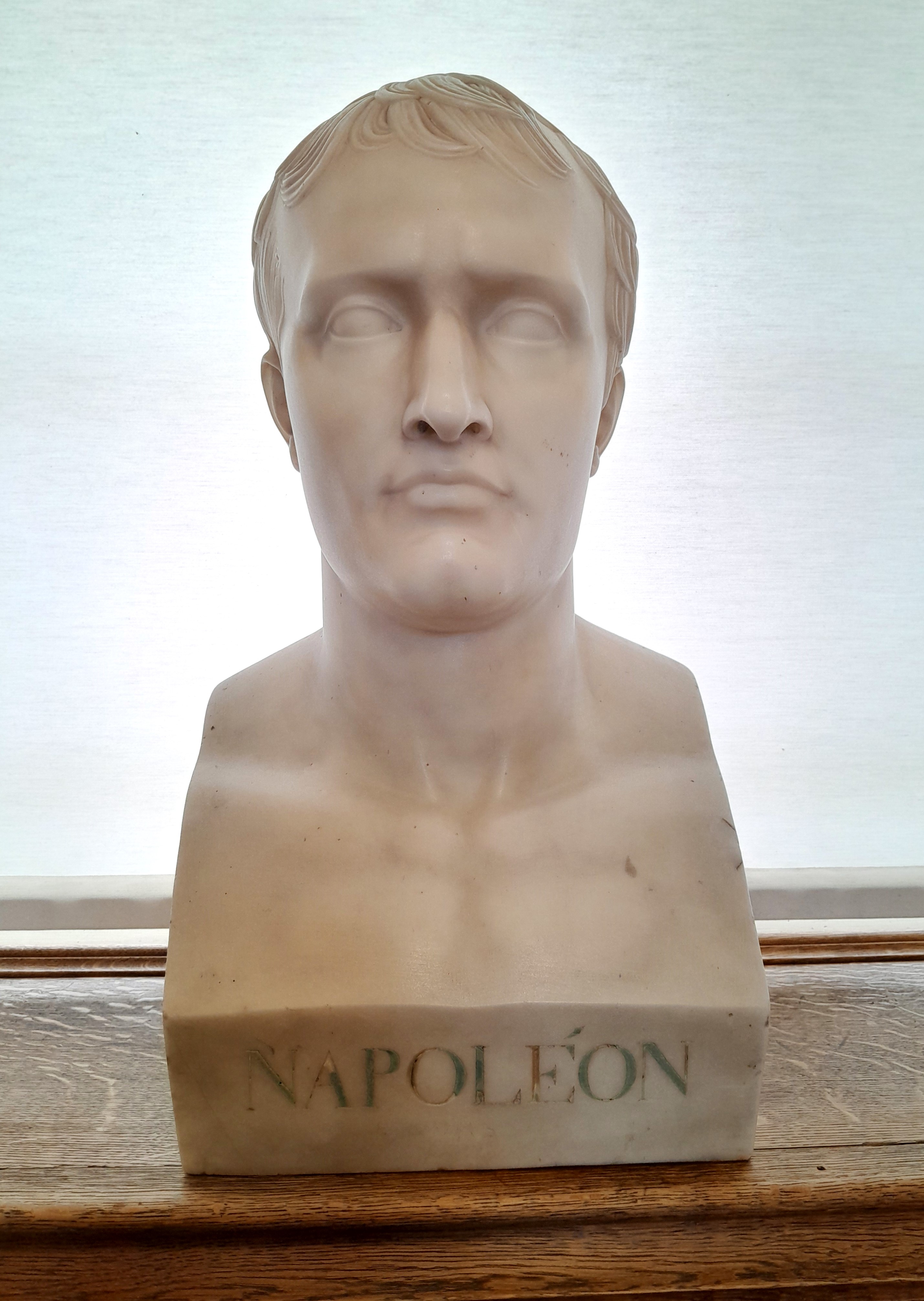
Bust of Napoleon in King’s College Library

IJ

Notes

[1] Philip Dwyer, Napoleon: Passion, Death and Resurrection, 1815-1840 (London: Bloomsbury Publishing, 2019, pp. 44-45)

Gibbs, Groats and Gowns: Celebrating the Tercentenary of the Gibbs Building

James Gibbs, A Book of Architecture, Containing Designs of Buildings and Ornaments (London: 1728), frontispiece. (Shelfmark: F.27.7)

Three hundred years ago today, on the 25th March 1724, the foundation stone was laid for a new building in King’s, known today as the Gibbs Building, named after the architect James Gibbs (1682–1754) who designed it. We are fortunate to know quite a lot about the events of that day because of the survival of certain items in the special collections in King’s Library.

Proceedings began with the sermon before the university in a special service in Chapel given by senior King’s fellow Gregory Doughty (ca. 1690–1742, KC 1706).  We know exactly what the sermon was, because it was published, and the publication also reveals other aspects of the service and the ceremony which followed.

A Sermon Preached Before the University of Cambridge in King’s College Chapel on the 25th of March 1724 … by Gregory Doughty (Cambridge, 1724), title page. (Shelfmark: C.5.44.(3.)

A Sermon Preached Before the University, page 3. (Shelfmark: C.5.44.(3.)


The subject of the sermon was ‘Luke II.14 Good Will Towards Men’, and much space was given to extolling the virtues of acts of benevolence, particularly that of founders and patrons of learned societies such as Cambridge colleges. It being ‘Founder’s Day’ (it was celebrated on 25th March at the time), several passages praise Henry VI, the founder of King’s: ‘We must account it sure as well the peculiar felicity, as glory of this society, to be bless’d with such a sovereign for its founder; who prefer’d the honor and service of his Maker to all the gay and flattering privileges of Crown’, writes Doughty.

A Sermon Preached Before the University, appended section ‘The State of King’s College in Relation to the Old Fabrick’. (Shelfmark: C.5.44.(3.)

Appended to the sermon is a document entitled ‘The state of King’s College, in relation to the old fabrick, together with some account of the foundation of a new one.’ This document points out that the new building was long overdue, given the old buildings were intended only for Henry’s original foundation of a community consisting of ‘a rector and 12 scholars’ which he had soon abandoned in favour of a community of ‘a Provost and 70 fellows and scholars’. Towards the end of the document there is an interesting account of the foundation ceremony which took place immediately after the service in Chapel:

Accordingly (the Ground having been first laid out, and the Foundation dug for the West-side of the Square, pursuant to a PLAN design’d by Mr Gibbs) on 25th Day of March last, being the Anniversary of Commemorating the Founder, and the University being met, as usual, at King’s College Chappel; after the Sermon, and an Anthem compos’d on the Occasion; The Provost, accompanied by the Noblemen, Heads of Colleges, Doctors, and other Members of the University, proceeding to the Corner, where the first Stone was to be laid, bespoke Success to the Undertaking in the Form which follows, with such Actions, at proper Intervals, as the Words themselves express, or are customary in such Kinds of Ceremony.

The words ‘in the form which follows’ were printed in Latin at the end of the sermon publication, and reveal a number of interesting details, most notably that some of the words were engraved on a bronze plate and, together with some gold, silver and bronze coins, were put into the foundation stone of the building. The story becomes more intriguing when the text goes on to explain that ‘If in future years a student of ancient times, while searching through the rubble, unearths this bronze plate encased in stone, may he know that this stone was destined for the construction of this College in the times of Henry VI.’

A Sermon Preached Before the University, final two pages comprising the Latin words read out at the foundation ceremony together with an English translation. (Shelfmark: C.5.44.(3.)

The famous clergyman and antiquary William Cole (1714–1782), if his version is to be trusted, sheds light on this stone that had been ‘destined for the construction of this college in the times of Henry VI’:

When the news came of the Founder’s deposition the labourers who were sawing the stone in halves and not having finished it, imagining that there would be no further proceeding in the design by his successors left of their work and the stone remaining half sawed in two. This was always the story about the stone which I myself have seen before any design of making the use of it which was afterwards thought on; and a cut of that stone is in the print of this chapel engraved by David Loggan. In the cleft part was the plate and inscription with ye different coins put. (See British Library, Add MS 5802, fol. 110)

Here is Loggan’s engraving. You can see the stone, partly sawn in half, on the grass on the right-hand side of what was then known as ‘Chapel Yard’:

King’s College Chapel engraved by university engraver David Loggan (1634–1692) (Reference: JS/4/10/38)

Gibbs, A book of Architecture, plate 32 showing the plan for the ‘West Front’ (the Gibbs building) and the front court. (Shelfmark: F.27.7)

Regarding the gold, silver and bronze coins that were enclosed with the engraved bronze plate, there is a centuries-old tradition of burying contemporary coins in the foundations of new buildings in the belief that it would bring good luck and prosperity. How tantalising it is to know that these coins and the engraved plate are buried in the foundations of the Gibbs building but we are not able to see them today! William Cole also tells us that when digging the foundations of the Gibbs building apparently a number of coins from the reign of Henry V were discovered:

at ye digging of the foundation for the aforesaid new building a large quantity was supposed, tho’ not 100 were owned to have been found by ye workmen & labourers, who were thought to have disposed of them otherwise, of gold coins of King Henry ye 5th & others, which were as was surmised, hid by ye people in those troublesome times; for where ye present new building stands, was formerly a large street, call’d Mill Street … These coins were sent by ye College to ye benefactors to this building as presents, & a very few remain in ye Treasury as a memorial. (BL Add MS 5802, fol. 115)

Indeed, the following is a photograph of a coin (a groat) from the reign of Henry V which is still in the College’s collections, and is perhaps one of those dug from the ground when laying the foundations for the Gibbs building:

A silver groat from the reign of Henry V from the collections of King’s Library.

The conclusion of the inscribed Latin words printed with the sermon which discusses ‘literary monuments more lasting than this bronze plate’ (‘Monumenta Literaria, Hoc Aere perenniora . . .’) is a clear allusion to Horace’s Odes 3.30 which begins ‘I have completed a monument more lasting than bronze . . .’ (‘Exegi monumentum aere perennius’). The author will have known his audience, and this allusion to Horace will not have been lost on them.

We saw above that ‘an Anthem compos’d on the occasion’ was mentioned in the published sermon, and this brings us to our second item in the Library’s special collections. The anthem in question is ‘Hearken unto me ye holy children’ by the composer Thomas Tudway (before 1650–1726), professor of music in the university and organist at King’s from 1670 until 1726. The original manuscript is held in the Rowe Music Library in King’s. It is a verse anthem, scored for three soloists and choir, and the copy in King’s Library is clearly a presentation copy that begins with a dedication to Provost Andrew Snape (1675–1742, KC1690) and the fellows of the College:

Thomas Tudway, Hearken Unto Me ye Holy Children, dedication page. (Rowe MS 108)

The text of the anthem is made up of a variety of verses from several books of the Bible including Ecclesiastes, Ezra and the Psalms.  Its sentiments resonate with the themes of the sermon as you would expect:

Blessed be the Lord God, of our fathers, who hath put such a thing into the King’s heart, to build this house.

to be a Father to the Fatherless, to feed them with the bread of understanding, & give them the waters of wisdom to drink

His name shall endure for ever, His name shall remain under the sun among the posterities

Provost Andrew Snape (engraving by John Faber, between 1696 and 1721. King’s Archive reference: KCAC/1/4)

Thomas Tudway holding a page of an anthem he has composed for King’s College Chapel. (Bate Collection of Musical Instruments, University of Oxford).


Tudway, Hearken Unto Me, opening. (Shelfmark: Rowe MS 108)

Tudway, Hearken Unto Me, final page of music. (Shelfmark: Rowe MS 108)


Several aspects of the binding of the volume point towards its importance and uniqueness as a presentation copy. It is a leather-bound volume with a panel design tooled with gold borders with fleuron decorations stamped in gold on the front and back boards. The foredges of the binding are also tooled in gold, as are the text block edges. No expense has been spared. Unusually, the pastedowns—which are usually simply plain hand-made paper—are in this case made of a much more expensive paper embossed with a red and gold floral design.

Tudway, Hearken Unto Me, Front panel binding with gold tooling (left), Inside front pastedown embossed in red and gold (centre), Front fore-edges of binding and text block decorated in gold (right). (Shelfmark: Rowe MS 108)

One would think that something as special as this would have been treasured in King’s, but curiously, by one means or another, the manuscript ended up being owned by one Henry Robson in the early nineteenth century who gave the volume to his cousin John Henry Robson in 1833. Thankfully it was returned to King’s by a relative, a Mrs Robson, in 1852.

Tudway, Hearken Unto Me, ownership inscriptions on front pastedown. (Shelfmark: Rowe MS 108)

Alas, this reminds us of the dilemma faced by William Cole who had spent eighteen years in King’s meticulously documenting our history, but when deciding where to deposit his manuscripts in 1788, he wrote ‘I have long wavered how to dispose of all my manuscript volumes; to give them to King’s College, would be to throw them into a horsepond; and I had as lieve do one as the other; they are generally so conceited of their Latin and Greek, that all other studies are barbarism.’ A little harsh perhaps, but rest assured that the librarians and archivists in King’s today take great care in looking after the special collections and are delighted to be able to share them with you on special days such as today!

Gibbs, A Book of Architecture, plate 35 showing the designs for the Gibbs building. (Shelfmark: F.27.7)

An early eighteenth-century theodolite by London instrument maker Richard Glynne (1681–1755), active ca. 1707 to 1730, belonging to King’s. A record in the College archives shows that we purchased a theodolite in 1724, presumably for building the Gibbs building. Could this be the one? (The theodolite is on long-term loan to the Whipple Museum in Cambridge. Reference: Wh.6588)

JC

________________________

For an online exhibition of documents from King’s archive relating to the Gibbs building see https://www.kings.cam.ac.uk/archive-centre/the-gibbs-building
Thanks are due to Ingo Gildenhard for advice on improving the translation of the Latin into English, as well as to my colleagues in King’s Library and Archives, and to Peter Jones for locating the Henry V coins.
The photographs of the Glynne theodolite are reproduced by kind permission of the Whipple Museum of the History of Science, University of Cambridge.