
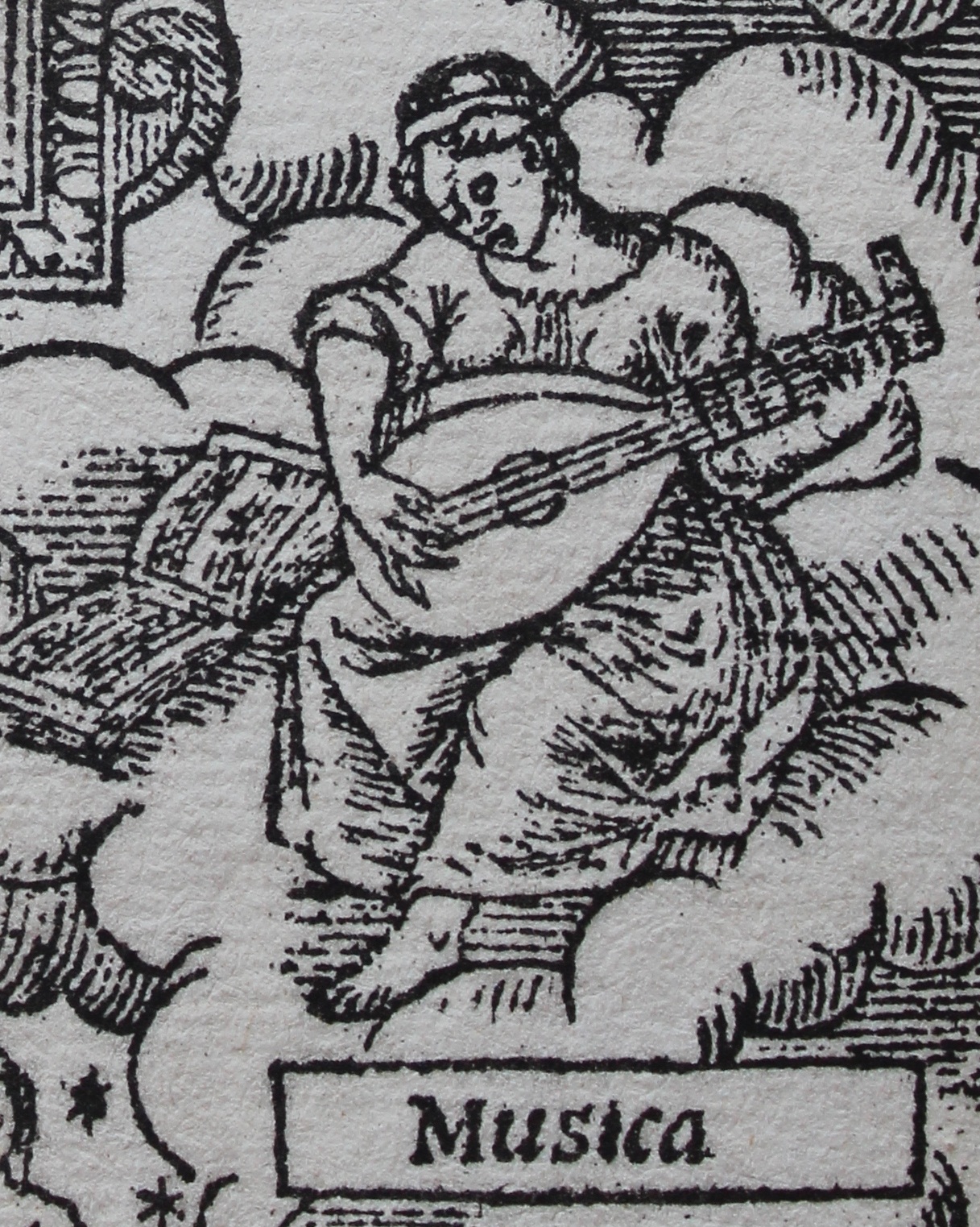
This year marks the 400th anniversary of the death of composer and lutenist John Dowland (born ca. 1563) who is widely recognised as the greatest English composer of lute music and lute songs. It gives us an excuse to take a closer look at an interesting manuscript book of lute songs in the Rowe Music Library known as the Turpyn Lute Book (Rowe MS 2).
Compiled between about 1610 and 1615 and given to King’s by John Maynard Keynes (1883–1946) in 1939, the manuscript takes its name from the signatures of the various members of the Turpyn family—Francis, Elizabeth and Dorothy—that are practised in ink on the limp vellum covers, and the initials ‘F.T.’ (presumably Francis Turpyn) tooled in gold on the front and back covers of the manuscript. The published literature does not state who this Turpyn family were or where they lived.[i] A search through genealogy sources online reveals a number of Turpyns and Turpins with these Christian names, including Francis and Franciscus, living in the Yorkshire area in the sixteenth and seventeenth centuries, but alas not enough information to connect any with our lute book.
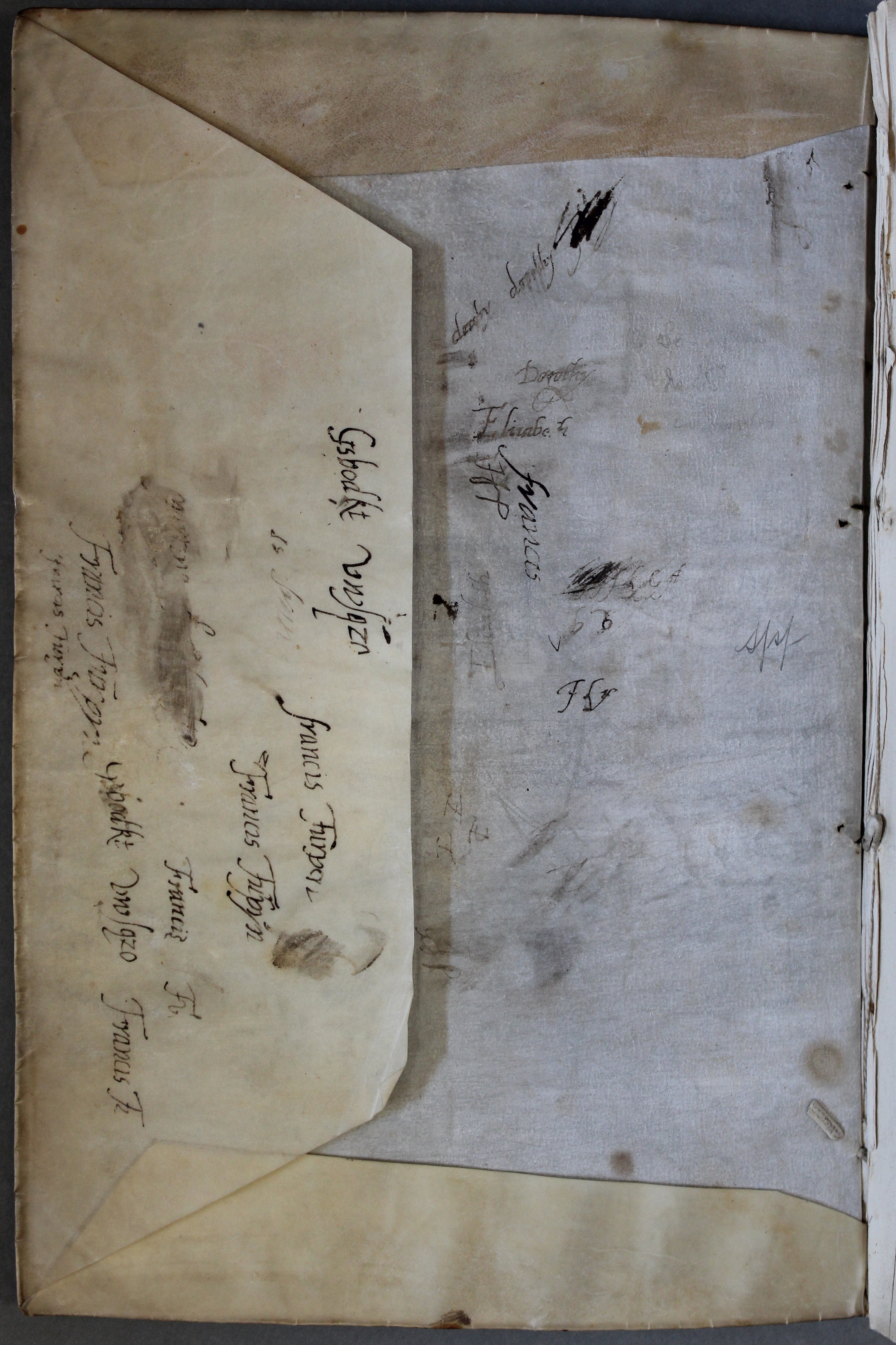
Inside front binding (Rowe MS 2)
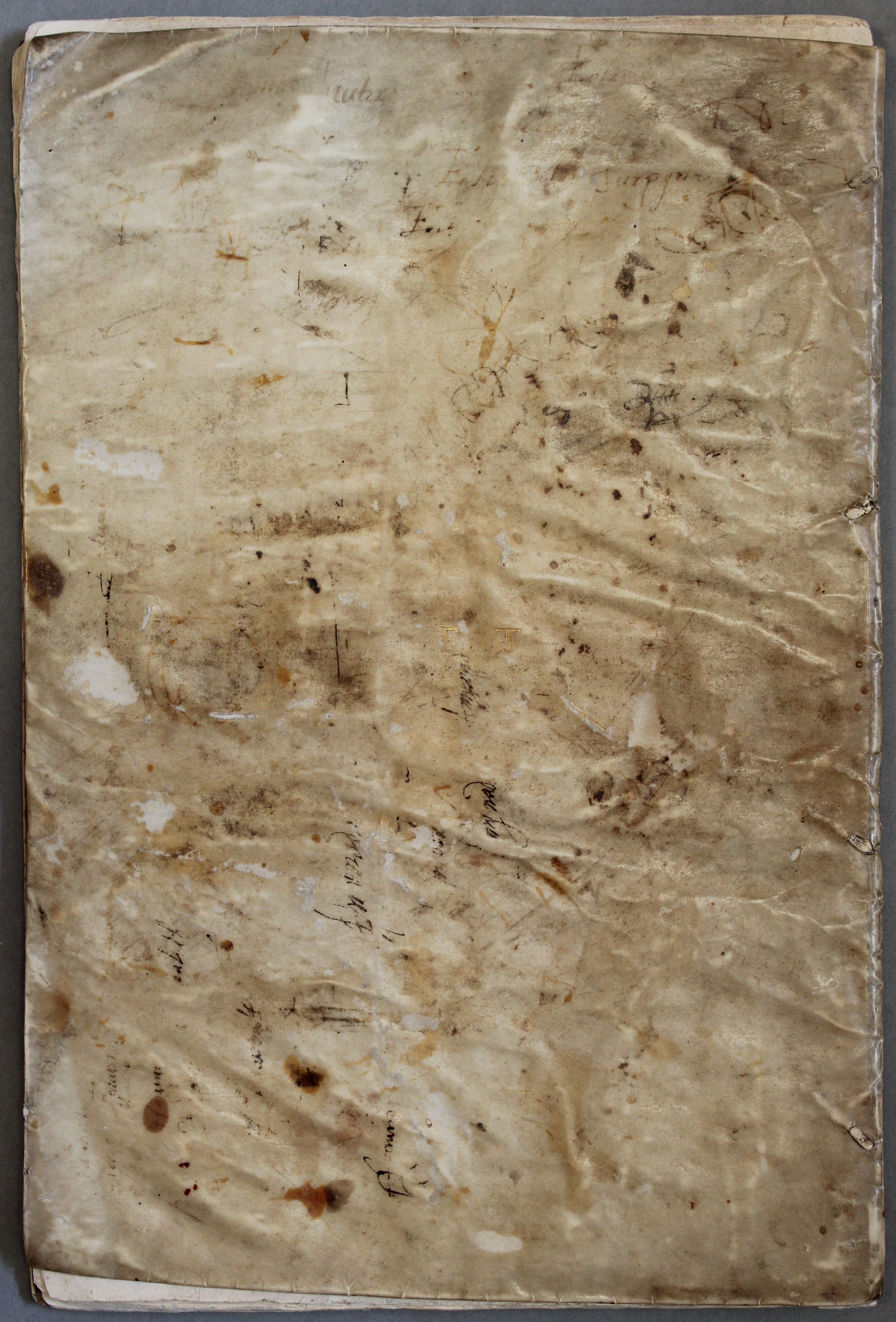
Rear binding (Rowe MS 2)
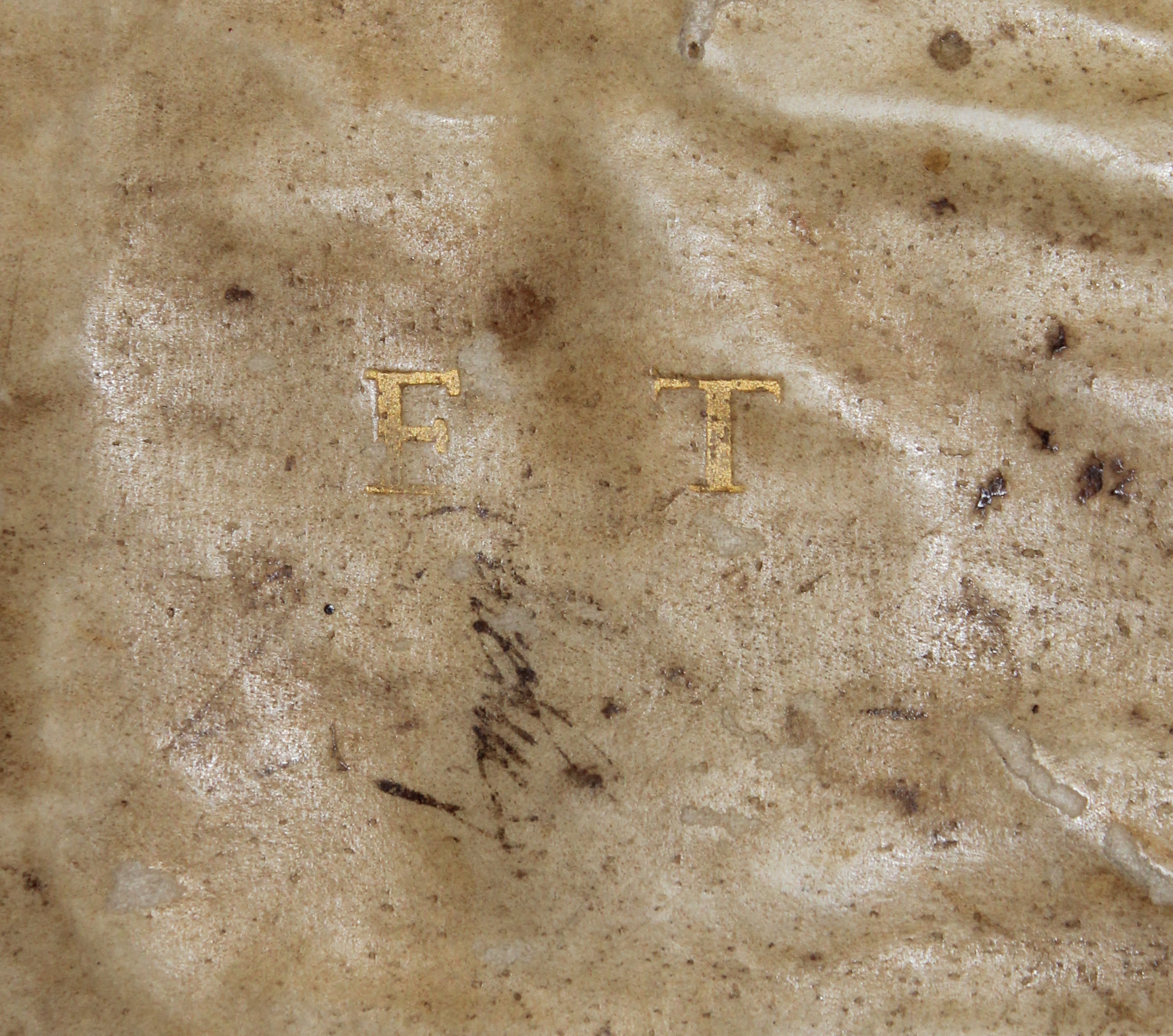
Detail of rear binding (Rowe MS 2)
The volume comprises twelve songs written in three different hands. Of the twelve, three are by Dowland (numbers 1–3), five are anonymous (number 6, 8–11) and there is one each by Dowland’s contemporaries Robert Hales (number 4), Robert Parsons (number 5), Thomas Morley (number 7) and Robert Jones (number 12). In only one of them is the composer identified: number 3, by Dowland.
The three songs by Dowland had all been printed in 1597 in London in his first publication The First Booke of Songes or Ayres of fowre partes with Tableture for the Lute, known more commonly as The First Booke of Songes. The title page of that publication goes on to explain that the songs can be sung in four parts as a madrigal, or for voice with lute accompaniment: so made that all the partes together, or either of them severally may be song to the Lute, Orpherian or Viol de gambo. The versions in our manuscript include the voice part and lute tablature for each song. The three songs are ‘Can she excuse my wrongs’, ‘Now, o now I needs must part’ and ‘Rest a while, you cruell cares’. Interestingly, the title page describes Dowland as ‘Batchelor of musicke in both the Universities’, although no record of a Cambridge degree has ever been found.
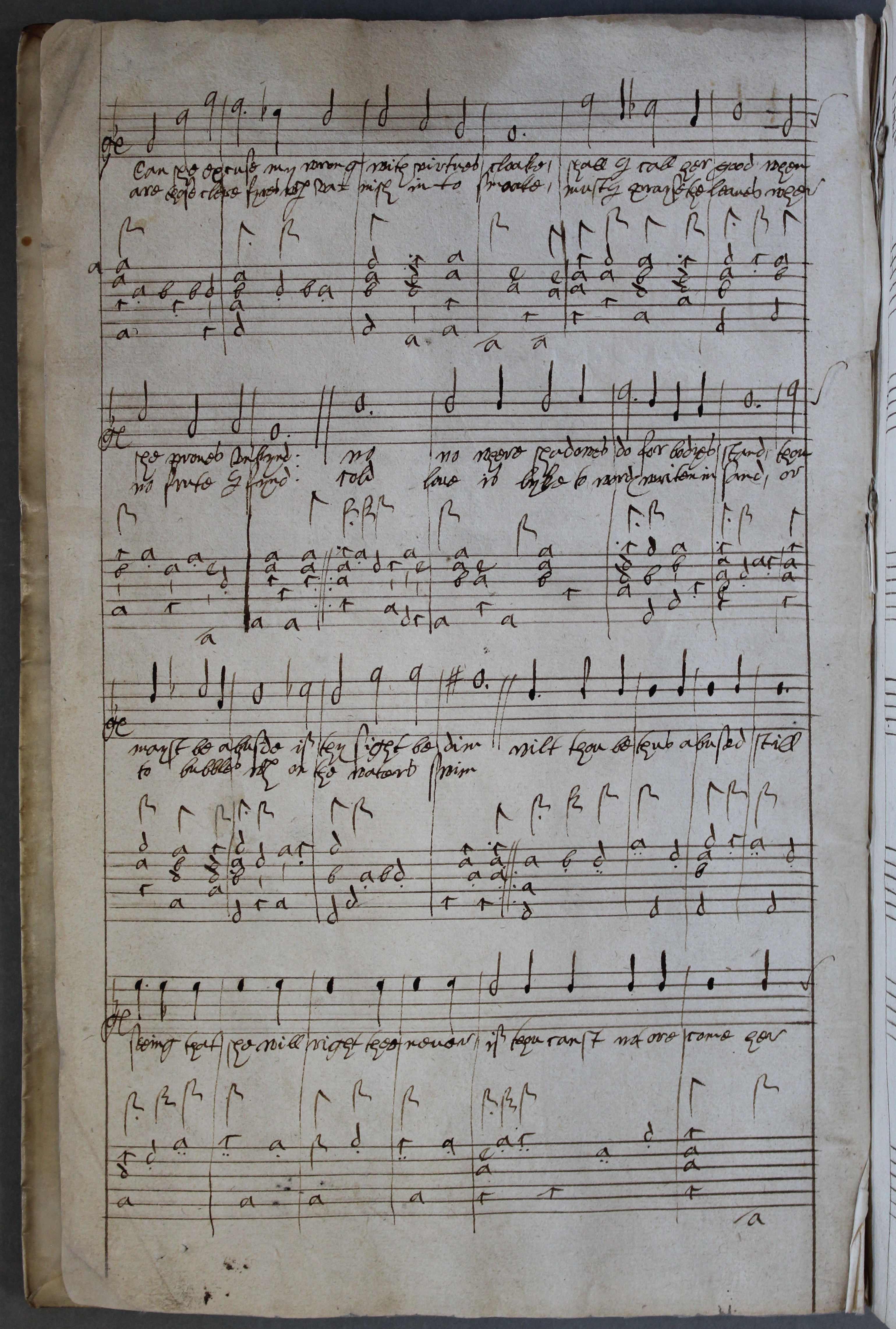
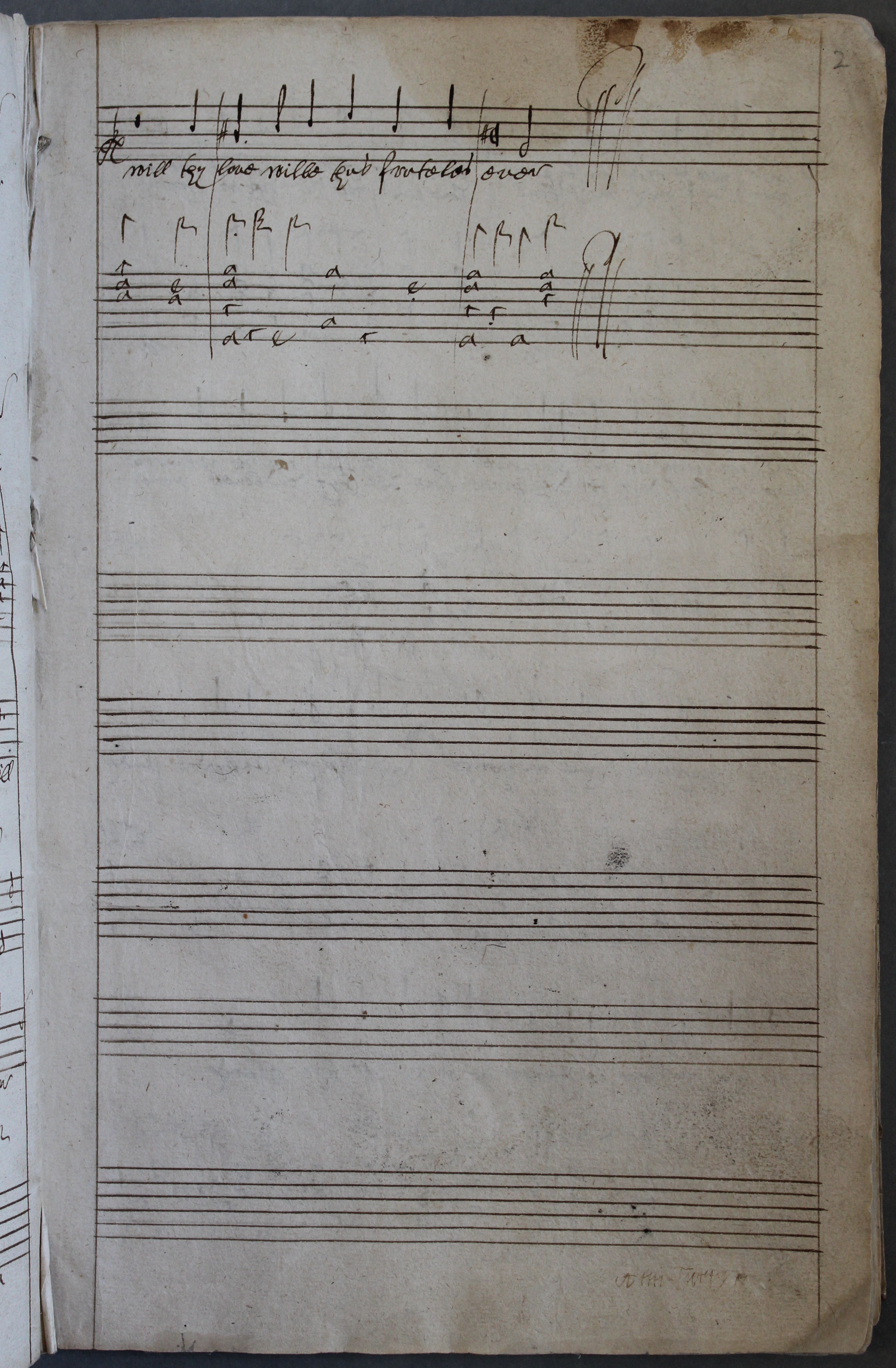
Above: Dowland’s ‘Can she excuse my wrongs’
The song ‘Can she excuse my wrongs’ was one of Dowland’s most popular from The First Booke. It ‘has been framed by many scholars as a plea to the queen by royal favourite Robert Devereux, second Earl of Essex. The courtier maintained a volatile relationship with his monarch [Elizabeth I], falling into and out of grace as his hotheaded ego often led him to action before considering possible consequences’.[ii] In 1597 (the same year as the The First Booke was published) Essex’s misdemeanours required him to apologise numerous times to the Queen (we know this from his letters). Although the words of this song have not been found in any of Essex’s manuscripts—like other Elizabethan figures at court he wrote poetry—an instrumental consort version titled ‘The Earl of Essex Galiard’, was published in Dowland’s collection of Lachrimæ, or Seaven Teares in London in 1604. Essex had been executed in 1601, and it is believed contemporary listeners would most likely have understood these musical references to the goings on at court. The relatively upbeat style of the music compared with the text has led to the assumption that the instrumental version existed first and the words were added later.
Here we can hear the song performed by soprano Emma Kirkby and lutenist Anthony Rooley.
The viol consort version ‘The Earl of Essex Galiard’ from the 1604 Lachrimæ publication is performed here by the ensemble A Golden Wire. The harpist in this performance, Parker Ramsay, studied at King’s College and also served as organ scholar.
The Earl of Essex did have a connection with Cambridge in that he was Chancellor of the university from 1598 until his death. Our college account books (‘mundum books’) reveal that in 1593 we made a payment of twelve pence to the Earl’s trumpeters. Move forward to 1626, the year of Dowland’s death, and by coincidence there is another record of a payment to the Earl’s trumpeters, by now the third Earl of Essex, his son Robert Devereux (1591-1646) for four shillings: ‘Soluti Buccinatoribus honoratissimi Domini Comitis Essex [paid to the trumpeters of the honourable Earl of Essex)’.
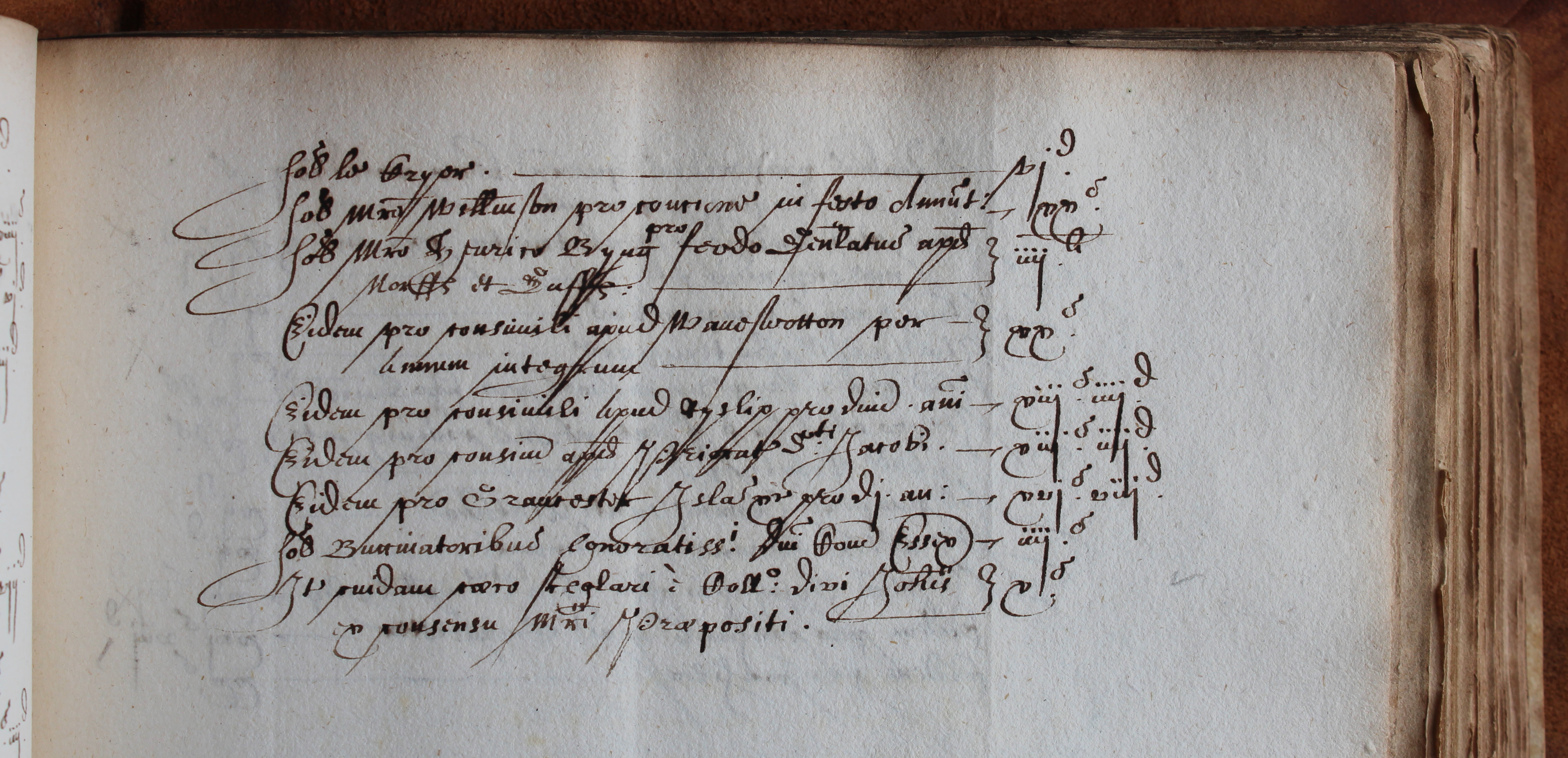
Detail from the accounts of 1626 showing the payment to the Earl of Essex’s trumpeters (Reference: KCAR/4/1/1 vol. 25, f. 2)
The next song, ‘Now, o now I needs must part’, a bitter-sweet contemplation of love and loss, has similarly been interpreted as a commentary on events at court, in this case ‘reminiscent of the end of a long-discussed courtship between Elizabeth and the French Duke of Anjou and Alençon. Francis, youngest son of French King Henri II and Catherine de’ Medici, was first suggested as a match for Elizabeth in 1579, with hopes of negotiating an English alliance with France against Scotland. The duke was twenty-two years younger than the queen but the two seemed to develop a certain affection for each other, as evidenced in a rich trove of correspondence. Elizabeth even nicknamed Francis “her frog”.’[iii] Francis stayed with the queen at court for three months in 1581 and she even wrote a poem of grief when he returned home after a grand send-off attended by many members of court including her. The words to ‘Now, o now’ express similar sentiments to Elizabeth’s poems.
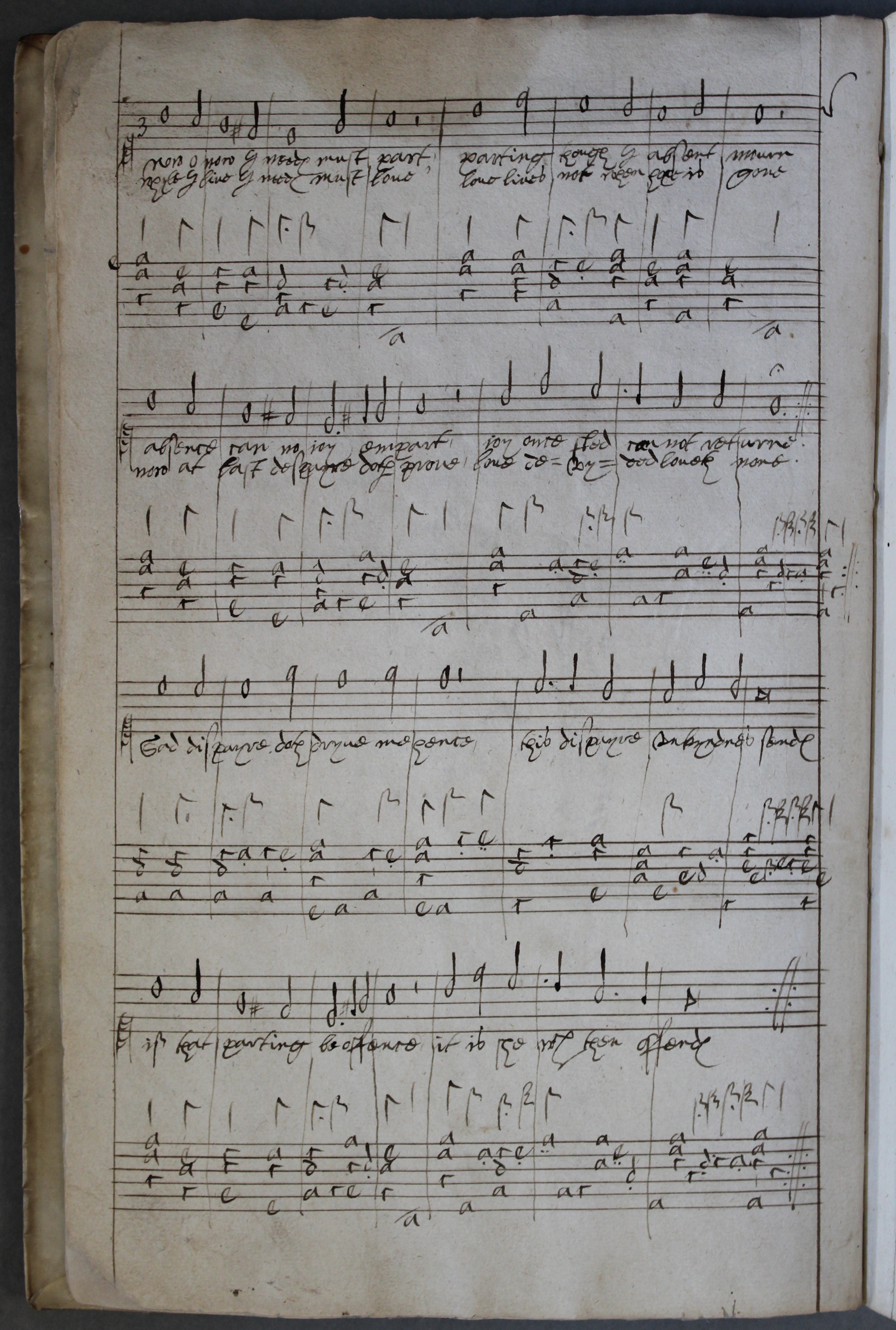
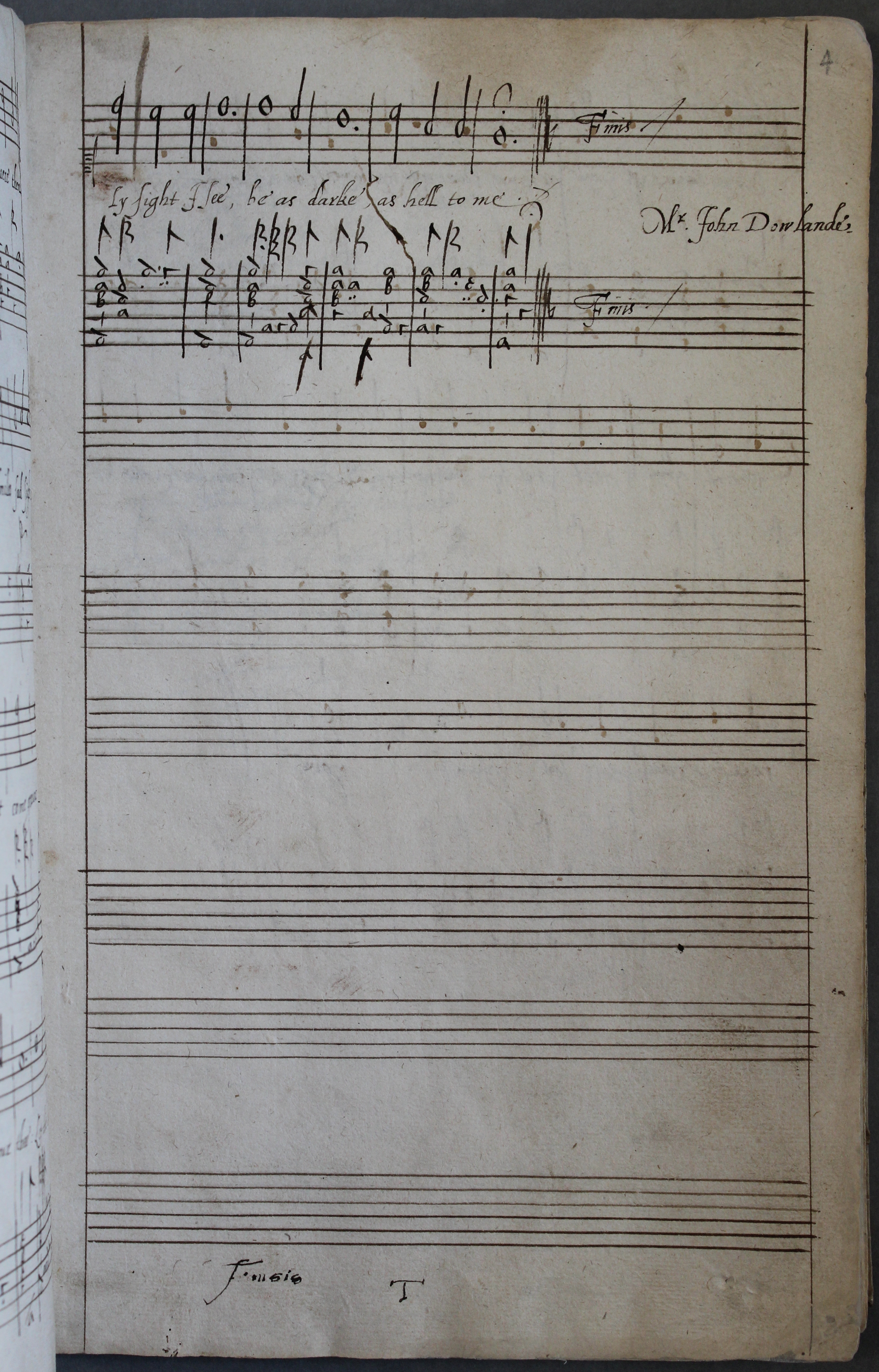
Above: ‘Now, o now I needs must part’.
The piece finds concordances in other Dowland manuscripts and prints as a solo lute galliard, including one where it is titled ‘the frog galliard’, a title which it retains in many printed and manuscript collections during the following fifty years.[iv] As Diana Poulton noted, ‘when the tragedy was ended and Elizabeth herself was dead too, Dowland called the piece “The Earl of Essex Galiard” in Lachrimæ or Seaven Teares.’[v]
Here we can hear countertenor Andreas Scholl singing the song with the viol consort Concerto di Viole.
And the ‘Frog Galliard’ version for solo lute here performed by lutenist Thomas Langlois.
‘Rest a while, you cruell cares’ is musically a gentle affair with seemingly no references to the court, but it gives us the familiar theme of a tormented lover singing about his woes. The words to the second verse give a flavour of the lover’s despair:
If I speak, my words want weight,
Am I mute, my heart doth break,
If I sigh, she fears deceit,
Sorrow then for me must speak:
Cruel unkind, with favour view
The wound that first was made by you,
And if my torments feigned be,
Let this heavenly light I see,
Be as dark as hell to me.
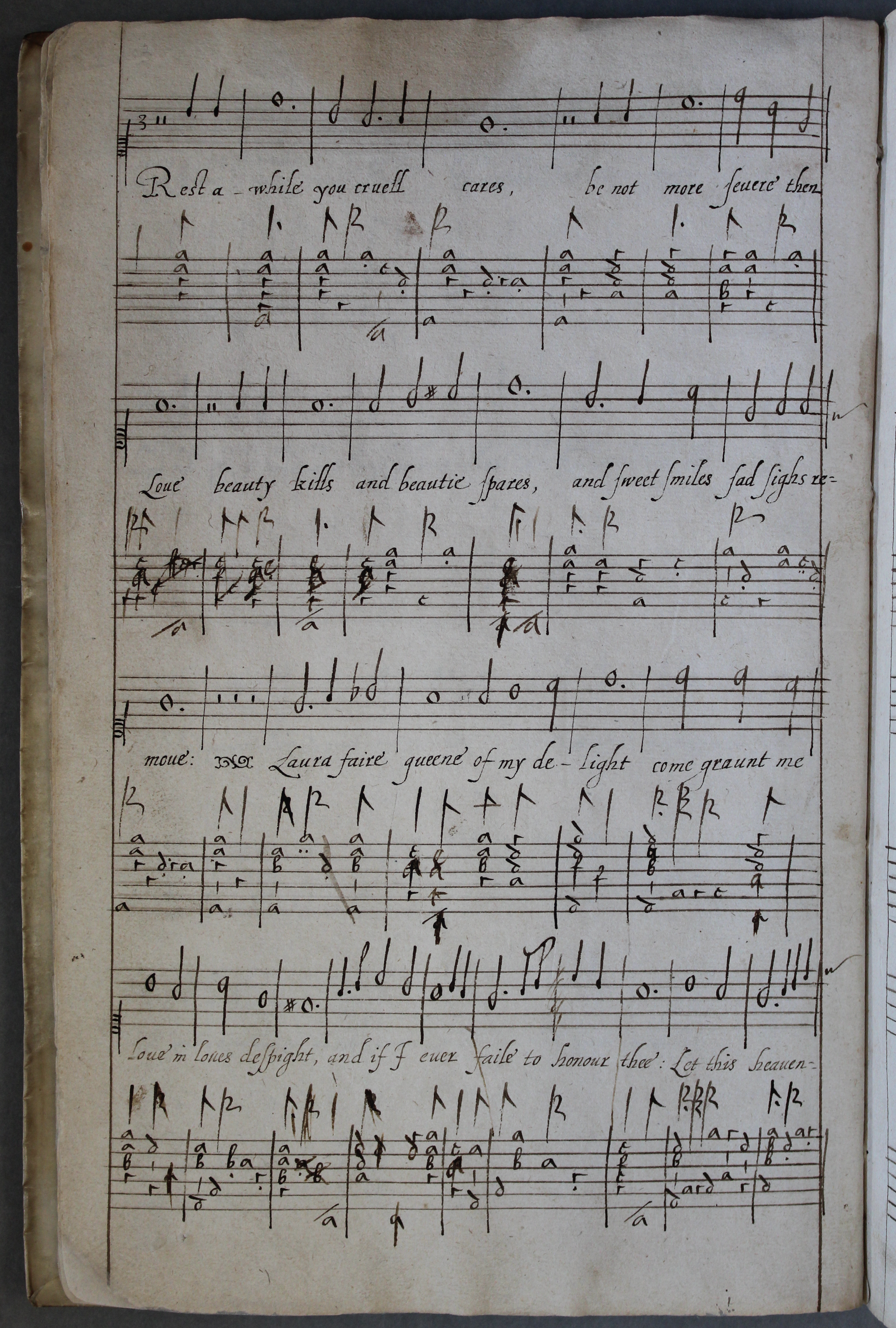
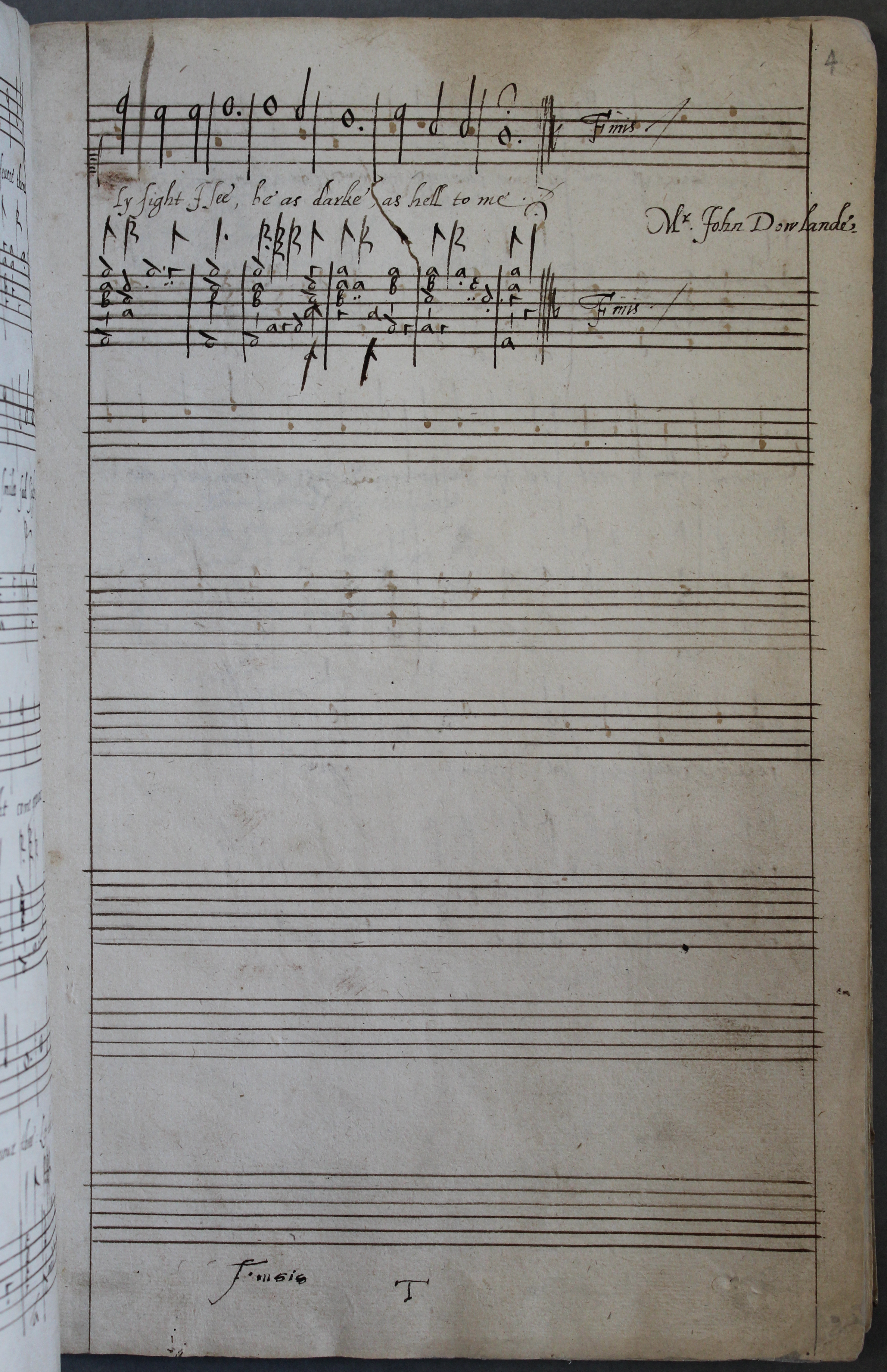
Above: ‘Rest a while, you cruell cares’ (Rowe MS 2)
Here soprano Grace Davidson sings the piece accompanied by David Miller on lute.
If this whets your appetite for more Dowland, you can hear the songs ‘Now, o now’ and ‘Can she excuse my wrongs’, together with their instrumental versions and a number of other pieces by Dowland at the BBC Proms on 21st July in a programme performed by tenor Laurence Kilsby with the Jupiter Ensemble directed by lutenist Thomas Dunford. For more information see https://www.bbc.co.uk/events/enbv9r [Update 22 July 2026: the Prom can now be heard on BBC Sounds at https://www.bbc.co.uk/sounds/play/m002yxkx)
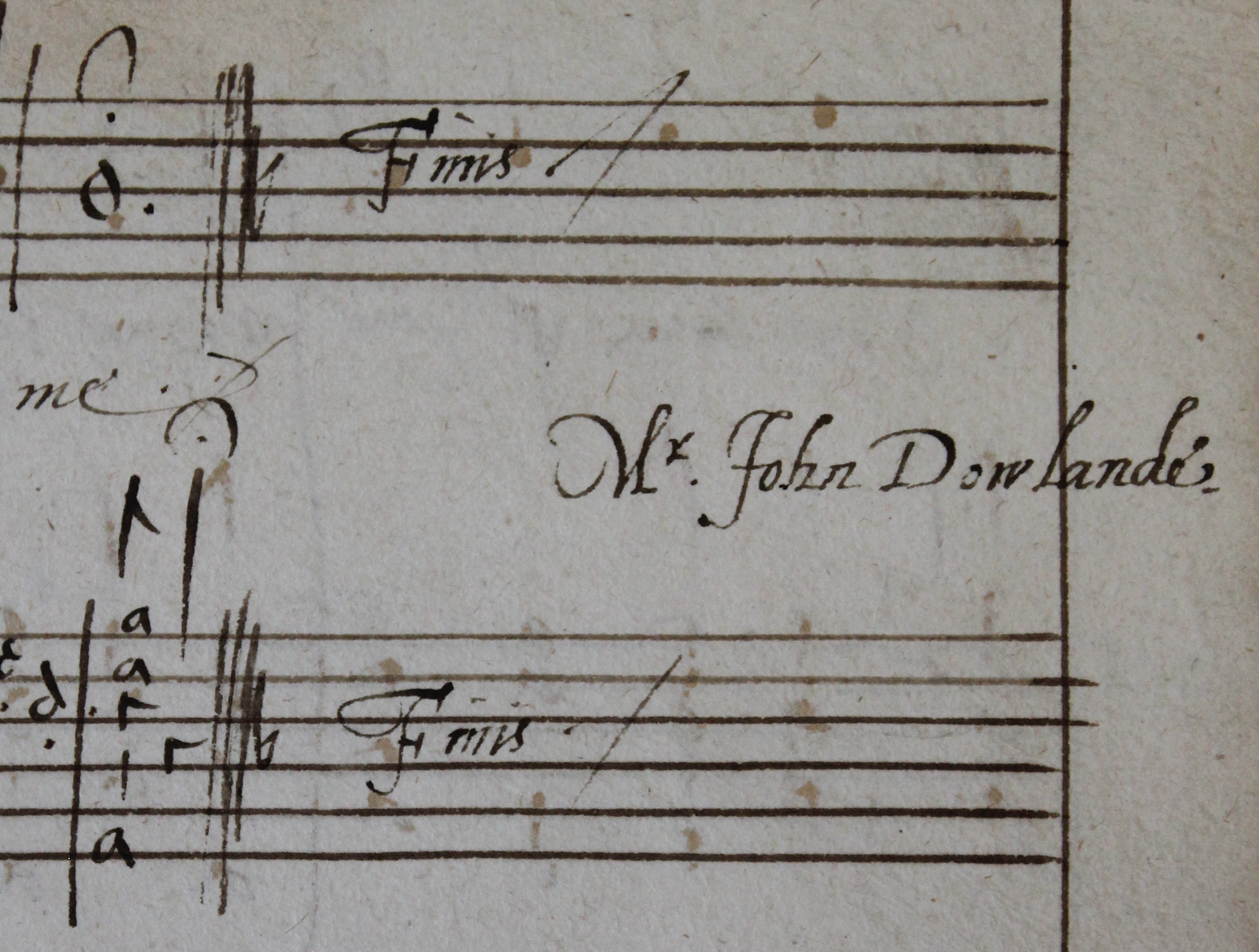
In his final collection of printed music, A Pilgrimes Solace, published in 1612 and considered by many to represent the pinnacle of his achievement, Dowland signs off his note to the reader with ‘Farewell. Your friend, John Dowland’. He died in early 1626 and was buried at St Ann’s, Blackfriars (London) on 20th February 1626.
JC
[i] See Philippe Oboussier, ‘Turpyn’s Book of Lute-Songs’, Music & Letters 34/2 (1953), pp. 145–149, and Richard Rastall, Introduction to The Turpyn Book of Lute Songs, ‘Early Music in Facsimile’ II (Leeds: Boethius Press, 1973). [ii] K Dawn Grapes, Dowland (Oxford: OUP, 2024), p. 97. [iii] K Dawn Grapes, Dowland, p. 99. This view is first posited by Diana Poulton, John Dowland (London: Faber, 1972), pp. 224–229. [iv] K Dawn Grapes, Dowland, p. 101. [v] Poulton, John Dowland, p. 229.

