Tag Archives: Rare Books

Jane Austen at 250: An Online Exhibition

Today, 16 December 2025, marks the 250th anniversary of Jane Austen’s birth. Events have been held throughout the year to celebrate this occasion. As part of Open Cambridge on 17 September, King’s College Library mounted an exhibition featuring first editions of all of Austen’s novels, the autograph manuscript of her unfinished novel Sanditon, a manuscript letter to her publisher, a book from her library, early translations of her novels, and other rare items. The event was a great success and was attended by over 650 people who braved the wet weather to come and view the treasures on display, thus creating a “ceaseless clink of pattens” on the wooden library floor reminiscent of Lady Russell’s description of driving through Bath on a wet afternoon in Persuasion. We present below some highlights from the exhibition for those who could not visit in person.

One of the exhibition cases housing the treasures on display

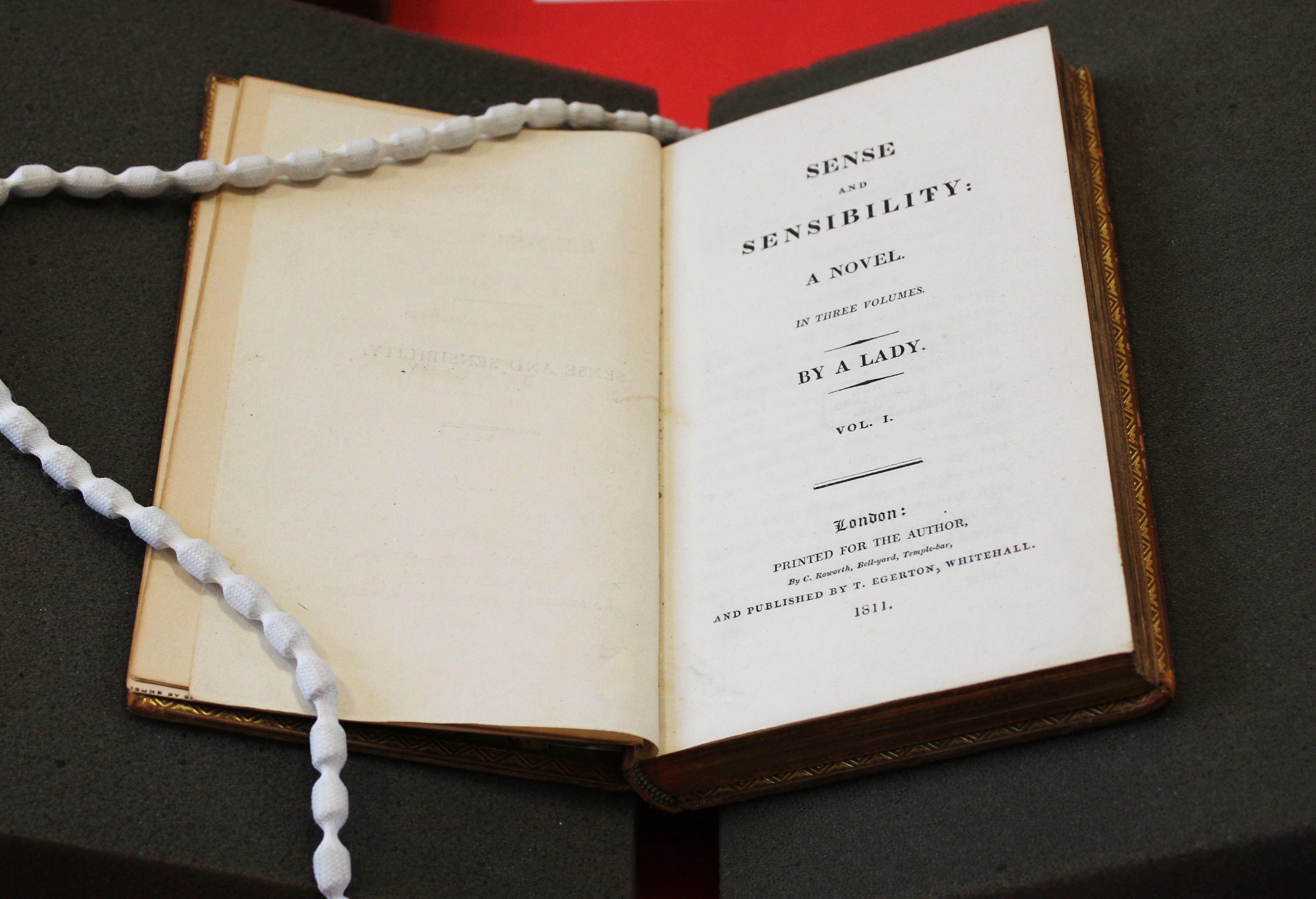
Sense and Sensibility, Austen’s first novel to be published, was written in epistolary form around 1795 in Steventon under the title Elinor and Marianne. It was begun in its present form in autumn 1797 and revised and prepared for publication in 1809-1811 when Jane was living in Chawton.

Jane Austen, Sense and Sensibility (London: Egerton, 1811), First edition
Warren.A.Se.1811/1-3

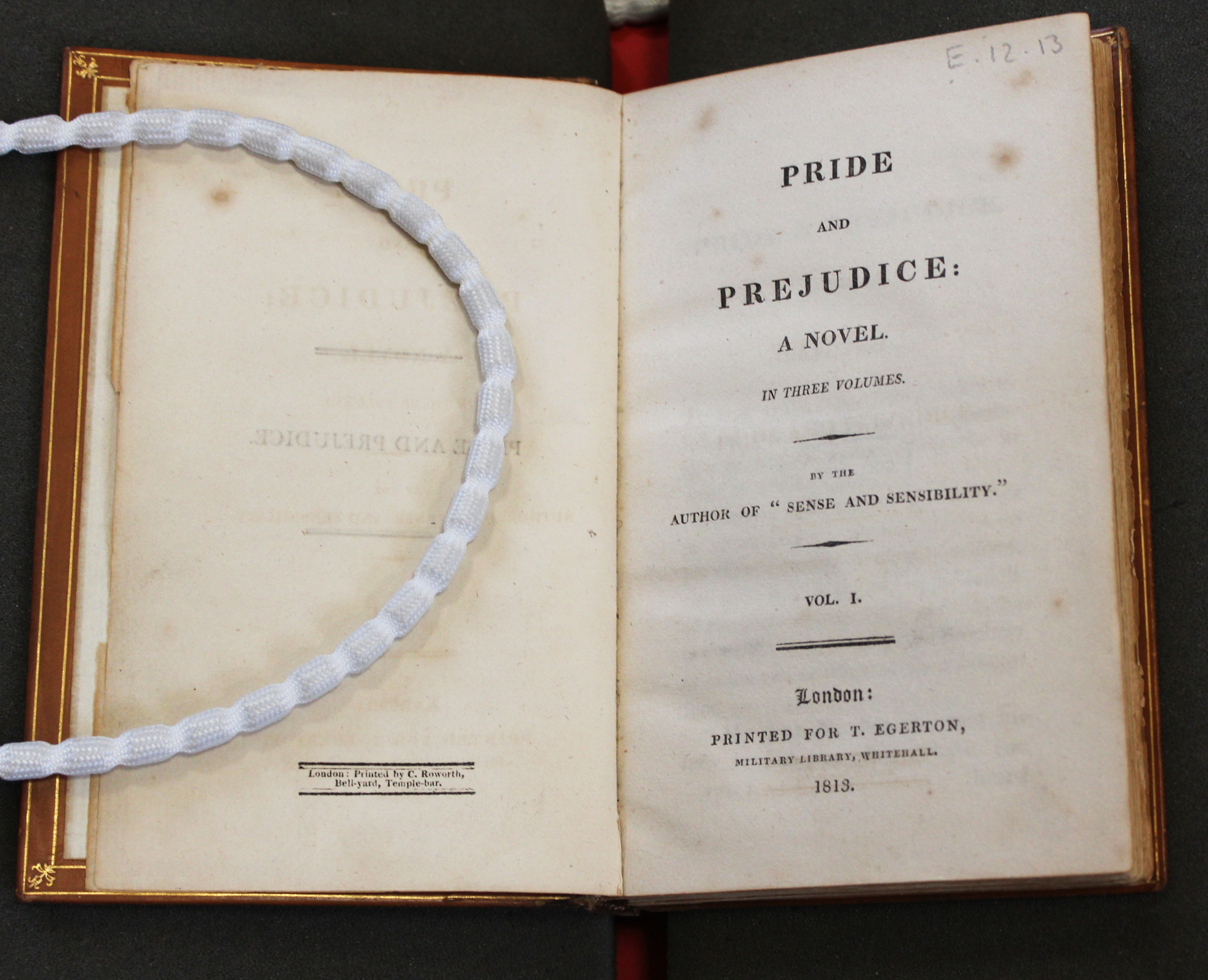
Pride and Prejudice, originally titled First Impressions, was offered for publication to the London bookseller Thomas Cadell, but the offer was declined by return post. The novel was subsequently published by Thomas Egerton under the revised title Pride and Prejudice. Upon receiving her copy of the first edition from the publisher, Jane wrote: ‘I have got my darling child from London’ (27 Jan 1813).

Jane Austen, Pride and Prejudice (London: Egerton, 1813), First edition
Warren.A.Pr.1813a/1-3

The Austen family lived in Bath between 1801 and 1806. Jane was familiar with the Pump Room, a venue for fashionable people, which is used as a setting in her novels Northanger Abbey and Persuasion. This image, from The New Bath Guide (1807), shows the Pump Room as it would have looked during Jane Austen’s time there.

Christopher Anstey, The New Bath Guide; or, Memoirs
of the B.N.R.D. Family in a Series of Poetical Epistles (Bath, 1807)
Warren.B.97.New.1807

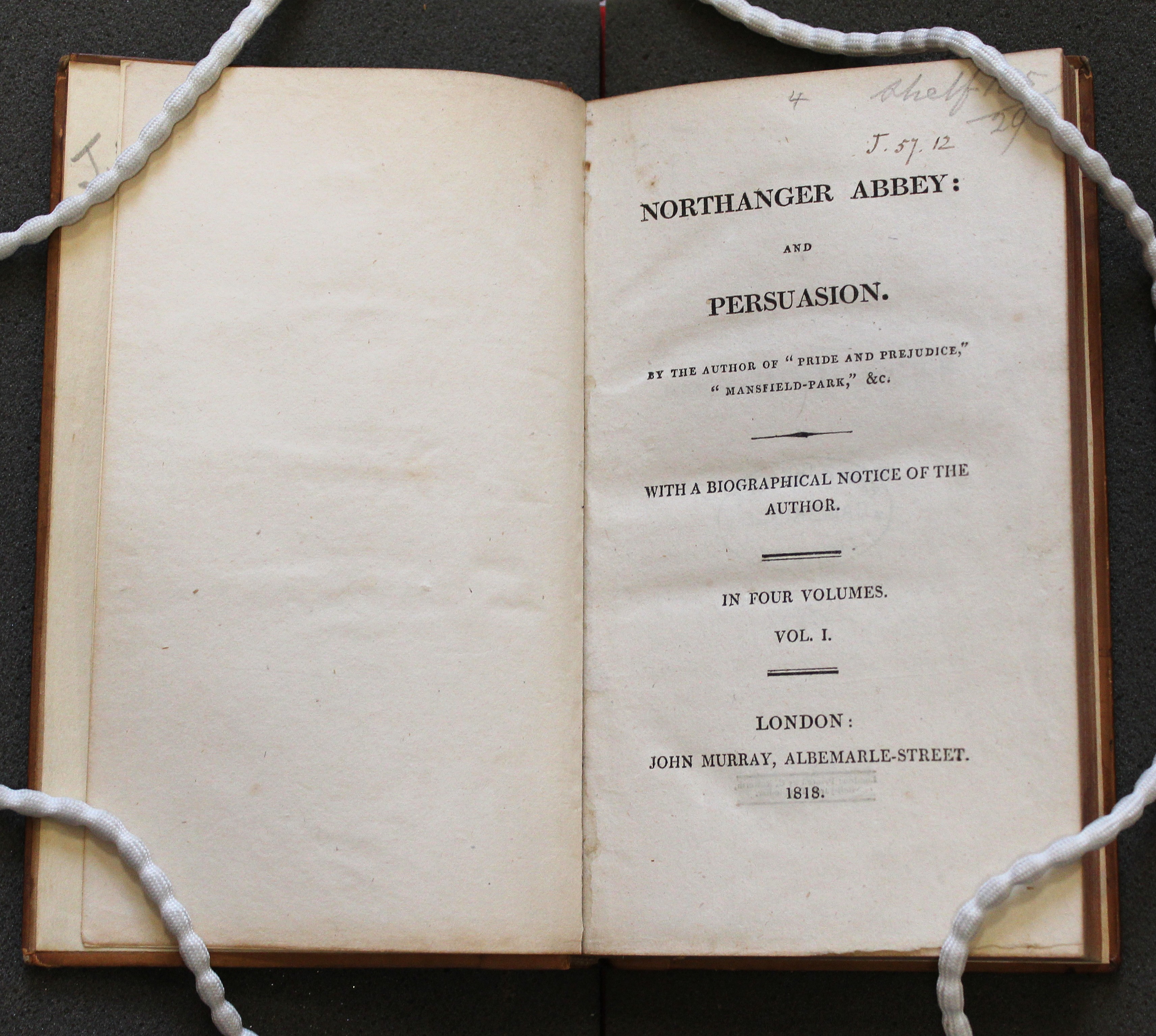
Austen’s novels Persuasion (written 1815-16) and Northanger Abbey (written 1798-99) both appeared posthumously in a four-volume set in December 1817, although the title page states 1818. They are prefaced by a ‘biographical notice’ written by Jane’s brother Henry Austen in which Jane’s identity is revealed for the first time. She appears to have intended to publish Persuasion in 1818 but did not live long enough to do so.

Jane Austen, Northanger Abbey, and Persuasion (London: Murray, 1818), First edition
Thackeray.J.57.12-15

In 1809 Austen’s brother Edward offered his mother and sisters a more settled life – the use of a large cottage in Chawton, near Alton in Hampshire. Whilst living in Chawton Jane published her first four novels. She also wrote Mansfield Park there between 1811 and 1813. It was first published by Egerton in 1814 and a second edition was published in 1816 by John Murray, still within Austen’s lifetime. It did not receive any critical attention when it first appeared.

Jane Austen, Mansfield Park (London: Egerton, 1814), First edition
Warren.A.Ma.1814/1-3

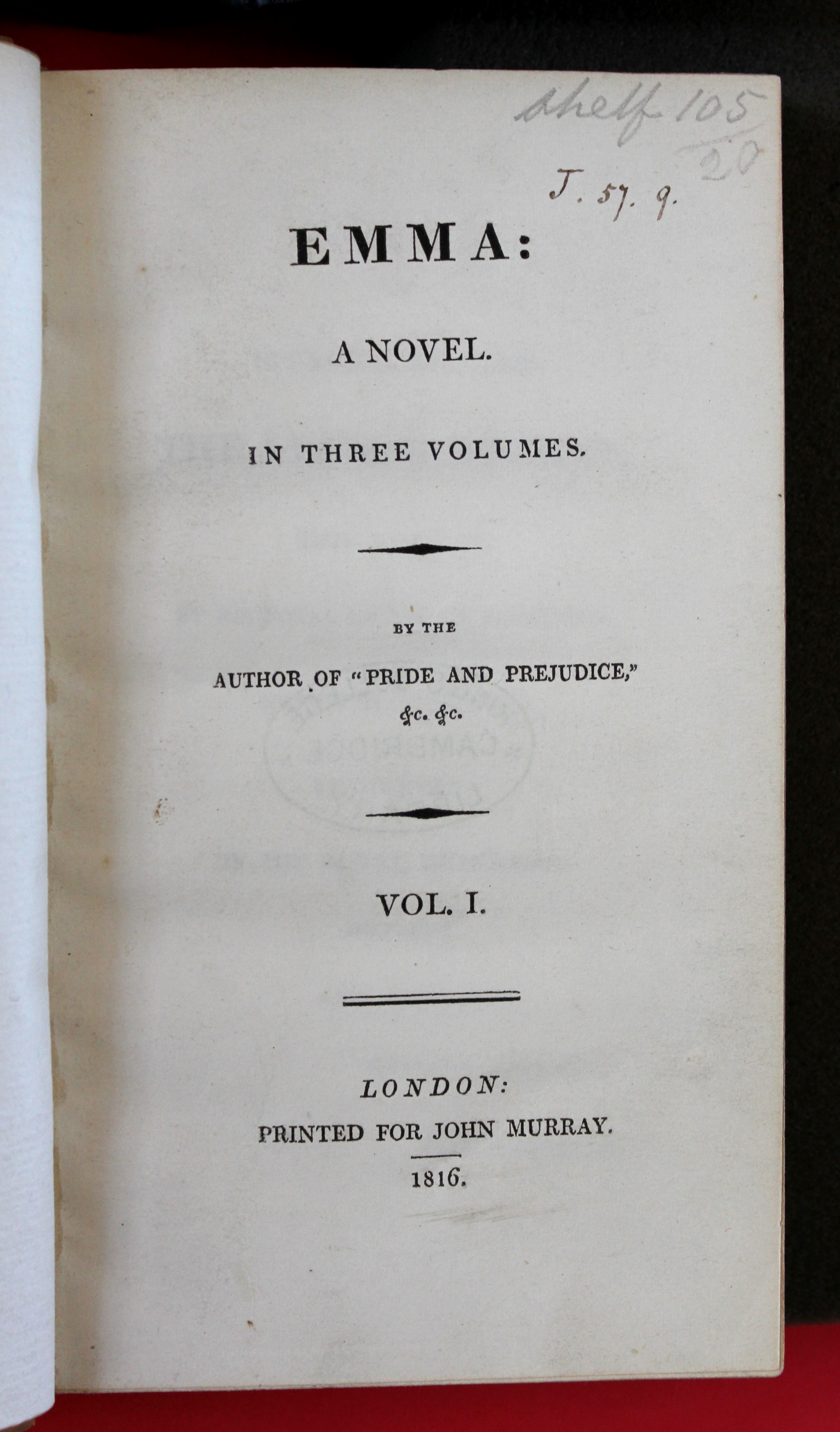
When Henry Austen was taken ill in London in October 1815, he was attended by his sister Jane and by one of the Prince Regent’s doctors who identified her as the author of Pride and Prejudice. The doctor reported that the Prince (later George IV) was a great admirer of her novels and she was invited to dedicate one of her future works to the Prince. Emma was the lucky work. Jane disapproved of the Prince’s treatment of his wife, but felt she couldn’t refuse, so she settled for a title page reading simply ‘Emma, Dedicated by Permission to HRH The Prince Regent’, though her publisher (John Murray) thought it ought to be more elaborate.

This copy of the first edition of Emma belonged to King’s Provost George Thackeray (1777–1850).

Jane Austen, Emma (London: Murray, 1816), First edition
Thackeray.J.57.9-11

Several months after the dedication of Emma, Jane wrote to John Murray and reported that the Prince had thanked her for the copy of Emma. In the same letter she notes that in a recent review of the novel, printed in The Quarterly Review (vol. XIV, 1816), the anonymous reviewer (later established as Sir Walter Scott) completely fails to mention Mansfield Park, remarking with regret that ‘so clever a man as the reviewer of Emma, should consider it as unworthy of being noticed’.

Jane Austen’s letter to John Murray, 1 April 1816 (NM/Austen/1)

Among the miscellaneous items on display was one of the few known copies of Sense and Sensibility in yellowback. Chapman and Hall’s series ‘Select Library of Fiction’ was closely associated with W.H. Smith, who carefully sought out copyrights, or reprint rights, of popular novels in order to publish yellowback editions for sale on his railway bookstalls. The series, which ran from 1854 until it was taken over by Ward, Lock in 1881, included at least thirty novels by Anthony Trollope, who had strong views on the poor quality of much railway literature.

Jane Austen, Sense and Sensibility
(London: Chapman and Hall, 1870)
Warren.A.Se.1870

One of the highlights of the exhibition was Jane Austen’s copy of Orlando furioso, signed by her on the fly-leaf, sold by the Austen-Leigh family, bought by Virginia Woolf, and inscribed by Woolf to John Maynard Keynes at Christmas 1936.

Ludovico Ariosto, Orlando furioso (trans. by John Hoole)
(London: Charles Bathurst, 1783)
Keynes.E.4.1

These Victorian editions of Mansfield Park, Emma, and Northanger Abbey were presented to E. M. Forster’s mother by his father, and were later inherited by Forster himself.

Copies of Mansfield Park, Emma and Northanger Abbey from the library of E. M. Forster (all London: Routledge, 18–)
Forster.AUS.Man; Forster.AUS.EMM; Forster.AUS.Nor

King’s College owns the manuscript of Jane Austen’s unfinished novel Sanditon, the last one on which she was working before she died on 18 July 1817. It is a rare surviving autograph manuscript of her fiction. It was given to King’s in 1930 by Jane’s great-great niece (Mary) Isabella Lefroy in memory of her sister Florence and Florence’s husband, the late Provost Augustus Austen Leigh who was a great-nephew of Jane. The booklets were made by Austen herself. The last writing is dated 18 March 1817. She died four months later.

The beginning of Sanditon

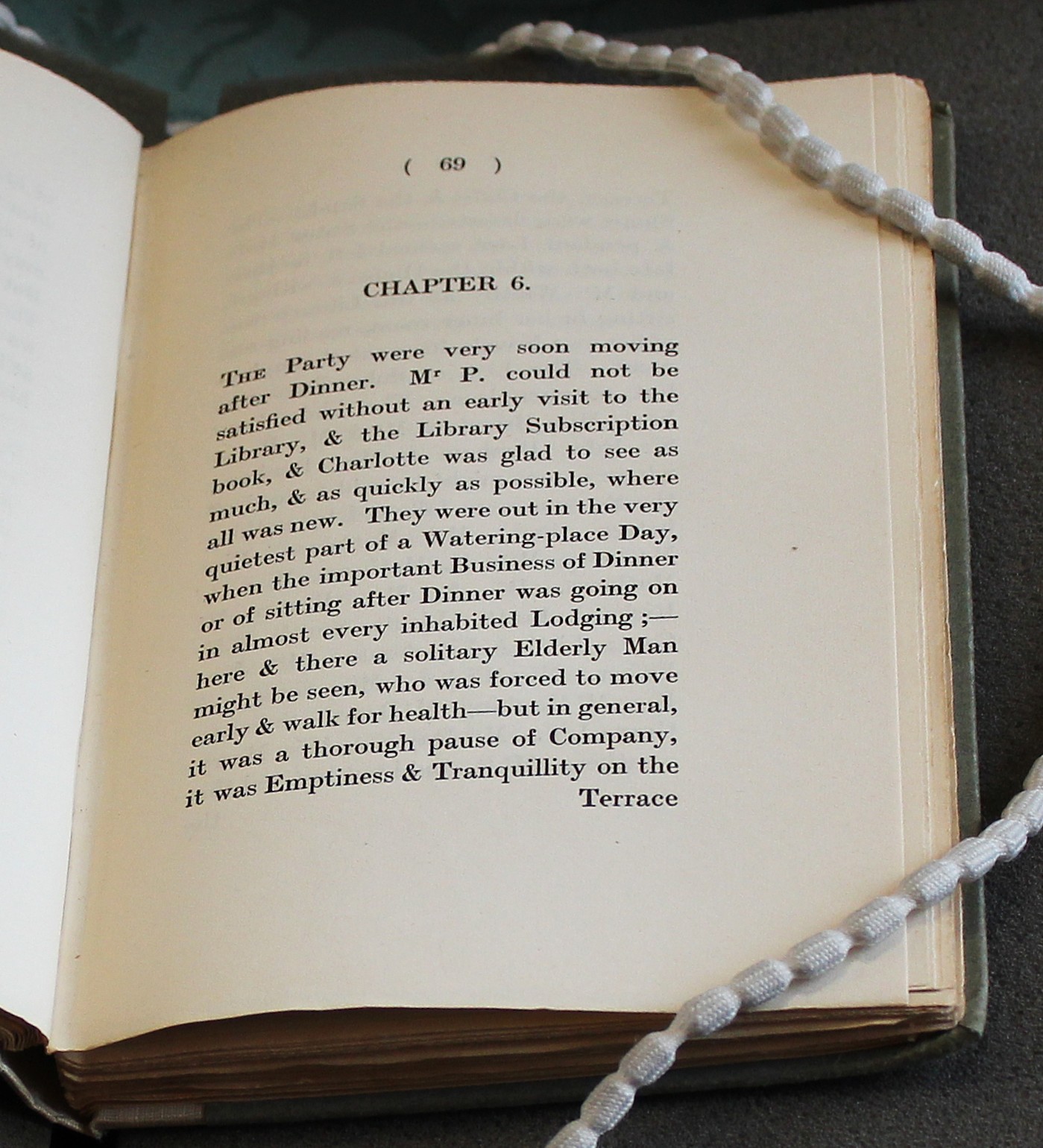
Below is the beginning of chapter 6, followed by the transcription in the printed version of Sanditon.

The beginning of chapter 6

This copy of the first edition of Sanditon comes from the library of E. M. Forster.
Jane Austen, Fragment of a Novel (Oxford: Clarendon Press, 1925)
Gilson.A.Sa.1925a

During the summer, King’s College loaned one of the fascicles of Sanditon to Harewood House to be displayed there as part of their exhibition ‘Austen and Turner: A Country House Encounter’ where it occupied pride of place and was viewed and admired by thousands of visitors.

JC/IJ


Victorian railway excursions

In this second blog post marking 200 years of the modern railway, we focus mainly upon its arrival and early years in the Lake District, with a few other choice items from our collections making an appearance towards the end.

The arrival of the railway in the Lake District in the late 1840s markedly increased accessibility to a landscape that had been growing in popularity with tourists since the late eighteenth century. Here, just as in Cambridge, the guidebooks quickly adapted to reflect the new realities of travel.

Likely one of the earliest railway maps of the region is the Collins’ Railway Map of Westmoreland, a small folded map mounted on linen, which would have made it durable and easily portable for use by travellers.

Cover of map. Has a bright orange background

Cover of Collins’ Railway Map of Westmoreland, London, [circa  1847]. Classmark: Bicknell.233

The map is undated, but examination of the railway lines that are indicated on it in black suggests a publication date of around 1847, since it depicts the railway line extending to Lake Windermere which opened in 1847, but not the line to Coniston which arrived in the following year.

Map from Collins’ Railway Map of Westmoreland

Another nice map can be found in a tiny pamphlet guide from 1848, which this time has rail lines marked in red.

titlepage of guidebook

Title page of The Lakes, By Way of Fleetwood and Liverpool …, Manchester, Bradshaw and Blacklock, 1848. Classmark: Bicknell 243

Map

Map from The Lakes, By Way of Fleetwood and Liverpool …


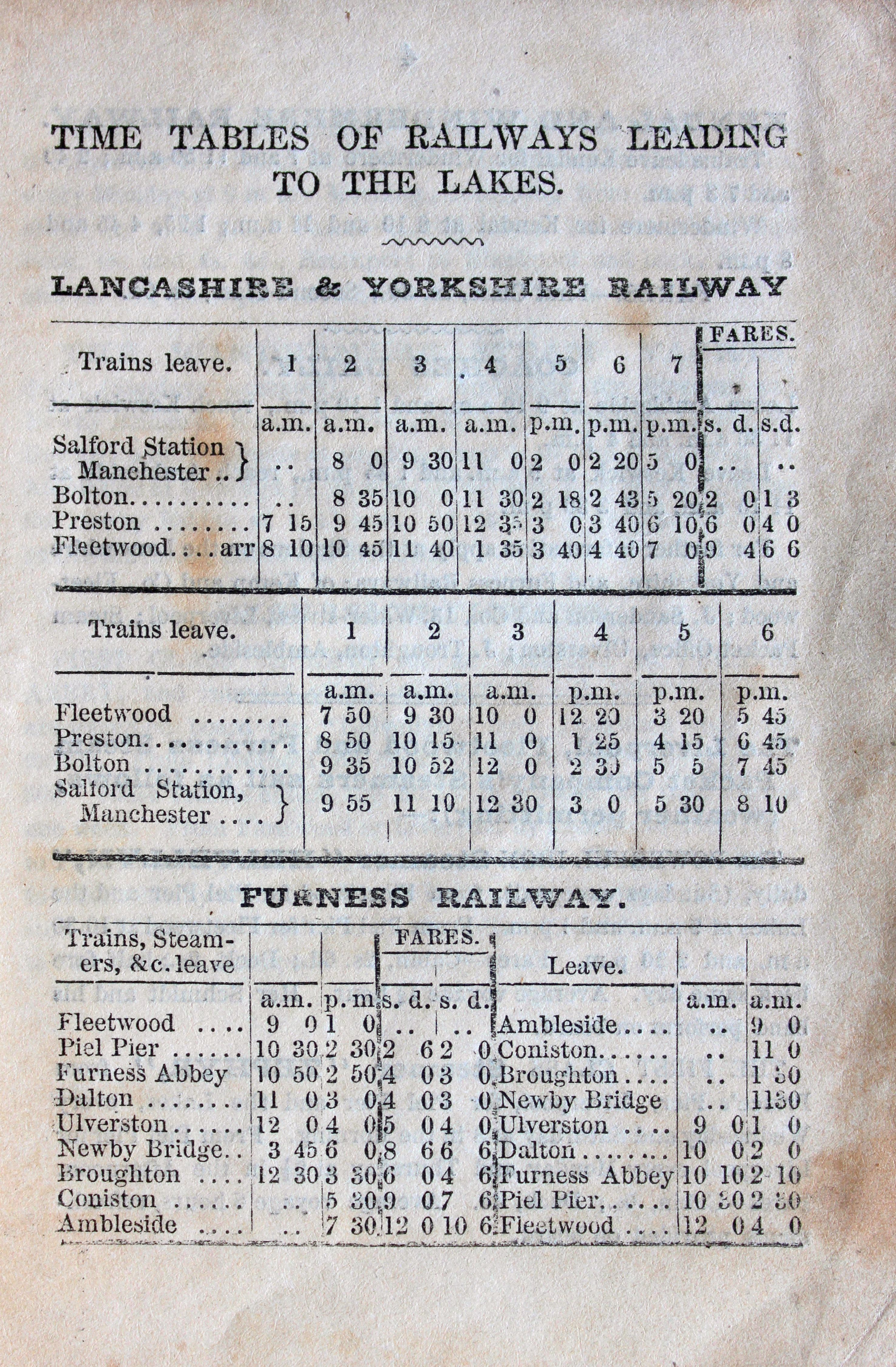
This guide includes timetables for steam ships and railways leading to the Lakes, alongside information about coaches to and from Keswick, which was not yet served by a rail line.

Railway timetables on page 03 of The Lakes …

Coach and steamer information, on page 04 of The Lakes …


Steamer information on page 05 of The Lakes …

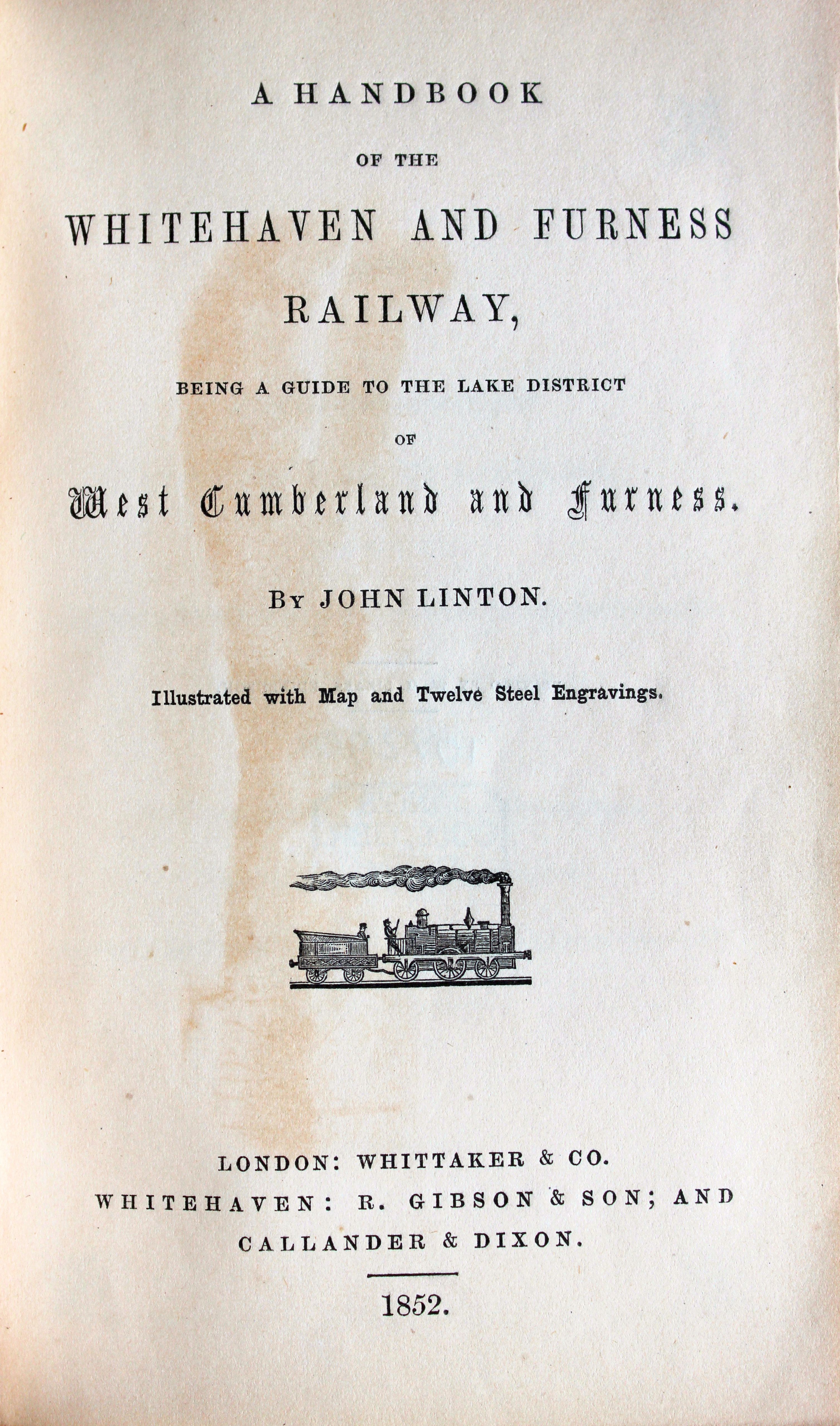
A slightly later guide focuses on areas made more accessible by the Whitehaven and Furness Railway, which opened in 1850. Note the sweet little title page vignette depicting a steam engine:

Ttile page, featuring a small illustration of a steam engine

Title page of: A Handbook of the Whitehaven and Furness Railway by John Linton, London, 1852. Classmark: Bicknell.107

The guide states its purpose clearly (if a little long-windedly) in the introduction:

Our object is merely to supply what, in consequence of the changes recently effected by railway travelling in the approaches to this district, has become a desideratum; – to point out the routes by which the greatly increased number of tourists and others … may arrive at various interesting points of the district; – and to give brief descriptions of several places, all within an easy distance of the railway we have taken as our starting point, which have hitherto, owing to the difficulty of approaching them, been much less frequented …

One such place is the vale of St. Bees, which is described as if viewed from a moving train.  The guidebook goes into raptures about its charms:

After emerging from the cutting, we are again at liberty to enjoy the beauties spread so abundantly on either hand, and it may with truth be said, that a more pleasant and enlivening scene is very rarely met with than that presented to the traveller through the vale of St. Bees. It is a scene of quiet and repose, and yet of the highest cultivation, combining the varied charms of dale and upland, grove and meadow, stately mansion and thriving farm.

If you look closely at the centre of the accompanying engraving (below), you can see a train travelling along the track, trailing steam behind it.

Black and white engraving of a valley with a church and small hamlet, and a train track running through the centre. A train is coming along the track

Plate facing page 24 of A Handbook of the Whitehaven and Furness Railway

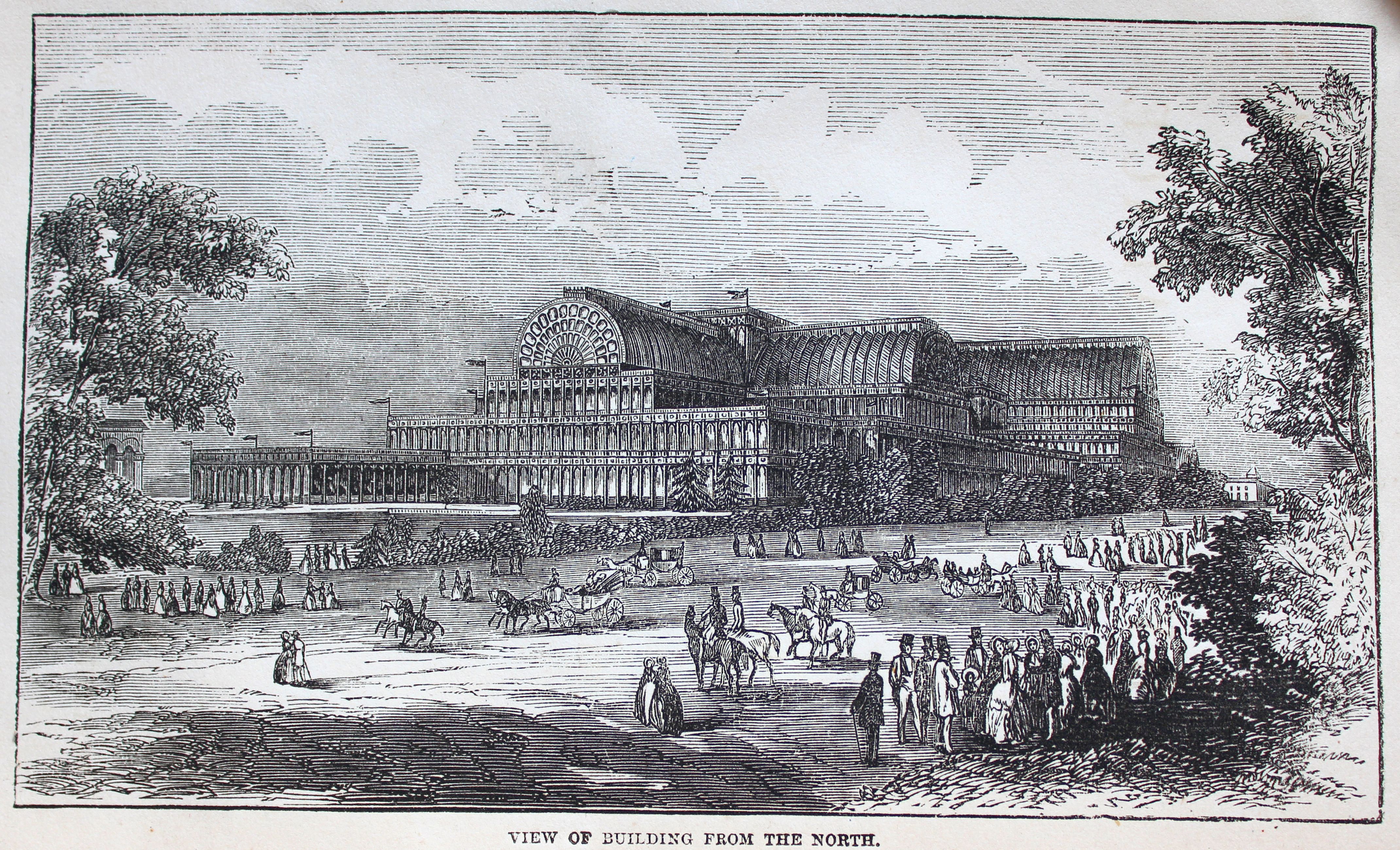
Rail access played an important part in the viability of many business ventures in the Victorian age. When the historic Great Exhibition in London’s Hyde Park, the world’s first international trade fair, closed its doors in October 1851, the future of the exhibition hall, the magnificent Crystal Palace, was initially uncertain. However, the designer Sir Joseph Paxton soon orchestrated the raising of enough private funds to purchase the building and have it re-erected in an adapted and enlarged form on a hilltop in Sydenham, in the south east of the city. An elaborate park was constructed around it and the site was opened to the general public in 1854 as a place for relatively cheap entertainment and recreation for the masses. Attractions included concerts, exhibitions, pantomimes, circuses and the delights of the building itself and the surrounding landscaped gardens. Vital to the success of the scheme was the construction, by the London, Brighton and South-Coast Railway Company, of a dedicated railway station for the site, which opened shortly after the park itself. Close co-operation with the railway was expedited by the fact that the chair of the railway company, Samuel Laing, was also chair of the new Crystal Palace Company. It also made commercial sense for the railway, since any big attraction would boost the growth of rail travel.

The illustration below comes from a little guidebook to the palace and park, published in its inaugural year. Our copy is part of the Thackeray Collection.

Black and white illustration showing the Crystal Palace building in parkland. It looks like a huge greenhouse.

Frontispiece from Guide to the Crystal Palace and Park by Samuel Phillips, London, 1854. Classmark: Thackeray.VIII.11.24

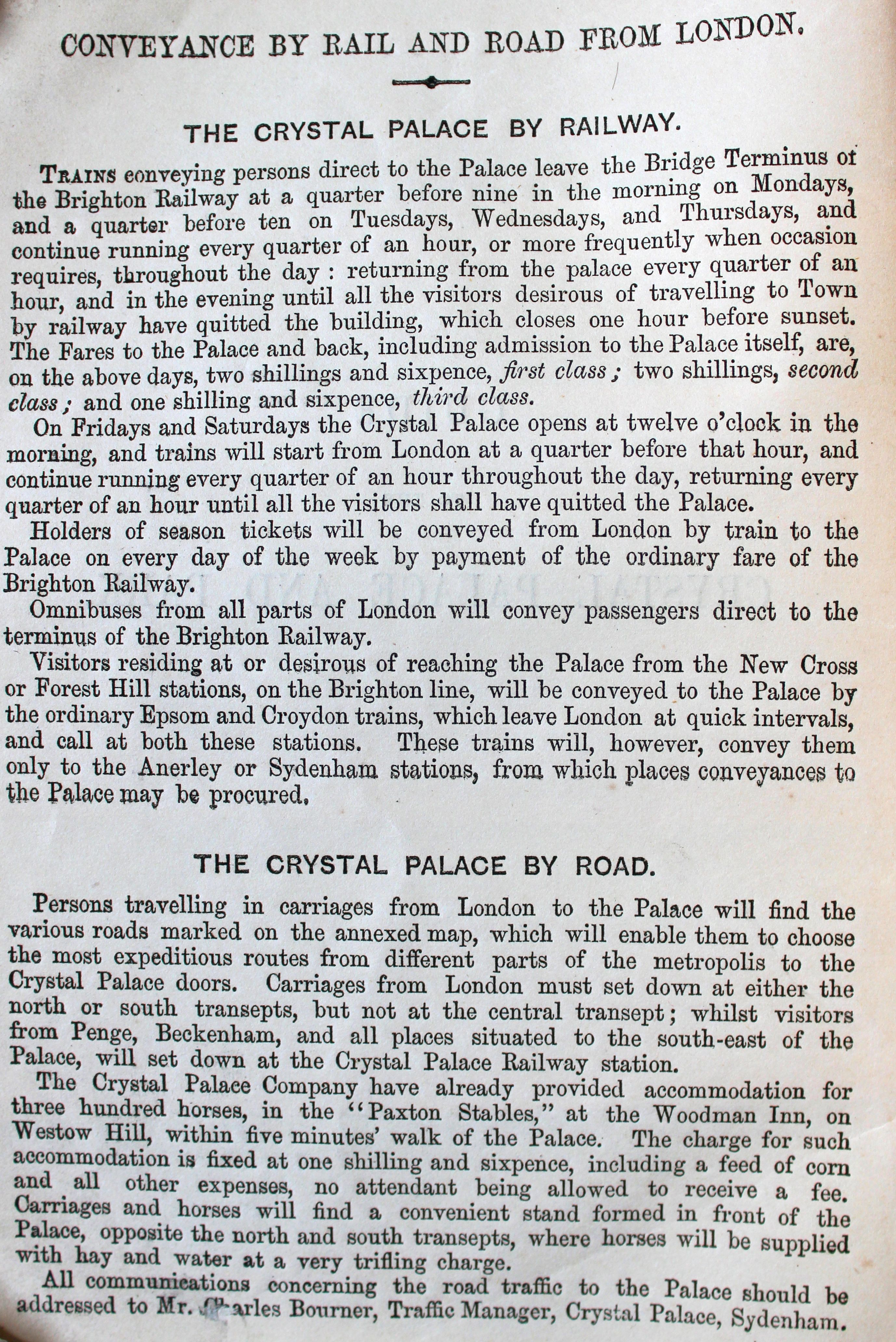
Detailed information on accessing the park by rail is provided inside the guide, revealing that the service ran at least every quarter of an hour and more frequently at busy times of day. Return tickets, which included admission to the Palace, were one shilling and sixpence for third class travel, rising to two shillings and sixpence for first class.

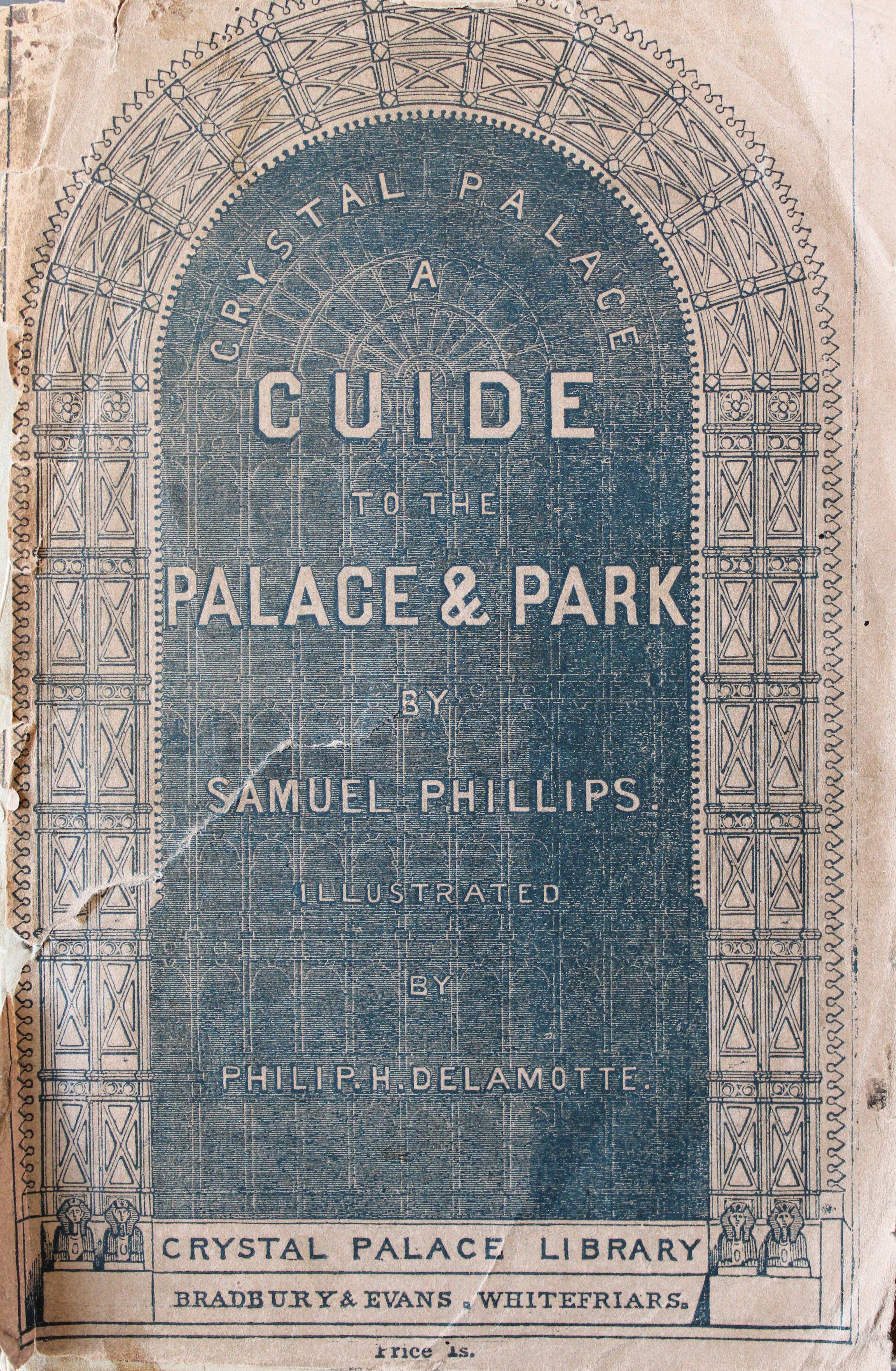
Cover of the guide. The title is depicted within an illustration of a large ornate archway

Front cover of Guide to the Crystal Palace and Park

Travel information

Travel information on the back of the half-title page of Guide to the Crystal Palace and Park 

Incidentally, this guide includes  an advertisement by the South Eastern Railway for what they refer to as: “tidal trains”, which offered a streamlined service between London and Paris. Passengers could board an express train to Folkestone, embark upon a waiting steamer ship and be met after the channel crossing by a direct train for Paris. Luggage would be managed from start to finish by the rail company. The same arrangements applied for a trip in the other direction. Not bad for the early decades of rail travel!

Advert

Page 47 of the Advertiser section of Guide to the Crystal Palace and Park

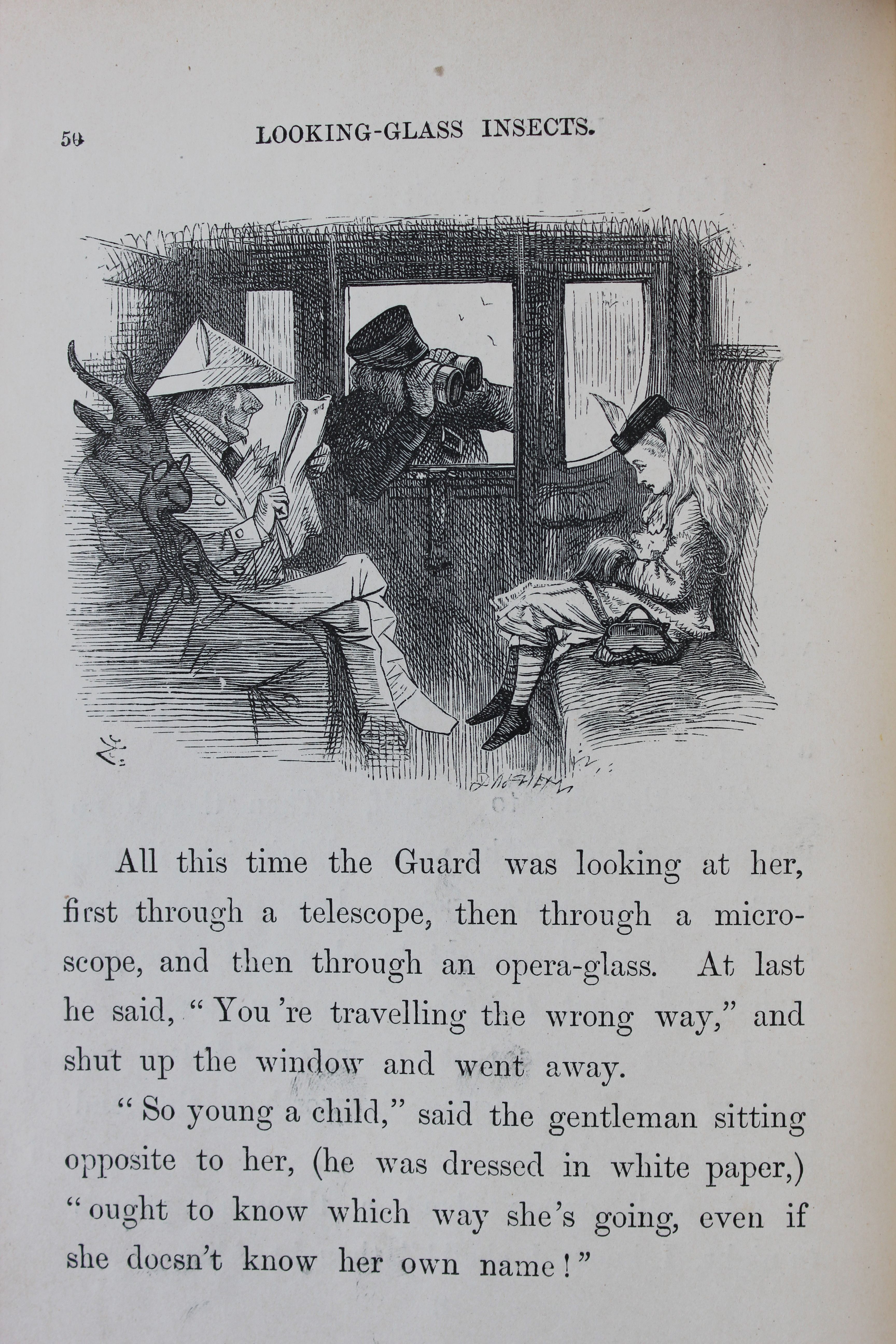
The final destination on our whistlestop tour of railway-themed material is our Rylands Collection of children’s books. An illustration from the first edition of Through the Looking Glass depicts Alice in a train carriage with some rather odd travelling companions.

Illustration within the text of Alice in a railway carriage with a goat and a man with a paper hat. There is a guard peering at her through binoculars

Illustration by John Tenniel from page 50 of Through the Looking Glass, and What Alice                                   Found There by Lewis Carroll, London, 1872. Classmark: Rylands.C.CAR.Thr.1872

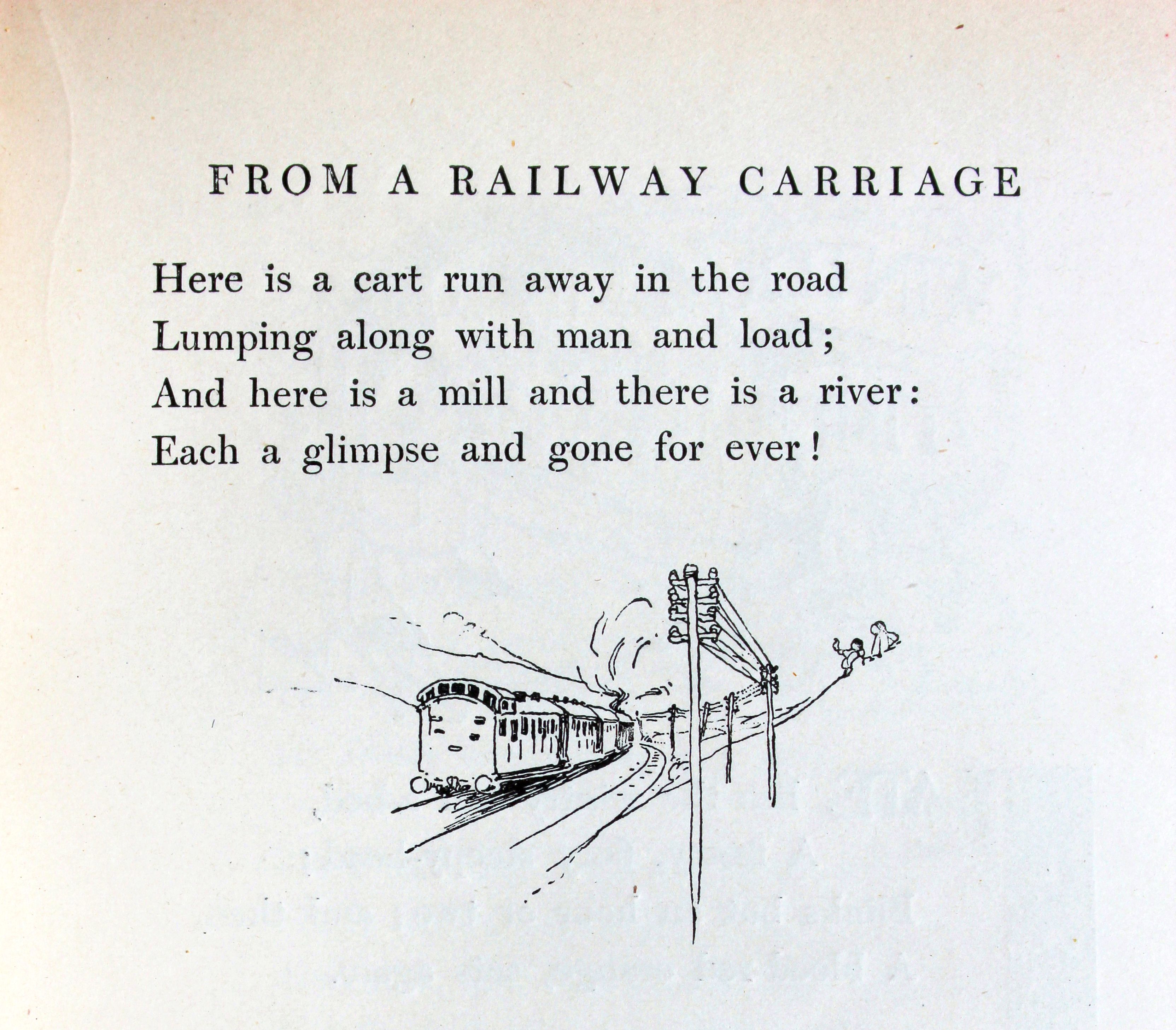
We also hold a copy of Robert Louis Stevenson’s A Child’s Garden of Verses, which includes this wonderfully evocative poem about a train journey.

The text of the poem, illustrated with a railway carriage

Page 68 of A Child’s Garden of Verses by Robert Louis Stevenson, London, 1896. Classmark: Ryland’s.C.STE.Chi.1896

The second page of the poem, with a small illustration of a retreating train

Page 69 of A Child’s Garden of Verses

We hope you’ve enjoyed this look at the early days of rail travel as reflected in our collections and that you enjoy any and all excursions you make this autumn and winter, whether by train or by any other means!

AC

References and further reading:

Railway 200 [accessed September 2025]

Lee Jackson, Palaces of pleasure: how the Victorians invented mass entertainment, New Haven, 2021

The Crystal Palace Foundation [accessed September 2025]
The railway arrives in Cambridge!

This year marks both 200 years of the modern railway and the 180th anniversary of the opening of Cambridge Station on 29 July 1845.  These anniversaries prompted us to search out and share some railway-related material from our various special collections. Enough material was found for two blog posts, so this first will begin close to home with Cambridge, whilst a second subsequent post will range further afield.

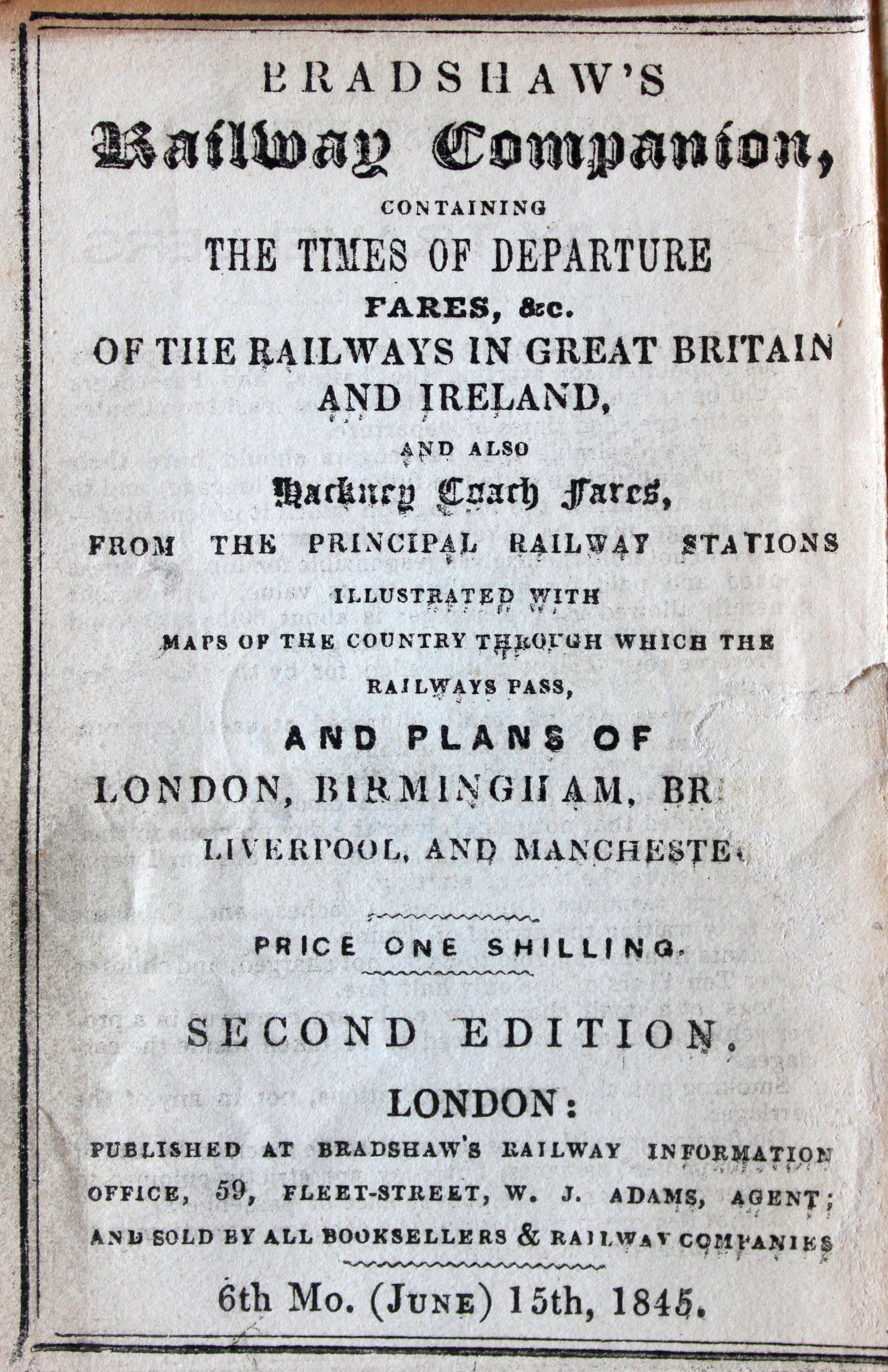
We happen to hold both a Cambridge guidebook published in 1845 and an edition of Bradshaw’s Railway Companion from the same year, both of which anticipate the imminent arrival of the station.

Titlepage of Bradshaw's railway companion from June 1845

Title page of Bradshaw’s Railway Companion, London, 1845. Classmark: N.26.33

Bradshaw’s guides were the first railway timetables ever to be published and were hugely popular in the Victorian era. They are frequently referenced in the literature of the day, including in Arthur Conan Doyle’s stories of Sherlock Holmes. Our copy dates from June 1845, when the closest  station to Cambridge was Bishop’s Stortford, but the timetable below is already labelled as: “Eastern Counties – Cambridge Line”.

A detailed timetable for the Eastern Counties Cambridge line, in dense, small type.

Timetable from Bradshaw’s Railway Companion

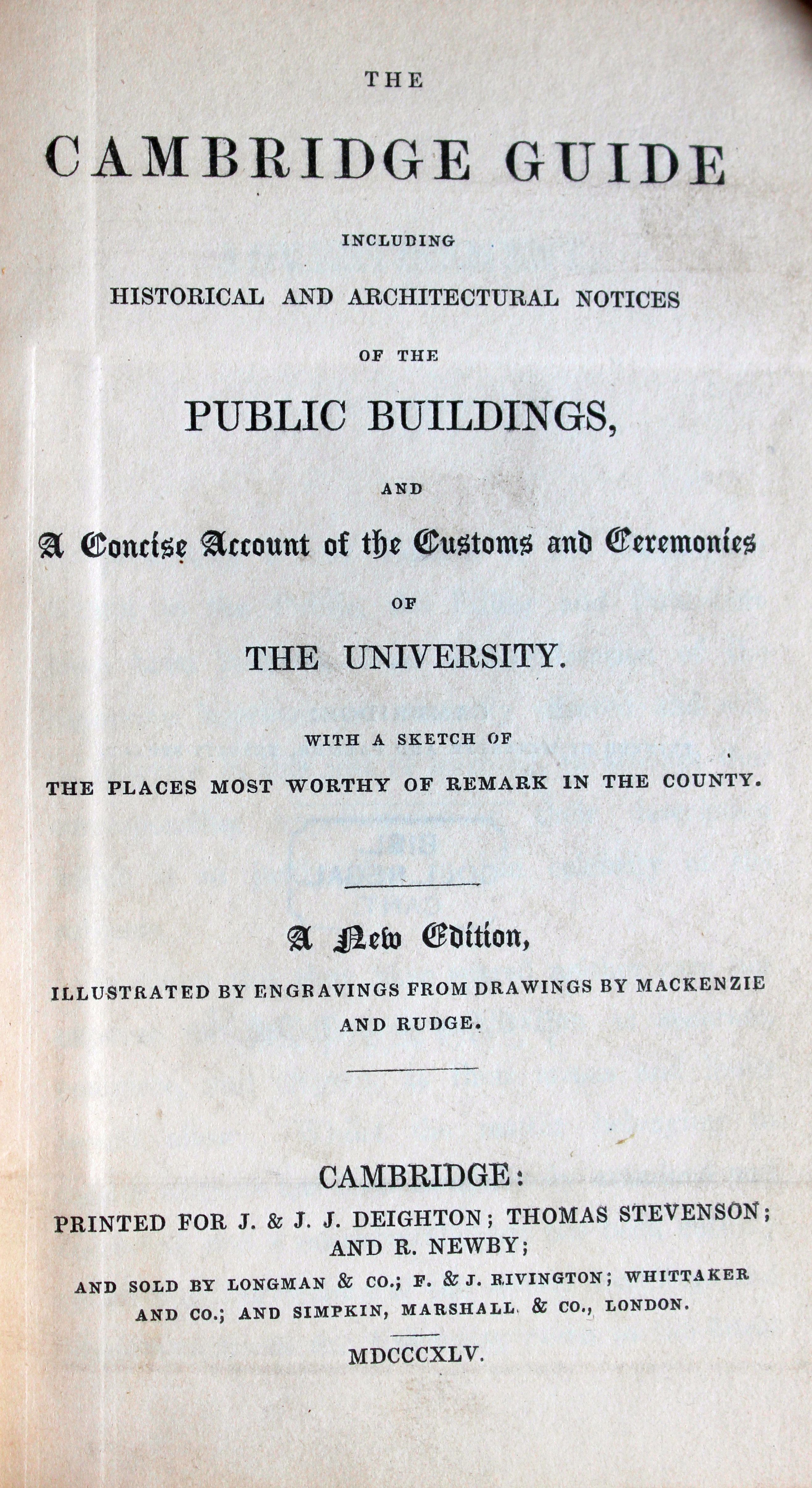
The Cambridge Guide published the same year has a map which already includes directions to the station, although the travel information provided at the rear of the guide still focuses on describing the numerous stagecoach routes between Cambridge and London. Many of these coaches travelled via the station at Bishop’s Stortford, presumably in order to provide onward travel to Cambridge for rail passengers alighting there.

Title page of "The Cambridge Guide"

Title page of The Cambridge Guide, Cambridge, 1845. Classmark: NW CAM 3ML Cam

Part of the folded, black and white city map from The Cambridge Guide

Section of the folded city map from The Cambridge Guide. The road in the bottom right-hand corner is labelled as leading to the station


Description of coach routes between London and Cambridge

Coach information from page 268 of The Cambridge Guide

In the course of describing the wider region, this guide explains that:

A rail-road is now in rapid progress from London by Cambridge, and extending by Brandon to Norwich; a branch is also contemplated from Ely to Peterborough, and so to the north of England.

Bradshaw’s Railway Companion also provides an interesting insight into the rules of the early railway. These include the very modern sounding prohibition: “Smoking not allowed at the Stations, nor in any of the carriages”.  This rule was in force across much of the rail network until Parliament passed a law in 1868 mandating that every train must have a smoking compartment.

List of rules for travelling on the railway

General instructions for railway travellers from Bradshaw’s Railway Companion

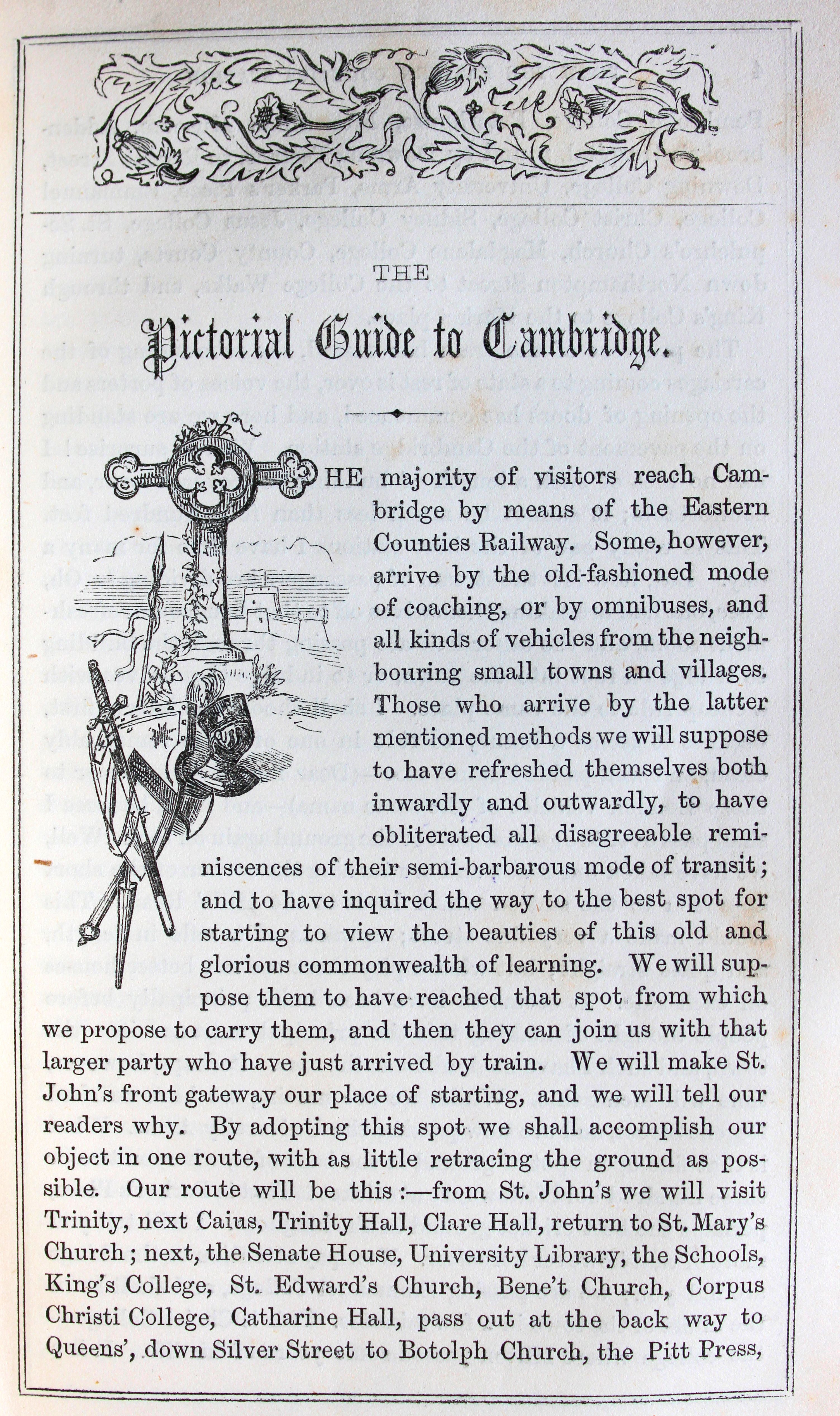
Once Cambridge station was open it soon became the natural starting point for many descriptive tours of the city, on the justified assumption that the majority of tourists would now choose to arrive by rail. The first paragraph of The Pictorial Guide to Cambridge, which adopts a very informal, discursive tone, states this clearly, and the author even disparages other forms of transport:

The majority of visitors reach Cambridge by means of the Eastern Counties Railway. Some, however, arrive by the old-fashioned mode of coaching, or by omnibuses … Those who arrive by the latter mentioned methods we will suppose to have refreshed themselves both inwardly and outwardly, to have obliterated all disagreeable reminiscences of their semi-barbarous mode of transit …

Introduction page

Introduction to The Pictorial Guide to Cambridge, Cambridge, [1853]. Classmark: NW CAM 3ML Pic

The Pictorial Guide goes on to hymn the glories of the new station and the convenience of  rail travel:

… here we are standing on the pavement of the Cambridge station. What a surprise! I had no idea of such a length of building, all covered over, and comfortable; it cannot be much less than four hundred feet. This really is one of the best stations I have seen for many a day. But, how is it that the stream of passengers are dividing? Oh, I see, one half are taking themselves off to that handsome refreshment room, and the other half are passing through the building to trudge on foot into the town, or to indulge themselves with a cheap ride to the same place.

You see the advantage of travelling by rail; whilst we breakfasted at home, and have come all this distance as fresh and clean as when we started, there are those less fortunate folks who left their homes by day-break this morning and arrived an hour ago, have hardly had time to make their first meal, and cannot possibly turn out in half such good trim as ourselves.

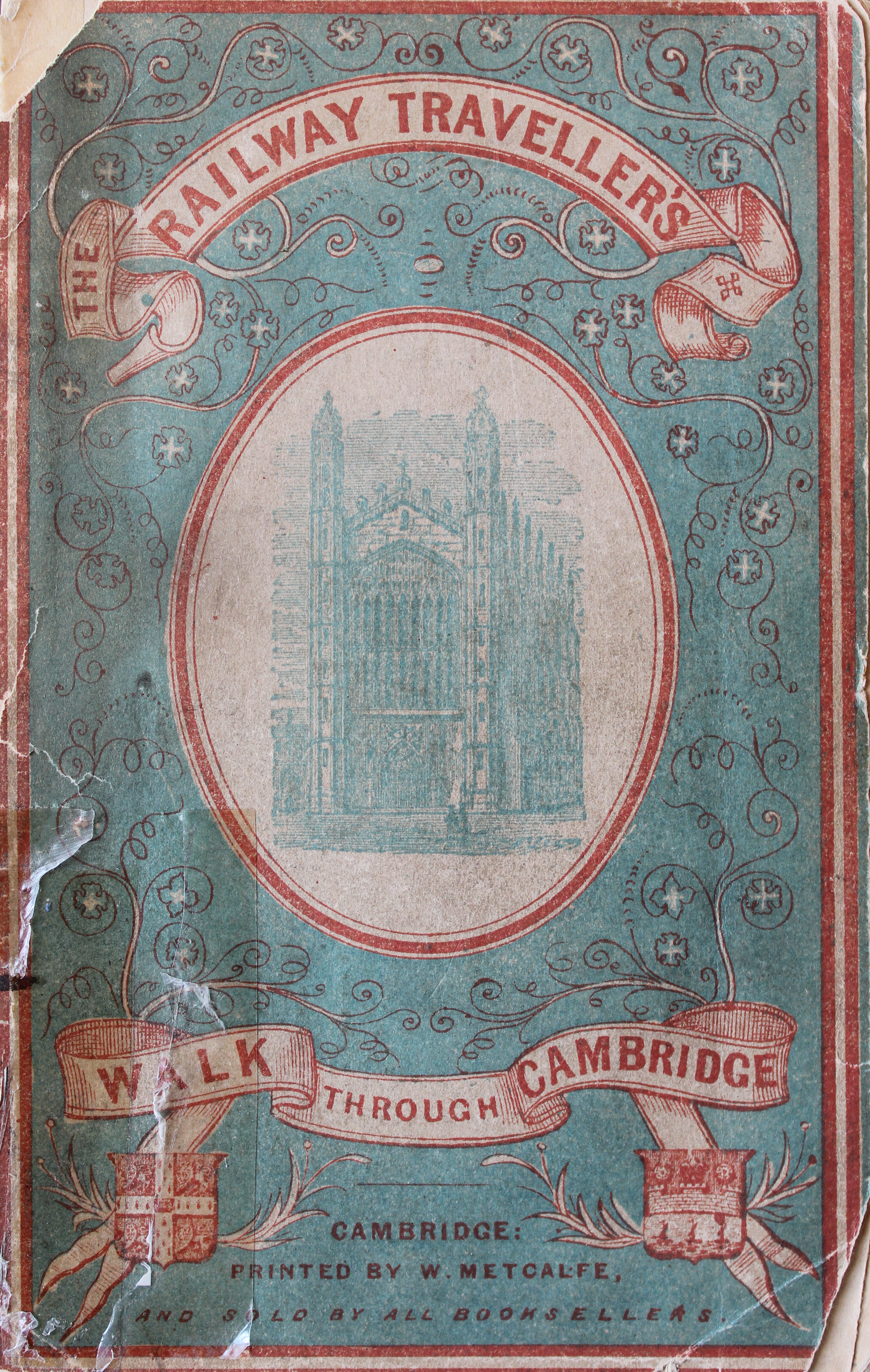
Another guidebook, from 1863, explicitly markets itself to rail passengers by using the title The Railway Traveller’s Walk through Cambridge. The station was completely remodelled in that year and the guide remarks approvingly that: “It now forms one of the finest on the line”. Naturally, King’s College Chapel is depicted on the guide’s cover.

Decorative blue and red cover with an illustration of King's College Chapel in the centre

Cover of The Railway Traveller’s Walk through Cambridge, Cambridge, 1864. Classmark: NW CAM 3ML Rai

A later edition of this guidebook from the 1890s, reissued under a different title, contains a useful fold-out map of the city, in which important buildings and the station are highlighted in red.

Map of Cambridge

Map from The Cambridge Visitor’s Guide, Cambridge, [1892]. Classmark: NW CAM 3ML Rai

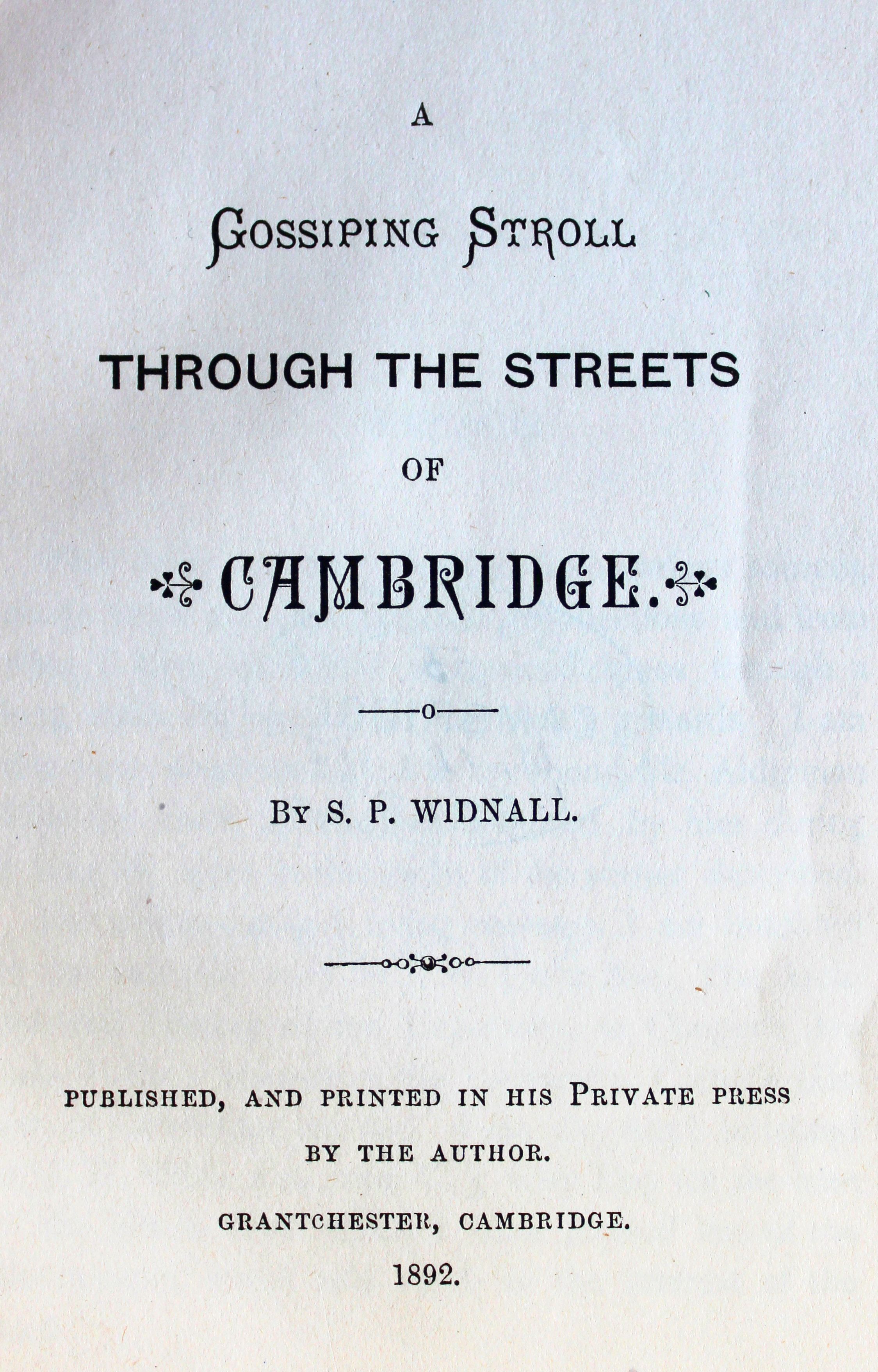
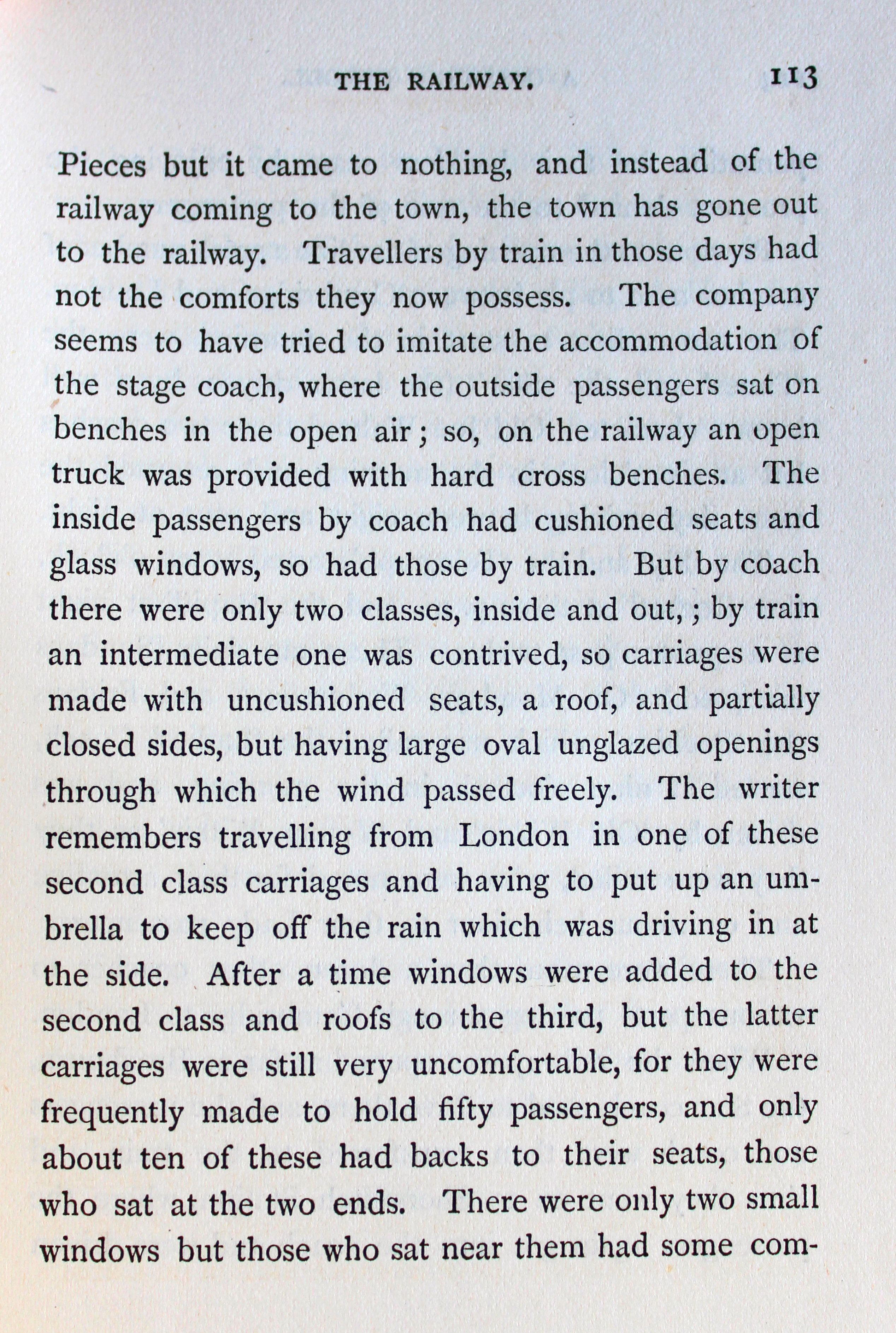
By this final decade of the nineteenth century, writers were already reminiscing about the privations of the early days of the railways, as can be seen in the amusingly titled guidebook A Gossiping Stroll through the Streets of Cambridge. The author, S.P. Widnall, recalls using an umbrella to keep off the rain when travelling in a second class carriage that had no glass in its windows!

Title page

Title page of A Gossiping Stroll Through the Streets of Cambridge, by S.P. Widnall, Cambridge, 1892. Classmark: NW CAM 3ML Wid

Page 113 of A Gossiping Stroll Through the Streets of Cambridge


Widnall also discusses the effect of the railway upon coaching routes between London and Cambridge, stating that:

When the railway was finished to Cambridge the coaches were of course driven off the road. Some people professed to dislike railways and to prefer riding behind four horses; this led to the attempt to keep one coach on the road, and for a short time the Beehive continued its journeys, when it arrived for the last time it was draped in black, as mourning for its own decease.

Additionally, he touches upon the location of the station, which is (and remains today) some way out of the city centre, remarking that:

We believe the Station would have been nearer the town had it not been opposed by the University authorities on account of the supposed disturbance to University pursuits.

Some modern histories of the Cambridge railway dismiss this as a myth, asserting that the area to the west of the eventual site was already too heavily built up for a more centrally located station to be either economically or practically feasible. Nevertheless, the belief that the University was to blame persists to this very day, especially among those who trudge wearily to the station every evening after work!

AC

References and further reading:

Reginald B. Fellows, London to Cambridge by Train 1845 – 1938, Cambridge, 1939

Cambridge: its Railways and Station  [accessed September 2025]

Railway 200 [accessed September 2025]

Dante: An Online Exhibition

In November 2024 King’s College had the opportunity to host the annual doctoral and postdoctoral research conference “Dante Futures 2024: New Voices in the UK and Ireland”. For this occasion, an exhibition of rare early printed and manuscript materials relating to Dante was mounted in the library. As this year marks the 760th anniversary of Dante’s birth in 1265, we thought it would be timely to share some of these treasures in an online exhibition.

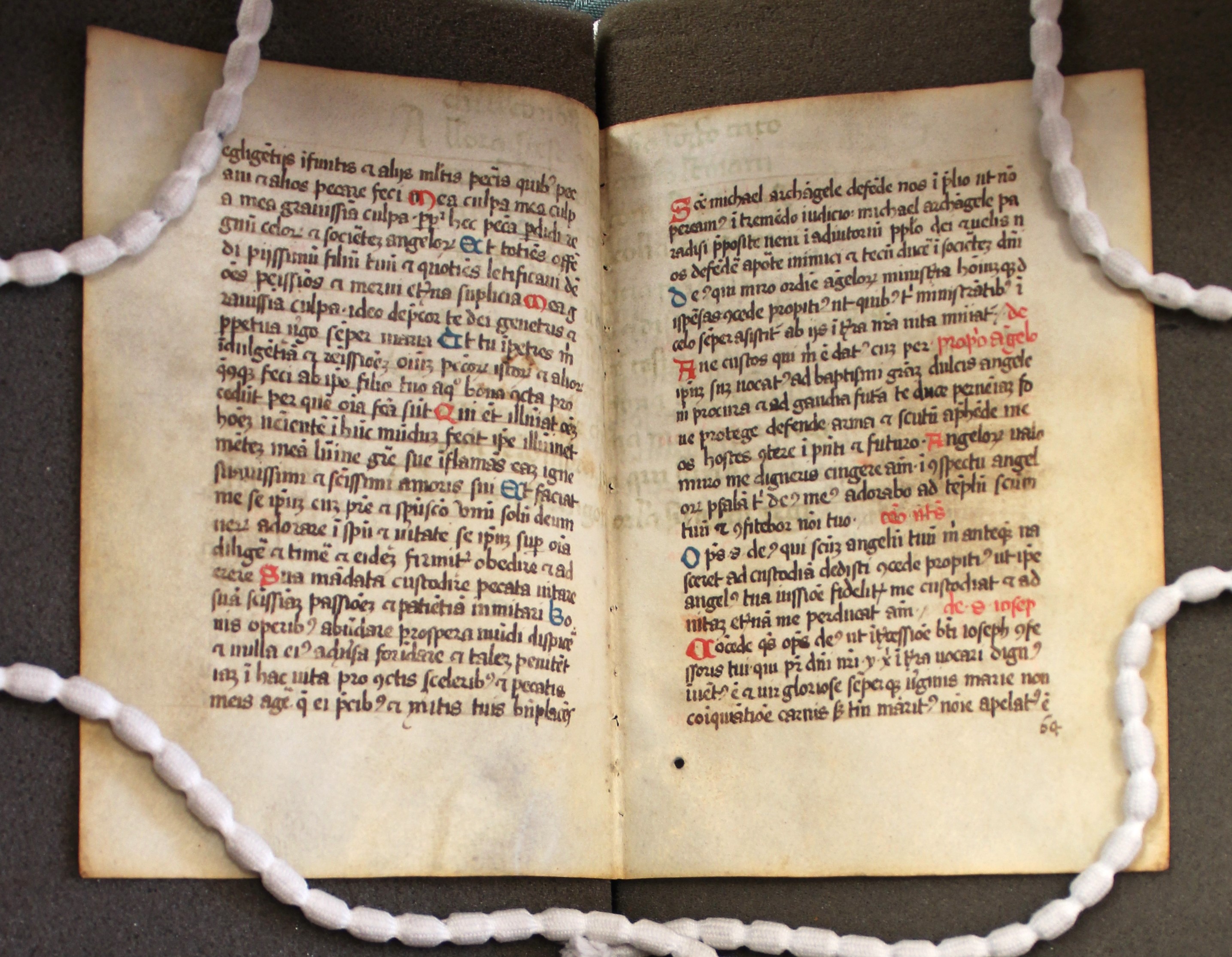
While there is no extant autograph manuscript of the Divine Comedy, many other fourteenth- and fifteenth-century manuscripts survive. Below is a fifteenth-century breviary written in an Italian hand on vellum. This is a palimpsest, namely a manuscript on which a piece of writing has been superimposed, effacing the original text. In this case the erased text is from Dante’s Inferno, one of the three parts of the Divine Comedy, which was written on at least 31 leaves used in this breviary. The vellum was not thoroughly cleaned when it was prepared for reuse, meaning Dante’s text can be seen by the naked eye in a number of places, apparently written in a fourteenth-century hand. Each leaf of the original manuscript was folded in two, vertically, to create two leaves (one bifolium). At the top of the page we can see lines 39-40 of Inferno VIII (spelling modernised):

ch’i’ ti conosco, ancor sie lordo tutto.
Allora [di]stese al legno ambo le mani

[for thee I know, all filthy though thou be.
Then toward the boat he stretched out both his hands]

Breviary (imperfect), fifteenth century, partly written on a palimpsest vellum of Dante’s Inferno, fourteenth century (Salt MS 3)

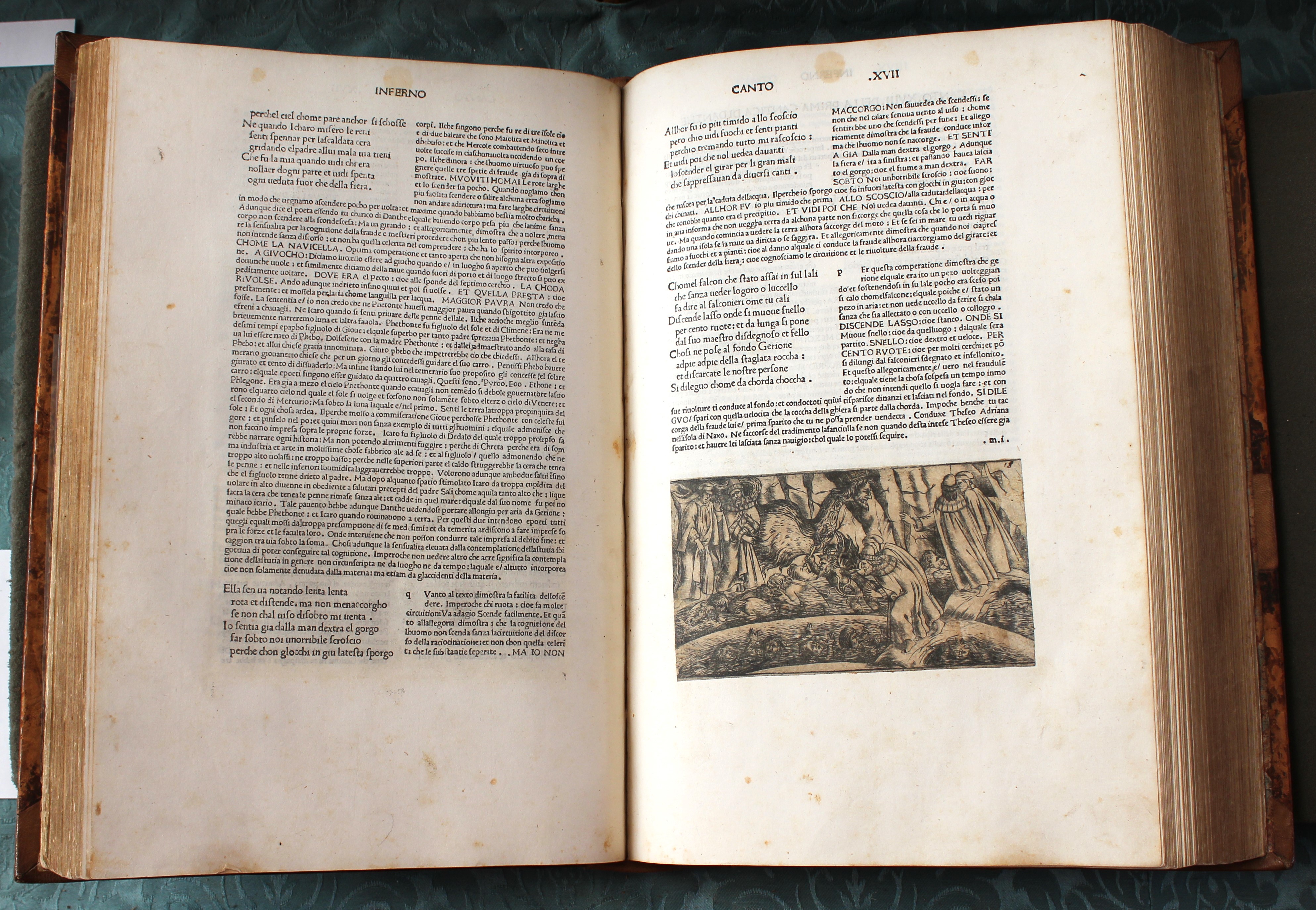
The first printed edition of the Divine Comedy appeared in 1472. This incunabulum from 1481 (a book from the dawn of printing, printed before 1501) includes the commentary of Cristoforo Landino with additions by Marsilio Ficino, and is the third edition of the work to be published. The engravings are attributed to Baccio Baldini after designs by Sandro Botticelli, eighteen of which are included in this copy, mainly pasted in spaces left by the printer for that purpose. Here we see the descent of Virgil and Dante into Hell, as they move to the circle of the fraudulent in the Malebolge, thanks to the mythological monster Gerion, who flies them down on its back. With the face of a just man, the body of a snake, the tail of a scorpion, and hairy paws, Gerion is an allegory of falseness and fraud, precisely because its human face displays a benign humanity while the serpentine and monstrous body reveals its evil:

Comento di Christophoro Landino fiorentino sopra
La comedia di Danthe Alighieri poeta fiorentino
(Florence: Nicholo di Lorenzo della Magna, 1481; Bryant.XV.1.4)

Aldus Manutius (c. 1449/1452–1515), founder of the Aldine Press in Venice, was one of the most important printers of the period. He was an advocate of the smaller, more portable book format, which is arguably the precursor to the modern paperback. His work also helped to standardise the use of punctuation.

Along with Greek classics, the Aldine Press also printed Latin and Italian works. At the start of the sixteenth century the Bembo family—a noble Venetian family—hired the Aldine Press to produce accurate texts of both Dante and Petrarch using Bernardo Bembo’s personal manuscript collection. Pietro Bembo worked with Manutius from 1501 to 1502 to undertake this work, resulting in this, the fifth edition of the Divine Comedy to be published. Here we see the well-known dolphin-and-anchor printer’s device used by the Aldine Press, adopted in 1502 and used for the first time in this publication:

Dante Alighieri, Lo ‘nferno e ‘l Purgatorio e ‘l Paradiso di Dante Alaghieri
(Venice: Aldus Manutius, 1502; M.71.15)

The Aldine Press published a second edition of the Divine Comedy in 1515 in partnership with Aldus’s father-in-law, Andrea Torresani “nelle case d’Aldo et d’Andrea di Asola suo suocero” (at the house of Aldo and Andrea of Asola, his father-in-law), with whom he had a professional relationship from 1506 until his death in 1515. Although the volume appeared just after his death, Aldus is believed to have prepared this second edition himself. The publication was dedicated to Vittoria Colonna (1490–1547), one of the most famous women of the Italian Renaissance, friend to the most important cultural figures of the age including Bembo, Castiglione and Michelangelo, and a poet in her own right. Below is the opening of the second part of the Divine Comedy, the Purgatorio:

Dante col sito, et forma dell’inferno tratta dalla istessa descrittione del poeta
(Venice: nelle case d’Aldo et d’Andrea di Asola suo suocero, 1515; Keynes.Ec.7.3.22)

Alessandro Vellutello (born 1473) produced an influential commentary on the Divine Comedy, published in 1544, which is a real gem in the collection of rare books bequeathed to King’s College by novelist E.M. Forster (1879–1970). This copy belonged to Bishop John Jebb (1775–1833) who gifted it to Forster’s grandfather, Charles Forster (1789–1871). The printer left spaces for 87 woodcut illustrations which were first used in this edition and subsequently in a number of other editions throughout the sixteenth and seventeenth centuries. They were considered some of the most beautiful Renaissance illustrations of the poem after Botticelli’s.

This is a depiction of Giudecca (named after Judas Iscariot), the very last region of Hell. The sinners are punished by being completely frozen in the lake of Cocytus, some upright, some upside down, some with their bodies bent double. Enormous in size, we see the top half of Lucifer in the lake, gnawing on the bodies of sinners:

La comedia di Dante Aligieri con la nova espositione di Alessandro Vellutello
(Venice: per Francesco Marcolini, 1544; Forster.DAN.Com.1544)

Cosimo Bartoli (1503–72) was a humanist, philologist and writer. He promoted the Italian vernacular as a language which could be used in scientific discussion as much as Latin, and Dante was regarded as an example of the heights the vernacular could reach. A friend of the famed Renaissance painter and architect Giorgio Vasari (1511–74), he also worked for the Medicis for most of his life. His Ragionamenti accademici sopra alcuni luoghi difficili di Dante takes the form of fictitious discussions held between Bartoli and his Florentine friends, to provide explanations of some of the most difficult passages in the Divine Comedy. A collection of some of the lectures he had given in the Accademia fiorentina between 1541 and 1547, it was published in Venice in 1567:

Cosimo Bartoli, Ragionamenti accademici di Cosimo Bartoli gentil’huomo et
accademico fiorentino sopra alcuni luoghi difficili di Dante
(Venice: appresso Francesco de Franceschi Senese, 1567; Bury.BAR.Rag.1567)

JC/IJ


Sinuous, slithery snakes!

As the Lunar New Year of the Snake gets underway, we’ve discovered that our rare book stores are teeming with these sinuous reptiles! They slither through the pages of bibles, travel books, natural history books, works of heraldry and more! Where is St. Patrick when you need him! What follows is a only a selection of the many serpents that have recently emerged, hissing, into the light of day.

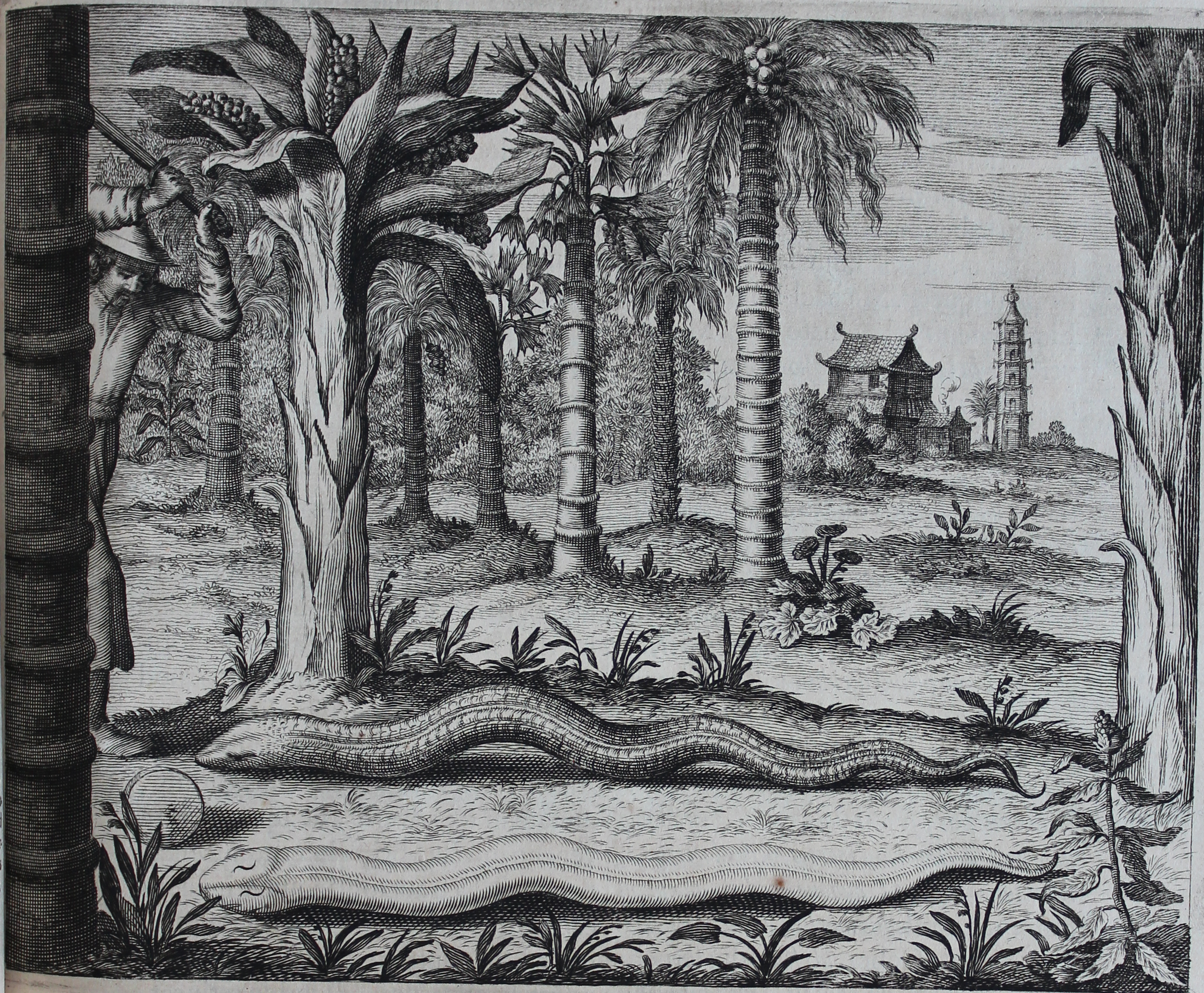
It seems appropriate to begin in China, with an illustration from a book on the country by Athanasius Kircher (1602-1680). Kircher was a German Jesuit and Renaissance polymath, who has been styled by some as the last man who knew everything. He had a long eventful life during which he published around forty books on a wide variety of topics, including ancient languages, music and geology. He was refused permission to become a missionary in China himself, but compiled the reports of many of his Jesuit colleagues to produce a magnificently illustrated volume on the country, encompassing zoology, geography, religion, botany, and much more besides. Below is one of the illustrations, featuring two large snakes, and a man in the corner apparently about to attack them with a stick!

Two large snakes slithering across the foreground, with trees and buildings in the background and a man with a hammer in the left hand corner

Illustration from page 81 of China Monumentis by Athanasius Kircher, Amsterdam, 1667 (Shelfmark: M.40.28)

From one of our early printed bibles comes this woodcut of Adam and Eve in the Garden of Eden, with the wily serpent coiled around a tree in the background. If you look closely, it appears to have a Mohican haircut!

Black and white woodcut showing Adam, Eve and the serpent in Eden, and also being ejected from the garden by a winged figure

Woodcut from fol. 1 of Biblia cum concordantiis veteris et novi testamenti et sacrorum canonum, London, 1522 (Shelfmark: Keynes.E.12.15)

A later depiction of Eden is found in one of our copies of John Milton’s epic poem Paradise Lost, which has glorious illustrations by Francis Hayman (1708-1776), one of the founding members (and first librarian) of the Royal Academy. Here, in an engraving placed at the beginning of Book 10, the serpent lurks in the corner while Adam and Eve beg forgiveness from God for their disobedience in eating the apple.

Adam and Eve

Plate facing page 221 of volume 2 of The Poetical Works of John Milton, London, 1761 (Shelfmark; Thackeray.J.60.19)

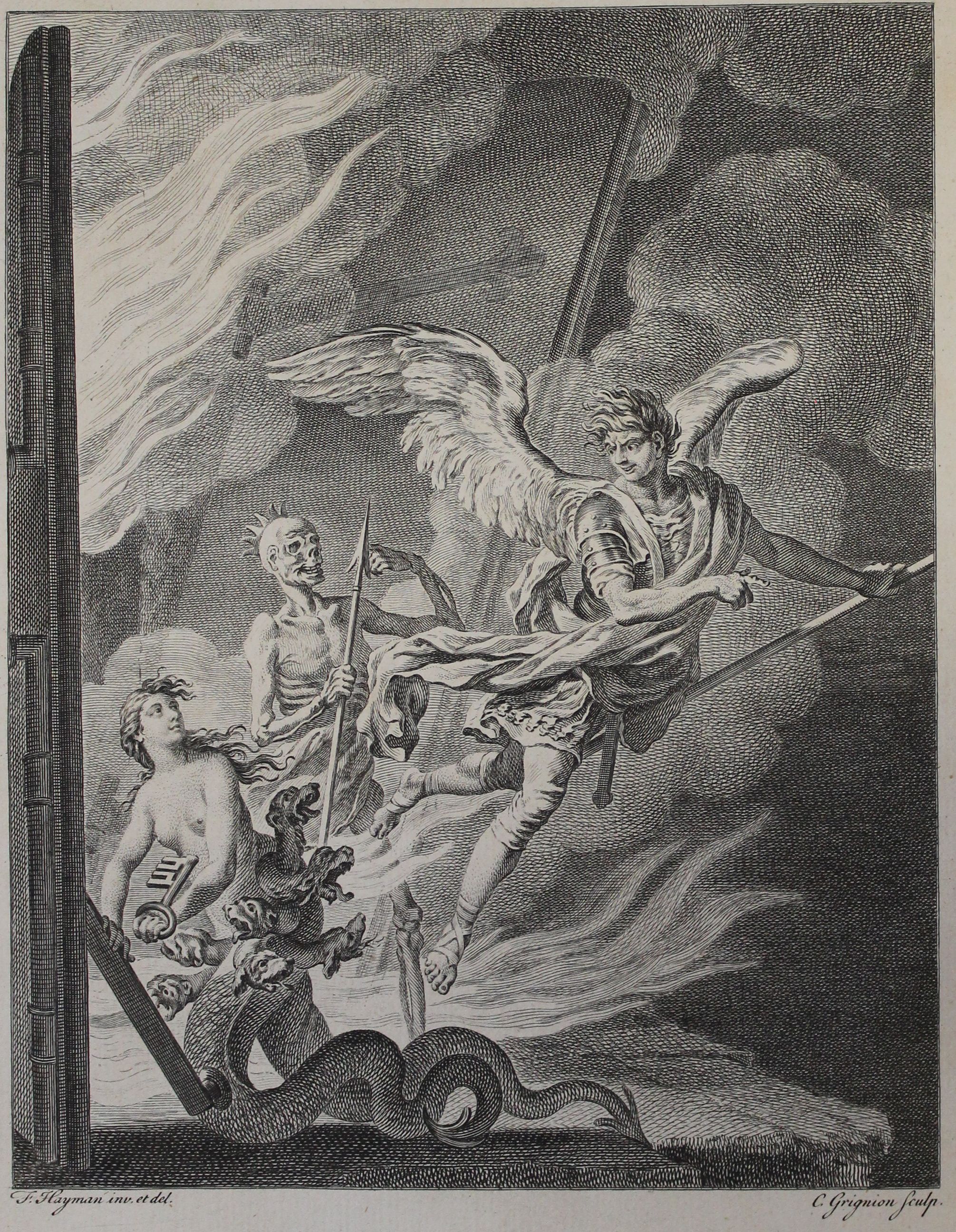
An earlier engraving from Book 2 of the same poem shows Satan at the gates of Hell, which are guarded by a skeletal figure in a crown, a many-headed hell hound, and a woman representing sin, who has a serpent’s coils instead of legs. The text describes it thus:

The one seem’d Woman to the waste, and fair [line 650]
But ended foul in many a scaly fould
Voluminous and vast, a Serpent arm’d
With mortal sting: about her middle round
A cry of Hell Hounds never ceasing bark’d

Satan at the gates of hell

Plate facing page 83 of volume 1 of The Poetical Works of John Milton, London, 1761 (Shelfmark; Thackeray.J.60.18)

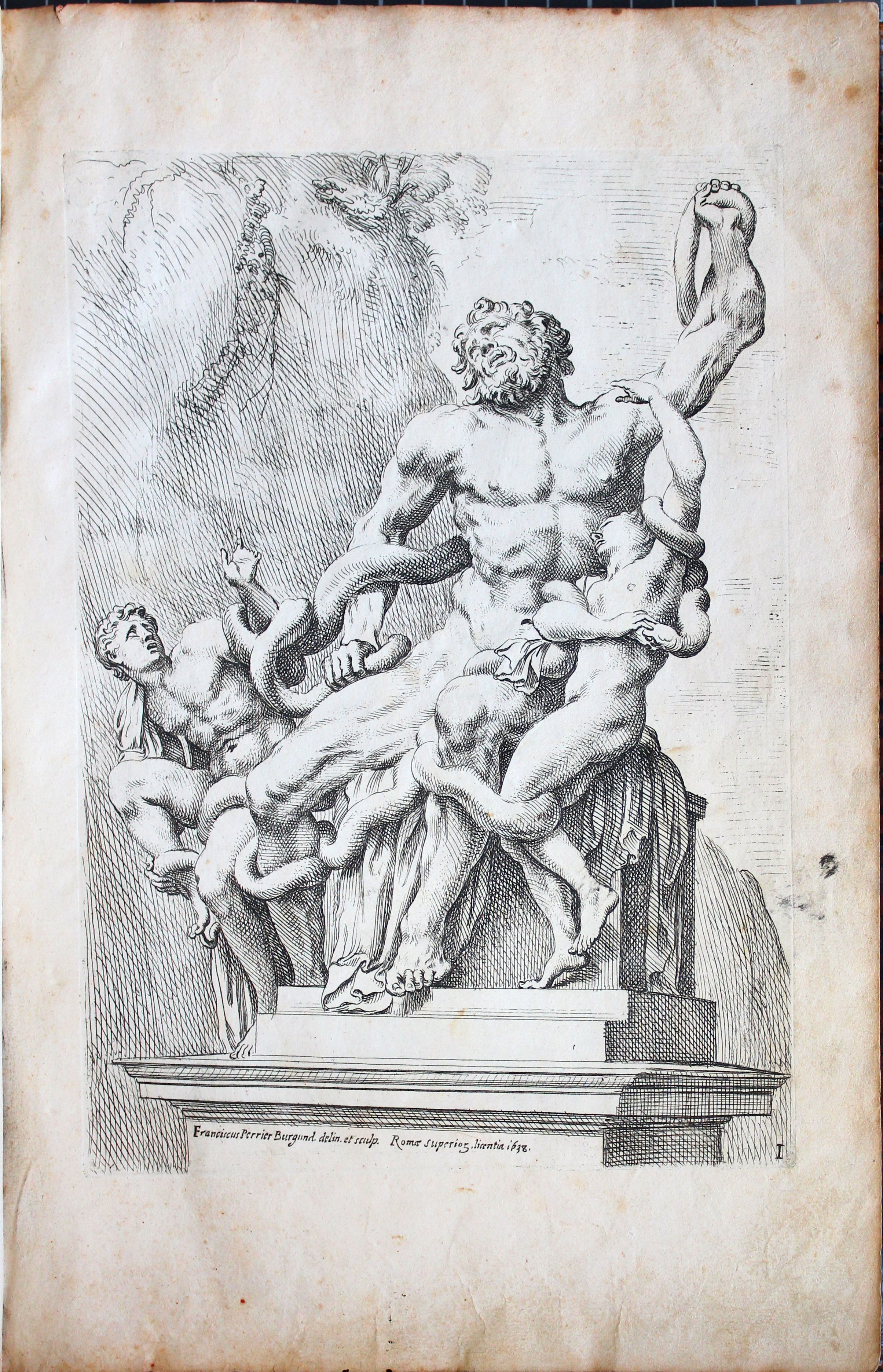
Next we turn to classical mythology and the story of Laocoön, a Trojan priest, who, along with his two sons, was attacked by venomous sea serpents. Reasons given for the attack vary, but Virgil’s version of the story goes that Laocoön was punished for attempting to alert Troy’s inhabitants to the grave threat posed by the Trojan Horse. From the Bury Collection, this seventeenth-century volume of sketches of classical statues includes a rendering of a Roman statue of Laocoön and his sons languishing in the coils of the serpents.

 Laocoön and sons being attacked by serpents

Plate 1 from Segmenta nobilium signora et statuarum by François Perrier, Rome, 1638 (Shelfmark: Bury.PER.Seg.1638)

Another engraving in the same volume depicts a statue of a Vestal virgin, with a snake draped over her shoulder.

A statue of a vestal virgin with a snake on her shoulder

Plate 65 from Segmenta nobilium signora et statuarum, by François Perrier, Rome, 1638 (Shelfmark: Bury.PER.Seg.1638)

Snakes are among the many different creatures that appear in printers’ marks or devices, which were a kind of early logo or copyright mark commonly found on the title pages of early printed books. Below is the printer’s device of William Jaggard (1569-1623), which features the ancient Ouroboros symbol of a coiled snake devouring its own tail.

Printer's device

Printer’s device from the title page of The Two Most Unworthy and Notable Histories Which Remaine Unmained to Posterity, by Sallust, London, 1609 (Shelfmark: Keynes.D.2.14)

In heraldry, snakes have often been used on coats of arms as symbols of prudence and subtlety, as this seventeenth-century book, A Display of Heraldrie by John Guillim (1565-1621) explains. Guillim was an antiquarian and officer of arms at the College of Arms in London.  His book references the Medusa myth, and notes a belief that if the hair of a woman is placed in manure it will transform into venomous snakes!

Explanation of the use of snakes in coats of arms

Illustration and text from page 153 of A Display of Heraldrie by John Guillim, London, 1611 (Shelfmark: H.17.39)

Later in the same book, an adder wrapped round a pillar is said to symbolize prudence combined with constancy.

Explanation of a snake wrapped round a pillar

Illustration and text from page 213 of A Display of Heraldrie by John Guillim, London, 1611 (Shelfmark: H.17.39)

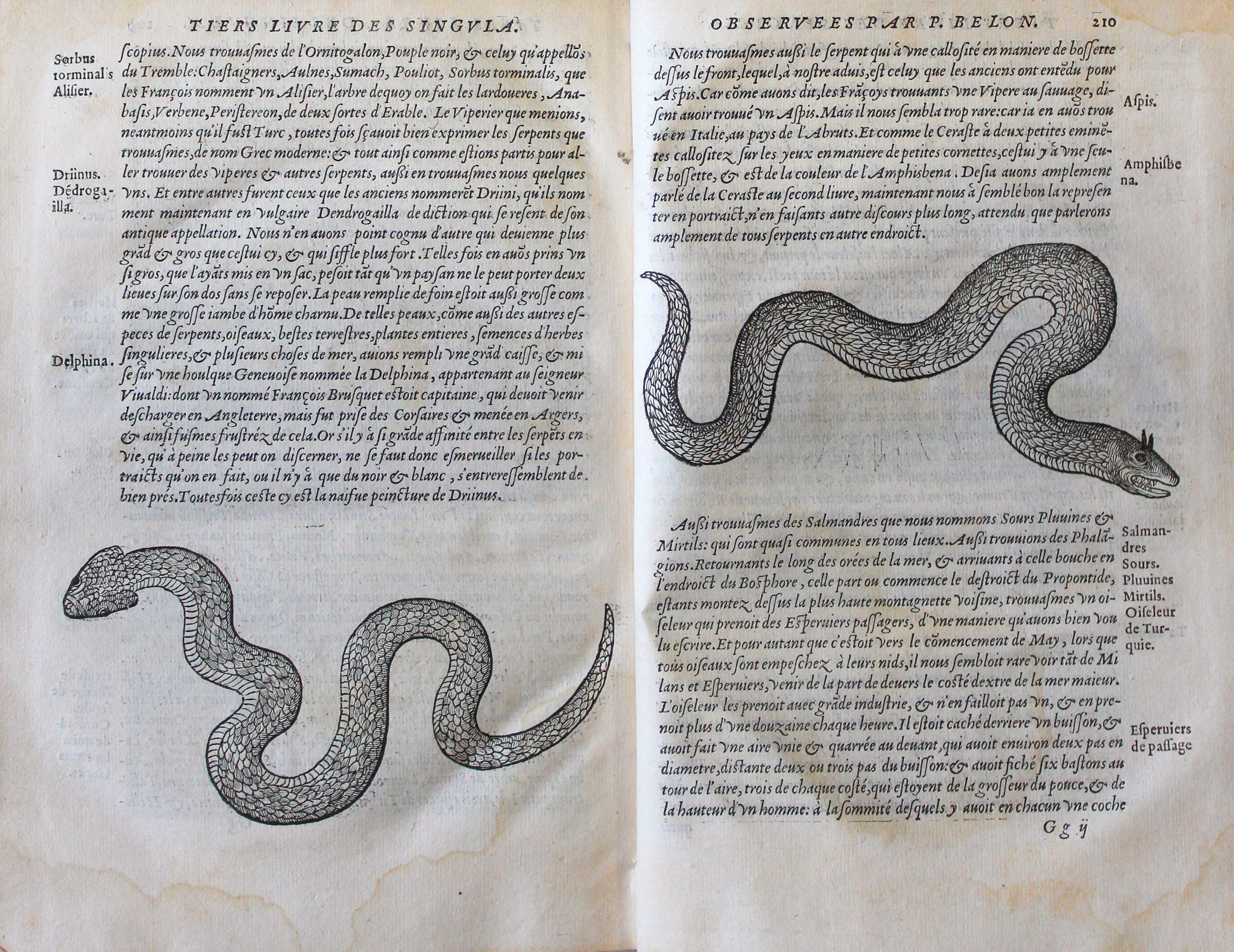
Moving into early works of natural history, we find an abundance of snakes. The sixteenth-century drawings below come from a work published by the traveller and naturalist Pierre Belon (1517?-1564).

Text in French and black and white illustrations of two snakes

Illustrations of snakes from pages 209 and 210 of Les Obseruations de plusieurs singularitez & choses memorables by Pierre Belon, Paris, 1555 (shelfmark: T.16.20)

Next comes an entire work dedicated to snakes by French apothecary Moyse Charas (1619-1698). Charas, whose work was first published in French in 1669 under the title:  Nouvelles expériences sur la vipère, was interested in the nature of snake venom and the ways in which extracts from snakes could allegedly be used to treat various ailments, such as smallpox and leprosy. Our library holds an English translation from 1670.

title page

Title page of New Experiments upon Vipers by Moyse Charas, London, 1670 (Shelfmark: Thackeray.VIII.11.12)

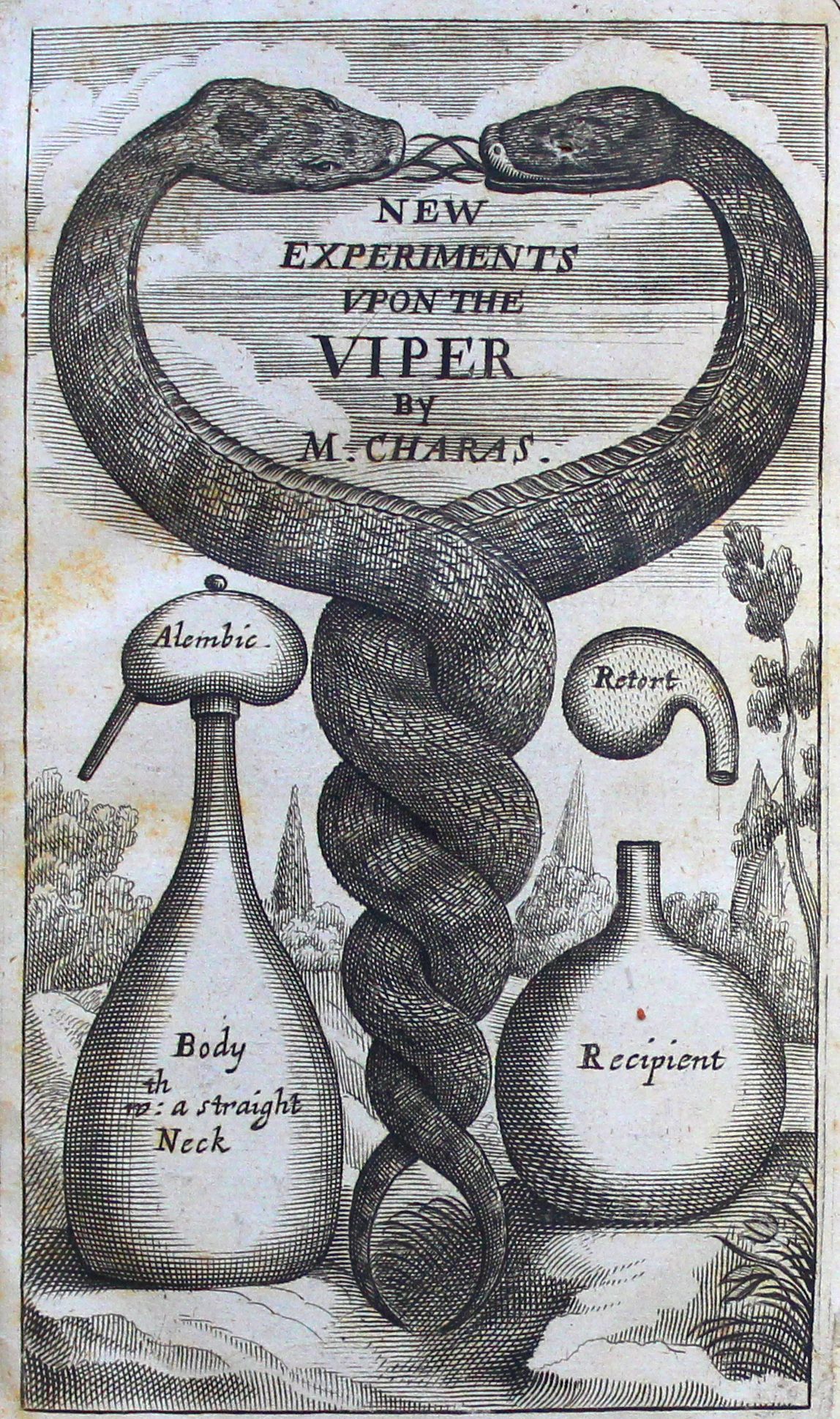
In addition to the main title page, it contains a glorious added engraved title page, showing entwined serpents.

Two entwined snakes, with the title in the middle

Added engraved page of New Experiments upon Vipers by Moyse Charas, London, 1670 (Shelfmark: Thackeray.VIII.11.12)

The book includes detailed anatomical drawings on folded plates at the rear, one of which is shown below.

folded plate showing illustrations of a snake's skeleton and various heads and skulls

Folded anatomical plate from New Experiments Upon Vipers by Moyse Charas, London, 1670 (Shelfmark: Thackeray.VIII.11.12)

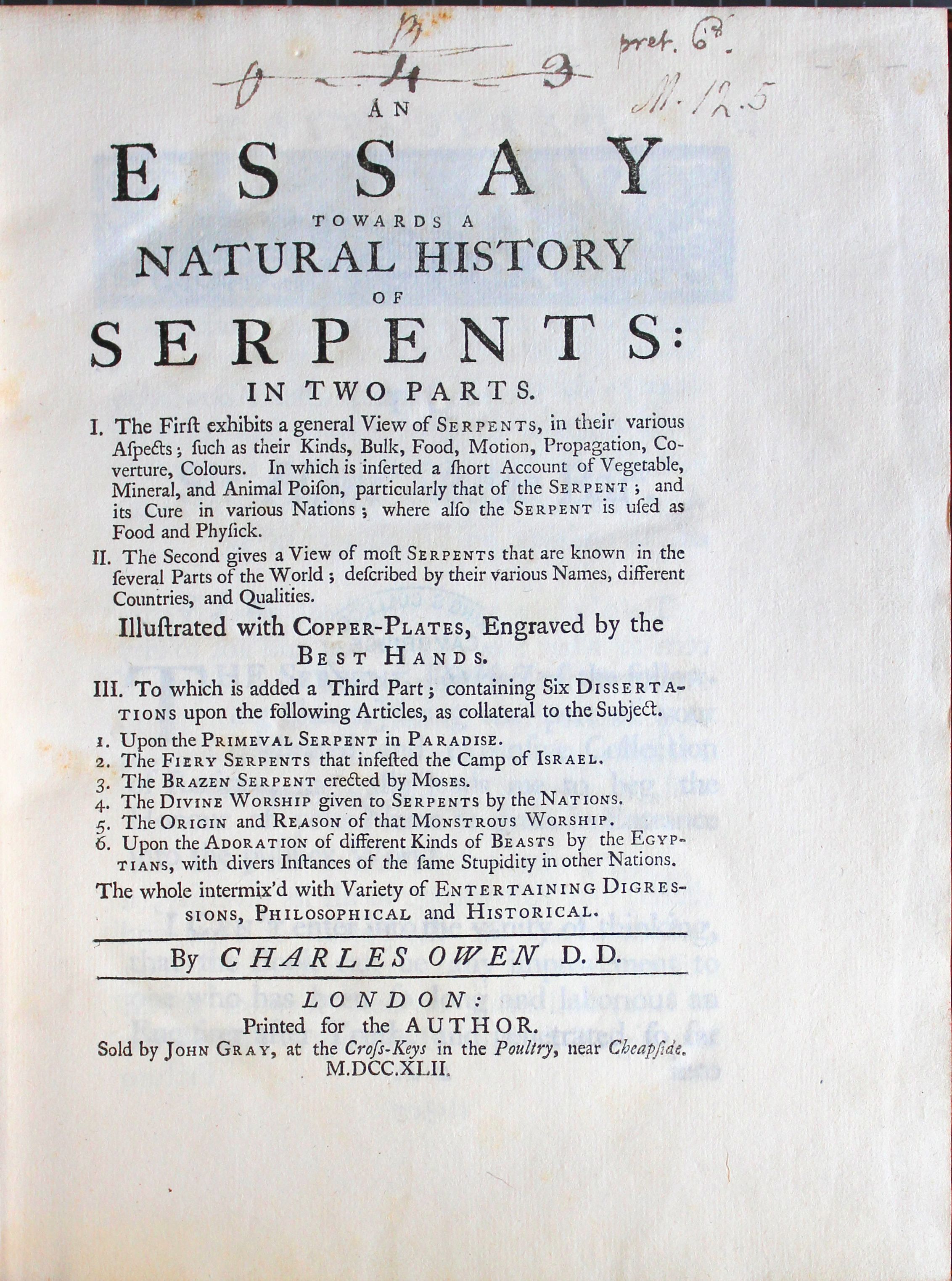
Another book focused entirely upon snakes is An Essay towards a Natural History of Serpents by Charles Owen (d.1746). Owen was a clergyman rather than a scientist, and his (often inaccurate) information is drawn from various biblical and mythological sources. The title page describes the contents in a fair amount of detail.

title page

Title page of An Essay towards a Natural History of Serpents by Charles Owen, London, 1742 (Shelfmark: Bryant.M.12.5)

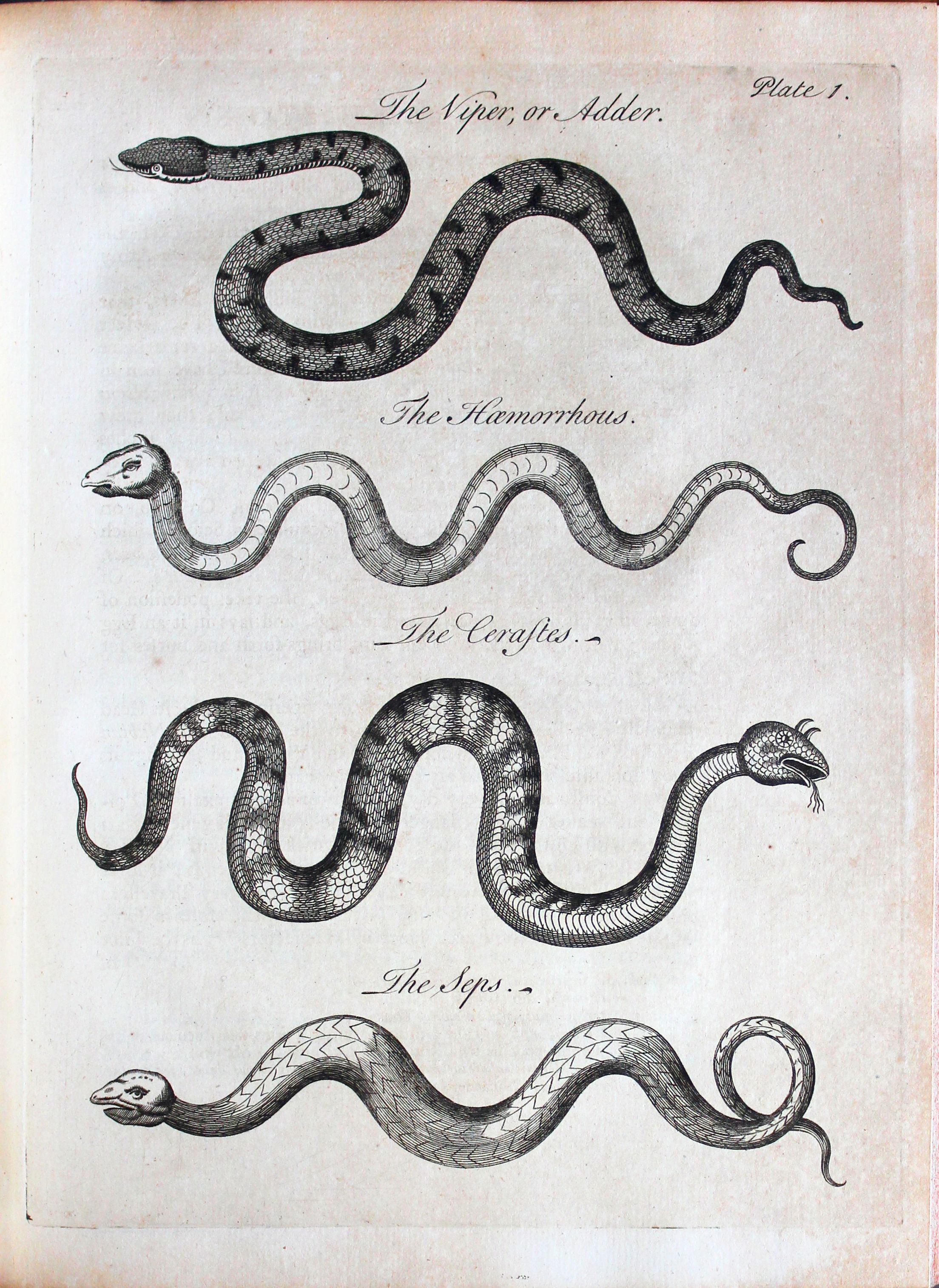
The illustrations in this volume are great fun, and very striking, as can be seen from the examples below. The snakes all have very expressive faces.

 four snakes

Plate 1 facing page 54 from An Essay towards a Natural History of Serpents by Charles Owen, London, 1742 (Shelfmark: Bryant.M.12.5)

four snakes, including a cockatrice

Plate 3 facing page 78 from An Essay towards a Natural History of Serpents by Charles Owen, London, 1742 (Shelfmark: Bryant.M.12.5)

The plate above includes the depictions of a mythical creature: the Basilisk (here conflated with the Cockatrice), which the text describes as the Little King of Serpents, hence the crown upon its head.

Four snakes

Plate 6 facing page 142 from An Essay towards a Natural History of Serpents by Charles Owen, London, 1742 (Shelfmark: Bryant.M.12.5)

Other natural history books provide beautiful colour images. Below is an illustration of a double-headed snake from a work chiefly devoted to rare birds, by noted English ornithologist George Edwards (1694-1773). Edwards widened the scope of his work to include other unusual creatures, including reptiles, and described this snake thus:

I did not propose at first in this Natural History to exhibit monsters, but our present subject (considered even with a single head) may be looked on as a natural production of a species little or not at all known to us.

We now know that this phenomenon comes about in some snakes in a very similar way to the development of human conjoined twins, and is not a sign of a separate species.

Colour illustration of a double-headed snake

Double-headed snake. From the plate facing page 207 of volume 4 of A Natural History of Uncommon Birds by George Edwards, London, 1743-51 (Shelfmark Keynes.P.6.11/1)

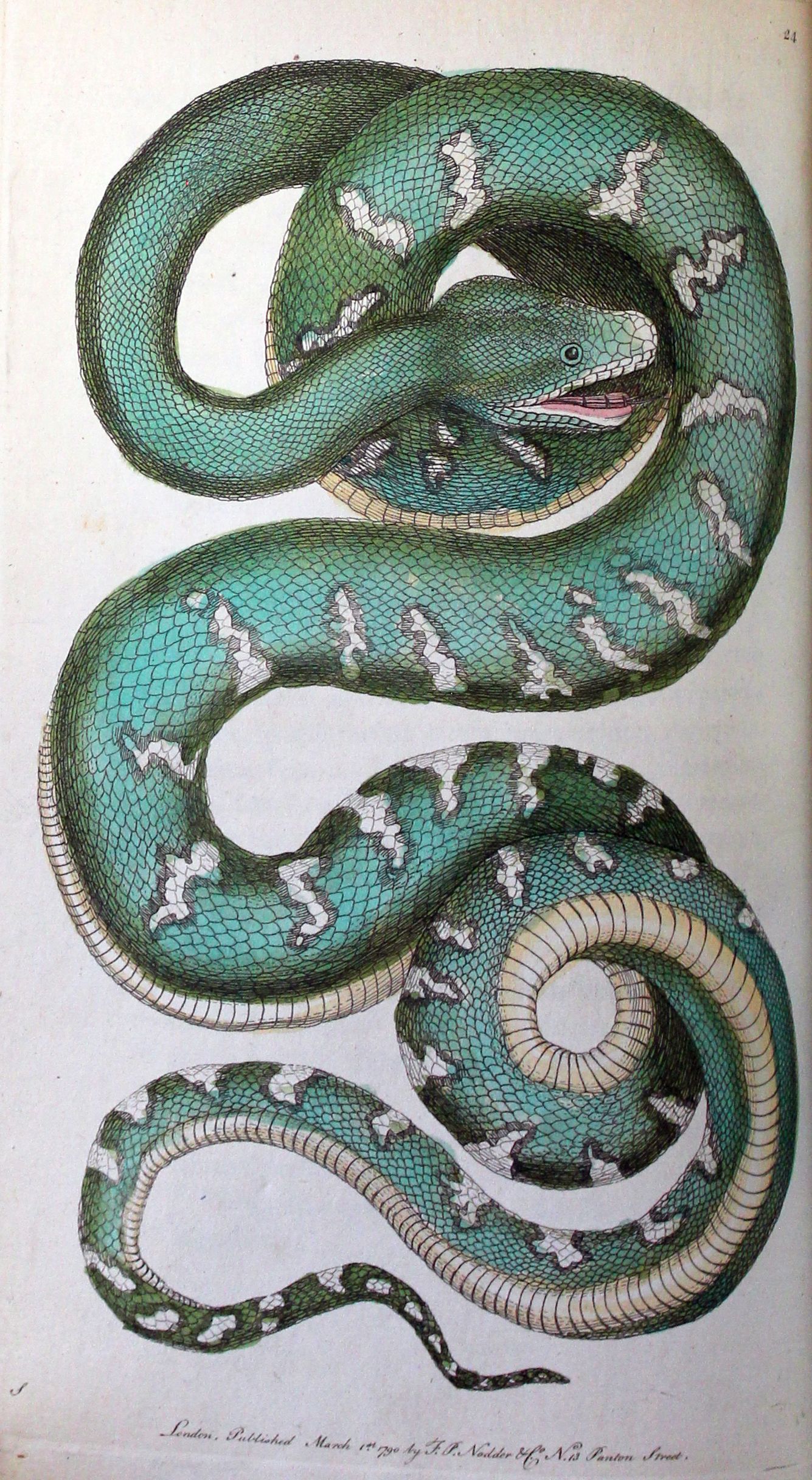
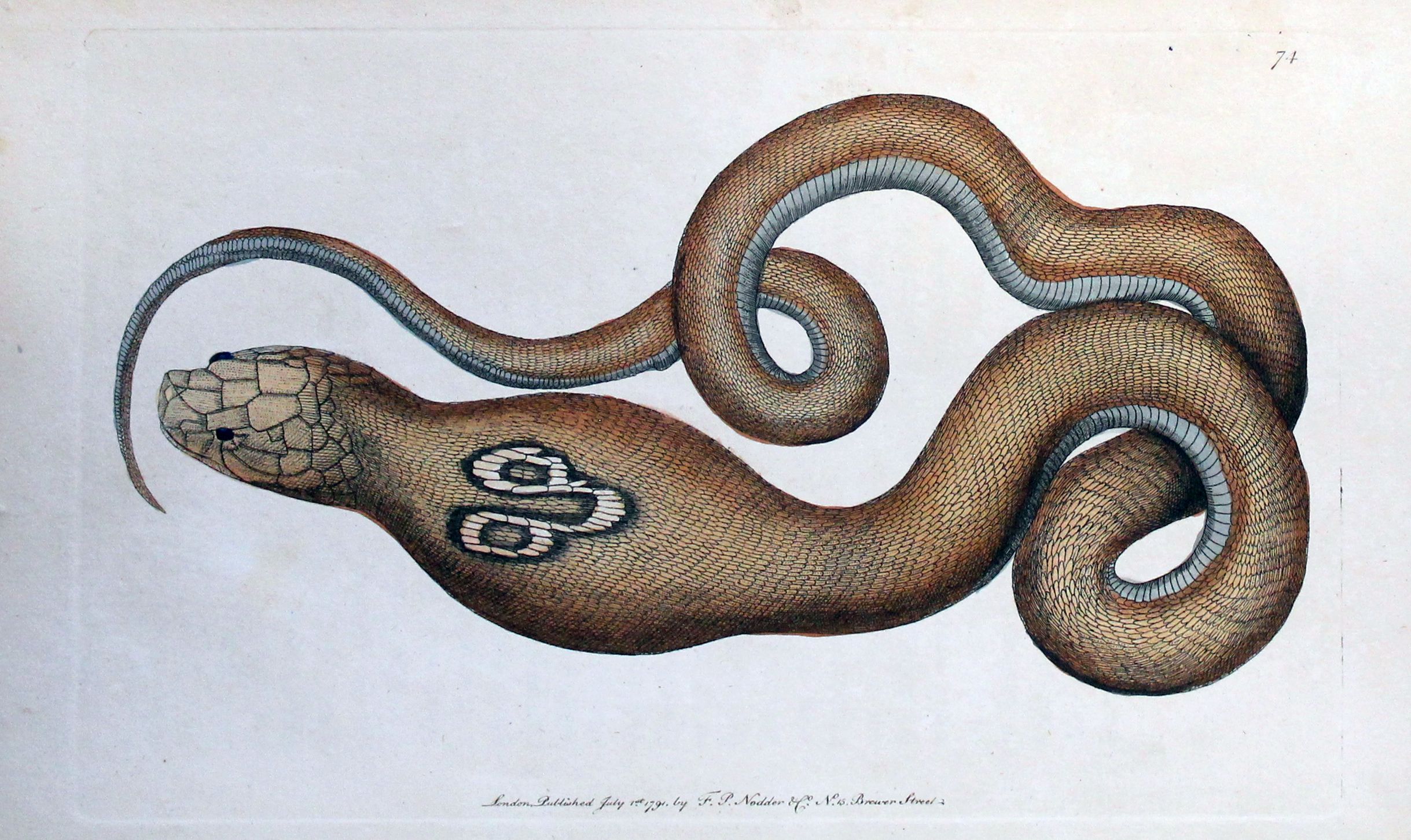
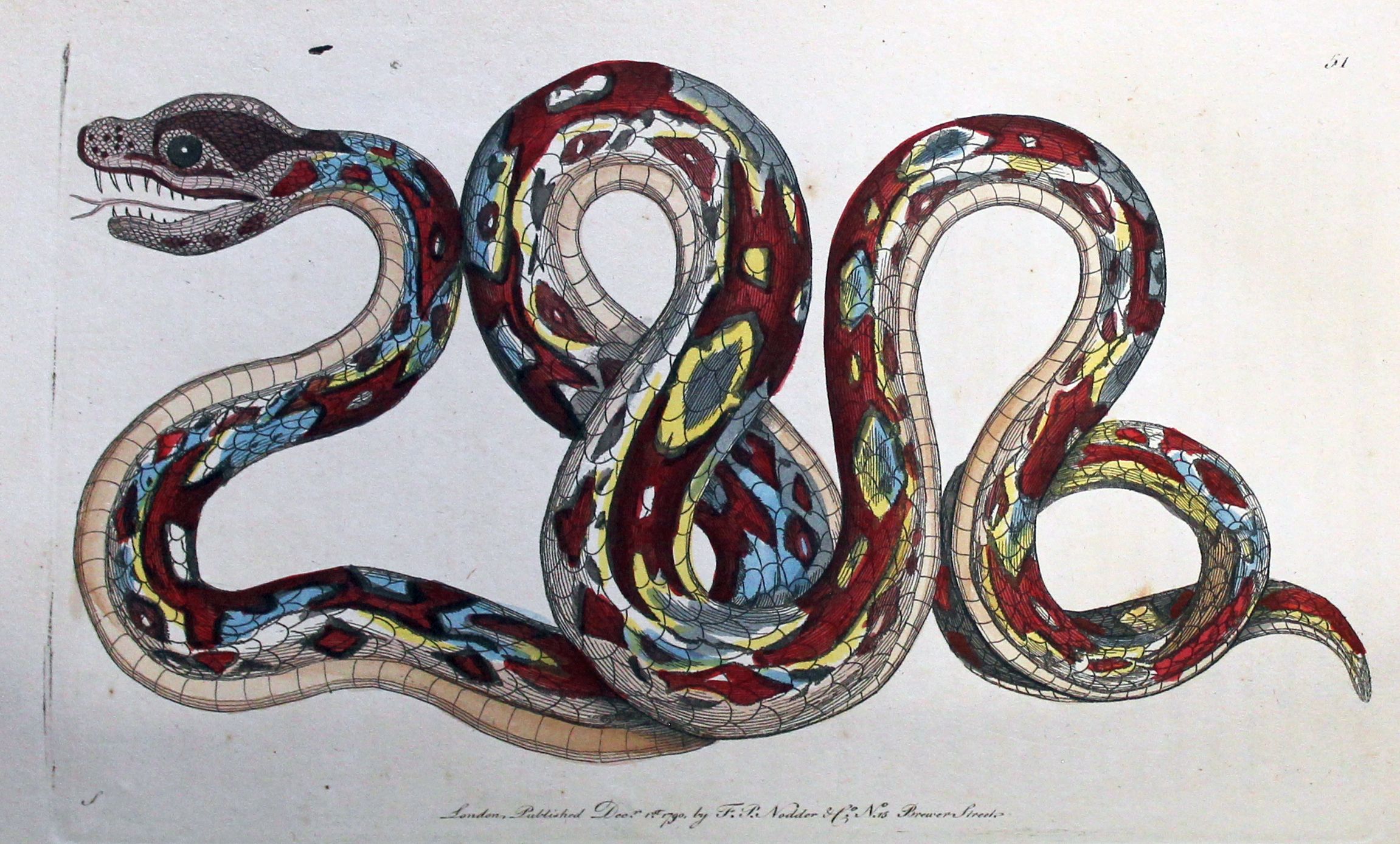
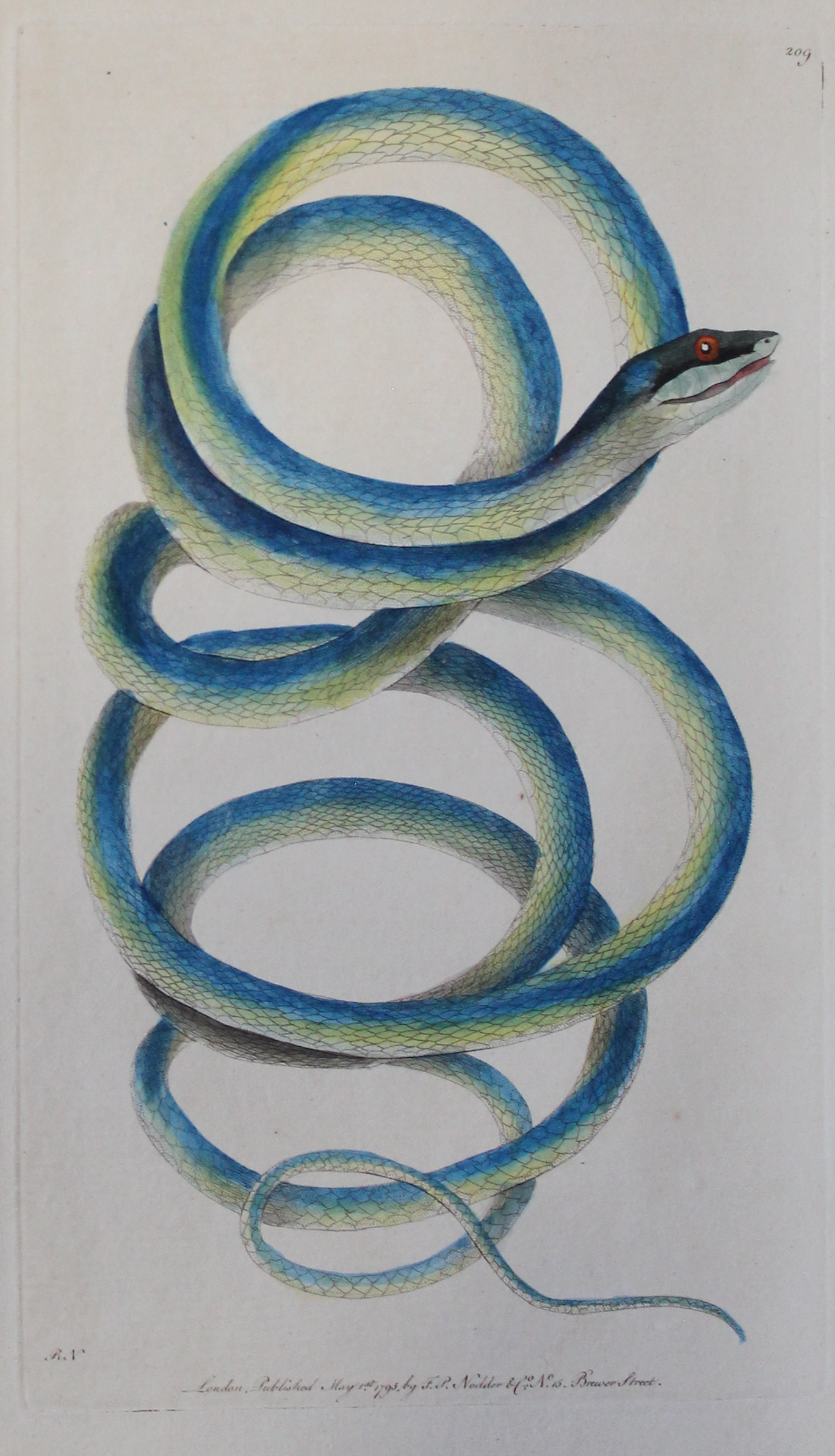
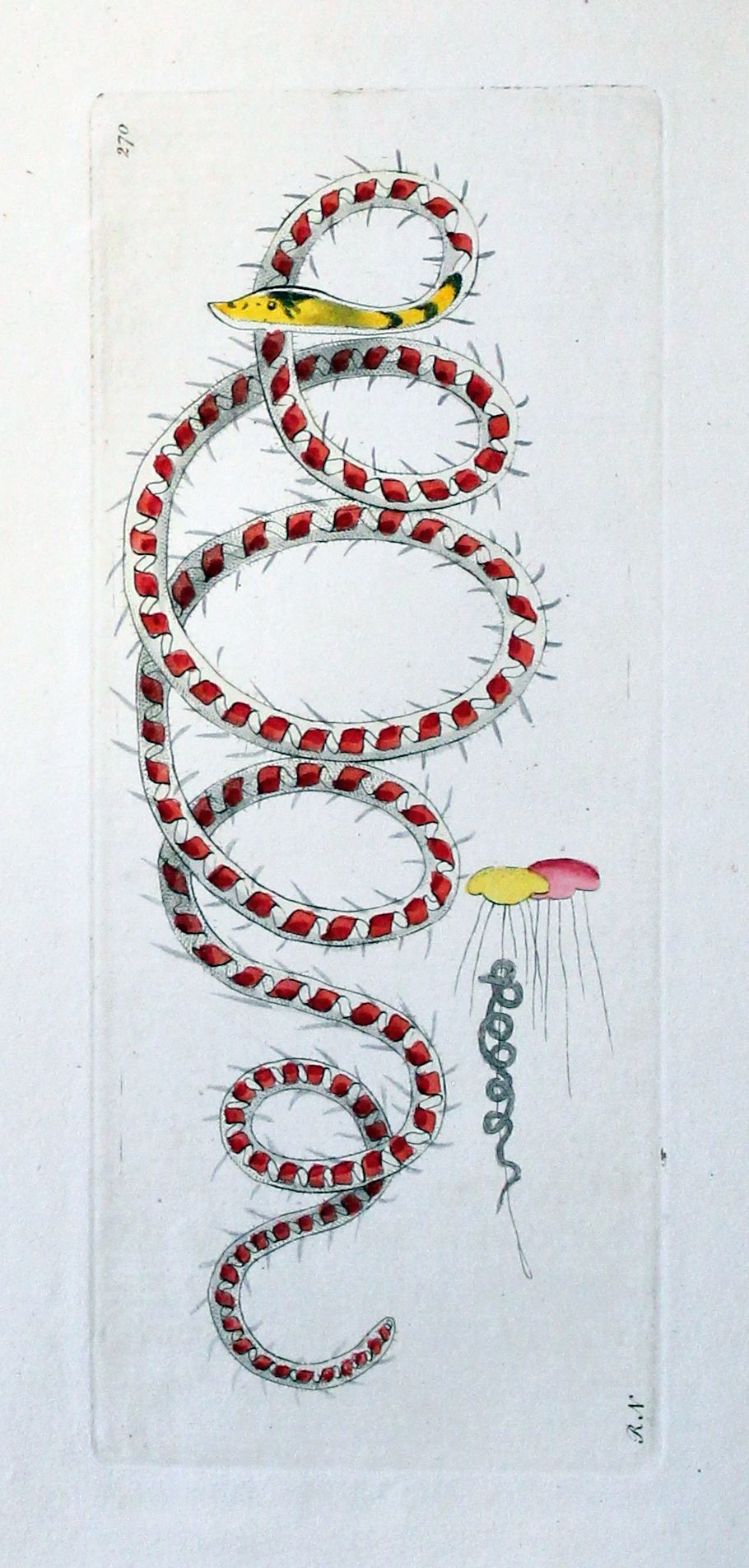
Leafing through a multi-volume miscellany of the natural world by biologist George Shaw (1751-1813), we were spoilt for choice for great images to highlight.  Shaw was a Fellow of the Royal Society and sometime keeper of the Natural History Department at the British Museum. He described many new species of amphibian and reptile. Below are just a few of the many vibrant illustrations of snakes contained within Shaw’s Miscellany.

Painted snake - orange with black spots

Painted snake. Plate facing fol. C2 recto in volume 1 of The Naturalist’s Miscellany by George Shaw, London, 1790 (Shelfmark: Thackeray.IV.2.2)

Large bright green snake with white spotches

The canine boa. Plate 24, facing fol. L4 recto in part 1 of The Naturalist’s Miscellany by George Shaw, London, 1790 (Shelfmark: Thackeray.IV.2.2)

Large brown snake

The spectacle snake. Plate 74, facing fol. 2K4 verso in part 2 of The Naturalist’s Miscellany by George Shaw, London, 1791 (Shelfmark: Thackeray.IV.2.2)

red, blue and yellow snake

The Great Boa. Plate 51, facing fol. Z5 recto in part 2 of The Naturalist’s Miscellany by George Shaw, London, 1791 (Shelfmark: Thackeray.IV.2.2)

Long thin bluish green snake

The Gilded Snake. Plate 209, facing fol. O8 recto in part 6 of The Naturalist’s Miscellany by George Shaw, London, 1795 (Shelfmark: Thackeray.IV.2.4)

Strange thin red and white snake with bristles.

The Serpentiform Nais. Plate 270, facing fol. E4 recto in part 8 of The Naturalist’s Miscellany by George Shaw, London, 1796 (Shelfmark: Thackeray.IV.2.5)

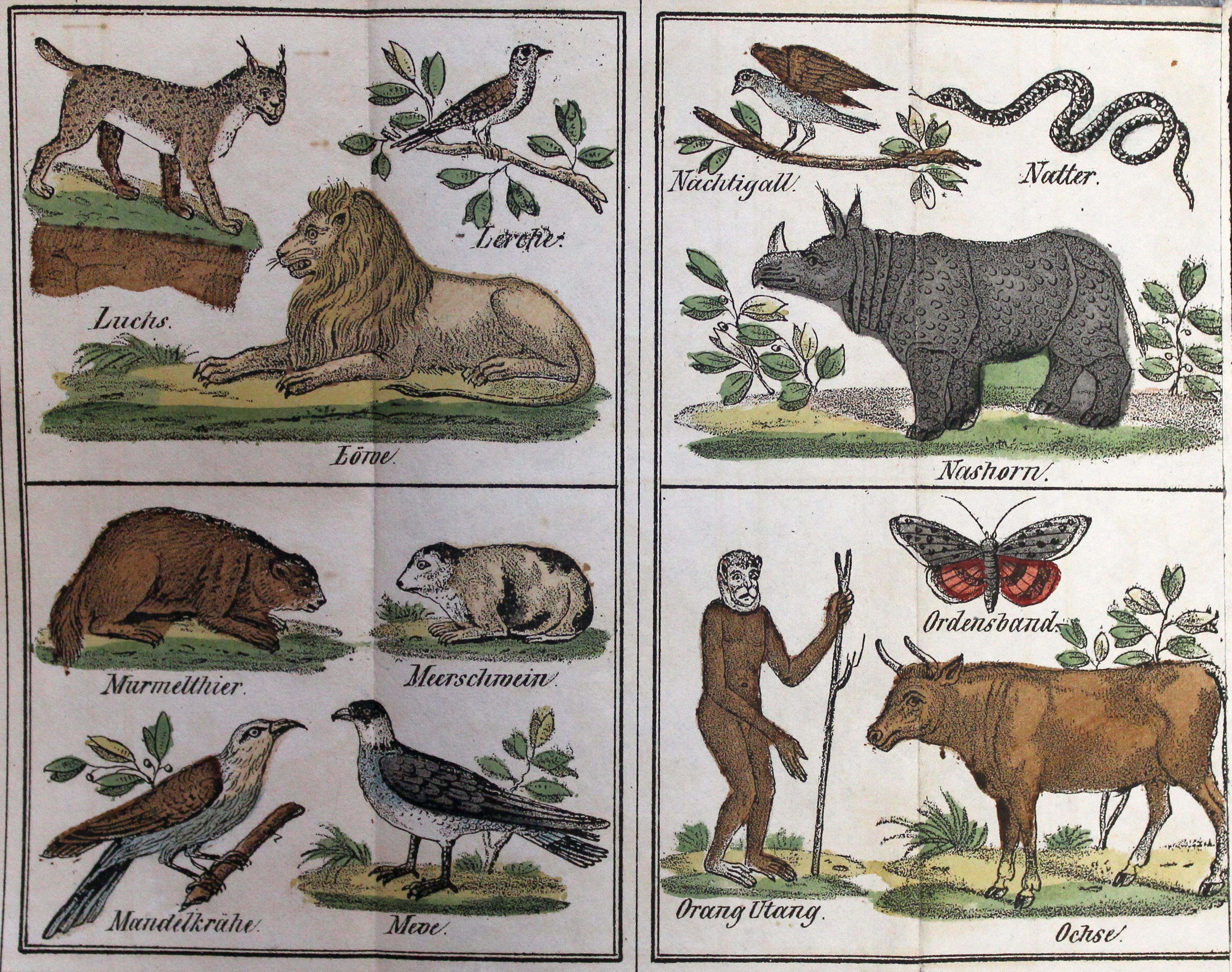
Finally, a little snake appears in a charming little German alphabet book from our Rylands Collection of children’s books. This tiny book, dating from the latter half of the nineteenth century, consists of three strips of paper stuck together and folded accordion-style. The German word for snake being “Natter”, the snake comes under the letter N in this sequence, alongside a Nashorn, or rhino, and a nightingale.

Illustrations representing different letters of the alphabet - a grid of four letters is shown. other animals shown include a lion, orangutan and an Ox

Section from Das ABC in Thieren, Neuruppin, circa late 19th century (Shelfmark: Rylands.C.ABC)

We hope you have enjoyed this survey of snakes within the pages of our rare book collections, and that you have a wonderful New Year!

References 

Joscelyn Godwin, Athanasius Kircher: A Renaissance Man and the Quest for Lost Knowledge , London, 1979.

Paula Findlen (editor), Athanasius Kircher: The Last Man Who Knew Everything, New York, 2004.

AC

Horticultural delights

The library holds a fascinating collection of books on horticulture given to us by Kingsman Richard Gorer (1913-1994), who was a scholar here in the 1930s. In later years Gorer himself wrote a considerable number of gardening books, and became a fellow of the Royal Horticultural Society.

The collection spans the 17th to the 20th centuries and includes some wonderful works, with equally glorious illustrations.

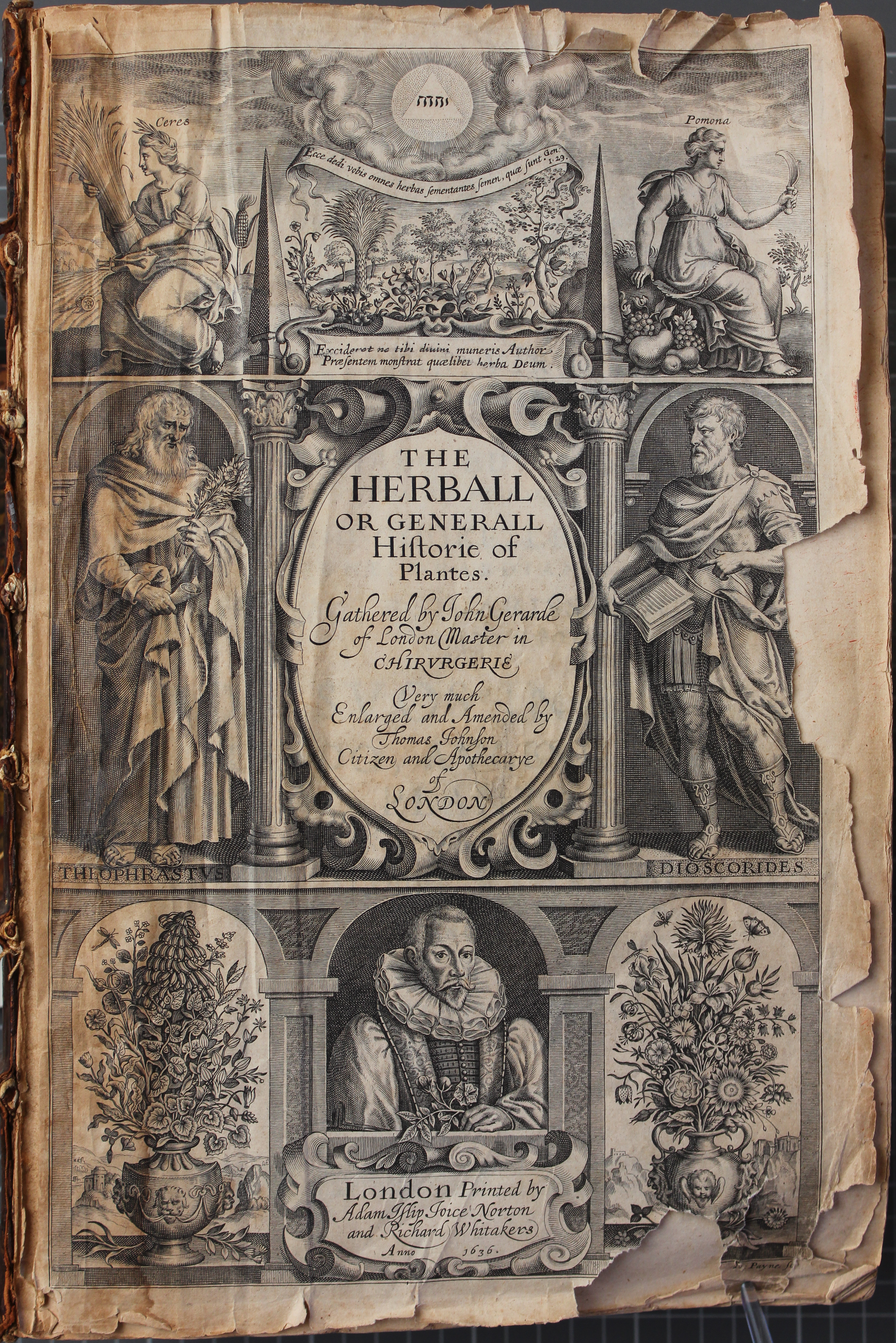
The oldest volume in the collection is The Herball or Generall Historie of Plantes. Prominent sixteenth-century English herbalist, John Gerard (c.1545-1612) published the first edition of this work in 1597. It was based almost entirely on the work of a Flemish botanist Rembert Doedens (1517-1585) with fanciful additions by Gerard. The work was then overhauled and expanded by Thomas Johnson (c.1595-1644), to produce a second edition in 1633, in which many of Gerard’s inaccuracies and fabrications were removed or corrected. The lavishly engraved title page of this second edition is pictured below, in a reprint dating from 1636. Gerard is shown in the bottom centre panel, holding a potato flower, the first image of this plant to appear in a work published in the Western world. Vases of exotic flowers and fruits appear either side of Gerard, and arrayed above him are figures from the ancient world associated with agriculture and plants, including, at the top left, Ceres, the Roman goddess of agriculture.

Engraved titlepage with mythical figures and plants

Title page of The Herball or Generall Historie of Plantes by John Gerard and Thomas Johnson, London, 1636 (Classmark: Gorer.50)

The revised Herball still contains some fanciful notions, including a description of the “Goose tree” which was believed to generate barnacle crustaceans that then developed into live geese! This was a myth of long-standing, featuring in various forms in medieval bestiaries and numerous other works over the centuries. It is thought to have originated, before bird migration was known about, as a way to explain why barnacle geese were never seen nesting, and to have been prompted by some perceived similarities in colour and shape between the barnacle and the geese. Barnacle shells were often seen attached to driftwood, which was mistaken for fallen tree branches.

A goose beside a branch full of barnacles

Illustration of a branch from a Goose Barnacle tree, page 1587 in The Herball (Classmark: Gorer.50)

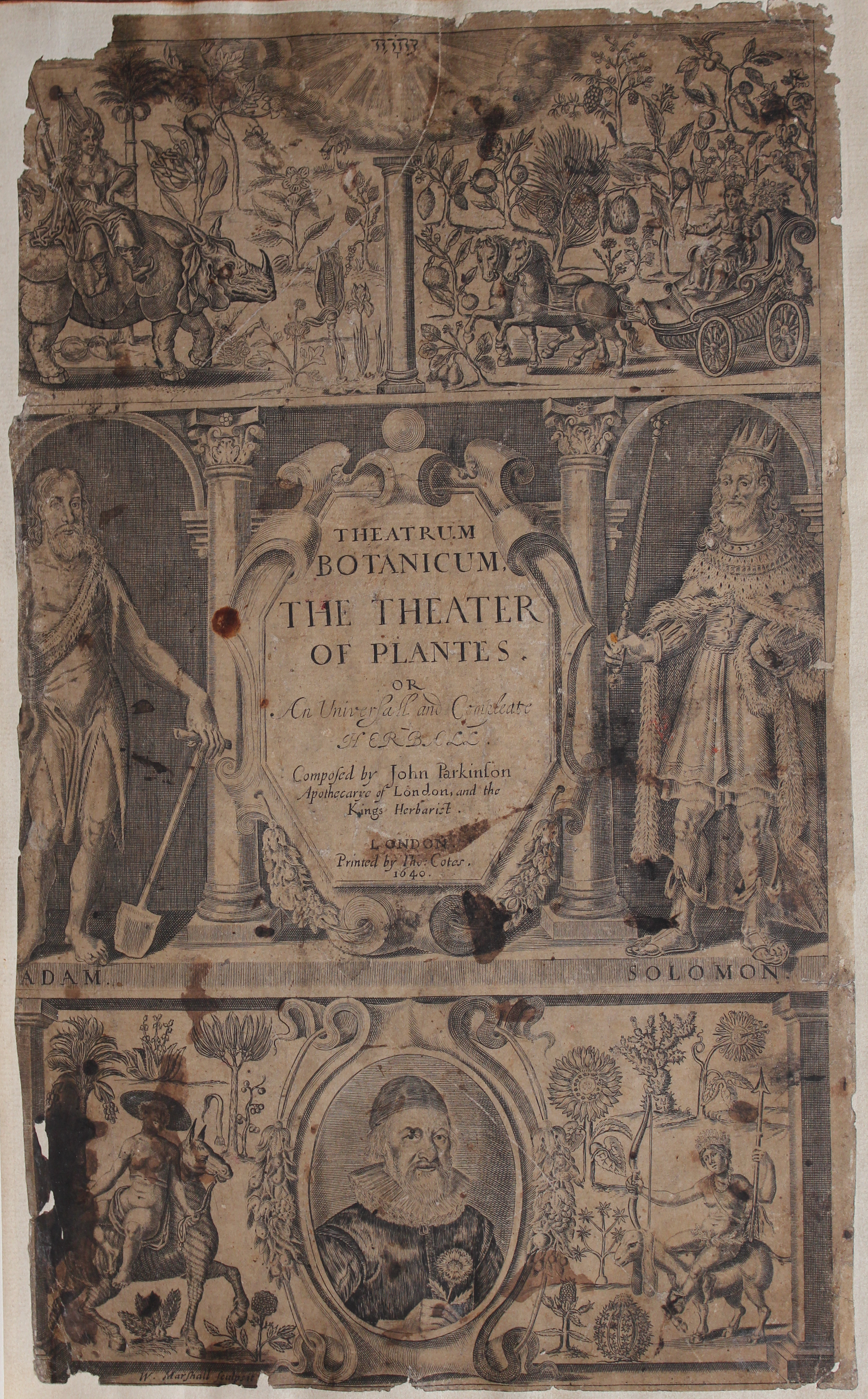
Another elaborate illustration is found on the added engraved title page of Theatrum botanicum by John Parkinson (1567-1650). The engraving is divided into the four quarters of the known world: Asia, Europe, the Americas and Africa. These are arranged clockwise from the top left. Each section depicts a woman riding an animal, or in the case of “civilised” Europe, sat in a horse-drawn carriage, and also shown are plants thought (often erroneously) to be native to each continent. Maize, for example, is depicted in the Asian quarter, since it was not yet known that it originated in the Americas. The European quarter has the most abundant selection of plants, highlighting the lack of in-depth knowledge of the other areas of the world. In the centre of the page are two figures: Adam, holding a spade, and Solomon, known for his wisdom. 

Detailed engraving depicting the four corners of the known world

Title page of Theatrum botanicum by John Parkinson, London,1640 (Classmark: Gorer.51)

Moving on to the latter part of the seventeenth century, we have a copy of The History of the Propagation & Improvement of Vegetables by clergyman and natural historian Robert Sharrock (1630-1684). Sharrock was a fellow of New College, Oxford and an associate of noted chemist Robert Boyle (1627-1691). He was also involved with the University’s Physick Garden, where he carried out some of his experiments with grafting.

Title page

Title page of The History of the Propagation & Improvement of Vegetables by Robert Sharrock, Oxford, 1660 (Classmark: Gorer.30)

The work’s only illustration, shown below, depicts the many different ways to carry out propagation via grafting.

Illustration of a stem with various methods of grafting shown

Page 60 and accompanying illustration from The History of the Propagation & Improvement of Vegetables 

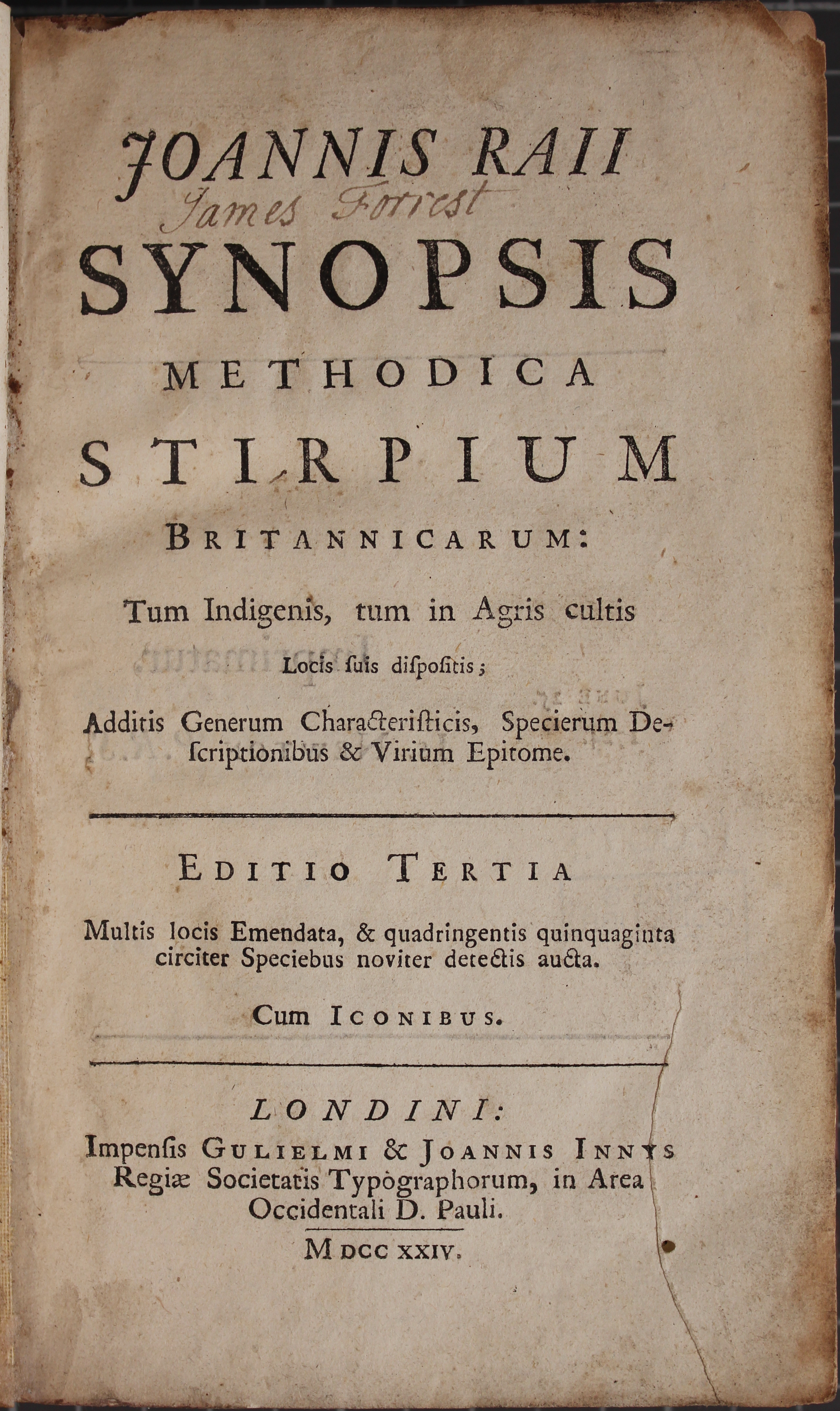
Next we have the third edition of Synopsis Methodica stirpium britannicarum by the famous naturalist John Ray (1627-1705). Originally published in 1690, this work became a hugely popular guide for amateur and professional botanists alike throughout the eighteenth century and beyond. It is now of great historical value, as it records many plants which were much reduced or lost entirely as a result of land enclosures, the expansion of cities and the Industrial Revolution.

Title page

Title page of Synopsis Methodica stirpium britannicarum by John Ray, London, 1724 (Classmark: Gorer.29)

tree illustration

Illustration facing page 477 from Synopsis Methodica stirpium britannicarum

Transitioning into the eighteenth century, the collection contains a 1754 edition of The Gardener’s Dictionary by botanist Philip Miller (1691-1771). Originally published in 1731, this work was based on Miller’s experience with plants from around the globe gained through his role as head gardener at the Chelsea Physic Garden. It is notable for its breadth of coverage and assured tone, which meant it sold well enough to be reissued in many subsequent editions across the century. The lavish engraved frontispiece depicts Britannia sitting in an orangery being gifted a cornucopia, or horn of plenty, by allegories of industry, science and nature.

Title page

Title page from volume 1 of The Gardeners Dictionary by Philip Miller, London, 1754 (Classmark: Gorer.27/1)


Engraved frontispiece

Frontispiece from volume 1 of The Gardeners Dictionary by Philip Miller, London, 1754 (Classmark: Gorer.27/1)

Arriving in the Victorian era, when gardening became a much more widespread pastime, we find books and periodicals containing an abundance of advice for amateur gardeners, often accompanied by vibrant colour illustrations.

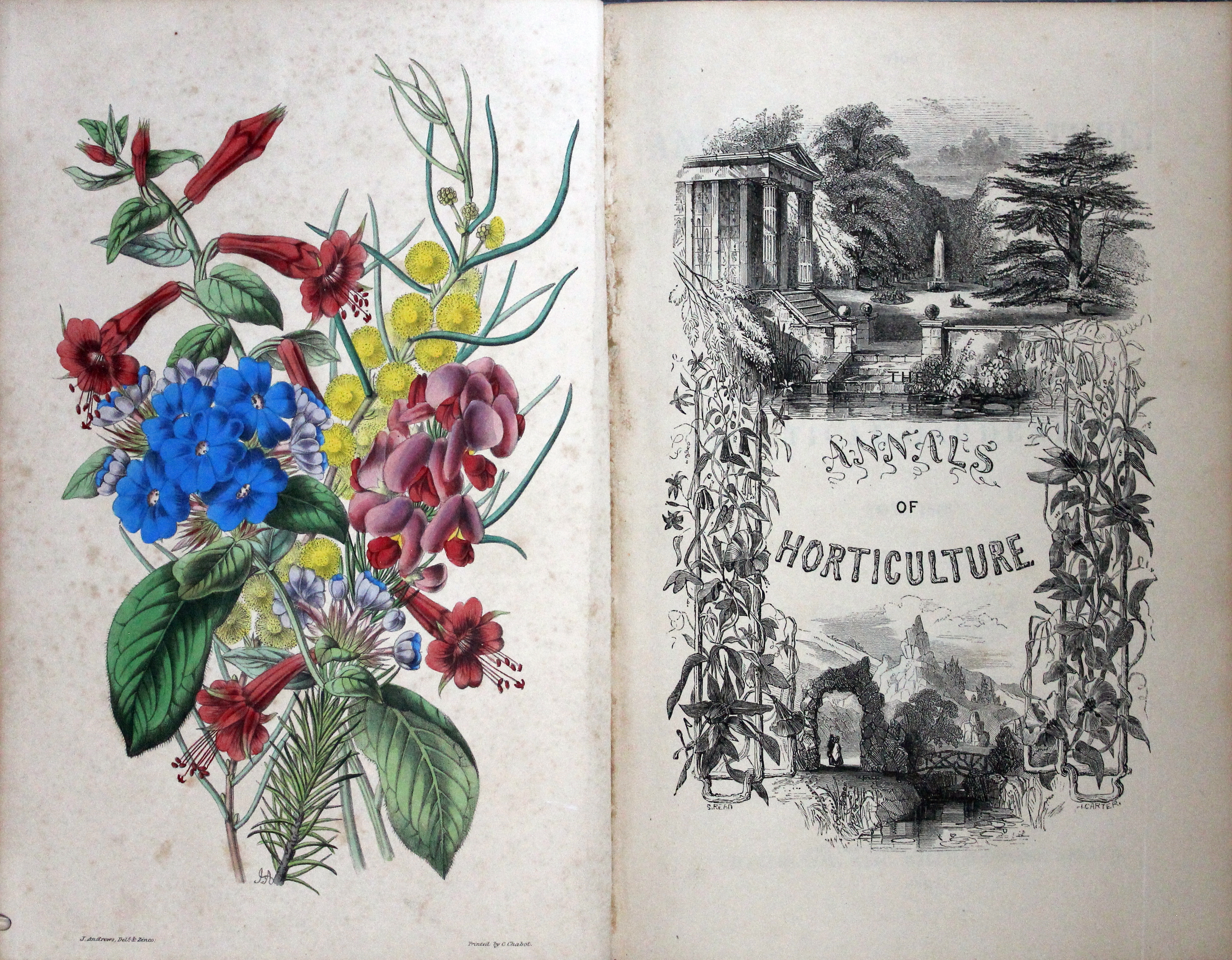
One such periodical, The Annals of Horticulture (1846-1850), first appeared monthly, and was then reissued in five annual collected volumes, of which the Gorer collection contains two. The illustrated title pages and frontispieces are very attractive.

Attractive colour frontispiece showing many different flowers and an illustrated titlepage

Frontispiece and engraved title page from The Annals of Horticulture, London, 1849 (Classmark: Gorer.32/1)

The subject matter of this periodical even extends to designs for summer houses, as illustrated below. These examples wouldn’t be out of place in a modern garden.

Pages showing summer houses

Garden architecture from page 449 of the 1849 edition of The Annals of Horticulture

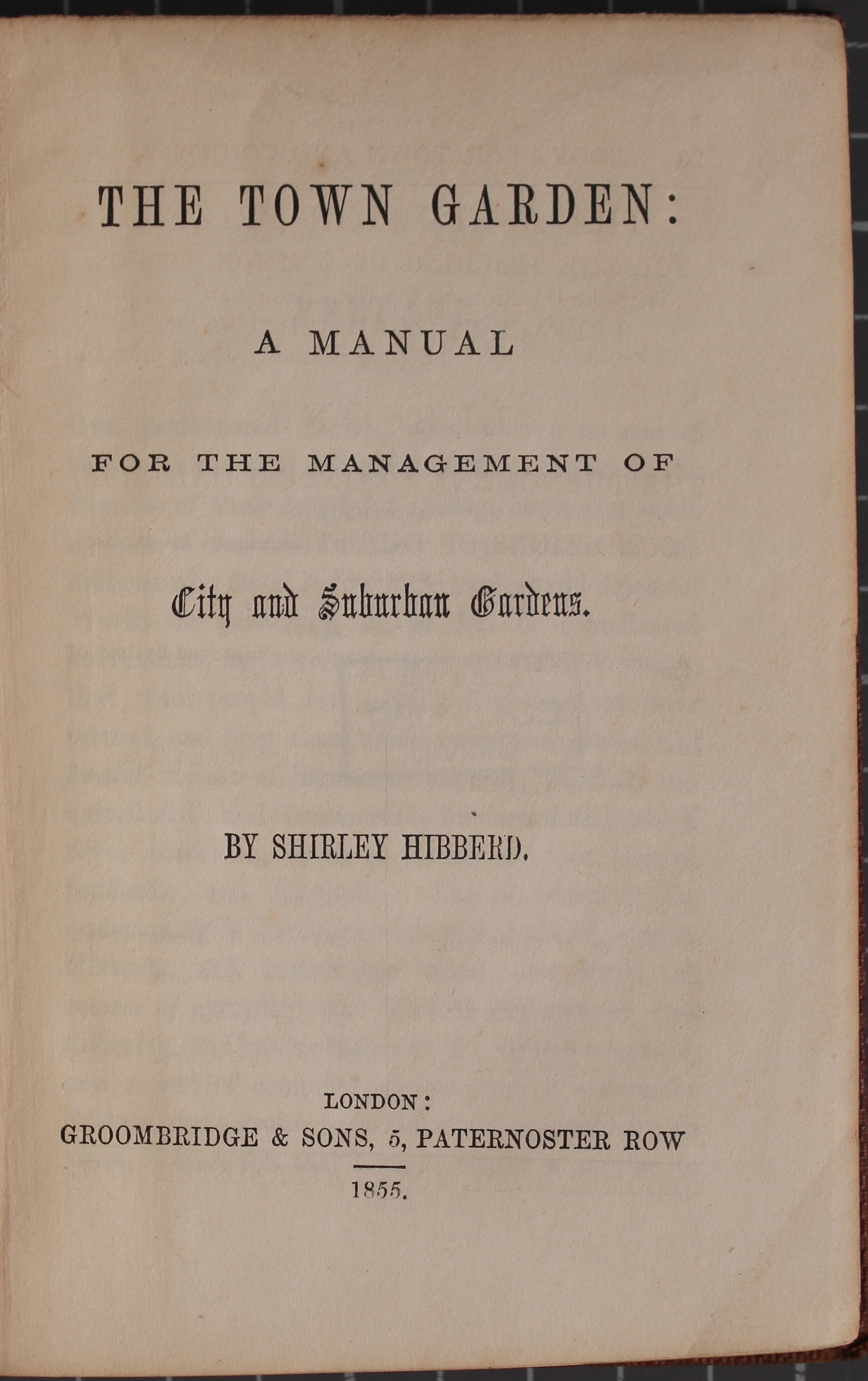
One of the most popular writers of the period was Shirley Hibberd (1825-1890), who tailored his advice particularly towards the requirements of those with urban and town gardens, rather than grand, sprawling country estates. His first gardening book, The Town Garden: A Manual (1855) was devoted to this topic. It also provided those new to gardening with tips on how to get going. In his writings, Hibberd drew upon his own experiences of hobby gardening, initially in a small garden in North London, and subsequently in various suburban settings. He was also a keen early environmentalist, and a strong opponent of cruelty towards animals and birds.

Title page

Title page of The Town Garden: A Manual by Shirley Hibberd, London, 1855 (Classmark: Gorer.10)

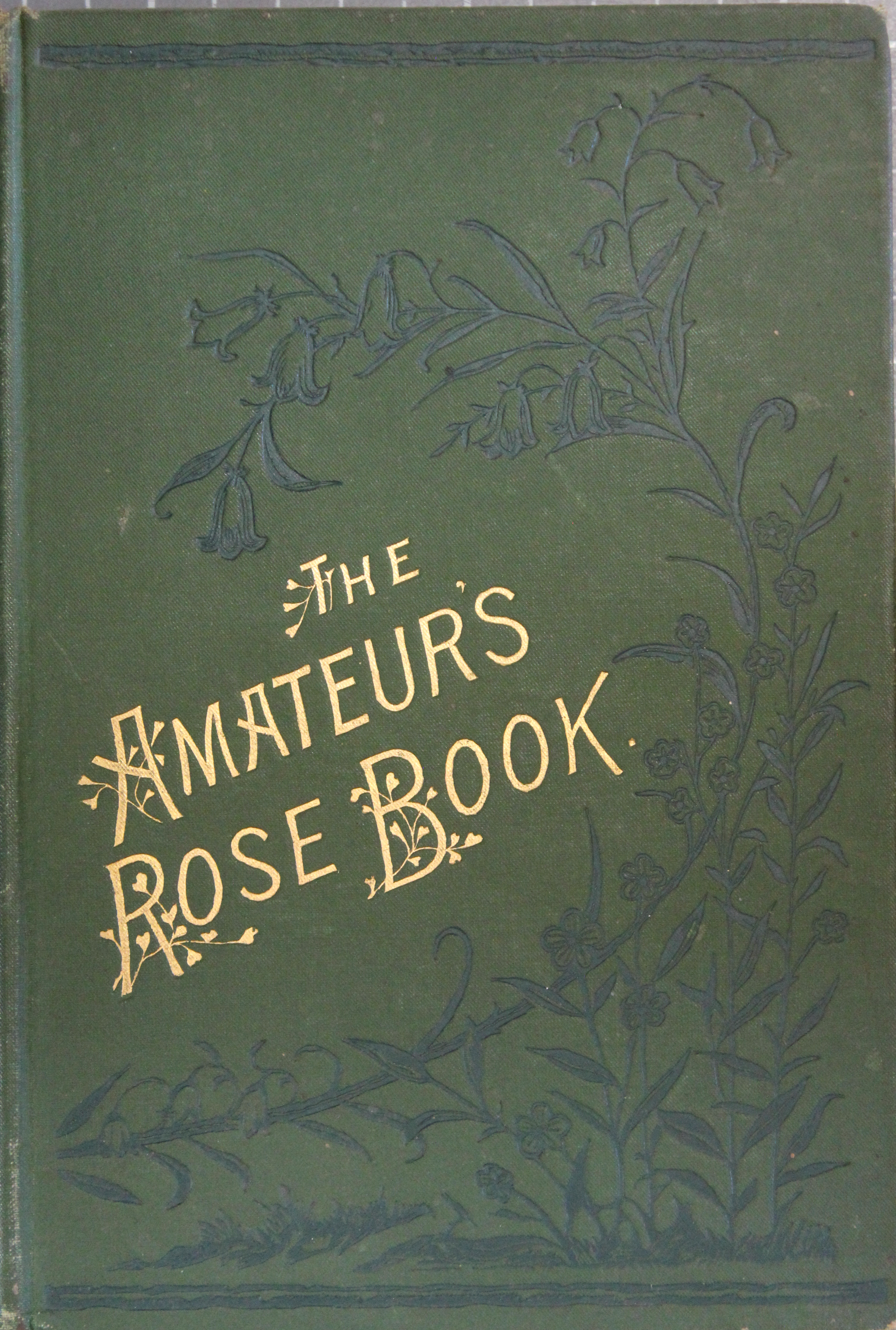
Hibberd went on to edit numerous gardening magazines and produce many more successful gardening books, often issued with attractive floral covers:

Attractive green floral book cover

Cover of The Amateur’s Flower Garden by Shirley Hibberd, London, 1871 (Classmark: Gorer.11)

Attractive green floral book cover

Cover of The Amateur’s Rose Book by Shirley Hibberd, London, 1885 (Classmark: Gorer.12)


Light brown floral book cover

Cover of Familiar Garden Flowers by Shirley Hibberd, London, 1879-1885 (Classmark: Gorer.14/1)

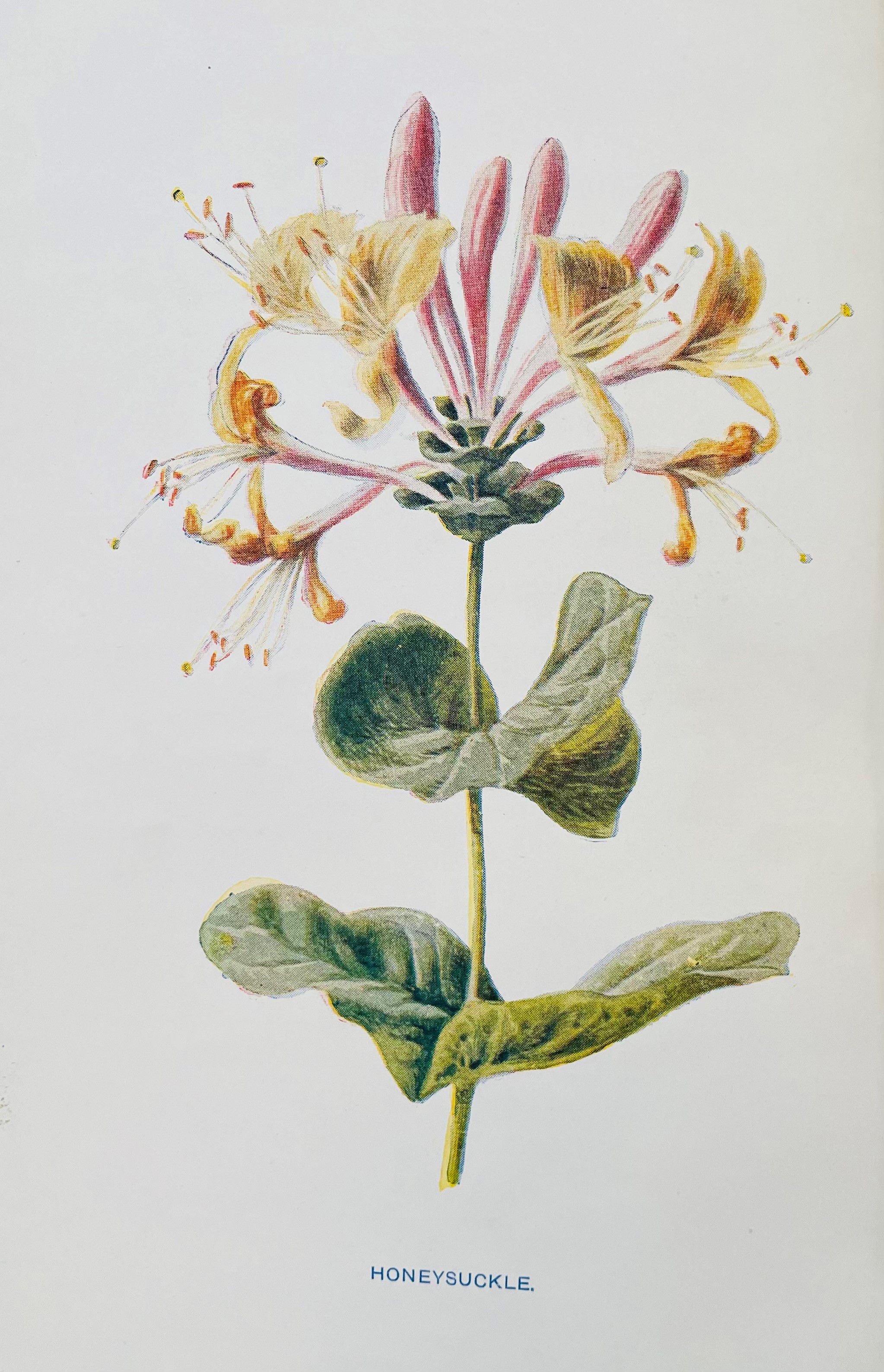
Familiar Garden Flowers, produced in five volumes between 1879 and 1887, contains particularly delightful colour illustrations, a selection of which provide a fitting way to conclude this post on gardening books through the ages. We hope you have gained some inspiration for your own gardens or flower boxes!

everlasting pea

Everlasting pea illustration facing p.105 in vol.1 of Familiar Garden Flowers (Classmark: Gorer.14/1)

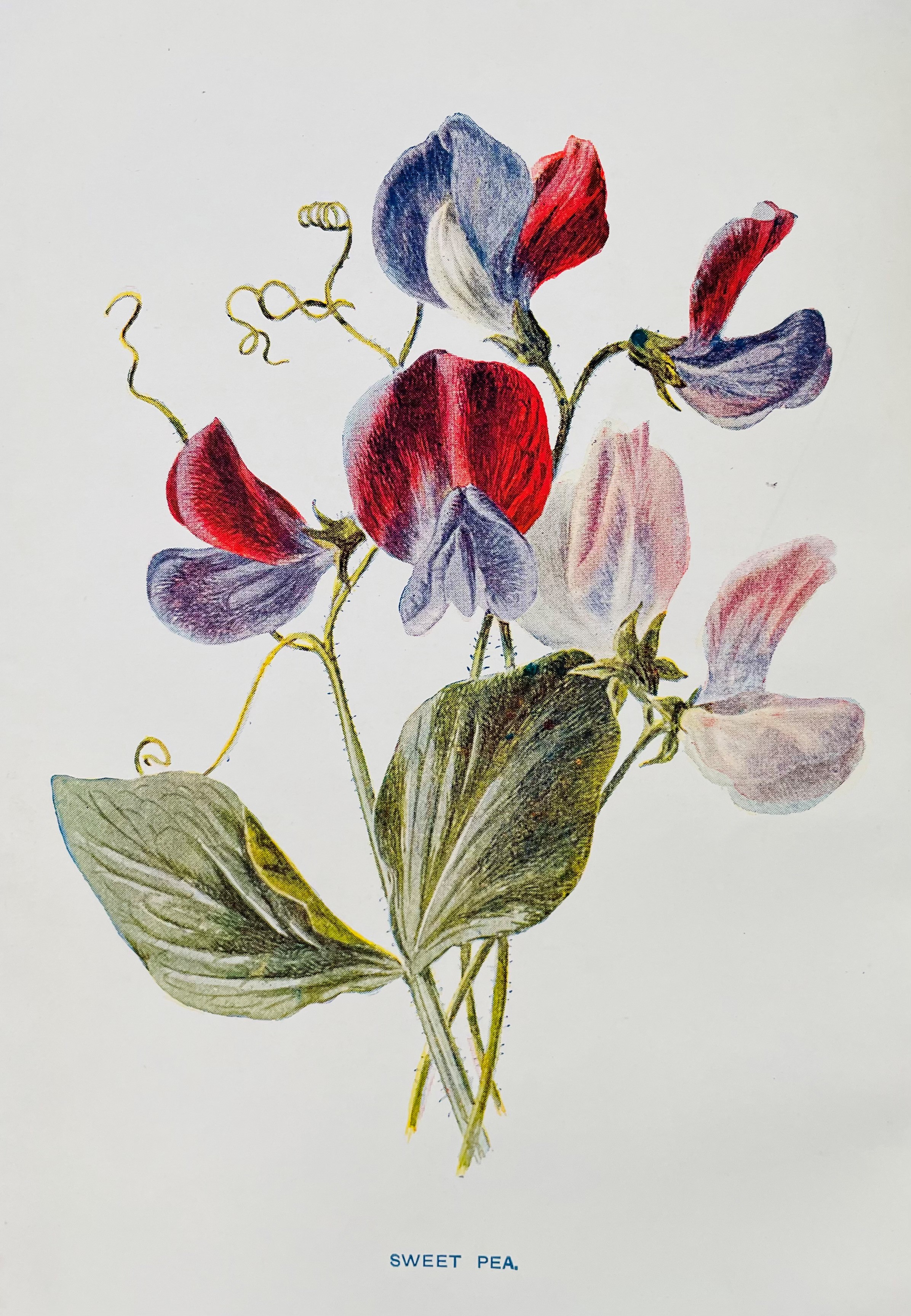
sweet pea

Sweet pea illustration facing p.113 in vol.1 of Familiar Garden Flowers (Classmark: Gorer.14/1)

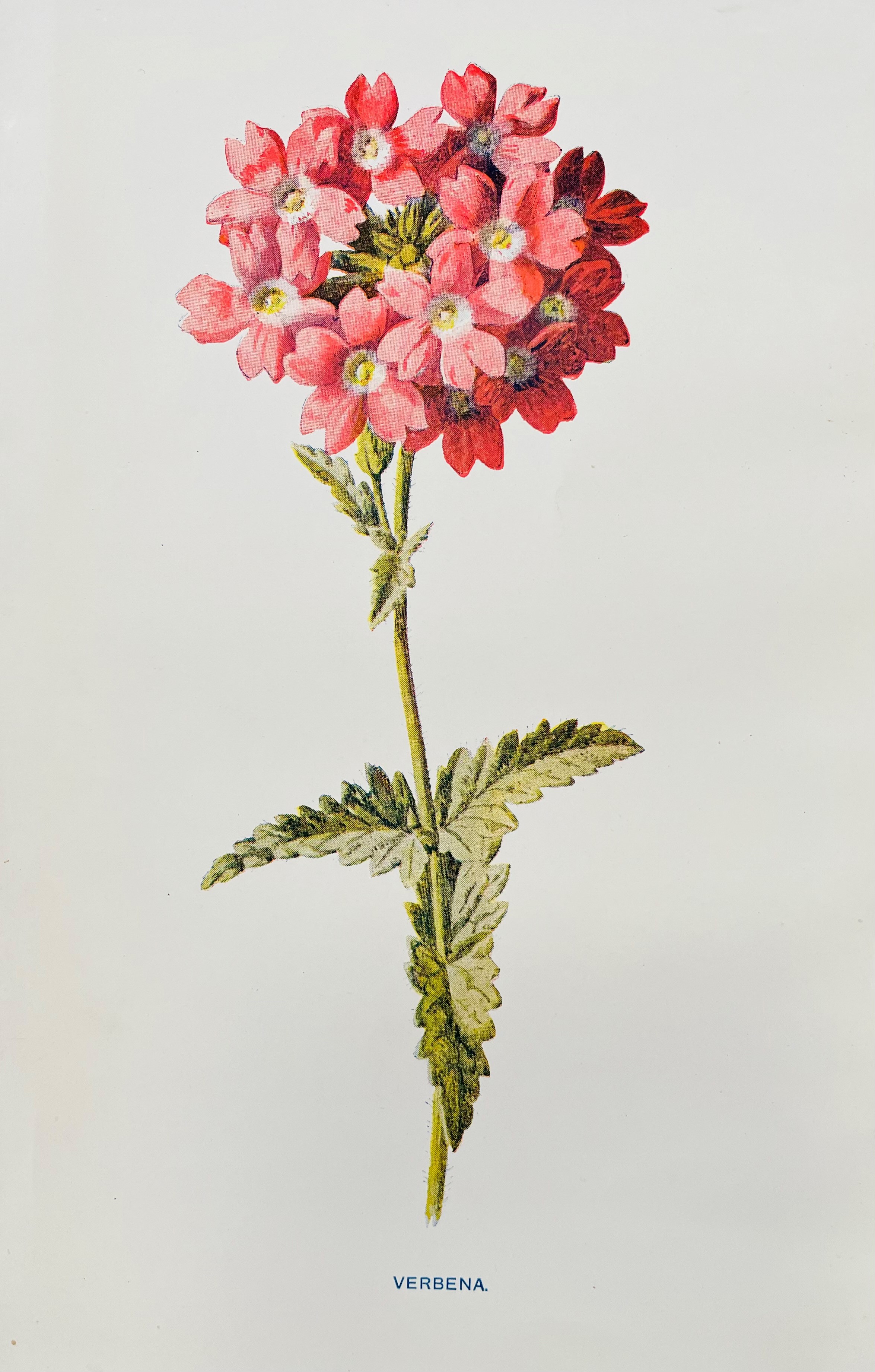
verbena

Verbena illustration facing page 105 in volume 5 of Familiar Garden Flowers (Classmark: Gorer.14/5)

wall flower

Wall flower illustration on frontispiece of volume 1 of Familiar Garden Flowers


Amethyst

Amethyst illustration facing page 5 in volume 5 of Familiar Garden Flowers

AC

References and further reading:

Richard Gorer: An English Jewish horticultural scholar and garden writer of the mid-twentieth century    [accessed September 2024]

John Gerard’s Herball   [accessed September 2024]

John Parkinson’s “Theatrum Botanicum” (1640) [accessed October 2024]

Synopsis Methodica Stirpium Britannicarum. John Ray   [accessed October 2024]

Robert Sharrock   [accessed October 2024]

A Botanical Wonderland Resides in the World of Rare and Unusual Books  [accessed October 2024]

Shirley Hibberd – the Father of Amateur Gardening    [accessed October 2024]

I Am Emperor of the French Still

While Ridley Scott’s biopic Napoleon has come and gone without too much fanfare or recognition during awards season, its release nevertheless reminded me that we have a volume in our rare-book collection that belonged to the French emperor, whose 255th birthday falls today (15 August 1769 – 5 May 1821):

Title page of Pierre Victor Jean Berthre de Bournisseaux, Histoire des guerres de la Vendée et des Chouans, depuis l’année 1792 jusqu’en 1815 (Paris: Claude Brunot-Labbe, 1819; M.37.116)

Napoleon’s ink signature is above the circular stamp: “l’Empereur Napoleon”. As he had been in exile on St Helena since October 1815, the book must have been shipped to him from France. The volume was sold at auction by Sotheby’s in June 1905 and was later donated to the College by Kingsman Alban Goderic Arthur Hodges (1893-1982):

Rear pastedown on which is stuck an advertisement for the Sotheby’s sale on 1-3 June 1905, including “Books from the library of the Emperor Napoleon I at St. Helena”. Next to it is a slip describing this book and its provenance: “Cachet of St. Helena and ‘L’Empereur Napoléon’ on title”.

While there are several items in King’s College’s collection that belonged to British monarchs, these are usually identified as such thanks to a royal cypher or a crest on the binding. This copy of the order of service performed at the coronation of George II (1727) belonged to his grandson George III (1738-1820), who was on the throne during Napoleon’s reign and exile:

The Form and Order of the Service that Is To Be Performed […] in the Coronation of their Majesties, King George II. and Queen Caroline (London: John Baskett, 1727; Thackeray.M.32.53)

The volume is bound in red morocco featuring an elaborate gilt panel design on front and rear boards with the crest of King George III at the centre and royal cyphers on each corner. This book did not come to King’s College as part of the large Thackeray Bequest, but was purchased in 1950. Though George III’s pre-1801 crest was identical to that of George II, the fact that Provost George Thackeray was chaplain in ordinary to George III suggests that he likely received it as a gift from the latter (who may have inherited it from his grandfather George II).

Gone are the days of gilt imperial bindings for the erstwhile French emperor: Napoleon can now only assert his ownership through a mere signature, like most other book owners. The contrast between the British monarch’s mark of ownership through this elaborate morocco binding and Napoleon’s ink inscription on the title page could not be starker.

One cannot help but draw a parallel between Napoleon’s predicament and that of the heroine in John Webster’s play The Duchess of Malfi (1623), loosely based on the life of Giovanna d’Aragona, Duchess of Amalfi (1478-1510):

Title page of the second edition of John Webster’s The Dutchesse of Malfy: A Tragedy (London: John Raworth and John Benson, 1640; Keynes.C.6.27)

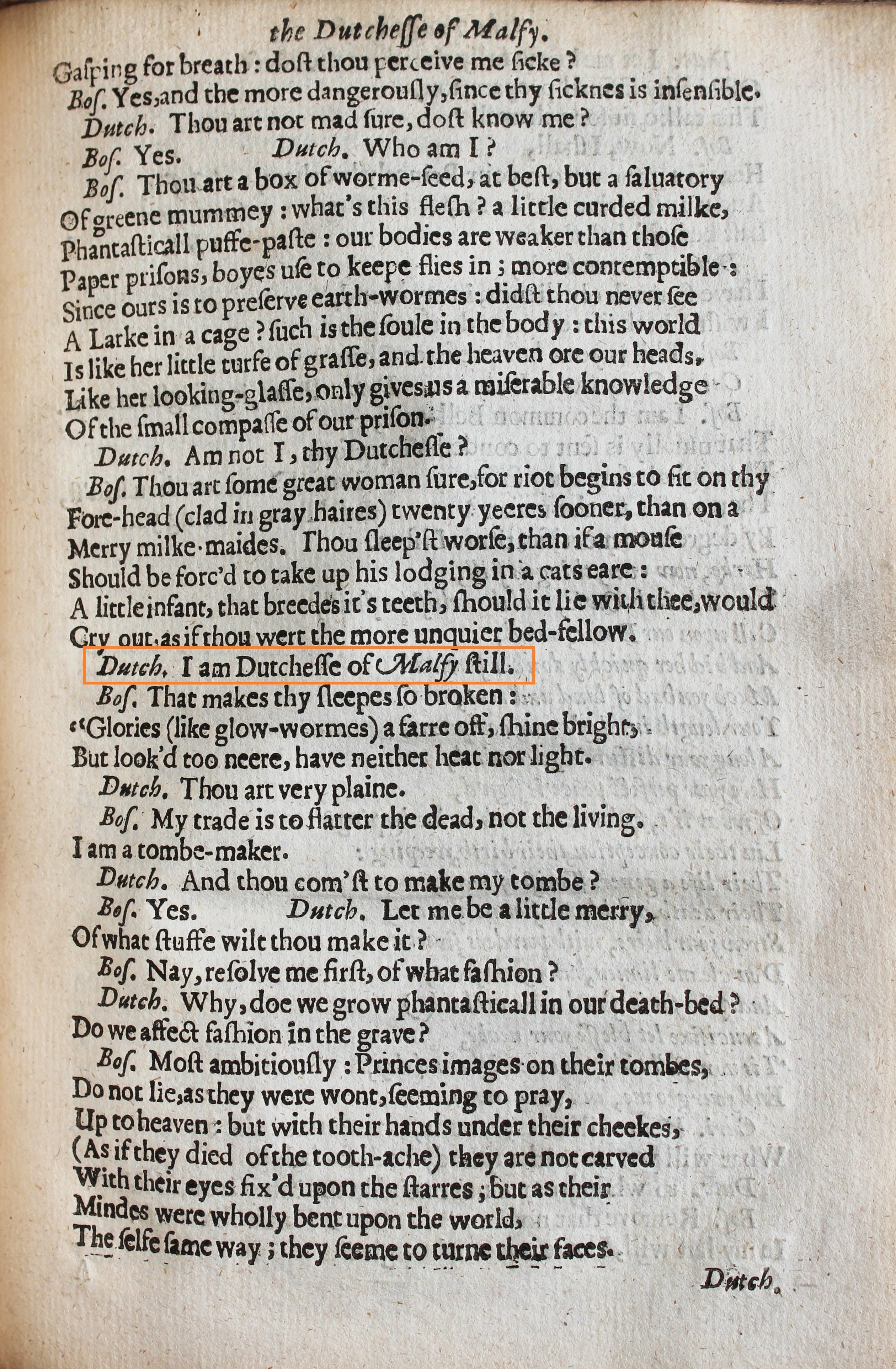
In the play, the widowed duchess secretly marries her lowly household steward Antonio and bears him three children, thus attracting the rage of her two brothers Ferdinand and the Cardinal who want to safeguard their inheritance. The duchess and her two younger children are murdered at Ferdinand’s behest in the fourth act. As she is about to be strangled by the executioners, she utters the famous words, “I am Duchess of Malfi still”:

Part of Act IV, scene ii (leaf G4 recto)

There is a sense of poignancy in the defiance shown by both the duchess and Napoleon as they cling to a former glorious past in the face of imminent death or a fall from grace. The difference is that Napoleon was technically no longer an emperor in 1819, while the duchess was still Duchess of Malfi, at least in name, when she died. In November 1818, Napoleon had been informed that he would remain a prisoner on St Helena for the rest of his life, and the island’s governor Sir Hudson Lowe had refused to recognise him as a former emperor. However, as this ownership inscription confirms, “Napoleon never considered forgoing ceremony or the recognition of his title. It was the only way he could assert his claim to being emperor in the face of the British insistence that he was a simple general. Much of his stay on St Helena was about constructing a space for himself in which he displayed his quality as an imperial sovereign”.[1]

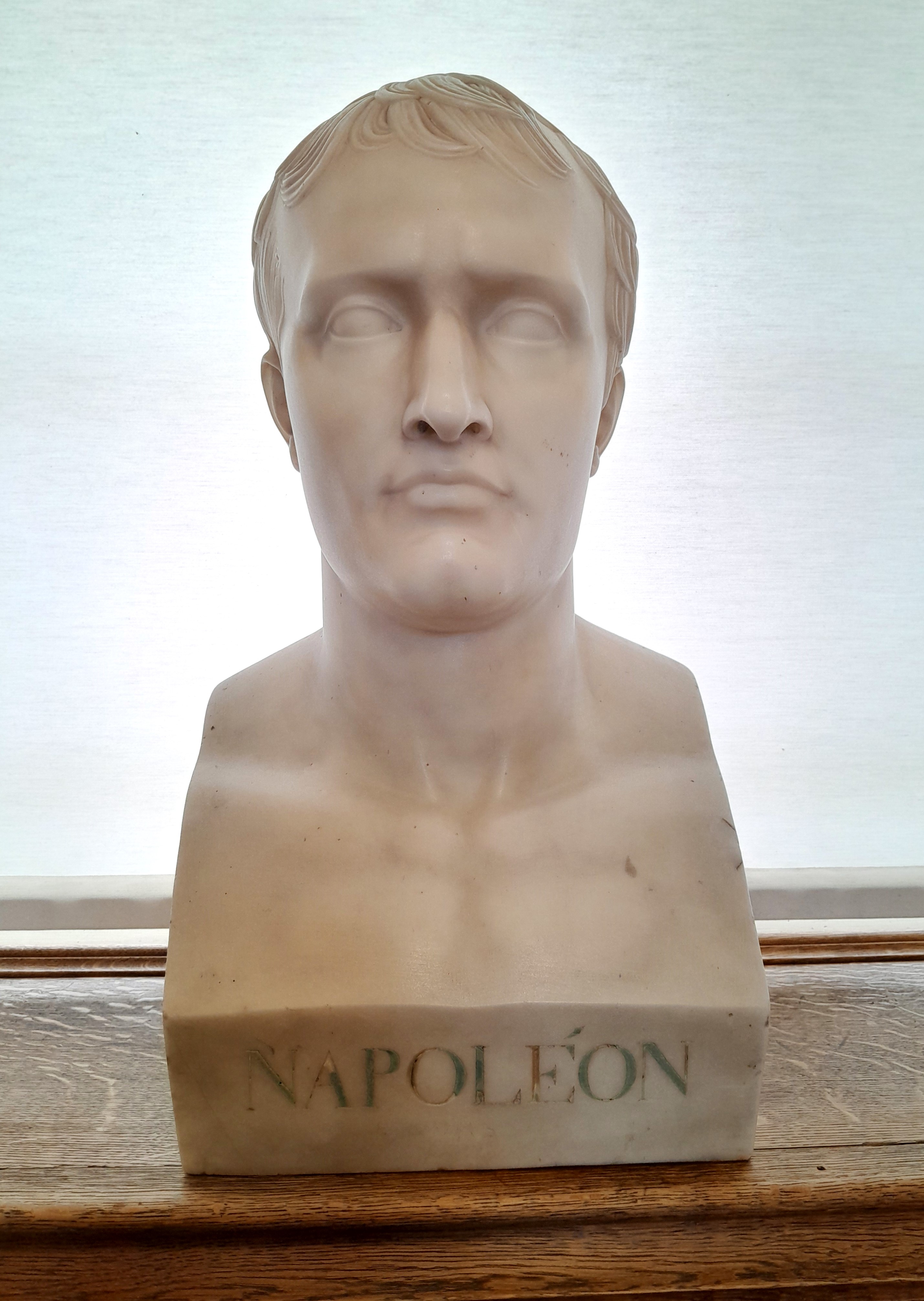
Bust of Napoleon in King’s College Library

IJ

Notes

[1] Philip Dwyer, Napoleon: Passion, Death and Resurrection, 1815-1840 (London: Bloomsbury Publishing, 2019, pp. 44-45)

Soaring into the New Year on the back of a dragon

In honour of the Year of the Dragon, we went on a perilous mission into the Library’s treasure hoards of books to find out if any of those fearsome beasts might be lurking inside. Alas, no Chinese dragons were discovered, but we did encounter several of the European variety and bravely captured their images to share with you in this post.

Our first dragon however, is not to be found within the pages of a book. It is a much more solid beast; a sculpture which originally adorned the College Chapel, but which was removed and replaced during restoration work. For the last few decades it has stood guard over the upstairs entrance of our Library, somewhat worn and battered by time maybe, but fierce and stalwart nonetheless.

A stone dragon standing upright with mouth open

The dragon outside the upstairs entrance of the Library

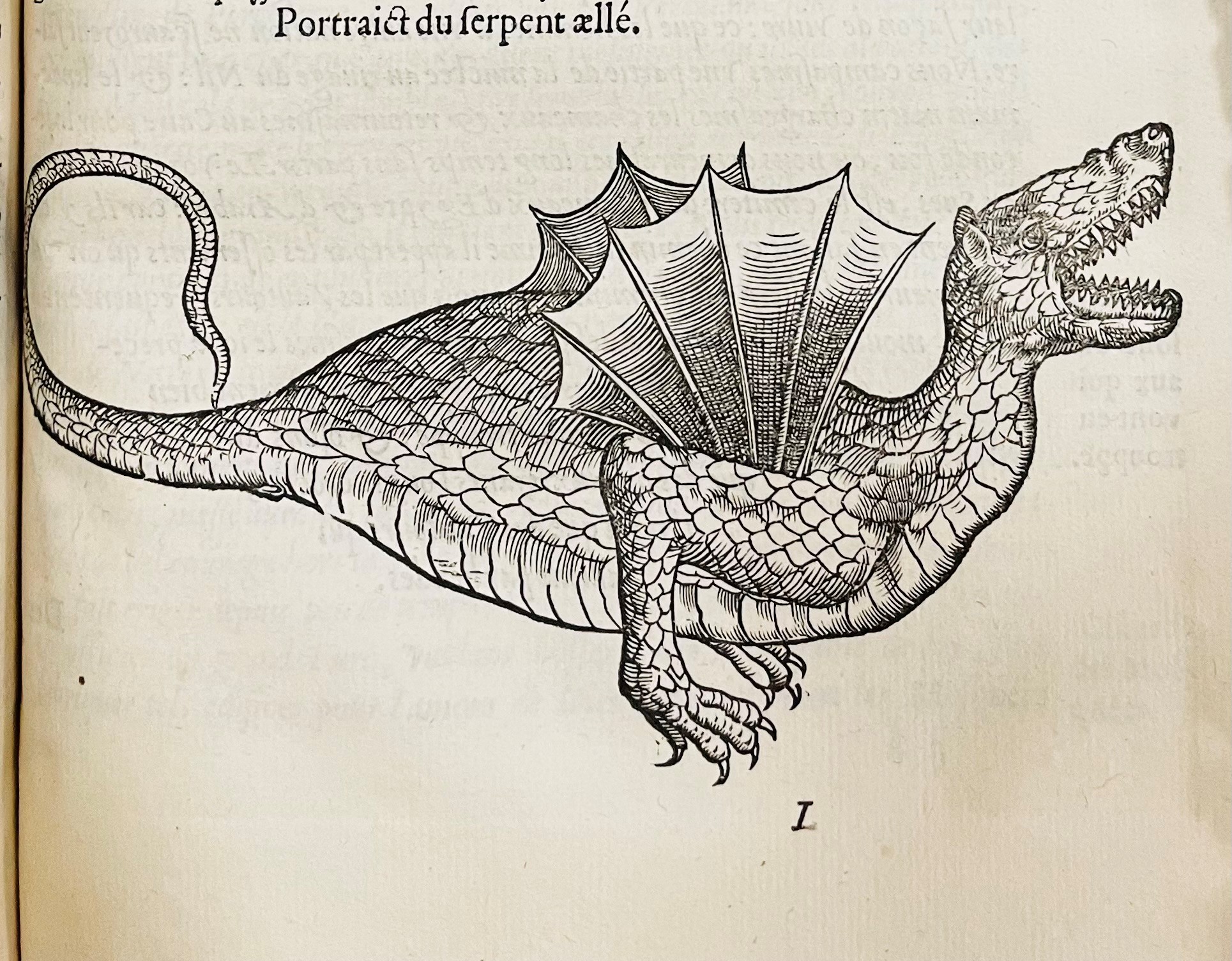
Several sixteenth-century works from our collections proved to be harbouring dragons. The first image comes from a volume of natural history by Pierre Belon (1517?-1564), originally produced in 1553. This is a very early printed depiction of a dragon with wings. Belon, a French naturalist and traveller, claimed to have seen embalmed bodies of these creatures during his travels in Egypt.

Woodcut of a two-legged winged dragon

Egyptian dragon from Les Obseruations de plusieurs singularitez & choses memorables by Pierre Belon, Paris, 1555 (T.16.20)

Secondly, we have an illustration depicting a very grand St George slaying a dragon, which adorns the title page of the 1527 edition of Polycronicon, by Benedictine monk, Ranulf Higden (ca. 1280-1364).  This was a very popular work of world history, written originally in Latin and later translated into English and added to over the following centuries.

Woodcut of St George on horseback with a dragon under the horse's hooves

St George and the dragon from the title page of Polycronycon by Ranulf Higden, London, 1527 (M.24.08)

Our last sixteenth-century image is from a 1590 edition of Edmund Spenser’s Faerie Queene. Here we have another knight, the Redcrosse Knight, killing a dragon in a very similar fashion. The Redcrosse Knight is very closely associated with St George.

Image of a knight on horseback with a dragon under the horse's hooves. The knight is running a spear through the dragon

The Redcrosse Knight from The Faerie Queene by Edmund Spenser, London, 1590 (Keynes.C.02.19)

Moving into the seventeenth century, a work of alchemy provides more images. Dragons in alchemy symbolize the unification of opposing forces like the sun and the moon or sulphur and mercury, and the change they produce when combined.  We therefore get these striking illustrations of entwined or two-headed dragons, as shown in the images below.

Two dragons perched atop a ring with their necks intertwined

Alchemical dragon symbol from page 212 of Theatrum Chemicum Britannicum edited by Elias Ashmole, London, 1652 (Keynes.C.4.2)

Upright two-headed dragon with a bird above and alchemists gathered around it

Two-headed dragon from page 213 of Theatrum Chemicum Britannicum edited by Elias Ashmole, London, 1652 (Keynes.C.4.2)

From our collection of children’s books comes a tale brimful of dragons. Snap-dragons: a Tale of Christmas Eve by Juliana Horatia Ewing (1841-1885) revolves around the parlour game of Snap-dragon, very popular in the nineteenth century, in which people took it in turns to snatch raisins from a bowl of flaming brandy.  This particular game conjures up a bevy of real dragons who draw a little boy into their boisterous and violent game of trading insults, or “snapping” at each other. It has some delightful illustrations.

Cover of the book showing a boy looking at a swirling group of dragons

Cover of Snap-dragons: a Tale of Christmas Eve by Juliana Horatia Ewing, London, 1888 (Rylands.C.EWI.Sna.1888a)

Text with a dragon illustration. The dragon is entwined with the initial B

Page 33 of Snap-dragons 

Text with an illustration of a dragon confronting a small boy

Pages 34 and 35 of Snap-dragons

Finally, we have this charming little dragon wrapped around an initial letter A in a volume of fairy tales, also by Ewing. Oddly enough, the tale it accompanies: “Knave and Fool”, features no dragons at all.

a dragon entwined around the initial A

Initial dragon from Old-fashioned Fairy Tales by Juliana Horatia Ewing, London, [1882?]  (Rylands.C.EWI.Old.1882)

Happy New Year!

References

Mythical creatures at the Edward Worth Library: Here be dragons! [accessed January 2024]

Jean Chevalier and Alain Gheerbrant, A Dictionary of Symbols. Oxford, 1994.

Lyndy Abraham, A Dictionary of Alchemical Imagery. Cambridge, 1998.

AC

The Boke Named the Royall

The many libraries of the University of Cambridge host an incredibly diverse range of books, manuscripts, and historic documents, some of which are over a thousand years old. That such documents are still available to us in a readable state is a tribute to the care and dedication of generations of librarians curating these collections.

We must remember that books are made of relatively vulnerable materials: papers and parchments. They are easily torn, creased, or stained through careless handling, but also damage caused by the environment such as mould, insects, water, or their arch-enemy: fire. When such damage occurs or is found on objects, librarians can call on the services of the book conservators at the Cambridge Colleges’ Conservation Consortium.

The book as received from King’s College Library

Here is the example of a 1507 book from the King’s College Library collection, “The Boke named the royall” printed by Wynkyn de Worde, an extremely important printer based in London, known for his work with William Caxton who was the first to popularise the use of the printing press in England.

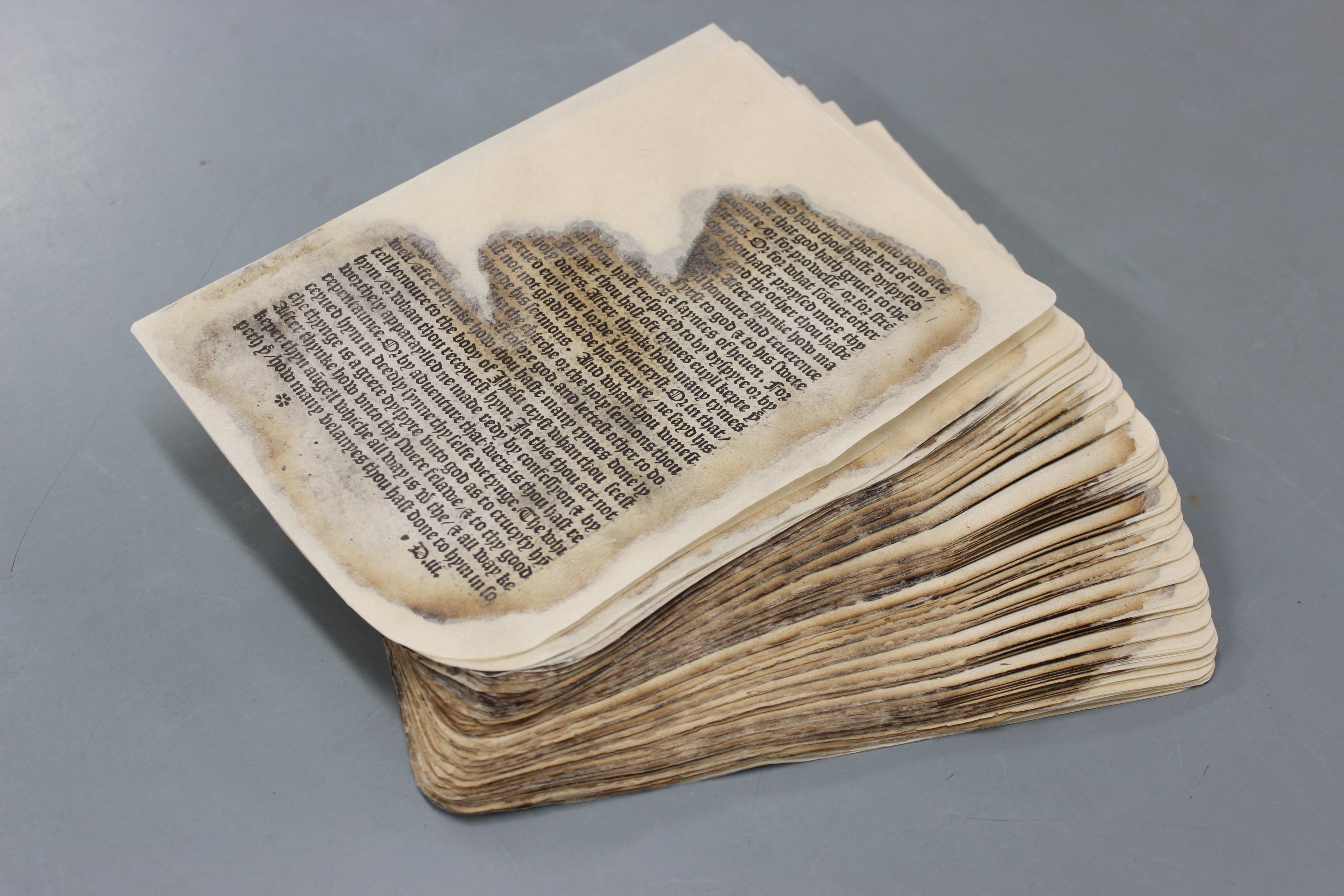
The severely burned pages

The volume is printed on handmade paper with many beautiful wood-block print images, but it has obviously suffered extensive damage caused by fire. The previous binding structure and the covers had been completely destroyed,  leaving only loose sheets with fire-damaged edges. When or how this fire happened is not documented, but we know that the book has been stored in this way since at least the 1980s.

A typical issue with fire-damaged books is that the pages, especially the edges, become very brittle and cannot be manipulated without causing further damage, meaning that the librarians at King’s could never allow this book to be consulted by researchers. Was there any way to make these 162 fragile leaves accessible again to scholars and researchers? This is the question that was put to me by the King’s College Librarian in 2022. This was a challenge, requiring very precise work, but the answer was a definite yes.

Reordering the individual leaves of the book

The first stage of the work was to re-order the leaves properly using a combination of clues, including the handwritten folio numbers and the signature letters and numbers printed on the leaves. This allowed us to identify that a number of the initial leaves were missing, possibly destroyed in the fire that caused the damage.

Each leaf was then washed following a four-stage process: a gentle surface dirt cleaning using a soft brush and a smoke sponge (a sponge made of natural vulcanized rubber). A water bath to dissolve impurities and stains in the paper. An alkali bath to stop acidic degradation of the papers, especially strong after fire damage. Lastly, a gelatine bath to “size” the papers to make it less brittle. It was truly delightful when I discovered several types of pretty watermarks during these washing processes.

Washing the leaves

The water before and after the washing

A crown-shaped watermark in one of the leaves

Then came time to infill the losses and to reinforce the damage along the edges by using layers of two different weights of Japanese papers. Japanese papers are very fine, strong and flexible, almost transparent and alkaline or neutral making them perfect for conservation work. This process is essential to restore mechanical robustness of the leaves and allow handling. It is important to note that beyond these mechanical objectives, aesthetics must be considered, with each infill paper being pre-toned to colour match the original material.

Mito Matsumaru repairing paper

Lizzie Willetts and Hollie Drinkwater undertaking paper repairs

Placing remioistenable tissue over burnt edge

After all leaves had been treated, dried, and pressed, the excess repair papers were trimmed.

Leaves after paper repair

Leaves after trimming

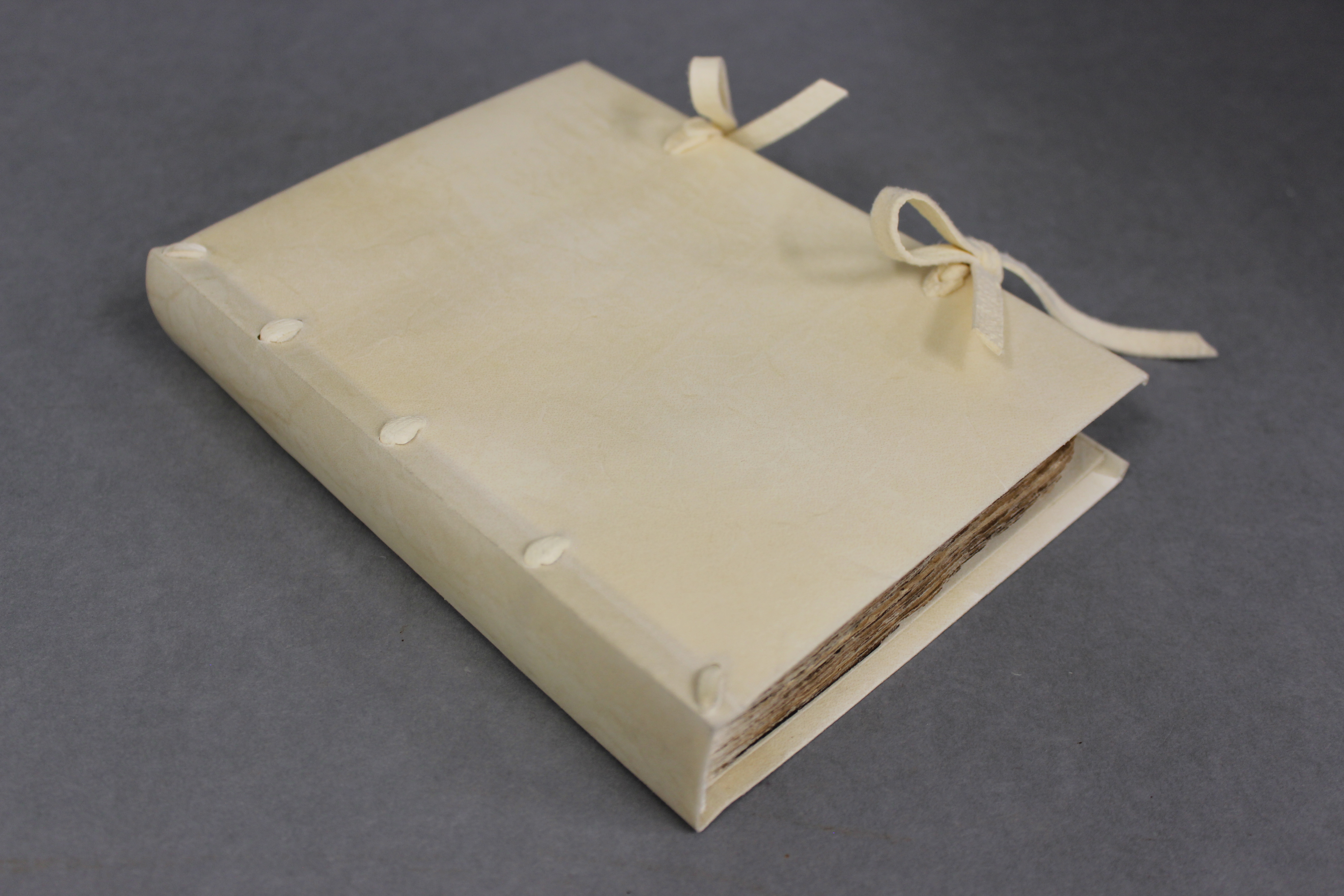
The volume was rebound in a historically compatible yet conservation quality “limp vellum” binding.

Binding the leaves over alum-tawed sewing supports

The completed new binding

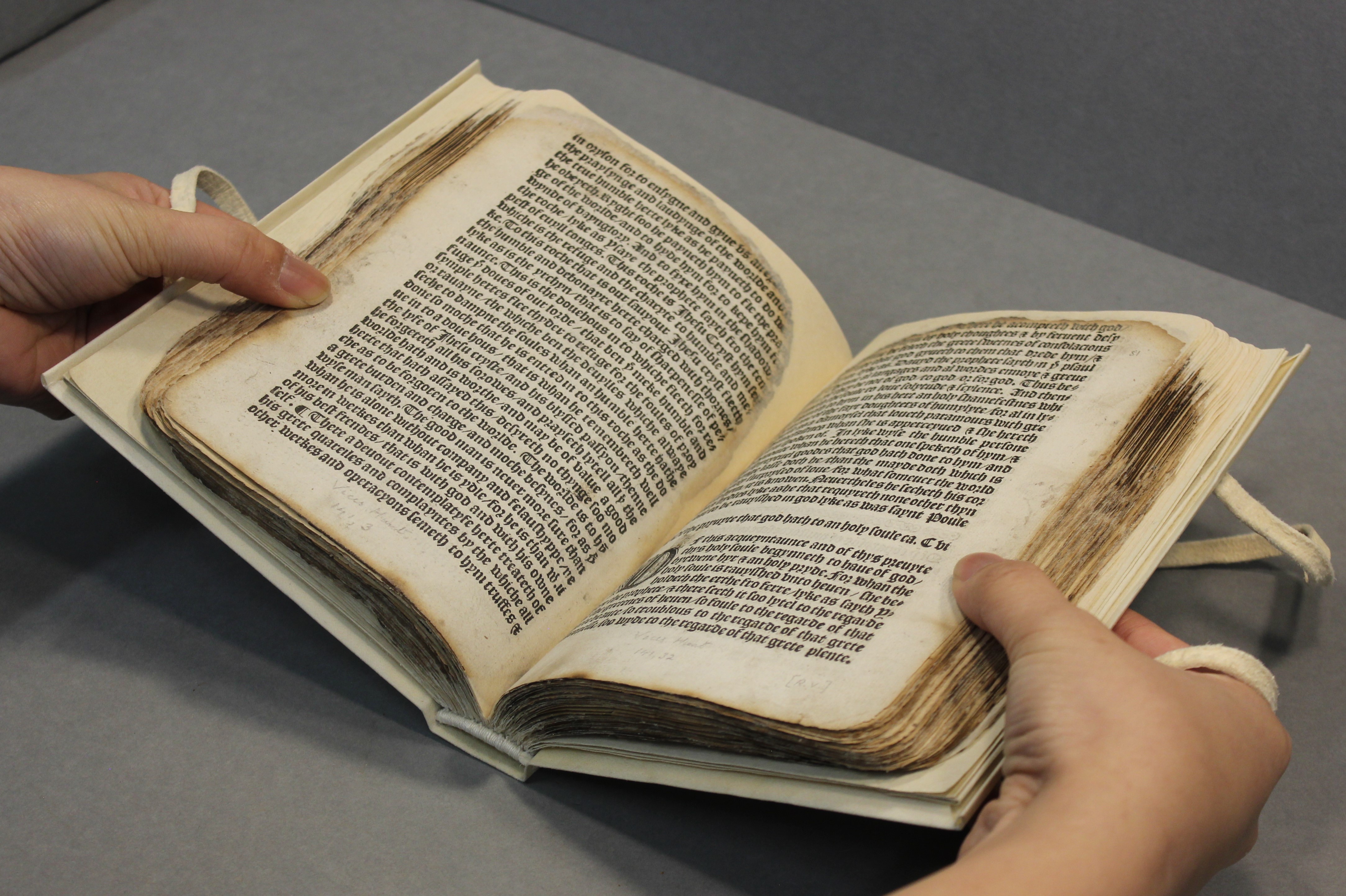
The rebound pages after treatment

The rebound pages after treatment

Detail of the repairs

Finally, a bespoke box was built to house the newly rebound volume.

This was a very challenging but satisfying project and I am very pleased to have contributed to the preservation of this volume which can now be consulted, although, of course, still with careful handling.

One last gift: after the treatment, I looked at the aligned fore-edges, and I found the edge is partially glistened in gold! That means that the book had gold-tooled edges when the fire occurred.

Detail of the gold decoration on the edge of the text block

As always, these projects are never solo work, and I must extend my deepest thanks to:

  • My colleagues Lizzie Willetts and Hollie Drinkwater who helped  during the washing and repair stages.
  • My manager Flavio Marzo for his advice and constant support, especially on limp vellum binding.
  • Dr James Clements, College Librarian at King’s College Library for entrusting me with such a wonderful project.

Mito Matsumaru, Book and Manuscript Conservator at Cambridge Colleges’ Conservation Consortium

The Consolation of Literature

It is not unusual to seek refuge in our favourite authors when faced with difficult situations. On the day on which we celebrate the quatercentenary of the First Folio’s publication (8 November 1623), it is timely to remember that Shakespeare’s play The Tempest played an important role in the New Zealand author Janet Frame’s life and writing. Confined to various mental institutions for eight years with misdiagnosed schizophrenia, she used to derive comfort by scribbling lines from The Tempest and poems she loved on the wall of her isolation room, an experience dramatised in her novel Faces in the Water (1961): “With the pencil I wrote on the wall snatches of remembered poems but the pencil applied to the Brick Building wall was like a revolutionary dye that refuses to ‘take’”.[1]

Opening of The Tempest, first published 400 years ago today in Mr. William Shakespeares Comedies, Histories, & Tragedies (London: printed by Isaac Iaggard, and Ed. Blount, 1623; Thackeray.38.D.2). This is one of the plays that might have been lost had it not been included in the First Folio.

The American poet Henry Wadsworth Longfellow found solace in Dante when coming to terms with the loss of his wife, as he confided to his friend Ferdinand Freiligrath on 24 May 1867: “Of what I have been through, during the last six years, I dare not venture to write even to you; it is almost too much for any man to bear and live. I have taken refuge in this translation of the Divine Comedy”.[2]

Janet Frame (1924-2004) and Henry Wadsworth Longfellow (1807-82) found comfort in Shakespeare and Dante respectively.

During World War II, another eminent Dante enthusiast, the German critic Ernst Robert Curtius, wrote to Fritz Schalk on 30 October 1944:

Am 18. (sind) alle Fenster und Türen unserer Wohnung kaputt gegangen. Bonn zur Hälfte zerstört, die ‚Insel des Friedens’! Dies & vieles andre deprimiert mich tief. En attendant lese ich Dante & Vergil.[3]

[On the 18th all the windows and doors in our flat were shattered. Bonn half-destroyed, the ‘island of peace’! This and many other things make me feel deeply depressed. En attendant I read Dante & Virgil].

Curtius also commended an eminent German mathematician who began to learn the 14,233-line Divine Comedy by heart during the Christmas of 1914 “um sich über die trübe Gegenwart hinaustragen zu lassen” [in order to get over the bleak present].[4]

King’s College alumnus Gerald Warre Cornish (1874-1916), a classical scholar who was killed in action in France, seems to have coped in a similar way during World War I by immersing himself in the Bible. On his body was found a muddy notebook containing his translations of St Paul’s Epistles, published in 1937 as St Paul from the Trenches: A Rendering of the Epistles to the Corinthians and Ephesians Done in France during the Great War.

During an earlier war, another classical author, Homer, provided strength to the educationalist Sir Theodore Morison (1863-1936), a graduate of Trinity College, Cambridge, whose copy of the Iliad is in our rare-book collection. His inscription on the flyleaf reads: “This book was I believe given to me by Percy Wallace in Aligarh some time between 1890 & 1895. It accompanied me on the German East African campaign & I read it through when I was at Ujiji & Tabora & during the pursuit of Capt. Neumann in company with the Belgian forces. It was in a sadly tattered condition when it got back to England, so in memory of its vicissitudes I had it bound in the School of Art, Armstrong College. Theodore Morison”:

Homērou Ilias (Oxford: J. H. Parker, between 1849 and 1890; M.37.114). Theodore Morison’s inscription and (right) the spine of the rebound book with his gilt initials on the bottom panel. Percy Maxwell Wallace (1863-1943) was professor of English Literature at the Mohammedan Anglo-Oriental College in Aligarh, India between 1887 and 1890. Theodore Morison was the principal at the College from 1899 to 1905. When he returned to England, Morison also served as the principal of Armstrong College in Durham.

The verb “accompanied” is significant as it suggests that the book became a sort of companion in the course of his trials and tribulations, in a way not entirely dissimilar to the role Philosophy played during Boethius’s imprisonment:

Incipit of Boethius’s De consolatione philosophiae (Nuremberg: Anton Koberger, 1476; Keynes.Ec.7.1.4). The editio princeps was published around 1474, which makes this incunable one of the earliest printed versions of Boethius’s seminal work, where he describes his dialogues with a personified Philosophy on a number of issues including fate, good and evil, and free will.

As we celebrate one of the most important books in English literature today, Prospero’s words to Miranda describing Gonzalo’s kindness in providing them with necessities during the move to the island, aptly summarise the sentiment shared by book lovers as diverse as Janet Frame, Henry Wadsworth Longfellow, E. R. Curtius, G. W. Cornish, and Theodore Morison:

The Tempest, Act I, scene ii, lines 278-80 as they appear on leaf A2r of the First Folio.

IJ

Notes

[1] Faces in the Water (London: The Women’s Press, 1991), p. 206

[2]  Life of Henry Wadsworth Longfellow: With Extracts from his Journals and Correspondence, vol. III, ed. Samuel Longfellow (Boston and New York: Houghton Mifflin, 1891), pp. 89-90

[3] In Willi Hirdt, “Ernst Robert Curtius und Dante Alighieri”, in “In Ihnen begegnet sich das Abendland”: Bonner Vorträge zur Erinnerung an Ernst Robert Curtius, ed. Wolf-Dieter Lange (Bonn: Bouvier Verlag, 1990), p. 181

[4] “Neue Dantestudien”, Romanische Forschungen, 60 (1947), p. 238