Tag Archives: Keynes Bequest

All that glitters is not gold

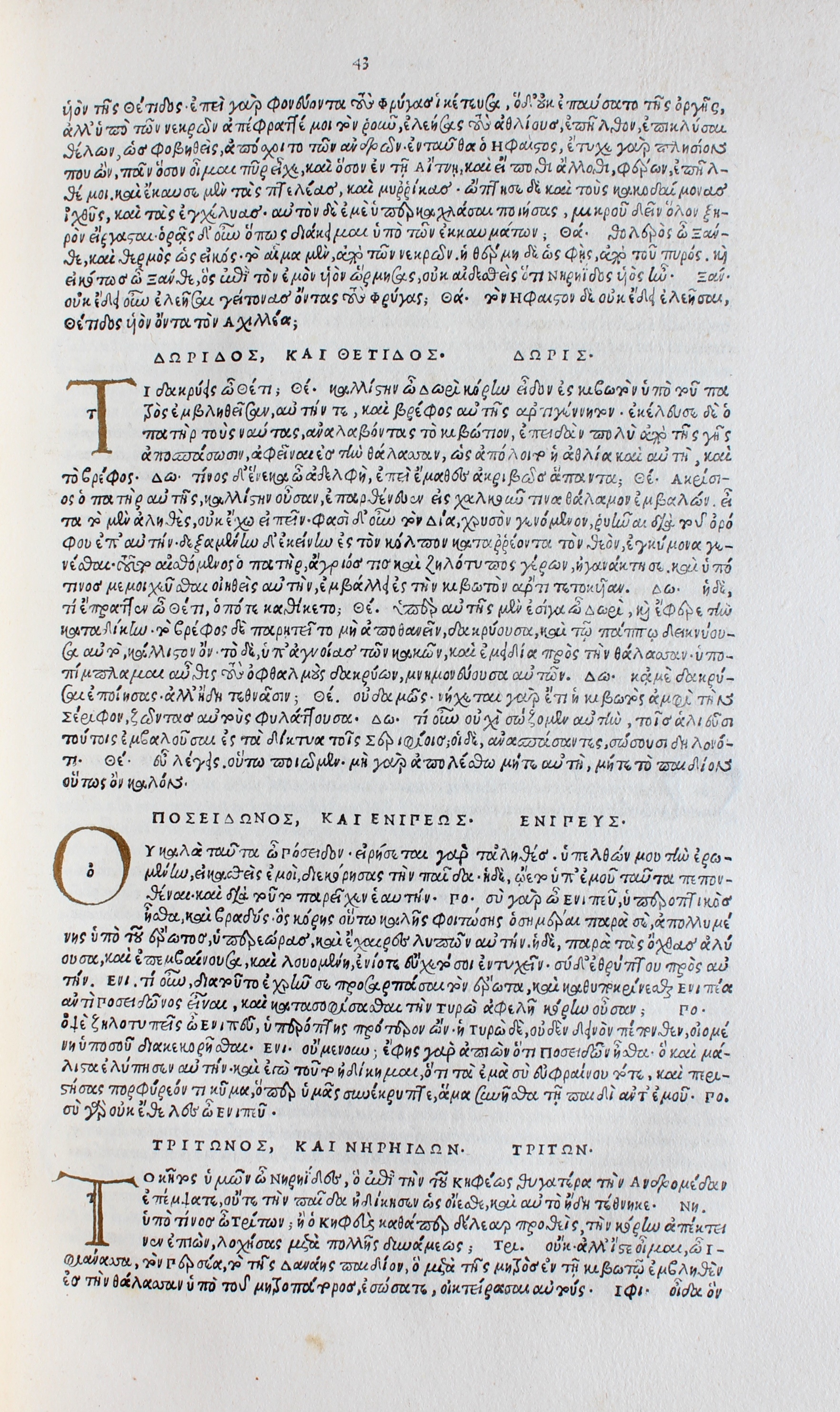
As we are all surrounded by illuminations at this time of the year (whether we like it or not), let’s have a look at another type of illumination, that of the vibrant colours and intricate decorations of initials and margins often found in medieval manuscript books. Such illuminations were also a feature of early printed books and can be regarded as a vestige of the manuscript tradition that persisted in the transition to the printing era. As Scrase and Croft point out in their book Maynard Keynes, “It is characteristic of the earliest period of printing that the book was conceived as a collaboration between the practitioners of the new art and the professional scribes and illuminators whose traditional involvement in book production went back for centuries” (Cambridge: Provost and Scholars of King’s College, Cambridge, 1983, p. 74). The illuminations were applied by hand following completion of the printing process, and the printer would leave blank spaces with or without guide letters for the illuminator:

Keynes.Ec.7.2.9

Diogenes Laertius, Vitae et sententiae eorum qui in philosophia probati fuerunt (Venice: Nicolas Jenson, 1475; Keynes.Ec.7.2.9).

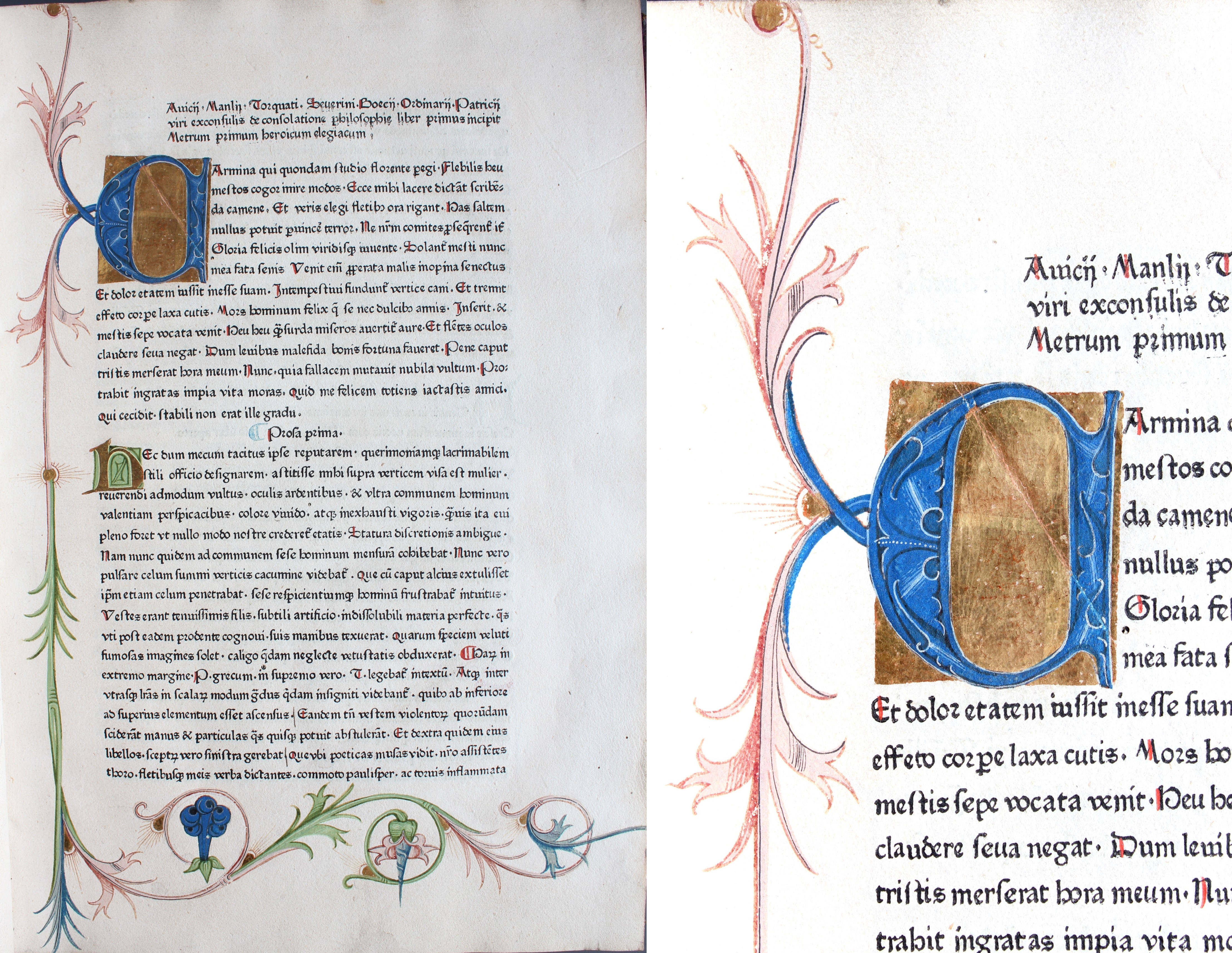
This 1476 copy of Boethius’s De consolatione philosophiae has the first initial of text illuminated in gold and blue, with a pink, green and blue decorative leaf border carried around the inner and lower margins:

Keynes.Ec.7.1.4

Boethius, De consolatione philosophiae (Nuremberg: Anton Koberger, 1476; Keynes.Ec.7.1.4) with close-up of initial illuminated in gold and blue.

Sometimes, the initial letters were simply supplied in red, blue or gold, as in this copy of Lucian’s Opera (1503): 

Keynes.Ec.7.2.19 2

Lucian of Samosata, Luciani opera (Venice: Aldo Manuzio, 1503; Keynes.Ec.7.2.19).

One of the most impressive illuminations in the incunabula in the Keynes Bequest is undoubtedly to be found in a copy of Saint Augustine’s De civitate Dei (1468), printed in Rome by two Germans, Konrad Sweynheim and Arnold Pannartz, who are credited with introducing the art of printing into Italy. The first page of text after the preliminaries features the initials “I” and “G” supplied in gold; both initials are embellished with a decorative white vine stem border defined in blue, pink and green with a pattern of white dots, which extends into the upper, inner and lower margins. In the lower margin is a painted coat of arms of Cardinal Medici within a green laurel wreath and a putto on either side:

Keynes.Ec.7.1.2

Saint Augustine, De civitate Dei (Rome: Konrad Sweynheim and Arnold Pannartz, 1468; Keynes.Ec.7.1.2). The Medici arms are not authentic and were added by the forger Hagué.

Below is a close-up of the 15-line initial “I” and the 8-line initial “G”:

Keynes.Ec.7.1.2 (2)

Saint Augustine, De civitate Dei (Rome: Konrad Sweynheim and Arnold Pannartz, 1468; Keynes.Ec.7.1.2); detail.

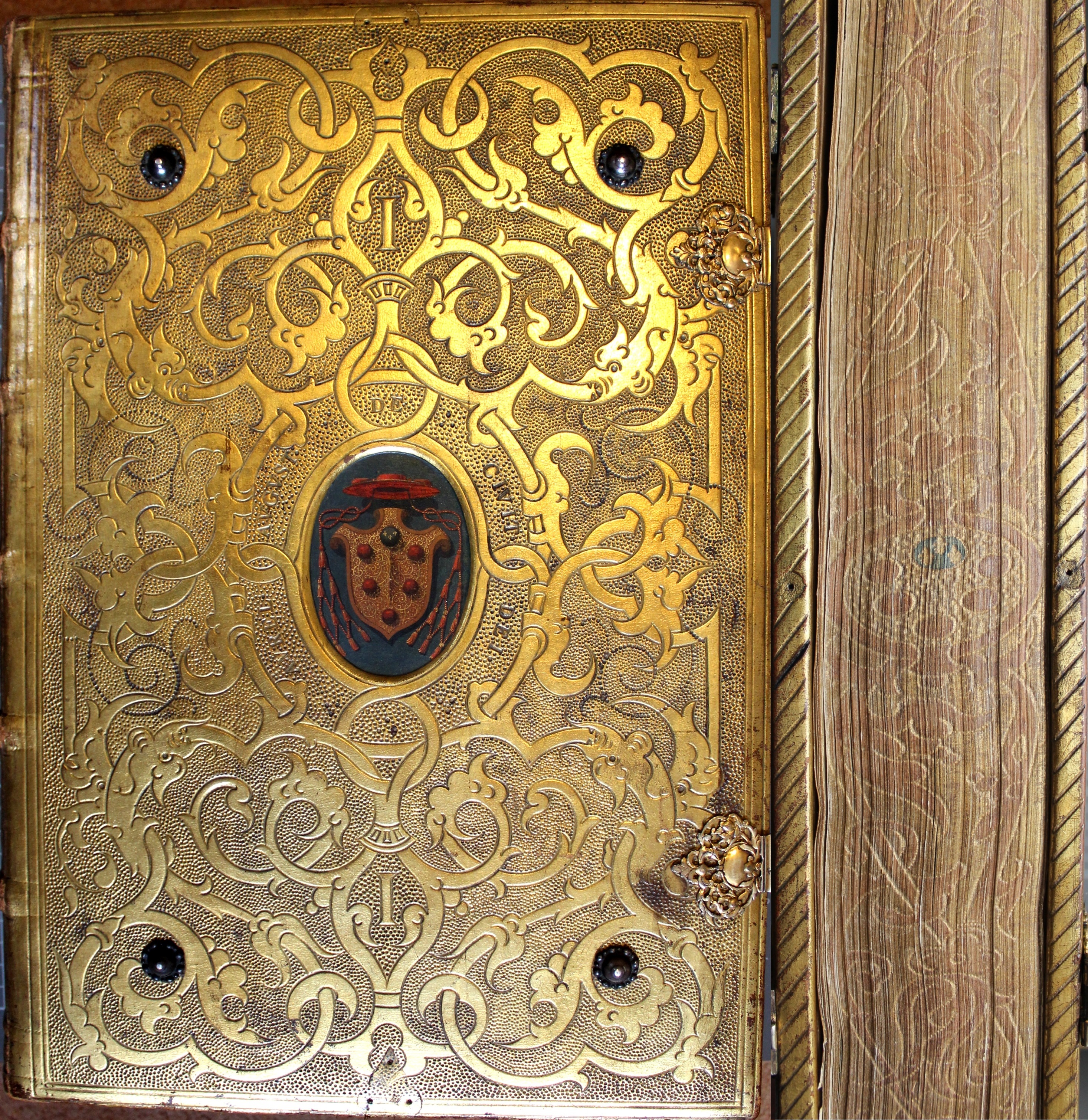
If you thought the illumination in this incunabulum was impressive, wait until you see the cover. This is a 19th-century binding entirely covered in gold produced by the Belgian bookbinder and binding forger Théodore (aka Louis) Hagué (1822 or 1823-1891) in imitation of a 16th-century Italian binding purported to have been made for Cardinal Medici:

Keynes.Ec.7.1.2 (3)

The book with the golden cover: calf over wooden boards; covers and spine entirely covered in gold with an elaborate interlacing ribbon/strapwork design; four metal bosses on each cover; arms of Cardinal Medici painted in an oval medallion at the centre of each cover. Detail shows gilt and gauffered edges with the Medici coat of arms in the middle, and the pattern of the decorations filled in with red.

Hagué was a master of forgery and produced fake bindings that were passed off as having belonged to popes, cardinals, kings  and queens. And people fell for it hook line and sinker. The sale catalogue description pasted on the fly-leaf reads: “Italian binding of the 16th century. This book is probably unique in its style of binding. It is of calf; tooled and completely covered with gilding. On each cover the arms of Cardinal Medici are painted…” For more information on Hagué, see Mirjam M. Foot, “Binder, Faker and Artist”, The Library 13.2 (2012), pp. 133-146, available here.

This is our last blog post before Christmas, so happy festive season from all of us at King’s College Library and Archives! We’ll be back in the New Year with more posts about the treasures in our special collections, so watch this space…

IJ

Flying Sheets

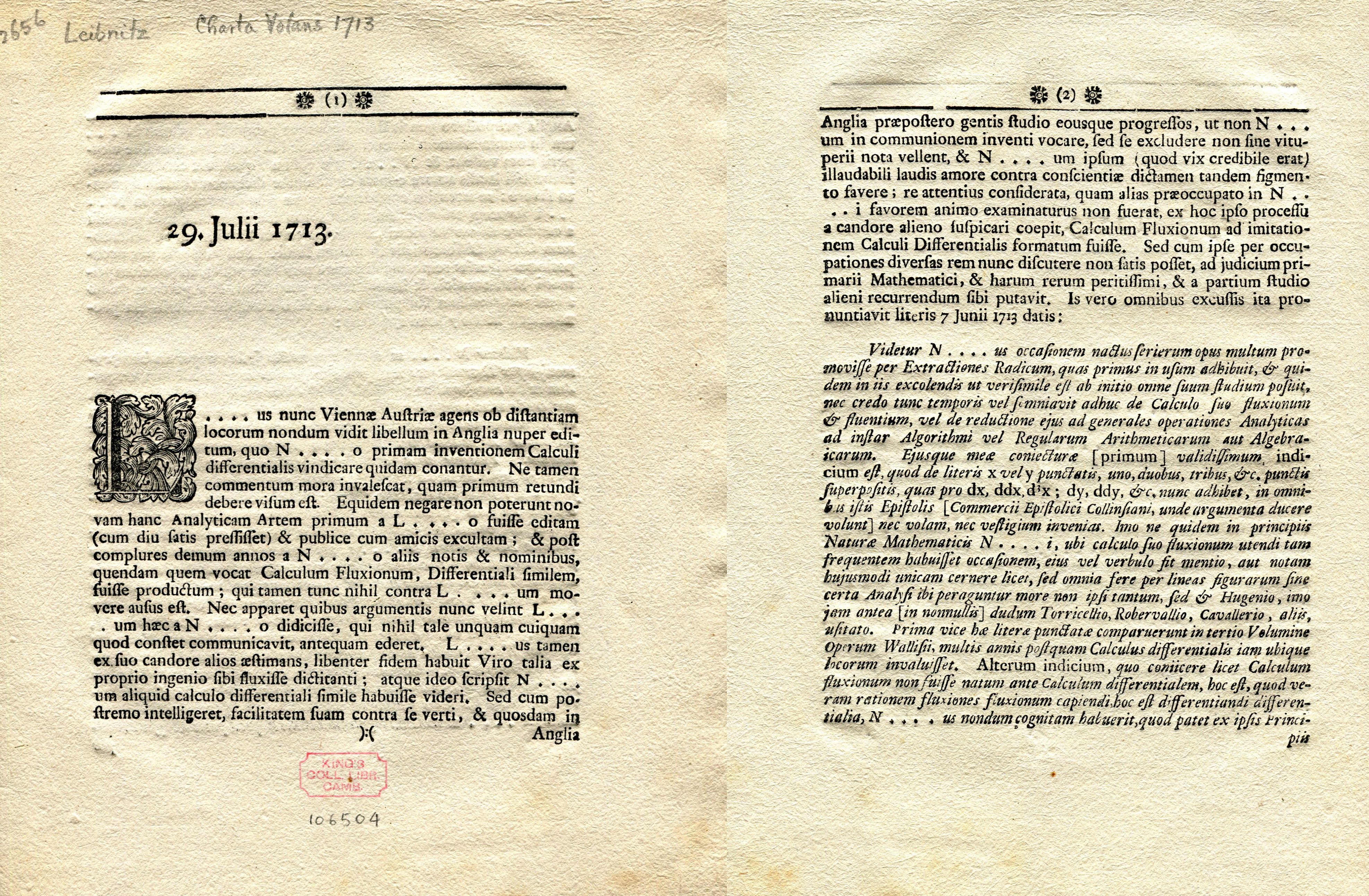
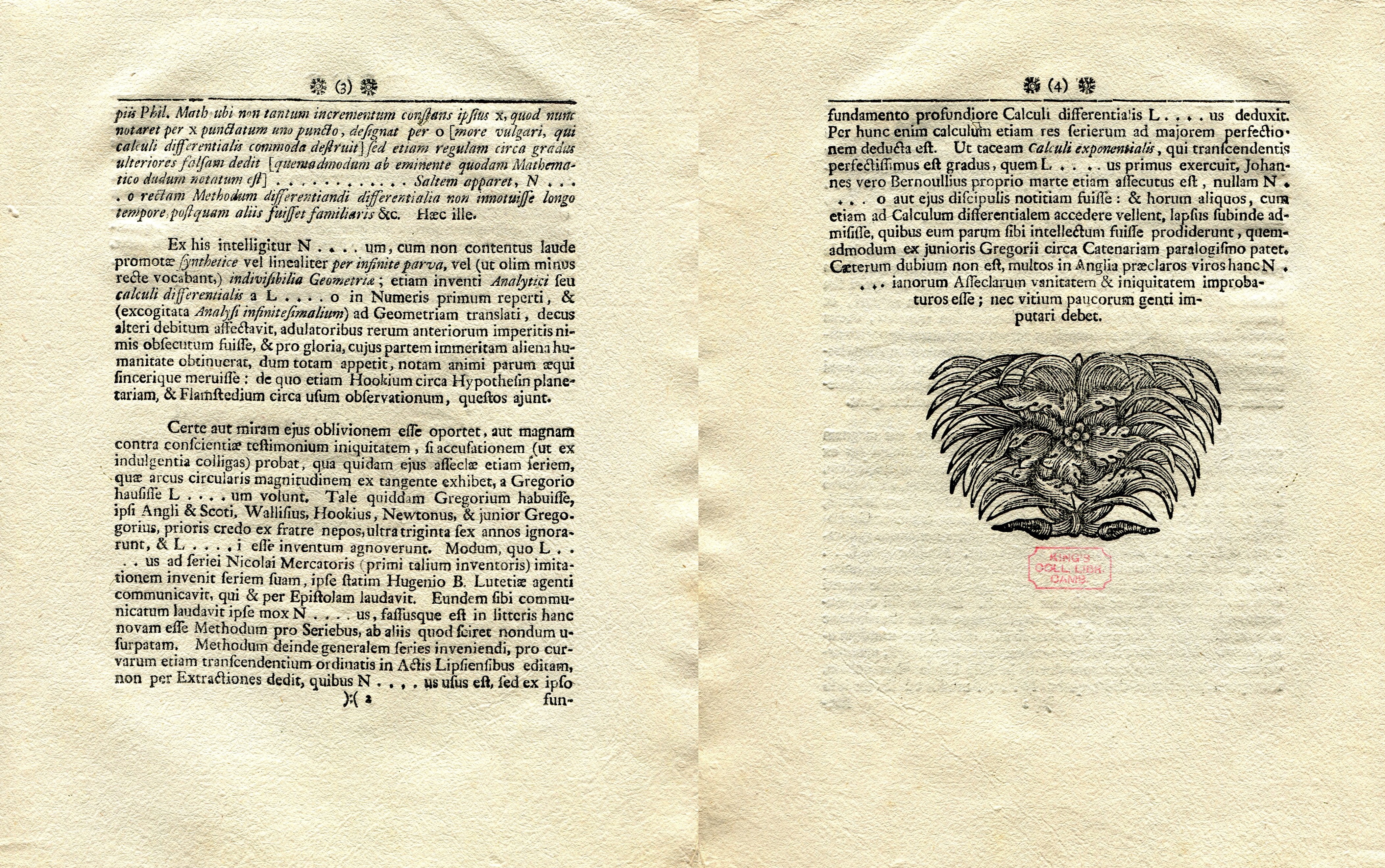
The Keynes Bequest is not merely a collection of books. Interspersed among first editions of Galileo, Descartes, Pascal, Hobbes, Kant and Locke are a number of pamphlets of historical, literary and scientific significance, ranging in size from one sheet to several pages. In the extensive collection of first and early editions of Isaac Newton’s works is an anonymous pamphlet with the caption “29. Julii 1713”. This is the so-called Charta volans (flying sheet), an important document written by Gottfried Leibniz during the bitter controversy between him and Newton over which of them invented the mathematical study of change, calculus. Given the rarity of this pamphlet (the only other copies are in Yale, Chicago and in the Burndy Library), and in the interest of scholarship, we provide a scan of all four pages:

Charta Volans 1-2

Gottfried Leibniz’s Charta volans (1713), in which he argues that Newton had not published anything on calculus before him, adding that Newton’s fluxional method was in imitation of his calculus (Keynes.Ec.7.2.27)

Charta Volans 3-4

Charta volans, pp. 3-4

Its acquisition history is also rather fascinating. Keynes had originally bought two copies of the pamphlet, and observed in a letter to K. G. Maggs when the latter offered to purchase the duplicate copy in May 1942 that he had done so “not because I wanted them, but because they were fastened together, never having been separated by a paper knife when issued. So far I have not had the heart to split the Siamese twins.” The correspondence between Keynes and Maggs throws an interesting light on his relationship with booksellers and how he went about augmenting his collection of rare books and pamphlets:

Keynes-Maggs 1

J. M. Keynes’s correspondence with K. G. Maggs, 15 May-18 May 1942

Keynes-Maggs 2

J. M. Keynes’s correspondence with K. G. Maggs, 28 May-29 May 1942

The “American library which specialises in Newton material” that bought the second copy of the Charta volans is almost certainly the Burndy Library, founded the previous year by the industrialist and historian Bern Dibner. Their copy is now at the Huntington Library in San Marino, California.

As the above correspondence reveals, the loss of one of the “Siamese twins” to the Burndy Library led to Keynes’s acquisition of another exciting “flying sheet”, namely a leaf from the Gutenberg Bible, the first book printed using movable type which marked the beginning of the Printing Revolution. The iconic 42-line Bible was printed in Mainz, ca. 1454-55, by Johannes Gutenberg. Of the about 180 copies printed, 49 are known to have survived, only 21 of which are complete. This leaf includes all of Jeremiah XX and part of Jeremiah XXI:

Gutenberg Bible Leaf 2

The first printed book: recto and verso of leaf 80 from the Gutenberg Bible (1454-55). Printed in two columns, one column on each side being defective; 2 initials supplied in red, chapter numbers in red and blue (Keynes.Ec.7.2.13)

The addition of a leaf from the Gutenberg Bible to Keynes’s collection means that the items in the Keynes Bequest cover five centuries of printing, from its very inception in the middle of the fifteenth century, right up to the middle of the twentieth.

IJ
Judging a Book by its Cover

While most of the books in the Keynes Bequest have been acquired for their intellectual content, charting the history of European thought, there is one section in which the items have been collected primarily because of their physical characteristics, namely the binding. Every book bound before the early 19th century is a unique handcrafted object, so no two bindings can be genuinely identical. Recording the binding information when cataloguing a rare book is important as it gives us an indication of its provenance as well as how the book was used, regarded and circulated. Below is a selection of some of the most interesting items in the ‘binding’ section of the Keynes Library.

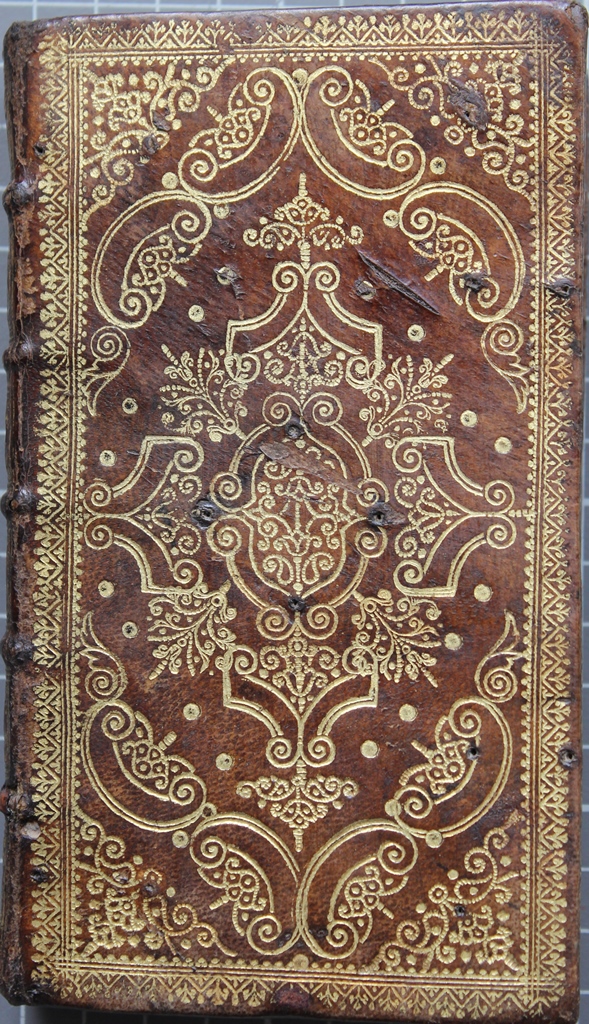
This copy of Les Pseaumes de David (1668) features an ornamental binding in goat-skin from the atelier de Charenton, characterised by corner-pieces and fleurons incorporating several pointillé motifs; on the board edges is a decorative roll in the style of the binder Antoine Ruette (1609-1669). Four stud holes are visible at the centre:

Keynes.Ec.7.4.11

Keynes.Ec.7.4.11: Les Pseaumes de David mis en rime franc̜oise par Clement Marot, et Theodore de Beze (Charenton: Estienne Lucas, 1668).

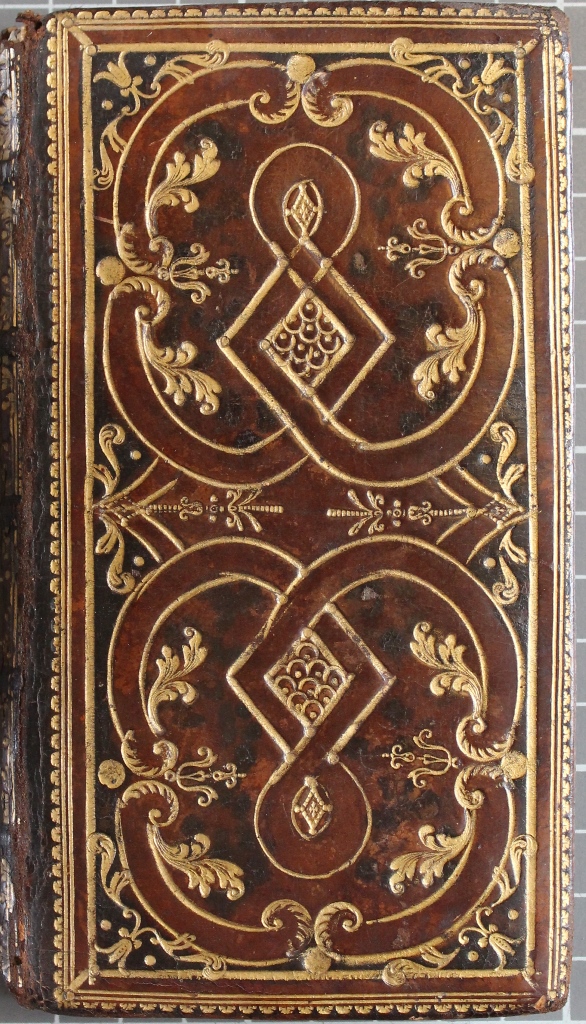
Keynes.Ec.7.4.13 is an example of a book judged solely by its cover, being a copy of an obscure Italian play on St. John the Baptist which seems to have been consigned to oblivion by literary history, but whose binding features an aesthetically pleasing symmetrical double-panel design with drawer-handle and leaf ornaments tooled in gold:

Keynes.Ec.7.4.13

Keynes.Ec.7.4.13: Niccolò Lippi, La verità conosciuta, e non seguita: overo la decollazione del glorioso S. Gio. Battista (Naples: Eredi di Laino, 1721).

There are also a number of armorial bindings in this section with interesting historical associations. We have a copy of Notizie per l’anno 1759, a volume of a statistical and administrative annual printed in Rome from 1716 to 1849, the precursor of the Annuario pontificio. Again, the content of the book is probably less interesting than the binding, which features the arms of the book’s dedicatee Cardinal Carlo Rezzonico (1724-1799), nephew of Pope Clement XIII, gold-stamped at the centre, and corner-pieces with elaborate floral decorations:

Keynes.Ec.7.4.12

Keynes.Ec.7.4.12: Notizie per l’anno 1759 (Rome: Chracas, 1759).

Going back to France, this copy of René Budel’s De monetis, et re numaria (1591) has the coat of arms of the noted French historian and bibliophile Jacques-Auguste de Thou (1553-1617) and of his second wife Gasparde de la Chastre blocked in gold at the centre of each cover. The fact that de Thou and his wife were already dead when this volume was added to their library is indicated by the addition of an urn above the two coats of arms. Underneath them, and on each spine panel, is the couple’s monogram IAGG. De Thou’s son François continued to add books to his late father’s library using this version of his coat of arms:

Keynes.Ec.7.4.6

Keynes.Ec.7.4.6: René Budel, De monetis, et re numaria, libri duo (Cologne: Johann Gymnich, 1591). Detail from the cover and spine.

And finally something closer to home: a 16th-century English blind-stamped volume bound by Garret Godfrey of Cambridge (d. 1539), with a panel design formed by a roll containing a lion, a wyvern, and a gryphon; the floral ornaments feature the binder’s initials G. G. The metal clasps, catch plates and leather straps are intact:

Keynes.Ec.7.4.7

Keynes.Ec.7.4.7: Petrus Comestor, Historia scholastica (Paris: Jean Frellon, 1513).

Some useful online resources on bookbinding:

http://www.bl.uk/catalogues/bookbindings/

https://armorial.library.utoronto.ca/

http://www.cyclopaedia.org/virtual/bookbinding.html

http://www.joh.cam.ac.uk/library/special_collections/provenance/bindings/

IJ
Something Fishy

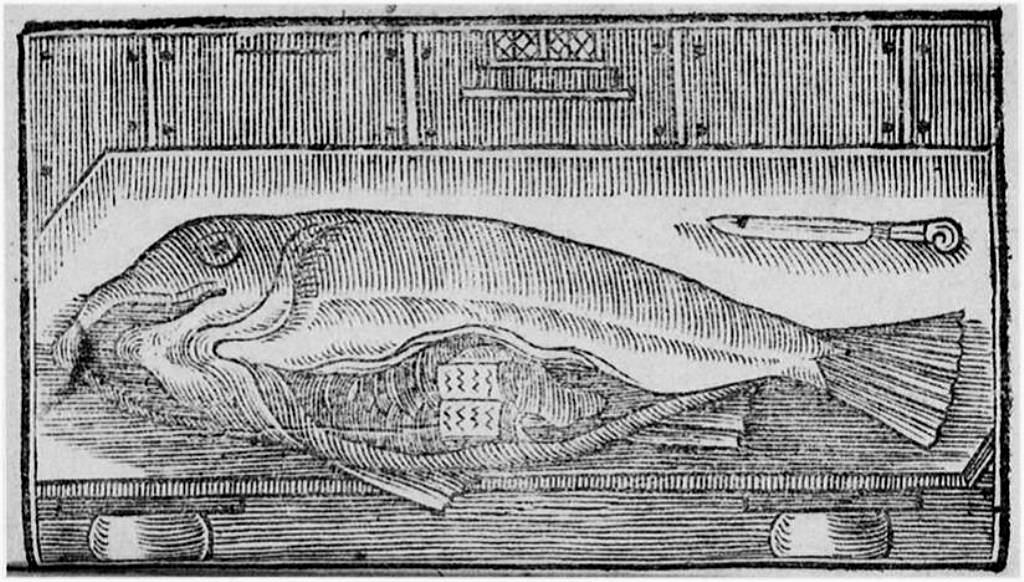
Among the more curious items in the Keynes Bequest is a book entitled Vox Piscis; or, The Book-Fish; Contayning Three Treatises Which Were Found in the Belly of a Cod-Fish in Cambridge Market, on Midsummer Eve Last, Anno Domini 1626 (1627). The title says it all. The circumstances surrounding this catch are detailed in the preface of the book, where we are told that “a codfish being brought to the fish-market of Cambridge and there cut up, … in the depth of the mawe of the fish was found wrapped in a peice of canvase, a booke in decimo sexto, containing in it three treatises bound up in one” (p. 8). The preface was written by the clergyman Thomas Goad (1576-1638), who became a Fellow of King’s College in 1596. In his will, he bequeathed his land in Milton to the College, “to the intent that the whole yearlie profitt thereof bee faithfullie emploied yearlie for ever in divinitie bookes for the librarie”. Many of these books bear the inscription “Legavit Thomas Goad”.

Vox Piscis 1b

The voice of the fish: title page and frontispiece of Vox Piscis; or, The Book-Fish (Keynes.D.4.15). It is unclear how the book ended up in the fish’s stomach.

Joseph Mede (1586-1639), theologian and Fellow of Christ’s College, helped clean the bundle and decipher the content of the treatises. They were attributed to John Frith (1503-33), the Protestant reformer who was imprisoned in Oxford in a “darke cave, where salt-fish was then kept” (p. 19) and burned at the stake in London on 4 July 1533. Frith received his B.A. degree from King’s, so the book bears a close connection with the College. Incidentally, his tutor at Cambridge, Stephen Gardiner, later played a role in condemning him to death. That’s Cambridge supervisions for you. The Keynes Bequest has two other copies of Frith’s works: A Pistle to the Christen Reader (Antwerp, 1529) and A Boke Made by Iohn Fryth, Prysoner in the Tower of London (Antwerp, 1548), a reply to Sir Thomas More.

Vox Piscis 2b

The second plate of Vox Piscis, wanting in King’s College copy; this is from the copy in the Cambridge University Library.

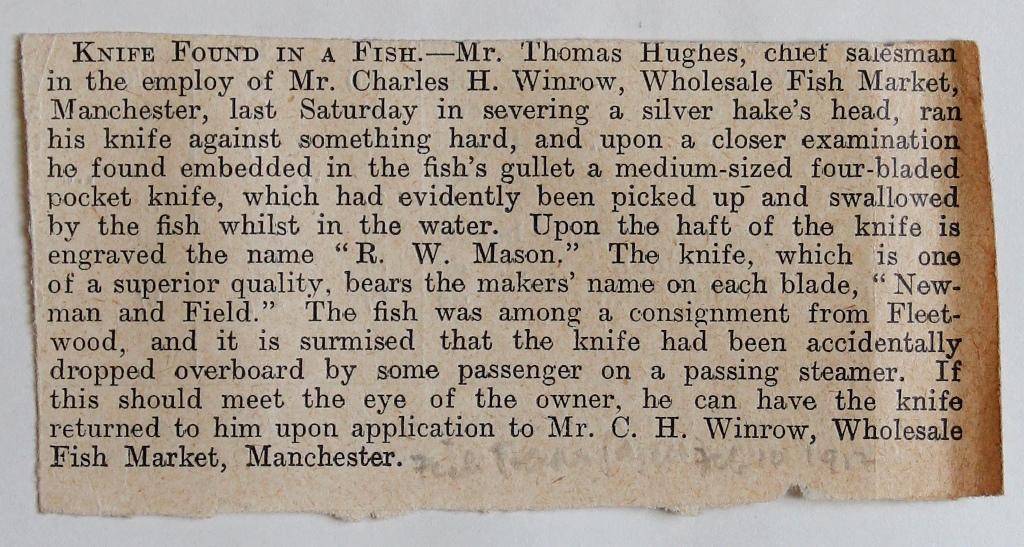
If you think this already sounds like something out of Pinocchio, there is more to come. Inside the book is preserved a newspaper cutting with the date “Feb 10 1912” pencilled in by a former owner. The short article recounts how a pocket knife was found inside a silver hake by Thomas Hughes, a salesman at the Wholesale Fish Market in Manchester. It then describes the knife, “one of a superior quality” bearing the makers’ name on each blade, “Newman and Field”, before inviting the owner to come forward and have it returned to them.

Vox Piscis 3

“Knife found in a fish”: newspaper cutting preserved inside the book.

Carrying such items is now probably illegal following the introduction of the Offensive Weapons Act in 1996, but if a knife that matches this description has been missing from your kitchen for the last century, now may be a good time to claim it back.

IJ

The Vagaries of English Spelling

When George Bernard Shaw died in 1950, he bequeathed a substantial portion of his estate to finance the creation of a new English phonemic alphabet. The word ‘ghoti’, i.e. ‘fish’ (gh, pronounced [f] as in tough; o, pronounced [ɪ] as in women; ti, pronounced [ʃ] as in nation), is often cited as an example of the irregularities in English and misattributed to Shaw. While his endeavours to simplify English orthography are well known, he is not the first one to have taken steps towards this end.

Shavian Alphabet

The Shavian Alphabet, devised in 1958 by Kingsley Read and three other entrants who won a competition to create an economical writing system for English, as stipulated in Shaw’s will

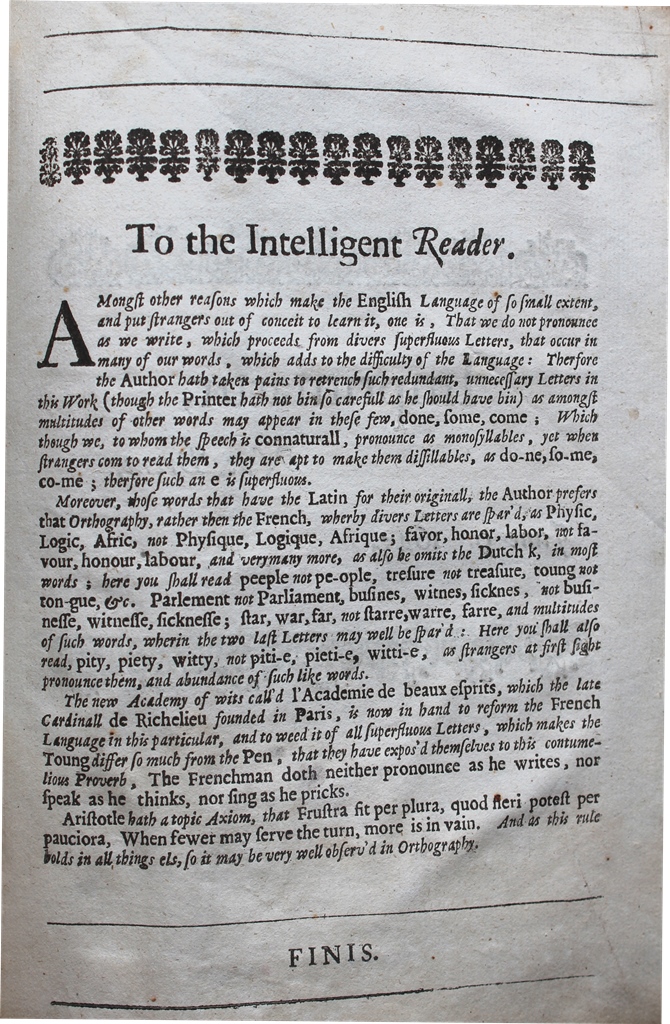
The Keynes Bequest features a first edition of Epistolae Ho-Elianae: Familiar Letters Domestic and Forren (1645) by James Howell (ca. 1594-1666), in which the author argues in the epilogue: ‘Amongst other reasons which make the English language of so small extent, and put strangers out of conceit to learn it, one is, that we do not pronounce as we write, which proceeds from divers superfluous letters, that occur in many of our words, which adds to the difficulty of the language’.

Keynes.D.3.16-2 Title page

Engraved title page of Howell’s Epistolae Ho-Elianae: Familiar Letters Domestic and Forren (1645)

Keynes.D.3.16-2 Epilogue

Howell’s Epilogue ‘To the Intelligent Reader’ criticising redundant letters in English words

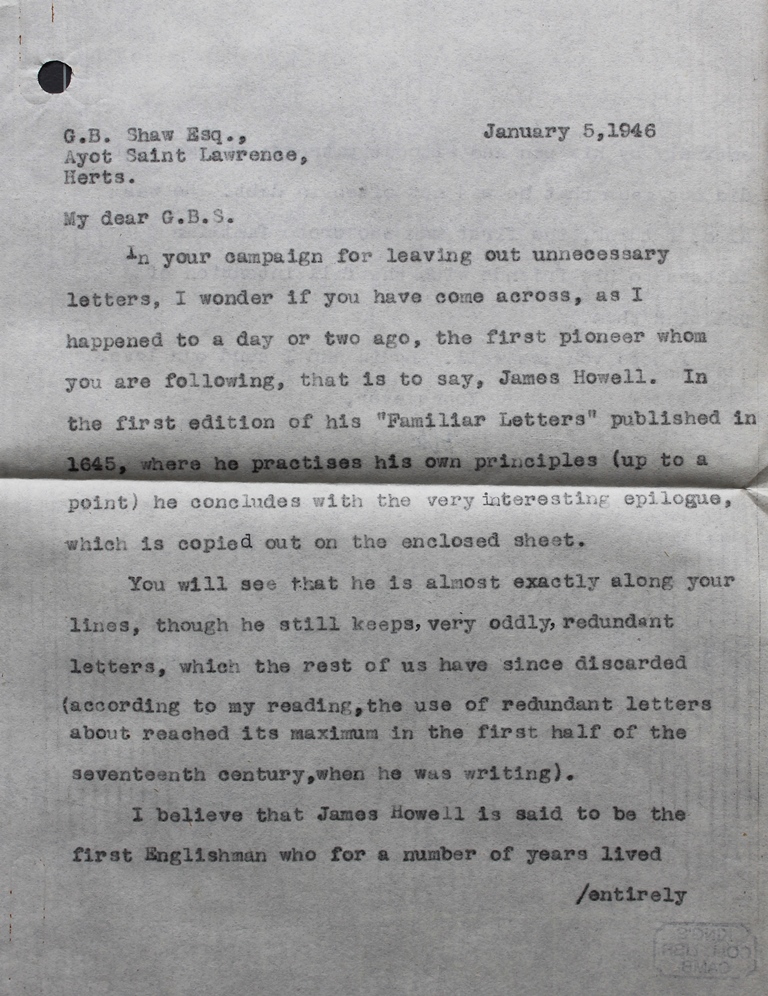
Keynes wrote to Shaw on 5 January 1946 to draw his attention to Howell, ‘the first pioneer whom you are following’. The carbon copy of the letter, initialled by Keynes, is preserved in the book and accompanied by his transcription of Howell’s epilogue ‘To the Intelligent Reader’. This highlights the importance of cataloguing the collection, as it throws light on Keynes himself, his book-collecting habits and uncovers new correspondence between him and his illustrious friends.

Keynes.D.3.16-2 Letter

Keynes’s letter to Shaw, 5 January 1946 [recto]

Keynes.D.3.16-2 Letter 2

Keynes’s letter to Shaw, 5 January 1946 [verso]

Later this year, the English Spelling Society will host the first International Spelling Congress to come up with proposals to update the English spelling system. While the implementation of such recommendations is likely to face major obstacles, the case for simplification has been made compellingly in a 2003 study which investigated literacy acquisition rates in 13 languages, and concluded what Howell had already highlighted in 1645: ‘Children from a majority of European countries become accurate and fluent in foundation level reading before the end of the first school year. […] The rate of development in English is more than twice as slow.’

In 1991, the Académie française recommended a number of ‘rectifications orthographiques’ to regularise French spelling, which, though largely ignored at first, have now become widely accepted. The Germans too introduced an orthography reform in 1996, which has been adopted throughout German-speaking countries after some initial controversies and teething problems. So shud Inglish follou sut?

IJ

Je suis Louis de Montalte

At a time when freedom of expression has been widely debated following the Charlie Hebdo shootings in Paris, it may seem appropriate to look at a book in the Keynes Bequest published when the freedoms which we take for granted were but a distant mirage.

Keynes.Ec.7.3.20 Title page

Title page of Keynes.Ec.7.3.20

Blaise Pascal’s Lettres provinciales was first printed in 1657 under the pseudonym Louis de Montalte during the formulary controversy between the Jesuits and Jansenists. Jansenism was a seventeenth-century movement in the Catholic Church which came under attack from the Jesuits in 1655. Pascal was invited to write a rejoinder, which took the form of a withering criticism of the casuistical methods of argument used by the Jesuits to justify their lax morality. Having been forced into hiding while writing this work, Pascal pretended the letters were reports on religious and doctrinal issues debated at the Sorbonne sent from a Parisian, Louis de Montalte, to a friend in the provinces.

Port-Royal-des-Champs (1700-49) Museum Catharijneconvent, Utrecht

The abbey of Port-Royal-des-Champs in Paris, the theological centre of the Jansenist movement (Museum Catharijneconvent, Utrecht, ca. 1700-49)

The 18 letters were published and circulated anonymously as individual pamphlets from 23 January 1656 to 24 March 1657, and later collected under the fictitious imprint ‘Cologne, Chés Pierre de la Vallée’. They were in fact printed in Paris, probably by Pierre le Petit, Denis Langlois, Sébastien Hyp, and others. Anyone found in possession of the pamphlets was arrested, as the book was banned by both King Louis XIV and Pope Alexander VII.

Keynes.Ec.7.3.20 Title page detail

Close-up of the signature on the title page: L’abbé de champagne du Saullay?

Most editions are bound with polemical responses to Pascal’s epistles. Our copy is noteworthy in that it consists of no fewer than 57 items, and the original owner recorded on the flyleaf that ‘la plus grande partie de ces pièces m’ont esté données par les autheurs’. The identity of this owner remains elusive: ‘L’abbé de champagne du Saullay’? Or ‘L’abbé de champ [?] Saullay’? Any assistance in identifying them would be much appreciated!

Keynes.Ec.7.3.20 Nodier 2

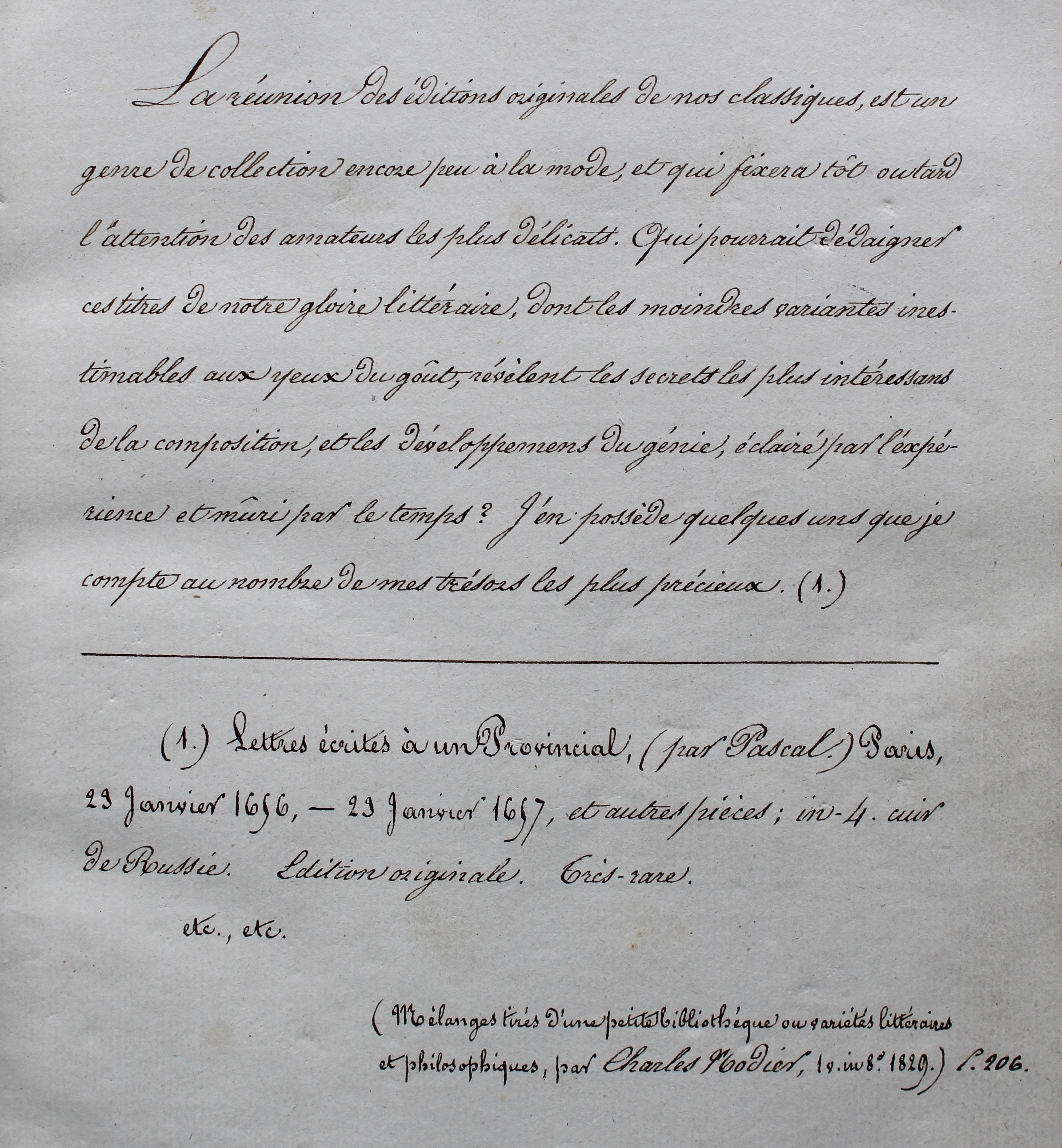
A 19th-century owner’s inscription from Charles Nodier’s Mélanges tirés d’une petite bibliothèque (1829)

The book passed through several hands before Keynes. An anonymous owner recorded: ‘Acheté à M. Guillemot, libraire, le 28 mai 1832’. The same person inscribed on one of the fly-leaves a quotation from the French author and bibliophile Charles Nodier’s Mélanges tirés d’une petite bibliothèque (1829): ‘La réunion des éditions originales de nos classiques est un genre de collection encore peu à la mode, et qui fixera tôt ou tard l’attention des amateurs les plus délicats.’

Keynes.Ec.7.3.20 Keynes
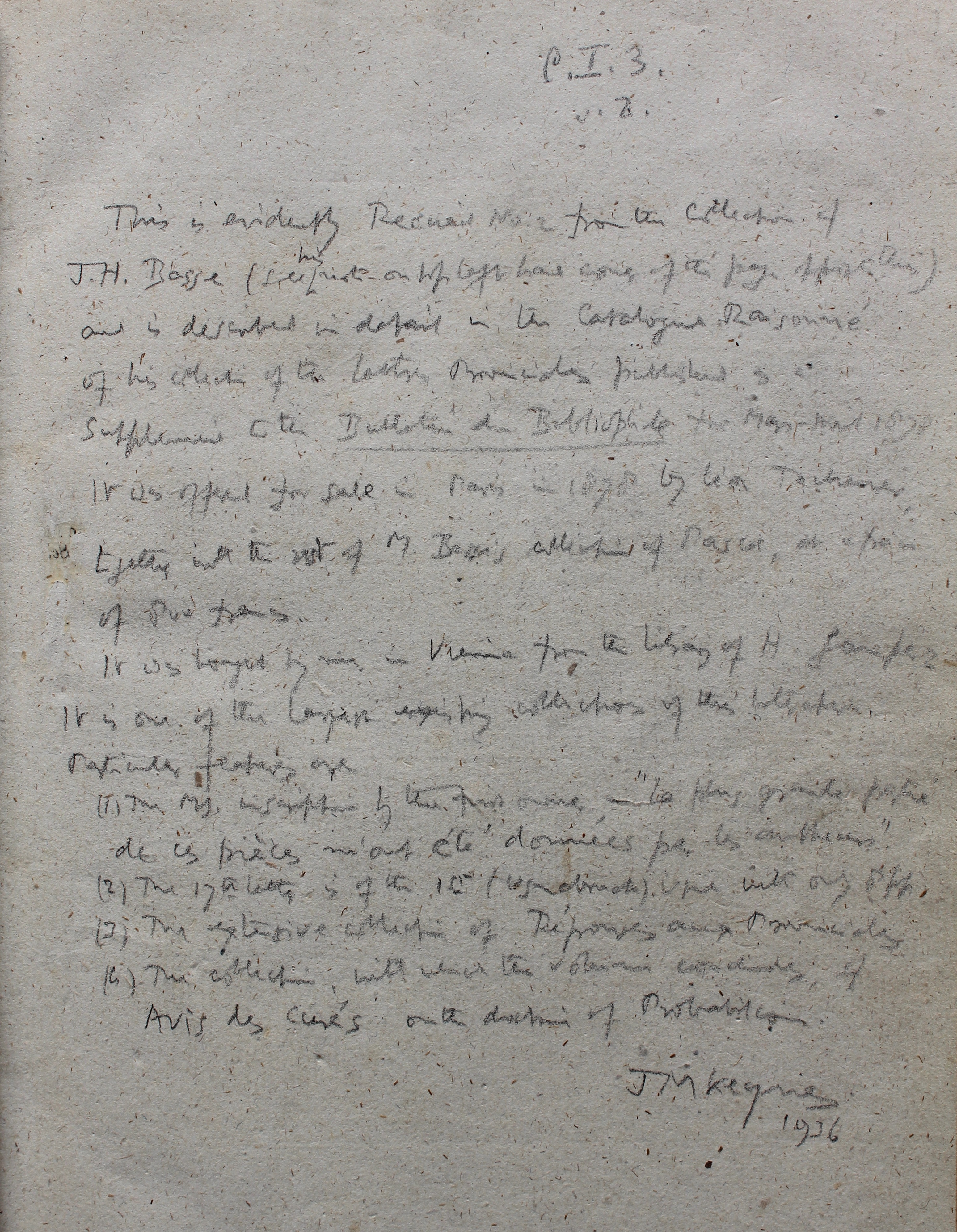
Keynes’s pencil note on the fly-leaf

This statement could not have been more prophetic in light of the book’s subsequent owners. Unusually, Keynes recorded on one of the fly-leaves details of the book’s provenance and notable features: ‘This is evidently Recueil no. 2 from the collection of J. H. Basse [Jean Hippolyte Basse, d. 1877]’. It was offered for sale in Paris in 1878 by Léon Techener,  and must have been bought by the book collector Sir Thomas Brooke (1830-1908), whose bookplate is on the front paste-down. The volume was acquired in 1913 by the Austrian philosopher and rare books collector Heinrich Gomperz (1873-1942), who fled his homeland in 1938 following the annexation of Austria by Nazi Germany and joined the University of Southern California. It was bought by Keynes in Vienna in 1936, and bequeathed to King’s College in 1946.

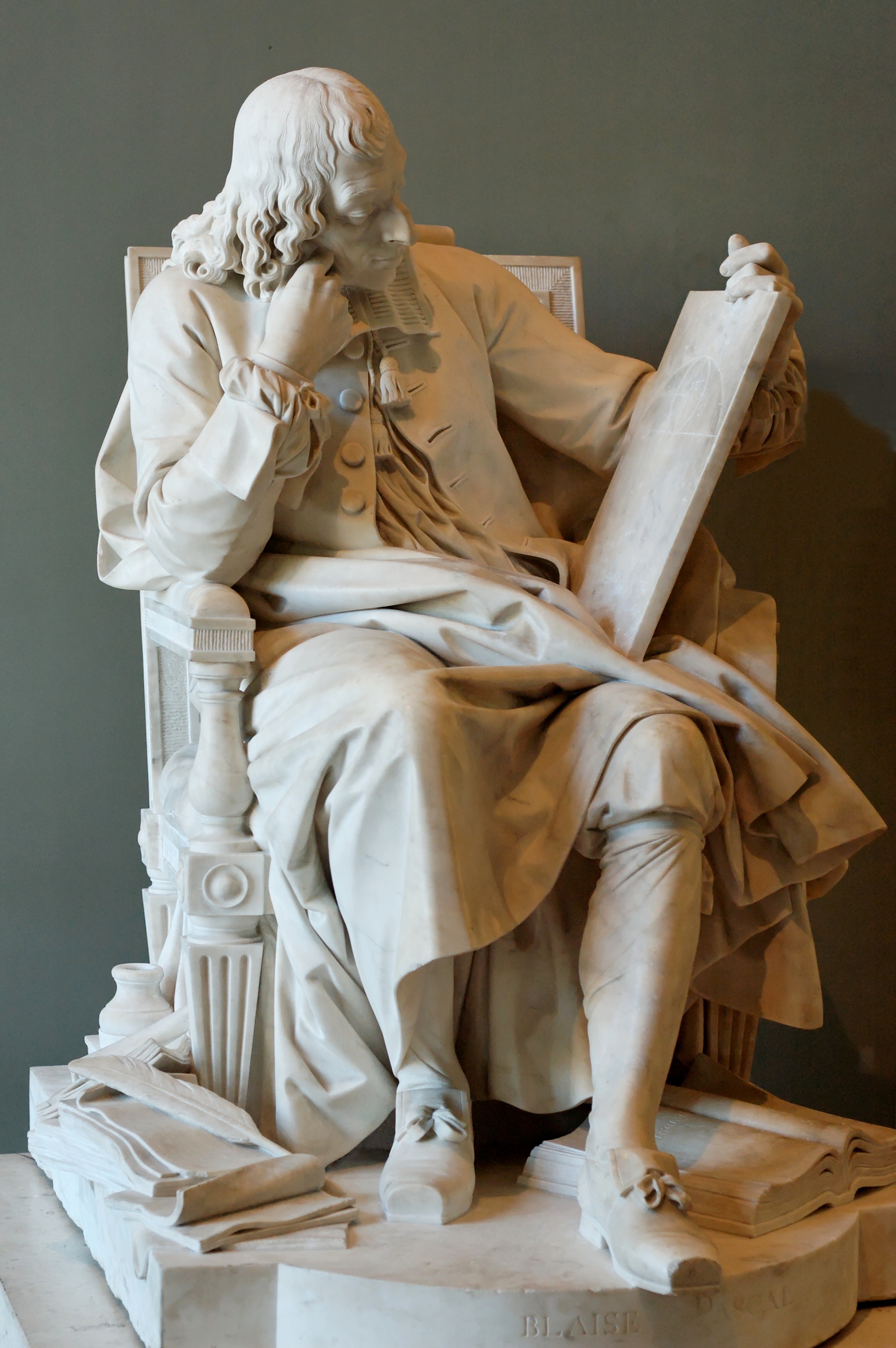
Pascal_Pajou_Louvre_RF2981

Blaise Pascal (1623-1662) studying the cycloid. At his feet are the Pensées; the open book is the Provinciales (Augustin Pajou, 1785)

King Louis XIV’s order that the Lettres provinciales should be burned, and Pope Alexander VII’s placing it on the Index of Prohibited Books in 1657, clearly did nothing to deter educated Frenchmen from reading it: its popularity spread like wildfire, both in France and abroad, so that there were about 30 editions by 1700. The genealogy of this rare first edition’s illustrious owners, spanning three centuries and three countries, and their eagerness to mark their ownership on the book in a way that Pascal could not (he was identified as the author only after his death), is a testament to the letters’ enduring significance and importance. Apart from their religious value, Pascal’s brilliant prose style, his coruscating wit and use of mockery and satire contributed to making the Provinciales popular as a literary work. It later influenced Molière, Montesquieu and Voltaire, who, despite his aversion to Pascal’s thought, defined it in Le Siècle de Louis XIV (1751) as ‘le premier livre de génie qu’on vit en prose’.

‘I have made this [post] longer than usual, only because I have not had the time to make it shorter.’

IJ

Isaac Newton’s dog-ears

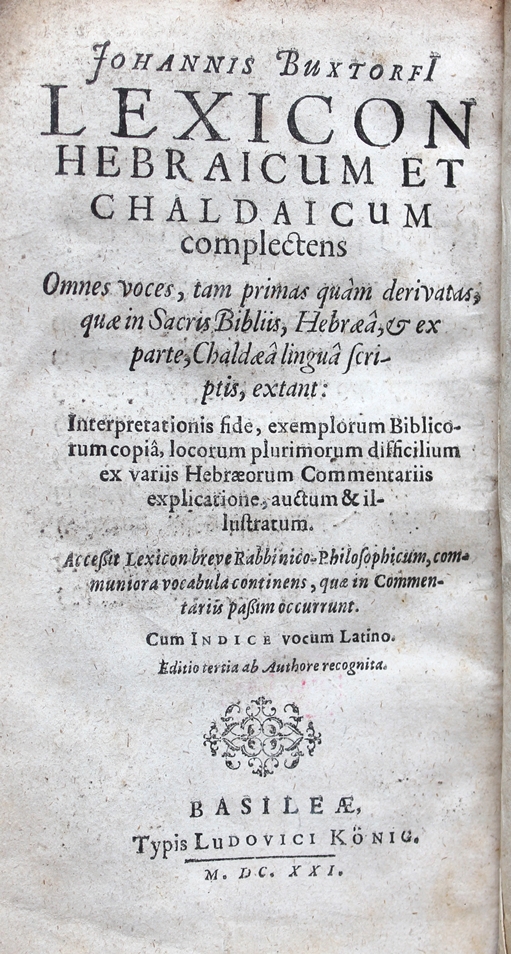
Keynes.Ec.7.3.26 Lexicon Hebraicum et Chaldaicum - title page

The title page of Keynes.Ec.7.3.26

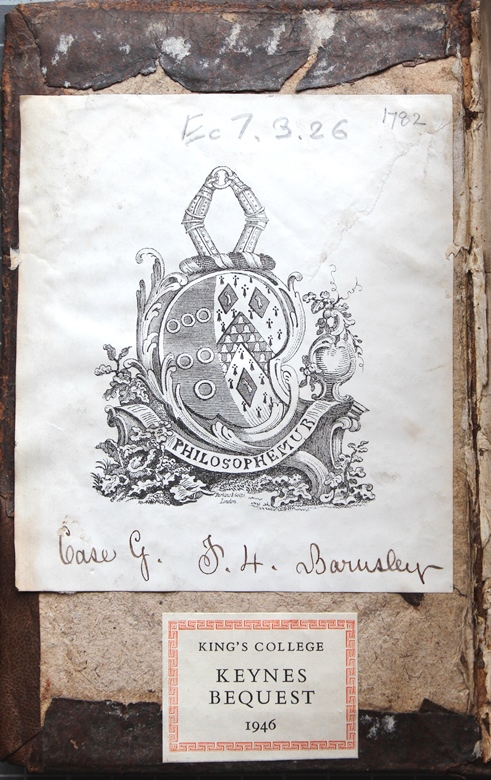
Bookplate on inside front board of Keynes.Ec.7.3.26

Bookplate on inside front board of Keynes.Ec.7.3.26

Among the highlights of the Keynes Bequest are two volumes from Sir Isaac Newton’s library, with a fascinating history behind them. This copy of Johann Buxtorf’s third edition of Lexicon Hebraicum et Chaldaicum (Basel: Ludwig König, 1621) features an armorial bookplate with motto ‘Philosophemur’ and ‘Case G. F.4. Barnsley’ in ink underneath the bookplate. On the rear fly-leaf is the shelfmark ‘F2_27’. The ‘Philosophemur’ bookplate belonged to Dr James Musgrave, who was Rector of Chinnor, near Oxford. After he died in 1778 the library was removed to Barnsley Park, Gloucestershire, the home of his son, where the books were re-catalogued and re-classified with ‘Barnsley’ shelfmarks. Musgrave’s books had been previously owned by his predecessor at Chinnor, Charles Huggins, who received them from his father, John Huggins, Warden of the Fleet Prison. John Huggins had bought the collection from the estate of his late neighbour, Isaac Newton, for £300.

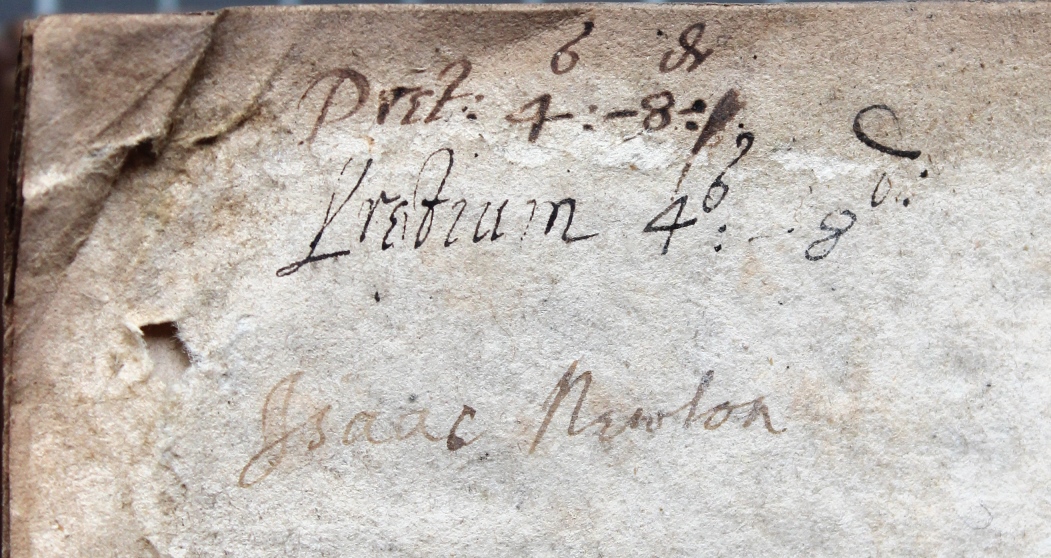
Signature of Isaac Newton

Signature of Isaac Newton

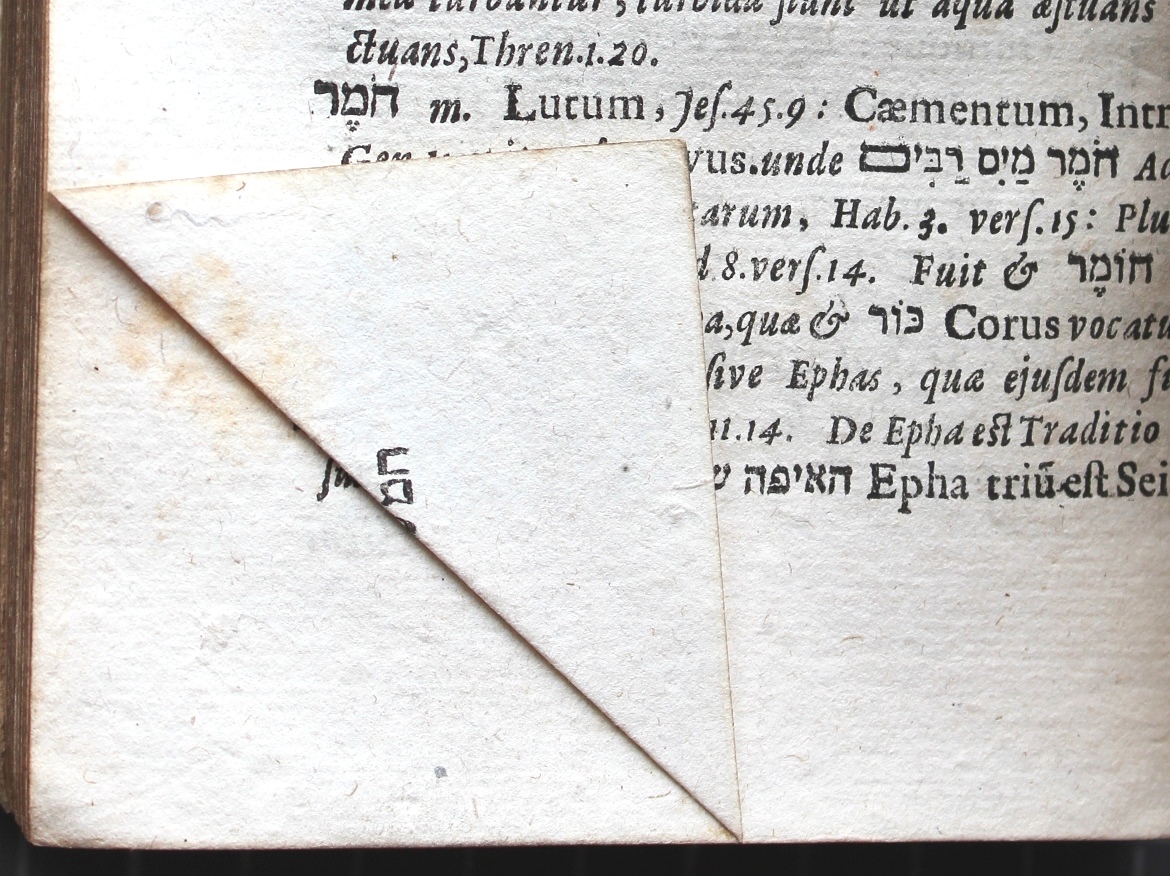
Newton’s library was preserved almost intact until 1920, when more than half of the items were auctioned off and dispersed. Before securing one of the most important collections of Newton’s manuscripts in the world, which he acquired during and after a sale at Sotheby’s in 1936, John Maynard Keynes purchased two of Newton’s books from the Guildford bookseller Thomas Thorp in March 1921. This Latin-Hebrew dictionary is signed on the front and rear fly-leaves: ‘Isaac Newton’, who also noted the price on the rear fly-leaf: ‘Pret: 4s: 8d’.

Newton highlighting the word 'Lutum' in Keynes.Ec.7.3.26

Newton highlighting the word ‘Lutum’ in Keynes.Ec.7.3.26

Newton had the habit of ‘dog-earing’ his books, turning back the corner of leaves to note a reference, the corner of the leaf pointing to the exact word he wished to highlight. Eight pages (pp. 11, 18, 29, 45, 164, 247, 593 and 636) are turned back in this way in this dictionary. For more information, see John Harrison, The Library of Isaac Newton (Cambridge: Cambridge University Press, 1978). Some of the information in this post is drawn from the SCOLAR blog of Cardiff University.

IJ

Munby Cataloguing Project (Rare Books)

Title page

The title page of Keynes.D.1.9

In June 2013 King’s College held a conference to mark the centenary of the birth of A.N.L. (Tim) Munby, Librarian at King’s from 1947 to 1974. The conference was a great success, with a distinguished panel of speakers from the world of bibliography and the history of books, and over 120 registered participants. As a follow-up to the conference, and as a permanent tribute to Tim Munby, King’s College inaugurated a fund in his name—The Munby Centenary Fund.  Donations to the fund support projects initiated by Munby, or related closely to his interests and achievements.

Spine detail

The gold tooling on the book’s spine.

The initial objective is to complete the online cataloguing of all of the books in the collection of John Maynard Keynes and generous donations have already made it possible to hire Dr Iman Javadi as ‘Munby Project Cataloguer (Rare Books)’ to begin this work. Iman joined the library team in November 2014, and has so far catalogued over 200 books.

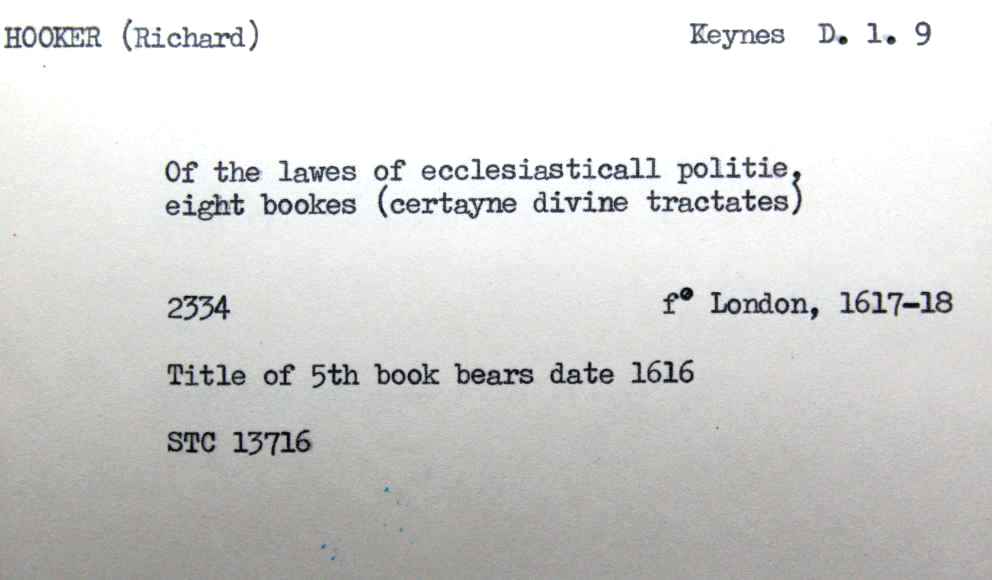
Tim Munby began his career at King’s as the first cataloguer of Keynes’s collection, although cataloguing in those days was very different. Catalogue cards often included little more than author, title and imprint details.

Index card2

Tim Munby’s original catalogue card.

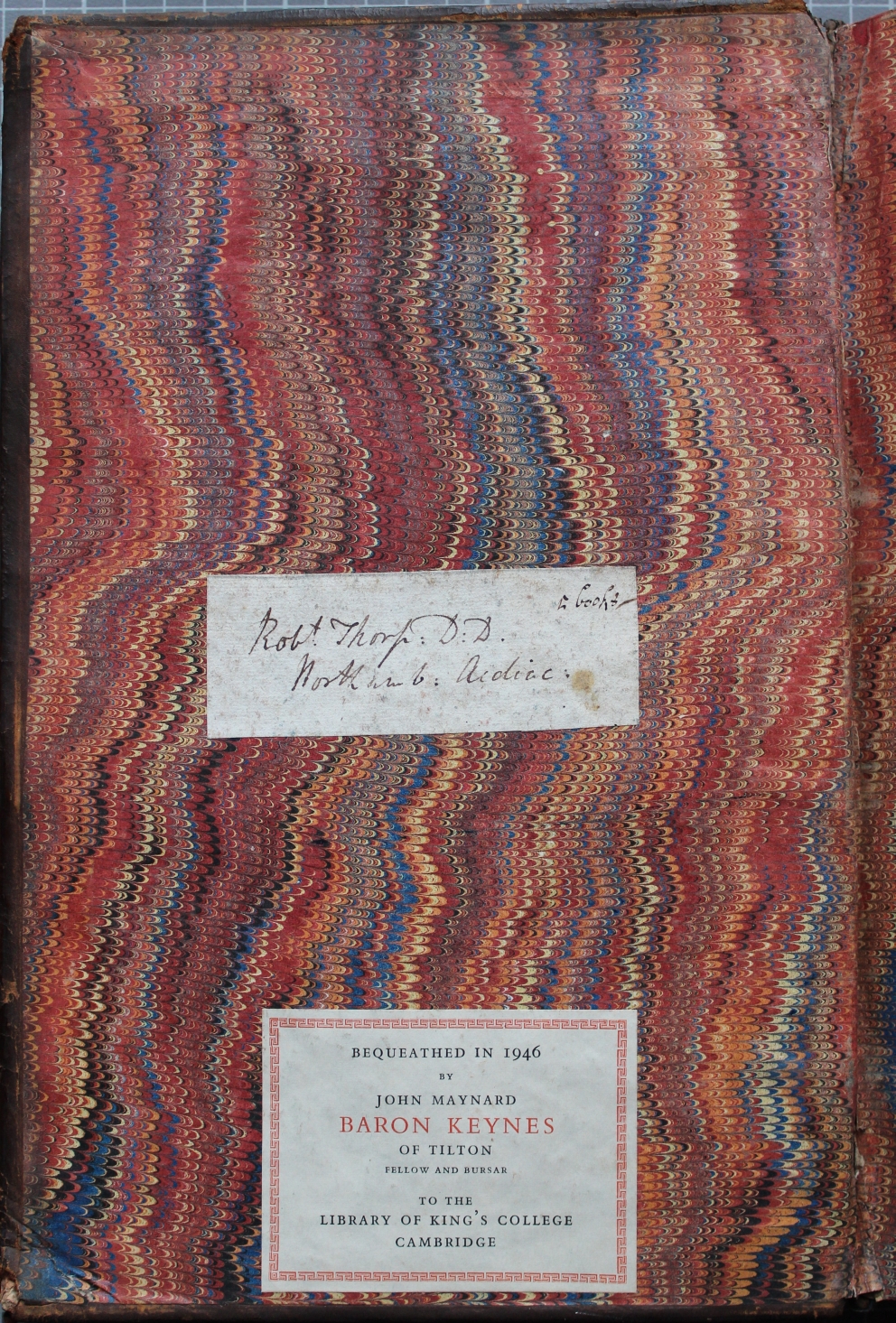
Front pastedown1

Inside front pastedown showing Keynes’s bookplate.

These days catalogue records for rare books typically include a wealth of copy-specific information such as binding descriptions, provenance information and information relating to former owners and detailed physical descriptions of the book as an object. This change not only reflects changes in research interests in bibliography, but also assists librarians in collection management, and the availability of these descriptions online improves access to the collections.

The newly created online record for this  item can be viewed here: MARC record (opens a .docx file)

Further updates about the project will be posted on this blog.

JC