HLF funding for King’s Library

King’s Library has received £44,000 from the Heritage Lottery Fund (HLF) for an exciting project, ‘Shakespeare and Austen at King’s College: Celebrating their Centenaries in 2016 and 2017’. The project will result in the online cataloguing and conservation of the English literature section of the Thackeray collection of rare books, bequeathed to King’s College Library in the mid-nineteenth century by the sometime Provost of the College, George Thackeray (1777-1850), cousin of the novelist William Makepeace Thackeray (1811-1863). A major part of the project is a comprehensive programme of outreach activities and online educational material.

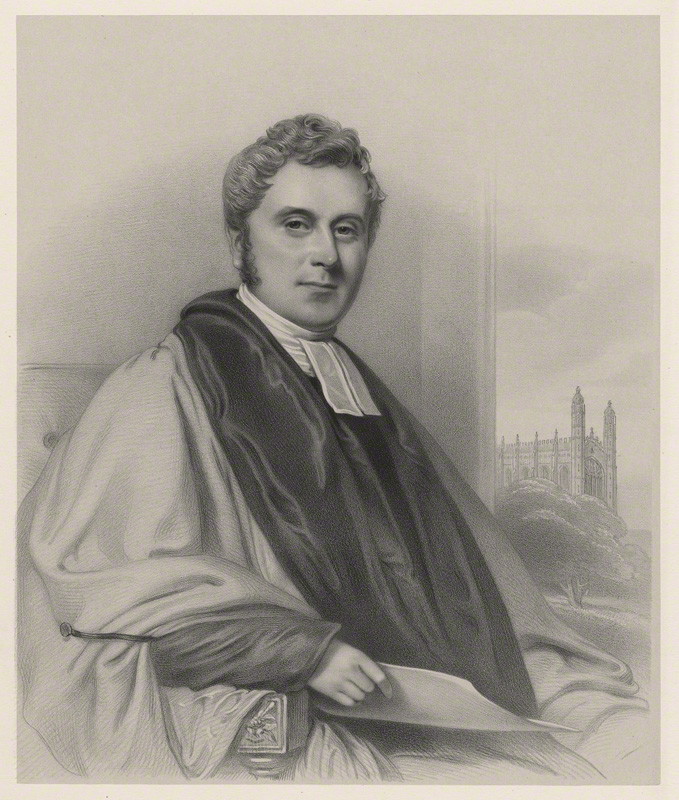
by Richard James Lane, lithograph, 1851

George Thackeray (1777-1850) by Richard James Lane, lithograph, 1851

The project will enable local people and volunteers to engage with some of the most important books in the history of English literature through a series of exhibitions, talks, open days and workshops for young people, and give a worldwide audience the opportunity to learn about the collection online. Owing to the lack of a proper online catalogue, the collection has remained difficult to explore.

Shakespeare folio image

Title page of Shakespeare’s First Folio (1623)

Highlights in Thackeray’s library include Shakespeare’s First Folio, first and early editions of all of Austen’s novels, a collection of 16th-century books on theology (including works by Sir Thomas More, Martin Luther and Erasmus), and over one thousand volumes of early editions of the most important English authors in sumptuous historic bindings. Other major writers included are John Milton, John Donne, Edmund Spenser and Ben Jonson.

We are delighted to have received the support of the Heritage Lottery Fund, which will enable us to gain a much better understanding of the Thackeray collection and help us to improve access to these treasures. We are also looking forward to the many opportunities the project will afford us to allow local people to engage with their heritage (anyone interested in volunteering for the project is most welcome to get in touch), and hopefully revisit the works of Shakespeare and Austen during their anniversary years.

english_landscape_pantone

JC


Lake District Books (1750-1850): An Online Exhibition

Peter Bicknell (1907-1995), an architect, mountaineer and art historian who taught architecture at Cambridge for more than fifty years, was also a book collector with a particular interest in eighteenth-century topographical books and prints. In 1980 he donated his collection of books on the Lake District to King’s College Library. As Bicknell later recalled in his introduction to The Picturesque Scenery of the Lake District, “My addiction to book-collecting was stimulated by the friendship of that inspired lover of books, A. N. L. (‘Tim’) Munby. When some years ago I decided that it was time I found a permanent home for my Lake District collection, it occurred to me that there could be no better place for it than the library of King’s” (Winchester: St. Paul Bibliographies, 1990, p. x). We have just started cataloguing the collection and mounted an exhibition in the library, some highlights from which are described below.

Peter Holland was a Liverpool artist about whom little is known. He visited Ambleside in 1797. His Select Views of the Lakes is the first book of Lake District views using the printing technique known as aquatint. In this method of printing the artist makes marks on the plate (in the case of aquatint, a copper or zinc plate) that are capable of holding ink. The inked plate is passed through a printing press together with a sheet of paper, resulting in a transfer of the ink to the paper.

Peter Holland, Select Views of the Lakes in Cumberland, Westmoreland & Lancashire (Liverpool: printed by James Smith, for John Peeling, [1792]) Bicknell.61

Peter Holland, Select Views of the Lakes in
Cumberland, Westmoreland & Lancashire
(Liverpool: printed by James Smith, for John Peeling, [1792])
Bicknell.61

This copy of Revd Stebbing Shaw’s A Tour in 1787 from London to the Western Highlands of Scotland bears the ownership inscription “Elizabeth Vernon: Given to her by the Marquis of Lansdown 1792”. It ended up in the library of Holland House in Kensington and has their bookplate on the inside front pastedown. The book shows signs of fire damage from when Holland House was bombed during the Blitz in 1940.

Stebbing Shaw, A tour, in 1787, from London, to the Western Highlands of Scotland (London: printed for L. Davis, Messrs. Robson and Clarke, W. Lowndes, H. Gardner, J. Walker, [1788]) Bicknell.27

Stebbing Shaw, A Tour, in 1787, from London,
to the Western Highlands of Scotland
(London: printed for L. Davis, Messrs. Robson and Clarke,
W. Lowndes, H. Gardner, J. Walker, [1788])
Bicknell.27

Peter Crosthwaite was an expert in self-advertisement, referring to himself in this plate as “Admiral at Keswick Regatta; who keeps the Museum at Keswick, is Guide, Pilot, Geographer, Hydrographer to the Nobility and Gentry, who makes the Tour of the Lakes”.

An accurate map of the matchless Lake of Derwent (situated in the most delightful Vale which perhaps ever Human Eye beheld) Peter Crosthwaite, Maps of the Lake District (London: published & sold by Peter Crosthwaite, 1819) Bicknell.10

“An accurate map of the matchless Lake of Derwent (situated in the most delightful Vale which perhaps ever Human Eye beheld)”
Peter Crosthwaite, Maps of the Lake District
(London: published & sold by Peter Crosthwaite, 1819)
Bicknell.10

The next item in the exhibition, William Hutchinson’s An Excursion to the Lakes in Westmoreland and Cumberland, is one of the earliest books in the Bicknell Collection. The excursion was made with William Hutchinson’s brother Richard who acted as draughtsman. The book includes a generous amount of rich picturesque description and lively accounts of unusual incidents.
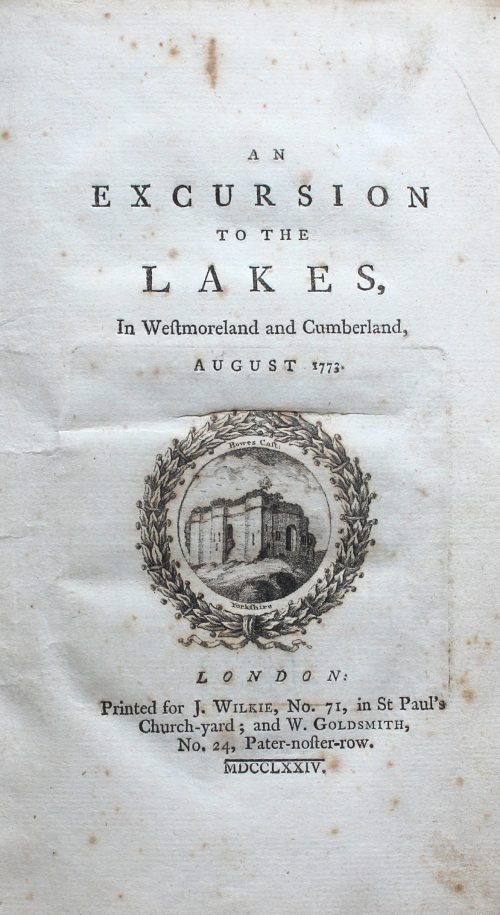
William Hutchinson, An Excursion to the Lakes in Westmoreland and Cumberland (London: printed for J. Wilkie & W. Goldsmith, 1774) Bicknell.1

William Hutchinson, An Excursion to the Lakes in Westmoreland and Cumberland
(London: printed for J. Wilkie & W. Goldsmith, 1774)
Bicknell.1

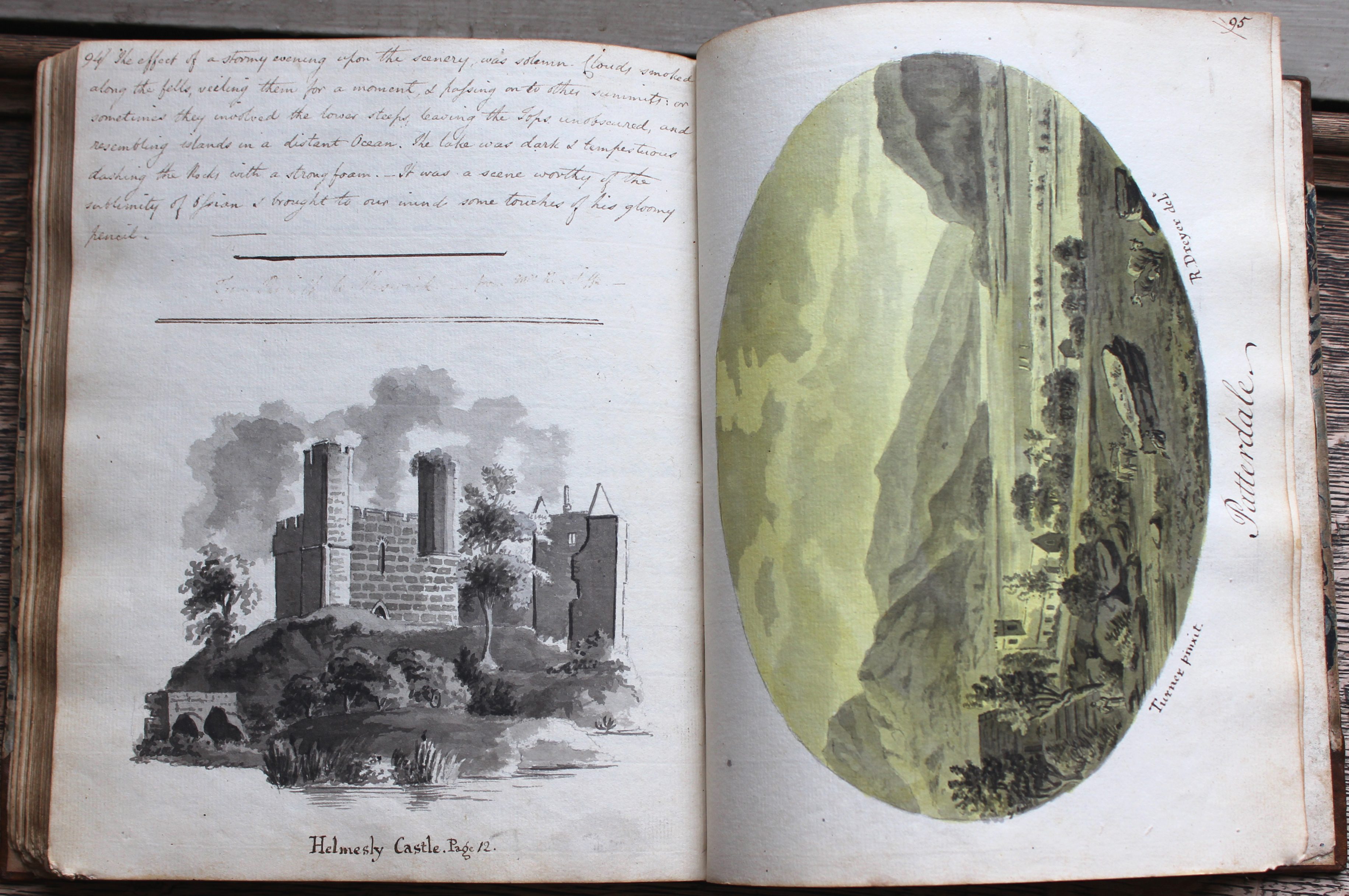
This manuscript journal is illustrated with wash drawings in imitation of William Gilpin’s Observations (London, 1786). The tour was taken in the autumn of 1792 by Mr and Mrs R. Rede and Mr Dreyer. The book is compiled from notes taken on the spot by Mr Rede.
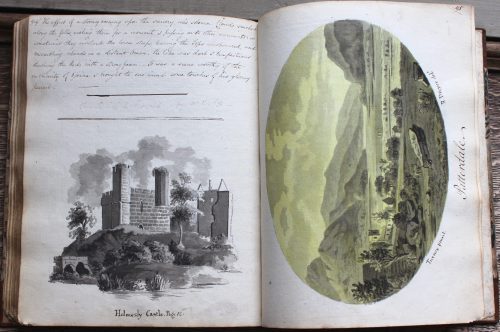
R. Dreyer, A Tour of the Lakes of Cumberland & Westmoreland (Great Yarmouth) Bicknell.82

R. Dreyer, A Tour of the Lakes of Cumberland & Westmoreland
(Great Yarmouth)
Bicknell.82

Thomas Rose’s three-volume work Westmorland, Cumberland, Durham, & Northumberland includes 213 steel engravings from drawings by Allom, Gastineau and Pickering by various engravers. Prints from these fine and durable steel plates were produced in large numbers for many years. They were used in various books and for a variety of purposes such as headings for letter paper and for table maps.

Thomas Rose, Westmorland, Cumberland, Durham, & Northumberland (London: Fisher & Jackson, [1832-1835]) Bicknell.85

Thomas Rose, Westmorland, Cumberland, Durham, & Northumberland
(London: Fisher & Jackson, [1832-1835])
Bicknell.85

Finally, these sixteen views were issued without text or title to be bound with Thomas West’s Guide to the Lakes (1778). The views were advertised in the later editions of West’s Guide, and in that sense belong closely to the aesthetic promoted by West’s editors. The artists often intervene in the topography to improve the view.

John Smith, Sixteen Views of the Lakes in Cumberland and Westmorland (London: printed for W. Clarke [1794-1795]) Bicknell.84

John Smith, Sixteen Views of the Lakes in Cumberland and Westmorland
(London: printed for W. Clarke [1794-1795])
Bicknell.84

Mira Le/JC/IJ

Riveting Accounts

After someone asked me about a young King’s fellow in about 1579 (whom the enquirer thought might be the minister who married Will Shakespeare and Anne Hathaway – we were not surprised when I couldn’t find any supporting evidence at King’s), I searched through that entire year’s accounts. Some surprising, or at least interesting, things came up.

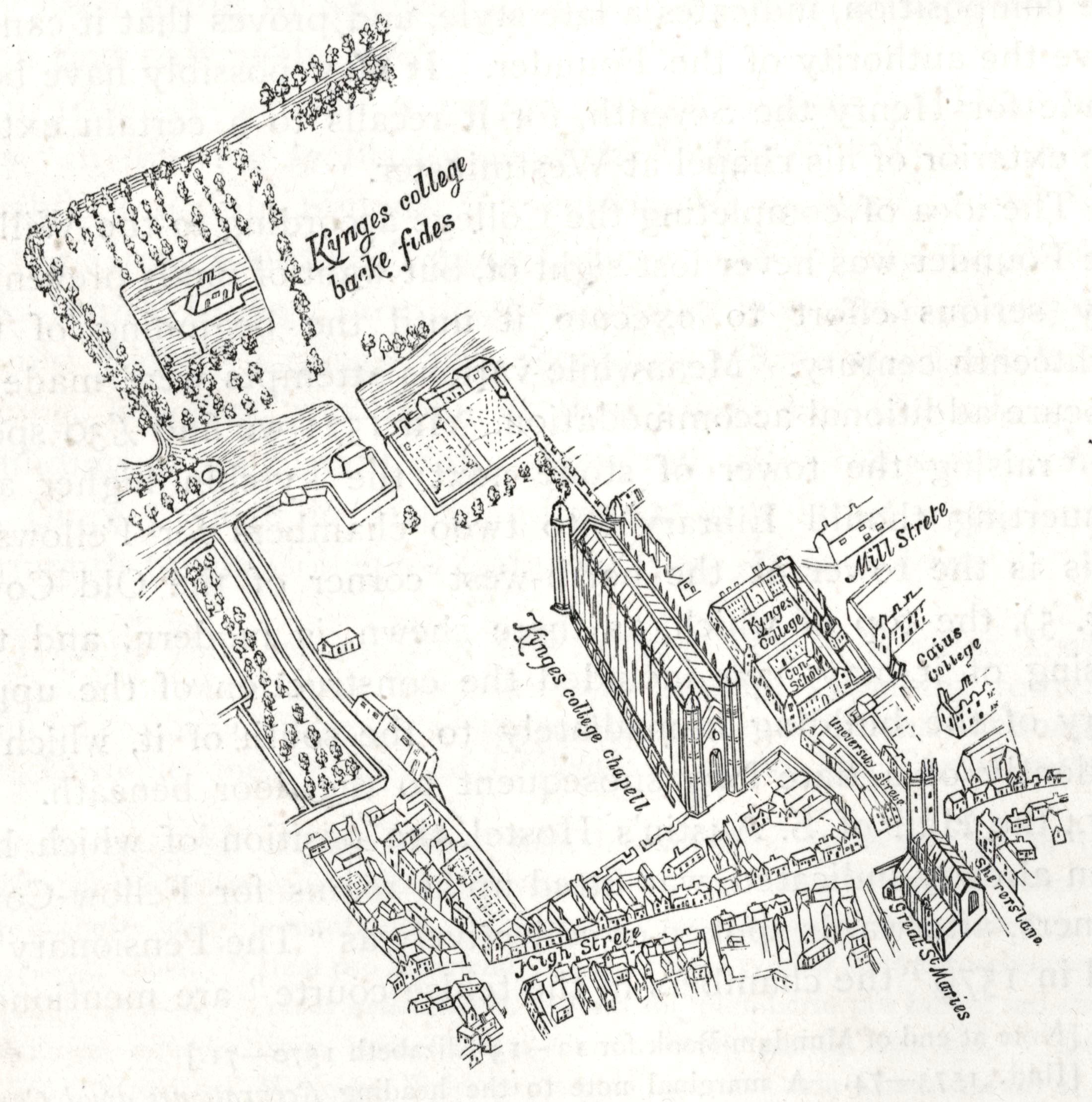
The two great maps of the College site pre-Gibbs’ building are Hamond’s map of 1592 and Loggan’s map of 1688. Hamond’s map is faint, and is reproduced here as a re-drawing from Willis and Clark’s Architectural History of the University of Cambridge and of the Colleges of Cambridge and Eton. The Loggan excerpt reproduced here is taken from a 1921 reprint by Clark and Gray.

W&C-553 fig 57 b

Hamond’s map

1688 Loggan_crop

Loggan’s map

Queens’ Road (west) is at the top – the fields beyond, now the Fellows’ Garden, were common land at the time.

What’s that moated site in the middle of Scholars’ Piece? On the Hamond map it’s occupied by a dovecote. And what about all those buildings around the wall surrounding the College site, particularly visible in Hamond’s map? What are they? The draft accounts (a page of which is shown below) offer some partial explanations.

1578-9 rep cantab 4

KCAR-4-1-4-11 Bursar’s particulars book, reparationes cantab. for Annunt and Bapt term (Easter and long vacation/summer) 1579

These particular pages from the accounts record repairs on the College site. (Other pages record repairs at our Grantchester and Barton estates, for example.) The first three items on this page record payments of

Junii 23 le pavier for paving 32 yerdes in the lane by the stables 2 d ob the yerde…vi s iiii d

for a load of ragge to the same…iiii s vi d

Cochei July 8° pro 10 bigatis argille…vi s viii d

The abbreviation ob is for oblus, technically a halfpenny but the term often appears in the accounts to stand generally for ‘a portion’ – in this case the paving cost works out at 2 3/8 shillings per yard. This suggests it is internal to the College site, for the 1543 Cambridge paving bill (in force until 1788) decreed that all the public streets be maintained by the frontage-holders and that ‘no persone or persones exercysyng the handecrafte or ocupacion of pavyng wythin the sayd towne, shall take above a jd. q. for every yarde square pavyng’ (Cooper’s Annals of Cambridge, vol. 1, p. 411).

Thus we paid someone to pave a lane, at two and a bit pence per yard, and he supplied the (rag-)stones at 4 shillings sixpence. We also paid Cochei for 10 cartloads of clay. It’s not clear whether this is a man called Cochei, or just ‘a coach driver’ – the designation appears in the accounts books frequently during these years, when labourers’ names are usually specified. From the marginal ‘g.w.’ next to this entry and others I surmise the clay (‘argille’), as well as the next items (sand and straw, also delivered by Cochei), were used to build the garden wall in that year. 10,800 tiles were purchased at one point to cope the garden wall ‘about the Fellows garden’ which had a locked gate.

In various places the late 1570s College accounts mention a thatched swan house and a dove house which probably housed the ‘salt stone for the pigeons’ who were fattened, like the swans, with malt – the swans were later ‘upped’ (gathered and marked) and one presumes the pigeons were consumed in Hall. Other buildings mentioned in these years are:

• the stables and stable yard
• wheat house
• wood house and wood yard
• storehouse which might be the same as the larder mentioned
• salt house
• lead house (it housed the leads used in windows and the Chapel roof I suppose)
• ‘house over the water in the Scholars’ garden’
• coal house
• mill house with mill stone and mill horse
• brew house
• bake house
• sedge house with a wall around it which might be the same as the new straw house – a boat was required to remove the scaffolding after the sedge yard wall had been repaired, so if they are the same it must be one of the riverside buildings.

Gates mentioned:

• field gate
• bridge gate
• water gate
• College gate
• alms gate
• friars’ gate

The friars’ gate was approximately where Webb’s Court gate now is. There was a tennis court outside the friars’ gate and an orchard in what is now the Provost’s garden. There were lofts somewhere for malt and fish. Willis and Clark examined the accounts and offered some explanations, but it’s likely that in many cases we will never know which buildings were used for which purposes. So there are more questions than answers at this point, and plenty more research to do in those ‘boring, dry old accounts’.

PKM

“Only connect”: Laura Mary Forster and Charles Darwin

Amongst our fascinating collection of books from the personal library of E.M. Forster (1879-1970) are some which were passed down to him by relations. These include a number of volumes which once belonged to his aunt, Laura Mary Forster (1839-1924):

Laura Mary Forster's bookplate

The bookplate of Laura Mary Forster (1839-1924)

In his biography of Marianne Thornton, Laura’s aunt, E.M. Forster provides a brief outline of Laura’s character:

“Miss Forster never married … she followed the Thornton pattern of intellectual and philanthropic activity, but she could be censorious of her elders, and is constantly taking them up and dusting them before she replaces them, with a word of c0mmendation, on their shelf. In her later life she changed – became gentler, wiser, greater.”

Some of the volumes formerly owned by Laura are especially interesting, since they feature bindings with blind-tooled and stamped leatherwork of her own design. These include a volume by John Ruskin on the medieval Italian artist Giotto, which has a design based around circles, making reference to Giotto’s reputed ability to draw a perfect circle freehand without the aid of a compass.

Binding of Ruskin's work on Giotto

Front cover of: John Ruskin “Giotto and his works in Padua …” (London: Arundel Society, 1854. Forster.RUS.Gio.1854)

It is possible that Laura’s designs were influenced by her association with the arts and crafts designer William Morris (1834-1896), with whom she is known to have corresponded and sent samples of her work. The Arts and Crafts Exhibitions Society exhibit for 1889 featured several of Laura’s book-bindings and also embossed leather chair seats produced by Morris and Co. from her designs.

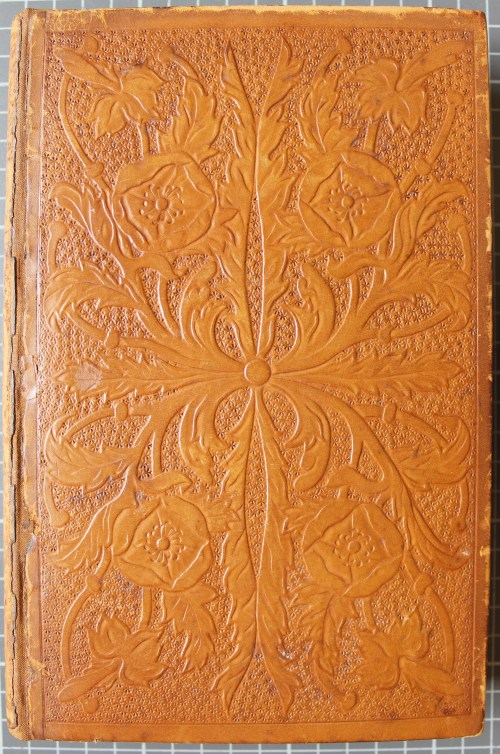
Another work, a three volume set of “The life and letters of Charles Darwin”, which was given to Laura by the editor, Darwin’s son Francis, features a floral design based on poppies.

Binding of volume 2 of "Life and letters of Charles Darwin"

Front cover of volume two of: Francis Darwin (ed.) “The life and letters of Charles Darwin…” (London: John Murray, 1887. Forster.DARW.Lif/2.1887)

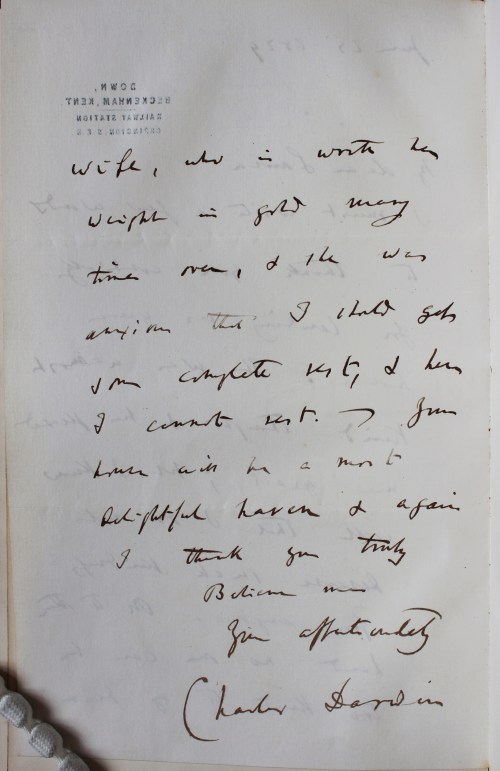
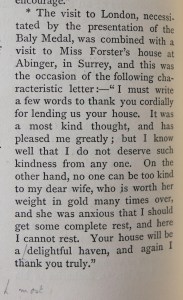
This set is one of the jewels of the Forster collection, since attached inside the front cover of the first volume is an autograph letter from Charles Darwin himself, addressed to Laura and thanking her for allowing him to stay at her house in Surrey in 1879. A transcript of the letter appears in a footnote on page 224 of the third volume.

Darwin letter page 1

First page of a letter to Laura Mary Forster from Charles Darwin, written in 1879

Forster.DARW.Lif1.1887 letter page 02

Second page of Darwin’s letter to Laura

Transcript of Darwin letter

Transcript of Darwin’s letter, from volume three of “The life and letters of Charles Darwin”

Laura was a lifelong friend of Darwin’s eldest daughter Henrietta, with whom she conducted a lively correspondence. Many of these letters survive, including some which convey Laura’s leaning towards Darwinism. Whilst stating that: “it is against one’s taste to come from furry animals, tidal or otherwise”, and remaining steadfast in her Christian faith, she nevertheless believed that: “it is of practical use to get a just estimate of one’s place in creation”. Other relations regarded Darwinism with horror, and Laura relates wryly that one family acquaintance: “…expects every time he comes down to see me hung up on one of the large oaks opposite our house…”

Bibliography:

Forster, E.M. Marianne Thornton (André Deutsch, 2000)

Kelvin, N. (ed.) The collected letters of William Morris, Volume II, Part B: 1885-1888 (Princeton University Press, 1987)

AC


Mania and Imagination

Building on the success of our 2013 conference to celebrate the centenary of ‘Tim’ Munby’s birth, ‘Floreat Bibliomania—Great Collectors and their Grand Designs’, we will be holding a second conference on 18-19 June 2016. This will be called ‘Mania and Imagination: Perils and pleasures of the private collector, present and future’, and will again be held in the Keynes Hall at King’s.

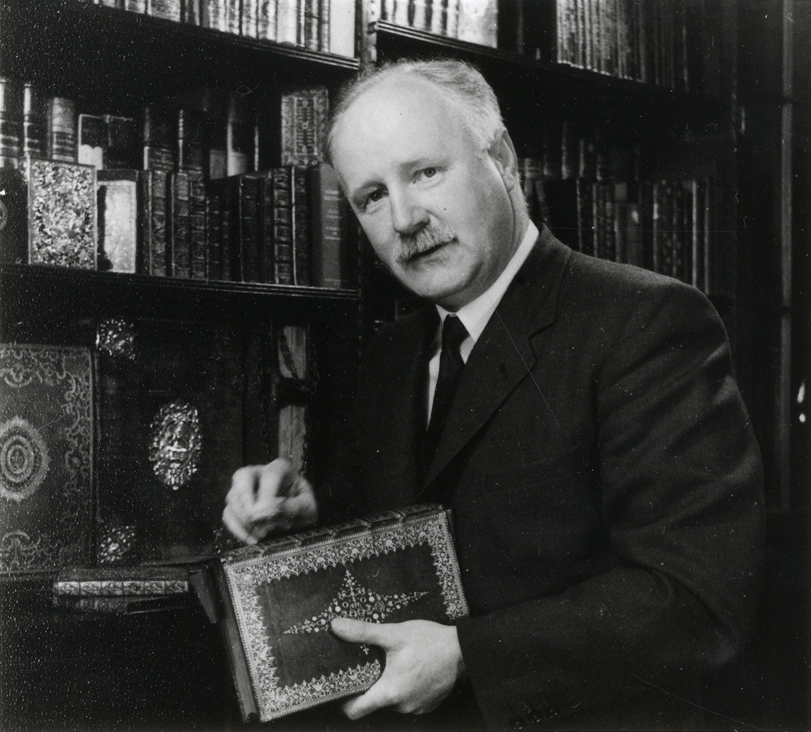
A.N.L. Munby

Please visit this page for further details, including a programme and registration form. We hope it will be as enjoyable as the first conference, and that readers of the King’s Treasures blog will be well represented!

We are also happy to announce the publications of the proceedings of the first conference in a special issue of the Transactions of the Cambridge Bibliographical Society. See here for full details.

Great Collectors

PMJ

Mozart’s birthday: an online exhibition

To mark the 260th anniversary of the birth of Wolfgang Amadeus Mozart earlier this week, the Library mounted a small exhibition. For the benefit of those who cannot visit the exhibition in person, here are some selected highlights.

Versuch einer gründlichen Violinschule / Leopold Mozart. Augsburg: Johann Jakob Lotter, 1756. Rw.38.43

Leopold Mozart, Versuch einer gründlichen Violinschule. (Augsburg: Johann Jakob Lotter, 1756. Rw.38.43)

Leopold Mozart (1719-1787) was not just a pushy parent: he was also a composer, violinist and music theorist. This first edition of his Versuch einer gründlichen Violinschule, a treatise on violin playing, dates from the year of his son’s birth, and features a number of plates illustrating common errors. The frontispiece (above left) is a portrait of Leopold himself surrounded by his own compositions, and both images show the practice, common at the time, of playing the violin with a concave bow and without chin rest or shoulder rest.

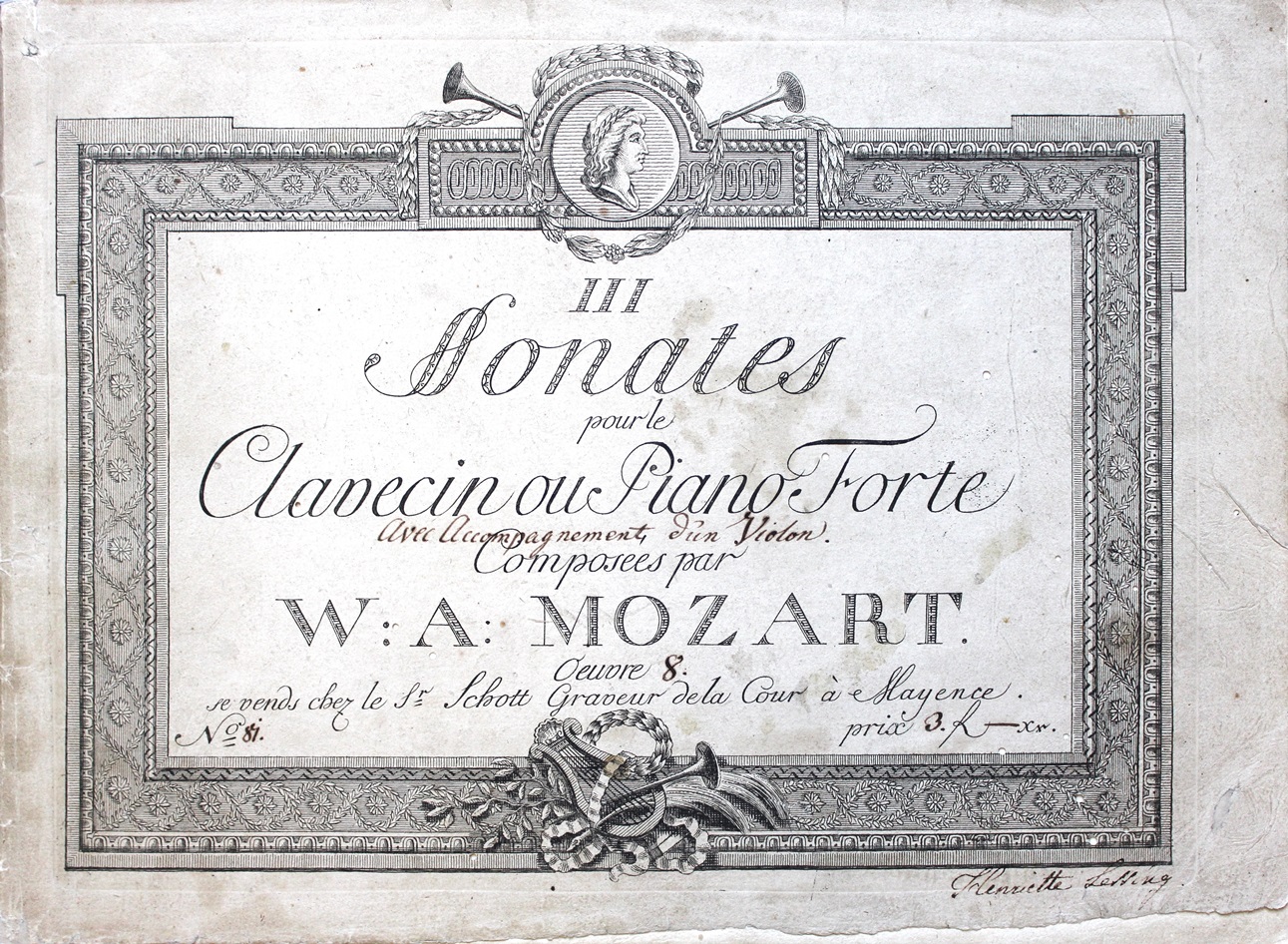
III sonates pour le clavecin ou piano forte: œuvre 8 / Wolfgang Amadeus Mozart. Mainz: Schott, 1789. Rw.13.88

Wolfgang Amadeus Mozart, III sonates pour le clavecin ou piano forte, avec accompagnement d’un violon: œuvre 8. (Mainz: Schott, ca. 1789. Rw.13.88)

This set of parts for two sonatas for violin and piano, K.526 and K.481, and for the piano trio, K.496, was bequeathed to the College by Kingsman Andrew Raeburn (1933-2010, KC 1955). It dates from Mozart’s own lifetime, having been published around 1789. The title page bears the ownership inscription of Henriette Lessing. Further details of the item’s acquisition may be found on the College website here.

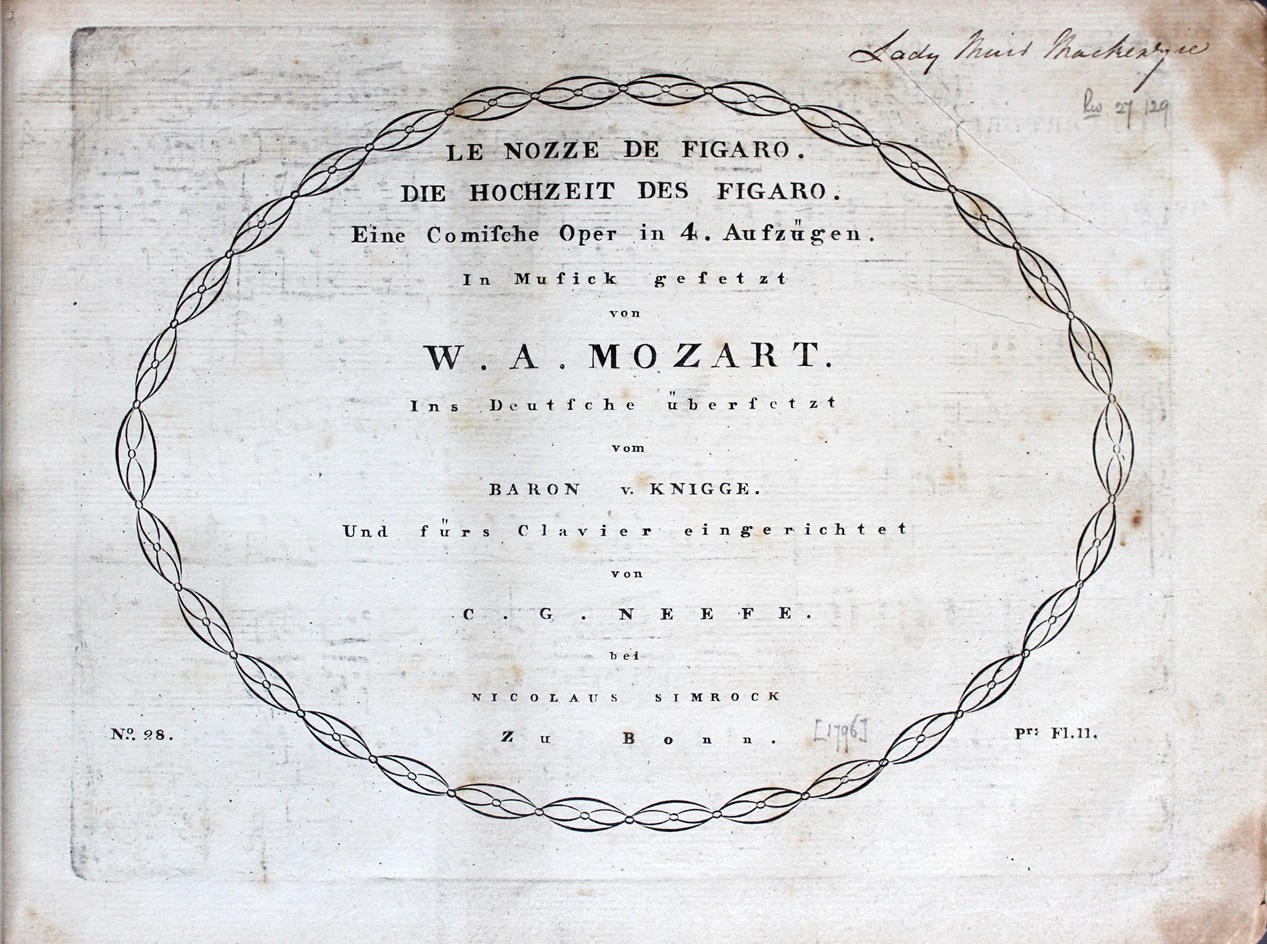
Le nozze di Figaro = Die Hochzeit des Figaro / Wolfgang Amadeus Mozart. Bonn: Simrock, ca. 1796. Rw.85.209

Wolfgang Amadeus Mozart, Le nozze di Figaro = Die Hochzeit des Figaro. (Bonn: Simrock, ca. 1796. Rw.85.209)

This German-Italian edition of Le nozze di Figaro, published in Bonn by the newly founded Simrock publishing house, was the first vocal score of the opera to appear in print. The title page of this copy bears the ownership mark of Lady Muir Mackenzie. This may plausibly be Georgina Muir Mackenzie (1833-1874), later Lady Sebright, a traveller and writer who, during a tour of the Austro-Hungarian Empire in 1858, was arrested as a spy with ‘pan-Slavistic tendencies’. She wrote about this experience and devoted much time during the following years to the promotion of Christianity in Turkey.

‘E Susanna non vien! ... Dove sono i bei momenti’ from Le nozze di Figaro / Wolfgang Amadeus Mozart. Manuscript, late 18th century. Rowe Ms 198

Wolfgang Amadeus Mozart, ‘E Susanna non vien! … Dove sono i bei momenti’ from Le nozze di Figaro. (Manuscript, late 18th century. Rowe Ms 198)

This manuscript, a contemporary transcription of ‘Dove sono i bei momenti’ from Act 3 of Le nozze di Figaro and its preceding recitative, is a relatively recent addition to the library’s collection, bought in 1981. In this aria, one of Mozart’s most exquisite, the Countess reflects on her marriage in the light of her husband’s presumed infidelity (‘Where are the lovely moments of sweetness and pleasure? Where have the promises gone that came from those lying lips?’). Naturally the opera ends with the blissful reunion of the Count and Countess.

Œuvres complettes. Cahier I, contenant VII sonates pour le pianoforte / Wolfgang Amadeus Mozart. Leipzig: Breitkopf & Härtel, ca. 1798. Rw.28.84/1

Wolfgang Amadeus Mozart, Œuvres complettes. Cahier I, contenant VII sonates pour le pianoforte. (Leipzig: Breitkopf & Härtel, ca. 1798. Rw.28.84/1)

Unlike Johann Sebastian Bach, whose greatness was not acknowledged (and whose music was not disseminated) until long after his death, Mozart’s popularity was immediate and enduring, and it was as early as 1798, seven years after his death, that the German firm of Breitkopf & Härtel began publishing a 17-volume edition of what purported to be the composer’s ‘Œuvres complettes’ [sic]. This volume of piano music contains among other works the K.331 sonata, with its familiar ‘Alla Turca’ finale.

Programme for Cambridge Grand Musical Festival. London: W. Glindon, 1824. Mn.22.7

Programme for Cambridge Grand Musical Festival. (London: W. Glindon, 1824. Mn.22.7)

This programme for a Grand Musical Festival ‘for the benefit of Addinbrooke’s [sic] Hospital (Upon the Occasion of the Opening of the New Wards)’ gives details of three ‘Grand Miscellaneous Concerts’ in the Senate House and two ‘Selections of Sacred Music’ at Great St Mary’s to be performed on 2, 3 and 5 July 1824. The opening concert featured a performance of Mozart’s Jupiter Symphony, and is most notable for the participation of the composer Gioachino Rossini (1792-1868), making a rare appearance as a vocalist. The Times review remarked upon Rossini’s comic talent, observing that in the reprise of the Cimarosa duet that closed the first half his partner Angelica Catalani was ‘literally convulsed with laughter, and unable to proceed in two or three places’.

GB

Monday mourning

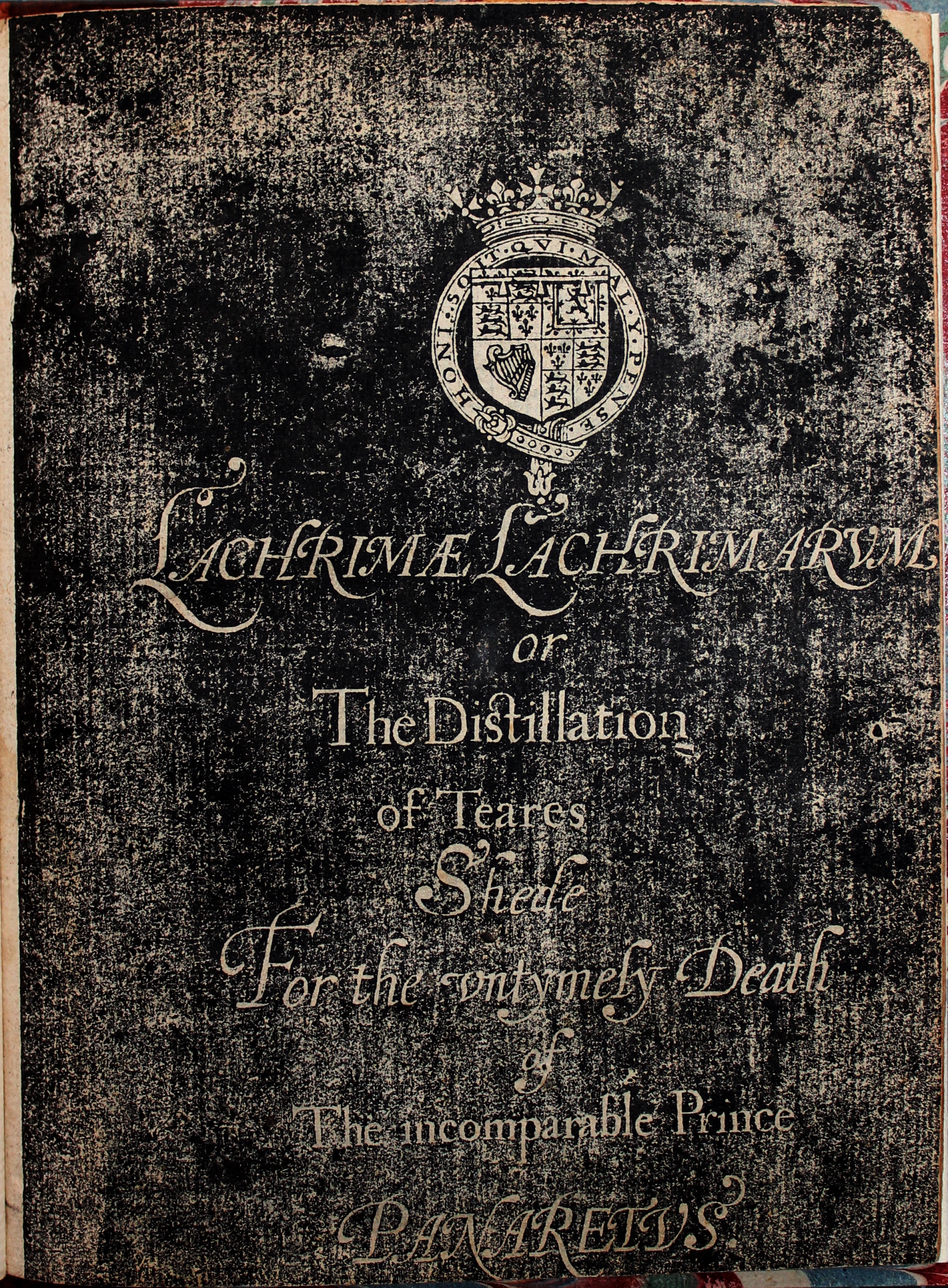
The untimely death of Henry Frederick, Prince of Wales was met with universal sorrow across the land in 1612. The national outpouring of grief is probably comparable to that witnessed in the aftermath of Princess Diana’s death in 1997. Prince Henry (1594-1612), the eldest son of James I and brother of the future King Charles I, was praised in life by authors including George Chapman, Sir John Davies, Michael Drayton, and Francis Bacon. There was a proliferation of mourning pamphlets and funeral sermons following the popular Prince’s death at the age of 18 from typhoid fever, and he was mourned by such luminaries as Thomas Campion, George Herbert, and Sir Walter Raleigh. Prince Henry was the patron of the poet Josuah Sylvester (1563-1618), who expressed his sorrow in Lachrimae lachrimarum (1612), one of the earliest examples of a book containing black mourning pages:

Keynes.C.12.8

The tears of tears: title page of the first edition of Lachrimae lachrimarum; or, The distillation of teares shede for the untymely death of the incomparable Prince Panaretus (London: Humfrey Lownes, 1612; Keynes.C.12.8).

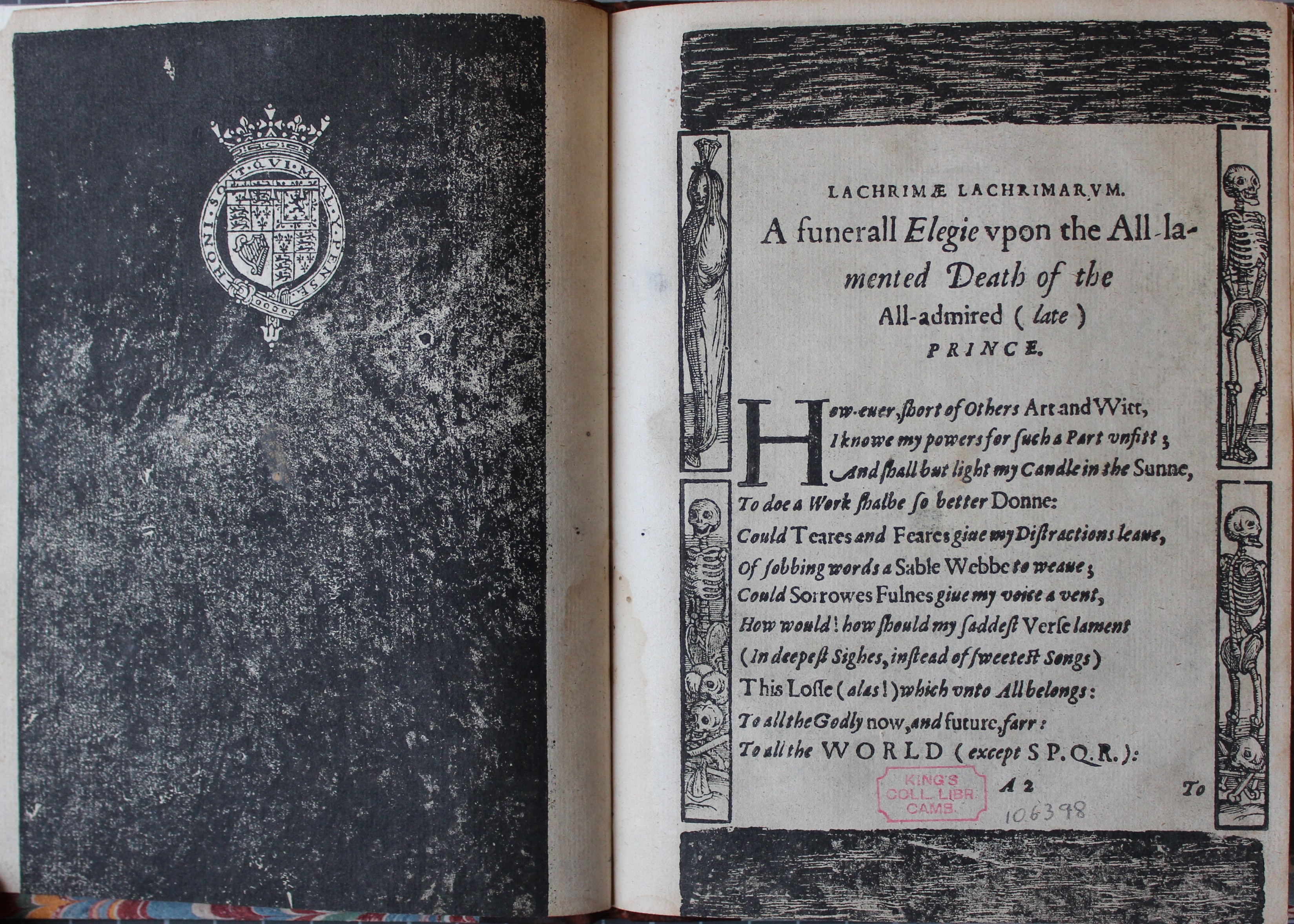
The sense of grief is compounded by a black page with a woodcut of the royal arms on every verso, and mourning borders with skeleton frames on each recto:

Keynes.C.12.8 (2)

Lachrimae lachrimarum, leaf A2 recto and facing mourning page (Keynes.C.12.8).

The first edition includes elegies in English, French, Latin and Italian by the royal tutor, Walter Quin (1575?-1640):

Keynes.C.12.8 (3)

Lachrimae lachrimarum, leaf D3 recto with an Italian sonnet by Walter Quin (Keynes.C.12.8).

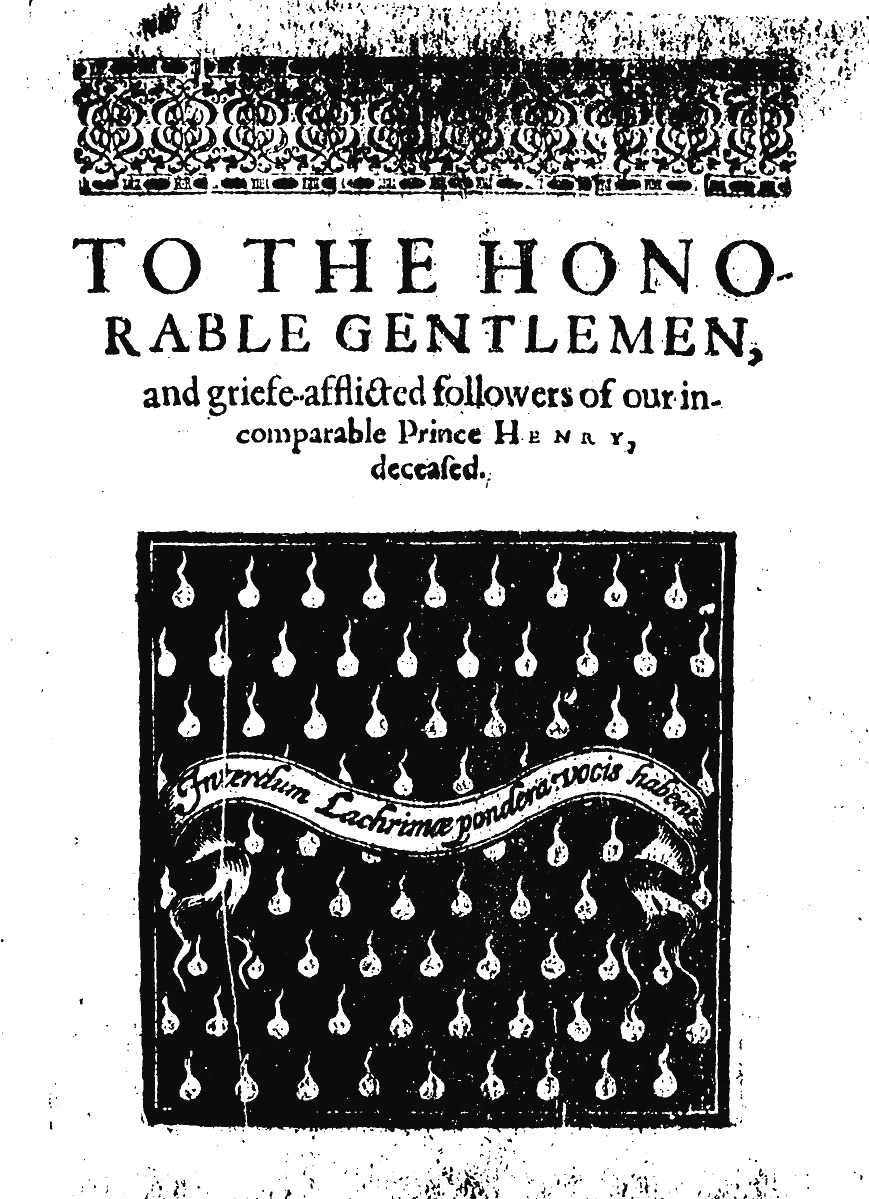
While tears are only mentioned in Sylvester’s book, these are shown explicitly in Christopher Brooke’s Two Elegies (1613), which features a pattern of tears with a quotation from Ovid’s Epistulae ex Ponto, 3.1.158: “Interdum lachrimae pondera vocis habent” (sometimes tears have the same weight as words):

Brooke, Two elegies (ESTC S106715) 2

Christopher Brooke, Two elegies, consecrated to the neuer-dying memorie of the most worthily admyred; most hartily loued; and generally bewayled prince; Henry Prince of Wales (London: Thomas Snodham, 1613; image from EEBO).

Variations on the black mourning page were used widely well into the 18th century. The premature death of John Churchill, Marquess of Blandford (1686-1703), who died here at King’s College on 20 February 1703, was lamented in William Congreve’s The Tears of Amaryllis for Amyntas (1703). The title page is framed within a mourning border of black blocks:

Keynes.C.5.6

Title page of William Congreve’s The Tears of Amaryllis for Amyntas (London: Jacob Tonson, 1703; Keynes.C.5.6).

The black mourning page may be a technique that originated in the 17th century, but one of the most well-known examples of this practice is to be found in the 18th century, namely in Laurence Sterne’s novel Tristram Shandy (1759-67), which is revolutionary in its use of unconventional typographical devices such as blank and marbled pages. Yorick’s death in vol. 1 is followed by a black mourning page:

Keynes.Ec.7.1.15

Alas, poor Yorick: black mourning page in the first edition of Sterne’s The Life and Opinions of Tristram Shandy, Gentleman (York: J. Hinxman, 1759; Keynes.Ec.7.1.15).

In order to protect his work from piracy, Sterne signed the opening chapter of the first and second editions of volume 5, as well as the first editions of volumes 7 and 9. He must have therefore autographed over 12,000 volumes:

Keynes.Ec.7.1.21 and 23

Opening chapters of volumes 7 and 9 of Tristram Shandy, with Sterne’s autograph (Keynes.Ec.7.1.21 and Keynes.Ec.7.1.23).

Today is Blue Monday, allegedly the gloomiest day of the year, so we thought this would cheer everyone up. And let’s look on the bright side: if Prince Henry had lived to become King, he would have probably been beheaded during the English Civil War, as happened to his younger brother Charles I, so it looks like he had a lucky escape after all…

IJ


All that glitters is not gold

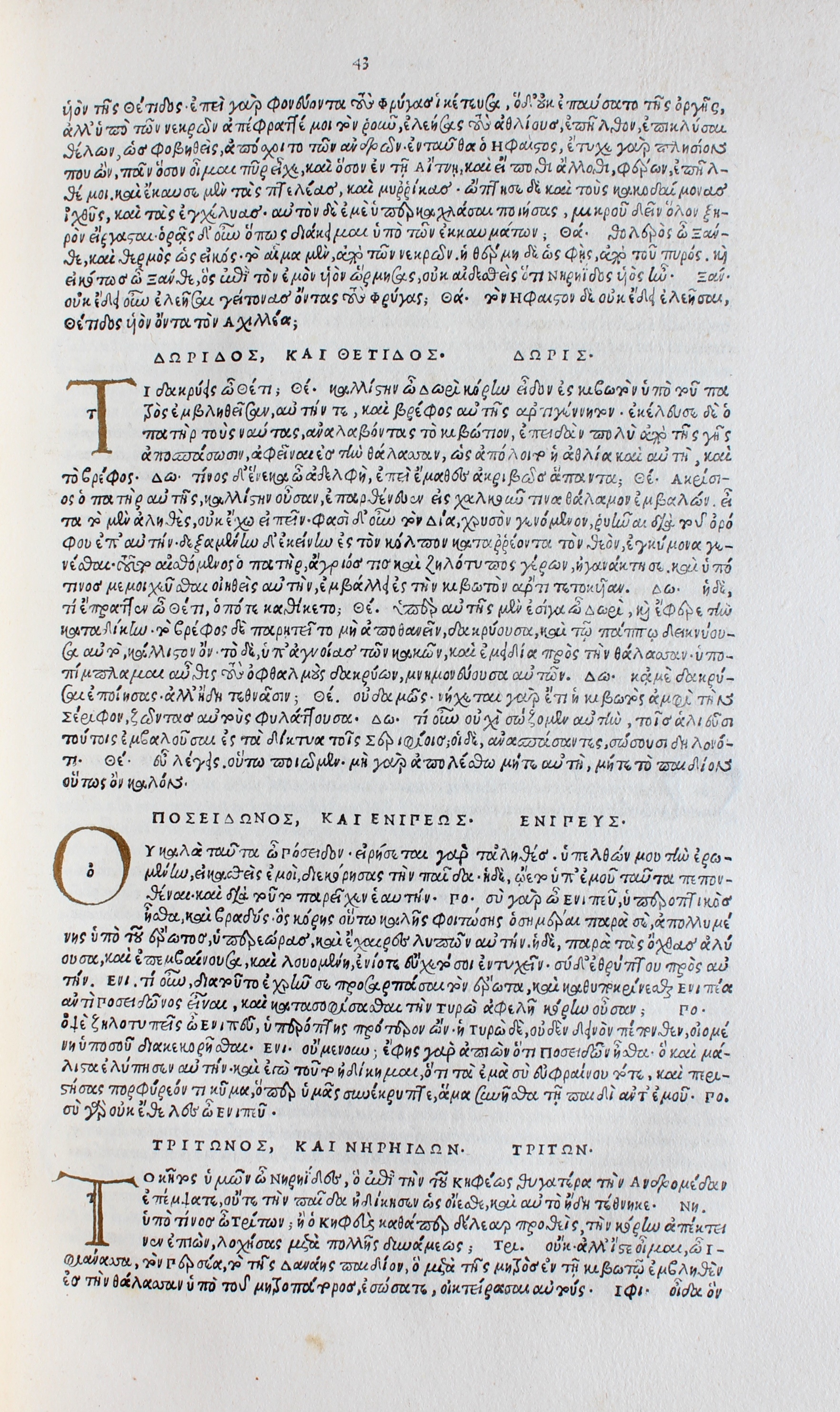
As we are all surrounded by illuminations at this time of the year (whether we like it or not), let’s have a look at another type of illumination, that of the vibrant colours and intricate decorations of initials and margins often found in medieval manuscript books. Such illuminations were also a feature of early printed books and can be regarded as a vestige of the manuscript tradition that persisted in the transition to the printing era. As Scrase and Croft point out in their book Maynard Keynes, “It is characteristic of the earliest period of printing that the book was conceived as a collaboration between the practitioners of the new art and the professional scribes and illuminators whose traditional involvement in book production went back for centuries” (Cambridge: Provost and Scholars of King’s College, Cambridge, 1983, p. 74). The illuminations were applied by hand following completion of the printing process, and the printer would leave blank spaces with or without guide letters for the illuminator:

Keynes.Ec.7.2.9

Diogenes Laertius, Vitae et sententiae eorum qui in philosophia probati fuerunt (Venice: Nicolas Jenson, 1475; Keynes.Ec.7.2.9).

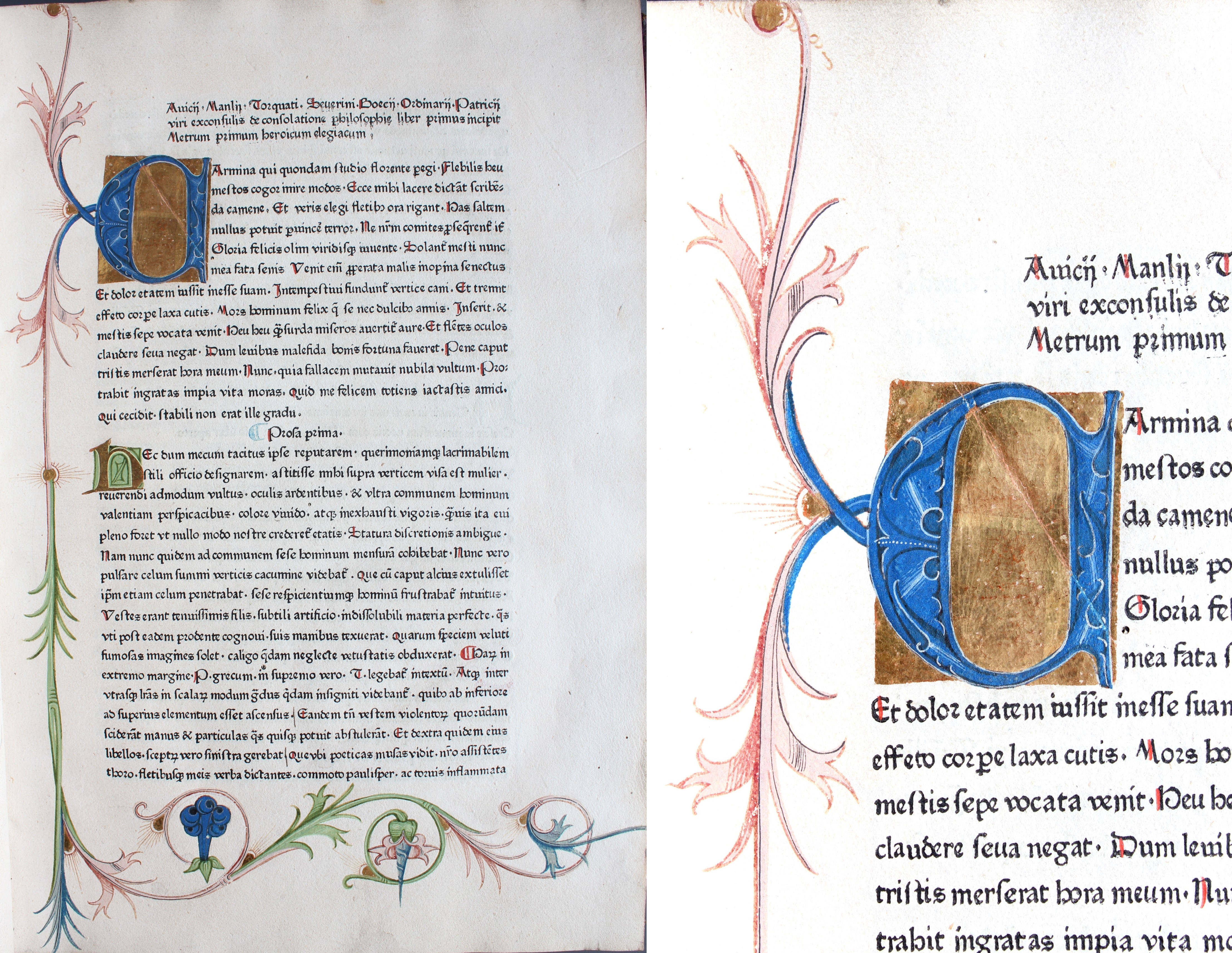
This 1476 copy of Boethius’s De consolatione philosophiae has the first initial of text illuminated in gold and blue, with a pink, green and blue decorative leaf border carried around the inner and lower margins:

Keynes.Ec.7.1.4

Boethius, De consolatione philosophiae (Nuremberg: Anton Koberger, 1476; Keynes.Ec.7.1.4) with close-up of initial illuminated in gold and blue.

Sometimes, the initial letters were simply supplied in red, blue or gold, as in this copy of Lucian’s Opera (1503): 

Keynes.Ec.7.2.19 2

Lucian of Samosata, Luciani opera (Venice: Aldo Manuzio, 1503; Keynes.Ec.7.2.19).

One of the most impressive illuminations in the incunabula in the Keynes Bequest is undoubtedly to be found in a copy of Saint Augustine’s De civitate Dei (1468), printed in Rome by two Germans, Konrad Sweynheim and Arnold Pannartz, who are credited with introducing the art of printing into Italy. The first page of text after the preliminaries features the initials “I” and “G” supplied in gold; both initials are embellished with a decorative white vine stem border defined in blue, pink and green with a pattern of white dots, which extends into the upper, inner and lower margins. In the lower margin is a painted coat of arms of Cardinal Medici within a green laurel wreath and a putto on either side:

Keynes.Ec.7.1.2

Saint Augustine, De civitate Dei (Rome: Konrad Sweynheim and Arnold Pannartz, 1468; Keynes.Ec.7.1.2). The Medici arms are not authentic and were added by the forger Hagué.

Below is a close-up of the 15-line initial “I” and the 8-line initial “G”:

Keynes.Ec.7.1.2 (2)

Saint Augustine, De civitate Dei (Rome: Konrad Sweynheim and Arnold Pannartz, 1468; Keynes.Ec.7.1.2); detail.

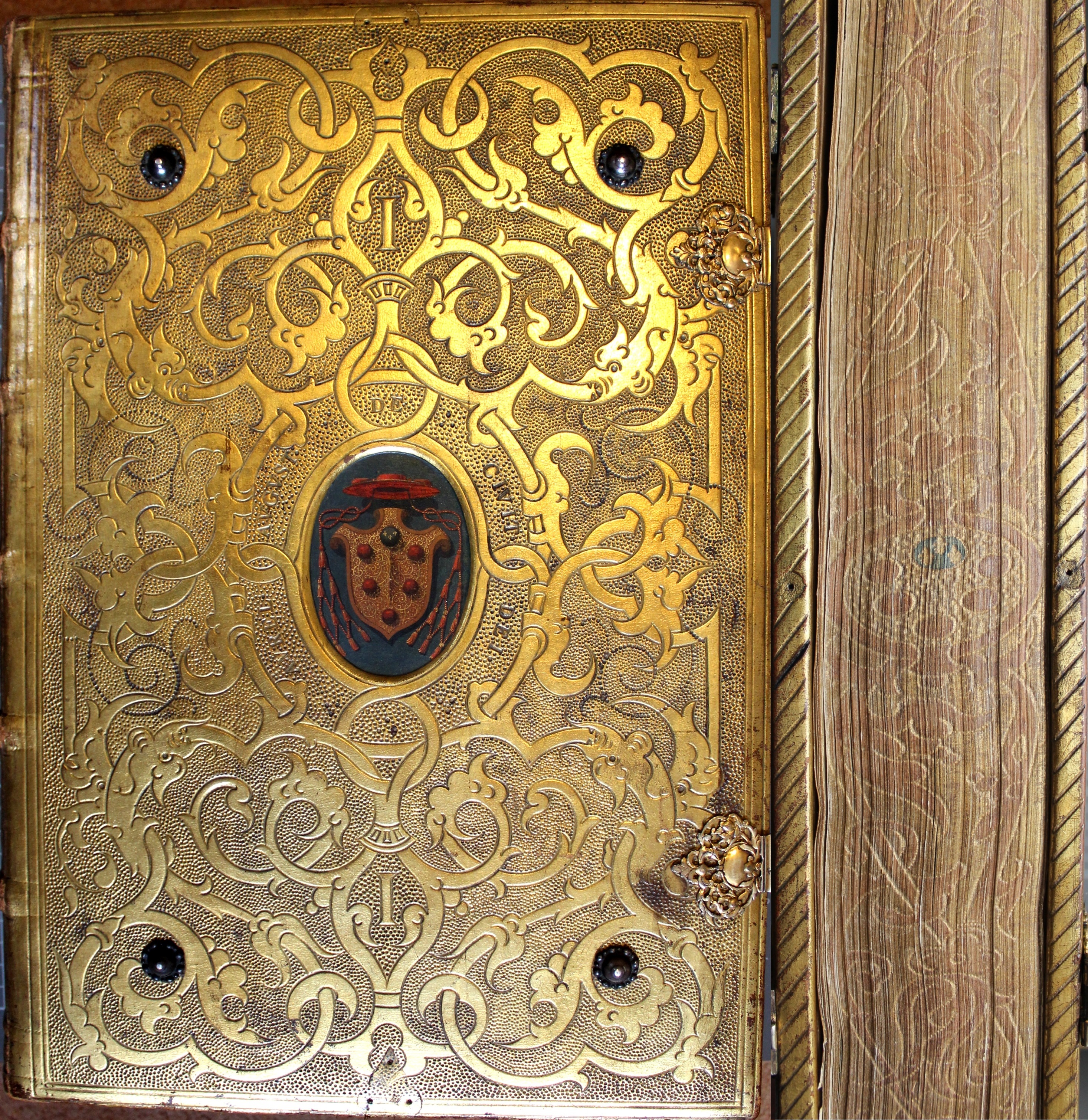
If you thought the illumination in this incunabulum was impressive, wait until you see the cover. This is a 19th-century binding entirely covered in gold produced by the French bookbinder and binding forger Théodore (aka Louis) Hagué (1822 or 1823-1891) in imitation of a 16th-century Italian binding purported to have been made for Cardinal Medici:

Keynes.Ec.7.1.2 (3)

The book with the golden cover: calf over wooden boards; covers and spine entirely covered in gold with an elaborate interlacing ribbon/strapwork design; four metal bosses on each cover; arms of Cardinal Medici painted in an oval medallion at the centre of each cover. Detail shows gilt and gauffered edges with the Medici coat of arms in the middle, and the pattern of the decorations filled in with red.

Hagué was a master of forgery and produced fake bindings that were passed off as having belonged to popes, cardinals, kings  and queens. And people fell for it hook, line and sinker. The sale catalogue description pasted on the fly-leaf reads: “Italian binding of the 16th century. This book is probably unique in its style of binding. It is of calf; tooled and completely covered with gilding. On each cover the arms of Cardinal Medici are painted…” For more information on Hagué, see Mirjam M. Foot, “Binder, Faker and Artist”, The Library 13.2 (2012), pp. 133-146, available here.

This is our last blog post before Christmas, so happy festive season from all of us at King’s College Library and Archives! We’ll be back in the New Year with more posts about the treasures in our special collections, so watch this space…

IJ

Celebrating Saltmarsh and the Chapel

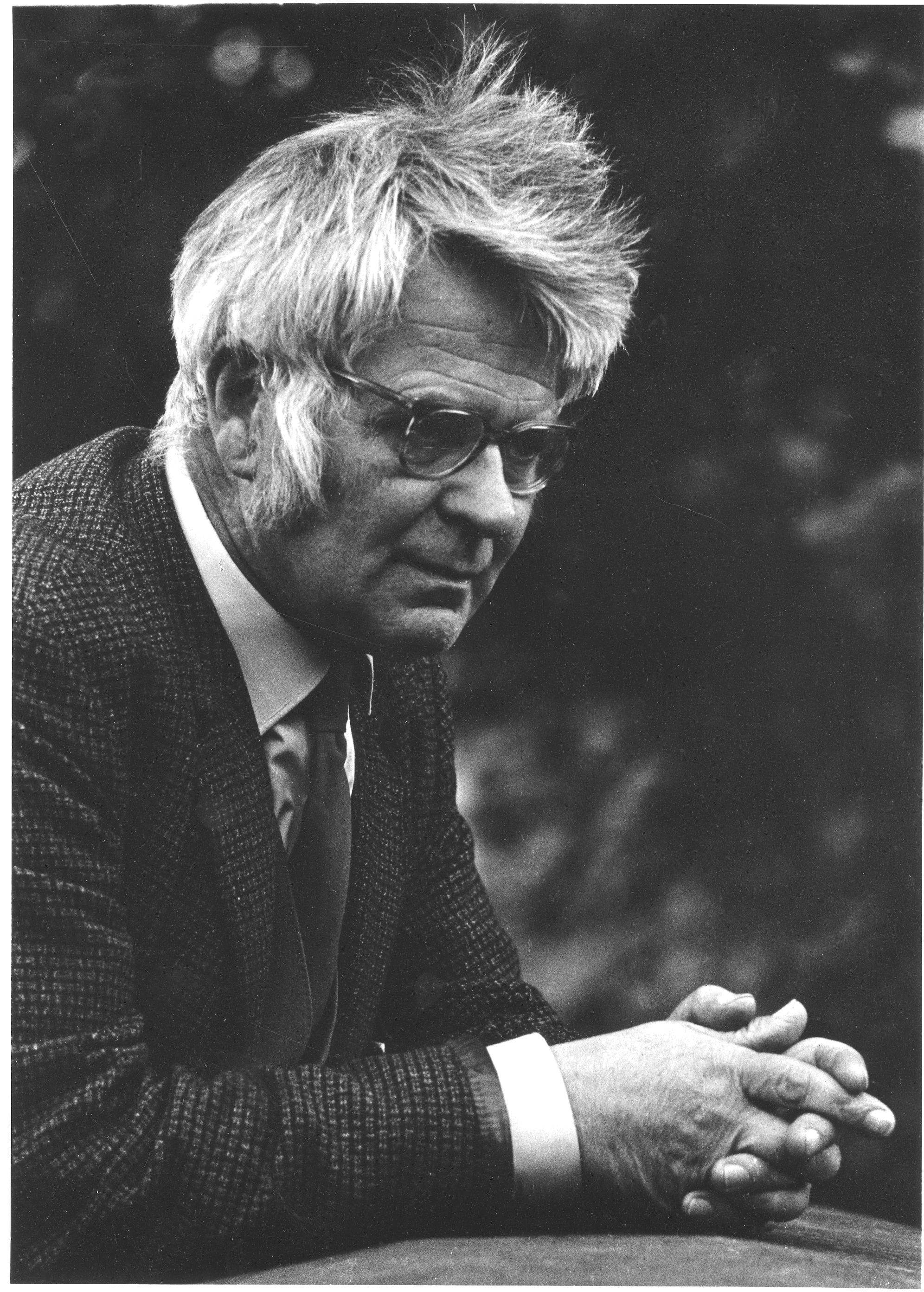
John Saltmarsh (1908-1974) Photograph taken on the King’s College Bridge, by Robert Le Rougetel in 1965. (Archive Centre, King’s College, Cambridge. College Photo 9.)

John Saltmarsh (1908-1974)
on the King’s College Bridge, by Robert Le Rougetel in 1965.
(College Photo 9)

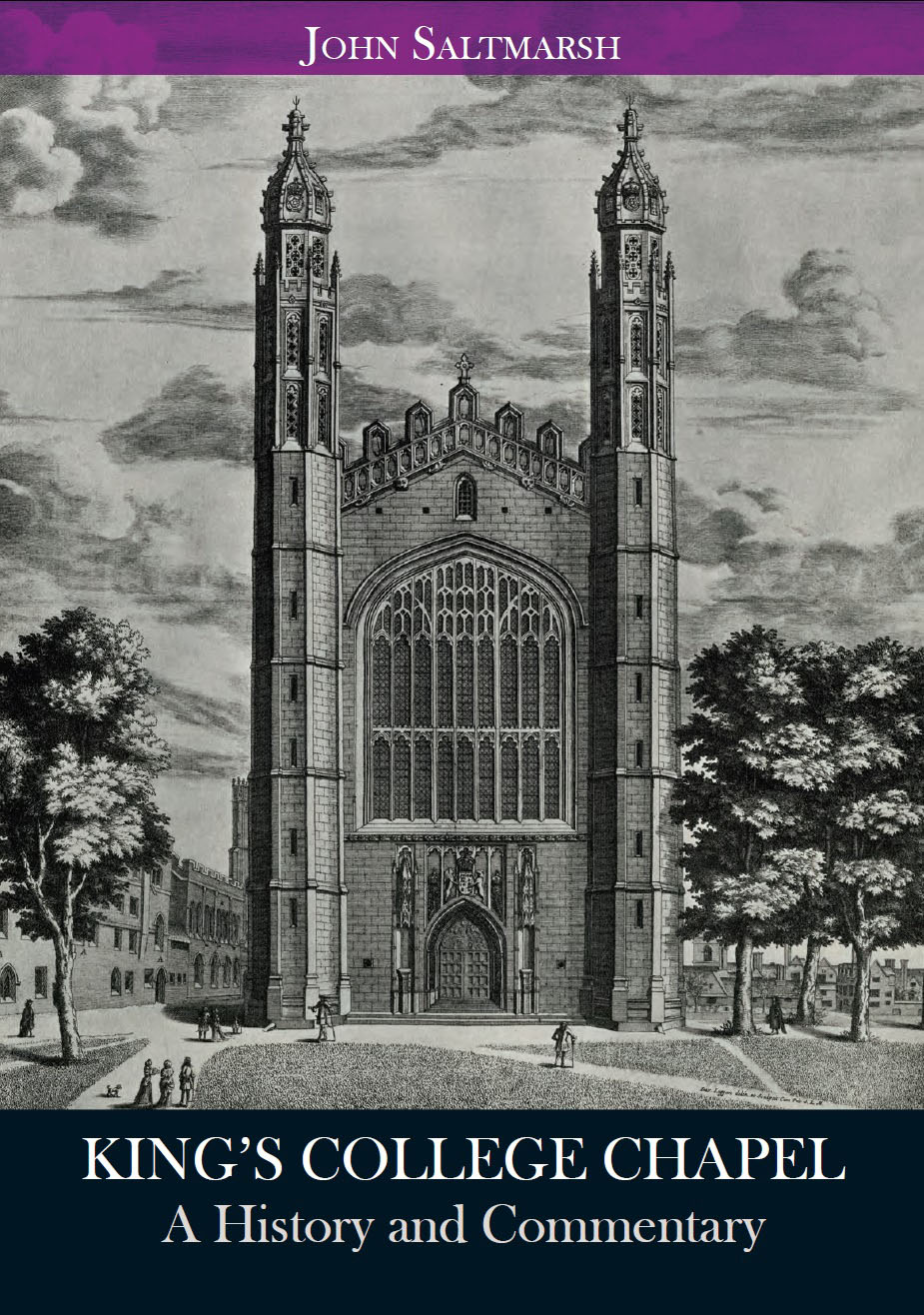
When John Saltmarsh (historian, archivist and Vice-Provost) died in 1974, he left behind unfinished but quite remarkable manuscripts for a book entitled ‘King’s College Chapel: A History and Commentary’. The book has been co-edited by Bert Vaux (Fellow and Graduate Tutor) and me (Peter Monteith, Assistant Archivist) and was launched on Friday (6 November).

Our launch was a fairly modest event with around thirty guests, including Saltmarsh’s relatives, Fellows and a few other individuals whom we wanted to thank for their part in the publication. This publication is part of the College’s celebrations of the 500th anniversary of the completion of the stonework of the Chapel; however, we felt it was important that this event was also a celebration of John Saltmarsh’s life and work.

A page from the manuscript of the commentary. (Archive Centre, King’s College, Cambridge. JS-1-70)

A page from the manuscript of the commentary.
(JS-1-70)

When our guests arrived, they came to the Archive Centre to see an exhibition on ‘John Saltmarsh and the Chapel’. This exhibition included records relating to his youth, the various roles he held at King’s, his work as a historian and his work on the Chapel. The guests had the opportunity to greet each other, as they admired the beautifully written medieval building accounts used to great effect by Saltmarsh while writing his Chapel book.

A few of John Saltmarsh's relatives at the exhibition. They had just been looking at the chapel building account for 1508-9.

A few of John Saltmarsh’s relatives at the exhibition. They had just been looking at the chapel building account for 1508-9.

After this, we all headed over to the Chapel, where we sat in the Fellows’ stalls. Andrew Hammond (King’s Chaplain) led a wonderful Evensong and our guests had the opportunity to hear the College’s famous choir.

Then we went to the Saltmarsh suite, where Rob Wallach formally welcomed our guests, and paid tribute to John Saltmarsh. Bert and I took the opportunity to thank our guests for all of the support they have shown us throughout this project.

The Saltmarsh family seem very close, with four generations being present at the launch. We heard wonderful stories about Saltmarsh. He has a reputation as a ‘notable Cambridge eccentric’. The stories supported that view but showed the warmth he had for others and how keen he was to share his knowledge of local history.

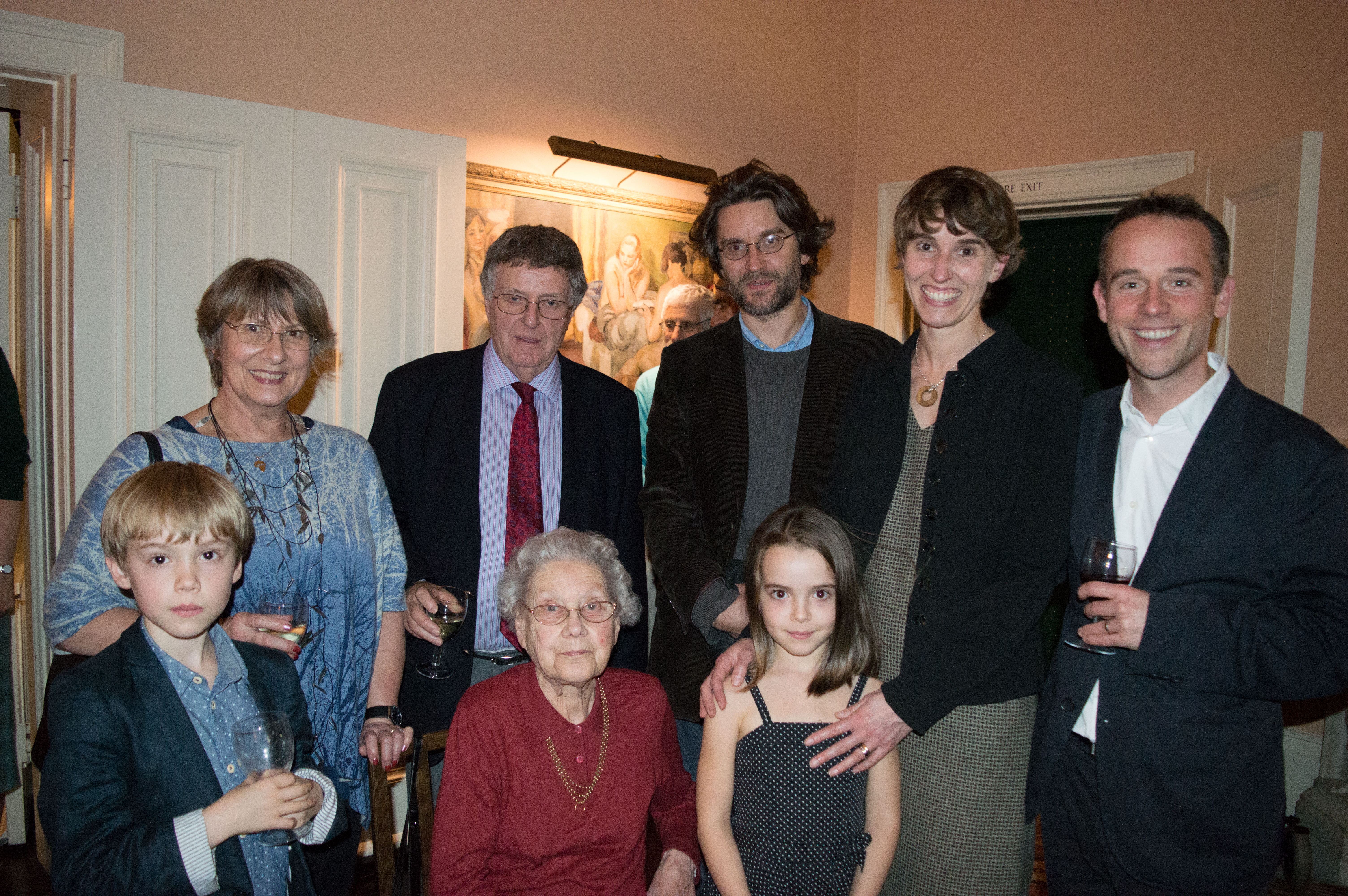
Back (l-r): Vicky and Henry Saltmarsh, their son Nick and daughter Anna, with her husband Richard Hartshorn. Front (l-r) Anna and Richard’s children Harry and Hebe, with Violet Saltmarsh, their great-grandmother and John Saltmarsh’s sister-in-law.

Back (l-r): Vicky and Henry Saltmarsh, their son Nick and daughter Anna, with Anna’s husband Richard Hartshorn. Front: Anna and Richard’s children Harry and Hebe, with Violet Saltmarsh, their great great aunt and John Saltmarsh’s sister-in-law.

We were also pleased to welcome Lilah Wayment, who had kindly allowed us to print her husband Hilary’s report on the manuscript. Shortly before he died, Saltmarsh had told Hilary Wayment (an expert on the Chapel windows) about the manuscript so the report, along with one written by Saltmarsh himself, sheds light on the story behind the book.

Lilah Wayment (left) with Henrietta Ryan.

Lilah Wayment (left) with Henrietta Ryan.

For further details on the book, please visit the ‘Saltmarsh’s Chapel Book’ webpage. The book can be purchased from the College’s Visitor Centre, on King’s Parade, or online.

saltmarsh_cover

Book cover

PGM

Flying Sheets

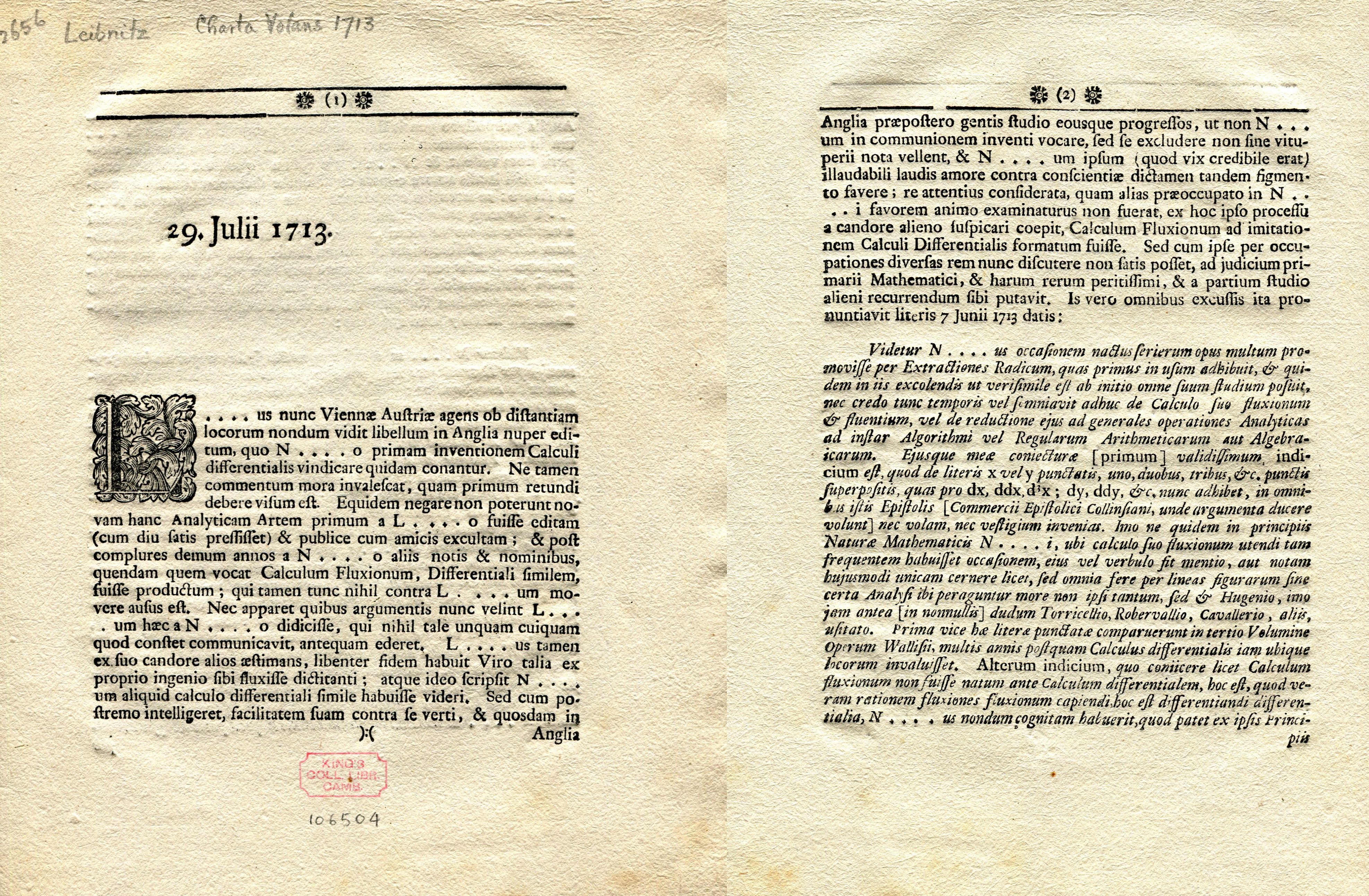
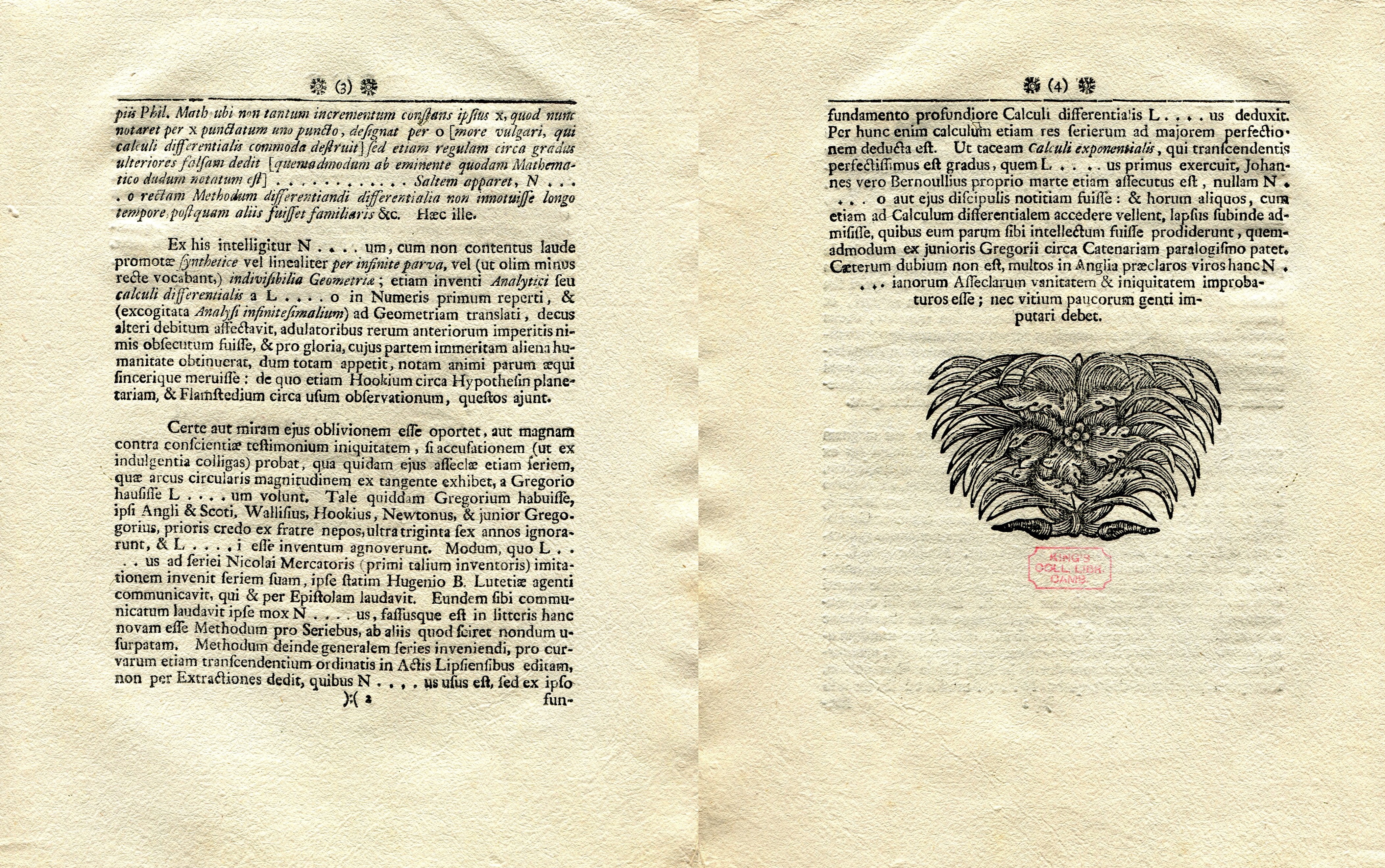
The Keynes Bequest is not merely a collection of books. Interspersed among first editions of Galileo, Descartes, Pascal, Hobbes, Kant and Locke are a number of pamphlets of historical, literary and scientific significance, ranging in size from one sheet to several pages. In the extensive collection of first and early editions of Isaac Newton’s works is an anonymous pamphlet with the caption “29. Julii 1713”. This is the so-called Charta volans (flying sheet), an important document written by Gottfried Leibniz during the bitter controversy between him and Newton over which of them invented the mathematical study of change, calculus. Given the rarity of this pamphlet (the only other copies are in Yale, Chicago and in the Burndy Library), and in the interest of scholarship, we provide a scan of all four pages:

Charta Volans 1-2

Gottfried Leibniz’s Charta volans (1713), in which he argues that Newton had not published anything on calculus before him, adding that Newton’s fluxional method was in imitation of his calculus (Keynes.Ec.7.2.27)

Charta Volans 3-4

Charta volans, pp. 3-4

Its acquisition history is also rather fascinating. Keynes had originally bought two copies of the pamphlet, and observed in a letter to K. G. Maggs when the latter offered to purchase the duplicate copy in May 1942 that he had done so “not because I wanted them, but because they were fastened together, never having been separated by a paper knife when issued. So far I have not had the heart to split the Siamese twins.” The correspondence between Keynes and Maggs throws an interesting light on his relationship with booksellers and how he went about augmenting his collection of rare books and pamphlets:

Keynes-Maggs 1

J. M. Keynes’s correspondence with K. G. Maggs, 15 May-18 May 1942

Keynes-Maggs 2

J. M. Keynes’s correspondence with K. G. Maggs, 28 May-29 May 1942

The “American library which specialises in Newton material” that bought the second copy of the Charta volans is almost certainly the Burndy Library, founded the previous year by the industrialist and historian Bern Dibner. Their copy is now at the Huntington Library in San Marino, California.

As the above correspondence reveals, the loss of one of the “Siamese twins” to the Burndy Library led to Keynes’s acquisition of another exciting “flying sheet”, namely a leaf from the Gutenberg Bible, the first book printed using movable type which marked the beginning of the Printing Revolution. The iconic 42-line Bible was printed in Mainz, ca. 1454-55, by Johannes Gutenberg. Of the about 180 copies printed, 49 are known to have survived, only 21 of which are complete. This leaf includes all of Jeremiah XX and part of Jeremiah XXI:

Gutenberg Bible Leaf 2

The first printed book: recto and verso of leaf 80 from the Gutenberg Bible (1454-55). Printed in two columns, one column on each side being defective; 2 initials supplied in red, chapter numbers in red and blue (Keynes.Ec.7.2.13)

The addition of a leaf from the Gutenberg Bible to Keynes’s collection means that the items in the Keynes Bequest cover five centuries of printing, from its very inception in the middle of the fifteenth century, right up to the middle of the twentieth.

IJ