Tag Archives: William Shakespeare

Bowdlerizing the Bard

According to the OED, the etymology of the verb “to bowdlerize”, meaning “to expurgate (a book or writing), by omitting or modifying words or passages considered indelicate or offensive”, comes from Thomas Bowdler (1754-1825), “who in 1818 published an edition of Shakespeare, ‘in which those words and expressions are omitted which cannot with propriety be read aloud in a family’”.

In the collection of books bequeathed to King’s College by its sometime Provost George Thackeray (1777-1850), a cousin of the novelist William Makepeace Thackeray, is a copy of the fifth edition of Thomas Bowdler’s eight-volume The Family Shakspeare (1827):

Thomas Bowdler, The family Shakspeare (London: Printed for Longman, Rees, Orme, Brown, and Green, Paternoster-Row, 1827) (Thackeray.J.63.1)

Title of page of vol. 1 of Thomas Bowdler’s The Family Shakspeare (London: Printed for Longman, Rees, Orme, Brown, and Green, Paternoster-Row, 1827) Thackeray.J.63.1

Some of the alterations to Shakespeare’s plays made by Bowdler include, for example, Lady Macbeth’s line, “Out, damned spot!” changed to “Out, crimson spot!” (Macbeth, V.1); in Henry IV, Part 2 the prostitute Doll Tearsheet is omitted from the story altogether; and in all plays the exclamation “God!” is replaced with “Heavens!”

Below is the scan of a line spoken by Mercutio in Romeo and Juliet (II.iv) as it appeared in the Fourth Folio of Shakespeare’s plays (1685) along with the expurgated version printed by Bowdler (vol. 8, p. 168):

Spot the difference: Mercutio’s “the bawdy hand of the dial is now upon the prick of noon” has been changed to “the hand of the dial is now upon the point of noon”.

Spot the difference: Mercutio’s “the bawdy hand of the dial is now upon the prick of noon” has been changed to “the hand of the dial is now upon the point of noon”.

Thackeray’s obituarist writes that “In his discipline generally there was something of almost Roman firmness … Yet under the rigid manner lay the kindest sympathy”. While his library included the First, Second and Fourth Folios of Shakespeare’s plays – as well as later editions – it is interesting that this is the edition he decided to present to his daughter, who recorded the gift on the fly-leaf of all eight volumes: “Mary Ann Eliz.th Thackeray the gift of her father”. But this is perhaps more a reflection on the times than on Thackeray himself.

All these books, along with many other treasures, will be on display at King’s Library’s free Shakespeare exhibition as part of Open Cambridge on Friday 9th and Saturday 10th September, 10.30am – 4pm:

http://www.opencambridge.cam.ac.uk/news/kings-college-library-and-archives-open-their-doors

We hope to see many of you there!

english_landscape_pantone

IJ


Celebrating Shakespeare at King’s Library

Shakespeare folio image

William Shakespeare as depicted on the title page of the first folio edition

This year is the quatercentenary of the death of William Shakespeare (1654–1616) and events are being held worldwide to celebrate the life and work of the UK’s most famous poet, playwright and actor, described by Ben Jonson as ‘not of an age, but for all time’. In this special year, thanks to a grant from the Heritage Lottery Fund, King’s College Library and Archives will be joining the festivities by hosting various events showcasing many of our rare book and archive treasures.

1. The interior of the Library

The interior of King’s College Library

Our first event is an exhibition celebrating Shakespeare and theatre in Cambridge which will be running until the end of August. This free exhibition is open to all and can be viewed between 2pm and 5pm Monday to Friday in King’s College’s beautiful early nineteenth-century library. If you would like to see some early editions of Shakespeare’s plays as well as some archival treasures, why not pop in and see us when you are in town.

.

Upon arrival at the front gate of King’s College speak to the Visitor Guide on duty and tell them that you are visiting the Library’s Shakespeare exhibition. They will direct you to the College Library. When you reach the Library, simply press the buzzer on the main door and one of the Library team will let you in and welcome you to the Library.

We look forward to seeing you!

college-map-library

How to find King’s College Library

english_landscape_pantone

JC

Another Portrait of Mr. W. H.

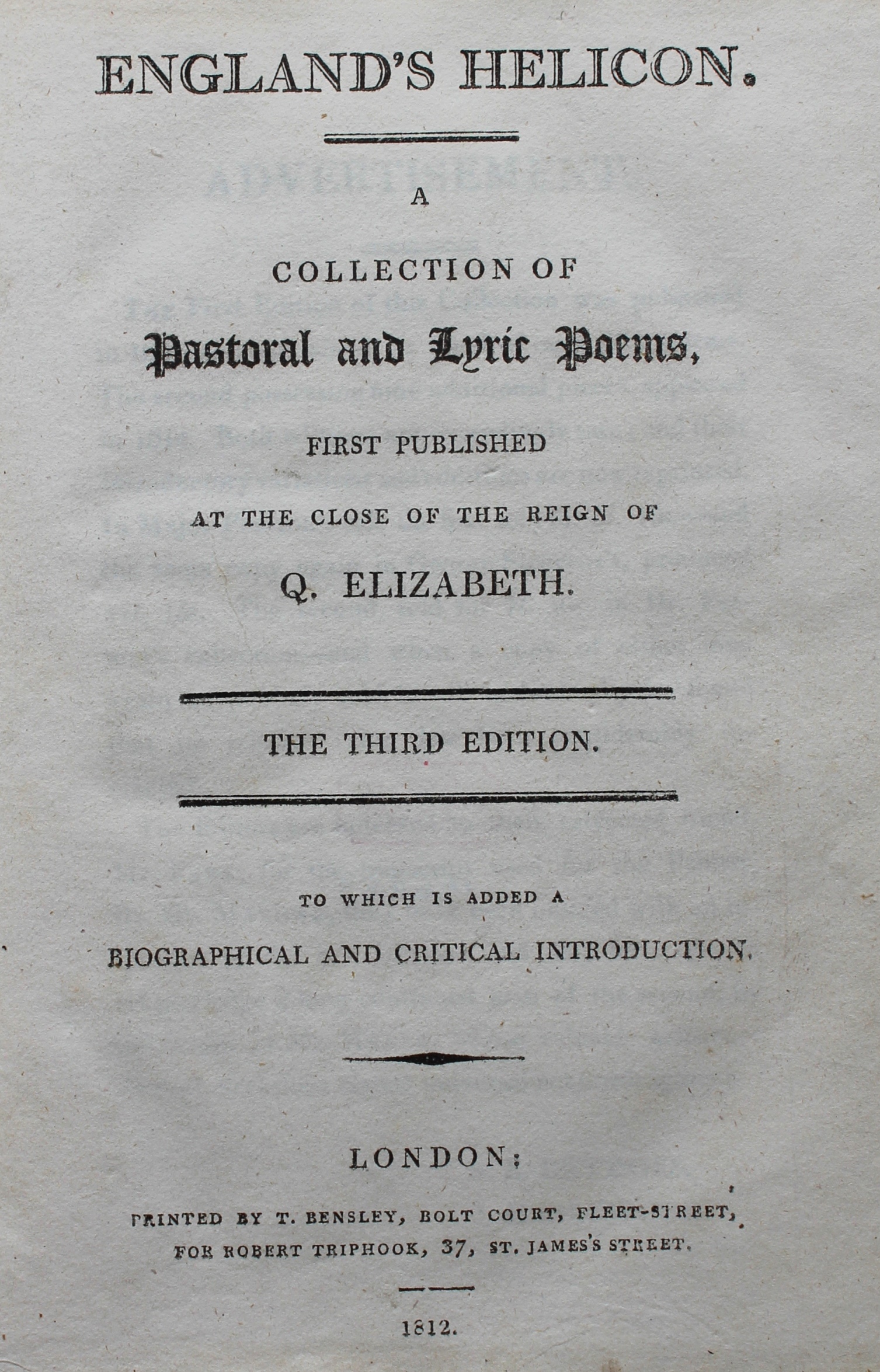
As we’re marking the 400th anniversary of Shakespeare’s death, this book from the Keynes Bequest could not be more topical. England’s Helicon, an anthology of Elizabethan poems first printed in 1600, includes contributions by Christopher Marlowe, Sir Walter Raleigh, William Shakespeare, Sir Philip Sidney and Edmund Spenser.

Title page of England’s Helicon: A Collection of Pastoral and Lyric Poems, First Published at the Close of the Reign of Q. Elizabeth, edited by S. E. Brydges and Joseph Haslewood (London: Thomas Bensley, 1812; Keynes.E.3.8)

Title page of England’s Helicon: A Collection of Pastoral and Lyric Poems, edited by S. E. Brydges and Joseph Haslewood (London: Thomas Bensley, 1812; Keynes.E.3.8)

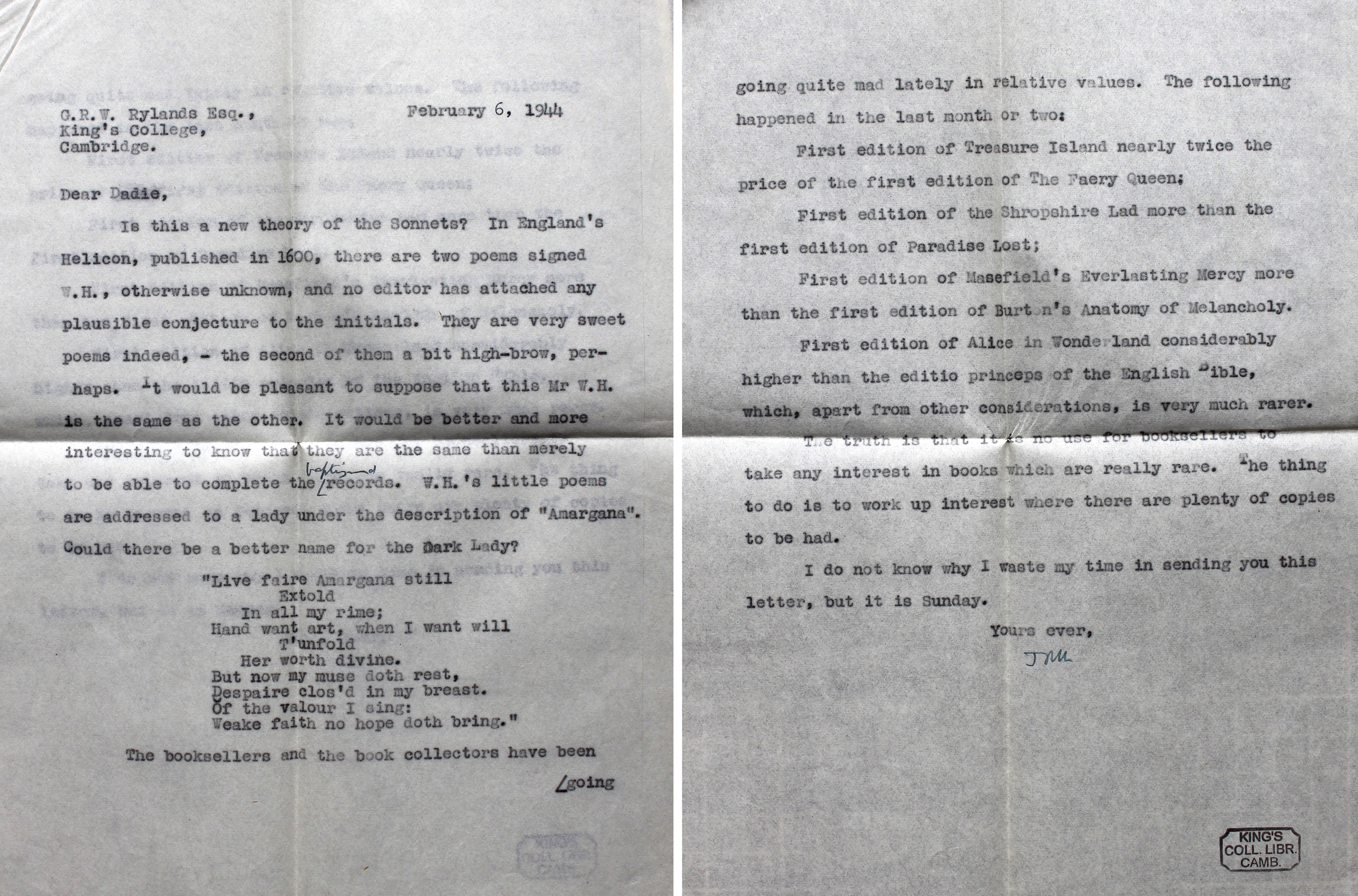
In an 1812 reprint of the third edition (1614) is the carbon copy of a letter from John Maynard Keynes to Dadie Rylands dated 6 February 1944 and initialled in ink by Keynes. Rylands was a Fellow at King’s and a noted Shakespeare scholar who also directed several plays for the Marlowe Society and acted as chairman of the Cambridge Arts Theatre between 1946 and 1982.

Dadie Rylands (1902-1999) punting on the Cam, mid-1930s

Dadie Rylands (1902-1999) punting along the Cam, mid-1930s

Keynes writes: “Is this a new theory of the Sonnets? In England’s Helicon, published in 1600, there are two poems signed W. H., otherwise unknown, and no editor has attached any plausible conjecture to the initials. […] It would be pleasant to suppose that this Mr. W. H. is the same as the other”.

Carbon copy of Keynes’s letter to Dadie Rylands, 6 February 1944

Carbon copy of Keynes’s letter to Dadie Rylands, 6 February 1944

The first 126 of Shakespeare’s Sonnets (1609) are addressed to a “fair youth”, and the whole work is dedicated to a certain “Mr. W. H.”. The identity of the dedicatee remains a mystery, and possible contenders include Shakespeare’s patrons, Henry Wriothesley, 3rd Earl of Southampton (1573-1624), and William Herbert, 3rd Earl of Pembroke (1580-1630).

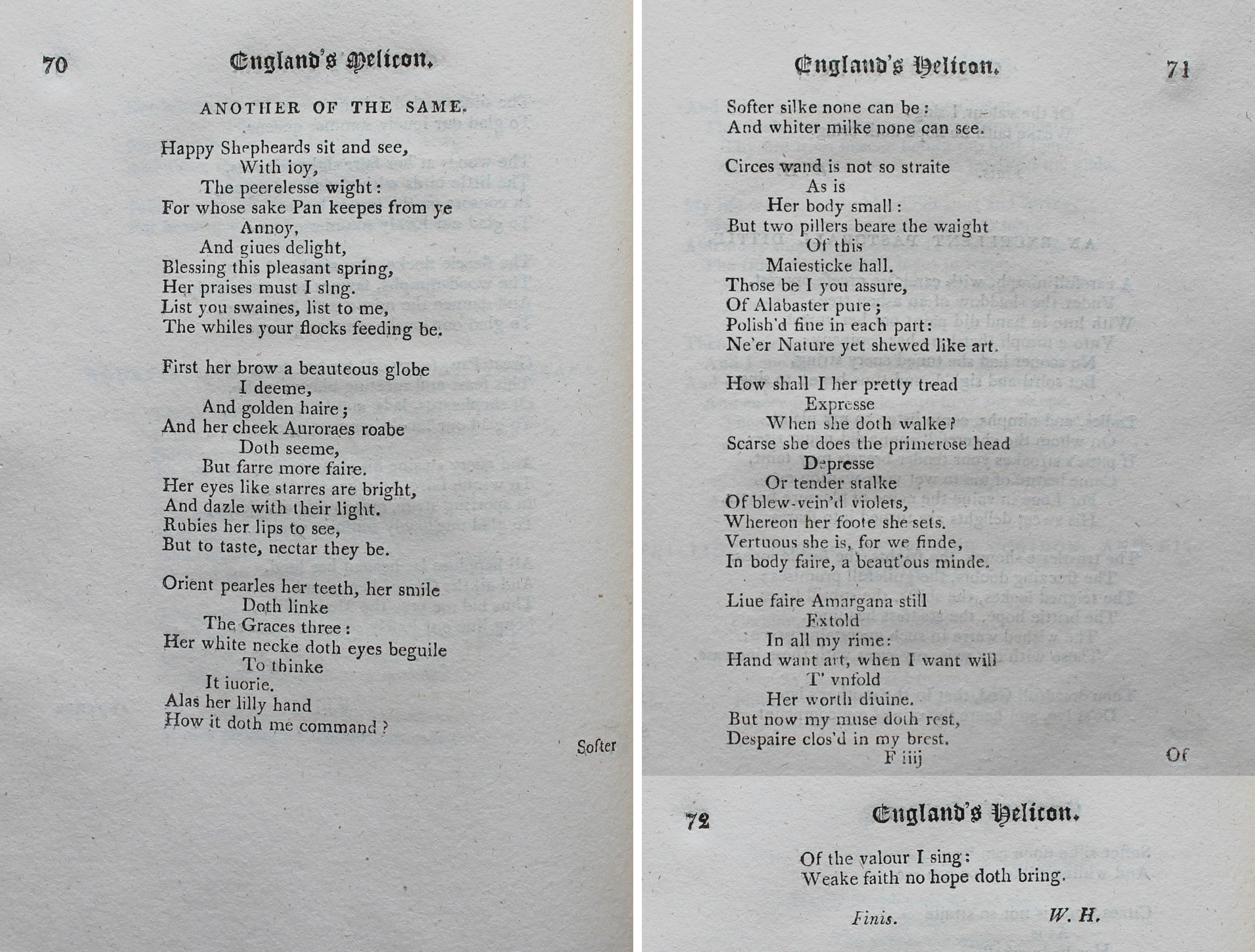
W. H., “Wodenfride’s Song in Praise of Amargana”, England’s Helicon, pp. 68-69

W. H., “Wodenfride’s Song in Praise of Amargana”, England’s Helicon, pp. 68-69

Keynes seems to have failed to check the “Index of the Names of Authors” at the beginning of the book, where W. H. is tentatively identified as “Wm. Hunnis?” The editors, S. E. Brydges and Joseph Haslewood, state in the biographical notice of W. H.: “I recollect no writer to whom these initials may apply, unless William Hunnis, who seems to have lived too early to have been a contributor to this volume. […] Qu.? William Herbert?” The poet William Hunnis, who died in 1597 and could have therefore known Shakespeare, was in the service of William Herbert, 1st Earl of Pembroke (1501-1570) and grandfather of Shakespeare’s patron, the 3rd Earl of Pembroke. So there is a connection with Shakespeare there, albeit a tenuous one.

The second poem by W. H. in England’s Helicon, pp. 70-72

The second poem by W. H. in England’s Helicon, pp. 70-72

As shown in a previous post on James Howell’s Epistolae Ho-Elianae (1645), Keynes’s book collecting was not merely a matter of accumulating items, as he actively engaged with the issues raised in these works and shared his ideas, thoughts and opinions with friends. But going back to his original question. Could the W. H. in England’s Helicon really be the mysterious dedicatee of Shakespeare’s Sonnets? Over to Shakespeare scholars.

IJ

HLF funding for King’s Library

King’s Library has received £44,000 from the Heritage Lottery Fund (HLF) for an exciting project, ‘Shakespeare and Austen at King’s College: Celebrating their Centenaries in 2016 and 2017’. The project will result in the online cataloguing and conservation of the English literature section of the Thackeray collection of rare books, bequeathed to King’s College Library in the mid-nineteenth century by the sometime Provost of the College, George Thackeray (1777-1850), cousin of the novelist William Makepeace Thackeray (1811-1863). A major part of the project is a comprehensive programme of outreach activities and online educational material.

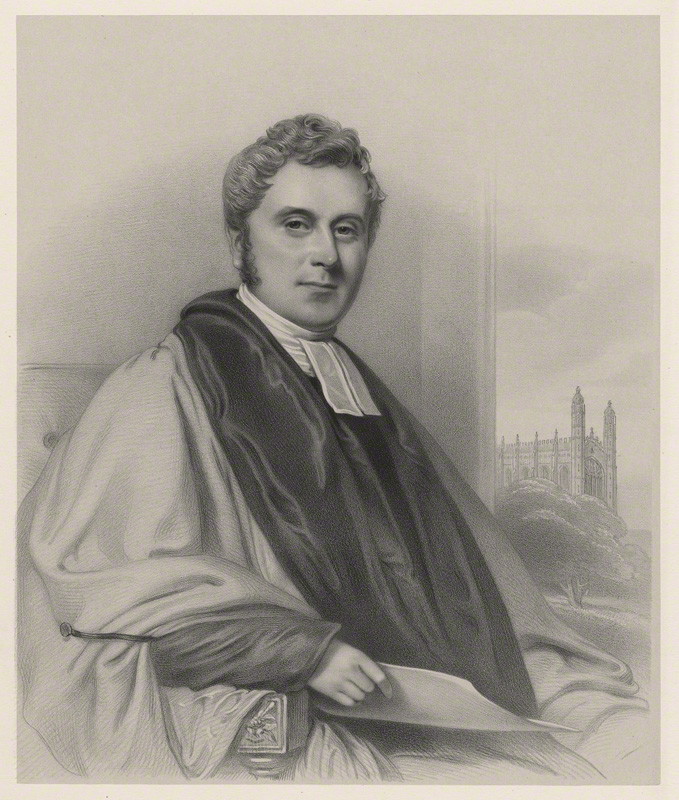
by Richard James Lane, lithograph, 1851

George Thackeray (1777-1850) by Richard James Lane, lithograph, 1851

The project will enable local people and volunteers to engage with some of the most important books in the history of English literature through a series of exhibitions, talks, open days and workshops for young people, and give a worldwide audience the opportunity to learn about the collection online. Owing to the lack of a proper online catalogue, the collection has remained difficult to explore.

Shakespeare folio image

Title page of Shakespeare’s First Folio (1623)

Highlights in Thackeray’s library include Shakespeare’s First Folio, first and early editions of all of Austen’s novels, a collection of 16th-century books on theology (including works by Sir Thomas More, Martin Luther and Erasmus), and over one thousand volumes of early editions of the most important English authors in sumptuous historic bindings. Other major writers included are John Milton, John Donne, Edmund Spenser and Ben Jonson.

We are delighted to have received the support of the Heritage Lottery Fund, which will enable us to gain a much better understanding of the Thackeray collection and help us to improve access to these treasures. We are also looking forward to the many opportunities the project will afford us to allow local people to engage with their heritage (anyone interested in volunteering for the project is most welcome to get in touch), and hopefully revisit the works of Shakespeare and Austen during their anniversary years.

english_landscape_pantone

JC


Riveting Accounts

After someone asked me about a young King’s fellow in about 1579 (whom the enquirer thought might be the minister who married Will Shakespeare and Anne Hathaway – we were not surprised when I couldn’t find any supporting evidence at King’s), I searched through that entire year’s accounts. Some surprising, or at least interesting, things came up.

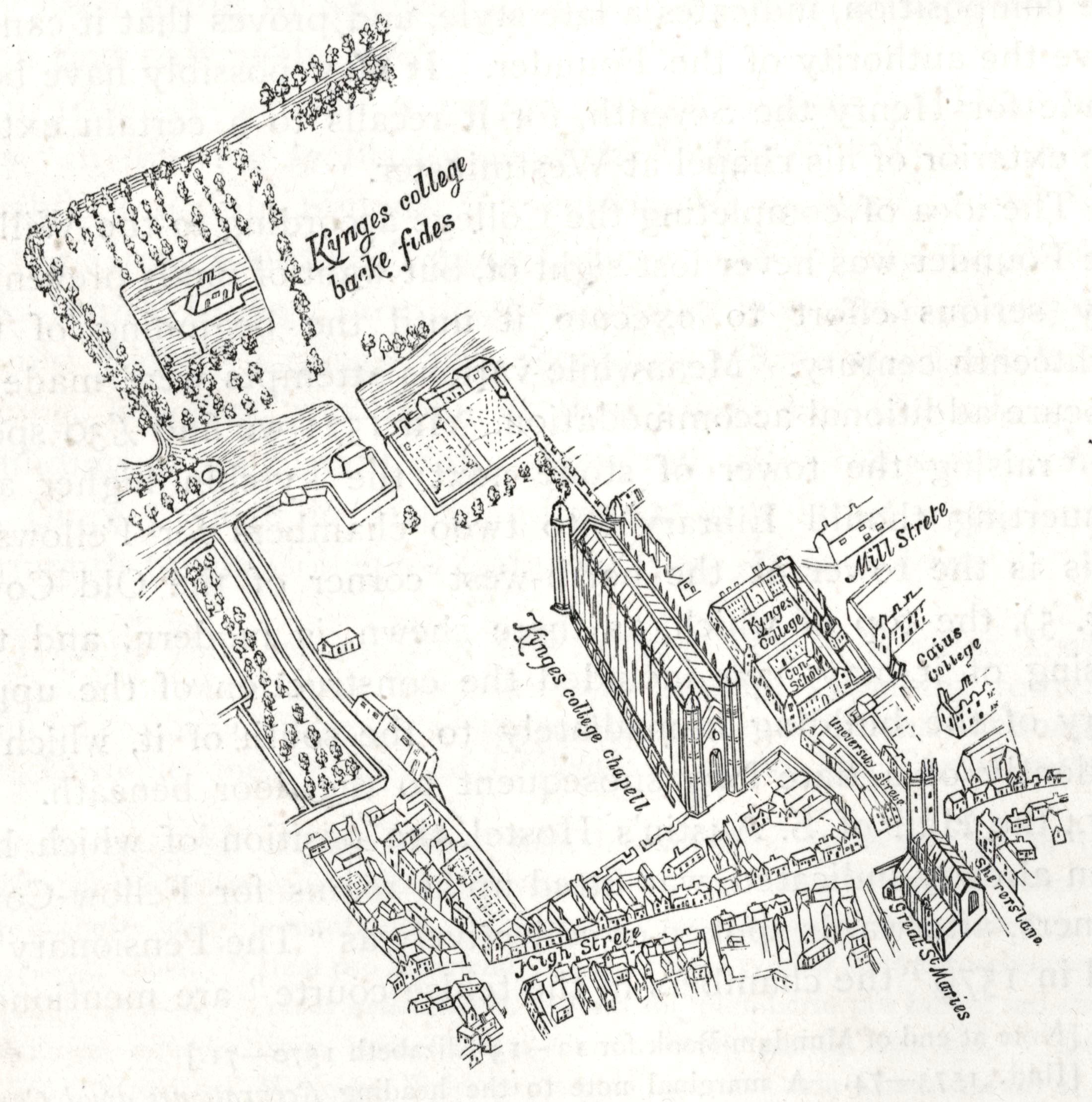
The two great maps of the College site pre-Gibbs’ building are Hamond’s map of 1592 and Loggan’s map of 1688. Hamond’s map is faint, and is reproduced here as a re-drawing from Willis and Clark’s Architectural History of the University of Cambridge and of the Colleges of Cambridge and Eton. The Loggan excerpt reproduced here is taken from a 1921 reprint by Clark and Gray.

W&C-553 fig 57 b

Hamond’s map

1688 Loggan_crop

Loggan’s map

Queens’ Road (west) is at the top – the fields beyond, now the Fellows’ Garden, were common land at the time.

What’s that moated site in the middle of Scholars’ Piece? On the Hamond map it’s occupied by a dovecote. And what about all those buildings around the wall surrounding the College site, particularly visible in Hamond’s map? What are they? The draft accounts (a page of which is shown below) offer some partial explanations.

1578-9 rep cantab 4

KCAR-4-1-4-11 Bursar’s particulars book, reparationes cantab. for Annunt and Bapt term (Easter and long vacation/summer) 1579

These particular pages from the accounts record repairs on the College site. (Other pages record repairs at our Grantchester and Barton estates, for example.) The first three items on this page record payments of

Junii 23 le pavier for paving 32 yerdes in the lane by the stables 2 d ob the yerde…vi s iiii d

for a load of ragge to the same…iiii s vi d

Cochei July 8° pro 10 bigatis argille…vi s viii d

The abbreviation ob is for oblus, technically a halfpenny but the term often appears in the accounts to stand generally for ‘a portion’ – in this case the paving cost works out at 2 3/8 shillings per yard. This suggests it is internal to the College site, for the 1543 Cambridge paving bill (in force until 1788) decreed that all the public streets be maintained by the frontage-holders and that ‘no persone or persones exercysyng the handecrafte or ocupacion of pavyng wythin the sayd towne, shall take above a jd. q. for every yarde square pavyng’ (Cooper’s Annals of Cambridge, vol. 1, p. 411).

Thus we paid someone to pave a lane, at two and a bit pence per yard, and he supplied the (rag-)stones at 4 shillings sixpence. We also paid Cochei for 10 cartloads of clay. It’s not clear whether this is a man called Cochei, or just ‘a coach driver’ – the designation appears in the accounts books frequently during these years, when labourers’ names are usually specified. From the marginal ‘g.w.’ next to this entry and others I surmise the clay (‘argille’), as well as the next items (sand and straw, also delivered by Cochei), were used to build the garden wall in that year. 10,800 tiles were purchased at one point to cope the garden wall ‘about the Fellows garden’ which had a locked gate.

In various places the late 1570s College accounts mention a thatched swan house and a dove house which probably housed the ‘salt stone for the pigeons’ who were fattened, like the swans, with malt – the swans were later ‘upped’ (gathered and marked) and one presumes the pigeons were consumed in Hall. Other buildings mentioned in these years are:

• the stables and stable yard
• wheat house
• wood house and wood yard
• storehouse which might be the same as the larder mentioned
• salt house
• lead house (it housed the leads used in windows and the Chapel roof I suppose)
• ‘house over the water in the Scholars’ garden’
• coal house
• mill house with mill stone and mill horse
• brew house
• bake house
• sedge house with a wall around it which might be the same as the new straw house – a boat was required to remove the scaffolding after the sedge yard wall had been repaired, so if they are the same it must be one of the riverside buildings.

Gates mentioned:

• field gate
• bridge gate
• water gate
• College gate
• alms gate
• friars’ gate

The friars’ gate was approximately where Webb’s Court gate now is. There was a tennis court outside the friars’ gate and an orchard in what is now the Provost’s garden. There were lofts somewhere for malt and fish. Willis and Clark examined the accounts and offered some explanations, but it’s likely that in many cases we will never know which buildings were used for which purposes. So there are more questions than answers at this point, and plenty more research to do in those ‘boring, dry old accounts’.

PKM