Tag Archives: Manuscripts

A celebration of Orlando Gibbons (1583-1625)

This year at King’s we have been marking the 400th anniversary of the death of the composer Orlando Gibbons. Gibbons was born in Oxford in 1583 to a musical family who moved to Cambridge when he was an infant. He was admitted to King’s College in 1598 at the age of fourteen, though had apparently been a chorister at King’s for some years before that, and received a Bachelor of Music degree from the university in 1606. His later life took him to London, where his reputation as a composer and organist was established, and finally to Canterbury, where he died in June 1625 after a sudden illness. He is buried in Canterbury Cathedral.

Portrait of Orlando Gibbons by an unknown artist. Image from Wikimedia Commons.

An inspection of Gibbons items held by King’s College Library has revealed some treasures that may not have seen the light of day for many a year.

My own introduction to Gibbons came when I was about fourteen, singing his sublime five-voice madrigal ‘The silver swan’ with my school chamber choir. We can trace this work through the centuries using various editions held in the Rowe Music Library.

Few of Gibbons’ compositions were published during his lifetime, one notable exception being The First Set of Madrigals and Mottets, printed in 1612 by Thomas Snodham. This is a collection of 20 secular songs, the first of which is ‘The silver swanne’. At King’s we have a copy of the cantus partbook only (containing the part for the highest voice), purchased in 1996 with a gift from the widow of Sir Henry Lintott (KC 1928).

Title page and page 1 of Orlando Gibbons, The First Set of Madrigals and Mottets … (London: Printed by Thomas Snodham, the Assigne of W. Barley, 1612) Shelfmark: LU.50

‘The silver swan’ next appears in the Rowe’s collection as part of a 1673 edition of The Musical Companion, a collection by John Playford anthologising ‘dialogues, glees, ayres and songs’.

Title page of John Playford (ed.), The Musical Companion … [Book 2] (London: Printed by W. Godbid for John Playford, 1673) Shelfmark: LU.101

The madrigal here is arranged for three voices, sacrificing much of the richness of the inner parts. The three parts are presented as a double-page spread, the middle part printed upside down, presumably so that three singers could share a single book, the Cantus Primus and Bassus singers reading from one side, the Cantus Secundus from the other.

Pages 152-153 of The Musical Companion … [Book 2] (London: Printed by W. Godbid for John Playford, 1673) Shelfmark: LU.101

The rise of glee and catch clubs in late eighteenth-century Britain led to many publications like The Apollo, or Harmonist in Miniature, an 8-volume anthology probably dating from the early 1820s. The frontispiece features William Hawes, Master of Children at the Chapel Royal from 1817 and evidently the pin-up of catch club members at that time.

Frontispiece and title page of The Apollo, or Harmonist in Miniature … Vol. 3 (London: T. Williams, c. 1820) Shelfmark: Rw.112.48

This arrangement of ‘The silver swan’, essentially the same as Playford’s, is presented in a small format (18 cm high), which suggests that each member of the catch club would have had his own copy.

Pages 198-199 of The Apollo, or Harmonist in Miniature … Vol. 3 (London: T. Williams, c. 1820) Shelfmark: Rw.112.48

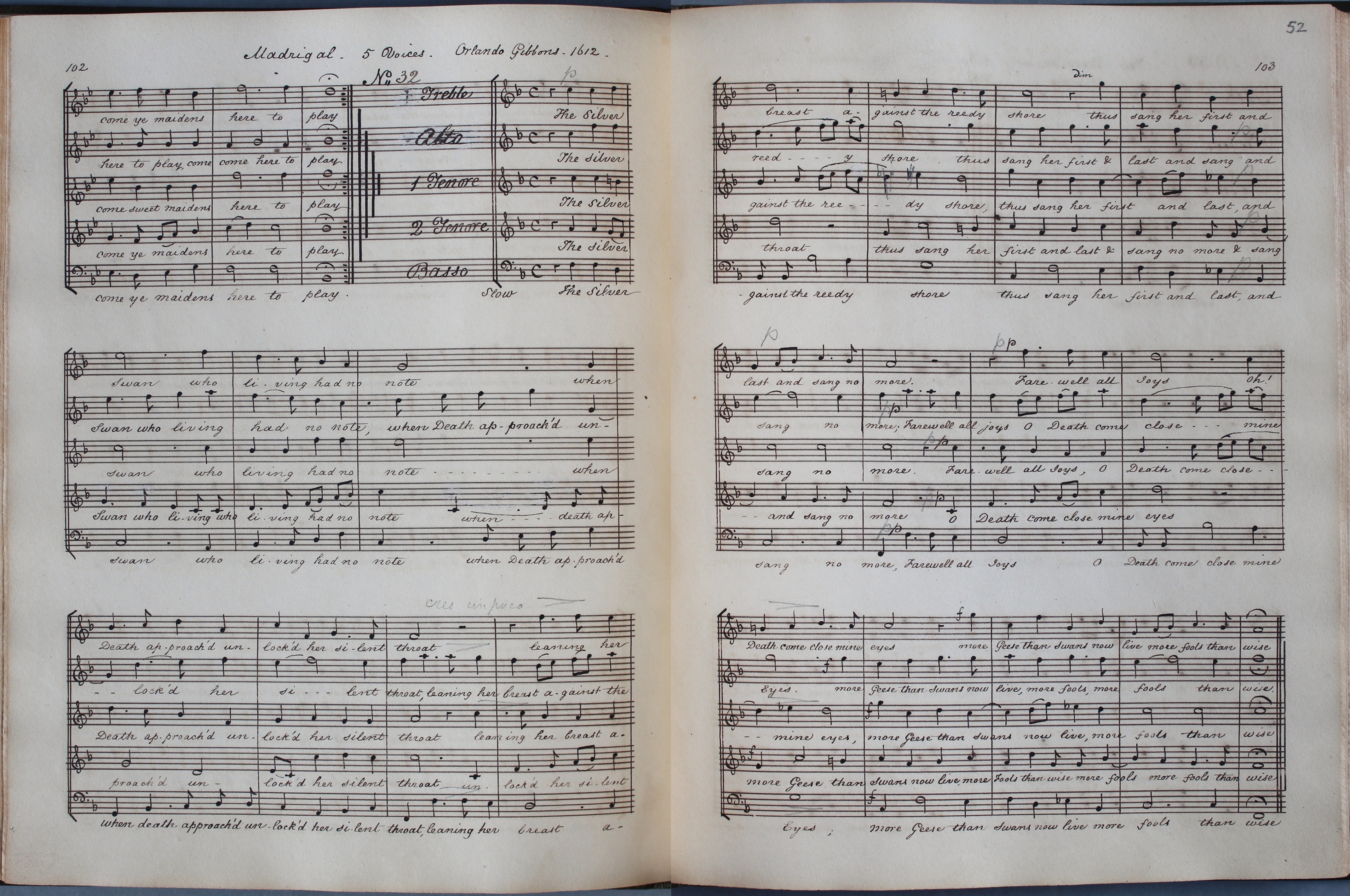
The Rowe Library’s MS 111 is a manuscript dating from 1834-5 in the hand of Thomas Oliphant (1799-1873), best remembered today for writing the lyrics of ‘Deck the hall with boughs of holly’. Oliphant had recently been elected Honorary Secretary of The Madrigal Society (still going today, and now admitting women), and the book may have been intended as his neat conductor’s copy of the 83 motets, madrigals and glees it contains, of which no. 32 is ‘The silver swan’.

Pages 102-103 of Rowe Music Library, MS 111

***

Naturally it is Gibbons’ sacred music that is heard most in King’s College Chapel, in the form of hymns and anthems. Gibbons’ reputation as a composer of hymn tunes rests on his contributions to George Wither’s 1623 publication The Hymnes and Songs of the Church, for which he wrote 17 original tunes still known today by the ‘Song’ numbers accorded them in this volume. A patent of King James I ordained that the book should be bound with all copies of the metrical Psalms sold, which may account for the early adoption of Gibbons’ tunes by church choirs.

Title page of G[eorge] W[ither], The Hymnes and Songs of the Church … (London: Printed by the Asignes of George Wither, 1623) Shelfmark: Keynes.C.5.17

‘Song 1’, which in this book accompanies Wither’s text ‘Now shall the praises of the Lord be sung’, is today more commonly sung to ‘O Thou who at the Eucharist did pray’ or ‘Eternal ruler of the ceaseless round’.

Opening of ‘Song 1’ from G[eorge] W[ither], The Hymnes and Songs of the Church … (London: Printed by the Asignes of George Wither, 1623) Shelfmark: Keynes.C.5.17

***

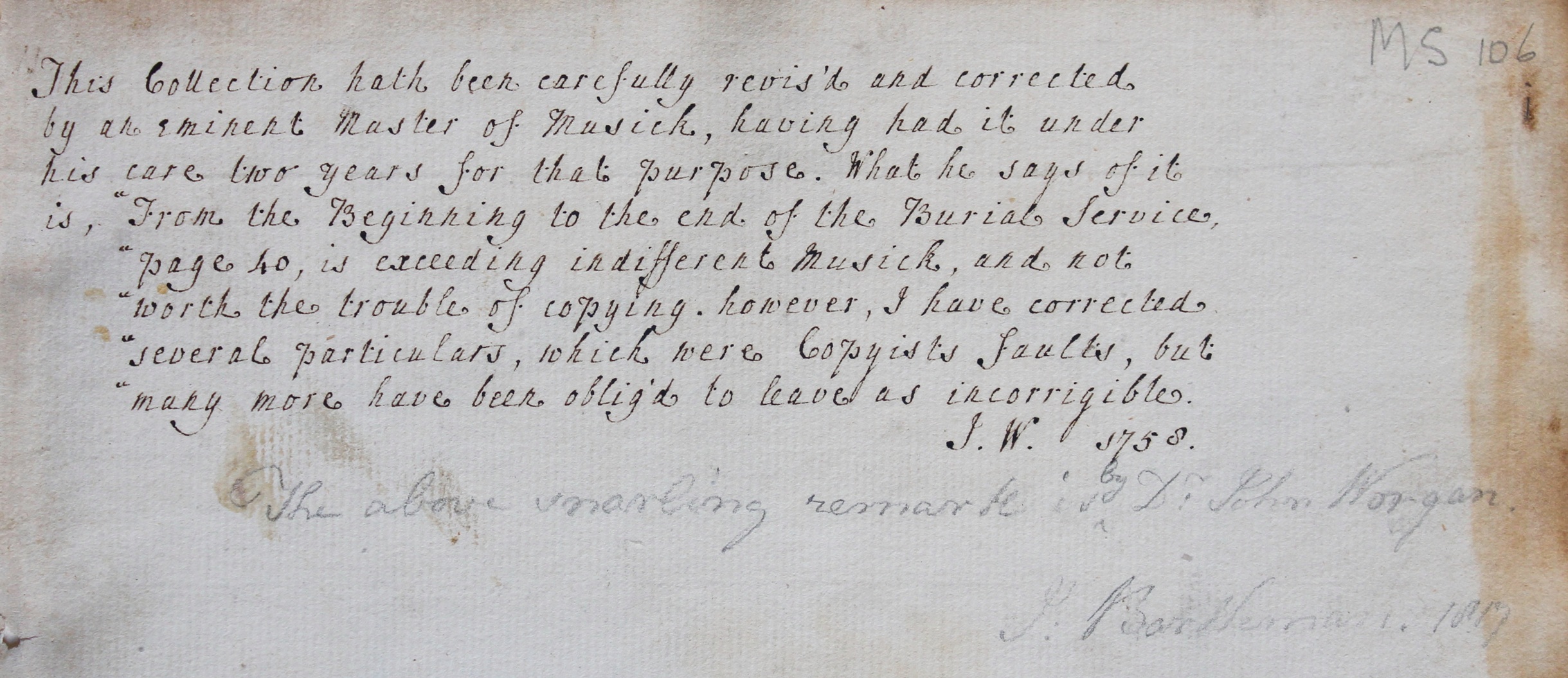
The Rowe Library’s MS 106 is an eighteenth-century manuscript containing anthems and services copied in several hands. A note on the flyleaf observes:

This Collection hath been carefully revis’d and corrected by an eminent Master of Musick, having had it under his care two years for that purpose. What he says of it is, ‘From the Beginning to the end of the Burial Service, page 40, is exceeding indifferent Musick, and not worth the trouble of copying. However, I have corrected several particulars, which were Copyists faults, but many more have been oblig’d to leave as incorrigible.’ J.W. 1758

A pencil addition notes:

The above snarling remark is by Dr John Worgan. J. Bartleman, 1817

Note on flyleaf of Rowe Music Library, MS 106

The one Gibbons work present in this volume is his six-voice anthem ‘Hosanna to the Son of David’, at the head of which is written a quotation from Sir John Hawkins’ A General History of the Science and Practice of Music of 1776 describing it as ‘one of the most perfect Models for Composition in the Church-Style of any now existing’.

Page 162 of of Rowe Music Library, MS 106

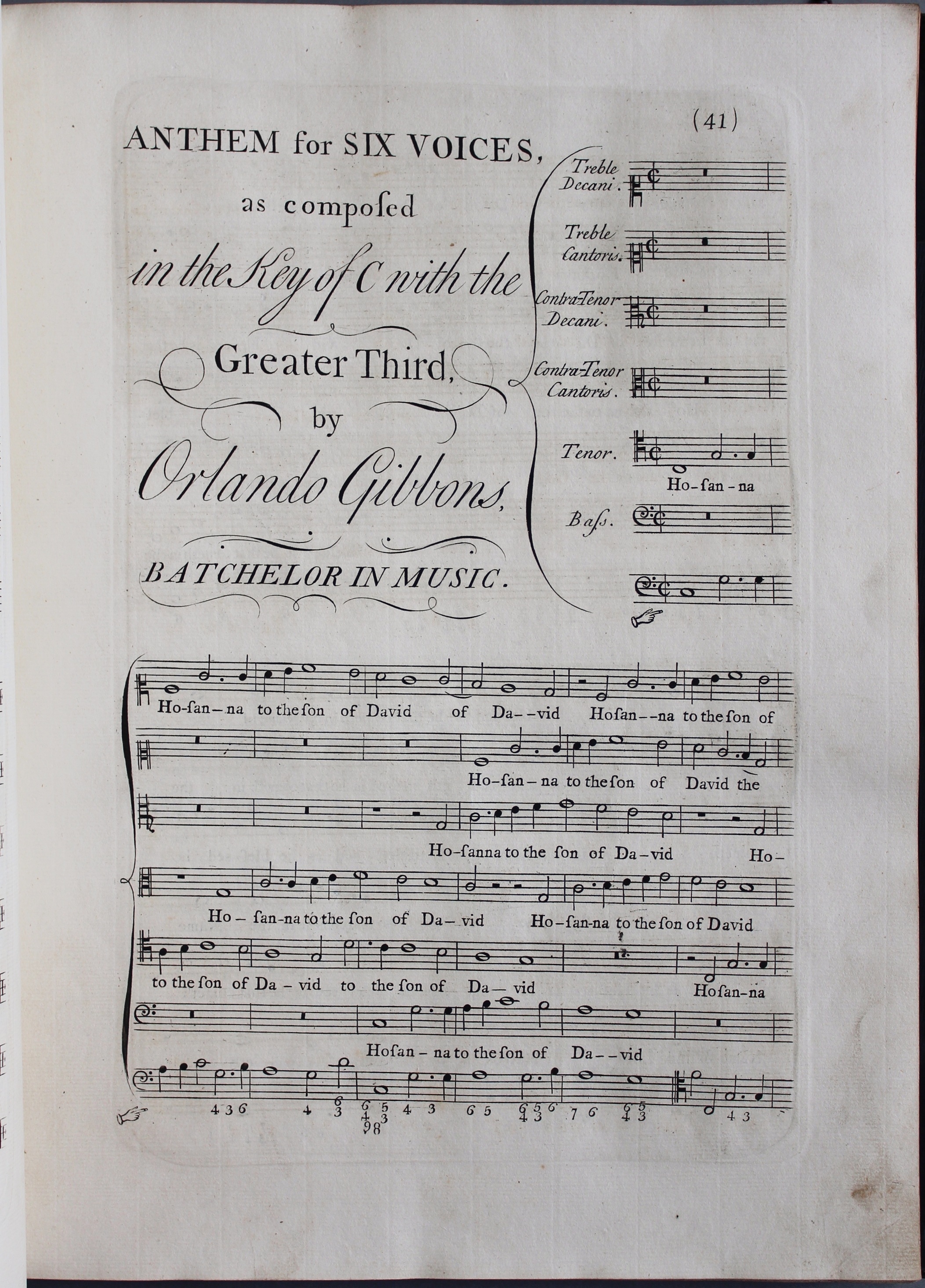
‘Hosanna to the Son of David’ is one of several Gibbons anthems anthologised in the second volume of Cathedral Music, edited by William Boyce (1711-1779), Master of the King’s Musick, and published in 1768 after a long gestation.

Page 41 of William Boyce (ed.), Cathedral Music … Volume the Second (London: Printed for the Editor, 1768) Shelfmark: Rw.115.12

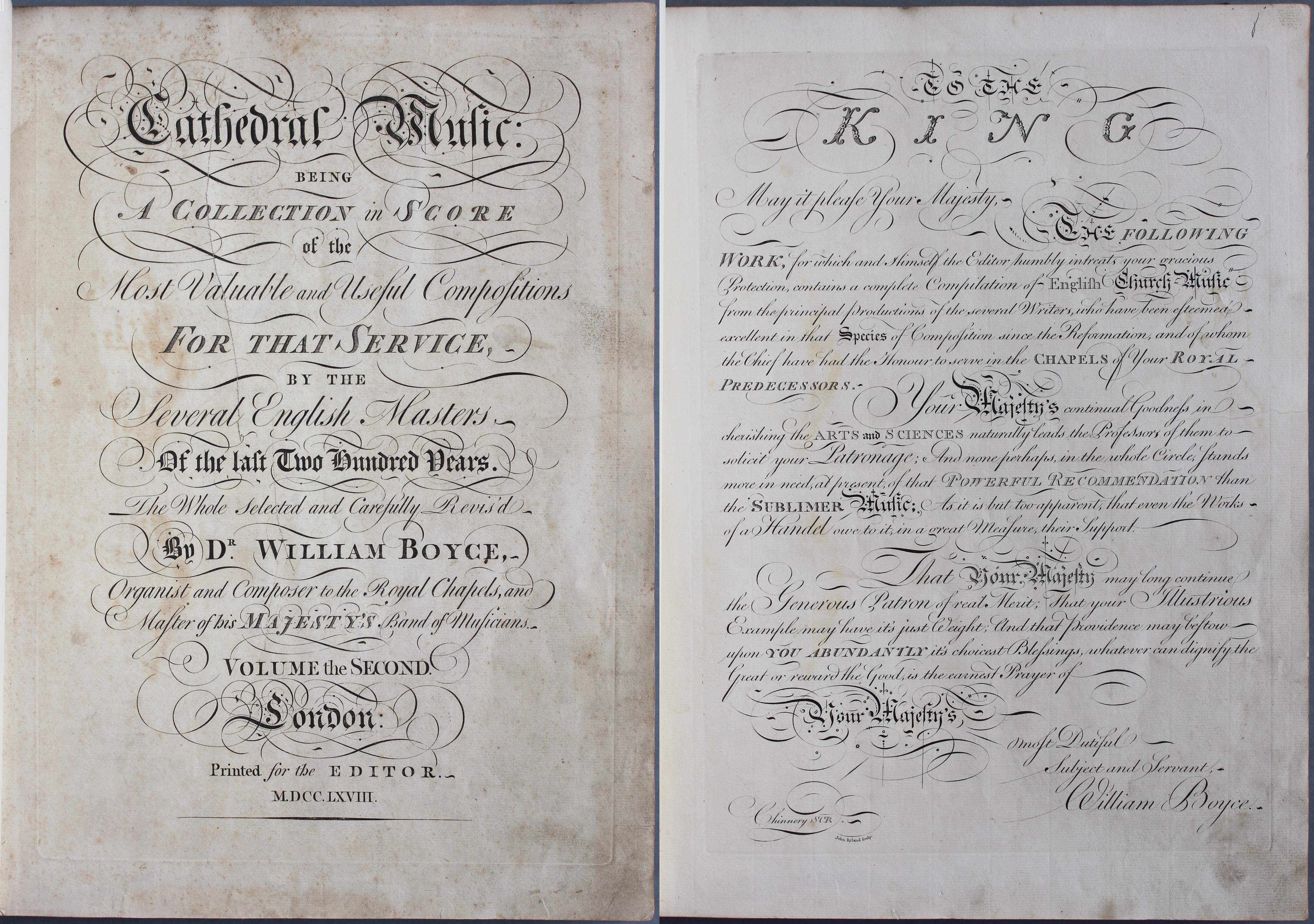
Doubtless partly due to the royal imprimatur, this volume was a swanky undertaking all round, bearing a title page boasting of ‘the most valuable and useful compositions … of the last two hundred years’, a dedication to King George III involving every typeface under the sun, and even an anthem ostensibly composed by George’s predecessor Henry VIII (‘O Lord, the maker of all things’, now usually attributed to William Mundy).

Title page and dedication from William Boyce (ed.), Cathedral Music … Volume the Second (London: Printed for the Editor, 1768) Shelfmark: Rw.115.12

The volume’s subscribers included not only the Provost and Fellows of King’s College, Cambridge (of course), but also such luminaries as:

The Rev. Mr. Heneage Dering, Chaplain to the Earl of Winchelsea.
The late Rev. Mr. Phocion Henley.
Bybie Lake, Esq.
Gervas Scrope, Esq. of Cockerington, in the County of Lincoln.
Messrs. Sharp, of Mincing-Lane, London. Two Sets.
The King.

Blank spaces at the end of anthems are filled with illustrations: usually flourishes and curlicues, but occasionally faces or, at the end of William Byrd’s ‘Bow thine ear, O Lord’, a complementary bird. Note also the snazzy manicules (pointy fingers) in the score to help the organist find his line. No such help for the choir, though the size of the book (42 cm high) suggests it may have been a publication meant primarily for the use of a choirmaster, from which choir parts could be copied in manuscript.

Various devices from William Boyce (ed.), Cathedral Music … Volume the Second (London: Printed for the Editor, 1768) Shelfmark: Rw.115.12

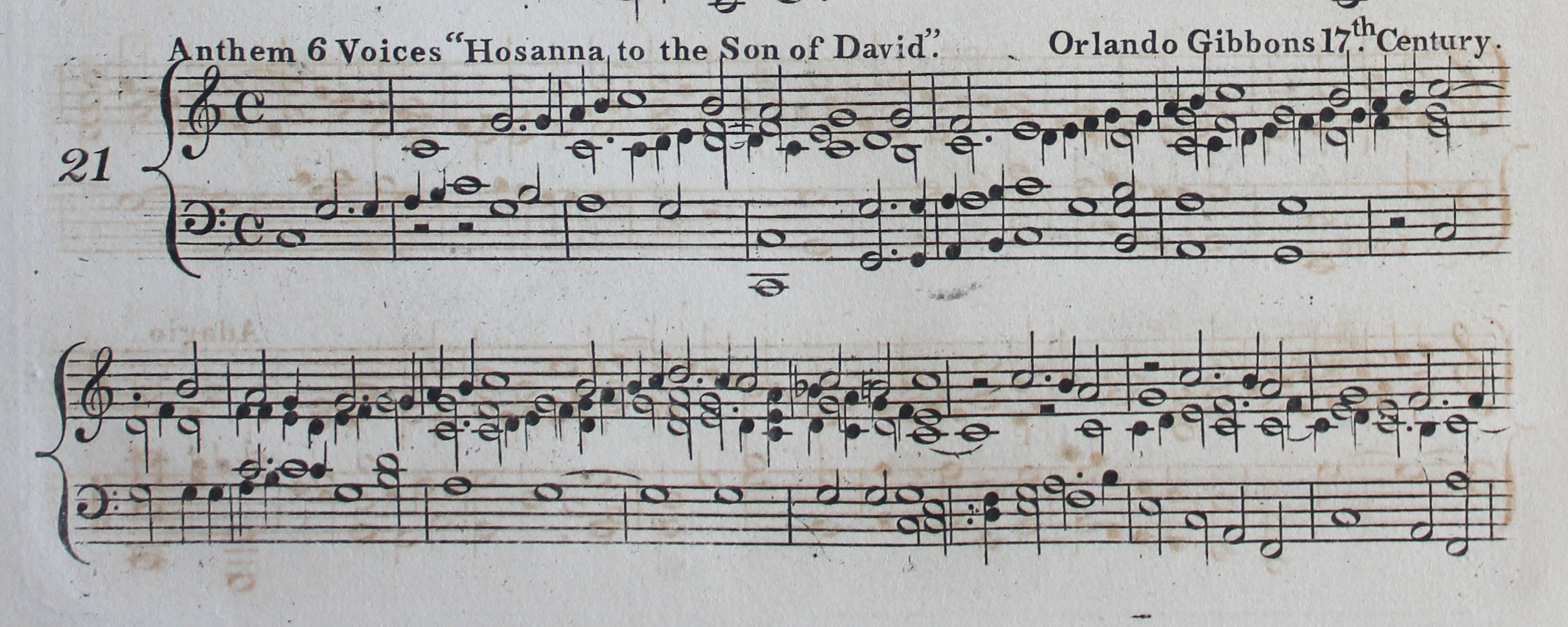
‘Hosanna to the Son of David’ also appears, albeit in short score, in the work known unpromisingly as ‘Crotch’s Specimens’, or more fully as Specimens of Various Styles of Music Referred to in a Course of Lectures Read at Oxford & London and Adapted to Keyed Instruments by Wm. Crotch, Mus.D., Professor of Music in the University of Oxford. The Specimens was a major work of scholarship, ‘encyclopaedic in scope and surprisingly forward-looking in its aim to combine academic example with practical purpose’, in the words of Grove. In a preface to this revised edition, Crotch writes:

The study of Orlando Gibbon’s [sic] works cannot be too strongly recommended. For choice of subjects, for skill in the management of them, and for the flow of melody in all the parts, this great master was inferior to none of his cotemporaries.

Opening of No. 21 from William Crotch, Specimens of Various Styles of Music … Vol. 2 (London: Printed for the Author … c. 1821) Shelfmark: Rw.54.14

It’s no surprise that Gibbons’ music has been an attractive proposition to Kingsmen looking to produce performing editions over the years. Twentieth-century editions of choral works by Gibbons held by the Rowe Library include those prepared by David Willcocks (KC 1939), John Whitworth (KC 1946), Philip Brett (KC 1955) and John Morehen (KC 1964).

***

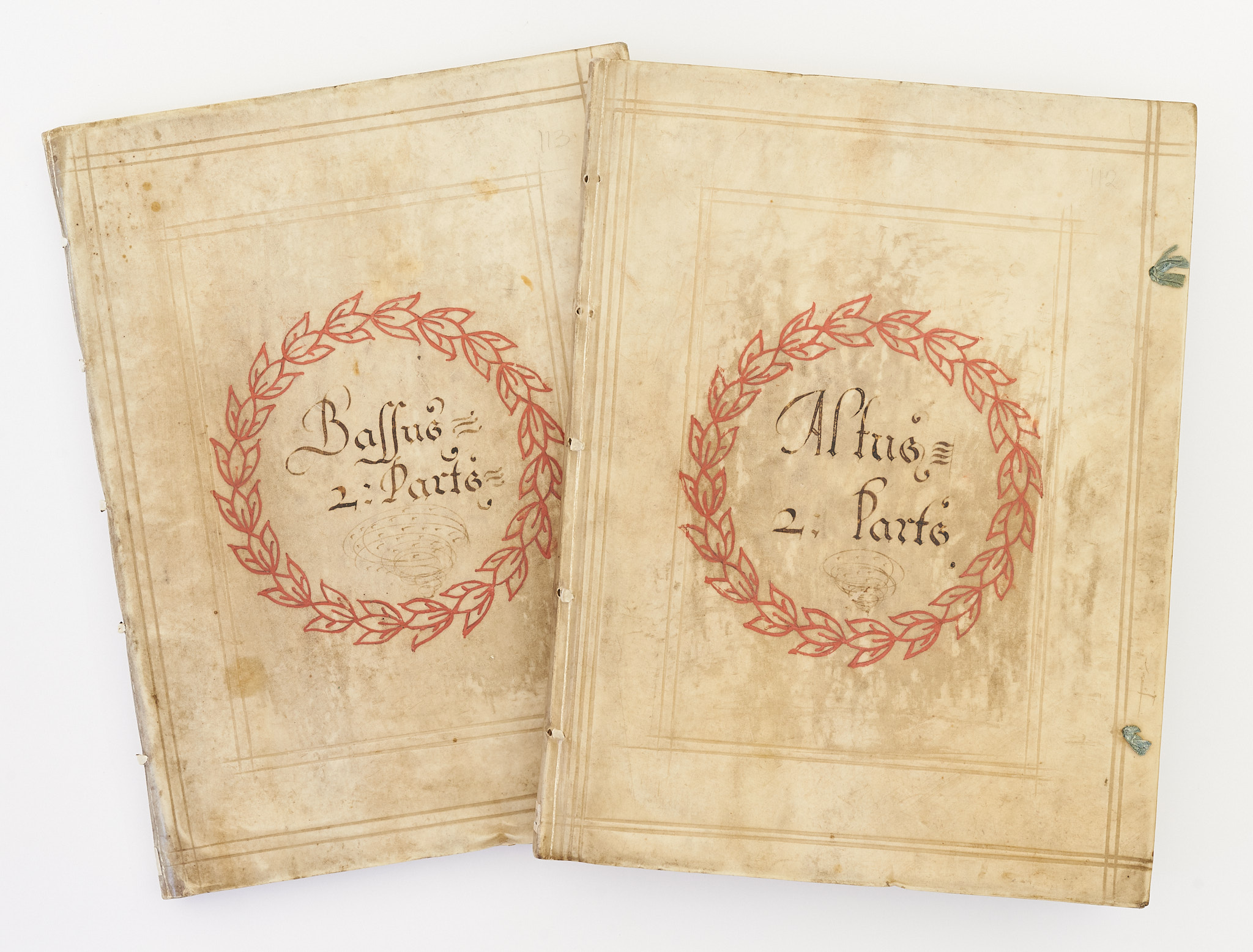
Finally, a pair of mid-seventeenth-century music manuscripts given to the college by John Maynard Keynes. MSS 112 and 113 are two partbooks for viols of fantasias and dances primarily by John Coprario, but also containing works by John Jenkins, William White and others.

Bindings of Rowe Music Library, MSS 112 and 113. Photo © 2025 Sara Rawlinson at HeritagePhotographs.com.

The works included by Gibbons are six fantasias for two treble viols, which are not preserved in manuscript elsewhere. These manuscripts were the property of John Browne (1608-91), Clerk of the Parliaments, and the Gibbons fantasias here are in Browne’s own hand.

No. 13 in Rowe Music Library, MSS 112 and 113

These fantasias have been published in many editions: they appear in the Musica Britannica volume of Gibbons’ Consort Music, and if you fancy playing them yourself you can browse several public-domain versions here.

GB

Dante: An Online Exhibition

In November 2024 King’s College had the opportunity to host the annual doctoral and postdoctoral research conference “Dante Futures 2024: New Voices in the UK and Ireland”. For this occasion, an exhibition of rare early printed and manuscript materials relating to Dante was mounted in the library. As this year marks the 760th anniversary of Dante’s birth in 1265, we thought it would be timely to share some of these treasures in an online exhibition.

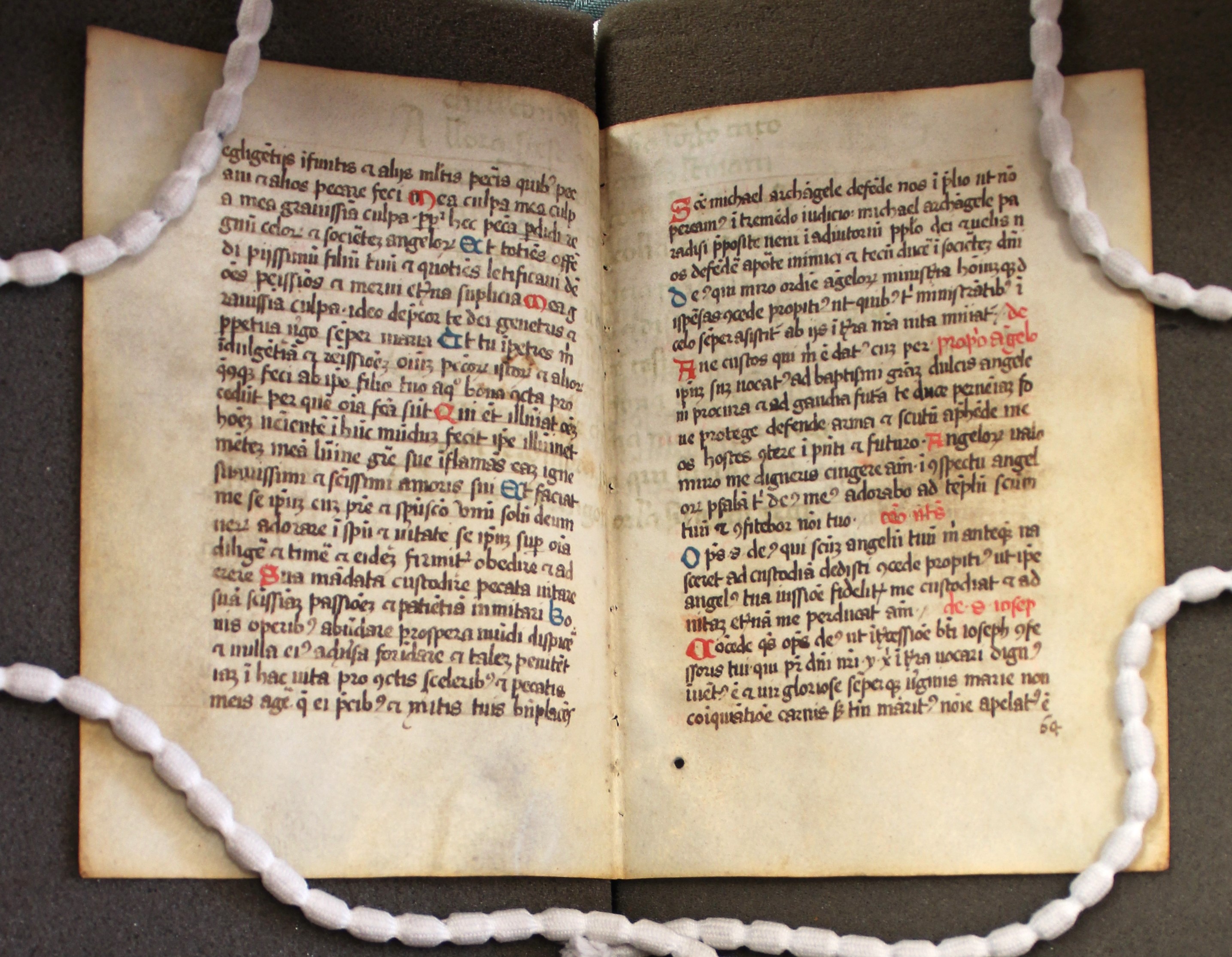
While there is no extant autograph manuscript of the Divine Comedy, many other fourteenth- and fifteenth-century manuscripts survive. Below is a fifteenth-century breviary written in an Italian hand on vellum. This is a palimpsest, namely a manuscript on which a piece of writing has been superimposed, effacing the original text. In this case the erased text is from Dante’s Inferno, one of the three parts of the Divine Comedy, which was written on at least 31 leaves used in this breviary. The vellum was not thoroughly cleaned when it was prepared for reuse, meaning Dante’s text can be seen by the naked eye in a number of places, apparently written in a fourteenth-century hand. Each leaf of the original manuscript was folded in two, vertically, to create two leaves (one bifolium). At the top of the page we can see lines 39-40 of Inferno VIII (spelling modernised):

ch’i’ ti conosco, ancor sie lordo tutto.
Allora [di]stese al legno ambo le mani

[for thee I know, all filthy though thou be.
Then toward the boat he stretched out both his hands]

Breviary (imperfect), fifteenth century, partly written on a palimpsest vellum of Dante’s Inferno, fourteenth century (Salt MS 3)

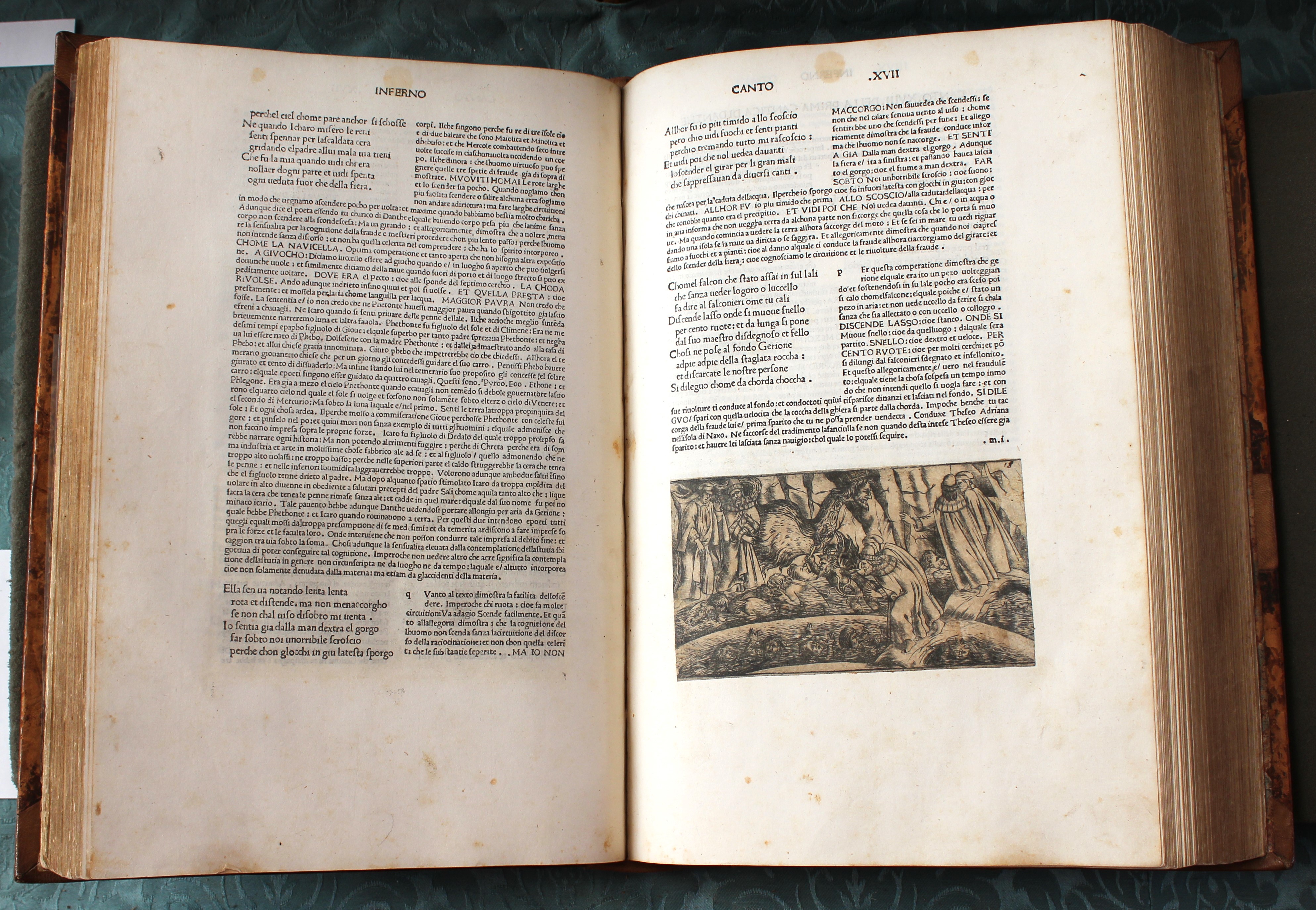
The first printed edition of the Divine Comedy appeared in 1472. This incunabulum from 1481 (a book from the dawn of printing, printed before 1501) includes the commentary of Cristoforo Landino with additions by Marsilio Ficino, and is the third edition of the work to be published. The engravings are attributed to Baccio Baldini after designs by Sandro Botticelli, eighteen of which are included in this copy, mainly pasted in spaces left by the printer for that purpose. Here we see the descent of Virgil and Dante into Hell, as they move to the circle of the fraudulent in the Malebolge, thanks to the mythological monster Gerion, who flies them down on its back. With the face of a just man, the body of a snake, the tail of a scorpion, and hairy paws, Gerion is an allegory of falseness and fraud, precisely because its human face displays a benign humanity while the serpentine and monstrous body reveals its evil:

Comento di Christophoro Landino fiorentino sopra
La comedia di Danthe Alighieri poeta fiorentino
(Florence: Nicholo di Lorenzo della Magna, 1481; Bryant.XV.1.4)

Aldus Manutius (c. 1449/1452–1515), founder of the Aldine Press in Venice, was one of the most important printers of the period. He was an advocate of the smaller, more portable book format, which is arguably the precursor to the modern paperback. His work also helped to standardise the use of punctuation.

Along with Greek classics, the Aldine Press also printed Latin and Italian works. At the start of the sixteenth century the Bembo family—a noble Venetian family—hired the Aldine Press to produce accurate texts of both Dante and Petrarch using Bernardo Bembo’s personal manuscript collection. Pietro Bembo worked with Manutius from 1501 to 1502 to undertake this work, resulting in this, the fifth edition of the Divine Comedy to be published. Here we see the well-known dolphin-and-anchor printer’s device used by the Aldine Press, adopted in 1502 and used for the first time in this publication:

Dante Alighieri, Lo ‘nferno e ‘l Purgatorio e ‘l Paradiso di Dante Alaghieri
(Venice: Aldus Manutius, 1502; M.71.15)

The Aldine Press published a second edition of the Divine Comedy in 1515 in partnership with Aldus’s father-in-law, Andrea Torresani “nelle case d’Aldo et d’Andrea di Asola suo suocero” (at the house of Aldo and Andrea of Asola, his father-in-law), with whom he had a professional relationship from 1506 until his death in 1515. Although the volume appeared just after his death, Aldus is believed to have prepared this second edition himself. The publication was dedicated to Vittoria Colonna (1490–1547), one of the most famous women of the Italian Renaissance, friend to the most important cultural figures of the age including Bembo, Castiglione and Michelangelo, and a poet in her own right. Below is the opening of the second part of the Divine Comedy, the Purgatorio:

Dante col sito, et forma dell’inferno tratta dalla istessa descrittione del poeta
(Venice: nelle case d’Aldo et d’Andrea di Asola suo suocero, 1515; Keynes.Ec.7.3.22)

Alessandro Vellutello (born 1473) produced an influential commentary on the Divine Comedy, published in 1544, which is a real gem in the collection of rare books bequeathed to King’s College by novelist E.M. Forster (1879–1970). This copy belonged to Bishop John Jebb (1775–1833) who gifted it to Forster’s grandfather, Charles Forster (1789–1871). The printer left spaces for 87 woodcut illustrations which were first used in this edition and subsequently in a number of other editions throughout the sixteenth and seventeenth centuries. They were considered some of the most beautiful Renaissance illustrations of the poem after Botticelli’s.

This is a depiction of Giudecca (named after Judas Iscariot), the very last region of Hell. The sinners are punished by being completely frozen in the lake of Cocytus, some upright, some upside down, some with their bodies bent double. Enormous in size, we see the top half of Lucifer in the lake, gnawing on the bodies of sinners:

La comedia di Dante Aligieri con la nova espositione di Alessandro Vellutello
(Venice: per Francesco Marcolini, 1544; Forster.DAN.Com.1544)

Cosimo Bartoli (1503–72) was a humanist, philologist and writer. He promoted the Italian vernacular as a language which could be used in scientific discussion as much as Latin, and Dante was regarded as an example of the heights the vernacular could reach. A friend of the famed Renaissance painter and architect Giorgio Vasari (1511–74), he also worked for the Medicis for most of his life. His Ragionamenti accademici sopra alcuni luoghi difficili di Dante takes the form of fictitious discussions held between Bartoli and his Florentine friends, to provide explanations of some of the most difficult passages in the Divine Comedy. A collection of some of the lectures he had given in the Accademia fiorentina between 1541 and 1547, it was published in Venice in 1567:

Cosimo Bartoli, Ragionamenti accademici di Cosimo Bartoli gentil’huomo et
accademico fiorentino sopra alcuni luoghi difficili di Dante
(Venice: appresso Francesco de Franceschi Senese, 1567; Bury.BAR.Rag.1567)

JC/IJ


Gibbs, Groats and Gowns: Celebrating the Tercentenary of the Gibbs Building

James Gibbs, A Book of Architecture, Containing Designs of Buildings and Ornaments (London: 1728), frontispiece. (Shelfmark: F.27.7)

Three hundred years ago today, on the 25th March 1724, the foundation stone was laid for a new building in King’s, known today as the Gibbs Building, named after the architect James Gibbs (1682–1754) who designed it. We are fortunate to know quite a lot about the events of that day because of the survival of certain items in the special collections in King’s Library.

Proceedings began with the sermon before the university in a special service in Chapel given by senior King’s fellow Gregory Doughty (ca. 1690–1742, KC 1706).  We know exactly what the sermon was, because it was published, and the publication also reveals other aspects of the service and the ceremony which followed.

A Sermon Preached Before the University of Cambridge in King’s College Chapel on the 25th of March 1724 … by Gregory Doughty (Cambridge, 1724), title page. (Shelfmark: C.5.44.(3.)

A Sermon Preached Before the University, page 3. (Shelfmark: C.5.44.(3.)


The subject of the sermon was ‘Luke II.14 Good Will Towards Men’, and much space was given to extolling the virtues of acts of benevolence, particularly that of founders and patrons of learned societies such as Cambridge colleges. It being ‘Founder’s Day’ (it was celebrated on 25th March at the time), several passages praise Henry VI, the founder of King’s: ‘We must account it sure as well the peculiar felicity, as glory of this society, to be bless’d with such a sovereign for its founder; who prefer’d the honor and service of his Maker to all the gay and flattering privileges of Crown’, writes Doughty.

A Sermon Preached Before the University, appended section ‘The State of King’s College in Relation to the Old Fabrick’. (Shelfmark: C.5.44.(3.)

Appended to the sermon is a document entitled ‘The state of King’s College, in relation to the old fabrick, together with some account of the foundation of a new one.’ This document points out that the new building was long overdue, given the old buildings were intended only for Henry’s original foundation of a community consisting of ‘a rector and 12 scholars’ which he had soon abandoned in favour of a community of ‘a Provost and 70 fellows and scholars’. Towards the end of the document there is an interesting account of the foundation ceremony which took place immediately after the service in Chapel:

Accordingly (the Ground having been first laid out, and the Foundation dug for the West-side of the Square, pursuant to a PLAN design’d by Mr Gibbs) on 25th Day of March last, being the Anniversary of Commemorating the Founder, and the University being met, as usual, at King’s College Chappel; after the Sermon, and an Anthem compos’d on the Occasion; The Provost, accompanied by the Noblemen, Heads of Colleges, Doctors, and other Members of the University, proceeding to the Corner, where the first Stone was to be laid, bespoke Success to the Undertaking in the Form which follows, with such Actions, at proper Intervals, as the Words themselves express, or are customary in such Kinds of Ceremony.

The words ‘in the form which follows’ were printed in Latin at the end of the sermon publication, and reveal a number of interesting details, most notably that some of the words were engraved on a bronze plate and, together with some gold, silver and bronze coins, were put into the foundation stone of the building. The story becomes more intriguing when the text goes on to explain that ‘If in future years a student of ancient times, while searching through the rubble, unearths this bronze plate encased in stone, may he know that this stone was destined for the construction of this College in the times of Henry VI.’

A Sermon Preached Before the University, final two pages comprising the Latin words read out at the foundation ceremony together with an English translation. (Shelfmark: C.5.44.(3.)

The famous clergyman and antiquary William Cole (1714–1782), if his version is to be trusted, sheds light on this stone that had been ‘destined for the construction of this college in the times of Henry VI’:

When the news came of the Founder’s deposition the labourers who were sawing the stone in halves and not having finished it, imagining that there would be no further proceeding in the design by his successors left of their work and the stone remaining half sawed in two. This was always the story about the stone which I myself have seen before any design of making the use of it which was afterwards thought on; and a cut of that stone is in the print of this chapel engraved by David Loggan. In the cleft part was the plate and inscription with ye different coins put. (See British Library, Add MS 5802, fol. 110)

Here is Loggan’s engraving. You can see the stone, partly sawn in half, on the grass on the right-hand side of what was then known as ‘Chapel Yard’:

King’s College Chapel engraved by university engraver David Loggan (1634–1692) (Reference: JS/4/10/38)

Gibbs, A book of Architecture, plate 32 showing the plan for the ‘West Front’ (the Gibbs building) and the front court. (Shelfmark: F.27.7)

Regarding the gold, silver and bronze coins that were enclosed with the engraved bronze plate, there is a centuries-old tradition of burying contemporary coins in the foundations of new buildings in the belief that it would bring good luck and prosperity. How tantalising it is to know that these coins and the engraved plate are buried in the foundations of the Gibbs building but we are not able to see them today! William Cole also tells us that when digging the foundations of the Gibbs building apparently a number of coins from the reign of Henry V were discovered:

at ye digging of the foundation for the aforesaid new building a large quantity was supposed, tho’ not 100 were owned to have been found by ye workmen & labourers, who were thought to have disposed of them otherwise, of gold coins of King Henry ye 5th & others, which were as was surmised, hid by ye people in those troublesome times; for where ye present new building stands, was formerly a large street, call’d Mill Street … These coins were sent by ye College to ye benefactors to this building as presents, & a very few remain in ye Treasury as a memorial. (BL Add MS 5802, fol. 115)

Indeed, the following is a photograph of a coin (a groat) from the reign of Henry V which is still in the College’s collections, and is perhaps one of those dug from the ground when laying the foundations for the Gibbs building:

A silver groat from the reign of Henry V from the collections of King’s Library.

The conclusion of the inscribed Latin words printed with the sermon which discusses ‘literary monuments more lasting than this bronze plate’ (‘Monumenta Literaria, Hoc Aere perenniora . . .’) is a clear allusion to Horace’s Odes 3.30 which begins ‘I have completed a monument more lasting than bronze . . .’ (‘Exegi monumentum aere perennius’). The author will have known his audience, and this allusion to Horace will not have been lost on them.

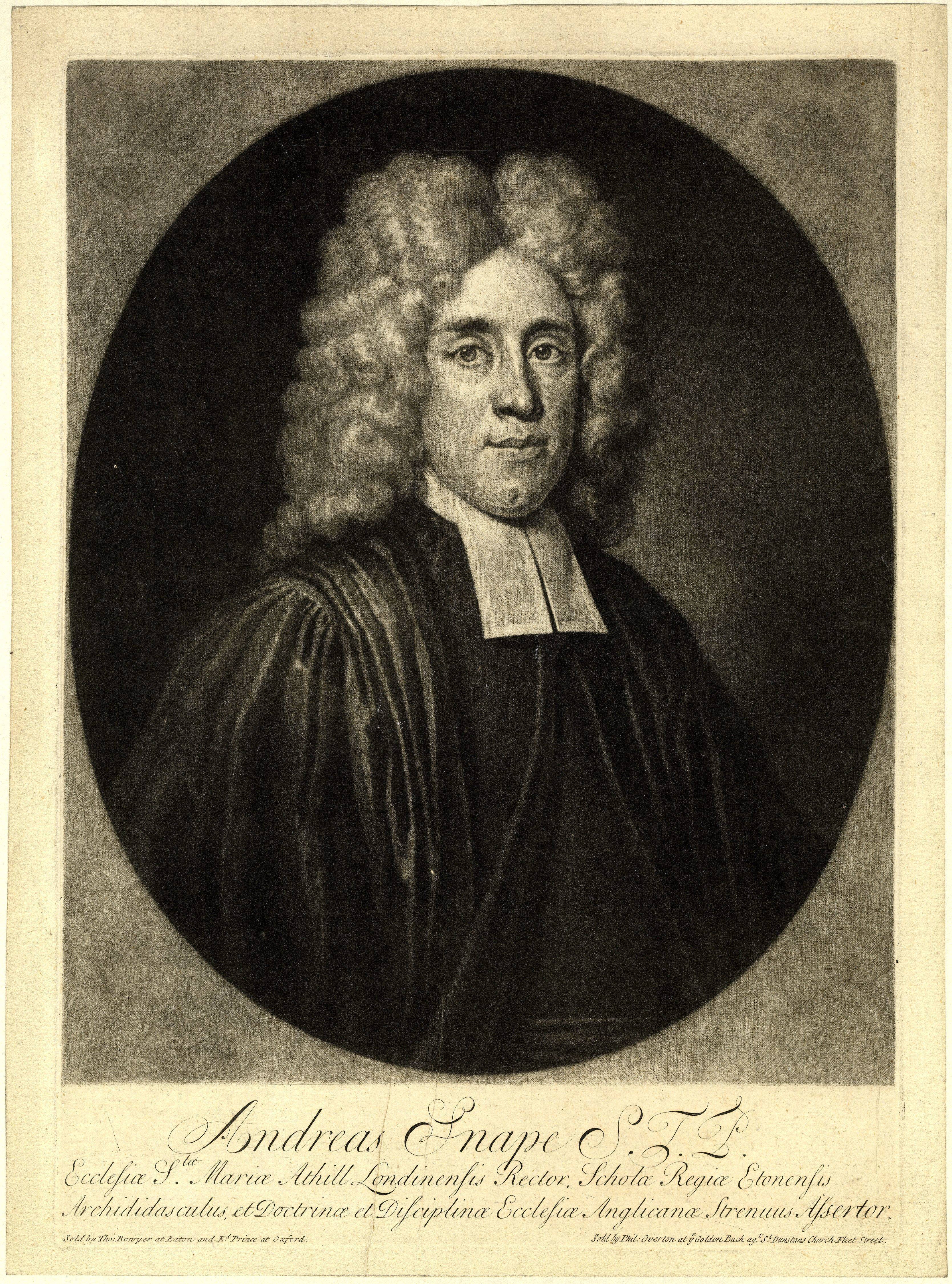
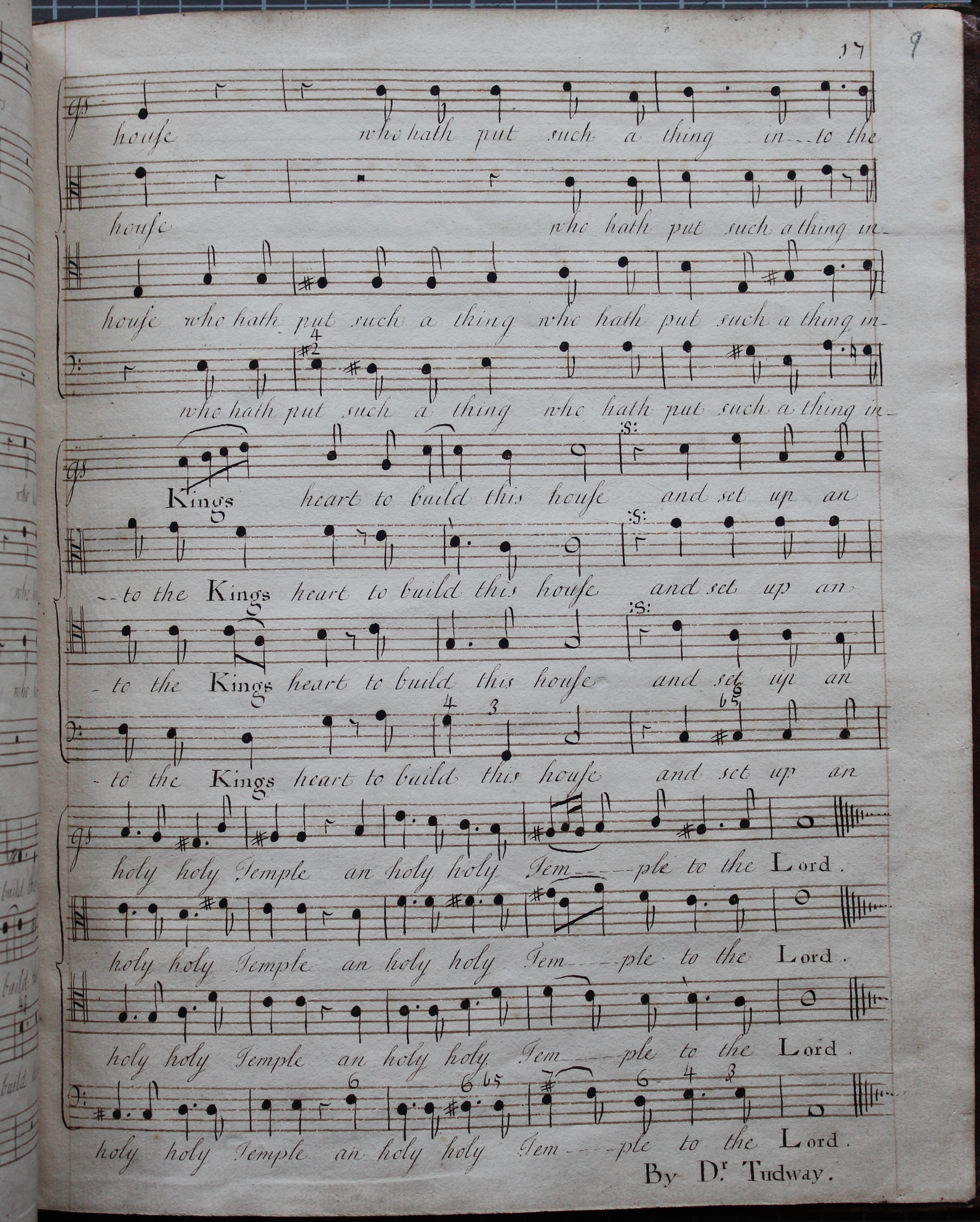
We saw above that ‘an Anthem compos’d on the occasion’ was mentioned in the published sermon, and this brings us to our second item in the Library’s special collections. The anthem in question is ‘Hearken unto me ye holy children’ by the composer Thomas Tudway (before 1650–1726), professor of music in the university and organist at King’s from 1670 until 1726. The original manuscript is held in the Rowe Music Library in King’s. It is a verse anthem, scored for three soloists and choir, and the copy in King’s Library is clearly a presentation copy that begins with a dedication to Provost Andrew Snape (1675–1742, KC1690) and the fellows of the College:

Thomas Tudway, Hearken Unto Me ye Holy Children, dedication page. (Rowe MS 108)

The text of the anthem is made up of a variety of verses from several books of the Bible including Ecclesiastes, Ezra and the Psalms.  Its sentiments resonate with the themes of the sermon as you would expect:

Blessed be the Lord God, of our fathers, who hath put such a thing into the King’s heart, to build this house.

to be a Father to the Fatherless, to feed them with the bread of understanding, & give them the waters of wisdom to drink

His name shall endure for ever, His name shall remain under the sun among the posterities

Provost Andrew Snape (engraving by John Faber, between 1696 and 1721. King’s Archive reference: KCAC/1/4)

Thomas Tudway holding a page of an anthem he has composed for King’s College Chapel. (Bate Collection of Musical Instruments, University of Oxford).


Tudway, Hearken Unto Me, opening. (Shelfmark: Rowe MS 108)

Tudway, Hearken Unto Me, final page of music. (Shelfmark: Rowe MS 108)


Several aspects of the binding of the volume point towards its importance and uniqueness as a presentation copy. It is a leather-bound volume with a panel design tooled with gold borders with fleuron decorations stamped in gold on the front and back boards. The foredges of the binding are also tooled in gold, as are the text block edges. No expense has been spared. Unusually, the pastedowns—which are usually simply plain hand-made paper—are in this case made of a much more expensive paper embossed with a red and gold floral design.

Tudway, Hearken Unto Me, Front panel binding with gold tooling (left), Inside front pastedown embossed in red and gold (centre), Front fore-edges of binding and text block decorated in gold (right). (Shelfmark: Rowe MS 108)

One would think that something as special as this would have been treasured in King’s, but curiously, by one means or another, the manuscript ended up being owned by one Henry Robson in the early nineteenth century who gave the volume to his cousin John Henry Robson in 1833. Thankfully it was returned to King’s by a relative, a Mrs Robson, in 1852.

Tudway, Hearken Unto Me, ownership inscriptions on front pastedown. (Shelfmark: Rowe MS 108)

Alas, this reminds us of the dilemma faced by William Cole who had spent eighteen years in King’s meticulously documenting our history, but when deciding where to deposit his manuscripts in 1788, he wrote ‘I have long wavered how to dispose of all my manuscript volumes; to give them to King’s College, would be to throw them into a horsepond; and I had as lieve do one as the other; they are generally so conceited of their Latin and Greek, that all other studies are barbarism.’ A little harsh perhaps, but rest assured that the librarians and archivists in King’s today take great care in looking after the special collections and are delighted to be able to share them with you on special days such as today!

Gibbs, A Book of Architecture, plate 35 showing the designs for the Gibbs building. (Shelfmark: F.27.7)

An early eighteenth-century theodolite by London instrument maker Richard Glynne (1681–1755), active ca. 1707 to 1730, belonging to King’s. A record in the College archives shows that we purchased a theodolite in 1724, presumably for building the Gibbs building. Could this be the one? (The theodolite is on long-term loan to the Whipple Museum in Cambridge. Reference: Wh.6588)

JC

________________________

For an online exhibition of documents from King’s archive relating to the Gibbs building see https://www.kings.cam.ac.uk/archive-centre/the-gibbs-building
Thanks are due to Ingo Gildenhard for advice on improving the translation of the Latin into English, as well as to my colleagues in King’s Library and Archives, and to Peter Jones for locating the Henry V coins.
The photographs of the Glynne theodolite are reproduced by kind permission of the Whipple Museum of the History of Science, University of Cambridge.

A summer holiday in the Lakes

The ongoing project to catalogue the Library’s Bicknell Collection of books relating to the Lake District [see earlier blog post] continues to uncover fascinating items, not least among them being a small leather-bound, handwritten journal, documenting a family holiday in the Lakes in late August and early September 1877.

Cover of journal

Cover of Bicknell.148

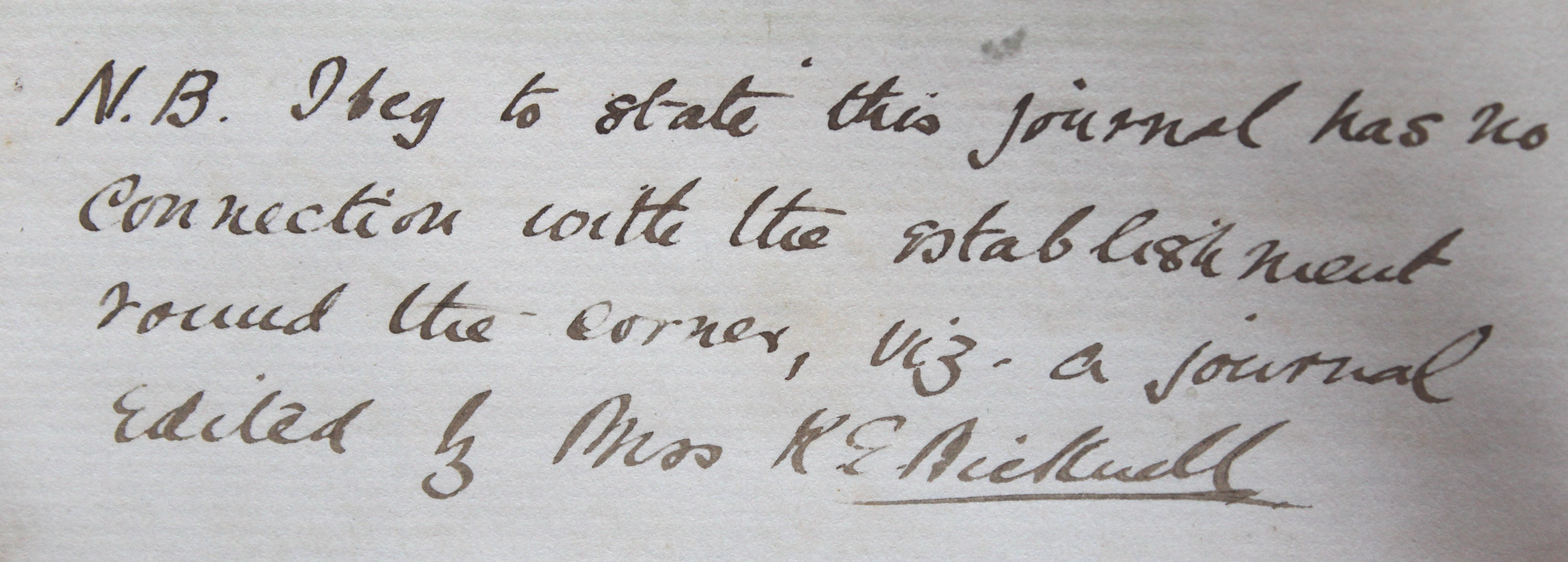
The journal was written by one of Peter Bicknell’s uncles, Claude Lynnford Bicknell (1860-1882), who would have been 17 at the time. He travelled by train from his home in Beckenham, Kent, with his parents and his sister, Kathleen. Gentle sibling rivalry is suggested by a note on the back of the title page of Claude’s journal, which aims to dissociate it from his sister’s diary, referred to as “… the establishment round the corner.”

Note about Kathleen's diary

Bicknell.148 “N.B. I beg to state this journal has no connection with the establishment round the corner, viz. a journal edited by Miss KE Bicknell.”

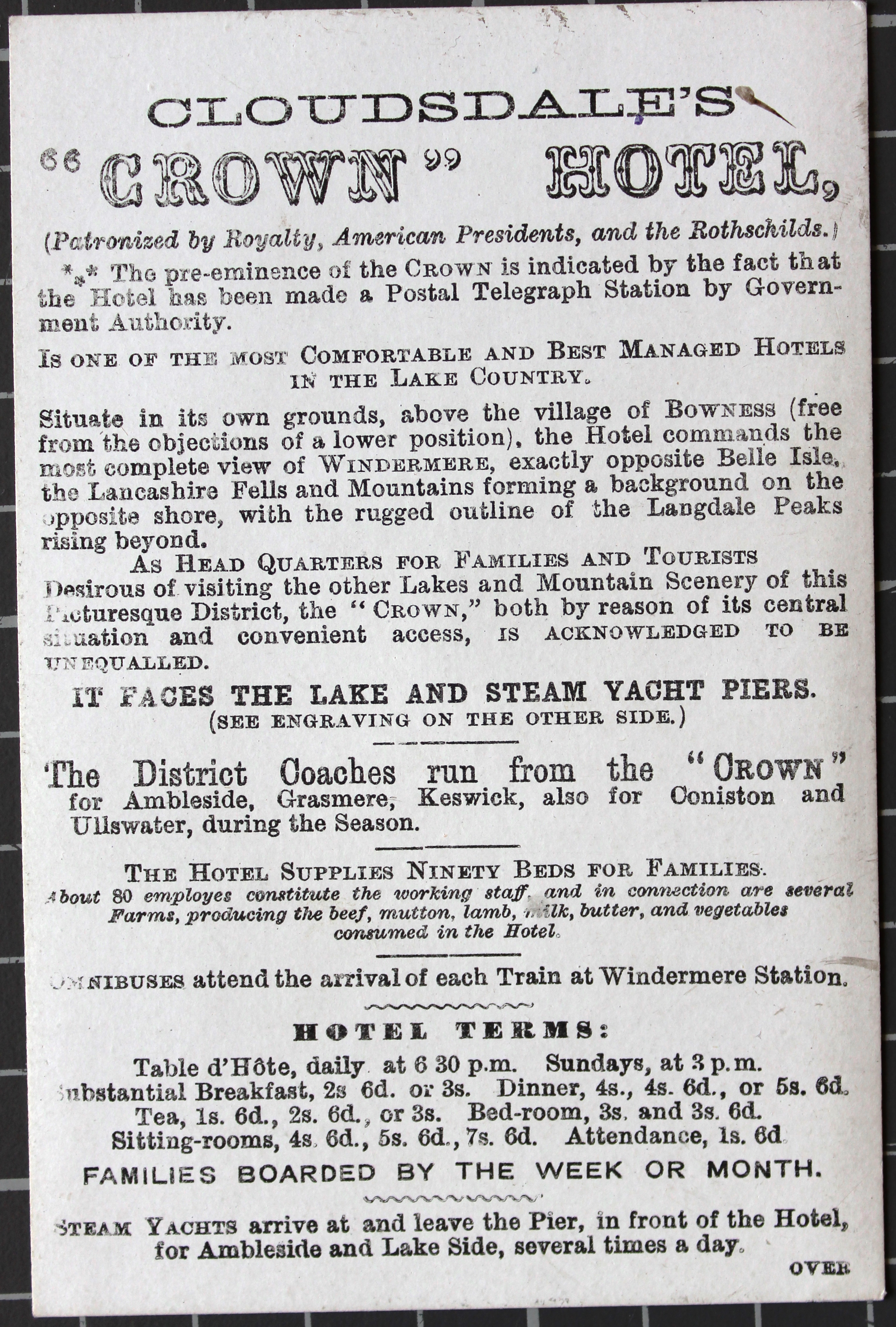
The family were initially based at Cloudsdale’s Crown Hotel, in Windermere, moving after a week to the Borrowdale Hotel, Derwentwater.  Tucked into the journal are various travel ephemera, including this leaflet advertising the Crown:

Hotel promotion leaflet

Bicknell.148 Leaflet advertising Cloudsdale’s Crown Hotel

Claude has an engaging style of writing, and much of the pleasure to be derived from reading the journal is contained in his wry (albeit often rather snobbish) observations regarding the people he encounters, and his grumbles and gripes about topics such as the weather and the quality of the hotel food.

Observations on dinner in the hotel

Bicknell.148 page 2: “Dinner was so so, and the company decidedly seedy consisting of 4 old men, 4 old women; 3 young women with an old one in charge and […?] N.M’s: nearly all Yanks or Lancashires. After a very good desert, by far the best thing in the dinner, an old man got up & said a long and disjointed grace which of course sent Kathleen and myself into convulsions.”

Observations on a coach trip

Bicknell.148 page 14 “…all the rest of the seats were filled with Lancashire people, the men looking like farmers and the women like cooks … The coach is a very seedy turn out, drawn by 4 frightful screws.”

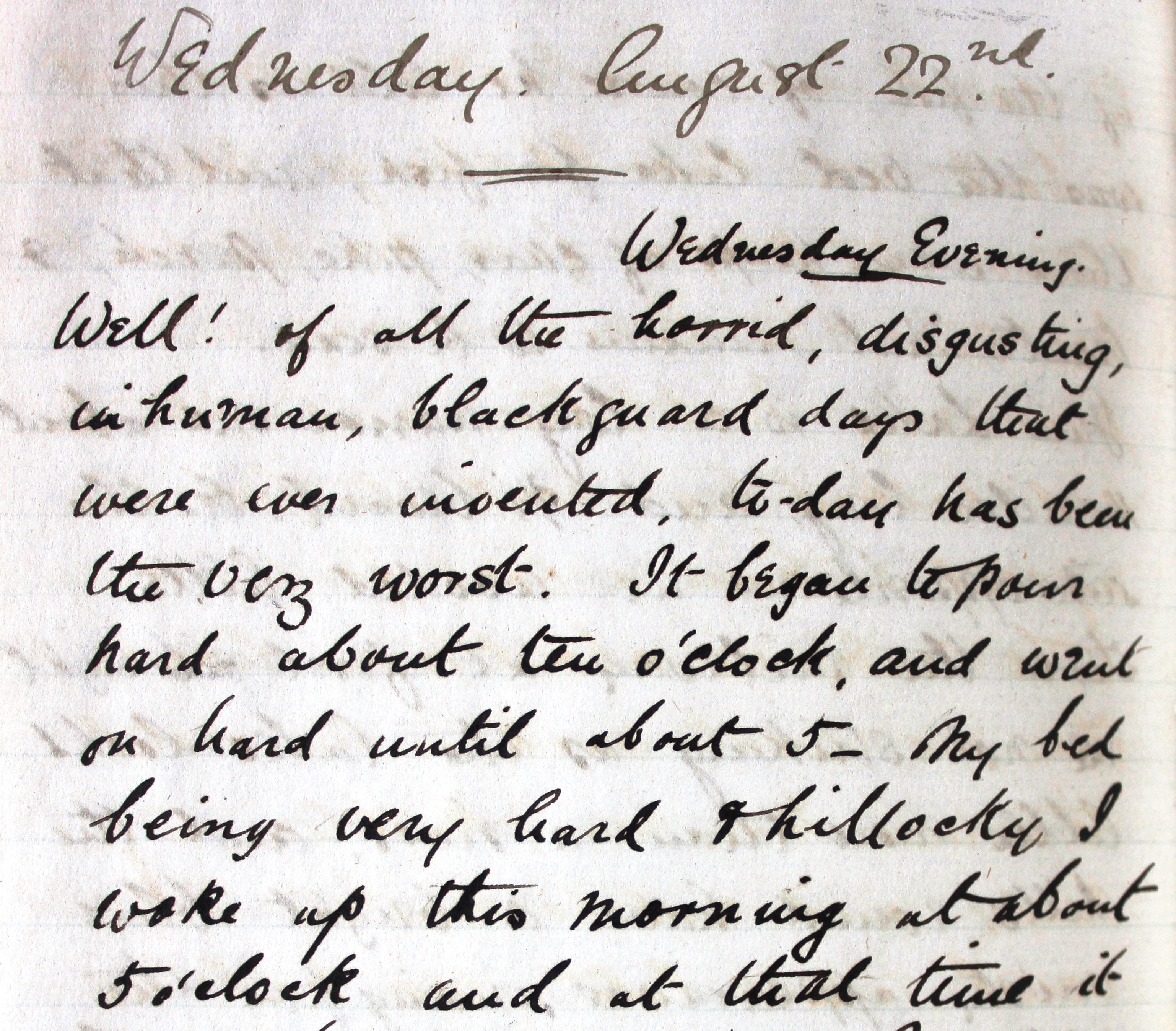
Occasionally Claude’s complaints veer into outright hyperbole, as seen most clearly in his reaction to heavy rain spoiling plans to go fishing on the first day of the holiday. With a wonderful turn of phrase he writes “Well, of all the horrid, disgusting, inhuman, blackguard days that were ever invented, to-day has been the very worst”.

Complaints about the weather

Bicknell.148 page 4. A very wet day

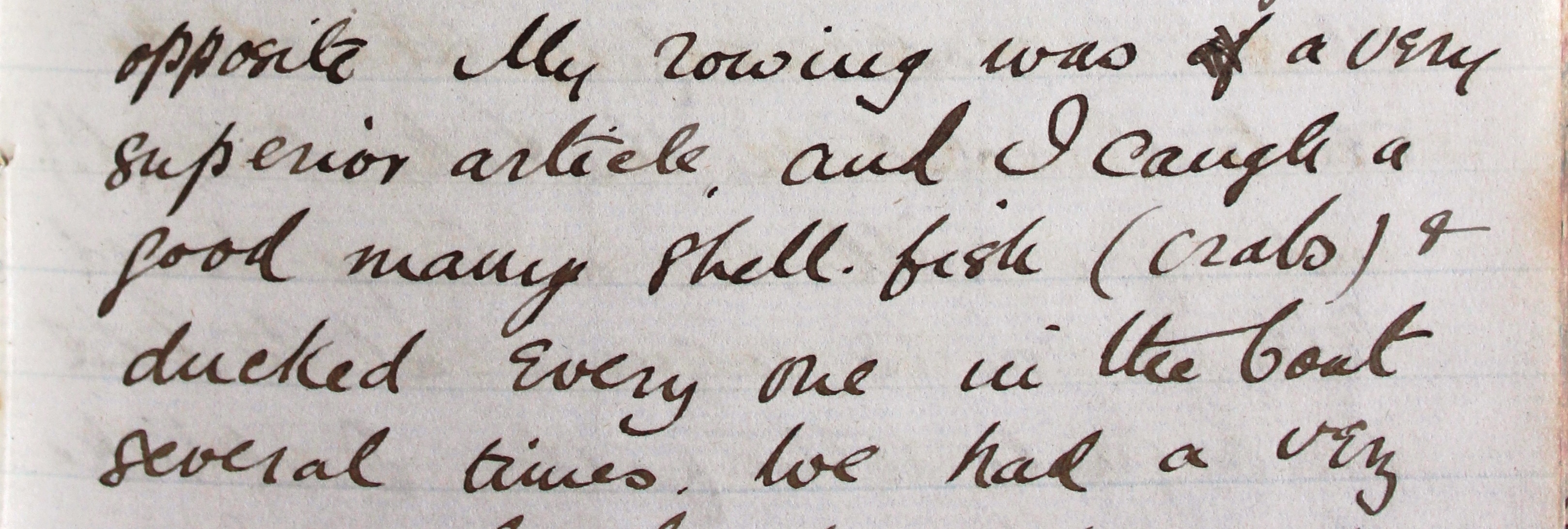
Better weather eventually allowed the family to make several fairly successful fishing trips, and to enjoy walks and excursions to local beauty spots. Claude took a turn rowing the boat during one fishing trip, and seems to have been very pleased with his performance:

A fishing trip

Bicknell.148 page 9: “My rowing was a very superior article and I caught a good many shell fish (crabs) & ducked every one in the boat several times.”

In typical teenager fashion however, he bemoans the decision of his mother to forbid him from going swimming:

Forbidden to bathe in the lake

Bicknell.148 page 12: “Bye the bye I wish to record here that during this day she refused to allow me to bathe in the lake. I think she imagines I shall drown in 20 or 30 feet of water because I am only accustomed to about 7.”

Illustrations in the journal are provided by engravings that Claude has repurposed from books or tourist pamphlets, and he is careful to note where artistic license has been employed:

Illustration of a hotel

Bicknell.148 page 18 “Something like only it is really much further from the lake”

The journal ends rather abruptly on Sunday the 2nd of September, with no indication as to whether this was actually the end of the holiday or simply the point at which Claude got bored with writing an account of each day. The final paragraph is slightly bizarre, featuring as it does, four alligators that apparently resided at the hotel!

Visiting the alligators

Bicknell.148 page 66 “During the day the number of people flocking to see 4 seedy little alligators which belong to the hotel was wonderful. They came in a string from morning to night.”

Claude went on to study at Trinity College, Cambridge, matriculating in 1879. That same year he was awarded a silver medal for political geography by the Royal Geographical Society. Sadly, he only lived a few more years, dying in 1882. It appears he was struck by a cricket ball at Fenner’s cricket ground in Cambridge. It seems likely that his untimely demise made his journal a treasured keepsake for his family, ensuring that it was preserved for posterity.

AC


A Persian-Indian crowning jewel at King’s

In 1788 a letter of benefaction was received by the Provost and Fellows of King’s from Patna in India. A Kingsman by the name of Edward Ephraim Pote (1750-1832) was announcing that he had ‘acquired a collection of Persian Manuscripts amounting to more than five hundred and fifty volumes’ and was arranging to have them shipped to England to be divided between the colleges of King’s and Eton. This, he said, was ‘to shew my gratitude to those Foundations to whose institutions I am indebted for my education’ (King’s College Archives: KCAC/6/2/23 or LIB/10.2).

Our recent research confirms what has long been suspected, that the Pote manuscripts had formed the bulk of the collection of Colonel Antoine-Louis Polier (1741–1795). As Henry Bradshaw noted, Polier’s seal appears on a large number of the manuscripts and his autograph is on several of them. Polier was an officer and agent of the East India Company, assimilated into the Mughal Courts, and, later in his career, an orientalist, collector and patron of the arts in Lucknow. The collection is dominated by Persian manuscripts, but it also contains codices in Hindustani and Arabic.

At the invitation of Professor Jean Michel Massing and with the support of the Apelles Art History Fund we have recently catalogued the half of the Pote Collection belonging to King’s and made the records globally accessible via the union catalogue of manuscripts in British collections from the Islamicate world known as Fihrist (www.Fihrist.org.uk). The Apelles Art History Fund was established by King’s in 2016 to support original research in the history of art at the College, patrimonial acquisitions and the restoration of art works owned by the College. It commemorates Professor Massing’s contribution to the field and encourages continued exploration and discovery in the arts. In the first years, one of the priorities of the Fund is research on the College’s works of art, including the Pote Collection of Islamic manuscripts and the Keynes Art Collection.

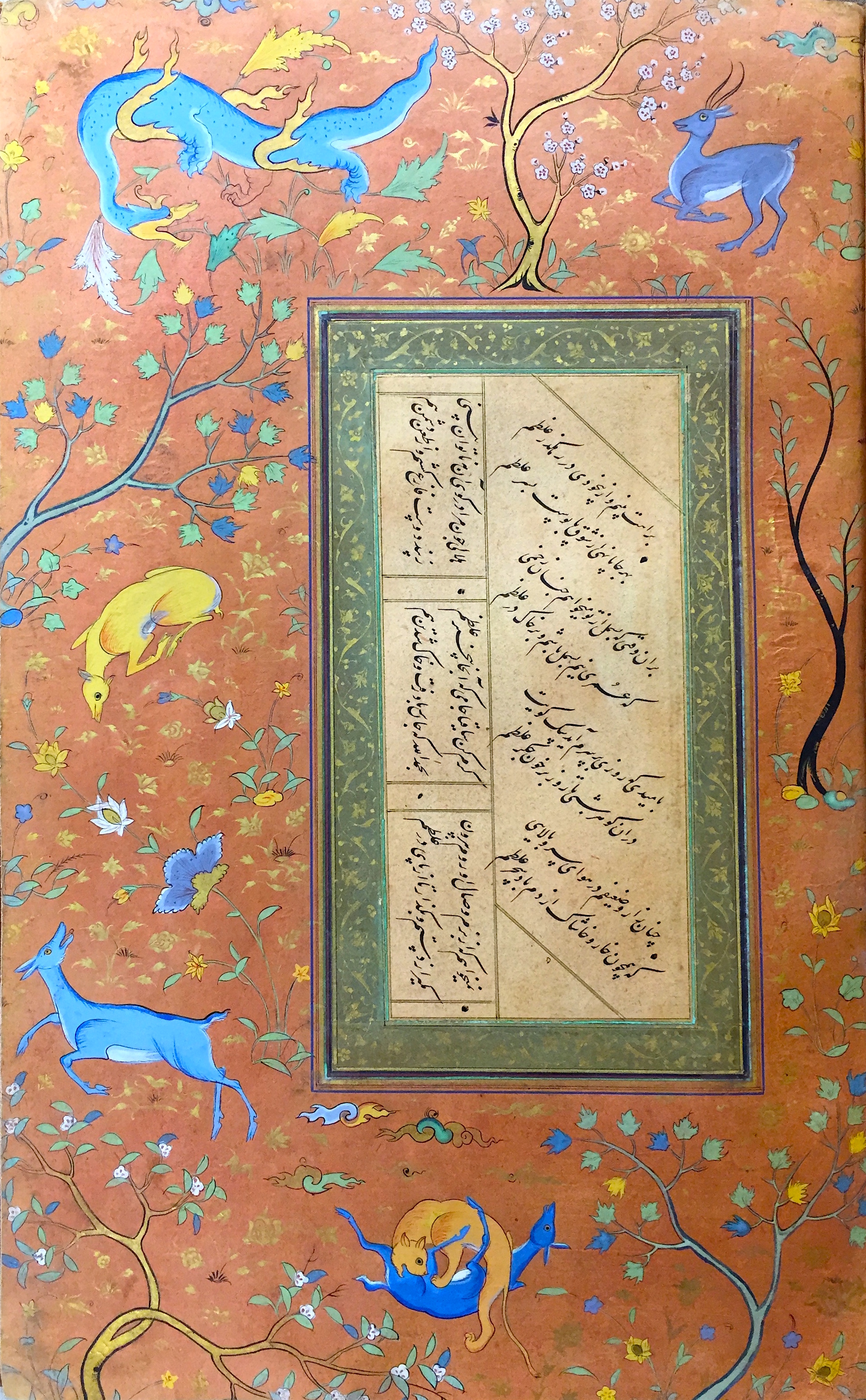
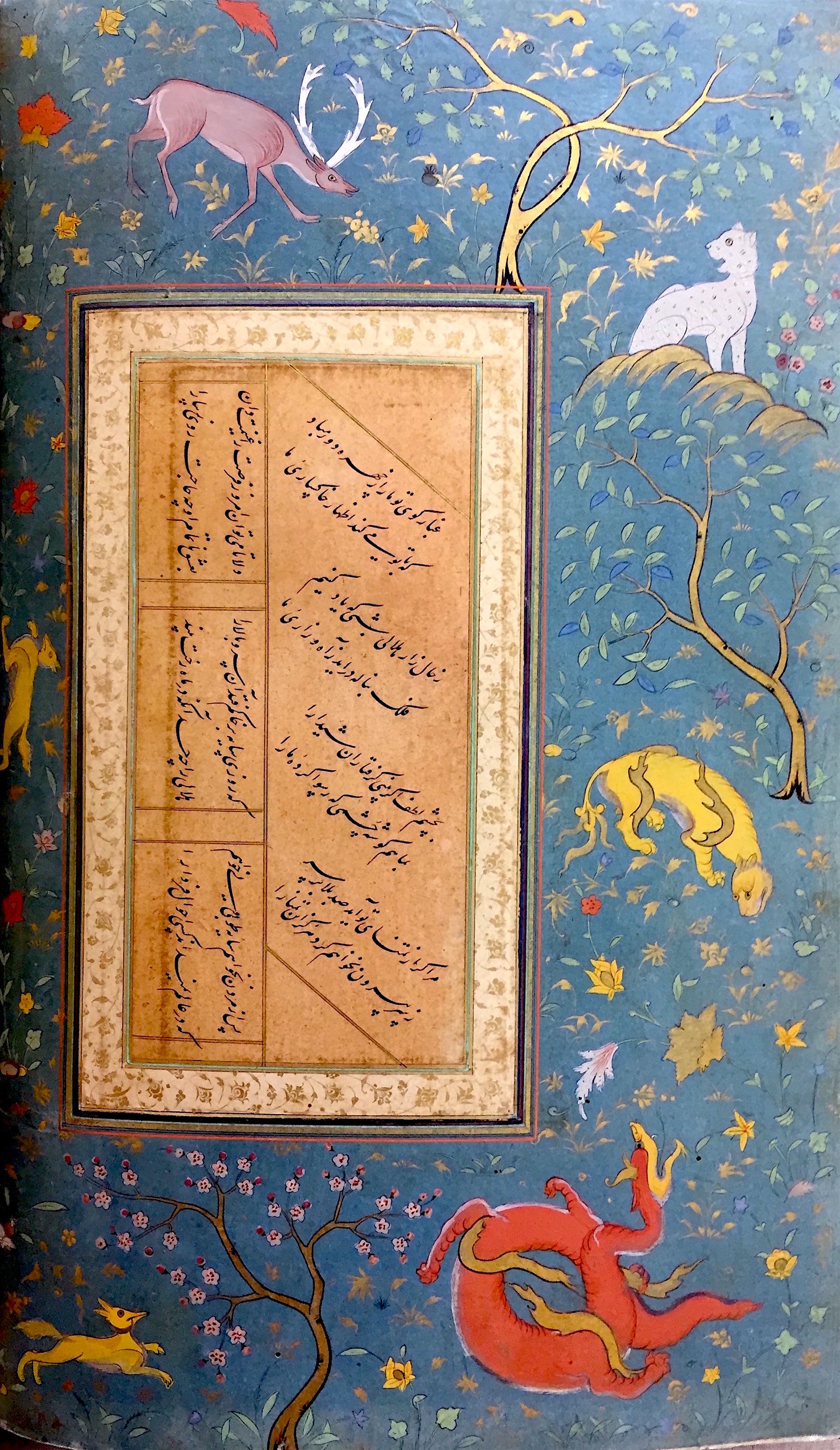
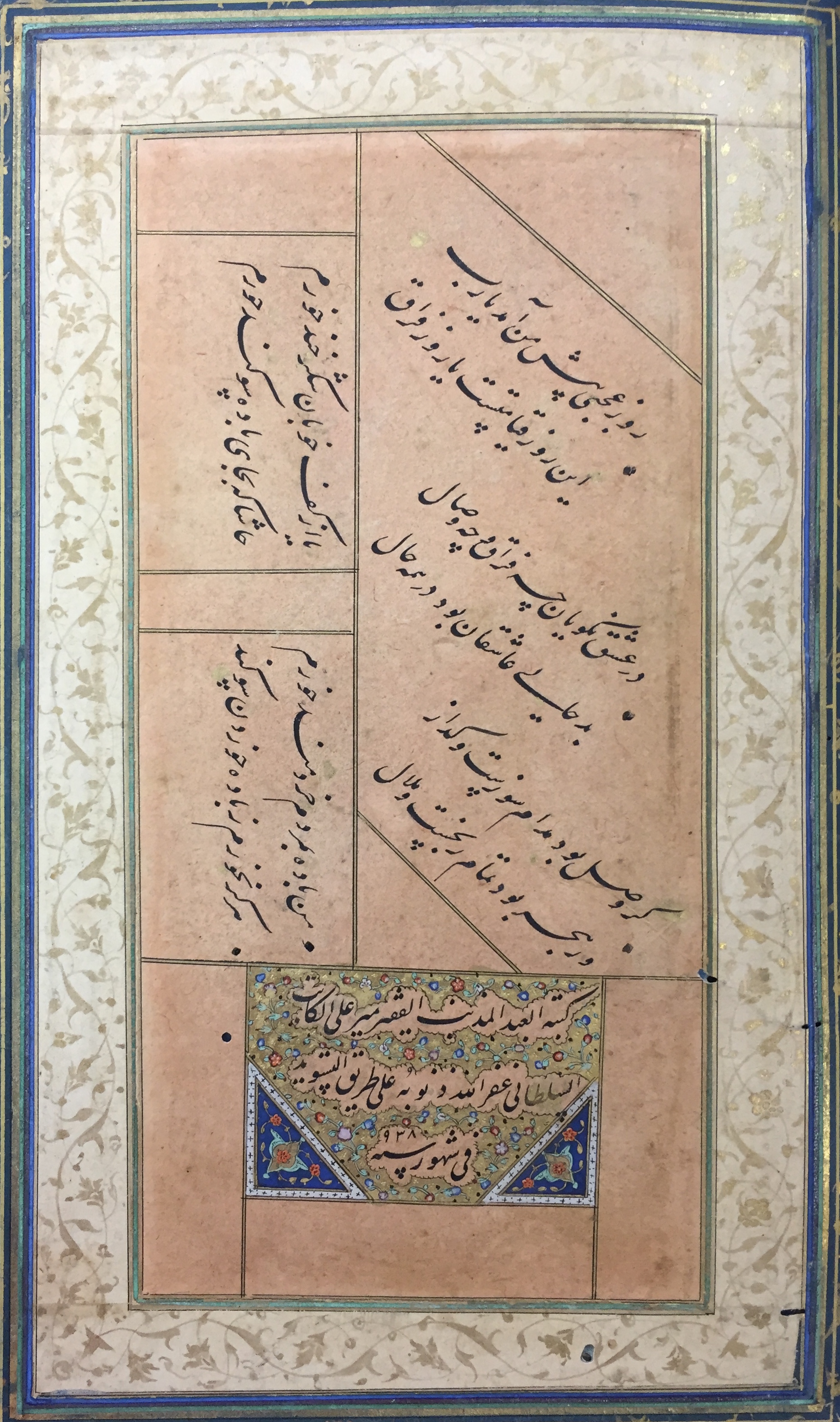
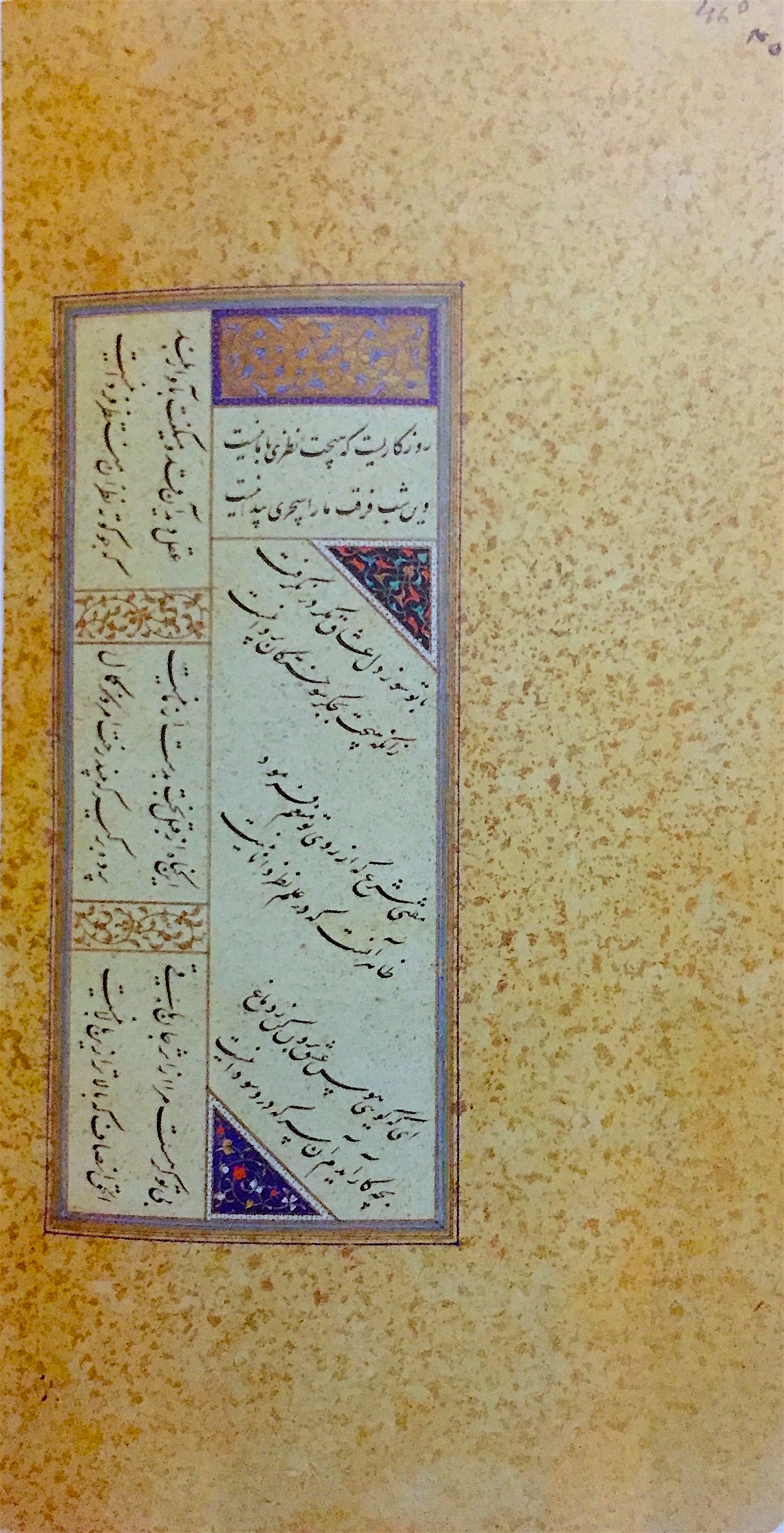
To help raise awareness of the little-studied Pote Collection, this post introduces one of its highlights: King’s Pote MS 186. This manuscript, comprising a collection of poems, is a feast for the eyes: the lyrical verses are arranged in a calligraphic layout, penned by the famous ‘Royal Scribe’ (Kātib al-Sulṭānī) Mīr ‘Alī Haravī (flourished 915–951/1509–1544), framed by exquisitely decorated margins, and enclosed in a beautiful lacquer binding and doublures (inside bindings).

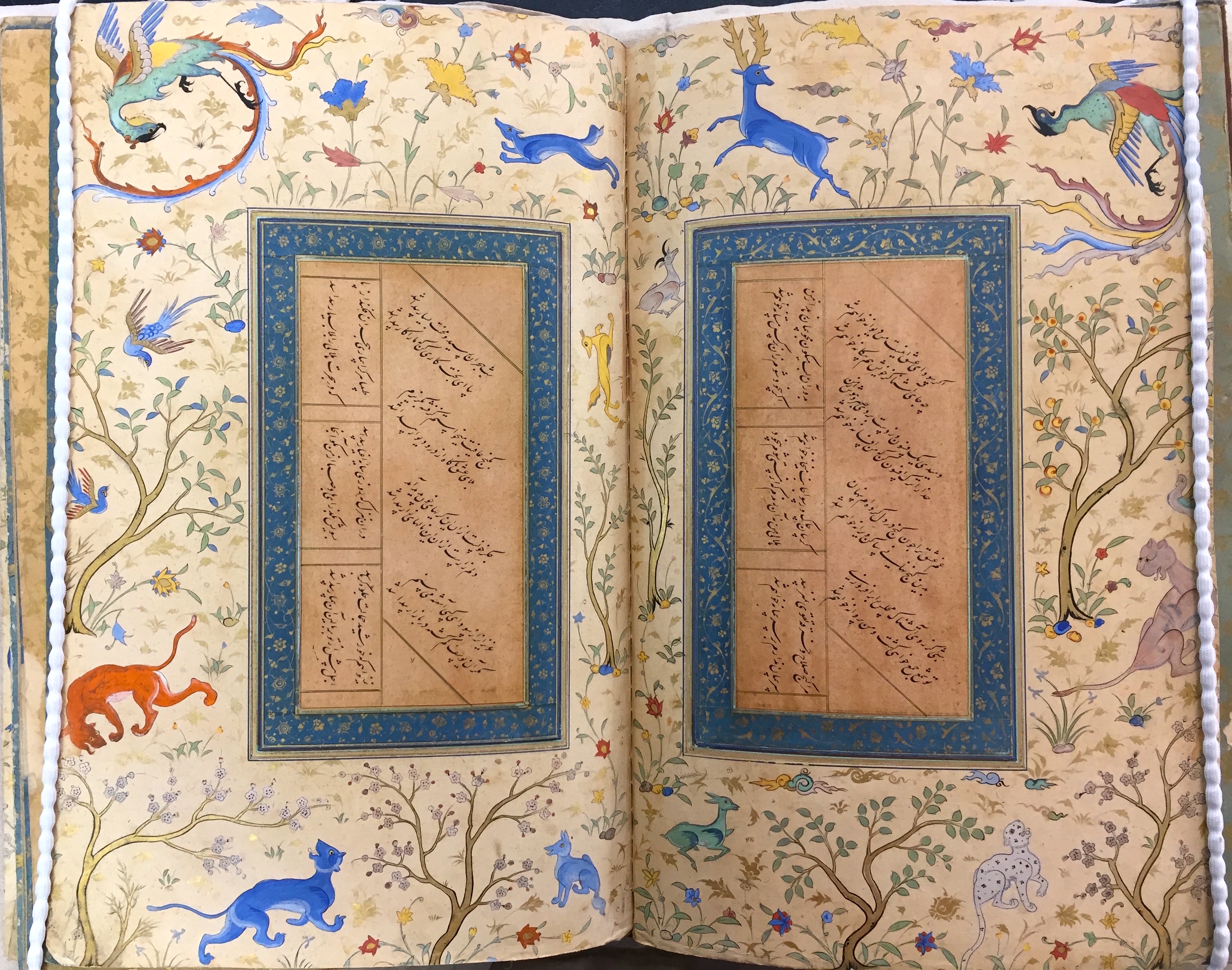
Left half of the double-page frontispiece, Dīvān of Hilālī, penned by Mīr ‘Alī Haravī, dated 938/1531-32 (King’s Pote MS 186).

Each page consists of a central text block with a narrow illuminated border, mounted within a frame (passe-partout) decorated either with drawings of flora and/or fauna in gold or with multi-coloured paintings with charming depictions of animals. Based on the artistic style and type of paper, the remounting was very probably executed in Mughal India.

Illuminated margins, floral decorations in gold (King’s Pote MS 186).

Mīr ‘Alī was an acknowledged master of calligraphy, especially prominent in a script known as nastaʿlīq. He worked in Herat and was moved to Bukhara around 935/1528–29.[1] His calligraphy was much prized in later centuries, especially at the court of Shah Jahan in India, and it is probable that the manuscript was remounted and decorated (and rebound) at the latter’s command. Although further research is required, there are signs the manuscript was once in Shah Jahan’s Royal Library: it bears an inspection note and the seal impression of ‘Abd al-Ḥaqq Amānat Khān, who might well be the calligrapher of that name (d. 1054–55/1644–45)[2] who designed the calligraphy on the Taj Mahal, and whose seal impression appears in other manuscripts from the Mughal Royal Library.

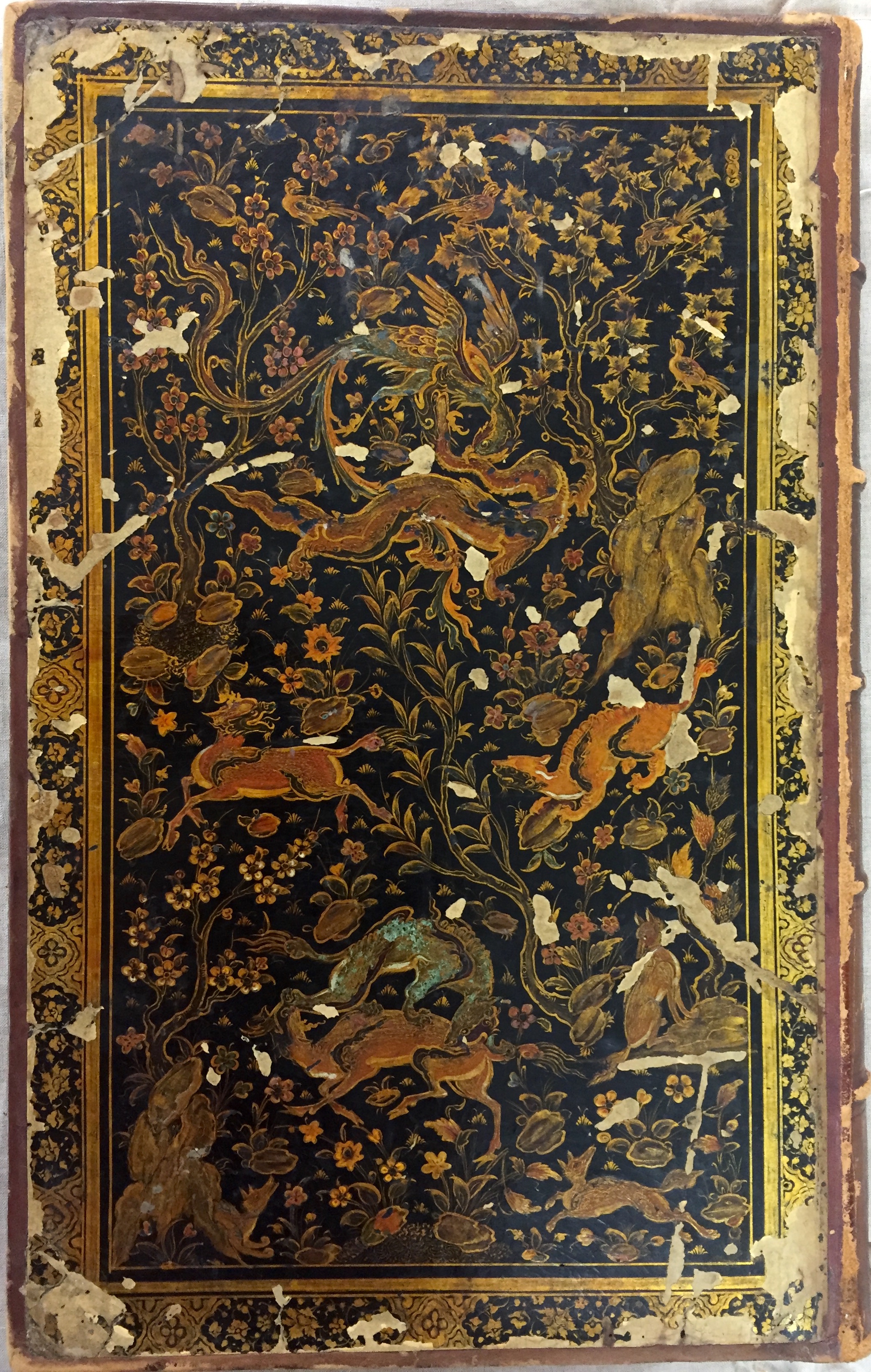
Lacquer binding showing fantastic landscape with dragon and simurgh (King’s Pote MS 186).

The manuscript has a lacquer-decorated binding depicting a hunt scene of fantastic and naturalistic animals, including a simurgh (a benevolent, mythical bird in Iranian mythology), a dragon, foxes, hares and birds of prey, all painted in glittering and bright colours on a blackground. The doublures, with a gold and ochre background, carry a diamond-shaped medallion (turanj) in black and gold, pendants in black and reddish brown, and corner pieces, all decorated with floral motifs. The ground depicts animals including a lion, a leopard, a fox, an antelope and a deer in a setting of sparse shrubs and flowers. The front and back covers and doublures are identical. The binding seems to be contemporary with the marginal illuminations and illustrations, and a product of the same Mughal royal atelier.

Lacquer doublure (inside front binding, King’s Pote MS 186).

Similar animals, in different poses, are illustrated among trees and flowers in some of the margins on both dark and light grounds. The palette used in these illustrations includes gold and a variety of vivid colours.

Illustrated margins showing flora and fauna in rich palettes on tinted paper (King’s Pote MS 186)

Illustrated margins showing flora and fauna in rich palettes on tinted paper (King’s Pote MS 186)

Illustrated margins showing flora and fauna in rich palettes on tinted paper (King’s Pote MS 186)


The textual content is a selection of lyrical poems (ghazals) by a prominent poet, Badr al-dīn Hilālī of Astarabad (d. 936/1529–30 or 939/1532–33). Hilālī had been in the literary circle of the Timurid Sultan Ḥusayn Bāyqarā (842–911/1438–1506) as a protégé of his bibliophile vizier, ‘Alīshīr Navā’ī (1441–1501), in Herat. Our manuscript, completed in 938/1531–32, is the earliest copy of Hilālī’s poetry and the closest to his time. To my knowledge, the second oldest manuscript from the same poet is dated 957/1550 (now in the Tehran Majles Library), almost two decades later than the King’s manuscript. Our manuscript was penned by the most prominent calligrapher of the time, Mīr ‘Alī Haravī, the Royal Scribe. The borders were illuminated and illustrated under the Mughals.

Although the poet’s date of death is a matter of debate, it is possible that this was copied before the poet was put to death for his religious beliefs, in which case he could have been involved in selecting his poems for this collection. Unfortunately, the first folio (right half of the double-page frontispiece), with the heading and title inscription, which could have contained some clues about the poet, has been lost and was replaced in the Mughal era (the first extant ghazal, i.e. a form of lyrical poem, begins partway through). We do not find any indication in the colophon that the poet had recently passed away. We know that the poet and the scribe were once companions at the court of the last Timurid Sultan in Herat in the late fifteenth- and early sixteenth-centuries, before both were moved to Bukhara to serve an Uzbek khan. Whether the poet was alive or not when the manuscript was penned is a question that requires further investigation. However, there is no doubt the textual content remains a significant early source for future editions of the ghazals of Hilālī’s dīvān.

Signed by the scribe, Mīr ‘Alī al-Kātib al-Sulṭānī, the Royal Scribe (King’s Pote MS 186, colophon).

There is a closely-related manuscript, which was also penned and compiled by Mīr ‘Alī Haravī, in 935/1529 in Bukhara (two to three years prior to our manuscript), and which contains a selection of poetry by eleven poets from the same courtly circle. That is MS C-860 which is housed in the Russian Academy of Sciences in St Petersburg, and comprises 56 folios with seven verses per page, arranged in a similar format to King’s Pote MS 186.[3] In that anthology, the dimensions of the text panels are smaller and the margins are not illuminated or illustrated but simply gold speckled. However, it contains two subsequently added illustrations. ‘Judging by the poem in the colophon, written by the author of the compilation [Mīr ‘Alī Haravī], the copy was intended for the Uzbek sovereign of Bukhara, the Shaibānid ‘Ubaid-Allāh Khān (died in 1533 [actually 1539]), an avid bibliophile.’[4] Based on the fact that the scribe Mīr ‘Alī Haravī was moved to Bukhara by ‘Ubayd-Allāh Khān (c. 935/1528–29) and the completion date of the King’s manuscript (938/1531–32), it is very likely that the patron of Hilālī’s dīvān was the same Shaybānid ruler ‘Ubayd-Allāh Khān. There is little doubt that the unnamed place where our manuscript was copied is again Bukhara.[5]

Poetry anthology, penned by Mīr ‘Alī Haravī, dated 935/1529 (MS C-860 in the Russian Academy of sciences, St Petersburg).

Poetry anthology, penned by Mīr ‘Alī Haravī, dated 935/1529 (MS C-860 in the Russian Academy of sciences, St Petersburg).


King’s Pote MS 186 is the crowning jewel of the Pote collection at King’s. There is beauty in the masterful sixteenth-century penmanship from Bukhara, and in the exquisite decorated margins and binding that were probably added in a Mughal royal atelier around a century later. There is also great textual value in this early collection of verse by a noted contemporary poet. Of course, not all of Colonel Polier’s Lucknow manuscript collection was of this quality and value. But there are lesser treasures too, now in Cambridge, thanks to the efforts and generosity of Edward Pote.

Shiva Mihan

All manuscripts of the Pote Collection are on permanent loan at Cambridge University Library.

Endnotes
[1] O.F. Akimushkin listed a number of manuscripts in the hand of Mīr ‘Alī on p. 333 of his article on the Shaibānid library at Bukhara: ‘Biblioteka Shibanidov v Bukhare XVI veka’ in Bamberger Zentralasienstudien: Konferenzakten ESCAS IV, Bamberg 8-12. Oktober 1991, ed. I. Baldauf and M. Friederich (Berlin, 1994), pp. 325-41. See http://menadoc.bibliothek.uni-halle.de/iud/content/pageview/347600 .
[2] http://www.iranicaonline.org/articles/amanat-khan-sirazi-abd-al-haqq
[3] For more details and reproductions of the manuscript, see Y. A. Petrosan et al. Pages of Perfection: Islamic paintings and calligraphy from the Russian Academy of Sciences, St. Petersburg (Lugano, 1995), pp. 226–29.
[4] Ibid., p. 226.
[5]For information on the Shaybānids (or Abū al-Khayrids) see http://www.iranicaonline.org/articles/abul-khayrids-dynasty. For Bukhara see http://www.iranicaonline.org/articles/bukhara-viii.


Celebrating Jane Austen at King’s Library

To mark the bicentenary year of Jane Austen’s death, King’s College Library and Archives are hosting an exhibition showcasing first and early editions of the author’s much-loved novels, alongside the autograph manuscript of her unfinished novel Sanditon and treasures highlighting the Austen family’s connection with the College. This two-day event, which is part of the Open Cambridge weekend, is a rare opportunity to take a look inside the College’s beautiful early nineteenth-century library designed by the architect William Wilkins.

If you would like to find out more about one of Britain’s most loved novelists, why not pop in when you are in town. This free exhibition is open to all and can be viewed on Friday 8 and Saturday 9 September between 10:30am and 4pm in King’s College Library.

The interior of King’s College Library

Upon arrival at the front gate of King’s College, tell the member of staff on duty (or the porters) that you are visiting the Jane Austen exhibition. They will direct you to the College Library (see map below).

How to find King’s College Library

Exhibition DATE: Friday 8 and Saturday 9 September 2017

Opening times: 10:30am-4pm each day

JC

Mozart’s birthday: an online exhibition

To mark the 260th anniversary of the birth of Wolfgang Amadeus Mozart earlier this week, the Library mounted a small exhibition. For the benefit of those who cannot visit the exhibition in person, here are some selected highlights.

Versuch einer gründlichen Violinschule / Leopold Mozart. Augsburg: Johann Jakob Lotter, 1756. Rw.38.43

Leopold Mozart, Versuch einer gründlichen Violinschule. (Augsburg: Johann Jakob Lotter, 1756. Rw.38.43)

Leopold Mozart (1719-1787) was not just a pushy parent: he was also a composer, violinist and music theorist. This first edition of his Versuch einer gründlichen Violinschule, a treatise on violin playing, dates from the year of his son’s birth, and features a number of plates illustrating common errors. The frontispiece (above left) is a portrait of Leopold himself surrounded by his own compositions, and both images show the practice, common at the time, of playing the violin with a concave bow and without chin rest or shoulder rest.

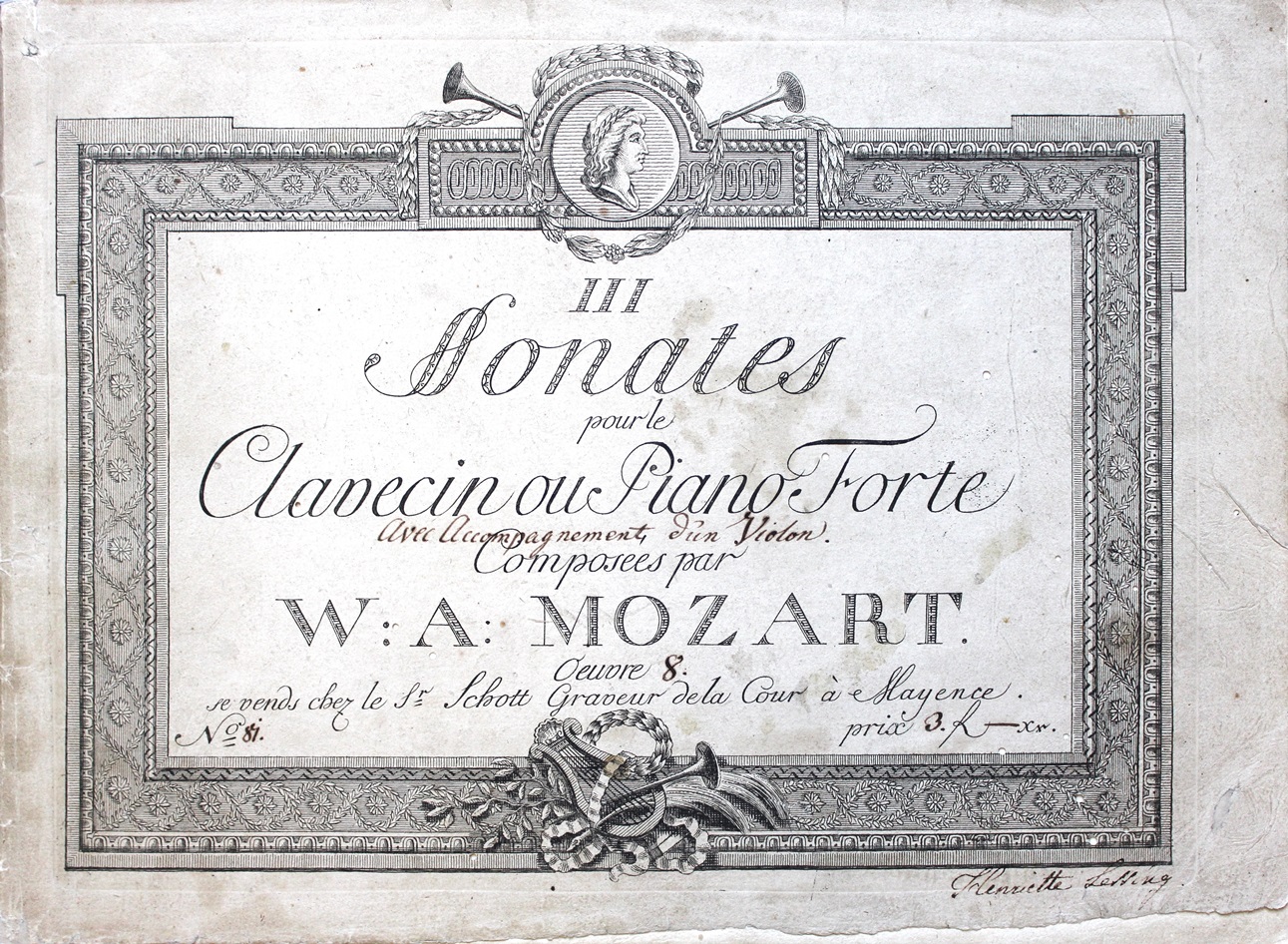
III sonates pour le clavecin ou piano forte: œuvre 8 / Wolfgang Amadeus Mozart. Mainz: Schott, 1789. Rw.13.88

Wolfgang Amadeus Mozart, III sonates pour le clavecin ou piano forte, avec accompagnement d’un violon: œuvre 8. (Mainz: Schott, ca. 1789. Rw.13.88)

This set of parts for two sonatas for violin and piano, K.526 and K.481, and for the piano trio, K.496, was bequeathed to the College by Kingsman Andrew Raeburn (1933-2010, KC 1955). It dates from Mozart’s own lifetime, having been published around 1789. The title page bears the ownership inscription of Henriette Lessing. Further details of the item’s acquisition may be found on the College website here.

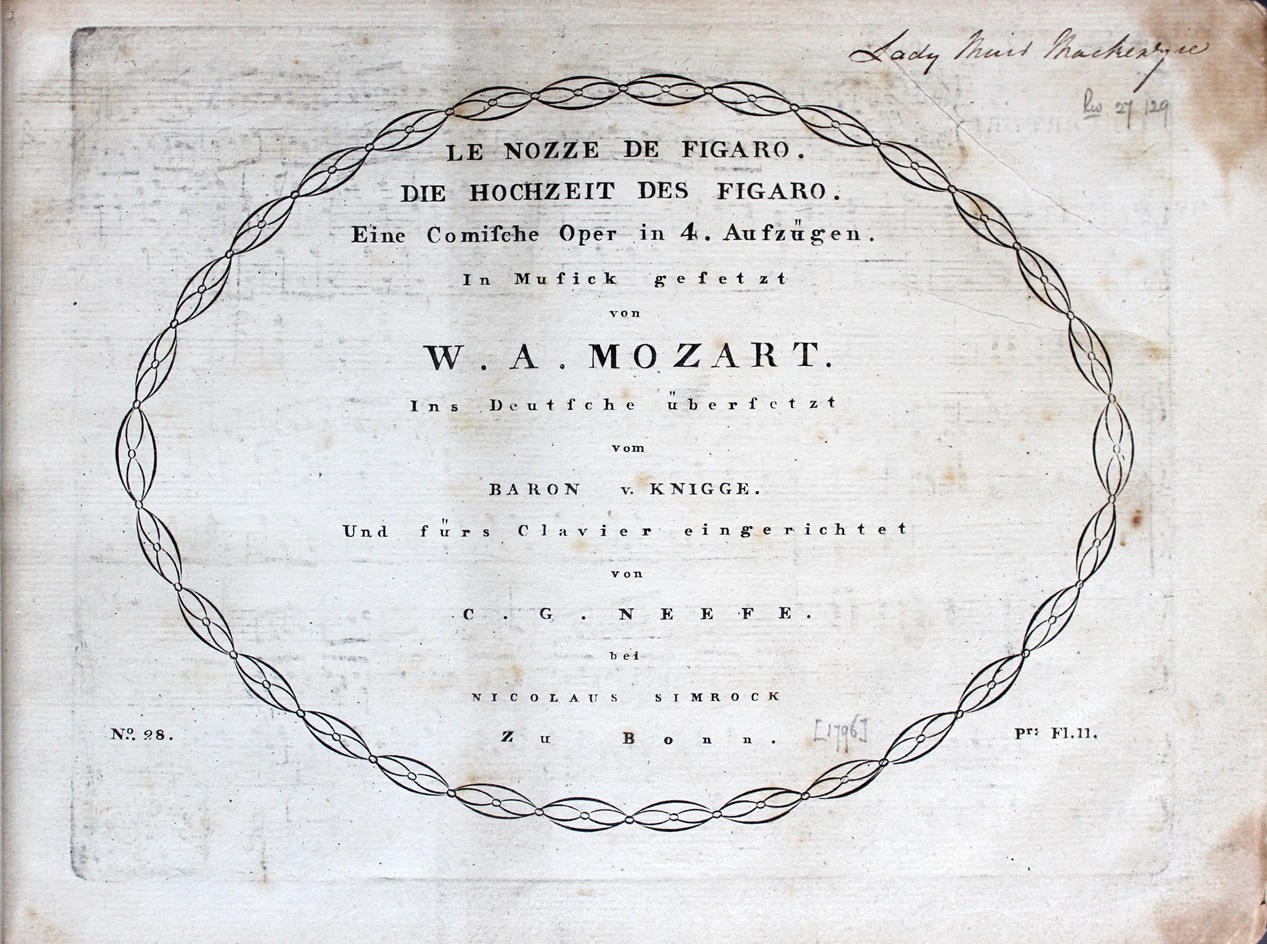
Le nozze di Figaro = Die Hochzeit des Figaro / Wolfgang Amadeus Mozart. Bonn: Simrock, ca. 1796. Rw.85.209

Wolfgang Amadeus Mozart, Le nozze di Figaro = Die Hochzeit des Figaro. (Bonn: Simrock, ca. 1796. Rw.85.209)

This German-Italian edition of Le nozze di Figaro, published in Bonn by the newly founded Simrock publishing house, was the first vocal score of the opera to appear in print. The title page of this copy bears the ownership mark of Lady Muir Mackenzie. This may plausibly be Georgina Muir Mackenzie (1833-1874), later Lady Sebright, a traveller and writer who, during a tour of the Austro-Hungarian Empire in 1858, was arrested as a spy with ‘pan-Slavistic tendencies’. She wrote about this experience and devoted much time during the following years to the promotion of Christianity in Turkey.

‘E Susanna non vien! ... Dove sono i bei momenti’ from Le nozze di Figaro / Wolfgang Amadeus Mozart. Manuscript, late 18th century. Rowe Ms 198

Wolfgang Amadeus Mozart, ‘E Susanna non vien! … Dove sono i bei momenti’ from Le nozze di Figaro. (Manuscript, late 18th century. Rowe Ms 198)

This manuscript, a contemporary transcription of ‘Dove sono i bei momenti’ from Act 3 of Le nozze di Figaro and its preceding recitative, is a relatively recent addition to the library’s collection, bought in 1981. In this aria, one of Mozart’s most exquisite, the Countess reflects on her marriage in the light of her husband’s presumed infidelity (‘Where are the lovely moments of sweetness and pleasure? Where have the promises gone that came from those lying lips?’). Naturally the opera ends with the blissful reunion of the Count and Countess.

Œuvres complettes. Cahier I, contenant VII sonates pour le pianoforte / Wolfgang Amadeus Mozart. Leipzig: Breitkopf & Härtel, ca. 1798. Rw.28.84/1

Wolfgang Amadeus Mozart, Œuvres complettes. Cahier I, contenant VII sonates pour le pianoforte. (Leipzig: Breitkopf & Härtel, ca. 1798. Rw.28.84/1)

Unlike Johann Sebastian Bach, whose greatness was not acknowledged (and whose music was not disseminated) until long after his death, Mozart’s popularity was immediate and enduring, and it was as early as 1798, seven years after his death, that the German firm of Breitkopf & Härtel began publishing a 17-volume edition of what purported to be the composer’s ‘Œuvres complettes’ [sic]. This volume of piano music contains among other works the K.331 sonata, with its familiar ‘Alla Turca’ finale.

Programme for Cambridge Grand Musical Festival. London: W. Glindon, 1824. Mn.22.7

Programme for Cambridge Grand Musical Festival. (London: W. Glindon, 1824. Mn.22.7)

This programme for a Grand Musical Festival ‘for the benefit of Addinbrooke’s [sic] Hospital (Upon the Occasion of the Opening of the New Wards)’ gives details of three ‘Grand Miscellaneous Concerts’ in the Senate House and two ‘Selections of Sacred Music’ at Great St Mary’s to be performed on 2, 3 and 5 July 1824. The opening concert featured a performance of Mozart’s Jupiter Symphony, and is most notable for the participation of the composer Gioachino Rossini (1792-1868), making a rare appearance as a vocalist. The Times review remarked upon Rossini’s comic talent, observing that in the reprise of the Cimarosa duet that closed the first half his partner Angelica Catalani was ‘literally convulsed with laughter, and unable to proceed in two or three places’.

GB