Tag Archives: Lake District

Victorian railway excursions

In this second blog post marking 200 years of the modern railway, we focus mainly upon its arrival and early years in the Lake District, with a few other choice items from our collections making an appearance towards the end.

The arrival of the railway in the Lake District in the late 1840s markedly increased accessibility to a landscape that had been growing in popularity with tourists since the late eighteenth century. Here, just as in Cambridge, the guidebooks quickly adapted to reflect the new realities of travel.

Likely one of the earliest railway maps of the region is the Collins’ Railway Map of Westmoreland, a small folded map mounted on linen, which would have made it durable and easily portable for use by travellers.

Cover of map. Has a bright orange background

Cover of Collins’ Railway Map of Westmoreland, London, [circa  1847]. Classmark: Bicknell.233

The map is undated, but examination of the railway lines that are indicated on it in black suggests a publication date of around 1847, since it depicts the railway line extending to Lake Windermere which opened in 1847, but not the line to Coniston which arrived in the following year.

Map from Collins’ Railway Map of Westmoreland

Another nice map can be found in a tiny pamphlet guide from 1848, which this time has rail lines marked in red.

titlepage of guidebook

Title page of The Lakes, By Way of Fleetwood and Liverpool …, Manchester, Bradshaw and Blacklock, 1848. Classmark: Bicknell 243

Map

Map from The Lakes, By Way of Fleetwood and Liverpool …


This guide includes timetables for steam ships and railways leading to the Lakes, alongside information about coaches to and from Keswick, which was not yet served by a rail line.
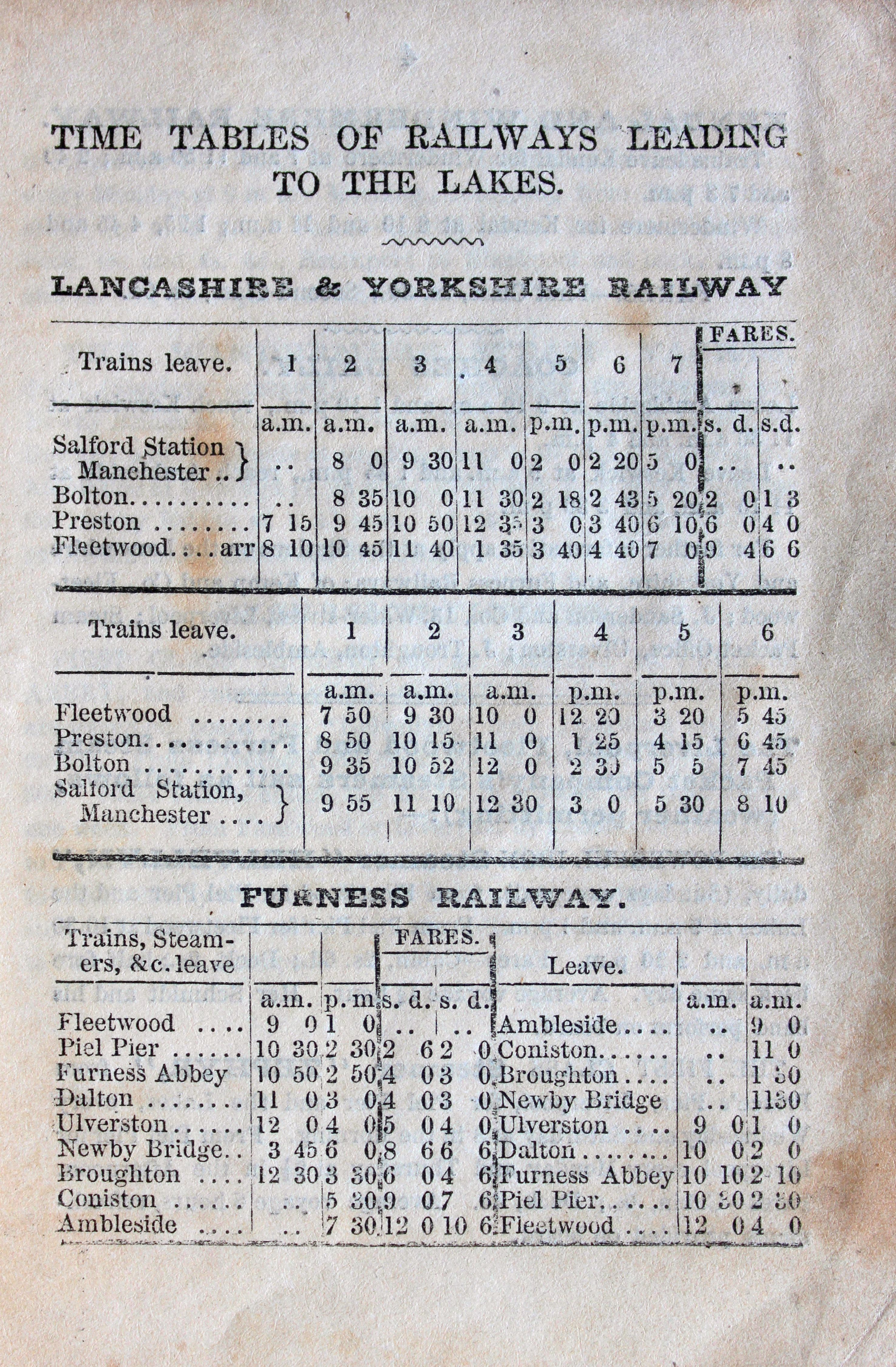
Railway timetables on page 03 of The Lakes …

Coach and steamer information, on page 04 of The Lakes …


Steamer information on page 05 of The Lakes …

A slightly later guide focuses on areas made more accessible by the Whitehaven and Furness Railway, which opened in 1850. Note the sweet little title page vignette depicting a steam engine:
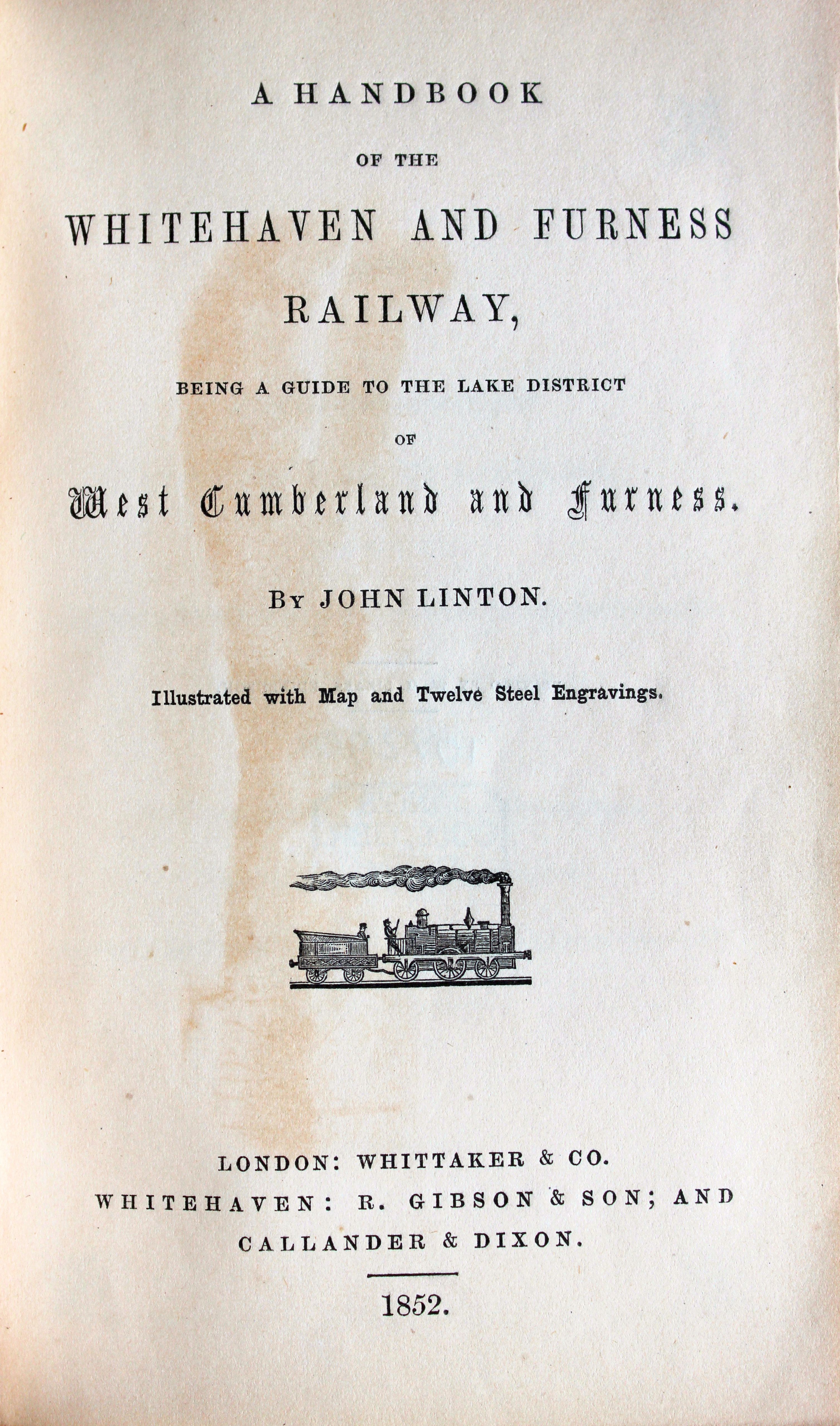
Ttile page, featuring a small illustration of a steam engine

Title page of: A Handbook of the Whitehaven and Furness Railway by John Linton, London, 1852. Classmark: Bicknell.107

The guide states its purpose clearly (if a little long-windedly) in the introduction:

Our object is merely to supply what, in consequence of the changes recently effected by railway travelling in the approaches to this district, has become a desideratum; – to point out the routes by which the greatly increased number of tourists and others … may arrive at various interesting points of the district; – and to give brief descriptions of several places, all within an easy distance of the railway we have taken as our starting point, which have hitherto, owing to the difficulty of approaching them, been much less frequented …

One such place is the vale of St. Bees, which is described as if viewed from a moving train.  The guidebook goes into raptures about its charms:

After emerging from the cutting, we are again at liberty to enjoy the beauties spread so abundantly on either hand, and it may with truth be said, that a more pleasant and enlivening scene is very rarely met with than that presented to the traveller through the vale of St. Bees. It is a scene of quiet and repose, and yet of the highest cultivation, combining the varied charms of dale and upland, grove and meadow, stately mansion and thriving farm.

If you look closely at the centre of the accompanying engraving (below), you can see a train travelling along the track, trailing steam behind it.

Black and white engraving of a valley with a church and small hamlet, and a train track running through the centre. A train is coming along the track

Plate facing page 24 of A Handbook of the Whitehaven and Furness Railway

Rail access played an important part in the viability of many business ventures in the Victorian age. When the historic Great Exhibition in London’s Hyde Park, the world’s first international trade fair, closed its doors in October 1851, the future of the exhibition hall, the magnificent Crystal Palace, was initially uncertain. However, the designer Sir Joseph Paxton soon orchestrated the raising of enough private funds to purchase the building and have it re-erected in an adapted and enlarged form on a hilltop in Sydenham, in the south east of the city. An elaborate park was constructed around it and the site was opened to the general public in 1854 as a place for relatively cheap entertainment and recreation for the masses. Attractions included concerts, exhibitions, pantomimes, circuses and the delights of the building itself and the surrounding landscaped gardens. Vital to the success of the scheme was the construction, by the London, Brighton and South-Coast Railway Company, of a dedicated railway station for the site, which opened shortly after the park itself. Close co-operation with the railway was expedited by the fact that the chair of the railway company, Samuel Laing, was also chair of the new Crystal Palace Company. It also made commercial sense for the railway, since any big attraction would boost the growth of rail travel.

The illustration below comes from a little guidebook to the palace and park, published in its inaugural year. Our copy is part of the Thackeray Collection.
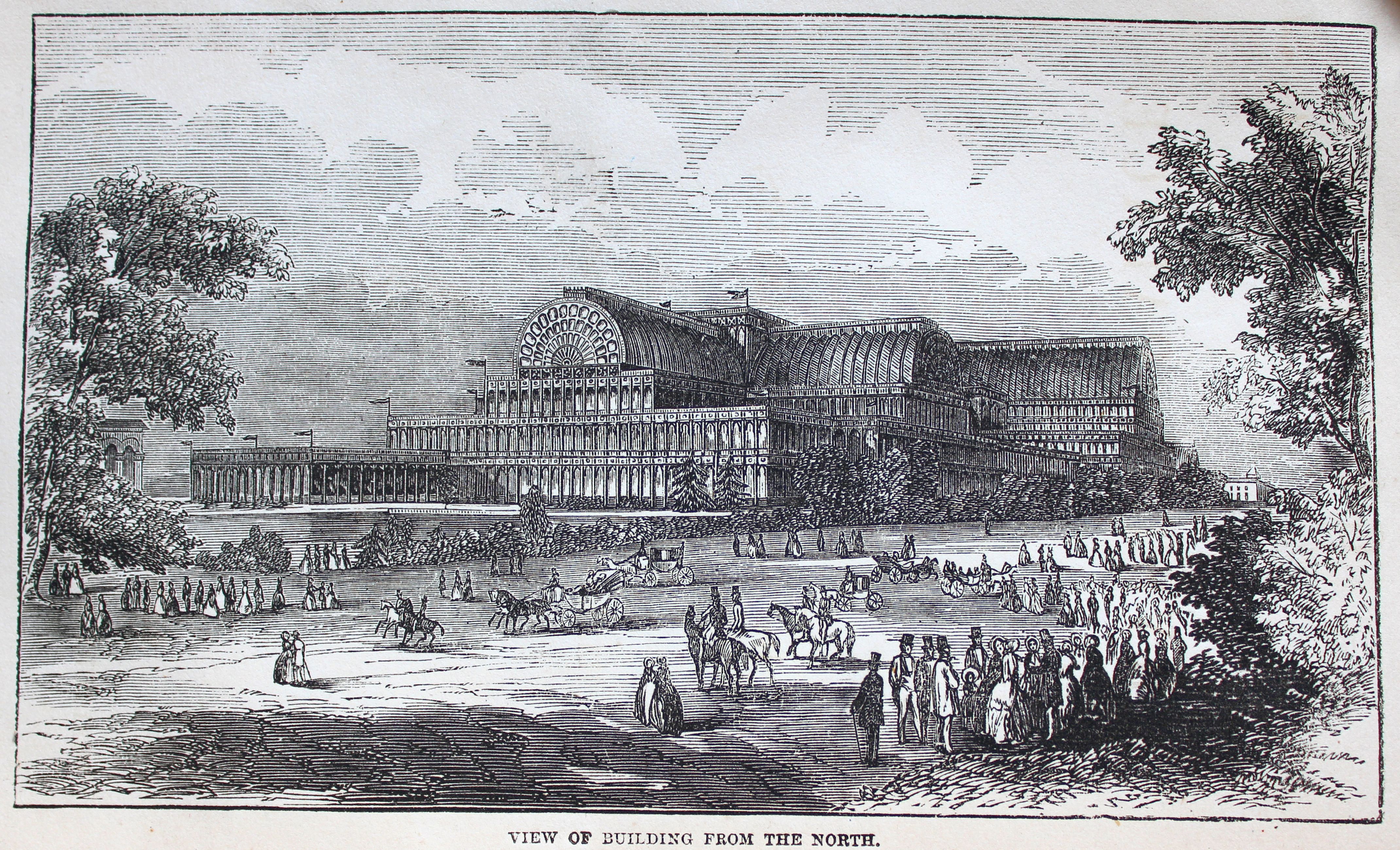
Black and white illustration showing the Crystal Palace building in parkland. It looks like a huge greenhouse.

Frontispiece from Guide to the Crystal Palace and Park by Samuel Phillips, London, 1854. Classmark: Thackeray.VIII.11.24

Detailed information on accessing the park by rail is provided inside the guide, revealing that the service ran at least every quarter of an hour and more frequently at busy times of day. Return tickets, which included admission to the Palace, were one shilling and sixpence for third class travel, rising to two shillings and sixpence for first class.
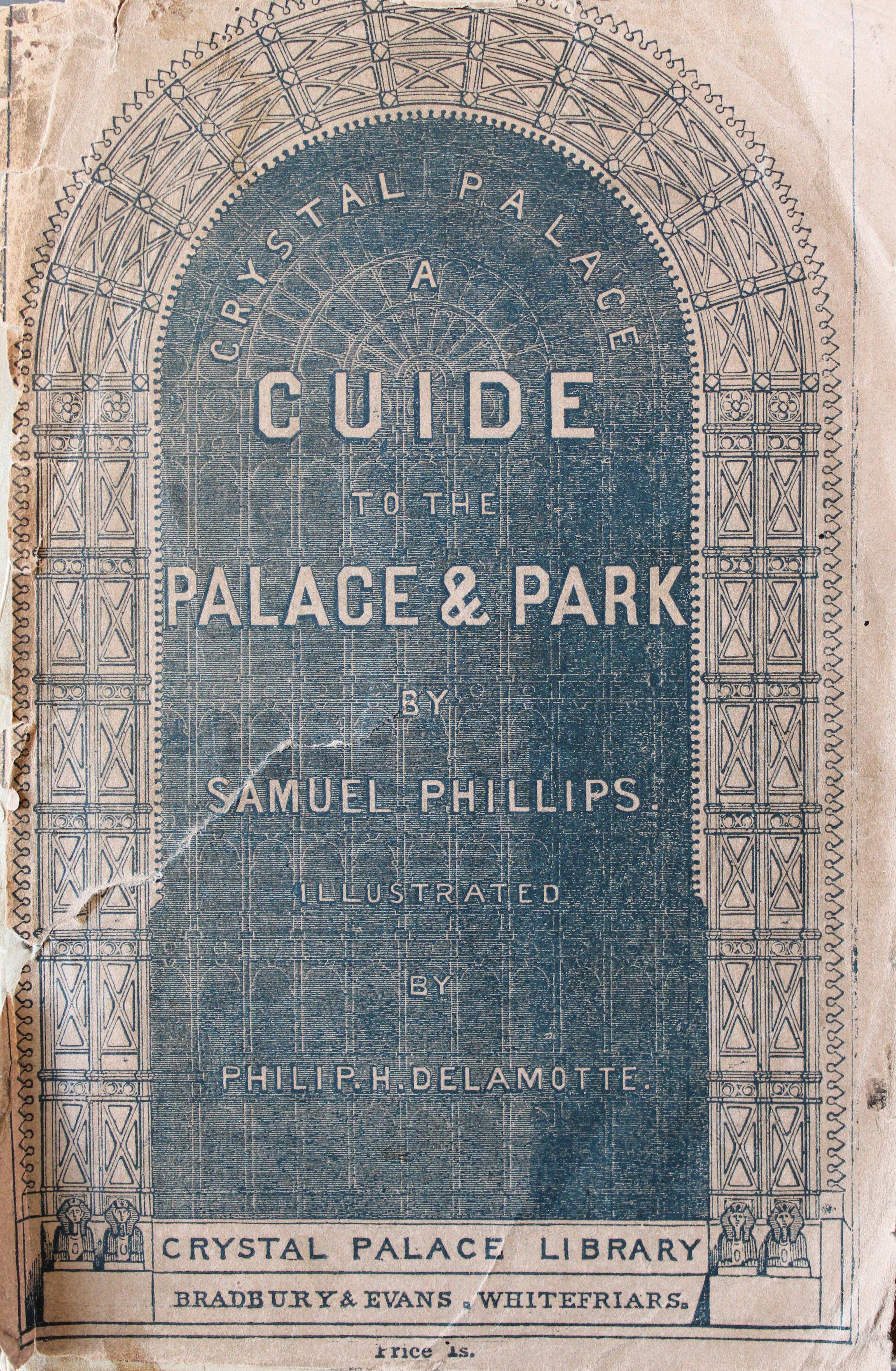
Cover of the guide. The title is depicted within an illustration of a large ornate archway

Front cover of Guide to the Crystal Palace and Park
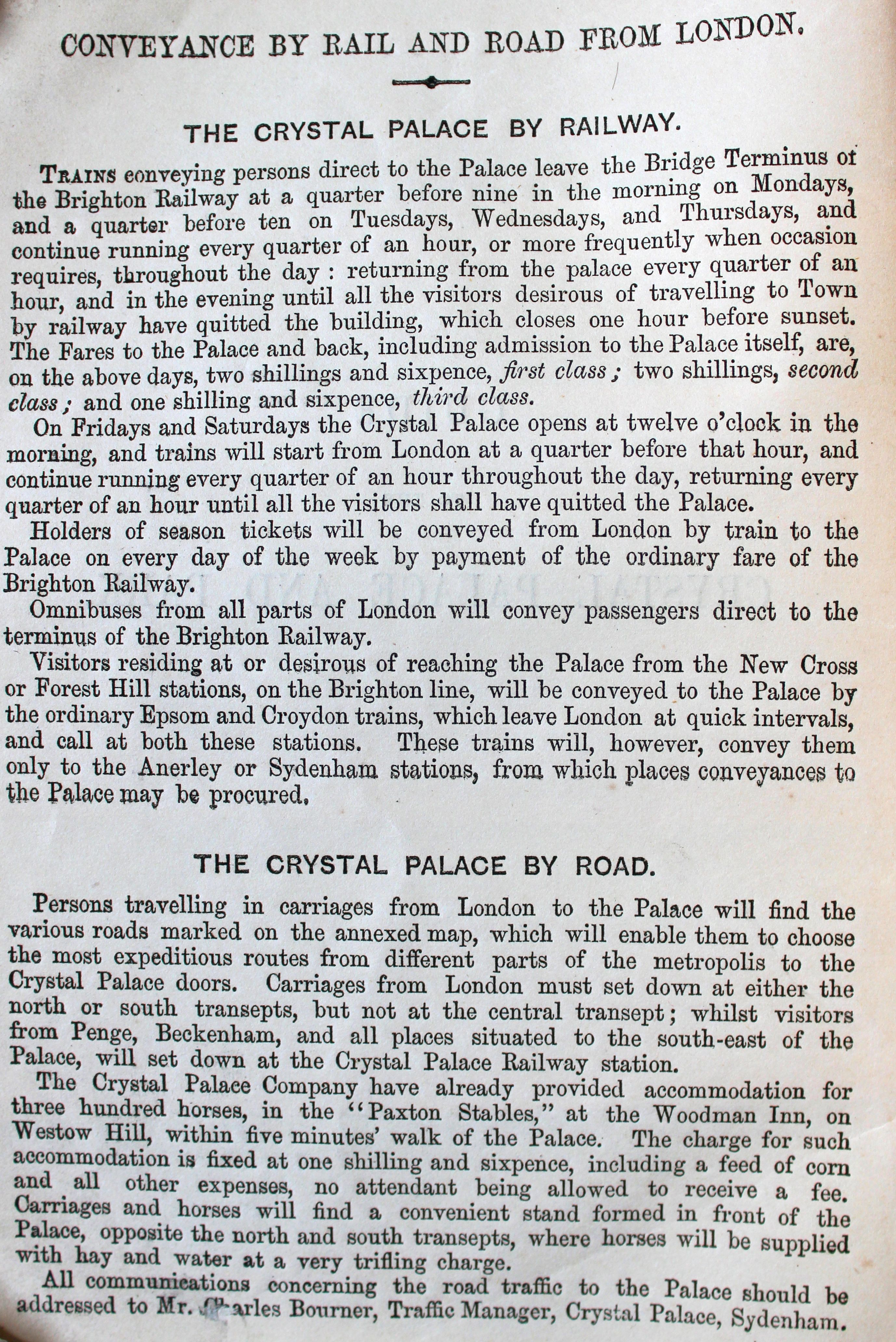
Travel information

Travel information on the back of the half-title page of Guide to the Crystal Palace and Park 

Incidentally, this guide includes  an advertisement by the South Eastern Railway for what they refer to as: “tidal trains”, which offered a streamlined service between London and Paris. Passengers could board an express train to Folkestone, embark upon a waiting steamer ship and be met after the channel crossing by a direct train for Paris. Luggage would be managed from start to finish by the rail company. The same arrangements applied for a trip in the other direction. Not bad for the early decades of rail travel!

Advert

Page 47 of the Advertiser section of Guide to the Crystal Palace and Park

The final destination on our whistlestop tour of railway-themed material is our Rylands Collection of children’s books. An illustration from the first edition of Through the Looking Glass depicts Alice in a train carriage with some rather odd travelling companions.
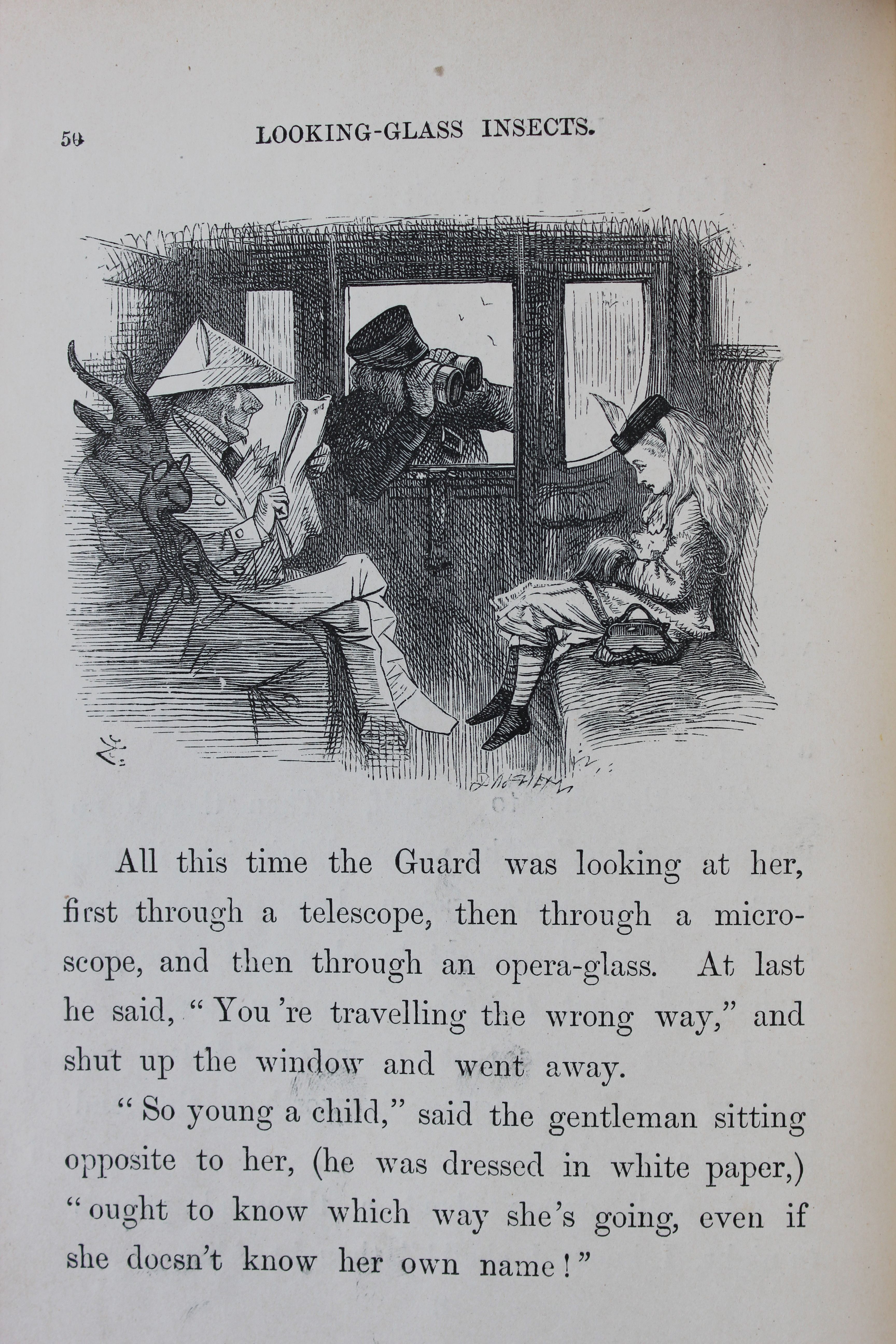
Illustration within the text of Alice in a railway carriage with a goat and a man with a paper hat. There is a guard peering at her through binoculars

Illustration by John Tenniel from page 50 of Through the Looking Glass, and What Alice                                   Found There by Lewis Carroll, London, 1872. Classmark: Rylands.C.CAR.Thr.1872

We also hold a copy of Robert Louis Stevenson’s A Child’s Garden of Verses, which includes this wonderfully evocative poem about a train journey.

The text of the poem, illustrated with a railway carriage

Page 68 of A Child’s Garden of Verses by Robert Louis Stevenson, London, 1896. Classmark: Ryland’s.C.STE.Chi.1896
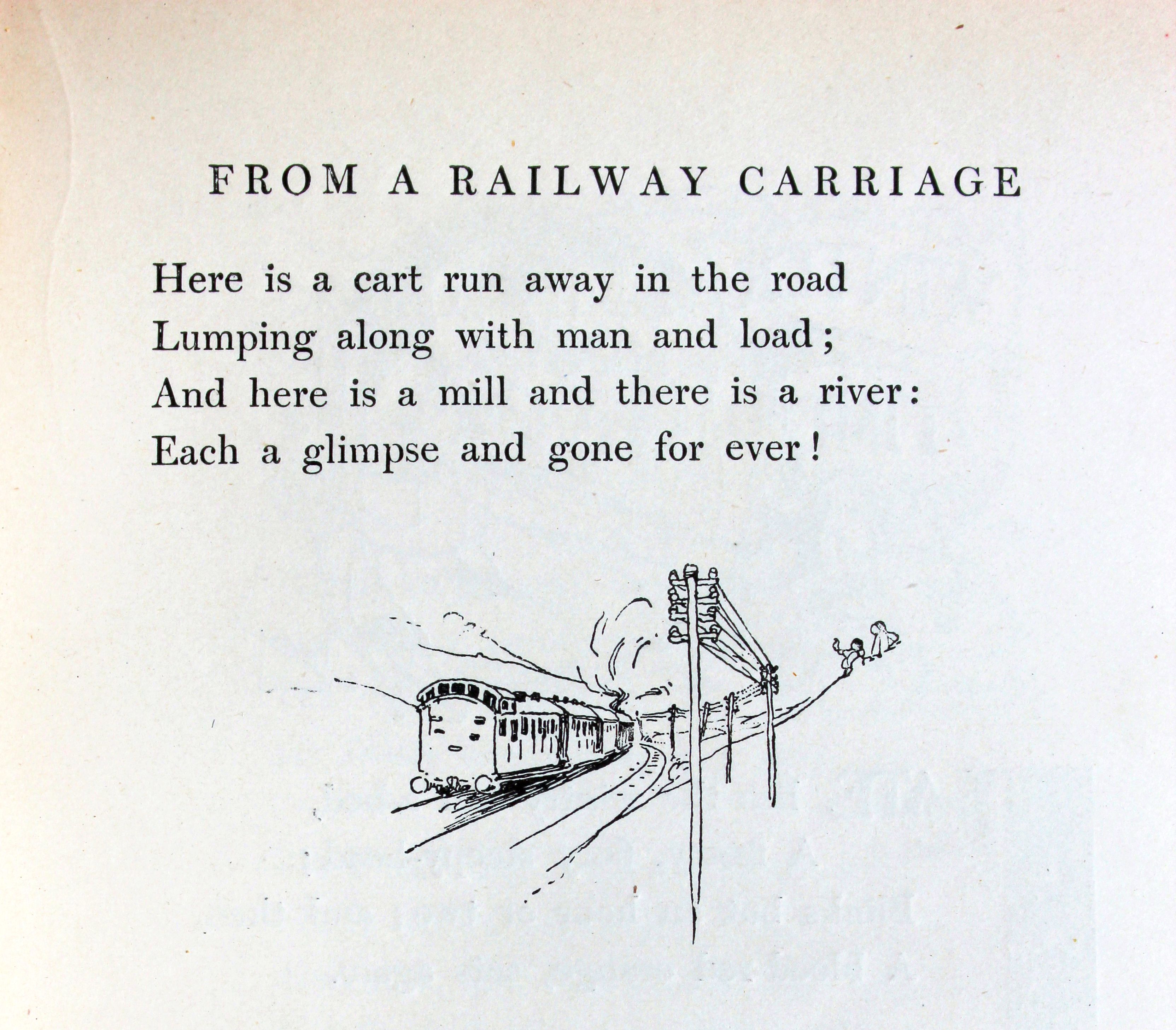
The second page of the poem, with a small illustration of a retreating train

Page 69 of A Child’s Garden of Verses

We hope you’ve enjoyed this look at the early days of rail travel as reflected in our collections and that you enjoy any and all excursions you make this autumn and winter, whether by train or by any other means!

AC

References and further reading:

Railway 200 [accessed September 2025]

Lee Jackson, Palaces of pleasure: how the Victorians invented mass entertainment, New Haven, 2021

The Crystal Palace Foundation [accessed September 2025]

A summer holiday in the Lakes

The ongoing project to catalogue the Library’s Bicknell Collection of books relating to the Lake District [see earlier blog post] continues to uncover fascinating items, not least among them being a small leather-bound, handwritten journal, documenting a family holiday in the Lakes in late August and early September 1877.

Cover of journal

Cover of Bicknell.148

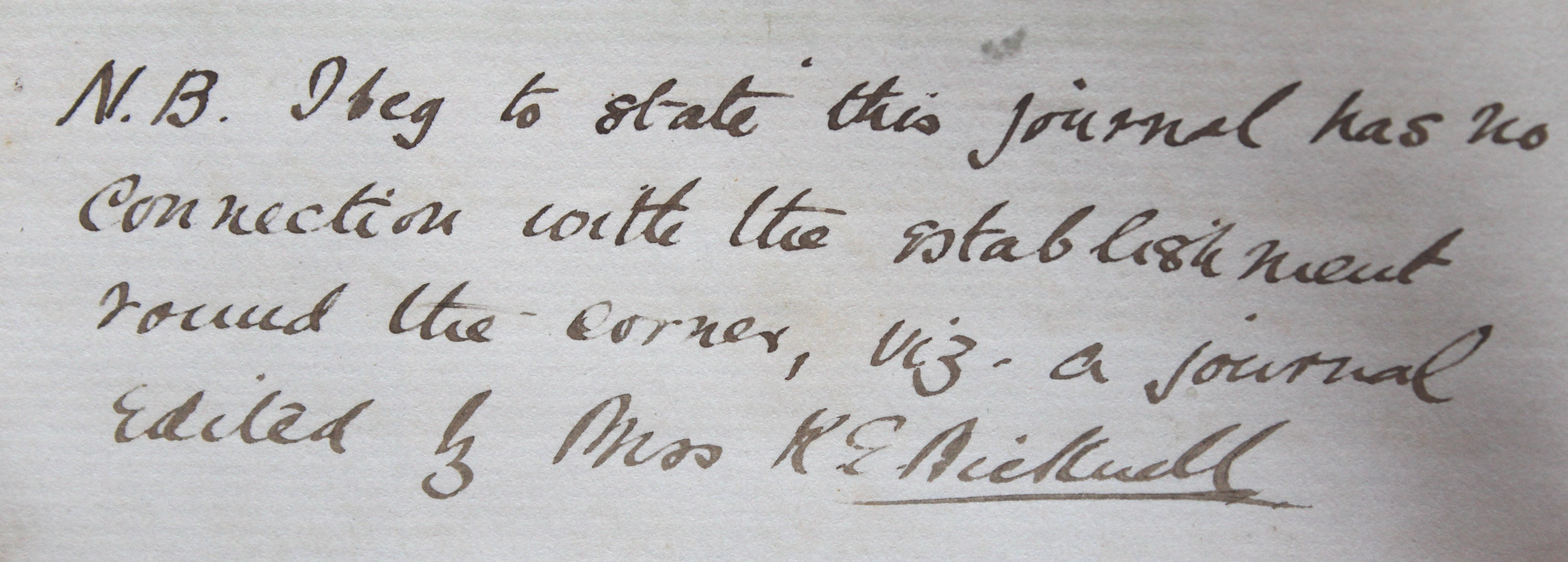
The journal was written by one of Peter Bicknell’s uncles, Claude Lynnford Bicknell (1860-1882), who would have been 17 at the time. He travelled by train from his home in Beckenham, Kent, with his parents and his sister, Kathleen. Gentle sibling rivalry is suggested by a note on the back of the title page of Claude’s journal, which aims to dissociate it from his sister’s diary, referred to as “… the establishment round the corner.”

Note about Kathleen's diary

Bicknell.148 “N.B. I beg to state this journal has no connection with the establishment round the corner, viz. a journal edited by Miss KE Bicknell.”

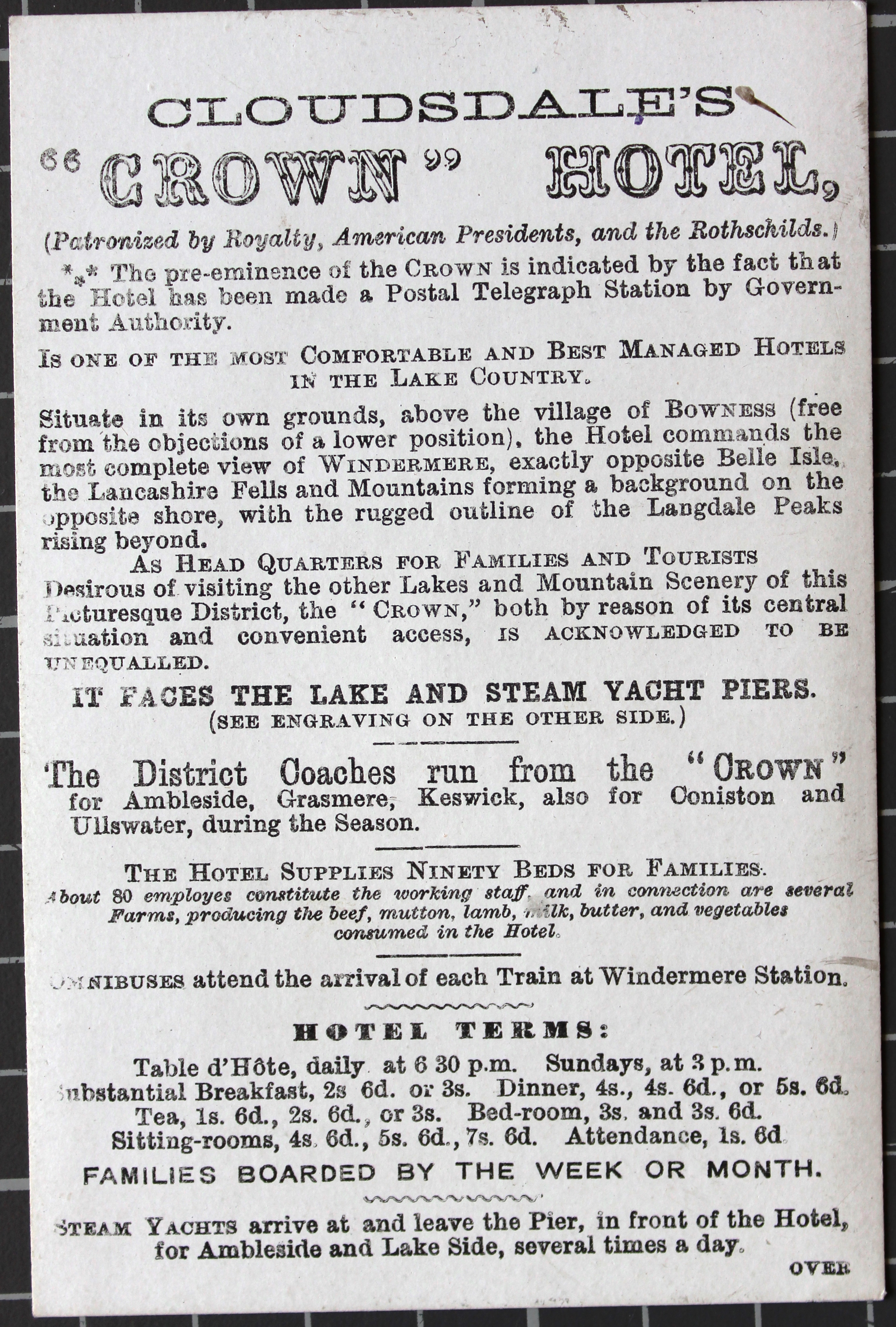
The family were initially based at Cloudsdale’s Crown Hotel, in Windermere, moving after a week to the Borrowdale Hotel, Derwentwater.  Tucked into the journal are various travel ephemera, including this leaflet advertising the Crown:

Hotel promotion leaflet

Bicknell.148 Leaflet advertising Cloudsdale’s Crown Hotel

Claude has an engaging style of writing, and much of the pleasure to be derived from reading the journal is contained in his wry (albeit often rather snobbish) observations regarding the people he encounters, and his grumbles and gripes about topics such as the weather and the quality of the hotel food.

Observations on dinner in the hotel

Bicknell.148 page 2: “Dinner was so so, and the company decidedly seedy consisting of 4 old men, 4 old women; 3 young women with an old one in charge and […?] N.M’s: nearly all Yanks or Lancashires. After a very good desert, by far the best thing in the dinner, an old man got up & said a long and disjointed grace which of course sent Kathleen and myself into convulsions.”

Observations on a coach trip

Bicknell.148 page 14 “…all the rest of the seats were filled with Lancashire people, the men looking like farmers and the women like cooks … The coach is a very seedy turn out, drawn by 4 frightful screws.”

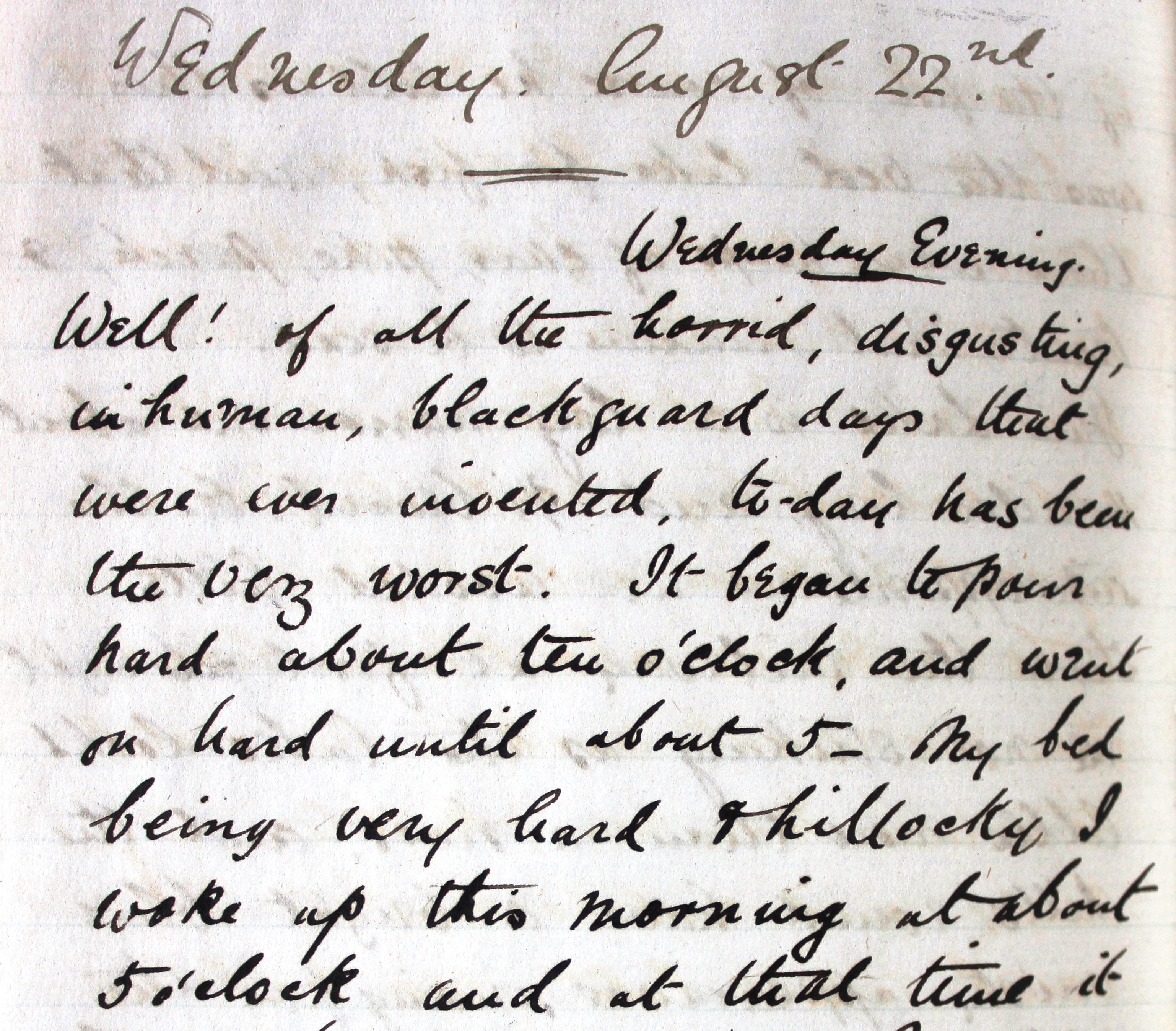
Occasionally Claude’s complaints veer into outright hyperbole, as seen most clearly in his reaction to heavy rain spoiling plans to go fishing on the first day of the holiday. With a wonderful turn of phrase he writes “Well, of all the horrid, disgusting, inhuman, blackguard days that were ever invented, to-day has been the very worst”.

Complaints about the weather

Bicknell.148 page 4. A very wet day

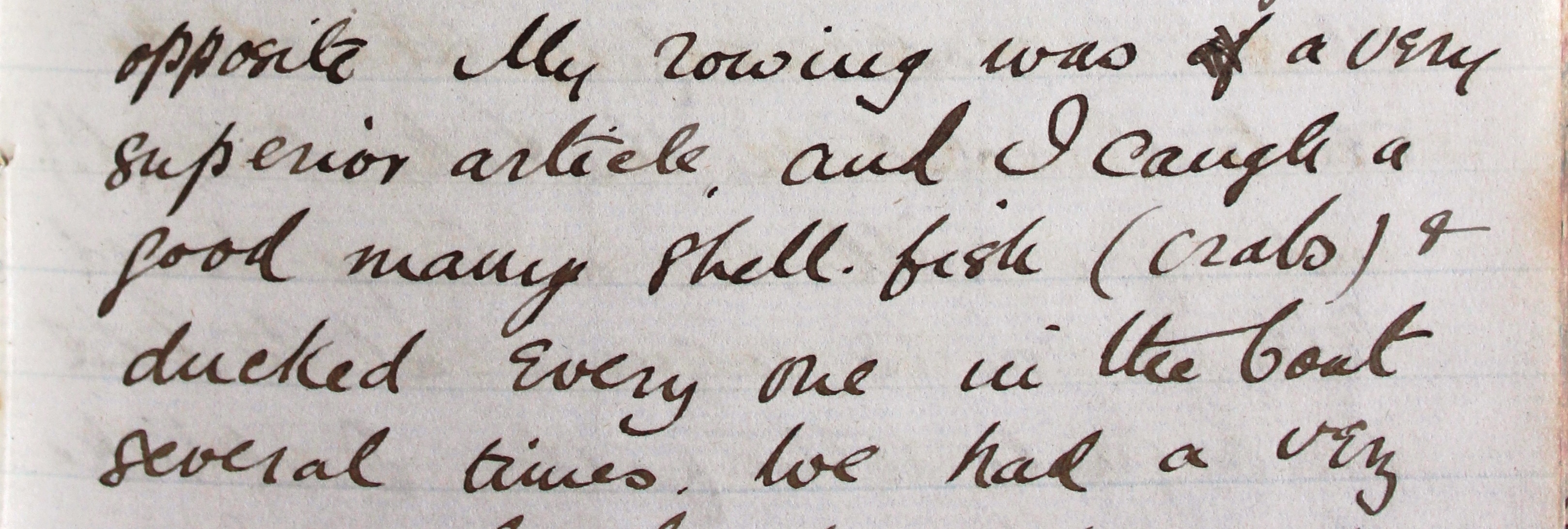
Better weather eventually allowed the family to make several fairly successful fishing trips, and to enjoy walks and excursions to local beauty spots. Claude took a turn rowing the boat during one fishing trip, and seems to have been very pleased with his performance:

A fishing trip

Bicknell.148 page 9: “My rowing was a very superior article and I caught a good many shell fish (crabs) & ducked every one in the boat several times.”

In typical teenager fashion however, he bemoans the decision of his mother to forbid him from going swimming:

Forbidden to bathe in the lake

Bicknell.148 page 12: “Bye the bye I wish to record here that during this day she refused to allow me to bathe in the lake. I think she imagines I shall drown in 20 or 30 feet of water because I am only accustomed to about 7.”

Illustrations in the journal are provided by engravings that Claude has repurposed from books or tourist pamphlets, and he is careful to note where artistic license has been employed:

Illustration of a hotel

Bicknell.148 page 18 “Something like only it is really much further from the lake”

The journal ends rather abruptly on Sunday the 2nd of September, with no indication as to whether this was actually the end of the holiday or simply the point at which Claude got bored with writing an account of each day. The final paragraph is slightly bizarre, featuring as it does, four alligators that apparently resided at the hotel!

Visiting the alligators

Bicknell.148 page 66 “During the day the number of people flocking to see 4 seedy little alligators which belong to the hotel was wonderful. They came in a string from morning to night.”

Claude went on to study at Trinity College, Cambridge, matriculating in 1879. That same year he was awarded a silver medal for political geography by the Royal Geographical Society. Sadly, he only lived a few more years, dying in 1882. It appears he was struck by a cricket ball at Fenner’s cricket ground in Cambridge. It seems likely that his untimely demise made his journal a treasured keepsake for his family, ensuring that it was preserved for posterity.

AC


Lake District Books (1750-1850): An Online Exhibition

Peter Bicknell (1907-1995), an architect, mountaineer and art historian who taught architecture at Cambridge for more than fifty years, was also a book collector with a particular interest in eighteenth-century topographical books and prints. In 1980 he donated his collection of books on the Lake District to King’s College Library. As Bicknell later recalled in his introduction to The Picturesque Scenery of the Lake District, “My addiction to book-collecting was stimulated by the friendship of that inspired lover of books, A. N. L. (‘Tim’) Munby. When some years ago I decided that it was time I found a permanent home for my Lake District collection, it occurred to me that there could be no better place for it than the library of King’s” (Winchester: St. Paul Bibliographies, 1990, p. x). We have just started cataloguing the collection and mounted an exhibition in the library, some highlights from which are described below.

Peter Holland was a Liverpool artist about whom little is known. He visited Ambleside in 1797. His Select Views of the Lakes is the first book of Lake District views using the printing technique known as aquatint. In this method of printing the artist makes marks on the plate (in the case of aquatint, a copper or zinc plate) that are capable of holding ink. The inked plate is passed through a printing press together with a sheet of paper, resulting in a transfer of the ink to the paper.

Peter Holland, Select Views of the Lakes in Cumberland, Westmoreland & Lancashire (Liverpool: printed by James Smith, for John Peeling, [1792]) Bicknell.61

Peter Holland, Select Views of the Lakes in
Cumberland, Westmoreland & Lancashire
(Liverpool: printed by James Smith, for John Peeling, [1792])
Bicknell.61

This copy of Revd Stebbing Shaw’s A Tour in 1787 from London to the Western Highlands of Scotland bears the ownership inscription “Elizabeth Vernon: Given to her by the Marquis of Lansdown 1792”. It ended up in the library of Holland House in Kensington and has their bookplate on the inside front pastedown. The book shows signs of fire damage from when Holland House was bombed during the Blitz in 1940.

Stebbing Shaw, A tour, in 1787, from London, to the Western Highlands of Scotland (London: printed for L. Davis, Messrs. Robson and Clarke, W. Lowndes, H. Gardner, J. Walker, [1788]) Bicknell.27

Stebbing Shaw, A Tour, in 1787, from London,
to the Western Highlands of Scotland
(London: printed for L. Davis, Messrs. Robson and Clarke,
W. Lowndes, H. Gardner, J. Walker, [1788])
Bicknell.27

Peter Crosthwaite was an expert in self-advertisement, referring to himself in this plate as “Admiral at Keswick Regatta; who keeps the Museum at Keswick, is Guide, Pilot, Geographer, Hydrographer to the Nobility and Gentry, who makes the Tour of the Lakes”.

An accurate map of the matchless Lake of Derwent (situated in the most delightful Vale which perhaps ever Human Eye beheld) Peter Crosthwaite, Maps of the Lake District (London: published & sold by Peter Crosthwaite, 1819) Bicknell.10

“An accurate map of the matchless Lake of Derwent (situated in the most delightful Vale which perhaps ever Human Eye beheld)”
Peter Crosthwaite, Maps of the Lake District
(London: published & sold by Peter Crosthwaite, 1819)
Bicknell.10

The next item in the exhibition, William Hutchinson’s An Excursion to the Lakes in Westmoreland and Cumberland, is one of the earliest books in the Bicknell Collection. The excursion was made with William Hutchinson’s brother Richard who acted as draughtsman. The book includes a generous amount of rich picturesque description and lively accounts of unusual incidents.

William Hutchinson, An Excursion to the Lakes in Westmoreland and Cumberland (London: printed for J. Wilkie & W. Goldsmith, 1774) Bicknell.1

William Hutchinson, An Excursion to the Lakes in Westmoreland and Cumberland
(London: printed for J. Wilkie & W. Goldsmith, 1774)
Bicknell.1

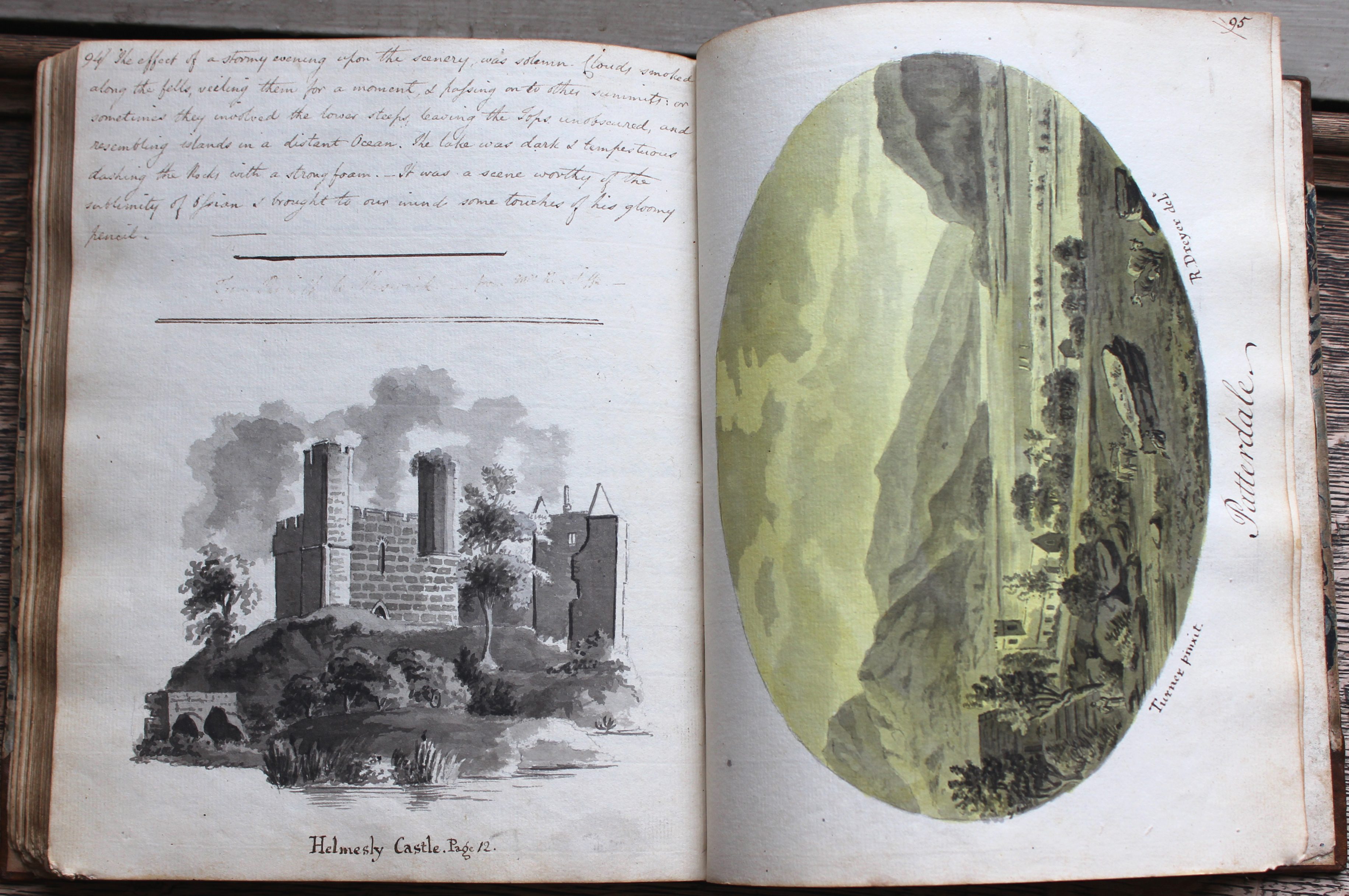
This manuscript journal is illustrated with wash drawings in imitation of William Gilpin’s Observations (London, 1786). The tour was taken in the autumn of 1792 by Mr and Mrs R. Rede and Mr Dreyer. The book is compiled from notes taken on the spot by Mr Rede.

R. Dreyer, A Tour of the Lakes of Cumberland & Westmoreland (Great Yarmouth) Bicknell.82

R. Dreyer, A Tour of the Lakes of Cumberland & Westmoreland
(Great Yarmouth)
Bicknell.82

Thomas Rose’s three-volume work Westmorland, Cumberland, Durham, & Northumberland includes 213 steel engravings from drawings by Allom, Gastineau and Pickering by various engravers. Prints from these fine and durable steel plates were produced in large numbers for many years. They were used in various books and for a variety of purposes such as headings for letter paper and for table maps.

Thomas Rose, Westmorland, Cumberland, Durham, & Northumberland (London: Fisher & Jackson, [1832-1835]) Bicknell.85

Thomas Rose, Westmorland, Cumberland, Durham, & Northumberland
(London: Fisher & Jackson, [1832-1835])
Bicknell.85

Finally, these sixteen views were issued without text or title to be bound with Thomas West’s Guide to the Lakes (1778). The views were advertised in the later editions of West’s Guide, and in that sense belong closely to the aesthetic promoted by West’s editors. The artists often intervene in the topography to improve the view.

John Smith, Sixteen Views of the Lakes in Cumberland and Westmorland (London: printed for W. Clarke [1794-1795]) Bicknell.84

John Smith, Sixteen Views of the Lakes in Cumberland and Westmorland
(London: printed for W. Clarke [1794-1795])
Bicknell.84

Mira Le/JC/IJ