Tag Archives: King’s College Chapel

A celebration of Orlando Gibbons (1583-1625)

This year at King’s we have been marking the 400th anniversary of the death of the composer Orlando Gibbons. Gibbons was born in Oxford in 1583 to a musical family who moved to Cambridge when he was an infant. He was admitted to King’s College in 1598 at the age of fourteen, though had apparently been a chorister at King’s for some years before that, and received a Bachelor of Music degree from the university in 1606. His later life took him to London, where his reputation as a composer and organist was established, and finally to Canterbury, where he died in June 1625 after a sudden illness. He is buried in Canterbury Cathedral.

Portrait of Orlando Gibbons by an unknown artist. Image from Wikimedia Commons.

An inspection of Gibbons items held by King’s College Library has revealed some treasures that may not have seen the light of day for many a year.

My own introduction to Gibbons came when I was about fourteen, singing his sublime five-voice madrigal ‘The silver swan’ with my school chamber choir. We can trace this work through the centuries using various editions held in the Rowe Music Library.

Few of Gibbons’ compositions were published during his lifetime, one notable exception being The First Set of Madrigals and Mottets, printed in 1612 by Thomas Snodham. This is a collection of 20 secular songs, the first of which is ‘The silver swanne’. At King’s we have a copy of the cantus partbook only (containing the part for the highest voice), purchased in 1996 with a gift from the widow of Sir Henry Lintott (KC 1928).

Title page and page 1 of Orlando Gibbons, The First Set of Madrigals and Mottets … (London: Printed by Thomas Snodham, the Assigne of W. Barley, 1612) Shelfmark: LU.50

‘The silver swan’ next appears in the Rowe’s collection as part of a 1673 edition of The Musical Companion, a collection by John Playford anthologising ‘dialogues, glees, ayres and songs’.

Title page of John Playford (ed.), The Musical Companion … [Book 2] (London: Printed by W. Godbid for John Playford, 1673) Shelfmark: LU.101

The madrigal here is arranged for three voices, sacrificing much of the richness of the inner parts. The three parts are presented as a double-page spread, the middle part printed upside down, presumably so that three singers could share a single book, the Cantus Primus and Bassus singers reading from one side, the Cantus Secundus from the other.

Pages 152-153 of The Musical Companion … [Book 2] (London: Printed by W. Godbid for John Playford, 1673) Shelfmark: LU.101

The rise of glee and catch clubs in late eighteenth-century Britain led to many publications like The Apollo, or Harmonist in Miniature, an 8-volume anthology probably dating from the early 1820s. The frontispiece features William Hawes, Master of Children at the Chapel Royal from 1817 and evidently the pin-up of catch club members at that time.

Frontispiece and title page of The Apollo, or Harmonist in Miniature … Vol. 3 (London: T. Williams, c. 1820) Shelfmark: Rw.112.48

This arrangement of ‘The silver swan’, essentially the same as Playford’s, is presented in a small format (18 cm high), which suggests that each member of the catch club would have had his own copy.

Pages 198-199 of The Apollo, or Harmonist in Miniature … Vol. 3 (London: T. Williams, c. 1820) Shelfmark: Rw.112.48

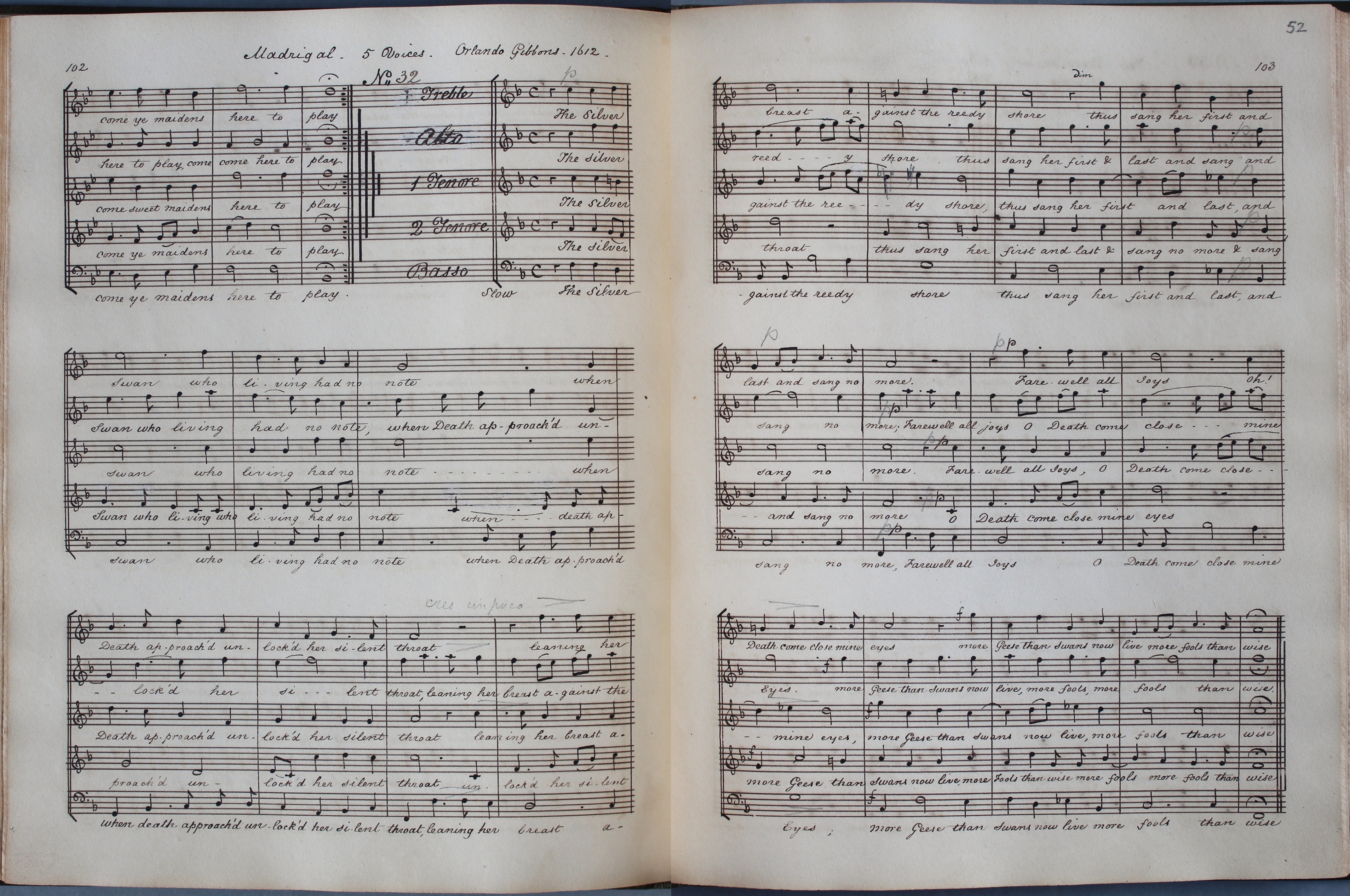
The Rowe Library’s MS 111 is a manuscript dating from 1834-5 in the hand of Thomas Oliphant (1799-1873), best remembered today for writing the lyrics of ‘Deck the hall with boughs of holly’. Oliphant had recently been elected Honorary Secretary of The Madrigal Society (still going today, and now admitting women), and the book may have been intended as his neat conductor’s copy of the 83 motets, madrigals and glees it contains, of which no. 32 is ‘The silver swan’.

Pages 102-103 of Rowe Music Library, MS 111

***

Naturally it is Gibbons’ sacred music that is heard most in King’s College Chapel, in the form of hymns and anthems. Gibbons’ reputation as a composer of hymn tunes rests on his contributions to George Wither’s 1623 publication The Hymnes and Songs of the Church, for which he wrote 17 original tunes still known today by the ‘Song’ numbers accorded them in this volume. A patent of King James I ordained that the book should be bound with all copies of the metrical Psalms sold, which may account for the early adoption of Gibbons’ tunes by church choirs.

Title page of G[eorge] W[ither], The Hymnes and Songs of the Church … (London: Printed by the Asignes of George Wither, 1623) Shelfmark: Keynes.C.5.17

‘Song 1’, which in this book accompanies Wither’s text ‘Now shall the praises of the Lord be sung’, is today more commonly sung to ‘O Thou who at the Eucharist did pray’ or ‘Eternal ruler of the ceaseless round’.

Opening of ‘Song 1’ from G[eorge] W[ither], The Hymnes and Songs of the Church … (London: Printed by the Asignes of George Wither, 1623) Shelfmark: Keynes.C.5.17

***

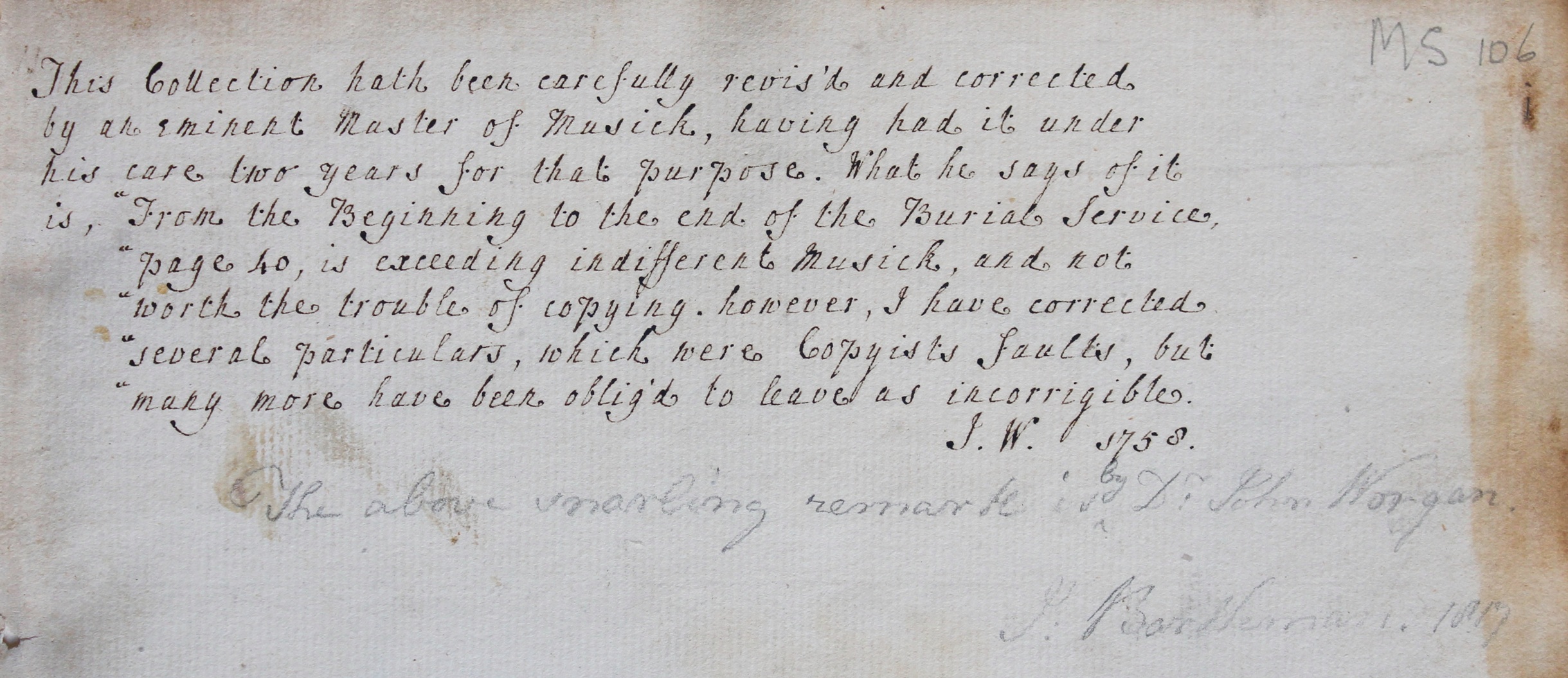
The Rowe Library’s MS 106 is an eighteenth-century manuscript containing anthems and services copied in several hands. A note on the flyleaf observes:

This Collection hath been carefully revis’d and corrected by an eminent Master of Musick, having had it under his care two years for that purpose. What he says of it is, ‘From the Beginning to the end of the Burial Service, page 40, is exceeding indifferent Musick, and not worth the trouble of copying. However, I have corrected several particulars, which were Copyists faults, but many more have been oblig’d to leave as incorrigible.’ J.W. 1758

A pencil addition notes:

The above snarling remark is by Dr John Worgan. J. Bartleman, 1817

Note on flyleaf of Rowe Music Library, MS 106

The one Gibbons work present in this volume is his six-voice anthem ‘Hosanna to the Son of David’, at the head of which is written a quotation from Sir John Hawkins’ A General History of the Science and Practice of Music of 1776 describing it as ‘one of the most perfect Models for Composition in the Church-Style of any now existing’.

Page 162 of of Rowe Music Library, MS 106

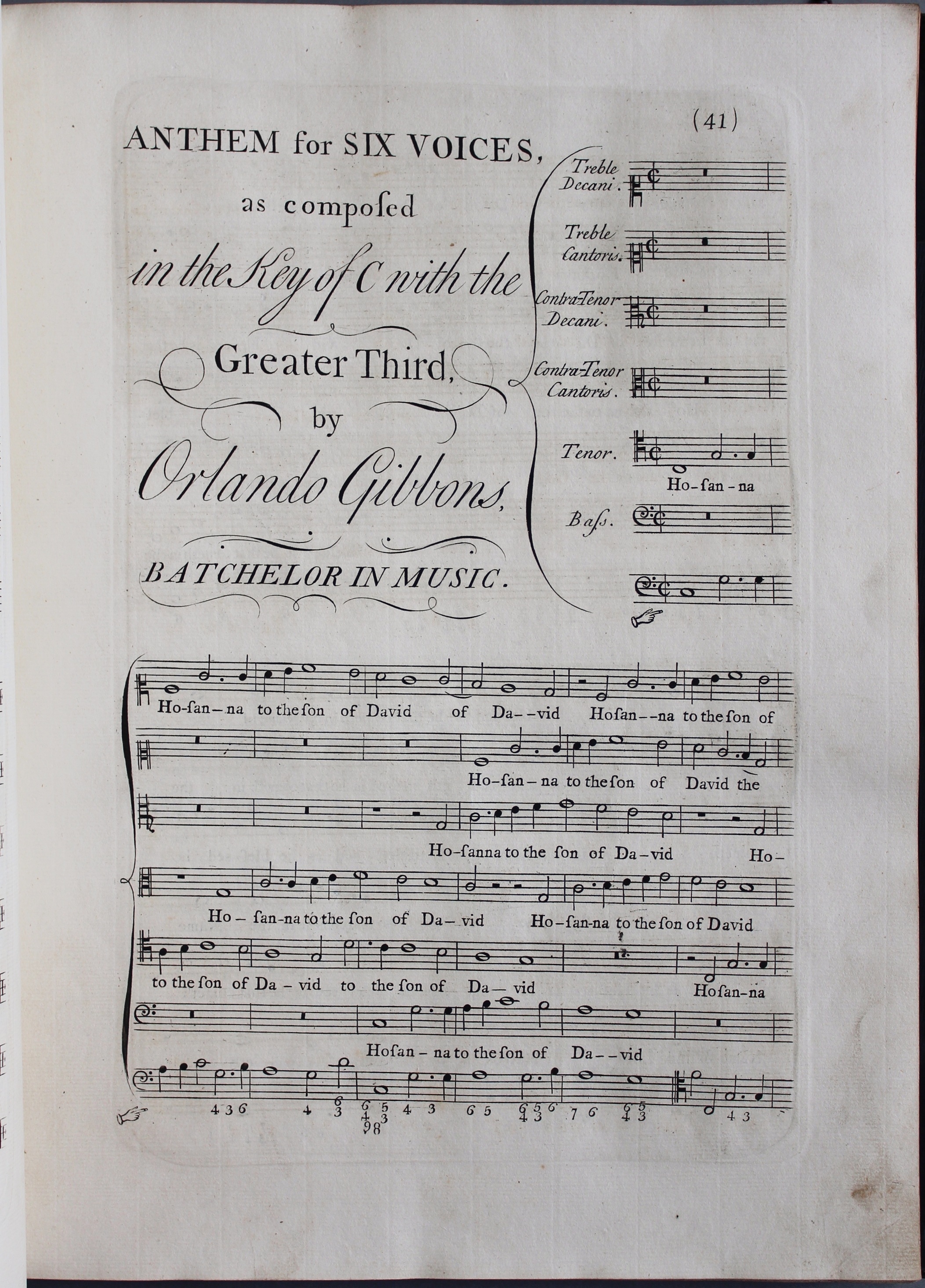
‘Hosanna to the Son of David’ is one of several Gibbons anthems anthologised in the second volume of Cathedral Music, edited by William Boyce (1711-1779), Master of the King’s Musick, and published in 1768 after a long gestation.

Page 41 of William Boyce (ed.), Cathedral Music … Volume the Second (London: Printed for the Editor, 1768) Shelfmark: Rw.115.12

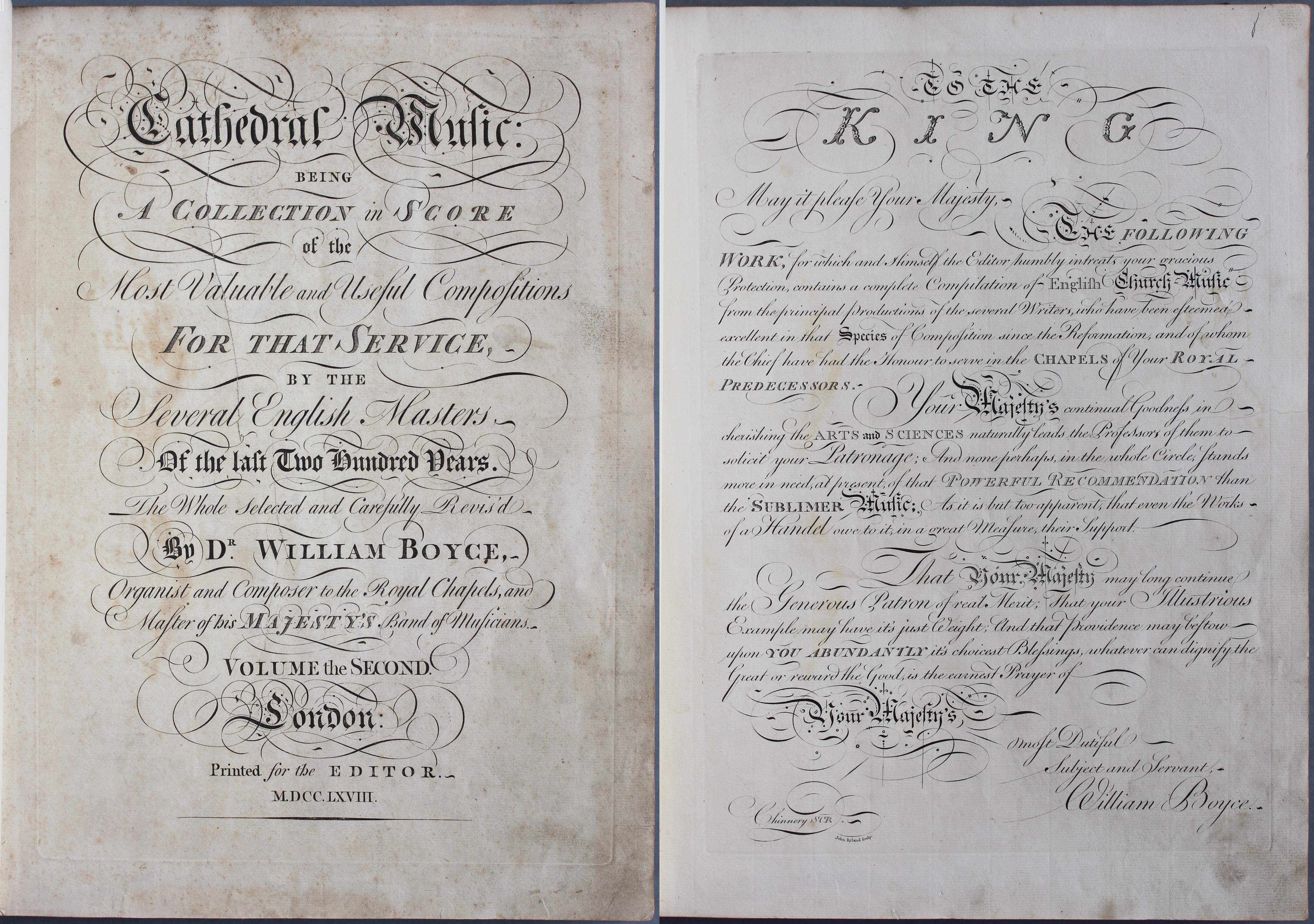
Doubtless partly due to the royal imprimatur, this volume was a swanky undertaking all round, bearing a title page boasting of ‘the most valuable and useful compositions … of the last two hundred years’, a dedication to King George III involving every typeface under the sun, and even an anthem ostensibly composed by George’s predecessor Henry VIII (‘O Lord, the maker of all things’, now usually attributed to William Mundy).

Title page and dedication from William Boyce (ed.), Cathedral Music … Volume the Second (London: Printed for the Editor, 1768) Shelfmark: Rw.115.12

The volume’s subscribers included not only the Provost and Fellows of King’s College, Cambridge (of course), but also such luminaries as:

The Rev. Mr. Heneage Dering, Chaplain to the Earl of Winchelsea.
The late Rev. Mr. Phocion Henley.
Bybie Lake, Esq.
Gervas Scrope, Esq. of Cockerington, in the County of Lincoln.
Messrs. Sharp, of Mincing-Lane, London. Two Sets.
The King.

Blank spaces at the end of anthems are filled with illustrations: usually flourishes and curlicues, but occasionally faces or, at the end of William Byrd’s ‘Bow thine ear, O Lord’, a complementary bird. Note also the snazzy manicules (pointy fingers) in the score to help the organist find his line. No such help for the choir, though the size of the book (42 cm high) suggests it may have been a publication meant primarily for the use of a choirmaster, from which choir parts could be copied in manuscript.

Various devices from William Boyce (ed.), Cathedral Music … Volume the Second (London: Printed for the Editor, 1768) Shelfmark: Rw.115.12

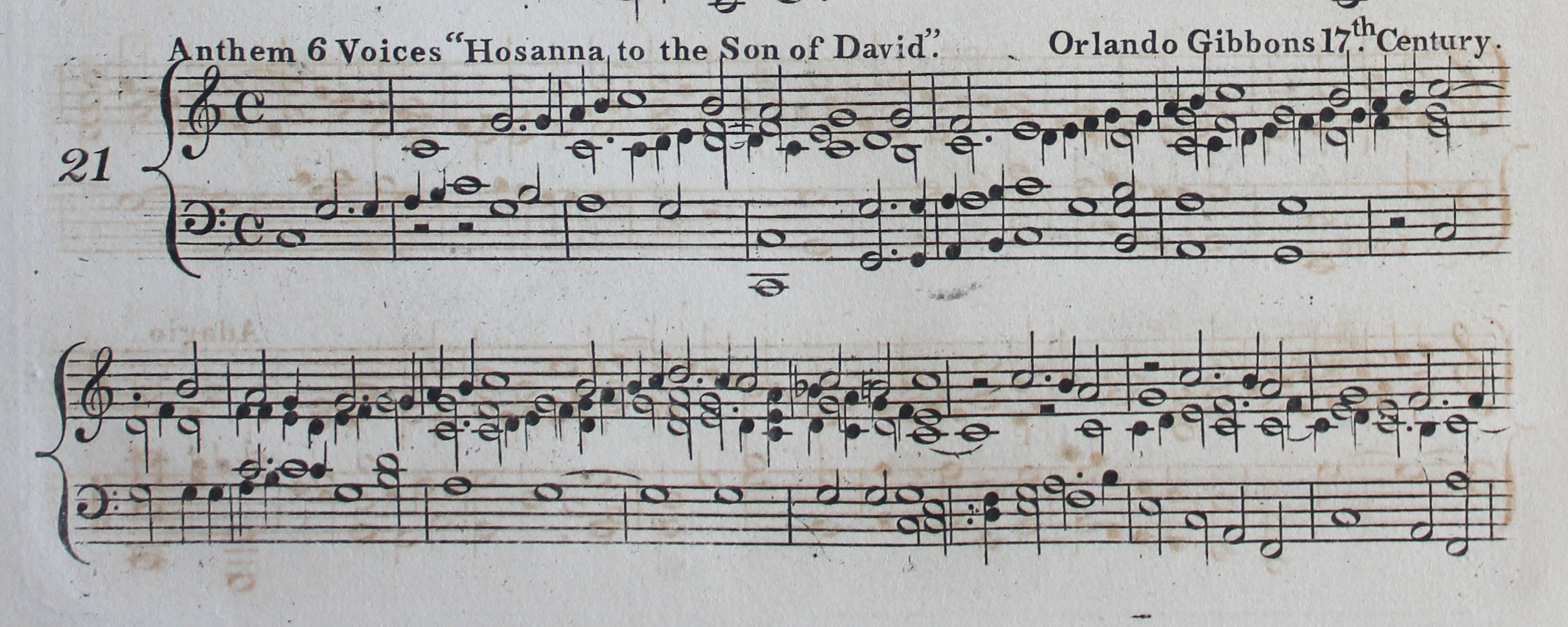
‘Hosanna to the Son of David’ also appears, albeit in short score, in the work known unpromisingly as ‘Crotch’s Specimens’, or more fully as Specimens of Various Styles of Music Referred to in a Course of Lectures Read at Oxford & London and Adapted to Keyed Instruments by Wm. Crotch, Mus.D., Professor of Music in the University of Oxford. The Specimens was a major work of scholarship, ‘encyclopaedic in scope and surprisingly forward-looking in its aim to combine academic example with practical purpose’, in the words of Grove. In a preface to this revised edition, Crotch writes:

The study of Orlando Gibbon’s [sic] works cannot be too strongly recommended. For choice of subjects, for skill in the management of them, and for the flow of melody in all the parts, this great master was inferior to none of his cotemporaries.

Opening of No. 21 from William Crotch, Specimens of Various Styles of Music … Vol. 2 (London: Printed for the Author … c. 1821) Shelfmark: Rw.54.14

It’s no surprise that Gibbons’ music has been an attractive proposition to Kingsmen looking to produce performing editions over the years. Twentieth-century editions of choral works by Gibbons held by the Rowe Library include those prepared by David Willcocks (KC 1939), John Whitworth (KC 1946), Philip Brett (KC 1955) and John Morehen (KC 1964).

***

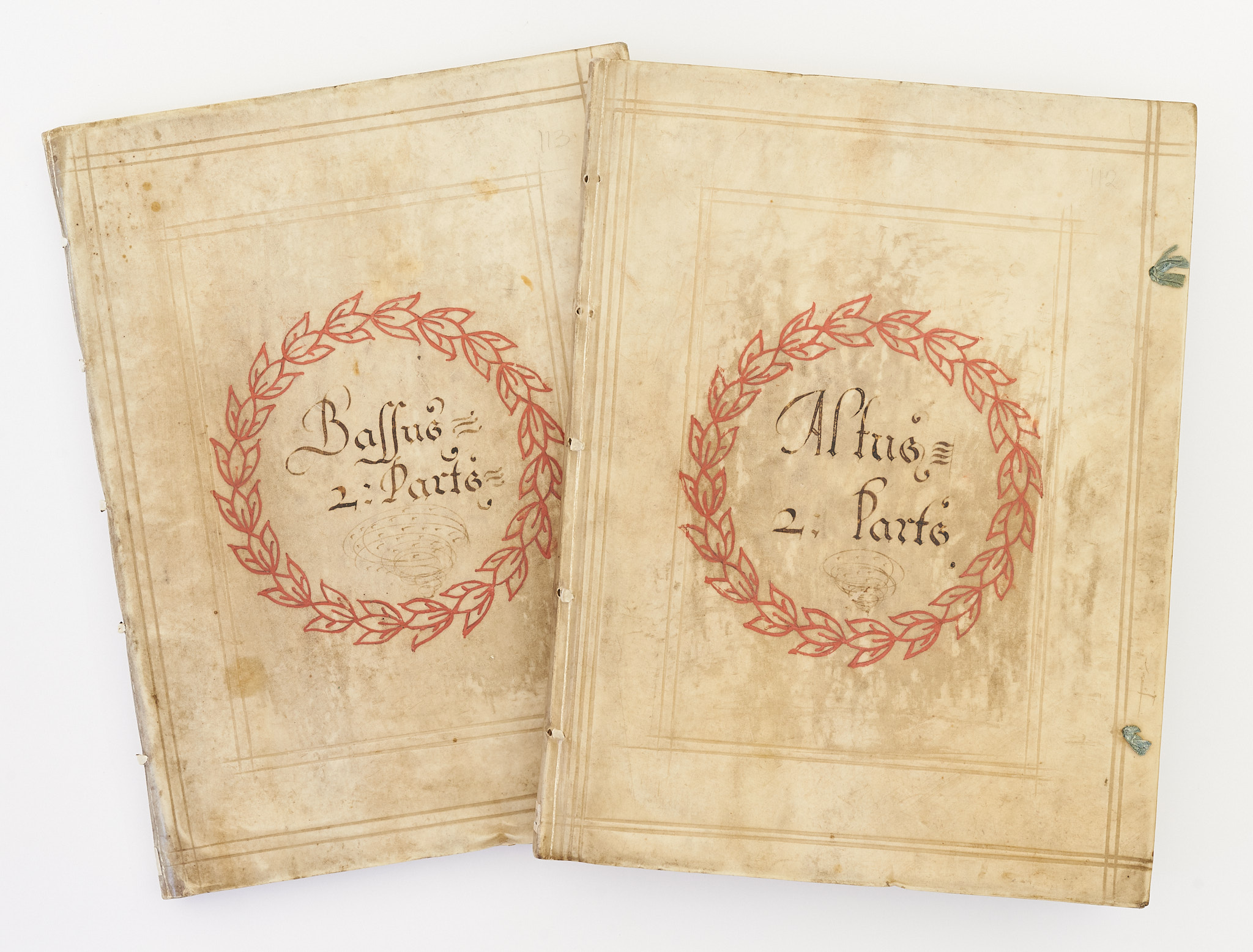
Finally, a pair of mid-seventeenth-century music manuscripts given to the college by John Maynard Keynes. MSS 112 and 113 are two partbooks for viols of fantasias and dances primarily by John Coprario, but also containing works by John Jenkins, William White and others.

Bindings of Rowe Music Library, MSS 112 and 113. Photo © 2025 Sara Rawlinson at HeritagePhotographs.com.

The works included by Gibbons are six fantasias for two treble viols, which are not preserved in manuscript elsewhere. These manuscripts were the property of John Browne (1608-91), Clerk of the Parliaments, and the Gibbons fantasias here are in Browne’s own hand.

No. 13 in Rowe Music Library, MSS 112 and 113

These fantasias have been published in many editions: they appear in the Musica Britannica volume of Gibbons’ Consort Music, and if you fancy playing them yourself you can browse several public-domain versions here.

GB

Gibbs, Groats and Gowns: Celebrating the Tercentenary of the Gibbs Building

James Gibbs, A Book of Architecture, Containing Designs of Buildings and Ornaments (London: 1728), frontispiece. (Shelfmark: F.27.7)

Three hundred years ago today, on the 25th March 1724, the foundation stone was laid for a new building in King’s, known today as the Gibbs Building, named after the architect James Gibbs (1682–1754) who designed it. We are fortunate to know quite a lot about the events of that day because of the survival of certain items in the special collections in King’s Library.

Proceedings began with the sermon before the university in a special service in Chapel given by senior King’s fellow Gregory Doughty (ca. 1690–1742, KC 1706).  We know exactly what the sermon was, because it was published, and the publication also reveals other aspects of the service and the ceremony which followed.

A Sermon Preached Before the University of Cambridge in King’s College Chapel on the 25th of March 1724 … by Gregory Doughty (Cambridge, 1724), title page. (Shelfmark: C.5.44.(3.)

A Sermon Preached Before the University, page 3. (Shelfmark: C.5.44.(3.)


The subject of the sermon was ‘Luke II.14 Good Will Towards Men’, and much space was given to extolling the virtues of acts of benevolence, particularly that of founders and patrons of learned societies such as Cambridge colleges. It being ‘Founder’s Day’ (it was celebrated on 25th March at the time), several passages praise Henry VI, the founder of King’s: ‘We must account it sure as well the peculiar felicity, as glory of this society, to be bless’d with such a sovereign for its founder; who prefer’d the honor and service of his Maker to all the gay and flattering privileges of Crown’, writes Doughty.

A Sermon Preached Before the University, appended section ‘The State of King’s College in Relation to the Old Fabrick’. (Shelfmark: C.5.44.(3.)

Appended to the sermon is a document entitled ‘The state of King’s College, in relation to the old fabrick, together with some account of the foundation of a new one.’ This document points out that the new building was long overdue, given the old buildings were intended only for Henry’s original foundation of a community consisting of ‘a rector and 12 scholars’ which he had soon abandoned in favour of a community of ‘a Provost and 70 fellows and scholars’. Towards the end of the document there is an interesting account of the foundation ceremony which took place immediately after the service in Chapel:

Accordingly (the Ground having been first laid out, and the Foundation dug for the West-side of the Square, pursuant to a PLAN design’d by Mr Gibbs) on 25th Day of March last, being the Anniversary of Commemorating the Founder, and the University being met, as usual, at King’s College Chappel; after the Sermon, and an Anthem compos’d on the Occasion; The Provost, accompanied by the Noblemen, Heads of Colleges, Doctors, and other Members of the University, proceeding to the Corner, where the first Stone was to be laid, bespoke Success to the Undertaking in the Form which follows, with such Actions, at proper Intervals, as the Words themselves express, or are customary in such Kinds of Ceremony.

The words ‘in the form which follows’ were printed in Latin at the end of the sermon publication, and reveal a number of interesting details, most notably that some of the words were engraved on a bronze plate and, together with some gold, silver and bronze coins, were put into the foundation stone of the building. The story becomes more intriguing when the text goes on to explain that ‘If in future years a student of ancient times, while searching through the rubble, unearths this bronze plate encased in stone, may he know that this stone was destined for the construction of this College in the times of Henry VI.’

A Sermon Preached Before the University, final two pages comprising the Latin words read out at the foundation ceremony together with an English translation. (Shelfmark: C.5.44.(3.)

The famous clergyman and antiquary William Cole (1714–1782), if his version is to be trusted, sheds light on this stone that had been ‘destined for the construction of this college in the times of Henry VI’:

When the news came of the Founder’s deposition the labourers who were sawing the stone in halves and not having finished it, imagining that there would be no further proceeding in the design by his successors left of their work and the stone remaining half sawed in two. This was always the story about the stone which I myself have seen before any design of making the use of it which was afterwards thought on; and a cut of that stone is in the print of this chapel engraved by David Loggan. In the cleft part was the plate and inscription with ye different coins put. (See British Library, Add MS 5802, fol. 110)

Here is Loggan’s engraving. You can see the stone, partly sawn in half, on the grass on the right-hand side of what was then known as ‘Chapel Yard’:

King’s College Chapel engraved by university engraver David Loggan (1634–1692) (Reference: JS/4/10/38)

Gibbs, A book of Architecture, plate 32 showing the plan for the ‘West Front’ (the Gibbs building) and the front court. (Shelfmark: F.27.7)

Regarding the gold, silver and bronze coins that were enclosed with the engraved bronze plate, there is a centuries-old tradition of burying contemporary coins in the foundations of new buildings in the belief that it would bring good luck and prosperity. How tantalising it is to know that these coins and the engraved plate are buried in the foundations of the Gibbs building but we are not able to see them today! William Cole also tells us that when digging the foundations of the Gibbs building apparently a number of coins from the reign of Henry V were discovered:

at ye digging of the foundation for the aforesaid new building a large quantity was supposed, tho’ not 100 were owned to have been found by ye workmen & labourers, who were thought to have disposed of them otherwise, of gold coins of King Henry ye 5th & others, which were as was surmised, hid by ye people in those troublesome times; for where ye present new building stands, was formerly a large street, call’d Mill Street … These coins were sent by ye College to ye benefactors to this building as presents, & a very few remain in ye Treasury as a memorial. (BL Add MS 5802, fol. 115)

Indeed, the following is a photograph of a coin (a groat) from the reign of Henry V which is still in the College’s collections, and is perhaps one of those dug from the ground when laying the foundations for the Gibbs building:

A silver groat from the reign of Henry V from the collections of King’s Library.

The conclusion of the inscribed Latin words printed with the sermon which discusses ‘literary monuments more lasting than this bronze plate’ (‘Monumenta Literaria, Hoc Aere perenniora . . .’) is a clear allusion to Horace’s Odes 3.30 which begins ‘I have completed a monument more lasting than bronze . . .’ (‘Exegi monumentum aere perennius’). The author will have known his audience, and this allusion to Horace will not have been lost on them.

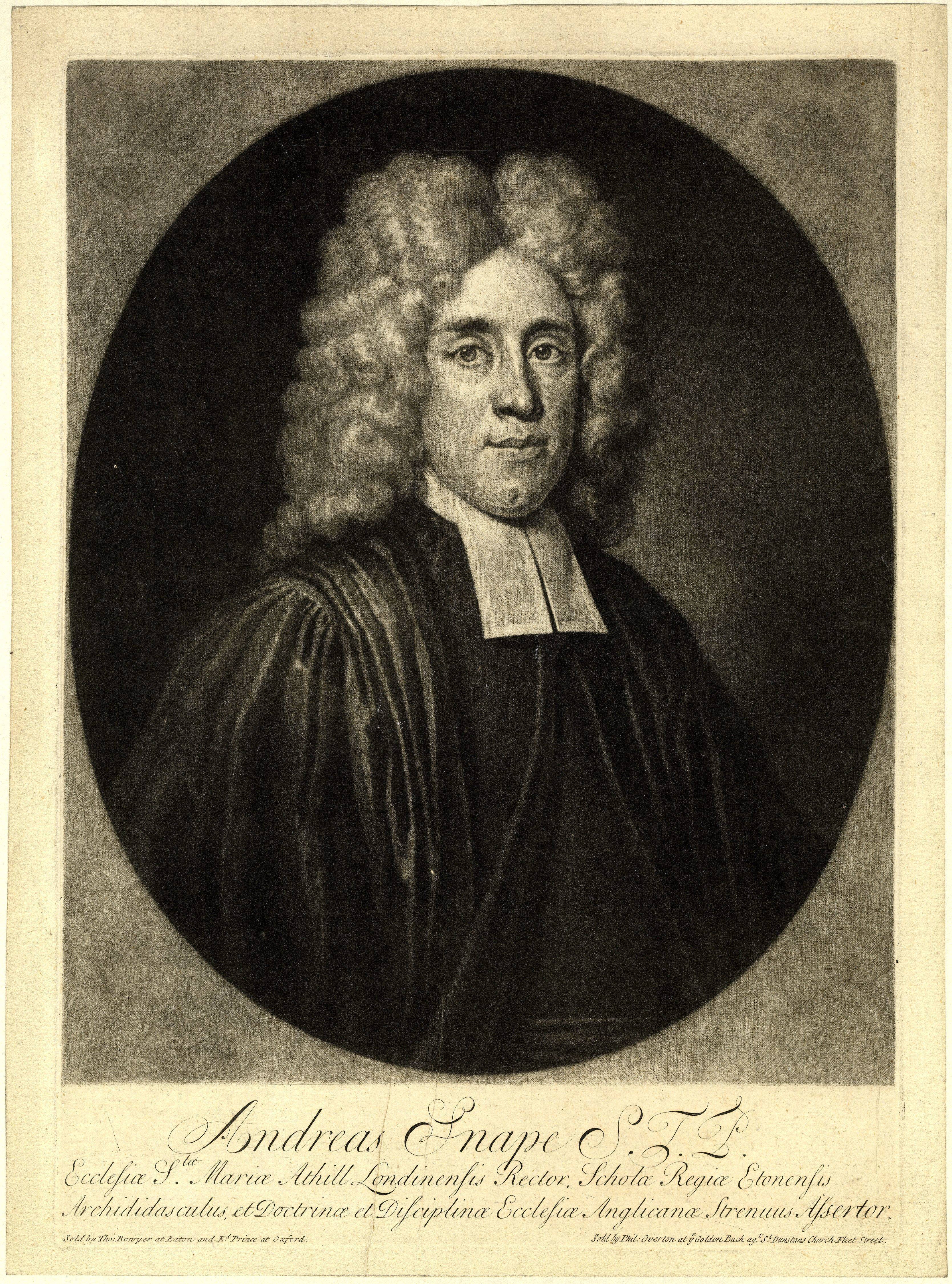
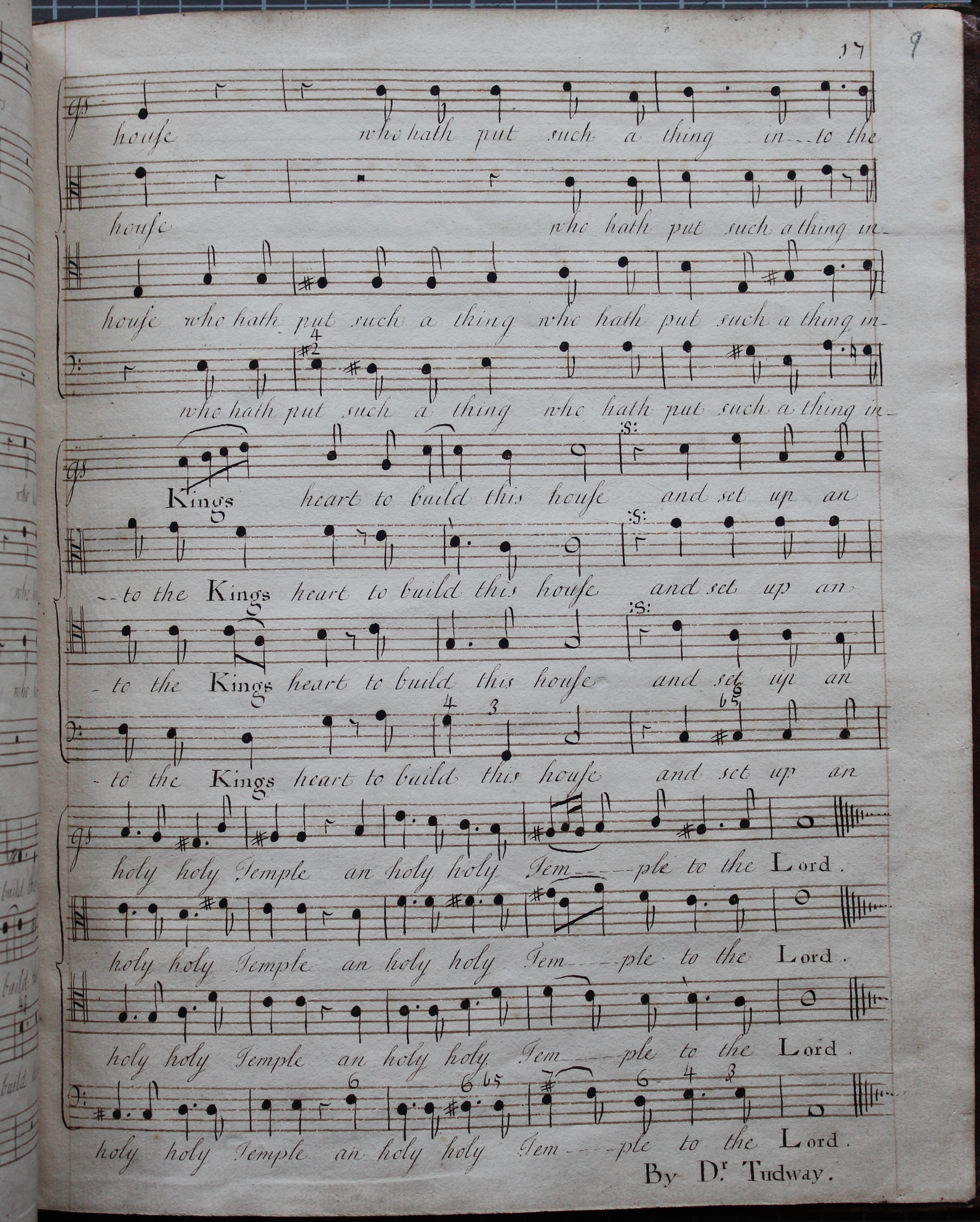
We saw above that ‘an Anthem compos’d on the occasion’ was mentioned in the published sermon, and this brings us to our second item in the Library’s special collections. The anthem in question is ‘Hearken unto me ye holy children’ by the composer Thomas Tudway (before 1650–1726), professor of music in the university and organist at King’s from 1670 until 1726. The original manuscript is held in the Rowe Music Library in King’s. It is a verse anthem, scored for three soloists and choir, and the copy in King’s Library is clearly a presentation copy that begins with a dedication to Provost Andrew Snape (1675–1742, KC1690) and the fellows of the College:

Thomas Tudway, Hearken Unto Me ye Holy Children, dedication page. (Rowe MS 108)

The text of the anthem is made up of a variety of verses from several books of the Bible including Ecclesiastes, Ezra and the Psalms.  Its sentiments resonate with the themes of the sermon as you would expect:

Blessed be the Lord God, of our fathers, who hath put such a thing into the King’s heart, to build this house.

to be a Father to the Fatherless, to feed them with the bread of understanding, & give them the waters of wisdom to drink

His name shall endure for ever, His name shall remain under the sun among the posterities

Provost Andrew Snape (engraving by John Faber, between 1696 and 1721. King’s Archive reference: KCAC/1/4)

Thomas Tudway holding a page of an anthem he has composed for King’s College Chapel. (Bate Collection of Musical Instruments, University of Oxford).


Tudway, Hearken Unto Me, opening. (Shelfmark: Rowe MS 108)

Tudway, Hearken Unto Me, final page of music. (Shelfmark: Rowe MS 108)


Several aspects of the binding of the volume point towards its importance and uniqueness as a presentation copy. It is a leather-bound volume with a panel design tooled with gold borders with fleuron decorations stamped in gold on the front and back boards. The foredges of the binding are also tooled in gold, as are the text block edges. No expense has been spared. Unusually, the pastedowns—which are usually simply plain hand-made paper—are in this case made of a much more expensive paper embossed with a red and gold floral design.

Tudway, Hearken Unto Me, Front panel binding with gold tooling (left), Inside front pastedown embossed in red and gold (centre), Front fore-edges of binding and text block decorated in gold (right). (Shelfmark: Rowe MS 108)

One would think that something as special as this would have been treasured in King’s, but curiously, by one means or another, the manuscript ended up being owned by one Henry Robson in the early nineteenth century who gave the volume to his cousin John Henry Robson in 1833. Thankfully it was returned to King’s by a relative, a Mrs Robson, in 1852.

Tudway, Hearken Unto Me, ownership inscriptions on front pastedown. (Shelfmark: Rowe MS 108)

Alas, this reminds us of the dilemma faced by William Cole who had spent eighteen years in King’s meticulously documenting our history, but when deciding where to deposit his manuscripts in 1788, he wrote ‘I have long wavered how to dispose of all my manuscript volumes; to give them to King’s College, would be to throw them into a horsepond; and I had as lieve do one as the other; they are generally so conceited of their Latin and Greek, that all other studies are barbarism.’ A little harsh perhaps, but rest assured that the librarians and archivists in King’s today take great care in looking after the special collections and are delighted to be able to share them with you on special days such as today!

Gibbs, A Book of Architecture, plate 35 showing the designs for the Gibbs building. (Shelfmark: F.27.7)

An early eighteenth-century theodolite by London instrument maker Richard Glynne (1681–1755), active ca. 1707 to 1730, belonging to King’s. A record in the College archives shows that we purchased a theodolite in 1724, presumably for building the Gibbs building. Could this be the one? (The theodolite is on long-term loan to the Whipple Museum in Cambridge. Reference: Wh.6588)

JC

________________________

For an online exhibition of documents from King’s archive relating to the Gibbs building see https://www.kings.cam.ac.uk/archive-centre/the-gibbs-building
Thanks are due to Ingo Gildenhard for advice on improving the translation of the Latin into English, as well as to my colleagues in King’s Library and Archives, and to Peter Jones for locating the Henry V coins.
The photographs of the Glynne theodolite are reproduced by kind permission of the Whipple Museum of the History of Science, University of Cambridge.

Soaring into the New Year on the back of a dragon

In honour of the Year of the Dragon, we went on a perilous mission into the Library’s treasure hoards of books to find out if any of those fearsome beasts might be lurking inside. Alas, no Chinese dragons were discovered, but we did encounter several of the European variety and bravely captured their images to share with you in this post.

Our first dragon however, is not to be found within the pages of a book. It is a much more solid beast; a sculpture which originally adorned the College Chapel, but which was removed and replaced during restoration work. For the last few decades it has stood guard over the upstairs entrance of our Library, somewhat worn and battered by time maybe, but fierce and stalwart nonetheless.

A stone dragon standing upright with mouth open

The dragon outside the upstairs entrance of the Library

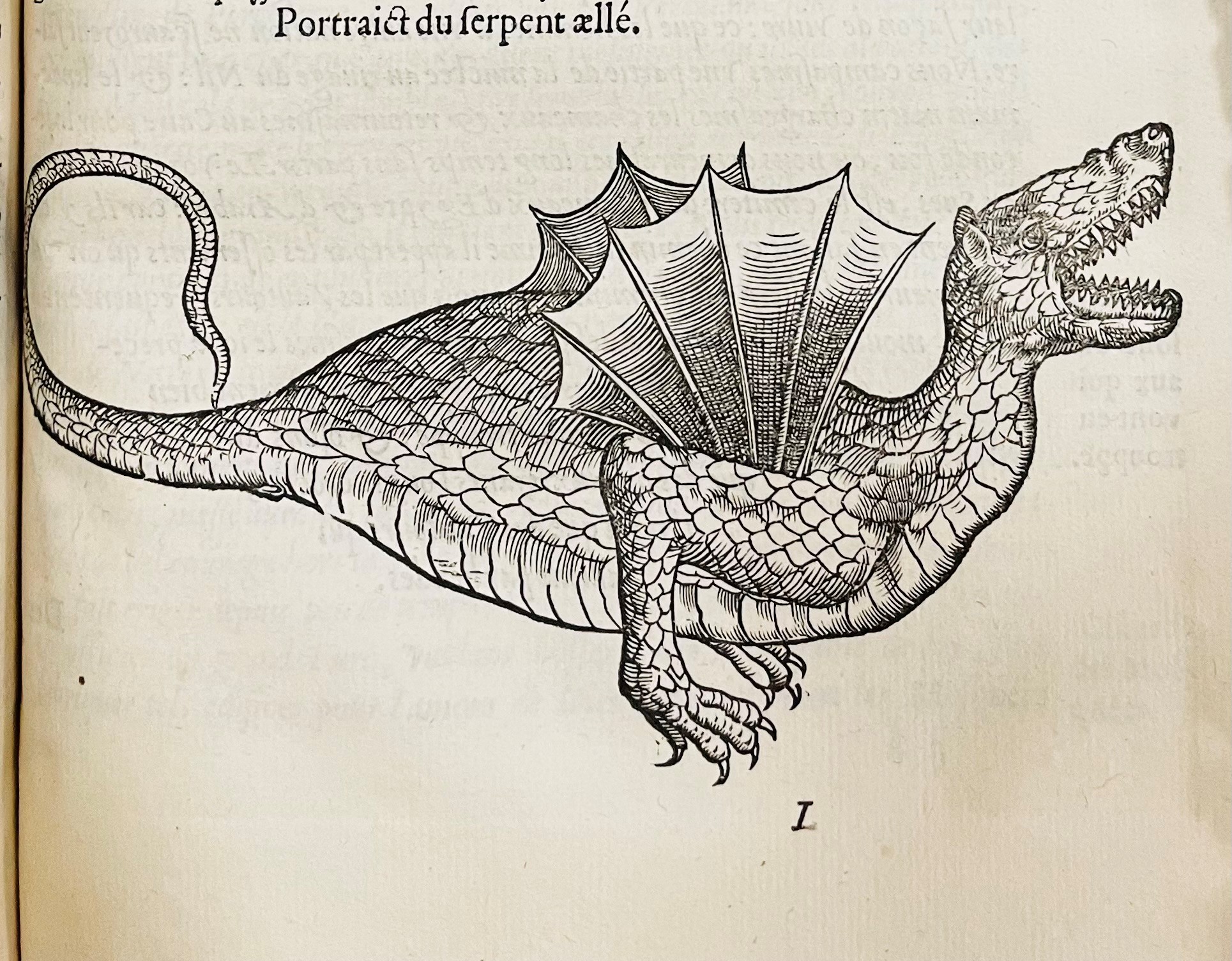
Several sixteenth-century works from our collections proved to be harbouring dragons. The first image comes from a volume of natural history by Pierre Belon (1517?-1564), originally produced in 1553. This is a very early printed depiction of a dragon with wings. Belon, a French naturalist and traveller, claimed to have seen embalmed bodies of these creatures during his travels in Egypt.

Woodcut of a two-legged winged dragon

Egyptian dragon from Les Obseruations de plusieurs singularitez & choses memorables by Pierre Belon, Paris, 1555 (T.16.20)

Secondly, we have an illustration depicting a very grand St George slaying a dragon, which adorns the title page of the 1527 edition of Polycronicon, by Benedictine monk, Ranulf Higden (ca. 1280-1364).  This was a very popular work of world history, written originally in Latin and later translated into English and added to over the following centuries.

Woodcut of St George on horseback with a dragon under the horse's hooves

St George and the dragon from the title page of Polycronycon by Ranulf Higden, London, 1527 (M.24.08)

Our last sixteenth-century image is from a 1590 edition of Edmund Spenser’s Faerie Queene. Here we have another knight, the Redcrosse Knight, killing a dragon in a very similar fashion. The Redcrosse Knight is very closely associated with St George.

Image of a knight on horseback with a dragon under the horse's hooves. The knight is running a spear through the dragon

The Redcrosse Knight from The Faerie Queene by Edmund Spenser, London, 1590 (Keynes.C.02.19)

Moving into the seventeenth century, a work of alchemy provides more images. Dragons in alchemy symbolize the unification of opposing forces like the sun and the moon or sulphur and mercury, and the change they produce when combined.  We therefore get these striking illustrations of entwined or two-headed dragons, as shown in the images below.

Two dragons perched atop a ring with their necks intertwined

Alchemical dragon symbol from page 212 of Theatrum Chemicum Britannicum edited by Elias Ashmole, London, 1652 (Keynes.C.4.2)

Upright two-headed dragon with a bird above and alchemists gathered around it

Two-headed dragon from page 213 of Theatrum Chemicum Britannicum edited by Elias Ashmole, London, 1652 (Keynes.C.4.2)

From our collection of children’s books comes a tale brimful of dragons. Snap-dragons: a Tale of Christmas Eve by Juliana Horatia Ewing (1841-1885) revolves around the parlour game of Snap-dragon, very popular in the nineteenth century, in which people took it in turns to snatch raisins from a bowl of flaming brandy.  This particular game conjures up a bevy of real dragons who draw a little boy into their boisterous and violent game of trading insults, or “snapping” at each other. It has some delightful illustrations.

Cover of the book showing a boy looking at a swirling group of dragons

Cover of Snap-dragons: a Tale of Christmas Eve by Juliana Horatia Ewing, London, 1888 (Rylands.C.EWI.Sna.1888a)

Text with a dragon illustration. The dragon is entwined with the initial B

Page 33 of Snap-dragons 

Text with an illustration of a dragon confronting a small boy

Pages 34 and 35 of Snap-dragons

Finally, we have this charming little dragon wrapped around an initial letter A in a volume of fairy tales, also by Ewing. Oddly enough, the tale it accompanies: “Knave and Fool”, features no dragons at all.

a dragon entwined around the initial A

Initial dragon from Old-fashioned Fairy Tales by Juliana Horatia Ewing, London, [1882?]  (Rylands.C.EWI.Old.1882)

Happy New Year!

References

Mythical creatures at the Edward Worth Library: Here be dragons! [accessed January 2024]

Jean Chevalier and Alain Gheerbrant, A Dictionary of Symbols. Oxford, 1994.

Lyndy Abraham, A Dictionary of Alchemical Imagery. Cambridge, 1998.

AC

Hopping into the new year

Last year we marked Chinese New Year with images of ferocious tigers discovered within our collections. 2023 is the year of a less fearsome creature, the rabbit, whose natural habitat appears to be the pages of children’s picture books. As a way of welcoming in the new year, this post will share some of the images unearthed from the warrens of our stores.

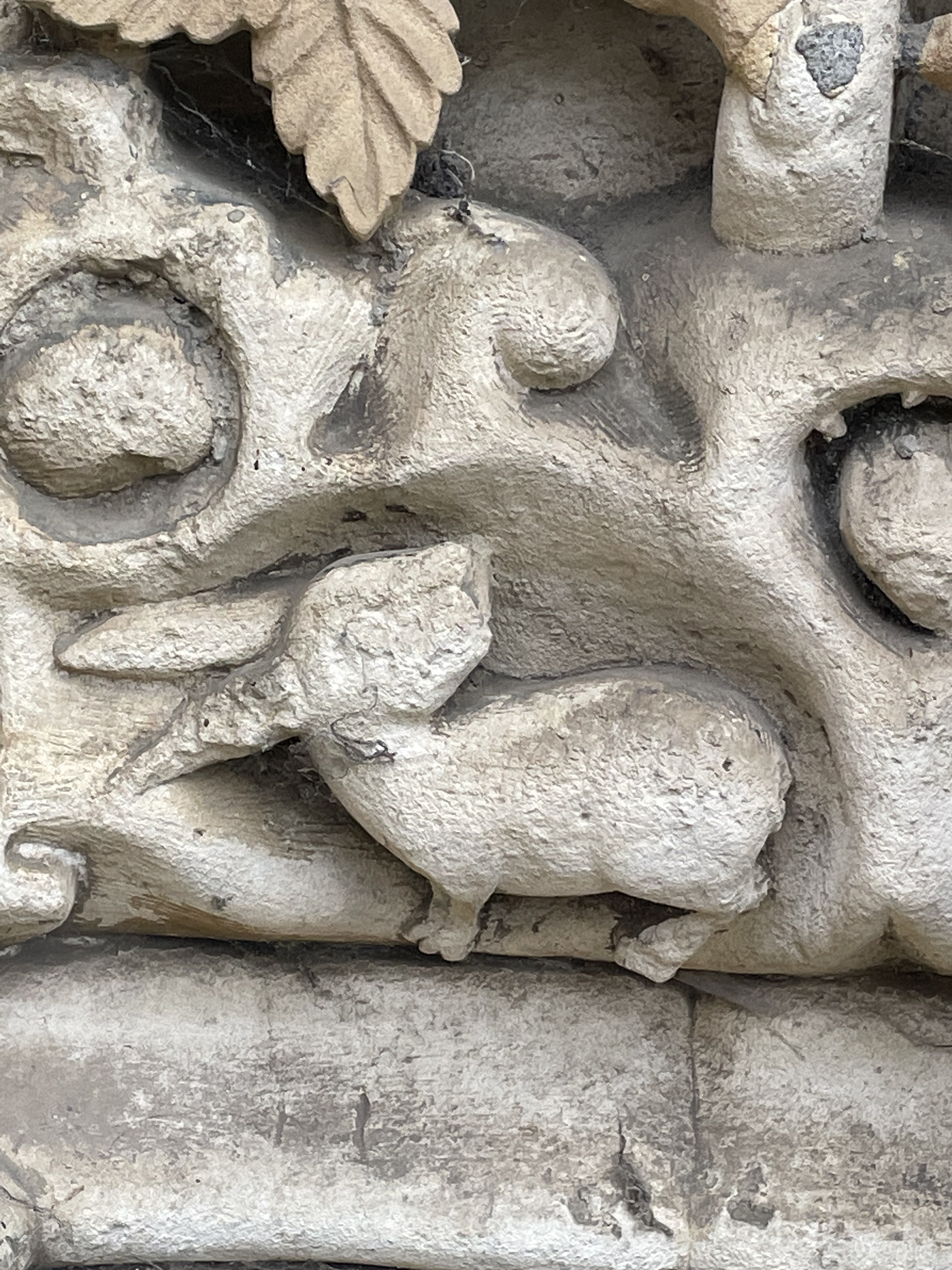
We start however, with a rabbit who has hopped his way into the very stonework of the College Chapel! Designed by master mason John Wastell, in the early 16th century, the jamb of the Chapel’s west door boasts an elaborate pattern of roses, crowns, leaves and stems, and at the base of one side can be found a dog playing hide and seek with a rabbit. The dog is now sadly weathered beyond recognition, but the rabbit is still very much visible, gazing up into the foliage above.

Stone rabbit in closeup

Close-up view of the rabbit on the jamb of the West door of King’s College Chapel, Cambridge

The stonework of the door jamb of the West door of King's College Chapel

The rabbit within the larger context of the decorative pattern on the door jamb

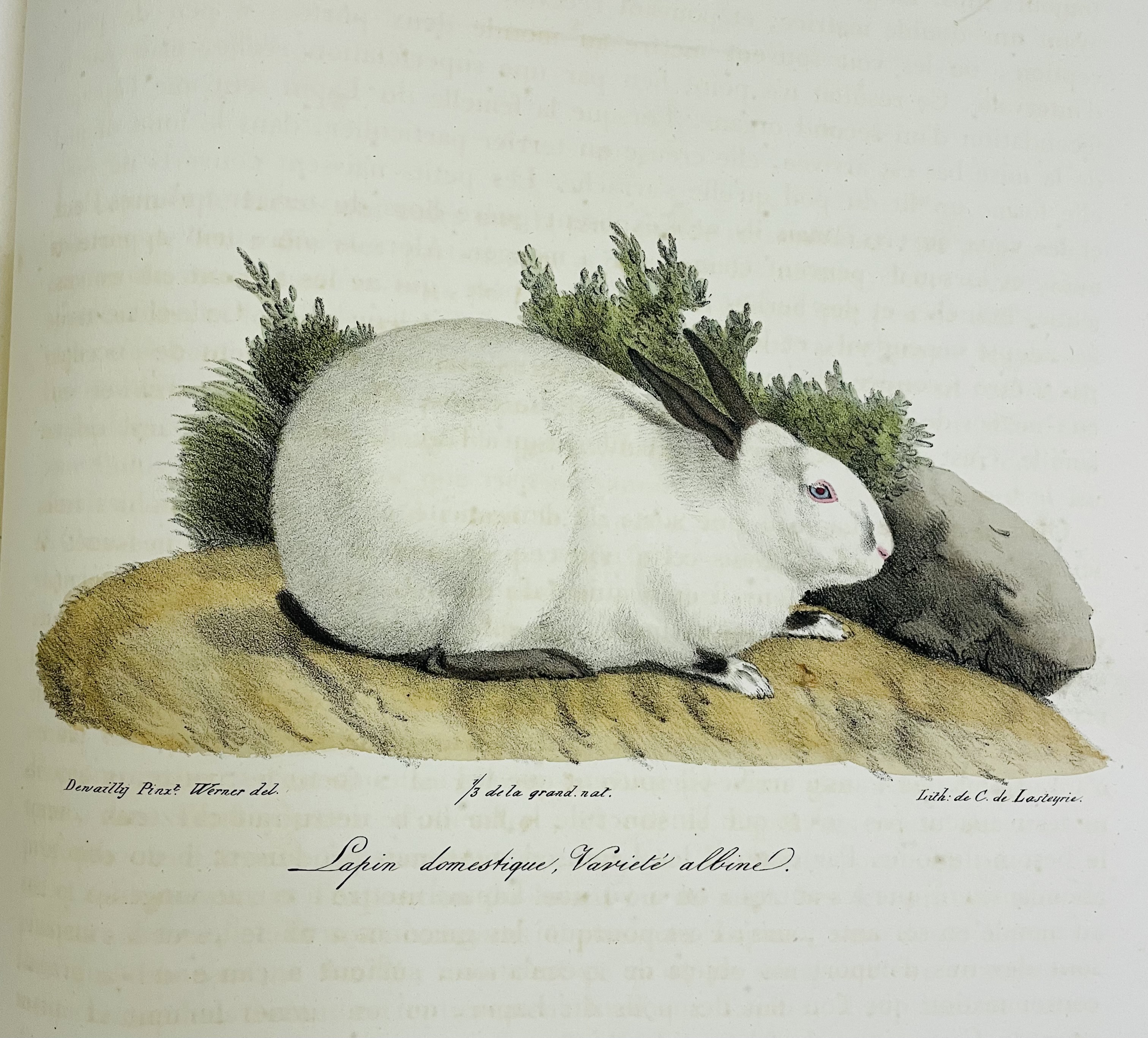
Next we have two illustrations from one of the early nineteenth century natural history titles featured in last year’s tiger post: Histoire naturelle des mammifères by Geoffroy-Saint-Hilaire and Frédéric Cuvier. These depict a familiar brown rabbit and one of the albino variety. 

Brown rabbit clutching a carrot

Plate from Vol. 2 of Histoire naturelle des mammifères, 1824, Shelfmark F.1.21

Albino rabbit

Plate from Vol. 2 of Histoire naturelle des mammifères, 1824, Shelfmark F.1.21

From here, we move into the realm of children’s books. The library holds an early edition of Alice’s Adventures in Wonderland by Lewis Carroll, which features a very famous rabbit, the White Rabbit, whom Alice follows down the rabbit-hole, thus beginning her strange and  eventful sojourn in Wonderland. The White Rabbit, complete with his waistcoat and pocket watch, is charmingly depicted by John Tenniel. 

The White Rabbit, dressed in a waistcoat, looking at this pocket watch

Illustration by John Tenniel from chapter one of Alice’s Adventures in Wonderland by Lewis Carroll, London 1874. Classmark: Rylands.C.CAR.Ali.1874

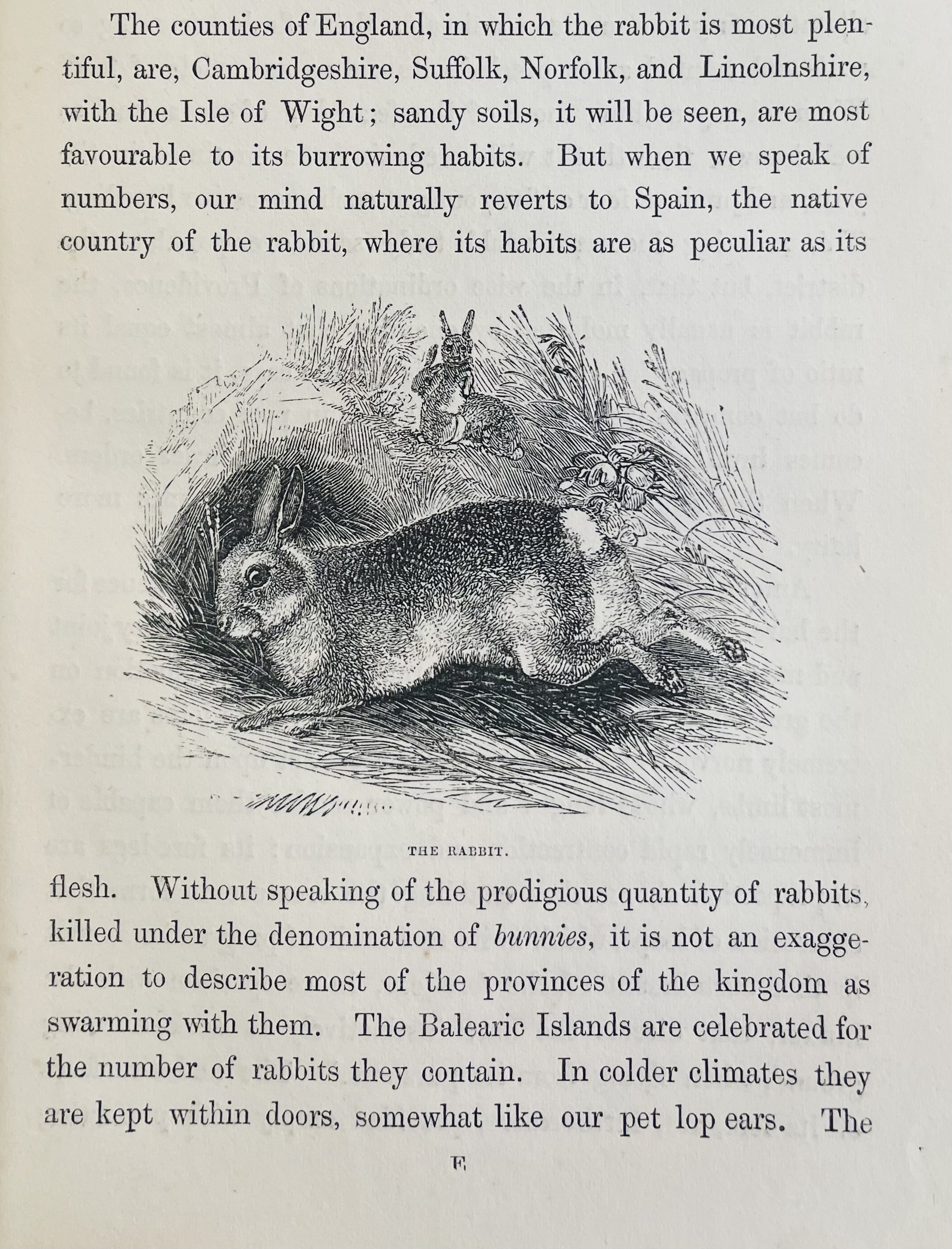
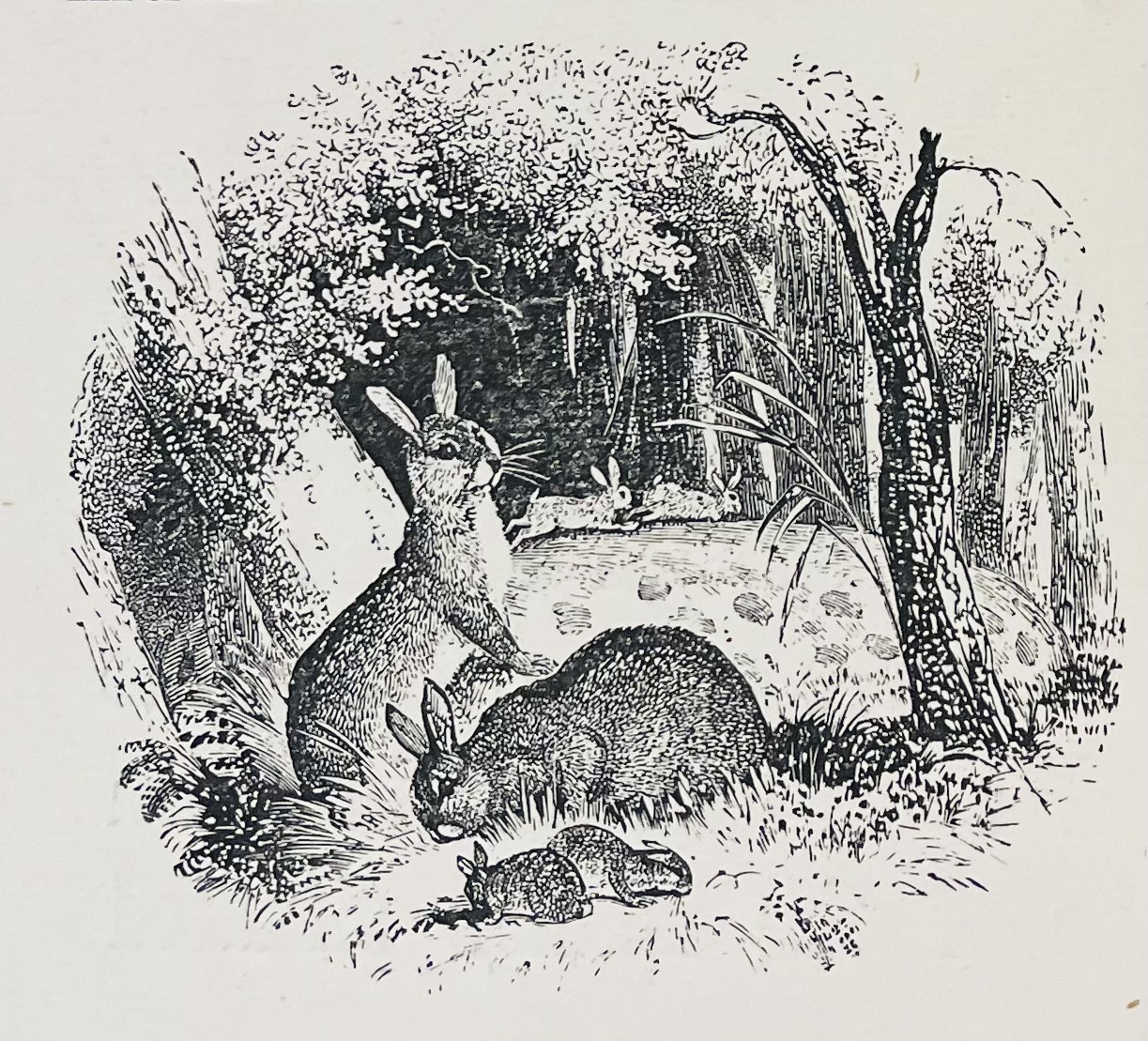
Rabbits also appear in books intended to educate children about the natural world and its inhabitants. My Own Annual: An Illustrated Gift-Book for Boys and Girls edited by Mark Merriwell, has a chapter entitled “Rabbits, hares and ferrets”which informs us that rabbits hail originally from Spain, and that Cambridgeshire is amongst the counties of England where they are most common.  

A rabbit bounding into its warren

Page 65 from My Own Annual: An IIlustrated Gift-Book for Boys and Girls edited by Mark Merriwell, London, 1847. Classmark: Ryland’s.C.MER.Ann.1847

Similar information is conveyed in The Pleasure Book of Domestic Animals by Harrison Weir, which has its own section on rabbits, accompanied by some attractive illustrations.

From The Pleasure Book of Domestic Animals by Harrison Weir, London, circa 1855-1870. Classmark: Ryland’s.C.WEI.Ple

From The Pleasure Book of Domestic Animals by Harrison Weir, London, circa 1855-1870. Classmark: Ryland’s.C.WEI.Ple

Finally, a very large and stately looking rabbit appears in full colour in Aunt Louisa’s Birthday Gift, dating from around 1875. 

Plate from Aunt Louisa’s Birthday Gift [by Laura Valentine], London, circa 1875. Classmark Rylands.C.VAL.1875

We hope you have a fruitful new year, and that, like the reproductive capacities of rabbits, your good luck grows and multiplies many times over! 

AC

References

King’s College Chapel: a History and Commentary by John Saltmarsh; edited by Peter Monteith and Bert Vaux. Peterborough, Jarrold, 2015.