Tag Archives: GB

A celebration of Orlando Gibbons (1583-1625)

This year at King’s we have been marking the 400th anniversary of the death of the composer Orlando Gibbons. Gibbons was born in Oxford in 1583 to a musical family who moved to Cambridge when he was an infant. He was admitted to King’s College in 1598 at the age of fourteen, though had apparently been a chorister at King’s for some years before that, and received a Bachelor of Music degree from the university in 1606. His later life took him to London, where his reputation as a composer and organist was established, and finally to Canterbury, where he died in June 1625 after a sudden illness. He is buried in Canterbury Cathedral.

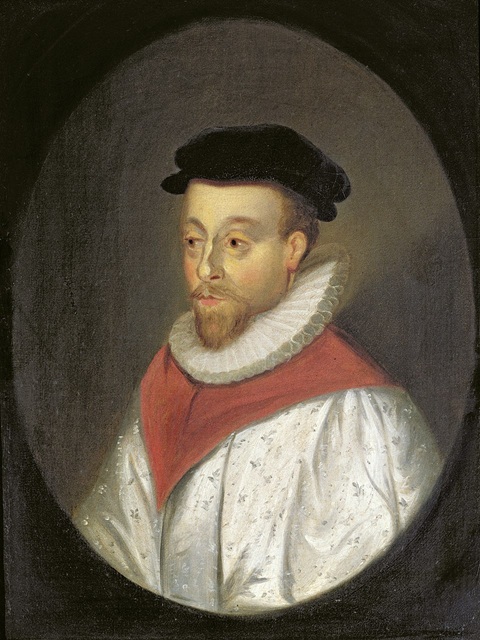
Portrait of Orlando Gibbons by an unknown artist. Image from Wikimedia Commons.

An inspection of Gibbons items held by King’s College Library has revealed some treasures that may not have seen the light of day for many a year.

My own introduction to Gibbons came when I was about fourteen, singing his sublime five-voice madrigal ‘The silver swan’ with my school chamber choir. We can trace this work through the centuries using various editions held in the Rowe Music Library.

Few of Gibbons’ compositions were published during his lifetime, one notable exception being The First Set of Madrigals and Mottets, printed in 1612 by Thomas Snodham. This is a collection of 20 secular songs, the first of which is ‘The silver swanne’. At King’s we have a copy of the cantus partbook only (containing the part for the highest voice), purchased in 1996 with a gift from the widow of Sir Henry Lintott (KC 1928).

Title page and page 1 of Orlando Gibbons, The First Set of Madrigals and Mottets … (London: Printed by Thomas Snodham, the Assigne of W. Barley, 1612) Shelfmark: LU.50

‘The silver swan’ next appears in the Rowe’s collection as part of a 1673 edition of The Musical Companion, a collection by John Playford anthologising ‘dialogues, glees, ayres and songs’.

Title page of John Playford (ed.), The Musical Companion … [Book 2] (London: Printed by W. Godbid for John Playford, 1673) Shelfmark: LU.101

The madrigal here is arranged for three voices, sacrificing much of the richness of the inner parts. The three parts are presented as a double-page spread, the middle part printed upside down, presumably so that three singers could share a single book, the Cantus Primus and Bassus singers reading from one side, the Cantus Secundus from the other.

Pages 152-153 of The Musical Companion … [Book 2] (London: Printed by W. Godbid for John Playford, 1673) Shelfmark: LU.101

The rise of glee and catch clubs in late eighteenth-century Britain led to many publications like The Apollo, or Harmonist in Miniature, an 8-volume anthology probably dating from the early 1820s. The frontispiece features William Hawes, Master of Children at the Chapel Royal from 1817 and evidently the pin-up of catch club members at that time.

Frontispiece and title page of The Apollo, or Harmonist in Miniature … Vol. 3 (London: T. Williams, c. 1820) Shelfmark: Rw.112.48

This arrangement of ‘The silver swan’, essentially the same as Playford’s, is presented in a small format (18 cm high), which suggests that each member of the catch club would have had his own copy.

Pages 198-199 of The Apollo, or Harmonist in Miniature … Vol. 3 (London: T. Williams, c. 1820) Shelfmark: Rw.112.48

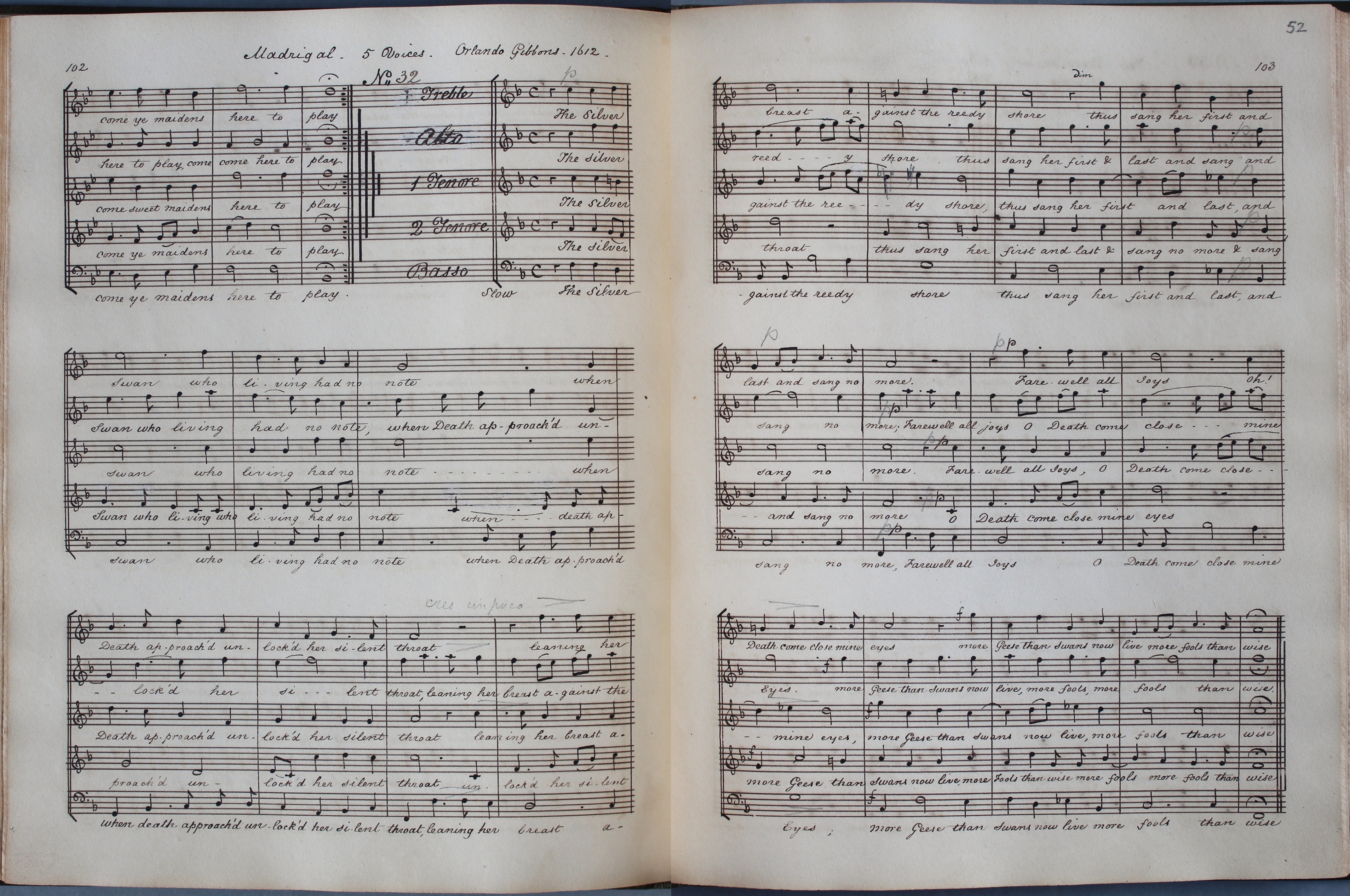
The Rowe Library’s MS 111 is a manuscript dating from 1834-5 in the hand of Thomas Oliphant (1799-1873), best remembered today for writing the lyrics of ‘Deck the hall with boughs of holly’. Oliphant had recently been elected Honorary Secretary of The Madrigal Society (still going today, and now admitting women), and the book may have been intended as his neat conductor’s copy of the 83 motets, madrigals and glees it contains, of which no. 32 is ‘The silver swan’.

Pages 102-103 of Rowe Music Library, MS 111

***

Naturally it is Gibbons’ sacred music that is heard most in King’s College Chapel, in the form of hymns and anthems. Gibbons’ reputation as a composer of hymn tunes rests on his contributions to George Wither’s 1623 publication The Hymnes and Songs of the Church, for which he wrote 17 original tunes still known today by the ‘Song’ numbers accorded them in this volume. A patent of King James I ordained that the book should be bound with all copies of the metrical Psalms sold, which may account for the early adoption of Gibbons’ tunes by church choirs.

Title page of G[eorge] W[ither], The Hymnes and Songs of the Church … (London: Printed by the Asignes of George Wither, 1623) Shelfmark: Keynes.C.5.17

‘Song 1’, which in this book accompanies Wither’s text ‘Now shall the praises of the Lord be sung’, is today more commonly sung to ‘O Thou who at the Eucharist did pray’ or ‘Eternal ruler of the ceaseless round’.

Opening of ‘Song 1’ from G[eorge] W[ither], The Hymnes and Songs of the Church … (London: Printed by the Asignes of George Wither, 1623) Shelfmark: Keynes.C.5.17

***

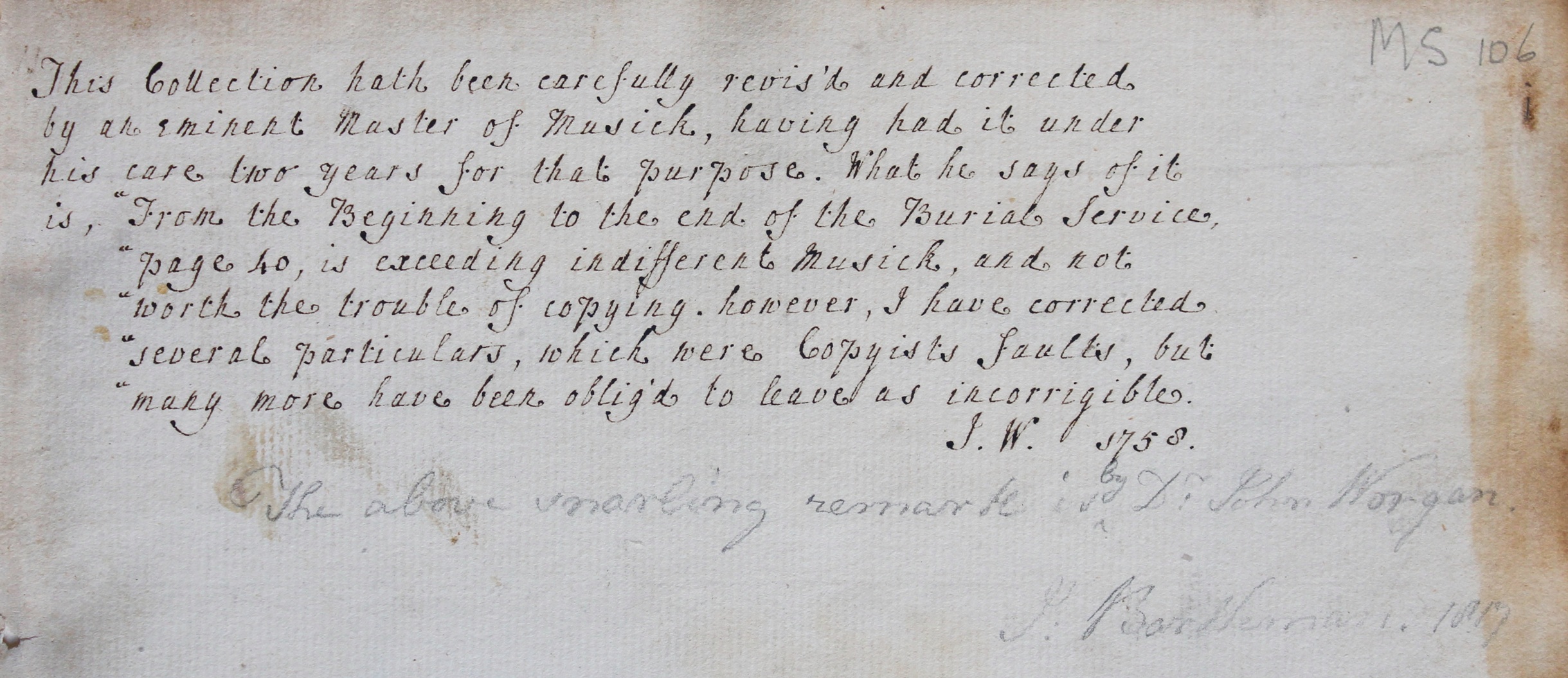
The Rowe Library’s MS 106 is an eighteenth-century manuscript containing anthems and services copied in several hands. A note on the flyleaf observes:

This Collection hath been carefully revis’d and corrected by an eminent Master of Musick, having had it under his care two years for that purpose. What he says of it is, ‘From the Beginning to the end of the Burial Service, page 40, is exceeding indifferent Musick, and not worth the trouble of copying. However, I have corrected several particulars, which were Copyists faults, but many more have been oblig’d to leave as incorrigible.’ J.W. 1758

A pencil addition notes:

The above snarling remark is by Dr John Worgan. J. Bartleman, 1817

Note on flyleaf of Rowe Music Library, MS 106

The one Gibbons work present in this volume is his six-voice anthem ‘Hosanna to the Son of David’, at the head of which is written a quotation from Sir John Hawkins’ A General History of the Science and Practice of Music of 1776 describing it as ‘one of the most perfect Models for Composition in the Church-Style of any now existing’.

Page 162 of of Rowe Music Library, MS 106

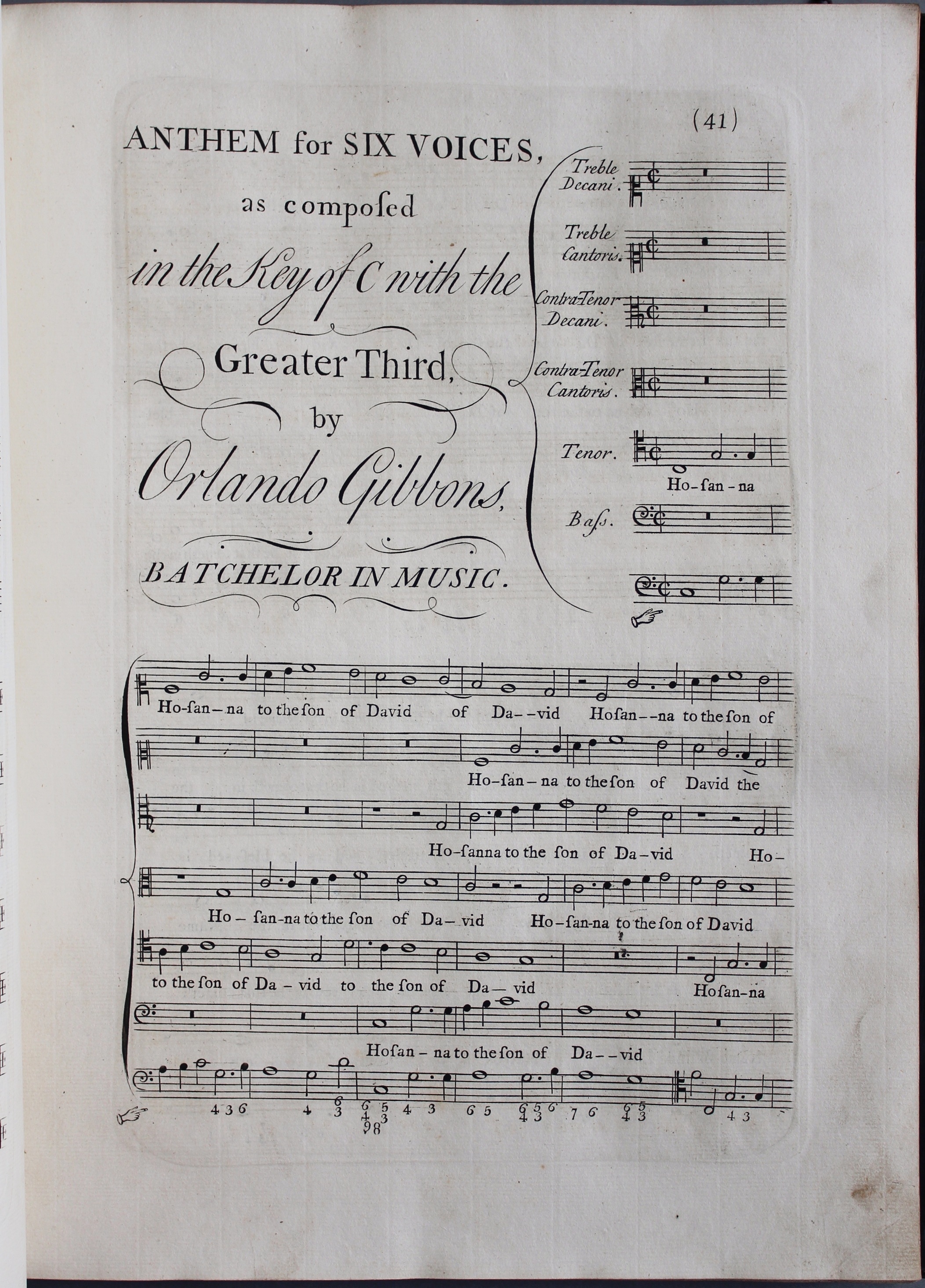
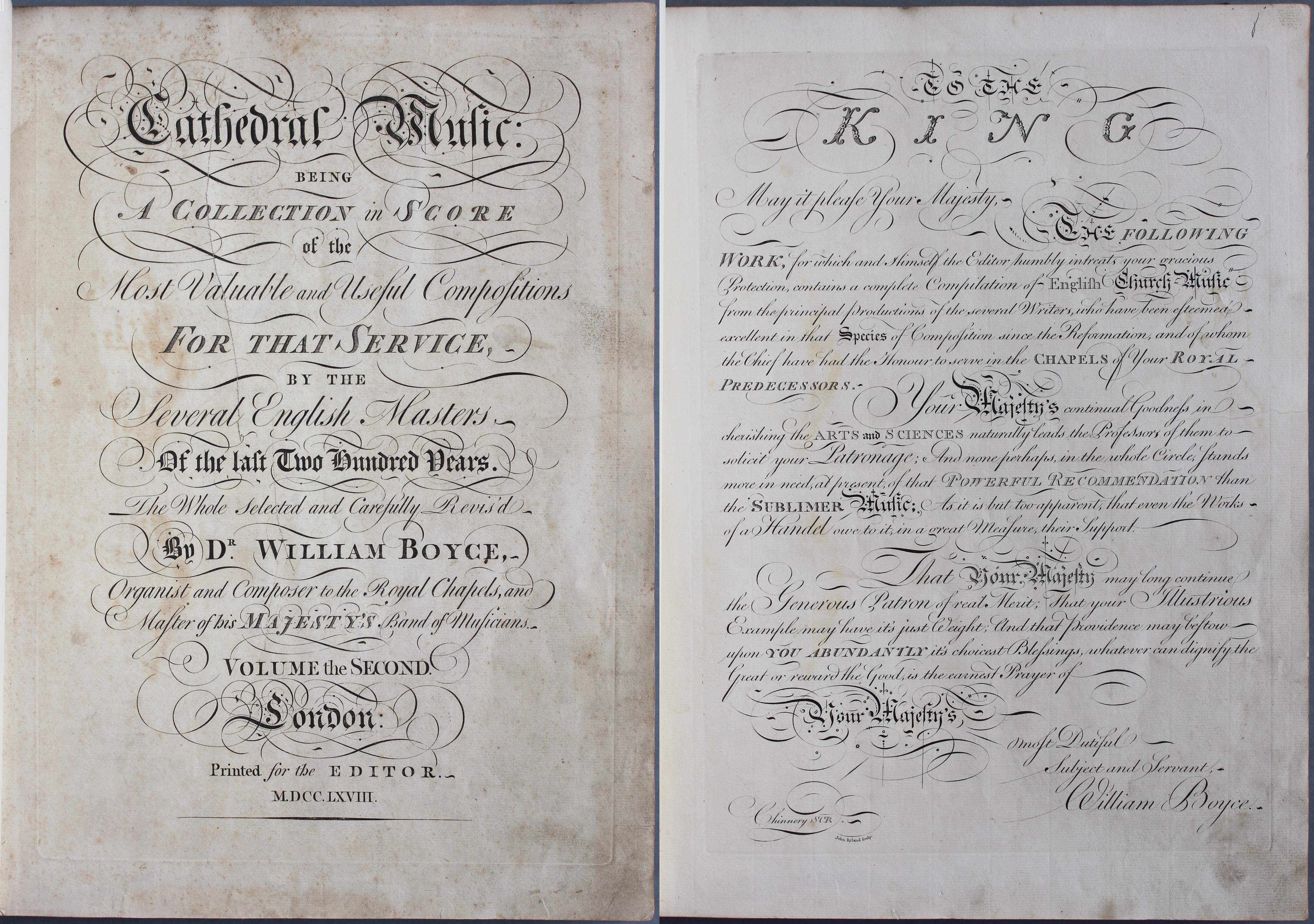
‘Hosanna to the Son of David’ is one of several Gibbons anthems anthologised in the second volume of Cathedral Music, edited by William Boyce (1711-1779), Master of the King’s Musick, and published in 1768 after a long gestation.

Page 41 of William Boyce (ed.), Cathedral Music … Volume the Second (London: Printed for the Editor, 1768) Shelfmark: Rw.115.12

Doubtless partly due to the royal imprimatur, this volume was a swanky undertaking all round, bearing a title page boasting of ‘the most valuable and useful compositions … of the last two hundred years’, a dedication to King George III involving every typeface under the sun, and even an anthem ostensibly composed by George’s predecessor Henry VIII (‘O Lord, the maker of all things’, now usually attributed to William Mundy).

Title page and dedication from William Boyce (ed.), Cathedral Music … Volume the Second (London: Printed for the Editor, 1768) Shelfmark: Rw.115.12

The volume’s subscribers included not only the Provost and Fellows of King’s College, Cambridge (of course), but also such luminaries as:

The Rev. Mr. Heneage Dering, Chaplain to the Earl of Winchelsea.
The late Rev. Mr. Phocion Henley.
Bybie Lake, Esq.
Gervas Scrope, Esq. of Cockerington, in the County of Lincoln.
Messrs. Sharp, of Mincing-Lane, London. Two Sets.
The King.

Blank spaces at the end of anthems are filled with illustrations: usually flourishes and curlicues, but occasionally faces or, at the end of William Byrd’s ‘Bow thine ear, O Lord’, a complementary bird. Note also the snazzy manicules (pointy fingers) in the score to help the organist find his line. No such help for the choir, though the size of the book (42 cm high) suggests it may have been a publication meant primarily for the use of a choirmaster, from which choir parts could be copied in manuscript.

Various devices from William Boyce (ed.), Cathedral Music … Volume the Second (London: Printed for the Editor, 1768) Shelfmark: Rw.115.12

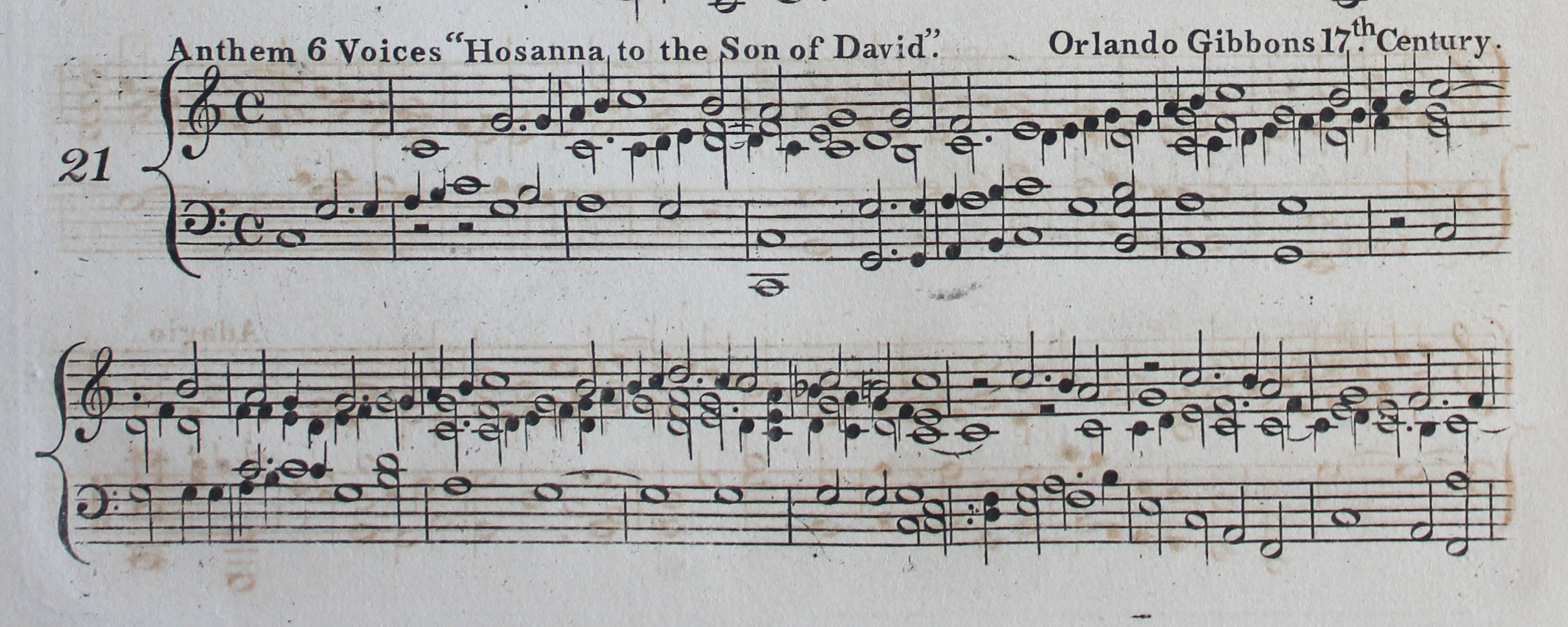
‘Hosanna to the Son of David’ also appears, albeit in short score, in the work known unpromisingly as ‘Crotch’s Specimens’, or more fully as Specimens of Various Styles of Music Referred to in a Course of Lectures Read at Oxford & London and Adapted to Keyed Instruments by Wm. Crotch, Mus.D., Professor of Music in the University of Oxford. The Specimens was a major work of scholarship, ‘encyclopaedic in scope and surprisingly forward-looking in its aim to combine academic example with practical purpose’, in the words of Grove. In a preface to this revised edition, Crotch writes:

The study of Orlando Gibbon’s [sic] works cannot be too strongly recommended. For choice of subjects, for skill in the management of them, and for the flow of melody in all the parts, this great master was inferior to none of his cotemporaries.

Opening of No. 21 from William Crotch, Specimens of Various Styles of Music … Vol. 2 (London: Printed for the Author … c. 1821) Shelfmark: Rw.54.14

It’s no surprise that Gibbons’ music has been an attractive proposition to Kingsmen looking to produce performing editions over the years. Twentieth-century editions of choral works by Gibbons held by the Rowe Library include those prepared by David Willcocks (KC 1939), John Whitworth (KC 1946), Philip Brett (KC 1955) and John Morehen (KC 1964).

***

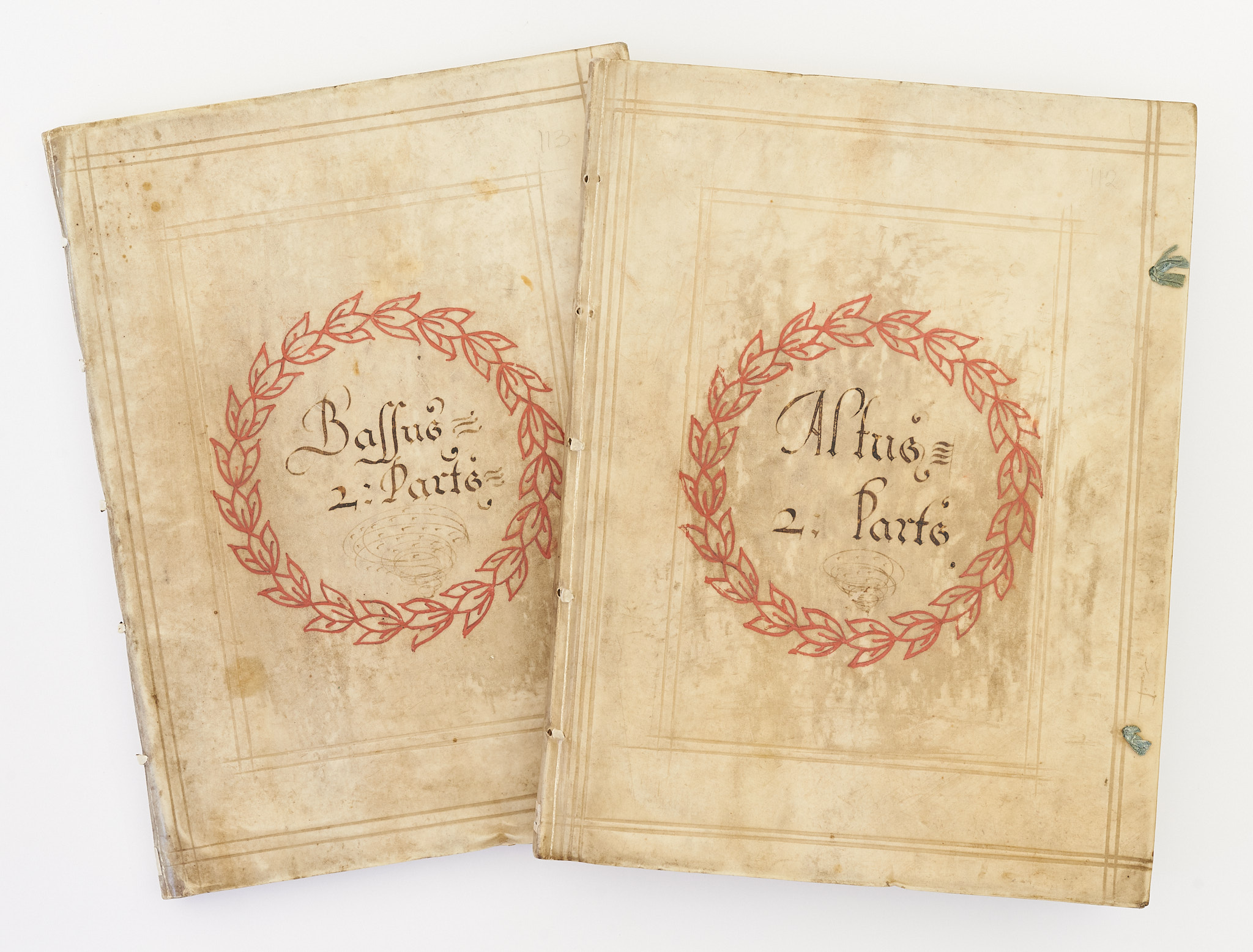
Finally, a pair of mid-seventeenth-century music manuscripts given to the college by John Maynard Keynes. MSS 112 and 113 are two partbooks for viols of fantasias and dances primarily by John Coprario, but also containing works by John Jenkins, William White and others.

Bindings of Rowe Music Library, MSS 112 and 113. Photo © 2025 Sara Rawlinson at HeritagePhotographs.com.

The works included by Gibbons are six fantasias for two treble viols, which are not preserved in manuscript elsewhere. These manuscripts were the property of John Browne (1608-91), Clerk of the Parliaments, and the Gibbons fantasias here are in Browne’s own hand.

No. 13 in Rowe Music Library, MSS 112 and 113

These fantasias have been published in many editions: they appear in the Musica Britannica volume of Gibbons’ Consort Music, and if you fancy playing them yourself you can browse several public-domain versions here.

GB

Moon Exploration: An Online Exhibition

We recently mounted a small exhibition on the subject of moon exploration, using items from our collections. In case you didn’t get to see it, here’s an online version of some of the exhibits.

First part of exhibition in display case

Second part of exhibition in display case

***

Johannes de Sacrobosco (born c.1195) was one of the most influential pre-Copernican astronomers, his treatise De sphaera mundi surviving in hundreds of manuscript copies dating from before the invention of the printing press. The earth is the centre of Sacrobosco’s model of the universe, with seven ‘planets’ (the moon, Mercury, Venus, the sun, Mars, Jupiter and Saturn in order) arrayed outwards from it. This 1581 print edition of the treatise features two volvelles (wheel charts with moving parts), this one depicting a lunar eclipse.

Johannes de Sacrobosco, Sphaera
Cologne: Maternus Cholinus, 1581
Shelfmark: Bury.SAC.Sph.1581

Volvelle in action from
Johannes de Sacrobosco, Sphaera
Cologne: Maternus Cholinus, 1581
Shelfmark: Bury.SAC.Sph.1581

***

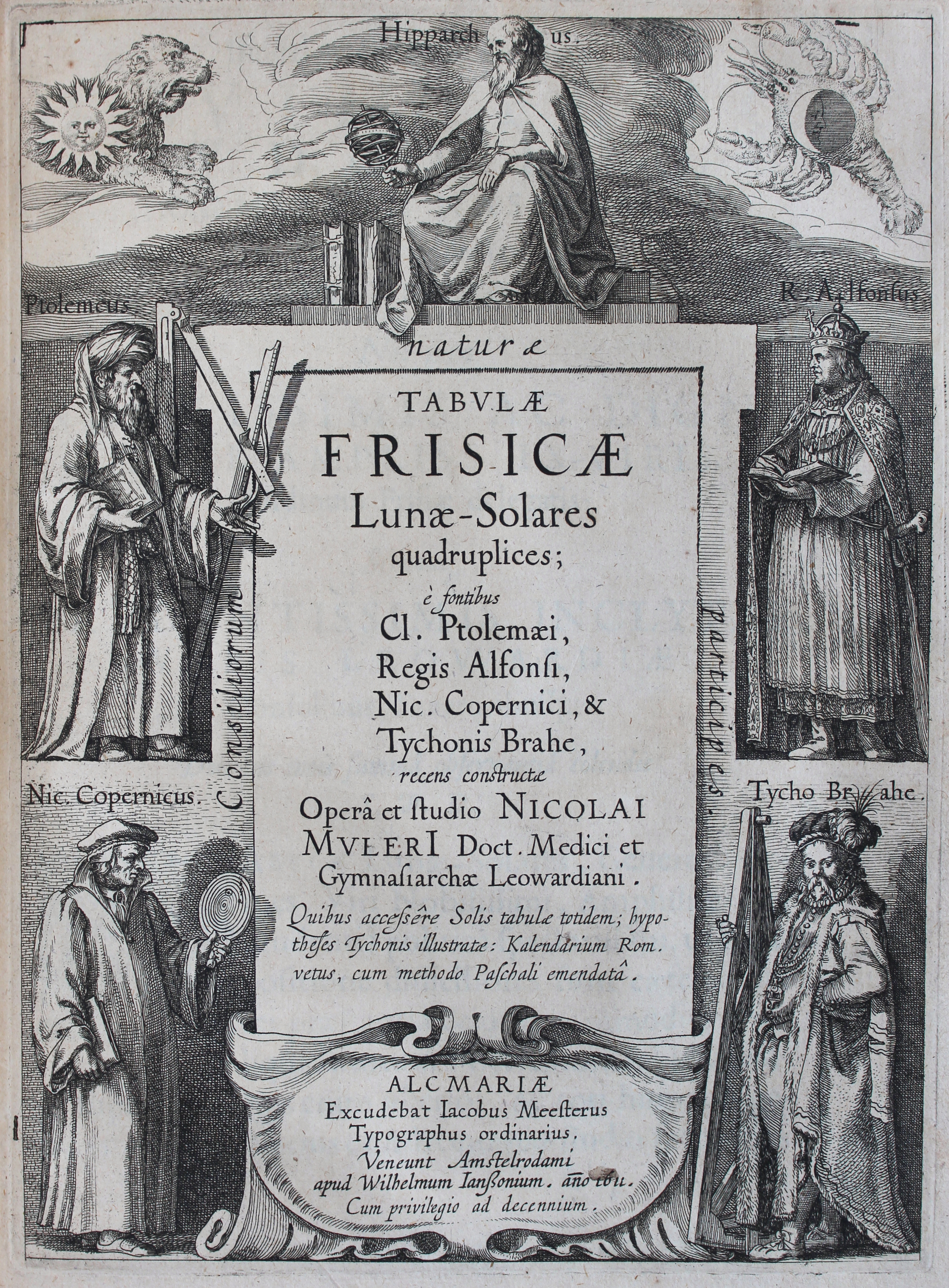
The Dutch astronomer Nicolaus Mulerius’ Tabulae frisicae lunae-solares quadruplices of 1611 is a collection of solar and lunar tables according to the calculations of Ptolemy (2nd century AD), King Alfonso X of Castile (1221-1284), Nicolaus Copernicus (1473-1543) and Tycho Brahe (1546-1601) respectively. The four great astronomers are depicted on the illustrated title page, with their illustrious forefather Hipparchus (2nd century BC) at the head.

Nicolaus Mulerius, Tabulae frisicae lunae-solares quadruplices
Alkmaar: Jacob de Meester, 1611
Shelfmark: Keynes.Ec4.1.3/2

***

Galileo Galilei’s treatise of 1610 Sidereus nuncius (Sidereal Messenger) was the first published scientific work to draw on the newly invented telescope, called by the Latin word ‘perspicillum’ in Galileo’s text, and contains the astronomer’s observations on the moon and hundreds of formerly unknown stars he had been the first human to witness. Though initially controversial, Galileo found a supporter in Johannes Kepler, who verified Galileo’s findings independently and published his own confirmation of them a few months later. This first London edition of the work, published in 1653, includes Kepler’s Dioptrice, a treatise on the telescope, as an addendum. The illustrations of the lunar surface on these pages are Galileo’s own.

Galileo Galilei, Sidereus nuncius
London: James Flesher, 1653
Shelfmark: Keynes.Ec4.1.5/2

***

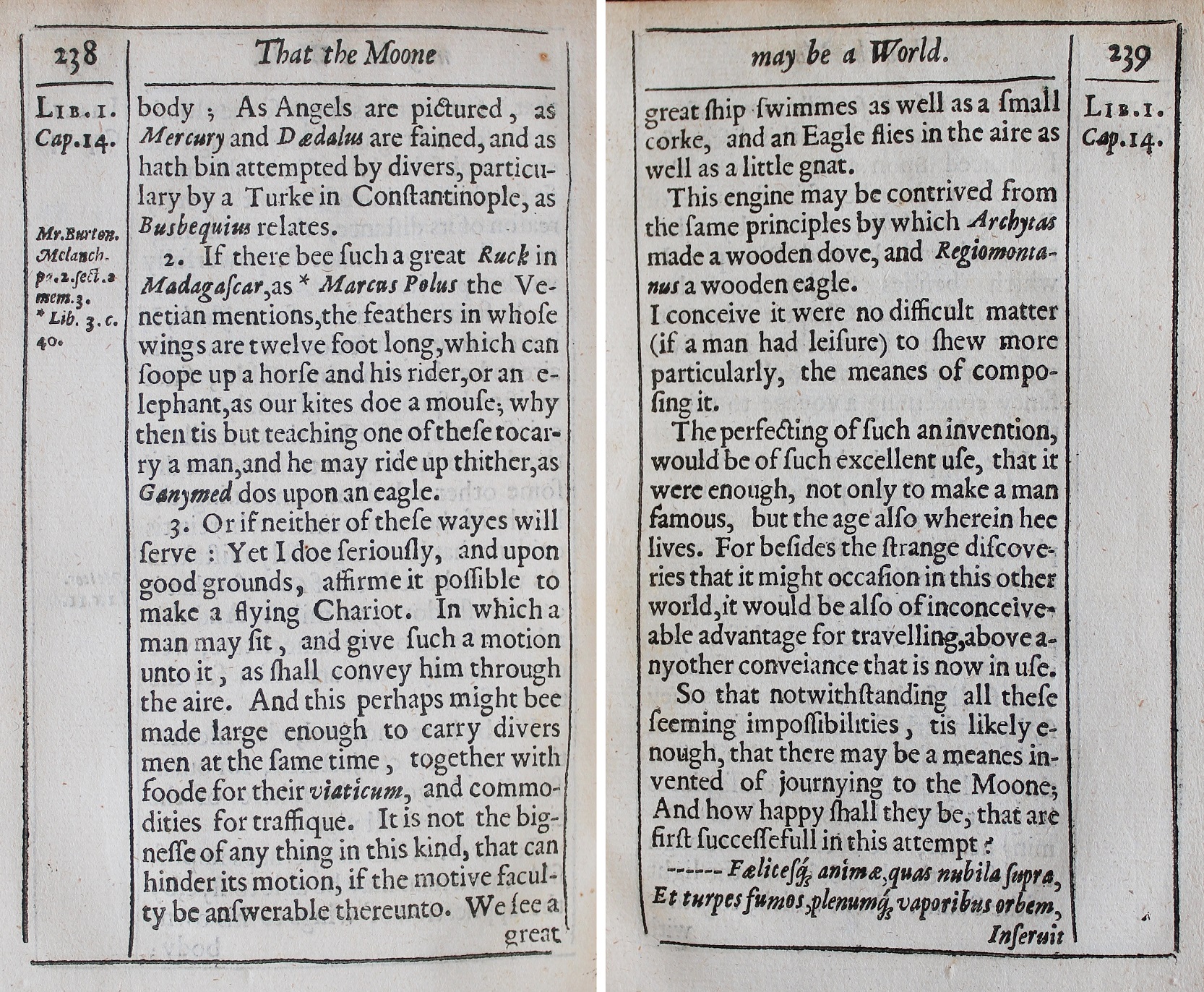
The natural philosopher John Wilkins (1614-1672) was a man of many parts: founder member of the Royal Society, Master of Trinity College, Cambridge, and finally Bishop of Chester. In The Discovery of a World in the Moone, first published in 1638, Wilkins put forward 13 propositions, drawing partly on the recent testimonies of Galileo and Kepler, in support of his theory ‘that the Moone may be a world’, including:

  • That the strangenesse of this opinion is no sufficient reason why it should be rejected, because other certaine truths have beene formerly esteemed ridiculous, and great absurdities entertained by common consent
  • That a plurality of worlds doth not contradict any principle of reason or faith
  • That the Moone hath not any light of her owne
  • That as their world is our Moone, so our world is their Moone

These two later editions contain an added fourteenth proposition, ‘That tis possible for some of our posteritie, to find out a conveyance to this other world; and if there be inhabitants there, to have commerce with them’, in which Wilkins suggests various possible methods of moon travel, including hitching a lift on a large winged animal (such as a ‘Ruck’, i.e. the roc, a mythological bird still believed in by many at the time) and inventing a flying chariot.

John Wilkins, The Mathematical and Philosophical Works of
the Right Reverend John Wilkins, Late Lord Bishop of Chester
London: John Nicholson; Andrew Bell; Benjamin Tooke; Ralph Smith, 1708
Shelfmark: Keynes.F.25.15

John Wilkins, A Discourse concerning a New World & Another Planet in 2 Bookes
London: John Maynard, 1640
Shelfmark: Keynes.D.5.69

***

The World in the Moon, a new opera staged in 1697 at the Dorset Garden Theatre in Whitefriars, by the Thames, featured songs by Daniel Purcell (brother of Henry) and Jeremiah Clarke. The opera’s book, by Elkanah Settle, was inspired by The Man in the Moone, a posthumously published narrative work by the Anglican bishop Francis Godwin (1562-1633) that purported to describe a ‘voyage of utopian discovery’ and is now considered one of the first works of science fiction. The stage directions in Settle’s text suggest the production must have been spectacular:

The Flat-Scene draws, and discovers Three grand Arches of Clouds extending to the Roof of the House, terminated with a Prospect of Cloud-work, all fill’d with the Figures of Fames and Cupids; a Circular part of the black Clouds rolls softly away, and gradually discovers a Silver Moon, near Fourteen Foot Diameter: After which, the Silver Moon wanes off by degrees, and discovers the World within, consisting of Four grand Circles of Clouds, illustrated with Cupids, &c. Twelve golden Chariots are seen riding in the Clouds, fill’d with Twelve Children, representing the Twelve Celestial Signs …

This song, ‘Smile then with a beam Devine’, is from the prologue of the opera, and contains a separate flute part at the foot of the page, common in music publications of the time, which could be used either to double the voice or to perform the song as an instrumental piece.

Songs in the New Opera, Call’d The World in the Moon
London: John Walsh; Joseph Hare, 1697
Shelfmark: Rw.85.1/9

***

Moon exploration has been a subject of science fiction for centuries, but properly took off (ha ha) in the 19th century with works such as Edgar Allan Poe’s short story ‘The Unparalleled Adventure of One Hans Pfaall’ (1835) and Jules Verne’s From the Earth to the Moon (1865).

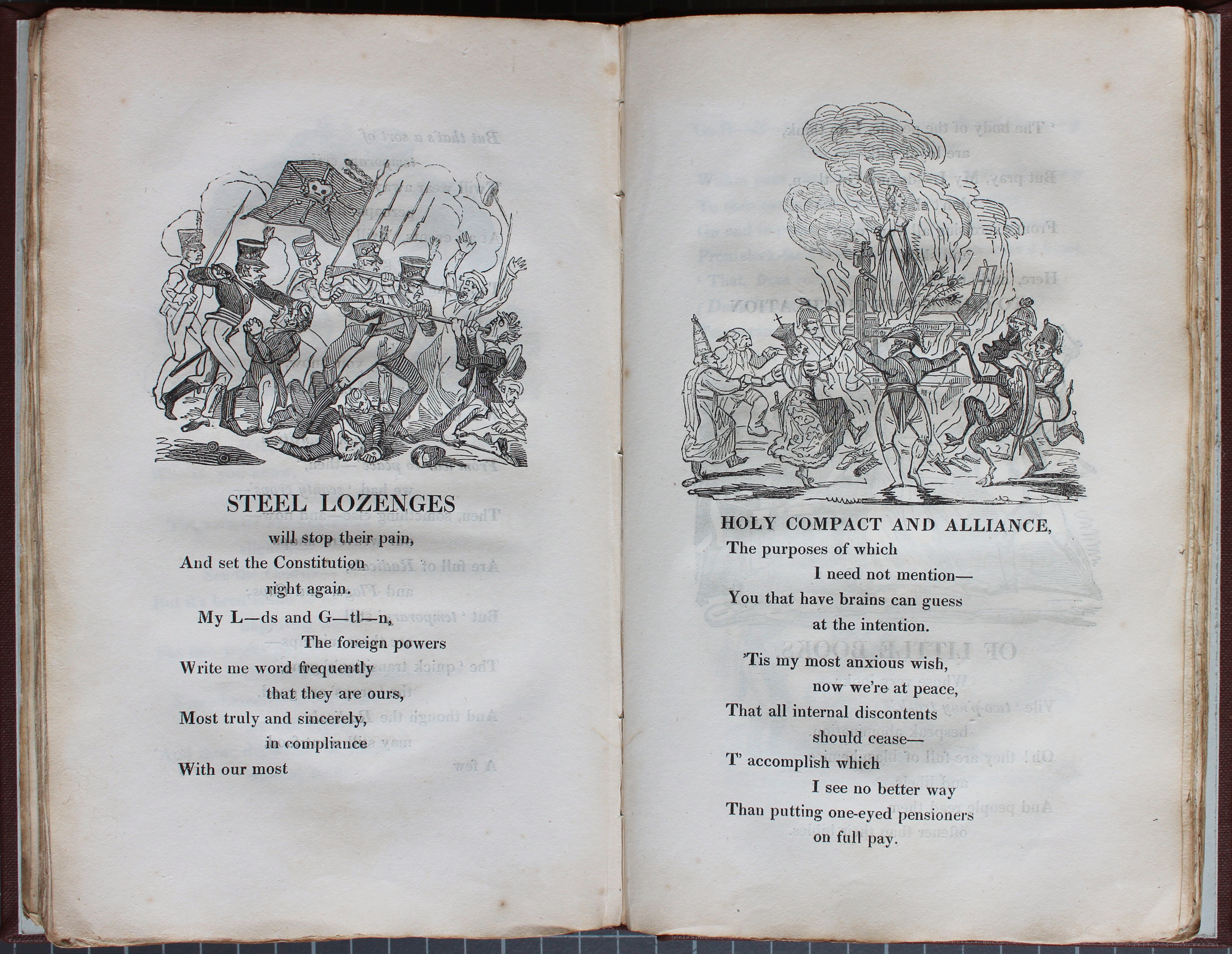
This radical political pamphlet of 1820, ‘The Man in the Moon’, by the satirist William Hone, employs the conceit of a man travelling to the nation of ‘Lunataria’:

I lately dream’d that, in a huge balloon,
All silk and gold, I journey’d to the Moon,
Where the same objects seem’d to meet my eyes
That I had lately left below the skies …

The resemblance of Lunataria to his home planet enables Hone to pass comment on the political events of the day, including on the left the Peterloo Massacre of 1819. The illustration on the right shows the Army, the Church, the Prince Regent and the devil linked in dance, in a parody of the Holy Alliance that arose in Europe following the fall of Napoleon. The illustrator is George Cruikshank, who was later a friend of Charles Dickens and provided illustrations to his early novels.

William Hone, Hone’s Select Popular Political Tracts
London: William Hone, [1820s]
Shelfmark: G.15.42

***

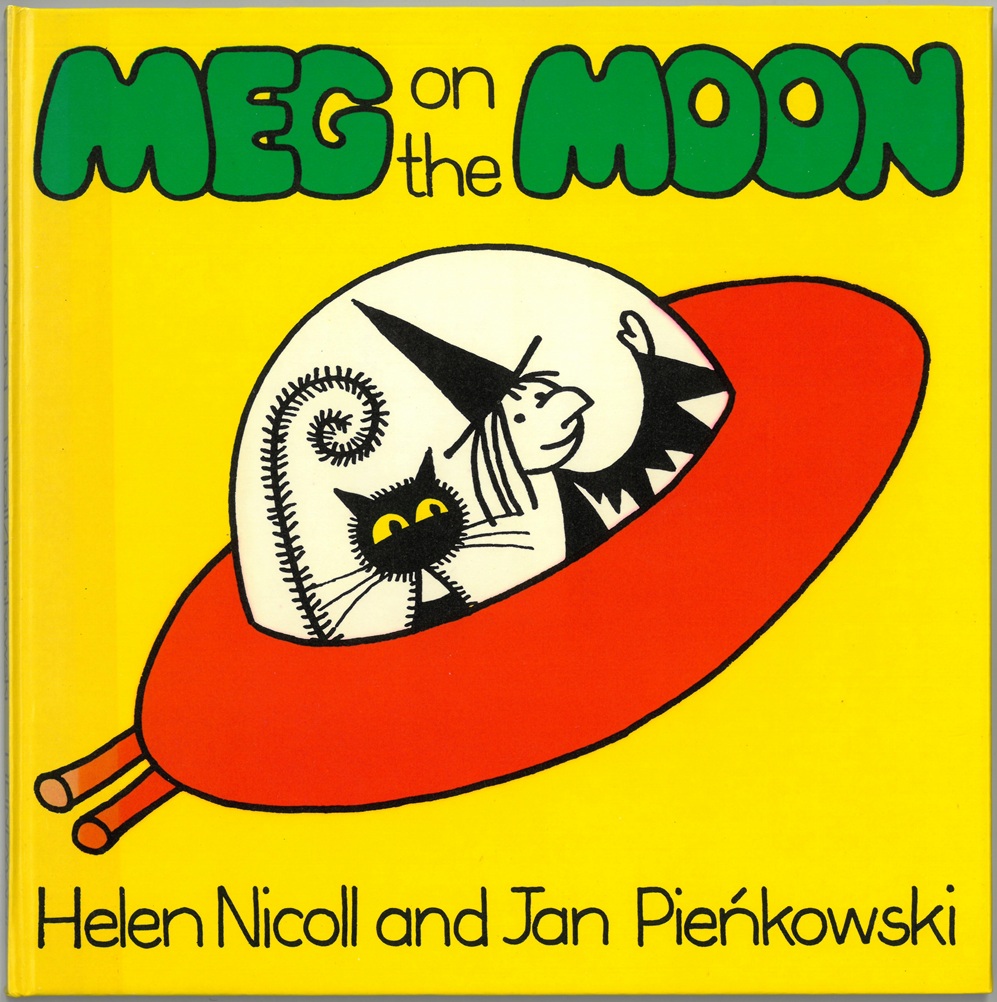
The most enduring creation of the illustrator Jan Pieńkowski (1936-2022, KC 1954) was the Meg and Mog series of books, which he wrote over a period of more than 40 years in collaboration first with the author Helen Nicoll and, after her death in 2012, with his partner David Walser. Meg on the Moon, an early entry in the series, tells the story of the witch Meg and her cat Mog going to the moon for Mog’s birthday treat.

Helen Nicoll & Jan Pieńkowski, Meg on the Moon
London: Heinemann, 1973
Shelfmark: Fiction K Pie/6

GB

Twelfth Night at King’s: A Guided Tour

Both in the library and on this blog, we have spent the past year marking the 400th anniversary of the publication of Shakespeare’s First Folio, and it seems appropriate to bring our celebrations to a close on Twelfth Night itself with a look at some of the play’s various manifestations in our library collections.

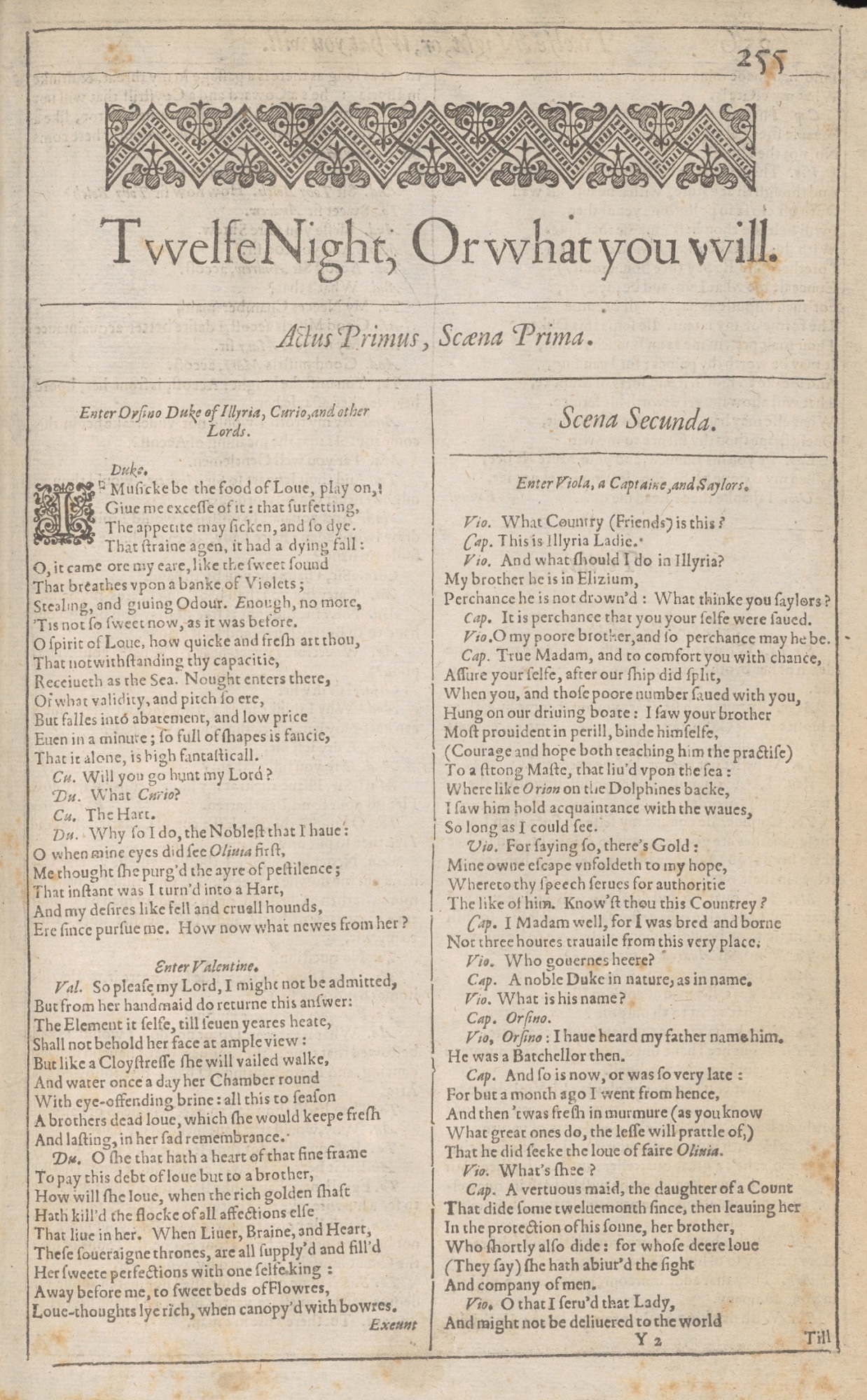
Twelfth Night, or What You Will was written around 1601 but didn’t appear in print until its inclusion in the First Folio of 1623. It’s my personal favourite of Shakespeare’s comedies, so I give particular thanks to the First Folio’s editors Heminges and Condell for rescuing it from likely oblivion.

Opening page of Twelfth Night in the First Folio (Thackeray.D.38.2)

There’s no question about it, the guy knew how to start a play. ‘When shall we three meet again / In thunder, lightning, or in rain?’ (Macbeth.) ‘Now is the winter of our discontent / Made glorious summer by this sun of York.’ (Richard III.) ‘Good day, sir.’ (Timon of Athens.) The memorable opening scene of Twelfth Night sees Orsino, Duke of Illyria, addressing one of his court musicians:

If music be the food of love, play on;
Give me excess of it, that, surfeiting,
The appetite may sicken, and so die.
That strain again! it had a dying fall:
O, it came o’er my ear like the sweet sound,
That breathes upon a bank of violets,
Stealing and giving odour! Enough; no more:
‘Tis not so sweet now as it was before.
O spirit of love! how quick and fresh art thou,
That, notwithstanding thy capacity
Receiveth as the sea, nought enters there,
Of what validity and pitch soe’er,
But falls into abatement and low price,
Even in a minute: so full of shapes is fancy
That it alone is high fantastical.

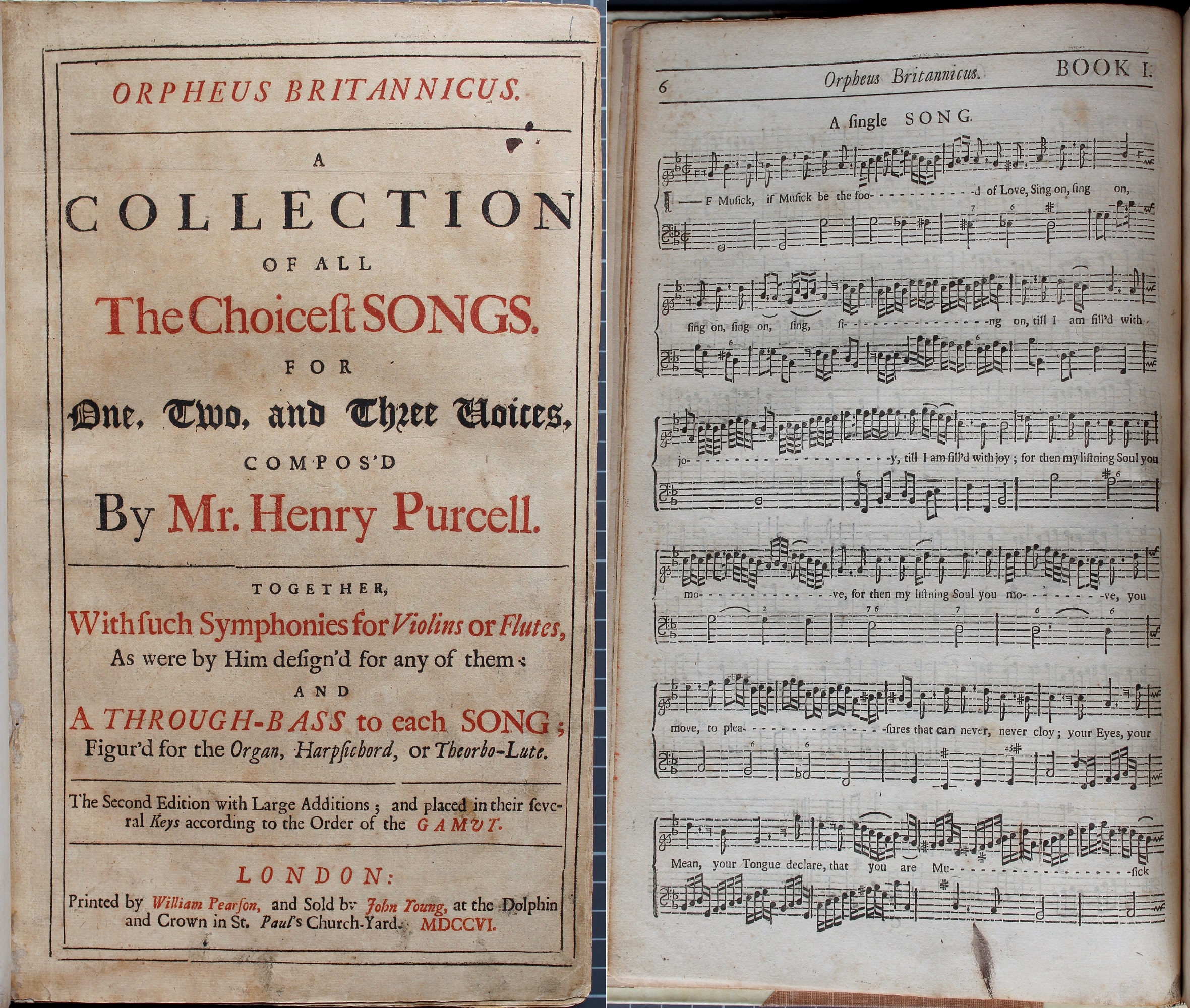
The first line of Orsino’s speech was ‘borrowed’ by the poet Colonel Henry Heveningham (1651-1700) for a lyric opening ‘If music be the food of love / Sing on till I am fill’d with joy.’ Heveningham’s text was set three times by Henry Purcell (1659-1695), the greatest English composer of his generation, one version being included in the huge two-volume compendium of Purcell’s songs Orpheus Britannicus, published posthumously in 1698. The copy below comes from the second edition of 1706 held in the Rowe Music Library.

Title page and page 6 of Henry Purcell, Orpheus Britannicus, Book I (LU.13/1)

Another posthumous publication in the Rowe with a Twelfth Night connection is a set of sonatas for violin or hautboy (oboe) and harpsichord by the composer William Babell (1690-1723), printed by the noted music publisher John Walsh in 1725. The edition includes a preface by Walsh describing Babell as his ‘late lov’d friend’ and observing that ‘had he liv’d in Shakespear’s time, we might justly have concluded him the occasion of the following lines’, appending Orsino’s words.

Title page and dedication page of William Babell, XII Solos for a Violin or Hautboy … (Rw.13.7/1)

Some sources online attribute Babell’s early death to ‘intemperate habits’; this has proved impossible to verify.

Shakespeare includes a small number of songs in Twelfth Night, all sung by the clown Feste, and three in particular have inspired a multitude of musical settings: ‘When that I was and a little tiny boy’ (with its refrain of ‘For the rain it raineth every day’), ‘Come away, death’, and most popular of all ‘O mistress mine’. The Rowe Library holds a partsong setting of this text, described as a ‘Glee, for five voices’, by R.J.S. Stevens. By the time it was ‘entered at Stationer’s Hall’ on 19 April 1790, Stevens must already have experienced success as a composer of Shakespeare songs, as attested by the legend in the caption title: ‘Author of “Sigh no more Ladies”’.

Pages 1 and 2 of R.J.S. Stevens, O Mistress Mine (Rw.111.16/18)

In nineteenth-century Europe there was no shortage of musical stage versions of Shakespeare, the most notable including Mendelssohn’s incidental music for A Midsummer Night’s Dream, Berlioz’s Béatrice et Bénédict (after Much Ado about Nothing) and Verdi’s Macbeth, Otello and Falstaff; but Twelfth Night, perhaps surprisingly, was not a popular choice with composers.

One exception was the Czech composer Bedřich Smetana (1824-1884), who in his final years began work on an opera, Viola, written to a libretto by the young Eliška Krásnohorská. Sadly only fragments of the opera were written. It opens with a shipwreck, followed by a scene between Sebastian and Antonio. The excerpt below shows Viola’s first entry, where she curses the ‘seductive surface’ of the sea she believes has swallowed her brother.

Title page and page 13 of Bedřich Smetana, Viola (Rw.82.SME.9/2)

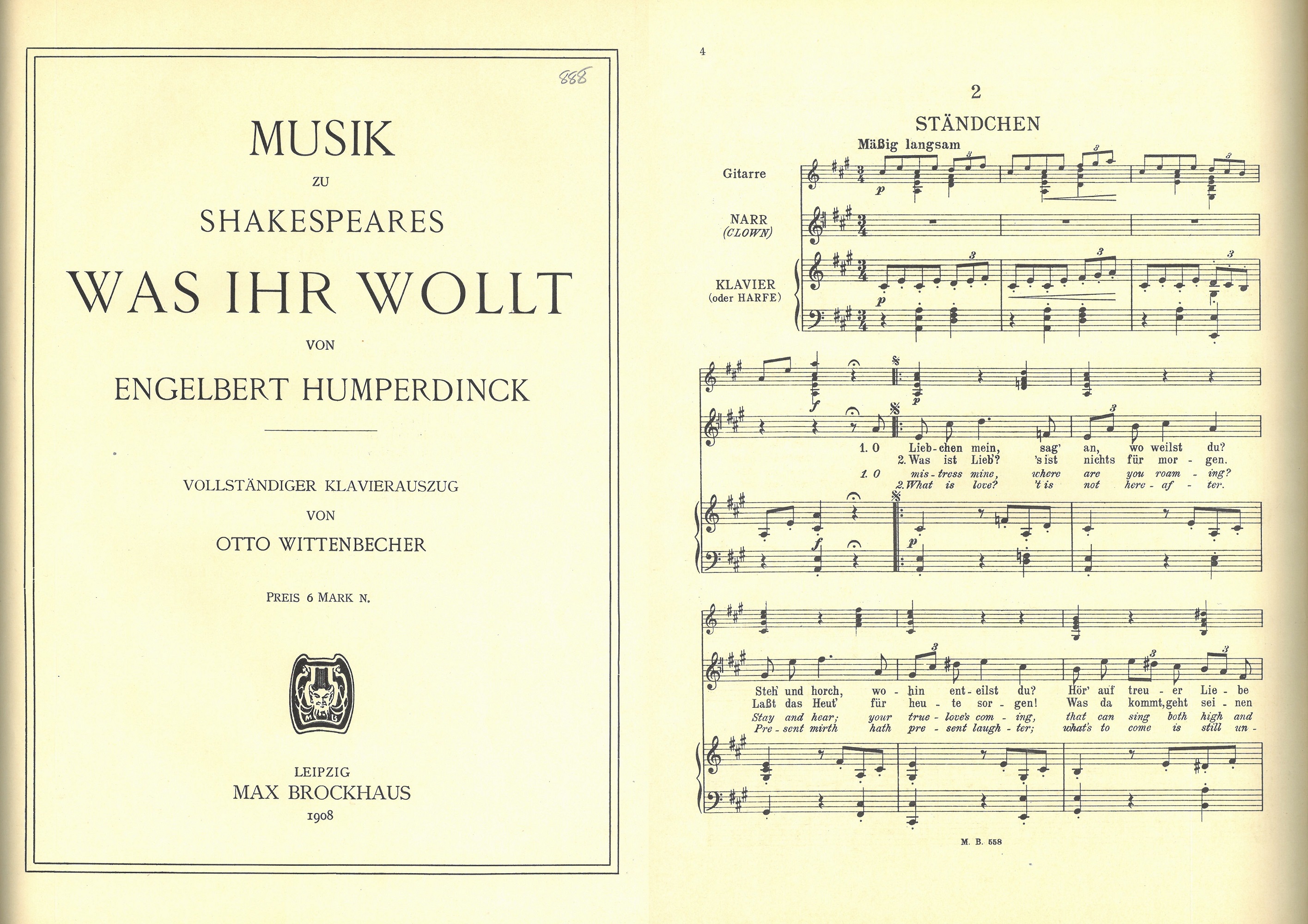
In the early years of the twentieth century, the German composer Engelbert Humperdinck struck up a fruitful partnership with the influential theatre director Max Reinhardt, writing incidental music for four Shakespeare plays staged at the Deutsches Theater in Berlin. The last of these was 1907’s Was ihr wollt, the excerpt below showing the opening of ‘O Liebchen mein’ (‘O mistress mine’), sung by Feste (identified here as Narr, i.e. Clown).

Title page and page 4 of Engelbert Humperdinck, Musik zu Shakespeares Was ihr wollt (Rw.82.HUM.4/4)

Ralph Vaughan Williams’ light and refreshing partsong setting of the same text dates from 1891 when he was a student at the Royal College of Music. It features on this record from 1960, one of several brightly-coloured EPs released by the choir of King’s College during the early years of David Willcocks’ tenure as Director of Music.

Cover of Ralph Vaughan Williams, Three Shakespeare Songs, The Turtle Dove, Two Elizabethan Songs (Choir.EP.1960.VAU.Thr)

To finish, we return to the play. In the 1950s the British Council commissioned Cambridge’s Marlowe Dramatic Society to record all Shakespeare’s plays for Argo Records using the text of the New Cambridge Edition. This project would culminate in 1964, the 400th anniversary of Shakespeare’s birth. Presiding over the recordings was director George ‘Dadie’ Rylands of King’s, who assembled casts consisting of members of the Marlowe Society and additional ‘professional players’, some of whom had been past members of the Society. The 1961 cast of Twelfth Night included Dorothy Tutin as Viola, Jill Balcon as Olivia, Patrick Wymark as Sir Toby Belch, Prunella Scales as Maria, and the tenor Peter Pears as Feste.

Cover of Twelfth Night (Rec.SHA.Twe.1961)

Insert, ‘The Works of William Shakespeare’ (Rec.SHA.Twe.1961)

Two excerpts from the Marlowe Society recording of Twelfth Night also feature in this compilation of scenes from Shakespeare’s comedies issued the following year. The fabulous covers of both this LP and the box set above (showing Malvolio in his yellow cross-gartered stockings) were designed by Argo’s in-house designer Arthur Wragg.

Cover of Scenes from Shakespeare: The Comedies, Volume I (Rec.SHA.Com.I.1962)

You can browse King’s College’s First Folio on the Cambridge University Digital Library here, and it also features on the First Folios Compared website where you can compare it side by side with other digitised copies of the First Folio.

GB

A Fairy Tale

To continue our series of blog posts marking the 400th anniversary of Shakespeare’s First Folio, now seems a particularly opportune time to take a look at A Midsummer Night’s Dream, written in the mid-1590s. The text of the play in the First Folio of 1623 is based mainly on that of the second quarto edition of the play, printed in 1619.

The opening page of A Midsummer Night’s Dream in the First Folio (Thackeray.D.38.2)

Sadly at King’s we have no copy of either quarto, but we do have an 18th-century curiosity: The Favourite New Songs & Duet in the Fairy Tale, composed by Michael Arne (son of Thomas ‘Rule, Britannia!’ Arne), and printed by Charles and Samuel Thompson in St Paul’s Church Yard, London, in 1764.

Title page of The Favourite New Songs & Duet in the Fairy Tale (Rw.85.118/3)

To put The Fairy Tale in context, we need to go back to 1760s London. Actually, let’s go back a century earlier, to Monday 29 September 1662, when Samuel Pepys went out on the town:

I sent for some dinner and there dined, Mrs. Margaret Pen being by, to whom I had spoke to go along with us to a play this afternoon, and then to the King’s Theatre, where we saw “Midsummer’s Night’s Dream,” which I had never seen before, nor shall ever again, for it is the most insipid ridiculous play that ever I saw in my life. I saw, I confess, some good dancing and some handsome women, which was all my pleasure.

(Is there an entry in Pepys’ diaries where he doesn’t mention handsome women? I salute the horniest man of the English Restoration.)

In case your memory needs refreshing, A Midsummer Night’s Dream has several interconnected plots, chief among them a dispute between Oberon and Titania, King and Queen of the fairies, a romantic intrigue between four young lovers, Helena, Hermia, Demetrius and Lysander, and the rehearsal of a play by a group of amateur actors (described by the fairy Puck as ‘rude mechanicals’).

The literary scholar George Winchester Stone, Jr., writing in 1939, suggests that the unorthodox mixture of realistic material (the mechanicals), classical mythology and fairy lore was ‘bound to fail in presentation’, which may account partly for the variety of reinventions of the play in the decades that followed Pepys’ disappointing visit to the King’s Theatre.

By the mid-18th century the Theatre Royal, Drury Lane was thriving under the command of actor-manager David Garrick. Taking his cue from the pageants fashionable at the time, Garrick’s first Theatre Royal production of A Midsummer Night’s Dream, in 1755, took the guise of an opera called The Fairies, which boasted music by John Christopher Smith (advertised as ‘pupil to Mr. Handel’), two Italian singers for the arias, and a troop of boys for the fairies.

Garrick’s collaborator on this production was the dramatist George Colman (sometimes known as ‘George the First’ to distinguish him from his identically named son), who seems to have been the driving force behind The Fairy Tale, first staged on 26 November 1763. Whereas The Fairies of 1755 focused largely on the two pairs of lovers and cut the mechanicals entirely, The Fairy Tale, judging by the published script, is the reverse. The lovers are nowhere to be seen, and the script is only about a quarter of the length of A Midsummer Night’s Dream as it appears in the First Folio.

The reason for this drastic abridgement may have been to make room for instrumental and vocal numbers. The four songs that appear in the published score of The Favourite New Songs & Duet in the Fairy Tale are three solo arias, ‘Kingcup, daffodil and rose’ (‘sung by Miss Wright’), ‘Yes, yes, I know you, you are he’ (ditto), and ‘Come follow, follow, follow me’ (‘sung by Masr. Rawworth’), along with a duet, ‘Wellcome, wellcome to this place’ (sung by both together), none of them to texts by Shakespeare.

‘Kingcup, daffodil and rose’ from The Favourite New Songs & Duet in the Fairy Tale (Rw.85.118/3)

The script contains about fourteen songs or likely songs. These include a number of verses from the original play, such as ‘Over hill, over dale’, ‘You spotted snakes’, ‘Up and down, up and down’ and ‘Flower of this purple dye’, and also, to round things off, ‘Orpheus with his lute’ (borrowed from Henry VIII) and ‘Sigh no more, ladies’ (borrowed from Much Ado about Nothing). Why do none of these more familiar texts appear in the Favourite Songs volume? Perhaps because in the production they were sung to pre-existing and already popular musical settings.

Most of the songs in The Fairy Tale, even those belonging to particular characters in Shakespeare’s play, are assigned to either ‘1st Fairy’ (Miss Wright) or ‘2nd Fairy’ (Master Rawworth), which suggests these two were specialist singers. The identity of Master Rawworth (called Raworth in the play text) is hazy, but Miss Wright is undoubtedly the soprano Elizabeth Wright, whom Arne eventually married in November 1766. Her performance must have been a success: over the next three and a half years The Fairy Tale received forty-one performances at the Theatre Royal, and in 1777 it was revived at the Haymarket Theatre, which had just been bought by Colman.

The end of Michael and Elizabeth Arne’s marriage has a hint of Shakespearean tragedy about it: in 1768, perhaps emboldened by their joint success at the Theatre Royal, where Elizabeth had become a leading lady, Arne built a laboratory at Chelsea for the study of alchemy, but went bankrupt and found himself in debtors’ prison; Elizabeth died the following year, with the writer Charles Burney, a friend of the family, claiming that Arne had ‘sung [her] to death’. Arne himself died destitute in 1786.

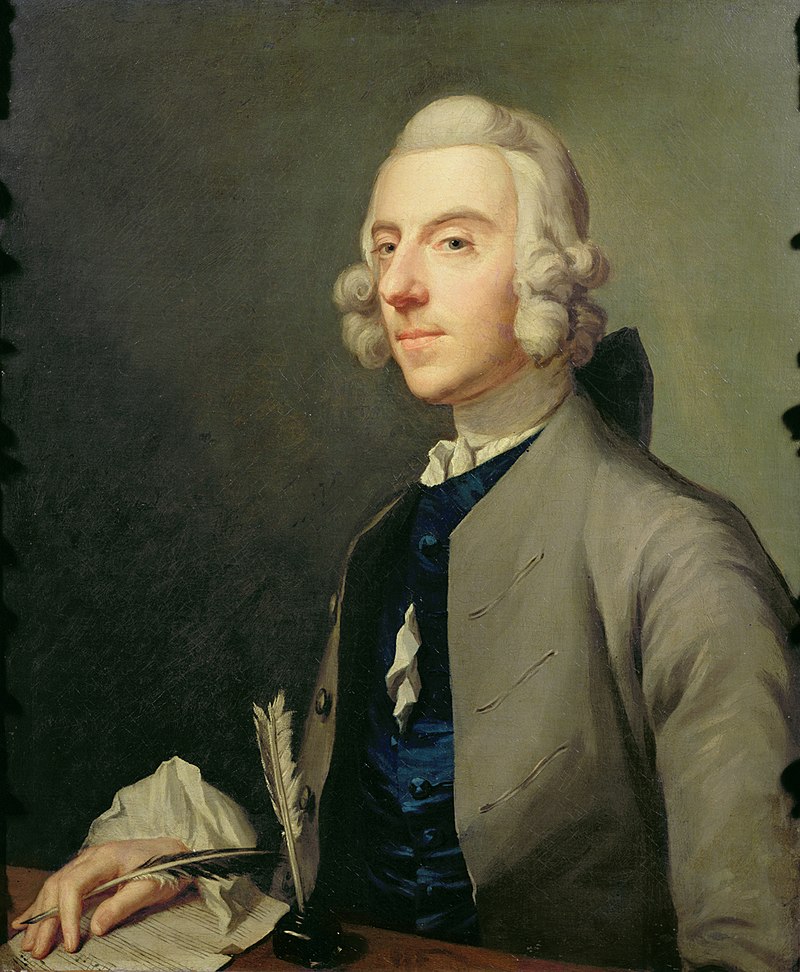
Portrait of Michael Arne in happier days by Johan Zoffany, c. 1765. Image from Wikimedia Commons

To end on a sunnier note, the Favourite Songs volume ends with an appendix containing transposed ‘guittar’ parts for all songs not written in ‘proper’ keys. So on page 18 we find a guitar part in C for ‘Kingcup, daffodil and rose’, originally written in the unfriendly key of E flat. The presence of guitar parts brings home the purpose of this publication: to enable performance outside the context of the play. It is pleasing to think of these modest but attractive songs having a life beyond Drury Lane, perhaps at public pleasure gardens (such as Ranelagh Gardens in Chelsea, where Michael Arne first saw Elizabeth Wright sing in 1763), or even in the home.

Guitar part for ‘Kingcup, daffodil and rose’ from The Favourite New Songs & Duet in the Fairy Tale (Rw.85.118/3)

References

Cholij, I.B. (1995). Music in Eighteenth-Century London Shakespeare productions. PhD thesis, King’s College, University of London.

Parkinson, J.A. (2001). ‘Arne, Michael.’ Grove Music Online [subscription only]

Stone, G.W., Jr. (1939). ‘A Midsummer Night’s Dream in the Hands of Garrick and Colman’. PMLA, 54, 467-482.

You can browse King’s College’s First Folio on the Cambridge University Digital Library here, and it also features on the First Folios Compared website where you can compare it side by side with other digitised copies of the First Folio.

GB

A King’s Banquet

Whether it be College catering, or spicy titbits from our rare books and early printed music, there is a feast of food-related material in the King’s College special collections. We table here an exhibition of serious, as well as fun, documents covering five hundred years of food at King’s. From food fights to food scarcity, the salutary effect of warm beer, or the economics of the price of corn, the special collections are sure to have something to satisfy any appetite!

the price of wheat

During the years between 1799 and 1801 widespread rioting broke out throughout England, mostly about the scarcity of food and soaring prices of bread. The cost of a loaf of bread was at an all-time high of 1 shilling and 9 pence. This was caused in part by a series of poor harvests as a result of unseasonally bad weather in England and equally poor harvests in Europe which limited imports. Sir Gilbert Blane (1749–1834) deals with the causes and remedies in his inquiry in 1800. Trained as a physician, we can perhaps be forgiven a wry (or even rye?) smile when we learn that Blane had previously been the personal physician to Admiral Sir George Rodney (1718–1792) on board HMS Sandwich!
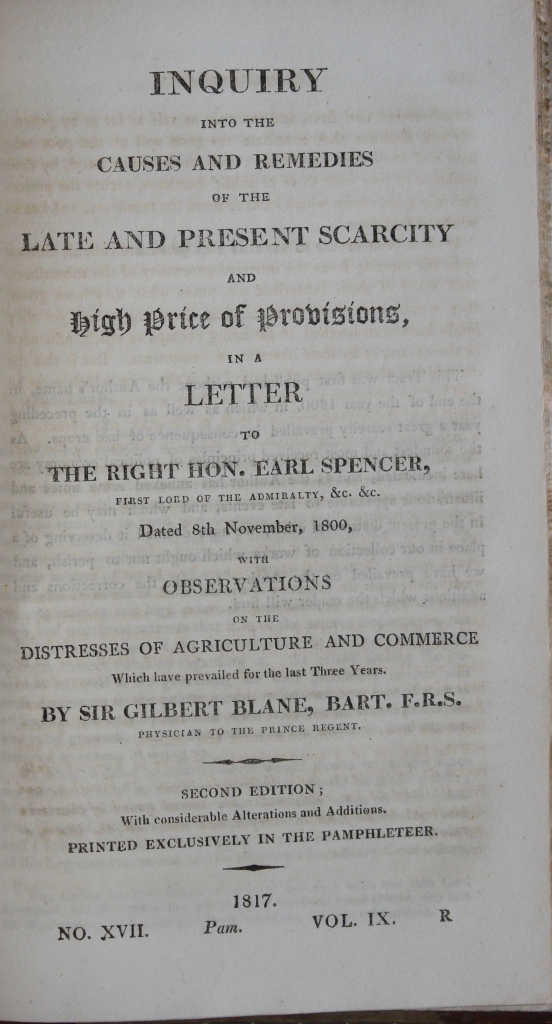
Gilbert Blane, Inquiry into the causes and remedies of the late and present scarcity and high price of provisions (London, 1817) (Shelfmark: Keynes.A.10.16.(10.)). Title page

Blane, Inquiry into the causes and remedies of the late and present scarcity and high price of provisions. Summary

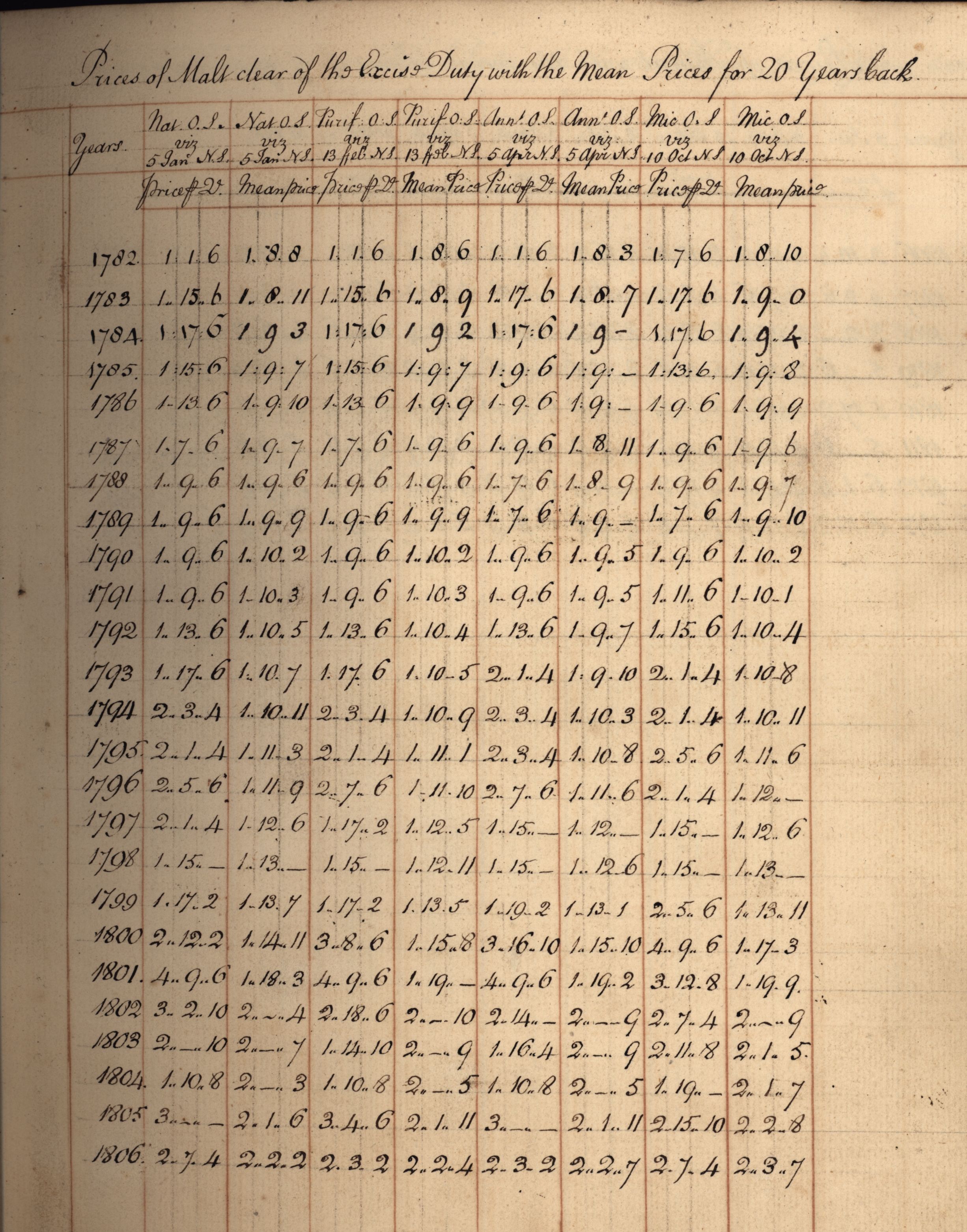
That particular volume came to King’s as part of the antiquarian book collection bequeathed by John Maynard Keynes. He was First Bursar (Financial Officer) at King’s from 1924 to 1944, and converted our land-based endowment to a stock portfolio. His predecessor bursars had to maximise the income from our land holdings, and compiled tables of the prices of wheat and malt during the late eighteenth and early nineteenth centuries.

‘Prices of Malt clear of the Excise Duty with the Mean Prices’, January 1782-October 1806 (Ref: KCE/1060)

‘Prices of Wheat with the Mean Prices’, January 1782-October 1806 (Ref: KCE/1060)

The price of wheat per quarter (1/4 of a ton) ranged from just under 1 pound per quarter in the early eighteenth century, to well over 5 pounds in January 1796, and was in the 7-8 pounds per quarter range in the winter and spring of 1800-1801. The 1799–1801 scarcity came at the end of a decade of bad harvests and hard winters—the problem was not so much that the rioters were fed up, as that they were not fed up!

Charles Simeon. Etching by an unknown artist (undated) (Ref: KCAC/1/4/Simeon/2)

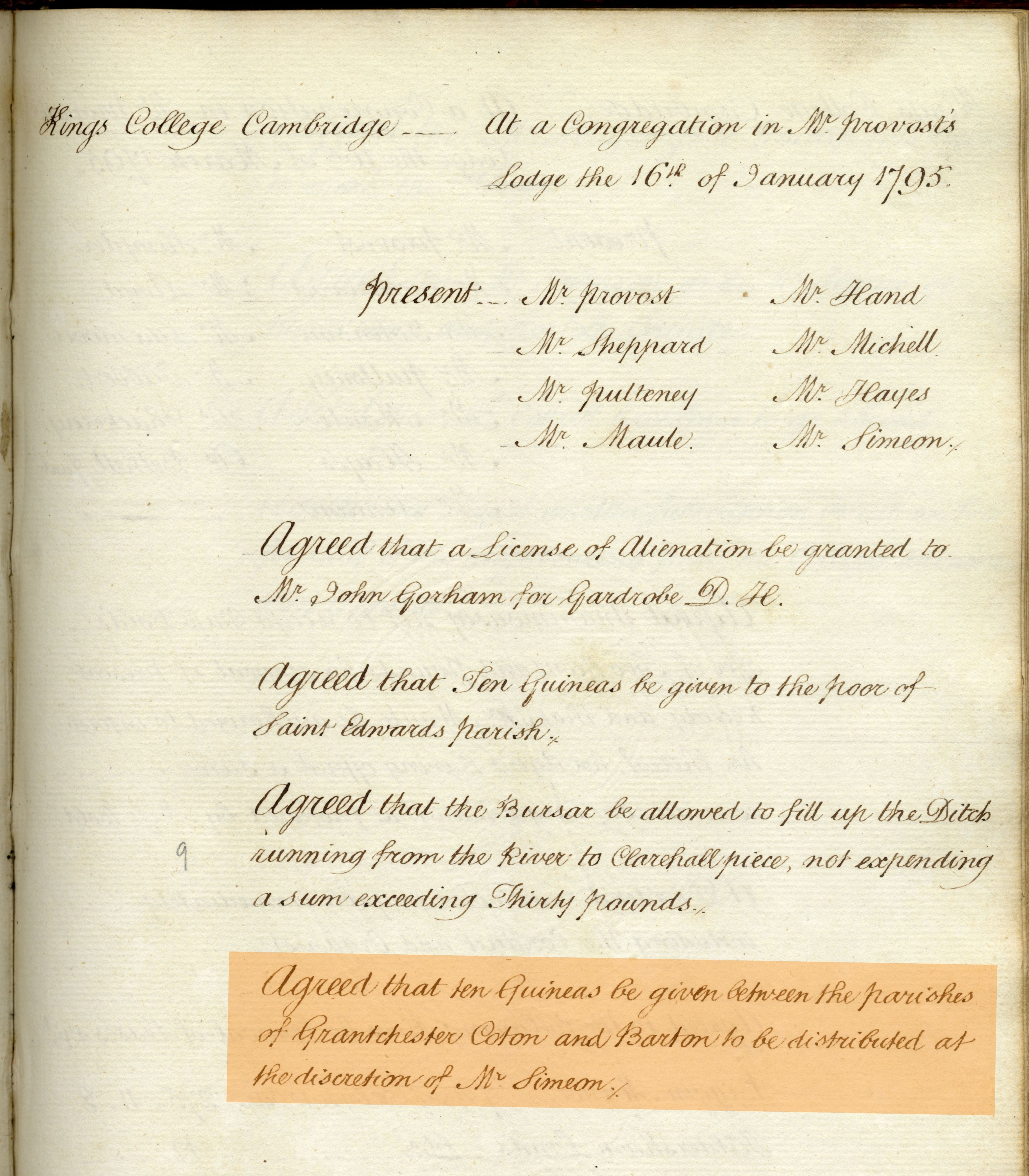
King’s did what it could towards poor relief. During the 1788 famine Charles Simeon (1759–1836, KC 1779) ‘organized a [University] subscription to enable bread to be sold at half-price in Cambridge and twenty-four neighbouring villages and rode round on horseback each Monday to make sure that the bakers were doing this.'[ODNB] In 1795 King’s College fellows were again occupied with poor relief. It was ‘agreed that ten guineas be given between the parishes of Grantchester Coton and Barton to be distributed at the discretion of Mr Simeon.’

Governing Body minutes, 16 January 1795 (Ref: KCGB/4/1/1/2)

We are not exempt from scarcity even in modern times. During World War II the College accommodated some of the Dunkirk evacuees, followed by an RAF transport unit, a quantity of relocated Queen Mary’s College students and faculty, and a miscellany of American and British military men in various stages of training. The acting bursar GHW ‘Dadie’ Rylands had to deal with the problems of rationing: an allowance of only half a sausage per head per week!

Part of a letter from the Acting Bursar to Sainsbury’s, about rationed meat (carbon copy), 14 November 1941 (Ref: KCAR/3/1/1/11)

Luckily for King’s we had enough space for a kitchen garden. Despite reduced staff, in 1941 the head gardener ‘produced large quantities of tomatoes, lettuces, onions, and savoys for use in Hall. ‘ In 1945 he supplied 550 pounds of tomatoes and 57 dozen lettuces.

Entry from George Salt’s college gardens journal, 1941 (Ref: GS/2/5 p 75)
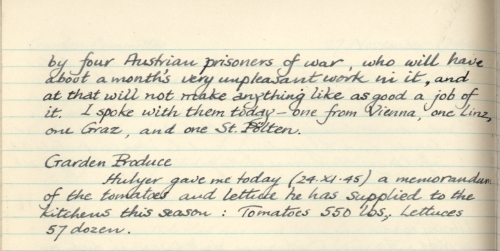
Entry from George Salt’s college gardens journal, 1945 (Ref: GS/2/5 page 92)

what they ate

Go back a couple of centuries before the wheat shortage, however, and according to Robert Speed’s The Counter Scuffle (1621) there was plenty of food to waste! This publication was one of the most influential mock poems of the time and went through 19 editions by the end of the seventeenth century. It tells the story of a food fight which broke out during a Lent dinner in the Wood Street Counter, a debtors’ prison. At the end of the fight, the prison keeper is found hiding under a table with his clothes and codpiece stuffed with food!

Robert Speed, The Counter Scuffle (London, 1648). (Shelfmark: Thackeray.J.65.48). Title page

Speed, The Counter Scuffle. Part of the description of the food

Speed, The Counter Scuffle. Part of the description of the fight


The foodstuffs being thrown around the prison dining hall are the same as King’s fellows and scholars were eating about 40 years earlier. The College’s dining accounts for 16-19 October 1579 list various types of fish (ling, plaice, tench, and pickerel–but no eels or herring), mutton and loin of veal, and the ‘flesh’ included beef, rabbits, pigeons, and chickens. The College also purchased milk, butter, eggs, pepper, sugar, currants, dates, cinnamon, cloves and mace during those days. Other pages in the accounts record the purchase of mustard. (See The Potticaries Bill blog and an article about early dining practices at King’s for more details).

College dining accounts for 16–19 October 1579 (Ref: KCAR/4/1/6/19 opening 276)

One would never catch Oxbridge dons engaging in such puerile behaviour as displayed in The Counter Scuffle, however. Why play or fight with your food when you can be academic about it? It is hard to imagine that the humble sausage would inspire a volume of poetry, but that is exactly what happened when Thomas Warton (1728–1790), sometime Poet Laureate and friend of Dr Johnson, put together his volume of poetry The Oxford Sausage in 1764 whilst he was Professor of Poetry at the University of Oxford. Here we have his new edition ‘adorned with cuts, engraved in a new taste, and designed by the best masters.’ The volume’s engraved frontispiece depicts Mrs Dorothy Spreadbury, the inventress of the Oxford sausage. There is apparently some doubt about the authenticity of this claim, but who would be so bold as to challenge such a formidable-looking lady!

The Oxford sausage: or, Select poetical pieces, written by the most celebrated wits of the University of Oxford (Oxford, 1777) (Shelfmark: Chawner.A.5.105). Title page.

The Oxford sausage. Frontispiece showing Mrs Dorothy Spreadbury.


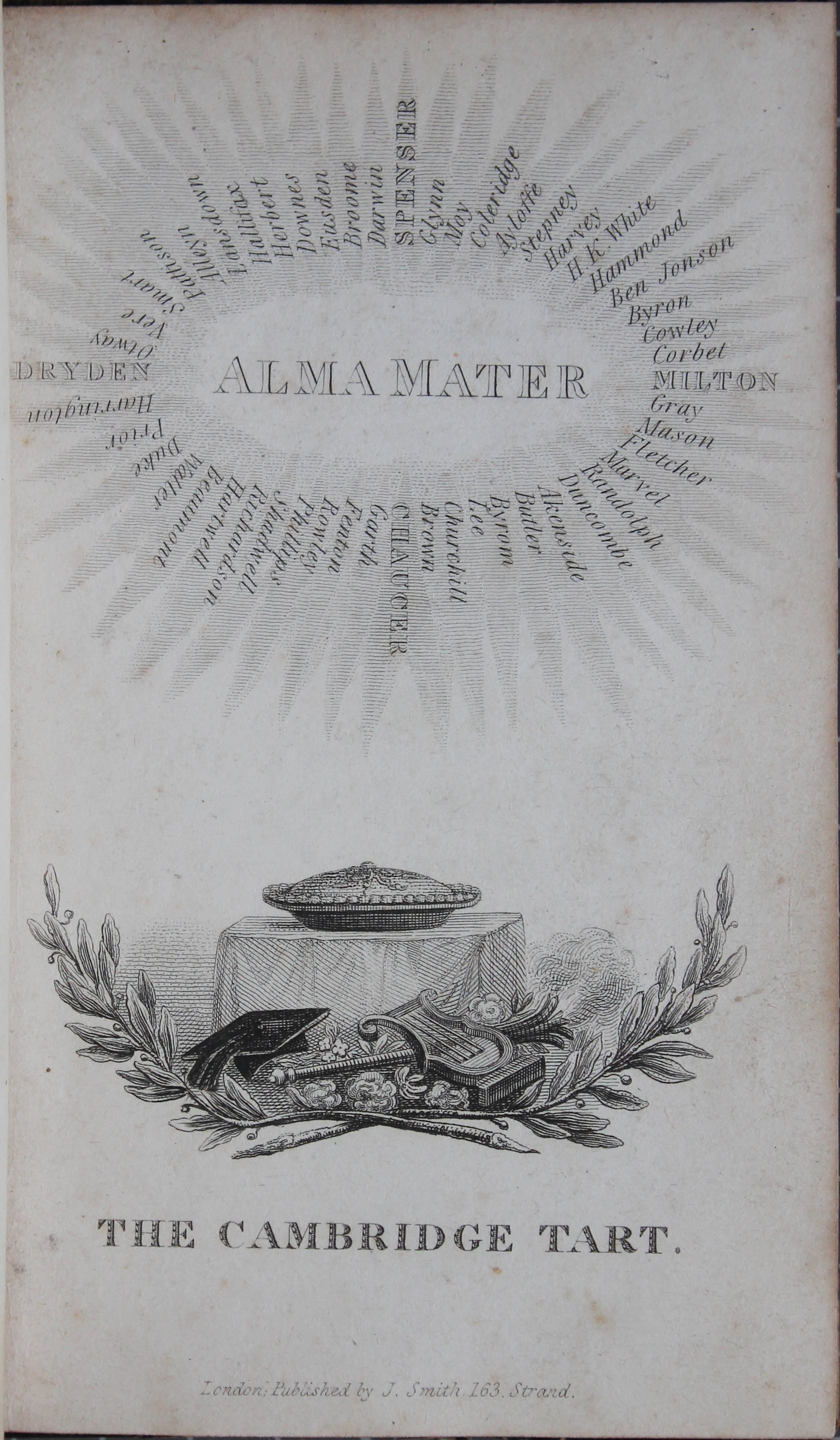
Over 50 years later in 1823 Cambridge decided it needed to acknowledge Oxford’s Sausage: ‘Oxford has its sausage, and why not Cambridge its tart?’ reads the preface to The Cambridge Tart, a volume of ‘epigrammatic and satiric-poetical effusions dainty morsels, served up by Cantabs, on various occasions’ put together by Richard Gooch (1791–1849) in 1823 under the pseudonym ‘Socius’. The engraved frontispiece depicts a baked tart, framed by laurel wreaths, a lyre and a mortarboard!
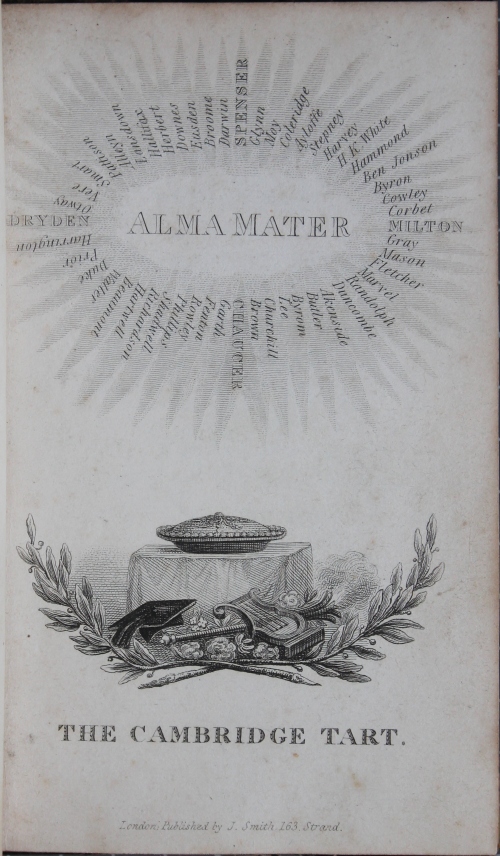
The Cambridge tart: epigrammatic and satiric-poetical effusions; &c. &c. Dainty morsels, served up by Cantabs, on various occasions. Dedicated to the members of the University of Cambridge / By Socius (London, 1823) (Shelfmark: P.25.13). Title page

The Cambridge tart. Opening

The Cambridge tart. Opening


what they drank

Of course with your sausage you need something to drink, perhaps a nice chilled beer on a summer’s day? Even better, a nice warm beer, perhaps, as the writer of this little treatise explains to us the ‘many reasons that beere so qualified is farre more wholsome than that which is drunke cold’. It is a most serious subject indeed, with chapters that explain ‘that actuall hot drink doth quench the thirst as well as cold drink, or better’ and ‘the hurt that ariseth from the use of actuall cold drink’ and ‘the benefit that ariseth from the use of actuall hot drink’.

Warme beere, or, A treatise wherein is declared by many reasons that beere so qualified is farre more wholsome then that which is drunke cold (Cambridge, 1641) (Shelfmark: Thackeray.J.66.45). Title page

King’s had its own brewer, and brewery, for several hundred years. They brewed six barrels of ale at a time, and two of small beer.

College brewing numbers (undated) (Ref: KCAR/3/1/3/4 – memo on brewing)

John Pontifex (self-styled Coppersmith, Back-Maker, Brewer’s Millwright and Brewer’s Architect) sold us a six barrel brewer in 1829. It took three pages to describe it completely and it cost a shilling short of 213 pounds.

Part of an invoice for the brewing equipment purchased by King’s College from John Pontifex, 1829 (Ref: KCA/723)


Plan of the brewhouse of King’s College, by Richard Woods (undated) (Ref: KCD/365)

There was a fire in the brewhouse in 1871, and in 1881 the College voted to stop brewing its own beer. Two years later the brewhouse was converted to kitchen offices.

On the subject of brewing—hot drinks this time—we turn now to tea, coffee and chocolate. All were relatively new arrivals in Europe in the seventeenth century when Philippe Sylvestre Dufour (1622–1687) published his treatise De l’usage du caphé, du thé, et du chocolat. Here we have the latin translation of that work which appeared in Paris in 1685. It includes a separate treatise on each of the three drinks, under the title Tractatus novi de potu caphé; de Chinesium thé; et de chocolata. Each treatise includes a splendid engraved frontispiece depicting the origins of each drink. It is thought to be the first work in any language to describe all these new beverages in Europe.

Philippe Sylvestre Dufour, Tractatus novi de potu caphé; de Chinesium thé; et de chocolate (Paris, 1685) (Shelfmark: Thackeray.J.47.33). Title page

Dufour, Tractatus novi de potu caphé; de Chinesium thé; et de chocolate. Frontispiece


Dufour, Tractatus novi de potu caphé; de Chinesium thé; et de chocolate. Frontispiece to the chocolate treatise


Dufour, Tractatus novi de potu caphé; de Chinesium thé; et de chocolate. Frontispiece to the tea treatise


DRINKING SONGS

Would the King’s Dining Hall have ever resounded with drinking songs? Probably not, because the Founder’s statutes dictated that conversation in the Hall be conducted in Latin ‘unless a reasonable cause requires otherwise’, and always in a ‘modest and courtly’ fashion. Theological tracts were to be read at dinner, in good monastic style.

But such strictures don’t govern the College’s Rowe Music Library which has more than its fair share of music related to food and drink. In the seventeenth and eighteenth centuries, one of the most common forms of popular song was the catch, a type of round. So-called catch and glee clubs sprang up in towns and cities, populated by men who liked to combine singing with feasting. While many catches of this period were bawdy in nature, at least as common was the subject of food and drink, with Henry Purcell, the greatest English composer of his generation, contributing to the repertoire such gems as ‘I gave her cakes and I gave her ale’, ‘He that drinks is immortal’ and ‘Wine in a morning makes us frolic and gay’. This catch in praise of punch is by Thomas Tudway (c. 1650–1726), organist of King’s College from 1670 until his death. The ‘S’ mark on the second stave shows the point at which the second voice should enter.

Thomas Tudway, ‘A Catch upon a Liquor call’d Punch’, in The Second Book of the Catch Club or Merry Companions (London, c. 1731) (Shelfmark: Rw.112.77)

The song sheet was ubiquitous in the early eighteenth century, with prints of love songs and operatic arias both available in abundance. This perhaps understandably anonymous song, ‘The Double Entendre’, appears at first sight to be about a maiden drinking a glass of wine, but each verse leaves open the possibility of a double meaning at the end of its third line, before things are resolved (after a pause and a playful ‘tal-lal-lal-lal’) with propriety. This song contains an optional flute part doubling the melody printed at the bottom, a practice common at the time.

‘The Double Entendre’ (London, c. 1730) (Shelfmark: Rw.110.25/71)

good taste

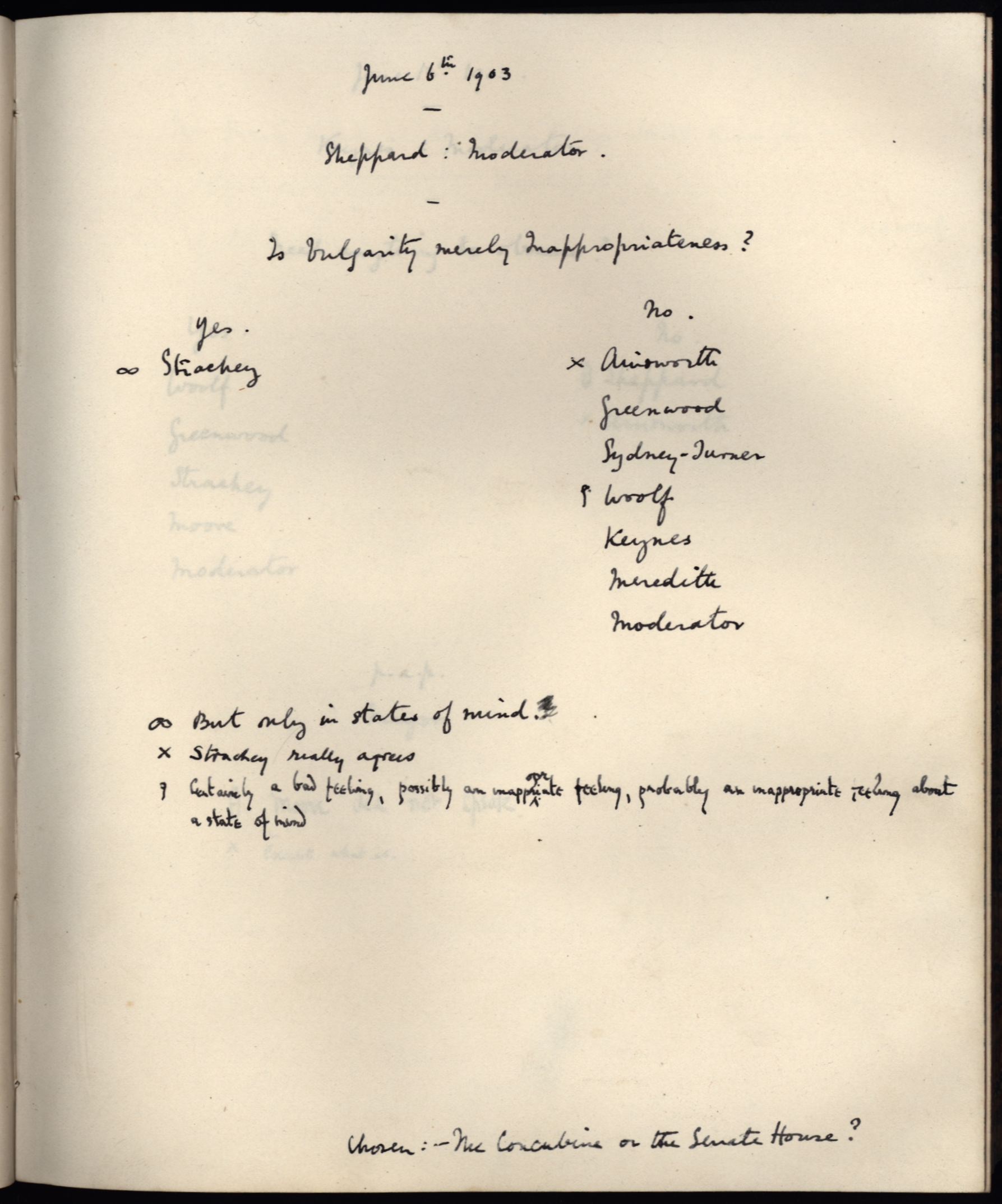
When it comes to sharing food with others one should properly consider etiquette. John Tresidder Sheppard (1881–1968, KC 1900, Provost 1933–54) was elected to the debating society known as The Cambridge Apostles in 1902. In 1903 he presented a paper styled ‘May we eat cheese with a knife?’ in which he considered, among other things, the question of bad manners. He opined that vulgarity of manners is due to the shock that others experience when witnessing, for example, ‘the knife-tip in the mouth’ rather than that the person committing the offense, or the offense itself, is somehow inherently vulgar.

Paper read by JT Sheppard to the Apostles, 6 June 1903 (Ref: JTS/1/3/2). Page 1

Paper read by JT Sheppard to the Apostles (Ref: JTS/1/3/2). Pages 5-6


The Apostles gave their customary impenetrable vote on his question:

Apostles’ vote on Sheppard’s paper, 6 June 1903 (Ref: KCAS/39/1/14)

how they made it

Another Kingsman, Osbert Burdett (1885–1936, KC 1903) also took the subject of cheese rather seriously. He wrote books about Blake and Gladstone (among others) as well as his rather humorous book A Little Book of Cheese which surveys English and foreign cheeses, shares some recipes and also incorporates tantalising titbits about the monstrous nature of smoking whilst enjoying cheese, all the while presenting us with curious facts such as which cheese was Thomas Hardy’s favourite!

Osbert Burdett, A Little Book of Cheese (London: Howe, 1935) (Shelfmark: UXL PSU Bur). Title page
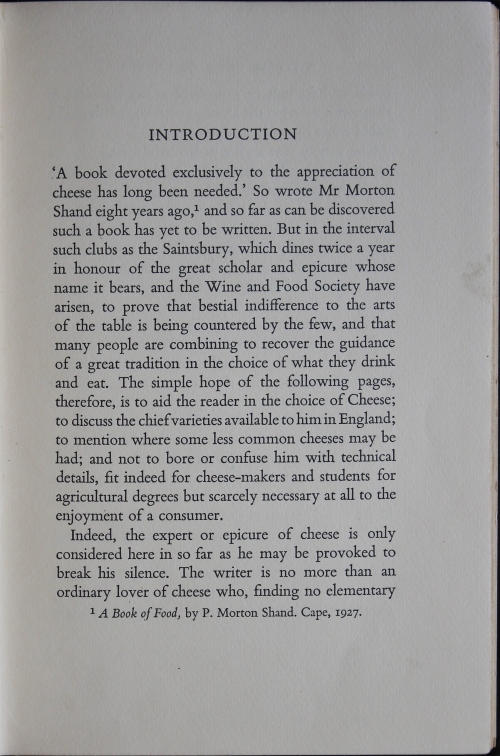
Osbert Burdett, A Little Book of Cheese. Introduction

Osbert Burdett, A Little Book of Cheese. Page 87


Well, cheese is all very good, but what if you have a sweet tooth? In this charming little book, the Banbury cake—one of the more erudite cakes that we have—tells its own story! Banbury cakes have been made in Banbury in Oxfordshire since the sixteenth century. During the eighteenth century the recipe had become more similar to Eccles cakes, but had originally enjoyed a filling of currants, mixed peel, brown sugar, rum and nutmeg encased in an oval of pastry. Appropriate for afternoon tea, and often stocked in railway stations as well as being sent as far afield as Australia and America, Banbury cakes were also presented to Queen Victoria on her way to Balmoral each August.

The History of a Banbury Cake: an entertaining book for children (Banbury, 1830s) (Shelfmark: Rylands.C.Banb). Title page

The History of a Banbury Cake. Preface and Opening

Staying with children’s literature, here we have the first edition of Beatrix Potter’s story The Pie and the Patty-Pan, which tells the story of a cat called Ribby who invites a dog named Duchess for afternoon tea, for whom Ribby bakes a mouse pie. The book remained one of Potter’s favourites, and the illustrations are considered to be some of her most beautiful.

Beatrix Potter, The Pie and the Patty-Pan (London, 1905) (Shelfmark: Rylands.C.Pot.Pie.1905.a). Title page

Potter, The Pie and the Patty-Pan. Ribby baking the pie made of mouse.

Potter, The Pie and the Patty-Pan. Description of the pie made of mouse.


OK, that’s quite enough frivolity: time to get serious. Only the most ardent researcher of food history would attempt this enormous tome (852 pages) all about the techniques and history of canning food! That being said, it includes fascinating morsels about one of the most important men in the history of preserving food from whose research we have all benefited. Nicolas Appert (1749–1841), known as ‘the father of canning’, devised his new method for conserving foods by experimenting with placing them in air-tight glass jars that were then subject to heat. He published his results in 1810 in Paris as L’Art de conserver, pendant plusieurs années, toutes les substances animales et végétales. We’re sure many a feast has been had throughout the country after the shops have closed by raiding the back of the larder for tins of preserved food!
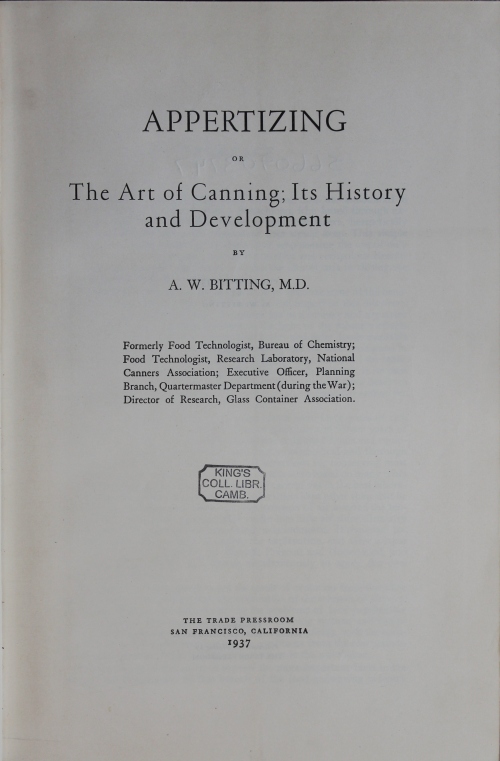
AW Bitting, Appertizing; or, The art of Canning; Its History and Development by A.W. Bitting (San Fransisco, 1937) (Shelfmark: CXM T Bit). Title page

Nicolas Appert (1749–1841)
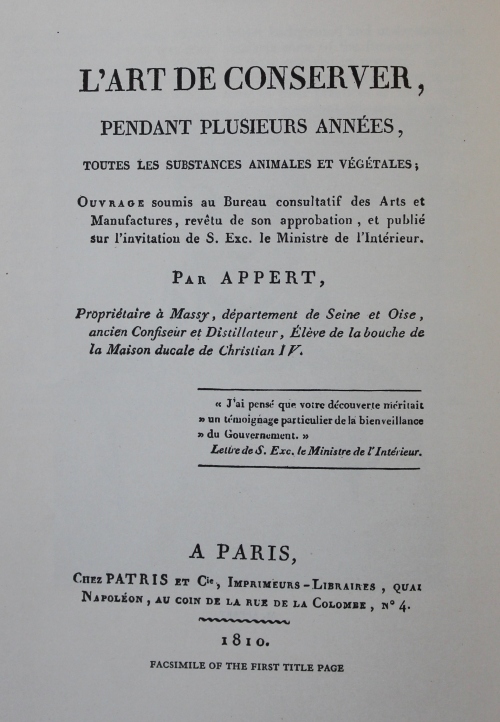
Facsimile title page of Nicolas Appert’s treatise L’Art de Conserver (Paris, 1810)


One cannot have a discussion about food without mentioning Apicius. Also known as De re culinaria or De re coquinaria (On the Subject of Cooking), Apicius is a collection of Roman recipes, thought to have been compiled in the first century AD. It has been attributed to various historical figures named Apicius, including the gourmet Marcus Gavius Apicius, although the connection is impossible to prove. The first printed edition appeared in Milan in 1498. Our edition, of which only 100 copies were printed, dates from 1709 and includes a commentary by Martin Lister (1639–1712), the English physician and naturalist, who related the material in the original work to medicine and healing.

Apicii Coelii De opsoniis et condimentis: sive arte coquinaria, libri decem. cum annotationibus Martini Lister (Amsterdam, 1709) (Shelfmark: M.37.52). Title page

Apicii Coelii De opsoniis et condimentis. Engraved frontispiece


Getting down to the nitty gritty of making food at King’s, bear in mind that the cooks were preparing food for around 100 fellows, scholars, choristers, lay clerks, chaplains and servants. Judging by the inventories, they seem to have had to do so in a kitchen less well-equipped than most modern British households. The kitchen inventory for 1598 (updated in 1605) notes 8 pots and pans with only 2 lids (for oven cooking), with the various necessary ironwork and tripods for suspending them over the fire (admittedly not part of most modern kitchens), a single set of bellows and tongs (the coal rake went missing sometime between 1598 and 1605), 4 skillets, 2 grills and an iron peele (for putting things into the oven and retrieving them again). There were only 2 ladles and 2 cooking spoons listed, 2 knives and a cleaver, a single colander and a grater. There was a mortar and pestle and also a querne for grinding the mustard. The food had to fit on 3 meat serving plates and 14 pie plates but there were dozens of other dishes and platters. Storage consisted of two large lead cisterns (presumably for water), a box (presumably wooden) for oatmeal and various probably wooden pails and tubs. What did they want with a wheelbarrow?

The King’s College kitchen inventory for 1598 and 1605 (Ref: KCAR/4/1/5/5, opening 19)

The brewhouse inventory in that same volume lists mash vats, wort vats, coolers, tuns, a fire fork and coal rake, pails, copper kettles and funnels, a pair of scales, 2 bushel baskets and a French fan, a hops basket and a horsemill. The bakery was equipped with, among other things, 2 stonking lead weights of 100 pounds each, and 2 smaller weights of 24 pounds each. 

Where they got it

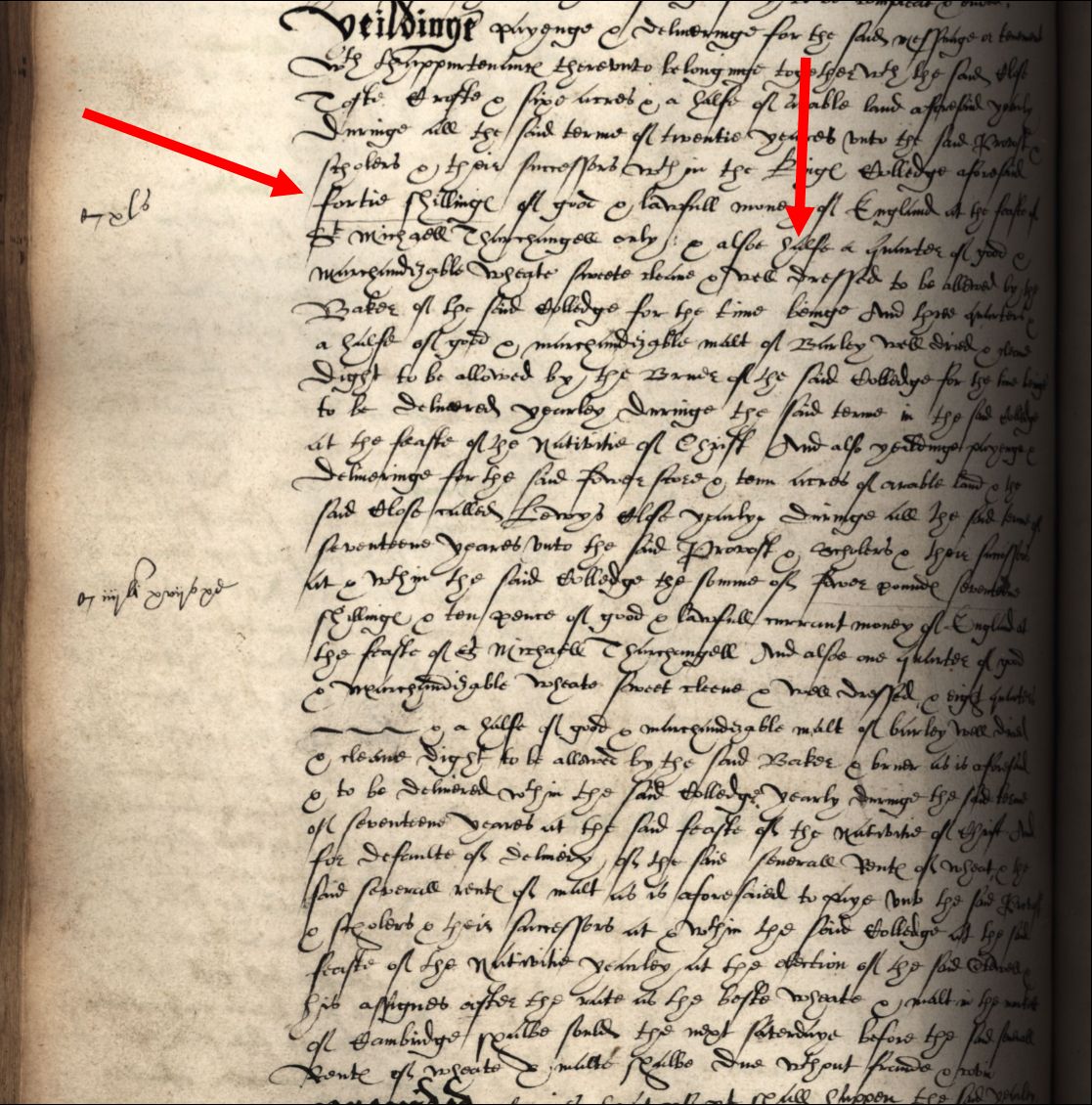
Who supplied our brewer and baker? An early College experiment with self-sufficiency in the form of a home farm in Grantchester had proven non-viable and certainly by 1570 the College got much of its wheat and malt as rent from our properties (endowed at the College’s foundation or acquired later), or bought it in the Cambridge markets and fairs. The cost depended upon whether it was delivered to College or not, and whether the barley was malted or not (we had a malt house) but it was definitely ground in the College’s mill house by the College’s mill horse. For example, one Grantchester tenant had to provide from his holding an annual rent of 40 shillings in addition to ‘halfe a quarter of good and marchandizable wheate sweete cleane and well dressed and three quarters & a halfe of good & marchandizable malt of Barley well dried and cleene, eight to be allowed by the [College] bruer to be delivered yearley’ to the College during Michaelmas term.
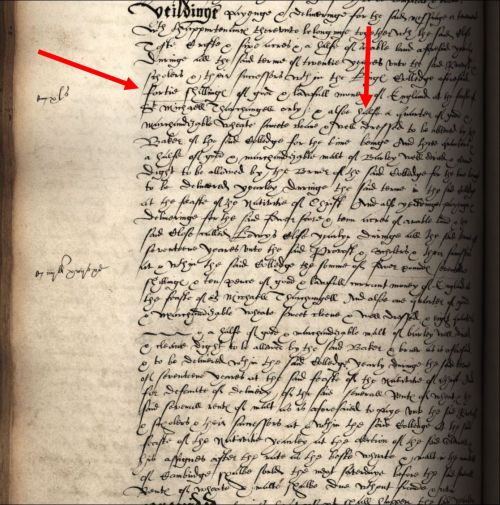
Part of a lease between King’s College and Otewell Hill for land in Grantchester, 2 October 1585 (Ref: KCAR/3/3/1/1/2, page 373)

For meat and fruit, by the late sixteenth century the College had an orchard, a swan house and a pigeon house. Beef, like malt and wheat, was sometimes part of the rent due to us. For example the tenant at Prescot in Lancashire had to deliver ’12 fatt oxen, of a lardge bone, soe that the Bulke or Fower quarters of every of the said Twelve Oxen, killed [and with the organs removed], shall weigh ffortie Stone at the least … or else … Twentie pounds of good & Lawfull money of England, in lieu & full recompense’.

Part of a lease between King’s College and Charles Lord Strang (son and heir apparent to the Earl of Derby), 15 May 1649. (Ref: KCAR/3/3/1/1/5 fo 76v)

Large quantities of mutton and beef were also purchased: in the 1579–80 financial year for example, 1,757 stone of beef was bought (equivalent to over 10,000 kg) as well as about 750 sheep. 800 cod, 15 lings and two barrels of preserved herring were bought, and expenses for veal, milk, rabbits, pork, chickens and eggs all appear at feast times in the dining accounts, so apparently the College had no fish ponds, dairy herds, coney warrens, pigsties and/or hen houses. At least in 1533 we had bees, because we repaid the Vice-Provost 2 shillings 8 pence for bee skeps (skepes pro apibus) and clay vessels (vasilibus luteis).
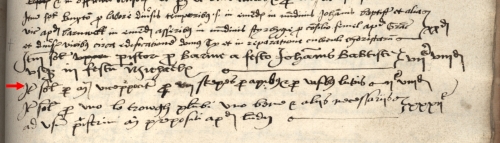
Beekeeping expenses in the annual accounts for late summer 1533 (Ref: KCAR/4/1/1/10, exp. nec.)

Vegetables possibly came from a kitchen garden. Certainly there was a kitchen garden by 1899, and at some point pigs had been introduced: ‘The produce of our 2 kitchen gardens (about 7 acres) and orchard (about 1 acre – very poor) … includes early + late vinery, tomato + cucumber houses, greenhouses + forcing pits … all the plant houses have been rebuilt one by one since I took then over in 1893 and the orchard has been largely replanted. Pigs were formerly a great feature but I have abolished them … I recommend tomatos strongly – not cucumbers … Grape growing cannot be done cheaply on a small scale … The great use of the garden is to supply vegetables quite fresh and in variety. For instance except in full summer quite fresh salads are scarcely to be bought, and even then there is little but cos lettuce.’

Pages from a letter to the Bursar from the Head Gardener (25 May 1899) (Ref: KCD/26 pages 1, 4, 5, 6)

That’s the final course of our offerings at this sitting.

Bon appétit!

an invitation

The special collections are open to visitors by appointment. For further information email library@kings.cam.ac.uk or archivist@kings.cam.ac.uk.

Further Reading

Purchases of food are listed in the Commons Books (described here) and the Mundum Books (described here).

Copies of leases are found in the Ledger Books (described here).

For a discussion of the price of wheat around 1900, see Minchinton, W. E. “Agricultural Returns and the Government during the Napoleonic Wars.” The Agricultural History Review, vol. 1, no. 1, 1953, pp. 29–43.

This exhibition is part of the 2021 Open Cambridge Festival on the 2021 Heritage Open Day theme of ‘Edible England’. Details of all the other events can be found at https://www.opencambridge.cam.ac.uk/events


GB/JC/PKM

A concert in Cambridge, 1767

In the Rowe Music Library at King’s College hangs a copy of this engraving, which shows seven local musicians performing at a concert that took place in the hall of Christ’s College on 8 June 1767. Tickets cost two shillings and sixpence.

The etching is attributed to Abraham Hume, after a drawing by Thomas Orde. Hume (1749-1838), later a Baronet, would have been eighteen years old at the time of the concert and a Fellow-Commoner at Trinity College. Orde (1746-1807), later Orde-Powlett, 1st Baron Bolton, was an undergraduate at King’s. Within a few years of graduating both men had been elected Tory MPs.

The personnel depicted are given in pencil at the foot of the engraving as: ‘Hallendale / Newell Senr. / Rennish / West / Wynn / Newell Junr. / Wood’. Exploring the backgrounds of these musicians helps to build up a picture of the Cambridge music scene 250 years ago that is impressively cosmopolitan.

The most arresting-looking individual in the picture is perhaps the severe-faced cellist in the centre, staring the viewer down through his spectacles. Although called ‘West’ in the Rowe copy, a name that has proved a dead end, another copy identifies him more fruitfully as ‘Alexis’, which suggests he is likely to be Alexis Magito, a Dutch-born musician who worked in England from the 1750s onwards. At around the time of this concert, an edition of a set of six sonatas for cello and double bass composed by Magito was published by the Cambridge music seller John Wynne, the bassist standing to the right of Magito in the picture. Wynne kept a music shop near the Senate House, ‘at the sign of the Harp and Hautboy’.

Rw.16.21, Alexis Magito, Six sonatas for the violoncello & basso, opera prima

There is no harp in Hume’s picture, but there is a hautboy, or oboe, being played by John Ranish, who stands to the left of Magito in a more than usually full-bodied wig. Ranish, named ‘Rennish’ in the Rowe copy, was probably of Eastern European stock (Christopher Hogwood suggests his name may have been Anglicised from ‘Wranisch’), and at the time of the concert had been established as an oboist and flautist in Cambridge for some time. His 1777 obituary in the Cambridge Chronicle and Journal claims he ‘always supported the character of a gentleman, and was respected by all that knew him’.

The man seated at a mysterious instrument to the right of Wynne and identified in the Rowe copy as ‘Newell Junr.’ is in fact the Portuguese musician Georg Noëlli, and the mysterious instrument is the pantalon or pantaleon (or indeed ‘Panthaleone’, as the concert’s advertisement in the Cambridge Chronicle and Journal has it). This was a large form of hammered dulcimer invented by the German musician Pantaleon Hebenstreit (1668-1750) and named after him by Louis XIV of France, who had been impressed by the instrument when Hebenstreit paid a visit to the court in 1705. Noëlli had studied with Hebenstreit, and in 1767 seems to have been on a tour of England: a Worcester newspaper boasts of his appearance there playing an instrument ‘eleven feet in length [with] 276 strings of different magnitudes’. Clearly the engraving does not fully communicate the sheer length of Noëlli’s pantalon.

The most distinguished musician in the picture, though, is probably Pieter Hellendaal, the violinist standing on the far left. Born in Rotterdam in 1721, he studied violin with Tartini in his youth, and in the 1750s moved to England, working in London and King’s Lynn. He settled in Cambridge in 1762, where he held musical posts at Pembroke College (then Pembroke Hall) and Peterhouse (then St Peter’s College). He died in 1799 and is buried in the shadow of Peterhouse, in the churchyard at Little St Mary’s.

Although several of the musicians pictured were composers as well as performers, Hellendaal’s music was the most widely published, both in London by a variety of publishers, and, as the title pages of editions in the Rowe Library attest, closer to home, ‘at the author’s house in Trompington Street, opposite St. Peter’s Colledge’. The Fitzwilliam Museum possesses a set of sonatas by Hellendaal in manuscript, six of which have been recorded recently by the performers in the video below, to general acclaim. If you would like to raise a glass to Hellendaal, this is a good time to do it: he was baptised on 1 April 1721, so this week may be taken to be the 300th anniversary of his birth!

Further information about this engraving and the characters it depicts can be found at https://kcctreasures.com/2023/06/01/what-do-we-think-they-did/

Bibliography

Hanks, S.E. (1969) ‘Pantaleon’s pantalon: an 18th-century musical fashion’, The Musical Quarterly, 55(2), pp. 215-227.

Hogwood, C. (1983) ‘A note on the frontispiece: A concert in Cambridge’, in Hogwood, C. & Luckett, R. (eds.), Music in eighteenth-century England: essays in memory of Charles Cudworth. Cambridge: Cambridge University Press, pp. xv-xviii.

GB

Video: Conserving Rare Books at King’s College, Cambridge

As part of our HLF-supported Thackeray Project, we have produced a video that looks at rare book conservation generally, before moving on to a case study of the repairs performed on a single book from the Thackeray Collection (Le rime di Francesco Petrarca, Thackeray.L.3.40).

Enjoy!


GB/JC/IJ

Library History: An Online Exhibition

A couple of months ago we curated an exhibition featuring items highlighting various aspects of the history of King’s College Library over the centuries. Below you will find some of the exhibits.

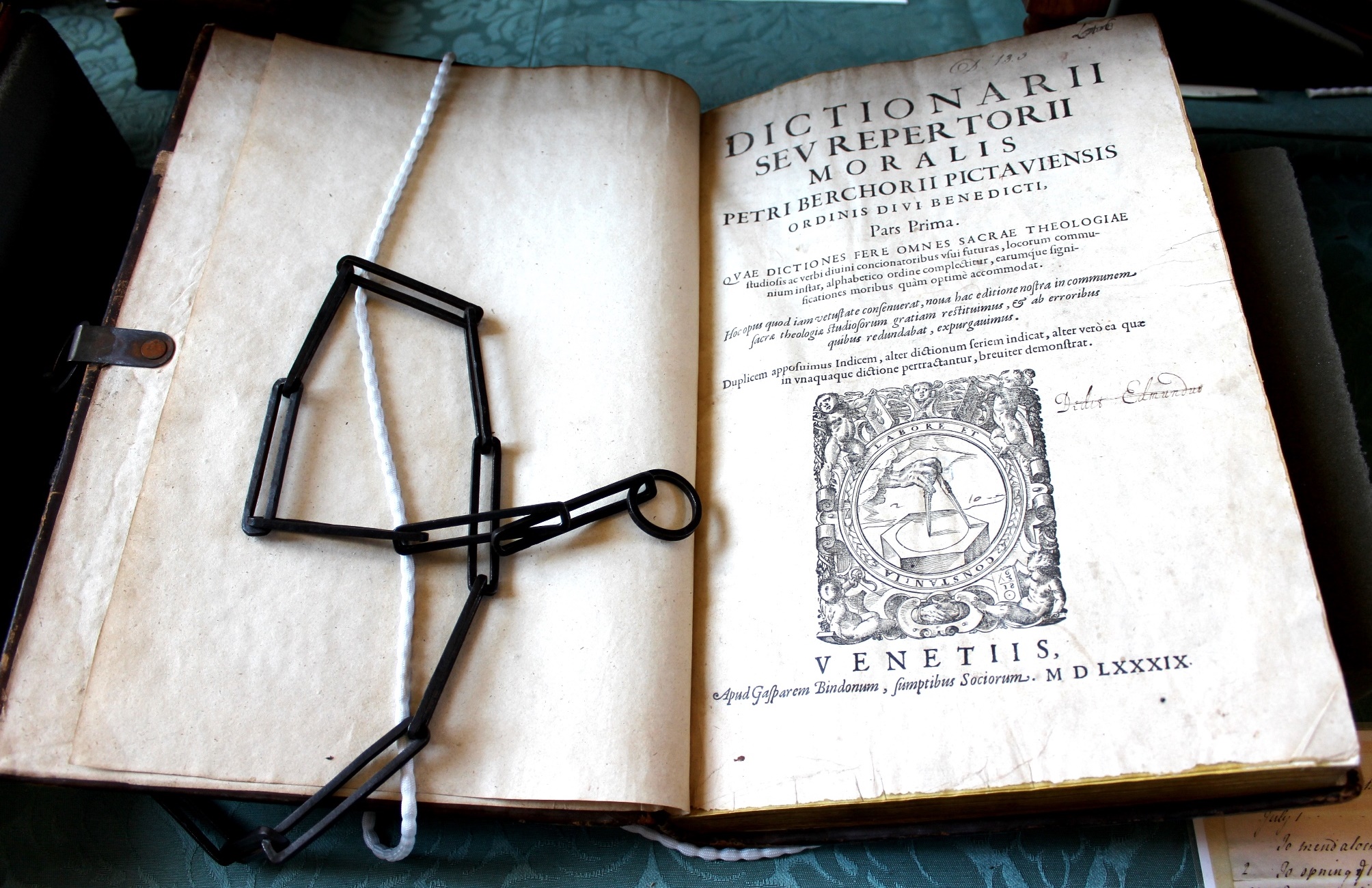
From the late sixteenth century until the current library opened in 1828, King’s Library occupied five of the side chapels on the south side of the famous Chapel. For most of this period it was a chained library. This book is one of a few to have survived with the original chains intact.

Pierre Bersuire, Dictionarii seu repertorii moralis
Venice: Gaspare Bindoni, 1589 (D.13.3)

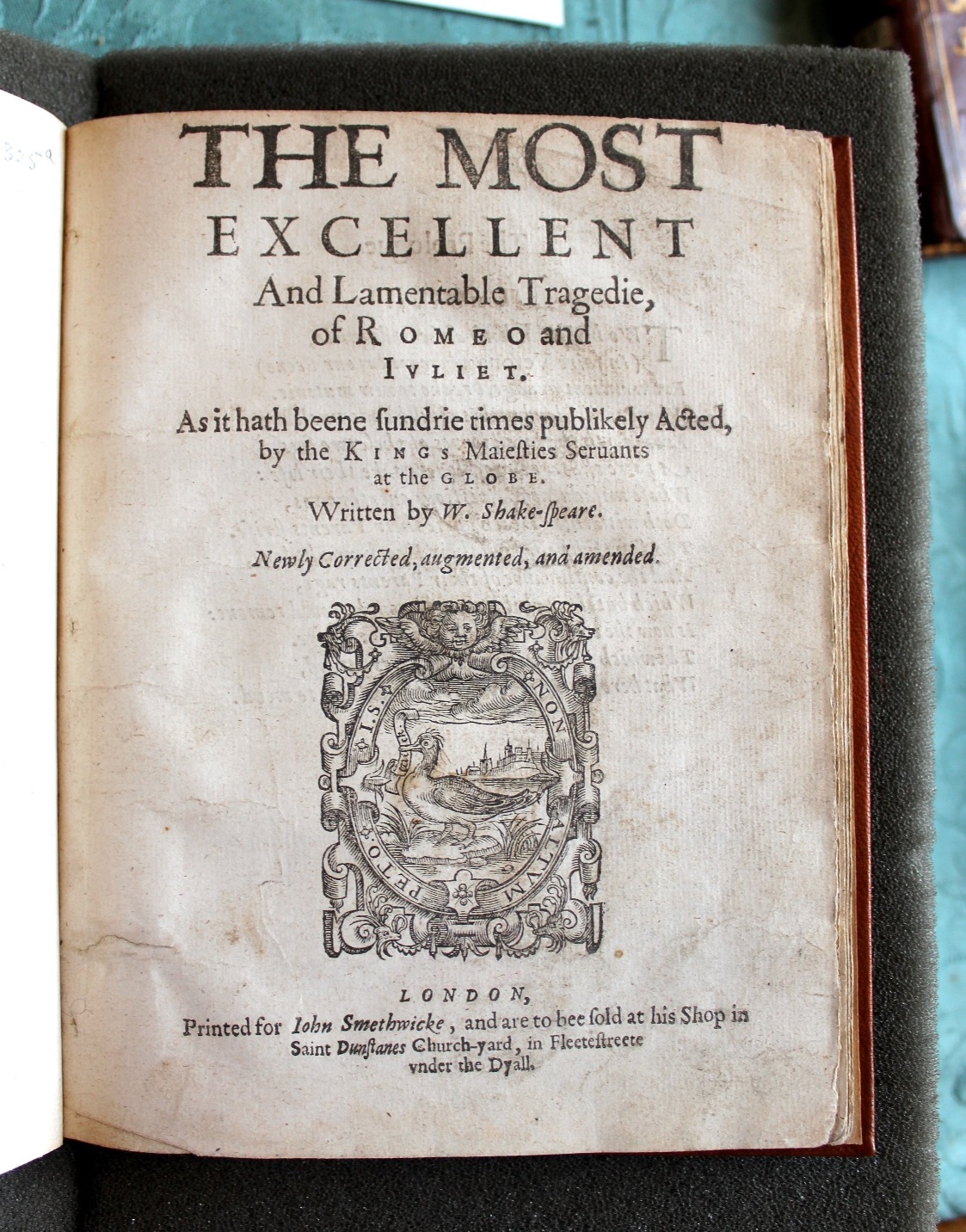
Theatre was one of John Maynard Keynes’ particular areas of interest and his book collection includes many plays. He founded the Cambridge Arts Theatre in 1936. This is a reprint of the second quarto of Romeo and Juliet that was published in 1599. All modern editions are based on this version, which is considered to be the most complete and reliable text of the play.

William Shakespeare, The Most Excellent and Lamentable Tragedie, of Romeo and Juliet
London: Printed [by William Stansby] for John Smethwicke, [1622] (Keynes.C.6.4)

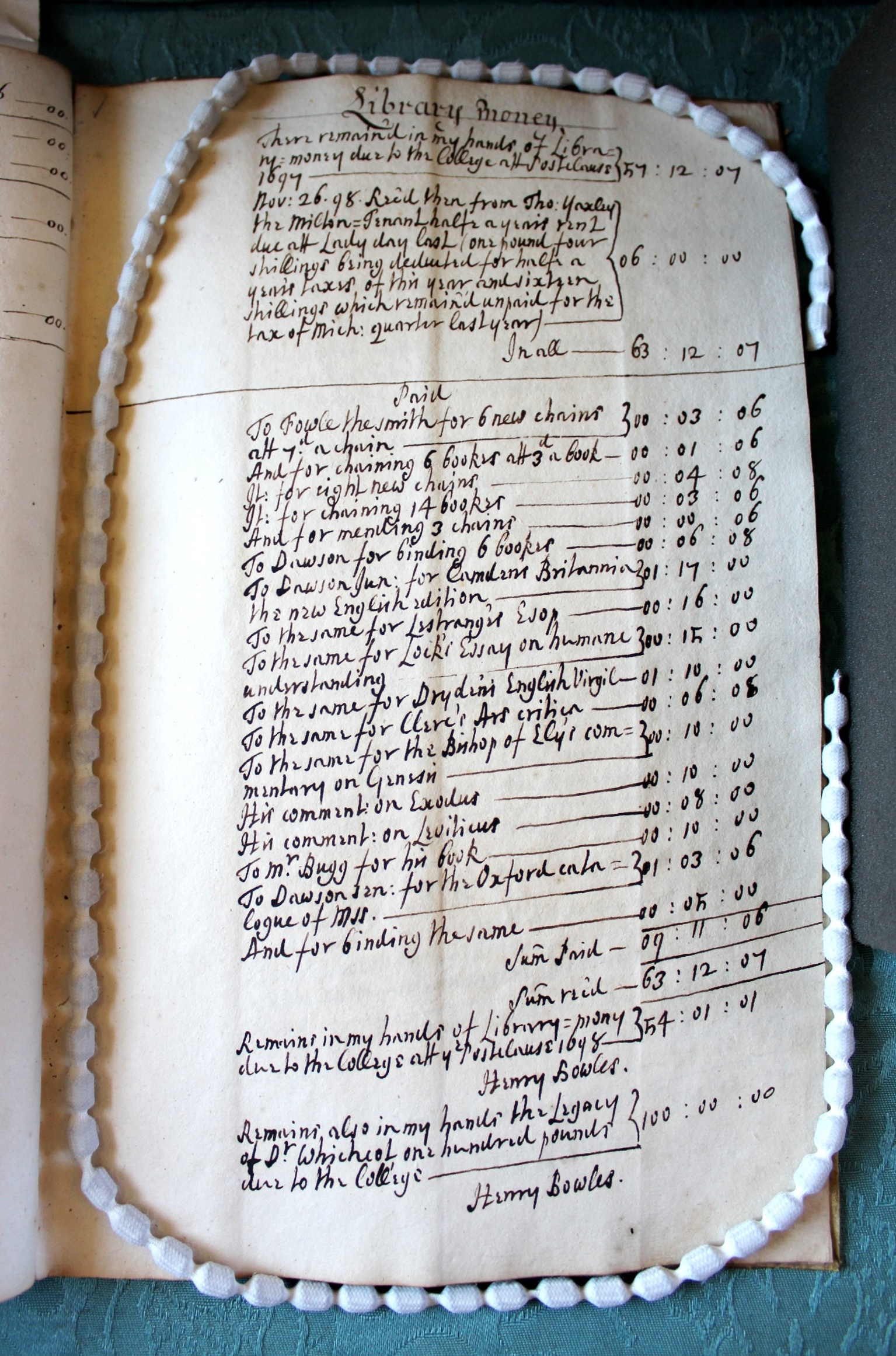
In 1638 Thomas Goad, a Kingsman and the son of Provost Roger Goad, who had been responsible for restoring the Library in the side chapels in King’s after a period of neglect, made provision in his will for the annual profit from some land he owned at Milton (near Cambridge) to be used in perpetuity to purchase divinity books for the Library. This was listed each year thereafter in the bursar’s account books as ‘Library Money’, and was spent on books and the upkeep of the bookcases and building.

Bursar’s book for 1697–98 (KCAR/4/1/4/106)

This is one of the books listed on the inventory of books bought in 1697–98: paid ‘to Mr. Bugg for his book’. In this case the book appears to have been bought directly from the author.

Francis Bugg, The Pilgrim’s Progress, from Quakerism, to Christianity
London: W. Kettleby, 1698 (D.13.3)

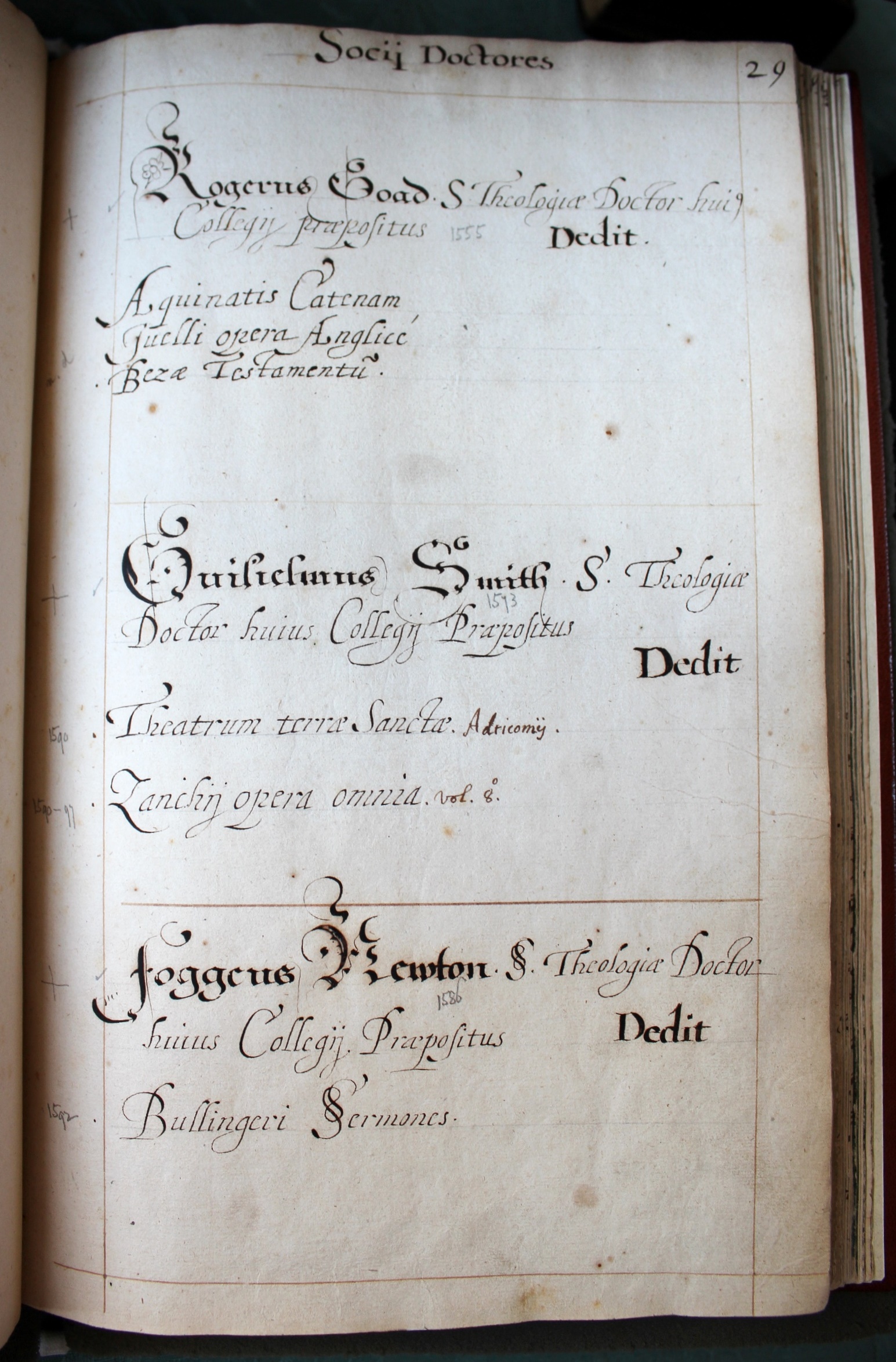
The volume below records donors of books to King’s College Library from about 1600 to about 1710, with details of the volumes they donated. On this page we see details of donations from three Provosts of King’s: Roger Goad, William Smith and Fogge Newton. The volume seems to have left King’s at some point in the 18th century, but was returned in 1784 as a note on the front flyleaf explains:

‘This book was given by the Revd Dr Farmer in 1784. He had found it at a Booksellers, & purchased it that it might be returned to the College. Wm Cooke’

Nomina eorum qu[i bibliothecam] Regalem sua munifice[ntia] locupletarunt [Donors’ Book]
(KCAC/6/2/29)

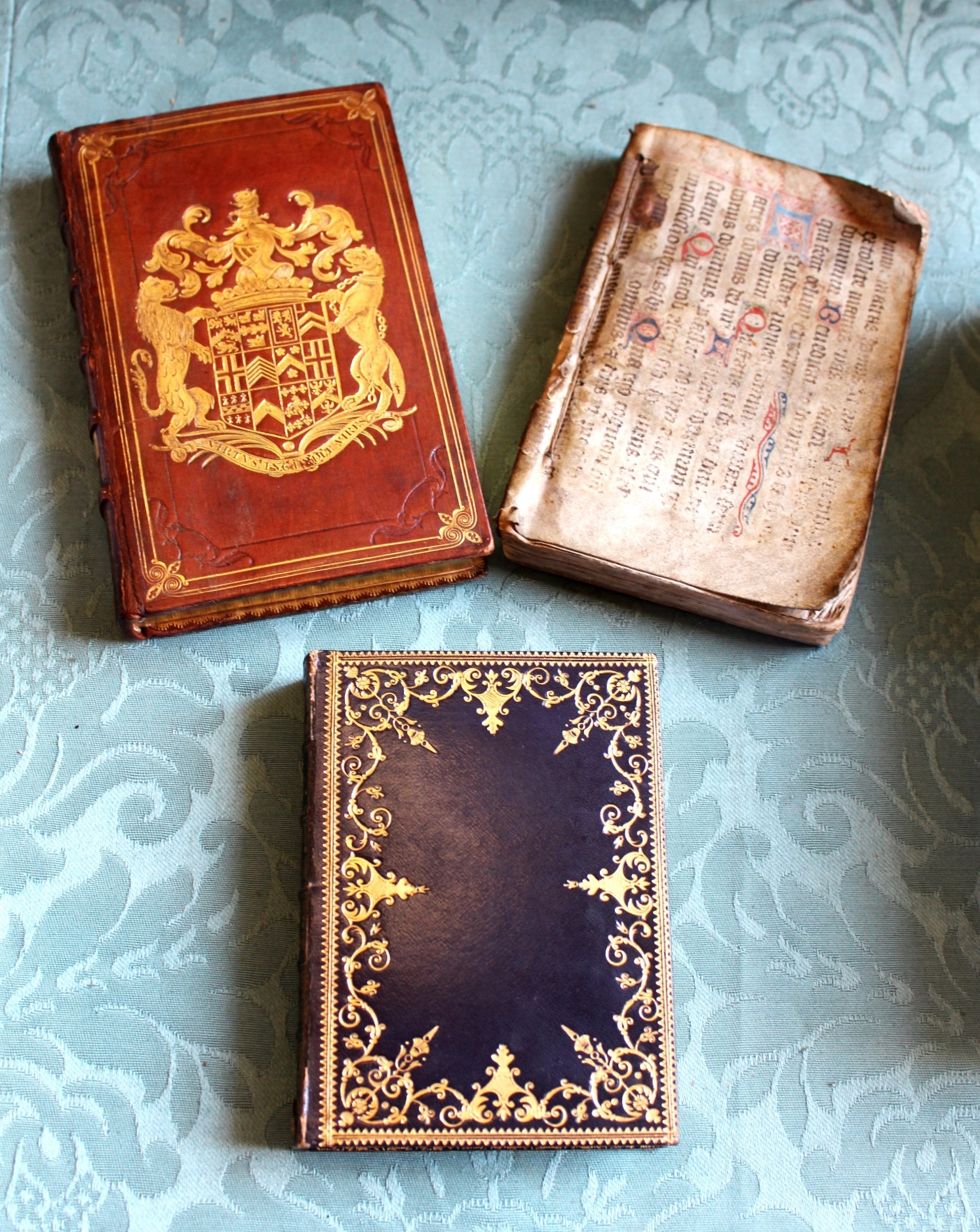
Finally, three historic bindings from the Thackeray Collection:

TOP LEFT: Calf armorial binding with the arms of Percy Clinton Sydney Smythe, 6th Viscount Strangford (1780-1855) (Thackeray.141)
TOP RIGHT: 16th-century manuscript waste binding consisting of a contemporary vellum sheet (stab-sewn) featuring part of the Psalms in textura quadrata with initials illuminated in red and blue (Thackeray.182)
BOTTOM: 19th-century blue goat skin stamped in gold (Thackeray.136)

GB/JC

Mozart’s birthday: an online exhibition

To mark the 260th anniversary of the birth of Wolfgang Amadeus Mozart earlier this week, the Library mounted a small exhibition. For the benefit of those who cannot visit the exhibition in person, here are some selected highlights.

Versuch einer gründlichen Violinschule / Leopold Mozart. Augsburg: Johann Jakob Lotter, 1756. Rw.38.43

Leopold Mozart, Versuch einer gründlichen Violinschule. (Augsburg: Johann Jakob Lotter, 1756. Rw.38.43)

Leopold Mozart (1719-1787) was not just a pushy parent: he was also a composer, violinist and music theorist. This first edition of his Versuch einer gründlichen Violinschule, a treatise on violin playing, dates from the year of his son’s birth, and features a number of plates illustrating common errors. The frontispiece (above left) is a portrait of Leopold himself surrounded by his own compositions, and both images show the practice, common at the time, of playing the violin with a concave bow and without chin rest or shoulder rest.

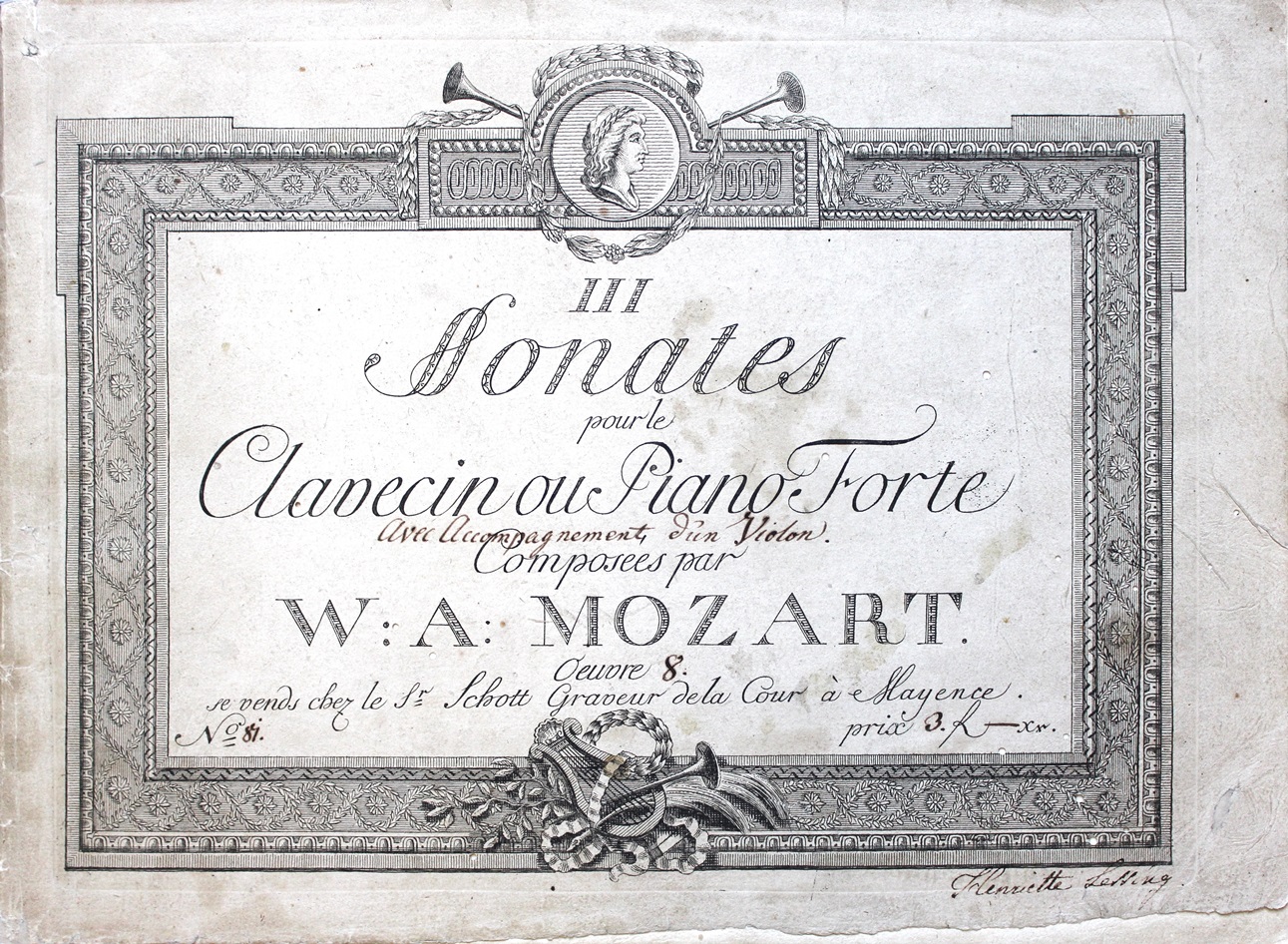
III sonates pour le clavecin ou piano forte: œuvre 8 / Wolfgang Amadeus Mozart. Mainz: Schott, 1789. Rw.13.88

Wolfgang Amadeus Mozart, III sonates pour le clavecin ou piano forte, avec accompagnement d’un violon: œuvre 8. (Mainz: Schott, ca. 1789. Rw.13.88)

This set of parts for two sonatas for violin and piano, K.526 and K.481, and for the piano trio, K.496, was bequeathed to the College by Kingsman Andrew Raeburn (1933-2010, KC 1955). It dates from Mozart’s own lifetime, having been published around 1789. The title page bears the ownership inscription of Henriette Lessing. Further details of the item’s acquisition may be found on the College website here.

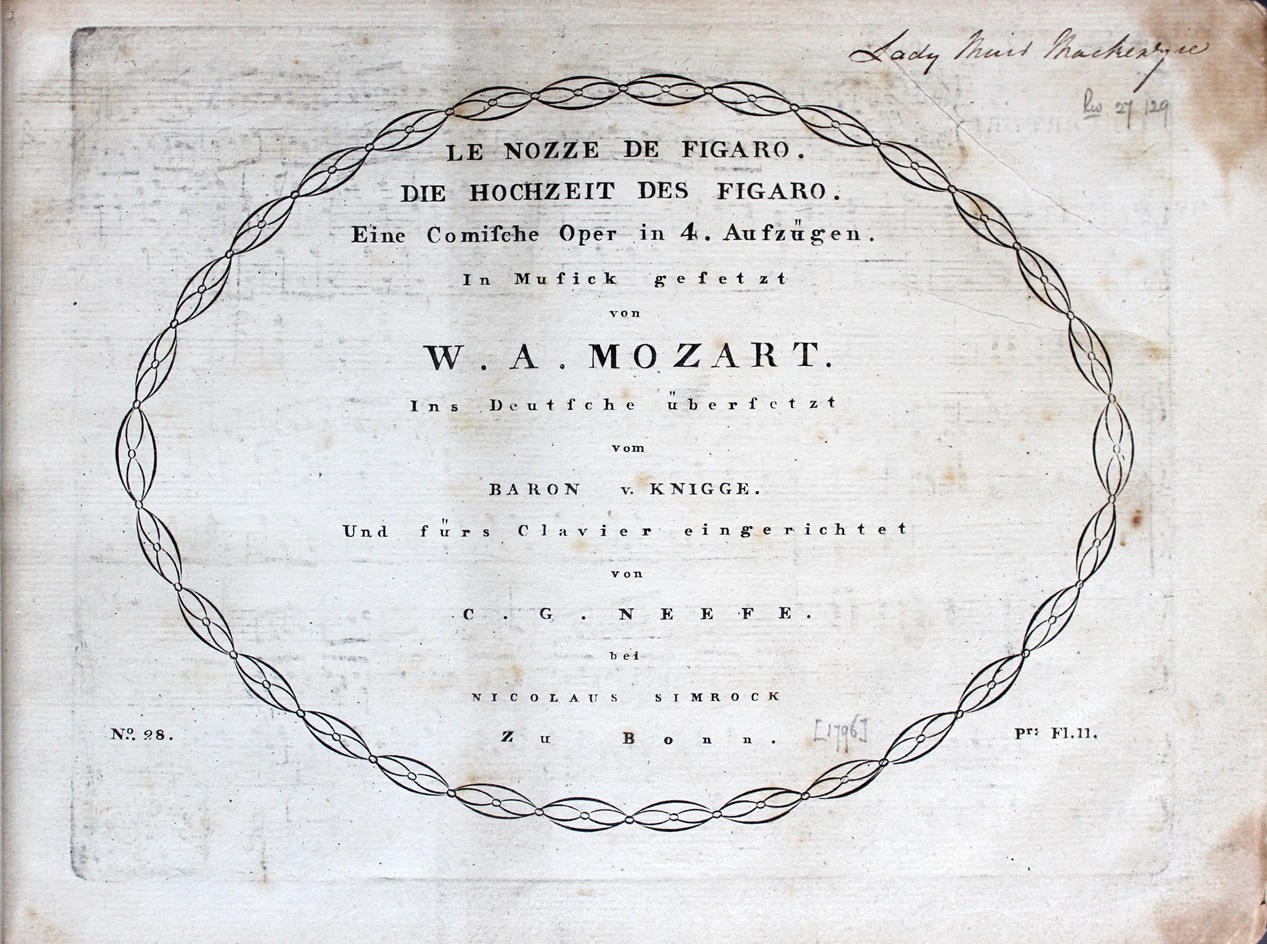
Le nozze di Figaro = Die Hochzeit des Figaro / Wolfgang Amadeus Mozart. Bonn: Simrock, ca. 1796. Rw.85.209

Wolfgang Amadeus Mozart, Le nozze di Figaro = Die Hochzeit des Figaro. (Bonn: Simrock, ca. 1796. Rw.85.209)

This German-Italian edition of Le nozze di Figaro, published in Bonn by the newly founded Simrock publishing house, was the first vocal score of the opera to appear in print. The title page of this copy bears the ownership mark of Lady Muir Mackenzie. This may plausibly be Georgina Muir Mackenzie (1833-1874), later Lady Sebright, a traveller and writer who, during a tour of the Austro-Hungarian Empire in 1858, was arrested as a spy with ‘pan-Slavistic tendencies’. She wrote about this experience and devoted much time during the following years to the promotion of Christianity in Turkey.

‘E Susanna non vien! ... Dove sono i bei momenti’ from Le nozze di Figaro / Wolfgang Amadeus Mozart. Manuscript, late 18th century. Rowe Ms 198

Wolfgang Amadeus Mozart, ‘E Susanna non vien! … Dove sono i bei momenti’ from Le nozze di Figaro. (Manuscript, late 18th century. Rowe Ms 198)

This manuscript, a contemporary transcription of ‘Dove sono i bei momenti’ from Act 3 of Le nozze di Figaro and its preceding recitative, is a relatively recent addition to the library’s collection, bought in 1981. In this aria, one of Mozart’s most exquisite, the Countess reflects on her marriage in the light of her husband’s presumed infidelity (‘Where are the lovely moments of sweetness and pleasure? Where have the promises gone that came from those lying lips?’). Naturally the opera ends with the blissful reunion of the Count and Countess.

Œuvres complettes. Cahier I, contenant VII sonates pour le pianoforte / Wolfgang Amadeus Mozart. Leipzig: Breitkopf & Härtel, ca. 1798. Rw.28.84/1

Wolfgang Amadeus Mozart, Œuvres complettes. Cahier I, contenant VII sonates pour le pianoforte. (Leipzig: Breitkopf & Härtel, ca. 1798. Rw.28.84/1)

Unlike Johann Sebastian Bach, whose greatness was not acknowledged (and whose music was not disseminated) until long after his death, Mozart’s popularity was immediate and enduring, and it was as early as 1798, seven years after his death, that the German firm of Breitkopf & Härtel began publishing a 17-volume edition of what purported to be the composer’s ‘Œuvres complettes’ [sic]. This volume of piano music contains among other works the K.331 sonata, with its familiar ‘Alla Turca’ finale.

Programme for Cambridge Grand Musical Festival. London: W. Glindon, 1824. Mn.22.7

Programme for Cambridge Grand Musical Festival. (London: W. Glindon, 1824. Mn.22.7)

This programme for a Grand Musical Festival ‘for the benefit of Addinbrooke’s [sic] Hospital (Upon the Occasion of the Opening of the New Wards)’ gives details of three ‘Grand Miscellaneous Concerts’ in the Senate House and two ‘Selections of Sacred Music’ at Great St Mary’s to be performed on 2, 3 and 5 July 1824. The opening concert featured a performance of Mozart’s Jupiter Symphony, and is most notable for the participation of the composer Gioachino Rossini (1792-1868), making a rare appearance as a vocalist. The Times review remarked upon Rossini’s comic talent, observing that in the reprise of the Cimarosa duet that closed the first half his partner Angelica Catalani was ‘literally convulsed with laughter, and unable to proceed in two or three places’.

GB

John Wilmot, Earl of Rochester: an online exhibition

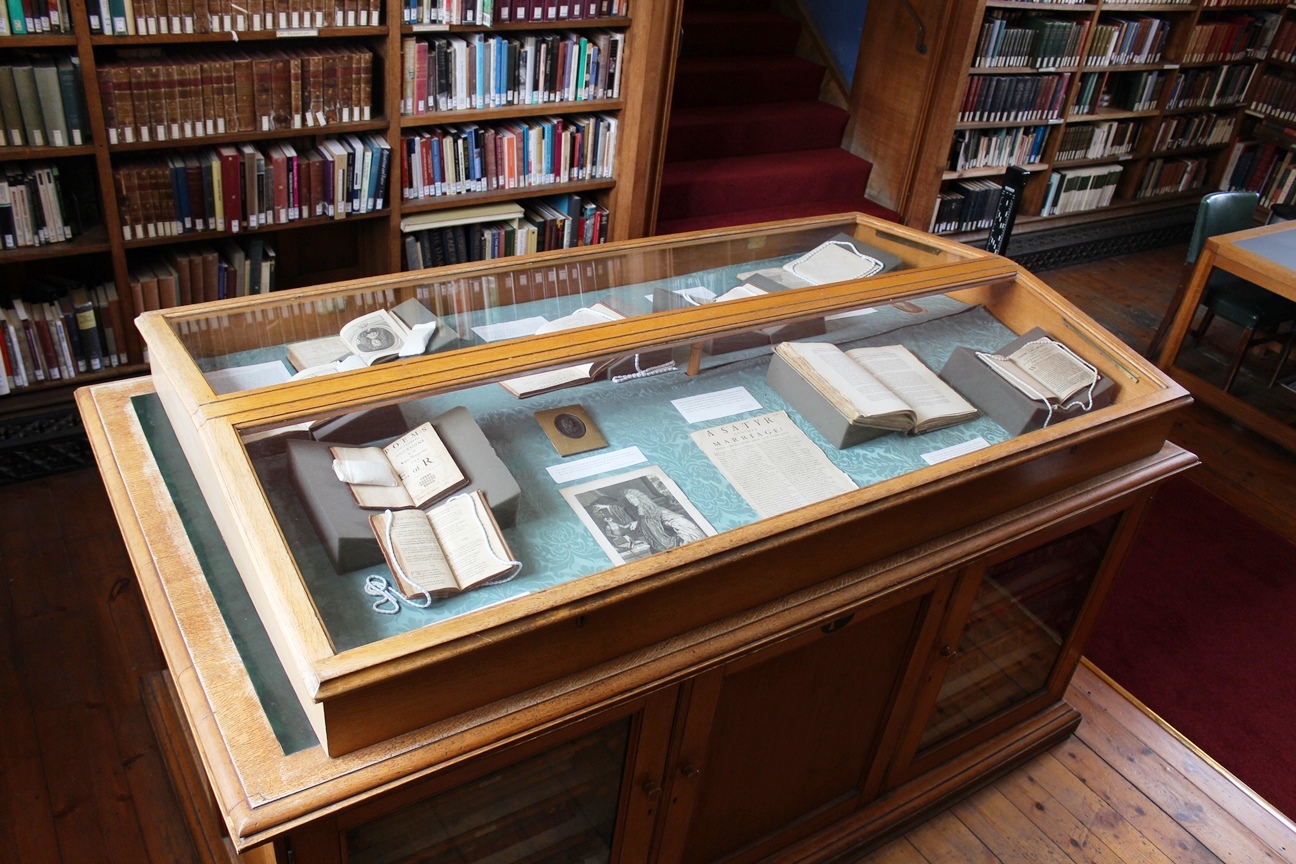
Exhibition case

Last Friday King’s College Library and Archives hosted an exhibition for the Open Cambridge weekend, focusing partly on Kingsman John Davy Hayward (1905-1965) and his collection of early editions of the works of John Wilmot, Second Earl of Rochester (1647-1680). These are some selected highlights of the exhibition.

H.14.1

Poems on Several Occasions by the Right Honourable the E. of R- – – (Printed at Antwerp, 1680). Hayward Bequest, H.14.1

Poems on Several Occasions was the first anthology of Rochester’s poems published after his death in July 1680. The false imprint (it was printed in London) and lack of a publisher’s name permitted unrestrained lewdness of content. By November of that year Samuel Pepys had a copy which he kept in the right-hand drawer of his writing desk as he considered it ‘unfit to mix with my other books’, adding ‘pray let it remain there, for as he is past writing any more so bad in one sense, so I despair of any man surviving him to write so good in another’.

H.10.5

A Satyr against Marriage ([London], undated). Hayward Bequest, H.10.5

Only a handful of Rochester’s works were printed during his lifetime, mainly satires published as broadsides. The most famous was his ‘A Satyr against Mankind’ (1679) which is a scathing denunciation of rationalism and optimism that contrasts human wickedness with animal wisdom. His ‘A Satyr against Marriage’ is written in a similar vein.

H.14.17 and H.14.16

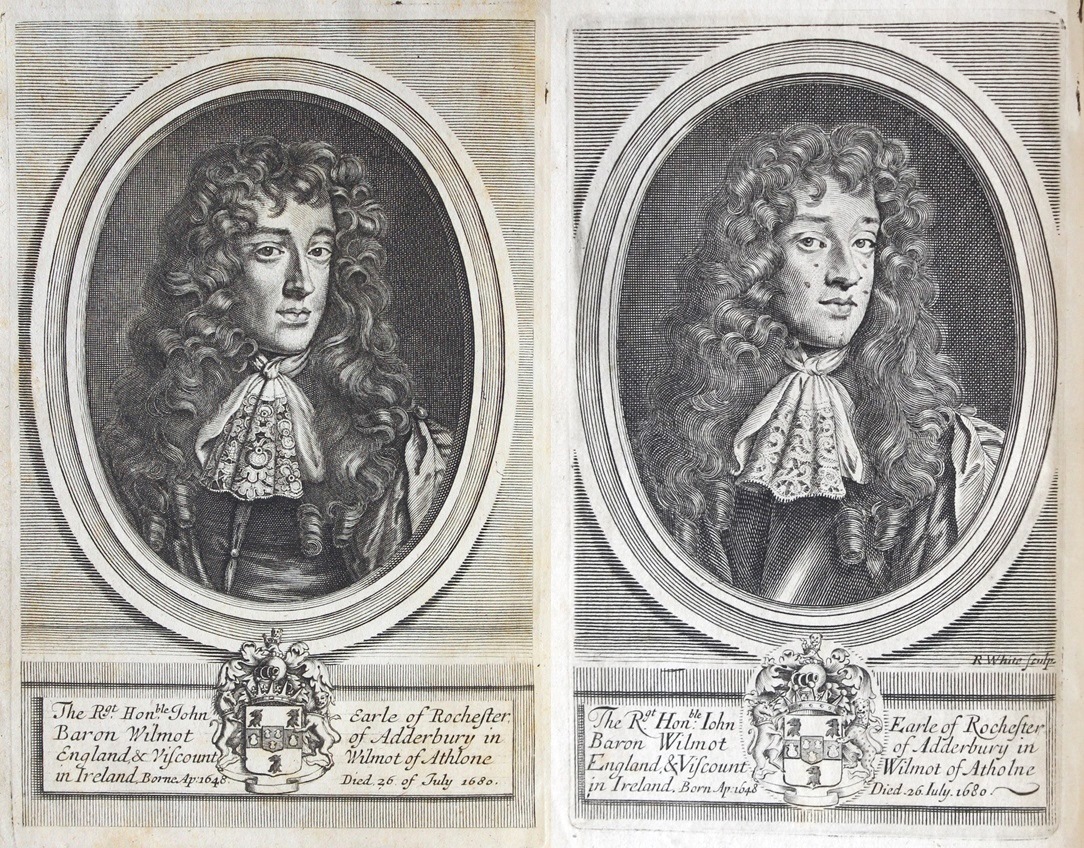
Frontispiece portraits from two editions of The Miscellaneous Works of the Right Honourable the late Earls of Rochester and Roscommon . . . by Mons. St. Evremont (London, 1707). Hayward Bequest, H.14.16 & H.14.17

Spot the difference: numerous editions of Rochester’s works appeared during the late seventeenth and eighteenth centuries, and their salacious content was gradually rewritten to reflect ‘respectable’ tastes. One of these portraits has been doctored, perhaps to suggest the venereal disease that would eventually lead to Rochester’s demise.

H.12.7

A Genuine Letter from the Earl of Rochester to Nell Gwyn. Copied from an Original Manuscript in the French King’s Library. Hayward Bequest, H.12.7

The actress Nell Gwyn, a long-time mistress of Charles II, is also believed to have been Rochester’s mistress, perhaps demonstrating his prominent position at court as well as his interest in the theatre. In 1673 Rochester had begun training Elizabeth Barry as an actress. She went on to become the most famous actress of her age and her relationship with Rochester produced a daughter. Whilst bearing all the hallmarks of Rochester’s style, some doubt the authenticity of this explicit (and anonymously published) letter from Rochester to Nell.

Engraving

Engraving of Rochester crowning his monkey. Hayward Bequest, no shelfmark

Monkey business: this engraving is one of the best known images of Rochester, and provided the title for Graham Greene’s biography of the author, Lord Rochester’s Monkey. In ‘A Satyr against Mankind’ Rochester writes:

Were I, who to my Cost already am
One of those strange, prodigious Creatures Man,
A Spirit free, to choose for my own Share,
What sort of Flesh and Blood I pleas’d to wear,
I’d be a Dog, a Monkey, or a Bear,
Or any thing, but that vain Animal,
Who is so proud of being Rational.

H.12.15

Broadside circular ([London], ca. 1676), Hayward Bequest, H.12.15

In 1676 Rochester fell into disfavour with the King and fled this time to Tower Hill where he impersonated a physician, one ‘Dr Alexander Bendo’. Under this persona he claimed skill in treating many conditions including ‘barrenness’, apparently gaining him access to many young ladies.

WARNING: This blog post was not suitable for children.

GB/JC/IJ