Tag Archives: Theatre

Moon Exploration: An Online Exhibition

We recently mounted a small exhibition on the subject of moon exploration, using items from our collections. In case you didn’t get to see it, here’s an online version of some of the exhibits.

First part of exhibition in display case

Second part of exhibition in display case

***

Johannes de Sacrobosco (born c.1195) was one of the most influential pre-Copernican astronomers, his treatise De sphaera mundi surviving in hundreds of manuscript copies dating from before the invention of the printing press. The earth is the centre of Sacrobosco’s model of the universe, with seven ‘planets’ (the moon, Mercury, Venus, the sun, Mars, Jupiter and Saturn in order) arrayed outwards from it. This 1581 print edition of the treatise features two volvelles (wheel charts with moving parts), this one depicting a lunar eclipse.

Johannes de Sacrobosco, Sphaera
Cologne: Maternus Cholinus, 1581
Shelfmark: Bury.SAC.Sph.1581

Volvelle in action from
Johannes de Sacrobosco, Sphaera
Cologne: Maternus Cholinus, 1581
Shelfmark: Bury.SAC.Sph.1581

***

The Dutch astronomer Nicolaus Mulerius’ Tabulae frisicae lunae-solares quadruplices of 1611 is a collection of solar and lunar tables according to the calculations of Ptolemy (2nd century AD), King Alfonso X of Castile (1221-1284), Nicolaus Copernicus (1473-1543) and Tycho Brahe (1546-1601) respectively. The four great astronomers are depicted on the illustrated title page, with their illustrious forefather Hipparchus (2nd century BC) at the head.
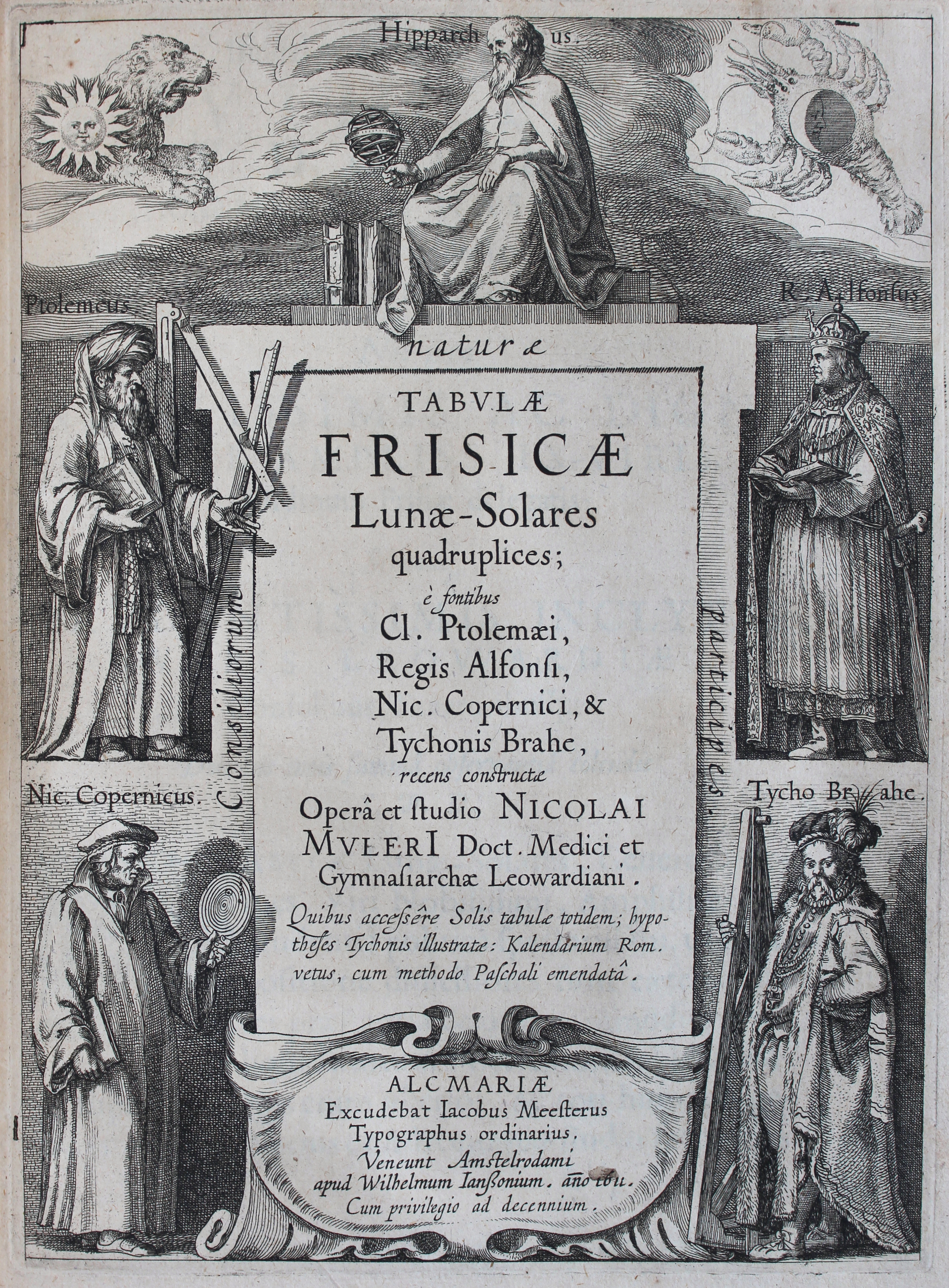
Nicolaus Mulerius, Tabulae frisicae lunae-solares quadruplices
Alkmaar: Jacob de Meester, 1611
Shelfmark: Keynes.Ec4.1.3/2

***

Galileo Galilei’s treatise of 1610 Sidereus nuncius (Sidereal Messenger) was the first published scientific work to draw on the newly invented telescope, called by the Latin word ‘perspicillum’ in Galileo’s text, and contains the astronomer’s observations on the moon and hundreds of formerly unknown stars he had been the first human to witness. Though initially controversial, Galileo found a supporter in Johannes Kepler, who verified Galileo’s findings independently and published his own confirmation of them a few months later. This first London edition of the work, published in 1653, includes Kepler’s Dioptrice, a treatise on the telescope, as an addendum. The illustrations of the lunar surface on these pages are Galileo’s own.

Galileo Galilei, Sidereus nuncius
London: James Flesher, 1653
Shelfmark: Keynes.Ec4.1.5/2

***

The natural philosopher John Wilkins (1614-1672) was a man of many parts: founder member of the Royal Society, Master of Trinity College, Cambridge, and finally Bishop of Chester. In The Discovery of a World in the Moone, first published in 1638, Wilkins put forward 13 propositions, drawing partly on the recent testimonies of Galileo and Kepler, in support of his theory ‘that the Moone may be a world’, including:

  • That the strangenesse of this opinion is no sufficient reason why it should be rejected, because other certaine truths have beene formerly esteemed ridiculous, and great absurdities entertained by common consent
  • That a plurality of worlds doth not contradict any principle of reason or faith
  • That the Moone hath not any light of her owne
  • That as their world is our Moone, so our world is their Moone

These two later editions contain an added fourteenth proposition, ‘That tis possible for some of our posteritie, to find out a conveyance to this other world; and if there be inhabitants there, to have commerce with them’, in which Wilkins suggests various possible methods of moon travel, including hitching a lift on a large winged animal (such as a ‘Ruck’, i.e. the roc, a mythological bird still believed in by many at the time) and inventing a flying chariot.

John Wilkins, The Mathematical and Philosophical Works of
the Right Reverend John Wilkins, Late Lord Bishop of Chester
London: John Nicholson; Andrew Bell; Benjamin Tooke; Ralph Smith, 1708
Shelfmark: Keynes.F.25.15
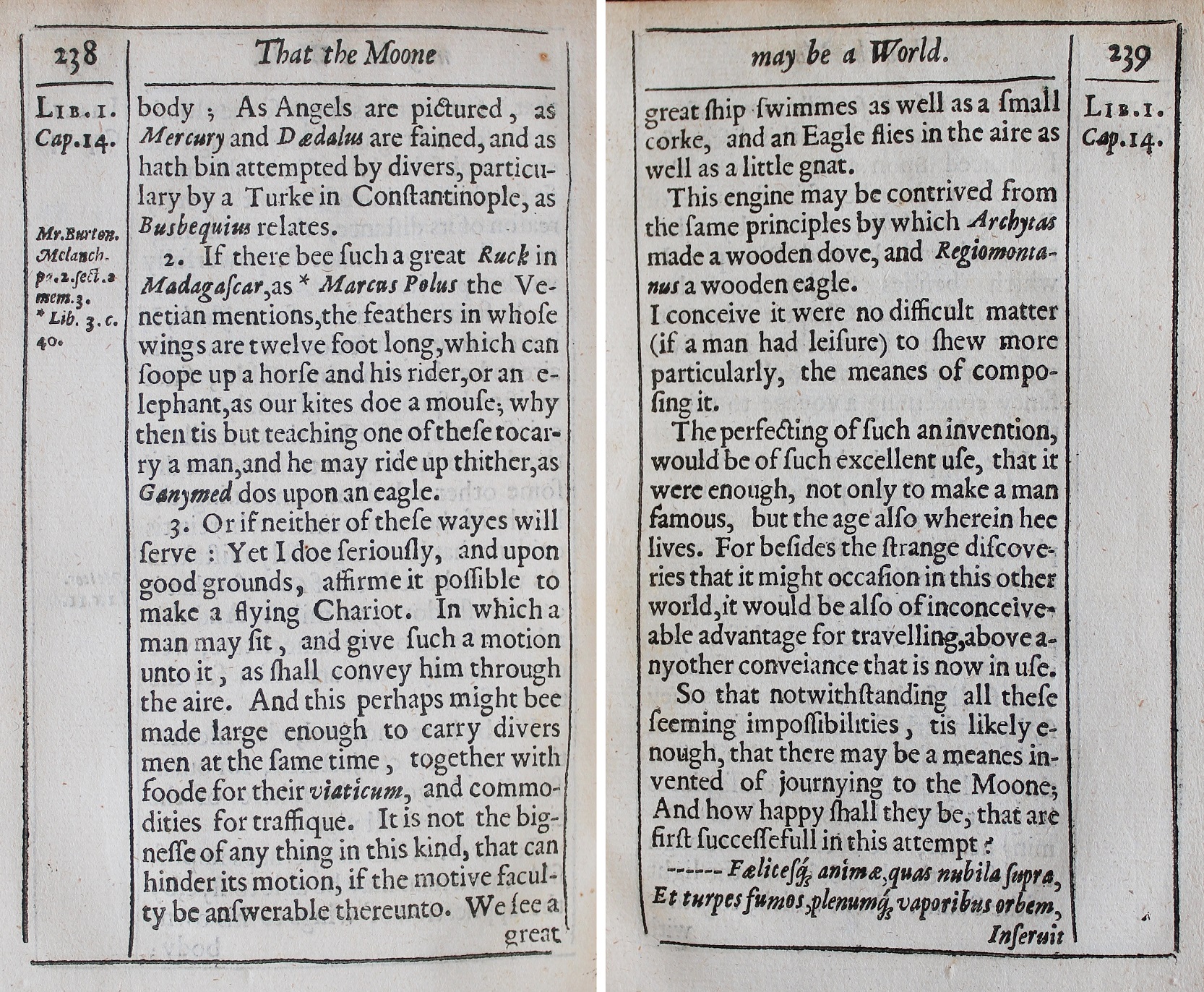
John Wilkins, A Discourse concerning a New World & Another Planet in 2 Bookes
London: John Maynard, 1640
Shelfmark: Keynes.D.5.69

***

The World in the Moon, a new opera staged in 1697 at the Dorset Garden Theatre in Whitefriars, by the Thames, featured songs by Daniel Purcell (brother of Henry) and Jeremiah Clarke. The opera’s book, by Elkanah Settle, was inspired by The Man in the Moone, a posthumously published narrative work by the Anglican bishop Francis Godwin (1562-1633) that purported to describe a ‘voyage of utopian discovery’ and is now considered one of the first works of science fiction. The stage directions in Settle’s text suggest the production must have been spectacular:

The Flat-Scene draws, and discovers Three grand Arches of Clouds extending to the Roof of the House, terminated with a Prospect of Cloud-work, all fill’d with the Figures of Fames and Cupids; a Circular part of the black Clouds rolls softly away, and gradually discovers a Silver Moon, near Fourteen Foot Diameter: After which, the Silver Moon wanes off by degrees, and discovers the World within, consisting of Four grand Circles of Clouds, illustrated with Cupids, &c. Twelve golden Chariots are seen riding in the Clouds, fill’d with Twelve Children, representing the Twelve Celestial Signs …

This song, ‘Smile then with a beam Devine’, is from the prologue of the opera, and contains a separate flute part at the foot of the page, common in music publications of the time, which could be used either to double the voice or to perform the song as an instrumental piece.

Songs in the New Opera, Call’d The World in the Moon
London: John Walsh; Joseph Hare, 1697
Shelfmark: Rw.85.1/9

***

Moon exploration has been a subject of science fiction for centuries, but properly took off (ha ha) in the 19th century with works such as Edgar Allan Poe’s short story ‘The Unparalleled Adventure of One Hans Pfaall’ (1835) and Jules Verne’s From the Earth to the Moon (1865).

This radical political pamphlet of 1820, ‘The Man in the Moon’, by the satirist William Hone, employs the conceit of a man travelling to the nation of ‘Lunataria’:

I lately dream’d that, in a huge balloon,
All silk and gold, I journey’d to the Moon,
Where the same objects seem’d to meet my eyes
That I had lately left below the skies …

The resemblance of Lunataria to his home planet enables Hone to pass comment on the political events of the day, including on the left the Peterloo Massacre of 1819. The illustration on the right shows the Army, the Church, the Prince Regent and the devil linked in dance, in a parody of the Holy Alliance that arose in Europe following the fall of Napoleon. The illustrator is George Cruikshank, who was later a friend of Charles Dickens and provided illustrations to his early novels.
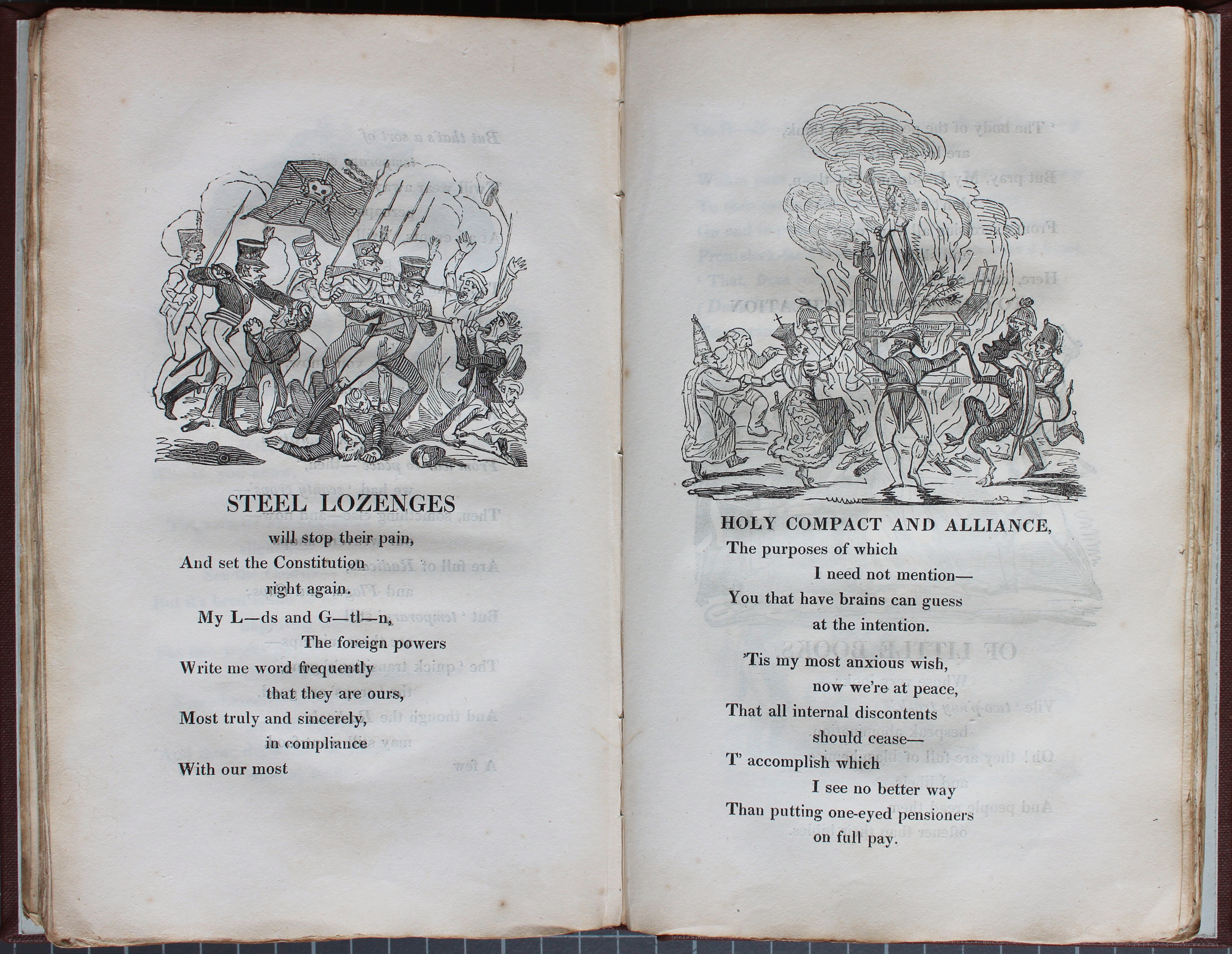
William Hone, Hone’s Select Popular Political Tracts
London: William Hone, [1820s]
Shelfmark: G.15.42

***

The most enduring creation of the illustrator Jan Pieńkowski (1936-2022, KC 1954) was the Meg and Mog series of books, which he wrote over a period of more than 40 years in collaboration first with the author Helen Nicoll and, after her death in 2012, with his partner David Walser. Meg on the Moon, an early entry in the series, tells the story of the witch Meg and her cat Mog going to the moon for Mog’s birthday treat.
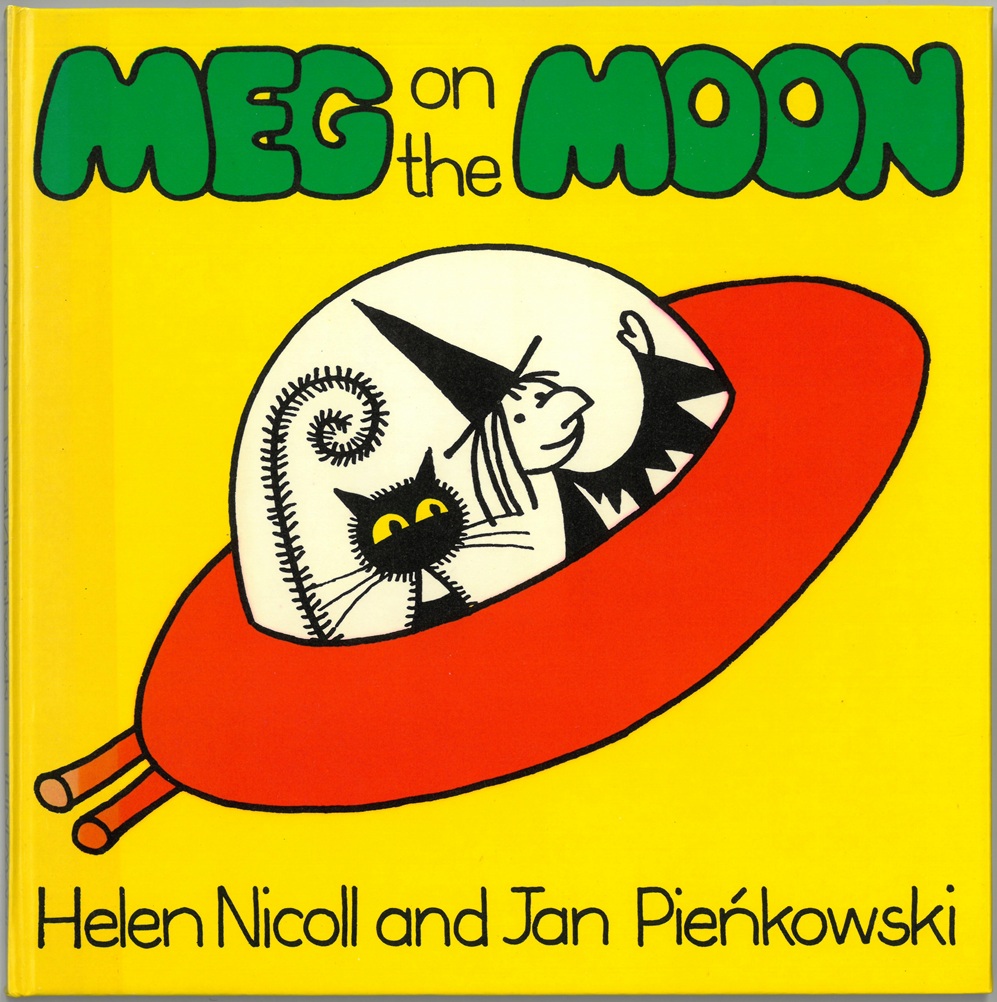
Helen Nicoll & Jan Pieńkowski, Meg on the Moon
London: Heinemann, 1973
Shelfmark: Fiction K Pie/6

GB

A Fairy Tale

To continue our series of blog posts marking the 400th anniversary of Shakespeare’s First Folio, now seems a particularly opportune time to take a look at A Midsummer Night’s Dream, written in the mid-1590s. The text of the play in the First Folio of 1623 is based mainly on that of the second quarto edition of the play, printed in 1619.

The opening page of A Midsummer Night’s Dream in the First Folio (Thackeray.D.38.2)

Sadly at King’s we have no copy of either quarto, but we do have an 18th-century curiosity: The Favourite New Songs & Duet in the Fairy Tale, composed by Michael Arne (son of Thomas ‘Rule, Britannia!’ Arne), and printed by Charles and Samuel Thompson in St Paul’s Church Yard, London, in 1764.

Title page of The Favourite New Songs & Duet in the Fairy Tale (Rw.85.118/3)

To put The Fairy Tale in context, we need to go back to 1760s London. Actually, let’s go back a century earlier, to Monday 29 September 1662, when Samuel Pepys went out on the town:

I sent for some dinner and there dined, Mrs. Margaret Pen being by, to whom I had spoke to go along with us to a play this afternoon, and then to the King’s Theatre, where we saw “Midsummer’s Night’s Dream,” which I had never seen before, nor shall ever again, for it is the most insipid ridiculous play that ever I saw in my life. I saw, I confess, some good dancing and some handsome women, which was all my pleasure.

(Is there an entry in Pepys’ diaries where he doesn’t mention handsome women? I salute the horniest man of the English Restoration.)

In case your memory needs refreshing, A Midsummer Night’s Dream has several interconnected plots, chief among them a dispute between Oberon and Titania, King and Queen of the fairies, a romantic intrigue between four young lovers, Helena, Hermia, Demetrius and Lysander, and the rehearsal of a play by a group of amateur actors (described by the fairy Puck as ‘rude mechanicals’).

The literary scholar George Winchester Stone, Jr., writing in 1939, suggests that the unorthodox mixture of realistic material (the mechanicals), classical mythology and fairy lore was ‘bound to fail in presentation’, which may account partly for the variety of reinventions of the play in the decades that followed Pepys’ disappointing visit to the King’s Theatre.

By the mid-18th century the Theatre Royal, Drury Lane was thriving under the command of actor-manager David Garrick. Taking his cue from the pageants fashionable at the time, Garrick’s first Theatre Royal production of A Midsummer Night’s Dream, in 1755, took the guise of an opera called The Fairies, which boasted music by John Christopher Smith (advertised as ‘pupil to Mr. Handel’), two Italian singers for the arias, and a troop of boys for the fairies.

Garrick’s collaborator on this production was the dramatist George Colman (sometimes known as ‘George the First’ to distinguish him from his identically named son), who seems to have been the driving force behind The Fairy Tale, first staged on 26 November 1763. Whereas The Fairies of 1755 focused largely on the two pairs of lovers and cut the mechanicals entirely, The Fairy Tale, judging by the published script, is the reverse. The lovers are nowhere to be seen, and the script is only about a quarter of the length of A Midsummer Night’s Dream as it appears in the First Folio.

The reason for this drastic abridgement may have been to make room for instrumental and vocal numbers. The four songs that appear in the published score of The Favourite New Songs & Duet in the Fairy Tale are three solo arias, ‘Kingcup, daffodil and rose’ (‘sung by Miss Wright’), ‘Yes, yes, I know you, you are he’ (ditto), and ‘Come follow, follow, follow me’ (‘sung by Masr. Rawworth’), along with a duet, ‘Wellcome, wellcome to this place’ (sung by both together), none of them to texts by Shakespeare.

‘Kingcup, daffodil and rose’ from The Favourite New Songs & Duet in the Fairy Tale (Rw.85.118/3)

The script contains about fourteen songs or likely songs. These include a number of verses from the original play, such as ‘Over hill, over dale’, ‘You spotted snakes’, ‘Up and down, up and down’ and ‘Flower of this purple dye’, and also, to round things off, ‘Orpheus with his lute’ (borrowed from Henry VIII) and ‘Sigh no more, ladies’ (borrowed from Much Ado about Nothing). Why do none of these more familiar texts appear in the Favourite Songs volume? Perhaps because in the production they were sung to pre-existing and already popular musical settings.

Most of the songs in The Fairy Tale, even those belonging to particular characters in Shakespeare’s play, are assigned to either ‘1st Fairy’ (Miss Wright) or ‘2nd Fairy’ (Master Rawworth), which suggests these two were specialist singers. The identity of Master Rawworth (called Raworth in the play text) is hazy, but Miss Wright is undoubtedly the soprano Elizabeth Wright, whom Arne eventually married in November 1766. Her performance must have been a success: over the next three and a half years The Fairy Tale received forty-one performances at the Theatre Royal, and in 1777 it was revived at the Haymarket Theatre, which had just been bought by Colman.

The end of Michael and Elizabeth Arne’s marriage has a hint of Shakespearean tragedy about it: in 1768, perhaps emboldened by their joint success at the Theatre Royal, where Elizabeth had become a leading lady, Arne built a laboratory at Chelsea for the study of alchemy, but went bankrupt and found himself in debtors’ prison; Elizabeth died the following year, with the writer Charles Burney, a friend of the family, claiming that Arne had ‘sung [her] to death’. Arne himself died destitute in 1786.

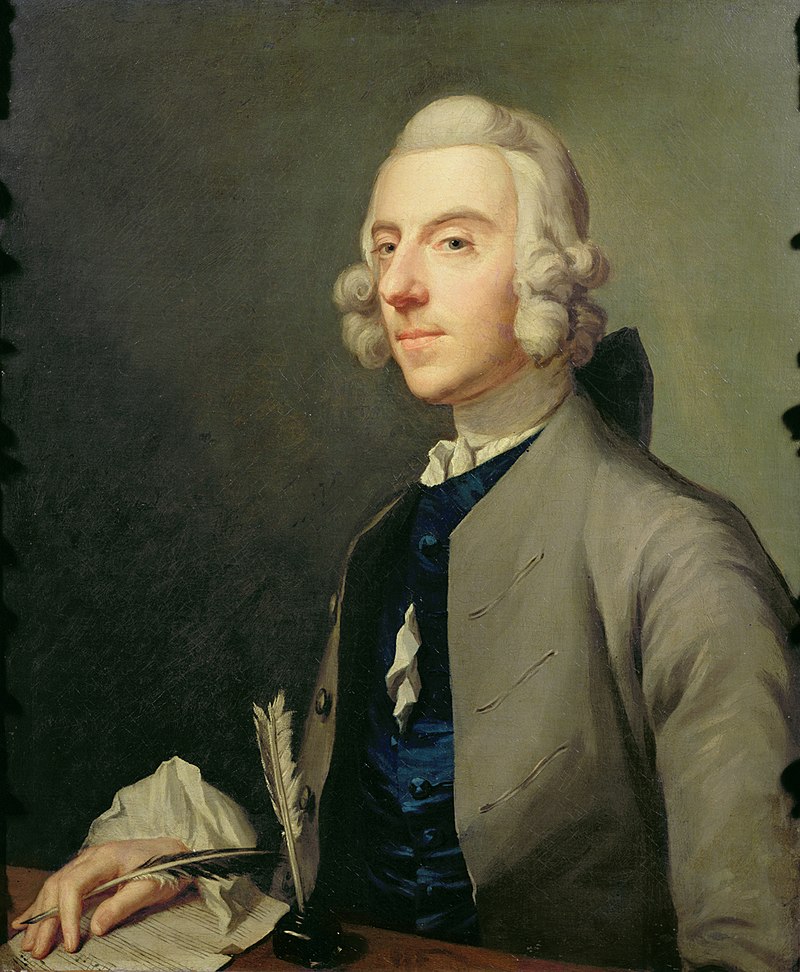
Portrait of Michael Arne in happier days by Johan Zoffany, c. 1765. Image from Wikimedia Commons

To end on a sunnier note, the Favourite Songs volume ends with an appendix containing transposed ‘guittar’ parts for all songs not written in ‘proper’ keys. So on page 18 we find a guitar part in C for ‘Kingcup, daffodil and rose’, originally written in the unfriendly key of E flat. The presence of guitar parts brings home the purpose of this publication: to enable performance outside the context of the play. It is pleasing to think of these modest but attractive songs having a life beyond Drury Lane, perhaps at public pleasure gardens (such as Ranelagh Gardens in Chelsea, where Michael Arne first saw Elizabeth Wright sing in 1763), or even in the home.

Guitar part for ‘Kingcup, daffodil and rose’ from The Favourite New Songs & Duet in the Fairy Tale (Rw.85.118/3)

References

Cholij, I.B. (1995). Music in Eighteenth-Century London Shakespeare productions. PhD thesis, King’s College, University of London.

Parkinson, J.A. (2001). ‘Arne, Michael.’ Grove Music Online [subscription only]

Stone, G.W., Jr. (1939). ‘A Midsummer Night’s Dream in the Hands of Garrick and Colman’. PMLA, 54, 467-482.

You can browse King’s College’s First Folio on the Cambridge University Digital Library here, and it also features on the First Folios Compared website where you can compare it side by side with other digitised copies of the First Folio.

GB

Theatrical connections: Gertrude Kingston and George Bernard Shaw

In 1941, Kingsman Judge Edwin Max Konstam C.B.E. donated to the College a collection of books and papers from the library of his late sister, the acclaimed actress Gertrude Kingston (1862–1937).

Portrait of Gertrude Kingston

Gertrude Kingston (1862–1937) Portrait by Sidney Starr, 1888

Kingston (born Gertrude Angela Kohnstamm) had many strings to her bow. Passionate about art from an early age, she studied painting in Paris and Berlin, going on to publish three illustrated books. She developed an interest in lacquer  work and exhibited her creations in this medium in New York in 1927. She was a popular public speaker, using this talent initially on behalf of the women’s suffrage movement, and later in life also for the Conservative Party.  She taught public speaking to others, and wrote many journalistic articles.

However, it was as an actress that Kingston was best known. Her acting career moved from amateur involvement as a child to professional work after her marriage in 1889, necessitated by deficiencies in her husband’s income.  Adopting Kingston as her stage name, she made a reputation for herself on the London stage, acting in Shakespearean and classical as well as contemporary roles. One of the most notable of these roles was as Helen of Troy in Euripides’ The Trojan Women. Kingston undertook this role at the suggestion of playwright George Bernard Shaw (1856–1950).

Kingston appeared in a number of productions of Shaw’s plays, and seems to have been highly regarded by him. The pair were in regular correspondence, as the large number of letters from Shaw to Kingston amongst the papers given to the College by her brother testify. Kingston also owned several copies of early published editions of Shaw’s plays, some of which are likely to have been her working copies, since they contain performance annotations.

One of the earliest of Shaw’s plays in Kingston’s collection is a first edition of Press Cuttings dating from 1909. This play is a satire of the anti-suffragist lobby, so is likely to have appealed to her feminist sensibilities. The cover has a label proclaiming “Votes for women”:

Cover of the play "Press cuttings" by George Bernard Shaw

Cover of the first edition of George Bernard Shaw’s play Press cuttings London, 1909. Shelfmark N.28.5

The title character of Shaw’s play Great Catherine was written specifically for Kingston,  and in November 1913 she duly starred in its first production at the Vaudeville Theatre in London.

Great Catherine cast note

Note detailing the cast of the first performance of Great Catherine in 1913, with Gertrude Kingston in the starring role. From the flyleaf of Great Catherine, London, 1914. Shelfmark N.28.4

Shaw’s inscription on the half-title page of Kingston’s copy of Heartbreak House, Great Catherine, and playlets of the war identifies her closely with the lead role and underlines the high regard he had for her:

Inscription by George Bernard Shaw

Half-title page of Heartbreak House, Great Catherine and playlets of the war, London, 1919. Shelfmark N.28.2. Shaw’s inscription reads: “To Gertrude Kingston, Catherine the second, but also Catherine the first (and the rest nowhere) from Bernard Shaw. 10th Oct 1919”

Kingston’s personal copy of Great Catherine is an early unpublished rough proof:

Rough proof copy of "Great Catherine" by Bernard Shaw

Great Catherine, London, 1914. Unpublished proof copy. Shelfmark N.28.4

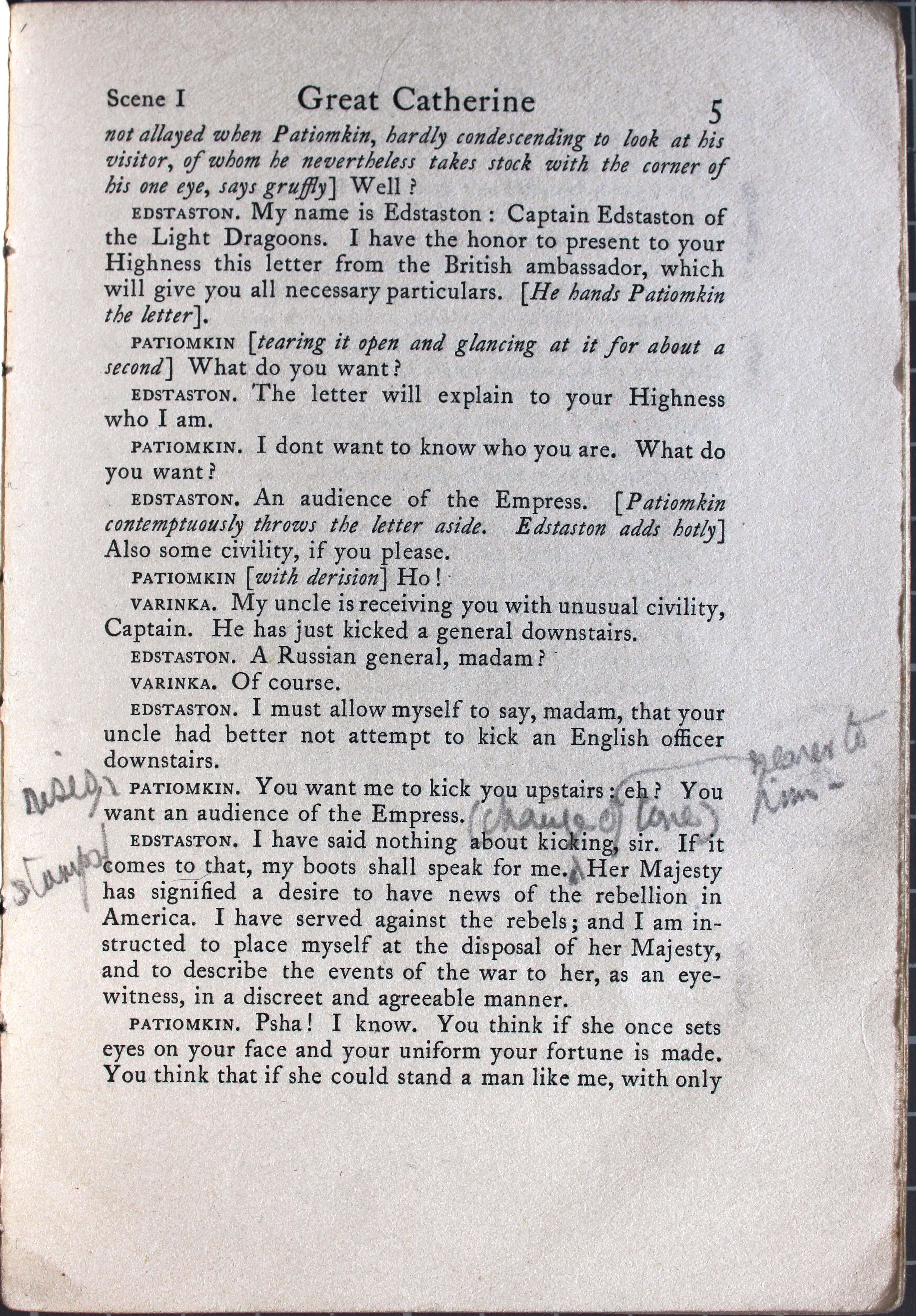
This is one of the volumes containing pencil annotations within the text, likely to have been made by Kingston in order to help guide her performance:

Textual annotations

Annotations to page 5 of Great Catherine, London, 1914. Shelfmark N.28.4

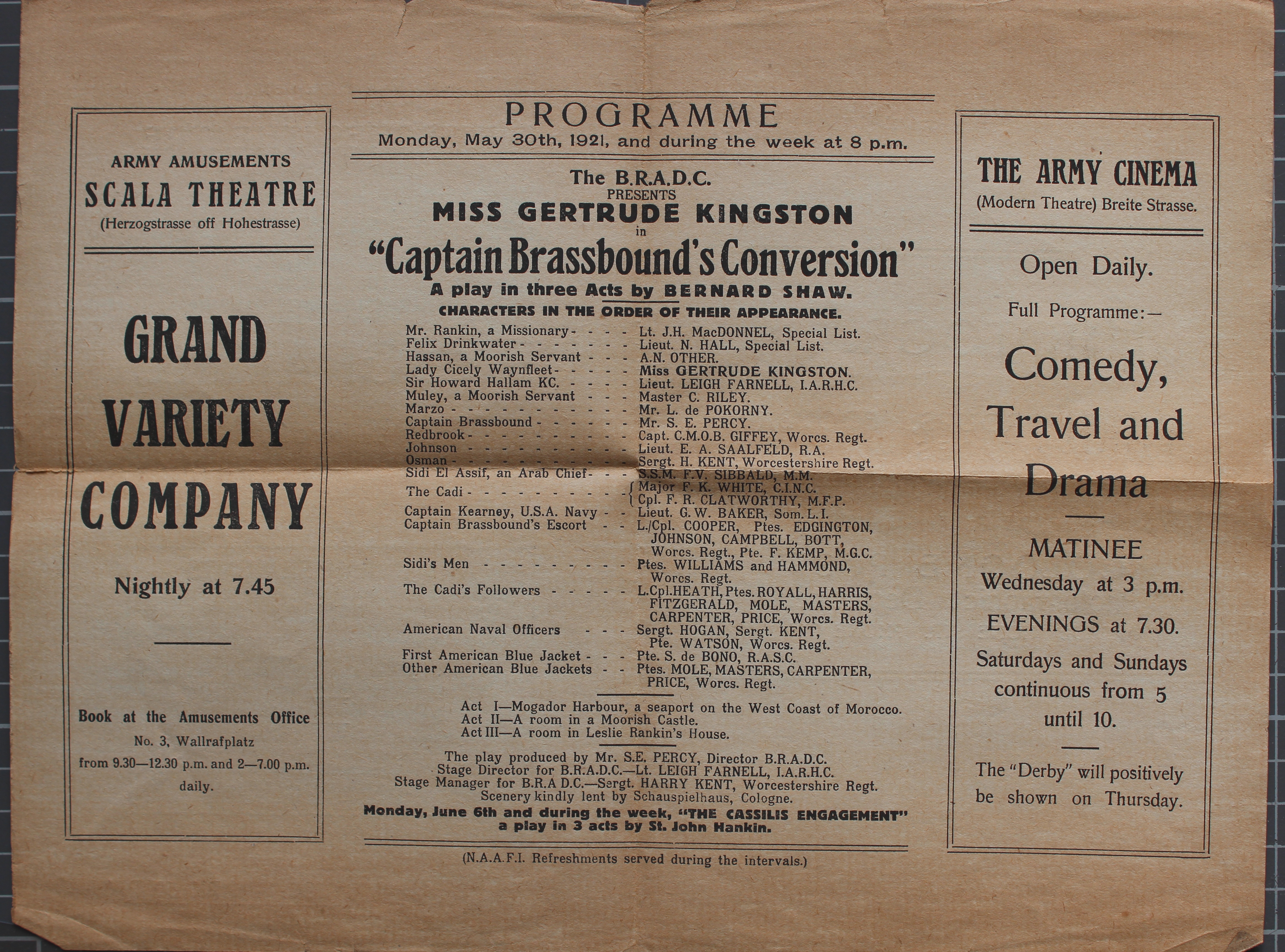
In 1921 Gertrude Kingston joined the British Rhine Army Dramatic Company in Germany. She reprised the role of Lady Waynflete in Shaw’s 1901 play Captain Brassbound’s Conversion, having first played this character in 1912. The front cover of Kingston’s copy of this play gives instructions in several languages on where it should be returned if she should happen to misplace it:

Front cover of Captain Brassbound's conversion

Front cover of Captain Brassbound’s Conversion, London, 1920. Shelfmark N.28.6

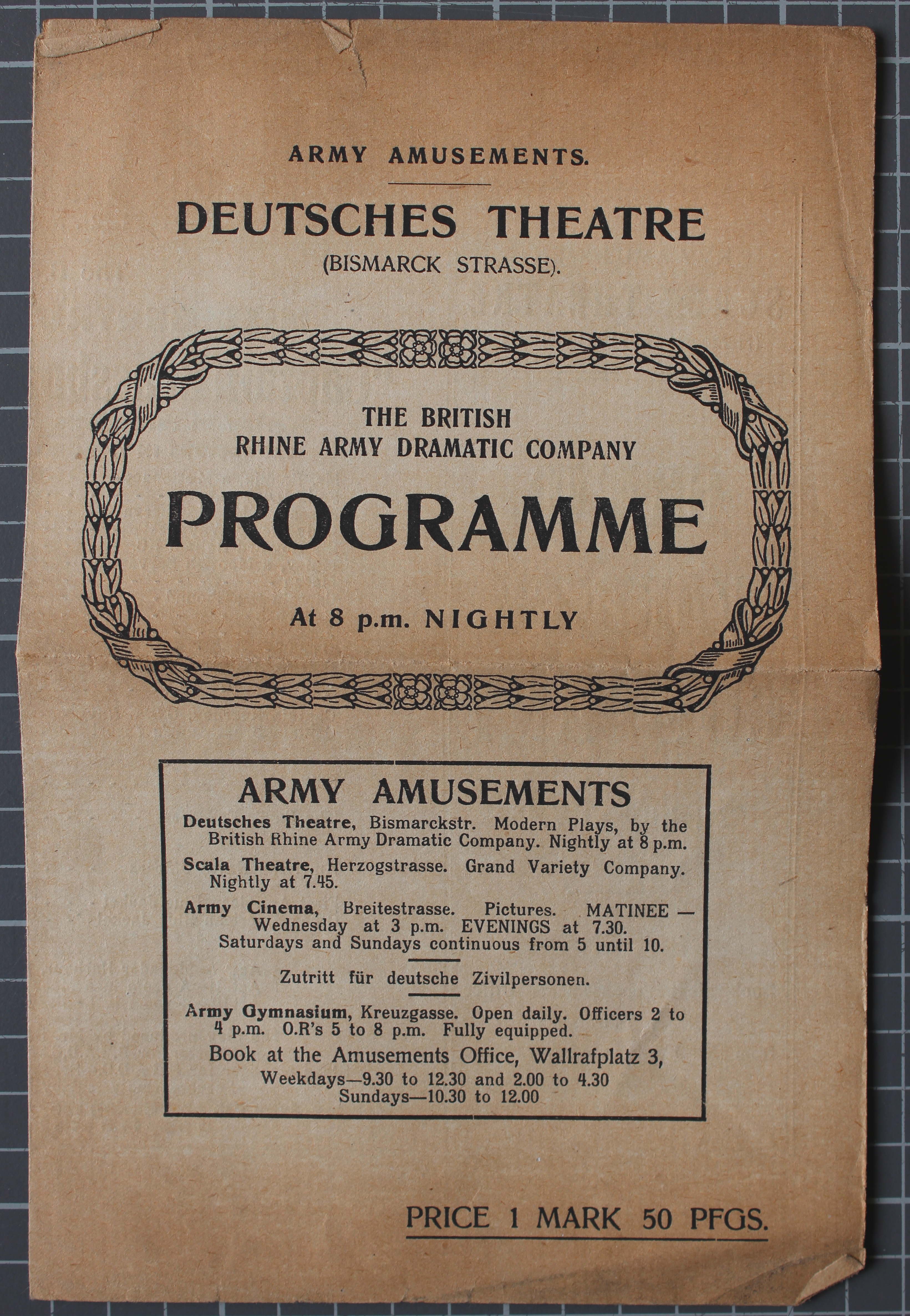
Tucked inside the play is a leaflet advertising this production and other forthcoming “Army amusements” at other theatres:

Theatrical leaflet

Front cover of Army Amusements leaflet, 1921

Theatrical leaflet

Centre-page spread of Army Amusements leaflet, 1921

Collections such as these provide a fascinating glimpse into a long-vanished theatrical world.

AC

References

Kate Steedman, “Kingston, Gertrude [real name Gertrude Angela Kohnstamm] (1862–1937), actress.” Oxford Dictionary of National Biography. 23 Sep. 2004; Accessed 16 Apr. 2020.