Tag Archives: Rowe Music Library

Gibbs, Groats and Gowns: Celebrating the Tercentenary of the Gibbs Building

James Gibbs, A Book of Architecture, Containing Designs of Buildings and Ornaments (London: 1728), frontispiece. (Shelfmark: F.27.7)

Three hundred years ago today, on the 25th March 1724, the foundation stone was laid for a new building in King’s, known today as the Gibbs Building, named after the architect James Gibbs (1682–1754) who designed it. We are fortunate to know quite a lot about the events of that day because of the survival of certain items in the special collections in King’s Library.

Proceedings began with the sermon before the university in a special service in Chapel given by senior King’s fellow Gregory Doughty (ca. 1690–1742, KC 1706).  We know exactly what the sermon was, because it was published, and the publication also reveals other aspects of the service and the ceremony which followed.

A Sermon Preached Before the University of Cambridge in King’s College Chapel on the 25th of March 1724 … by Gregory Doughty (Cambridge, 1724), title page. (Shelfmark: C.5.44.(3.)

A Sermon Preached Before the University, page 3. (Shelfmark: C.5.44.(3.)


The subject of the sermon was ‘Luke II.14 Good Will Towards Men’, and much space was given to extolling the virtues of acts of benevolence, particularly that of founders and patrons of learned societies such as Cambridge colleges. It being ‘Founder’s Day’ (it was celebrated on 25th March at the time), several passages praise Henry VI, the founder of King’s: ‘We must account it sure as well the peculiar felicity, as glory of this society, to be bless’d with such a sovereign for its founder; who prefer’d the honor and service of his Maker to all the gay and flattering privileges of Crown’, writes Doughty.

A Sermon Preached Before the University, appended section ‘The State of King’s College in Relation to the Old Fabrick’. (Shelfmark: C.5.44.(3.)

Appended to the sermon is a document entitled ‘The state of King’s College, in relation to the old fabrick, together with some account of the foundation of a new one.’ This document points out that the new building was long overdue, given the old buildings were intended only for Henry’s original foundation of a community consisting of ‘a rector and 12 scholars’ which he had soon abandoned in favour of a community of ‘a Provost and 70 fellows and scholars’. Towards the end of the document there is an interesting account of the foundation ceremony which took place immediately after the service in Chapel:

Accordingly (the Ground having been first laid out, and the Foundation dug for the West-side of the Square, pursuant to a PLAN design’d by Mr Gibbs) on 25th Day of March last, being the Anniversary of Commemorating the Founder, and the University being met, as usual, at King’s College Chappel; after the Sermon, and an Anthem compos’d on the Occasion; The Provost, accompanied by the Noblemen, Heads of Colleges, Doctors, and other Members of the University, proceeding to the Corner, where the first Stone was to be laid, bespoke Success to the Undertaking in the Form which follows, with such Actions, at proper Intervals, as the Words themselves express, or are customary in such Kinds of Ceremony.

The words ‘in the form which follows’ were printed in Latin at the end of the sermon publication, and reveal a number of interesting details, most notably that some of the words were engraved on a bronze plate and, together with some gold, silver and bronze coins, were put into the foundation stone of the building. The story becomes more intriguing when the text goes on to explain that ‘If in future years a student of ancient times, while searching through the rubble, unearths this bronze plate encased in stone, may he know that this stone was destined for the construction of this College in the times of Henry VI.’

A Sermon Preached Before the University, final two pages comprising the Latin words read out at the foundation ceremony together with an English translation. (Shelfmark: C.5.44.(3.)

The famous clergyman and antiquary William Cole (1714–1782), if his version is to be trusted, sheds light on this stone that had been ‘destined for the construction of this college in the times of Henry VI’:

When the news came of the Founder’s deposition the labourers who were sawing the stone in halves and not having finished it, imagining that there would be no further proceeding in the design by his successors left of their work and the stone remaining half sawed in two. This was always the story about the stone which I myself have seen before any design of making the use of it which was afterwards thought on; and a cut of that stone is in the print of this chapel engraved by David Loggan. In the cleft part was the plate and inscription with ye different coins put. (See British Library, Add MS 5802, fol. 110)

Here is Loggan’s engraving. You can see the stone, partly sawn in half, on the grass on the right-hand side of what was then known as ‘Chapel Yard’:

King’s College Chapel engraved by university engraver David Loggan (1634–1692) (Reference: JS/4/10/38)

Gibbs, A book of Architecture, plate 32 showing the plan for the ‘West Front’ (the Gibbs building) and the front court. (Shelfmark: F.27.7)

Regarding the gold, silver and bronze coins that were enclosed with the engraved bronze plate, there is a centuries-old tradition of burying contemporary coins in the foundations of new buildings in the belief that it would bring good luck and prosperity. How tantalising it is to know that these coins and the engraved plate are buried in the foundations of the Gibbs building but we are not able to see them today! William Cole also tells us that when digging the foundations of the Gibbs building apparently a number of coins from the reign of Henry V were discovered:

at ye digging of the foundation for the aforesaid new building a large quantity was supposed, tho’ not 100 were owned to have been found by ye workmen & labourers, who were thought to have disposed of them otherwise, of gold coins of King Henry ye 5th & others, which were as was surmised, hid by ye people in those troublesome times; for where ye present new building stands, was formerly a large street, call’d Mill Street … These coins were sent by ye College to ye benefactors to this building as presents, & a very few remain in ye Treasury as a memorial. (BL Add MS 5802, fol. 115)

Indeed, the following is a photograph of a coin (a groat) from the reign of Henry V which is still in the College’s collections, and is perhaps one of those dug from the ground when laying the foundations for the Gibbs building:

A silver groat from the reign of Henry V from the collections of King’s Library.

The conclusion of the inscribed Latin words printed with the sermon which discusses ‘literary monuments more lasting than this bronze plate’ (‘Monumenta Literaria, Hoc Aere perenniora . . .’) is a clear allusion to Horace’s Odes 3.30 which begins ‘I have completed a monument more lasting than bronze . . .’ (‘Exegi monumentum aere perennius’). The author will have known his audience, and this allusion to Horace will not have been lost on them.

We saw above that ‘an Anthem compos’d on the occasion’ was mentioned in the published sermon, and this brings us to our second item in the Library’s special collections. The anthem in question is ‘Hearken unto me ye holy children’ by the composer Thomas Tudway (before 1650–1726), professor of music in the university and organist at King’s from 1670 until 1726. The original manuscript is held in the Rowe Music Library in King’s. It is a verse anthem, scored for three soloists and choir, and the copy in King’s Library is clearly a presentation copy that begins with a dedication to Provost Andrew Snape (1675–1742, KC1690) and the fellows of the College:

Thomas Tudway, Hearken Unto Me ye Holy Children, dedication page. (Rowe MS 108)

The text of the anthem is made up of a variety of verses from several books of the Bible including Ecclesiastes, Ezra and the Psalms.  Its sentiments resonate with the themes of the sermon as you would expect:

Blessed be the Lord God, of our fathers, who hath put such a thing into the King’s heart, to build this house.

to be a Father to the Fatherless, to feed them with the bread of understanding, & give them the waters of wisdom to drink

His name shall endure for ever, His name shall remain under the sun among the posterities
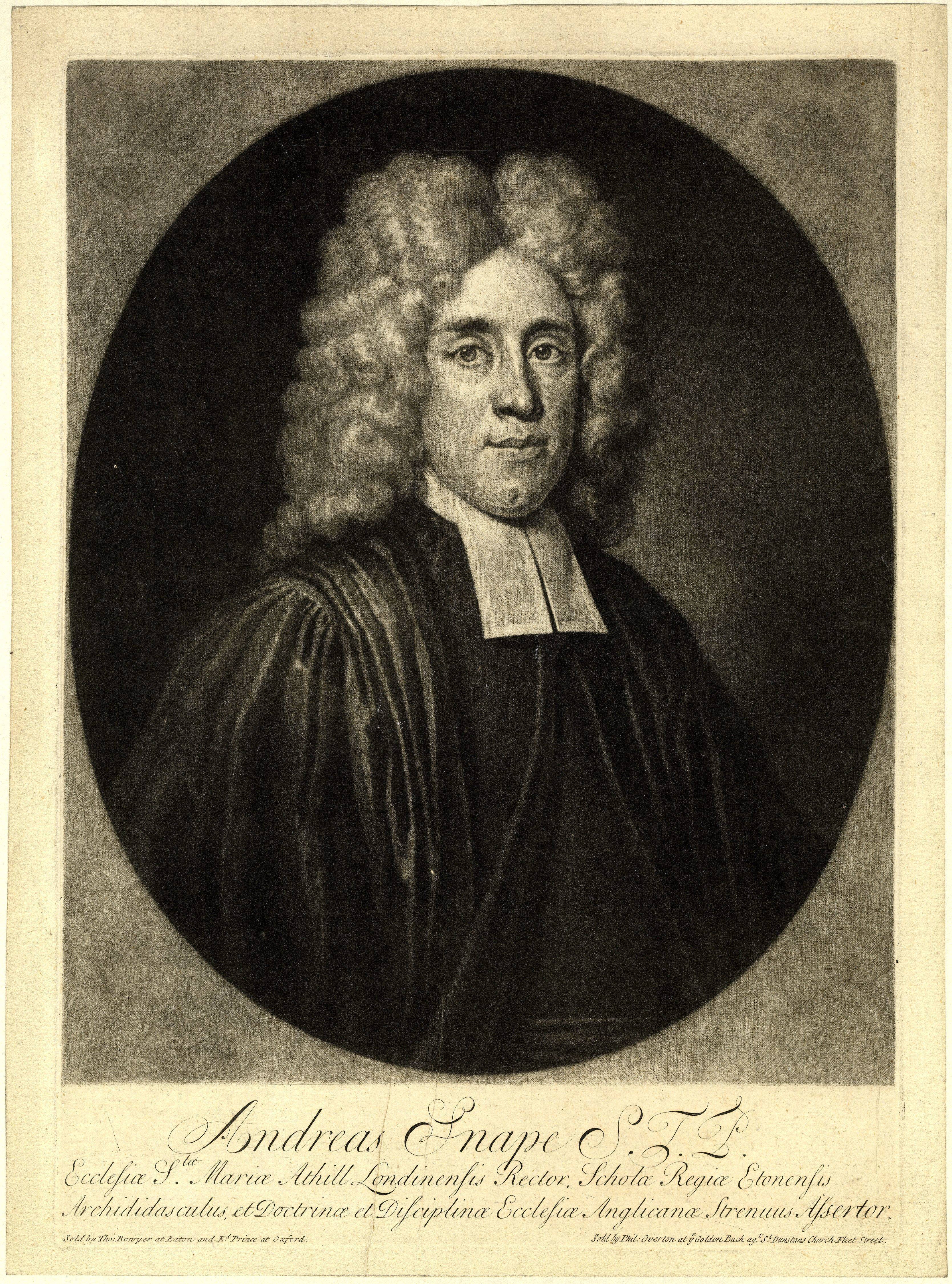
Provost Andrew Snape (engraving by John Faber, between 1696 and 1721. King’s Archive reference: KCAC/1/4)

Thomas Tudway holding a page of an anthem he has composed for King’s College Chapel. (Bate Collection of Musical Instruments, University of Oxford).


Tudway, Hearken Unto Me, opening. (Shelfmark: Rowe MS 108)
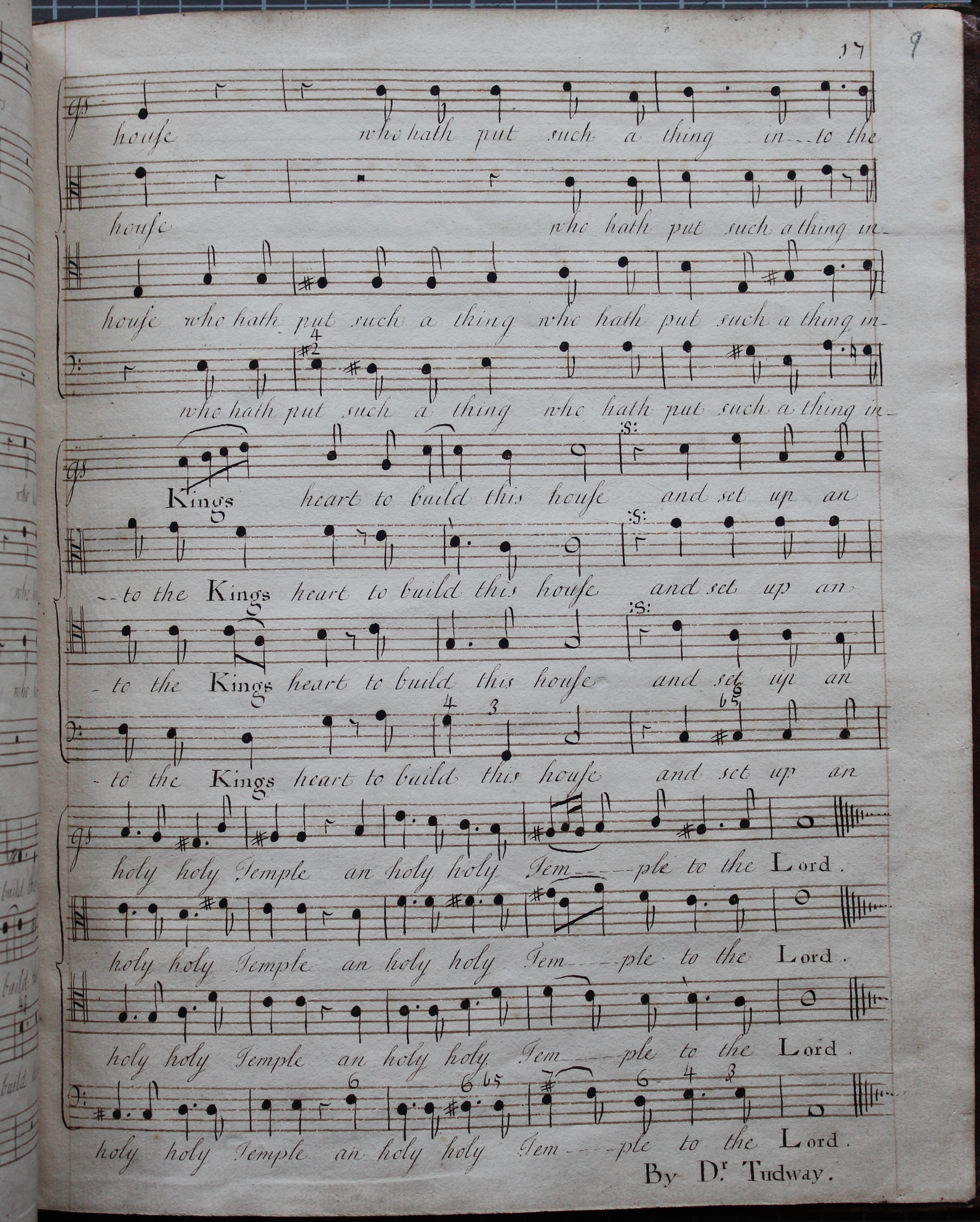
Tudway, Hearken Unto Me, final page of music. (Shelfmark: Rowe MS 108)


Several aspects of the binding of the volume point towards its importance and uniqueness as a presentation copy. It is a leather-bound volume with a panel design tooled with gold borders with fleuron decorations stamped in gold on the front and back boards. The foredges of the binding are also tooled in gold, as are the text block edges. No expense has been spared. Unusually, the pastedowns—which are usually simply plain hand-made paper—are in this case made of a much more expensive paper embossed with a red and gold floral design.

Tudway, Hearken Unto Me, Front panel binding with gold tooling (left), Inside front pastedown embossed in red and gold (centre), Front fore-edges of binding and text block decorated in gold (right). (Shelfmark: Rowe MS 108)

One would think that something as special as this would have been treasured in King’s, but curiously, by one means or another, the manuscript ended up being owned by one Henry Robson in the early nineteenth century who gave the volume to his cousin John Henry Robson in 1833. Thankfully it was returned to King’s by a relative, a Mrs Robson, in 1852.

Tudway, Hearken Unto Me, ownership inscriptions on front pastedown. (Shelfmark: Rowe MS 108)

Alas, this reminds us of the dilemma faced by William Cole who had spent eighteen years in King’s meticulously documenting our history, but when deciding where to deposit his manuscripts in 1788, he wrote ‘I have long wavered how to dispose of all my manuscript volumes; to give them to King’s College, would be to throw them into a horsepond; and I had as lieve do one as the other; they are generally so conceited of their Latin and Greek, that all other studies are barbarism.’ A little harsh perhaps, but rest assured that the librarians and archivists in King’s today take great care in looking after the special collections and are delighted to be able to share them with you on special days such as today!

Gibbs, A Book of Architecture, plate 35 showing the designs for the Gibbs building. (Shelfmark: F.27.7)

An early eighteenth-century theodolite by London instrument maker Richard Glynne (1681–1755), active ca. 1707 to 1730, belonging to King’s. A record in the College archives shows that we purchased a theodolite in 1724, presumably for building the Gibbs building. Could this be the one? (The theodolite is on long-term loan to the Whipple Museum in Cambridge. Reference: Wh.6588)

JC

________________________

For an online exhibition of documents from King’s archive relating to the Gibbs building see https://www.kings.cam.ac.uk/archive-centre/the-gibbs-building
Thanks are due to Ingo Gildenhard for advice on improving the translation of the Latin into English, as well as to my colleagues in King’s Library and Archives, and to Peter Jones for locating the Henry V coins.
The photographs of the Glynne theodolite are reproduced by kind permission of the Whipple Museum of the History of Science, University of Cambridge.

What Do We Think They Did?

In a previous blogpost in March 2021 we wrote about an eighteenth-century engraving depicting ‘A Concert in Cambridge’ that hangs on the wall in the Rowe Music Library in King’s. That blogpost identified all the individuals in the rather cosmopolitan group of musicians captured in the engraving and provided brief biographical information about each of them. We had a wonderful excuse to revisit the engraving in the autumn of 2022 when the College Librarian, Dr James Clements, took part in the filming of an episode of the BBC series Who Do You Think You Are? (https://www.bbc.co.uk/iplayer/episode/m001mgp3/who-do-you-think-you-are-series-20-1-andrew-lloyd-webber) which focusses on the ancestry of the composer and musical theatre impresario Andrew Lloyd Webber, one of whose ancestors features in the engraving.

‘A Concert at Cambridge’, probably 1767

The musician in question is the rather stern-looking bespectacled cellist in the centre of the engraving. He is believed to be the Dutch musician Alexis Magito (1711–1773) who came from a family of showmen, acrobats and musicians who had lived in Holland since about 1675.[1] His father, Johannes Alexis, was a violin teacher and impressario, and another close relative, Pieter Magito, is thought to have been the first circus master in Holland. By the second half of the eighteenth century the word Magito had become synonymous with fairground showmen, circus entertainers and musicians. We discovered in the episode that Alexis is Andrew’s six times great-uncle, and his father Johannes his six times great-grandfather.

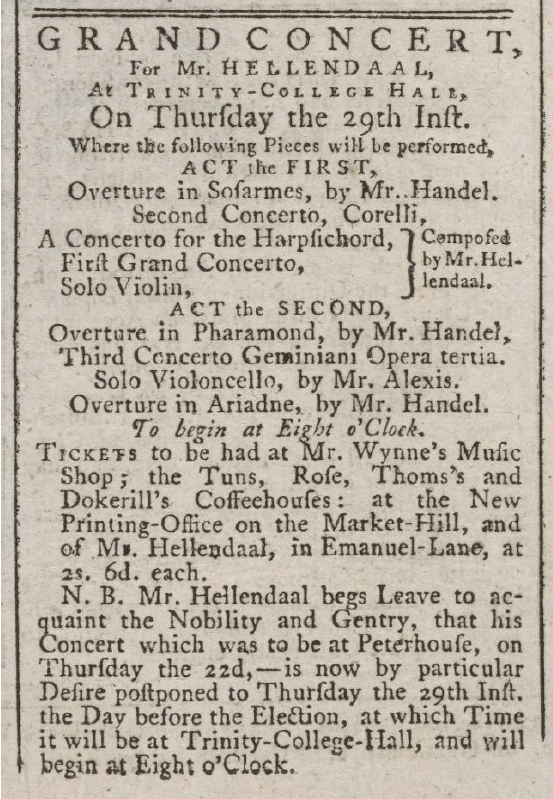
Born in Rotterdam in 1711, Alexis lived in Gouda for a few years in the 1730s, before going back to Rotterdam during the 1740s, and enrolling at the University of Leiden in 1746. There is plenty of evidence of his activities on the Dutch concert scene up until 1754, but by 1760 it is clear he had moved to England, perhaps to London initially. By the early 1760s there is documentary evidence that he was active on the Cambridge concert scene, alongside other figures in our 1767 concert engraving including the Dutch-born violinist Pieter Hellendaal (1721–1799) (on the far left of the engraving) and Cambridge double bassist John Wynne (1720–1788). The following newspaper concert advertisement from 1764, which features in the episode, demonstrates this:[2]

Advertisement for a ‘Grand Concert for Mr Hellendaal’ featuring Mr Alexis on the violoncello. (Cambridge Chronicle, 17 Mar 1764).

It’s clear that the career of Alexis Magito took a somewhat different musical path from that of some of his family, and he was well enough known on the British concert scene as a cellist to be referred to without his surname as only ‘Mr Alexis’. Like several of the musicians in our engraving, his skills weren’t limited to musical performance, however, as we know he also composed music as well as engraved music for publication. The cellist and musicologist Elske Tinbergen has identified four publications that were engraved by Alexis Magito, one of which is the Concerti Armonici by Unico Wilhelm van Wassenaer (1692–1766) published in the Hague in about 1740, a copy of which is in the Library at King’s.

Title page and final page of music (inscribed ‘Gravé par Alexis Magito Fils’ or ‘Engraved by Alexis Magito the son’) of Wassenaer’s VI Concerti Armonici (deliberately misattributed to Carlo Ricciotti (1681–1756)). (Shelfmark: Radcliffe.LOC.Con.1736/3).

We noted in the earlier blog post that Magito’s six cello sonatas were printed and published by the double bassist in our engraving, John Wynne, in Cambridge in the 1760s. Like Magito, Wynne also composed music as well as having a successful music shop in Cambridge in Regent Walk (nowadays a lawn in front of Senate House). We saw in the advertisement for the ‘Grand Concert’ above that concert tickets could also be purchased at Wynne’s music shop.

Map showing location of Regent Walk (also known as University Street) in Cambridge (from Atkinson and Clark, Cambridge Described and Illustrated (London, 1893), p. 272)

In the Rowe Music Library we have a copy of Ten English songs by John Wynne published for him in London by John Johnson in 1754. Being published in London will have ensured a wider potential audience, but as the title page clearly states it was ‘printed for the author and sold by him at his House in the Regent Walk, Cambridge’.

Title page and song ‘Love and Musick’ from Ten English songs by John Wynne (London: John Johnson, 1754). (Shelfmark: Mn.12.36).

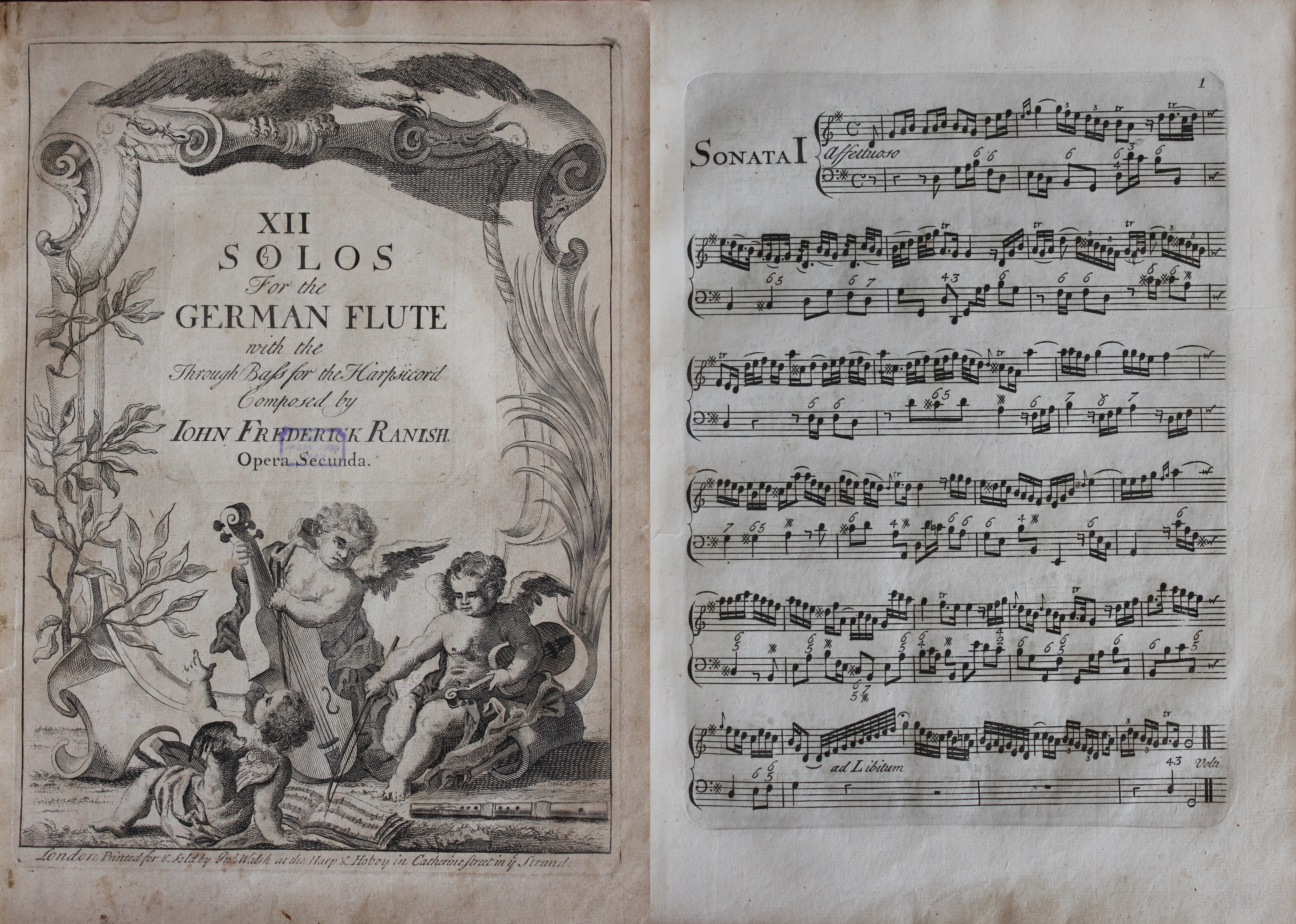
Another multi-talented figure in our group is the oboist John Frederick Ranish (1692/3–1777). Thought to have been of East-European origin, Ranish also played the flute, and published two sets of flute sonatas. The subscription list to his first set (opus 1, published circa 1735) includes the Cambridge Musical Society as well as some thirty names of individuals associated with Cambridge Colleges, indicating that he had considerable standing in the city at that time. In the Rowe Music Library we have his second set of flute sonatas (opus 2, 1744) published by John Walsh, one of the most important music engravers and publishers of the time, in London.

Title page and opening page of John Frederick Ranish, XII Solos for the German flute (London: Walsh, 1744). (Shelfmark: Mn.13.28).

Finally we turn to the figure on the far right of our engraving, listed as ‘Wood’ on the surviving copies, who appears to be singing, and is curiously not mentioned in the literature about the engraving. The research for the episode uncovered a newspaper advertisement for a concert that took place in Ely in 1770 which was ‘For Mr. Wood, Organist’, and he was clearly known to Alexis Magito who is playing the cello in the concert, and also John Wynne who sold tickets for the concert in his shop. It seems very likely the musician Wood in our engraving and in this concert is David Wood, organist at Ely Cathedral between 1768 and 1774, who became a gentleman of the Chapel Royal in 1774 and passed away in 1786. The violinist in the concert, Mr Alexis Jun[ior], is thought to be Alexis Magito’s younger brother and Andrew Lloyd Webber’s five times great-grandfather Henry Alexis Magito who was born in 1732.


Concert advertisement (Cambridge Chronicle, 21 July 1770).

Working with the director Harvey Lilley, producer Laia Niubo and the team at Wall to Wall who produced this episode, and of course with Andrew Lloyd Webber and being able to play this small part in telling his genealogy story was not only great fun, but gave us another opportunity to take a second look at this engraving resulting in a better understanding of the activities of the musicians it depicts and the ways in which the engraving relates to other music holdings in King’s Library.

College Librarian James Clements with Andrew Lloyd Webber on the day of filming.

JC

Notes

[1] The biographical information about Alexis Magito and his family comes from Elske Tinbergen, ‘The “cello” in the Low Countries: the instrument and its practical use in the 17th and 18th centuries’ (PhD Diss., University of Leiden, 2018), pp. 255-271. See http://hdl.handle.net/1887/68235

[2] The researcher for the episode who found the newspaper concert advertisements was Xin Fan.


A concert in Cambridge, 1767

In the Rowe Music Library at King’s College hangs a copy of this engraving, which shows seven local musicians performing at a concert that took place in the hall of Christ’s College on 8 June 1767. Tickets cost two shillings and sixpence.

The etching is attributed to Abraham Hume, after a drawing by Thomas Orde. Hume (1749-1838), later a Baronet, would have been eighteen years old at the time of the concert and a Fellow-Commoner at Trinity College. Orde (1746-1807), later Orde-Powlett, 1st Baron Bolton, was an undergraduate at King’s. Within a few years of graduating both men had been elected Tory MPs.

The personnel depicted are given in pencil at the foot of the engraving as: ‘Hallendale / Newell Senr. / Rennish / West / Wynn / Newell Junr. / Wood’. Exploring the backgrounds of these musicians helps to build up a picture of the Cambridge music scene 250 years ago that is impressively cosmopolitan.

The most arresting-looking individual in the picture is perhaps the severe-faced cellist in the centre, staring the viewer down through his spectacles. Although called ‘West’ in the Rowe copy, a name that has proved a dead end, another copy identifies him more fruitfully as ‘Alexis’, which suggests he is likely to be Alexis Magito, a Dutch-born musician who worked in England from the 1750s onwards. At around the time of this concert, an edition of a set of six sonatas for cello and double bass composed by Magito was published by the Cambridge music seller John Wynne, the bassist standing to the right of Magito in the picture. Wynne kept a music shop near the Senate House, ‘at the sign of the Harp and Hautboy’.

Rw.16.21, Alexis Magito, Six sonatas for the violoncello & basso, opera prima

There is no harp in Hume’s picture, but there is a hautboy, or oboe, being played by John Ranish, who stands to the left of Magito in a more than usually full-bodied wig. Ranish, named ‘Rennish’ in the Rowe copy, was probably of Eastern European stock (Christopher Hogwood suggests his name may have been Anglicised from ‘Wranisch’), and at the time of the concert had been established as an oboist and flautist in Cambridge for some time. His 1777 obituary in the Cambridge Chronicle and Journal claims he ‘always supported the character of a gentleman, and was respected by all that knew him’.

The man seated at a mysterious instrument to the right of Wynne and identified in the Rowe copy as ‘Newell Junr.’ is in fact the Portuguese musician Georg Noëlli, and the mysterious instrument is the pantalon or pantaleon (or indeed ‘Panthaleone’, as the concert’s advertisement in the Cambridge Chronicle and Journal has it). This was a large form of hammered dulcimer invented by the German musician Pantaleon Hebenstreit (1668-1750) and named after him by Louis XIV of France, who had been impressed by the instrument when Hebenstreit paid a visit to the court in 1705. Noëlli had studied with Hebenstreit, and in 1767 seems to have been on a tour of England: a Worcester newspaper boasts of his appearance there playing an instrument ‘eleven feet in length [with] 276 strings of different magnitudes’. Clearly the engraving does not fully communicate the sheer length of Noëlli’s pantalon.

The most distinguished musician in the picture, though, is probably Pieter Hellendaal, the violinist standing on the far left. Born in Rotterdam in 1721, he studied violin with Tartini in his youth, and in the 1750s moved to England, working in London and King’s Lynn. He settled in Cambridge in 1762, where he held musical posts at Pembroke College (then Pembroke Hall) and Peterhouse (then St Peter’s College). He died in 1799 and is buried in the shadow of Peterhouse, in the churchyard at Little St Mary’s.

Although several of the musicians pictured were composers as well as performers, Hellendaal’s music was the most widely published, both in London by a variety of publishers, and, as the title pages of editions in the Rowe Library attest, closer to home, ‘at the author’s house in Trompington Street, opposite St. Peter’s Colledge’. The Fitzwilliam Museum possesses a set of sonatas by Hellendaal in manuscript, six of which have been recorded recently by the performers in the video below, to general acclaim. If you would like to raise a glass to Hellendaal, this is a good time to do it: he was baptised on 1 April 1721, so this week may be taken to be the 300th anniversary of his birth!

Further information about this engraving and the characters it depicts can be found at https://kcctreasures.com/2023/06/01/what-do-we-think-they-did/

Bibliography

Hanks, S.E. (1969) ‘Pantaleon’s pantalon: an 18th-century musical fashion’, The Musical Quarterly, 55(2), pp. 215-227.

Hogwood, C. (1983) ‘A note on the frontispiece: A concert in Cambridge’, in Hogwood, C. & Luckett, R. (eds.), Music in eighteenth-century England: essays in memory of Charles Cudworth. Cambridge: Cambridge University Press, pp. xv-xviii.

GB

‘The oddest town I’ve ever seen’: Alban Berg’s visit to Cambridge

Rowe Music Library

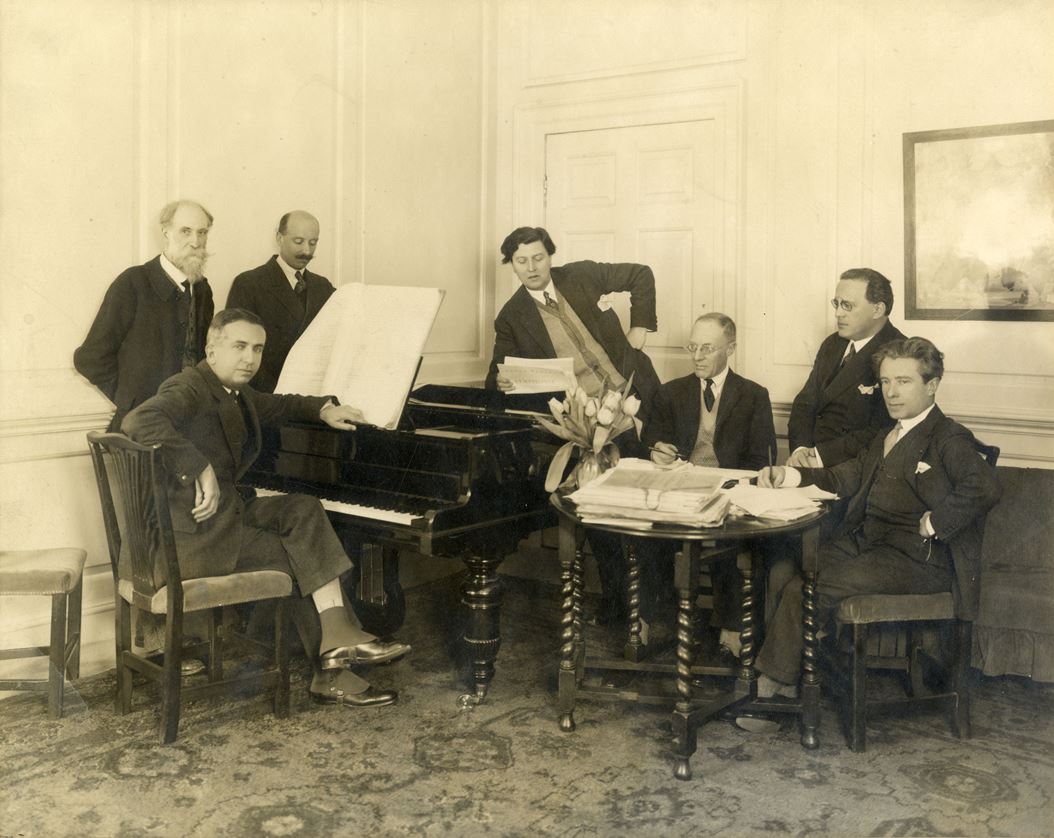
The first thing anyone notices on entering King’s College’s Rowe Music Library are shelves upon shelves of brightly coloured scores, and it is possible to be so beguiled by them that you fail to notice anything else; but there are pictures hanging on the walls that are just as interesting in their way. This, for instance:

Cambridge, 1931

The photograph was taken in January 1931, in the rooms of the musicologist E.J. Dent, a Fellow of King’s. Dent is the dapper, Wilfrid Brambell-esque figure seated at the table; alongside him, the Polish composer Grzegorz Fitelberg and the Belgian Désiré Defauw. At the piano is Alfredo Casella; standing behind him, Charles Koechlin and the conductor Adrian Boult. And in the middle, leaning on the piano, is Alban Berg. How did this man, one of the titans of twentieth-century classical music, come to be in Cambridge?

The occasion was a meeting of the jury of the International Society for Contemporary Music, which at that time consisted of Dent and the five composers (Boult serving in an advisory capacity). Dent had been President of the ISCM since its inception in 1922, and the purpose of the meeting was to determine which works would be performed at that summer’s Festival in Oxford and London, the first to be held in Britain.

Berg’s published letters to his wife tell the story. From 12th January:

So far I’ve only the impression of a provincial place, but not a German one. Sort of super-Deutsch-Landsberg.

Dent called for me, and we went on working in the College. Altogether this is the oddest town I’ve ever seen. More about that when I get back.

Dent, who is like a kindly nanny to me, made a splendid tea in the afternoon. We worked till about seven; and now the car is fetching me and taking me home to dinner. We had a very fine lunch at Dent’s, except that the food had no taste at all. In this country a pheasant tastes exactly like a turkey or a chicken.

A couple of days later:

I’ve been working hard all day, had a fine lunch (my ‘favourite’ roast lamb), home to dinner, played the gramophone afterwards, and went to bed early. It’s become colder. But thanks to all sorts of drinks, good warm pants and woolly vests and galoshes, I’m managing quite well and never catch cold. We all get on well on the jury, talking French almost all day – although we’re from six different countries: Italy, France, Belgium, Poland, Austria, England …

By 15th January, writing on his way to London, he had had enough:

Thank the Lord, Cambridge is over … not an hour more in that dull place.

In a letter to Arnold Schoenberg a month later, Berg wrote more frankly of his experience on the jury:

Of course the professional task at hand was very depressing since I, alone against 4, sometimes 5 opponents … was able to accomplish practically nothing worthwhile, as you can see from the concert programs of the Oxford Music Festival.

Thank heavens at least Webern will be heard!

The Webern performed that summer was his Symphony, Op. 21, the score of which Berg is seen holding in the photograph. Among the other works in the programme were Vaughan Williams’ Job: A Masque for Dancing, Gershwin’s An American in Paris, Hindemith’s children’s opera Wir bauen eine Stadt, and pieces by Szymanowski, Roussel, Roger Sessions, Egon Wellesz and Constant Lambert. Much of the Festival was broadcast by the BBC, which (alongside the Radio Times, at that time a publication of the BBC) made an effort to promote it with a series of articles and radio talks related to the music being performed.

While researching this post I had the opportunity of consulting Dent’s personal papers, housed in our Archive Centre. They include correspondence from several ISCM people, including a typed letter of thanks from Defauw dated 21st May 1931, to which is added a handwritten postscript referring presumably to the forthcoming Festival, to be held in July: ‘Cher Ami, je ferai tout mon possible pour venir en juillet – j’aurai une grande joie de vous revoir’.

Also in the Dent archive are several photographs dating from the foundation of the ISCM. This annotated photo, taken in Salzburg in 1922, features several composers of note, including Webern, Wellesz, Hindemith, Arthur Bliss (later Master of the Queen’s Music), and Ethel Smyth.

Salzburg, 1922

You can explore the Dent archive further by searching the catalogue on Janus here.

Bibliography
Brand, J., Hailey, C. & Harris, D. (eds.). The Berg-Schoenberg Correspondence: Selected Letters (Macmillan, 1987)
Doctor, J. The BBC and Ultra-Modern Music, 1922-1936 : Shaping a Nation’s Tastes (Cambridge University Press, 1999)
Grun, B. (ed.). Alban Berg: Letters to His Wife (Faber, 1971)

[The copyright holder of the 1931 ISCM photograph is unknown. We apologise for any inadvertent omission. Please contact us if you are the copyright holder.]

GB