
Welcome to the second instalment of our celebration of the arrival of the Lunar year of the Horse. This time the focus is on depictions of mythological, legendary and fictional horses, of which there are many.
We begin with one of our illuminated manuscripts, a fifteenth-century edition of the works of Horace which features the mythological winged horse Pegasus on its first page. According to Ancient Greek legend, the hero Bellerophon flew on Pegasus in his victorious battle against the monstrous Chimaera. This formidable horse, who eventually became a constellation, has been depicted extensively in art over the centuries and is also a symbol frequently used in heraldry. The Horace manuscript came originally from the library of Cardinal Pietro Bembo (1470-1547), a Venetian scholar and nobleman. His coat of arms features on the first page, with Pegasus as a crest, and two Pegasi appear in the illuminated initial M above.
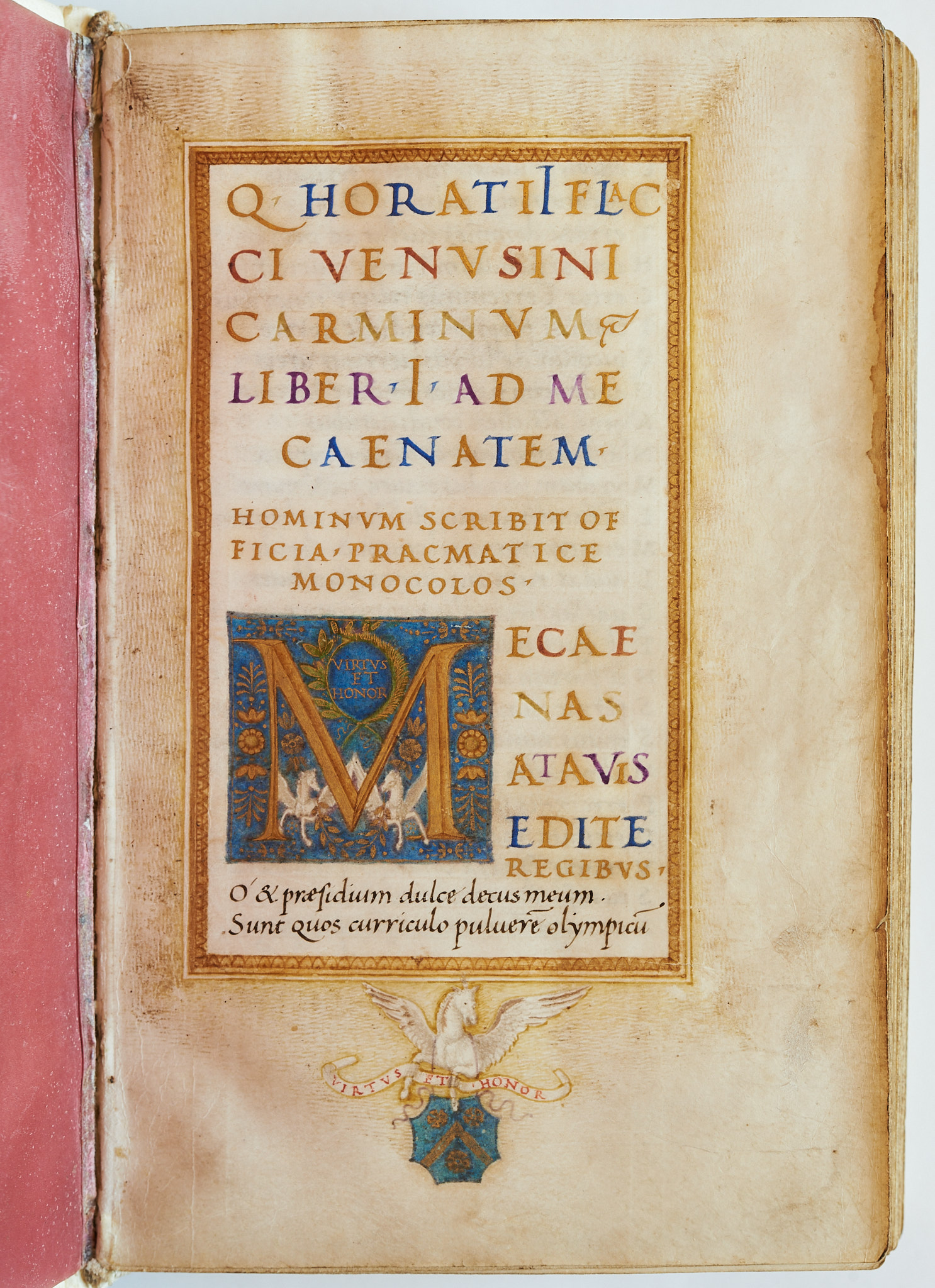
Title page of MS 34. Photo © 2025 Sara Rawlinson at HeritagePhotographs.com
Pegasus also features in some printer’s devices, which were an early form of logo used by printers to distinguish their work and protect against forgery. The device below, associated with the Italian typographer Valerio Dorico (died 1565), depicts Pegasus alongside the Fountain of Hippocrene. According to legend, this was a spring on Mount Helicon that Pegasus created by striking his hoof to the earth. Hippocrene means “horse spring”.
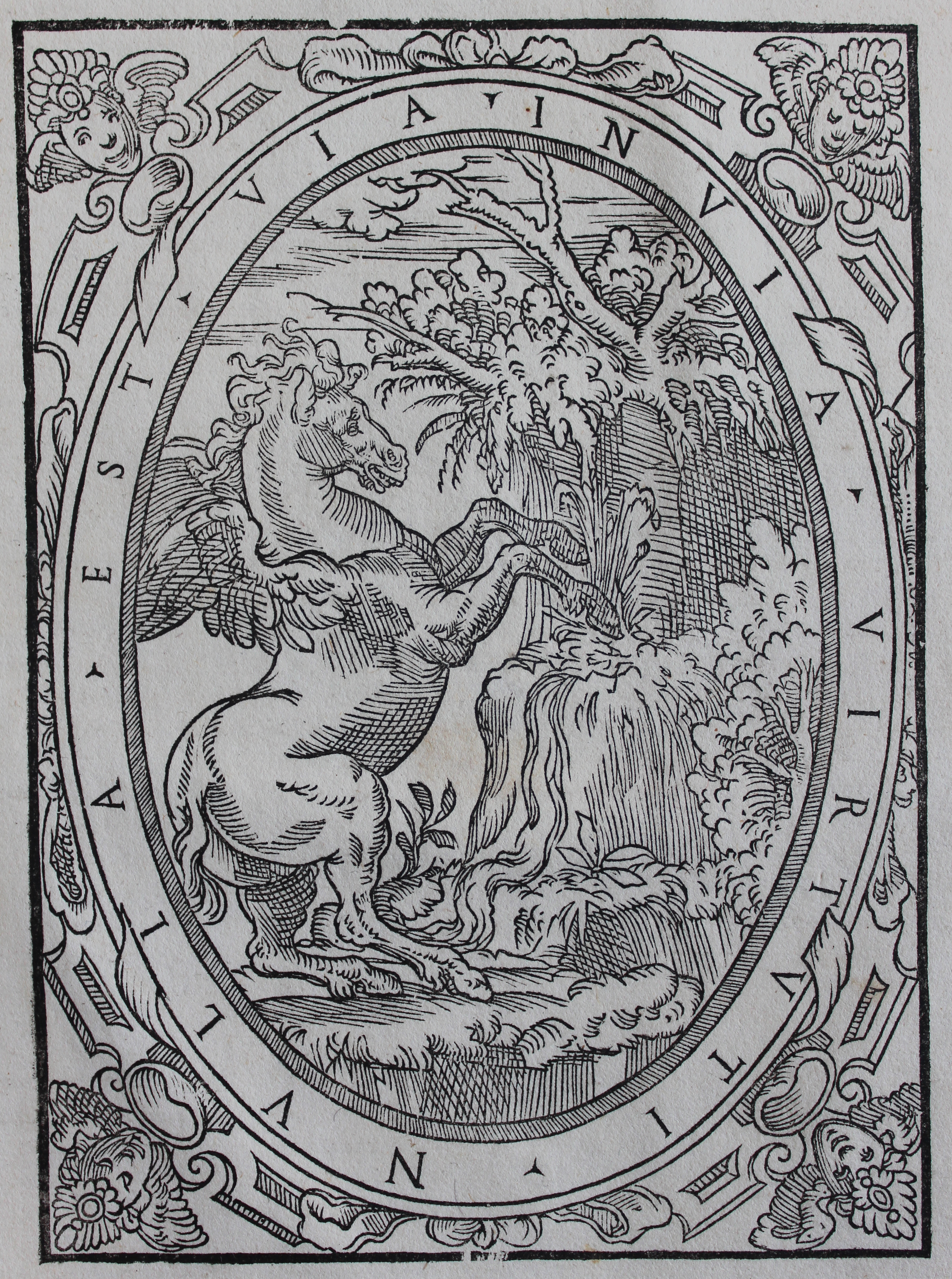
Pegasus printer’s device on fol. L6 of Vrbis Romae topographia by Bartolomeo Marliani, Rome, 1544. Shelfmark: Bury.I.MAR.Urb.1544
Another legendary creature often used in heraldry is the unicorn, a horse-like creature with a single large horn on its forehead. As can be seen in the early seventeenth-century illustrations below, unicorns are sometimes depicted with some of the attributes of goats, such as cloven hooves and beards. The accompanying text associates the unicorn with strength, courage and virtue and repeats the common belief that unicorn horns are an antidote to poison.
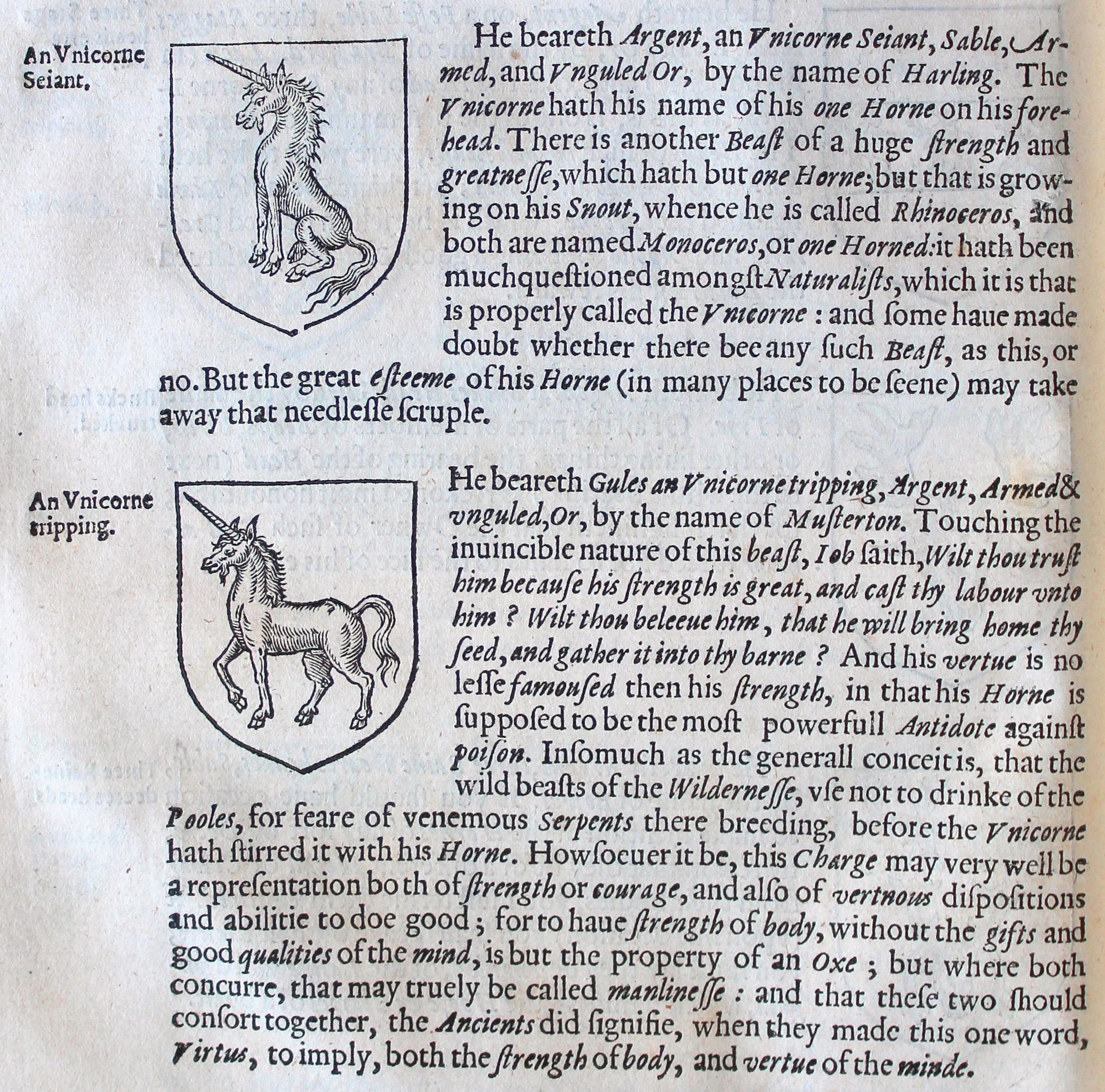
Illustration and text from page 134 of A Display of Heraldrie by John Guillim, London, 1611. Shelfmark: H.17.39
At the end of A Display of Heraldrie there are examples of regal coats of arms, including that of Charles, the second son of King James I, who was later to rule as Charles I. The lion and the unicorn flanking the shield still form part of the coat of arms of the United Kingdom, with the lion representing England and the chained unicorn representing Scotland. In Scotland, their positions are swapped and the Unicorn also wears a crown.
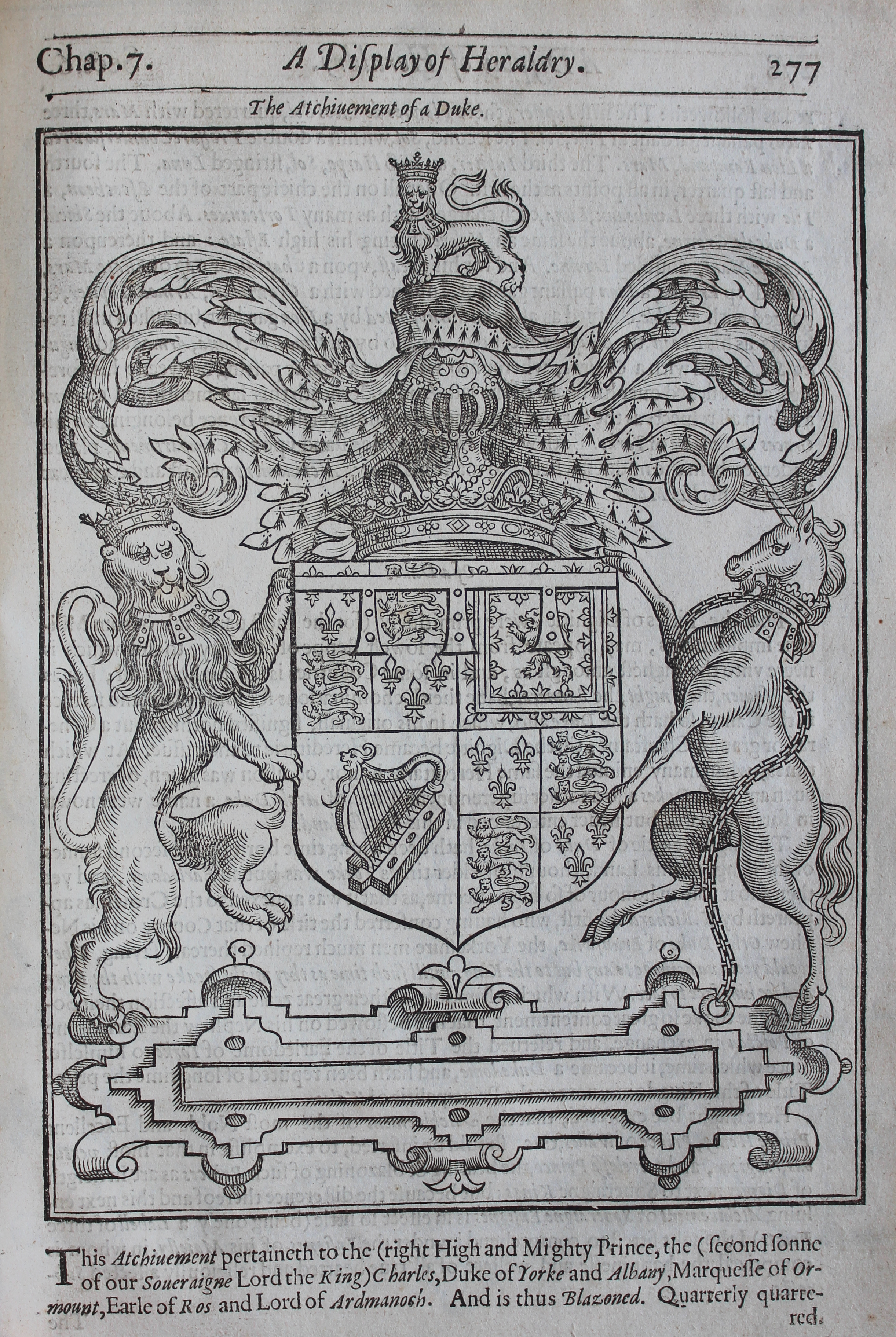
Illustration and text from page 277 of A Display of Heraldrie
The frontispiece of Richard Berenger’s The History and Art of Horsemanship features a magnificent illustration of statue of a Centaur, a creature which is half horse and half human. In the text, Berenger eloquently expounds upon the symbolism behind the mythical beast:
The Centaur is the symbol of horsemanship, and explains its meaning as soon as it is beheld: for there is such an intelligence and harmony between the rider and the horse, that they may, almost in a literal sense, be said to be but one creature.
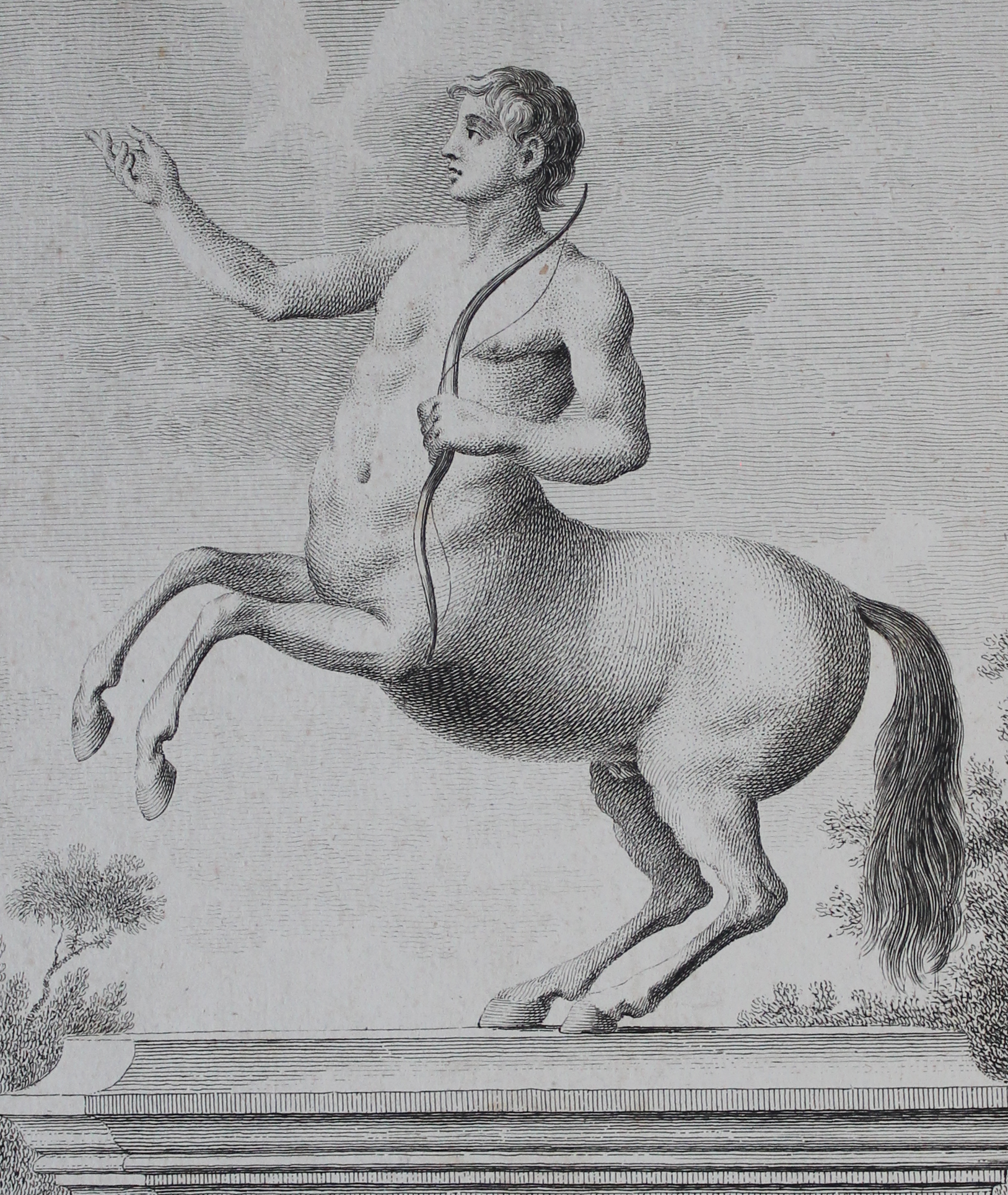
Frontispiece of volume one of The History and Art of Horsemanship by Richard Berenger, London, 1771. Shelfmark: Bryant.M.10.17
Sagittarius, the constellation and astrological sign, is often depicted as a centaur drawing a bow. One example is this lovely woodcut illustration from an English translation of a sixteenth-century astrological work by Frenchman Richard Roussat, writing under the pseudonym “Arcandam.”
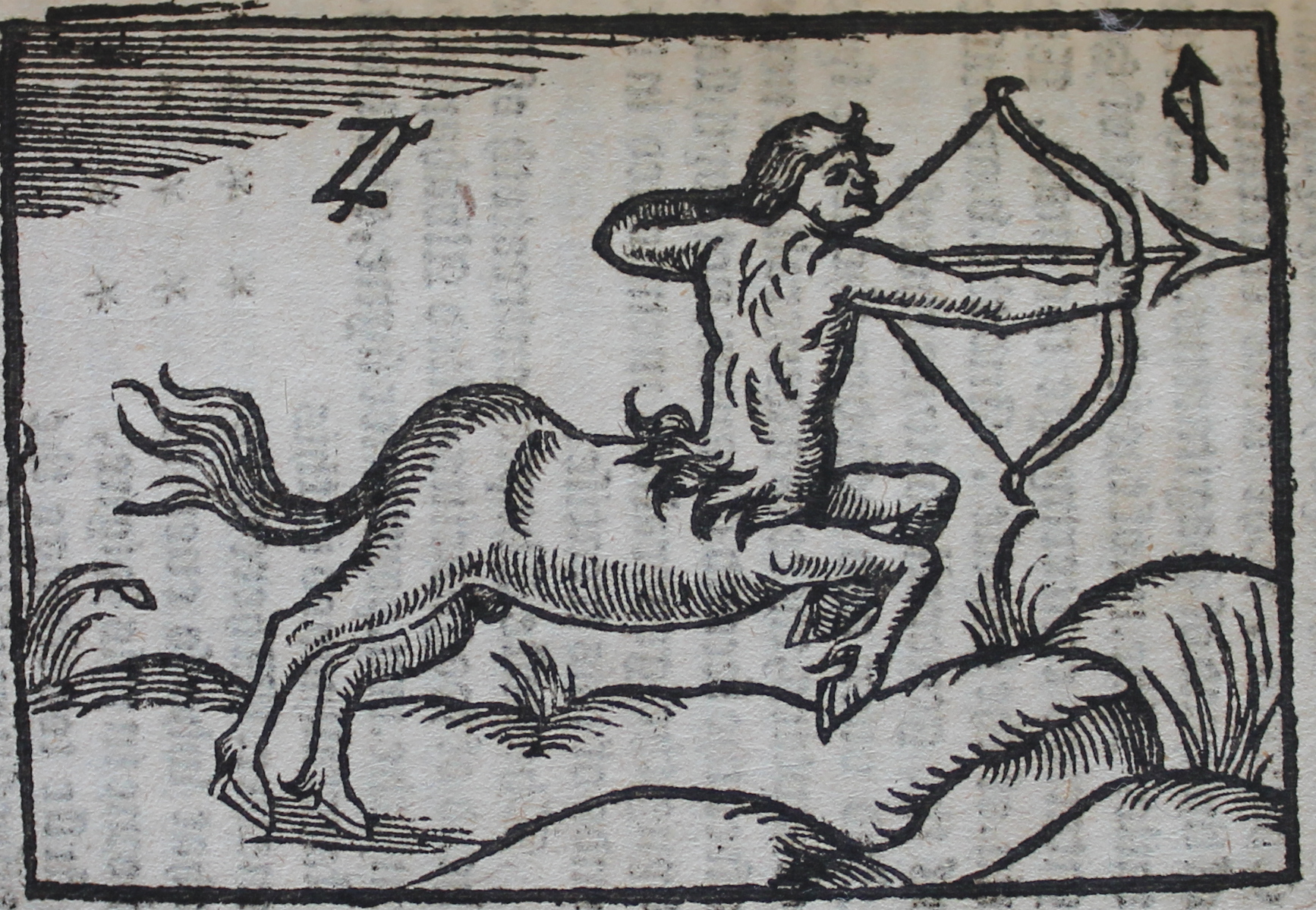
Illustration of Sagittarius the Archer from fol. H6 of The Most Excellent, Profitable, and Pleasant Booke of the Famous Doctour and Expert Astrologien Arcandam or Aleandrin … translated by William Warde, London, 1562. Shelfmark: Chawner.A.9.11
The Greek god of the sea Poseidon and his Roman equivalent Neptune were both said to have travelled in chariots drawn by Hippocampi, creatures which were half horse and half fish or sea monster. The illustration below comes from a work on classical mythology by Italian diplomat and mythographer Vincenzo Cartari (1531?-1590). It depicts Neptune in a sea-chariot with his consort the goddess Amphitrite and the young sea god Palaemon. They are being pulled through the waves by two Hippocampi.
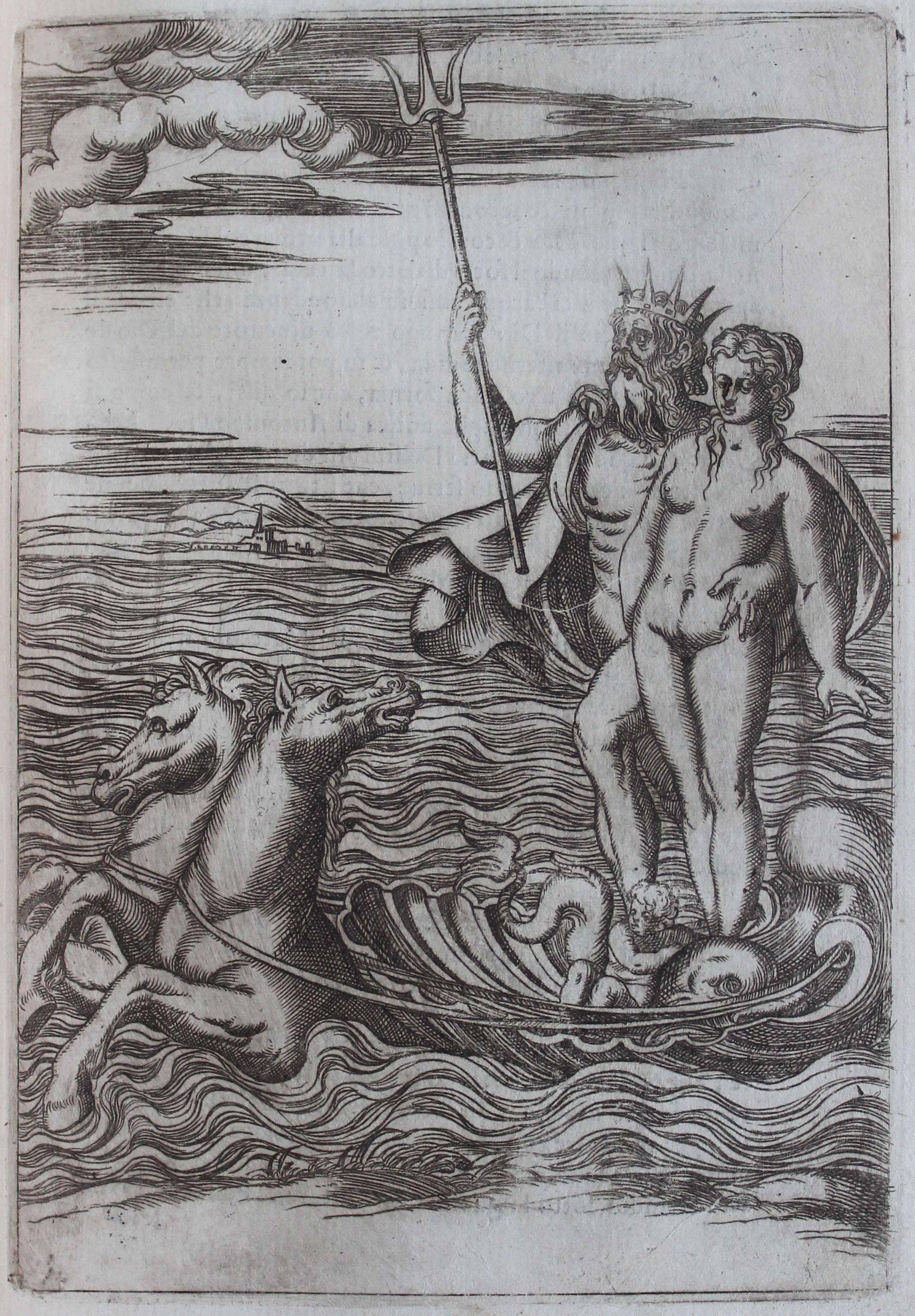
Illustration from page 201 of Le imagini de i dei de gli antichi, nelle quali si contengono gl’idoli, riti, ceremonie, & altre cose appartenenti alla religione de gli antichi by Vincenzo Cartari, Venice, 1587. Shelfmark: Bury.CAR.Ima.1587
Horses make an appearance in numerous fables, including those of Aesop. The charming frontispiece below, depicting Aesop surrounded by animals and birds from the tales, comes from Fables of Aesop and Other Eminent Mythologists by Roger L’Estrange (1616-1704). If you look closely, you can see that two quirky bird-like creatures have been added to this copy in ink by an unknown hand!
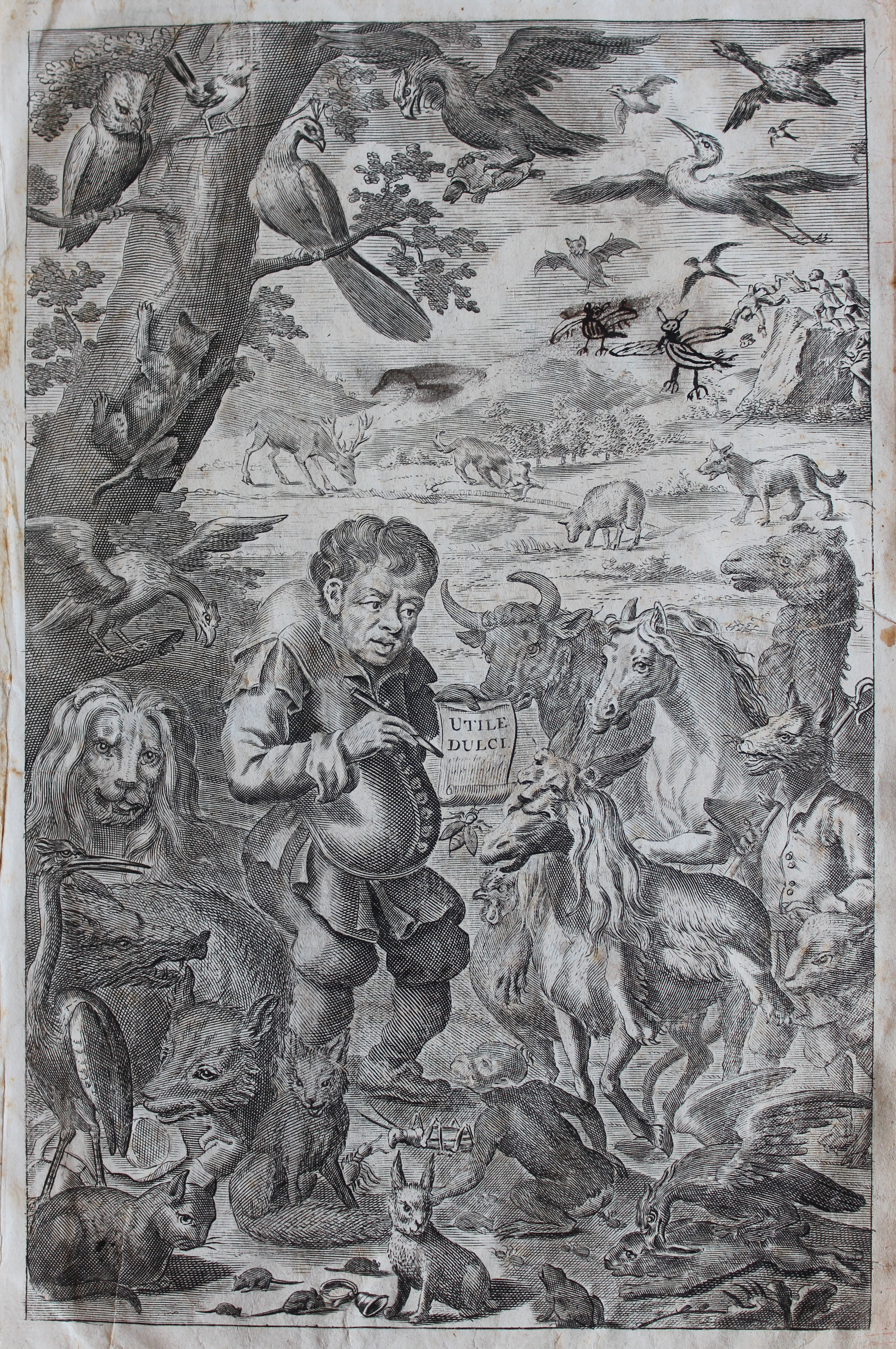
Frontispiece of Fables of Aesop and Other Eminent Mythologists by Roger L’Estrange, London, 1694. Shelfmark: L.2.11
One of Aesop’s fables, The Horse and the Lion, tells of how a wily horse gets the better of a lion who is posing as a doctor in order to get close enough to eat him. Realising the deception the horse affects an injured leg then kicks the lion hard in the face, stunning him. The moral is that it is fine to repay trickery with trickery.
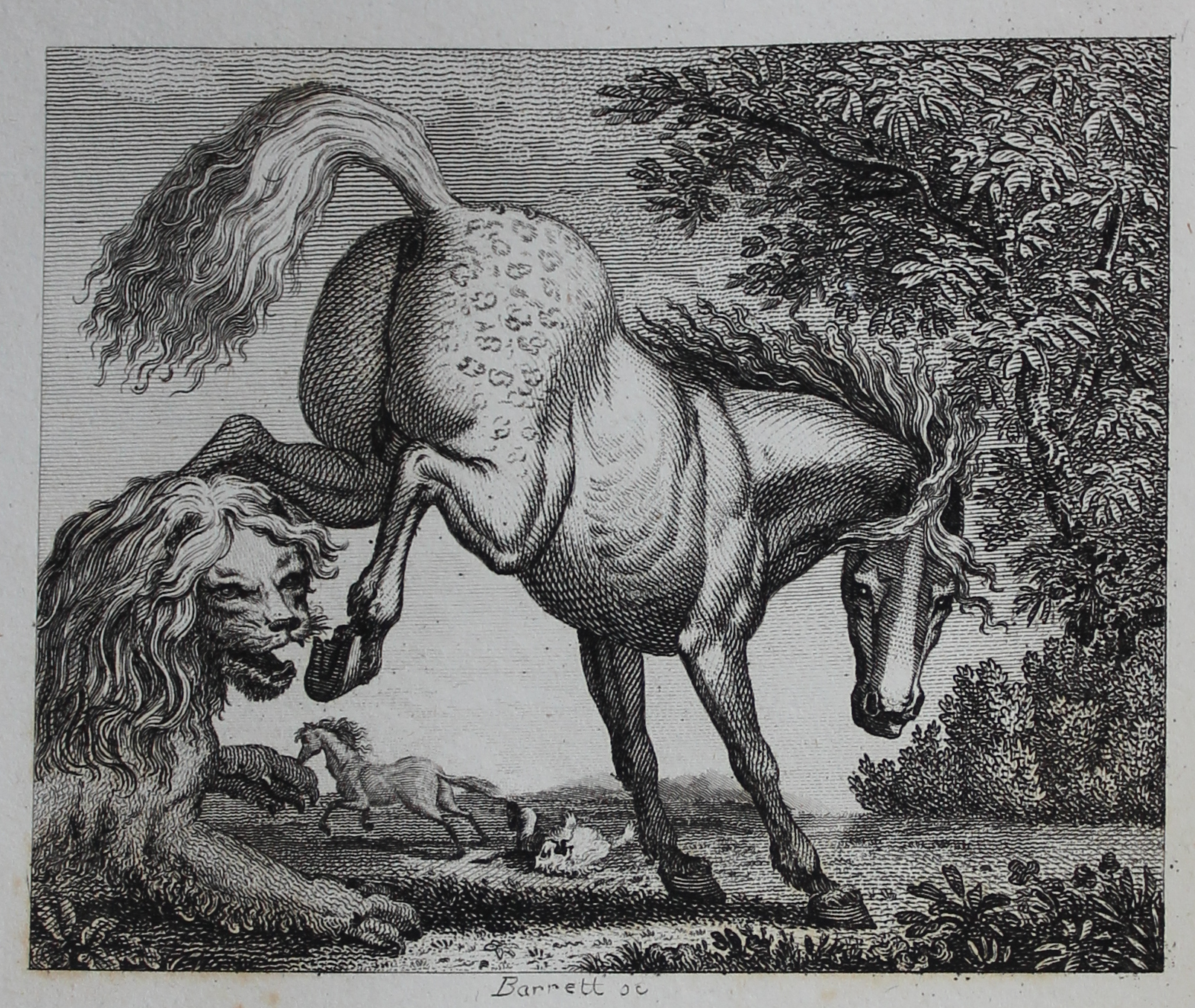
Plate facing page 31 from volume two of The Fables of Aesop translated by Samuel Croxall, London, 1793. Shelfmark: Thackeray.J.63.45
In 1727, the dramatist and poet John Gay (1685-1732) wrote his own collection of fables in verse. They were dedicated to Prince William, the youngest son of King George II, in the hopes of currying favour with the crown. Amongst the tales is one called The Council of Horses, in which a young colt addresses a gathering of horses and calls for them to throw off human control and claim their freedom:
Were we design’d for daily toil,
To drag the plough-share through the soil,
To sweat in harness through the road,
To groan beneath the carrier’s load?
How feeble are the two legg’d kind!
What force is in our nerves combin’d!
This call for mutiny receives wide support until an older horse defuses the situation by pointing out the mutual benefits to be gained from working for humans:
The toils of servitude I knew;
Now grateful man rewards my pains,
And gives me all these wide domains;
At will I crop the year’s increase,
My latter life is rest and peace.
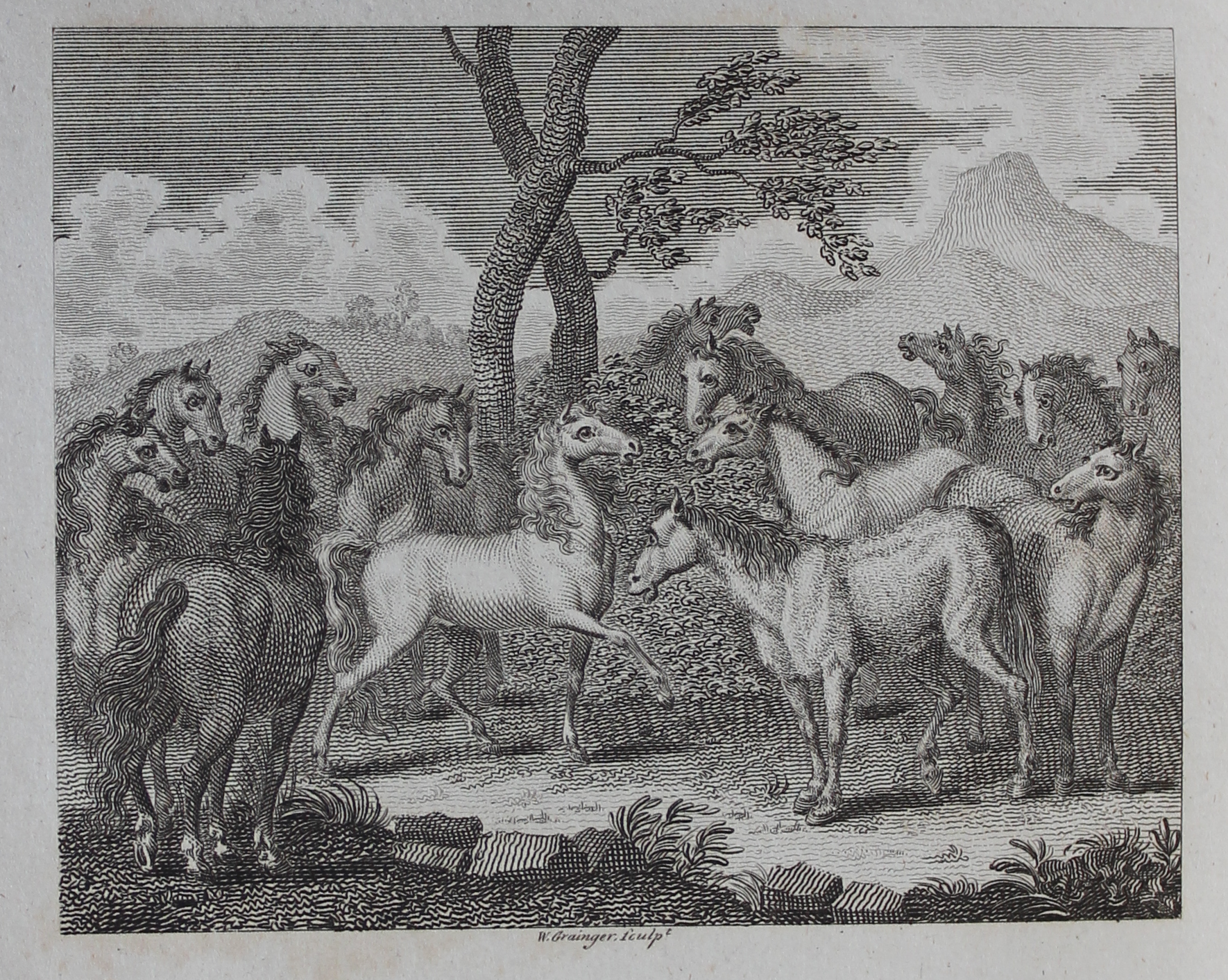
The Council of Horses. Plate facing page 191 from volume one of Fables by John Gay, London, 1793. Shelfmark: Thackeray.J.61.28
The eponymous hero of the Middle English romance Sir Bevis of Hampton is accompanied on his adventures by Arondel, his trusty steed. Arondel is so loyal to Bevis that he will not allow anyone else to ride him, kicking out at or throwing off anyone who makes the attempt. In turn, Bevis values Arondel so highly that he chooses exile rather than allow the horse to be executed for killing a prince who tried to steal him.
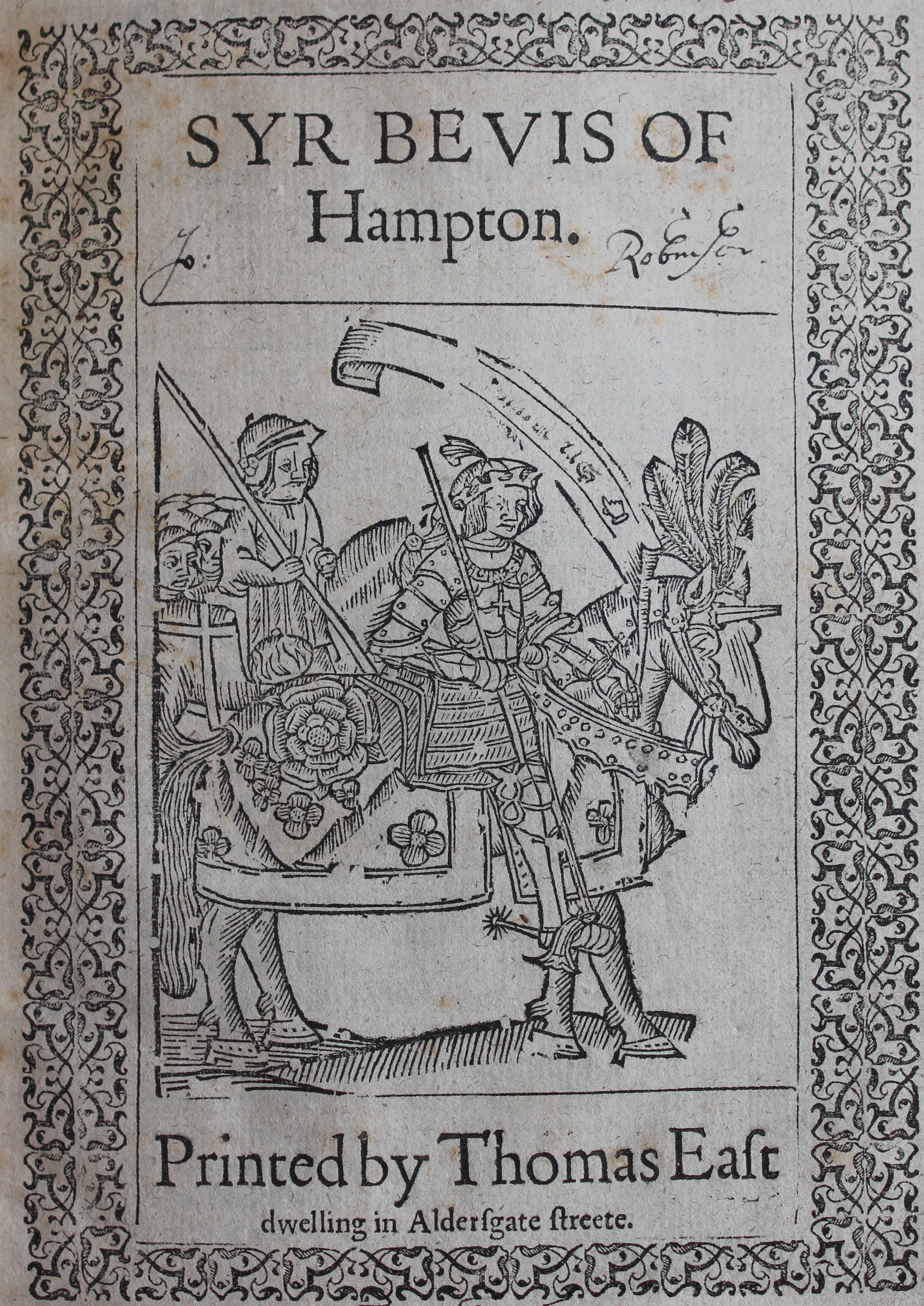
Title-page of Syr Bevis of Hampton, London, 1585. Shelfmark: M.29.13
At one point in the story, Bevis subdues a giant called Ascopart who then becomes his page for a time. As can be seen below, Ascopart is so large he can easily tuck Arondel under his arm!
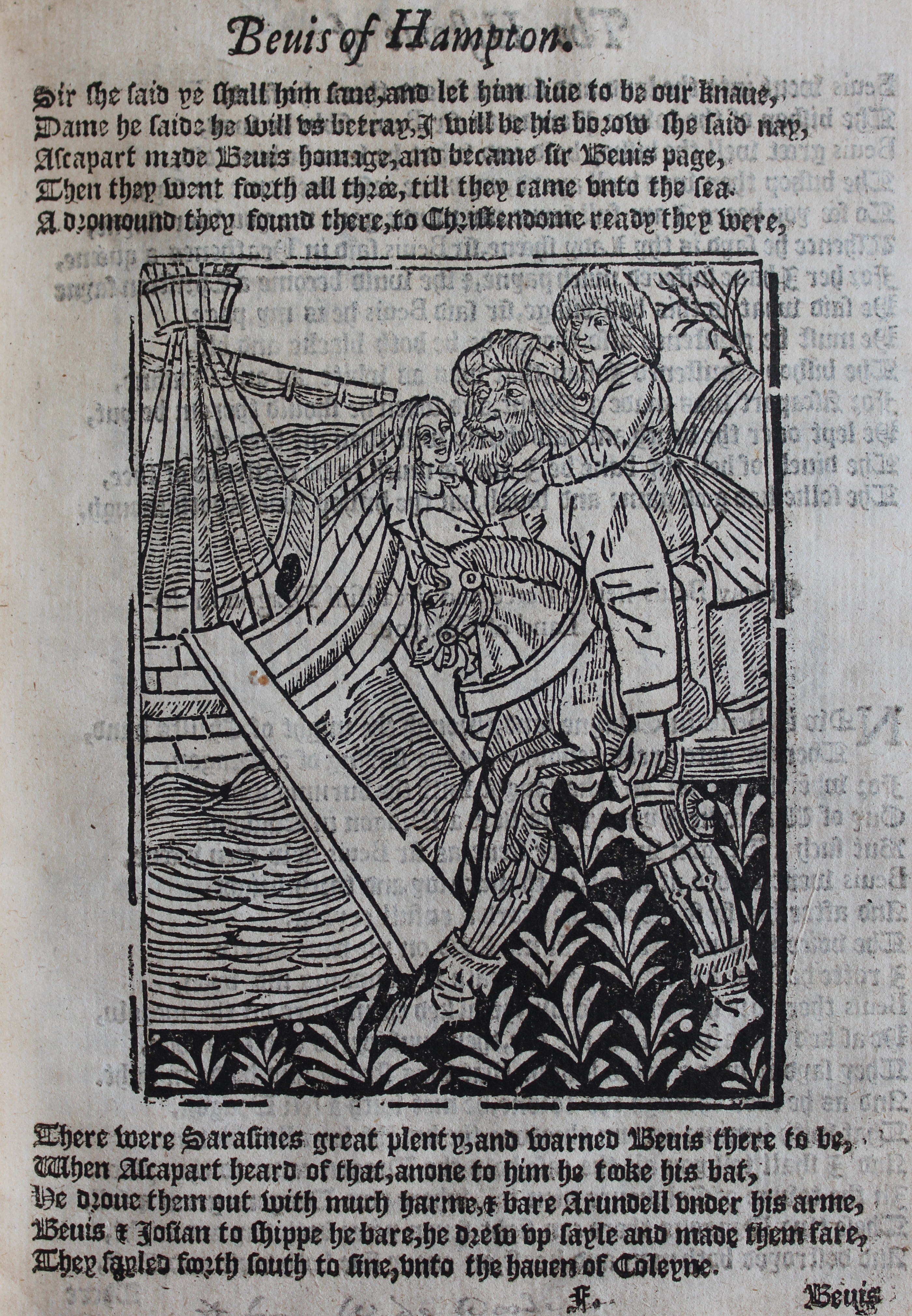
Fol. F1 recto from Syr Bevis of Hampton
Rocinante, the horse ridden by Don Quixote on his delusional misadventures is a much more run-down creature than Arondel, a re-purposed workhorse, elderly and infirm. Nonetheless, he is a vital part of the tale and endures in popular memory alongside Quixote and his squire Sancho Panza. Our Library holds many editions of Cervantes’ satirical masterpiece, both in the original Spanish and in English translation. What follows is a selection of glorious illustrations from some of these editions, most featuring Rocinante front and centre.
We start with a seventeenth-century English edition of the tale. In the plate below, Sancho Panza ties Rocinante’s hind-legs together to stop Don Quixote haring off into the dark on another imagined quest.
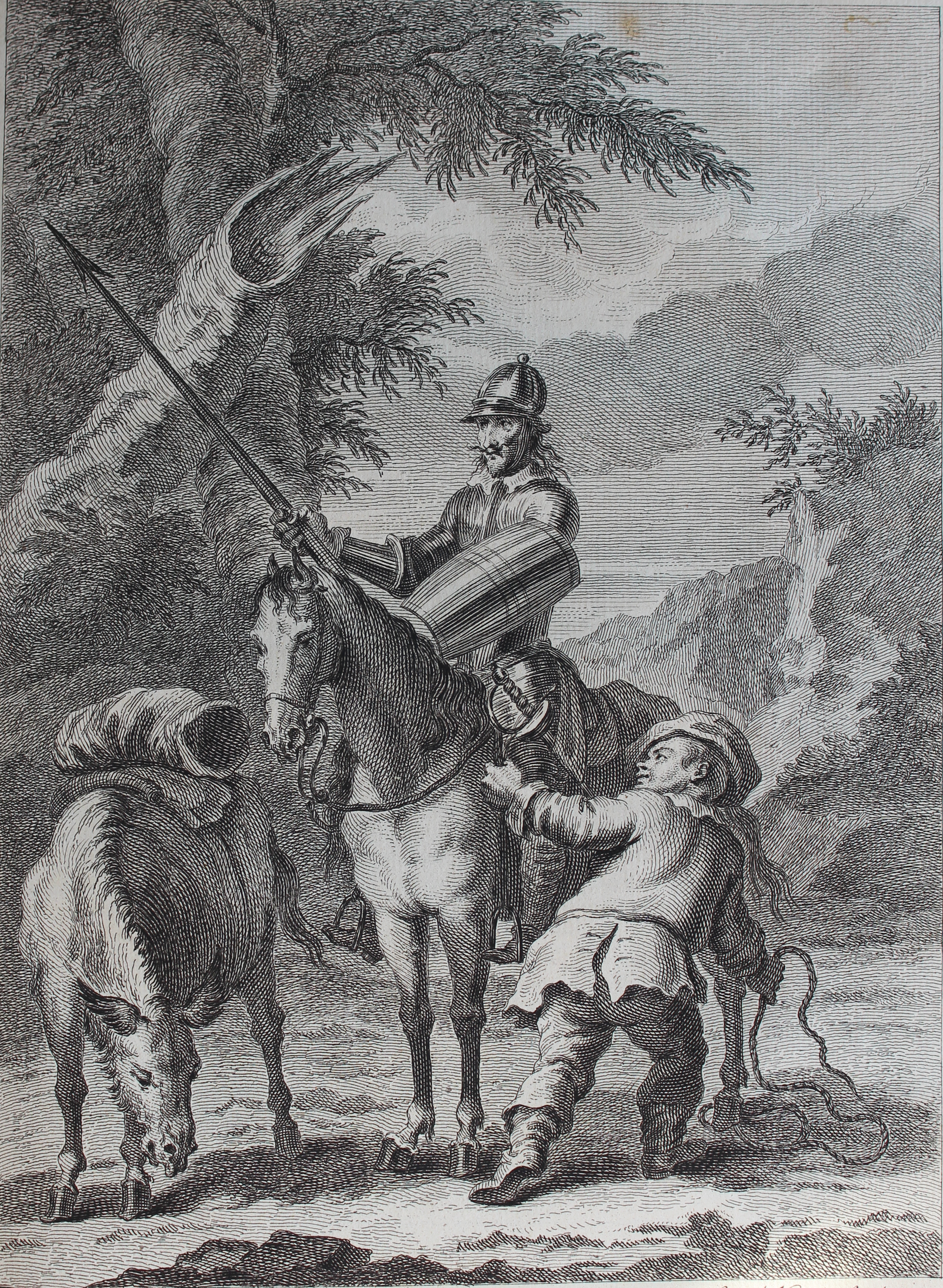
Plate facing page 100 from volume one of The Life and Exploits of the Ingenious Gentleman Don Quixote De La Mancha, translated from the original Spanish of Miguel Cervantes de Saavedra by Charles Jarvis, London, 1742. Shelfmark: Glendinning.98/1
Below Don Quixote is tricked into being trapped standing on poor Rocinante’s back with his hand tied above his head.
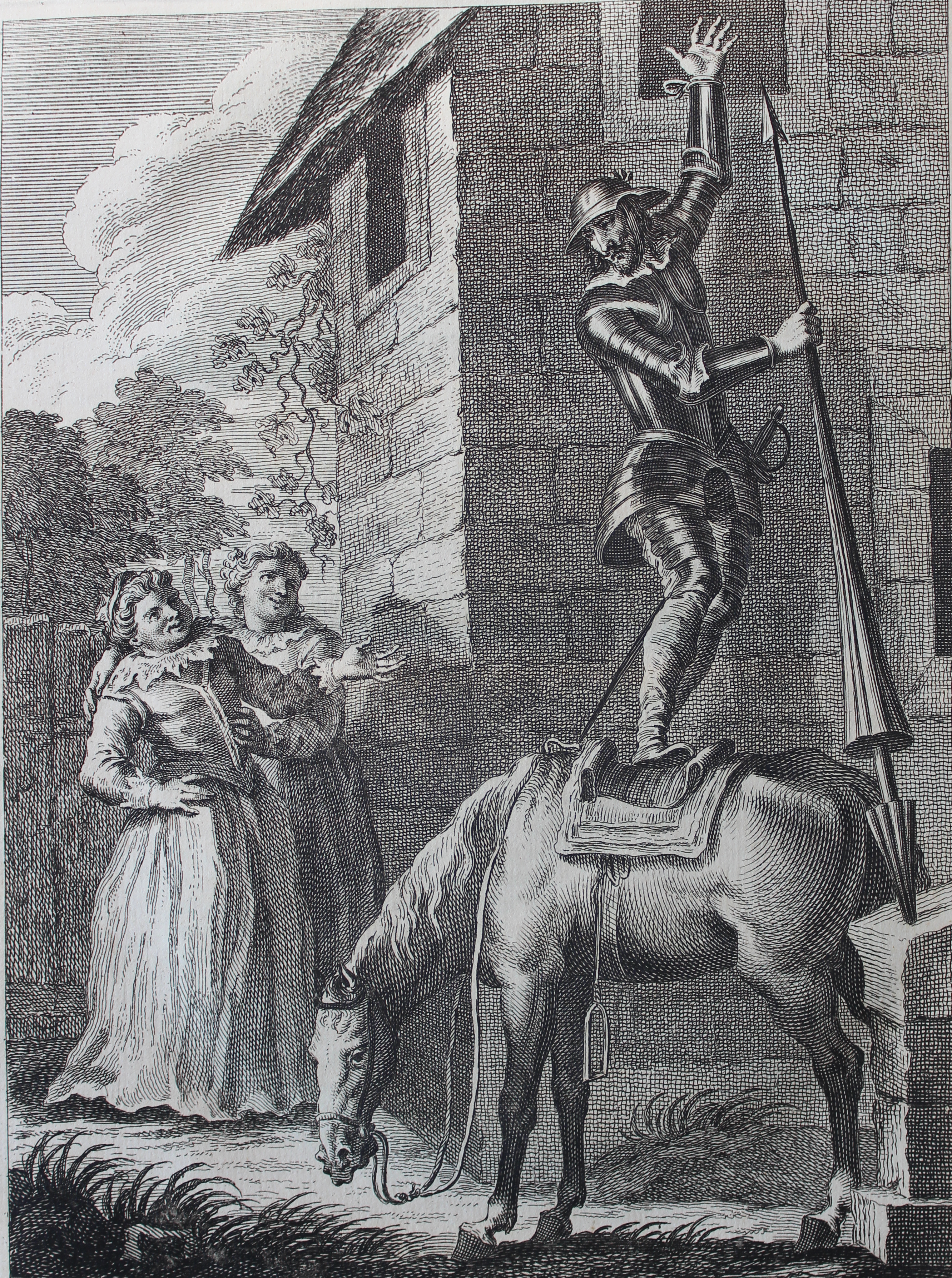
Plate facing page 299 from volume one of The Life and Exploits of the Ingenious Gentleman Don Quixote De La Mancha
In the next scene Don Quixote launches Sancho Panza into a tree so he can avoid fighting a squire whose large nose scares him. This squire, who can be seen on the left of the picture, is actually wearing a mask.
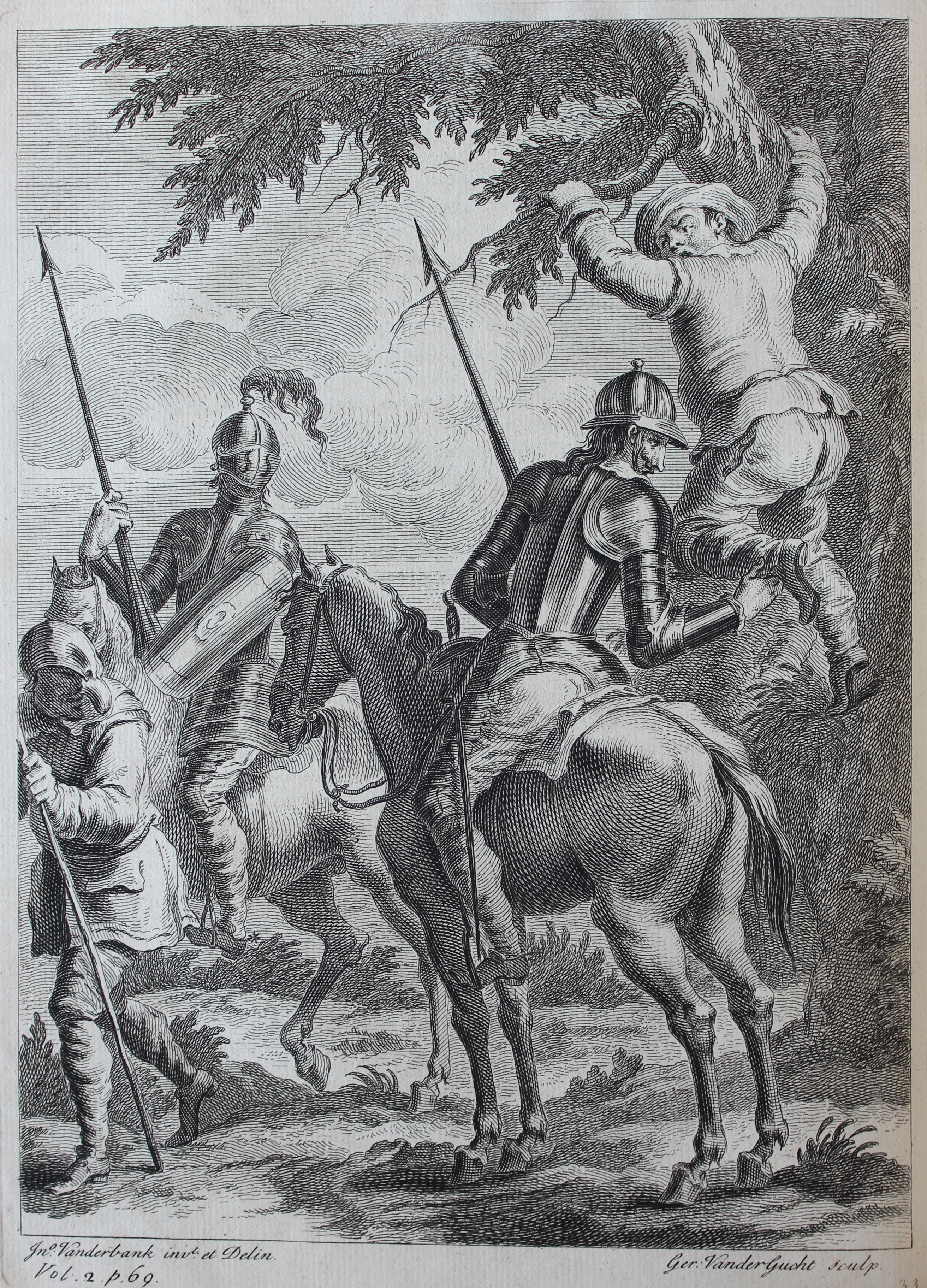
Plate facing page 69 from volume two of The Life and Exploits of the Ingenious Gentleman Don Quixote De La Mancha. Shelfmark: Glendinning.98/2
The following two illustrations come from a Spanish edition of the work from later in the same century. First we have a classic image of Don Quixote on Rocinante accompanied by his squire riding a donkey.
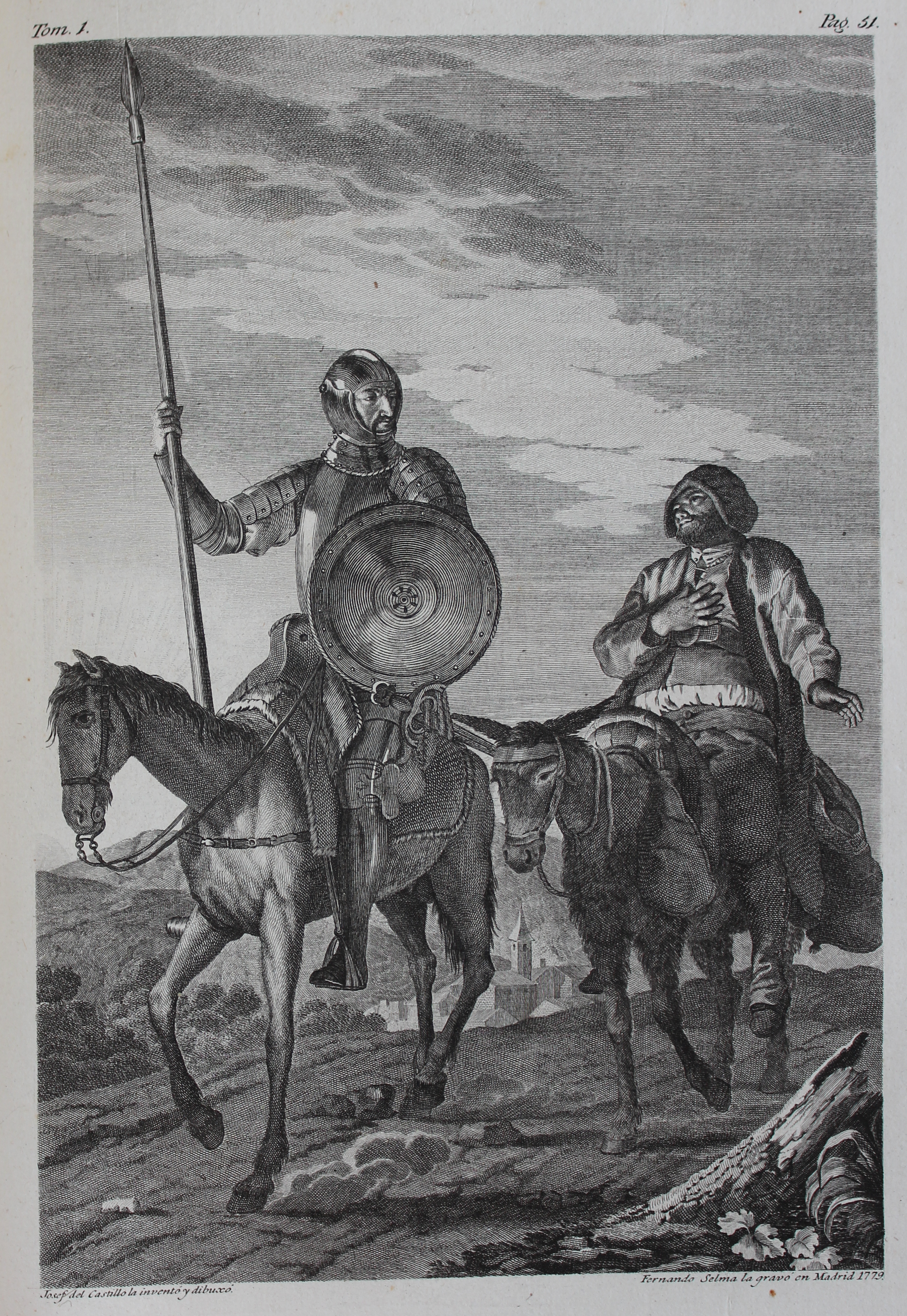
Plate facing page 50 from volume one of El ingenioso hidalgo Don Quixote de la Mancha by Miguel de Cervántes Saavedra, Madrid, 1780. Shelfmark: L.2.13
In the next illustration, Don Quixote is astride a wooden horse named Clavileño. He and Sancho Panza have been tricked into thinking they are flying on this horse, directing it via a peg in its forehead. Bellows and other props are used to make the “flight” more convincing.
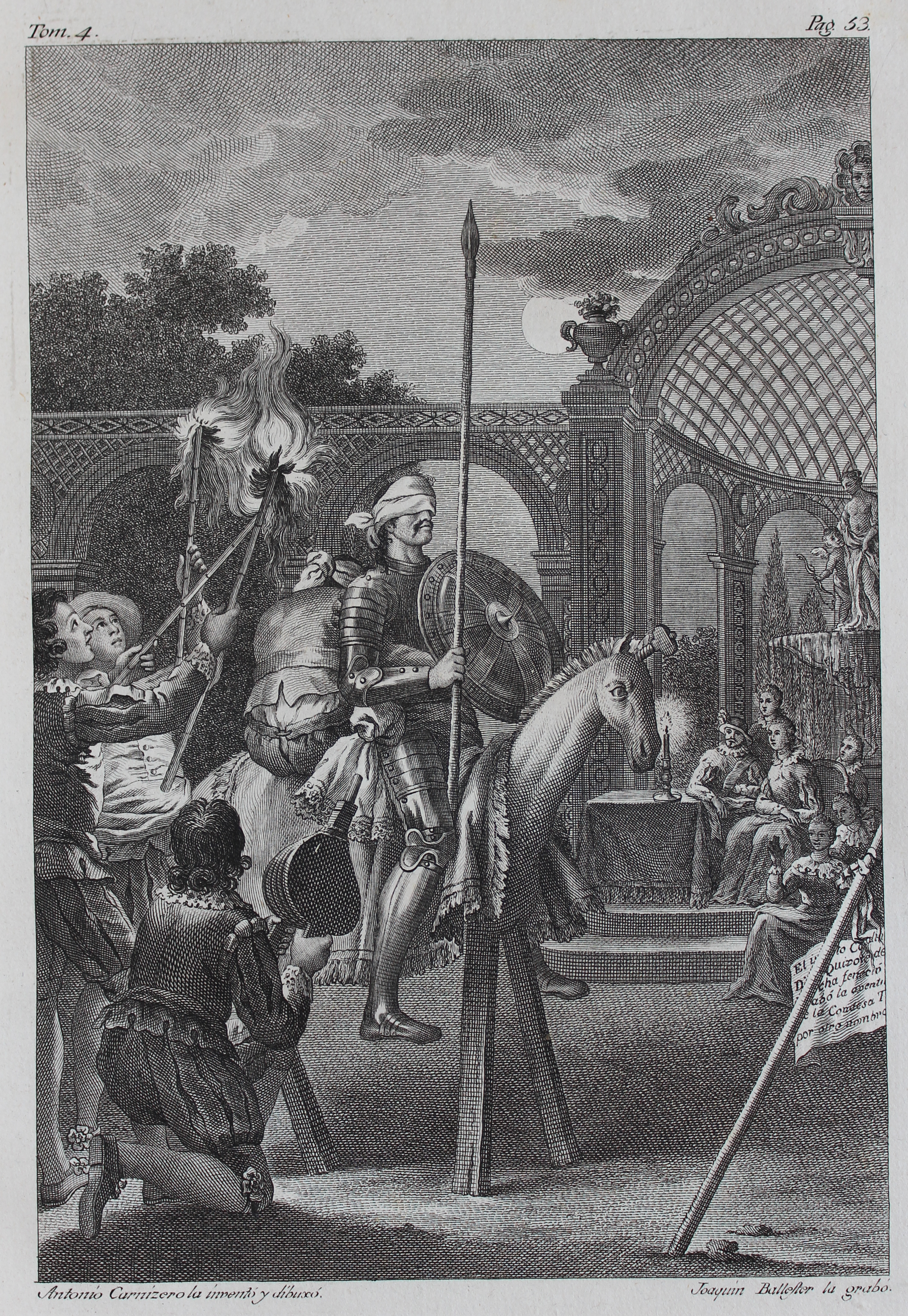
Plate facing page 52 from volume four of El ingenioso hidalgo Don Quixote de la Mancha by Miguel de Cervántes Saavedra, Madrid, 1780. Shelfmark: L.2.16
We finish our look at Rocinante with some lovely images from this very colourful early twentieth-century English edition, illustrated by artist Walter Crane (1845-1915).
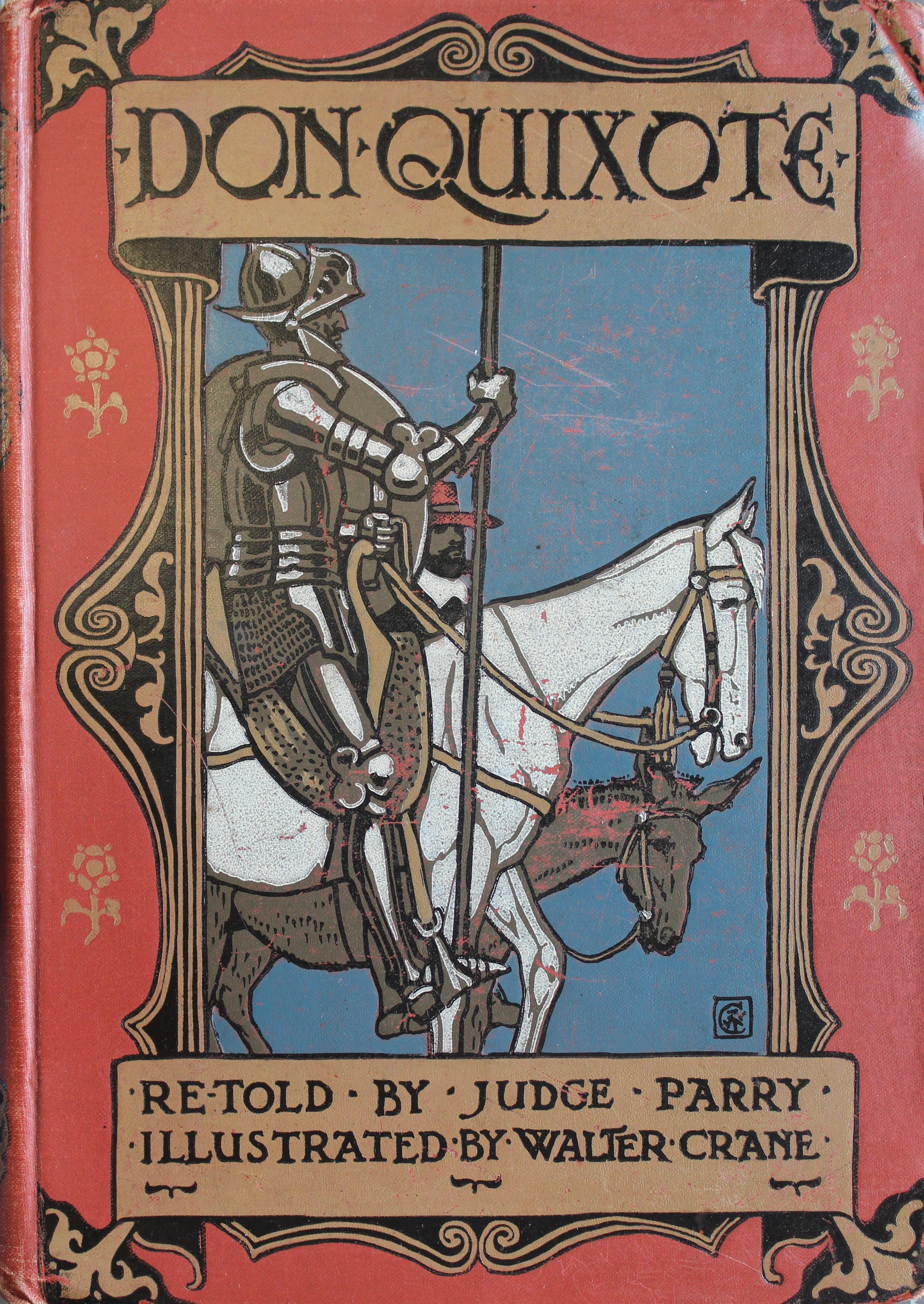
Cover of Don Quixote of the Mancha, retold by Judge Parry, London, 1900. Shelfmark: Glendinning.107
Below Don Quixote charges at windmills he believes are fearsome monsters.
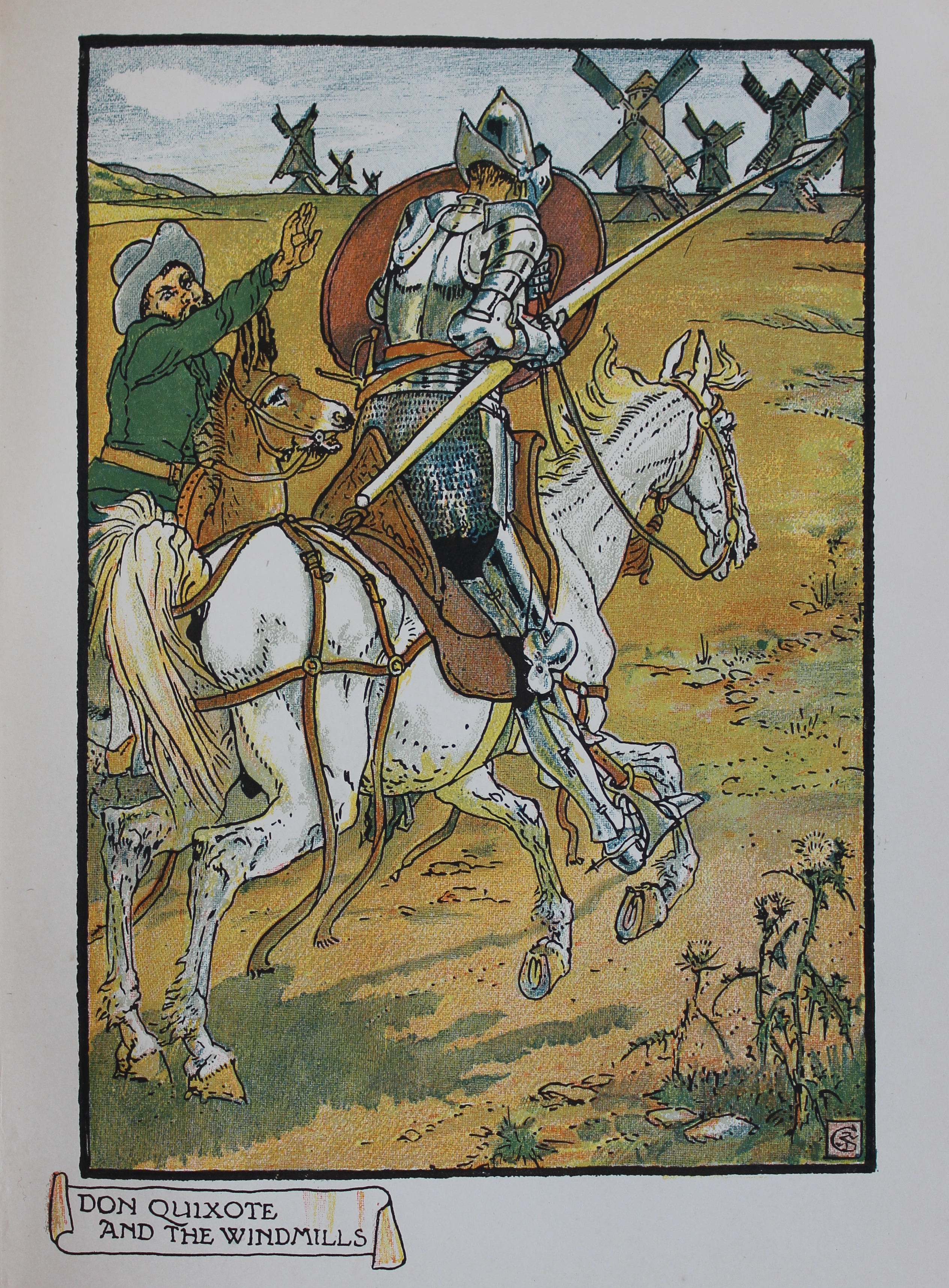
Plate facing page 38 from Don Quixote of the Mancha
Finally, here is Walter Crane’s illustration of Don Quixote with his hand tied above him. In this version his shadow looks a lot like a devil!
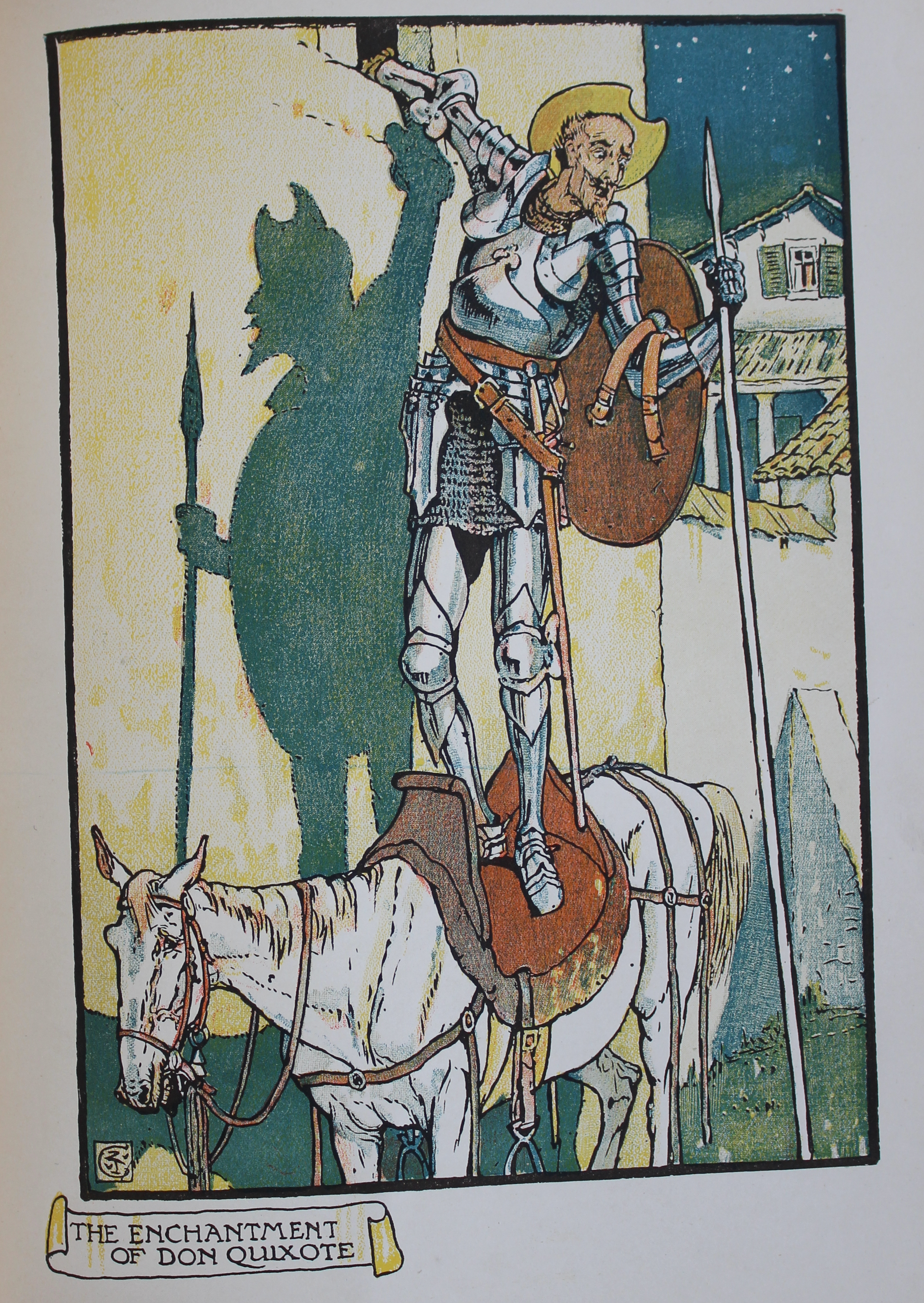
Plate facing page 212 from Don Quixote of the Mancha
A late nineteenth-century edition of The Adventures of Baron Munchausen from our Rylands Collection of children’s books contains some wonderful colour illustrations by Adolphe-Alphonse Géry-Bichard (1842-1926). Although the Baron does not have a particular named horse accompanying him throughout, horses do feature in many of his tall tales. Included below are illustrations of the Baron shooting through his horse’s bridle to bring him down from where he has become attached to the steeple of a church, and of the Baron extricating himself and his horse from a pond by gripping onto his own hair and pulling!
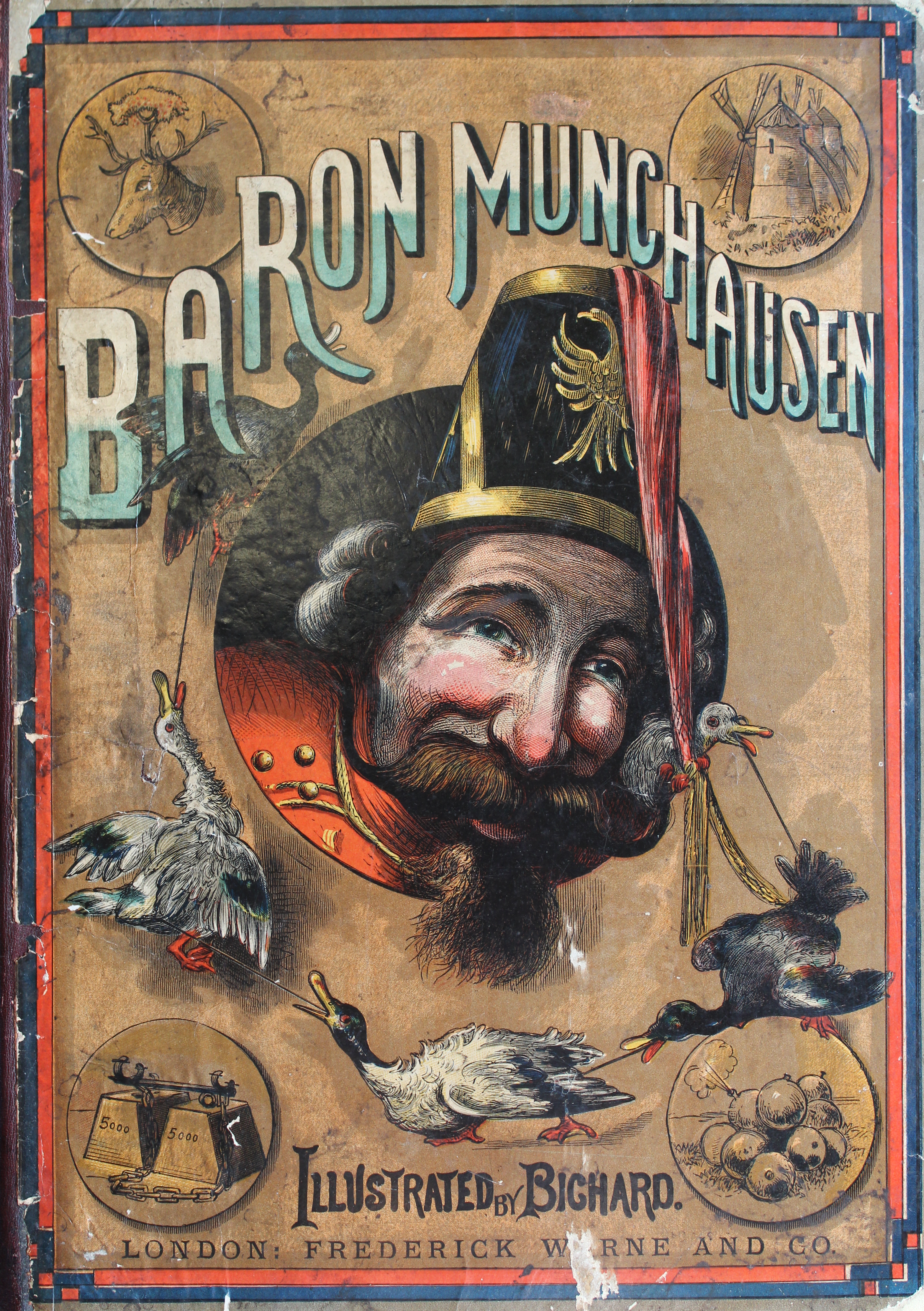
Cover of The Adventures of Baron Munchausen, illustrated by A. Bichard, London, c. 1880-1900? Shelfmark: Rylands.C.BAR
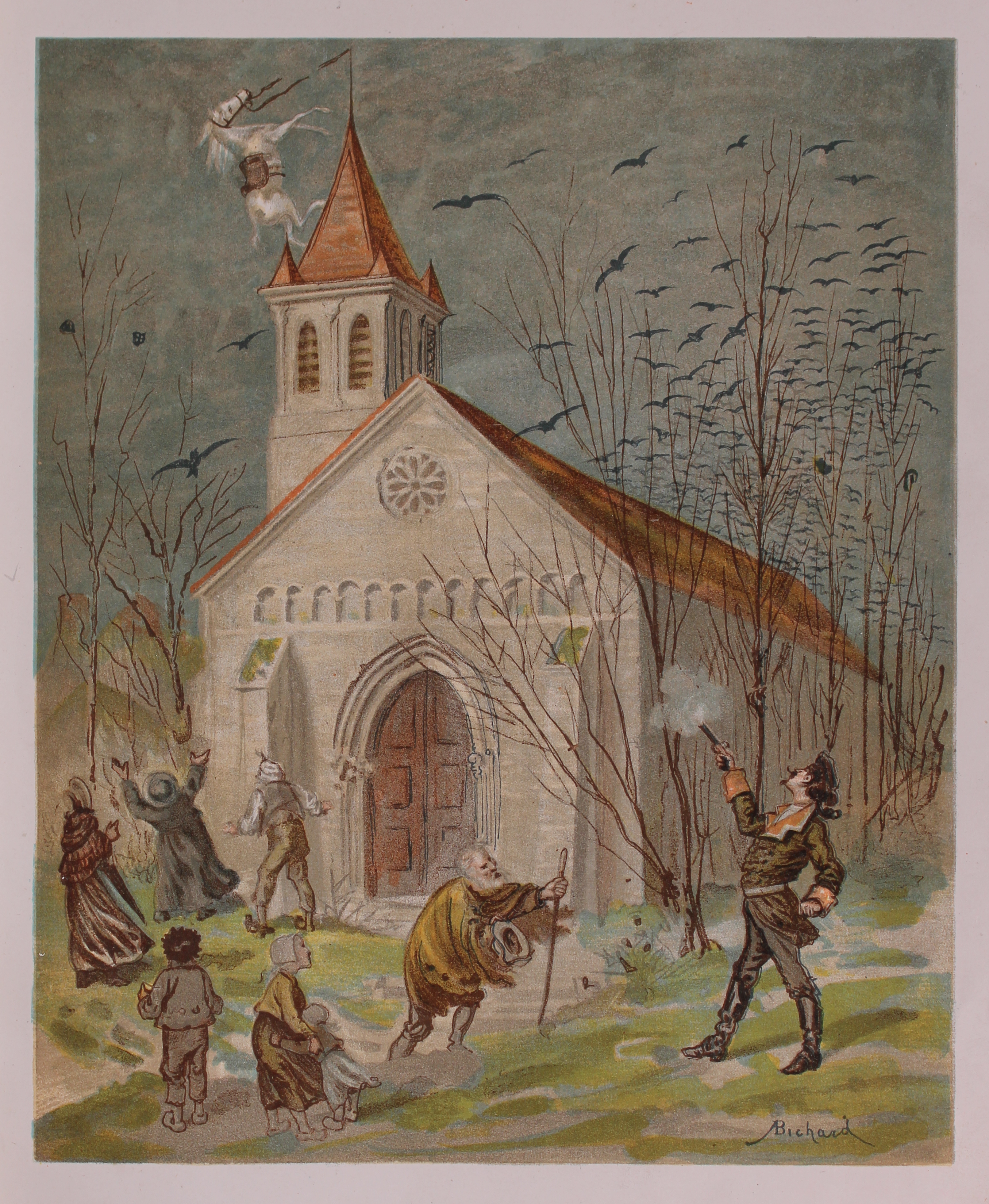
Plate before page 7 of The Adventures of Baron Munchausen
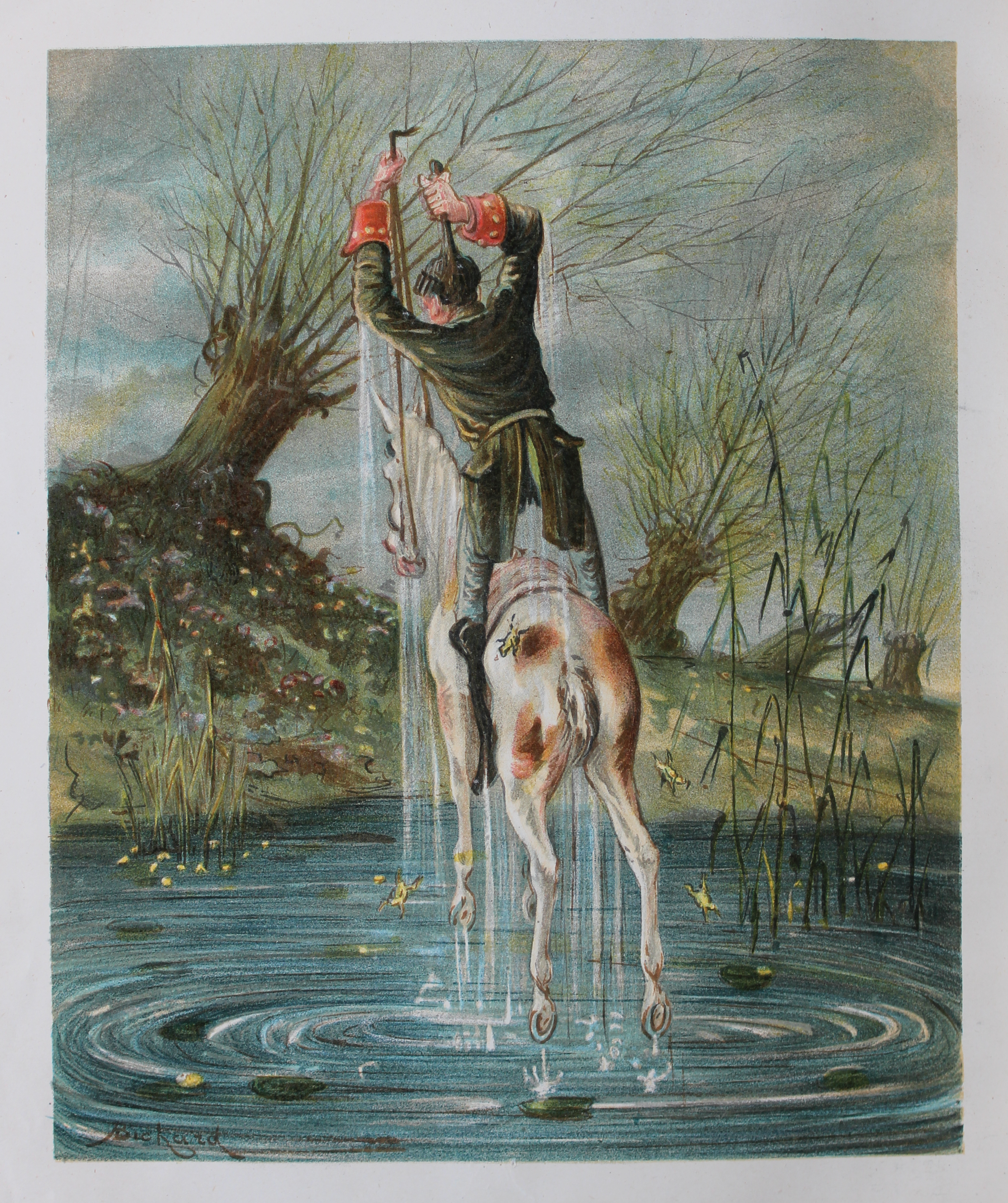
Plate facing page 89 of The Adventures of Baron Munchausen
The Victorian illustrator Randolph Caldecott (1846-1886) loved horse riding and was a keen observer of countryside pursuits. It is no surprise therefore that horses crop up regularly in his work, not only in his picture books for children, but also in his comic illustrations and tales for the London weekly illustrated paper The Graphic. Below is the cover of one of a series of incredibly popular shilling toy books that Caldecott produced in collaboration with the engraver Edmund Evans (1826-1905).
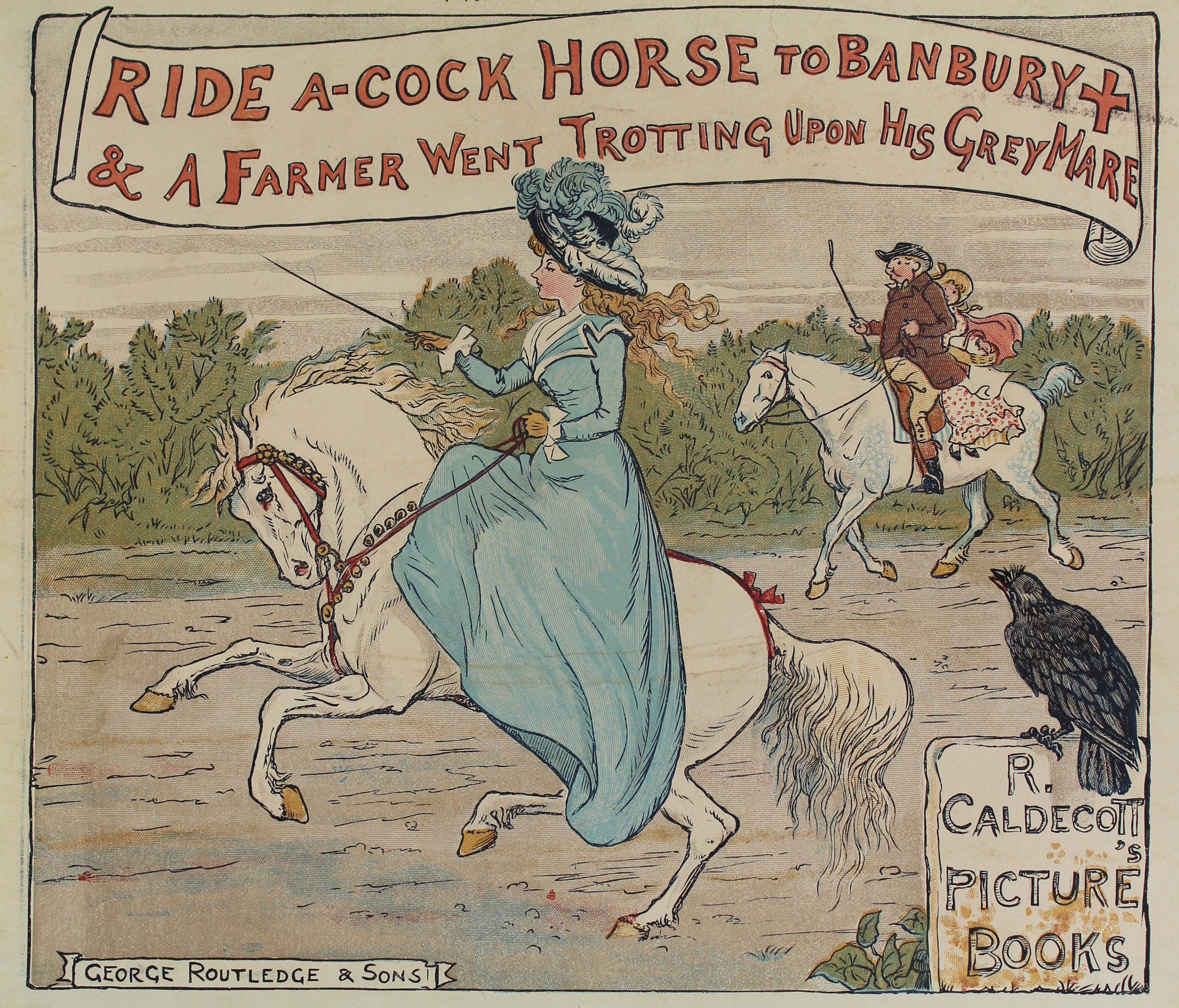
Front cover of Ride a Cock-Horse to Banbury Cross, London, 1884. Shelfmark: Rylands.C.CAL.Hey.1882/5
The Rylands Collection includes two collected volumes of some of Caldecott’s work for The Graphic, and they demonstrate his mastery of drawing horses in many different poses and situations. Below, the outing of two friends is temporarily disrupted when the horse pulling the cart is stung by a wasp.
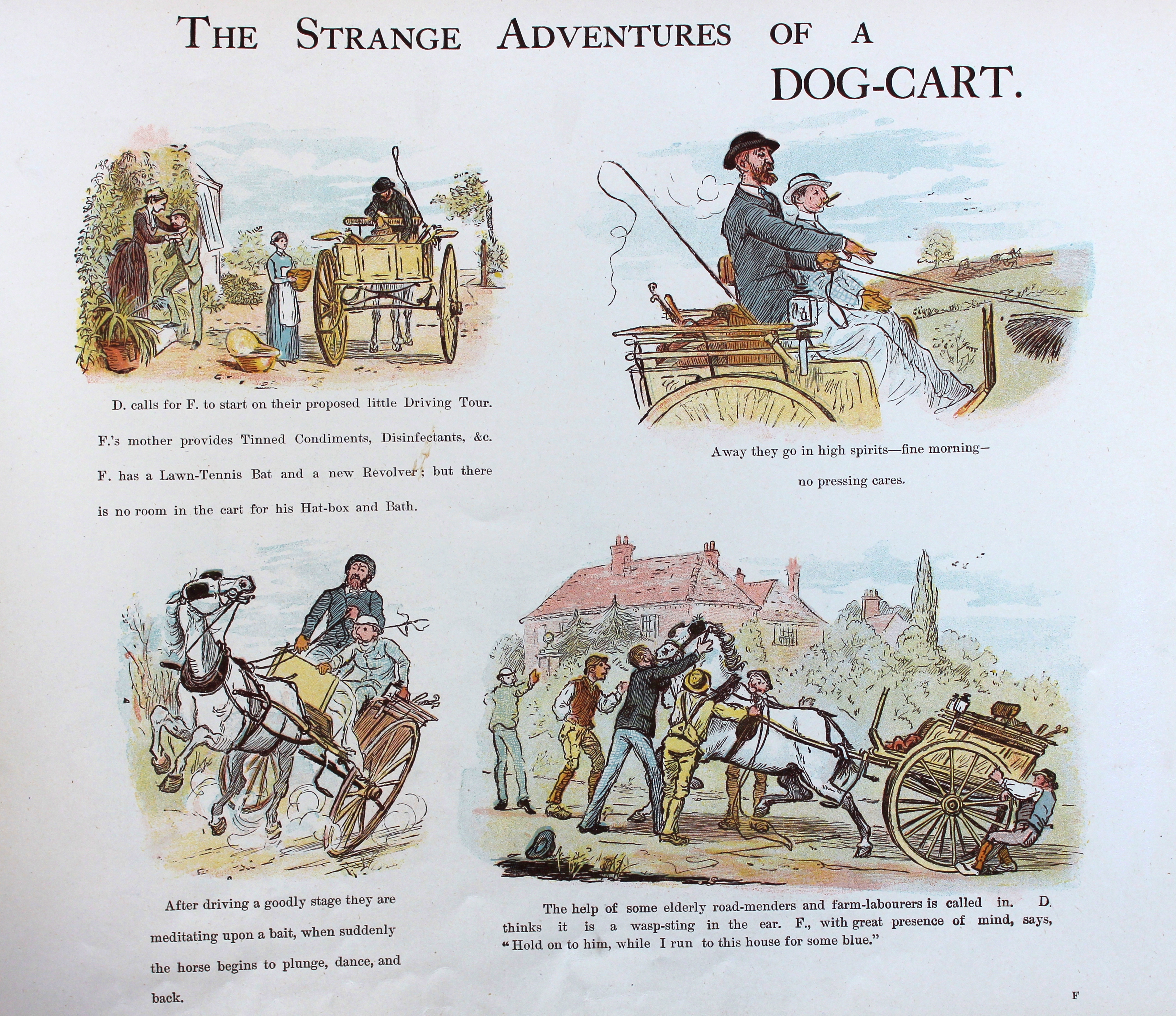
Page 41 of Randolph Caldecott’s Last “Graphic” Pictures, London, 1888. Shelfmark: Rylands.C.CAL.Las.1888
Next, a Christmas excursion is interrupted in even more dramatic circumstances, when the hero’s carriage is attacked by highwaymen! Luckily the miscreants are overpowered when Mr Carlyon (somewhat implausibly) launches himself out of the carriage at one of them and the other is bitten by one of the carriage horses.
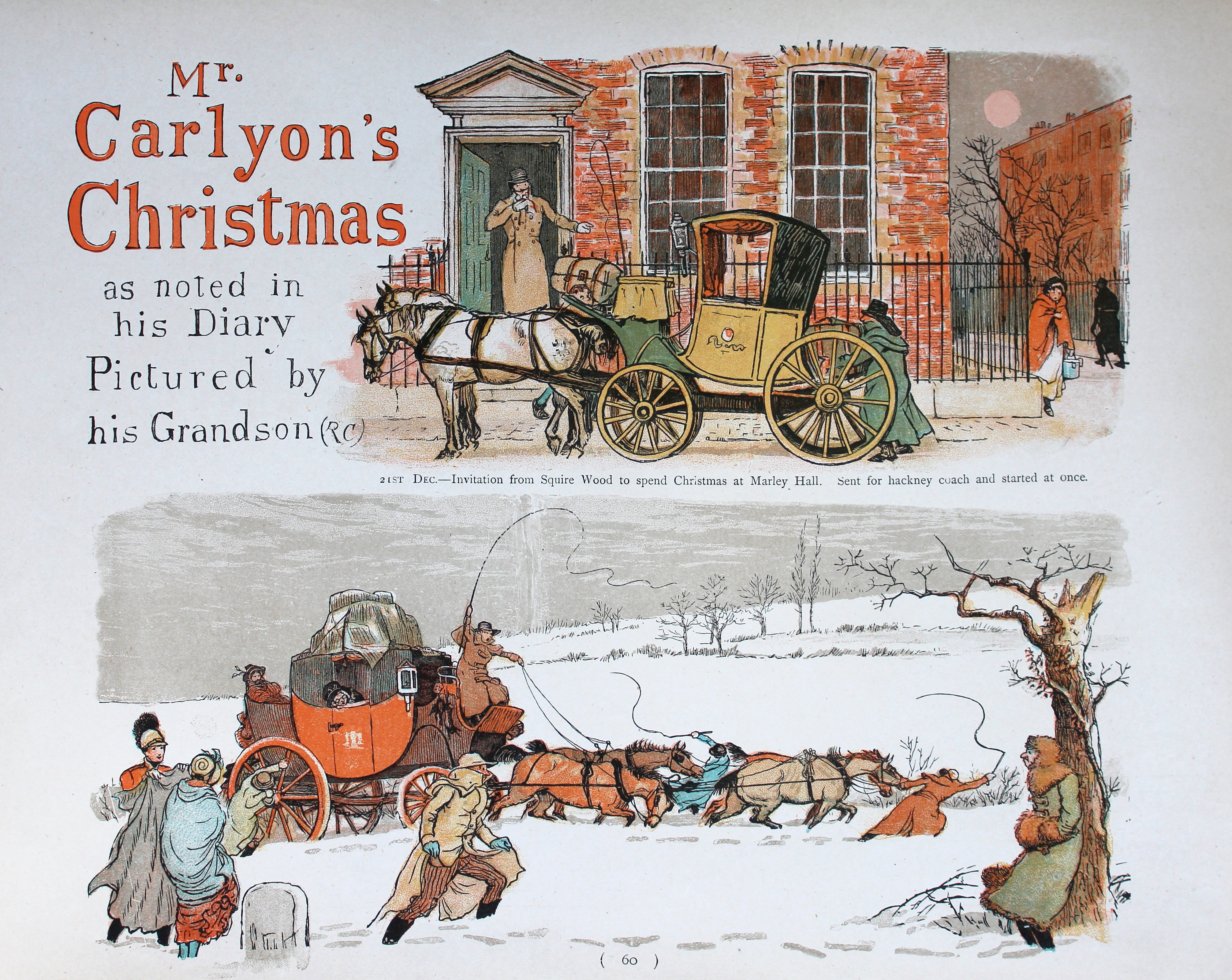
Page 60 of Randolph Caldecott’s “Graphic” Pictures, London, 1898. Shelfmark: Rylands.C.CAL.Gra.1898
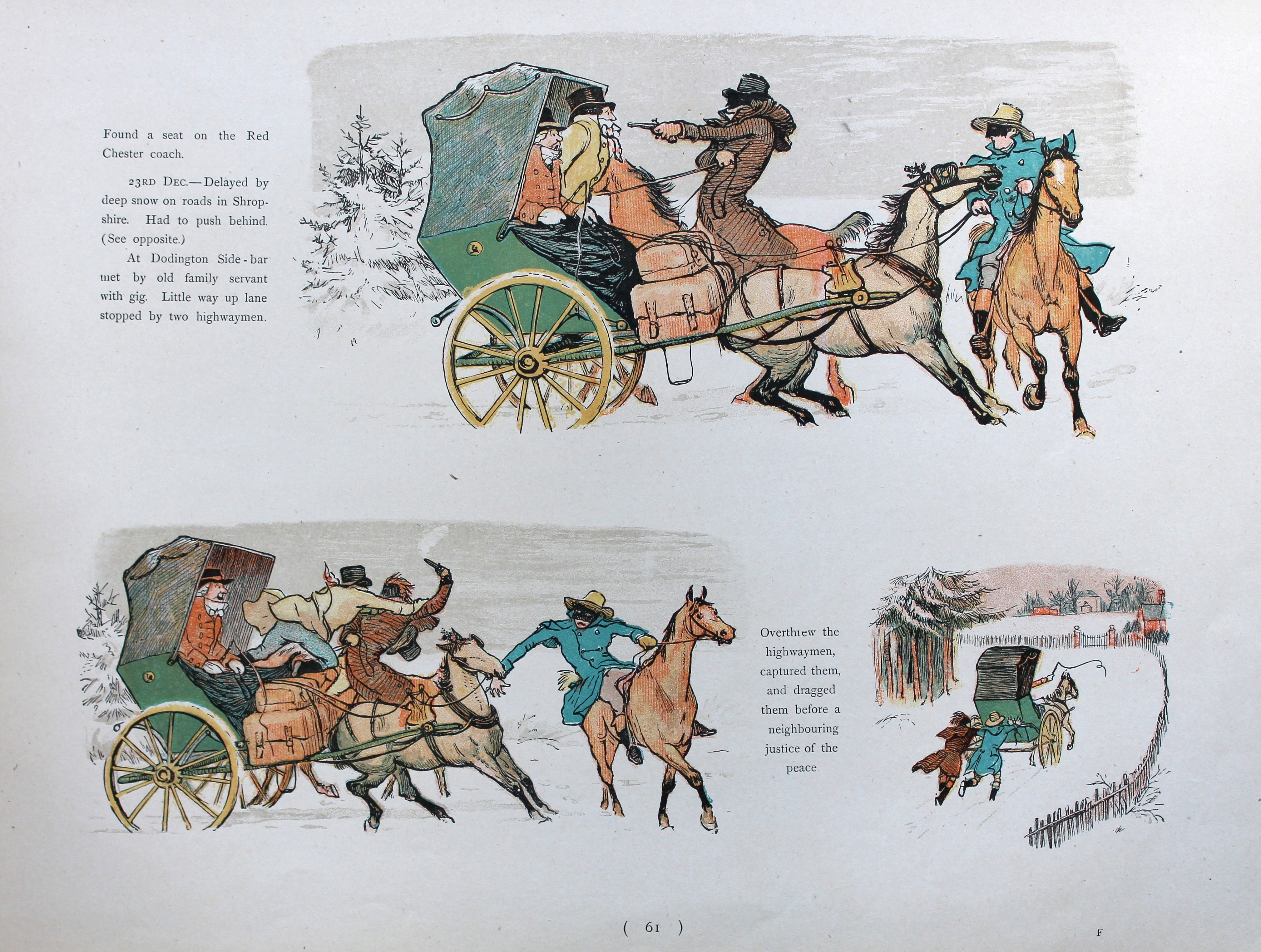
Page 61 of Randolph Caldecott’s “Graphic” Pictures
Another tale concerns a steeplechase race across the countryside, featuring many lively horses.
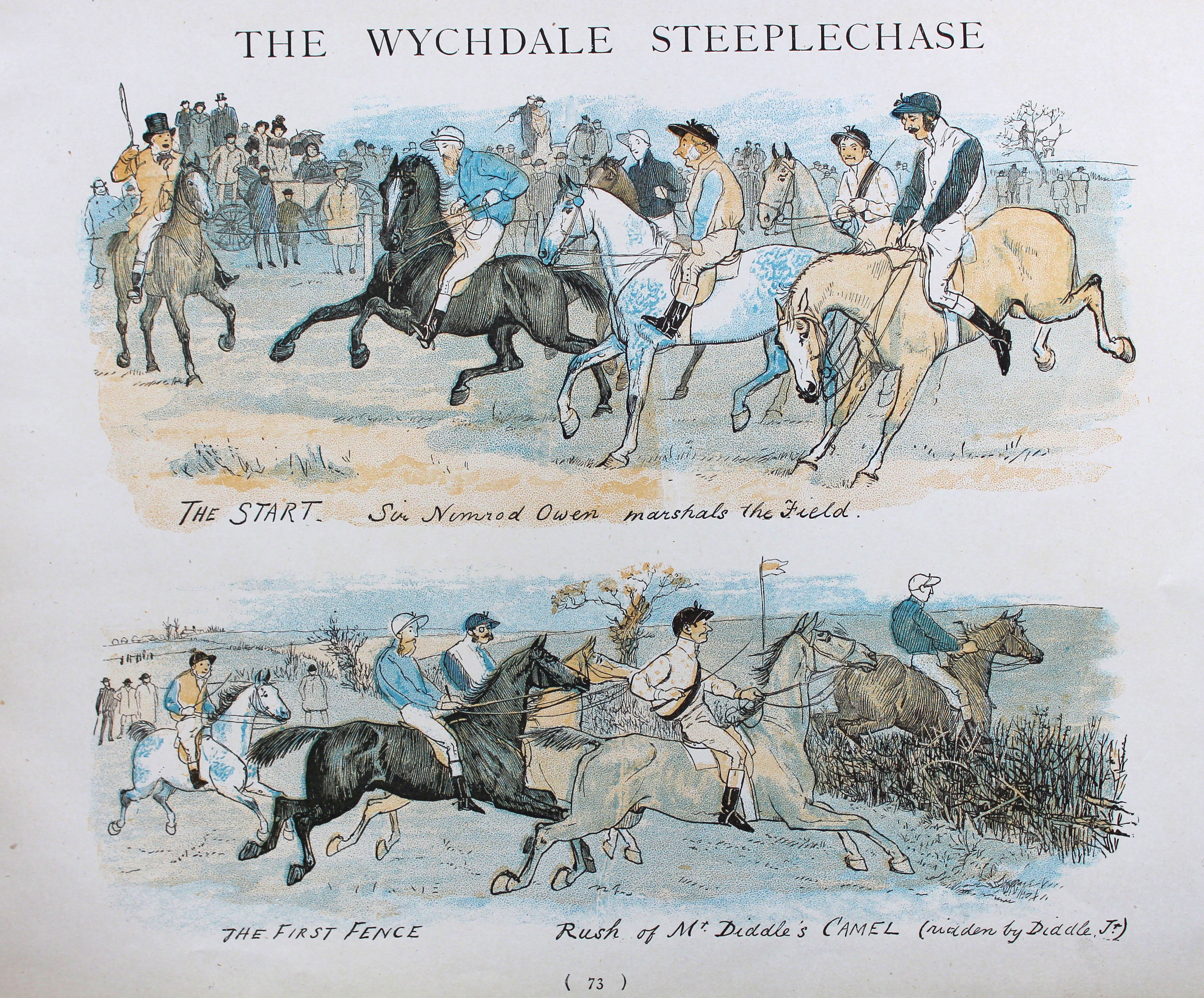
Page 73 of Randolph Caldecott’s “Graphic” Pictures
Our Local Collection includes the comic story of a Cambridge freshman, Samuel Golightly, who gets into various scrapes and adventures during his first year at the University. Below, Samuel participates in a drag hunt, where hounds follow a scent trail rather than a fox. His horse is somewhat too enthusiastic in pursuit, and he ends up tumbling to the ground, narrowly avoiding being trampled by another horse!
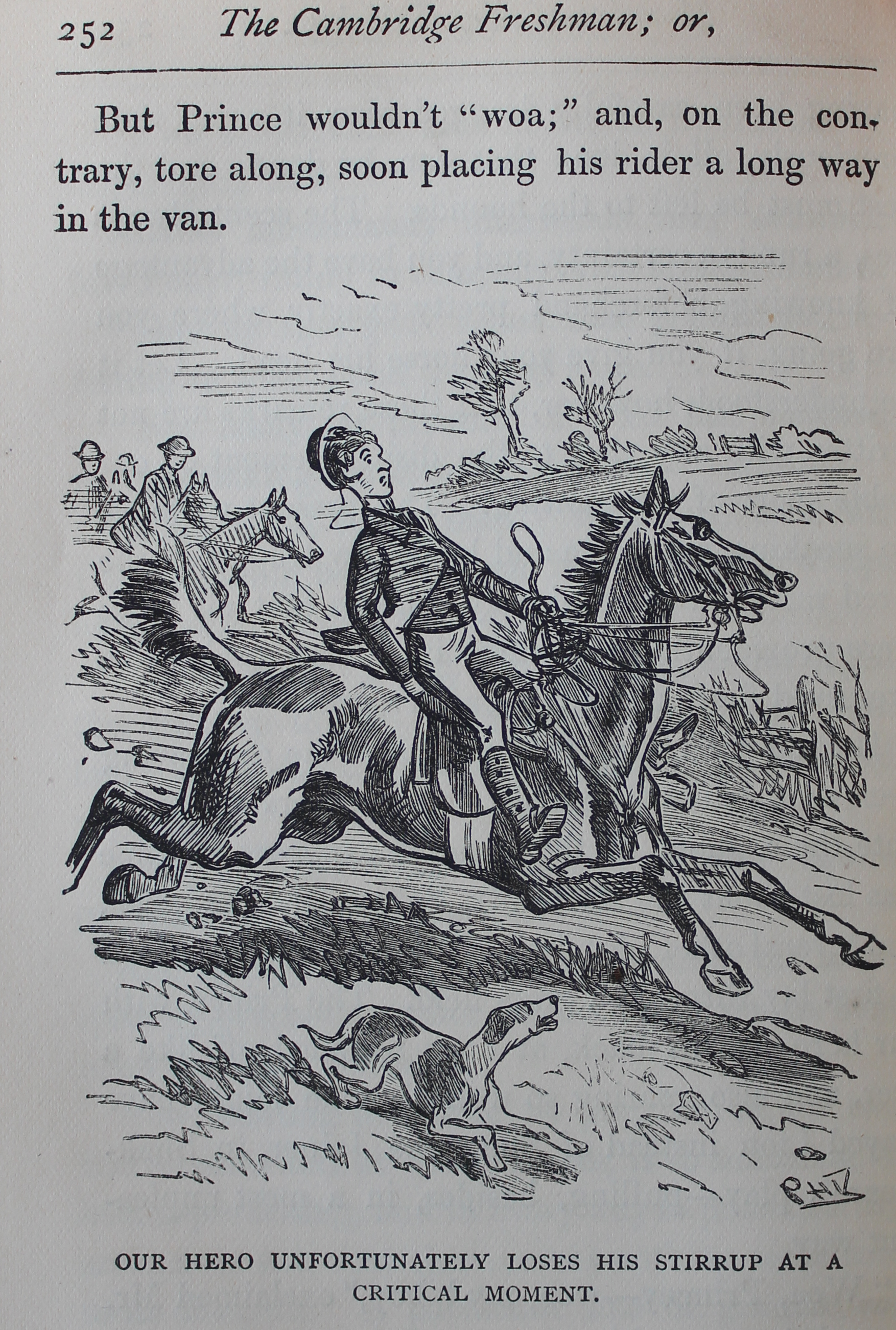
Page 252 of The Cambridge Freshman; or, Memoirs of Mr Golightly, by Martin Legrand, London, 1872. Shelfmark: NW CU JG 7P Leg
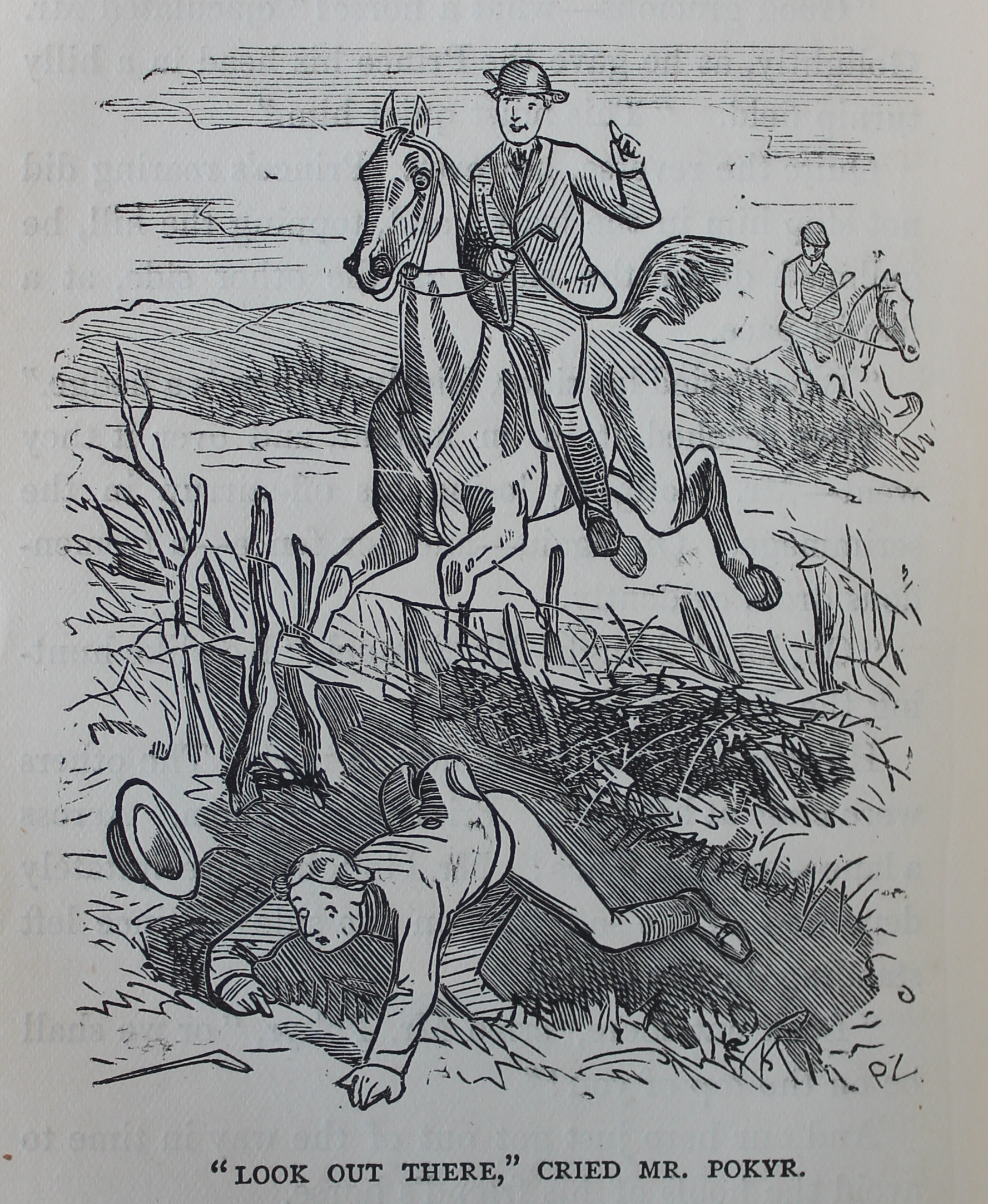
Page 254 of The Cambridge Freshman; or, Memoirs of Mr Golightly
There are many more horse illustrations in our collections, but all good things must come to an end, so we will take flight on Pegasus and bid you all farewell!
AC
References and further reading:
Pierre Grimal, The Dictionary of Classical Mythology, Oxford, 1986
Jennifer Fellows (ed.), Sir Bevis of Hampton, Oxford, 2017
Gary Lim, “‘A Stede Gode and Lel’: Valuing Arondel in Bevis of Hampton” Postmedieval Vol. 2, 1, 50-68, 2011
Rodney K. Engen, Randolph Caldecott: “Lord of the Nursery”, London, 1988.
 King's Treasures