Tag Archives: Rare Books

Something Fishy

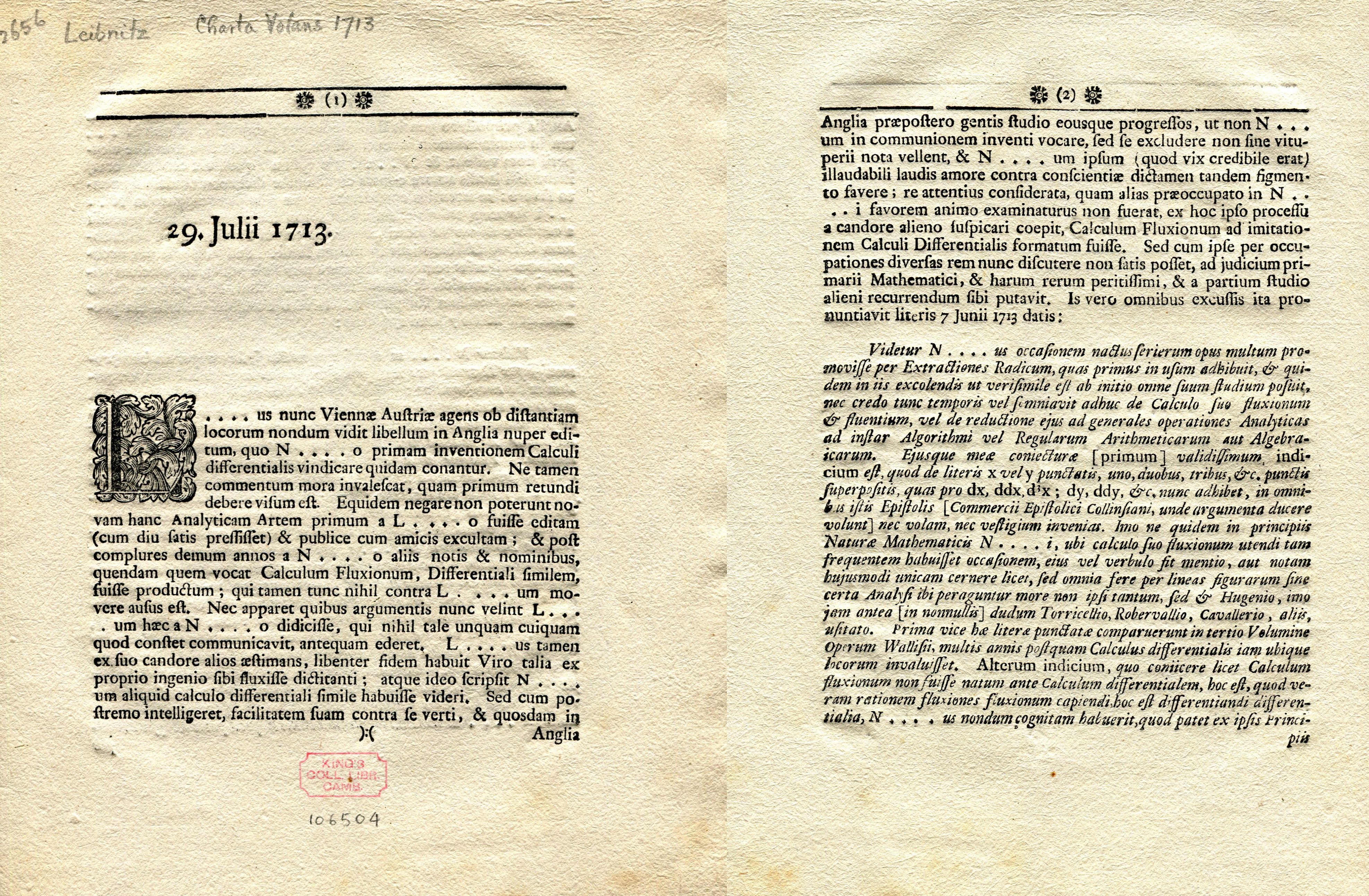
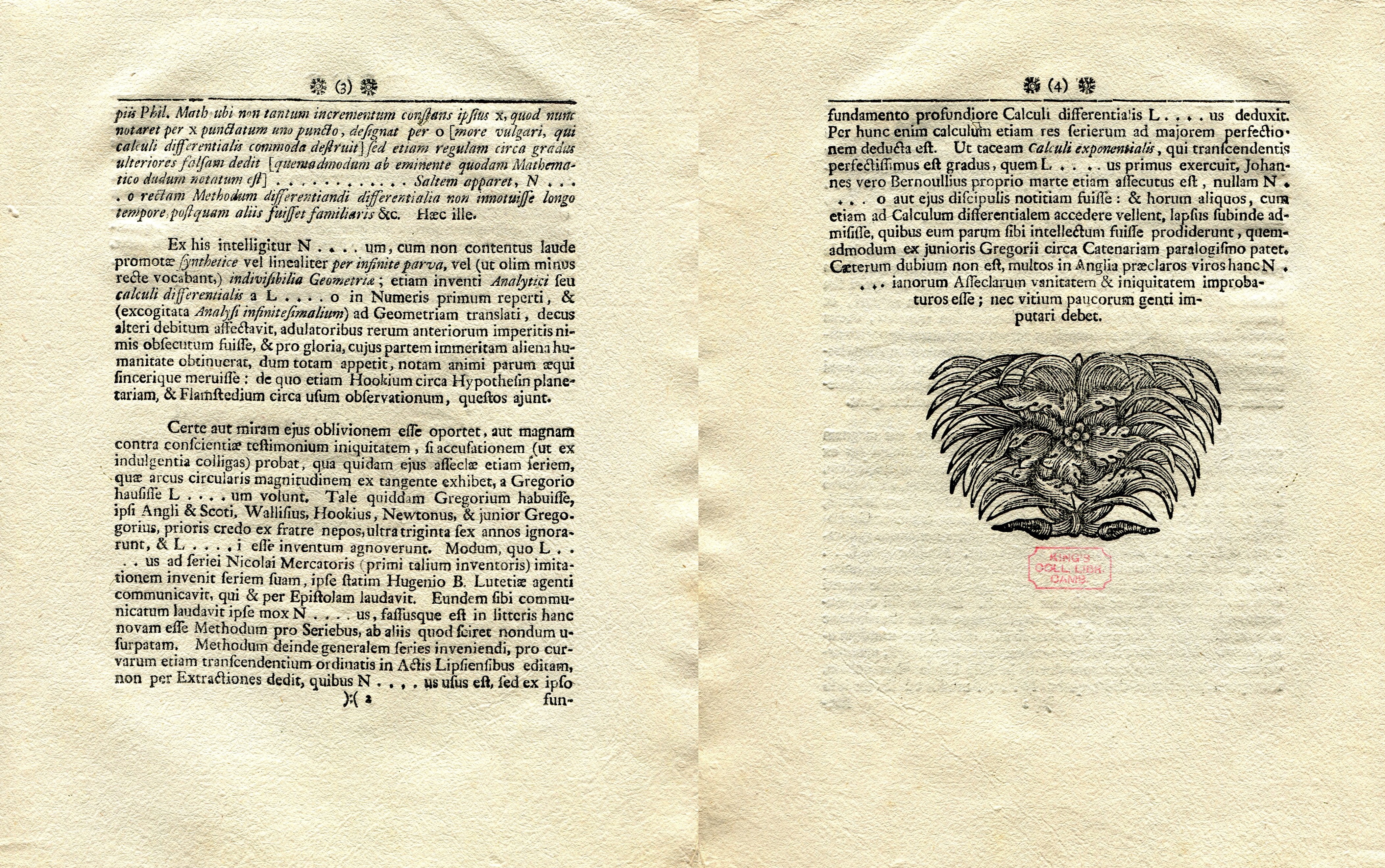
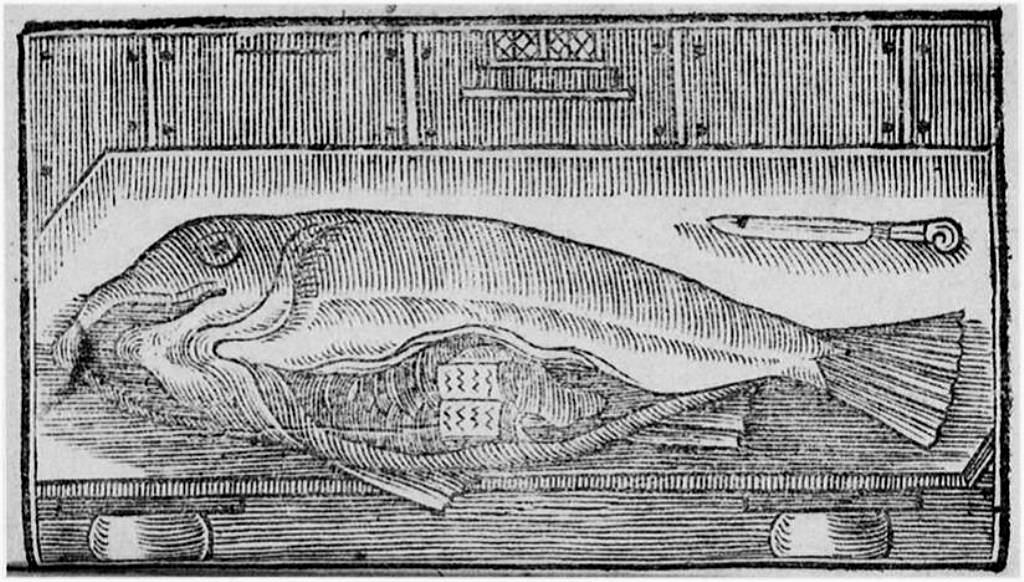
Among the more curious items in the Keynes Bequest is a book entitled Vox Piscis; or, The Book-Fish; Contayning Three Treatises Which Were Found in the Belly of a Cod-Fish in Cambridge Market, on Midsummer Eve Last, Anno Domini 1626 (1627). The title says it all. The circumstances surrounding this catch are detailed in the preface of the book, where we are told that “a codfish being brought to the fish-market of Cambridge and there cut up, … in the depth of the mawe of the fish was found wrapped in a peice of canvase, a booke in decimo sexto, containing in it three treatises bound up in one” (p. 8). The preface was written by the clergyman Thomas Goad (1576-1638), who became a Fellow of King’s College in 1596. In his will, he bequeathed his land in Milton to the College, “to the intent that the whole yearlie profitt thereof bee faithfullie emploied yearlie for ever in divinitie bookes for the librarie”. Many of these books bear the inscription “Legavit Thomas Goad”.

Vox Piscis 1b

The voice of the fish: title page and frontispiece of Vox Piscis; or, The Book-Fish (Keynes.D.4.15). It is unclear how the book ended up in the fish’s stomach.

Joseph Mede (1586-1639), theologian and Fellow of Christ’s College, helped clean the bundle and decipher the content of the treatises. They were attributed to John Frith (1503-33), the Protestant reformer who was imprisoned in Oxford in a “darke cave, where salt-fish was then kept” (p. 19) and burned at the stake in London on 4 July 1533. Frith received his B.A. degree from King’s, so the book bears a close connection with the College. Incidentally, his tutor at Cambridge, Stephen Gardiner, later played a role in condemning him to death. That’s Cambridge supervisions for you. The Keynes Bequest has two other copies of Frith’s works: A Pistle to the Christen Reader (Antwerp, 1529) and A Boke Made by Iohn Fryth, Prysoner in the Tower of London (Antwerp, 1548), a reply to Sir Thomas More.

Vox Piscis 2b

The second plate of Vox Piscis, wanting in King’s College copy; this is from the copy in the Cambridge University Library.

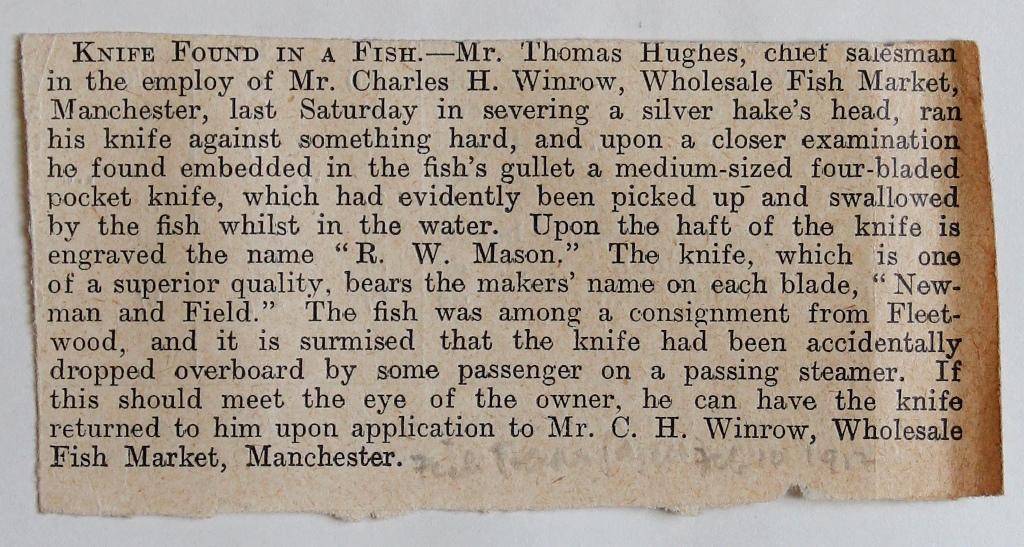
If you think this already sounds like something out of Pinocchio, there is more to come. Inside the book is preserved a newspaper cutting with the date “Feb 10 1912” pencilled in by a former owner. The short article recounts how a pocket knife was found inside a silver hake by Thomas Hughes, a salesman at the Wholesale Fish Market in Manchester. It then describes the knife, “one of a superior quality” bearing the makers’ name on each blade, “Newman and Field”, before inviting the owner to come forward and have it returned to them.

Vox Piscis 3

“Knife found in a fish”: newspaper cutting preserved inside the book.

Carrying such items is now probably illegal following the introduction of the Offensive Weapons Act in 1996, but if a knife that matches this description has been missing from your kitchen for the last century, now may be a good time to claim it back.

IJ

Hide and seek

[Or, if you prefer, Haydn seek. I absolve myself of all responsibility for this pun.]

The fun of cataloguing rare books is in the detective work. It’s like hide and seek at times, following tracks to work out where a particular item belongs. You chase up a reference here, another there, encountering any number of dark alleys and dead ends along the way, eliminating the possibilities one by one, until eventually whatever remains, however improbable, must be the truth.

I’ve been cataloguing rare music recently, most of it from the 1780s. The usual suspects: Davaux and Dalayrac, Tarchi and Tozzi, Sulzer, Schroeter and Schetky. Names that have the ring of familiarity even now. Occasionally, something out of the ordinary comes up, like a 1786 edition of Mozart piano sonatas printed in London by John Bland. Or this:

Title page 1

Most title pages have a publisher’s imprint, giving the cataloguer useful details of the place of publication, the name of the publisher, and even (in cases of great good fortune) the publication date. These are all standard on modern books, but in the 1780s they weren’t, especially on printed music.

Where to look, then, if your edition of Haydn’s Overture for the Piano Forte has no publication information? Well, in the first instance, major reference sources like the British Union-Catalogue of Early Music (BUCEM) and Répertoire international des sources musicales (RISM). In this case, though, the increasingly mysterious overture was listed in neither.

Haydn, happily, is a composer important enough to have his own thematic catalogue, which was compiled by Anthony van Hoboken and published in 1957. Hoboken arranges Haydn’s works by form (symphony, string quartet, piano sonata), and then chronologically by publication within sections. My heart sank at the prospect of having to wade through all of Haydn’s orchestral music to identify the overture in question. My first thought was that a piece of piano music calling itself an overture might just as easily be an arrangement of a symphony movement, and Haydn wrote a hell of a lot of symphonies.

Incipit 1

The task was to match the incipit (in plain English, the opening) of the score to one in Hoboken’s catalogue. After at least two minutes of tireless browsing, lo and behold, there it was in the Overtures section! Hob. Ia:7, Overture in D major. I hadn’t expected it to be so straightforward. Hoboken lists early editions of the piece, and includes the one I was cataloguing. But in the place where you would normally find the name of the publisher, one word: ‘Anonym’. Sigh.

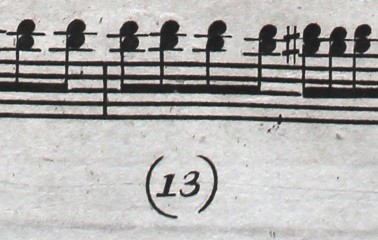
When the reference works let you down, it doesn’t have to be the end of the trail. You still have your own wits to rely on, and (more pertinently) the item itself. In this case, a major clue was provided by the plate number. Sets of music printed from engraved plates often have a number at the foot of each page, identical across all plates in a set, and here the style of the plate number (a number 13 in parentheses), combined with its proximity to a similar Plate number 1plate number (the item bound after it having a number 14 in the same style), led me to infer with some confidence that the unidentified publishers of this edition were Edinburgh’s Corri & Sutherland.

This in turn facilitated the task of assigning a publication date. Humphries & Smith’s Music Publishing in the British Isles, an invaluable ‘dictionary of engravers, printers, publishers and music sellers’, says Corri & Sutherland operated from 1780 until 1790, which fits neatly with Hoboken’s stated composition date of 1777.

So there you have it: the cataloguing of an early edition from cradle to grave. There’s more to it than that, of course, but one has to keep something exciting in reserve for future posts.

GB

Clashing inscriptions

Front pastedown of J.75.17 from the Thackeray collection

Front pastedown of J.75.17. From the Thackeray collection

This amusing exchange appears on the front pastedown of a 1794 edition of “The conduct of understanding” by John Locke. The inscriptions read: “C. Sturges K.C.C.  Recommended by Dr Glynn 1794” and: “You lying scoundrell Sturges. Dr Glyn does not recommend any such book”

1794 was the year the book’s first owner, Charles Sturges (1776-1802) joined the college as an undergraduate, and, as a newly minted scholar, he appears to have been eager – perhaps too eager – to show that his book purchases were guided by the advice of his betters. Being labelled a “lying scoundrell” seems to have done him little harm, as he later became a fellow of the College and also a clergyman, acting between 1800 and  1802 as curate of St. Mary’s Church in Reading, where his father was the vicar.

The author of the second inscription is thought to have been Dr Glynn himself.  Robert Glynn (1719-1800) was a colourful character in every respect.

Dr Robert Glynn. An engraving of a drawing by the Rev. Thomas Kerrich

Dr Robert Glynn. An engraving of a drawing by the Rev. Thomas Kerrich

A prominent and well respected Cambridge physician and a fellow of the Royal College of Physicians, his  habit of wearing a scarlet cloak and a three-cornered hat and carrying a gold-topped cane must have made him an easily  recognisable figure around the town. A Kingsman, Glynn lived in College and ran his practice from his rooms there.

Described in the Rev. Augustus Austen Leigh’s history of the College as: “the most active, eccentric, and benevolent of doctors”, Glynn’s popularity stemmed in part from his generosity and kindness towards the people of the malaria-ridden fens, who were encouraged to come to him for free medical advice. Fees were also waived for Cornishmen (Glynn was Cornish by birth), clergymen and old Etonians. A man of firm opinions, Glynn always avoided prescribing opium, advocated fresh air as one of the best remedies, and never bled his patients, despite this being a common medical practice at the time. He avoided regular mealtimes, preferring to snack on cold mutton kept in his rooms.

Memorial tablet in the College chapel

Memorial tablet in the College chapel

Eccentric to the last, Glynn stipulated that he should be buried in the College chapel  late at night, by torchlight, and that only College members were to attend.  He is memorialised by a tablet on the wall of one of the side-chapels. The name Clobery was adopted by Glynn after he received a large inheritance from a maternal uncle.

The book made its way into the collection of George Thackeray (1777-1850), who was Provost of King’s between 1814 and 1850. Most of Thackeray’s books were passed to his daughter  Mary Ann (1818-1879), who in turn bequeathed them to the College.

Sources: Oxford Dictionary of National Biography,  “King’s College” by Rev. A. Austen Leigh, and Venn’s “Alumni Cantabrigienses”

AC

Isaac Newton’s dog-ears

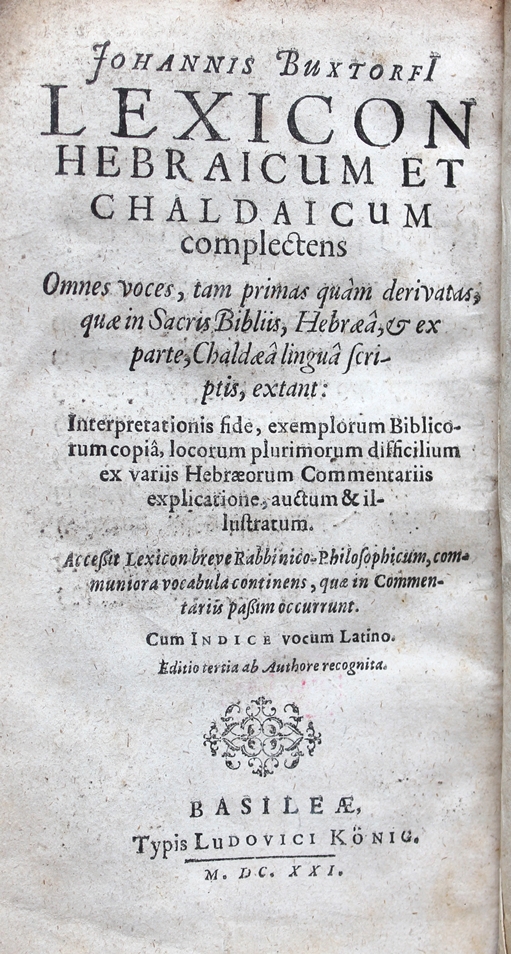
Keynes.Ec.7.3.26 Lexicon Hebraicum et Chaldaicum - title page

The title page of Keynes.Ec.7.3.26

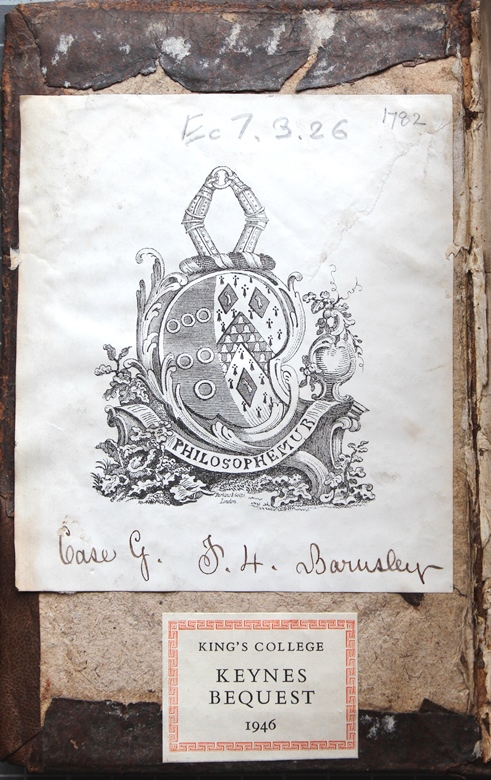
Bookplate on inside front board of Keynes.Ec.7.3.26

Bookplate on inside front board of Keynes.Ec.7.3.26

Among the highlights of the Keynes Bequest are two volumes from Sir Isaac Newton’s library, with a fascinating history behind them. This copy of Johann Buxtorf’s third edition of Lexicon Hebraicum et Chaldaicum (Basel: Ludwig König, 1621) features an armorial bookplate with motto ‘Philosophemur’ and ‘Case G. F.4. Barnsley’ in ink underneath the bookplate. On the rear fly-leaf is the shelfmark ‘F2_27’. The ‘Philosophemur’ bookplate belonged to Dr James Musgrave, who was Rector of Chinnor, near Oxford. After he died in 1778 the library was removed to Barnsley Park, Gloucestershire, the home of his son, where the books were re-catalogued and re-classified with ‘Barnsley’ shelfmarks. Musgrave’s books had been previously owned by his predecessor at Chinnor, Charles Huggins, who received them from his father, John Huggins, Warden of the Fleet Prison. John Huggins had bought the collection from the estate of his late neighbour, Isaac Newton, for £300.

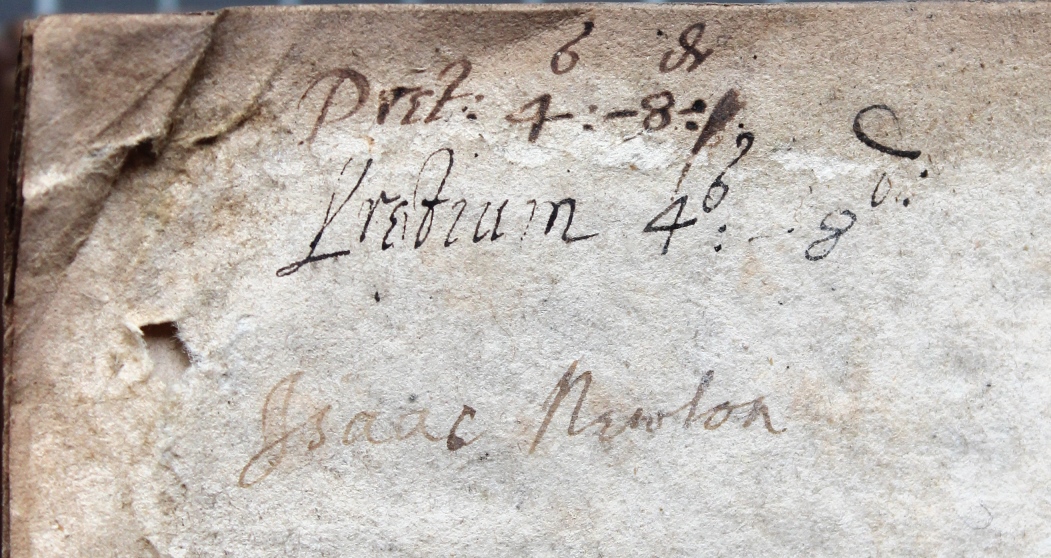
Signature of Isaac Newton

Signature of Isaac Newton

Newton’s library was preserved almost intact until 1920, when more than half of the items were auctioned off and dispersed. Before securing one of the most important collections of Newton’s manuscripts in the world, which he acquired during and after a sale at Sotheby’s in 1936, John Maynard Keynes purchased two of Newton’s books from the Guildford bookseller Thomas Thorp in March 1921. This Latin-Hebrew dictionary is signed on the front and rear fly-leaves: ‘Isaac Newton’, who also noted the price on the rear fly-leaf: ‘Pret: 4s: 8d’.

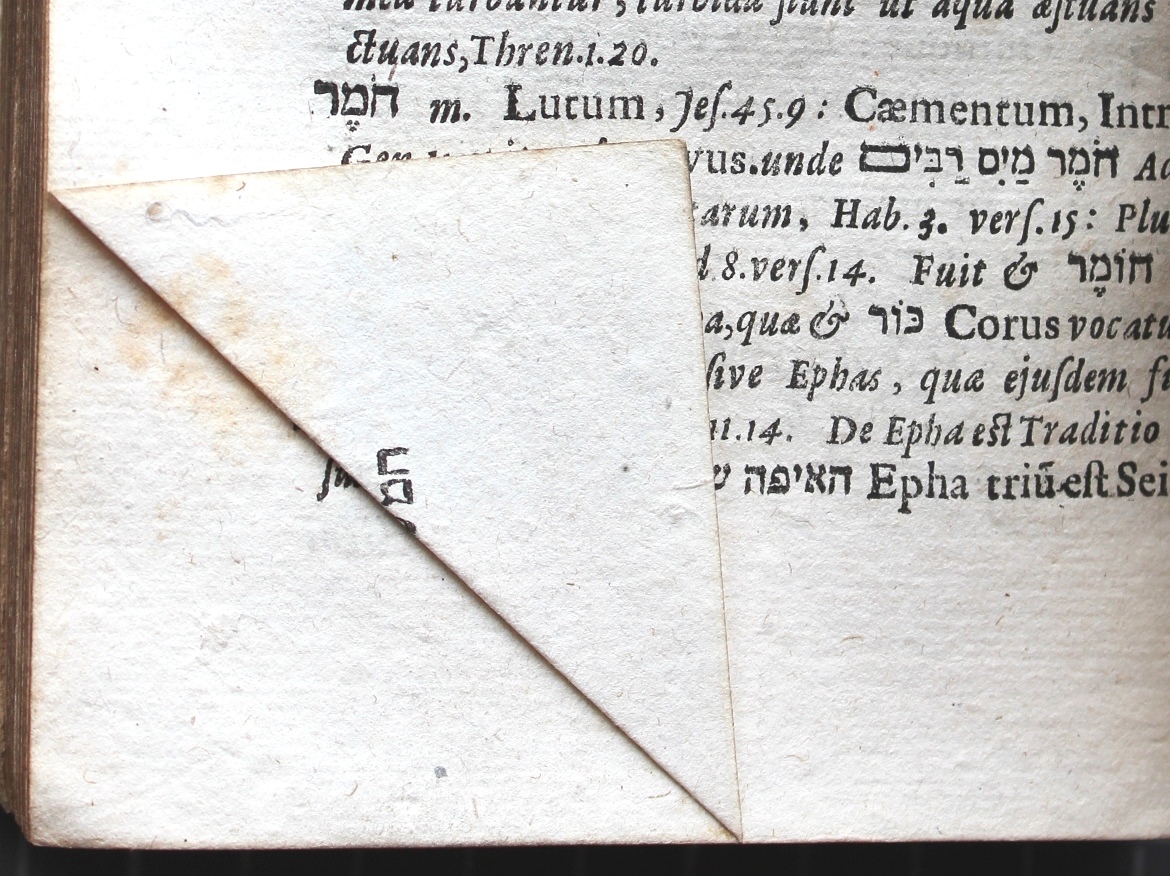
Newton highlighting the word 'Lutum' in Keynes.Ec.7.3.26

Newton highlighting the word ‘Lutum’ in Keynes.Ec.7.3.26

Newton had the habit of ‘dog-earing’ his books, turning back the corner of leaves to note a reference, the corner of the leaf pointing to the exact word he wished to highlight. Eight pages (pp. 11, 18, 29, 45, 164, 247, 593 and 636) are turned back in this way in this dictionary. For more information, see John Harrison, The Library of Isaac Newton (Cambridge: Cambridge University Press, 1978). Some of the information in this post is drawn from the SCOLAR blog of Cardiff University.

IJ

Munby Cataloguing Project (Rare Books)

Title page

The title page of Keynes.D.1.9

In June 2013 King’s College held a conference to mark the centenary of the birth of A.N.L. (Tim) Munby, Librarian at King’s from 1947 to 1974. The conference was a great success, with a distinguished panel of speakers from the world of bibliography and the history of books, and over 120 registered participants. As a follow-up to the conference, and as a permanent tribute to Tim Munby, King’s College inaugurated a fund in his name—The Munby Centenary Fund.  Donations to the fund support projects initiated by Munby, or related closely to his interests and achievements.

Spine detail

The gold tooling on the book’s spine.

The initial objective is to complete the online cataloguing of all of the books in the collection of John Maynard Keynes and generous donations have already made it possible to hire Dr Iman Javadi as ‘Munby Project Cataloguer (Rare Books)’ to begin this work. Iman joined the library team in November 2014, and has so far catalogued over 200 books.

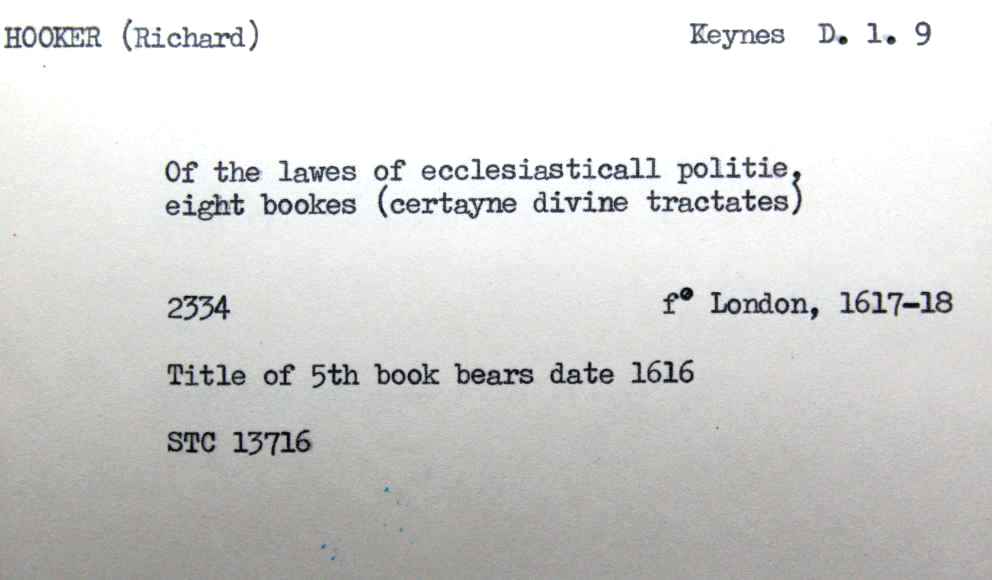
Tim Munby began his career at King’s as the first cataloguer of Keynes’s collection, although cataloguing in those days was very different. Catalogue cards often included little more than author, title and imprint details.

Index card2

Tim Munby’s original catalogue card.

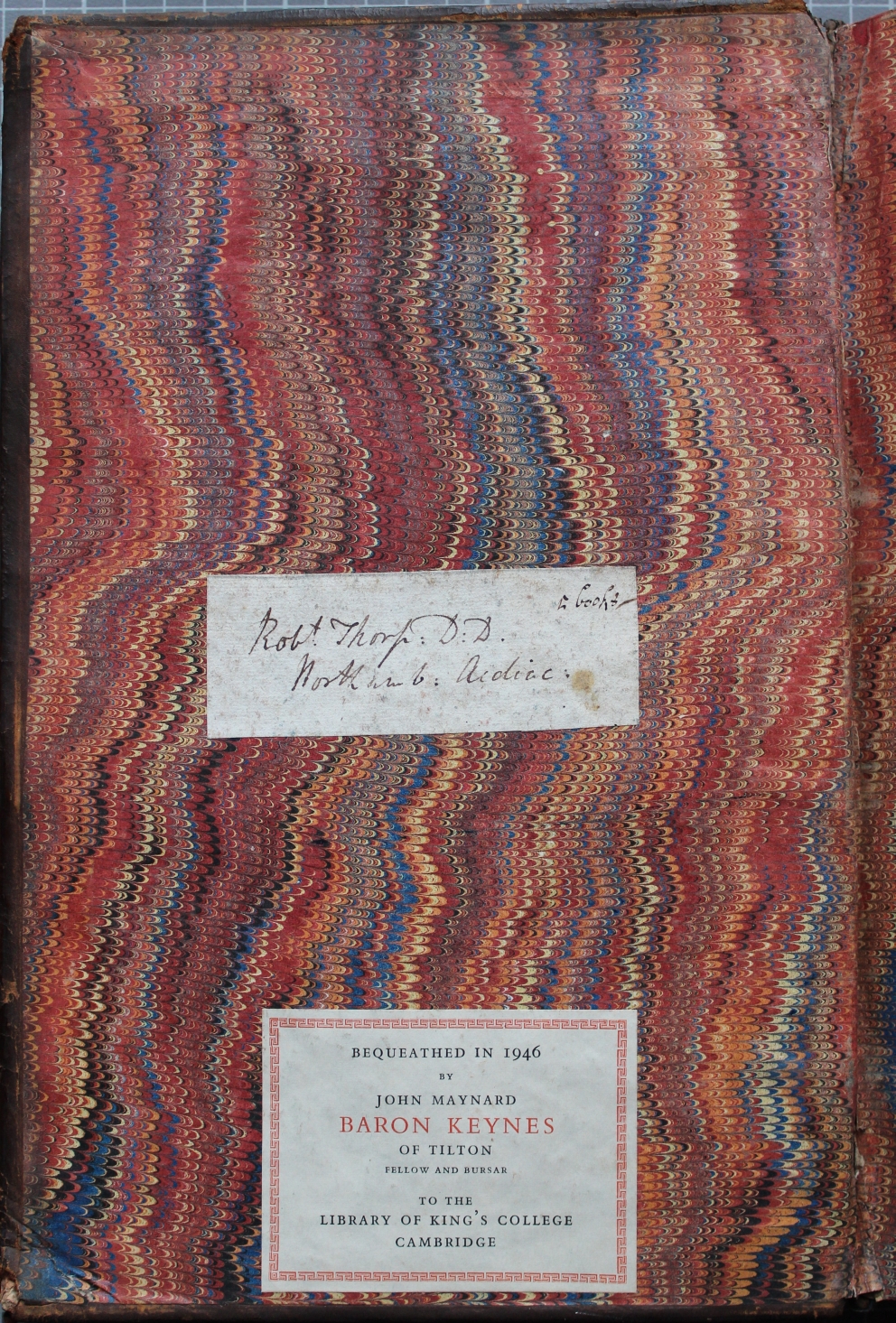
Front pastedown1

Inside front pastedown showing Keynes’s bookplate.

These days catalogue records for rare books typically include a wealth of copy-specific information such as binding descriptions, provenance information and information relating to former owners and detailed physical descriptions of the book as an object. This change not only reflects changes in research interests in bibliography, but also assists librarians in collection management, and the availability of these descriptions online improves access to the collections.

The newly created online record for this  item can be viewed here: MARC record (opens a .docx file)

Further updates about the project will be posted on this blog.

JC