Tag Archives: Poetry

Victorian railway excursions

In this second blog post marking 200 years of the modern railway, we focus mainly upon its arrival and early years in the Lake District, with a few other choice items from our collections making an appearance towards the end.

The arrival of the railway in the Lake District in the late 1840s markedly increased accessibility to a landscape that had been growing in popularity with tourists since the late eighteenth century. Here, just as in Cambridge, the guidebooks quickly adapted to reflect the new realities of travel.

Likely one of the earliest railway maps of the region is the Collins’ Railway Map of Westmoreland, a small folded map mounted on linen, which would have made it durable and easily portable for use by travellers.

Cover of map. Has a bright orange background

Cover of Collins’ Railway Map of Westmoreland, London, [circa  1847]. Classmark: Bicknell.233

The map is undated, but examination of the railway lines that are indicated on it in black suggests a publication date of around 1847, since it depicts the railway line extending to Lake Windermere which opened in 1847, but not the line to Coniston which arrived in the following year.

Map from Collins’ Railway Map of Westmoreland

Another nice map can be found in a tiny pamphlet guide from 1848, which this time has rail lines marked in red.

titlepage of guidebook

Title page of The Lakes, By Way of Fleetwood and Liverpool …, Manchester, Bradshaw and Blacklock, 1848. Classmark: Bicknell 243

Map

Map from The Lakes, By Way of Fleetwood and Liverpool …


This guide includes timetables for steam ships and railways leading to the Lakes, alongside information about coaches to and from Keswick, which was not yet served by a rail line.
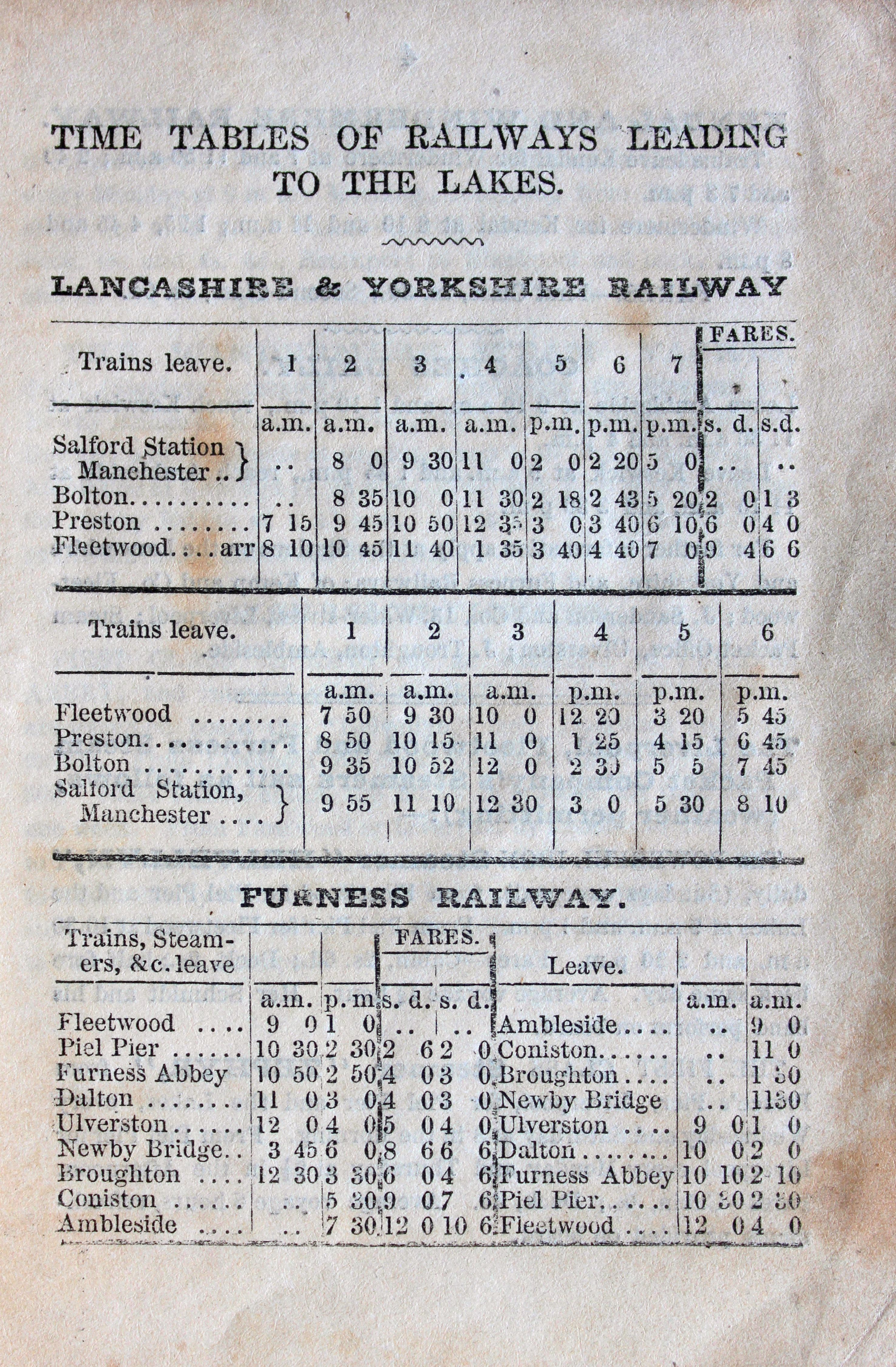
Railway timetables on page 03 of The Lakes …

Coach and steamer information, on page 04 of The Lakes …


Steamer information on page 05 of The Lakes …

A slightly later guide focuses on areas made more accessible by the Whitehaven and Furness Railway, which opened in 1850. Note the sweet little title page vignette depicting a steam engine:
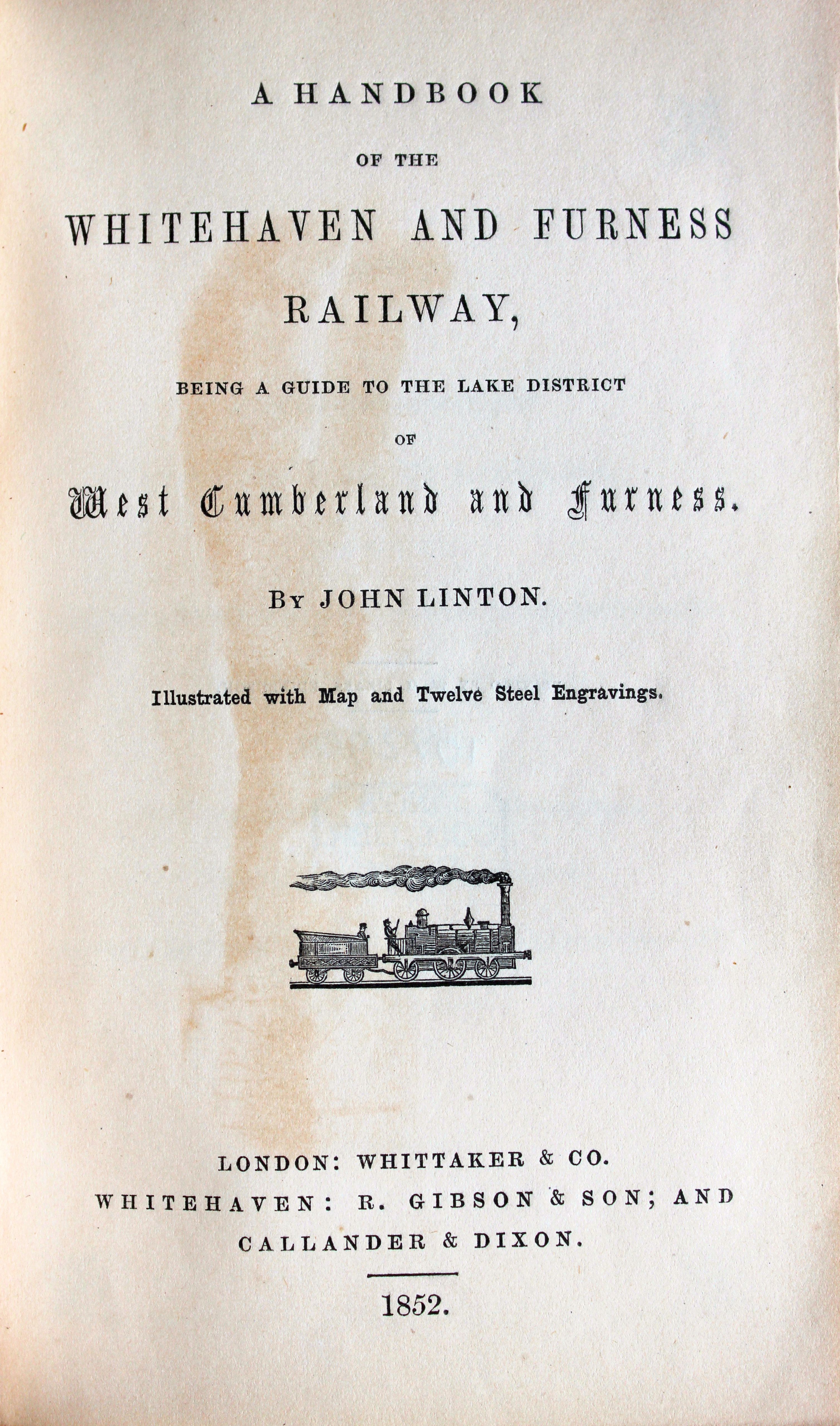
Ttile page, featuring a small illustration of a steam engine

Title page of: A Handbook of the Whitehaven and Furness Railway by John Linton, London, 1852. Classmark: Bicknell.107

The guide states its purpose clearly (if a little long-windedly) in the introduction:

Our object is merely to supply what, in consequence of the changes recently effected by railway travelling in the approaches to this district, has become a desideratum; – to point out the routes by which the greatly increased number of tourists and others … may arrive at various interesting points of the district; – and to give brief descriptions of several places, all within an easy distance of the railway we have taken as our starting point, which have hitherto, owing to the difficulty of approaching them, been much less frequented …

One such place is the vale of St. Bees, which is described as if viewed from a moving train.  The guidebook goes into raptures about its charms:

After emerging from the cutting, we are again at liberty to enjoy the beauties spread so abundantly on either hand, and it may with truth be said, that a more pleasant and enlivening scene is very rarely met with than that presented to the traveller through the vale of St. Bees. It is a scene of quiet and repose, and yet of the highest cultivation, combining the varied charms of dale and upland, grove and meadow, stately mansion and thriving farm.

If you look closely at the centre of the accompanying engraving (below), you can see a train travelling along the track, trailing steam behind it.

Black and white engraving of a valley with a church and small hamlet, and a train track running through the centre. A train is coming along the track

Plate facing page 24 of A Handbook of the Whitehaven and Furness Railway

Rail access played an important part in the viability of many business ventures in the Victorian age. When the historic Great Exhibition in London’s Hyde Park, the world’s first international trade fair, closed its doors in October 1851, the future of the exhibition hall, the magnificent Crystal Palace, was initially uncertain. However, the designer Sir Joseph Paxton soon orchestrated the raising of enough private funds to purchase the building and have it re-erected in an adapted and enlarged form on a hilltop in Sydenham, in the south east of the city. An elaborate park was constructed around it and the site was opened to the general public in 1854 as a place for relatively cheap entertainment and recreation for the masses. Attractions included concerts, exhibitions, pantomimes, circuses and the delights of the building itself and the surrounding landscaped gardens. Vital to the success of the scheme was the construction, by the London, Brighton and South-Coast Railway Company, of a dedicated railway station for the site, which opened shortly after the park itself. Close co-operation with the railway was expedited by the fact that the chair of the railway company, Samuel Laing, was also chair of the new Crystal Palace Company. It also made commercial sense for the railway, since any big attraction would boost the growth of rail travel.

The illustration below comes from a little guidebook to the palace and park, published in its inaugural year. Our copy is part of the Thackeray Collection.
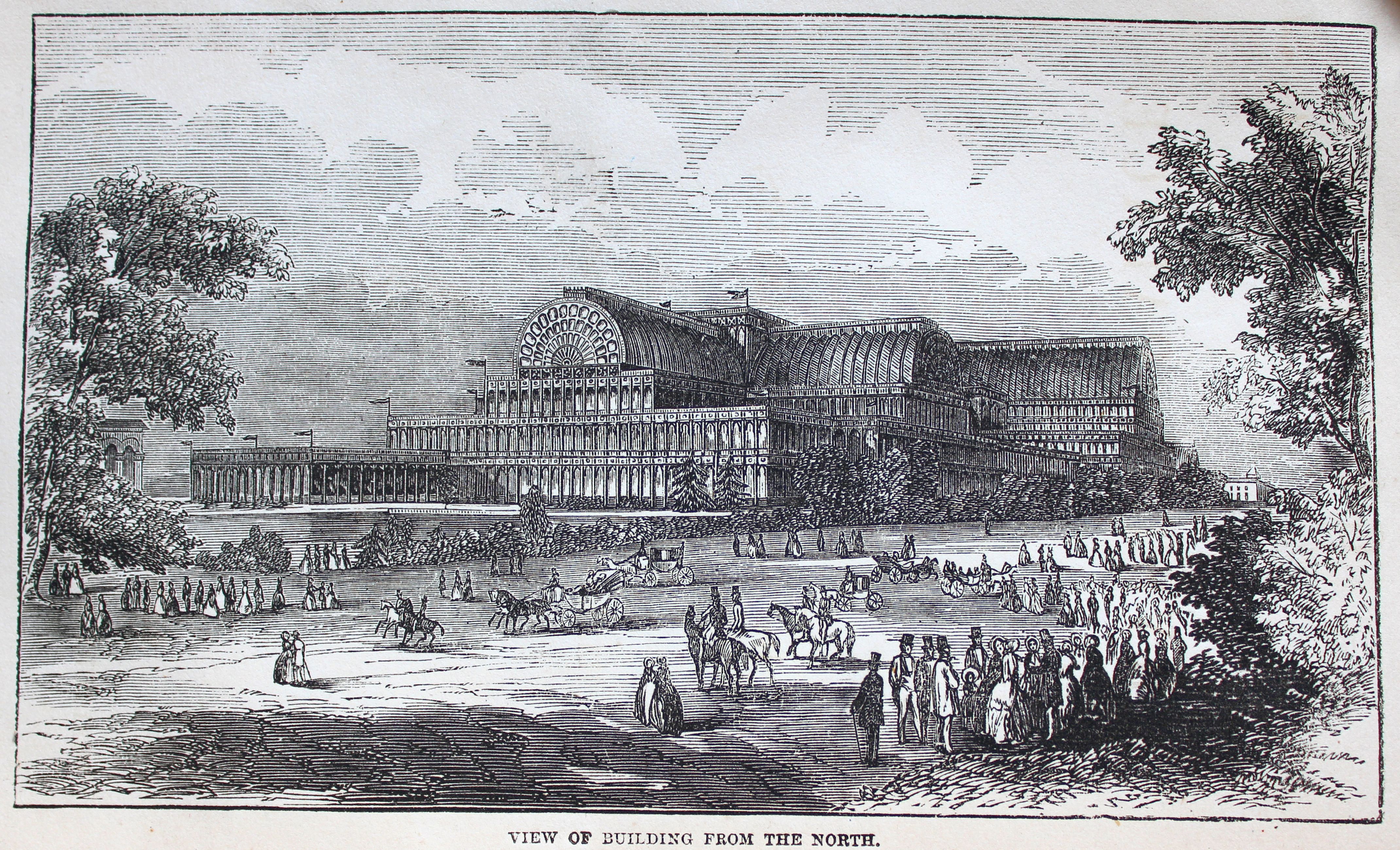
Black and white illustration showing the Crystal Palace building in parkland. It looks like a huge greenhouse.

Frontispiece from Guide to the Crystal Palace and Park by Samuel Phillips, London, 1854. Classmark: Thackeray.VIII.11.24

Detailed information on accessing the park by rail is provided inside the guide, revealing that the service ran at least every quarter of an hour and more frequently at busy times of day. Return tickets, which included admission to the Palace, were one shilling and sixpence for third class travel, rising to two shillings and sixpence for first class.
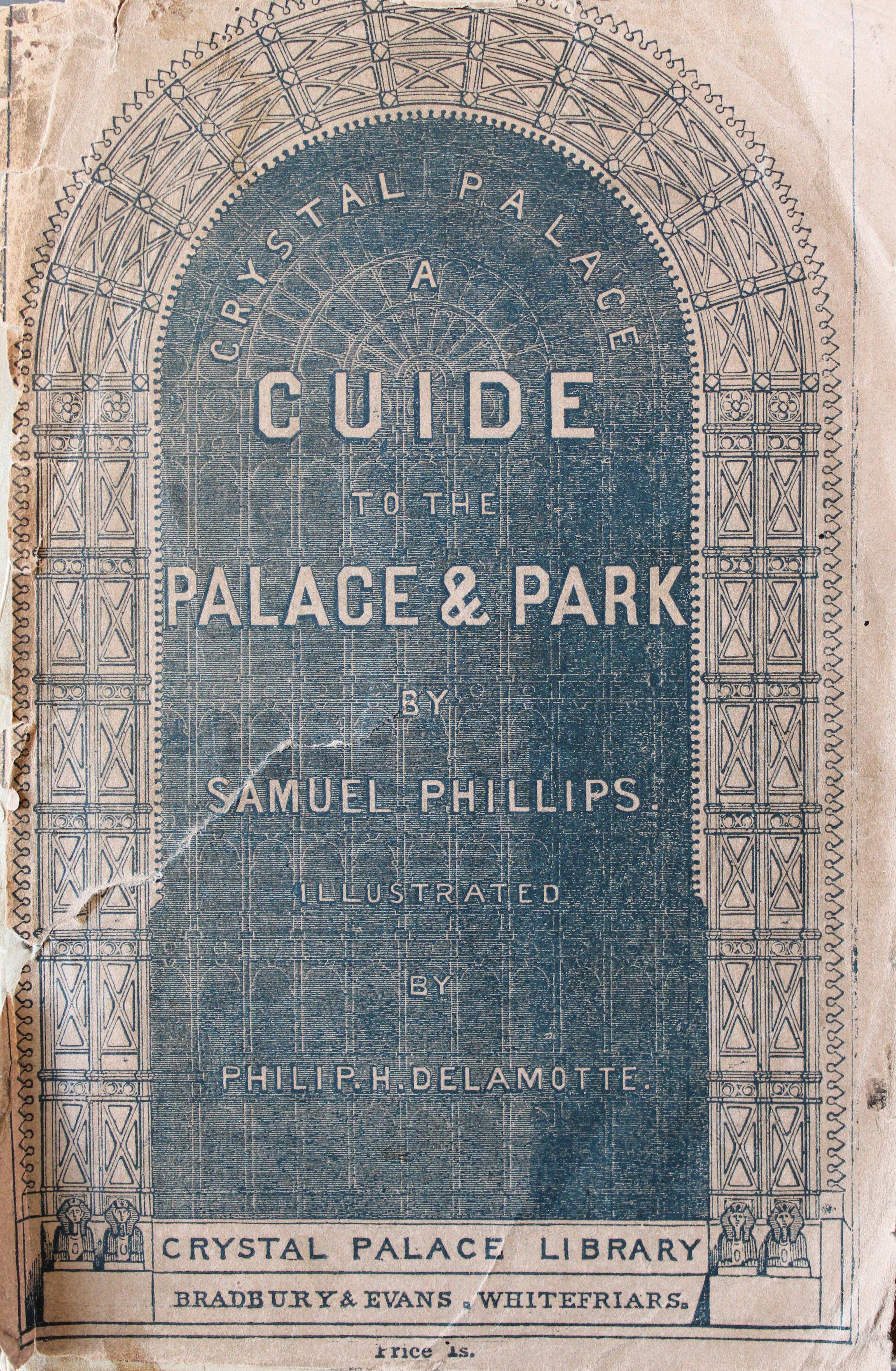
Cover of the guide. The title is depicted within an illustration of a large ornate archway

Front cover of Guide to the Crystal Palace and Park
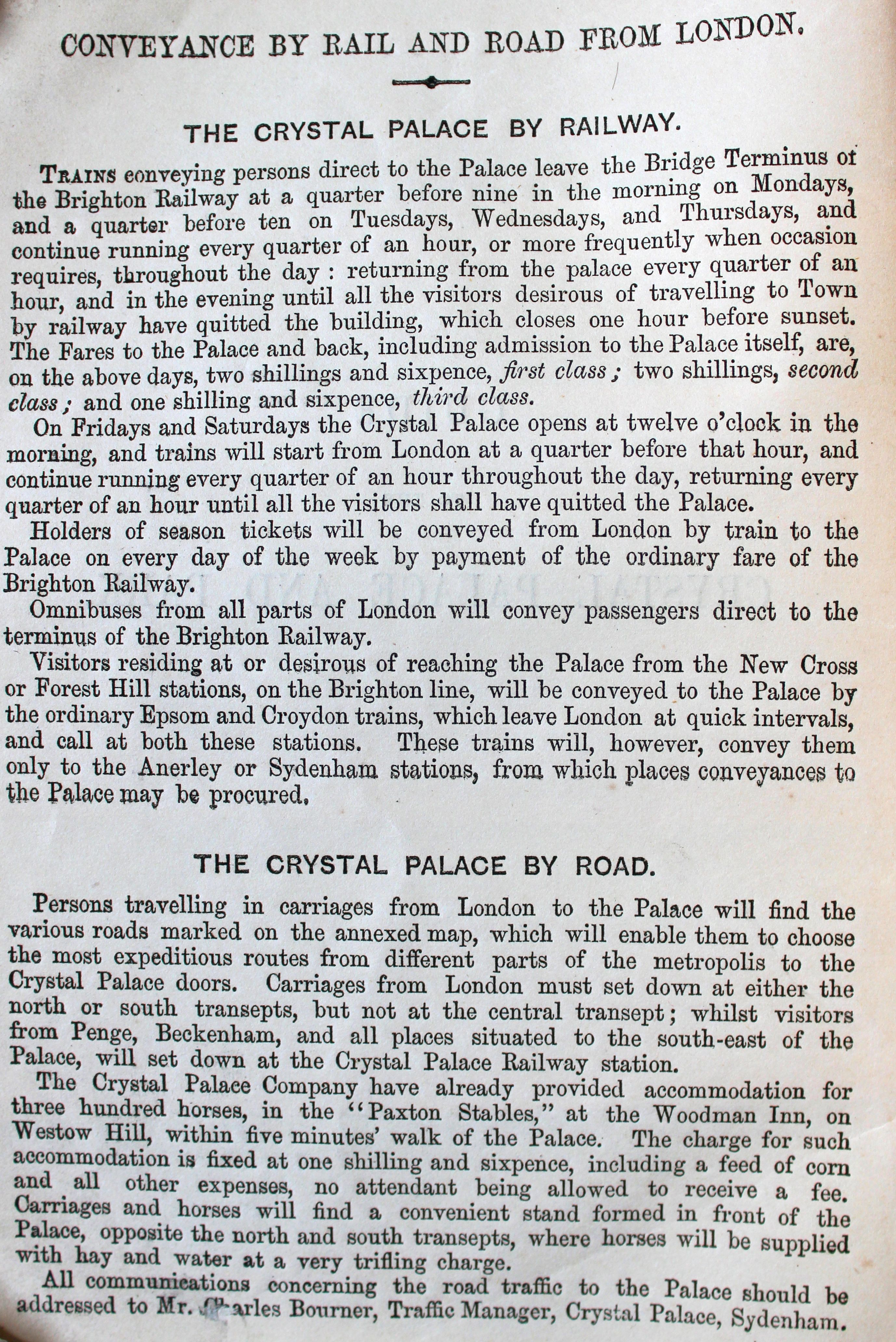
Travel information

Travel information on the back of the half-title page of Guide to the Crystal Palace and Park 

Incidentally, this guide includes  an advertisement by the South Eastern Railway for what they refer to as: “tidal trains”, which offered a streamlined service between London and Paris. Passengers could board an express train to Folkestone, embark upon a waiting steamer ship and be met after the channel crossing by a direct train for Paris. Luggage would be managed from start to finish by the rail company. The same arrangements applied for a trip in the other direction. Not bad for the early decades of rail travel!

Advert

Page 47 of the Advertiser section of Guide to the Crystal Palace and Park

The final destination on our whistlestop tour of railway-themed material is our Rylands Collection of children’s books. An illustration from the first edition of Through the Looking Glass depicts Alice in a train carriage with some rather odd travelling companions.
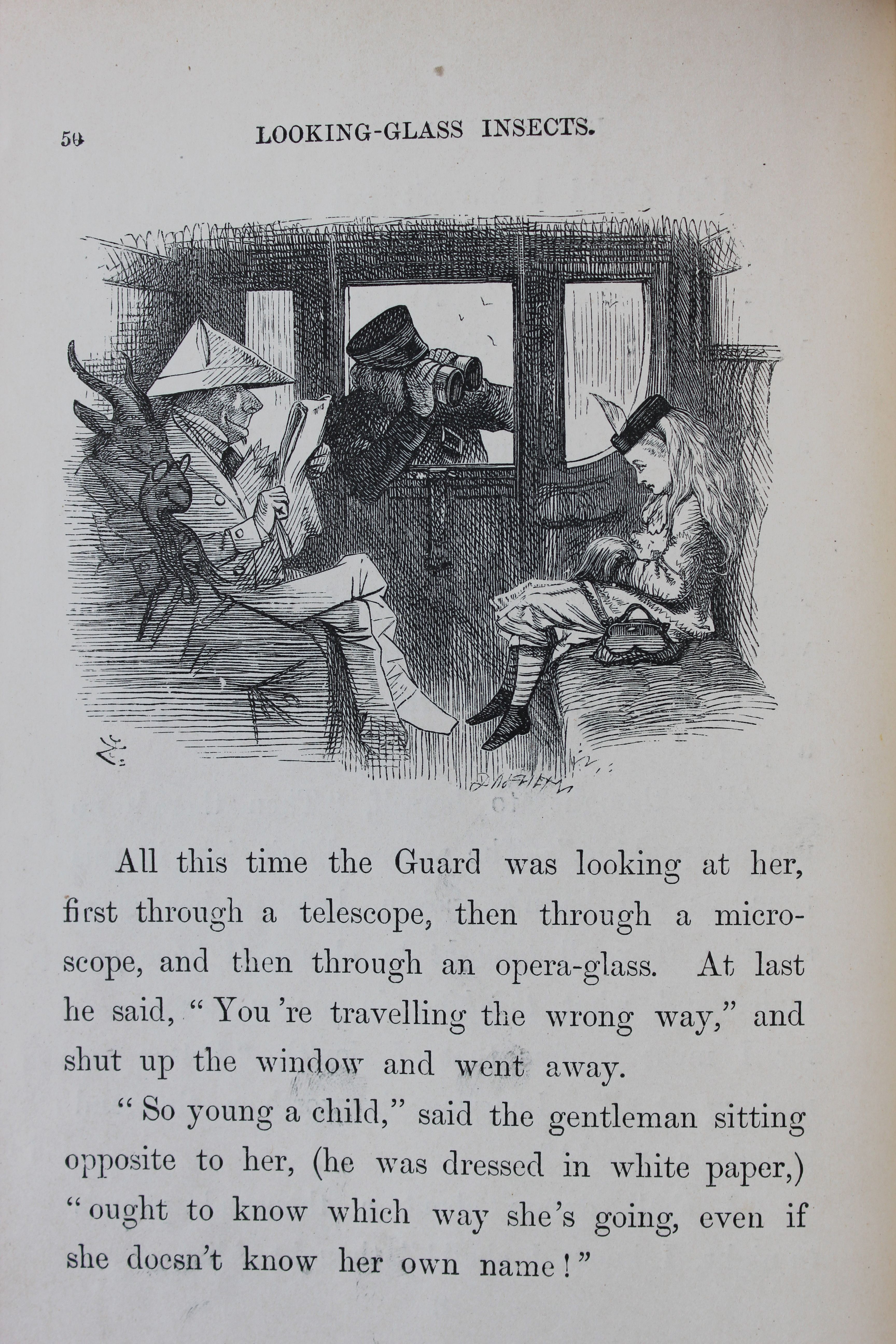
Illustration within the text of Alice in a railway carriage with a goat and a man with a paper hat. There is a guard peering at her through binoculars

Illustration by John Tenniel from page 50 of Through the Looking Glass, and What Alice                                   Found There by Lewis Carroll, London, 1872. Classmark: Rylands.C.CAR.Thr.1872

We also hold a copy of Robert Louis Stevenson’s A Child’s Garden of Verses, which includes this wonderfully evocative poem about a train journey.

The text of the poem, illustrated with a railway carriage

Page 68 of A Child’s Garden of Verses by Robert Louis Stevenson, London, 1896. Classmark: Ryland’s.C.STE.Chi.1896
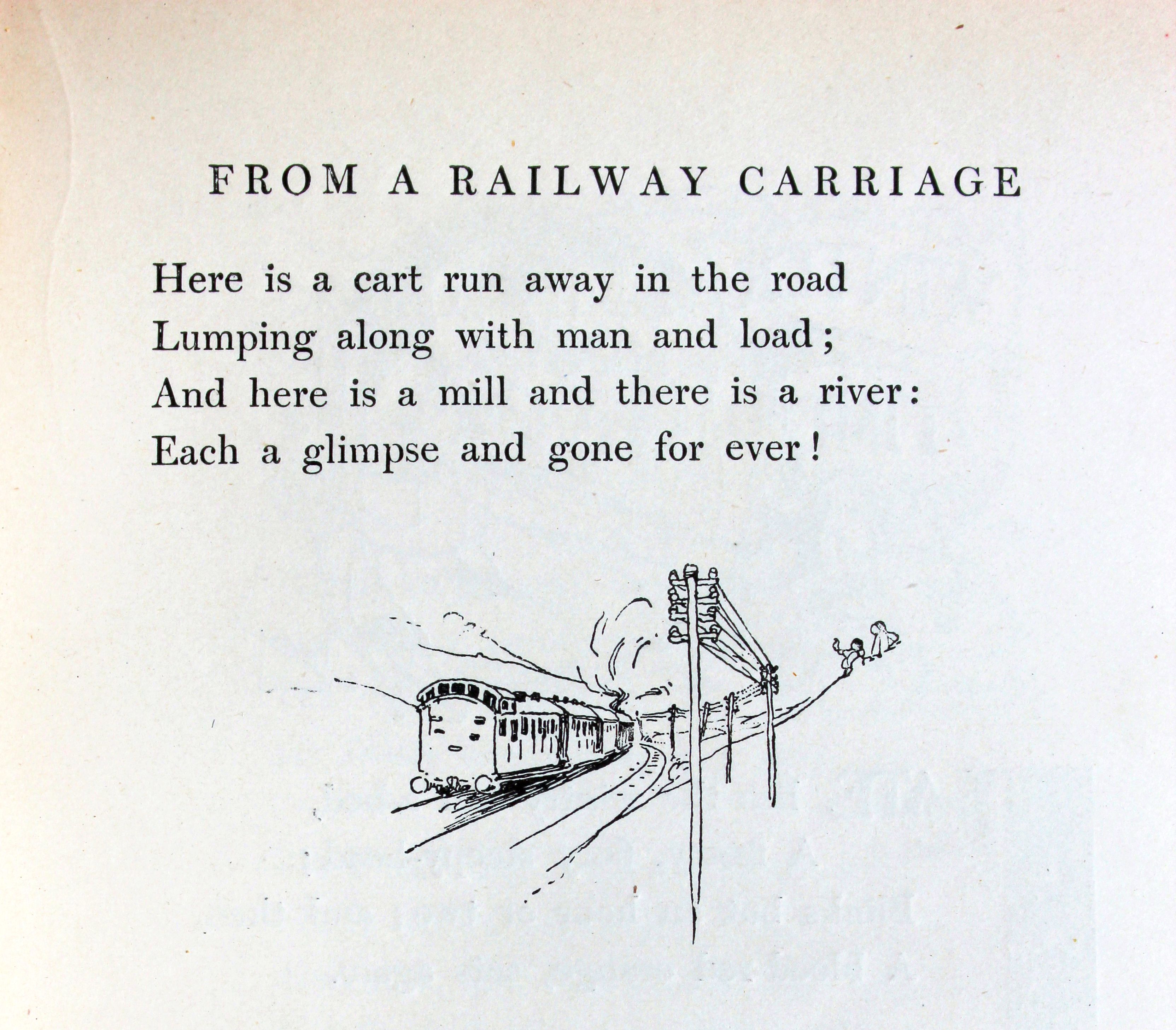
The second page of the poem, with a small illustration of a retreating train

Page 69 of A Child’s Garden of Verses

We hope you’ve enjoyed this look at the early days of rail travel as reflected in our collections and that you enjoy any and all excursions you make this autumn and winter, whether by train or by any other means!

AC

References and further reading:

Railway 200 [accessed September 2025]

Lee Jackson, Palaces of pleasure: how the Victorians invented mass entertainment, New Haven, 2021

The Crystal Palace Foundation [accessed September 2025]

LGBT LIT: An Exhibition for LGBT+ History Month

The special collections at King’s include rare editions of literary output of some noteworthy LGBT 20th-century writers—Kingsman E.M. Forster and war poets Siegfried Sassoon and Wilfred Owen—and one surprise, Alan Turing. King’s Archives and Library were pleased to mark LGBT+ History Month by showcasing this material, along with a display of borrowable LGBT-themed books, in an exhibition in King’s Library. We are delighted to be able to share the exhibition here.

AMT-k7.4 (2)

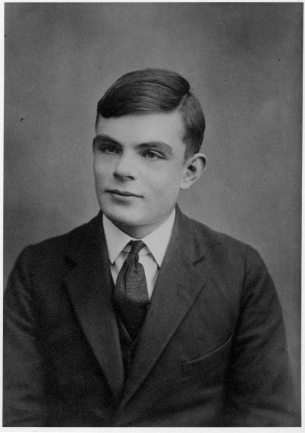
Alan Turing (1912–54) came up to King’s in 1931. (Reference: AMT/K/7/4)


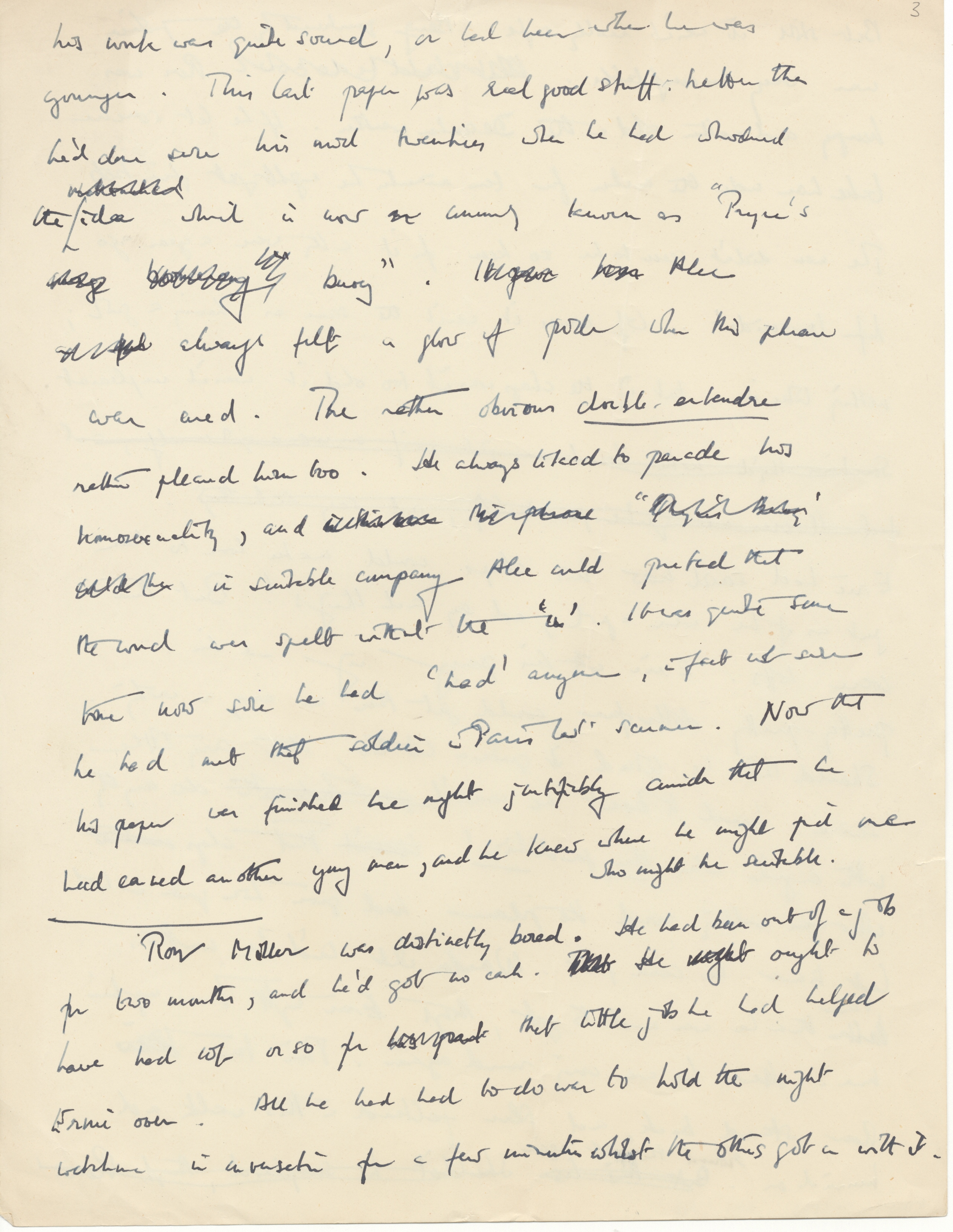
Probably while undergoing therapy in the 1950s, Turing began a near-autobiographical short story called ‘Pryce’s Buoy’. The story is about an interplanetary travel scientist, Alec Pryce, who resembles Alan in several ways. Just as Alan devised the idea that came to be known as the Turing machine, Alec, at the same age, comes up with ‘the idea which is now commonly known as ‘Pryce’s buoy’. ‘Alec always felt a glow of pride when this phrase was used. The rather obvious double-entendre rather pleased him too. He always liked to parade his homosexuality…’

The love interest in ‘Pryce’s Buoy’ is called Ron[ald] Miller, not a million miles from Arnold Murray, the other party involved when Alan was prosecuted for homosexuality.

A page from Alan Turing’s autograph manuscript of ‘Pryce’s Buoy’. (Reference: AMT/A/13)

A Trinity physicist named Maurice Pryce (1913–2003) was a Cambridge colleague of Turing. Maurice Pryce and Turing seem to have met at Cambridge but would no doubt quickly have discovered they shared a history in Guildford. Turing visited his parents there during school holidays from 1927, even into his College days, and in Guildford he indulged his interest in astronomy. Maurice Pryce attended the Royal Grammar School in Guildford from 1923 to 1929. The fictional Alec Pryce was an astronomical scientist.

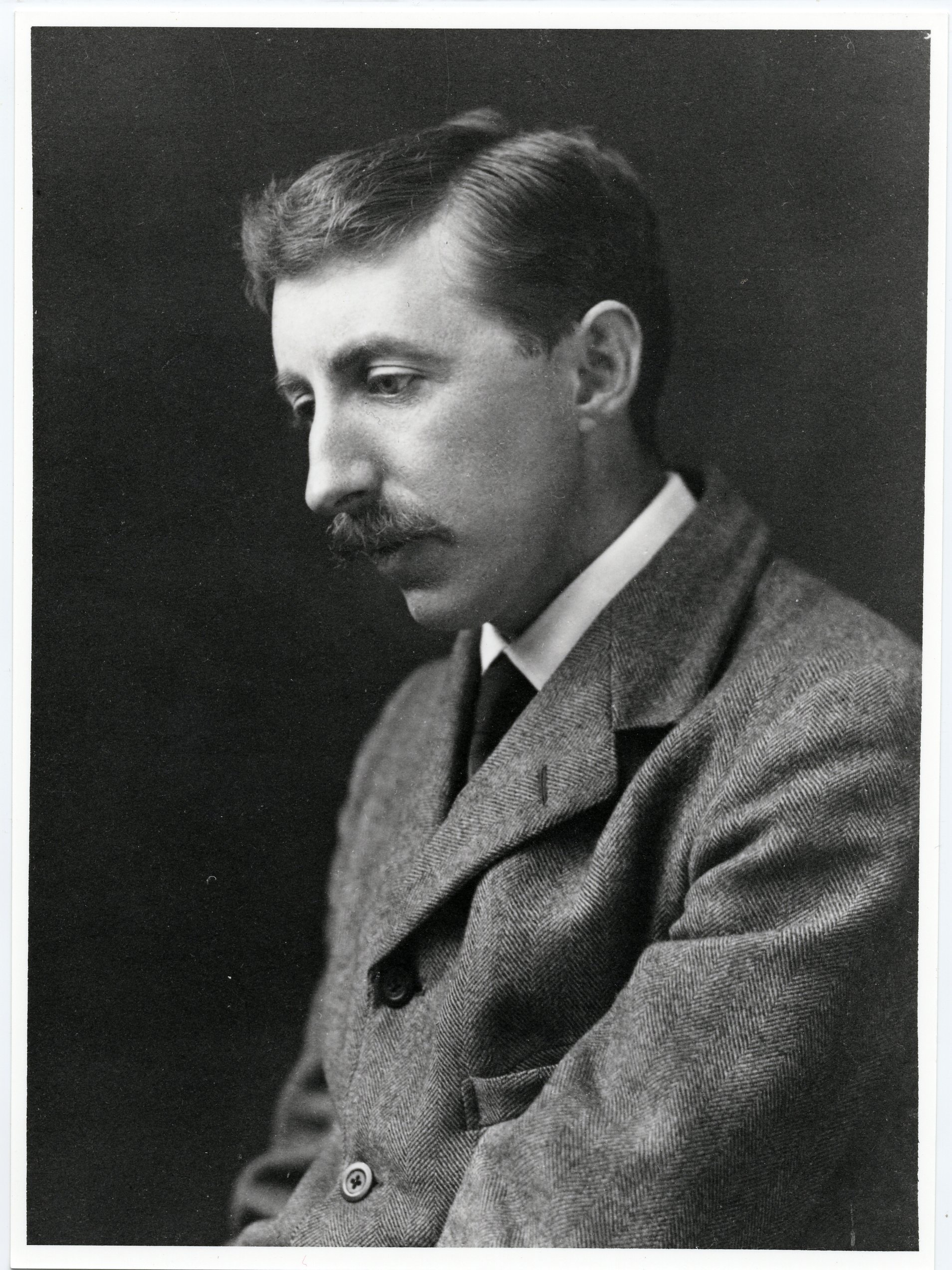
E.M. Forster (1879–1970) came up to King’s in 1897. (Reference: EMF/27/319)

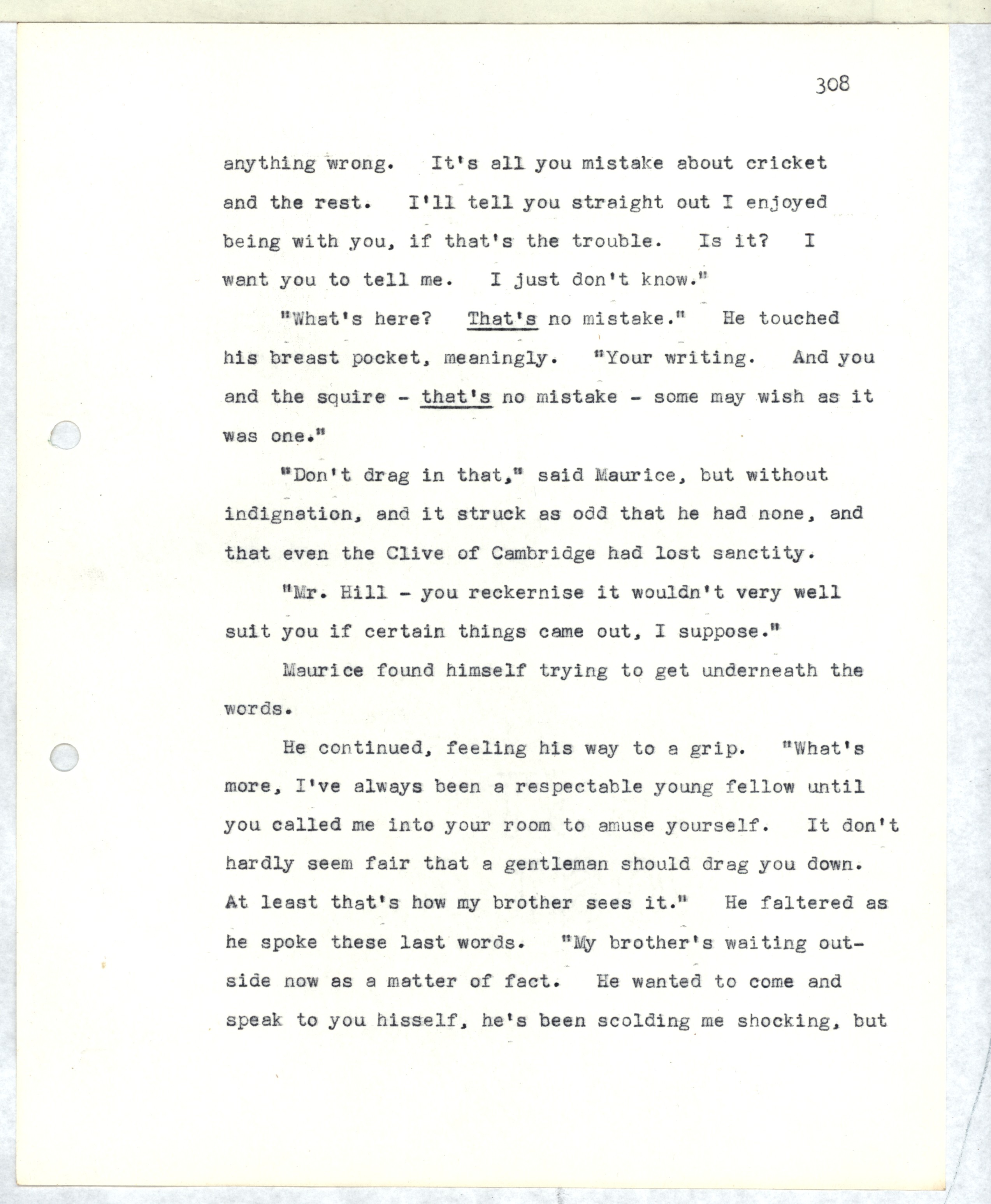
‘Pryce’s Buoy’ describes Alec picking up Ron, a small-time criminal (including male prostitution), while Christmas shopping. The notion of the bourgeois professional picking up a working-class man was common in the years before homosexuality was partially legalised in Britain in 1967. It is one of the similarities between ‘Pryce’s Buoy’ and E.M. Forster’s posthumously published novel of homosexual love Maurice, first drafted in 1913.

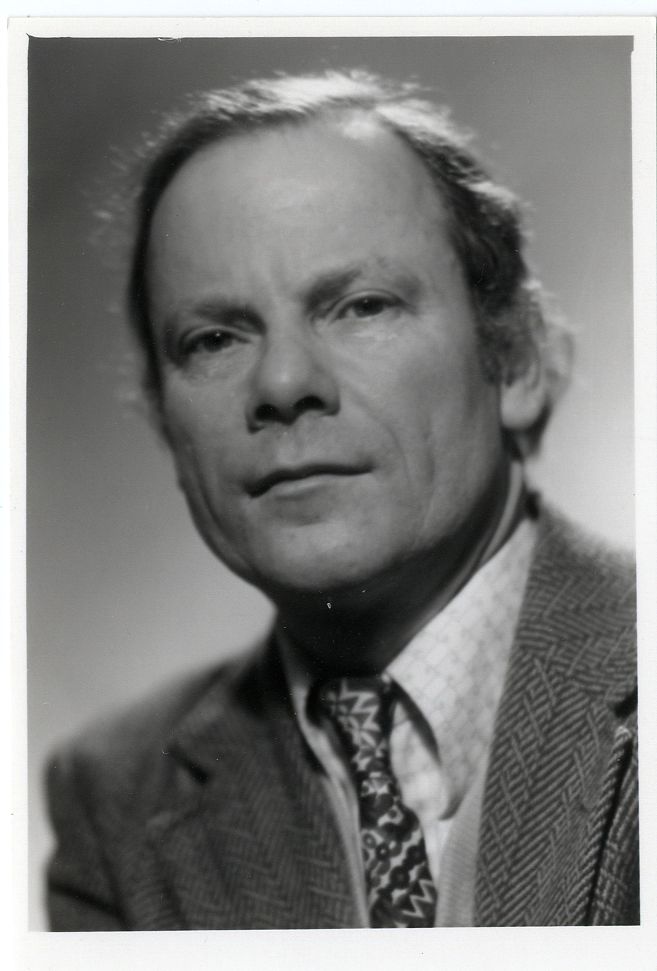
P.N. Furbank (1920–2014). (Reference: KCPH/3/5)

It is possible that Turing learned of the Maurice manuscript from P.N. Furbank, a good friend of both Forster and Turing. He was Forster’s authorised biographer and one of Turing’s executors. Furbank came up to Emmanuel College in 1939.

If Turing had seen or heard of the Maurice manuscript, that might subconsciously have informed the choice of his hero’s name: Pryce for the real-life Maurice Pryce and Alec because in Forster’s novel the second of Maurice’s lovers is a working-class gamekeeper called Alec.


Another parallel between the fictional stories and real life was the threat of blackmail faced by gay men. Turing met Murray outside a cinema in 1952, took him to lunch (just as Alec took Ron to lunch in Turing’s story), eventually entertained him at home and loaned him money. They wrangled over the money with Murray threatening to ‘do his worst’. In Maurice, Alec tells Maurice ‘you reckernize it wouldn’t very well suit you if certain things came out’.

A page from Forster’s typescript of his novel Maurice. (Reference: EMF/1/5/9C)

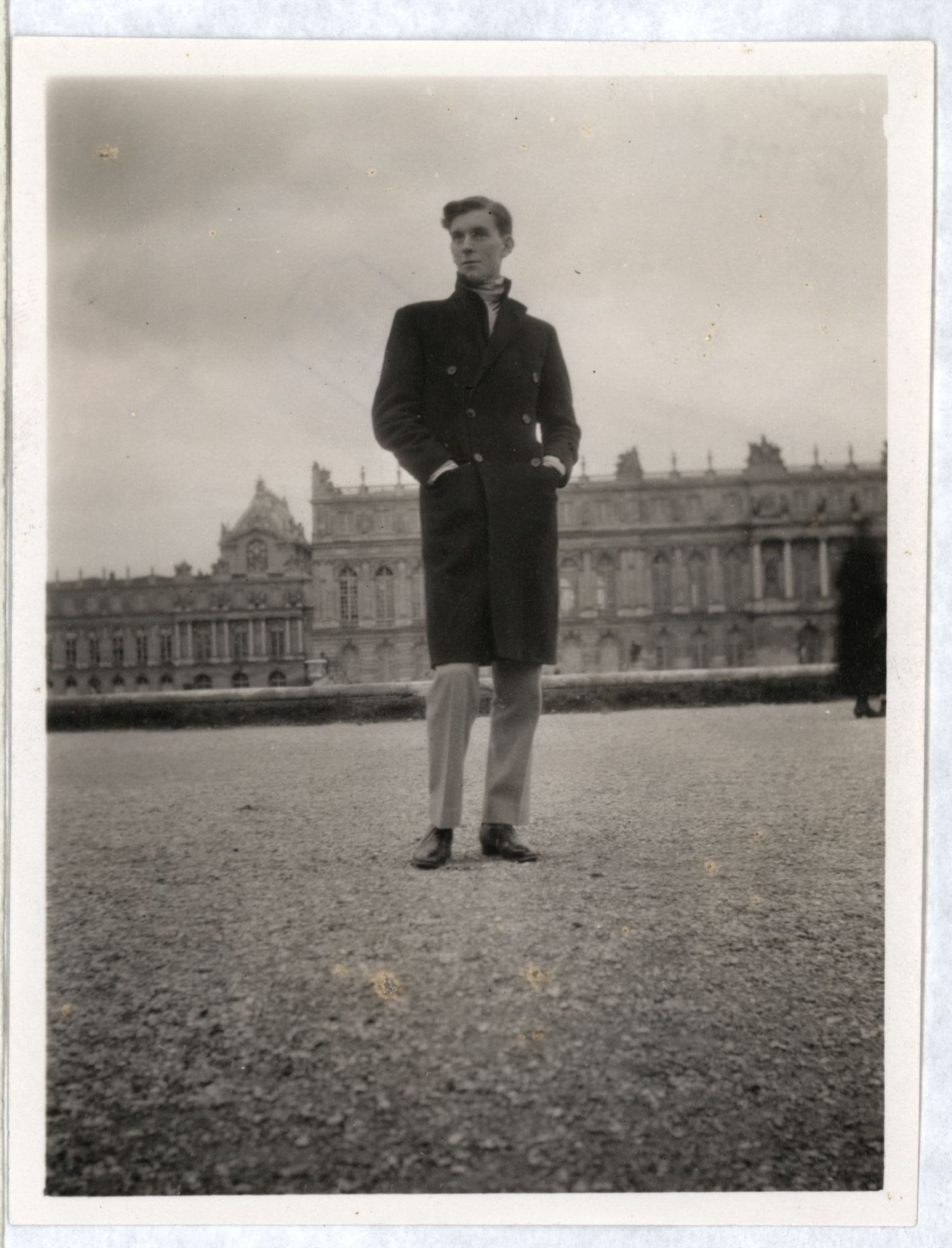
Siegfried Sassoon (1886–1967) in 1928 at Versailles (Reference: RNL/2/533)

Siegfried Sassoon came up to Clare College in 1905, a few years after Forster had left King’s. They knew of each other, had several aborted attempts at meeting and finally did so in 1919, soon after which Sassoon declared his homosexuality to Forster. Sassoon was one of the first people with whom Forster shared his short story ‘The Life to Come’, also published posthumously.

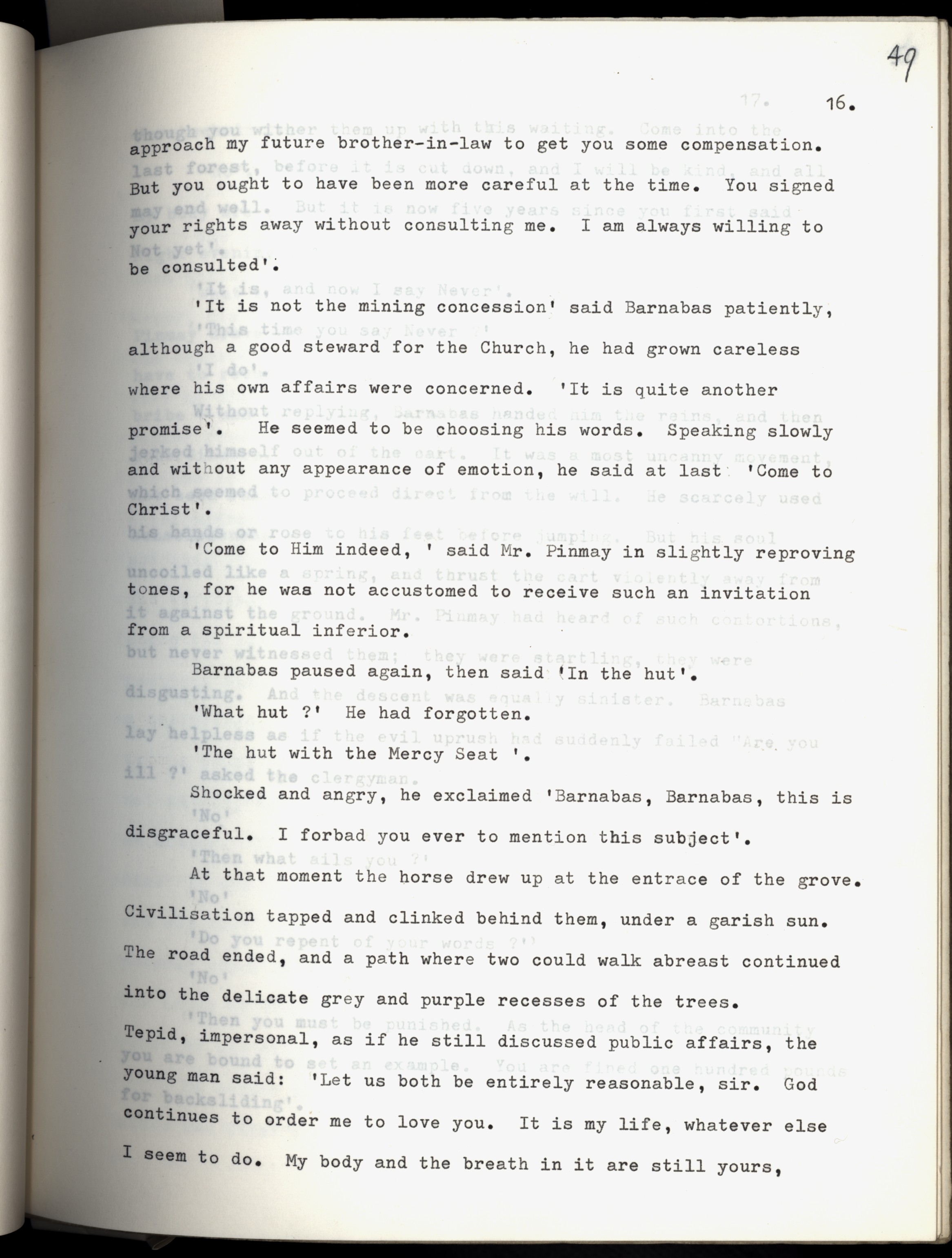
The story begins with Paul Pinmay, a missionary, going to bed with a great South Seas prince, Vithobai. For this he carries a great deal of guilt. Vithobai becomes Christian, taking the name Barnabas, and on the eve of both their weddings comes to Paul with a gift and confession of love.

A page from Forster’s typescript of ‘The Life to Come’. (Reference: EMF/3/13/2 vol 4/3)

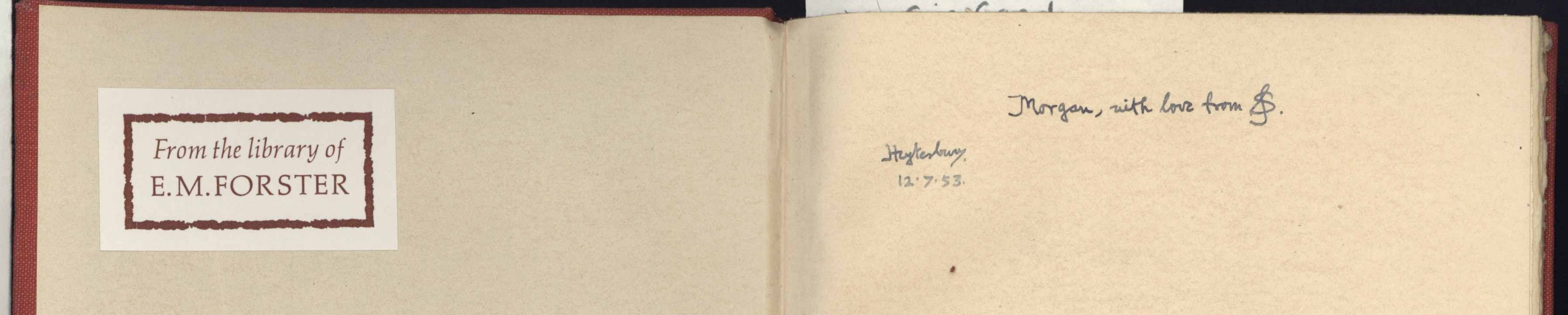
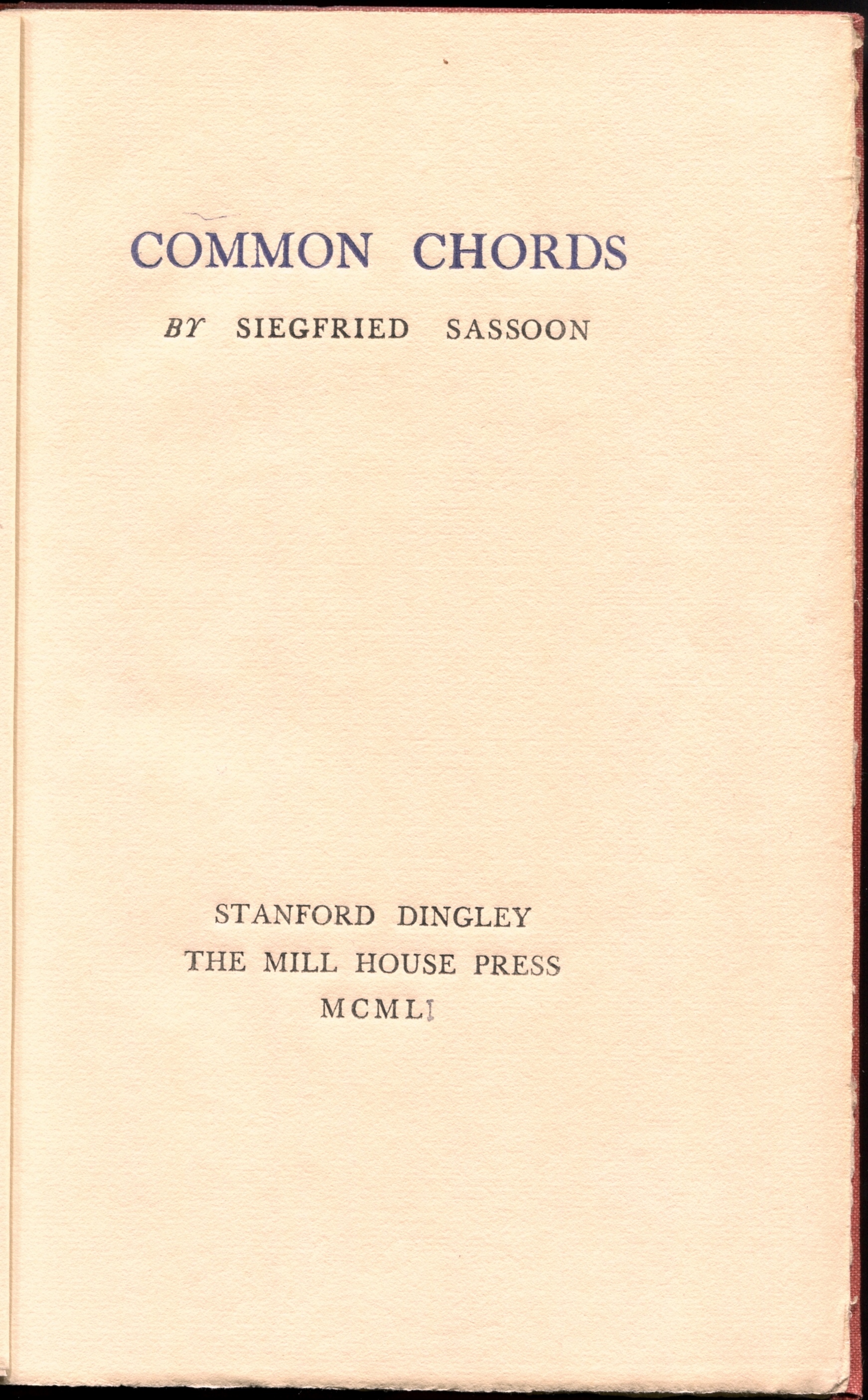
Sassoon gave Forster several inscribed copies of his books of poetry and prose which are now in the Forster collection at King’s. The most affectionate inscription is on his 1950 book of poems, Common Chords, one of 107 copies printed on hand-made paper.

Sassoon’s inscription to Forster on his copy of Common Chords (Stanford Dingley: The Mill House Press, 1950). (Shelfmark: Forster.SAS.Com.1950)

Title page of Common Chords (Stanford Dingley: The Mill House Press, 1950).

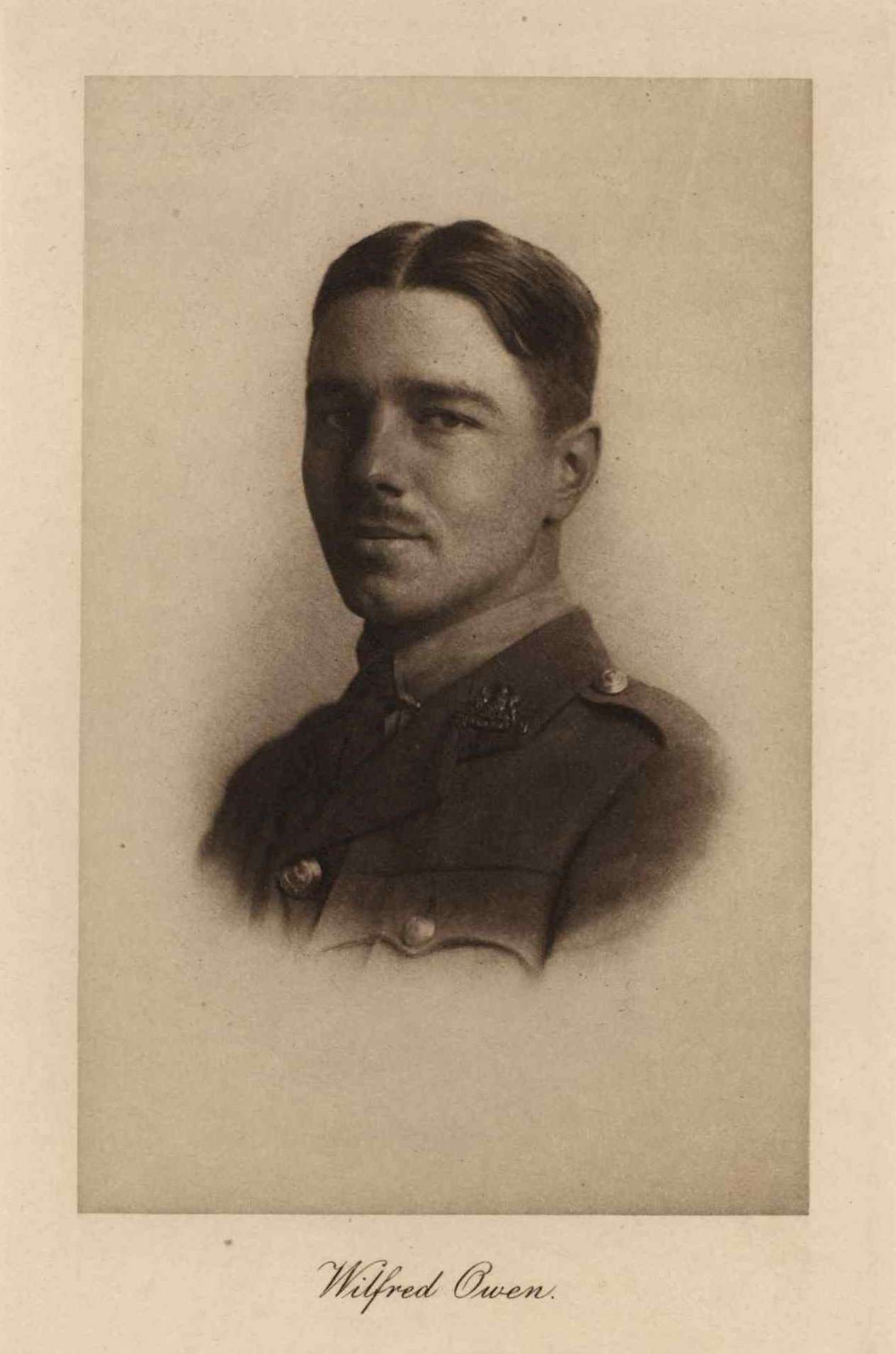
One cannot skip past Sassoon without mentioning his protégé Wilfred Owen (1893–1918) who died in World War I.

Photograph of Wilfred Owen printed in Wilfred Owen, Poems (London: Chatto & Windus, 1920). (Shelfmark: N.32.16)

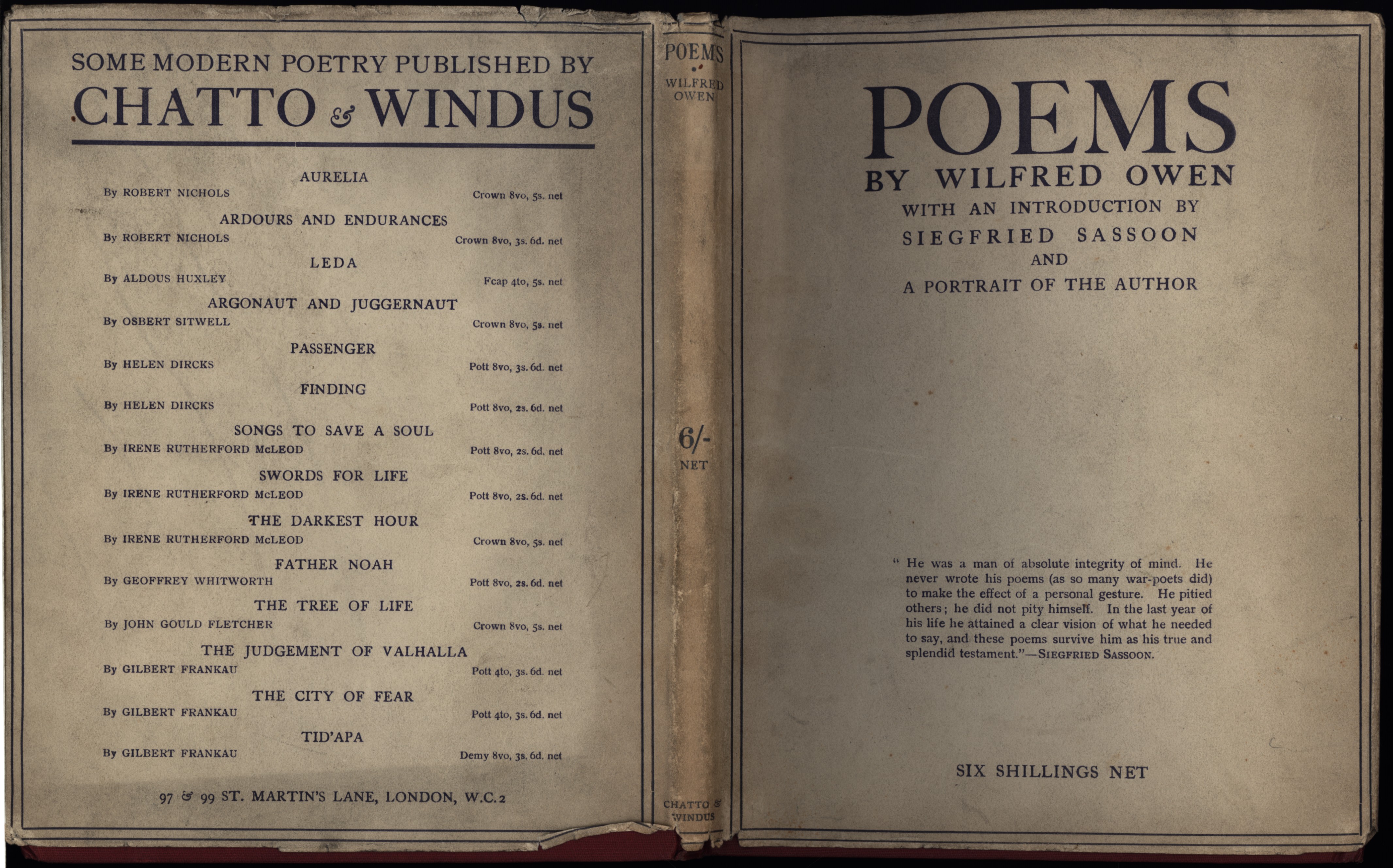
Owen and Sassoon met at Craiglockhart, a military psychiatric hospital in Edinburgh for the treatment of shell-shocked officers. It is believed that Owen, like Sassoon and other literary friends such as Robert Ross (Oscar Wilde’s literary executor, who was briefly a student at King’s), was also homosexual. As the Dictionary of National Biography says: ‘What is certain, however, is that Owen and Sassoon wrote more eloquently than other poets of the tragedy of boys killed in battle because they felt that tragedy more acutely, more personally.’ This year is the hundredth anniversary of the publication of this early edition of Owen’s poems, which includes an introduction by Sassoon.

Dustjacket from Owen’s Poems (London: Chatto & Windus, 1920). (Shelfmark: N.32.16)

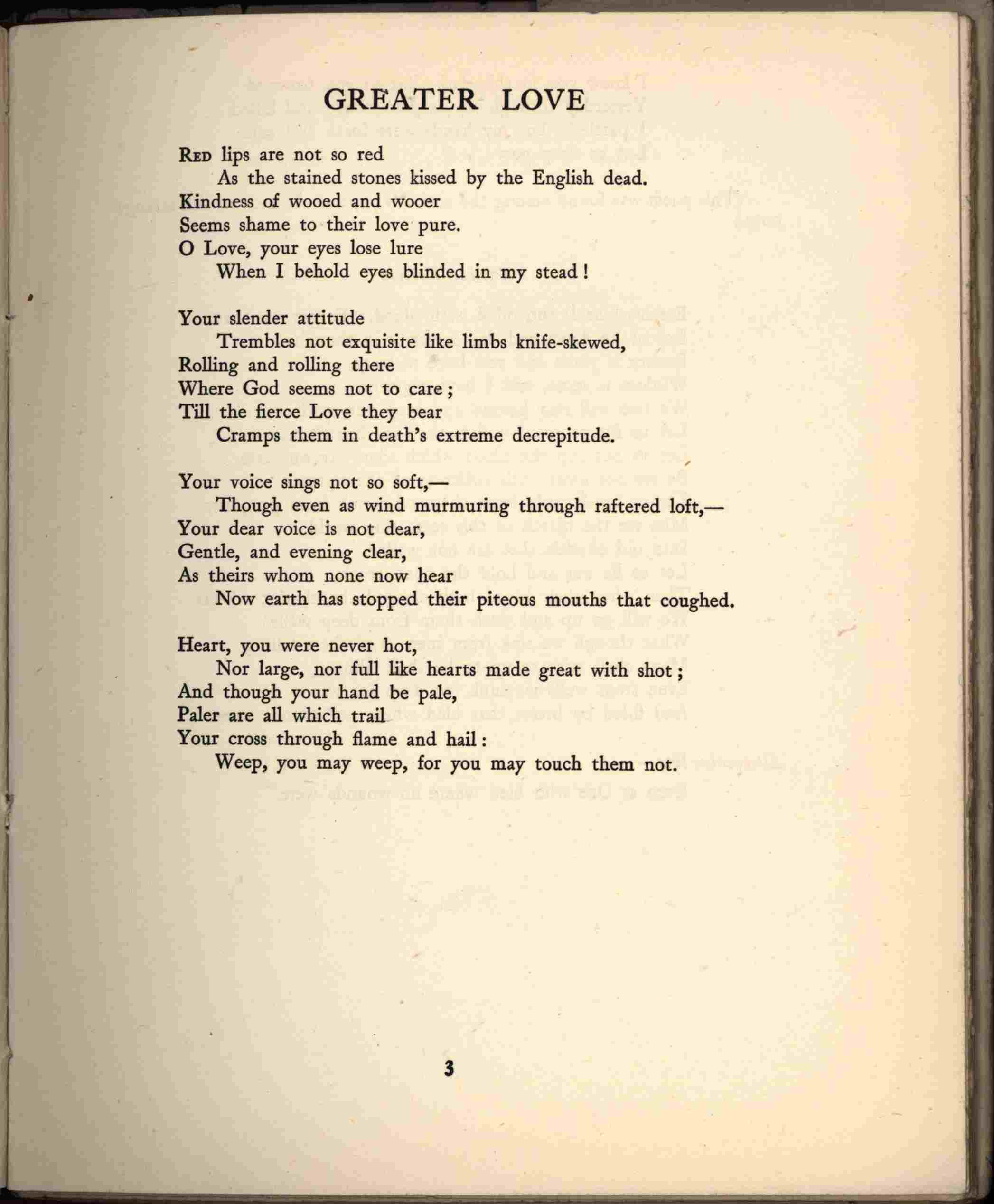
Wilfred Owen’s poem ‘Greater Love’, in Poems (London: Chatto & Windus, 1920). (Shelfmark: N.32.16)

PKM


A Persian-Indian crowning jewel at King’s

In 1788 a letter of benefaction was received by the Provost and Fellows of King’s from Patna in India. A Kingsman by the name of Edward Ephraim Pote (1750-1832) was announcing that he had ‘acquired a collection of Persian Manuscripts amounting to more than five hundred and fifty volumes’ and was arranging to have them shipped to England to be divided between the colleges of King’s and Eton. This, he said, was ‘to shew my gratitude to those Foundations to whose institutions I am indebted for my education’ (King’s College Archives: KCAC/6/2/23 or LIB/10.2).

Our recent research confirms what has long been suspected, that the Pote manuscripts had formed the bulk of the collection of Colonel Antoine-Louis Polier (1741–1795). As Henry Bradshaw noted, Polier’s seal appears on a large number of the manuscripts and his autograph is on several of them. Polier was an officer and agent of the East India Company, assimilated into the Mughal Courts, and, later in his career, an orientalist, collector and patron of the arts in Lucknow. The collection is dominated by Persian manuscripts, but it also contains codices in Hindustani and Arabic.

At the invitation of Professor Jean Michel Massing and with the support of the Apelles Art History Fund we have recently catalogued the half of the Pote Collection belonging to King’s and made the records globally accessible via the union catalogue of manuscripts in British collections from the Islamicate world known as Fihrist (www.Fihrist.org.uk). The Apelles Art History Fund was established by King’s in 2016 to support original research in the history of art at the College, patrimonial acquisitions and the restoration of art works owned by the College. It commemorates Professor Massing’s contribution to the field and encourages continued exploration and discovery in the arts. In the first years, one of the priorities of the Fund is research on the College’s works of art, including the Pote Collection of Islamic manuscripts and the Keynes Art Collection.

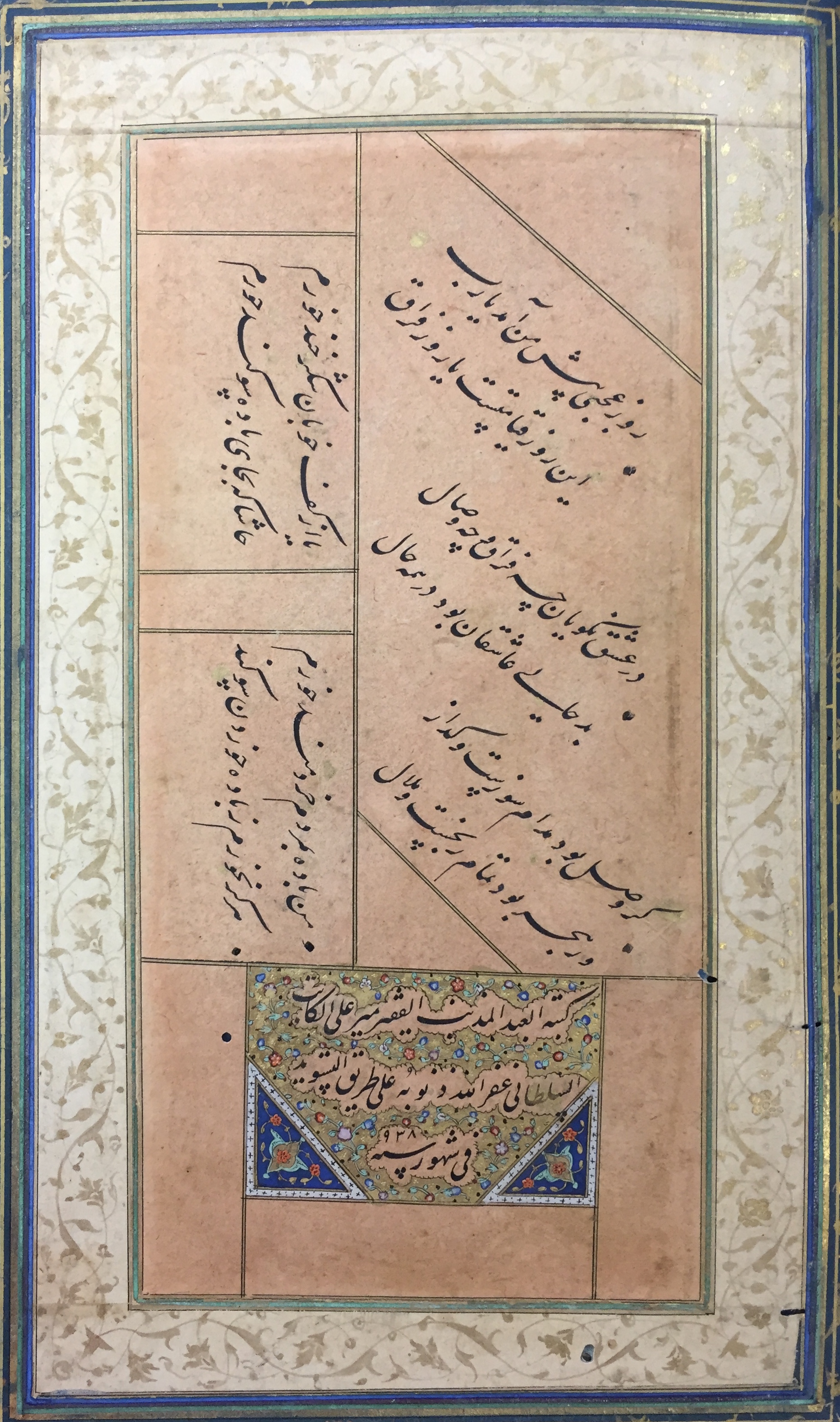
To help raise awareness of the little-studied Pote Collection, this post introduces one of its highlights: King’s Pote MS 186. This manuscript, comprising a collection of poems, is a feast for the eyes: the lyrical verses are arranged in a calligraphic layout, penned by the famous ‘Royal Scribe’ (Kātib al-Sulṭānī) Mīr ‘Alī Haravī (flourished 915–951/1509–1544), framed by exquisitely decorated margins, and enclosed in a beautiful lacquer binding and doublures (inside bindings).

Left half of the double-page frontispiece, Dīvān of Hilālī, penned by Mīr ‘Alī Haravī, dated 938/1531-32 (King’s Pote MS 186).

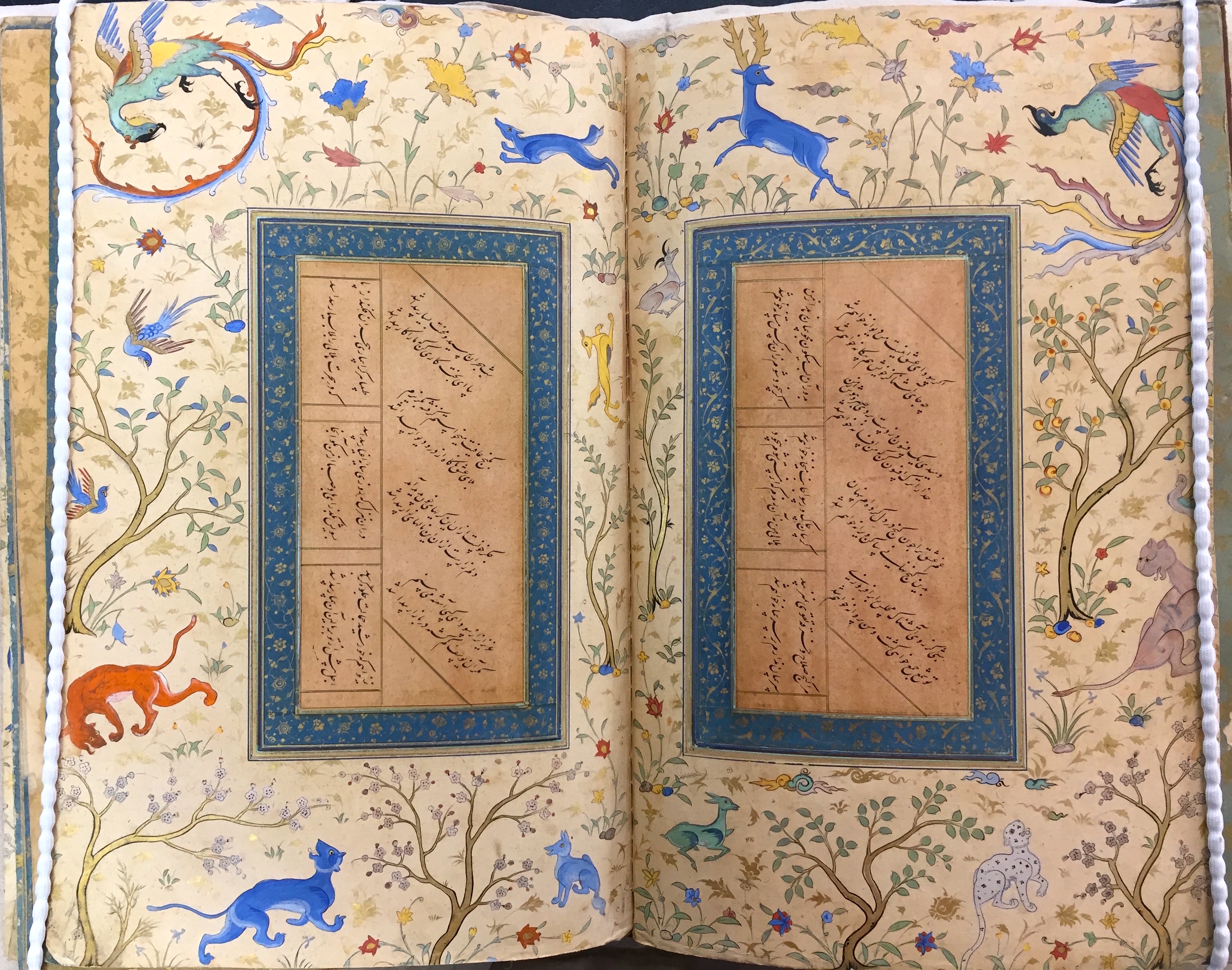
Each page consists of a central text block with a narrow illuminated border, mounted within a frame (passe-partout) decorated either with drawings of flora and/or fauna in gold or with multi-coloured paintings with charming depictions of animals. Based on the artistic style and type of paper, the remounting was very probably executed in Mughal India.

Illuminated margins, floral decorations in gold (King’s Pote MS 186).

Mīr ‘Alī was an acknowledged master of calligraphy, especially prominent in a script known as nastaʿlīq. He worked in Herat and was moved to Bukhara around 935/1528–29.[1] His calligraphy was much prized in later centuries, especially at the court of Shah Jahan in India, and it is probable that the manuscript was remounted and decorated (and rebound) at the latter’s command. Although further research is required, there are signs the manuscript was once in Shah Jahan’s Royal Library: it bears an inspection note and the seal impression of ‘Abd al-Ḥaqq Amānat Khān, who might well be the calligrapher of that name (d. 1054–55/1644–45)[2] who designed the calligraphy on the Taj Mahal, and whose seal impression appears in other manuscripts from the Mughal Royal Library.

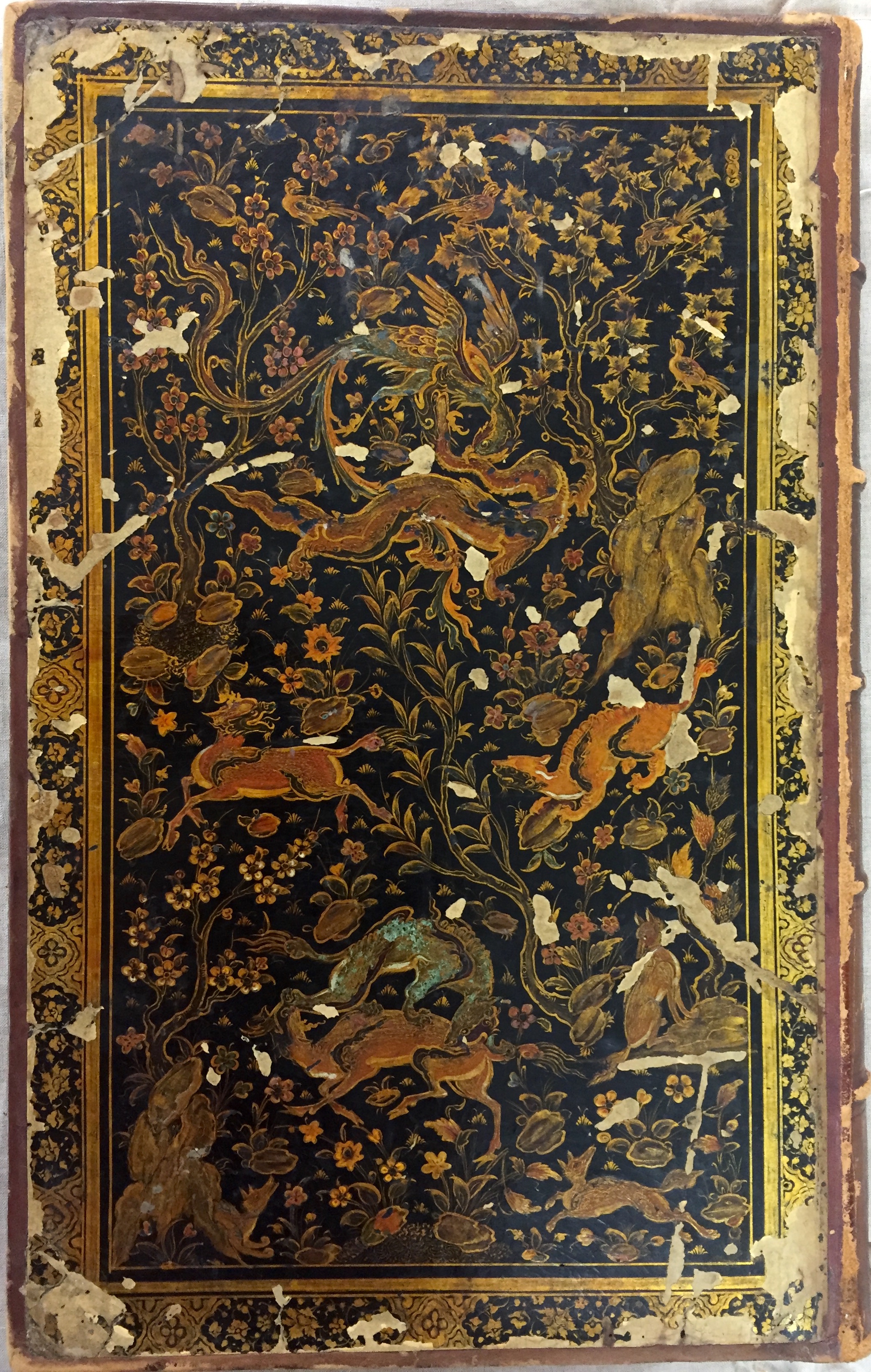
Lacquer binding showing fantastic landscape with dragon and simurgh (King’s Pote MS 186).

The manuscript has a lacquer-decorated binding depicting a hunt scene of fantastic and naturalistic animals, including a simurgh (a benevolent, mythical bird in Iranian mythology), a dragon, foxes, hares and birds of prey, all painted in glittering and bright colours on a blackground. The doublures, with a gold and ochre background, carry a diamond-shaped medallion (turanj) in black and gold, pendants in black and reddish brown, and corner pieces, all decorated with floral motifs. The ground depicts animals including a lion, a leopard, a fox, an antelope and a deer in a setting of sparse shrubs and flowers. The front and back covers and doublures are identical. The binding seems to be contemporary with the marginal illuminations and illustrations, and a product of the same Mughal royal atelier.

Lacquer doublure (inside front binding, King’s Pote MS 186).

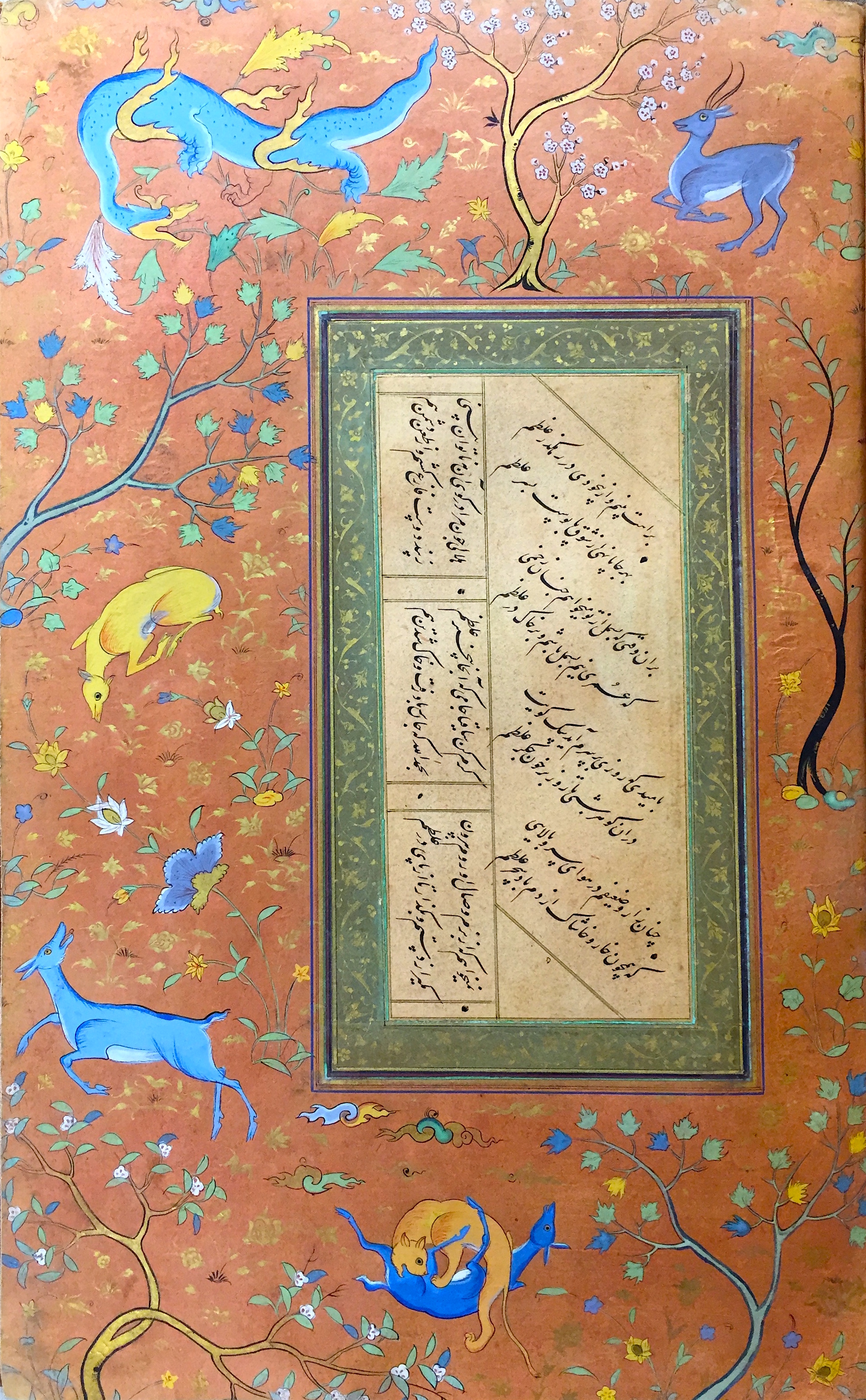
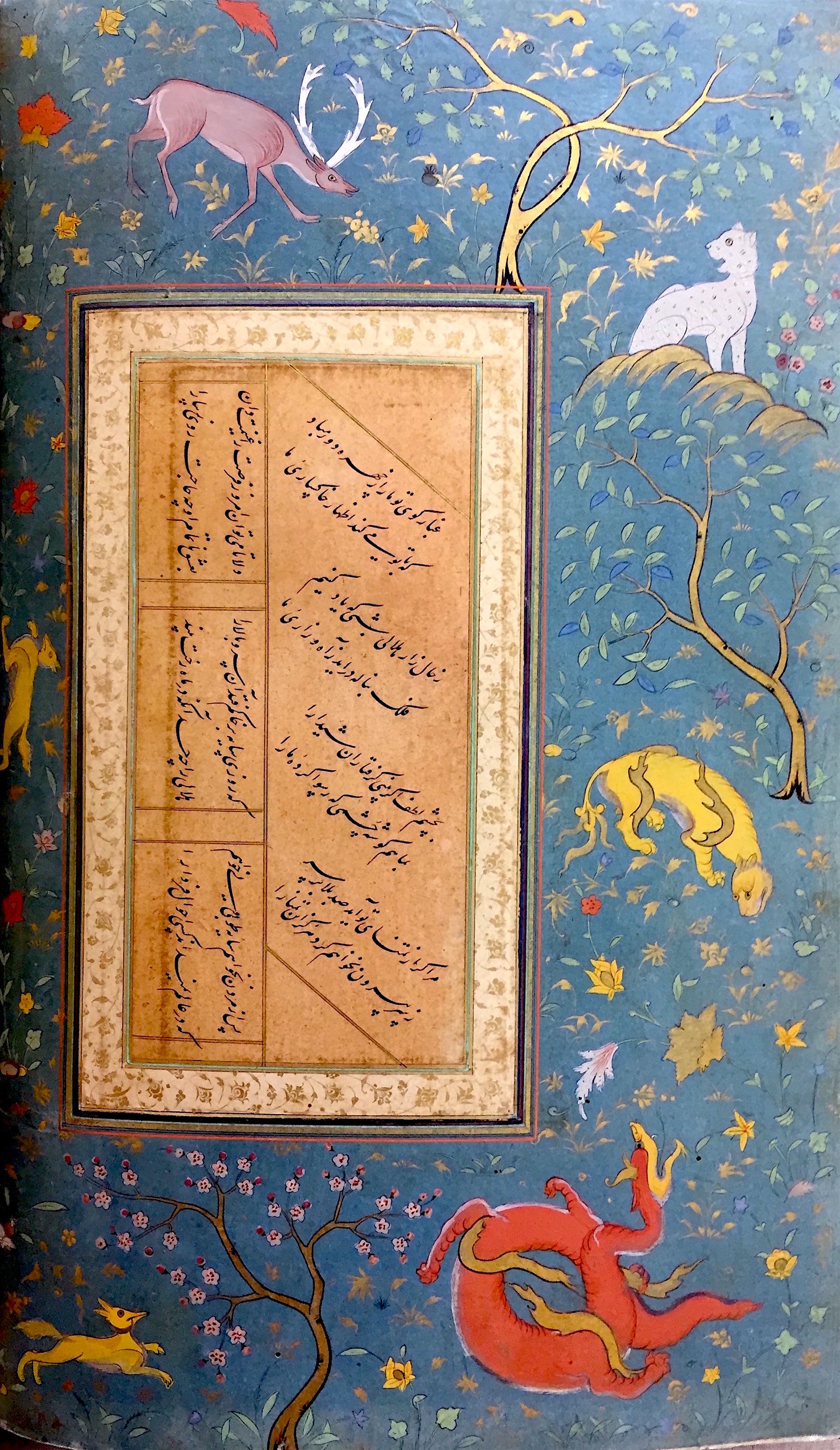
Similar animals, in different poses, are illustrated among trees and flowers in some of the margins on both dark and light grounds. The palette used in these illustrations includes gold and a variety of vivid colours.

Illustrated margins showing flora and fauna in rich palettes on tinted paper (King’s Pote MS 186)

Illustrated margins showing flora and fauna in rich palettes on tinted paper (King’s Pote MS 186)

Illustrated margins showing flora and fauna in rich palettes on tinted paper (King’s Pote MS 186)


The textual content is a selection of lyrical poems (ghazals) by a prominent poet, Badr al-dīn Hilālī of Astarabad (d. 936/1529–30 or 939/1532–33). Hilālī had been in the literary circle of the Timurid Sultan Ḥusayn Bāyqarā (842–911/1438–1506) as a protégé of his bibliophile vizier, ‘Alīshīr Navā’ī (1441–1501), in Herat. Our manuscript, completed in 938/1531–32, is the earliest copy of Hilālī’s poetry and the closest to his time. To my knowledge, the second oldest manuscript from the same poet is dated 957/1550 (now in the Tehran Majles Library), almost two decades later than the King’s manuscript. Our manuscript was penned by the most prominent calligrapher of the time, Mīr ‘Alī Haravī, the Royal Scribe. The borders were illuminated and illustrated under the Mughals.

Although the poet’s date of death is a matter of debate, it is possible that this was copied before the poet was put to death for his religious beliefs, in which case he could have been involved in selecting his poems for this collection. Unfortunately, the first folio (right half of the double-page frontispiece), with the heading and title inscription, which could have contained some clues about the poet, has been lost and was replaced in the Mughal era (the first extant ghazal, i.e. a form of lyrical poem, begins partway through). We do not find any indication in the colophon that the poet had recently passed away. We know that the poet and the scribe were once companions at the court of the last Timurid Sultan in Herat in the late fifteenth- and early sixteenth-centuries, before both were moved to Bukhara to serve an Uzbek khan. Whether the poet was alive or not when the manuscript was penned is a question that requires further investigation. However, there is no doubt the textual content remains a significant early source for future editions of the ghazals of Hilālī’s dīvān.

Signed by the scribe, Mīr ‘Alī al-Kātib al-Sulṭānī, the Royal Scribe (King’s Pote MS 186, colophon).

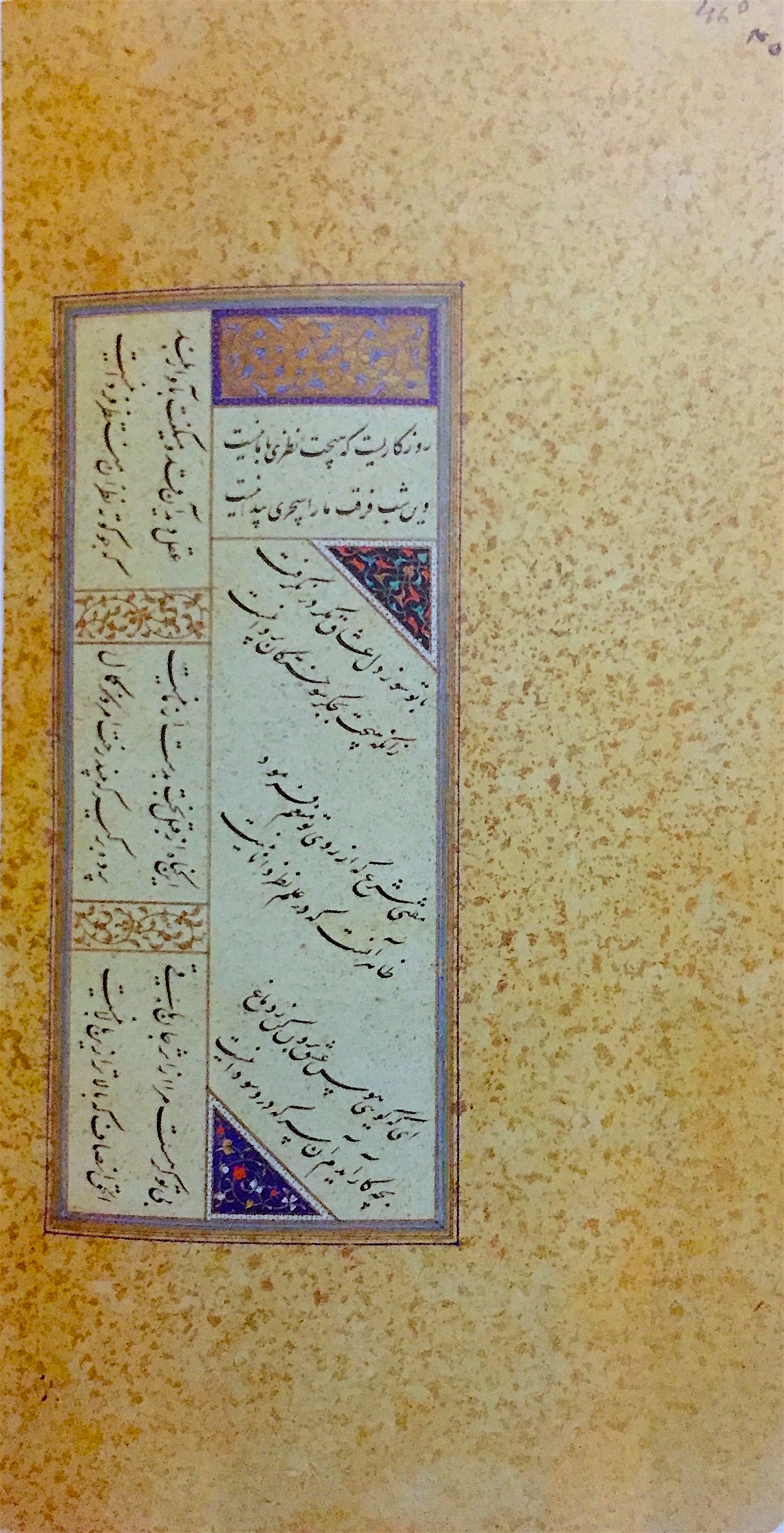
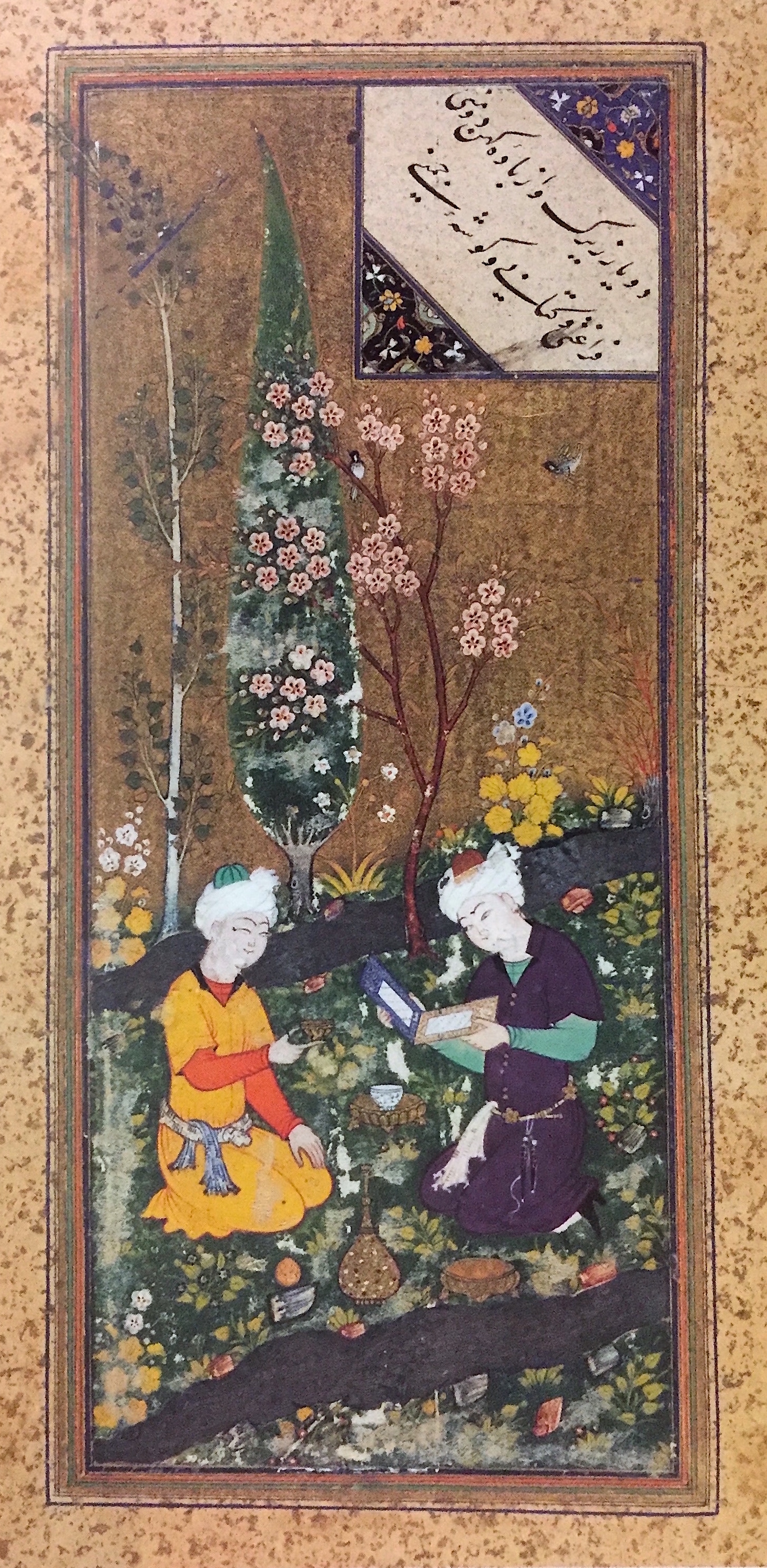
There is a closely-related manuscript, which was also penned and compiled by Mīr ‘Alī Haravī, in 935/1529 in Bukhara (two to three years prior to our manuscript), and which contains a selection of poetry by eleven poets from the same courtly circle. That is MS C-860 which is housed in the Russian Academy of Sciences in St Petersburg, and comprises 56 folios with seven verses per page, arranged in a similar format to King’s Pote MS 186.[3] In that anthology, the dimensions of the text panels are smaller and the margins are not illuminated or illustrated but simply gold speckled. However, it contains two subsequently added illustrations. ‘Judging by the poem in the colophon, written by the author of the compilation [Mīr ‘Alī Haravī], the copy was intended for the Uzbek sovereign of Bukhara, the Shaibānid ‘Ubaid-Allāh Khān (died in 1533 [actually 1539]), an avid bibliophile.’[4] Based on the fact that the scribe Mīr ‘Alī Haravī was moved to Bukhara by ‘Ubayd-Allāh Khān (c. 935/1528–29) and the completion date of the King’s manuscript (938/1531–32), it is very likely that the patron of Hilālī’s dīvān was the same Shaybānid ruler ‘Ubayd-Allāh Khān. There is little doubt that the unnamed place where our manuscript was copied is again Bukhara.[5]

Poetry anthology, penned by Mīr ‘Alī Haravī, dated 935/1529 (MS C-860 in the Russian Academy of sciences, St Petersburg).

Poetry anthology, penned by Mīr ‘Alī Haravī, dated 935/1529 (MS C-860 in the Russian Academy of sciences, St Petersburg).


King’s Pote MS 186 is the crowning jewel of the Pote collection at King’s. There is beauty in the masterful sixteenth-century penmanship from Bukhara, and in the exquisite decorated margins and binding that were probably added in a Mughal royal atelier around a century later. There is also great textual value in this early collection of verse by a noted contemporary poet. Of course, not all of Colonel Polier’s Lucknow manuscript collection was of this quality and value. But there are lesser treasures too, now in Cambridge, thanks to the efforts and generosity of Edward Pote.

Shiva Mihan

All manuscripts of the Pote Collection are on permanent loan at Cambridge University Library.

Endnotes
[1] O.F. Akimushkin listed a number of manuscripts in the hand of Mīr ‘Alī on p. 333 of his article on the Shaibānid library at Bukhara: ‘Biblioteka Shibanidov v Bukhare XVI veka’ in Bamberger Zentralasienstudien: Konferenzakten ESCAS IV, Bamberg 8-12. Oktober 1991, ed. I. Baldauf and M. Friederich (Berlin, 1994), pp. 325-41. See http://menadoc.bibliothek.uni-halle.de/iud/content/pageview/347600 .
[2] http://www.iranicaonline.org/articles/amanat-khan-sirazi-abd-al-haqq
[3] For more details and reproductions of the manuscript, see Y. A. Petrosan et al. Pages of Perfection: Islamic paintings and calligraphy from the Russian Academy of Sciences, St. Petersburg (Lugano, 1995), pp. 226–29.
[4] Ibid., p. 226.
[5]For information on the Shaybānids (or Abū al-Khayrids) see http://www.iranicaonline.org/articles/abul-khayrids-dynasty. For Bukhara see http://www.iranicaonline.org/articles/bukhara-viii.