Tag Archives: Keynes Bequest

Dante: An Online Exhibition

In November 2024 King’s College had the opportunity to host the annual doctoral and postdoctoral research conference “Dante Futures 2024: New Voices in the UK and Ireland”. For this occasion, an exhibition of rare early printed and manuscript materials relating to Dante was mounted in the library. As this year marks the 760th anniversary of Dante’s birth in 1265, we thought it would be timely to share some of these treasures in an online exhibition.

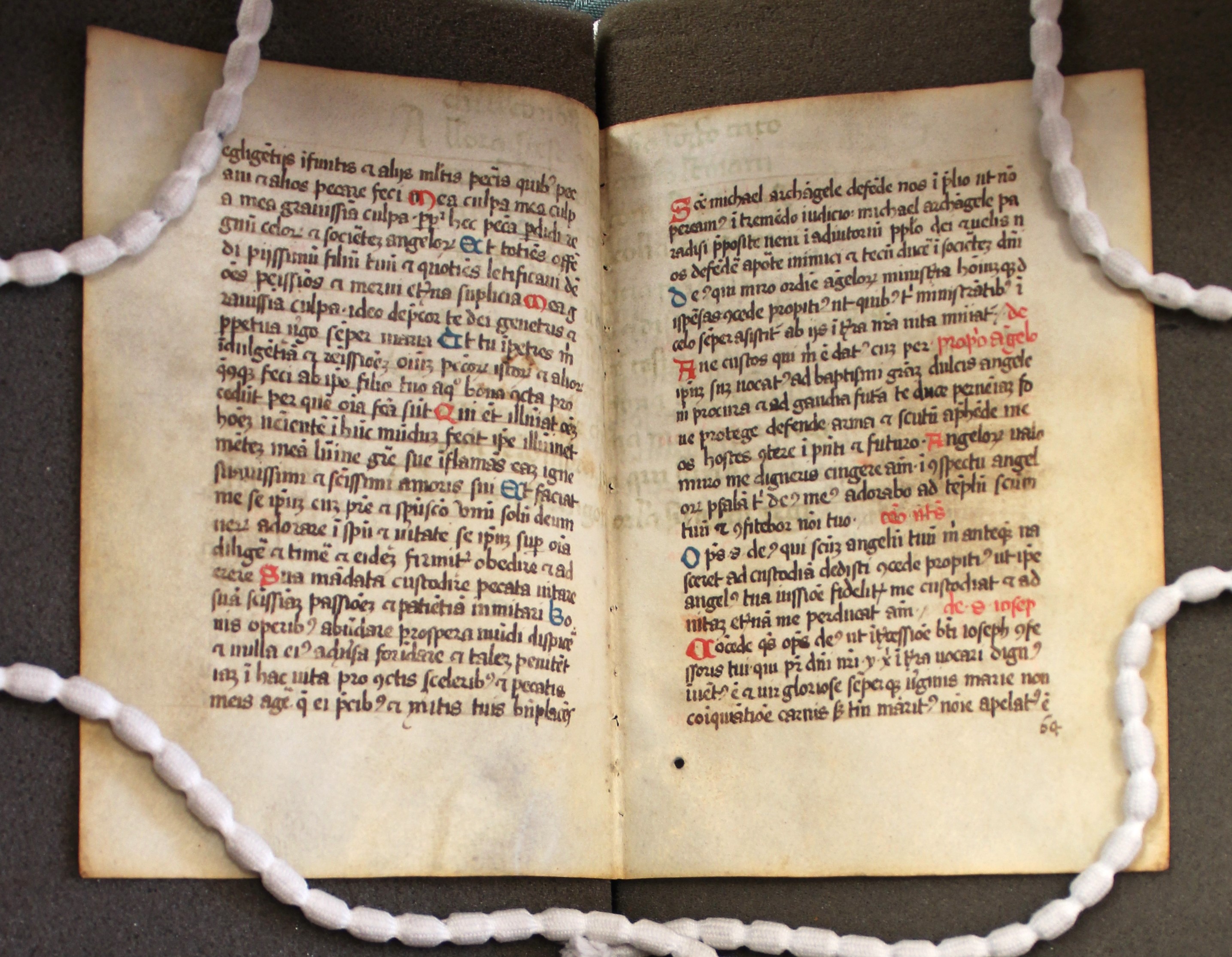
While there is no extant autograph manuscript of the Divine Comedy, many other fourteenth- and fifteenth-century manuscripts survive. Below is a fifteenth-century breviary written in an Italian hand on vellum. This is a palimpsest, namely a manuscript on which a piece of writing has been superimposed, effacing the original text. In this case the erased text is from Dante’s Inferno, one of the three parts of the Divine Comedy, which was written on at least 31 leaves used in this breviary. The vellum was not thoroughly cleaned when it was prepared for reuse, meaning Dante’s text can be seen by the naked eye in a number of places, apparently written in a fourteenth-century hand. Each leaf of the original manuscript was folded in two, vertically, to create two leaves (one bifolium). At the top of the page we can see lines 39-40 of Inferno VIII (spelling modernised):

ch’i’ ti conosco, ancor sie lordo tutto.
Allora [di]stese al legno ambo le mani

[for thee I know, all filthy though thou be.
Then toward the boat he stretched out both his hands]

Breviary (imperfect), fifteenth century, partly written on a palimpsest vellum of Dante’s Inferno, fourteenth century (Salt MS 3)

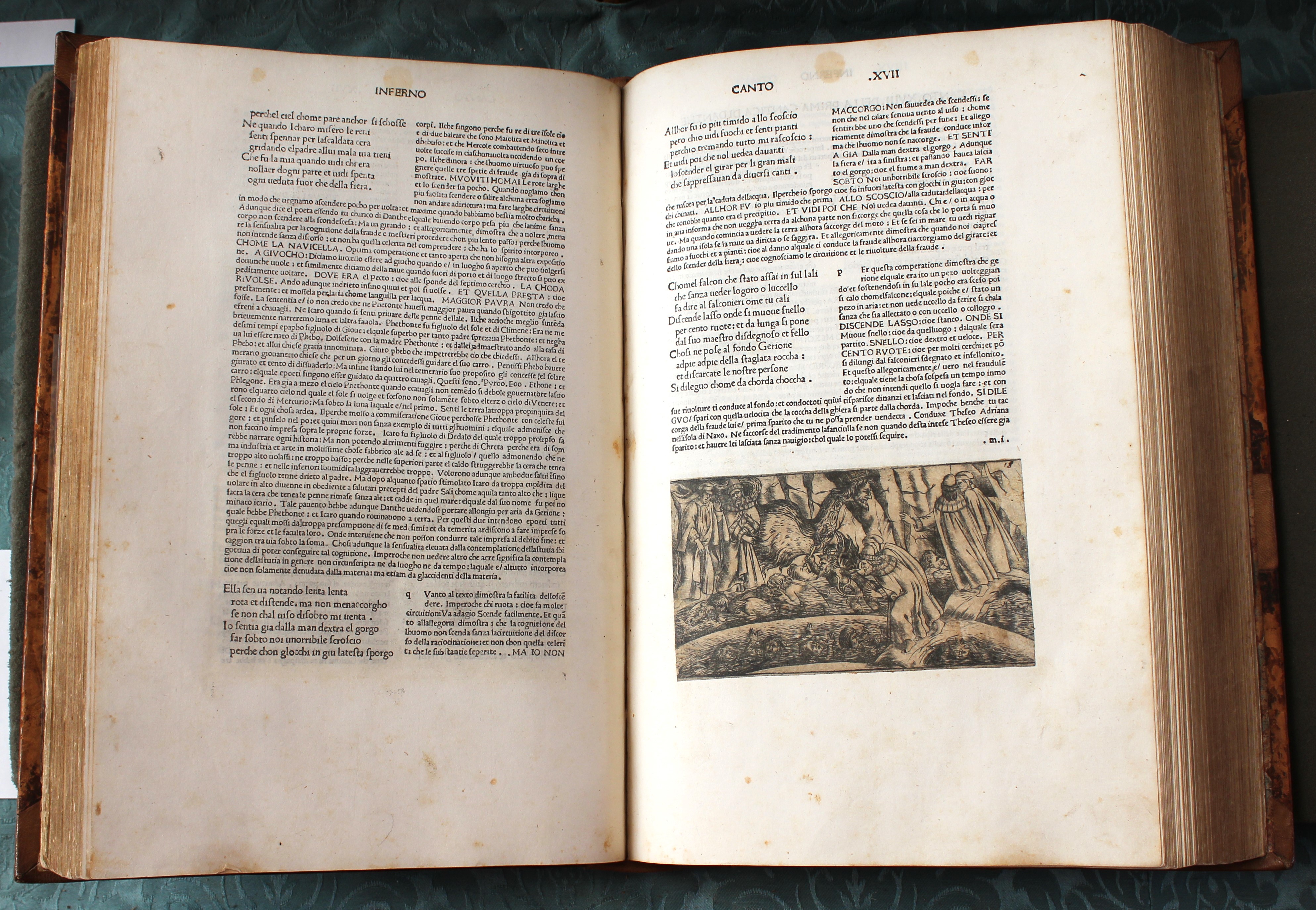
The first printed edition of the Divine Comedy appeared in 1472. This incunabulum from 1481 (a book from the dawn of printing, printed before 1501) includes the commentary of Cristoforo Landino with additions by Marsilio Ficino, and is the third edition of the work to be published. The engravings are attributed to Baccio Baldini after designs by Sandro Botticelli, eighteen of which are included in this copy, mainly pasted in spaces left by the printer for that purpose. Here we see the descent of Virgil and Dante into Hell, as they move to the circle of the fraudulent in the Malebolge, thanks to the mythological monster Gerion, who flies them down on its back. With the face of a just man, the body of a snake, the tail of a scorpion, and hairy paws, Gerion is an allegory of falseness and fraud, precisely because its human face displays a benign humanity while the serpentine and monstrous body reveals its evil:

Comento di Christophoro Landino fiorentino sopra
La comedia di Danthe Alighieri poeta fiorentino
(Florence: Nicholo di Lorenzo della Magna, 1481; Bryant.XV.1.4)

Aldus Manutius (c. 1449/1452–1515), founder of the Aldine Press in Venice, was one of the most important printers of the period. He was an advocate of the smaller, more portable book format, which is arguably the precursor to the modern paperback. His work also helped to standardise the use of punctuation.

Along with Greek classics, the Aldine Press also printed Latin and Italian works. At the start of the sixteenth century the Bembo family—a noble Venetian family—hired the Aldine Press to produce accurate texts of both Dante and Petrarch using Bernardo Bembo’s personal manuscript collection. Pietro Bembo worked with Manutius from 1501 to 1502 to undertake this work, resulting in this, the fifth edition of the Divine Comedy to be published. Here we see the well-known dolphin-and-anchor printer’s device used by the Aldine Press, adopted in 1502 and used for the first time in this publication:

Dante Alighieri, Lo ‘nferno e ‘l Purgatorio e ‘l Paradiso di Dante Alaghieri
(Venice: Aldus Manutius, 1502; M.71.15)

The Aldine Press published a second edition of the Divine Comedy in 1515 in partnership with Aldus’s father-in-law, Andrea Torresani “nelle case d’Aldo et d’Andrea di Asola suo suocero” (at the house of Aldo and Andrea of Asola, his father-in-law), with whom he had a professional relationship from 1506 until his death in 1515. Although the volume appeared just after his death, Aldus is believed to have prepared this second edition himself. The publication was dedicated to Vittoria Colonna (1490–1547), one of the most famous women of the Italian Renaissance, friend to the most important cultural figures of the age including Bembo, Castiglione and Michelangelo, and a poet in her own right. Below is the opening of the second part of the Divine Comedy, the Purgatorio:

Dante col sito, et forma dell’inferno tratta dalla istessa descrittione del poeta
(Venice: nelle case d’Aldo et d’Andrea di Asola suo suocero, 1515; Keynes.Ec.7.3.22)

Alessandro Vellutello (born 1473) produced an influential commentary on the Divine Comedy, published in 1544, which is a real gem in the collection of rare books bequeathed to King’s College by novelist E.M. Forster (1879–1970). This copy belonged to Bishop John Jebb (1775–1833) who gifted it to Forster’s grandfather, Charles Forster (1789–1871). The printer left spaces for 87 woodcut illustrations which were first used in this edition and subsequently in a number of other editions throughout the sixteenth and seventeenth centuries. They were considered some of the most beautiful Renaissance illustrations of the poem after Botticelli’s.

This is a depiction of Giudecca (named after Judas Iscariot), the very last region of Hell. The sinners are punished by being completely frozen in the lake of Cocytus, some upright, some upside down, some with their bodies bent double. Enormous in size, we see the top half of Lucifer in the lake, gnawing on the bodies of sinners:

La comedia di Dante Aligieri con la nova espositione di Alessandro Vellutello
(Venice: per Francesco Marcolini, 1544; Forster.DAN.Com.1544)

Cosimo Bartoli (1503–72) was a humanist, philologist and writer. He promoted the Italian vernacular as a language which could be used in scientific discussion as much as Latin, and Dante was regarded as an example of the heights the vernacular could reach. A friend of the famed Renaissance painter and architect Giorgio Vasari (1511–74), he also worked for the Medicis for most of his life. His Ragionamenti accademici sopra alcuni luoghi difficili di Dante takes the form of fictitious discussions held between Bartoli and his Florentine friends, to provide explanations of some of the most difficult passages in the Divine Comedy. A collection of some of the lectures he had given in the Accademia fiorentina between 1541 and 1547, it was published in Venice in 1567:

Cosimo Bartoli, Ragionamenti accademici di Cosimo Bartoli gentil’huomo et
accademico fiorentino sopra alcuni luoghi difficili di Dante
(Venice: appresso Francesco de Franceschi Senese, 1567; Bury.BAR.Rag.1567)

JC/IJ


I Am Emperor of the French Still

While Ridley Scott’s biopic Napoleon has come and gone without too much fanfare or recognition during awards season, its release nevertheless reminded me that we have a volume in our rare-book collection that belonged to the French emperor, whose 255th birthday falls today (15 August 1769 – 5 May 1821):

Title page of Pierre Victor Jean Berthre de Bournisseaux, Histoire des guerres de la Vendée et des Chouans, depuis l’année 1792 jusqu’en 1815 (Paris: Claude Brunot-Labbe, 1819; M.37.116)

Napoleon’s ink signature is above the circular stamp: “l’Empereur Napoleon”. As he had been in exile on St Helena since October 1815, the book must have been shipped to him from France. The volume was sold at auction by Sotheby’s in June 1905 and was later donated to the College by Kingsman Alban Goderic Arthur Hodges (1893-1982):

Rear pastedown on which is stuck an advertisement for the Sotheby’s sale on 1-3 June 1905, including “Books from the library of the Emperor Napoleon I at St. Helena”. Next to it is a slip describing this book and its provenance: “Cachet of St. Helena and ‘L’Empereur Napoléon’ on title”.

While there are several items in King’s College’s collection that belonged to British monarchs, these are usually identified as such thanks to a royal cypher or a crest on the binding. This copy of the order of service performed at the coronation of George II (1727) belonged to his grandson George III (1738-1820), who was on the throne during Napoleon’s reign and exile:

The Form and Order of the Service that Is To Be Performed […] in the Coronation of their Majesties, King George II. and Queen Caroline (London: John Baskett, 1727; Thackeray.M.32.53)

The volume is bound in red morocco featuring an elaborate gilt panel design on front and rear boards with the crest of King George III at the centre and royal cyphers on each corner. This book did not come to King’s College as part of the large Thackeray Bequest, but was purchased in 1950. Though George III’s pre-1801 crest was identical to that of George II, the fact that Provost George Thackeray was chaplain in ordinary to George III suggests that he likely received it as a gift from the latter (who may have inherited it from his grandfather George II).

Gone are the days of gilt imperial bindings for the erstwhile French emperor: Napoleon can now only assert his ownership through a mere signature, like most other book owners. The contrast between the British monarch’s mark of ownership through this elaborate morocco binding and Napoleon’s ink inscription on the title page could not be starker.

One cannot help but draw a parallel between Napoleon’s predicament and that of the heroine in John Webster’s play The Duchess of Malfi (1623), loosely based on the life of Giovanna d’Aragona, Duchess of Amalfi (1478-1510):

Title page of the second edition of John Webster’s The Dutchesse of Malfy: A Tragedy (London: John Raworth and John Benson, 1640; Keynes.C.6.27)

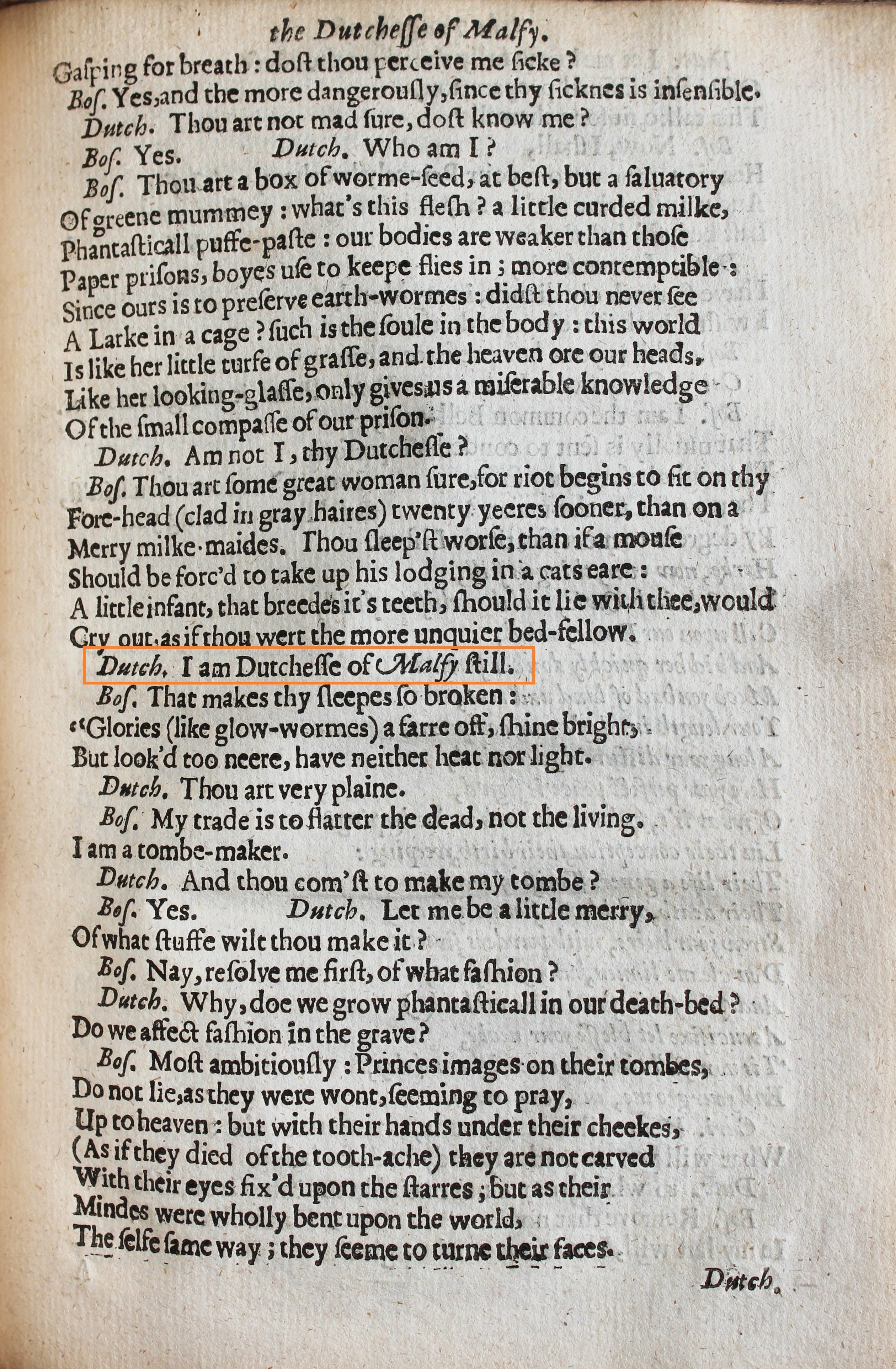
In the play, the widowed duchess secretly marries her lowly household steward Antonio and bears him three children, thus attracting the rage of her two brothers Ferdinand and the Cardinal who want to safeguard their inheritance. The duchess and her two younger children are murdered at Ferdinand’s behest in the fourth act. As she is about to be strangled by the executioners, she utters the famous words, “I am Duchess of Malfi still”:

Part of Act IV, scene ii (leaf G4 recto)

There is a sense of poignancy in the defiance shown by both the duchess and Napoleon as they cling to a former glorious past in the face of imminent death or a fall from grace. The difference is that Napoleon was technically no longer an emperor in 1819, while the duchess was still Duchess of Malfi, at least in name, when she died. In November 1818, Napoleon had been informed that he would remain a prisoner on St Helena for the rest of his life, and the island’s governor Sir Hudson Lowe had refused to recognise him as a former emperor. However, as this ownership inscription confirms, “Napoleon never considered forgoing ceremony or the recognition of his title. It was the only way he could assert his claim to being emperor in the face of the British insistence that he was a simple general. Much of his stay on St Helena was about constructing a space for himself in which he displayed his quality as an imperial sovereign”.[1]

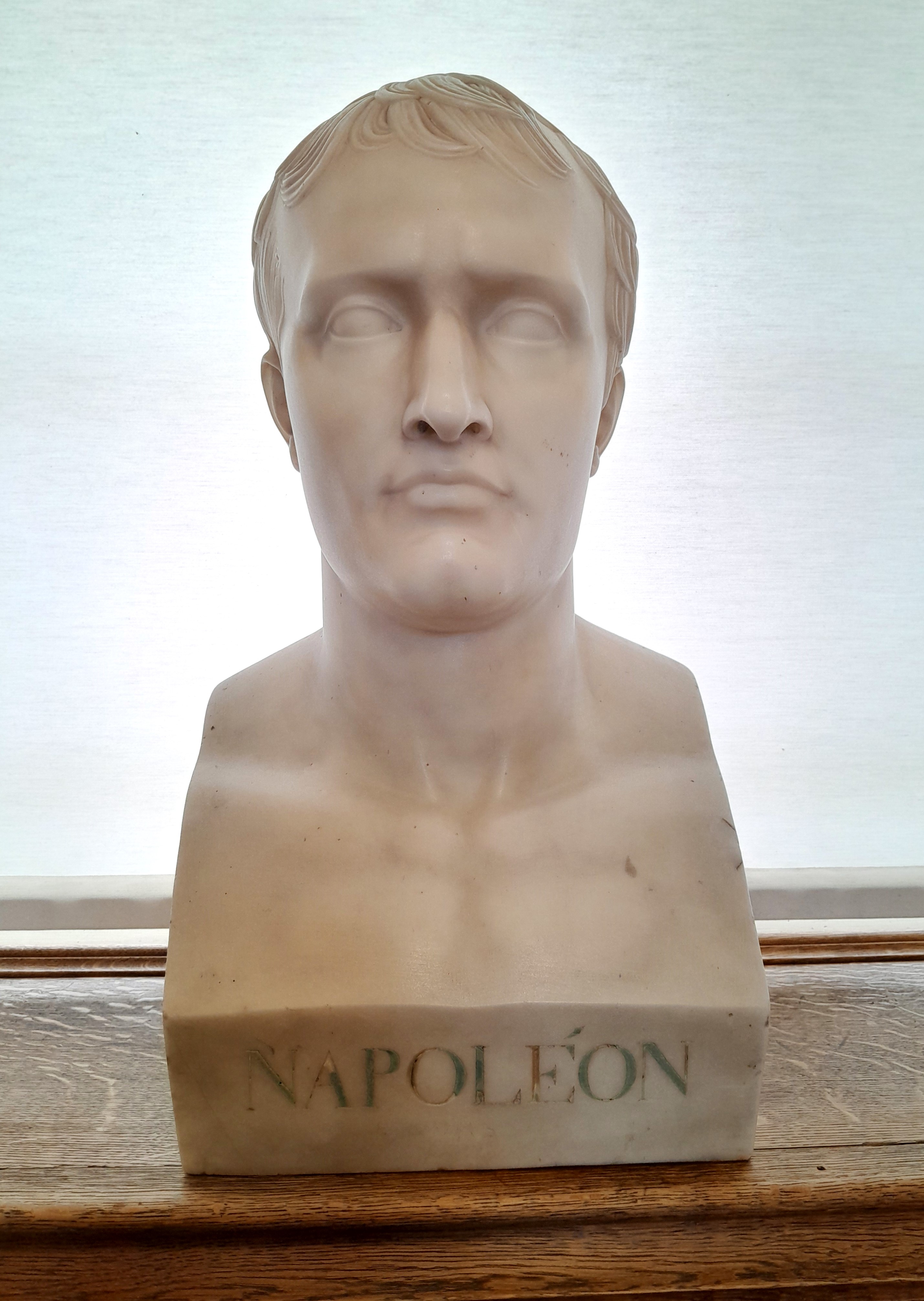
Bust of Napoleon in King’s College Library

IJ

Notes

[1] Philip Dwyer, Napoleon: Passion, Death and Resurrection, 1815-1840 (London: Bloomsbury Publishing, 2019, pp. 44-45)

Soaring into the New Year on the back of a dragon

In honour of the Year of the Dragon, we went on a perilous mission into the Library’s treasure hoards of books to find out if any of those fearsome beasts might be lurking inside. Alas, no Chinese dragons were discovered, but we did encounter several of the European variety and bravely captured their images to share with you in this post.

Our first dragon however, is not to be found within the pages of a book. It is a much more solid beast; a sculpture which originally adorned the College Chapel, but which was removed and replaced during restoration work. For the last few decades it has stood guard over the upstairs entrance of our Library, somewhat worn and battered by time maybe, but fierce and stalwart nonetheless.

A stone dragon standing upright with mouth open

The dragon outside the upstairs entrance of the Library

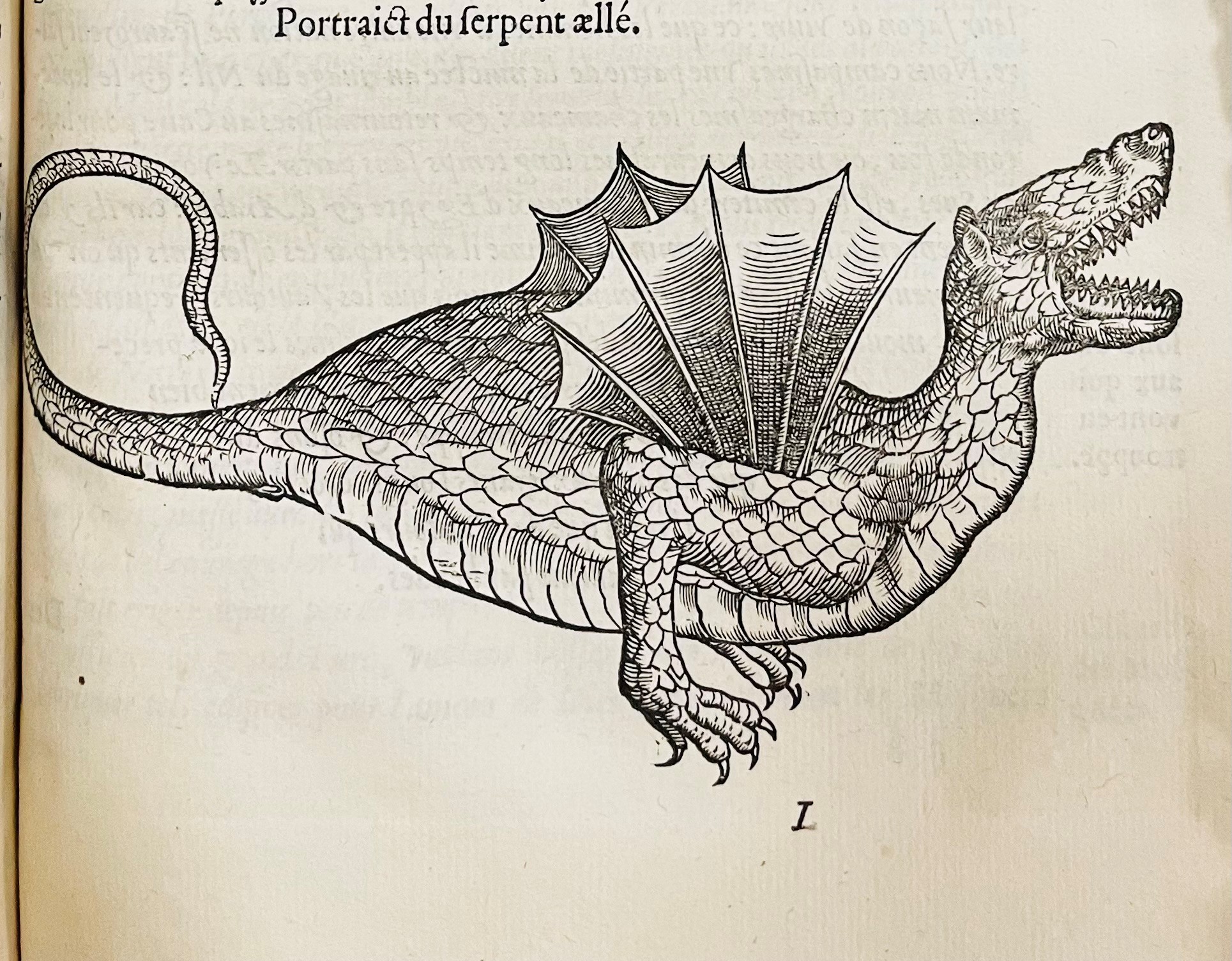
Several sixteenth-century works from our collections proved to be harbouring dragons. The first image comes from a volume of natural history by Pierre Belon (1517?-1564), originally produced in 1553. This is a very early printed depiction of a dragon with wings. Belon, a French naturalist and traveller, claimed to have seen embalmed bodies of these creatures during his travels in Egypt.

Woodcut of a two-legged winged dragon

Egyptian dragon from Les Obseruations de plusieurs singularitez & choses memorables by Pierre Belon, Paris, 1555 (T.16.20)

Secondly, we have an illustration depicting a very grand St George slaying a dragon, which adorns the title page of the 1527 edition of Polycronicon, by Benedictine monk, Ranulf Higden (ca. 1280-1364).  This was a very popular work of world history, written originally in Latin and later translated into English and added to over the following centuries.

Woodcut of St George on horseback with a dragon under the horse's hooves

St George and the dragon from the title page of Polycronycon by Ranulf Higden, London, 1527 (M.24.08)

Our last sixteenth-century image is from a 1590 edition of Edmund Spenser’s Faerie Queene. Here we have another knight, the Redcrosse Knight, killing a dragon in a very similar fashion. The Redcrosse Knight is very closely associated with St George.

Image of a knight on horseback with a dragon under the horse's hooves. The knight is running a spear through the dragon

The Redcrosse Knight from The Faerie Queene by Edmund Spenser, London, 1590 (Keynes.C.02.19)

Moving into the seventeenth century, a work of alchemy provides more images. Dragons in alchemy symbolize the unification of opposing forces like the sun and the moon or sulphur and mercury, and the change they produce when combined.  We therefore get these striking illustrations of entwined or two-headed dragons, as shown in the images below.

Two dragons perched atop a ring with their necks intertwined

Alchemical dragon symbol from page 212 of Theatrum Chemicum Britannicum edited by Elias Ashmole, London, 1652 (Keynes.C.4.2)

Upright two-headed dragon with a bird above and alchemists gathered around it

Two-headed dragon from page 213 of Theatrum Chemicum Britannicum edited by Elias Ashmole, London, 1652 (Keynes.C.4.2)

From our collection of children’s books comes a tale brimful of dragons. Snap-dragons: a Tale of Christmas Eve by Juliana Horatia Ewing (1841-1885) revolves around the parlour game of Snap-dragon, very popular in the nineteenth century, in which people took it in turns to snatch raisins from a bowl of flaming brandy.  This particular game conjures up a bevy of real dragons who draw a little boy into their boisterous and violent game of trading insults, or “snapping” at each other. It has some delightful illustrations.

Cover of the book showing a boy looking at a swirling group of dragons

Cover of Snap-dragons: a Tale of Christmas Eve by Juliana Horatia Ewing, London, 1888 (Rylands.C.EWI.Sna.1888a)

Text with a dragon illustration. The dragon is entwined with the initial B

Page 33 of Snap-dragons 

Text with an illustration of a dragon confronting a small boy

Pages 34 and 35 of Snap-dragons

Finally, we have this charming little dragon wrapped around an initial letter A in a volume of fairy tales, also by Ewing. Oddly enough, the tale it accompanies: “Knave and Fool”, features no dragons at all.

a dragon entwined around the initial A

Initial dragon from Old-fashioned Fairy Tales by Juliana Horatia Ewing, London, [1882?]  (Rylands.C.EWI.Old.1882)

Happy New Year!

References

Mythical creatures at the Edward Worth Library: Here be dragons! [accessed January 2024]

Jean Chevalier and Alain Gheerbrant, A Dictionary of Symbols. Oxford, 1994.

Lyndy Abraham, A Dictionary of Alchemical Imagery. Cambridge, 1998.

AC

Spooky Shakespeare: Macbeth

As the 400th anniversary year of Shakespeare’s First Folio reaches Halloween and the nights draw ever inward, our focus shifts to some of the spookier elements in Shakespeare’s plays, and particularly the witches and ghosts to be found in Macbeth. In addition, as we proceed, other witches and eerie creatures may swoop in from elsewhere in the Library’s collections.

The opening page of Macbeth in the First Folio (Thackeray.D.38.2)

The opening page of Macbeth in the First Folio (Thackeray.D.38.2)

Macbeth, believed to have been first performed in 1606, appears in print for the first time in the First Folio in 1623. It is thought that the Folio text was drawn from the latest version in theatres at the time, which incorporated revisions by the playwright Thomas Middleton (1580-1627).  One of Middleton’s revisions is thought to be the addition of two songs for scenes featuring the witches: “Come away, come away” and “Black spirits and white”. These songs are only mentioned by title in the Folio, but appear, complete with full lyrics, in Middleton’s own play The Witch (ca. 1613-1616). This expansion of the role of the witches reflected the continuing fascination of Jacobean audiences with witchcraft. This fascination was born partly out of the obsessions of King James I, whose book Dæmonologie was first published in 1597, and was then reprinted when he ascended the throne of England in 1603. James, who was convinced that he had almost met his death via witch-conjured storms in the North Sea, argued in his book that witchcraft arose from demons and humans working together to spread misery and destruction. Shakespeare is thought to have used Dæmonologie as one of his chief sources and inspirations in creating the play in the first place, likely with an eye on the King’s favour.  The plot’s focus on the murder of a King and its aftermath is also believed to reflect elements of the Gunpowder plot of 1605.

Image of a witch on a broomstick depicted in gilt decoration on a blue cloth book cover

Cover of The Blue Fairy Book, by Andrew Lang, London, 1897 (Rylands.C.LAN.Blu.1897)

Illustration of three witches flying through the sky on broomsticks, accompanied by black cats

Frontispiece of The Ingoldsby Legends, by Thomas Ingoldsby; illustrated by Arthur Rackham, London, 1907 (YHK BARH ZIN)


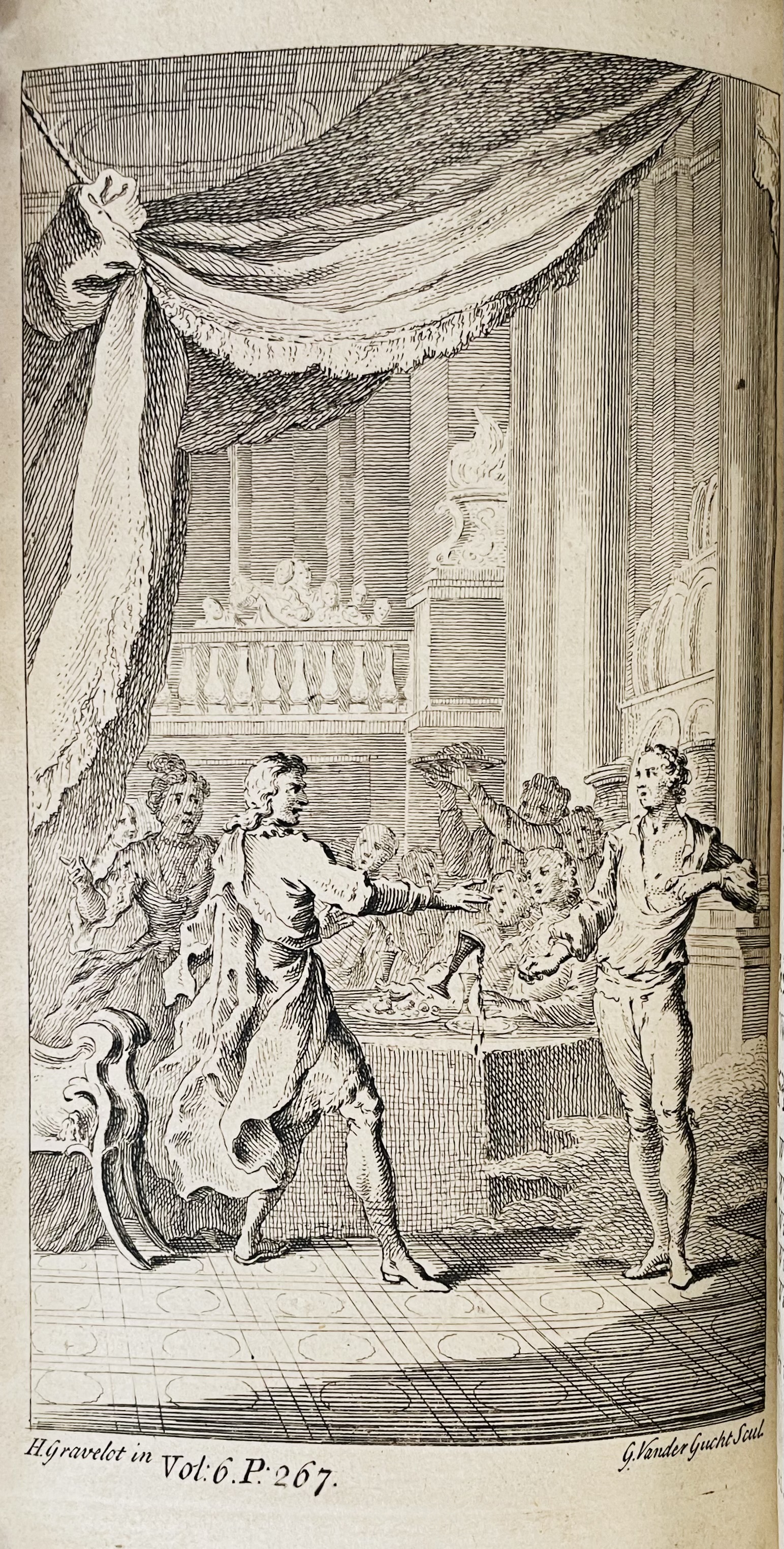
Next we turn to two eighteenth-century editions of the dramatic works of Shakespeare. The first, part of the Keynes Bequest, was edited by Lewis Theobald (ca. 1688-1744), who is a significant figure in Shakespeare scholarship. Theobald worked hard to correct errors and alterations that had crept into the plays through the work of earlier eighteenth-century editors, and surveyed as many surviving copies of the plays as he could in order to produce the most authoritative versions possible. His edition, originally published in 1733, was drawn upon heavily by subsequent major editors such as Edmund Malone (1741-1812), and thus continues to inform modern editions of the plays. Our set of Theobald’s Shakespeare dates from 1762. Macbeth appears in volume six, accompanied by an engraving by Hubert-François Gravelot (1699-1773), which depicts Macbeth confronting Banquo’s ghost during the feast scene (Act 3, scene 4).

Engraving of a feast scene in which Macbeth confronts the ghost of Banquo

Plate from The Works of Shakespeare, edited by Mr Theobald, London, 1762 (Keynes.P.13.24)


Title page of 1762 edition of the works of Shakespeare

Title page of volume six of The works of Shakespeare, [edited] by Mr Theobald, London, 1762 (Keynes.P.13.24)

First page of Macbeth.

First page of Macbeth from The works of Shakespeare, [edited] by Mr Theobald, London, 1762 (Keynes.P.13.24)


The second eighteenth-century edition is, like the First Folio, part of the Thackeray Collection. This fifteen-volume set, which dates from 1793, is an expanded version of an eight-volume edition of Shakespeare’s plays which originally appeared in 1765, and which was co-edited by the eminent writer Samuel Johnson (1709-1784).  Johnson had an abiding love of Shakespeare and had long wished to produce his own edition of the plays. He tested the waters in 1745 with the publication of his Miscellaneous Observations on the Tragedy of Macbeth, then spent the next twenty years working towards his goal. The preface to Macbeth in the 1793 edition includes Johnson’s ruminations on the supernatural themes of the play. He states:

A poet who should now make the whole action of his tragedy depend upon enchantment, and produce the chief events by the assistance of supernatural agents, would be censured as transgressing the bounds of probability … and condemned to write fairy tales instead of tragedies; but a survey of the notions that prevailed at the time when this play was written, will prove that Shakspeare [sic] was in no danger of such censures, since he only turned the system that was then universally admitted, to his advantage, and was far from overburdening the credulity of his audience.

Speaking of the prevailing atmosphere of the late 15th and early 16th centuries, he writes evocatively:

The Reformation did not immediately arrive at its meridian, and though day was gradually increasing upon us, the goblins of witchcraft still continued to hover in the twilight.

Having touched upon on James I’s preoccupation with witchcraft and its effect on the population, he goes on to say:

Thus the doctrine of witchcraft was very powerfully inculeated [sic]; and as the greatest part of mankind have no other reason for their opinions than that they are in fashion, it cannot be doubted but this persuasion made a rapid progress, since vanity and credulity co-operated in its favour.

Image of the title page of Johnson's edition of the plays

Title page of The Plays of William Shakspeare, edited by Samuel Johnson and George Steevens, London, 1793 (Thackeray.J.62.1)

Image of the first page of Macbeth from Johnson's edition of the plays

First page of Macbeth from volume 7 of The Plays of William Shakspeare, edited by Samuel Johnson and George Steevens, London, 1793 (Thackeray.J.62.7)

Black and white illustration of three witches huddled in an old shack

Three witches from a story called “The witches’ frolic”. Plate facing page 106 of The Ingoldsby Legends

An old bent-over woman with a black hat and a cat standing outside a hovel on a wild moor

“There’s an old woman dwells upon Tappington Moor”. Plate facing page 26 of The Ingoldsby Legends


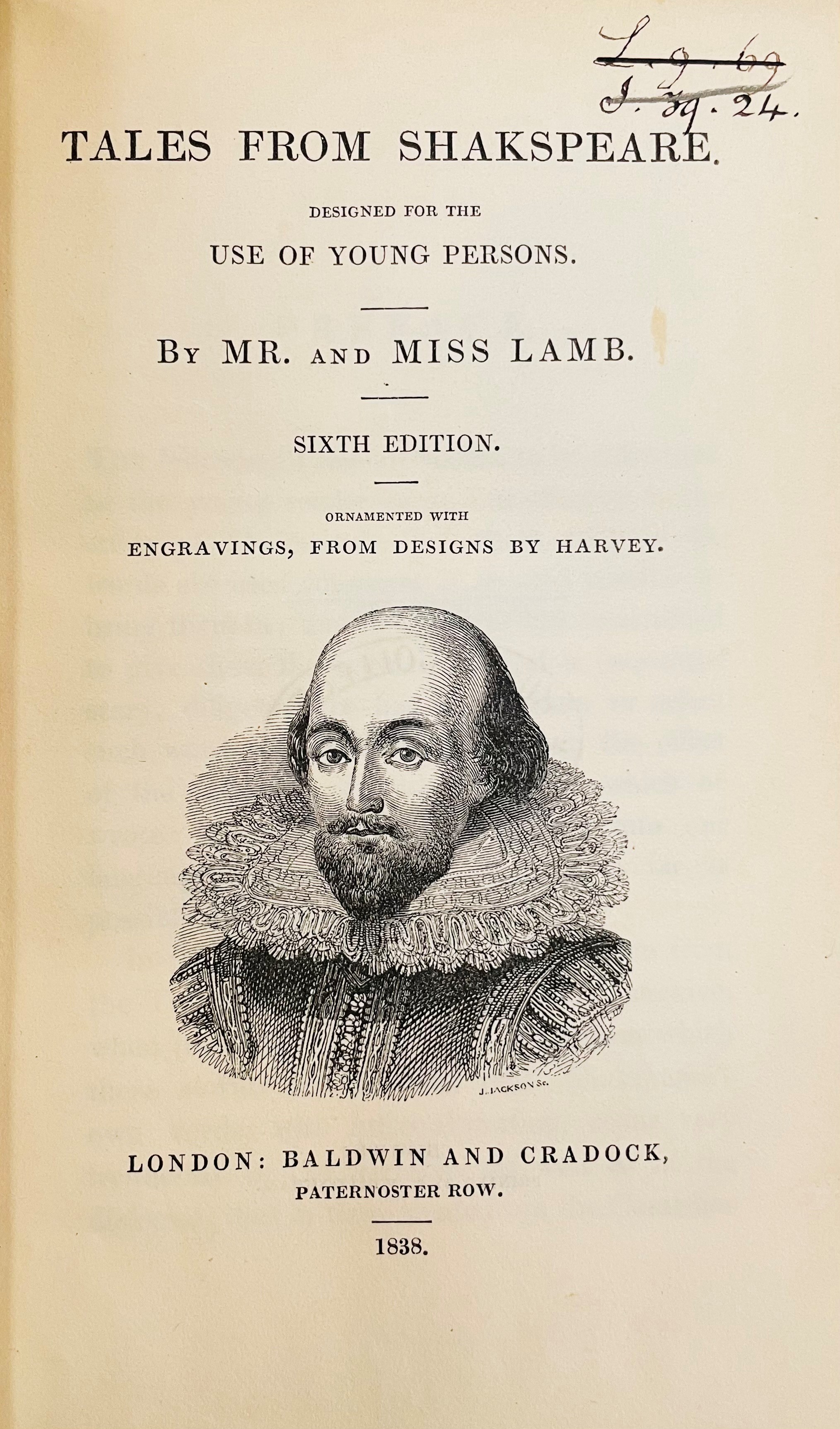
In 1807, Charles Lamb (1775-1834) and his sister Mary (1764-1847) produced a prose version of some of Shakespeare’s plays, modified to be suitable for children. More adult elements and complicated subplots were removed, but care was taken to adhere to the spirit of the originals, and to keep as much of the language as they could. The Library has a copy of the sixth edition, dating from 1838, which is the first edition to credit Mary Lamb on the title page. Macbeth appears in this volume, and the witches are described as follows:

… three figures like women, except that they had beards, and their withered skins and wild attire made them look not like any earthly creatures.

Title page of Tales from Shakspeare, which features an engraving of Shakespeare

Title page of Tales from Shakspeare, by Mr and Miss Lamb, London, 1838 (YHK LAM X 4)

First page of text from the prose version of Macbeth

Opening page of Macbeth from Tales from Shakspeare, by Mr and Miss Lamb, London, 1838 (YHK LAM X 4)


An illustration, pictured below, accompanies the tale, showing Macbeth and Banquo encountering these strange beings.

Macbeth and Banquo in armour, confronting three cloaked and bearded figures

Engraving of Macbeth and Banquo encountering the three witches. Plate from Tales from Shakspeare, by Mr and Miss Lamb, London, 1838 (YHK LAM X 4)

We leave you with a final dose of the supernatural via another wonderful  illustration by Arthur Rackham (1867-1939) from The Ingoldsby Legends. Originally serialised in the 1830s, the legends comprised ghost stories, myths and poems written by clergyman Richard Harris Barham (1788-1845) under the pen-name Thomas Ingoldsby. They were later published in book form and were hugely popular for decades. An edition featuring Rackham’s glorious illustrations was first published in 1898.

A gathering of witches, goblins and ghouls seemingly having a friendly chat amongst themselves

“Witches and warlocks, ghosts, goblins and ghouls”. Plate facing page 396 of The Ingoldsby Legends

Stay safe and watch out for whatever might be lurking out there in the dark this Halloween!

References

Julian Goodare, A royal obsession with black magic started Europe’s most brutal witch hunts   [accessed 10/10/23]

Emma Smith, The Making of Shakespeare’s First Folio, Oxford, 2015

You can browse King’s College’s First Folio on the Cambridge University Digital Library here and it also features on the First Folios Compared website where you can compare it side by side with other digitised copies of the First Folio.

AC

Parisian fashion plates

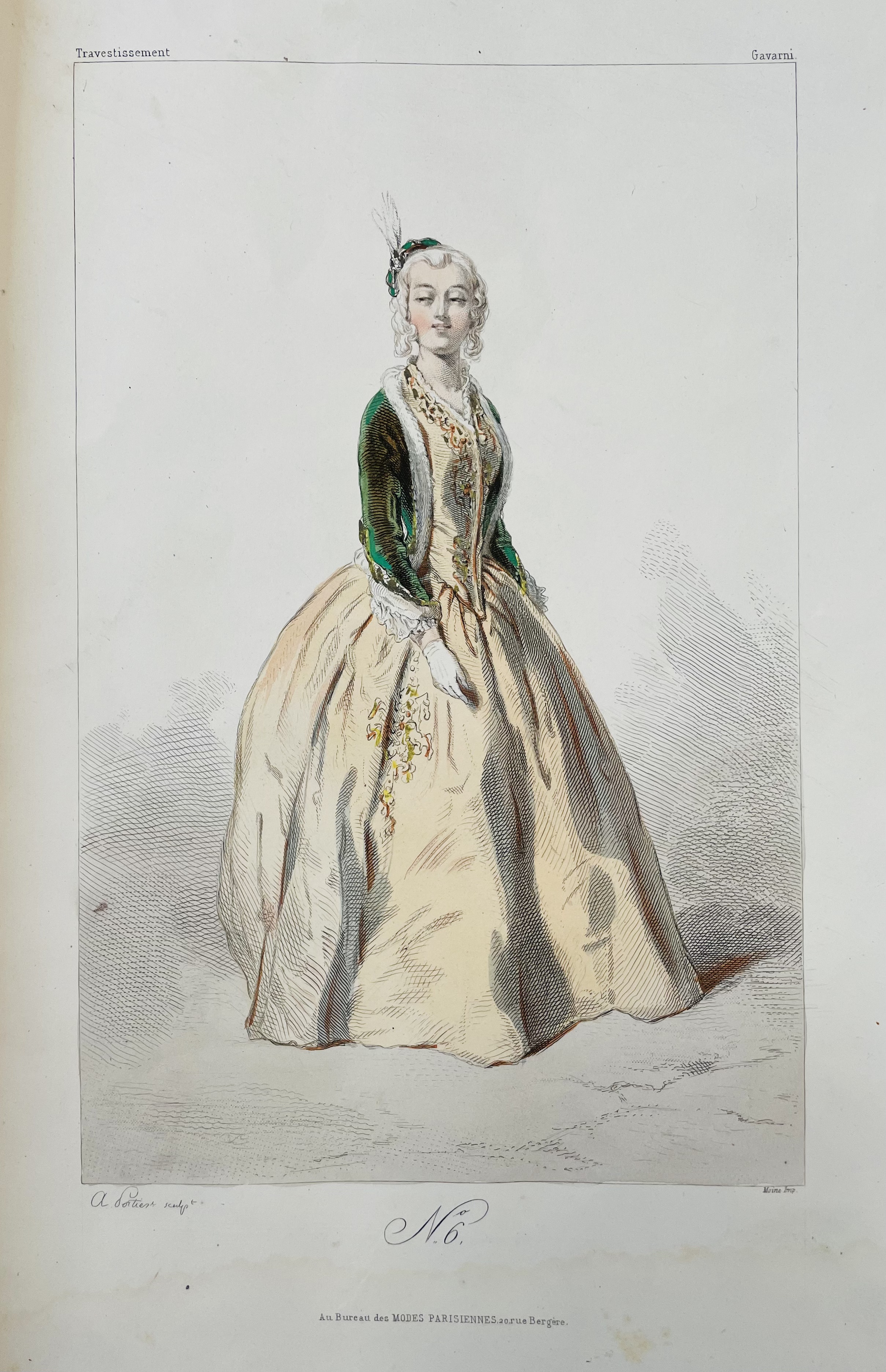
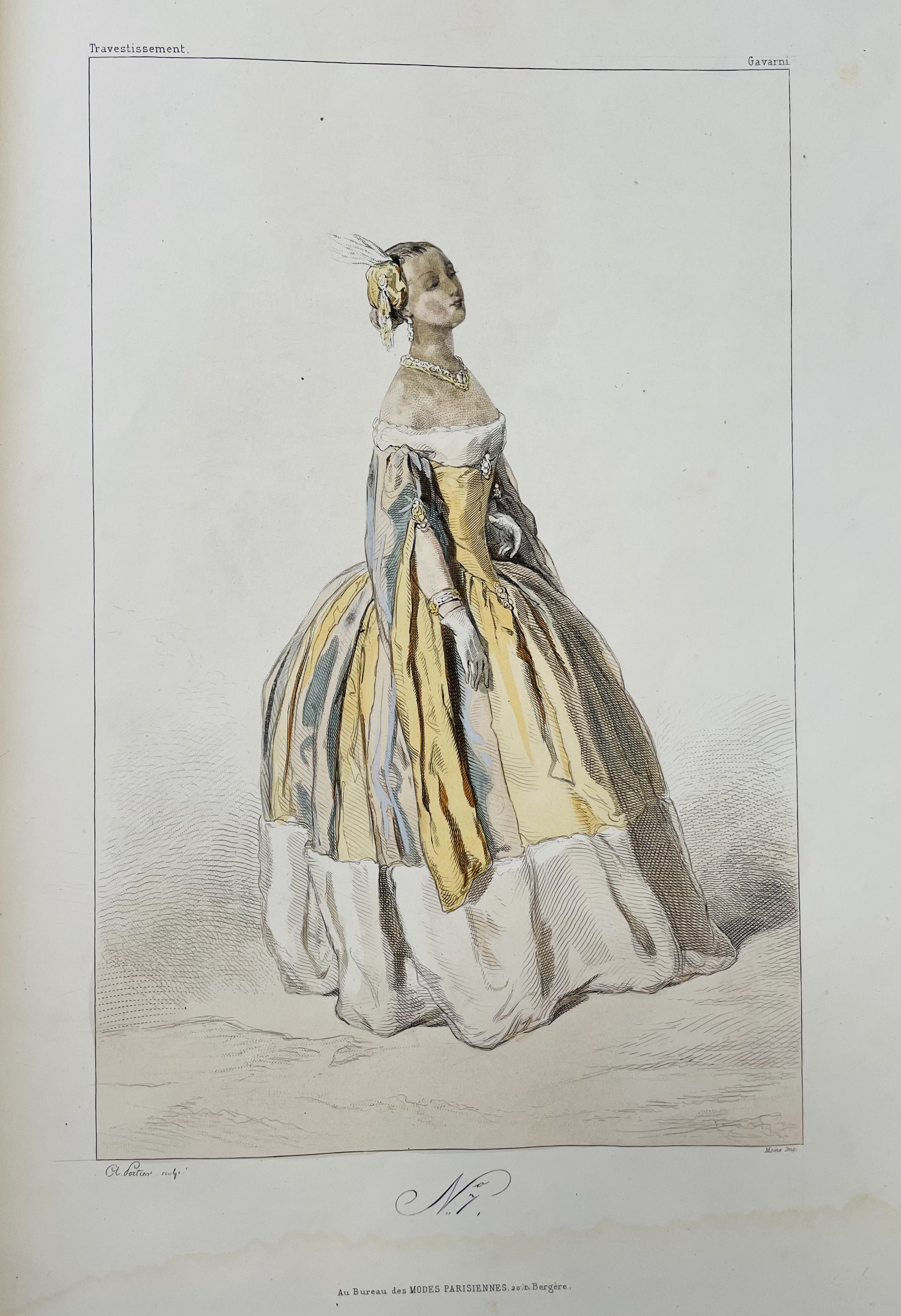
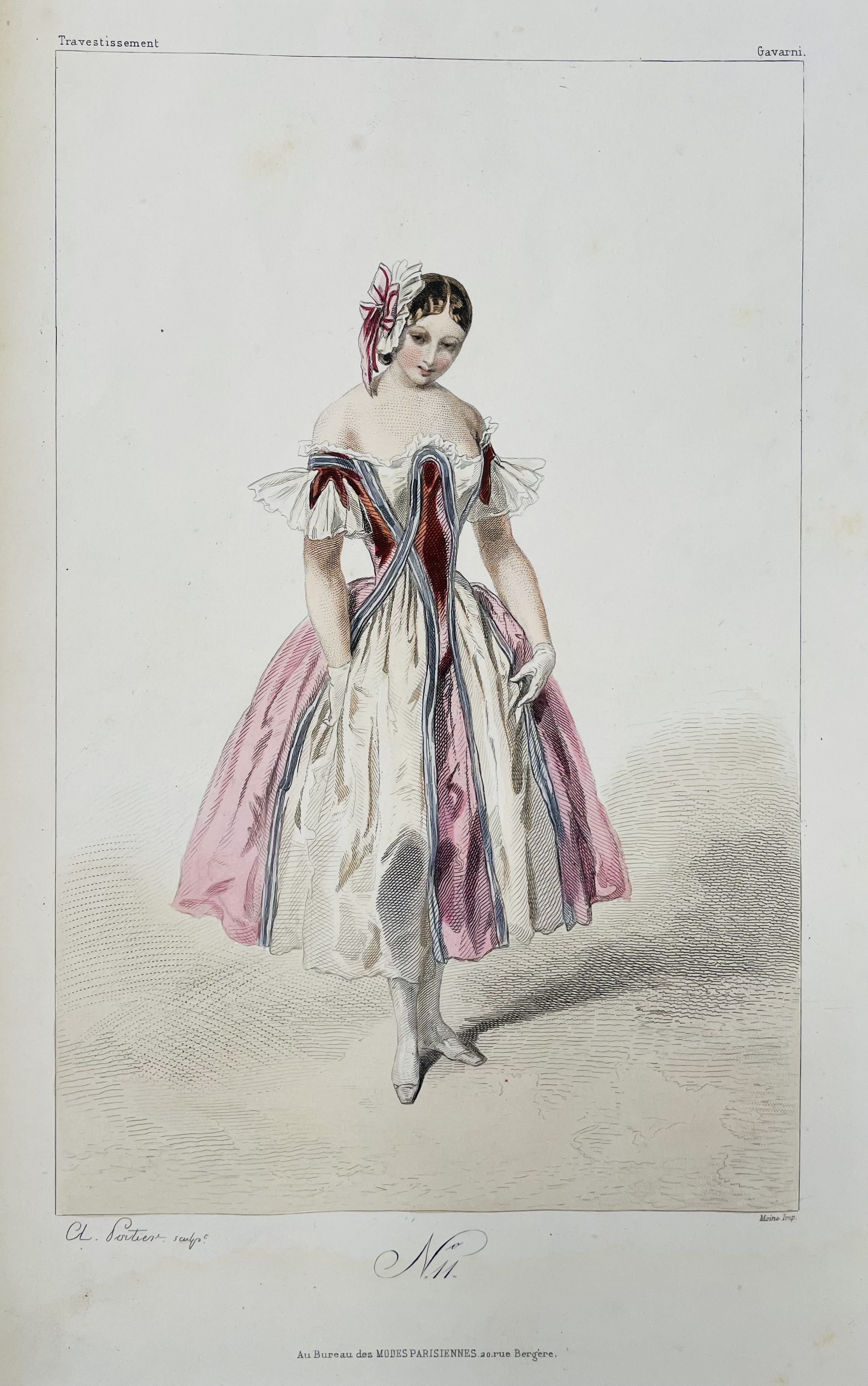
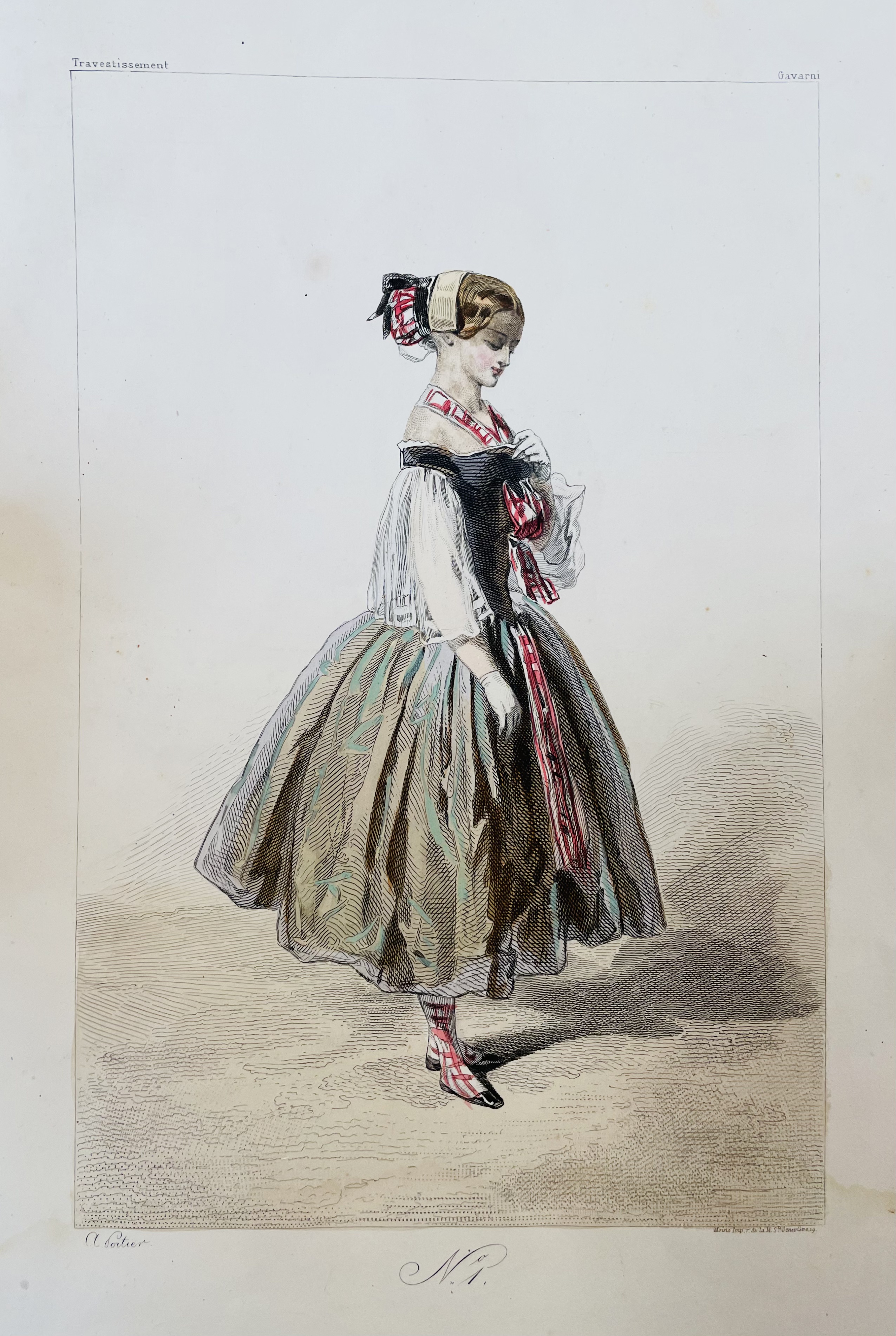
They may not be the very latest in fashion, but the dresses depicted in this slim volume from the Keynes Collection are far too pretty to remain under wraps. The book: Douze nouveaux travestissements (Paris, 1856) features twelve hand-coloured engravings produced from illustrations by the artist Paul Gavarni (1804-1866). Gavarni was a popular caricaturist and book illustrator, who illustrated the first collected edition of the works of Balzac in 1850. He also produced many illustrated volumes of his own, sketching and parodying the eccentricities of the various classes of French society.

This particular volume was published by the monthly fashion magazine Les Modes Parisiennes, which was published between 1843 and 1875. In magazines, fashion plates such as these were usually accompanied by detailed instructions on how the outfits could be reproduced, providing avid followers of French fashion – including many British women – with the information needed in order to dress to impress.

Plate No. 1 from Douze nouveaux travestissements,1856, Shelfmark Keynes.P.12


Plate No. 2 from Douze nouveaux travestissements,1856, Shelfmark Keynes.P.12

Plate No. 3 from Douze nouveaux travestissements,1856, Shelfmark Keynes.P.12

Plate No. 4 from Douze nouveaux travestissements,1856, Shelfmark Keynes.P.12

Plate No. 5 from Douze nouveaux travestissements,1856, Shelfmark Keynes.P.12

Plate No. 6 from Douze nouveaux travestissements,1856, Shelfmark Keynes.P.12

Plate No. 7 from Douze nouveaux travestissements,1856, Shelfmark Keynes.P.12

Plate No. 8 from Douze nouveaux travestissements,1856, Shelfmark Keynes.P.12

Plate No. 9 from Douze nouveaux travestissements,1856, Shelfmark Keynes.P.12

Plate No. 10 from Douze nouveaux travestissements,1856, Shelfmark Keynes.P.12

Plate No. 11 from Douze nouveaux travestissements,1856, Shelfmark Keynes.P.12

Plate No. 12 from Douze nouveaux travestissements,1856, Shelfmark Keynes.P.12

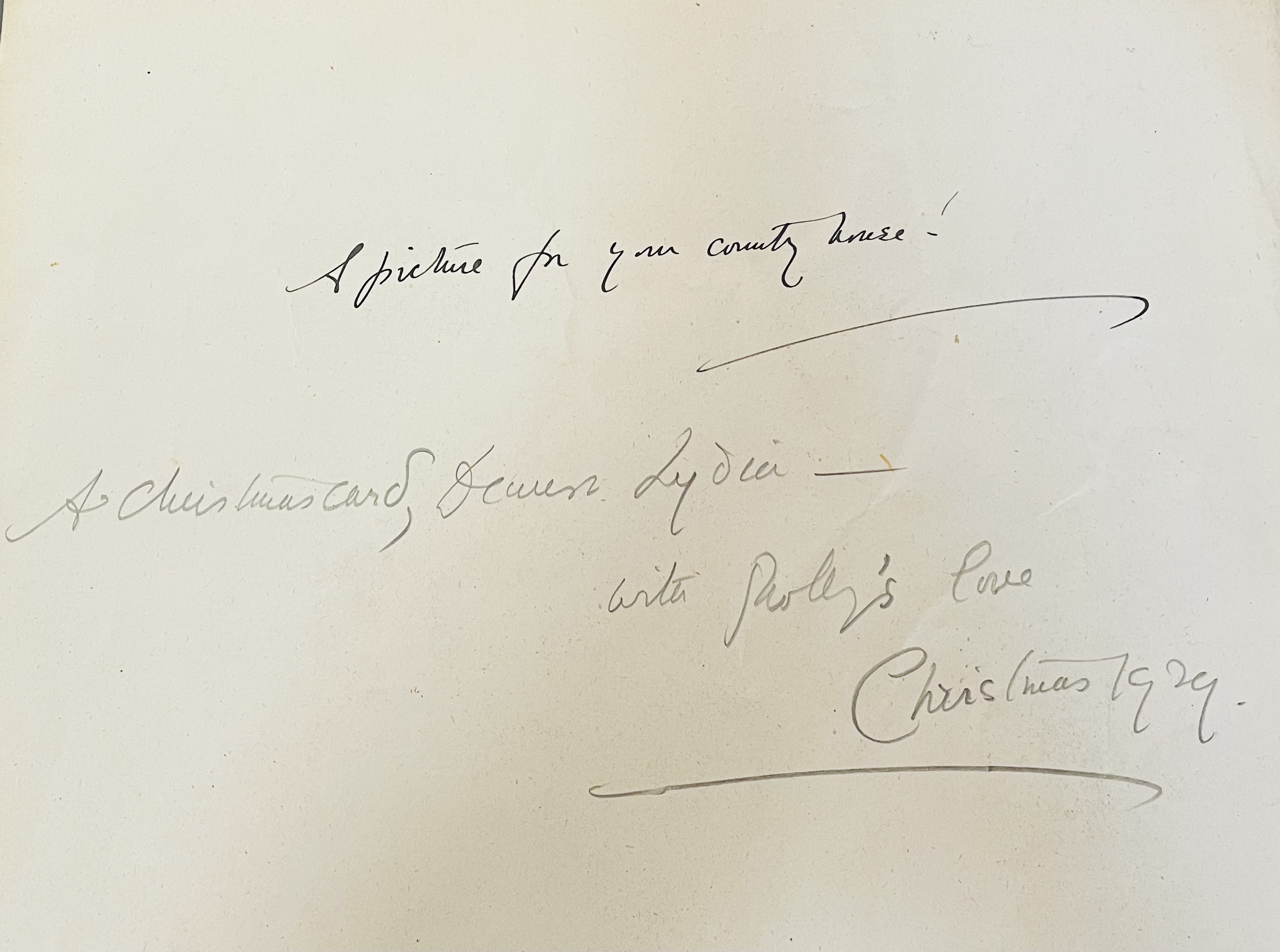
Finally, tucked loose inside this volume is another wonderful nineteenth-century engraving. An inscription on the back reveals that it was sent as a Christmas card to Lydia Lopokova, the wife of John Maynard Keynes, in 1929.

Loose plate tucked inside Keynes.P.12

Verso of the loose plate. The inscriptions read: “A picture for your country house!” and “A Christmas card, dearest Lydia, with [Molly’s?] love, Christmas 1929”

If this has left you keen to seek out more images of nineteenth-century fashion, then the National Portrait Galley has a fashion plate gallery covering the period 1770-1870, with a wealth of gorgeous images to explore. Have fun!

AC

A colourful treat for the eyes

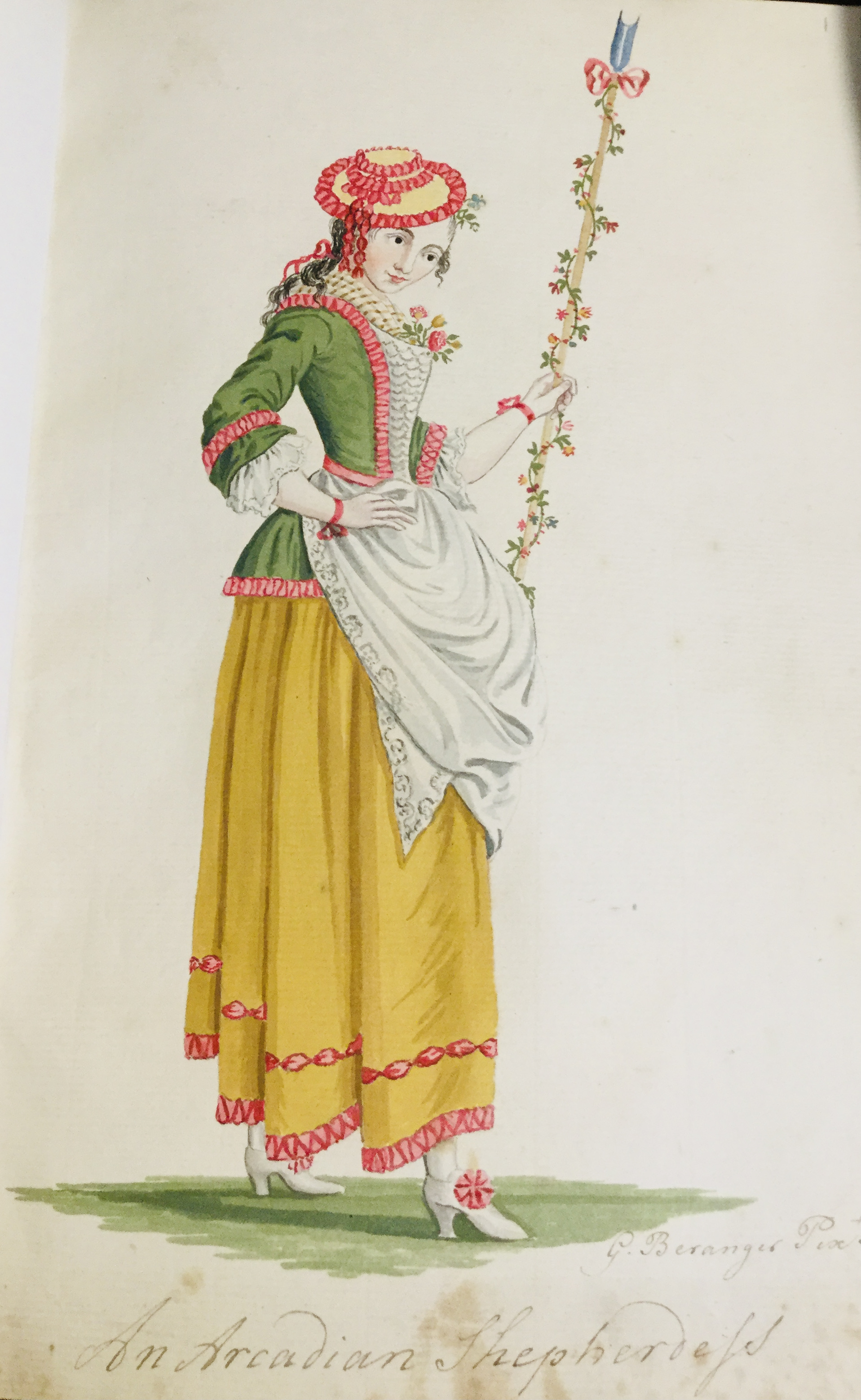
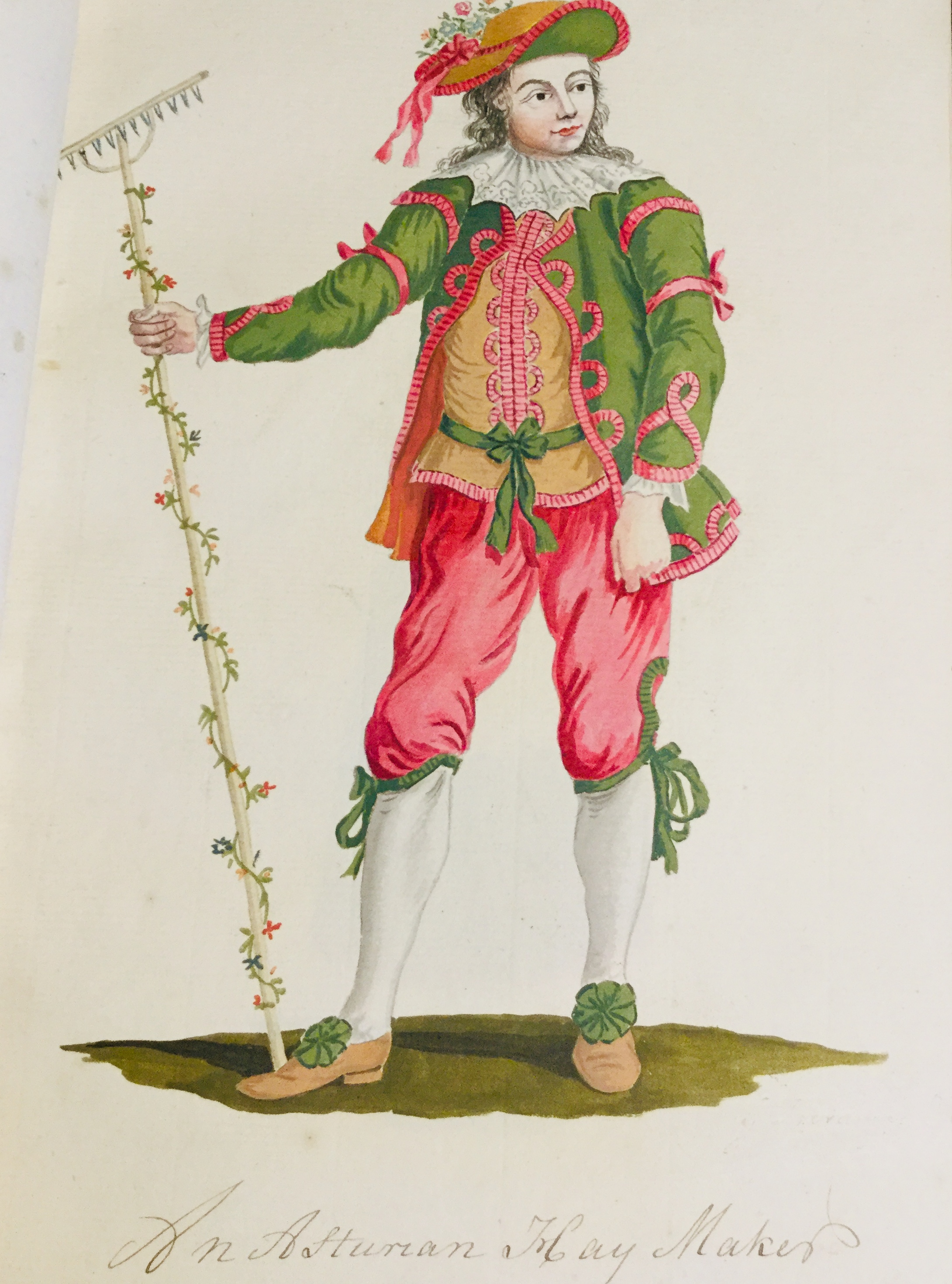
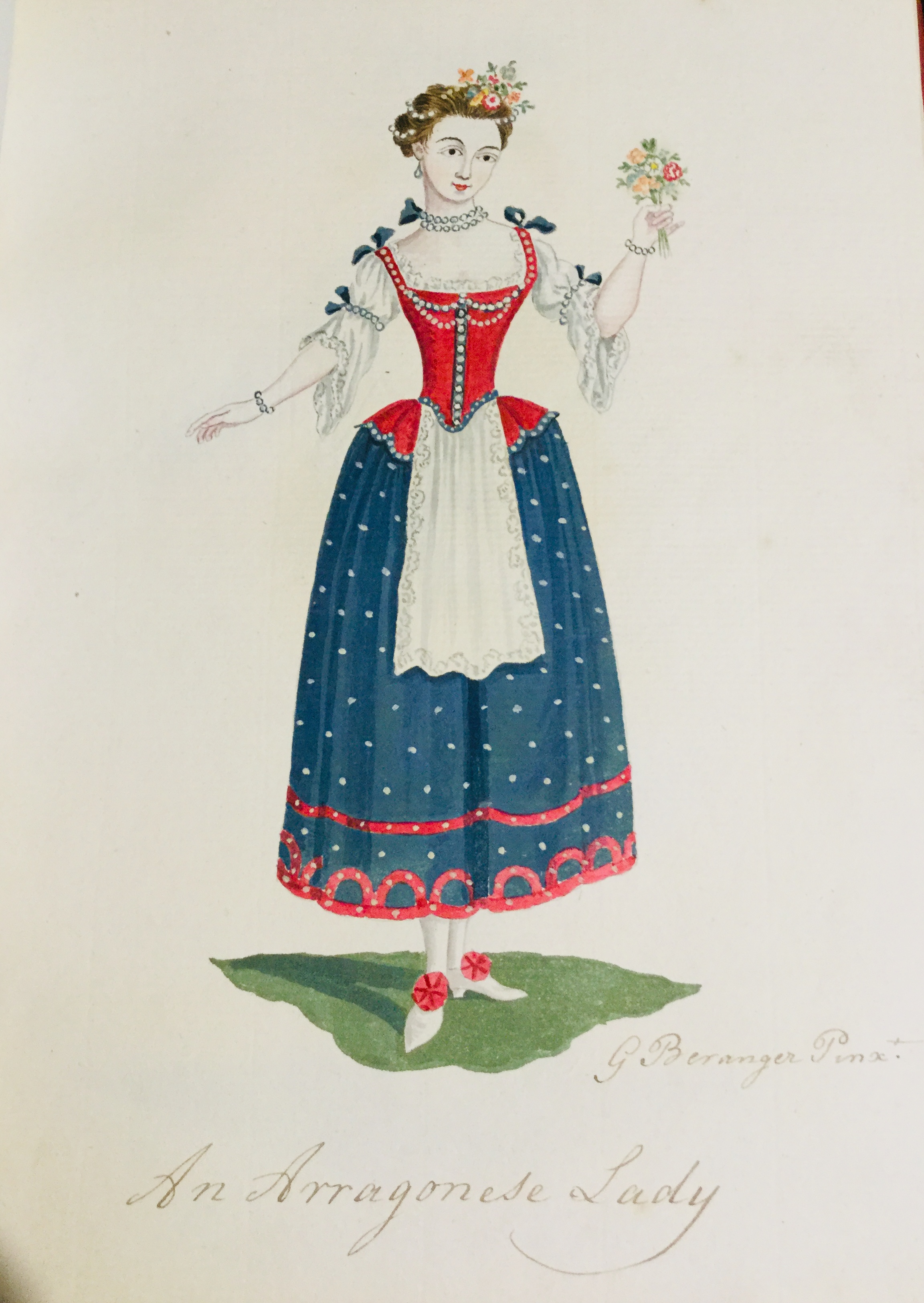
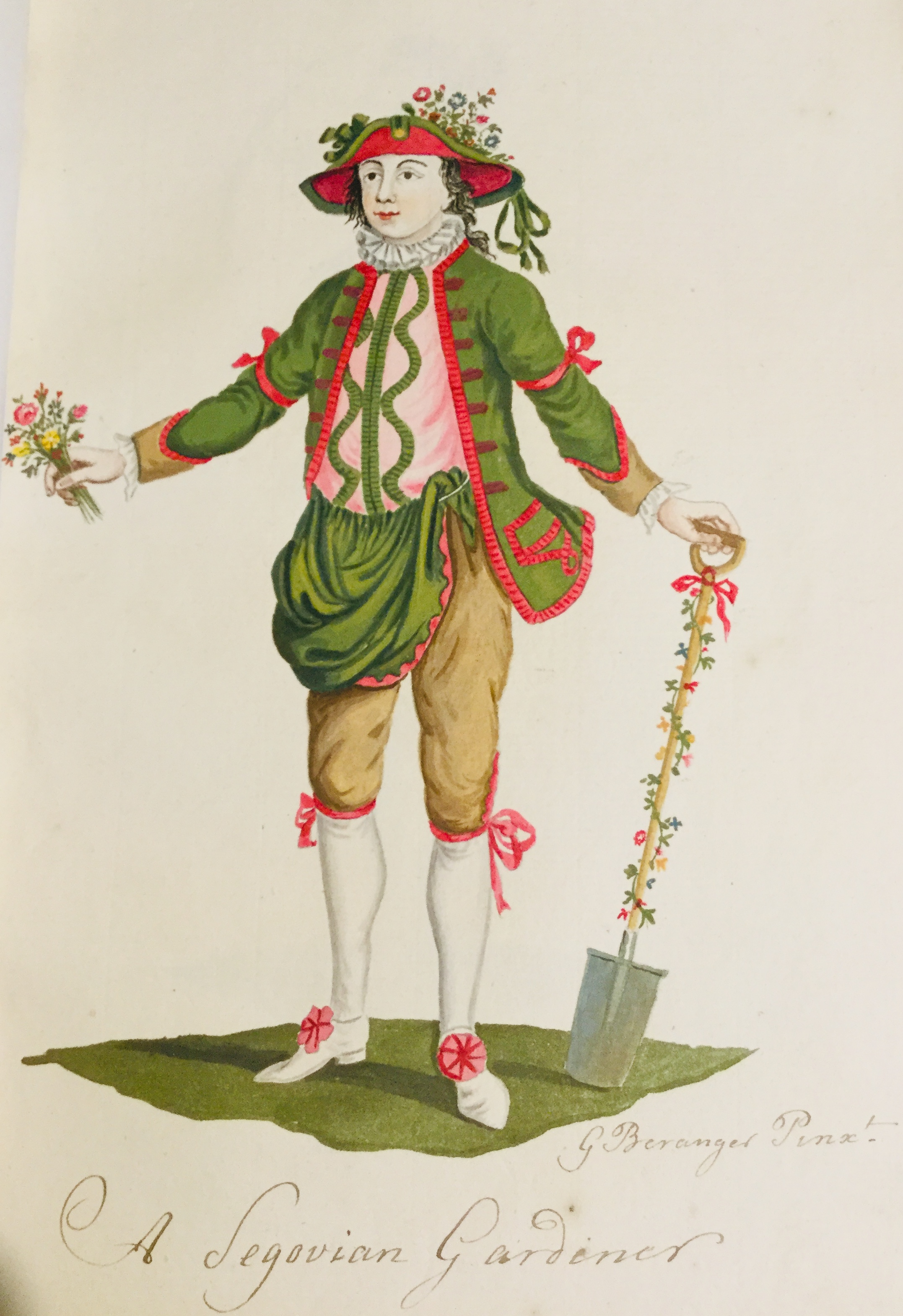
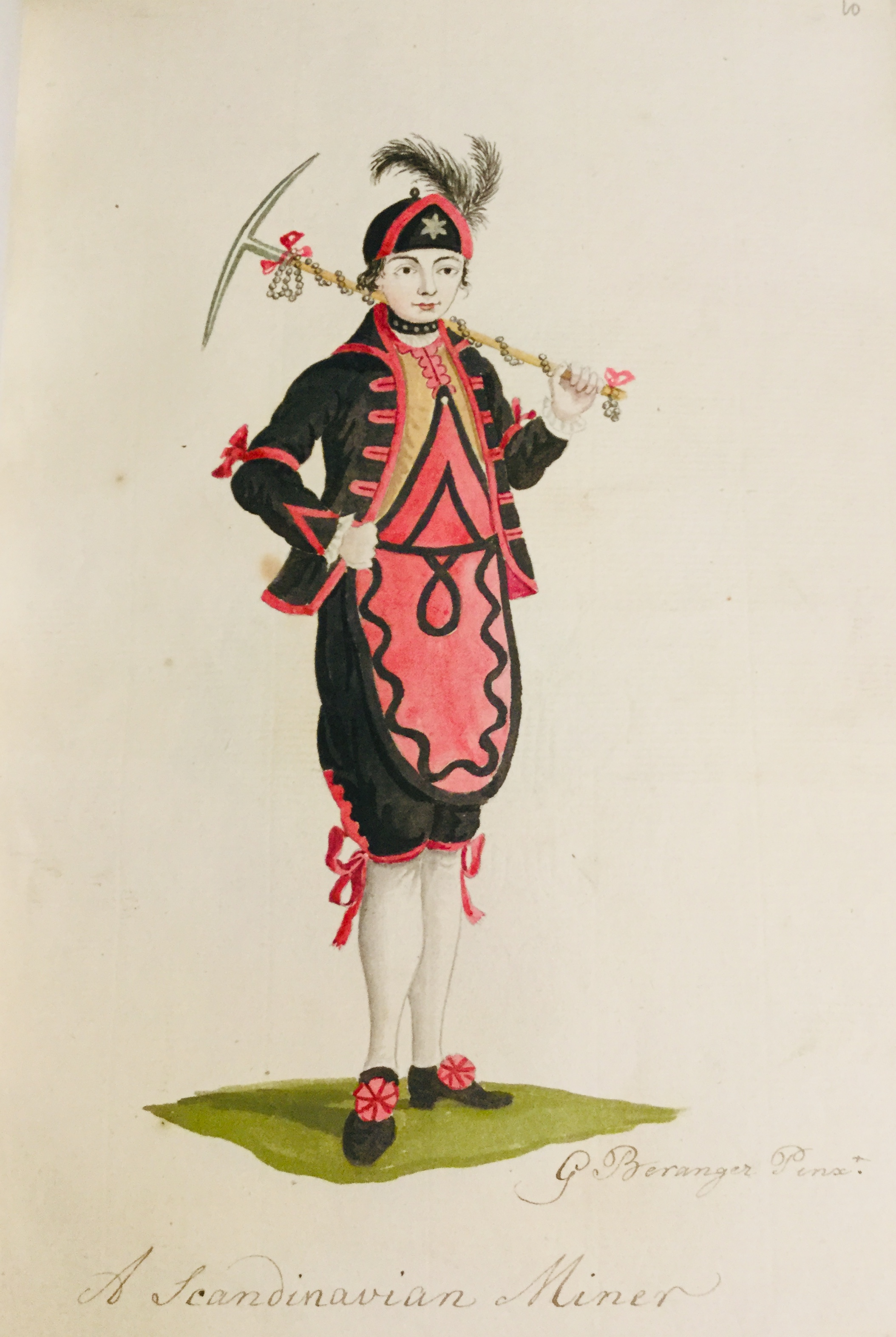
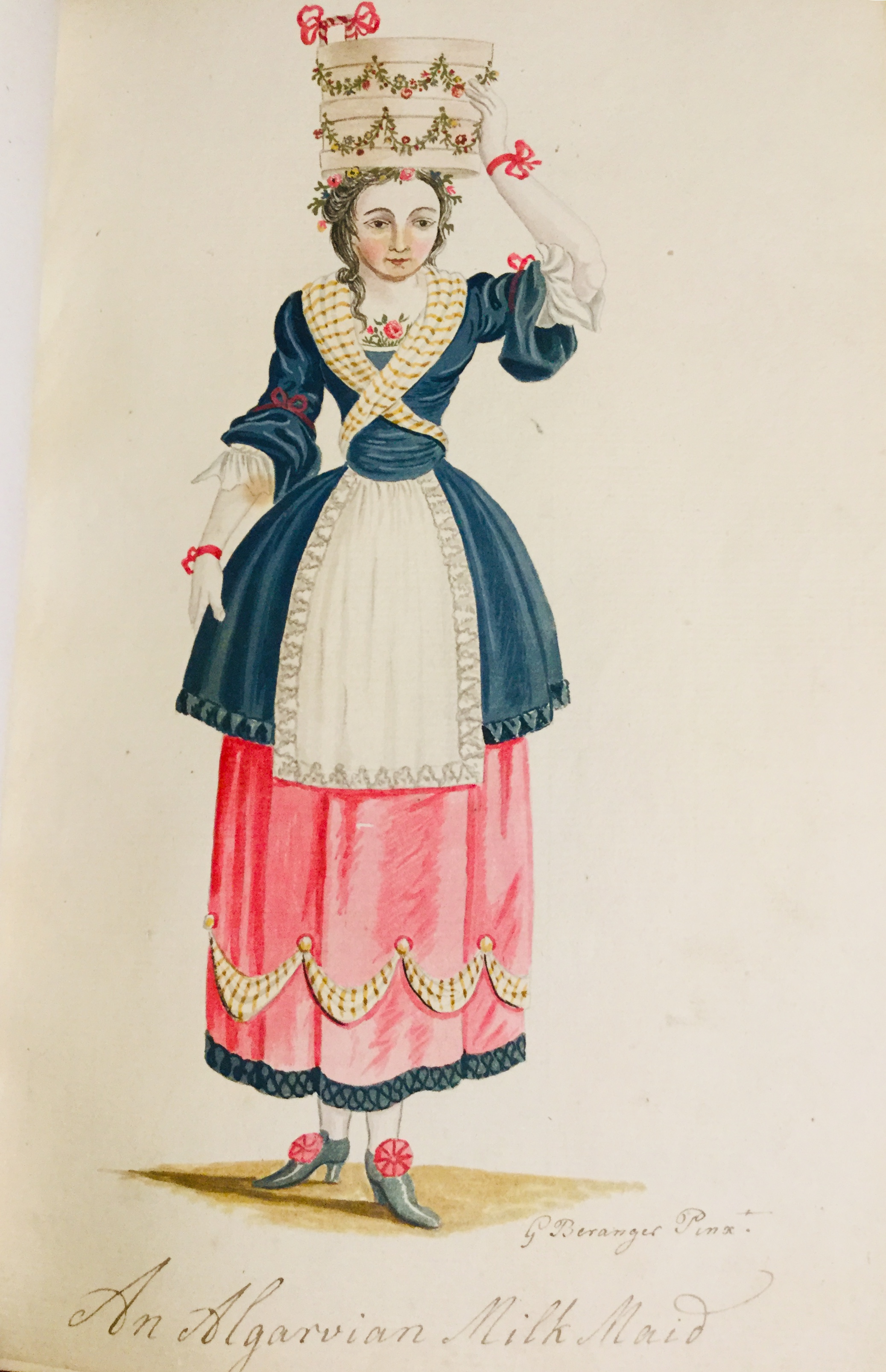
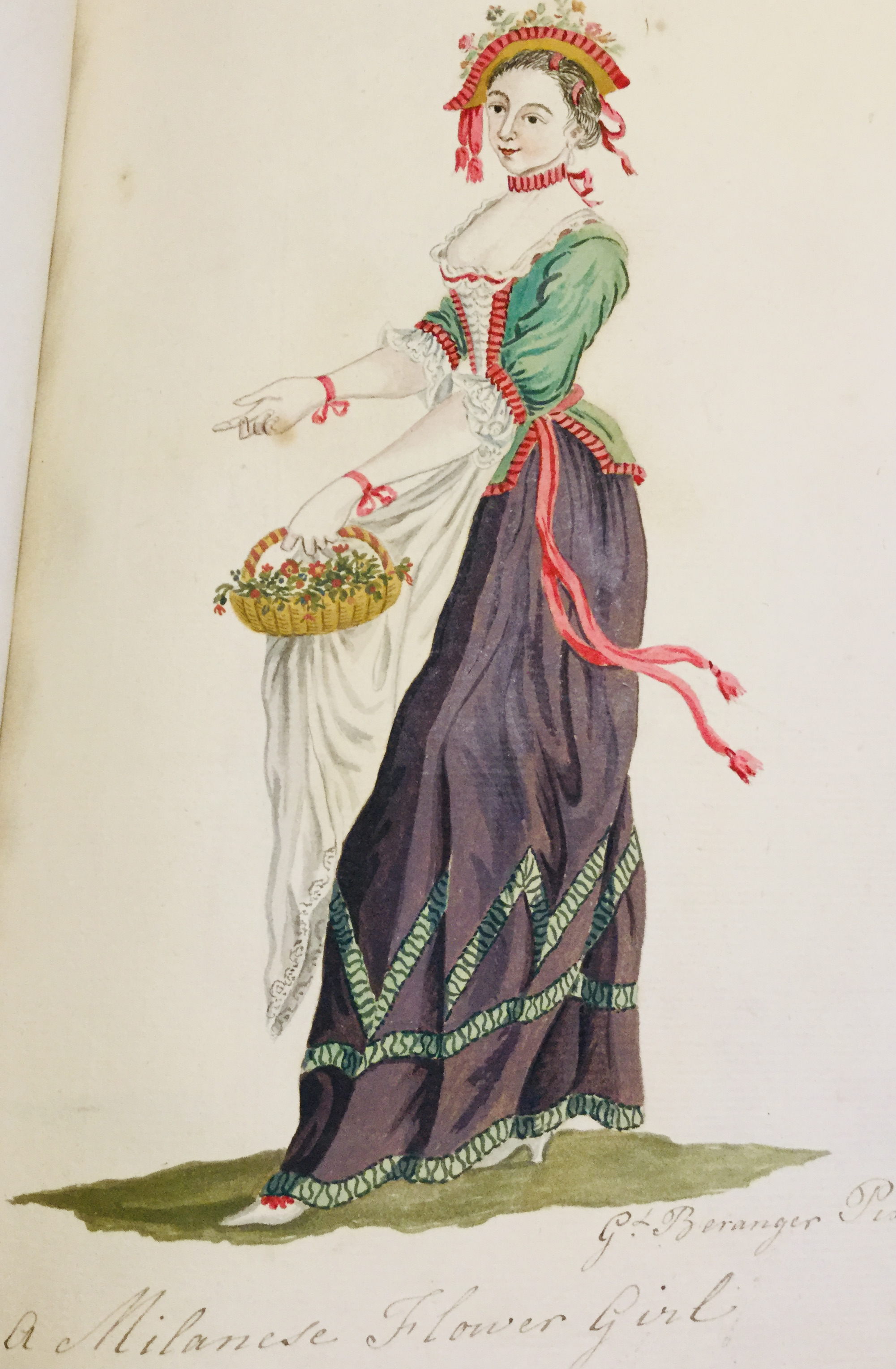
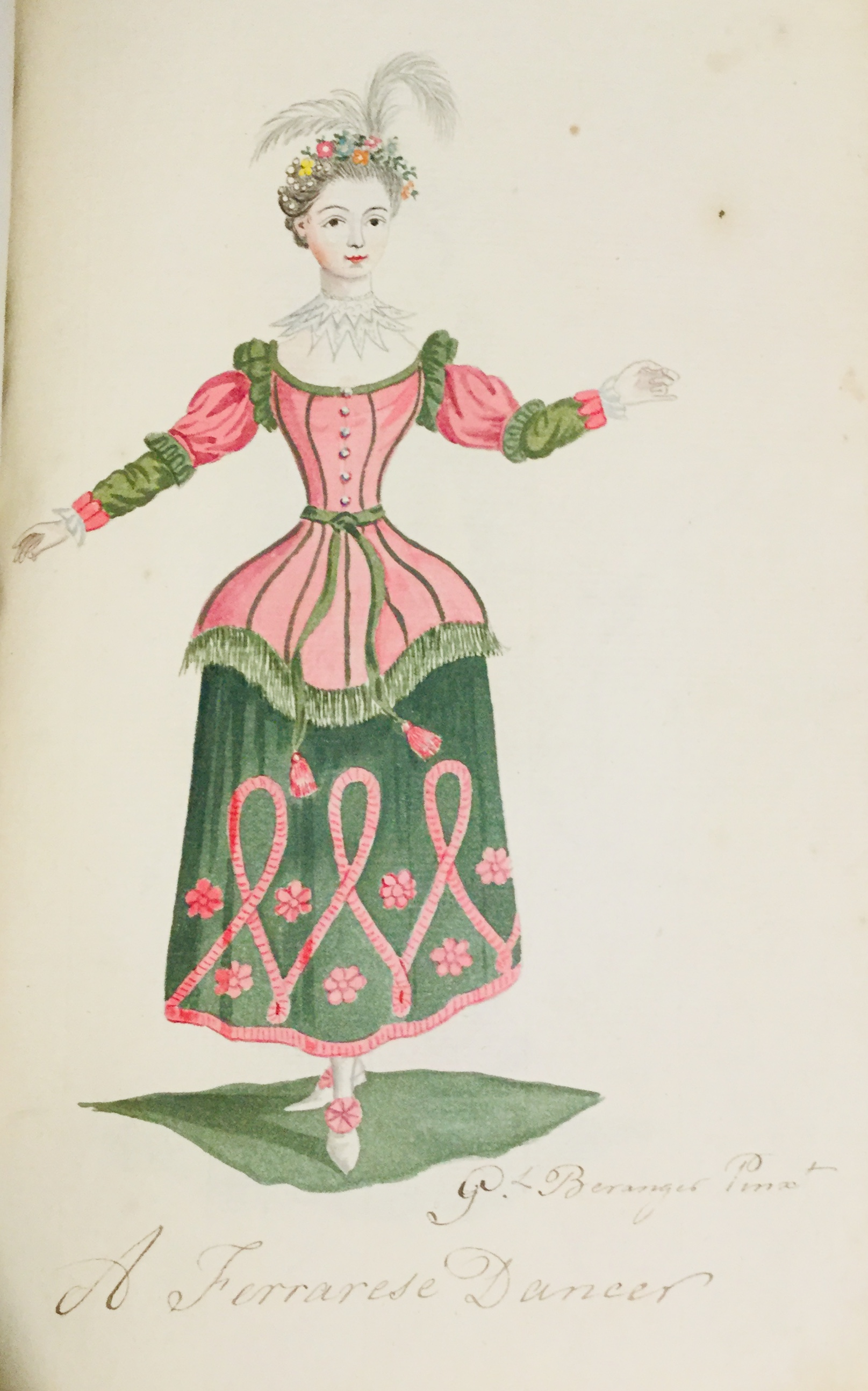
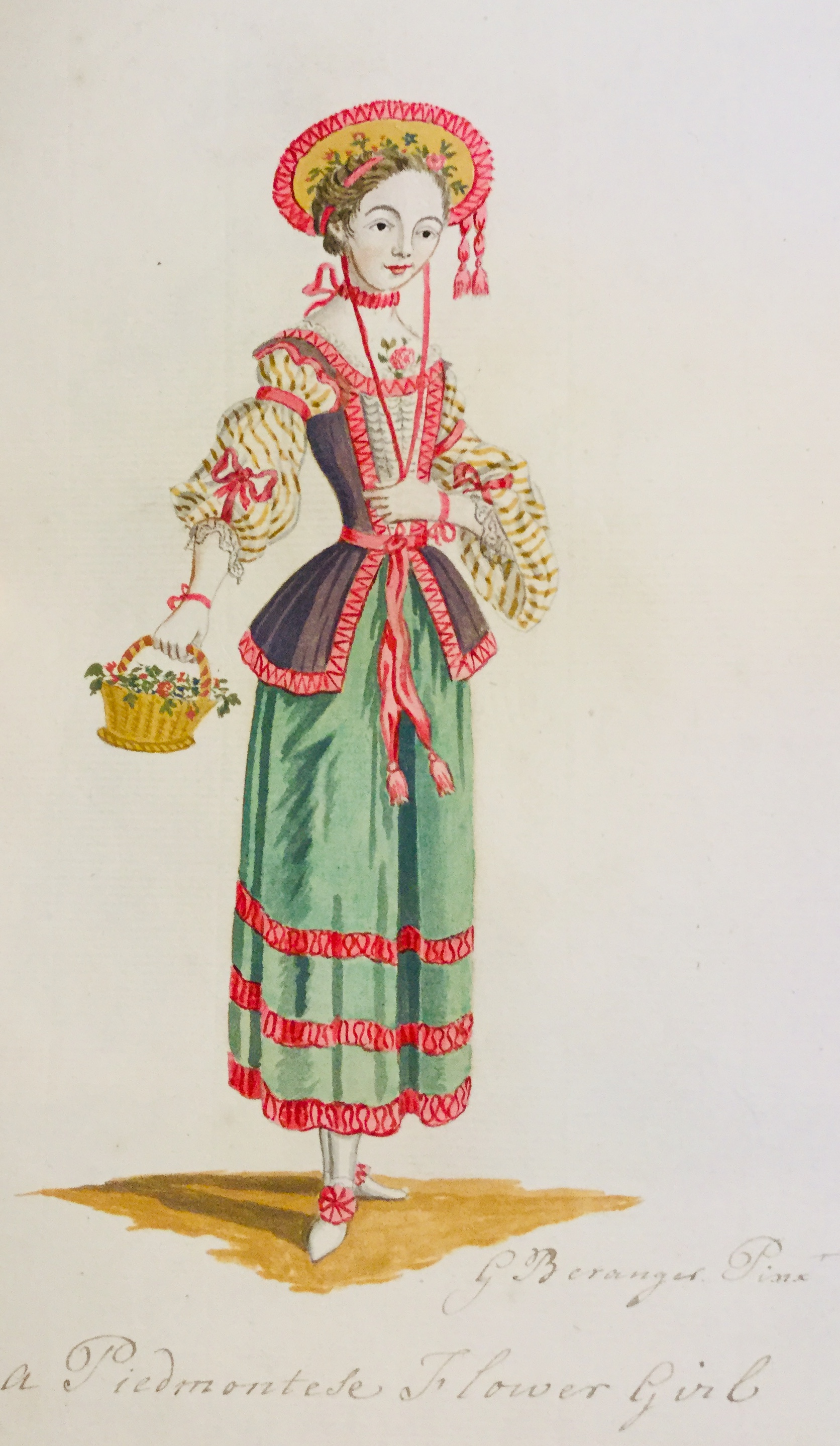
Within a slim unassuming volume drawn from amongst the books bequeathed to the College by the economist John Maynard Keynes (1883-1946) are bound a set of glorious colour drawings of figures by Gabriel Beranger (1729-1817).

Beranger was an artist and landscape draughtsman who was born in Rotterdam but moved to Ireland in 1750 and did most of his work in that country. Initially focusing on Dublin and its environs, he produced many fine drawings of buildings, scenery and antiquities. Later he widened his scope by embarking upon sketching tours around the country. Many of these drawings are preserved in the Royal Irish Academy and act as an important historical record of the times.

The drawings featured in the volume from the Keynes Collection depict beautifully dressed men and women of various different nationalities, alongside a few mythological figures, such as Diana the huntress. We share them here as a much-needed splash of colour in these dark times. Enjoy!

Keynes.P.6.17, Plate 1: An Arcadian shepherdess


Keynes.P.6.17, Plate 2: A Parisian shepherd


Keynes.P.6.17, Plate
3: A Calabrian shepherdess


Keynes.P.6.17, Plate 4: An Asturian hay maker


Keyes.P.6.17, Plate 5: An Arrogonese lady

Keynes.P.6.17, Plate 6: An English tar

Keynes.P.6.17, Plate 7: A Georgian shepherdess

Keynes.P.6.17, Plate 8: A Florentine lady

Keynes.P.6.17, Plate 9: A Segovian gardener

Keynes.P.6.17, Plate 10: A Scandinavian miner

Keynes.P.6.17, Plate 11: An Algarvian milk maid

Keynes.P.6.17, Plate 12: A Milanese flower girl

Keynes.P.6.17, Plate 13: The fairy queen

Keynes.P.6.17, Plate 14: A Spanish lady

Keynes.P.6.17, Plate 15: A Ferrarese dancer

Keynes.P.6.17, Plate 16: Diana

Keynes.P.6.17, Plate 17: An Italian dancer

Keynes.P.6.17, Plate 18: A Piedmontese flower girl

Keynes.P.6.17, Plate 19: Flora


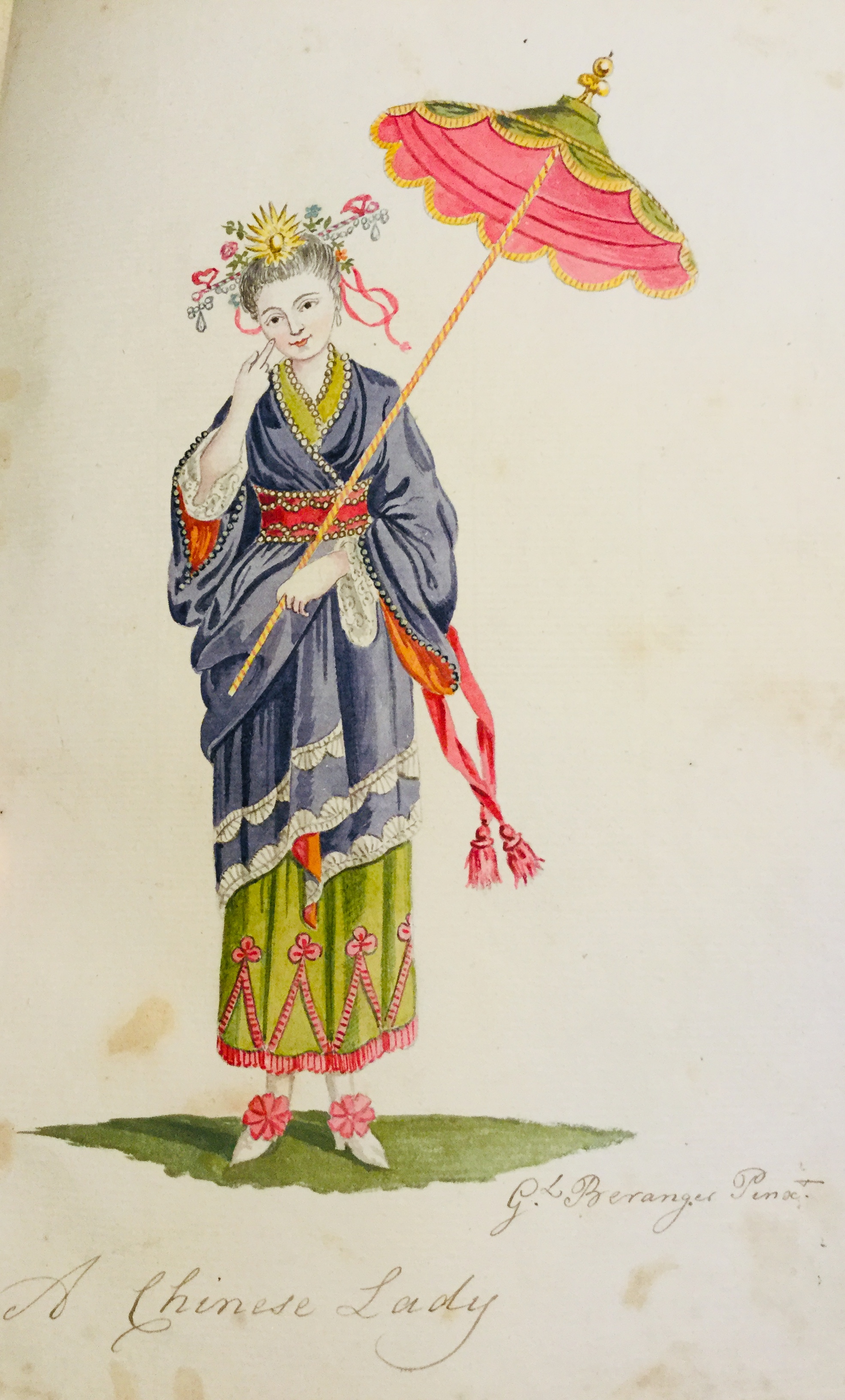
Keynes.P.6.17, Plate 20: A Chinese lady

AC

Demonology!

On this, the spookiest day of the year, we thought we’d share some images and text from books which tackle the subject of demons, devils, spirits and witches; all creatures regarded as a serious threat to body and soul in times past.

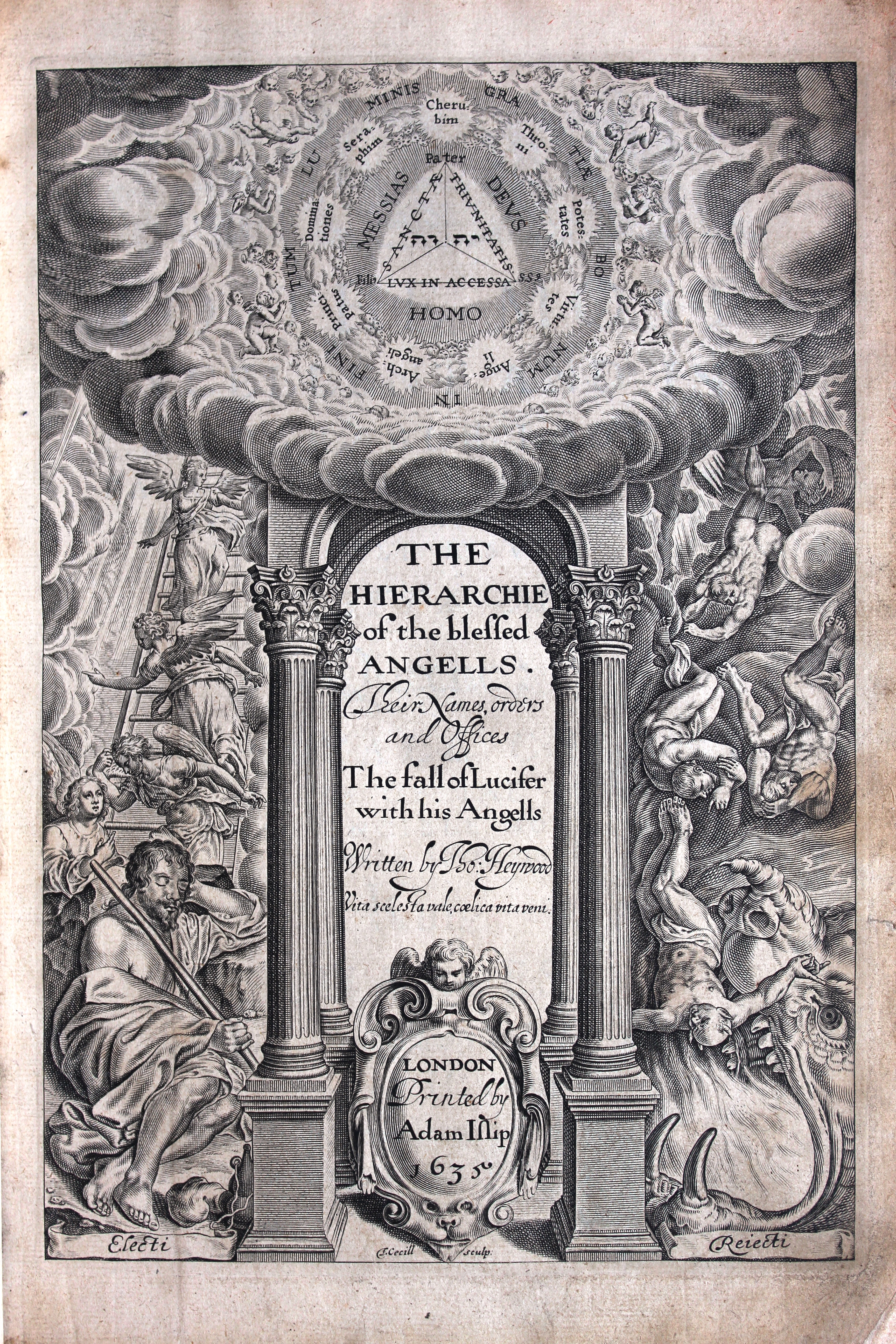
Our first tome is The hierarchie of the blessed angels, a long didactic poem by  the playwright Thomas Heywood (ca. 1570-1641) which also features Lucifer and his fallen angels, and includes many folkloric anecdotes and tales of demonic creatures engaged in spreading dread and devilment. Note the tumbling angels falling towards a demonic mouth on the right hand side of the title page below.

Keynes.C.10.01 title page

The hierarchie of the blessed angels. Their names,orders and offices. The fall of Lucifer with his angels by Thomas Heywood: London, 1635. Keynes.C.10.01

One illustration within the volume depicts the Archangel Michael standing victorious over the defeated Satan and his minions:

The Archangel Michael
Page 494 of Keynes.C.10.01

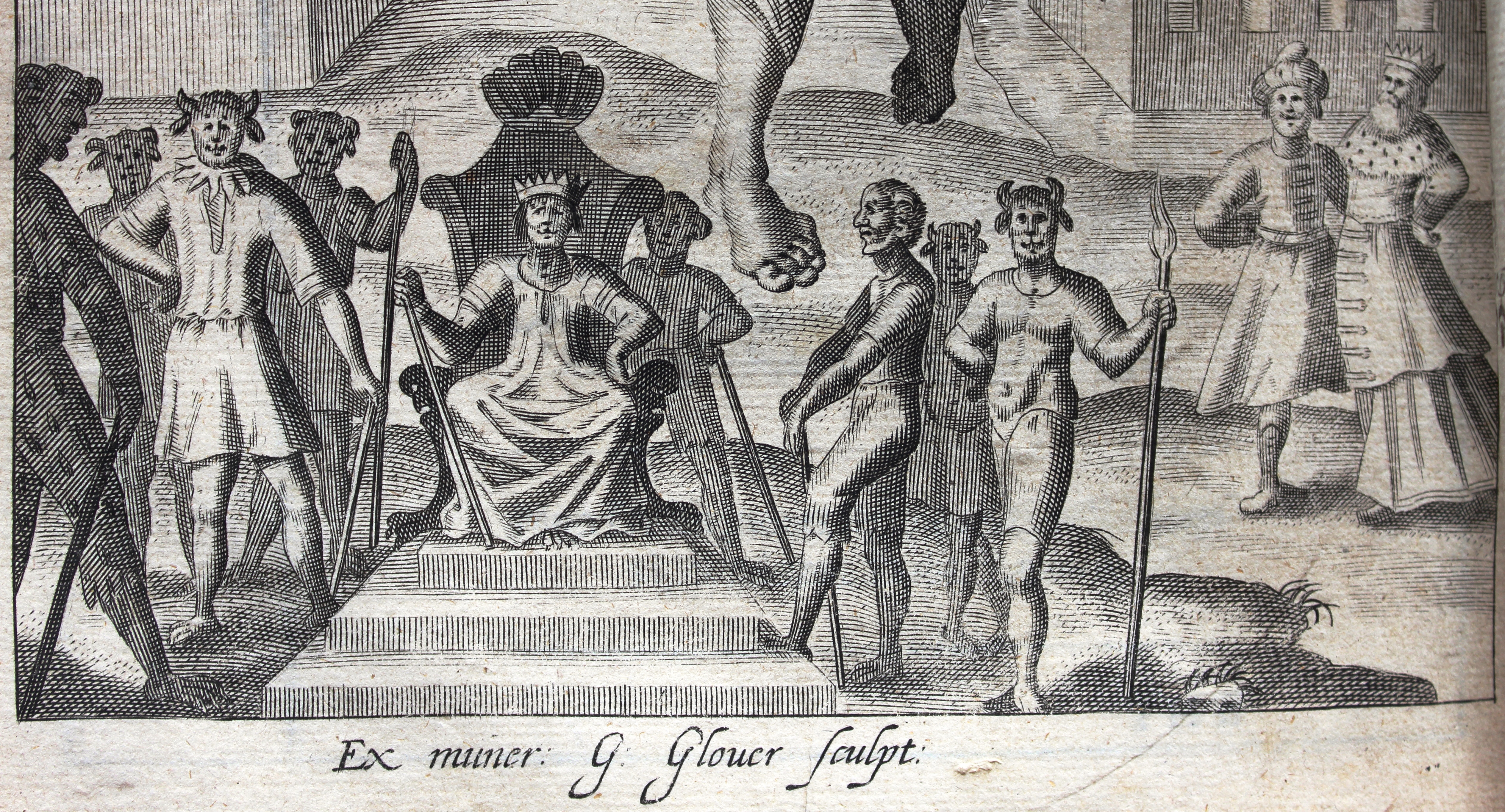
A detail from another appears to show a court of horned demons in hell:

Demons in hell. A detail from Keynes.C.10.01 page 406

Elsewhere, men of God try to ward off the forces of evil:

Detail from page 462 of Keynes.C.10.01

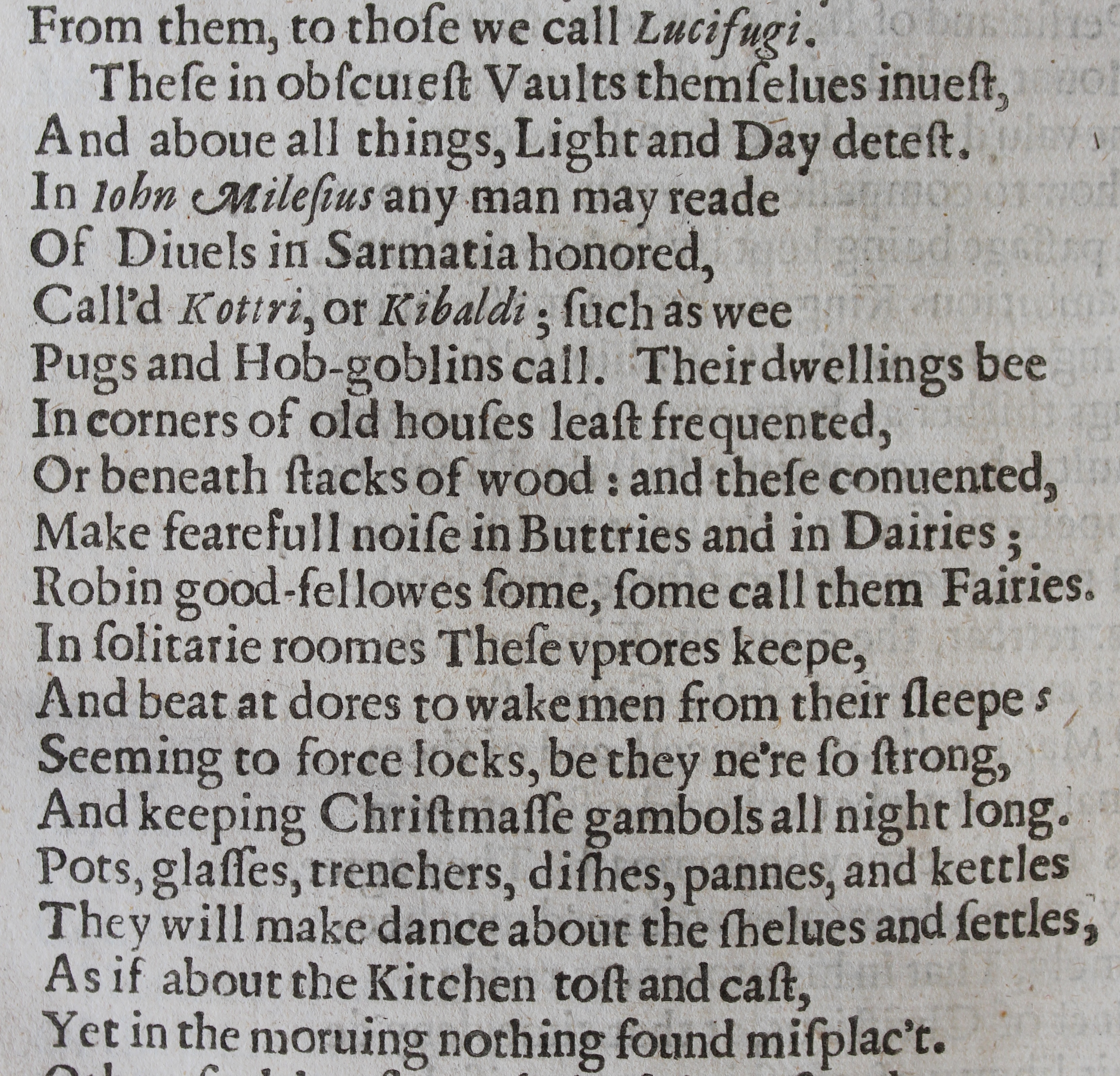
The poem has many evocative descriptions of various creatures up to the kind of  mischief and mayhem you might associate with Halloween:

Pugs and hob-goblins disturbing people’s sleep with their revels. Extract from page 574 of Keynes.C.10.01

Spooky inhabitants of church yards. Extract from page 505 of Keynes.C.10.01

Another passage vividly describes the marks by which evil creatures may be identified, including hooked noses and flaming eyes:

Extract from page 581 of Keynes.C.10.01

One of the anecdotes later in the text tells of a German illusionist who performed an aerial display with a woman and child in tow, only to end his life being burned at the stake as a witch:

Extract from page 613 of Keynes.C.10.01

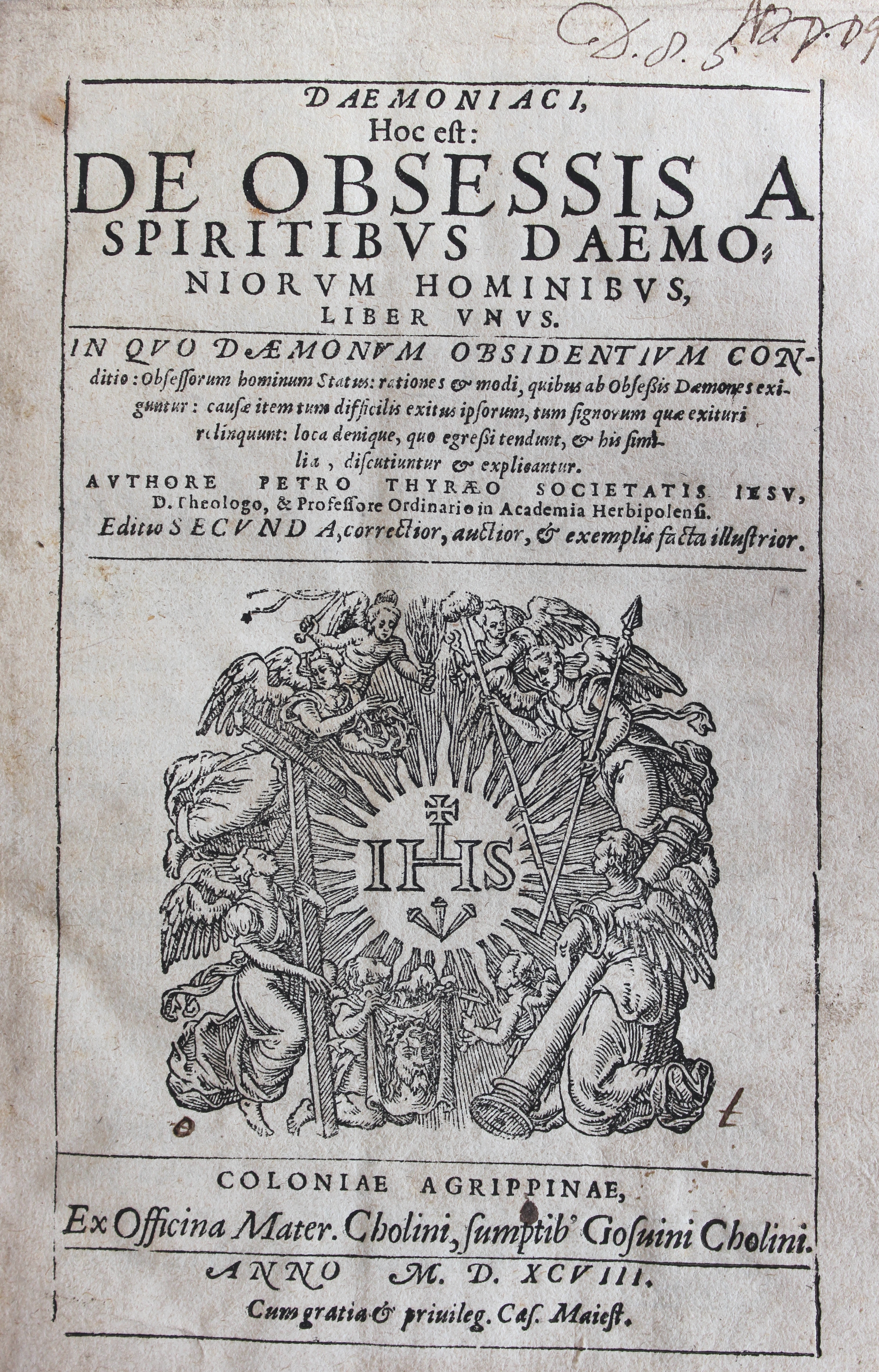
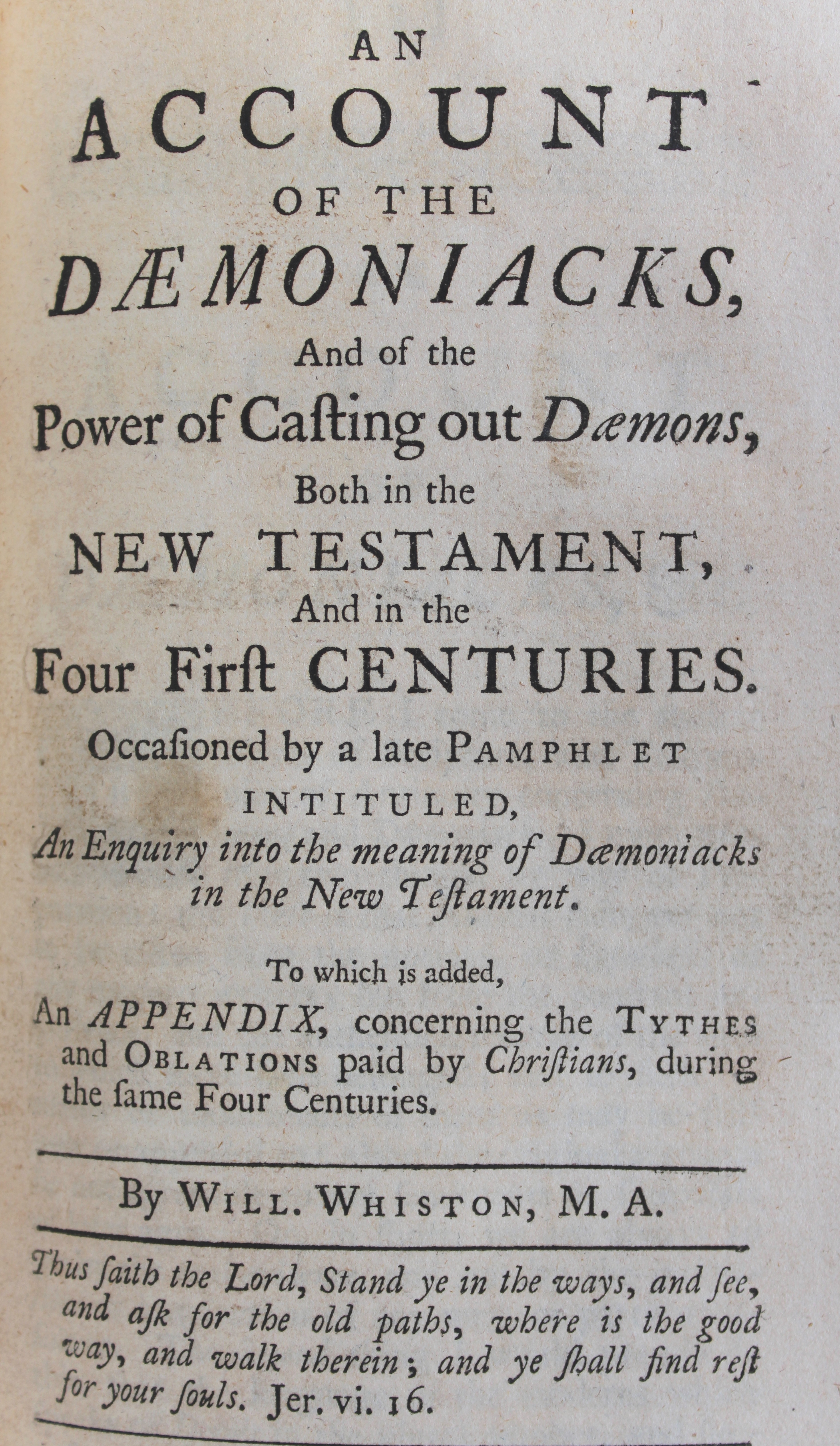
Other works on demonology held in the Library include a late 16th-century Latin tome by a German theologian, Peter Thyraeus (1546-1601) and an 18th-century pamphlet by theologian William Whiston (1667-1752):

Title page of Daemoniaci, hoc est: De obsessis a spiritibvs daemoniorvm hominibvs by Peter Thyraeus, Cologne, 1598. D.8.5/1

Title page of An account of the daemoniacks, and of the power of casting out demons … by William Whiston: London, 1737. Keynes.F.10.14/8

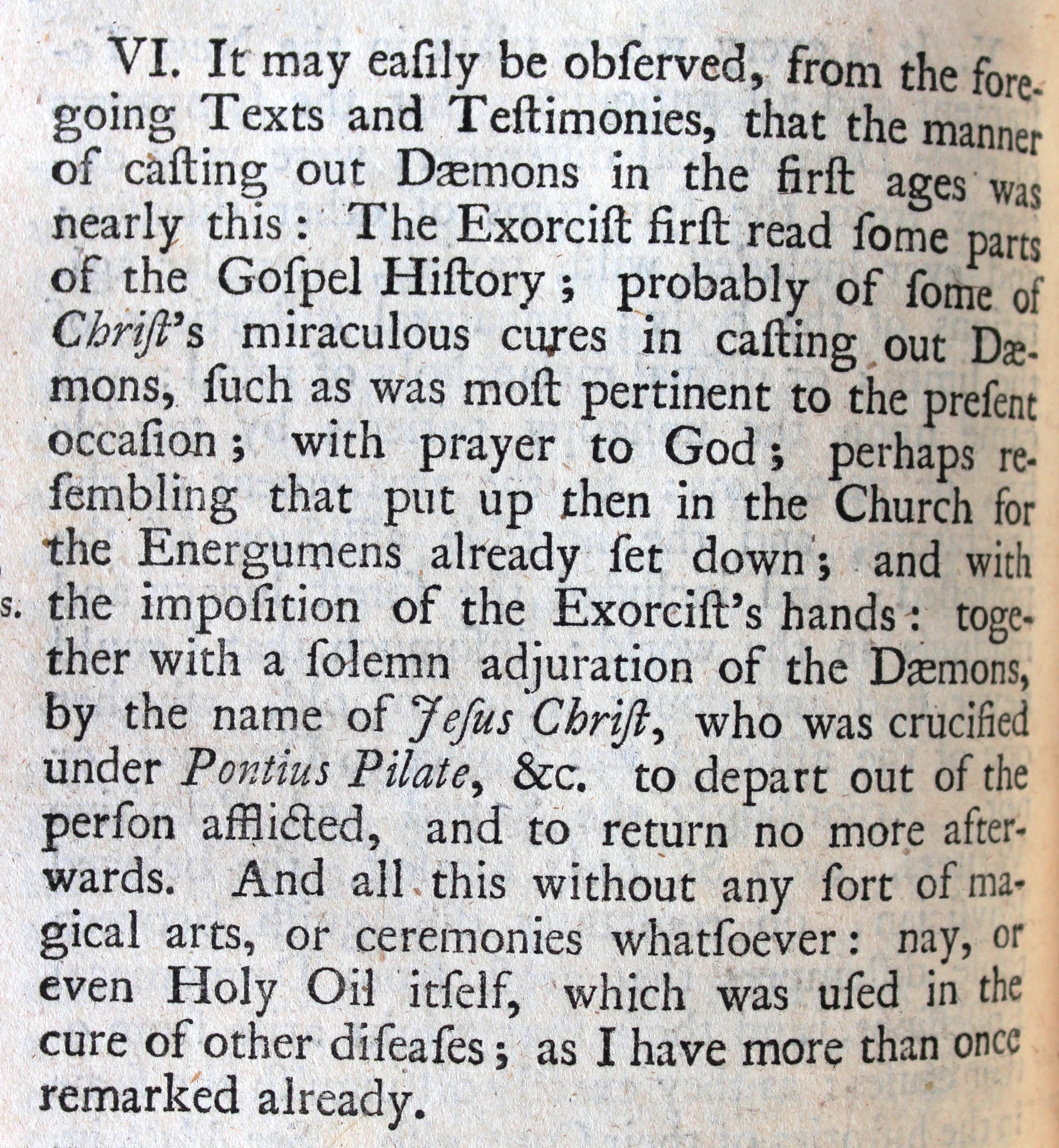
The latter work describes the manner in which demons were cast out in the early years of Christianity:

Extract from page 56 of Keynes.F.10.14/8

Whatever you are doing this Halloween, stay safe out there, and watch out for things that go bump in the night!

AC

Thomas More’s Utopia: An Online Exhibition

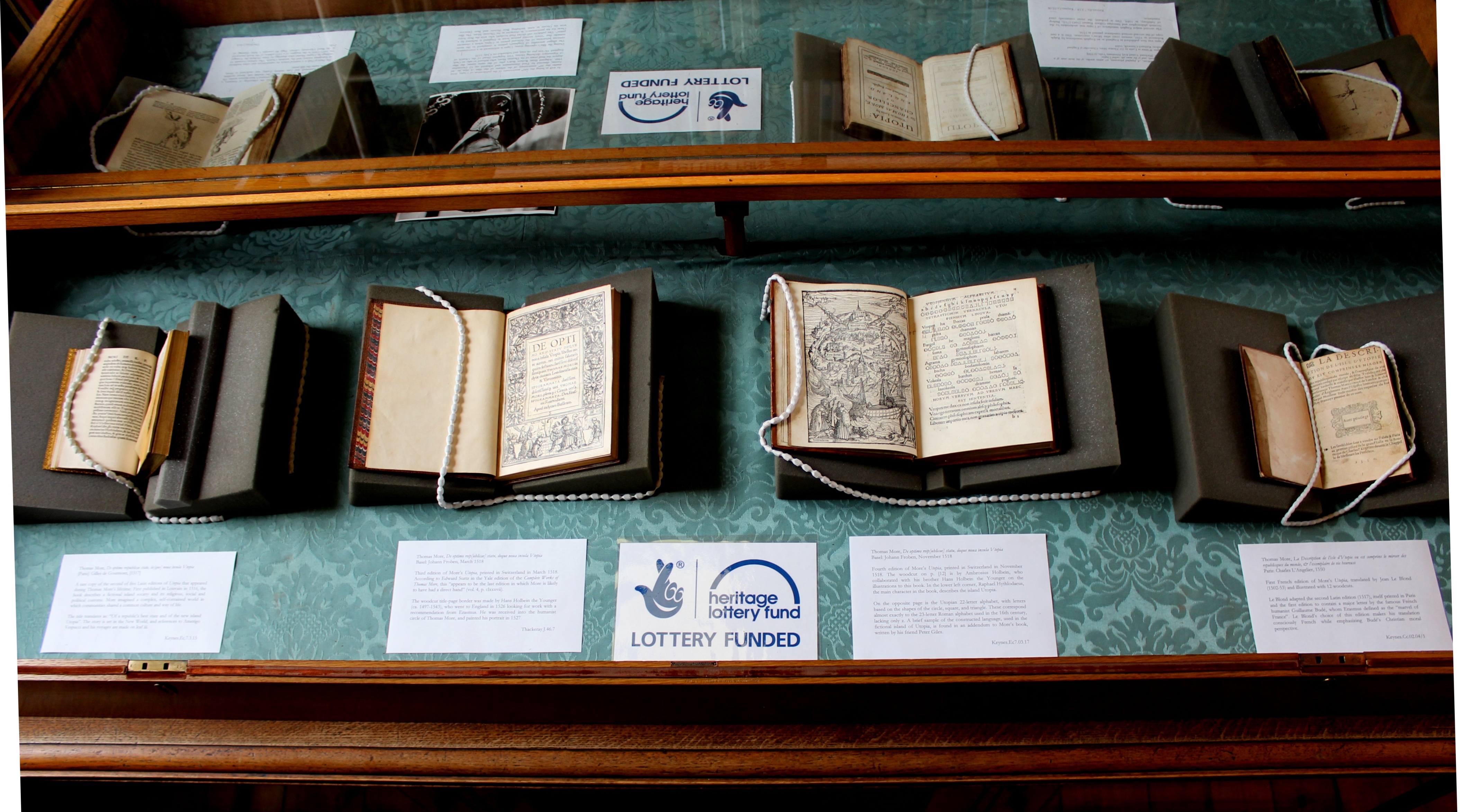
To mark the 500th anniversary of the publication of Sir Thomas More’s Utopia (1516), King’s College Library mounted an exhibition showcasing rare early editions and translations of More’s seminal text. For those who did not have the opportunity to visit the exhibition, we provide here some selected highlights.

The exhibition ran from November 2016 to January 2017

The exhibition ran in King’s College Library from November 2016 to January 2017

Below is a rare copy of the second of five Latin editions of Utopia that appeared during Thomas More’s lifetime. First published in Louvain in 1516, the book describes a fictional island society and its religious and social practices. More envisaged an independent community that shared a common culture and values.

The title translates as: “Of a republic’s best state and of the new island Utopia”. The story is set in the New World, and references to Amerigo Vespucci and his voyages are made on leaf iii.

Thomas More, De optimo reipublicae statu, de[que] noua insula Vtopia [Paris]: Gilles de Gourmont, [1517] (Keynes.Ec.7.3.15)

Thomas More, De optimo reipublicae statu, de[que] noua insula Vtopia
[Paris]: Gilles de Gourmont, [1517] (Keynes.Ec.7.3.15)

The third edition of More’s Utopia was printed in Switzerland in March 1518. The woodcut title-page border was made by Hans Holbein the Younger (ca. 1497-1543), who went to England in 1526 looking for work with a recommendation from Erasmus. He was received into the humanist circle of Thomas More, and painted his portrait in 1527.

Thomas More, De optimo reip[ublicae] statu, deque noua insula Vtopia Basel: Johann Froben, March 1518 (Thackeray.J.46.7)

Thomas More, De optimo reip[ublicae] statu, deque noua insula Vtopia
Basel: Johann Froben, March 1518 (Thackeray.J.46.7)

The fourth edition of More’s Utopia was printed in Switzerland in November 1518. The woodcut on p. [12] is by Ambrosius Holbein, who collaborated with his brother Hans Holbein the Younger on the illustrations to this book. In the lower left corner, Raphael Hythlodaeus, the main character in the book, describes the island Utopia.

On the opposite page is the Utopian 22-letter alphabet, featuring letters in the shape of a circle, square, and triangle. These correspond almost precisely to the 23-letter Latin alphabet.

Thomas More, De optimo reip[ublicae] statu, deque noua insula Vtopia Basel: Johann Froben, November 1518 (Keynes.Ec7.03.17)

Thomas More, De optimo reip[ublicae] statu, deque noua insula Vtopia
Basel: Johann Froben, November 1518 (Keynes.Ec7.03.17)

The first French edition of More’s Utopia, translated by Jean Le Blond (1502-53), was illustrated with 12 woodcuts. Le Blond adapted the second Latin edition (1517), itself printed in Paris and the first edition to contain a letter by the French humanist Guillaume Budé, whom Erasmus defined as the “marvel of France”.

Thomas More, La Description de l’isle d’Vtopie ou est comprins le miroer des republicques du monde, & l’exemplaire de vie heureuse Paris: Charles L’Angelier, 1550 (Keynes.Cc.02.04/1)

Thomas More, La Description de l’isle d’Vtopie ou est comprins le miroer des republicques du monde, & l’exemplaire de vie heureuse
Paris: Charles L’Angelier, 1550 (Keynes.Cc.02.04/1)

Utopia was first published in England as an English translation by Ralph Robinson in 1551, sixteen years after More’s execution. This is a rare copy of the second revised translation printed in 1556.

Thomas More, A frutefull pleasaunt, & wittie worke, of the beste state of a publique weale, and of the newe yle, called Utopia London: [Richard Tottel for] Abraham Vele, [1556] (Keynes.Ec.7.3.18)
Thomas More, A frutefull pleasaunt, & wittie worke, of the beste state of a publique weale, and of the newe yle, called Utopia
London: [Richard Tottel for] Abraham Vele, [1556] (Keynes.Ec.7.3.18)

The second major English translation of Utopia was undertaken by the Scottish philosopher and historian Gilbert Burnet (1643-1715), Bishop of Salisbury, in 1684. This is probably the most commonly quoted translation. 

Utopia: Written in Latin by Sir Thomas More, Chancellor of England London: Richard Chiswell, 1684 (Keynes.Cc.02.08)

Utopia: Written in Latin by Sir Thomas More, Chancellor of England
London: Richard Chiswell, 1684 (Keynes.Cc.02.08)

Utopia was first printed in 1516 under the editorship of Erasmus, a good friend of Thomas More. One of Erasmus’s best-known works, The Praise of Folly (1511), published under the double title Moriae encomium (Greek, Latinised) and Laus stultitiae (Latin), was dedicated to More, on whose name the title puns.

Desiderius Erasmus, Mōrias enkōmion = Stultitiae laus Basel: Johann Rudolph Genath, 1676 (Thackeray.J.46.6)

Desiderius Erasmus, Mōrias enkōmion = Stultitiae laus
Basel: Johann Rudolph Genath, 1676 (Thackeray.J.46.6)

This edition contains 83 etchings by Caspar Merian after drawings by Hans Holbein the Younger in the margins of a 1515 edition of the book preserved in the Basel University Library. Page 99 features a witty drawing of Folly.

english_landscape_pantone

IJ


Another Portrait of Mr. W. H.

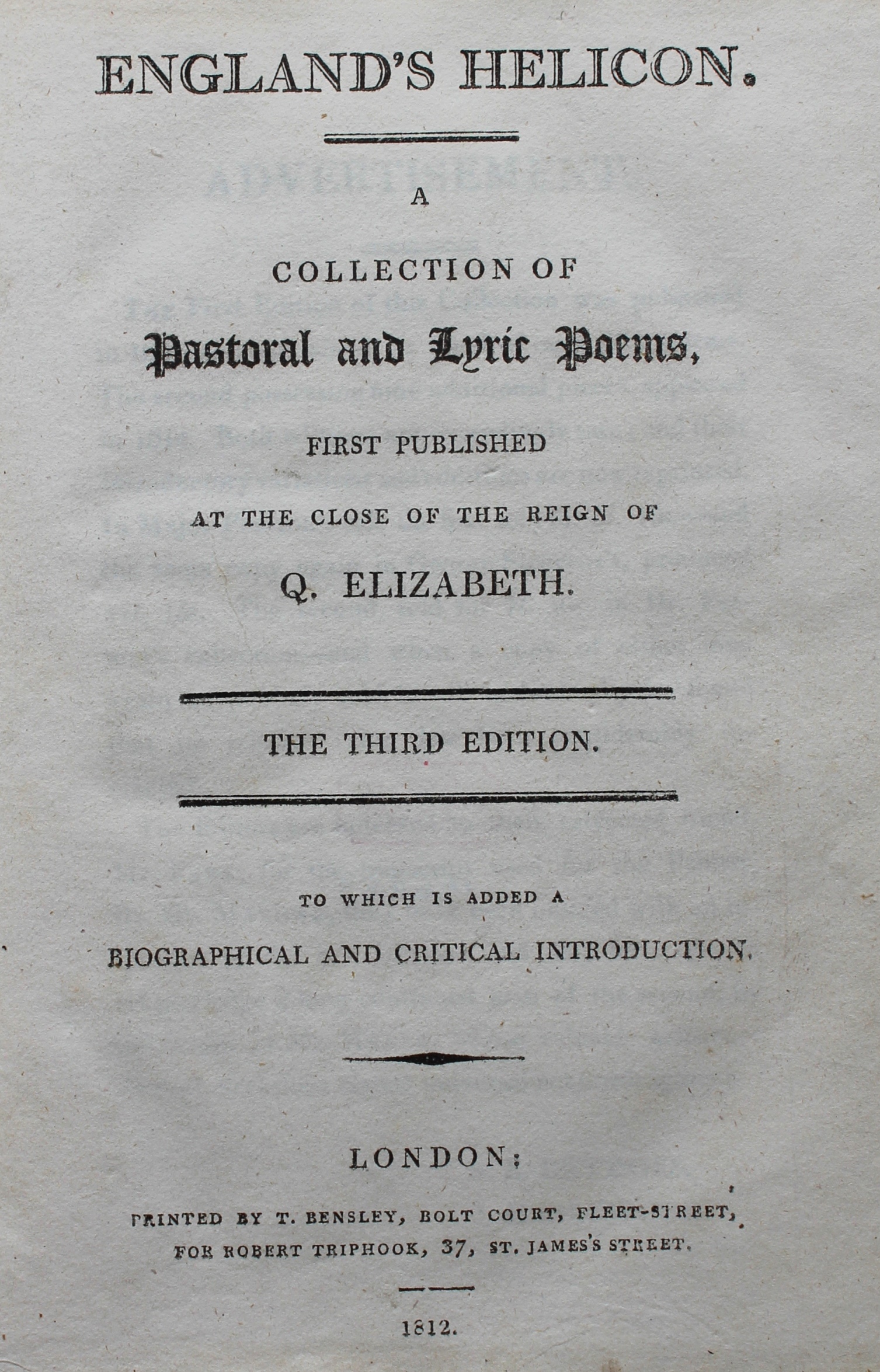
As we’re marking the 400th anniversary of Shakespeare’s death, this book from the Keynes Bequest could not be more topical. England’s Helicon, an anthology of Elizabethan poems first printed in 1600, includes contributions by Christopher Marlowe, Sir Walter Raleigh, William Shakespeare, Sir Philip Sidney and Edmund Spenser.

Title page of England’s Helicon: A Collection of Pastoral and Lyric Poems, First Published at the Close of the Reign of Q. Elizabeth, edited by S. E. Brydges and Joseph Haslewood (London: Thomas Bensley, 1812; Keynes.E.3.8)

Title page of England’s Helicon: A Collection of Pastoral and Lyric Poems, edited by S. E. Brydges and Joseph Haslewood (London: Thomas Bensley, 1812; Keynes.E.3.8)

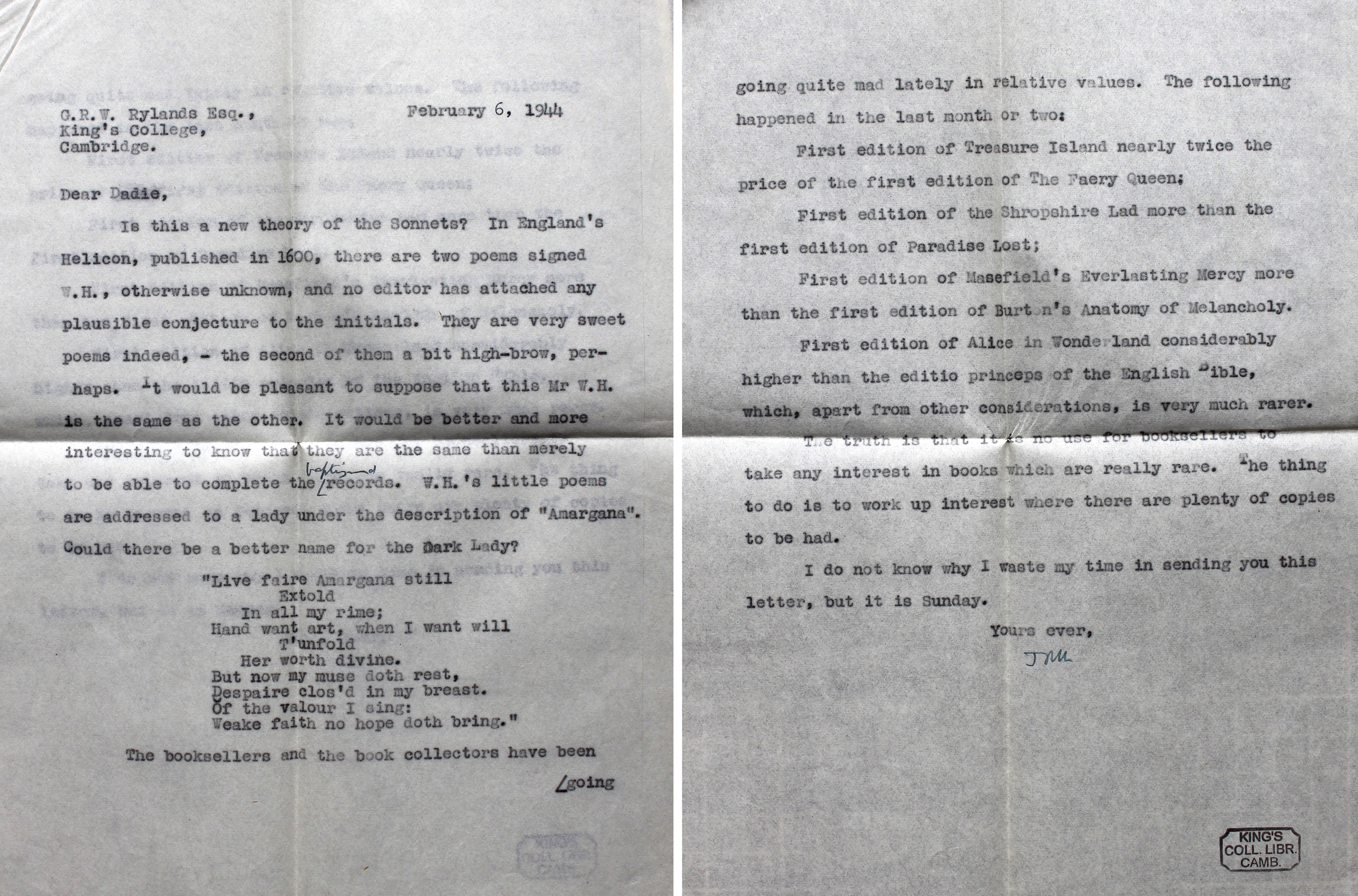
In an 1812 reprint of the third edition (1614) is the carbon copy of a letter from John Maynard Keynes to Dadie Rylands dated 6 February 1944 and initialled in ink by Keynes. Rylands was a Fellow at King’s and a noted Shakespeare scholar who also directed several plays for the Marlowe Society and acted as chairman of the Cambridge Arts Theatre between 1946 and 1982.

Dadie Rylands (1902-1999) punting on the Cam, mid-1930s

Dadie Rylands (1902-1999) punting along the Cam, mid-1930s

Keynes writes: “Is this a new theory of the Sonnets? In England’s Helicon, published in 1600, there are two poems signed W. H., otherwise unknown, and no editor has attached any plausible conjecture to the initials. […] It would be pleasant to suppose that this Mr. W. H. is the same as the other”.

Carbon copy of Keynes’s letter to Dadie Rylands, 6 February 1944

Carbon copy of Keynes’s letter to Dadie Rylands, 6 February 1944

The first 126 of Shakespeare’s Sonnets (1609) are addressed to a “fair youth”, and the whole work is dedicated to a certain “Mr. W. H.”. The identity of the dedicatee remains a mystery, and possible contenders include Shakespeare’s patrons, Henry Wriothesley, 3rd Earl of Southampton (1573-1624), and William Herbert, 3rd Earl of Pembroke (1580-1630).

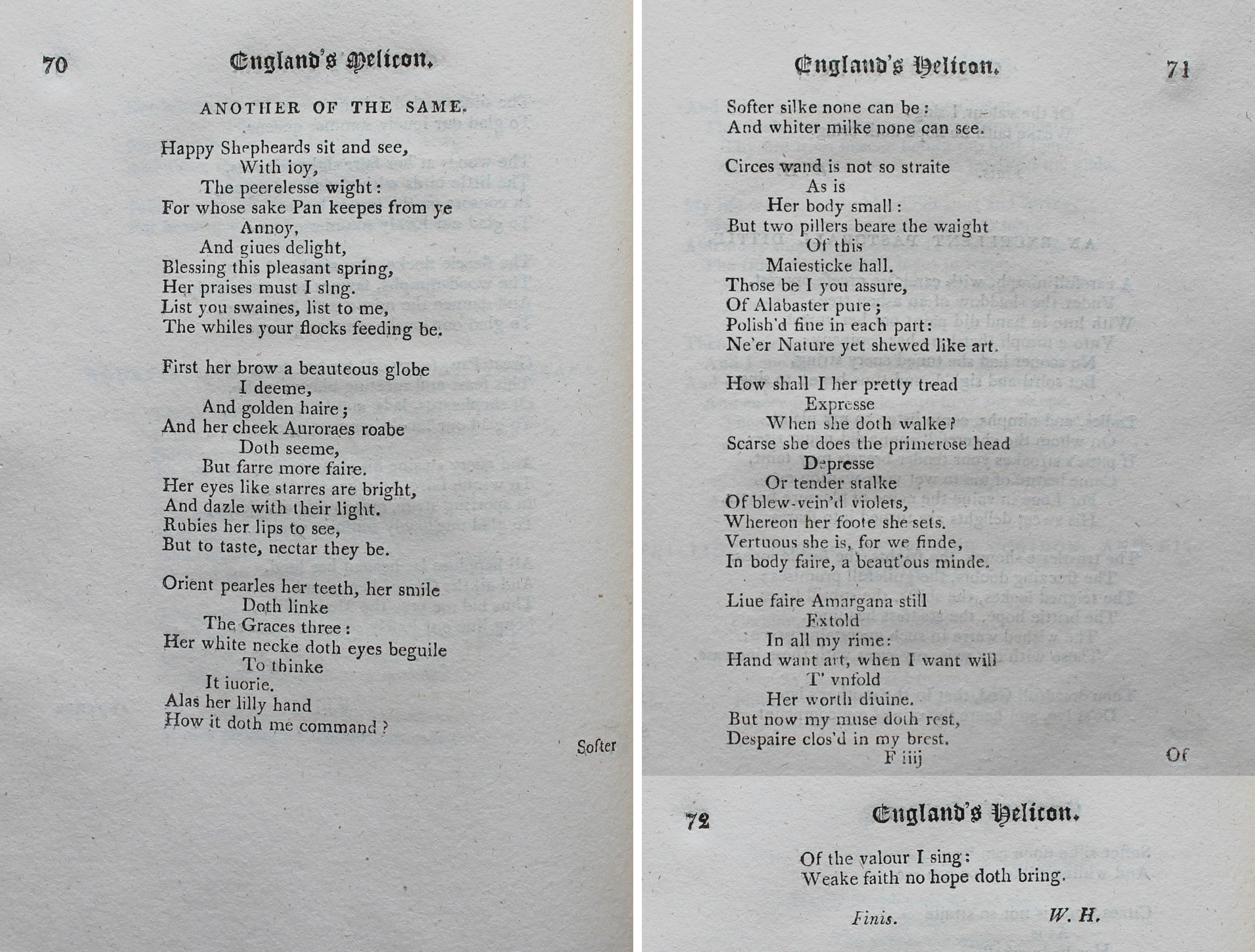
W. H., “Wodenfride’s Song in Praise of Amargana”, England’s Helicon, pp. 68-69

W. H., “Wodenfride’s Song in Praise of Amargana”, England’s Helicon, pp. 68-69

Keynes seems to have failed to check the “Index of the Names of Authors” at the beginning of the book, where W. H. is tentatively identified as “Wm. Hunnis?” The editors, S. E. Brydges and Joseph Haslewood, state in the biographical notice of W. H.: “I recollect no writer to whom these initials may apply, unless William Hunnis, who seems to have lived too early to have been a contributor to this volume. […] Qu.? William Herbert?” The poet William Hunnis, who died in 1597 and could have therefore known Shakespeare, was in the service of William Herbert, 1st Earl of Pembroke (1501-1570) and grandfather of Shakespeare’s patron, the 3rd Earl of Pembroke. So there is a connection with Shakespeare there, albeit a tenuous one.

The second poem by W. H. in England’s Helicon, pp. 70-72

The second poem by W. H. in England’s Helicon, pp. 70-72

As shown in a previous post on James Howell’s Epistolae Ho-Elianae (1645), Keynes’s book collecting was not merely a matter of accumulating items, as he actively engaged with the issues raised in these works and shared his ideas, thoughts and opinions with friends. But going back to his original question. Could the W. H. in England’s Helicon really be the mysterious dedicatee of Shakespeare’s Sonnets? Over to Shakespeare scholars.

IJ

Monday mourning

The untimely death of Henry Frederick, Prince of Wales was met with universal sorrow across the land in 1612. The national outpouring of grief is probably comparable to that witnessed in the aftermath of Princess Diana’s death in 1997. Prince Henry (1594-1612), the eldest son of James I and brother of the future King Charles I, was praised in life by authors including George Chapman, Sir John Davies, Michael Drayton, and Francis Bacon. There was a proliferation of mourning pamphlets and funeral sermons following the popular Prince’s death at the age of 18 from typhoid fever, and he was mourned by such luminaries as Thomas Campion, George Herbert, and Sir Walter Raleigh. Prince Henry was the patron of the poet Josuah Sylvester (1563-1618), who expressed his sorrow in Lachrimae lachrimarum (1612), one of the earliest examples of a book containing black mourning pages:

Keynes.C.12.8

The tears of tears: title page of the first edition of Lachrimae lachrimarum; or, The distillation of teares shede for the untymely death of the incomparable Prince Panaretus (London: Humfrey Lownes, 1612; Keynes.C.12.8).

The sense of grief is compounded by a black page with a woodcut of the royal arms on every verso, and mourning borders with skeleton frames on each recto:

Keynes.C.12.8 (2)

Lachrimae lachrimarum, leaf A2 recto and facing mourning page (Keynes.C.12.8).

The first edition includes elegies in English, French, Latin and Italian by the royal tutor, Walter Quin (1575?-1640):

Keynes.C.12.8 (3)

Lachrimae lachrimarum, leaf D3 recto with an Italian sonnet by Walter Quin (Keynes.C.12.8).

While tears are only mentioned in Sylvester’s book, these are shown explicitly in Christopher Brooke’s Two Elegies (1613), which features a pattern of tears with a quotation from Ovid’s Epistulae ex Ponto, 3.1.158: “Interdum lachrimae pondera vocis habent” (sometimes tears have the same weight as words):

Brooke, Two elegies (ESTC S106715) 2

Christopher Brooke, Two elegies, consecrated to the neuer-dying memorie of the most worthily admyred; most hartily loued; and generally bewayled prince; Henry Prince of Wales (London: Thomas Snodham, 1613; image from EEBO).

Variations on the black mourning page were used widely well into the 18th century. The premature death of John Churchill, Marquess of Blandford (1686-1703), who died here at King’s College on 20 February 1703, was lamented in William Congreve’s The Tears of Amaryllis for Amyntas (1703). The title page is framed within a mourning border of black blocks:

Keynes.C.5.6

Title page of William Congreve’s The Tears of Amaryllis for Amyntas (London: Jacob Tonson, 1703; Keynes.C.5.6).

The black mourning page may be a technique that originated in the 17th century, but one of the most well-known examples of this practice is to be found in the 18th century, namely in Laurence Sterne’s novel Tristram Shandy (1759-67), which is revolutionary in its use of unconventional typographical devices such as blank and marbled pages. Yorick’s death in vol. 1 is followed by a black mourning page:

Keynes.Ec.7.1.15

Alas, poor Yorick: black mourning page in the first edition of Sterne’s The Life and Opinions of Tristram Shandy, Gentleman (York: J. Hinxman, 1759; Keynes.Ec.7.1.15).

In order to protect his work from piracy, Sterne signed the opening chapter of the first and second editions of volume 5, as well as the first editions of volumes 7 and 9. He must have therefore autographed over 12,000 volumes:

Keynes.Ec.7.1.21 and 23

Opening chapters of volumes 7 and 9 of Tristram Shandy, with Sterne’s autograph (Keynes.Ec.7.1.21 and Keynes.Ec.7.1.23).

Today is Blue Monday, allegedly the gloomiest day of the year, so we thought this would cheer everyone up. And let’s look on the bright side: if Prince Henry had lived to become King, he would have probably been beheaded during the English Civil War, as happened to his younger brother Charles I, so it looks like he had a lucky escape after all…

IJ