Tag Archives: IJ

Jane Austen at 250: An Online Exhibition

Today, 16 December 2025, marks the 250th anniversary of Jane Austen’s birth. Events have been held throughout the year to celebrate this occasion. As part of Open Cambridge on 17 September, King’s College Library mounted an exhibition featuring first editions of all of Austen’s novels, the autograph manuscript of her unfinished novel Sanditon, a manuscript letter to her publisher, a book from her library, early translations of her novels, and other rare items. The event was a great success and was attended by over 650 people who braved the wet weather to come and view the treasures on display, thus creating a “ceaseless clink of pattens” on the wooden library floor reminiscent of Lady Russell’s description of driving through Bath on a wet afternoon in Persuasion. We present below some highlights from the exhibition for those who could not visit in person.

One of the exhibition cases housing the treasures on display

Sense and Sensibility, Austen’s first novel to be published, was written in epistolary form around 1795 in Steventon under the title Elinor and Marianne. It was begun in its present form in autumn 1797 and revised and prepared for publication in 1809-1811 when Jane was living in Chawton.
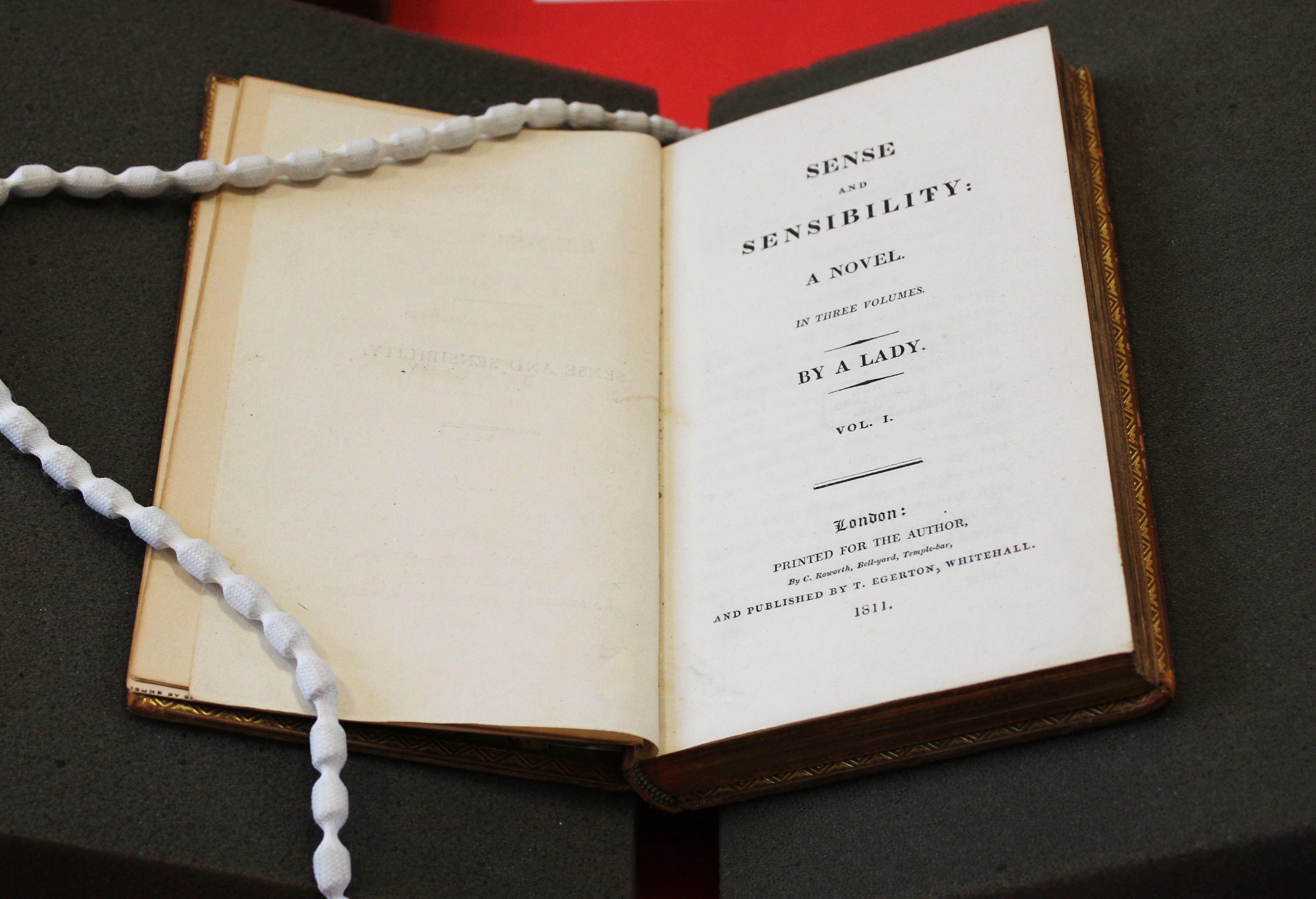
Jane Austen, Sense and Sensibility (London: Egerton, 1811), First edition
Warren.A.Se.1811/1-3

Pride and Prejudice, originally titled First Impressions, was offered for publication to the London bookseller Thomas Cadell, but the offer was declined by return post. The novel was subsequently published by Thomas Egerton under the revised title Pride and Prejudice. Upon receiving her copy of the first edition from the publisher, Jane wrote: ‘I have got my darling child from London’ (27 Jan 1813).
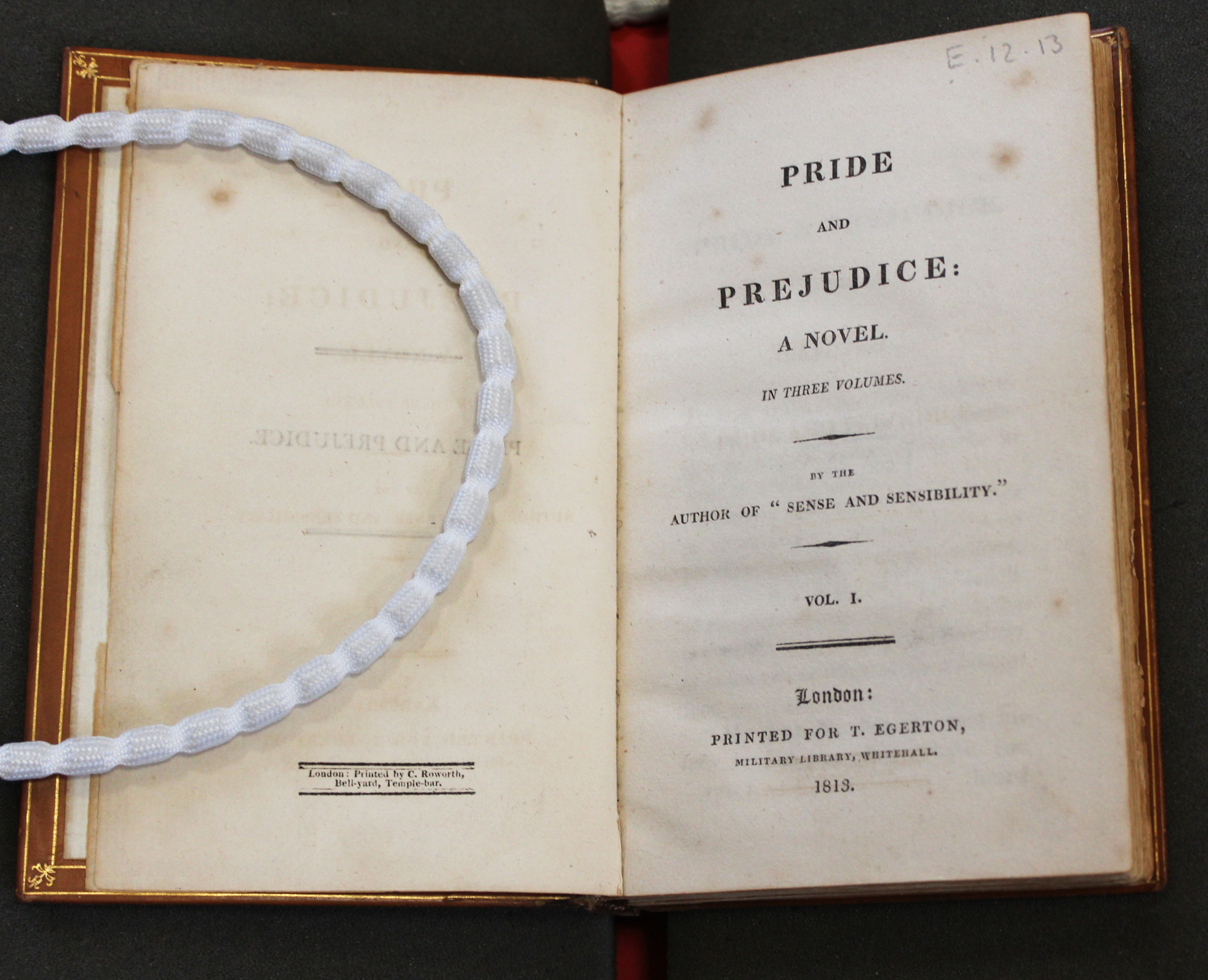
Jane Austen, Pride and Prejudice (London: Egerton, 1813), First edition
Warren.A.Pr.1813a/1-3

The Austen family lived in Bath between 1801 and 1806. Jane was familiar with the Pump Room, a venue for fashionable people, which is used as a setting in her novels Northanger Abbey and Persuasion. This image, from The New Bath Guide (1807), shows the Pump Room as it would have looked during Jane Austen’s time there.

Christopher Anstey, The New Bath Guide; or, Memoirs
of the B.N.R.D. Family in a Series of Poetical Epistles (Bath, 1807)
Warren.B.97.New.1807

Austen’s novels Persuasion (written 1815-16) and Northanger Abbey (written 1798-99) both appeared posthumously in a four-volume set in December 1817, although the title page states 1818. They are prefaced by a ‘biographical notice’ written by Jane’s brother Henry Austen in which Jane’s identity is revealed for the first time. She appears to have intended to publish Persuasion in 1818 but did not live long enough to do so.
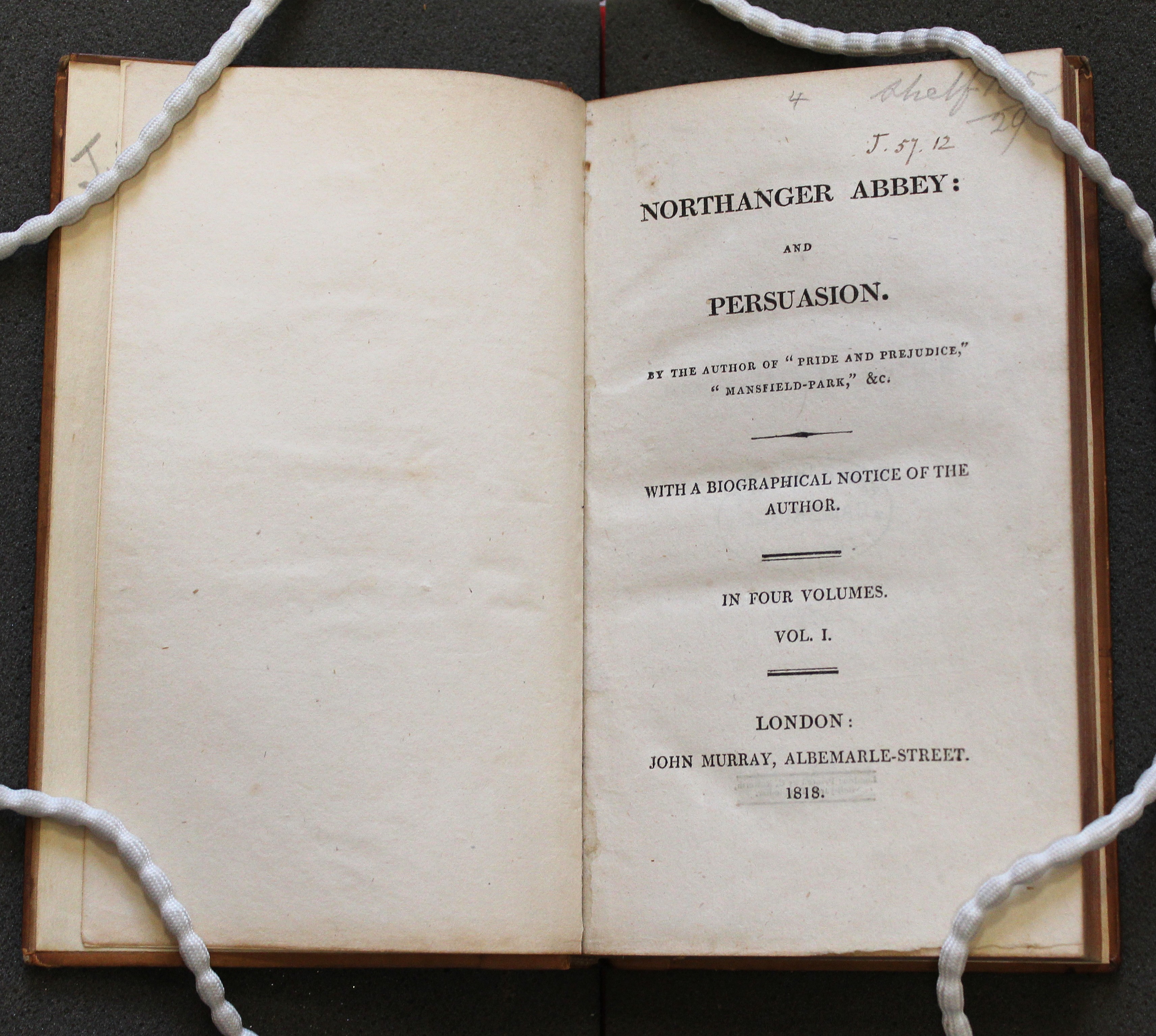
Jane Austen, Northanger Abbey, and Persuasion (London: Murray, 1818), First edition
Thackeray.J.57.12-15

In 1809 Austen’s brother Edward offered his mother and sisters a more settled life – the use of a large cottage in Chawton, near Alton in Hampshire. Whilst living in Chawton Jane published her first four novels. She also wrote Mansfield Park there between 1811 and 1813. It was first published by Egerton in 1814 and a second edition was published in 1816 by John Murray, still within Austen’s lifetime. It did not receive any critical attention when it first appeared.

Jane Austen, Mansfield Park (London: Egerton, 1814), First edition
Warren.A.Ma.1814/1-3

When Henry Austen was taken ill in London in October 1815, he was attended by his sister Jane and by one of the Prince Regent’s doctors who identified her as the author of Pride and Prejudice. The doctor reported that the Prince (later George IV) was a great admirer of her novels and she was invited to dedicate one of her future works to the Prince. Emma was the lucky work. Jane disapproved of the Prince’s treatment of his wife, but felt she couldn’t refuse, so she settled for a title page reading simply ‘Emma, Dedicated by Permission to HRH The Prince Regent’, though her publisher (John Murray) thought it ought to be more elaborate.

This copy of the first edition of Emma belonged to King’s Provost George Thackeray (1777–1850).
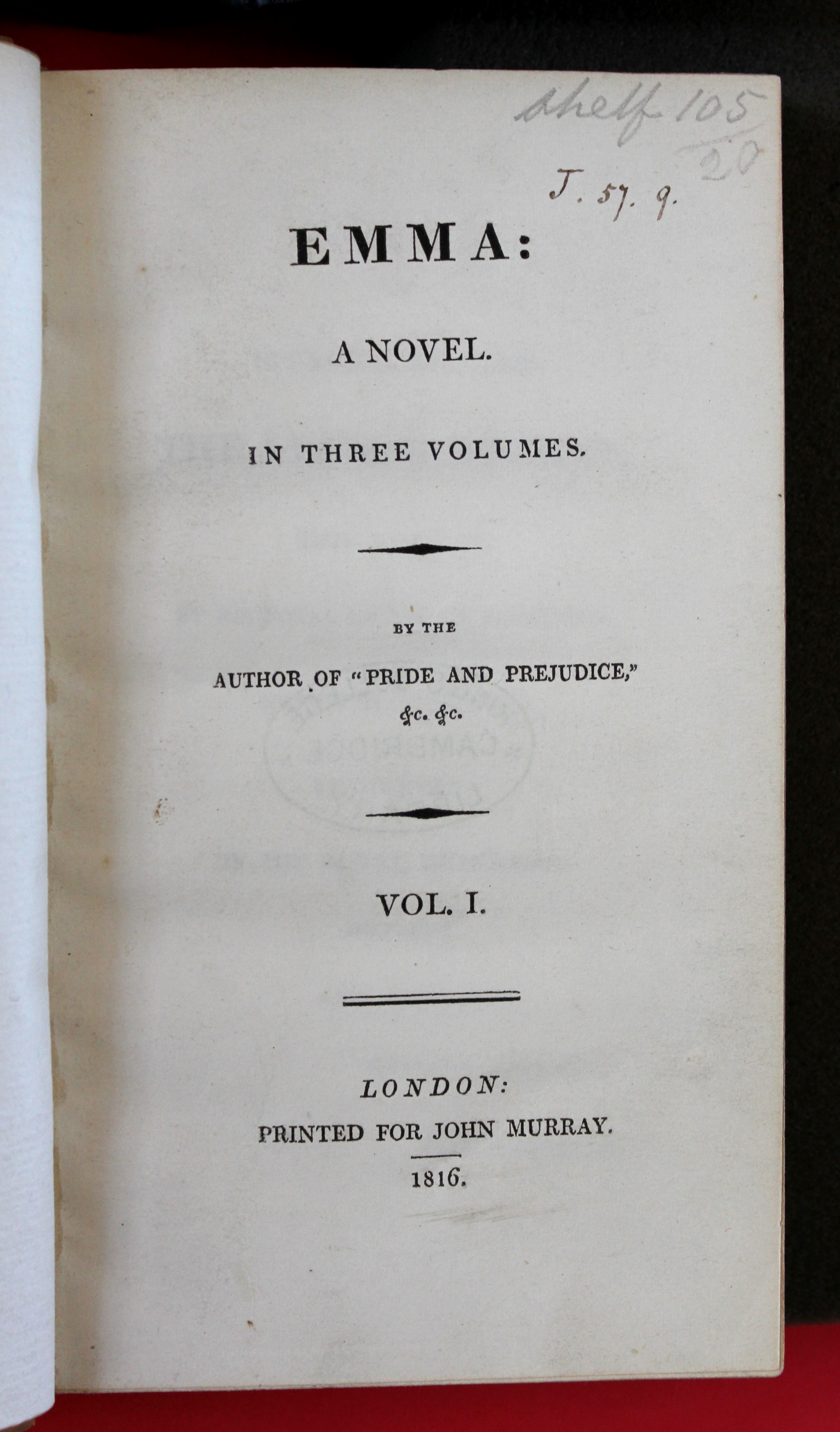
Jane Austen, Emma (London: Murray, 1816), First edition
Thackeray.J.57.9-11

Several months after the dedication of Emma, Jane wrote to John Murray and reported that the Prince had thanked her for the copy of Emma. In the same letter she notes that in a recent review of the novel, printed in The Quarterly Review (vol. XIV, 1816), the anonymous reviewer (later established as Sir Walter Scott) completely fails to mention Mansfield Park, remarking with regret that ‘so clever a man as the reviewer of Emma, should consider it as unworthy of being noticed’.

Jane Austen’s letter to John Murray, 1 April 1816 (NM/Austen/1)

Among the miscellaneous items on display was one of the few known copies of Sense and Sensibility in yellowback. Chapman and Hall’s series ‘Select Library of Fiction’ was closely associated with W.H. Smith, who carefully sought out copyrights, or reprint rights, of popular novels in order to publish yellowback editions for sale on his railway bookstalls. The series, which ran from 1854 until it was taken over by Ward, Lock in 1881, included at least thirty novels by Anthony Trollope, who had strong views on the poor quality of much railway literature.

Jane Austen, Sense and Sensibility
(London: Chapman and Hall, 1870)
Warren.A.Se.1870

One of the highlights of the exhibition was Jane Austen’s copy of Orlando furioso, signed by her on the fly-leaf, sold by the Austen-Leigh family, bought by Virginia Woolf, and inscribed by Woolf to John Maynard Keynes at Christmas 1936.

Ludovico Ariosto, Orlando furioso (trans. by John Hoole)
(London: Charles Bathurst, 1783)
Keynes.E.4.1

These Victorian editions of Mansfield Park, Emma, and Northanger Abbey were presented to E. M. Forster’s mother by his father, and were later inherited by Forster himself.

Copies of Mansfield Park, Emma and Northanger Abbey from the library of E. M. Forster (all London: Routledge, 18–)
Forster.AUS.Man; Forster.AUS.EMM; Forster.AUS.Nor

King’s College owns the manuscript of Jane Austen’s unfinished novel Sanditon, the last one on which she was working before she died on 18 July 1817. It is a rare surviving autograph manuscript of her fiction. It was given to King’s in 1930 by Jane’s great-great niece (Mary) Isabella Lefroy in memory of her sister Florence and Florence’s husband, the late Provost Augustus Austen Leigh who was a great-nephew of Jane. The booklets were made by Austen herself. The last writing is dated 18 March 1817. She died four months later.

The beginning of Sanditon

Below is the beginning of chapter 6, followed by the transcription in the printed version of Sanditon.

The beginning of chapter 6
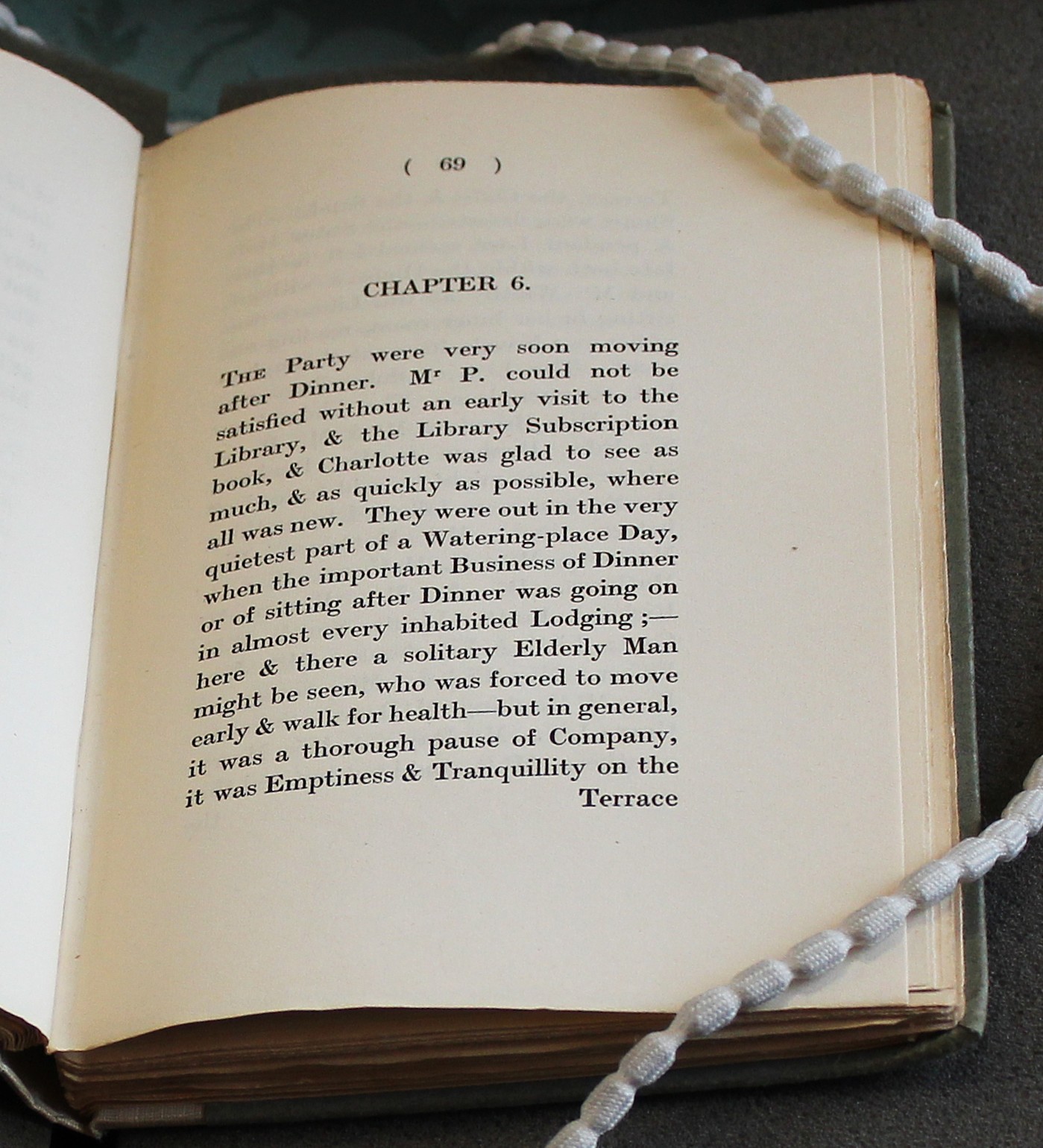
This copy of the first edition of Sanditon comes from the library of E. M. Forster.
Jane Austen, Fragment of a Novel (Oxford: Clarendon Press, 1925)
Gilson.A.Sa.1925a

During the summer, King’s College loaned one of the fascicles of Sanditon to Harewood House to be displayed there as part of their exhibition ‘Austen and Turner: A Country House Encounter’ where it occupied pride of place and was viewed and admired by thousands of visitors.

JC/IJ


Dante: An Online Exhibition

In November 2024 King’s College had the opportunity to host the annual doctoral and postdoctoral research conference “Dante Futures 2024: New Voices in the UK and Ireland”. For this occasion, an exhibition of rare early printed and manuscript materials relating to Dante was mounted in the library. As this year marks the 760th anniversary of Dante’s birth in 1265, we thought it would be timely to share some of these treasures in an online exhibition.

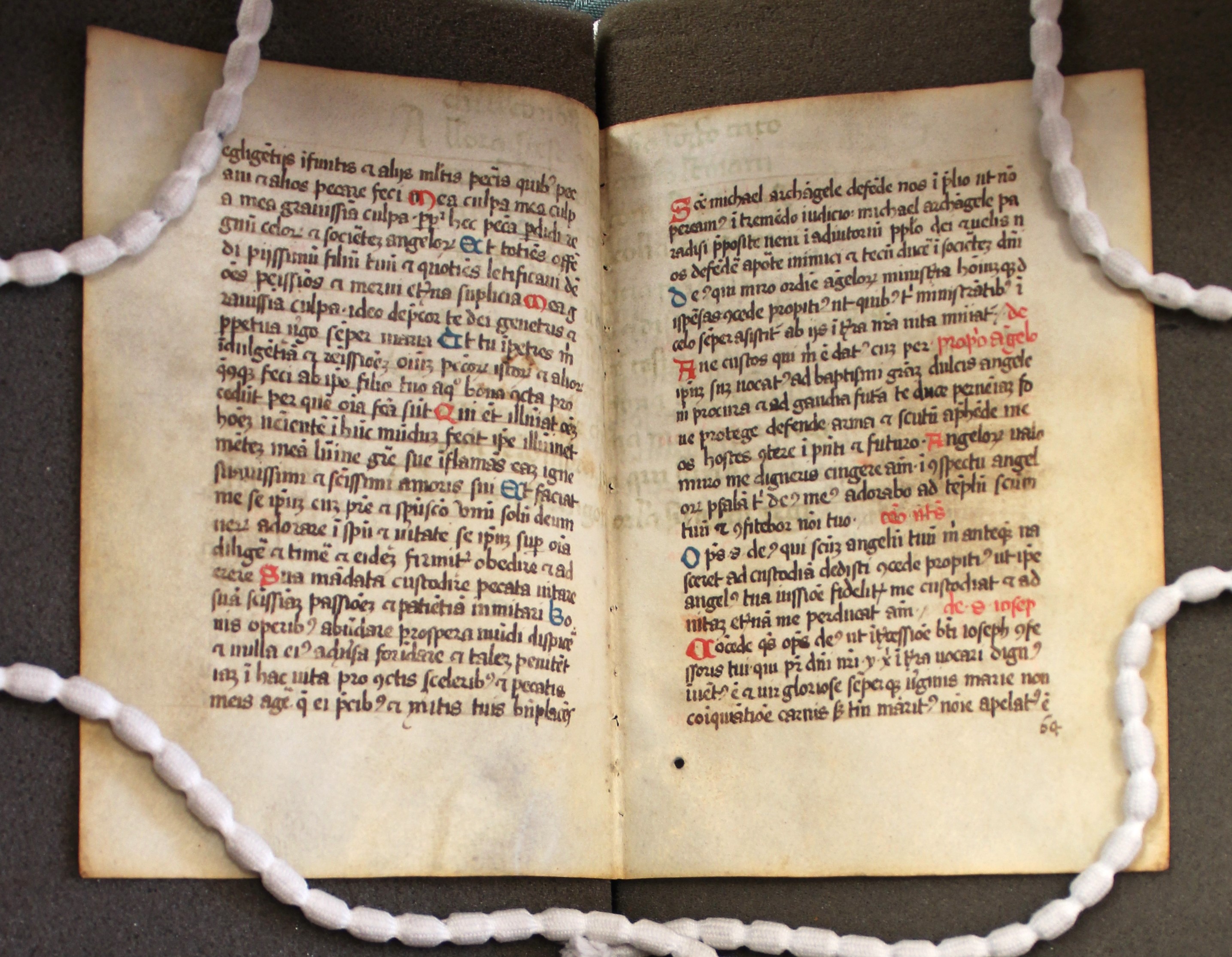
While there is no extant autograph manuscript of the Divine Comedy, many other fourteenth- and fifteenth-century manuscripts survive. Below is a fifteenth-century breviary written in an Italian hand on vellum. This is a palimpsest, namely a manuscript on which a piece of writing has been superimposed, effacing the original text. In this case the erased text is from Dante’s Inferno, one of the three parts of the Divine Comedy, which was written on at least 31 leaves used in this breviary. The vellum was not thoroughly cleaned when it was prepared for reuse, meaning Dante’s text can be seen by the naked eye in a number of places, apparently written in a fourteenth-century hand. Each leaf of the original manuscript was folded in two, vertically, to create two leaves (one bifolium). At the top of the page we can see lines 39-40 of Inferno VIII (spelling modernised):

ch’i’ ti conosco, ancor sie lordo tutto.
Allora [di]stese al legno ambo le mani

[for thee I know, all filthy though thou be.
Then toward the boat he stretched out both his hands]

Breviary (imperfect), fifteenth century, partly written on a palimpsest vellum of Dante’s Inferno, fourteenth century (Salt MS 3)

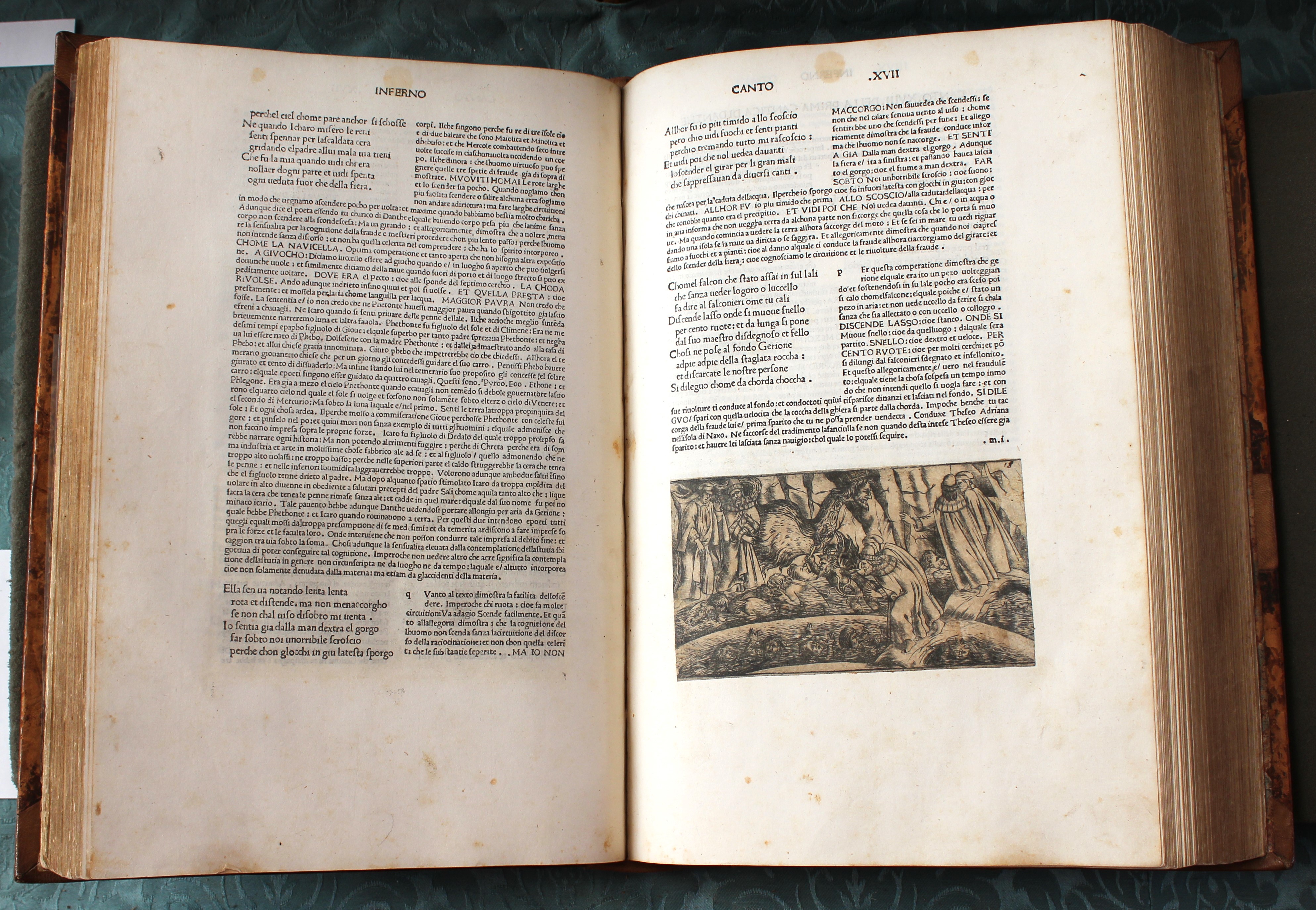
The first printed edition of the Divine Comedy appeared in 1472. This incunabulum from 1481 (a book from the dawn of printing, printed before 1501) includes the commentary of Cristoforo Landino with additions by Marsilio Ficino, and is the third edition of the work to be published. The engravings are attributed to Baccio Baldini after designs by Sandro Botticelli, eighteen of which are included in this copy, mainly pasted in spaces left by the printer for that purpose. Here we see the descent of Virgil and Dante into Hell, as they move to the circle of the fraudulent in the Malebolge, thanks to the mythological monster Gerion, who flies them down on its back. With the face of a just man, the body of a snake, the tail of a scorpion, and hairy paws, Gerion is an allegory of falseness and fraud, precisely because its human face displays a benign humanity while the serpentine and monstrous body reveals its evil:

Comento di Christophoro Landino fiorentino sopra
La comedia di Danthe Alighieri poeta fiorentino
(Florence: Nicholo di Lorenzo della Magna, 1481; Bryant.XV.1.4)

Aldus Manutius (c. 1449/1452–1515), founder of the Aldine Press in Venice, was one of the most important printers of the period. He was an advocate of the smaller, more portable book format, which is arguably the precursor to the modern paperback. His work also helped to standardise the use of punctuation.

Along with Greek classics, the Aldine Press also printed Latin and Italian works. At the start of the sixteenth century the Bembo family—a noble Venetian family—hired the Aldine Press to produce accurate texts of both Dante and Petrarch using Bernardo Bembo’s personal manuscript collection. Pietro Bembo worked with Manutius from 1501 to 1502 to undertake this work, resulting in this, the fifth edition of the Divine Comedy to be published. Here we see the well-known dolphin-and-anchor printer’s device used by the Aldine Press, adopted in 1502 and used for the first time in this publication:

Dante Alighieri, Lo ‘nferno e ‘l Purgatorio e ‘l Paradiso di Dante Alaghieri
(Venice: Aldus Manutius, 1502; M.71.15)

The Aldine Press published a second edition of the Divine Comedy in 1515 in partnership with Aldus’s father-in-law, Andrea Torresani “nelle case d’Aldo et d’Andrea di Asola suo suocero” (at the house of Aldo and Andrea of Asola, his father-in-law), with whom he had a professional relationship from 1506 until his death in 1515. Although the volume appeared just after his death, Aldus is believed to have prepared this second edition himself. The publication was dedicated to Vittoria Colonna (1490–1547), one of the most famous women of the Italian Renaissance, friend to the most important cultural figures of the age including Bembo, Castiglione and Michelangelo, and a poet in her own right. Below is the opening of the second part of the Divine Comedy, the Purgatorio:

Dante col sito, et forma dell’inferno tratta dalla istessa descrittione del poeta
(Venice: nelle case d’Aldo et d’Andrea di Asola suo suocero, 1515; Keynes.Ec.7.3.22)

Alessandro Vellutello (born 1473) produced an influential commentary on the Divine Comedy, published in 1544, which is a real gem in the collection of rare books bequeathed to King’s College by novelist E.M. Forster (1879–1970). This copy belonged to Bishop John Jebb (1775–1833) who gifted it to Forster’s grandfather, Charles Forster (1789–1871). The printer left spaces for 87 woodcut illustrations which were first used in this edition and subsequently in a number of other editions throughout the sixteenth and seventeenth centuries. They were considered some of the most beautiful Renaissance illustrations of the poem after Botticelli’s.

This is a depiction of Giudecca (named after Judas Iscariot), the very last region of Hell. The sinners are punished by being completely frozen in the lake of Cocytus, some upright, some upside down, some with their bodies bent double. Enormous in size, we see the top half of Lucifer in the lake, gnawing on the bodies of sinners:

La comedia di Dante Aligieri con la nova espositione di Alessandro Vellutello
(Venice: per Francesco Marcolini, 1544; Forster.DAN.Com.1544)

Cosimo Bartoli (1503–72) was a humanist, philologist and writer. He promoted the Italian vernacular as a language which could be used in scientific discussion as much as Latin, and Dante was regarded as an example of the heights the vernacular could reach. A friend of the famed Renaissance painter and architect Giorgio Vasari (1511–74), he also worked for the Medicis for most of his life. His Ragionamenti accademici sopra alcuni luoghi difficili di Dante takes the form of fictitious discussions held between Bartoli and his Florentine friends, to provide explanations of some of the most difficult passages in the Divine Comedy. A collection of some of the lectures he had given in the Accademia fiorentina between 1541 and 1547, it was published in Venice in 1567:

Cosimo Bartoli, Ragionamenti accademici di Cosimo Bartoli gentil’huomo et
accademico fiorentino sopra alcuni luoghi difficili di Dante
(Venice: appresso Francesco de Franceschi Senese, 1567; Bury.BAR.Rag.1567)

JC/IJ
 

I Am Emperor of the French Still

While Ridley Scott’s biopic Napoleon has come and gone without too much fanfare or recognition during awards season, its release nevertheless reminded me that we have a volume in our rare-book collection that belonged to the French emperor, whose 255th birthday falls today (15 August 1769 – 5 May 1821):

Title page of Pierre Victor Jean Berthre de Bournisseaux, Histoire des guerres de la Vendée et des Chouans, depuis l’année 1792 jusqu’en 1815 (Paris: Claude Brunot-Labbe, 1819; M.37.116)

Napoleon’s ink signature is above the circular stamp: “l’Empereur Napoleon”. As he had been in exile on St Helena since October 1815, the book must have been shipped to him from France. The volume was sold at auction by Sotheby’s in June 1905 and was later donated to the College by Kingsman Alban Goderic Arthur Hodges (1893-1982):

Rear pastedown on which is stuck an advertisement for the Sotheby’s sale on 1-3 June 1905, including “Books from the library of the Emperor Napoleon I at St. Helena”. Next to it is a slip describing this book and its provenance: “Cachet of St. Helena and ‘L’Empereur Napoléon’ on title”.

While there are several items in King’s College’s collection that belonged to British monarchs, these are usually identified as such thanks to a royal cypher or a crest on the binding. This copy of the order of service performed at the coronation of George II (1727) belonged to his grandson George III (1738-1820), who was on the throne during Napoleon’s reign and exile:

The Form and Order of the Service that Is To Be Performed […] in the Coronation of their Majesties, King George II. and Queen Caroline (London: John Baskett, 1727; Thackeray.M.32.53)

The volume is bound in red morocco featuring an elaborate gilt panel design on front and rear boards with the crest of King George III at the centre and royal cyphers on each corner. This book did not come to King’s College as part of the large Thackeray Bequest, but was purchased in 1950. Though George III’s pre-1801 crest was identical to that of George II, the fact that Provost George Thackeray was chaplain in ordinary to George III suggests that he likely received it as a gift from the latter (who may have inherited it from his grandfather George II).

Gone are the days of gilt imperial bindings for the erstwhile French emperor: Napoleon can now only assert his ownership through a mere signature, like most other book owners. The contrast between the British monarch’s mark of ownership through this elaborate morocco binding and Napoleon’s ink inscription on the title page could not be starker.

One cannot help but draw a parallel between Napoleon’s predicament and that of the heroine in John Webster’s play The Duchess of Malfi (1623), loosely based on the life of Giovanna d’Aragona, Duchess of Amalfi (1478-1510):

Title page of the second edition of John Webster’s The Dutchesse of Malfy: A Tragedy (London: John Raworth and John Benson, 1640; Keynes.C.6.27)

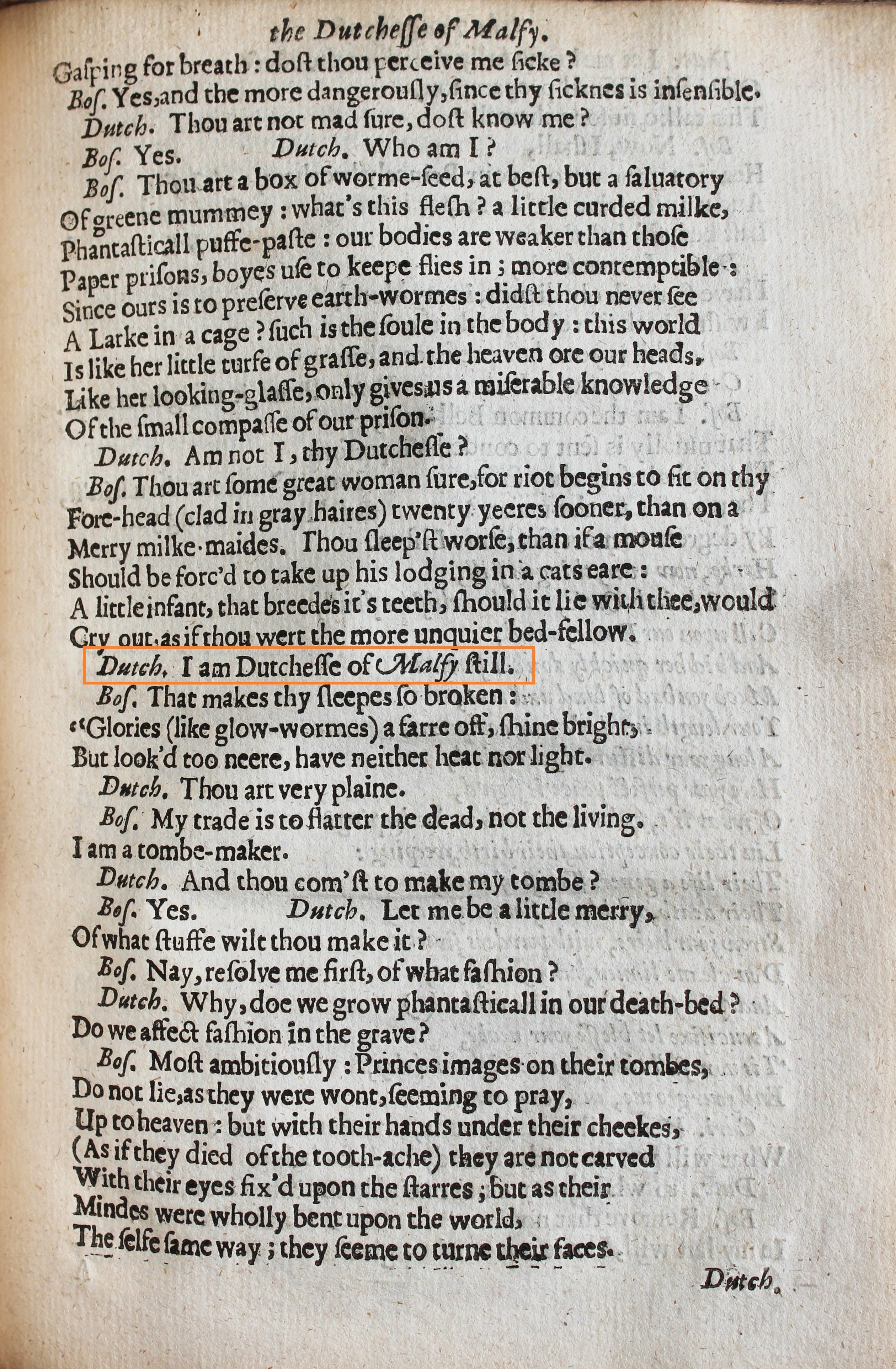
In the play, the widowed duchess secretly marries her lowly household steward Antonio and bears him three children, thus attracting the rage of her two brothers Ferdinand and the Cardinal who want to safeguard their inheritance. The duchess and her two younger children are murdered at Ferdinand’s behest in the fourth act. As she is about to be strangled by the executioners, she utters the famous words, “I am Duchess of Malfi still”:

Part of Act IV, scene ii (leaf G4 recto)

There is a sense of poignancy in the defiance shown by both the duchess and Napoleon as they cling to a former glorious past in the face of imminent death or a fall from grace. The difference is that Napoleon was technically no longer an emperor in 1819, while the duchess was still Duchess of Malfi, at least in name, when she died. In November 1818, Napoleon had been informed that he would remain a prisoner on St Helena for the rest of his life, and the island’s governor Sir Hudson Lowe had refused to recognise him as a former emperor. However, as this ownership inscription confirms, “Napoleon never considered forgoing ceremony or the recognition of his title. It was the only way he could assert his claim to being emperor in the face of the British insistence that he was a simple general. Much of his stay on St Helena was about constructing a space for himself in which he displayed his quality as an imperial sovereign”.[1]

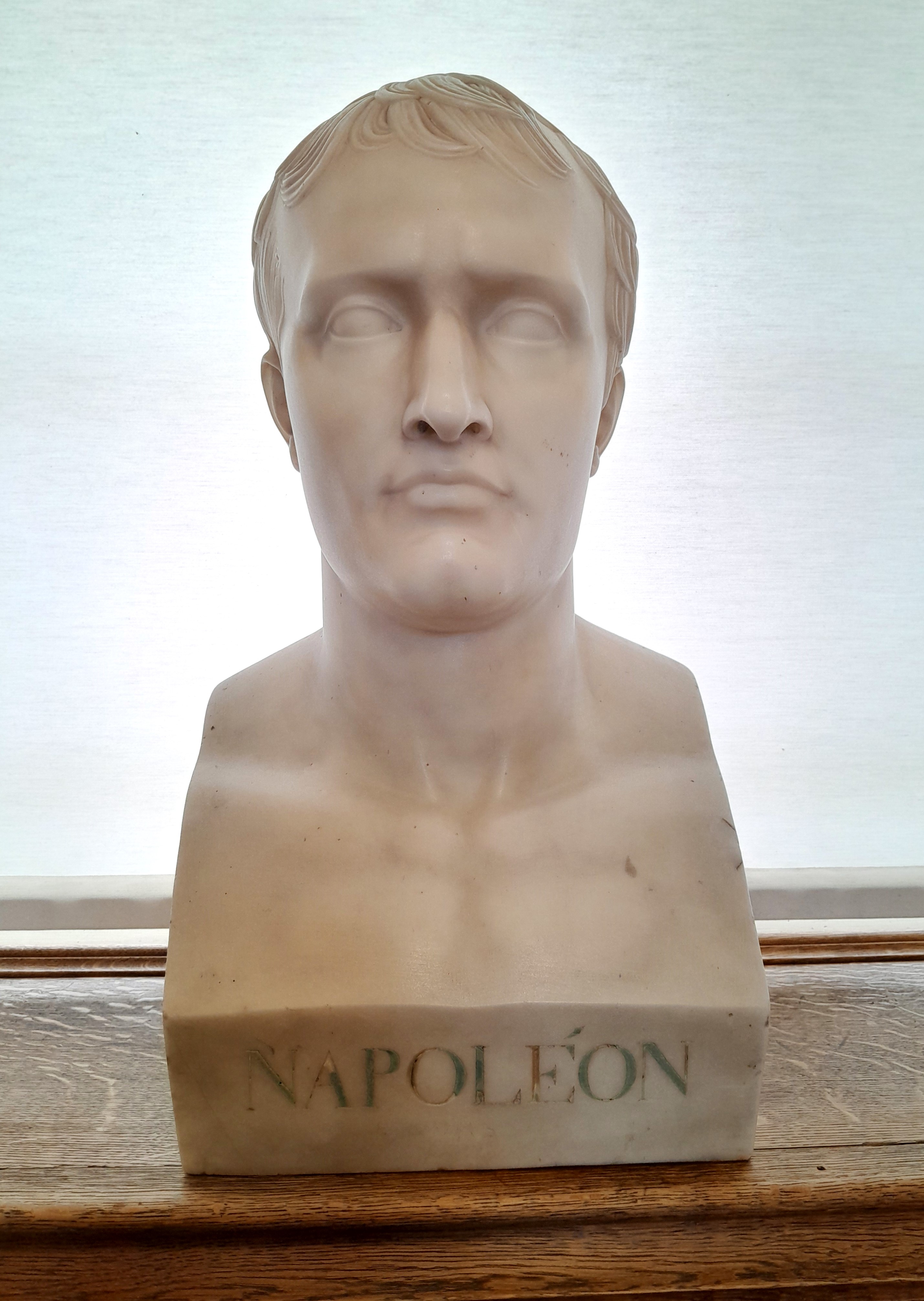
Bust of Napoleon in King’s College Library

IJ

Notes

[1] Philip Dwyer, Napoleon: Passion, Death and Resurrection, 1815-1840 (London: Bloomsbury Publishing, 2019, pp. 44-45)

The Consolation of Literature

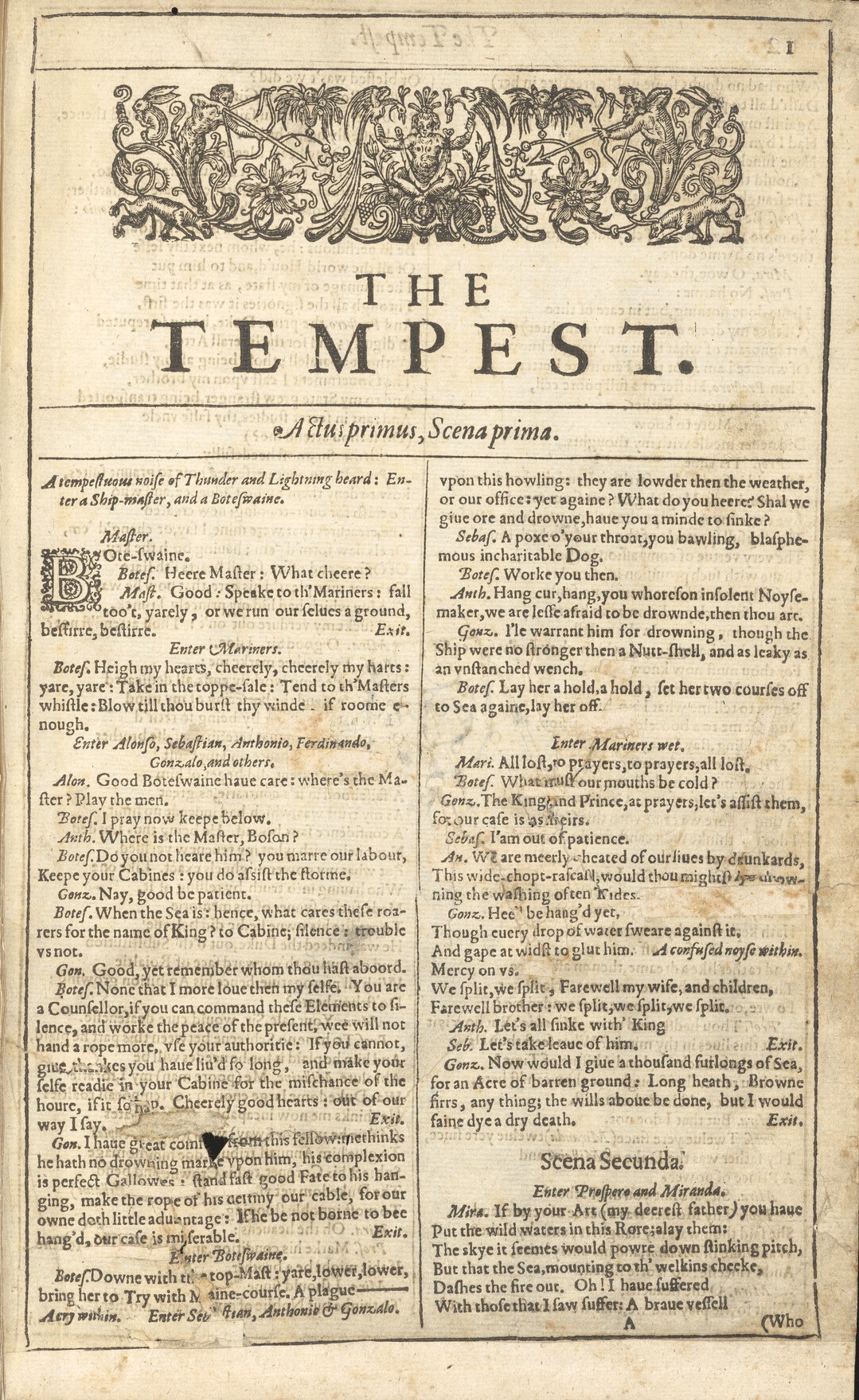
It is not unusual to seek refuge in our favourite authors when faced with difficult situations. On the day on which we celebrate the quatercentenary of the First Folio’s publication (8 November 1623), it is timely to remember that Shakespeare’s play The Tempest played an important role in the New Zealand author Janet Frame’s life and writing. Confined to various mental institutions for eight years with misdiagnosed schizophrenia, she used to derive comfort by scribbling lines from The Tempest and poems she loved on the wall of her isolation room, an experience dramatised in her novel Faces in the Water (1961): “With the pencil I wrote on the wall snatches of remembered poems but the pencil applied to the Brick Building wall was like a revolutionary dye that refuses to ‘take’”.[1]

Opening of The Tempest, first published 400 years ago today in Mr. William Shakespeares Comedies, Histories, & Tragedies (London: printed by Isaac Iaggard, and Ed. Blount, 1623; Thackeray.38.D.2). This is one of the plays that might have been lost had it not been included in the First Folio.

The American poet Henry Wadsworth Longfellow found solace in Dante when coming to terms with the loss of his wife, as he confided to his friend Ferdinand Freiligrath on 24 May 1867: “Of what I have been through, during the last six years, I dare not venture to write even to you; it is almost too much for any man to bear and live. I have taken refuge in this translation of the Divine Comedy”.[2]

Janet Frame (1924-2004) and Henry Wadsworth Longfellow (1807-82) found comfort in Shakespeare and Dante respectively.

During World War II, another eminent Dante enthusiast, the German critic Ernst Robert Curtius, wrote to Fritz Schalk on 30 October 1944:

Am 18. (sind) alle Fenster und Türen unserer Wohnung kaputt gegangen. Bonn zur Hälfte zerstört, die ‚Insel des Friedens’! Dies & vieles andre deprimiert mich tief. En attendant lese ich Dante & Vergil.[3]

[On the 18th all the windows and doors in our flat were shattered. Bonn half-destroyed, the ‘island of peace’! This and many other things make me feel deeply depressed. En attendant I read Dante & Virgil].

Curtius also commended an eminent German mathematician who began to learn the 14,233-line Divine Comedy by heart during the Christmas of 1914 “um sich über die trübe Gegenwart hinaustragen zu lassen” [in order to get over the bleak present].[4]

King’s College alumnus Gerald Warre Cornish (1874-1916), a classical scholar who was killed in action in France, seems to have coped in a similar way during World War I by immersing himself in the Bible. On his body was found a muddy notebook containing his translations of St Paul’s Epistles, published in 1937 as St Paul from the Trenches: A Rendering of the Epistles to the Corinthians and Ephesians Done in France during the Great War.

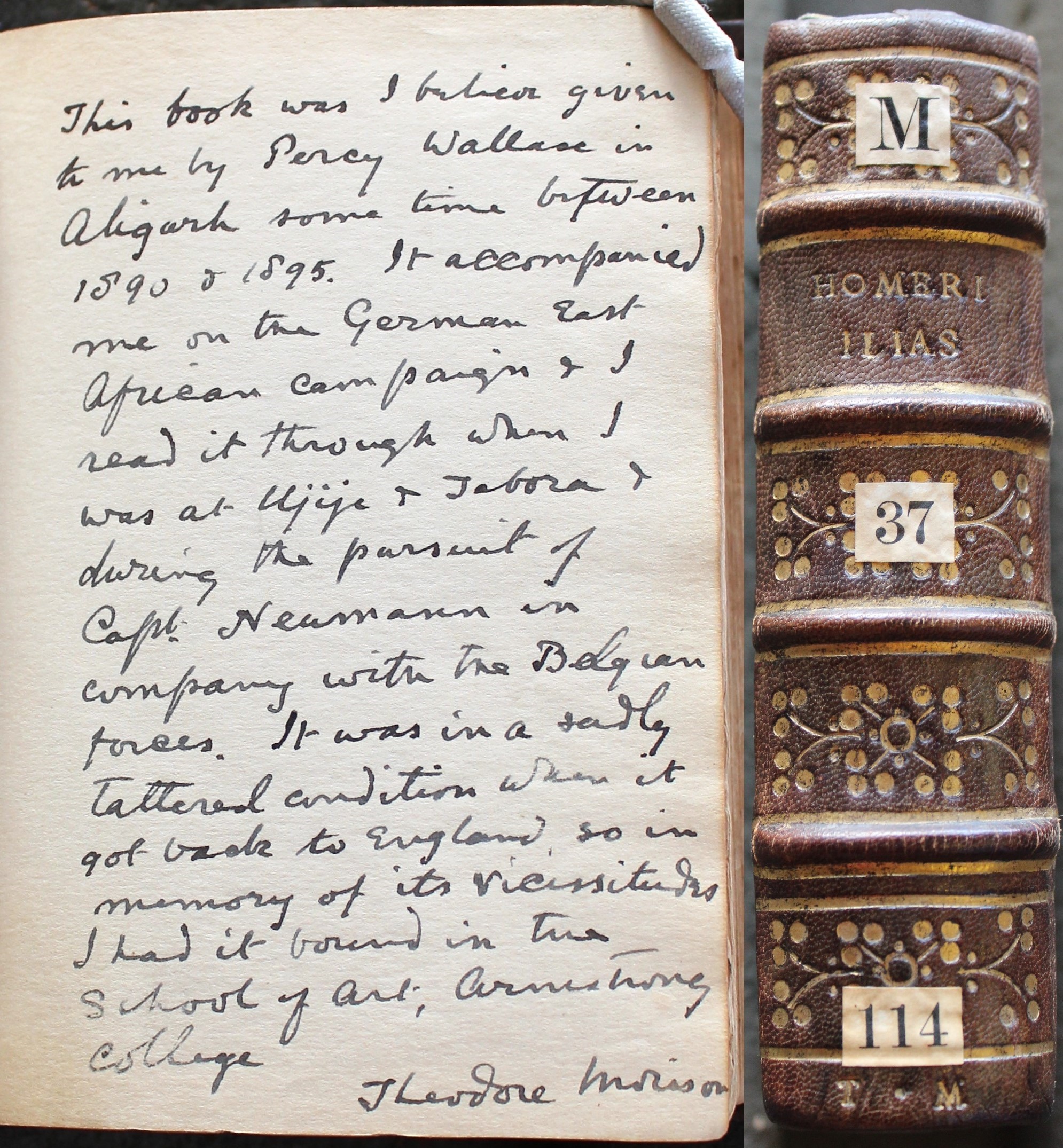
During an earlier war, another classical author, Homer, provided strength to the educationalist Sir Theodore Morison (1863-1936), a graduate of Trinity College, Cambridge, whose copy of the Iliad is in our rare-book collection. His inscription on the flyleaf reads: “This book was I believe given to me by Percy Wallace in Aligarh some time between 1890 & 1895. It accompanied me on the German East African campaign & I read it through when I was at Ujiji & Tabora & during the pursuit of Capt. Neumann in company with the Belgian forces. It was in a sadly tattered condition when it got back to England, so in memory of its vicissitudes I had it bound in the School of Art, Armstrong College. Theodore Morison”:

Homērou Ilias (Oxford: J. H. Parker, between 1849 and 1890; M.37.114). Theodore Morison’s inscription and (right) the spine of the rebound book with his gilt initials on the bottom panel. Percy Maxwell Wallace (1863-1943) was professor of English Literature at the Mohammedan Anglo-Oriental College in Aligarh, India between 1887 and 1890. Theodore Morison was the principal at the College from 1899 to 1905. When he returned to England, Morison also served as the principal of Armstrong College in Durham.

The verb “accompanied” is significant as it suggests that the book became a sort of companion in the course of his trials and tribulations, in a way not entirely dissimilar to the role Philosophy played during Boethius’s imprisonment:

Incipit of Boethius’s De consolatione philosophiae (Nuremberg: Anton Koberger, 1476; Keynes.Ec.7.1.4). The editio princeps was published around 1474, which makes this incunable one of the earliest printed versions of Boethius’s seminal work, where he describes his dialogues with a personified Philosophy on a number of issues including fate, good and evil, and free will.

As we celebrate one of the most important books in English literature today, Prospero’s words to Miranda describing Gonzalo’s kindness in providing them with necessities during the move to the island, aptly summarise the sentiment shared by book lovers as diverse as Janet Frame, Henry Wadsworth Longfellow, E. R. Curtius, G. W. Cornish, and Theodore Morison:

The Tempest, Act I, scene ii, lines 278-80 as they appear on leaf A2r of the First Folio.

IJ

Notes

[1] Faces in the Water (London: The Women’s Press, 1991), p. 206

[2]  Life of Henry Wadsworth Longfellow: With Extracts from his Journals and Correspondence, vol. III, ed. Samuel Longfellow (Boston and New York: Houghton Mifflin, 1891), pp. 89-90

[3] In Willi Hirdt, “Ernst Robert Curtius und Dante Alighieri”, in “In Ihnen begegnet sich das Abendland”: Bonner Vorträge zur Erinnerung an Ernst Robert Curtius, ed. Wolf-Dieter Lange (Bonn: Bouvier Verlag, 1990), p. 181

[4] “Neue Dantestudien”, Romanische Forschungen, 60 (1947), p. 238

Celebrating “Folio Day”

Today marks the 407th anniversary of William Shakespeare’s death and, by tradition, the 459th of his birth. This day has also been designated as “Folio Day” and begins a season of celebratory events taking place around the world to commemorate the quatercentenary of the publication of the First Folio on 8th November 1623. Various libraries and other institutions will have their First Folios on display during this time, and King’s College Library will also be taking part in the commemorations by exhibiting the First, Second and Fourth Folios as part of Open Cambridge on Friday 8th September 2023 from 10.30am to 4.00pm. Save the date!

As it’s Folio Day, we thought it would be appropriate to provide some details about our volume and its provenance. King’s College’s First Folio is one of only 235 extant copies, most of which have been described in detail in Rasmussen and West’s The Shakespeare First Folios: A Descriptive Catalogue. Our copy has recently been digitised and can be viewed in its entirety on the Cambridge University Digital Library website (a post about the digitisation process will follow in due course).

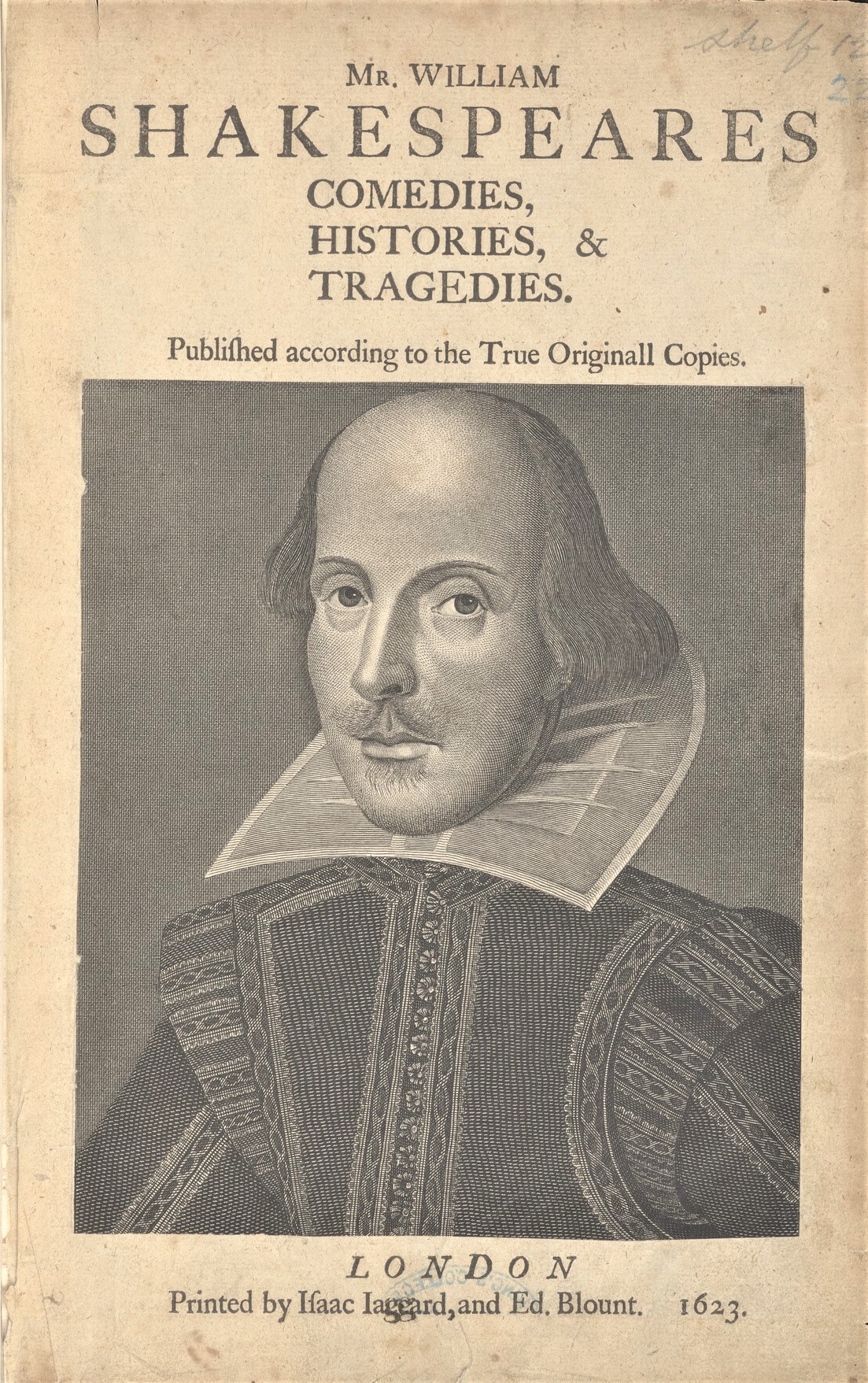
One of the most distinctive features of the book is the engraved title-page portrait of Shakespeare, which exists in two states: the earlier has lighter shading, while in the later state the shading is heavier, especially around the collar; there are also minor differences in the jawline and moustache. According to Rasmussen and West, the texture of the portrait suggests that the King’s College copy is an engraved facsimile copied from a state 2 original:

Title page of Mr. William Shakespeares Comedies, Histories, & Tragedies (London: printed by Isaac Iaggard, and Ed. Blount, 1623; Thackeray.38.D.2).

Spot the difference: the original state 2 portrait in the Bodleian Library’s First Folio (Arch. G c.7) (© Bodleian Libraries, University of Oxford).

As well as missing the original portrait, our copy also lacks the seven preliminary leaves containing the dedication, various celebratory verses by the likes of Ben Jonson, the list of actors and the table of contents. As is sometimes the case with rare books, the last two leaves are also wanting, though in this copy these have been supplied in manuscript so skilfully that you’d be forgiven for thinking they were the original:

Leaf 3b6r in the King’s First Folio supplied in facsimile.

Leaf 3b6r in the Bodleian First Folio (© Bodleian Libraries, University of Oxford).

As for its provenance, the First Folio is part of the collection of rare books bequeathed to the college by George Thackeray, who was Provost at King’s from 1814 to his death in 1850. In Shakespearean fashion, tragedy is said to have been at the heart of his love of books. Following the death of his first wife, Thackeray married his second wife Mary Ann Cottin in 1816. Two years later, on 13 February 1818, she was in labour with their first child, and the accoucheur in attendance, Sir Richard Croft (1762-1818), started showing signs of anxiety and distress and was therefore persuaded to lie down and rest in another room. At about 2am, Croft shot himself in the head with two pistols Thackeray was keeping for personal protection. A volume of Shakespeare was found lying on the dressing table, open at a page containing the line in Love’s Labour’s Lost, “Where is the Princess?”:

Act V, scene ii from Love’s Labour’s Lost as it appears in the First Folio, with the phrase “Wher’s the Princesse?” highlighted in the second column.

Mary Ann’s labour may have shown similarities to that of Princess Charlotte of Wales (1796-1817), who had died in childbirth the previous year; she was also attended by Sir Richard Croft. As pointed out by Jane Townley Pryme and Alicia Bayne, “It was supposed that he had never quite recovered from the shock occasioned by the Royal death, and that the anxiety of this case, combining with the coincidence of the passage in the play, which he had probably been reading, gave an impulse which he could not resist” (Memorials of the Thackeray Family, London, 1879, pp. 238-39).

Thackeray’s obituarist wrote that “this sad event threw an air of gloom and desolation about his house from which it never altogether recovered”. According to him, this early tragedy “threw him, for his general companionship, upon Erasmus and Propertius, black-letter Bibles, and odd books generally”. When he died in 1850, he bequeathed his black-letter books to King’s. His daughter, Mary Ann Elizabeth, lived into adulthood and left the rest of her father’s collection (including the First Folio), to the College when she died in 1879.

William Makepeace Thackeray, photographed here by Jesse Harrison Whitehurst, was a frequent visitor at the house of his second cousin Mary Ann. Another literary curiosity is that her unhappy love affair with Henry Kemble served as the plot for Henry James’s novel Washington Square (1880).

Our copy of the First Folio has a fascinating literary connection. George Thackeray, a cousin of William Makepeace Thackeray’s father Richmond Thackeray, was the novelist’s first cousin once removed. “After her father’s death Mary Ann Thackeray and her aunt lived in considerable state in London, where [William Makepeace] Thackeray was a frequent visitor to their home at 27 Portman Square” (The Letters and Private Papers of William Makepeace Thackeray, ed. Gordon N. Ray [London: Oxford University Press, 1945], vol. 1, p. 30, n. 11). It is therefore likely that William Makepeace Thackeray will have seen and consulted this copy of the First Folio at Mary Ann’s house.

More Shakespeare-related blog posts will follow in the course of this year, so watch this space!

IJ

The Waste Land at 100

This month marks the 100th anniversary of the publication of T. S. Eliot’s The Waste Land, one of the most influential poems of the twentieth century. To celebrate the occasion, we present a selection of images from first and early editions of the poem. King’s College is very fortunate in hosting one of the largest collections of manuscript and printed materials by Eliot thanks to the bequest of his close friend John Hayward (1905-65), who shared a flat with the poet from 1946 to 1957. Hayward read English and modern languages at King’s from 1923 to 1927 and went on to become an accomplished editor and critic. He met Eliot for the first time while still an undergraduate at Cambridge in 1926.

Eliot’s correspondence suggests that The Waste Land was written between late 1920 and early 1922. Though the drafts were lost during his lifetime, they resurfaced in 1968 and were published in a facsimile edition by his widow Valerie in 1971:

Eliot’s pencil draft of the beginning of the fifth section of the poem, “What the Thunder Said” (The Waste Land: A Facsimile and Transcript of the Original Drafts Including the Annotations of Ezra Pound, ed. Valerie Eliot [London: Faber, 1971], p. [70]; YIM ELI, ZWA 3XP 1).

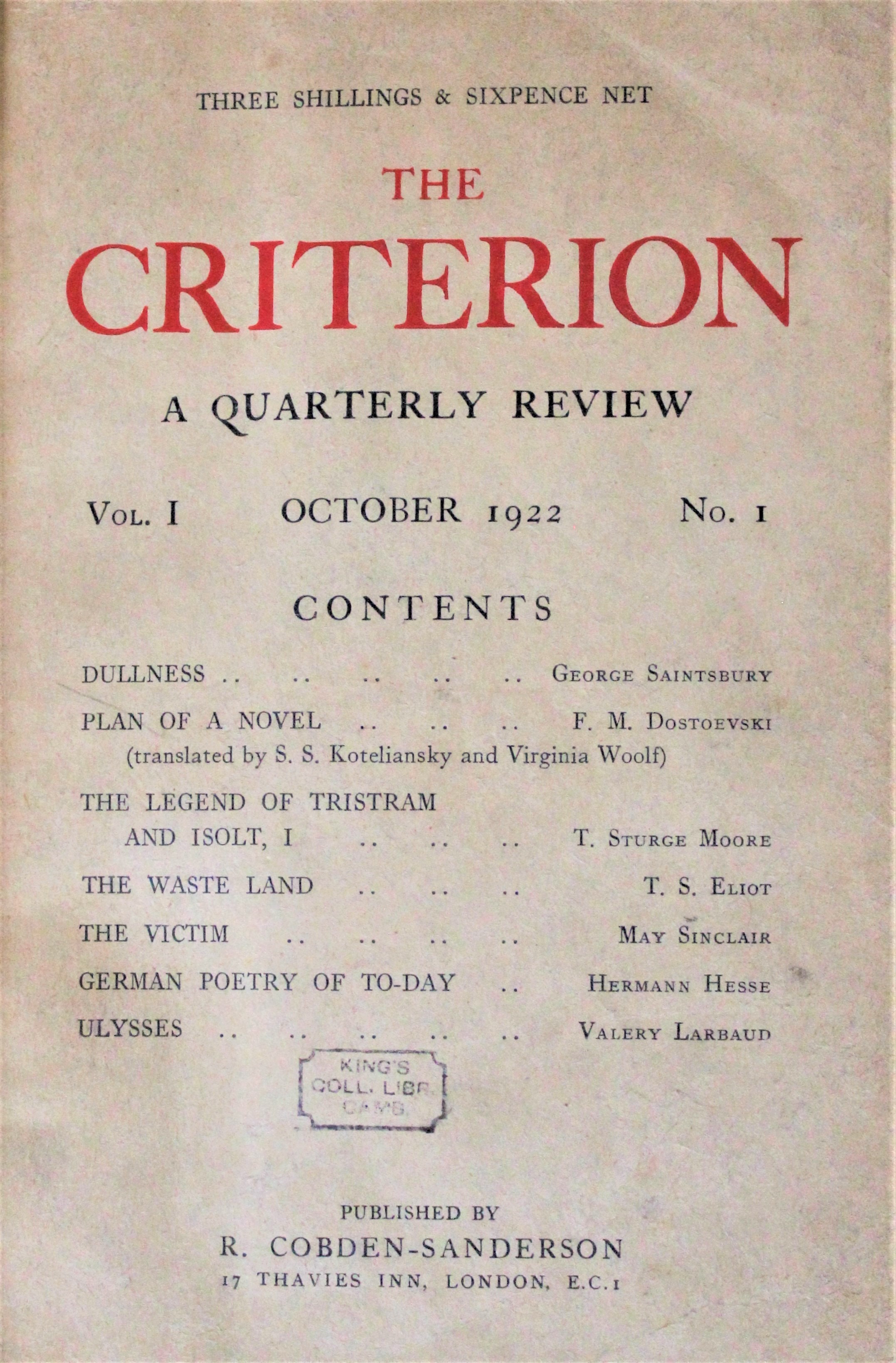
The poem was first printed in the inaugural issue of the literary journal The Criterion, edited by Eliot, which, according to his bibliographer Donald Gallup, appeared around 15 October 1922:

Front cover of the first issue of The Criterion, October 1922 (HC2.1.1 21).

The opening of The Waste Land from The Criterion, pp. 50-51. The poem was published almost simultaneously in America in The Dial, LXXIII.5 (Nov. 1922), pp. [473]-485.

It was then published in book form in New York on 15 December 1922 in a limited edition of 1,000 copies:

Dust jacket of The Waste Land (New York: Boni and Liveright, 1922). The colophon on p. [6] reads: “Of the one thousand copies printed of The Waste Land this volume is number 914” (Hayward.H.9.6).

It was in this volume that the epigraph and the “Notes” to the poem were first included. Eliot later reminisced in “The Frontiers of Criticism” (1956): “I had at first intended only to put down all the references for my quotations, with a view to spiking the guns of critics of my earlier poems who had accused me of plagiarism. Then, when it came to print The Waste Land as a little book – for the poem on its first appearance in The Dial and in The Criterion had no notes whatever – it was discovered that the poem was inconveniently short, so I set to work to expand the notes, in order to provide a few more pages of printed matter, with the result that they became the remarkable exposition of bogus scholarship that is still on view to-day” (The Complete Prose of T. S. Eliot: The Critical Edition, ed. Jewel Spears Brooker and Ronald Schuchard [Baltimore: Johns Hopkins University Press, 2019], vol. 8, p. 127):

First page of the “Notes” to The Waste Land (Hayward.H.9.6).

The first English edition appeared the following year on 12 September 1923: it was hand-printed by Leonard and Virginia Woolf at the Hogarth Press in Richmond. Virginia typeset the whole poem on her own between 23 June and 8 July 1923, writing to Barbara Bagenal on 8 July: “I have just finished setting up the whole of Mr Eliots poem [The Waste Land] with my own hands: You see how my hand trembles” (The Letters of Virginia Woolf, ed. Nigel Nicolson and Joanne Trautmann [New York: Harcourt Brace Jovanovich, 1978], vol. 3, p. 56):

Front cover of the first English edition (Richmond: Printed and published by Leonard and Viriginia Woolf at the Hogarth Press, Hogarth House, Paradise Road, 1923; Hayward.H.9.8A). The printed label at the top is known to exist in three states. This is the first state featuring a border of asterisks.

Title page of the first English edition of The Waste Land. This copy was bequeathed by another Kingsman, Dadie Rylands (1902-99), who worked for six months with Leonard and Virginia Woolf at the Hogarth Press in 1924.

In the copy of the first edition which Eliot presented to Ezra Pound, the dedication (For Ezra Pound / il miglior fabbro) appears as an autograph inscription. It was first printed in 1925 in the collection Poems, 1909-1925:

Title page of The Waste Land as printed in Poems, 1909-1925 (London: Faber & Gwyer, 1925, p. 63; Hayward.H.9.10).

To mark this momentous centenary, the BBC broadcast the radio drama “He Do The Waste Land in Different Voices,” as well as a programme on the importance of The Criterion, which is still available here. A documentary on the poem broadcast on BBC2 on 13 October can also be viewed here.

IJ

Medieval Mnemonics

In the collection of incunabula bequeathed to King’s College by Jacob Bryant (1715-1804) is a first edition of Giacomo Publicio’s Artes orandi, epistolandi, memoranda, a treatise on the rhetorical arts published in Venice by Erhard Ratdolt on 30 November 1482. Not much is known about Publicio, of whom no other works survive; in the text he describes himself as Florentine, though he may have also been Spanish.

Leaf A2r of Artes orandi, epistolandi, memoranda (Bryant.XV.3.12), with a woodcut white-on-black floriated initial “S”

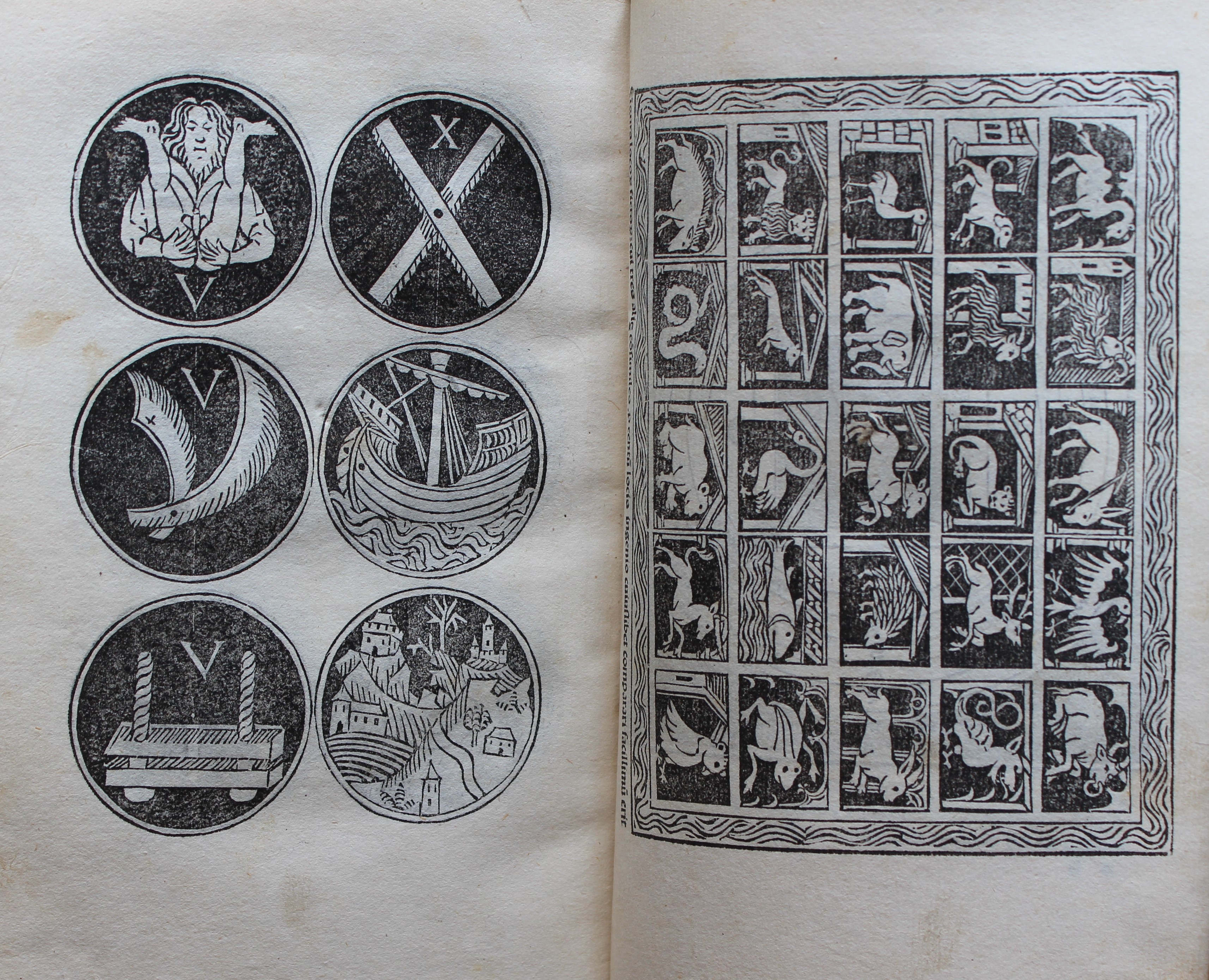
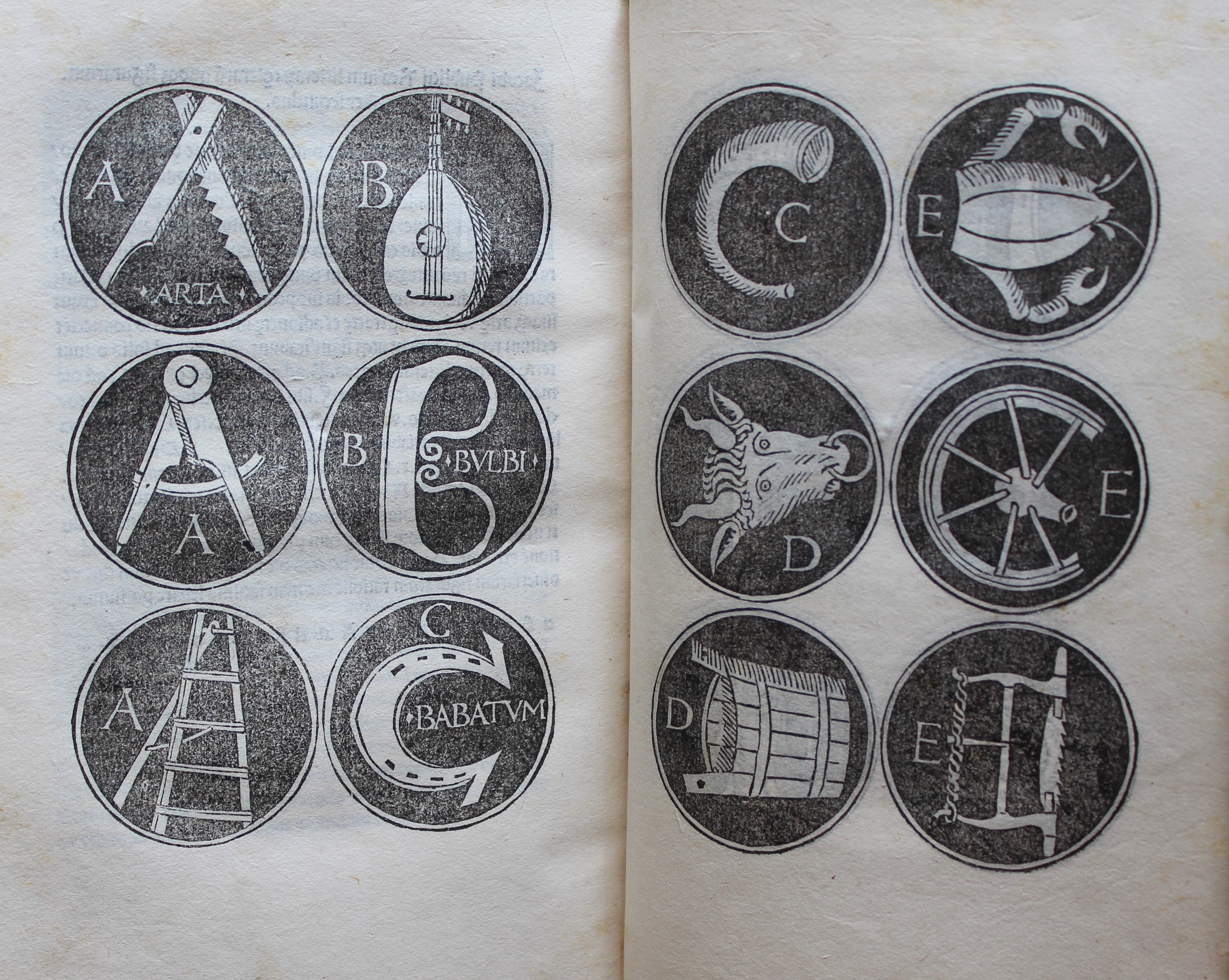
The third section of the work is devoted to the art of memory and is widely regarded as the first memory treatise to have been printed. Towards the end are seven pages containing 42 roundels forming a pictorial alphabet with two woodcuts for most letters, where each letter has been associated with objects of a similar shape. For example, A is coupled with a folding ladder and a pair of compasses, B with a mandolin, C with a horseshoe, D with a bull’s head, and so forth:

The visual alphabet is followed by a full-page woodcut of a mnemonic structure containing 25 animals, arranged alphabetically by the first letter of their Latin names.

The letter V is particularly “memorable” and may well represent the first instance of a simultaneous mooning and flashing to appear in print… Publicio’s book later influenced other scholars, including the English physician Robert Fludd (1574-1637) who devised his own mnemonic alphabet, as you can read here.

IJ

Taking the Bull by the Horns

When cataloguing the incunabula in the collection of rare books bequeathed to King’s College by Jacob Bryant (1715-1804), I came across a curious and unusual device in a copy of Werner Rolevinck’s Fasciculus temporum, an overview of world history up until the time of the book’s publication (ca. 1490). The title page features two hand-drawn devices: the one at the centre depicts a black bull with horns and nose rings coloured in gold:

Title page of Werner Rolevinck’s Fasciculus temporum (Strasbourg: Johann Prüss, ca. 1490; Bryant.XV.2.6). Underneath the device is an earlier inscription: “Martinus polonus Carsulanensis Ep[iscop]us, hoc Chronicon composuit”, evidently mistaking this work for the chronicle Chronicon pontificum et imperatorum by Martin of Opava (d. 1278). Another owner corrected this misattribution next to the title: “Wernerus fuit collector ha[rum] historia[rum]”.

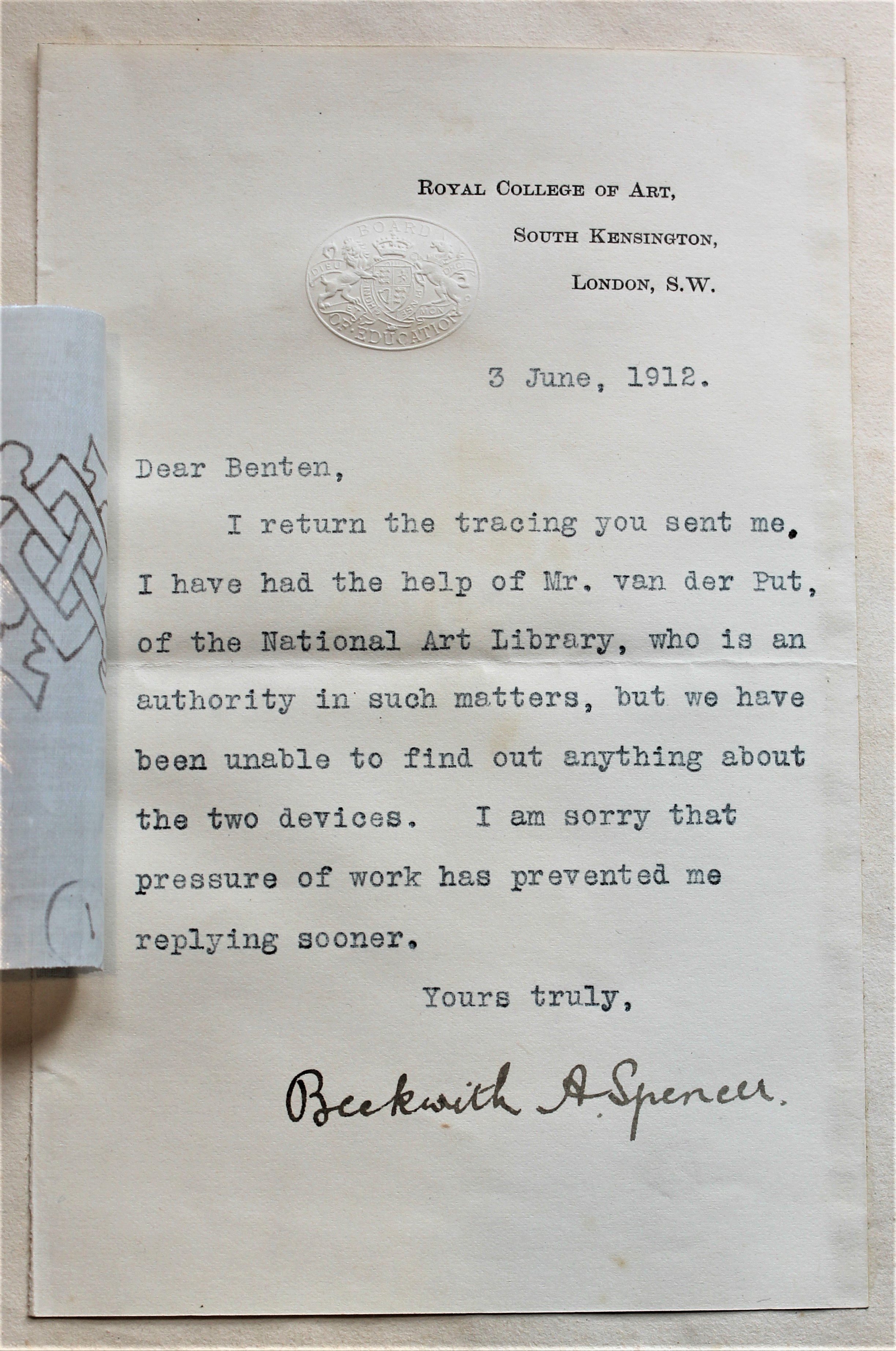
This emblem appears to have puzzled the staff in King’s Library for over a century. Stuck to the flyleaf opposite the title page is a letter of 3 June 1912 addressed to Arthur Richard Benten, then under-librarian at King’s, by Beckwith A. Spencer of the Royal College of Art. In it, he states that he was unable to identify these two devices despite enlisting the help of Albert van der Put of the National Art Library:

The same device also appears in two other incunabula bequeathed by Jacob Bryant: as an illumination inside the initial of the first page in Guido delle Colonne’s Historia destructionis Troiae (1486):

Detail of leaf a2 recto in Guido delle Colonne’s Historia destructionis Troiae (Strasbourg: Georg Husner, 1486; Bryant.XV.2.7).

and as a tail-piece painted at the bottom of a4 verso in our copy of Robert Gaguin’s Compendium De origine et gestis Francorum (1497):

Leaf a4 verso of Robert Gaguin’s Compendium De origine et gestis Francorum (Lyon: Johannes Trechsel, 1497; Bryant.XV.6.6). The bull device also rears its head as an illuminated initial on leaves b5 verso and g3 verso.

If anyone has any information that may help us identify this device and solve a century-old mystery, please do get in touch!

IJ

What’s in a Letter?

As we’ve seen in a previous post, illuminations in incunabula can be seen as a remnant of the manuscript tradition that persisted in the transition to the printing era. In our copy of Ognibene Bonisoli’s De octo partibus orationis (Padua, 1474), bequeathed to King’s College by Jacob Bryant (1715-1804), there are no guide letters in the spaces left blank for the illuminator, so it was up to him to choose which letter to write. On the first page is Bonisoli’s dedication to his pupil, the condottiere Federico Gonzaga (1441-84), who later became the third marquess of Mantua.

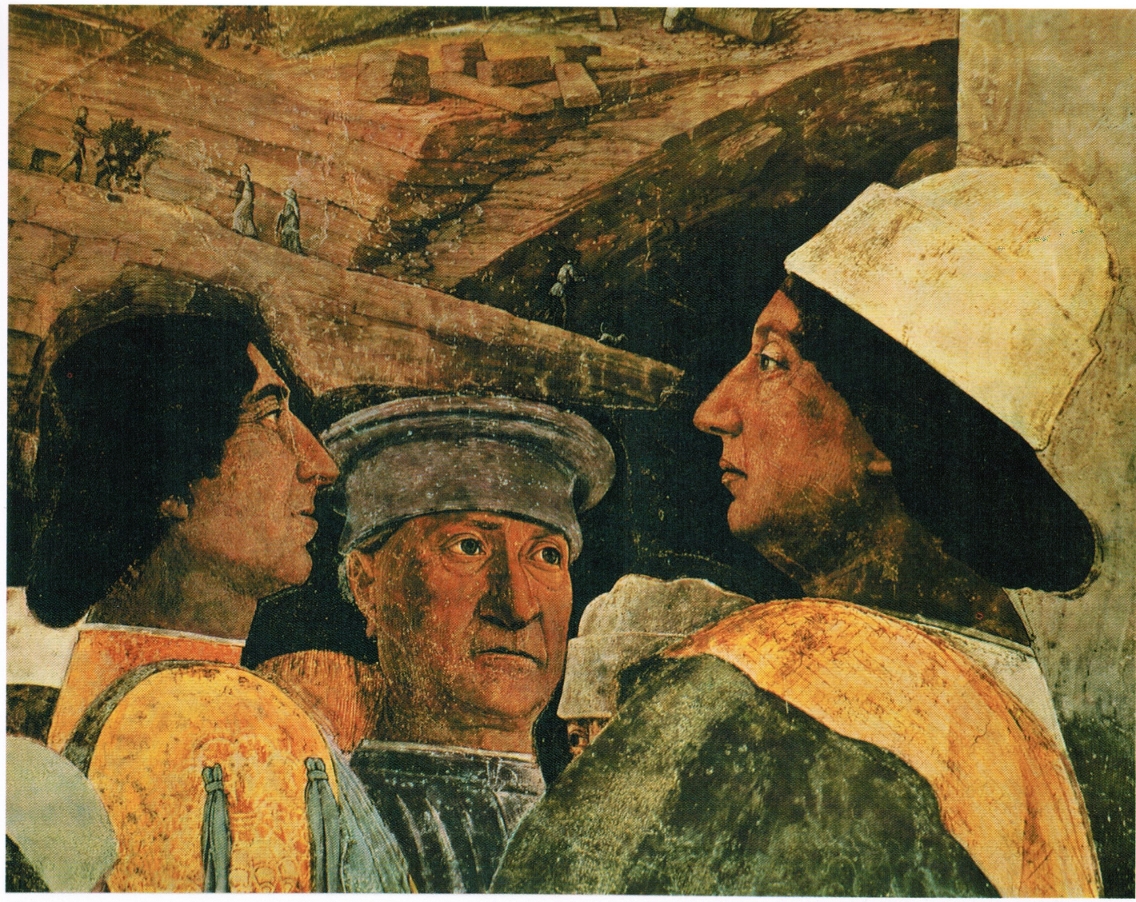
Federico Gonzaga (right) in one of Andrea Mantegna’s frescos in the Camera degli Sposi in Mantua, painted between 1465 and 1474.

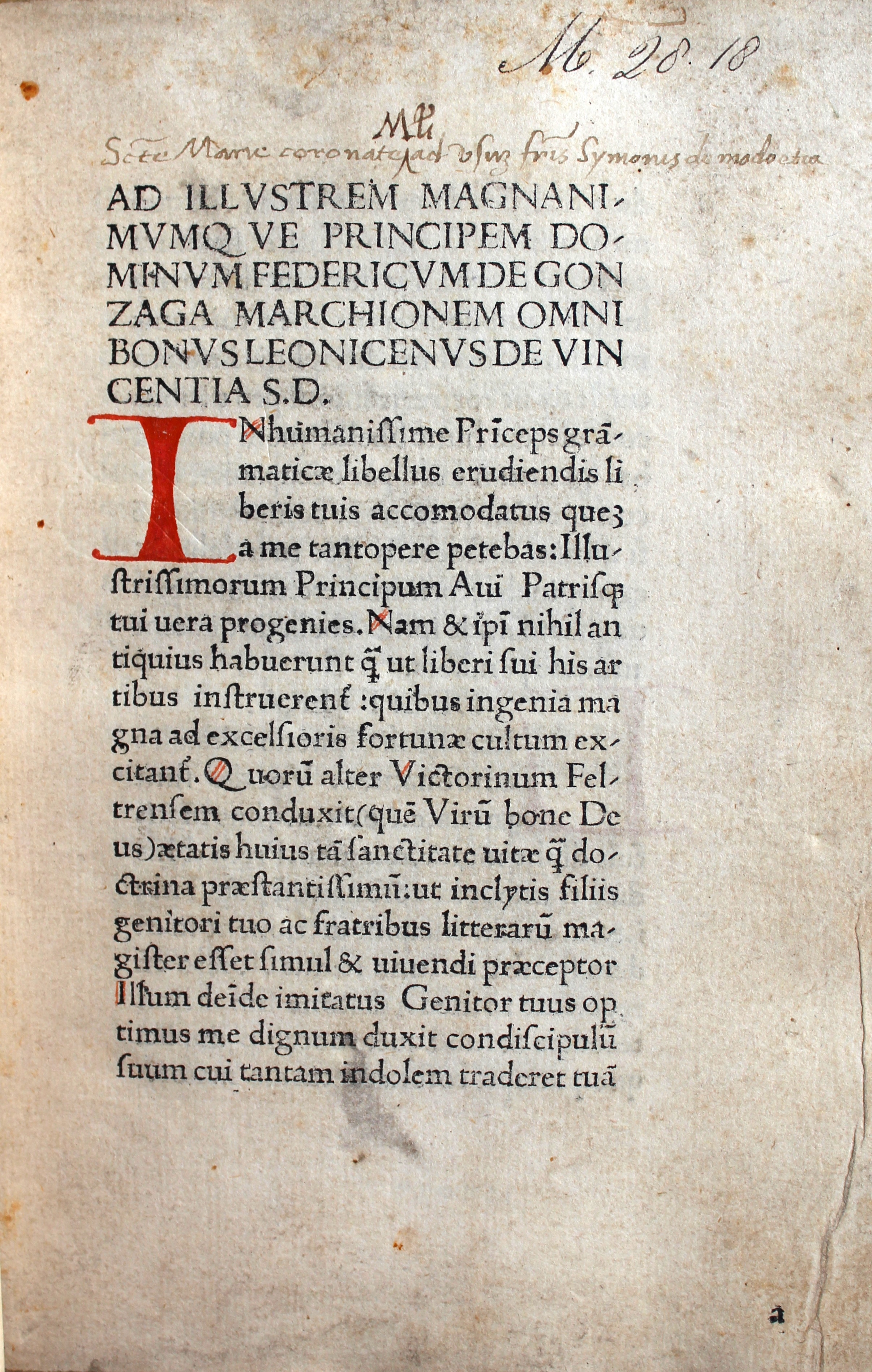
Instead of inserting an “E” to give “En humanissime pri[n]ceps” (Lo, most humane leader), the illuminator added an “I”: “Inhumanissime pri[n]ceps” (Most inhumane leader):

First leaf of Ognibene Bonisoli’s De octo partibus orationis (Padua: Bartholomaeus de Valdezoccho and Martinus de Septem Arboribus, 1474; Bryant.XV.3.6). The manuscript inscription at the top indicates that the book belonged to the church of Santa Maria Incoronata in Milan, which was completed in 1460.

Though this is most likely to have been an unintentional error on the illuminator’s part, whose Latin perhaps was not up to scratch, it is tempting to imagine that it may have been a parting shot from a disgruntled employee on his final day at work…

IJ

The Cadbury Bequest

Thanks to a generous bequest from Sir Adrian Cadbury (1929-2015), King’s College Library has been able to continue the process of cataloguing its collection of rare books. Sir Adrian was great-grandson of John Cadbury, a tea and coffee merchant in Birmingham who later manufactured cocoa powder. John’s sons developed a chocolate recipe in 1866 and went on to build the famous Bournville model village near Birmingham, introducing the Dairy Milk brand in 1905. Sir Adrian came up to King’s in 1949 to read economics. He joined the family business straight from university and became a director of Cadbury Bros in 1958. He retired from his position at Cadbury in 1989, and in his distinguished career was also a director of the Bank of England (1970-94) and of IBM (1975-94).

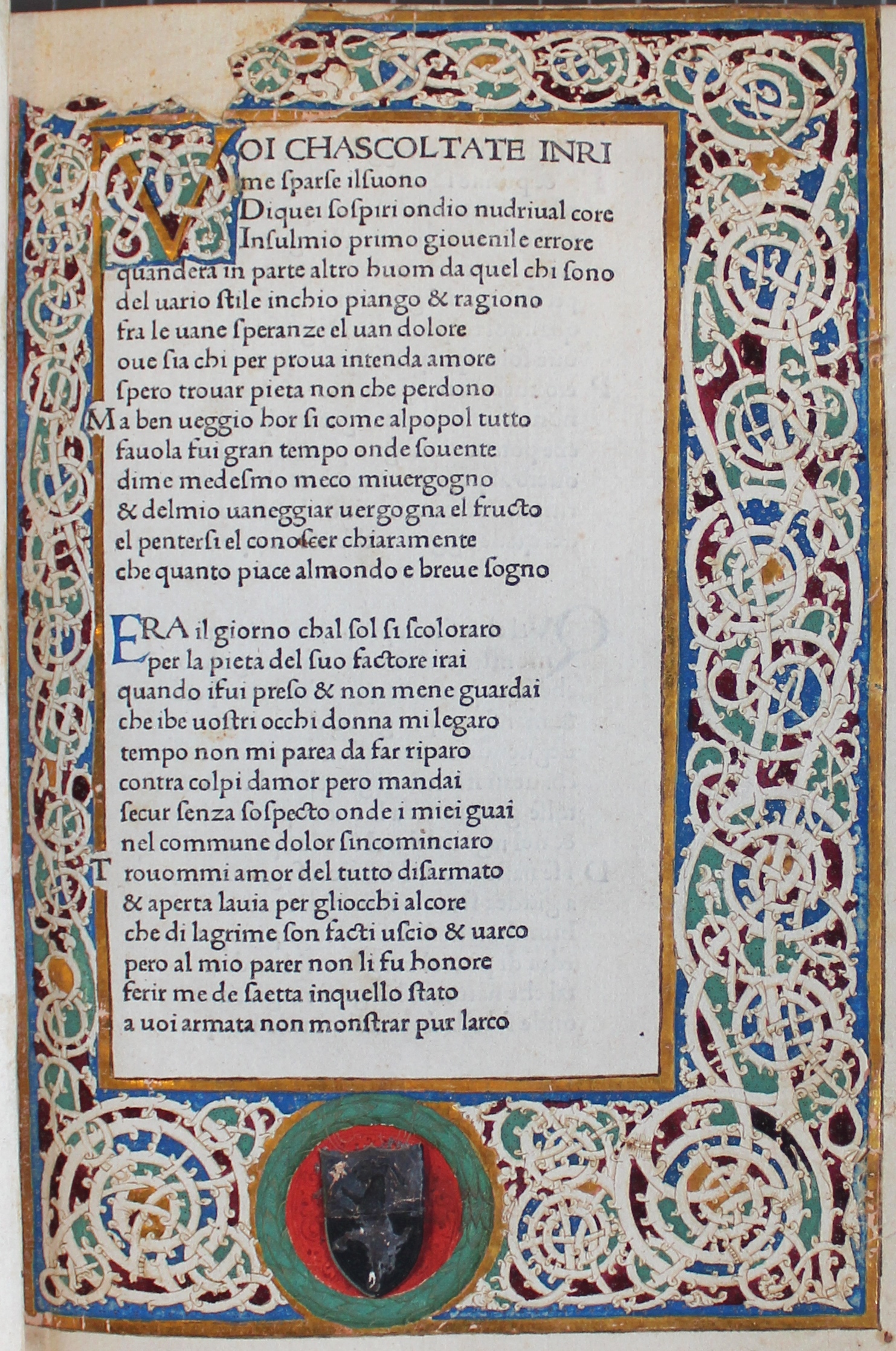
The Cadbury bequest has so far enabled us to catalogue over 200 incunabula, i.e. books printed before 1501. Some of these, such as a few statutes passed during the reign of King Henry VII and printed between 1496 and 1501, are not preserved in any other library. Other rare highlights include two copies of the 1470 editio princeps of Petrarch’s Canzoniere, one of the most important works in Italian literature of which only about 30 copies survive in public libraries worldwide:

“Voi ch’ascoltate in rime sparse il suono”: the opening of Petrarch’s Canzoniere, first printed in Venice by Vindelino da Spira in 1470 (Bryant.XV.2.11)

There are only three known copies of this 1495 edition of John Mirk’s Liber festivalis (Book of Festivals), a collection of homilies for the liturgical festivals as they were celebrated in Mirk’s native Shropshire at the time. The woodcut title page depicts the Annunciation and the Tree of Jesse:

Title page of John Mirk’s Liber festivalis (Rouen: James Ravynell, 1495) (Bryant.XV.3.24)

The book belonged to the noted Anglo-Saxon scholar Elizabeth Elstob (1683-1756), whose signature is visible on the right. On the title page verso is another woodcut featuring the Crucifixion and, at the foot of the page, Christ carrying the cross:

Title page verso of John Mirk’s Liber festivalis (Bryant.XV.3.24)

Happy Easter from all of us at King’s College Library and Archives; we hope you enjoy some Cadbury chocolate this Easter!

IJ