Tag Archives: Chinese New Year

Sinuous, slithery snakes!

As the Lunar New Year of the Snake gets underway, we’ve discovered that our rare book stores are teeming with these sinuous reptiles! They slither through the pages of bibles, travel books, natural history books, works of heraldry and more! Where is St. Patrick when you need him! What follows is a only a selection of the many serpents that have recently emerged, hissing, into the light of day.

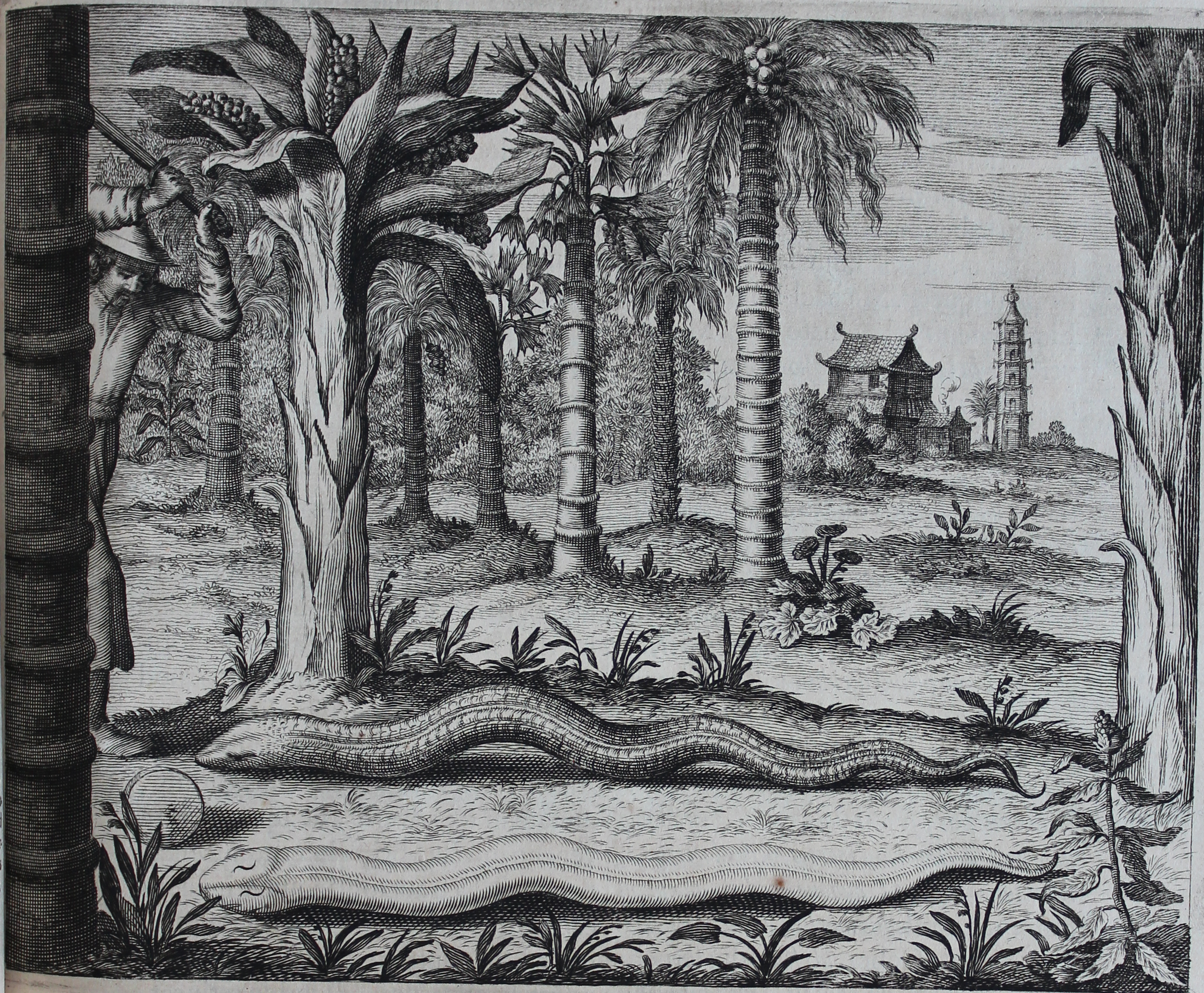
It seems appropriate to begin in China, with an illustration from a book on the country by Athanasius Kircher (1602-1680). Kircher was a German Jesuit and Renaissance polymath, who has been styled by some as the last man who knew everything. He had a long eventful life during which he published around forty books on a wide variety of topics, including ancient languages, music and geology. He was refused permission to become a missionary in China himself, but compiled the reports of many of his Jesuit colleagues to produce a magnificently illustrated volume on the country, encompassing zoology, geography, religion, botany, and much more besides. Below is one of the illustrations, featuring two large snakes, and a man in the corner apparently about to attack them with a stick!

Two large snakes slithering across the foreground, with trees and buildings in the background and a man with a hammer in the left hand corner

Illustration from page 81 of China Monumentis by Athanasius Kircher, Amsterdam, 1667 (Shelfmark: M.40.28)

From one of our early printed bibles comes this woodcut of Adam and Eve in the Garden of Eden, with the wily serpent coiled around a tree in the background. If you look closely, it appears to have a Mohican haircut!

Black and white woodcut showing Adam, Eve and the serpent in Eden, and also being ejected from the garden by a winged figure

Woodcut from fol. 1 of Biblia cum concordantiis veteris et novi testamenti et sacrorum canonum, London, 1522 (Shelfmark: Keynes.E.12.15)

A later depiction of Eden is found in one of our copies of John Milton’s epic poem Paradise Lost, which has glorious illustrations by Francis Hayman (1708-1776), one of the founding members (and first librarian) of the Royal Academy. Here, in an engraving placed at the beginning of Book 10, the serpent lurks in the corner while Adam and Eve beg forgiveness from God for their disobedience in eating the apple.

Adam and Eve

Plate facing page 221 of volume 2 of The Poetical Works of John Milton, London, 1761 (Shelfmark; Thackeray.J.60.19)

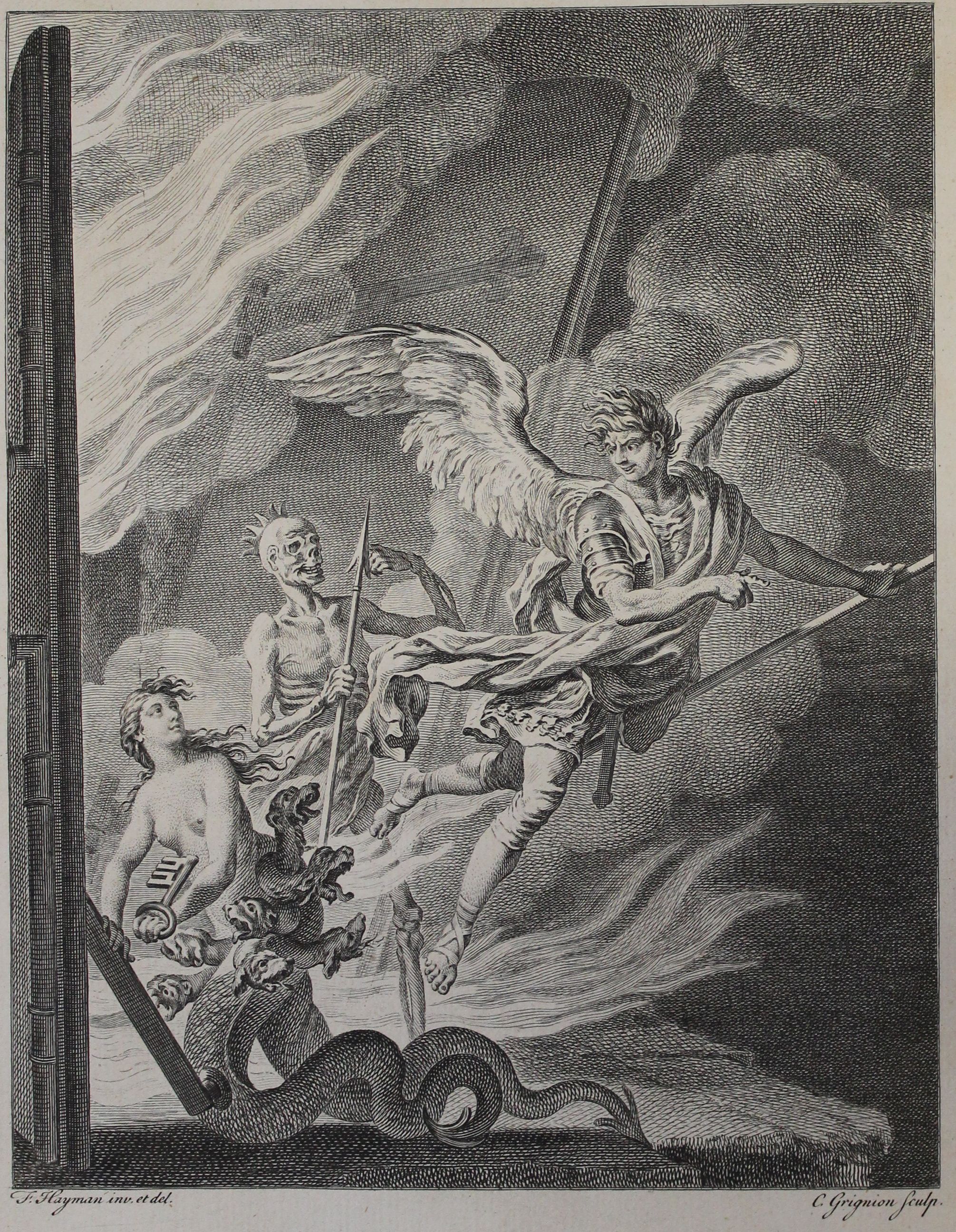
An earlier engraving from Book 2 of the same poem shows Satan at the gates of Hell, which are guarded by a skeletal figure in a crown, a many-headed hell hound, and a woman representing sin, who has a serpent’s coils instead of legs. The text describes it thus:

The one seem’d Woman to the waste, and fair [line 650]
But ended foul in many a scaly fould
Voluminous and vast, a Serpent arm’d
With mortal sting: about her middle round
A cry of Hell Hounds never ceasing bark’d

Satan at the gates of hell

Plate facing page 83 of volume 1 of The Poetical Works of John Milton, London, 1761 (Shelfmark; Thackeray.J.60.18)

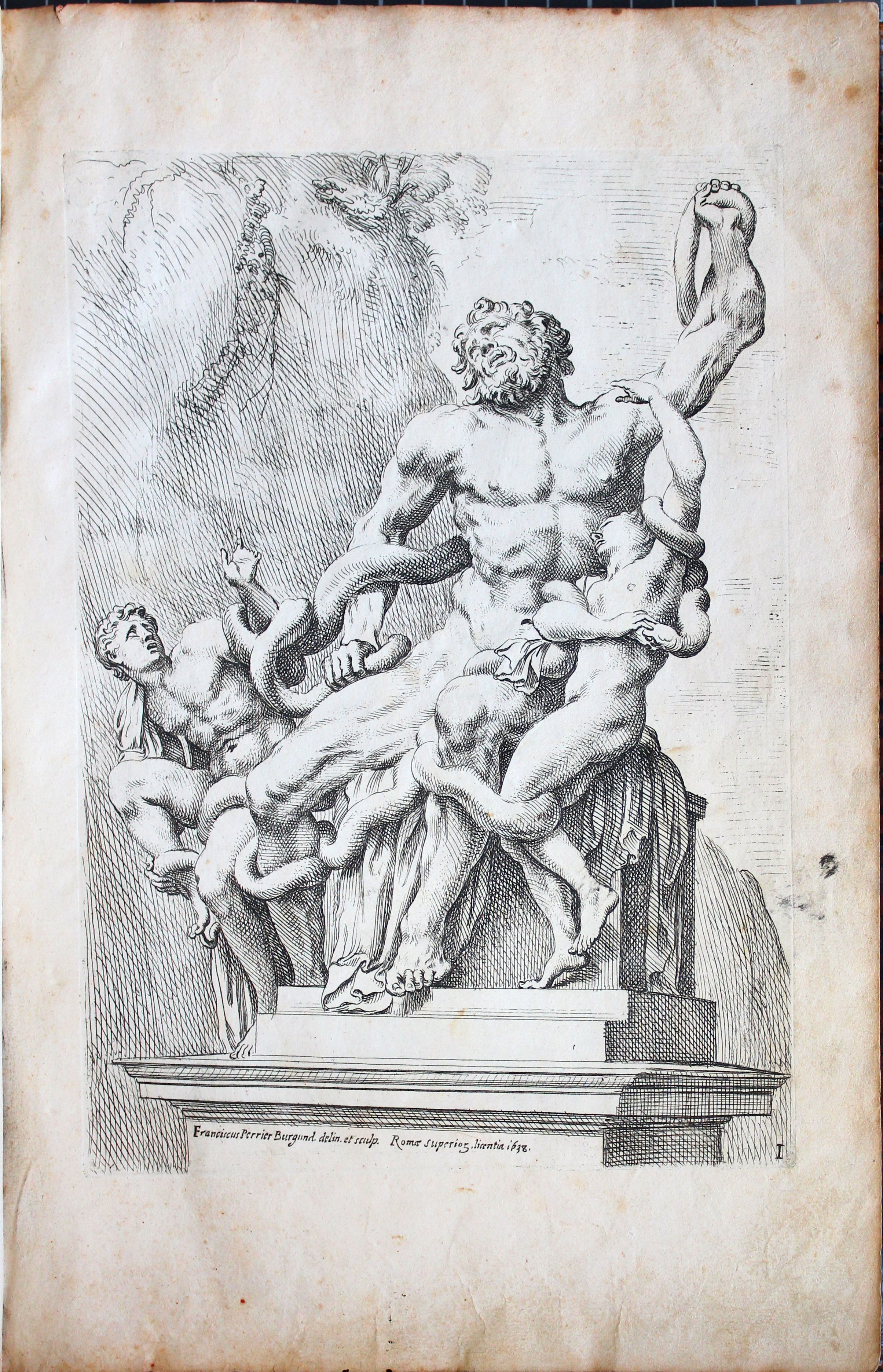
Next we turn to classical mythology and the story of Laocoön, a Trojan priest, who, along with his two sons, was attacked by venomous sea serpents. Reasons given for the attack vary, but Virgil’s version of the story goes that Laocoön was punished for attempting to alert Troy’s inhabitants to the grave threat posed by the Trojan Horse. From the Bury Collection, this seventeenth-century volume of sketches of classical statues includes a rendering of a Roman statue of Laocoön and his sons languishing in the coils of the serpents.

 Laocoön and sons being attacked by serpents

Plate 1 from Segmenta nobilium signora et statuarum by François Perrier, Rome, 1638 (Shelfmark: Bury.PER.Seg.1638)

Another engraving in the same volume depicts a statue of a Vestal virgin, with a snake draped over her shoulder.

A statue of a vestal virgin with a snake on her shoulder

Plate 65 from Segmenta nobilium signora et statuarum, by François Perrier, Rome, 1638 (Shelfmark: Bury.PER.Seg.1638)

Snakes are among the many different creatures that appear in printers’ marks or devices, which were a kind of early logo or copyright mark commonly found on the title pages of early printed books. Below is the printer’s device of William Jaggard (1569-1623), which features the ancient Ouroboros symbol of a coiled snake devouring its own tail.

Printer's device

Printer’s device from the title page of The Two Most Unworthy and Notable Histories Which Remaine Unmained to Posterity, by Sallust, London, 1609 (Shelfmark: Keynes.D.2.14)

In heraldry, snakes have often been used on coats of arms as symbols of prudence and subtlety, as this seventeenth-century book, A Display of Heraldrie by John Guillim (1565-1621) explains. Guillim was an antiquarian and officer of arms at the College of Arms in London.  His book references the Medusa myth, and notes a belief that if the hair of a woman is placed in manure it will transform into venomous snakes!

Explanation of the use of snakes in coats of arms

Illustration and text from page 153 of A Display of Heraldrie by John Guillim, London, 1611 (Shelfmark: H.17.39)

Later in the same book, an adder wrapped round a pillar is said to symbolize prudence combined with constancy.

Explanation of a snake wrapped round a pillar

Illustration and text from page 213 of A Display of Heraldrie by John Guillim, London, 1611 (Shelfmark: H.17.39)

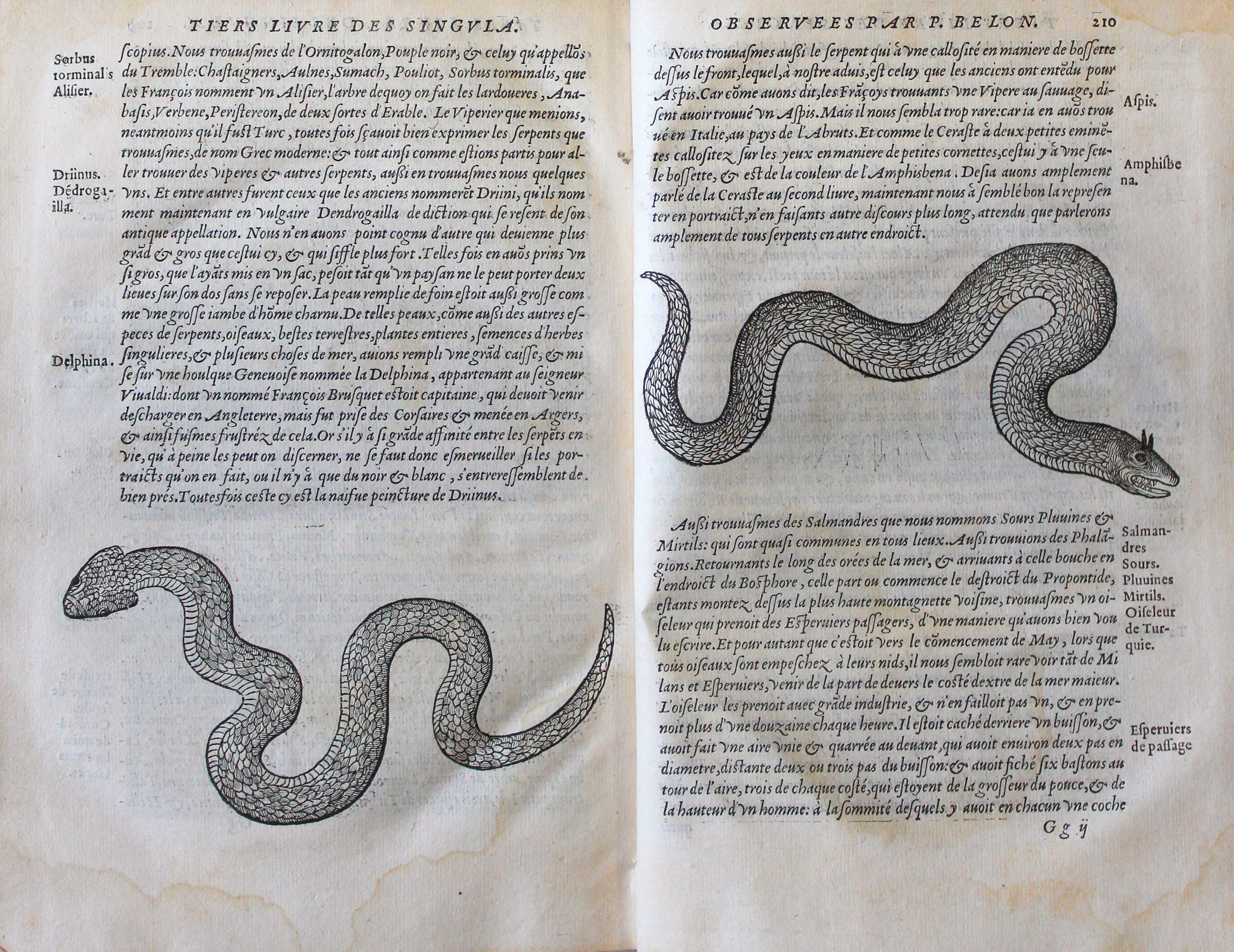
Moving into early works of natural history, we find an abundance of snakes. The sixteenth-century drawings below come from a work published by the traveller and naturalist Pierre Belon (1517?-1564).

Text in French and black and white illustrations of two snakes

Illustrations of snakes from pages 209 and 210 of Les Obseruations de plusieurs singularitez & choses memorables by Pierre Belon, Paris, 1555 (shelfmark: T.16.20)

Next comes an entire work dedicated to snakes by French apothecary Moyse Charas (1619-1698). Charas, whose work was first published in French in 1669 under the title:  Nouvelles expériences sur la vipère, was interested in the nature of snake venom and the ways in which extracts from snakes could allegedly be used to treat various ailments, such as smallpox and leprosy. Our library holds an English translation from 1670.

title page

Title page of New Experiments upon Vipers by Moyse Charas, London, 1670 (Shelfmark: Thackeray.VIII.11.12)

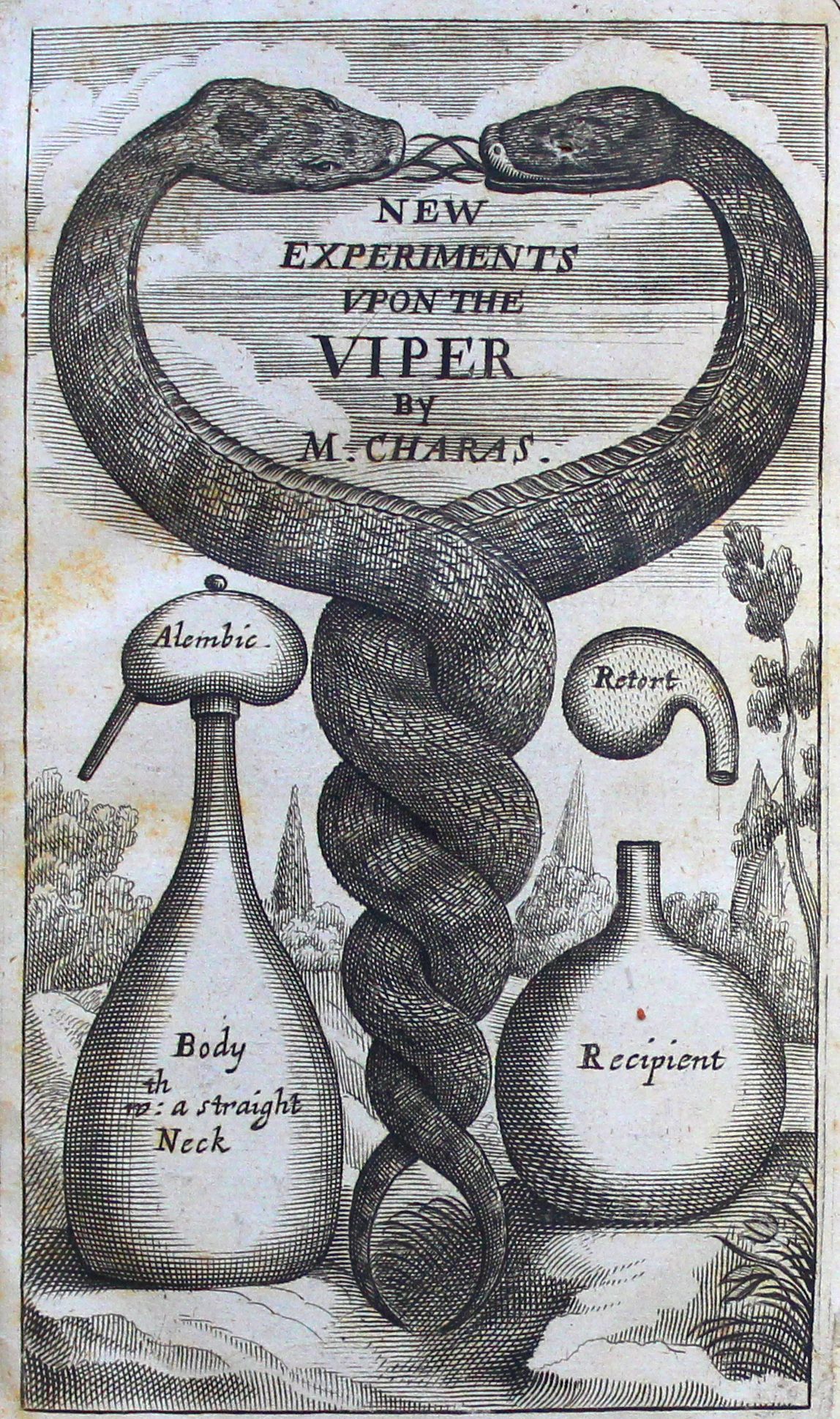
In addition to the main title page, it contains a glorious added engraved title page, showing entwined serpents.

Two entwined snakes, with the title in the middle

Added engraved page of New Experiments upon Vipers by Moyse Charas, London, 1670 (Shelfmark: Thackeray.VIII.11.12)

The book includes detailed anatomical drawings on folded plates at the rear, one of which is shown below.

folded plate showing illustrations of a snake's skeleton and various heads and skulls

Folded anatomical plate from New Experiments Upon Vipers by Moyse Charas, London, 1670 (Shelfmark: Thackeray.VIII.11.12)

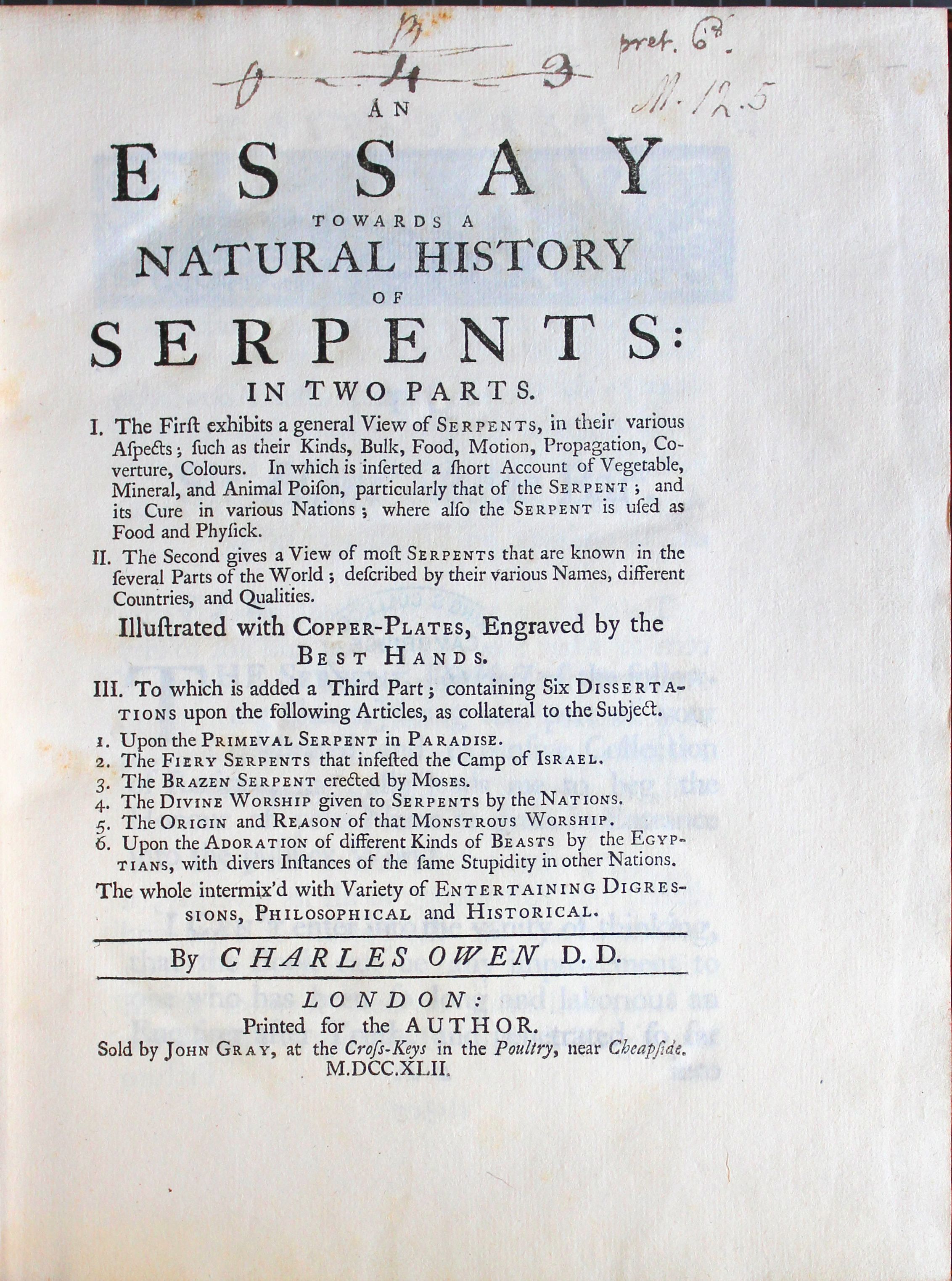
Another book focused entirely upon snakes is An Essay towards a Natural History of Serpents by Charles Owen (d.1746). Owen was a clergyman rather than a scientist, and his (often inaccurate) information is drawn from various biblical and mythological sources. The title page describes the contents in a fair amount of detail.

title page

Title page of An Essay towards a Natural History of Serpents by Charles Owen, London, 1742 (Shelfmark: Bryant.M.12.5)

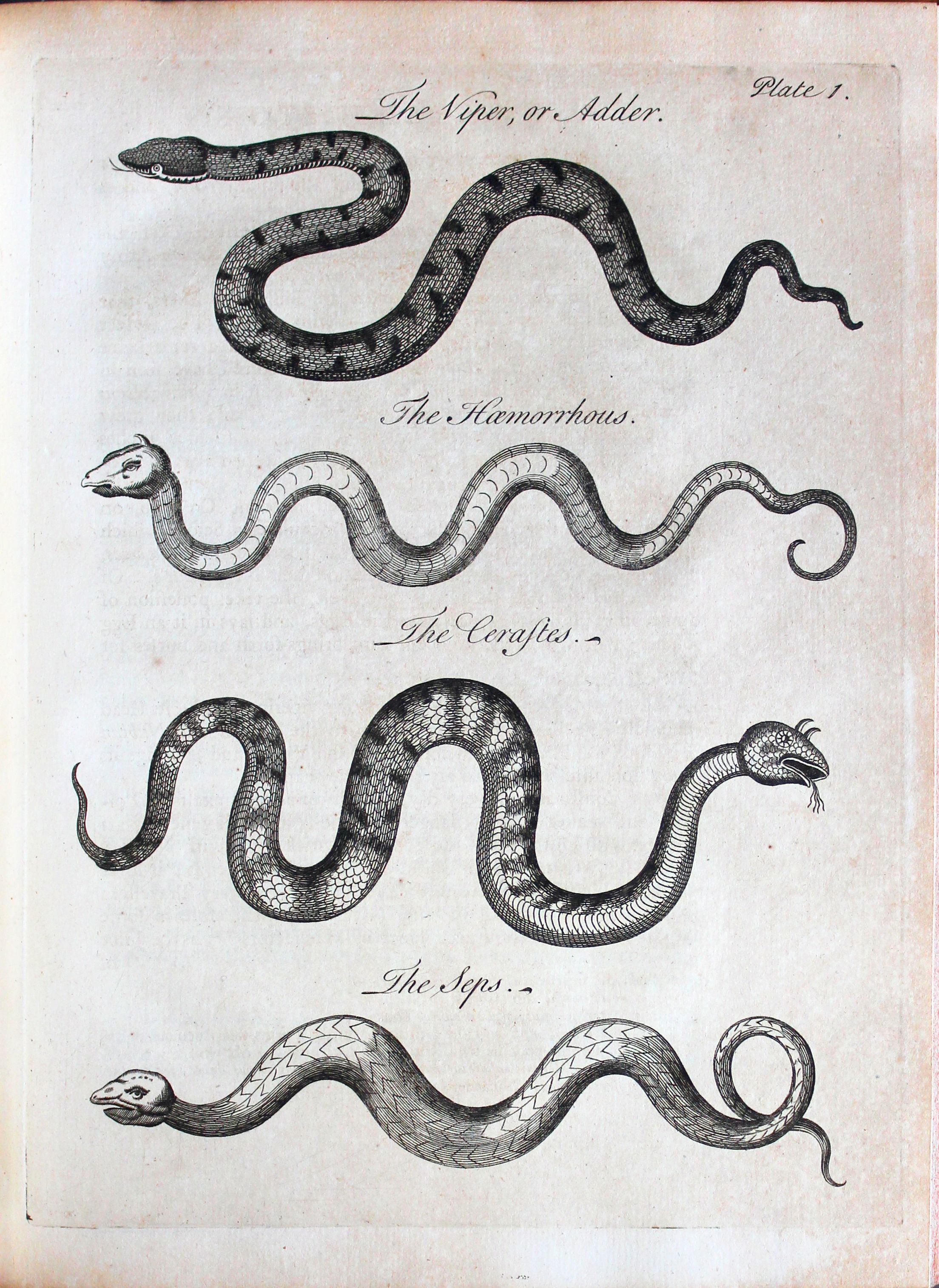
The illustrations in this volume are great fun, and very striking, as can be seen from the examples below. The snakes all have very expressive faces.

 four snakes

Plate 1 facing page 54 from An Essay towards a Natural History of Serpents by Charles Owen, London, 1742 (Shelfmark: Bryant.M.12.5)

four snakes, including a cockatrice

Plate 3 facing page 78 from An Essay towards a Natural History of Serpents by Charles Owen, London, 1742 (Shelfmark: Bryant.M.12.5)

The plate above includes the depictions of a mythical creature: the Basilisk (here conflated with the Cockatrice), which the text describes as the Little King of Serpents, hence the crown upon its head.

Four snakes

Plate 6 facing page 142 from An Essay towards a Natural History of Serpents by Charles Owen, London, 1742 (Shelfmark: Bryant.M.12.5)

Other natural history books provide beautiful colour images. Below is an illustration of a double-headed snake from a work chiefly devoted to rare birds, by noted English ornithologist George Edwards (1694-1773). Edwards widened the scope of his work to include other unusual creatures, including reptiles, and described this snake thus:

I did not propose at first in this Natural History to exhibit monsters, but our present subject (considered even with a single head) may be looked on as a natural production of a species little or not at all known to us.

We now know that this phenomenon comes about in some snakes in a very similar way to the development of human conjoined twins, and is not a sign of a separate species.

Colour illustration of a double-headed snake

Double-headed snake. From the plate facing page 207 of volume 4 of A Natural History of Uncommon Birds by George Edwards, London, 1743-51 (Shelfmark Keynes.P.6.11/1)

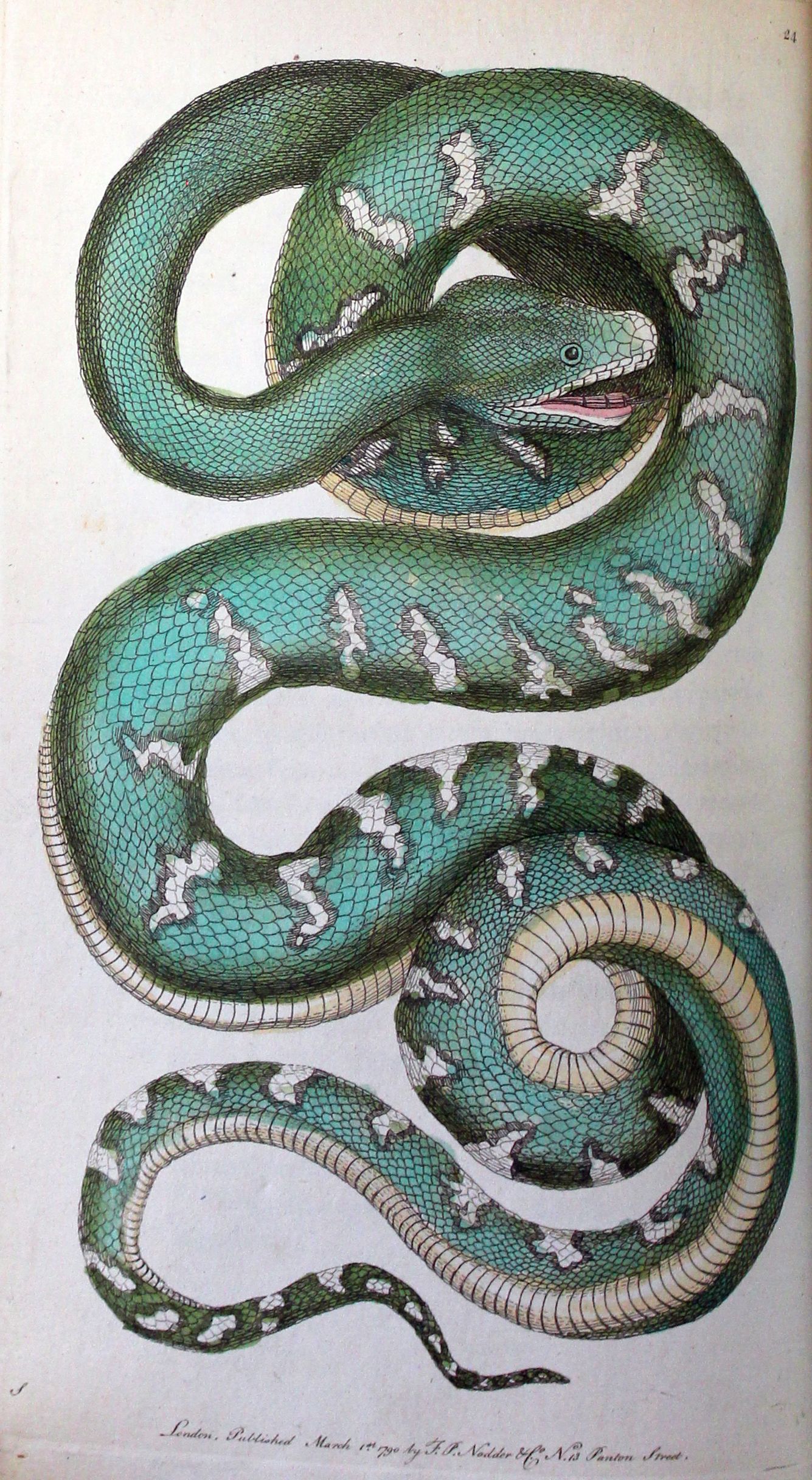
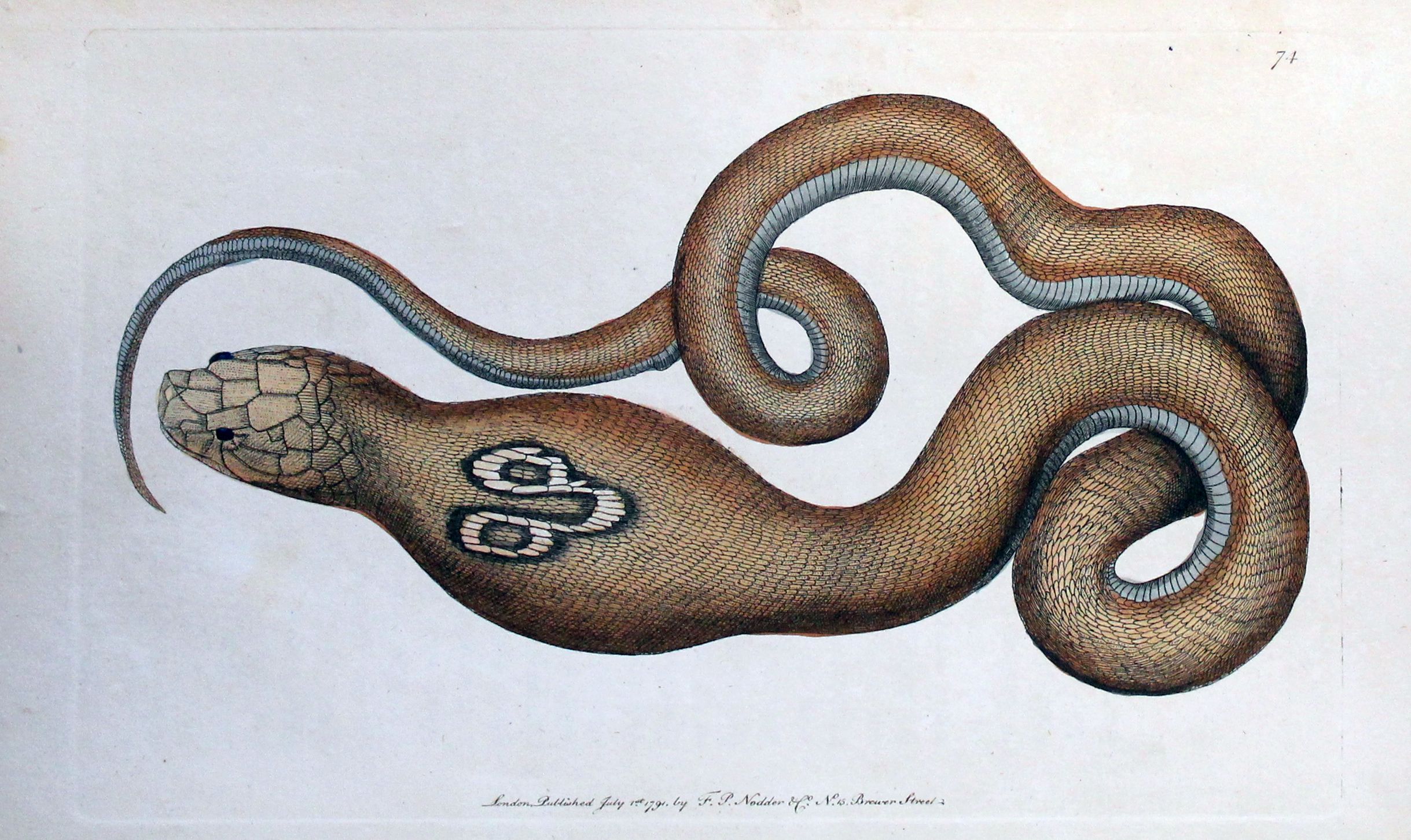
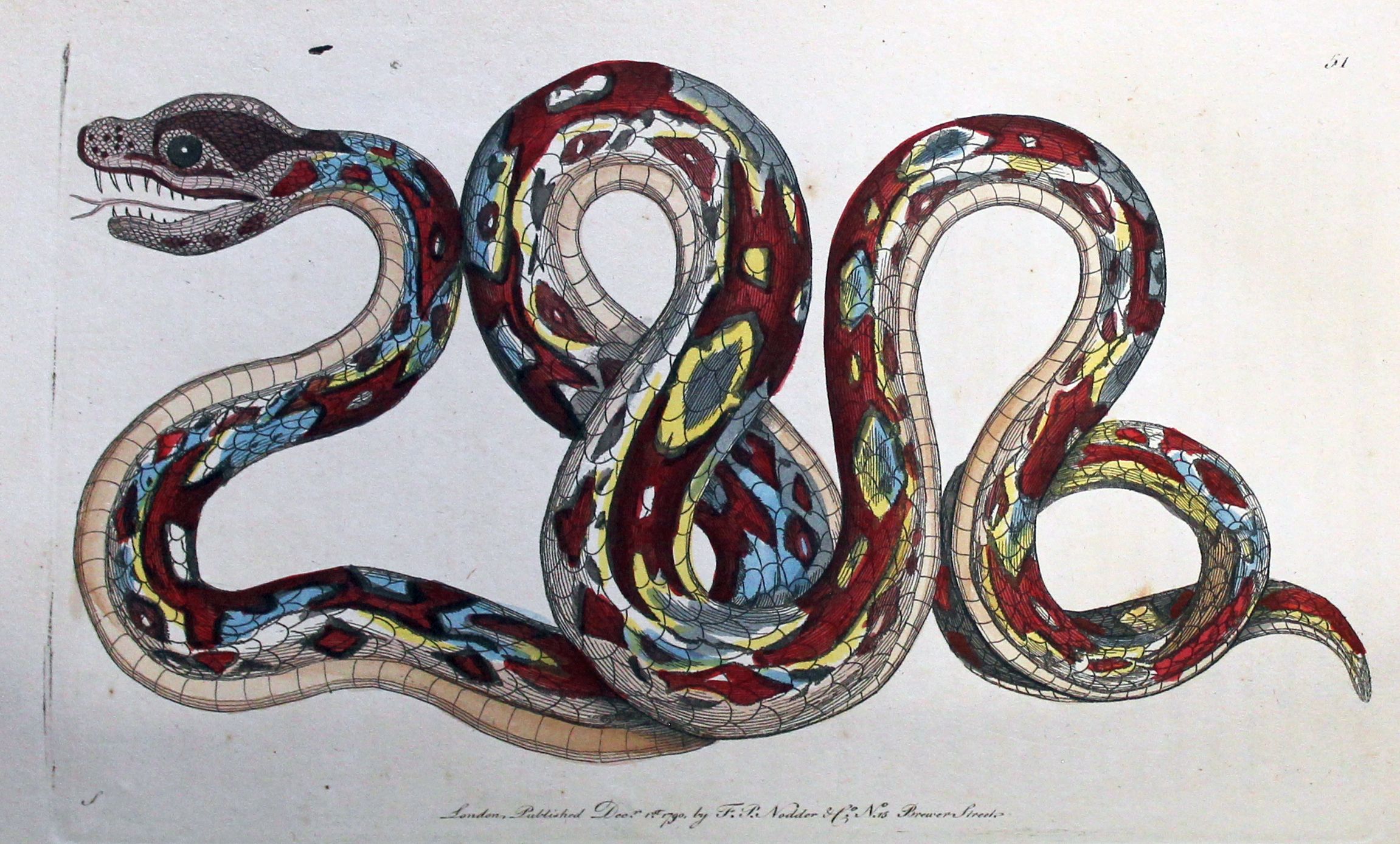
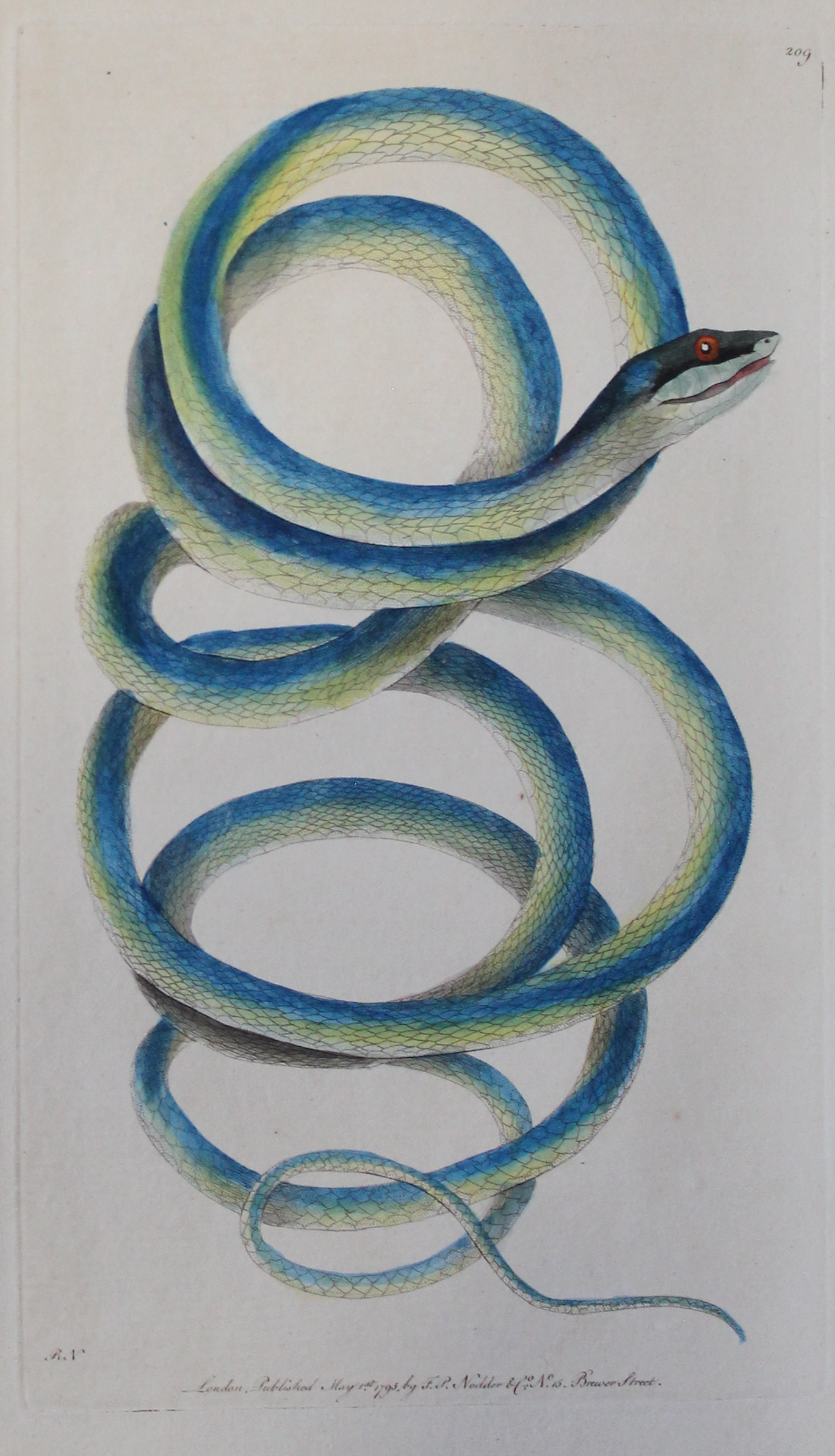
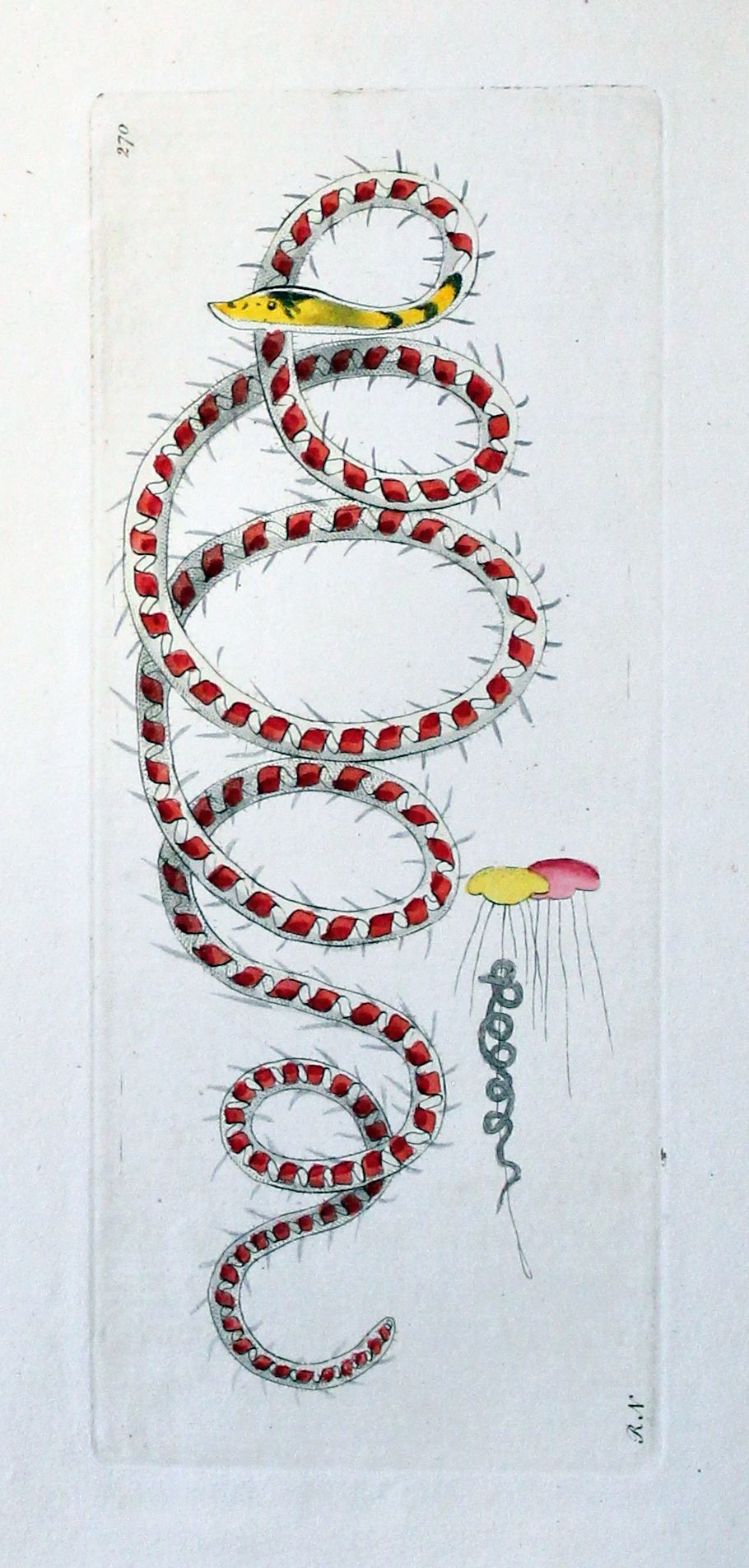
Leafing through a multi-volume miscellany of the natural world by biologist George Shaw (1751-1813), we were spoilt for choice for great images to highlight.  Shaw was a Fellow of the Royal Society and sometime keeper of the Natural History Department at the British Museum. He described many new species of amphibian and reptile. Below are just a few of the many vibrant illustrations of snakes contained within Shaw’s Miscellany.

Painted snake - orange with black spots

Painted snake. Plate facing fol. C2 recto in volume 1 of The Naturalist’s Miscellany by George Shaw, London, 1790 (Shelfmark: Thackeray.IV.2.2)

Large bright green snake with white spotches

The canine boa. Plate 24, facing fol. L4 recto in part 1 of The Naturalist’s Miscellany by George Shaw, London, 1790 (Shelfmark: Thackeray.IV.2.2)

Large brown snake

The spectacle snake. Plate 74, facing fol. 2K4 verso in part 2 of The Naturalist’s Miscellany by George Shaw, London, 1791 (Shelfmark: Thackeray.IV.2.2)

red, blue and yellow snake

The Great Boa. Plate 51, facing fol. Z5 recto in part 2 of The Naturalist’s Miscellany by George Shaw, London, 1791 (Shelfmark: Thackeray.IV.2.2)

Long thin bluish green snake

The Gilded Snake. Plate 209, facing fol. O8 recto in part 6 of The Naturalist’s Miscellany by George Shaw, London, 1795 (Shelfmark: Thackeray.IV.2.4)

Strange thin red and white snake with bristles.

The Serpentiform Nais. Plate 270, facing fol. E4 recto in part 8 of The Naturalist’s Miscellany by George Shaw, London, 1796 (Shelfmark: Thackeray.IV.2.5)

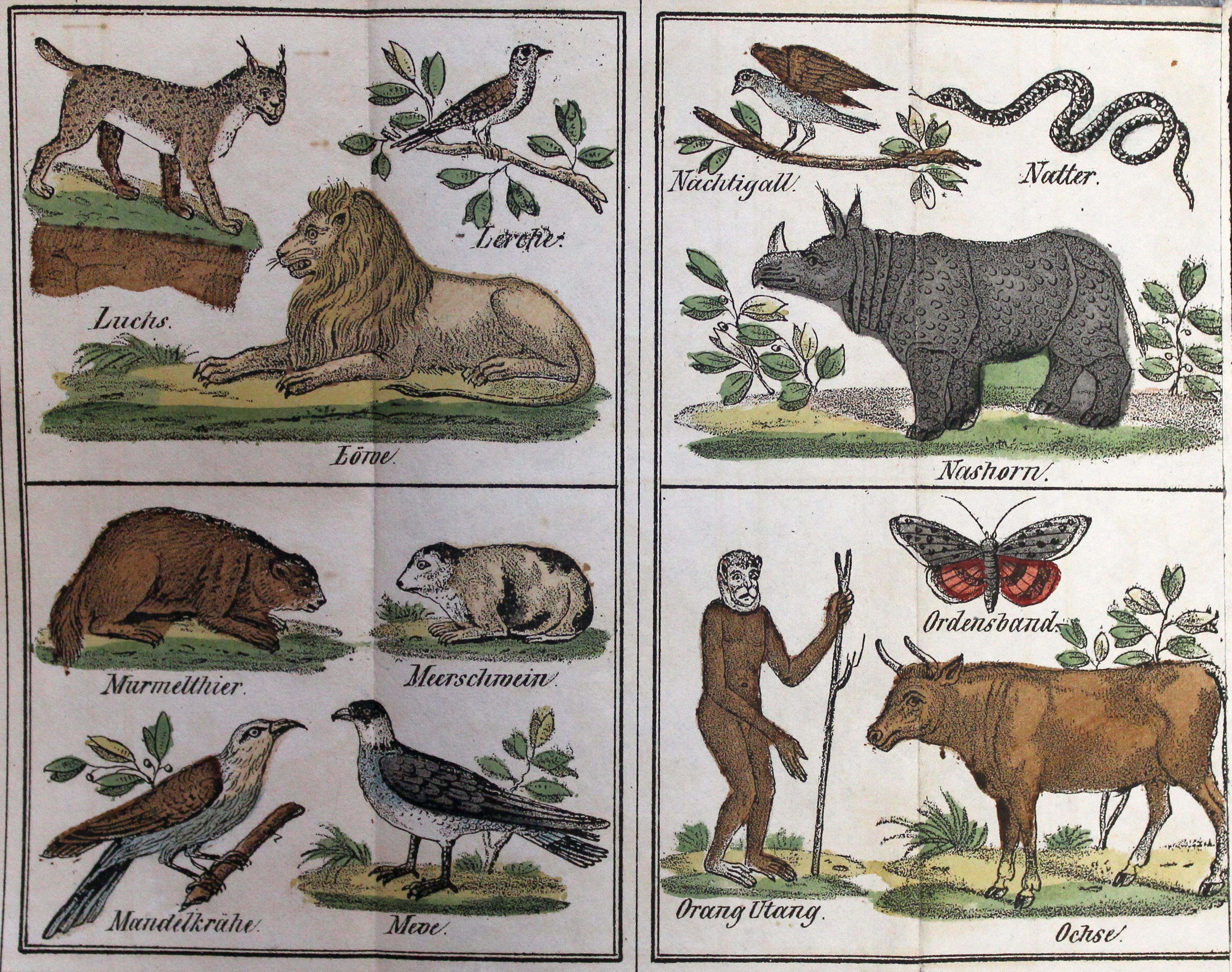
Finally, a little snake appears in a charming little German alphabet book from our Rylands Collection of children’s books. This tiny book, dating from the latter half of the nineteenth century, consists of three strips of paper stuck together and folded accordion-style. The German word for snake being “Natter”, the snake comes under the letter N in this sequence, alongside a Nashorn, or rhino, and a nightingale.

Illustrations representing different letters of the alphabet - a grid of four letters is shown. other animals shown include a lion, orangutan and an Ox

Section from Das ABC in Thieren, Neuruppin, circa late 19th century (Shelfmark: Rylands.C.ABC)

We hope you have enjoyed this survey of snakes within the pages of our rare book collections, and that you have a wonderful New Year!

References 

Joscelyn Godwin, Athanasius Kircher: A Renaissance Man and the Quest for Lost Knowledge , London, 1979.

Paula Findlen (editor), Athanasius Kircher: The Last Man Who Knew Everything, New York, 2004.

AC

Soaring into the New Year on the back of a dragon

In honour of the Year of the Dragon, we went on a perilous mission into the Library’s treasure hoards of books to find out if any of those fearsome beasts might be lurking inside. Alas, no Chinese dragons were discovered, but we did encounter several of the European variety and bravely captured their images to share with you in this post.

Our first dragon however, is not to be found within the pages of a book. It is a much more solid beast; a sculpture which originally adorned the College Chapel, but which was removed and replaced during restoration work. For the last few decades it has stood guard over the upstairs entrance of our Library, somewhat worn and battered by time maybe, but fierce and stalwart nonetheless.

A stone dragon standing upright with mouth open

The dragon outside the upstairs entrance of the Library

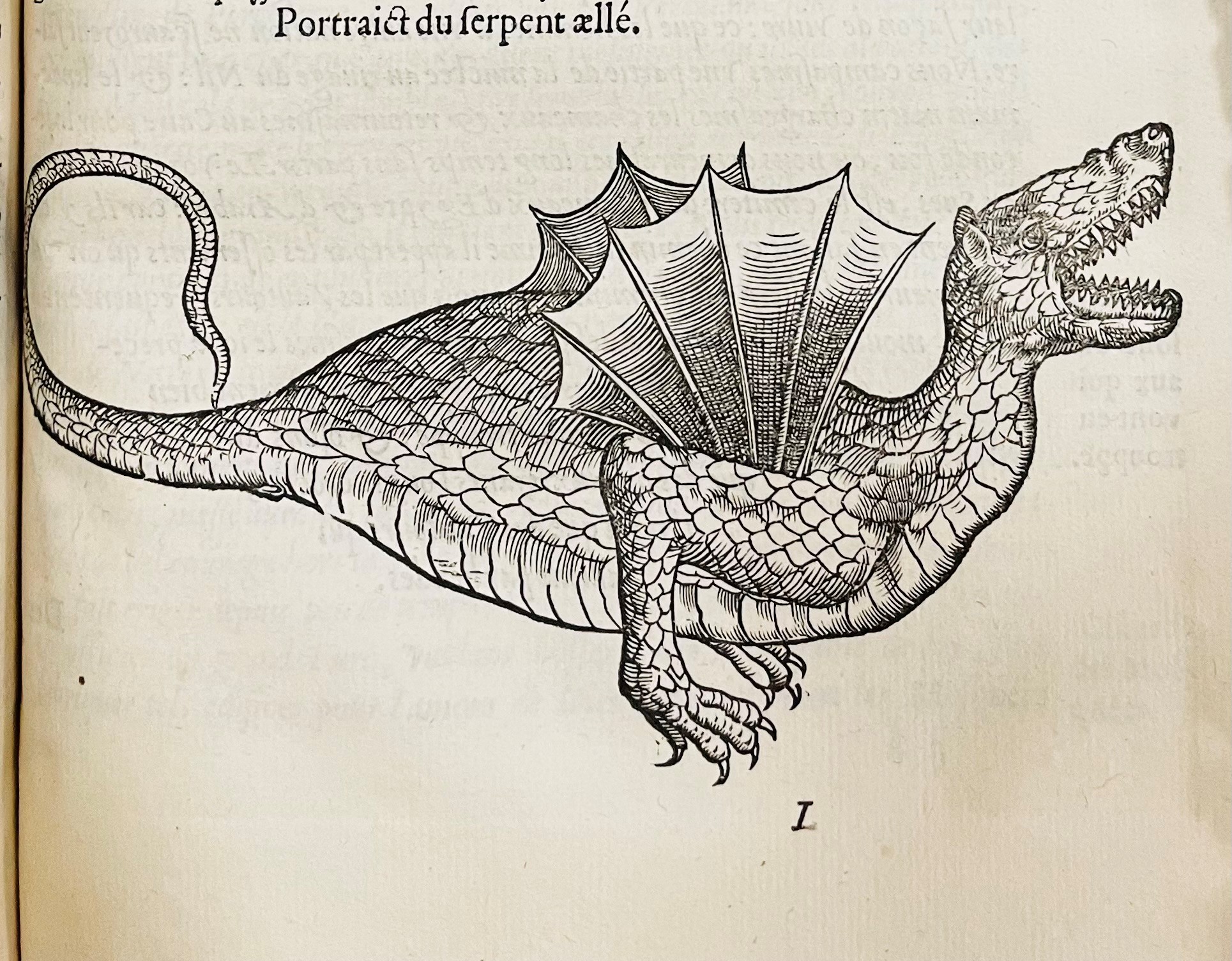
Several sixteenth-century works from our collections proved to be harbouring dragons. The first image comes from a volume of natural history by Pierre Belon (1517?-1564), originally produced in 1553. This is a very early printed depiction of a dragon with wings. Belon, a French naturalist and traveller, claimed to have seen embalmed bodies of these creatures during his travels in Egypt.

Woodcut of a two-legged winged dragon

Egyptian dragon from Les Obseruations de plusieurs singularitez & choses memorables by Pierre Belon, Paris, 1555 (T.16.20)

Secondly, we have an illustration depicting a very grand St George slaying a dragon, which adorns the title page of the 1527 edition of Polycronicon, by Benedictine monk, Ranulf Higden (ca. 1280-1364).  This was a very popular work of world history, written originally in Latin and later translated into English and added to over the following centuries.

Woodcut of St George on horseback with a dragon under the horse's hooves

St George and the dragon from the title page of Polycronycon by Ranulf Higden, London, 1527 (M.24.08)

Our last sixteenth-century image is from a 1590 edition of Edmund Spenser’s Faerie Queene. Here we have another knight, the Redcrosse Knight, killing a dragon in a very similar fashion. The Redcrosse Knight is very closely associated with St George.

Image of a knight on horseback with a dragon under the horse's hooves. The knight is running a spear through the dragon

The Redcrosse Knight from The Faerie Queene by Edmund Spenser, London, 1590 (Keynes.C.02.19)

Moving into the seventeenth century, a work of alchemy provides more images. Dragons in alchemy symbolize the unification of opposing forces like the sun and the moon or sulphur and mercury, and the change they produce when combined.  We therefore get these striking illustrations of entwined or two-headed dragons, as shown in the images below.

Two dragons perched atop a ring with their necks intertwined

Alchemical dragon symbol from page 212 of Theatrum Chemicum Britannicum edited by Elias Ashmole, London, 1652 (Keynes.C.4.2)

Upright two-headed dragon with a bird above and alchemists gathered around it

Two-headed dragon from page 213 of Theatrum Chemicum Britannicum edited by Elias Ashmole, London, 1652 (Keynes.C.4.2)

From our collection of children’s books comes a tale brimful of dragons. Snap-dragons: a Tale of Christmas Eve by Juliana Horatia Ewing (1841-1885) revolves around the parlour game of Snap-dragon, very popular in the nineteenth century, in which people took it in turns to snatch raisins from a bowl of flaming brandy.  This particular game conjures up a bevy of real dragons who draw a little boy into their boisterous and violent game of trading insults, or “snapping” at each other. It has some delightful illustrations.

Cover of the book showing a boy looking at a swirling group of dragons

Cover of Snap-dragons: a Tale of Christmas Eve by Juliana Horatia Ewing, London, 1888 (Rylands.C.EWI.Sna.1888a)

Text with a dragon illustration. The dragon is entwined with the initial B

Page 33 of Snap-dragons 

Text with an illustration of a dragon confronting a small boy

Pages 34 and 35 of Snap-dragons

Finally, we have this charming little dragon wrapped around an initial letter A in a volume of fairy tales, also by Ewing. Oddly enough, the tale it accompanies: “Knave and Fool”, features no dragons at all.

a dragon entwined around the initial A

Initial dragon from Old-fashioned Fairy Tales by Juliana Horatia Ewing, London, [1882?]  (Rylands.C.EWI.Old.1882)

Happy New Year!

References

Mythical creatures at the Edward Worth Library: Here be dragons! [accessed January 2024]

Jean Chevalier and Alain Gheerbrant, A Dictionary of Symbols. Oxford, 1994.

Lyndy Abraham, A Dictionary of Alchemical Imagery. Cambridge, 1998.

AC

Hopping into the new year

Last year we marked Chinese New Year with images of ferocious tigers discovered within our collections. 2023 is the year of a less fearsome creature, the rabbit, whose natural habitat appears to be the pages of children’s picture books. As a way of welcoming in the new year, this post will share some of the images unearthed from the warrens of our stores.

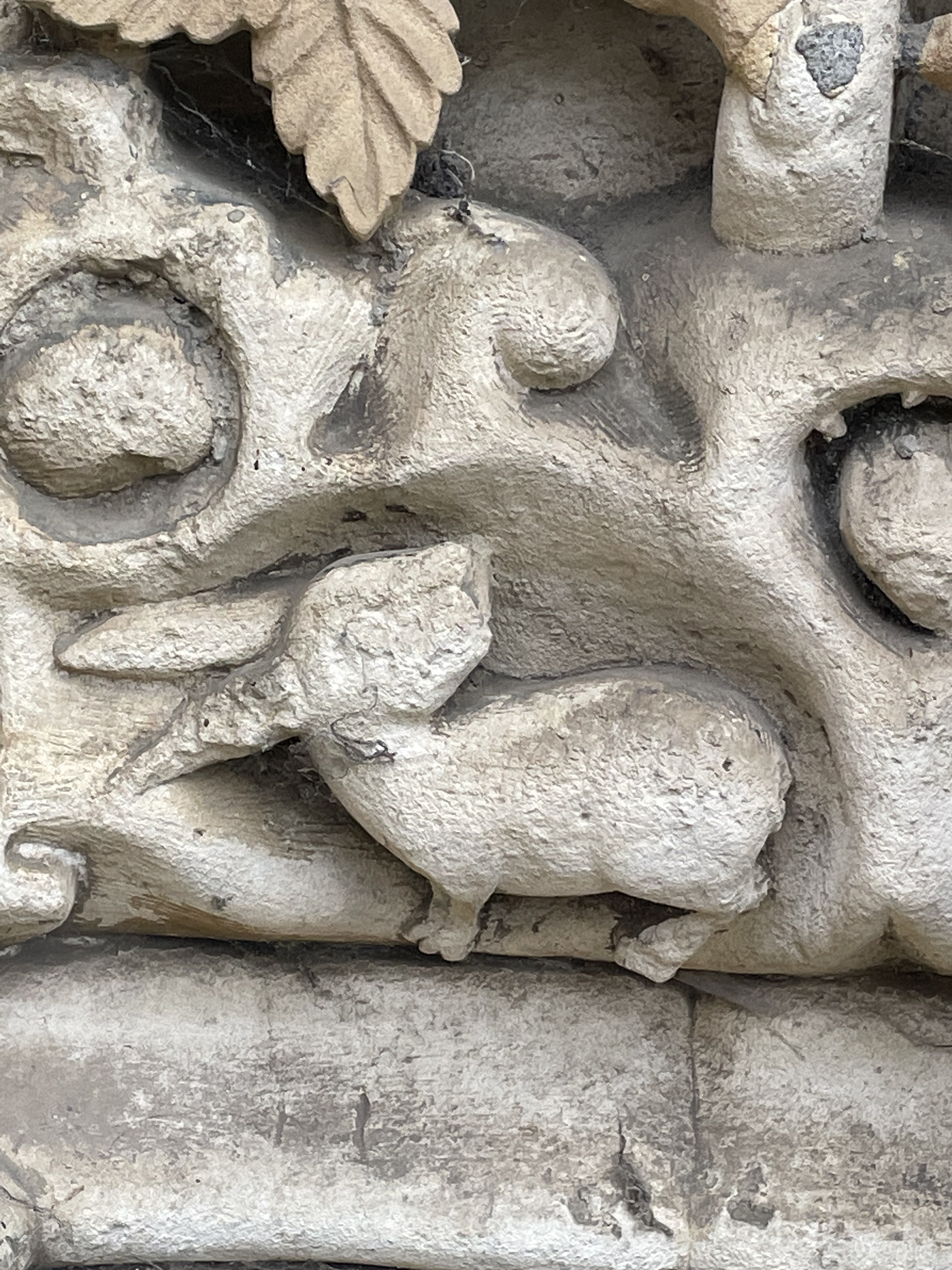
We start however, with a rabbit who has hopped his way into the very stonework of the College Chapel! Designed by master mason John Wastell, in the early 16th century, the jamb of the Chapel’s west door boasts an elaborate pattern of roses, crowns, leaves and stems, and at the base of one side can be found a dog playing hide and seek with a rabbit. The dog is now sadly weathered beyond recognition, but the rabbit is still very much visible, gazing up into the foliage above.

Stone rabbit in closeup

Close-up view of the rabbit on the jamb of the West door of King’s College Chapel, Cambridge

The stonework of the door jamb of the West door of King's College Chapel

The rabbit within the larger context of the decorative pattern on the door jamb

Next we have two illustrations from one of the early nineteenth century natural history titles featured in last year’s tiger post: Histoire naturelle des mammifères by Geoffroy-Saint-Hilaire and Frédéric Cuvier. These depict a familiar brown rabbit and one of the albino variety. 

Brown rabbit clutching a carrot

Plate from Vol. 2 of Histoire naturelle des mammifères, 1824, Shelfmark F.1.21

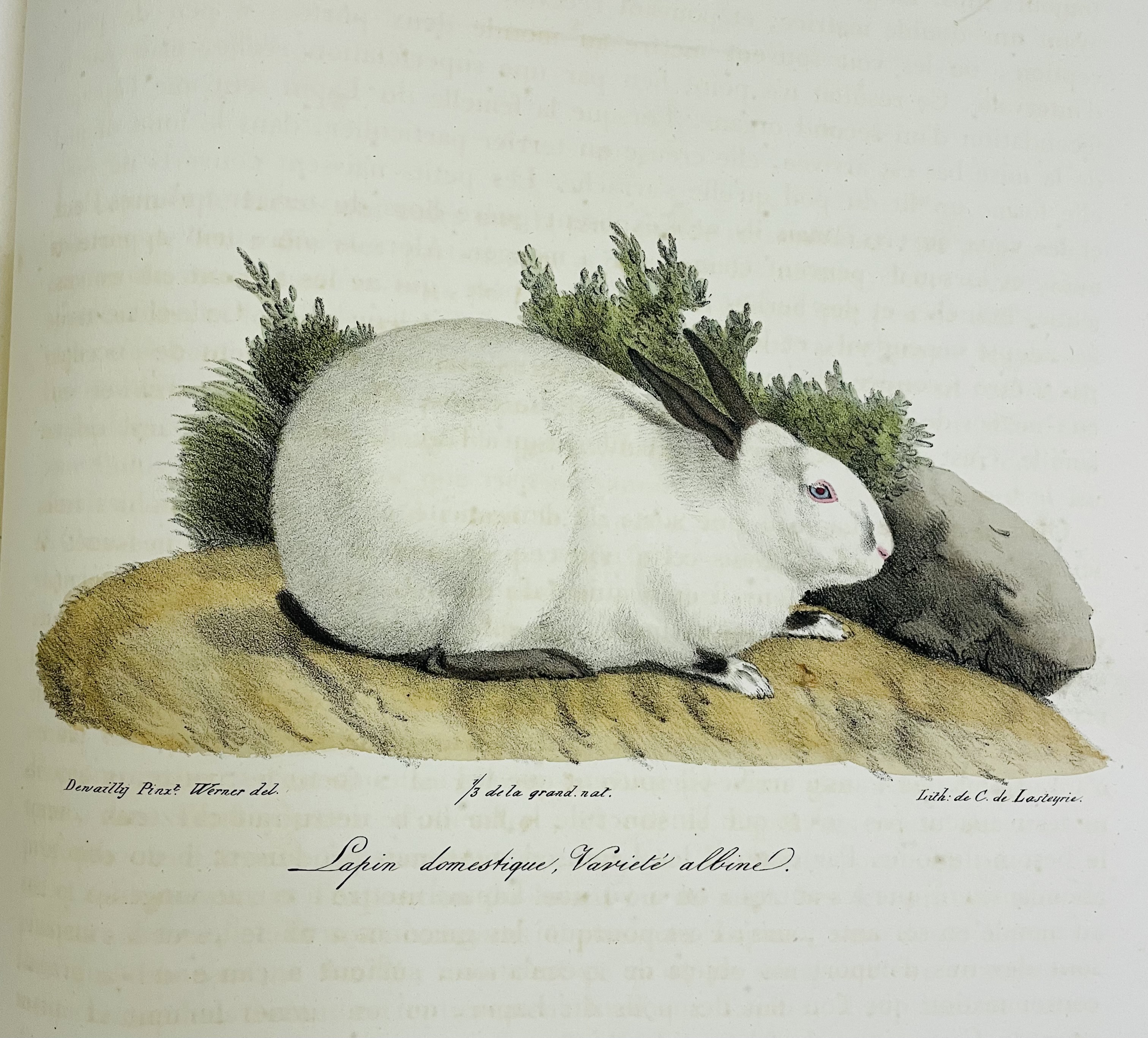
Albino rabbit

Plate from Vol. 2 of Histoire naturelle des mammifères, 1824, Shelfmark F.1.21

From here, we move into the realm of children’s books. The library holds an early edition of Alice’s Adventures in Wonderland by Lewis Carroll, which features a very famous rabbit, the White Rabbit, whom Alice follows down the rabbit-hole, thus beginning her strange and  eventful sojourn in Wonderland. The White Rabbit, complete with his waistcoat and pocket watch, is charmingly depicted by John Tenniel. 

The White Rabbit, dressed in a waistcoat, looking at this pocket watch

Illustration by John Tenniel from chapter one of Alice’s Adventures in Wonderland by Lewis Carroll, London 1874. Classmark: Rylands.C.CAR.Ali.1874

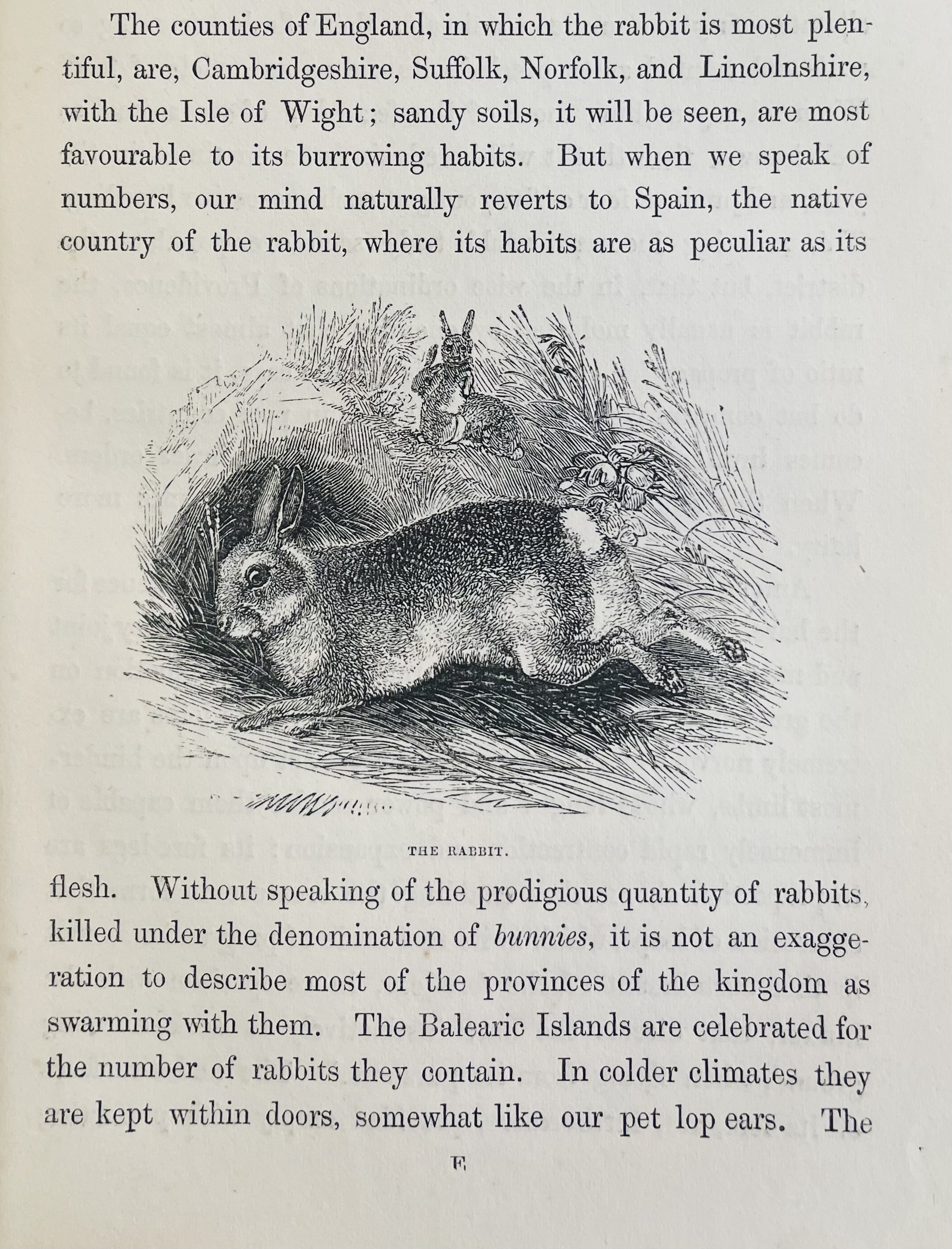
Rabbits also appear in books intended to educate children about the natural world and its inhabitants. My Own Annual: An Illustrated Gift-Book for Boys and Girls edited by Mark Merriwell, has a chapter entitled “Rabbits, hares and ferrets”which informs us that rabbits hail originally from Spain, and that Cambridgeshire is amongst the counties of England where they are most common.  

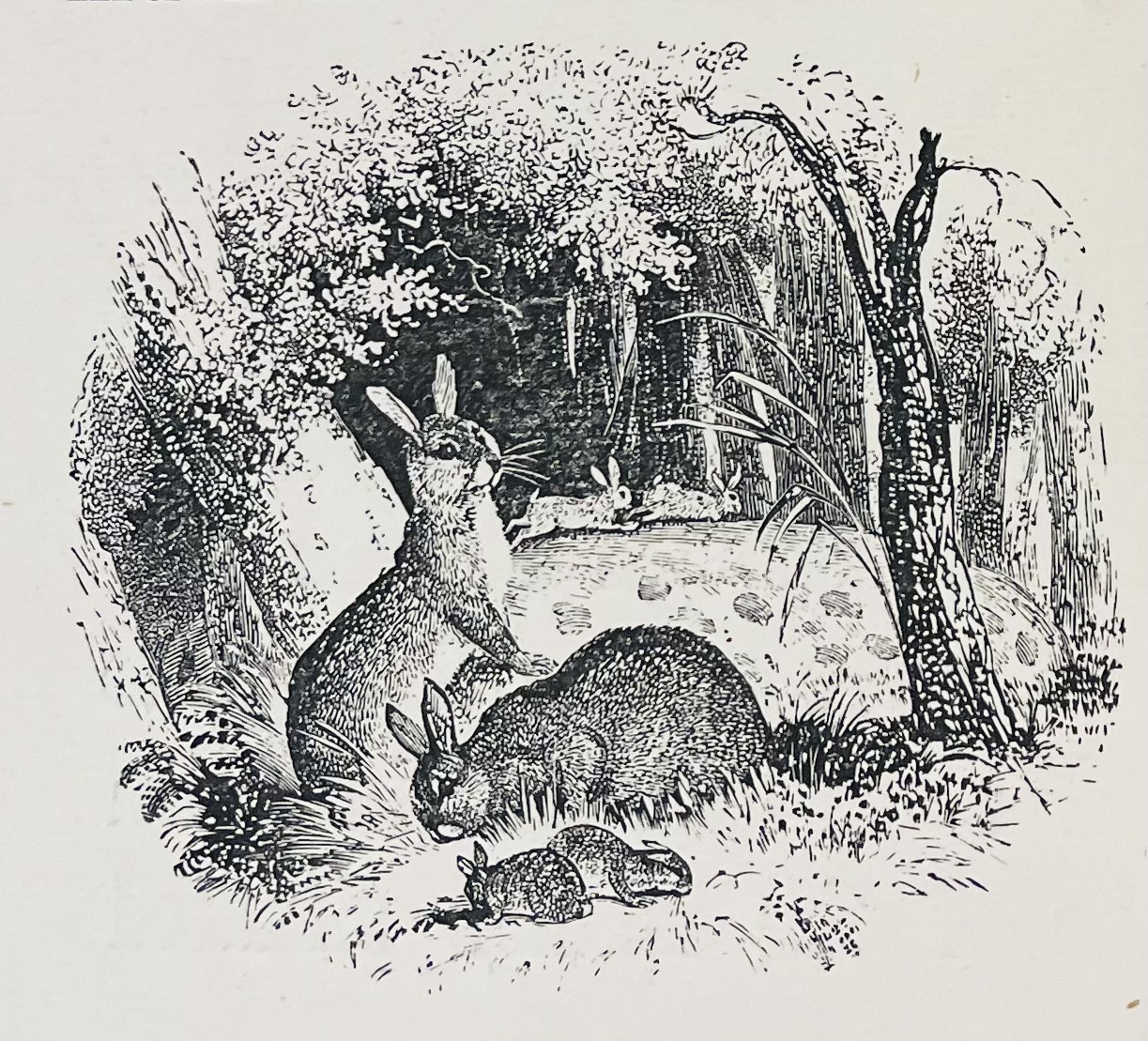
A rabbit bounding into its warren

Page 65 from My Own Annual: An IIlustrated Gift-Book for Boys and Girls edited by Mark Merriwell, London, 1847. Classmark: Ryland’s.C.MER.Ann.1847

Similar information is conveyed in The Pleasure Book of Domestic Animals by Harrison Weir, which has its own section on rabbits, accompanied by some attractive illustrations.

From The Pleasure Book of Domestic Animals by Harrison Weir, London, circa 1855-1870. Classmark: Ryland’s.C.WEI.Ple

From The Pleasure Book of Domestic Animals by Harrison Weir, London, circa 1855-1870. Classmark: Ryland’s.C.WEI.Ple

Finally, a very large and stately looking rabbit appears in full colour in Aunt Louisa’s Birthday Gift, dating from around 1875. 

Plate from Aunt Louisa’s Birthday Gift [by Laura Valentine], London, circa 1875. Classmark Rylands.C.VAL.1875

We hope you have a fruitful new year, and that, like the reproductive capacities of rabbits, your good luck grows and multiplies many times over! 

AC

References

King’s College Chapel: a History and Commentary by John Saltmarsh; edited by Peter Monteith and Bert Vaux. Peterborough, Jarrold, 2015.

Tyger, tyger, burning bright

Inspired by Chinese New Year, which this year heralds the year of the tiger, we sought out that ferocious beast within some of the many volumes of natural history which form part of the Library’s Thackeray collection and uncovered some wonderful illustrations, which roared out to be shared through this blog.

woodcut of tiger

Vol. 1, page 1060 of Historia animalium, 1551, Shelfmark F.4.1

We begin with this lovely woodcut illustration from the first volume of Conrad Gessner’s Historia animalium (History of the animals). Gessner (1516-1565) was a Swiss physician and naturalist. He produced several major works of zoology and botany and had a lasting influence upon the scientific world. Historia animalium, published in five volumes between 1551 and 1558, was a hugely popular and influential work. Gessner drew heavily on medieval and classical sources, building upon these with the latest zoological knowledge from his own time. These generously illustrated (for their time) volumes cover mammals, reptiles, fish and birds, detailing their diet, habits and physical attributes. 

A note in Gessner’s hand found in one copy of this work indicates that this tiger was modelled on a real life example from Florence. This may have been a beast housed in the menagerie of the Medici ruler of that city.

Early nineteenth-century works provide the rest of our illustrations, starting with a handsome colour engraving from Histoire naturelle des mammifères by Geoffroy-Saint-Hilaire and Frédéric Cuvier. The authors were both associated with the French National Museum of Natural History: the Muséum national d’Histoire naturelle. Frédéric Cuvier (1773-1838) was head keeper of the menagerie, and Geoffroy Saint-Hilaire (1772-1844)  was a professor there.

Colour engraving of tiger

Plate from Vol. 1 of Histoire naturelle des mammifères, 1824, Shelfmark F.1.20

Frédéric Cuvier’s brother, Georges (1769-1832) was a naturalist of great renown and author of many works on this subject. The most famous of these was Le Règne animal or, The animal kingdom, which was first published in 1817. The Library holds an English translation of this work in which can be found attractive engravings of several different types of tigers, displayed below.
Tiger engraving

Tiger from Cuvier’s animal kingdom: The class mammalia, Vol. 2, plate facing p.440, 1827, Shelfmark F.6.3

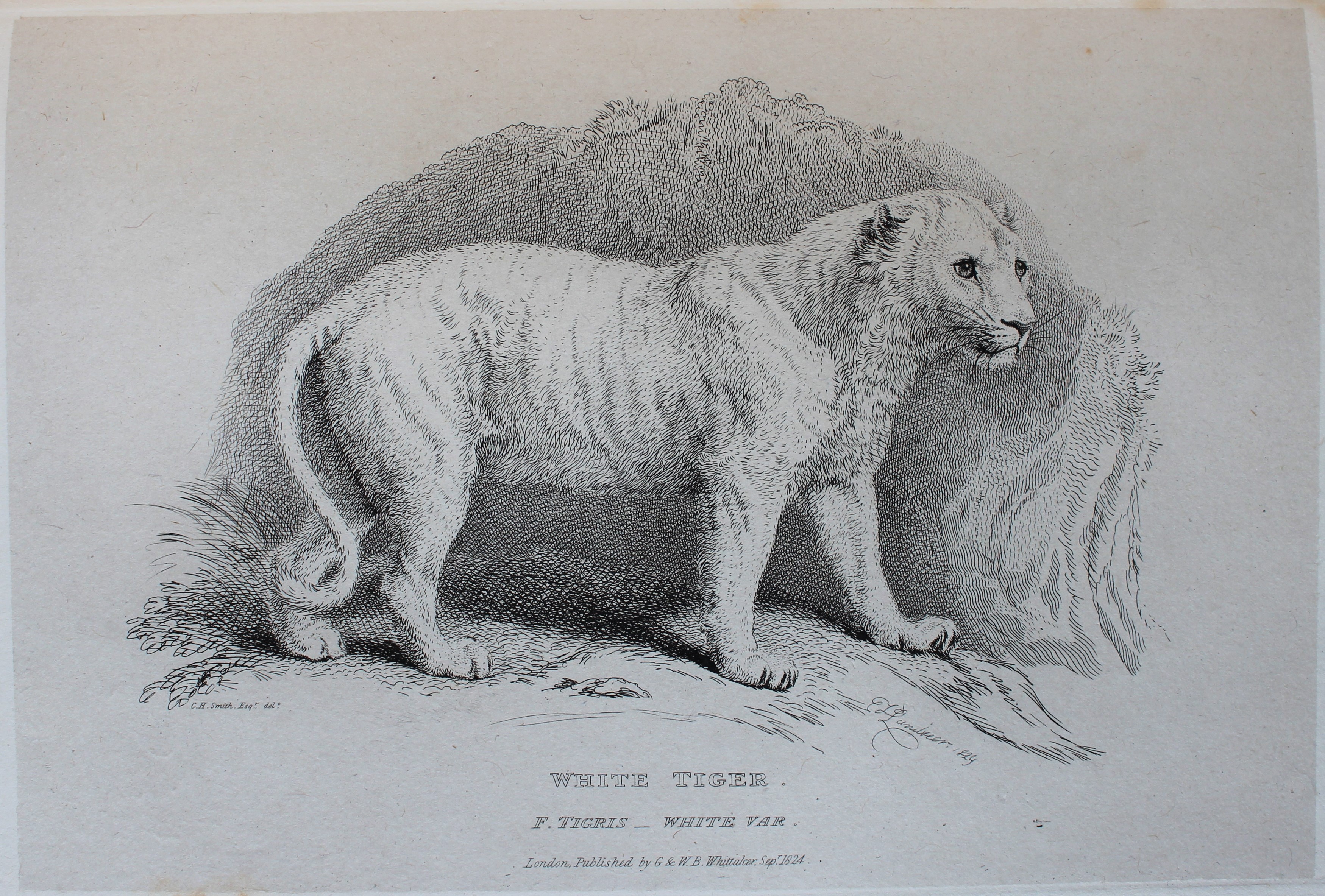
white tiger

White tiger from Cuvier’s animal kingdom: The class mammalia, Vol. 2, plate facing p.444, 1827, Shelfmark F.6.3

Clouded tiger

Clouded tiger from Cuvier’s animal kingdom: The class mammalia, Vol. 2 facing p.450, 1827, Shelfmark F.6.3

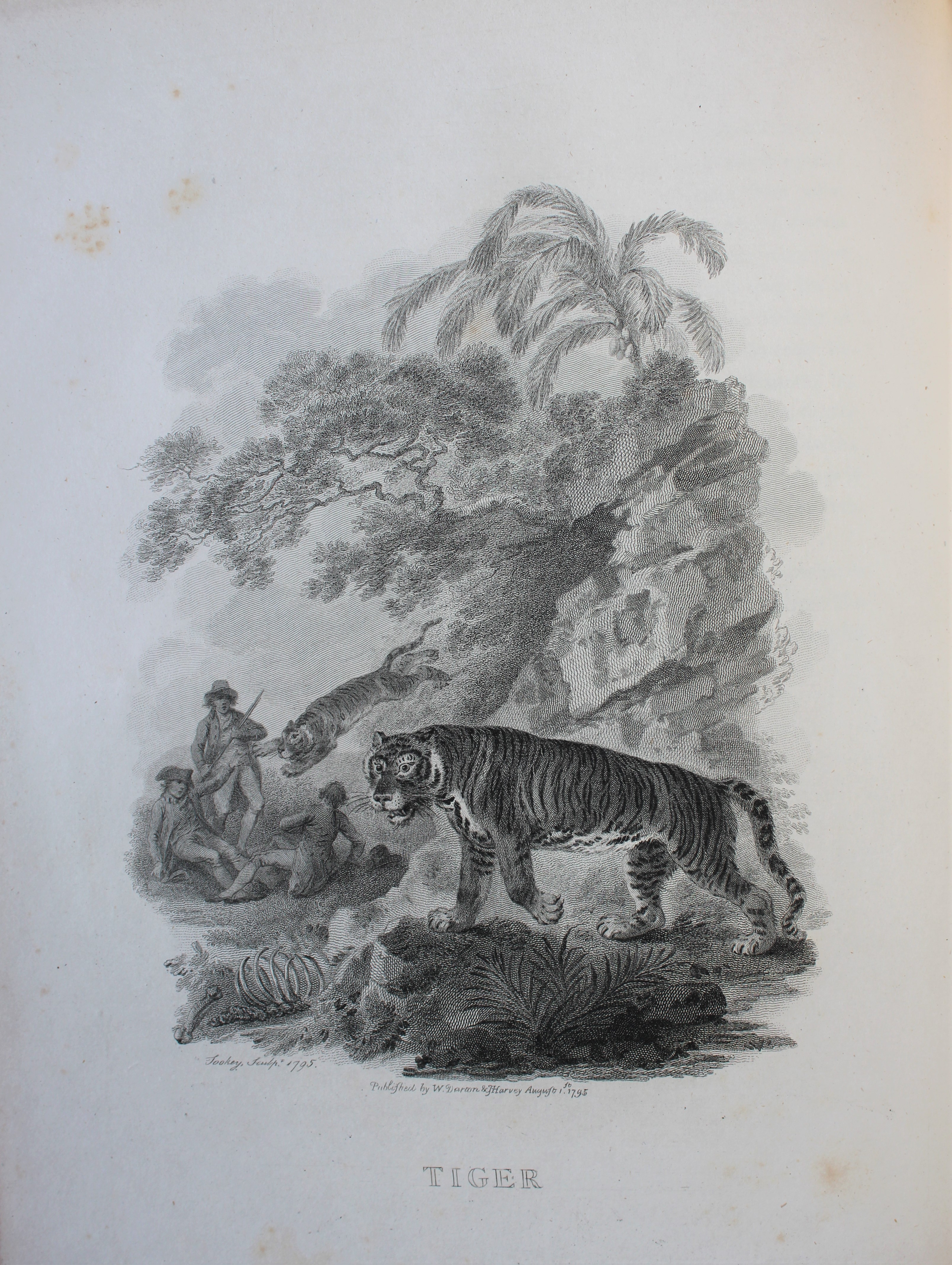
Fearsome tigers on the attack appear in an engraving (shown below) from John Church’s A Cabinet of Quadrupeds, which was published in 1805.

Tigers attacking men

Attacking tigers from Vol. 2 of A cabinet of quadrupeds: with historical and scientific descriptions, 1805, Shelfmark F.3.35

Our final image, aptly enough, depicts a tiger prowling away towards a deep dark forest. This is taken from a book of prints by English landscape and marine painter, William Daniell (1769-1837). Daniell travelled widely in India in his youth, so it is possible that he saw the beasts with his own eyes.

prowling tiger in woods

Plate from Vol. 1 of Interesting selections from animated nature, with illustrative scenery, [1809?], Shelfmark F.6.45

We hope this “ambush” of tigers has provided a stimulating start to your new year!

AC

References:

Marisol Erdman, Conrad Gesner: Illustrated Inventories with the use of Wonderful Woodcuts  [accessed 27/1/22]

Florike Egmond, 16th century ‘zoological goldmine’ discovered – in pictures [accessed 27/1/22]