Tag Archives: Cambridge Colleges’ Conservation Consortium

The Boke Named the Royall

The many libraries of the University of Cambridge host an incredibly diverse range of books, manuscripts, and historic documents, some of which are over a thousand years old. That such documents are still available to us in a readable state is a tribute to the care and dedication of generations of librarians curating these collections.

We must remember that books are made of relatively vulnerable materials: papers and parchments. They are easily torn, creased, or stained through careless handling, but also damage caused by the environment such as mould, insects, water, or their arch-enemy: fire. When such damage occurs or is found on objects, librarians can call on the services of the book conservators at the Cambridge Colleges’ Conservation Consortium.

The book as received from King’s College Library

Here is the example of a 1507 book from the King’s College Library collection, “The Boke named the royall” printed by Wynkyn de Worde, an extremely important printer based in London, known for his work with William Caxton who was the first to popularise the use of the printing press in England.

The severely burned pages

The volume is printed on handmade paper with many beautiful wood-block print images, but it has obviously suffered extensive damage caused by fire. The previous binding structure and the covers had been completely destroyed,  leaving only loose sheets with fire-damaged edges. When or how this fire happened is not documented, but we know that the book has been stored in this way since at least the 1980s.

A typical issue with fire-damaged books is that the pages, especially the edges, become very brittle and cannot be manipulated without causing further damage, meaning that the librarians at King’s could never allow this book to be consulted by researchers. Was there any way to make these 162 fragile leaves accessible again to scholars and researchers? This is the question that was put to me by the King’s College Librarian in 2022. This was a challenge, requiring very precise work, but the answer was a definite yes.

Reordering the individual leaves of the book

The first stage of the work was to re-order the leaves properly using a combination of clues, including the handwritten folio numbers and the signature letters and numbers printed on the leaves. This allowed us to identify that a number of the initial leaves were missing, possibly destroyed in the fire that caused the damage.

Each leaf was then washed following a four-stage process: a gentle surface dirt cleaning using a soft brush and a smoke sponge (a sponge made of natural vulcanized rubber). A water bath to dissolve impurities and stains in the paper. An alkali bath to stop acidic degradation of the papers, especially strong after fire damage. Lastly, a gelatine bath to “size” the papers to make it less brittle. It was truly delightful when I discovered several types of pretty watermarks during these washing processes.

Washing the leaves

The water before and after the washing

A crown-shaped watermark in one of the leaves

Then came time to infill the losses and to reinforce the damage along the edges by using layers of two different weights of Japanese papers. Japanese papers are very fine, strong and flexible, almost transparent and alkaline or neutral making them perfect for conservation work. This process is essential to restore mechanical robustness of the leaves and allow handling. It is important to note that beyond these mechanical objectives, aesthetics must be considered, with each infill paper being pre-toned to colour match the original material.

Mito Matsumaru repairing paper

Lizzie Willetts and Hollie Drinkwater undertaking paper repairs

Placing remioistenable tissue over burnt edge

After all leaves had been treated, dried, and pressed, the excess repair papers were trimmed.

Leaves after paper repair
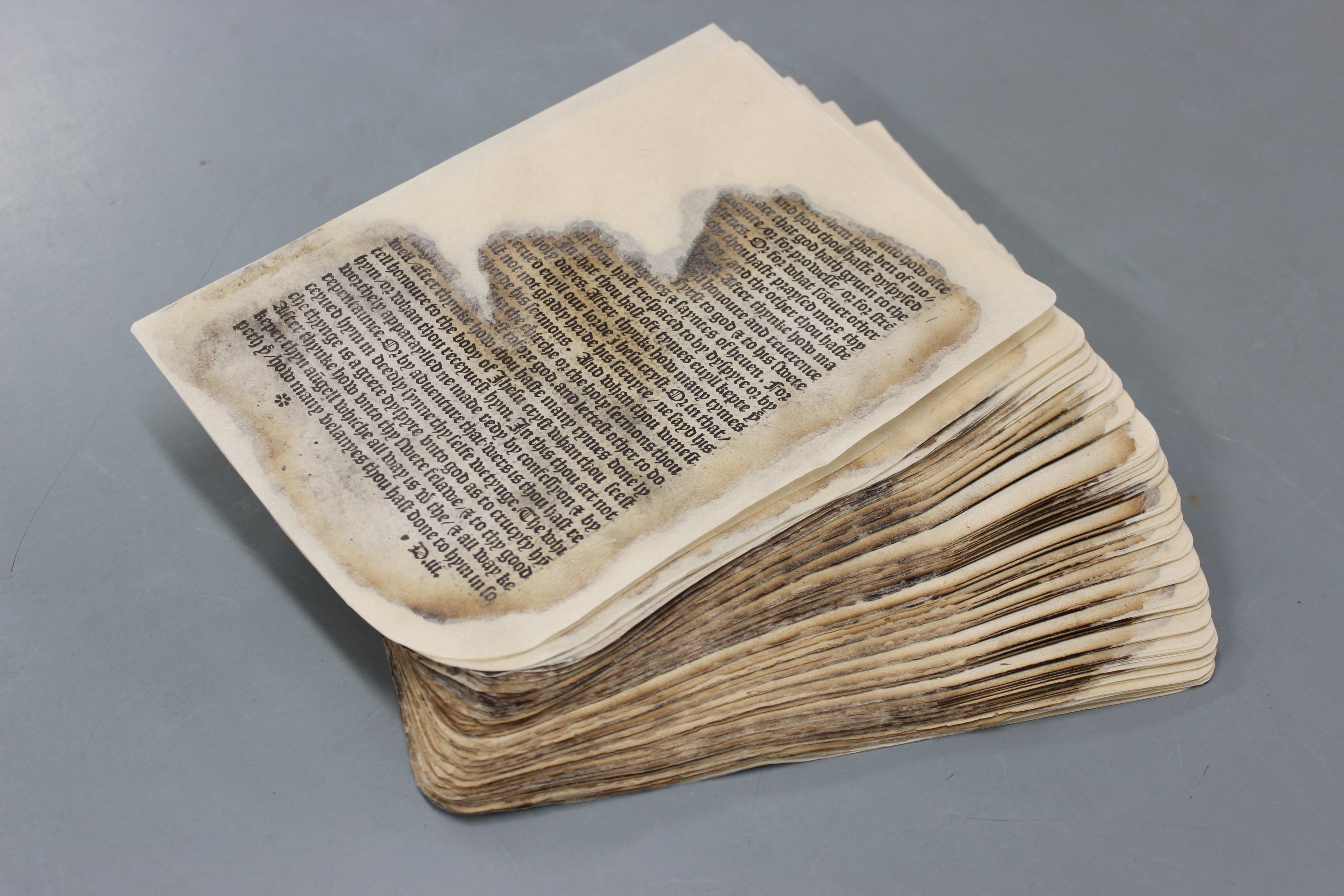
Leaves after trimming

The volume was rebound in a historically compatible yet conservation quality “limp vellum” binding.

Binding the leaves over alum-tawed sewing supports
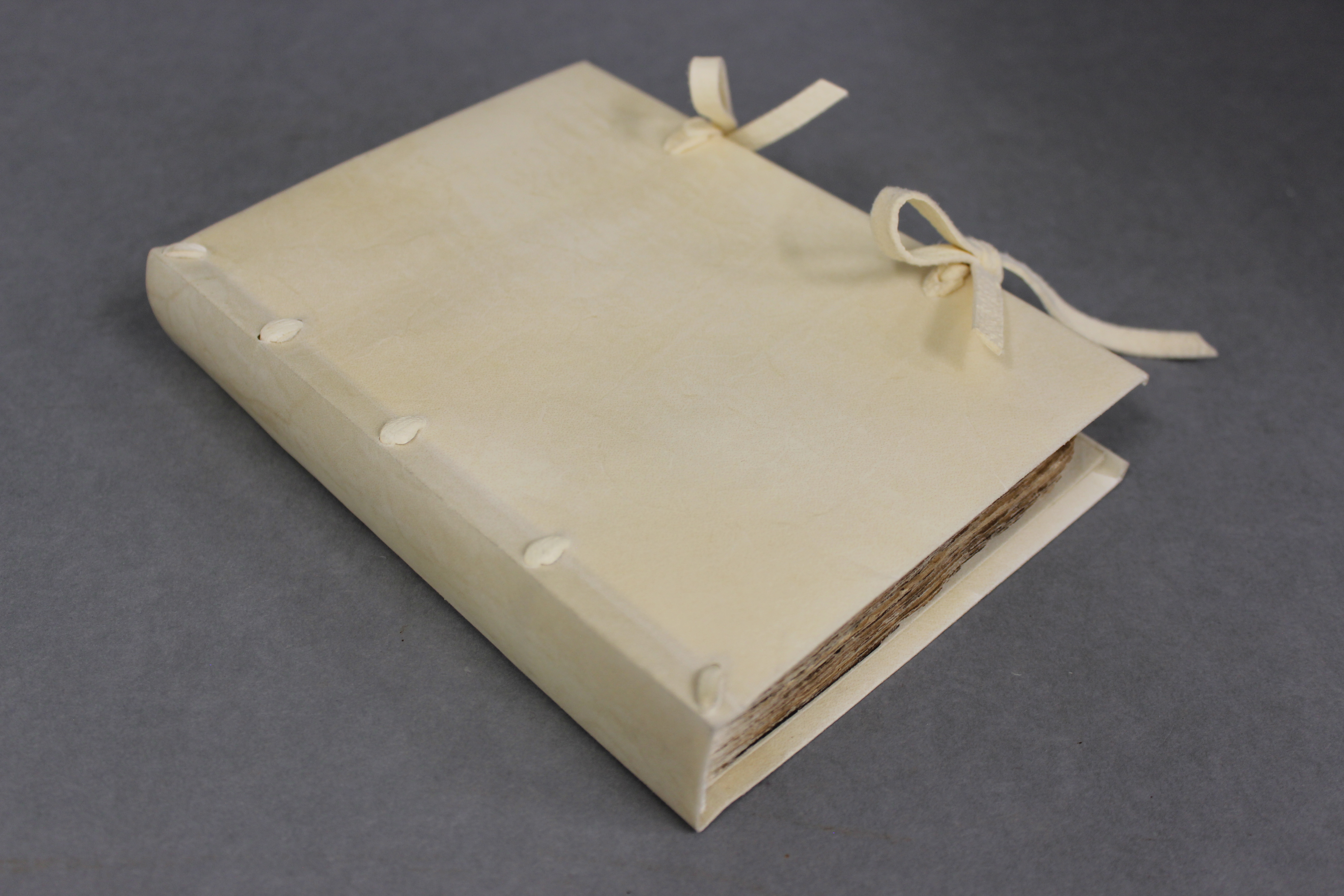
The completed new binding
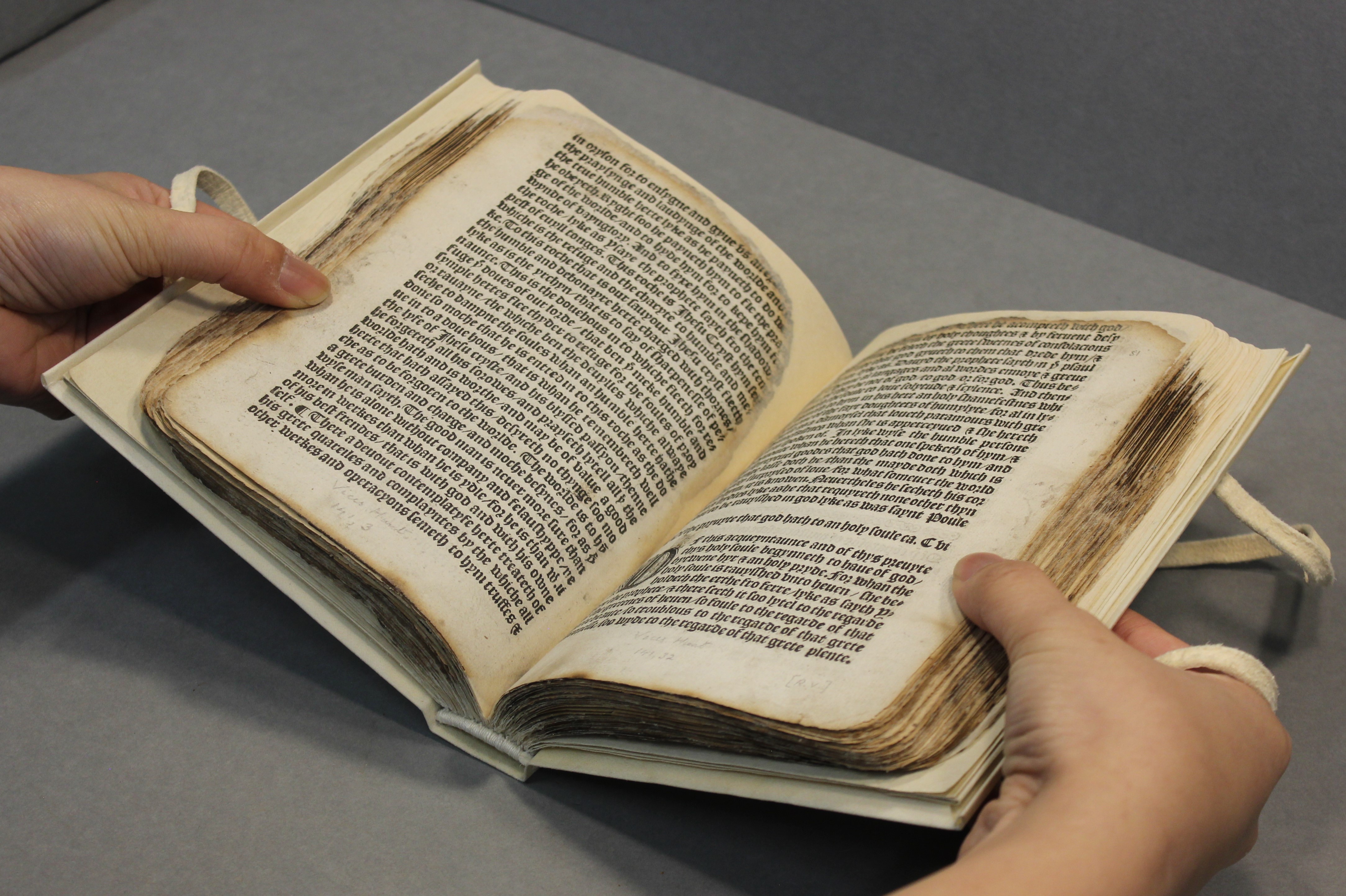
The rebound pages after treatment

The rebound pages after treatment

Detail of the repairs

Finally, a bespoke box was built to house the newly rebound volume.

This was a very challenging but satisfying project and I am very pleased to have contributed to the preservation of this volume which can now be consulted, although, of course, still with careful handling.

One last gift: after the treatment, I looked at the aligned fore-edges, and I found the edge is partially glistened in gold! That means that the book had gold-tooled edges when the fire occurred.

Detail of the gold decoration on the edge of the text block

As always, these projects are never solo work, and I must extend my deepest thanks to:

  • My colleagues Lizzie Willetts and Hollie Drinkwater who helped  during the washing and repair stages.
  • My manager Flavio Marzo for his advice and constant support, especially on limp vellum binding.
  • Dr James Clements, College Librarian at King’s College Library for entrusting me with such a wonderful project.

Mito Matsumaru, Book and Manuscript Conservator at Cambridge Colleges’ Conservation Consortium
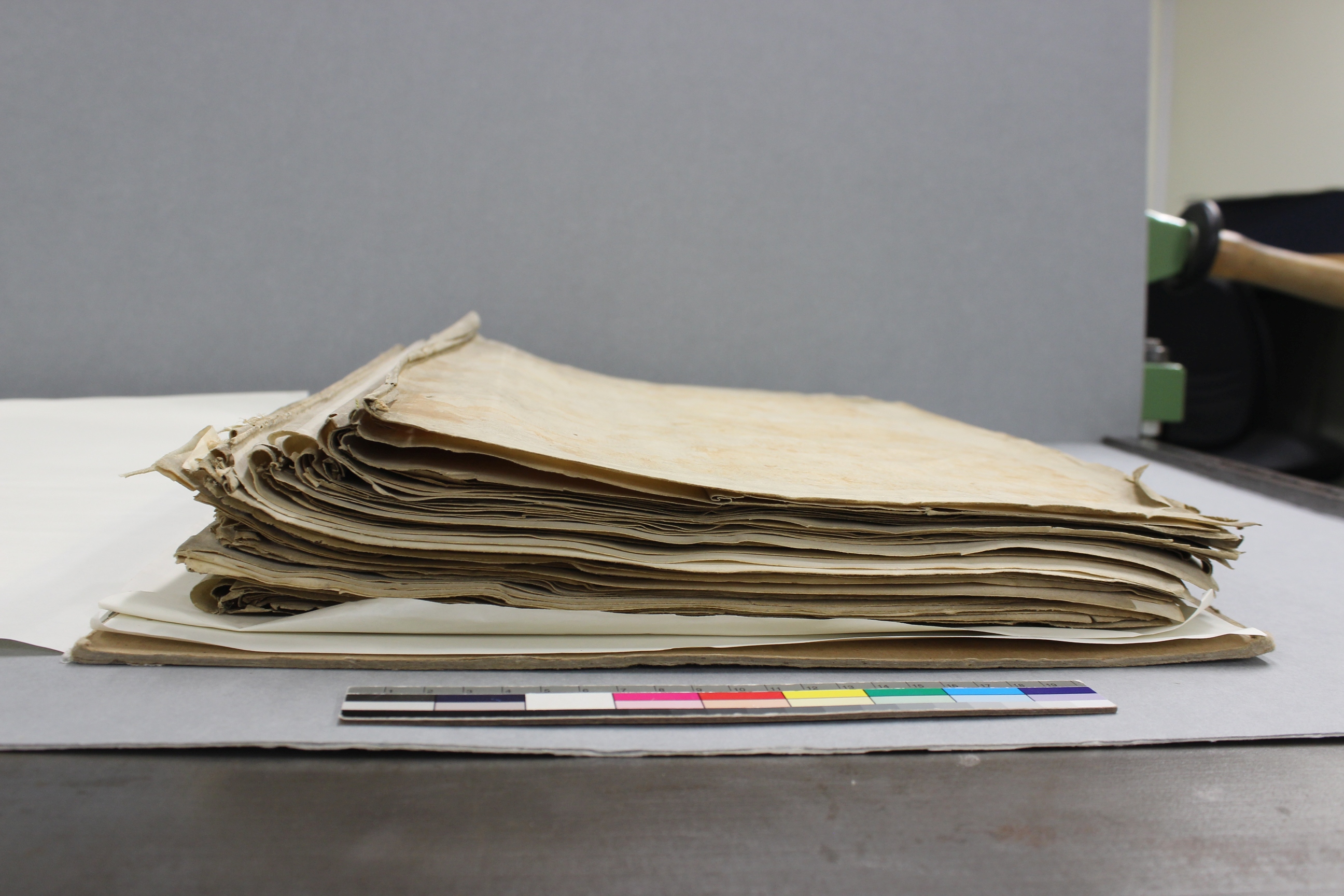
An astonishing transformation

THE OBJECT

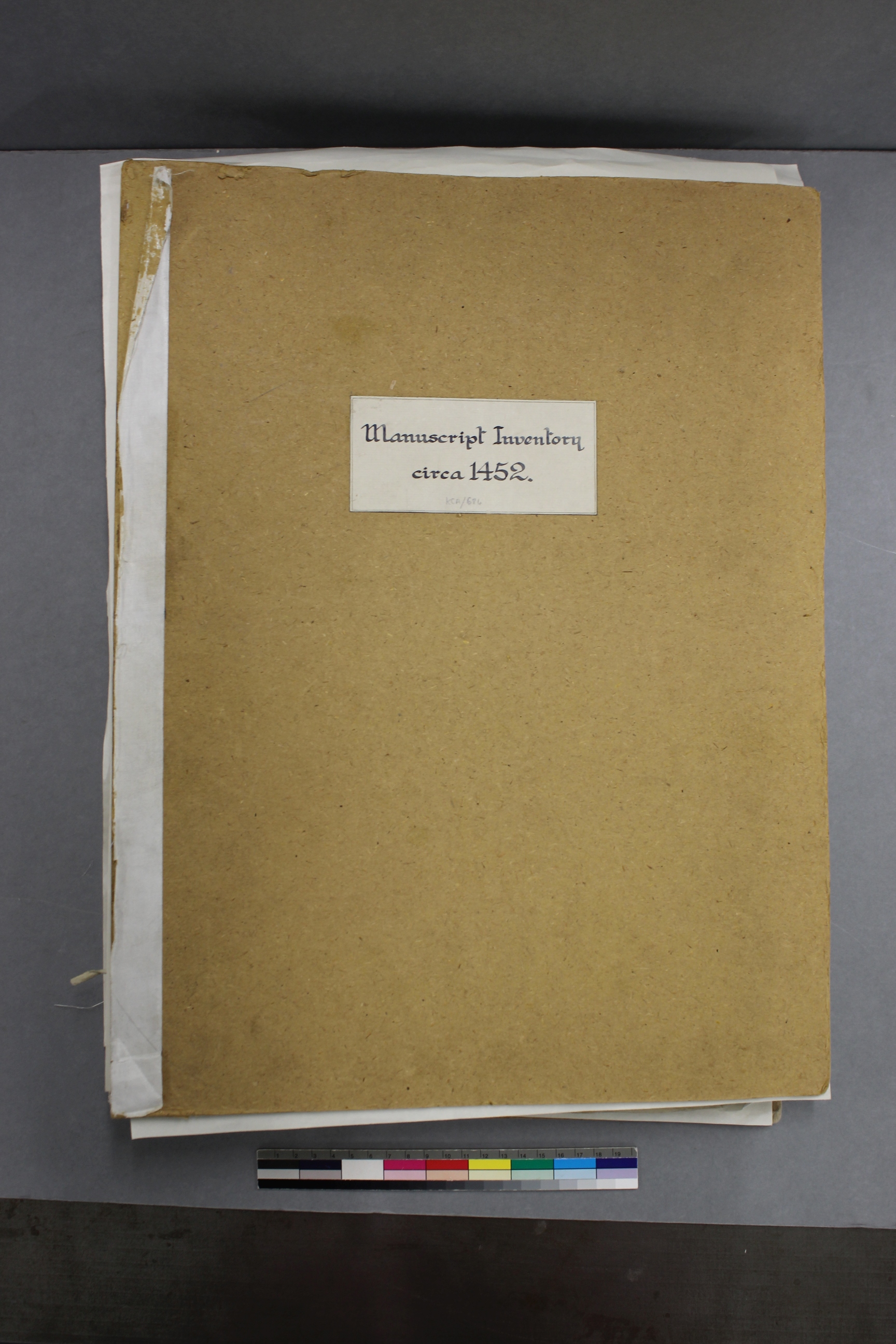
In the archives we have this somewhat intimidating collection of College records:

KCA/684: Before

Intimidating because it’s mostly 15th-century Latin, and it’s in this temporary-looking heavy straw-board folder

The old packaging

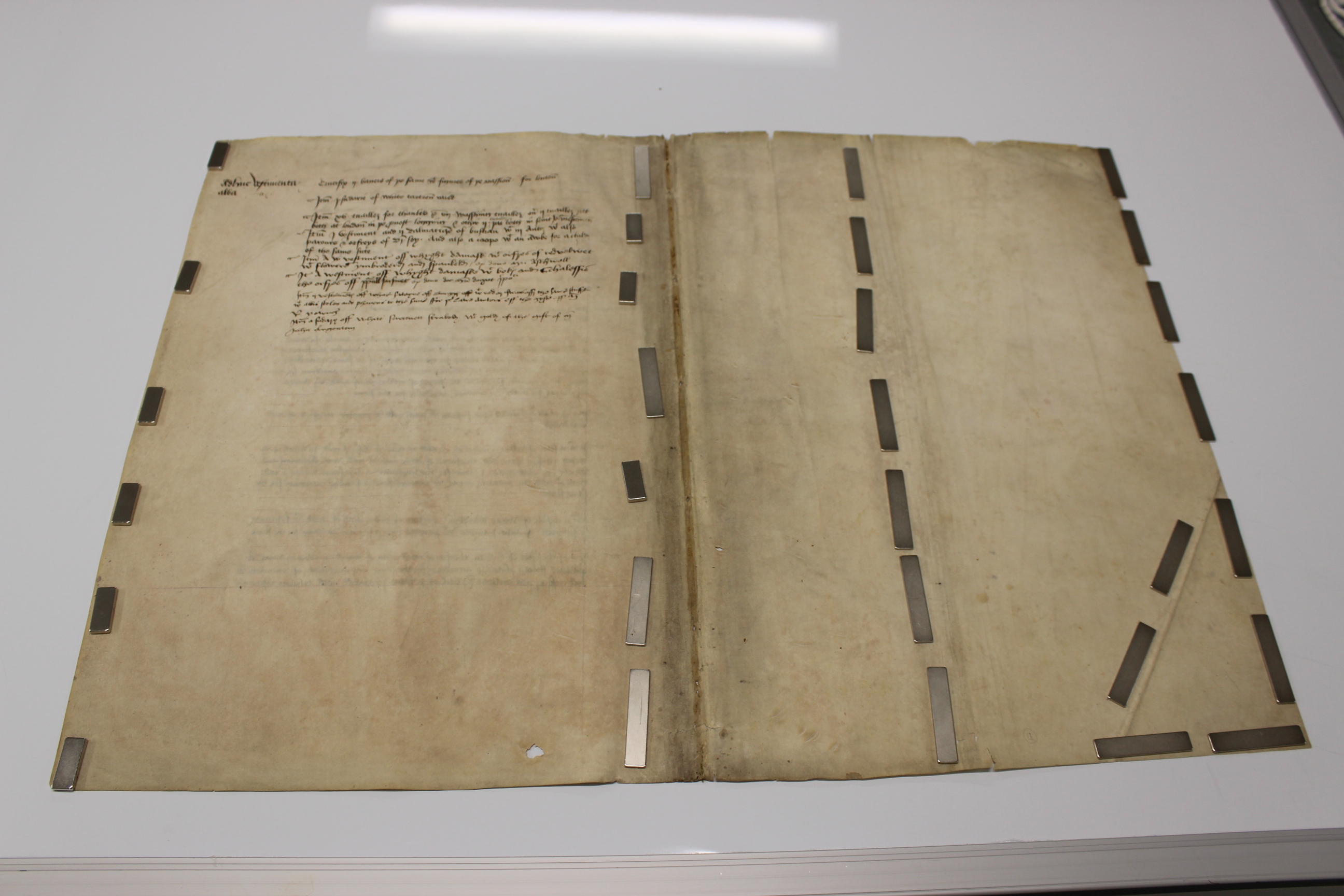
from the early 20th century which is itself falling apart, and you worry the pages will get out of place. Yet everything says it’s important: the vellum is so fine and soft that it drapes like fabric (nice to handle but it means you have to pay careful attention when turning pages), the wide margins bespeak a luxurious undertaking, and it’s one of the College’s oldest of its own documents. The first thing recorded in this volume is a detailed inventory of the College’s valuables in 1453-7.

THE TRANSFORMATION

Or at least we did have this intimidating object, until it was conserved over the winter by the Conservation Consortium and restored to what must be a very close approximation of its former glory.

During this process the Consortium carefully diagrammed all the quires, showing where blank pages had been cut out for use elsewhere:

Quire diagram

Then they flattened, under controlled humidification, and cleaned the pages,

Flattening the pages under weights

stabilising those that had the worst historic damage using Japanese paper. This is a soft tissue paper, often handmade, of consistent quality and free from impurities such as iron particles which can lead to paper degradation, rust spots, or ‘foxing’. It is transparent so that it can be glued over tears in existing pages while still allowing the text to be read, and allows for easily reversible interventions.

Based on evidence found within the book

Evidence of previous binding

and drawing from other historical contemporary book structures they recreated a late medieval-style binding. Boards were hand-carved from quarter cut planks of seasoned oak. The bookblock was carefully sewn to achieve a flat, well-supported opening,

Sewing the block

finishing it off with a quarto style alum-tawed (white) leather binding.

Claude applying glue to the leather binding

Sewing the binding to the spine of the book

Book conservator Claude Grewal-Sultze even went to the Bodleian Library to learn lessons from the conservation project on the Winchester Bible.

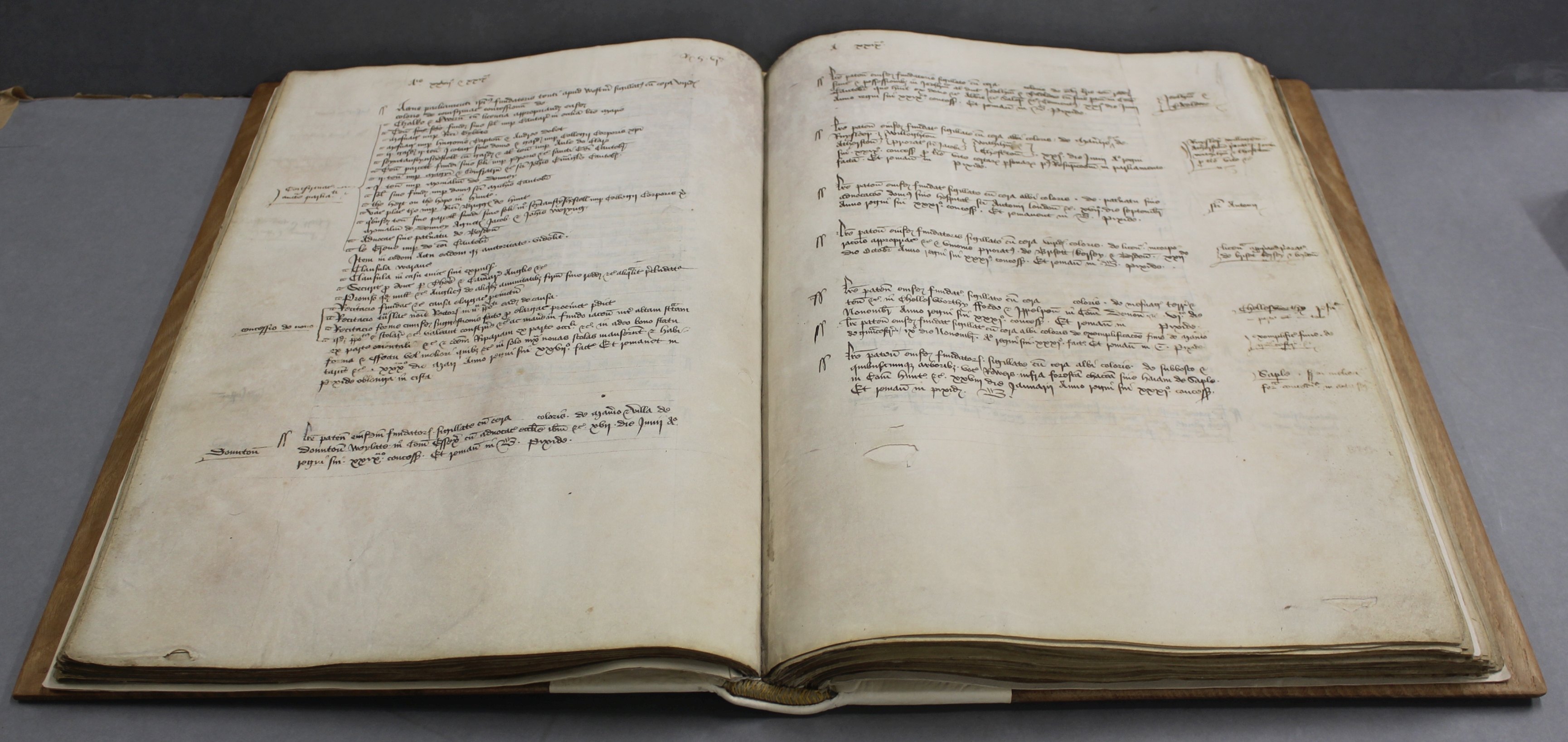
The result looks fabulous and now it’s hard to keep your hands off it – the smooth oak end-boards present a friendly, inviting surface.

KCA/684: After

Decorative sewing on the endband

You still have to be careful turning the soft pages of course. The document even appears smaller and lighter than it had done. Archivists will be surprised to hear that even after conservation and in its new protective box (made of archive-quality mid-weight cardboard), it fits in its old location.

The total cost of the renovation was £5000. This has been paid for by a generous donor, to whom we are very grateful.  

THE CONTENT

The volume contains more than just the inventory advertised on the cover, though it’s a magnificent inventory, befitting the holdings of a royal institution. We hope to publish a commentary on it in due course. The volume contents are:

1453-7 inventory (folios 3-12), high points of Henry VI’s charters for King’s (folios 13-26), Library books (folios 58r-65v), a list of members of the foundation (folios 70-77), and pledges (folio 81). There are blank pages between the sections, showing a consciousness that King’s was here to stay – further information would be added in due course.

Space on the page for additions

Due to the specially designed binding, the volume can be opened flat without causing damage.

The 1453-7 inventory was published by G. Williams (‘Ecclesiastical Vestments, Books, and Furniture, in the Collegiate Church of King’s College, Cambridge, in the Fifteenth Century’, three articles in The Ecclesiologist, 20 (1859), 304-15; 21 (1860), 1-7; and 24 (1863), 99-102). Williams left out additions to the inventory subsequent to the original scribe’s activity. These additions were transcribed by MR James and W St John Hope in a copy of Williams’s article (call mark Coll 2/23).

In 2018, various sections of this volume featured in an article Peter Jones wrote (‘Commemoration at a Royal College’, pages 106-122 from Commemoration in Medieval Cambridge, ed. John S. Lee and Christian Steer, in the series ‘The History of the University of Cambridge: Texts and Studies’ published by Boydell Press for Cambridge University Library).

SUBSEQUENTLY

Many of the objects listed here can be found in inventories made 50 or more years later (call mark KCA/22).

KCA/22 also left space for additions

The 1554 inventory in that book is interesting because in the intervening years the vestments had been turned into costumes – see our online exhibition about Queen Elizabeth’s 1564 visit.

Although not as elegantly presented as KCA/684, KCA/22 is still a spaciously designed book with a variety of flourished capitals and a use of display scripts. The inventories in KCA/22 were transcribed by MR James (Provost of King’s) and W St John Hope (antiquarian), and those transcriptions can be found in the archives under call marks Coll 2/23 and KCA/687. The same donation is covering the cost of conserving KCA/22. Part of the conservation will include replacement of the stiff parchment cover which has shrunk, making the pages’ leading edges vulnerable.

Peter Jones, Fellow Librarian
Patricia McGuire, Archivist


Video: Conserving Rare Books at King’s College, Cambridge

As part of our HLF-supported Thackeray Project, we have produced a video that looks at rare book conservation generally, before moving on to a case study of the repairs performed on a single book from the Thackeray Collection (Le rime di Francesco Petrarca, Thackeray.L.3.40).

Enjoy!


GB/JC/IJ