Category Archives: Library

Je suis Louis de Montalte

At a time when freedom of expression has been widely debated following the Charlie Hebdo shootings in Paris, it may seem appropriate to look at a book in the Keynes Bequest published when the freedoms which we take for granted were but a distant mirage.
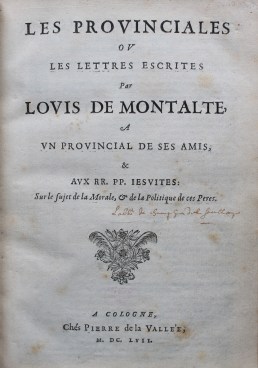
Keynes.Ec.7.3.20 Title page

Title page of Keynes.Ec.7.3.20

Blaise Pascal’s Lettres provinciales was first printed in 1657 under the pseudonym Louis de Montalte during the formulary controversy between the Jesuits and Jansenists. Jansenism was a seventeenth-century movement in the Catholic Church which came under attack from the Jesuits in 1655. Pascal was invited to write a rejoinder, which took the form of a withering criticism of the casuistical methods of argument used by the Jesuits to justify their lax morality. Having been forced into hiding while writing this work, Pascal pretended the letters were reports on religious and doctrinal issues debated at the Sorbonne sent from a Parisian, Louis de Montalte, to a friend in the provinces.

Port-Royal-des-Champs (1700-49) Museum Catharijneconvent, Utrecht

The abbey of Port-Royal-des-Champs in Paris, the theological centre of the Jansenist movement (Museum Catharijneconvent, Utrecht, ca. 1700-49)

The 18 letters were published and circulated anonymously as individual pamphlets from 23 January 1656 to 24 March 1657, and later collected under the fictitious imprint ‘Cologne, Chés Pierre de la Vallée’. They were in fact printed in Paris, probably by Pierre le Petit, Denis Langlois, Sébastien Hyp, and others. Anyone found in possession of the pamphlets was arrested, as the book was banned by both King Louis XIV and Pope Alexander VII.

Keynes.Ec.7.3.20 Title page detail

Close-up of the signature on the title page: L’abbé de champagne du Saullay?

Most editions are bound with polemical responses to Pascal’s epistles. Our copy is noteworthy in that it consists of no fewer than 57 items, and the original owner recorded on the flyleaf that ‘la plus grande partie de ces pièces m’ont esté données par les autheurs’. The identity of this owner remains elusive: ‘L’abbé de champagne du Saullay’? Or ‘L’abbé de champ [?] Saullay’? Any assistance in identifying them would be much appreciated!
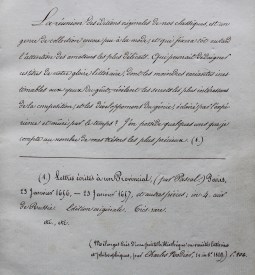
Keynes.Ec.7.3.20 Nodier 2

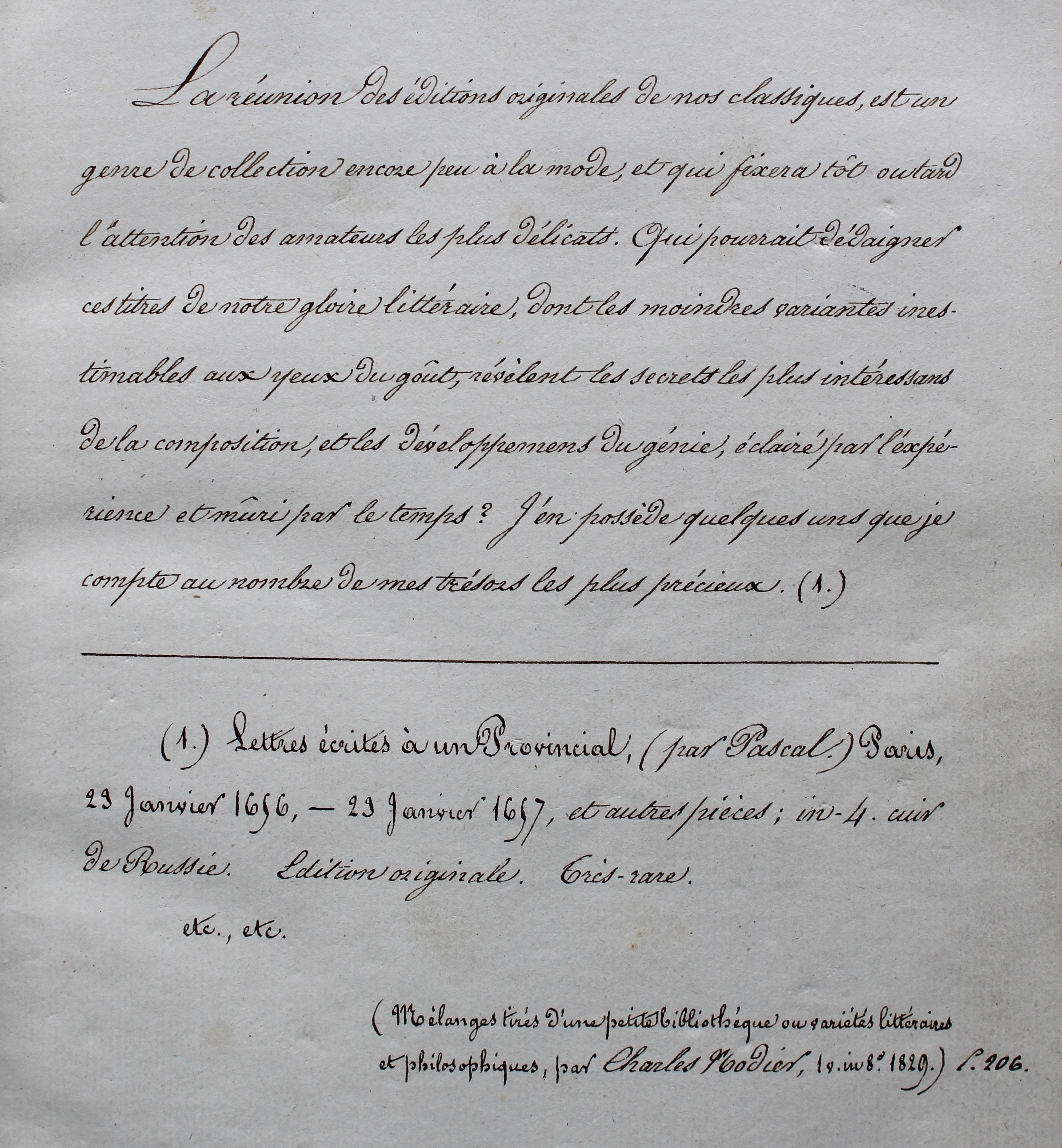
A 19th-century owner’s inscription from Charles Nodier’s Mélanges tirés d’une petite bibliothèque (1829)

The book passed through several hands before Keynes. An anonymous owner recorded: ‘Acheté à M. Guillemot, libraire, le 28 mai 1832’. The same person inscribed on one of the fly-leaves a quotation from the French author and bibliophile Charles Nodier’s Mélanges tirés d’une petite bibliothèque (1829): ‘La réunion des éditions originales de nos classiques est un genre de collection encore peu à la mode, et qui fixera tôt ou tard l’attention des amateurs les plus délicats.’

Keynes.Ec.7.3.20 Keynes
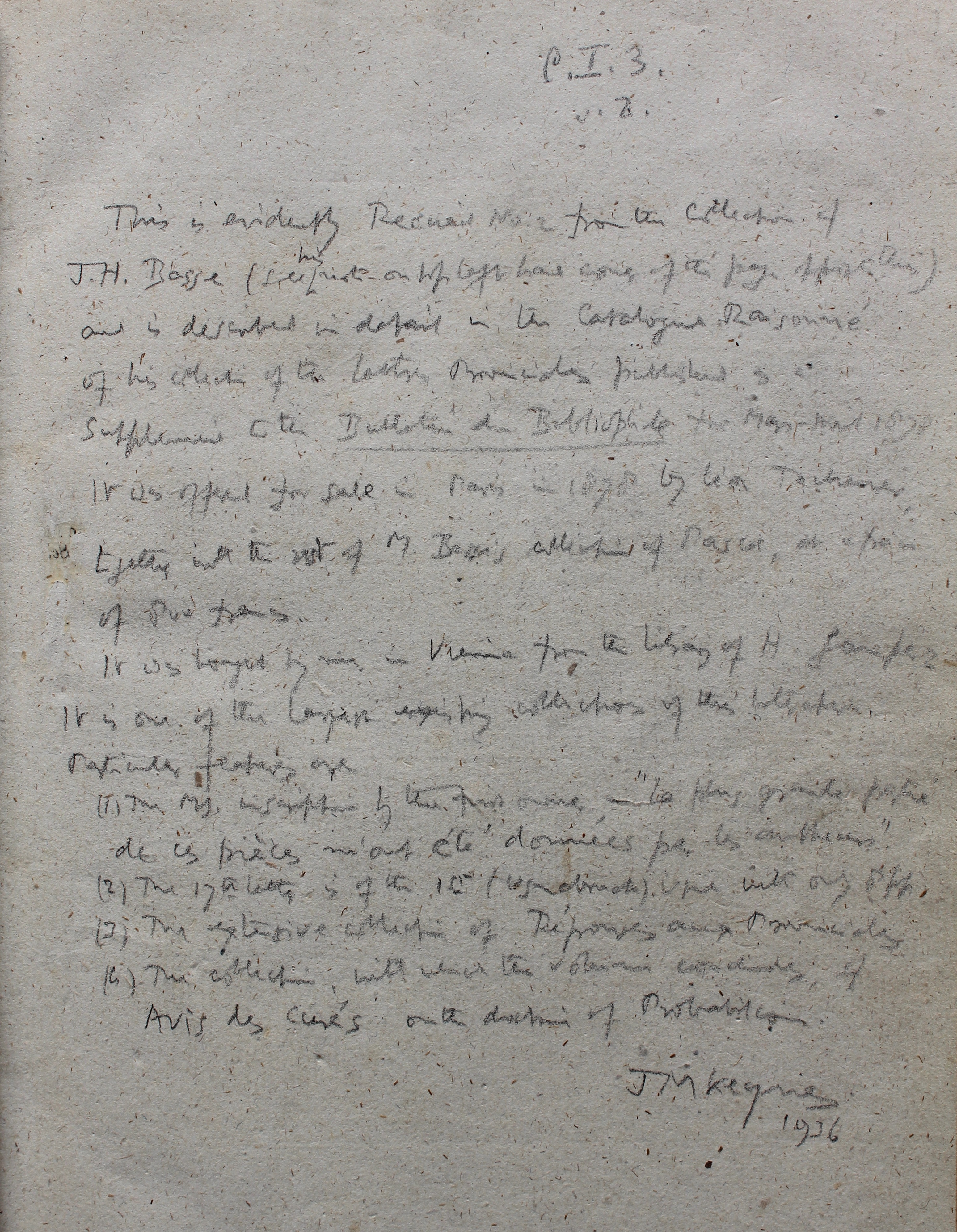
Keynes’s pencil note on the fly-leaf

This statement could not have been more prophetic in light of the book’s subsequent owners. Unusually, Keynes recorded on one of the fly-leaves details of the book’s provenance and notable features: ‘This is evidently Recueil no. 2 from the collection of J. H. Basse [Jean Hippolyte Basse, d. 1877]’. It was offered for sale in Paris in 1878 by Léon Techener,  and must have been bought by the book collector Sir Thomas Brooke (1830-1908), whose bookplate is on the front paste-down. The volume was acquired in 1913 by the Austrian philosopher and rare books collector Heinrich Gomperz (1873-1942), who fled his homeland in 1938 following the annexation of Austria by Nazi Germany and joined the University of Southern California. It was bought by Keynes in Vienna in 1936, and bequeathed to King’s College in 1946.

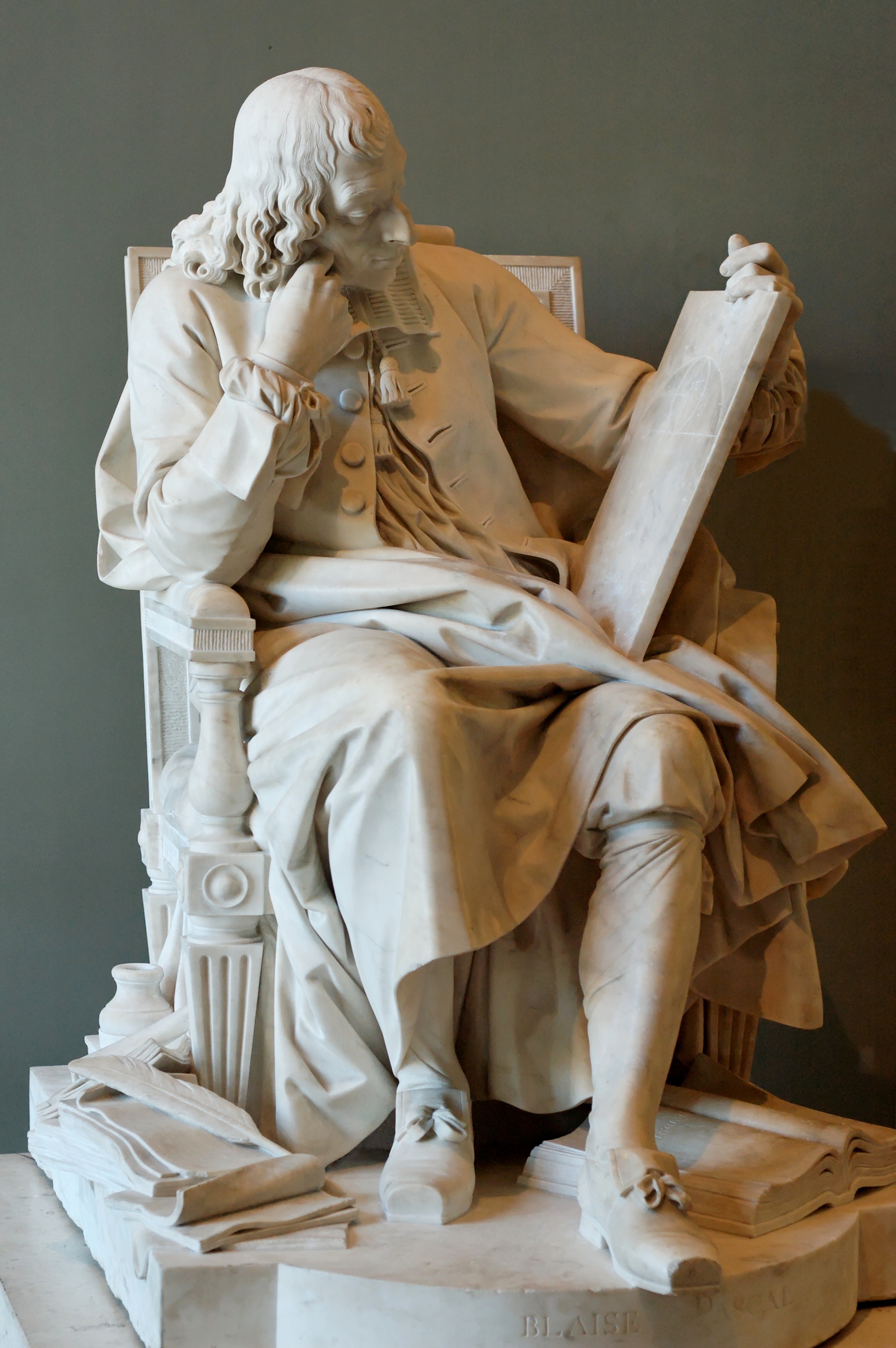
Pascal_Pajou_Louvre_RF2981

Blaise Pascal (1623-1662) studying the cycloid. At his feet are the Pensées; the open book is the Provinciales (Augustin Pajou, 1785)

King Louis XIV’s order that the Lettres provinciales should be burned, and Pope Alexander VII’s placing it on the Index of Prohibited Books in 1657, clearly did nothing to deter educated Frenchmen from reading it: its popularity spread like wildfire, both in France and abroad, so that there were about 30 editions by 1700. The genealogy of this rare first edition’s illustrious owners, spanning three centuries and three countries, and their eagerness to mark their ownership on the book in a way that Pascal could not (he was identified as the author only after his death), is a testament to the letters’ enduring significance and importance. Apart from their religious value, Pascal’s brilliant prose style, his coruscating wit and use of mockery and satire contributed to making the Provinciales popular as a literary work. It later influenced Molière, Montesquieu and Voltaire, who, despite his aversion to Pascal’s thought, defined it in Le Siècle de Louis XIV (1751) as ‘le premier livre de génie qu’on vit en prose’.

‘I have made this [post] longer than usual, only because I have not had the time to make it shorter.’

IJ

Clashing inscriptions

Front pastedown of J.75.17 from the Thackeray collection

Front pastedown of J.75.17. From the Thackeray collection

This amusing exchange appears on the front pastedown of a 1794 edition of “The conduct of understanding” by John Locke. The inscriptions read: “C. Sturges K.C.C.  Recommended by Dr Glynn 1794” and: “You lying scoundrell Sturges. Dr Glyn does not recommend any such book”

1794 was the year the book’s first owner, Charles Sturges (1776-1802) joined the college as an undergraduate, and, as a newly minted scholar, he appears to have been eager – perhaps too eager – to show that his book purchases were guided by the advice of his betters. Being labelled a “lying scoundrell” seems to have done him little harm, as he later became a fellow of the College and also a clergyman, acting between 1800 and  1802 as curate of St. Mary’s Church in Reading, where his father was the vicar.

The author of the second inscription is thought to have been Dr Glynn himself.  Robert Glynn (1719-1800) was a colourful character in every respect.

Dr Robert Glynn. An engraving of a drawing by the Rev. Thomas Kerrich

Dr Robert Glynn. An engraving of a drawing by the Rev. Thomas Kerrich

A prominent and well respected Cambridge physician and a fellow of the Royal College of Physicians, his  habit of wearing a scarlet cloak and a three-cornered hat and carrying a gold-topped cane must have made him an easily  recognisable figure around the town. A Kingsman, Glynn lived in College and ran his practice from his rooms there.

Described in the Rev. Augustus Austen Leigh’s history of the College as: “the most active, eccentric, and benevolent of doctors”, Glynn’s popularity stemmed in part from his generosity and kindness towards the people of the malaria-ridden fens, who were encouraged to come to him for free medical advice. Fees were also waived for Cornishmen (Glynn was Cornish by birth), clergymen and old Etonians. A man of firm opinions, Glynn always avoided prescribing opium, advocated fresh air as one of the best remedies, and never bled his patients, despite this being a common medical practice at the time. He avoided regular mealtimes, preferring to snack on cold mutton kept in his rooms.

Memorial tablet in the College chapel

Memorial tablet in the College chapel

Eccentric to the last, Glynn stipulated that he should be buried in the College chapel  late at night, by torchlight, and that only College members were to attend.  He is memorialised by a tablet on the wall of one of the side-chapels. The name Clobery was adopted by Glynn after he received a large inheritance from a maternal uncle.

The book made its way into the collection of George Thackeray (1777-1850), who was Provost of King’s between 1814 and 1850. Most of Thackeray’s books were passed to his daughter  Mary Ann (1818-1879), who in turn bequeathed them to the College.

Sources: Oxford Dictionary of National Biography,  “King’s College” by Rev. A. Austen Leigh, and Venn’s “Alumni Cantabrigienses”

AC

Isaac Newton’s dog-ears

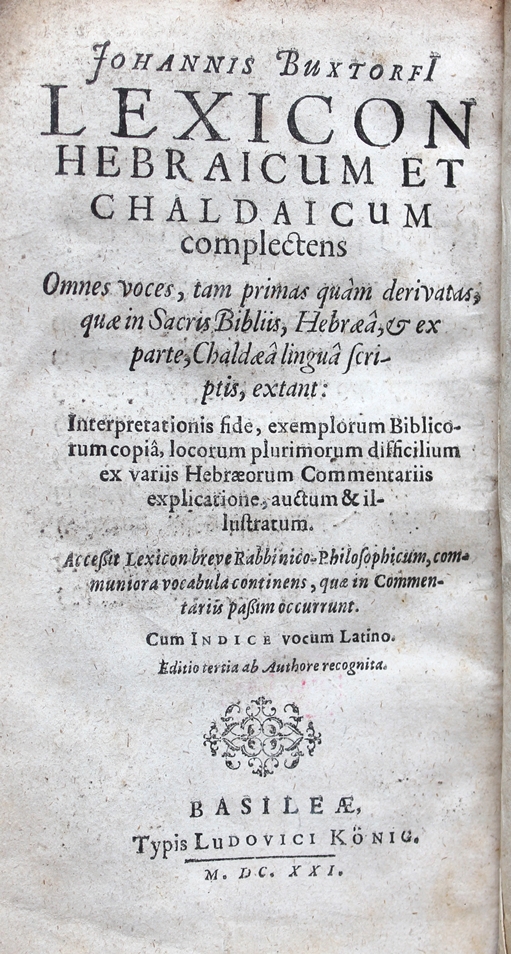
Keynes.Ec.7.3.26 Lexicon Hebraicum et Chaldaicum - title page

The title page of Keynes.Ec.7.3.26

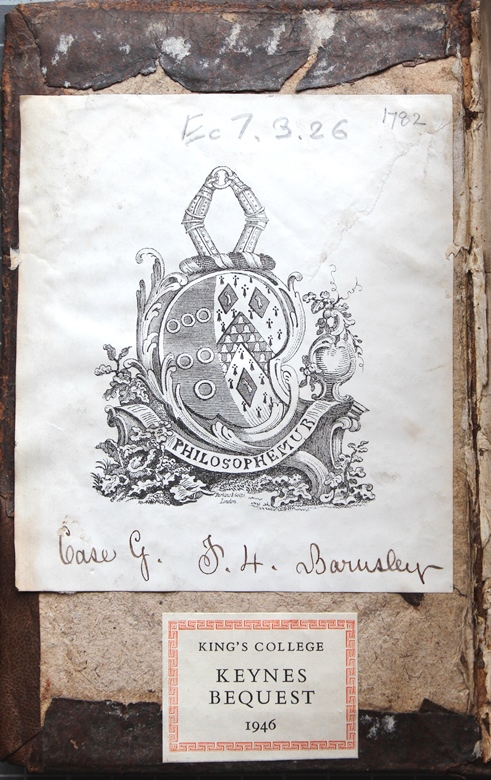
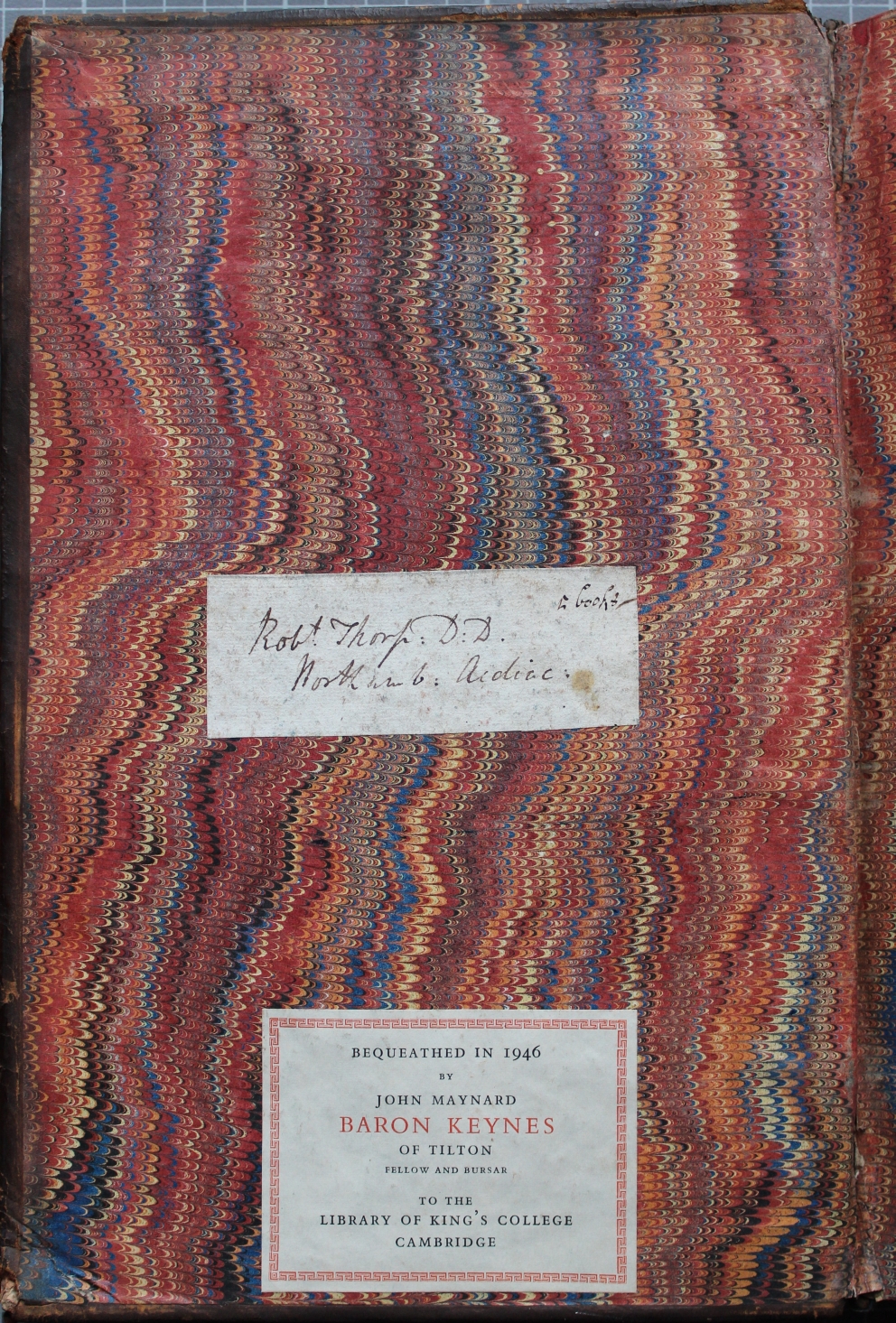
Bookplate on inside front board of Keynes.Ec.7.3.26

Bookplate on inside front board of Keynes.Ec.7.3.26

Among the highlights of the Keynes Bequest are two volumes from Sir Isaac Newton’s library, with a fascinating history behind them. This copy of Johann Buxtorf’s third edition of Lexicon Hebraicum et Chaldaicum (Basel: Ludwig König, 1621) features an armorial bookplate with motto ‘Philosophemur’ and ‘Case G. F.4. Barnsley’ in ink underneath the bookplate. On the rear fly-leaf is the shelfmark ‘F2_27’. The ‘Philosophemur’ bookplate belonged to Dr James Musgrave, who was Rector of Chinnor, near Oxford. After he died in 1778 the library was removed to Barnsley Park, Gloucestershire, the home of his son, where the books were re-catalogued and re-classified with ‘Barnsley’ shelfmarks. Musgrave’s books had been previously owned by his predecessor at Chinnor, Charles Huggins, who received them from his father, John Huggins, Warden of the Fleet Prison. John Huggins had bought the collection from the estate of his late neighbour, Isaac Newton, for £300.

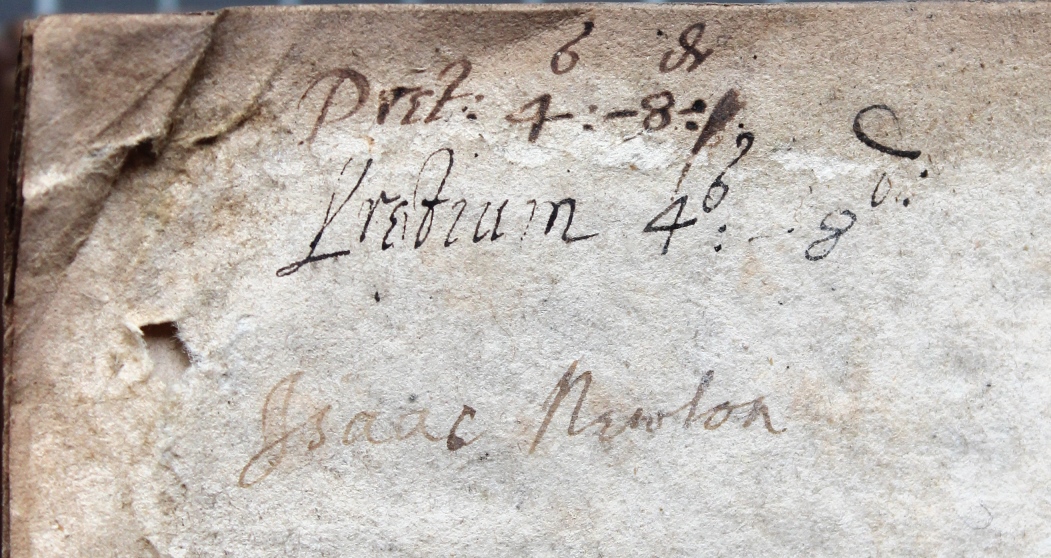
Signature of Isaac Newton

Signature of Isaac Newton

Newton’s library was preserved almost intact until 1920, when more than half of the items were auctioned off and dispersed. Before securing one of the most important collections of Newton’s manuscripts in the world, which he acquired during and after a sale at Sotheby’s in 1936, John Maynard Keynes purchased two of Newton’s books from the Guildford bookseller Thomas Thorp in March 1921. This Latin-Hebrew dictionary is signed on the front and rear fly-leaves: ‘Isaac Newton’, who also noted the price on the rear fly-leaf: ‘Pret: 4s: 8d’.

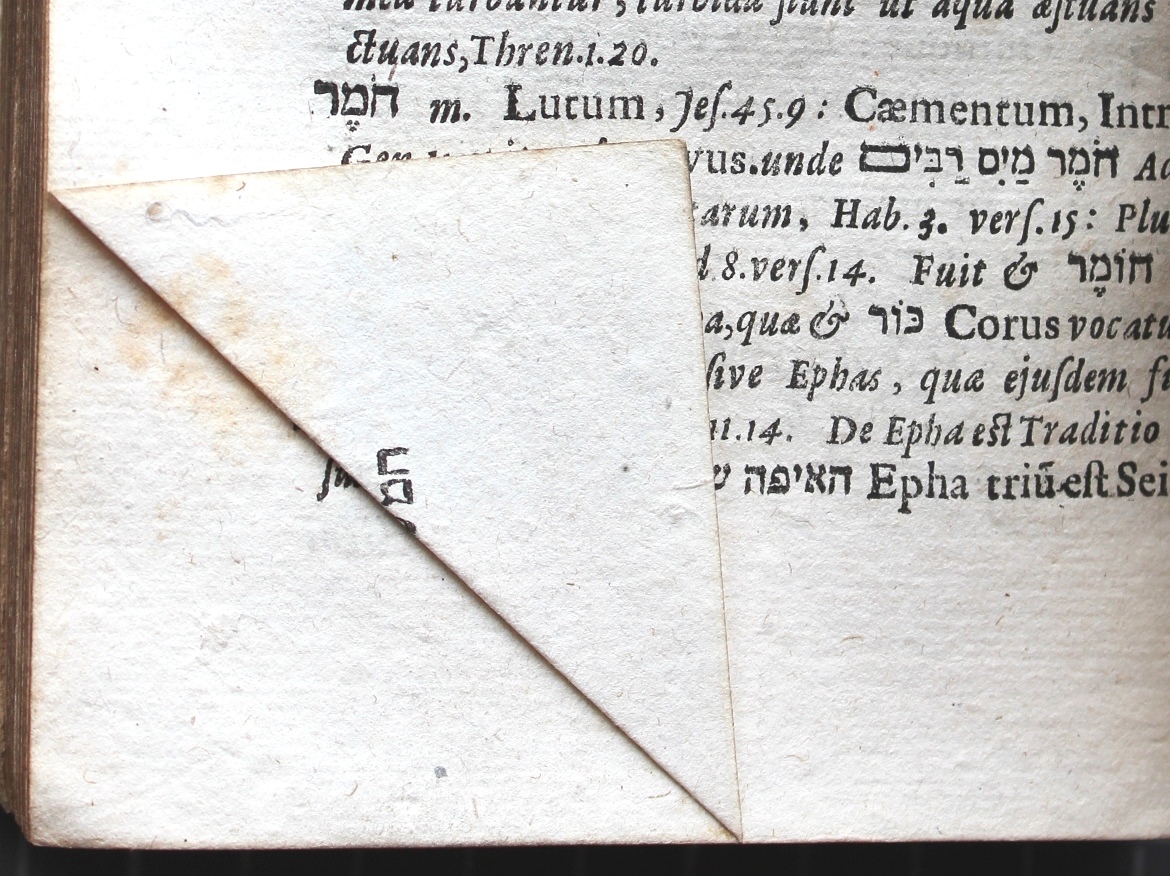
Newton highlighting the word 'Lutum' in Keynes.Ec.7.3.26

Newton highlighting the word ‘Lutum’ in Keynes.Ec.7.3.26

Newton had the habit of ‘dog-earing’ his books, turning back the corner of leaves to note a reference, the corner of the leaf pointing to the exact word he wished to highlight. Eight pages (pp. 11, 18, 29, 45, 164, 247, 593 and 636) are turned back in this way in this dictionary. For more information, see John Harrison, The Library of Isaac Newton (Cambridge: Cambridge University Press, 1978). Some of the information in this post is drawn from the SCOLAR blog of Cardiff University.

IJ

Munby Cataloguing Project (Rare Books)

Title page

The title page of Keynes.D.1.9

In June 2013 King’s College held a conference to mark the centenary of the birth of A.N.L. (Tim) Munby, Librarian at King’s from 1947 to 1974. The conference was a great success, with a distinguished panel of speakers from the world of bibliography and the history of books, and over 120 registered participants. As a follow-up to the conference, and as a permanent tribute to Tim Munby, King’s College inaugurated a fund in his name—The Munby Centenary Fund.  Donations to the fund support projects initiated by Munby, or related closely to his interests and achievements.

Spine detail

The gold tooling on the book’s spine.

The initial objective is to complete the online cataloguing of all of the books in the collection of John Maynard Keynes and generous donations have already made it possible to hire Dr Iman Javadi as ‘Munby Project Cataloguer (Rare Books)’ to begin this work. Iman joined the library team in November 2014, and has so far catalogued over 200 books.

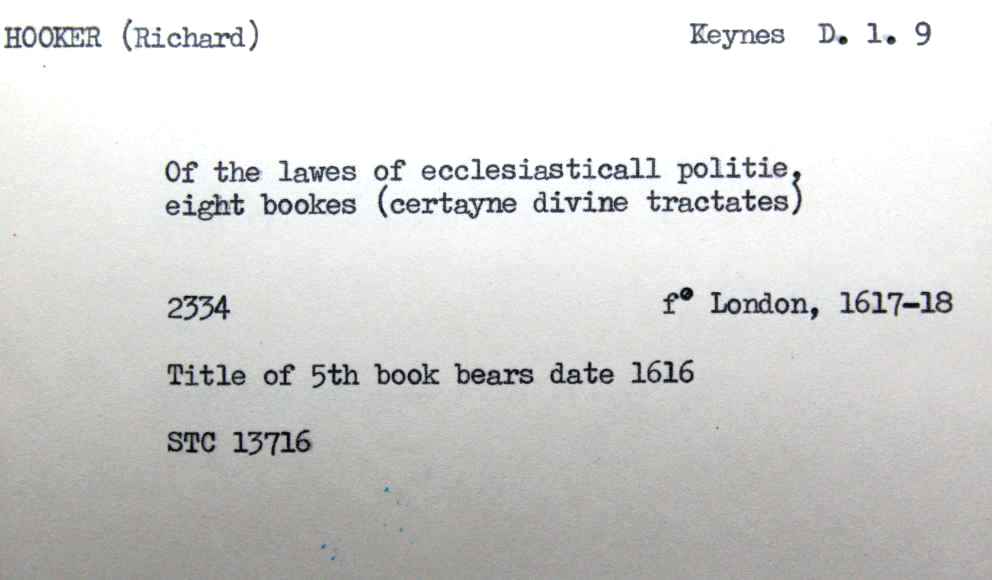
Tim Munby began his career at King’s as the first cataloguer of Keynes’s collection, although cataloguing in those days was very different. Catalogue cards often included little more than author, title and imprint details.

Index card2

Tim Munby’s original catalogue card.

Front pastedown1

Inside front pastedown showing Keynes’s bookplate.

These days catalogue records for rare books typically include a wealth of copy-specific information such as binding descriptions, provenance information and information relating to former owners and detailed physical descriptions of the book as an object. This change not only reflects changes in research interests in bibliography, but also assists librarians in collection management, and the availability of these descriptions online improves access to the collections.

The newly created online record for this  item can be viewed here: MARC record (opens a .docx file)

Further updates about the project will be posted on this blog.

JC

Welcome to King’s Treasures!

Welcome to the first post on King’s Treasures, the blog of the special collections of the Library and Archives at King’s College, Cambridge. The library and archive holdings are kept in an early nineteenth-century building designed by the architect William Wilkins. Holdings include thousands of items ranging from tenth-century manuscripts and incunabula to College administrative archives and personal papers of notable individuals associated with the College.

We will be posting news items here about these special collections, as well as regular updates about a current project funded by donations to the Munby Centenary Fund to catalogue some of our rare books from the collection of the economist John Maynard Keynes.

JC