Tag Archives: Virginia Woolf

Jane Austen at 250: An Online Exhibition

Today, 16 December 2025, marks the 250th anniversary of Jane Austen’s birth. Events have been held throughout the year to celebrate this occasion. As part of Open Cambridge on 17 September, King’s College Library mounted an exhibition featuring first editions of all of Austen’s novels, the autograph manuscript of her unfinished novel Sanditon, a manuscript letter to her publisher, a book from her library, early translations of her novels, and other rare items. The event was a great success and was attended by over 650 people who braved the wet weather to come and view the treasures on display, thus creating a “ceaseless clink of pattens” on the wooden library floor reminiscent of Lady Russell’s description of driving through Bath on a wet afternoon in Persuasion. We present below some highlights from the exhibition for those who could not visit in person.

One of the exhibition cases housing the treasures on display

Sense and Sensibility, Austen’s first novel to be published, was written in epistolary form around 1795 in Steventon under the title Elinor and Marianne. It was begun in its present form in autumn 1797 and revised and prepared for publication in 1809-1811 when Jane was living in Chawton.
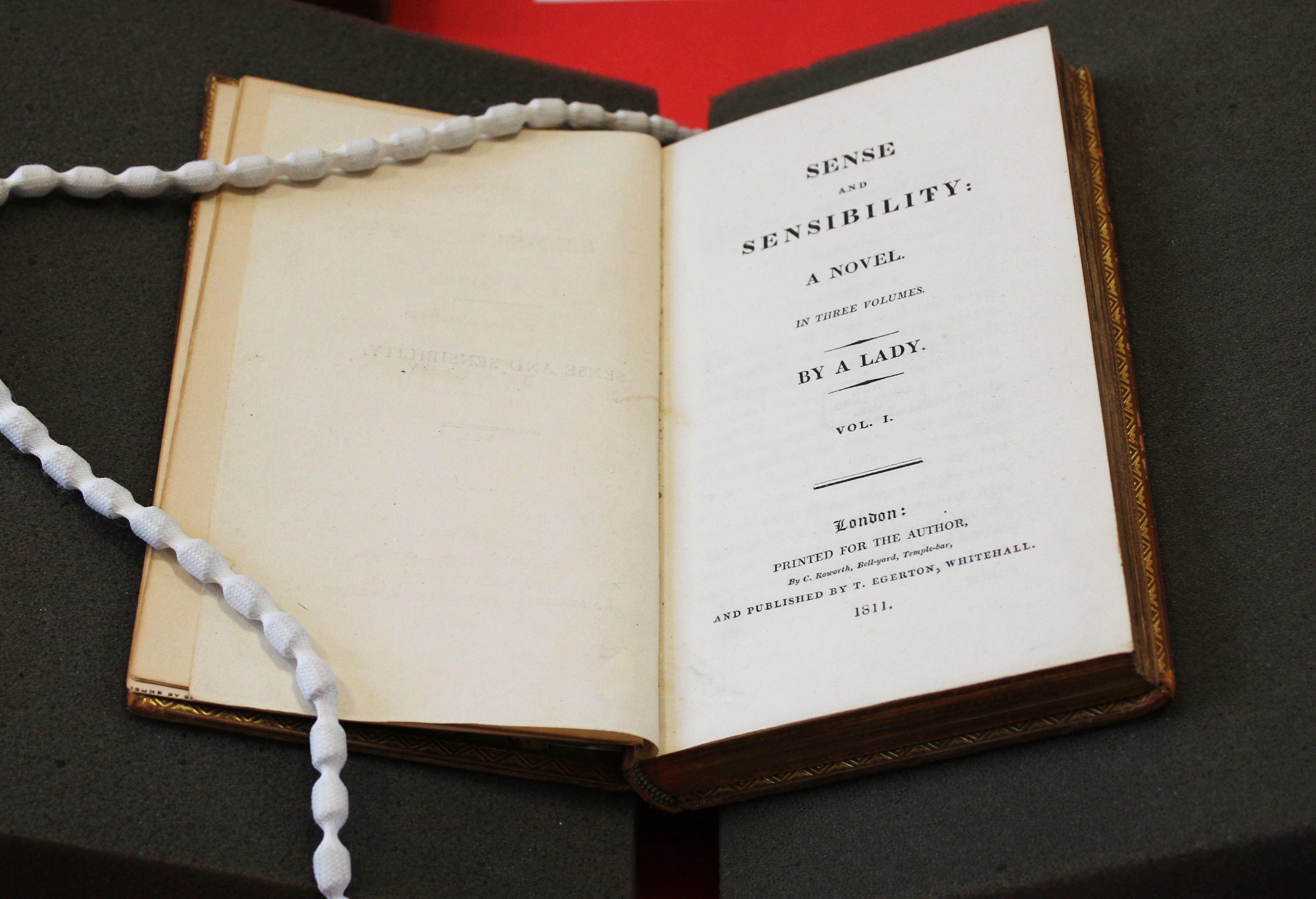
Jane Austen, Sense and Sensibility (London: Egerton, 1811), First edition
Warren.A.Se.1811/1-3

Pride and Prejudice, originally titled First Impressions, was offered for publication to the London bookseller Thomas Cadell, but the offer was declined by return post. The novel was subsequently published by Thomas Egerton under the revised title Pride and Prejudice. Upon receiving her copy of the first edition from the publisher, Jane wrote: ‘I have got my darling child from London’ (27 Jan 1813).
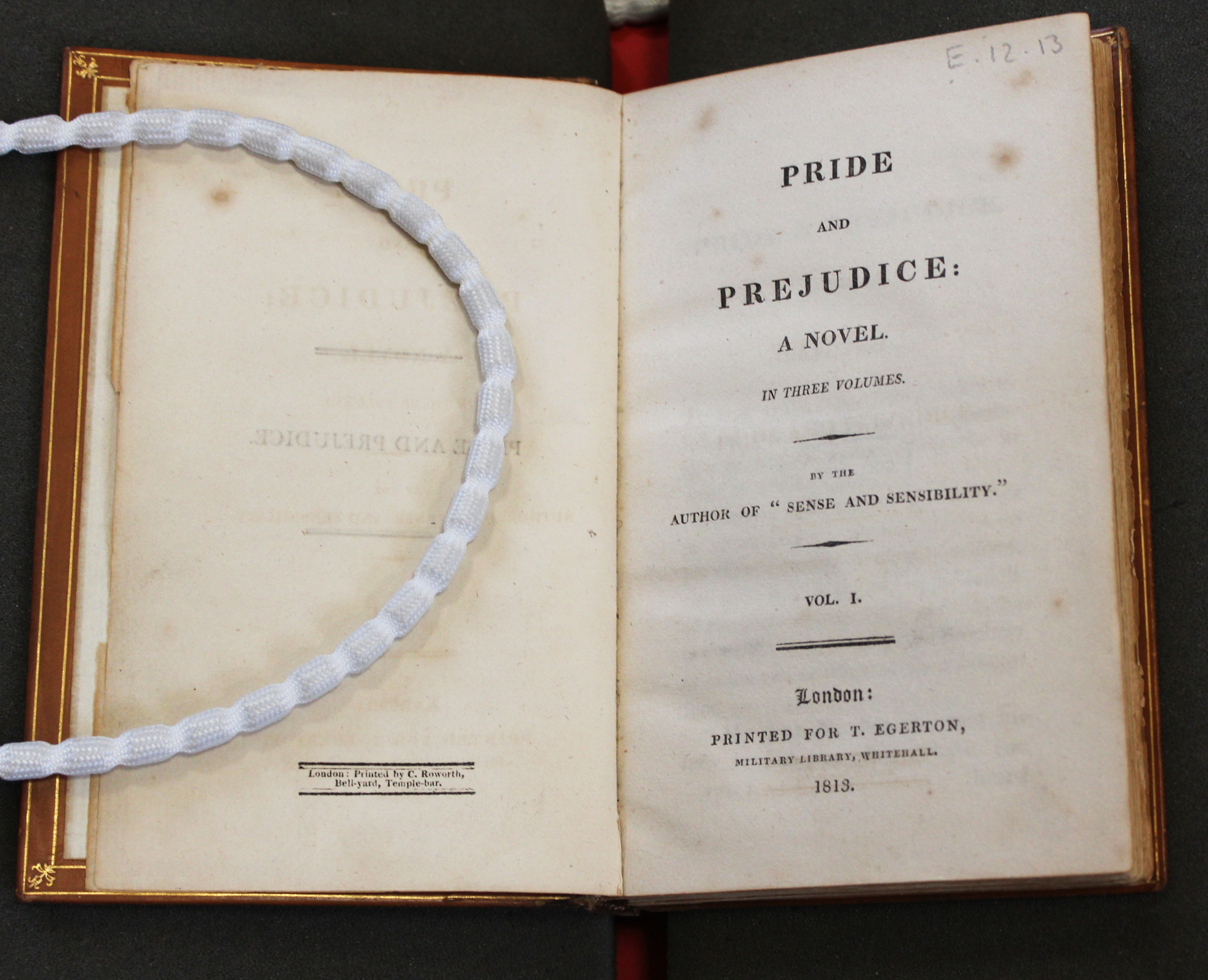
Jane Austen, Pride and Prejudice (London: Egerton, 1813), First edition
Warren.A.Pr.1813a/1-3

The Austen family lived in Bath between 1801 and 1806. Jane was familiar with the Pump Room, a venue for fashionable people, which is used as a setting in her novels Northanger Abbey and Persuasion. This image, from The New Bath Guide (1807), shows the Pump Room as it would have looked during Jane Austen’s time there.

Christopher Anstey, The New Bath Guide; or, Memoirs
of the B.N.R.D. Family in a Series of Poetical Epistles (Bath, 1807)
Warren.B.97.New.1807

Austen’s novels Persuasion (written 1815-16) and Northanger Abbey (written 1798-99) both appeared posthumously in a four-volume set in December 1817, although the title page states 1818. They are prefaced by a ‘biographical notice’ written by Jane’s brother Henry Austen in which Jane’s identity is revealed for the first time. She appears to have intended to publish Persuasion in 1818 but did not live long enough to do so.
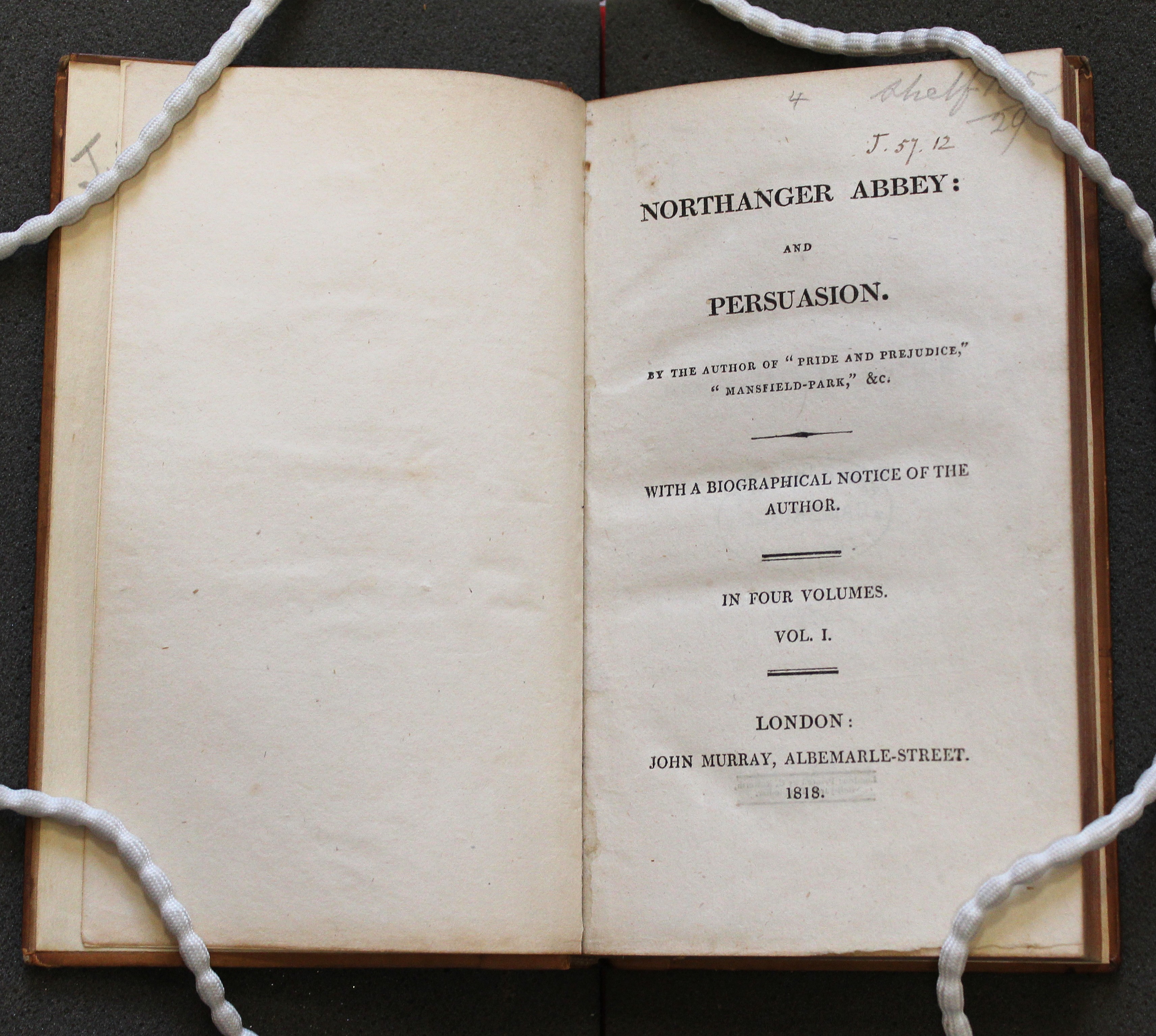
Jane Austen, Northanger Abbey, and Persuasion (London: Murray, 1818), First edition
Thackeray.J.57.12-15

In 1809 Austen’s brother Edward offered his mother and sisters a more settled life – the use of a large cottage in Chawton, near Alton in Hampshire. Whilst living in Chawton Jane published her first four novels. She also wrote Mansfield Park there between 1811 and 1813. It was first published by Egerton in 1814 and a second edition was published in 1816 by John Murray, still within Austen’s lifetime. It did not receive any critical attention when it first appeared.

Jane Austen, Mansfield Park (London: Egerton, 1814), First edition
Warren.A.Ma.1814/1-3

When Henry Austen was taken ill in London in October 1815, he was attended by his sister Jane and by one of the Prince Regent’s doctors who identified her as the author of Pride and Prejudice. The doctor reported that the Prince (later George IV) was a great admirer of her novels and she was invited to dedicate one of her future works to the Prince. Emma was the lucky work. Jane disapproved of the Prince’s treatment of his wife, but felt she couldn’t refuse, so she settled for a title page reading simply ‘Emma, Dedicated by Permission to HRH The Prince Regent’, though her publisher (John Murray) thought it ought to be more elaborate.

This copy of the first edition of Emma belonged to King’s Provost George Thackeray (1777–1850).
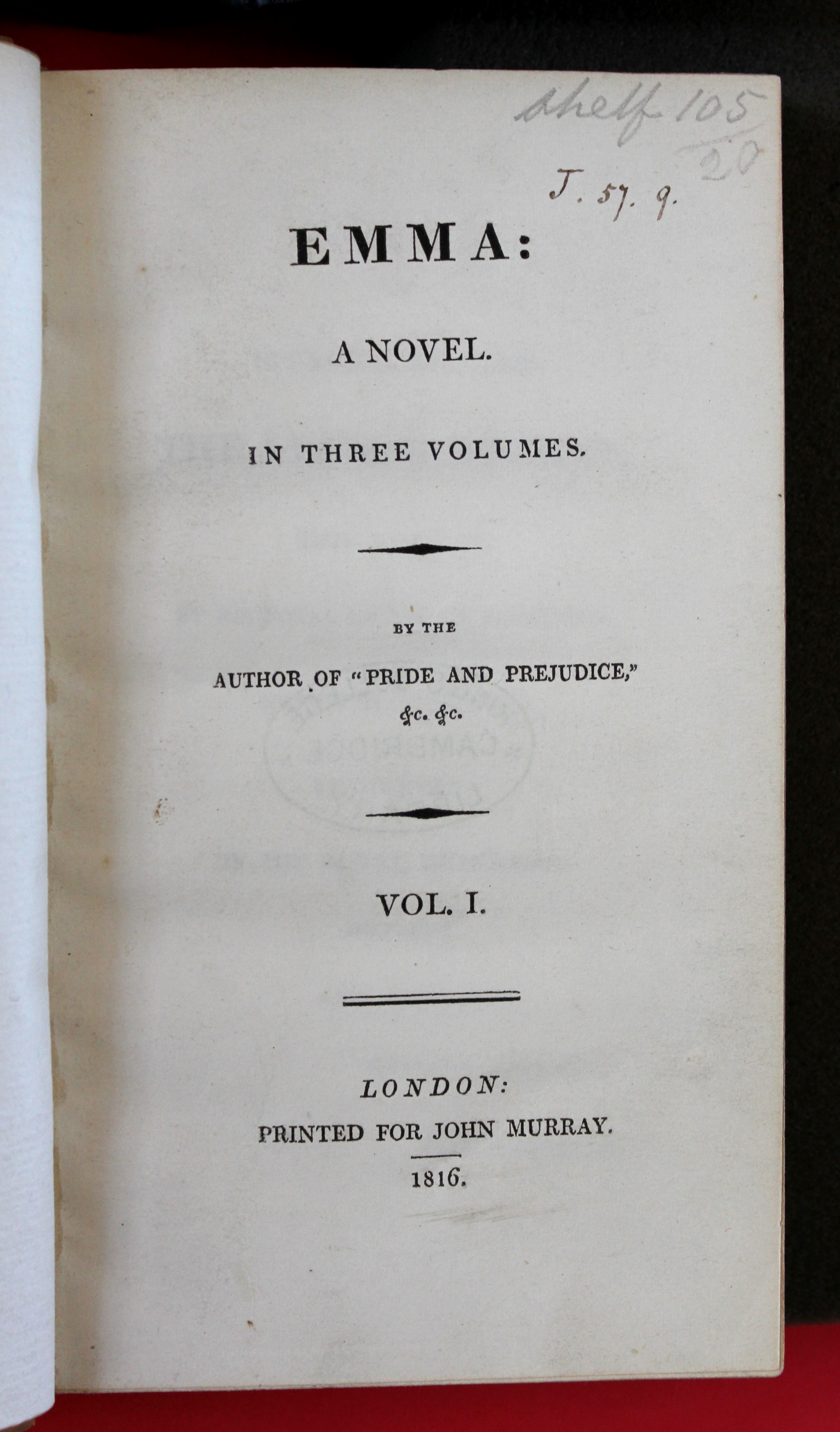
Jane Austen, Emma (London: Murray, 1816), First edition
Thackeray.J.57.9-11

Several months after the dedication of Emma, Jane wrote to John Murray and reported that the Prince had thanked her for the copy of Emma. In the same letter she notes that in a recent review of the novel, printed in The Quarterly Review (vol. XIV, 1816), the anonymous reviewer (later established as Sir Walter Scott) completely fails to mention Mansfield Park, remarking with regret that ‘so clever a man as the reviewer of Emma, should consider it as unworthy of being noticed’.

Jane Austen’s letter to John Murray, 1 April 1816 (NM/Austen/1)

Among the miscellaneous items on display was one of the few known copies of Sense and Sensibility in yellowback. Chapman and Hall’s series ‘Select Library of Fiction’ was closely associated with W.H. Smith, who carefully sought out copyrights, or reprint rights, of popular novels in order to publish yellowback editions for sale on his railway bookstalls. The series, which ran from 1854 until it was taken over by Ward, Lock in 1881, included at least thirty novels by Anthony Trollope, who had strong views on the poor quality of much railway literature.

Jane Austen, Sense and Sensibility
(London: Chapman and Hall, 1870)
Warren.A.Se.1870

One of the highlights of the exhibition was Jane Austen’s copy of Orlando furioso, signed by her on the fly-leaf, sold by the Austen-Leigh family, bought by Virginia Woolf, and inscribed by Woolf to John Maynard Keynes at Christmas 1936.

Ludovico Ariosto, Orlando furioso (trans. by John Hoole)
(London: Charles Bathurst, 1783)
Keynes.E.4.1

These Victorian editions of Mansfield Park, Emma, and Northanger Abbey were presented to E. M. Forster’s mother by his father, and were later inherited by Forster himself.

Copies of Mansfield Park, Emma and Northanger Abbey from the library of E. M. Forster (all London: Routledge, 18–)
Forster.AUS.Man; Forster.AUS.EMM; Forster.AUS.Nor

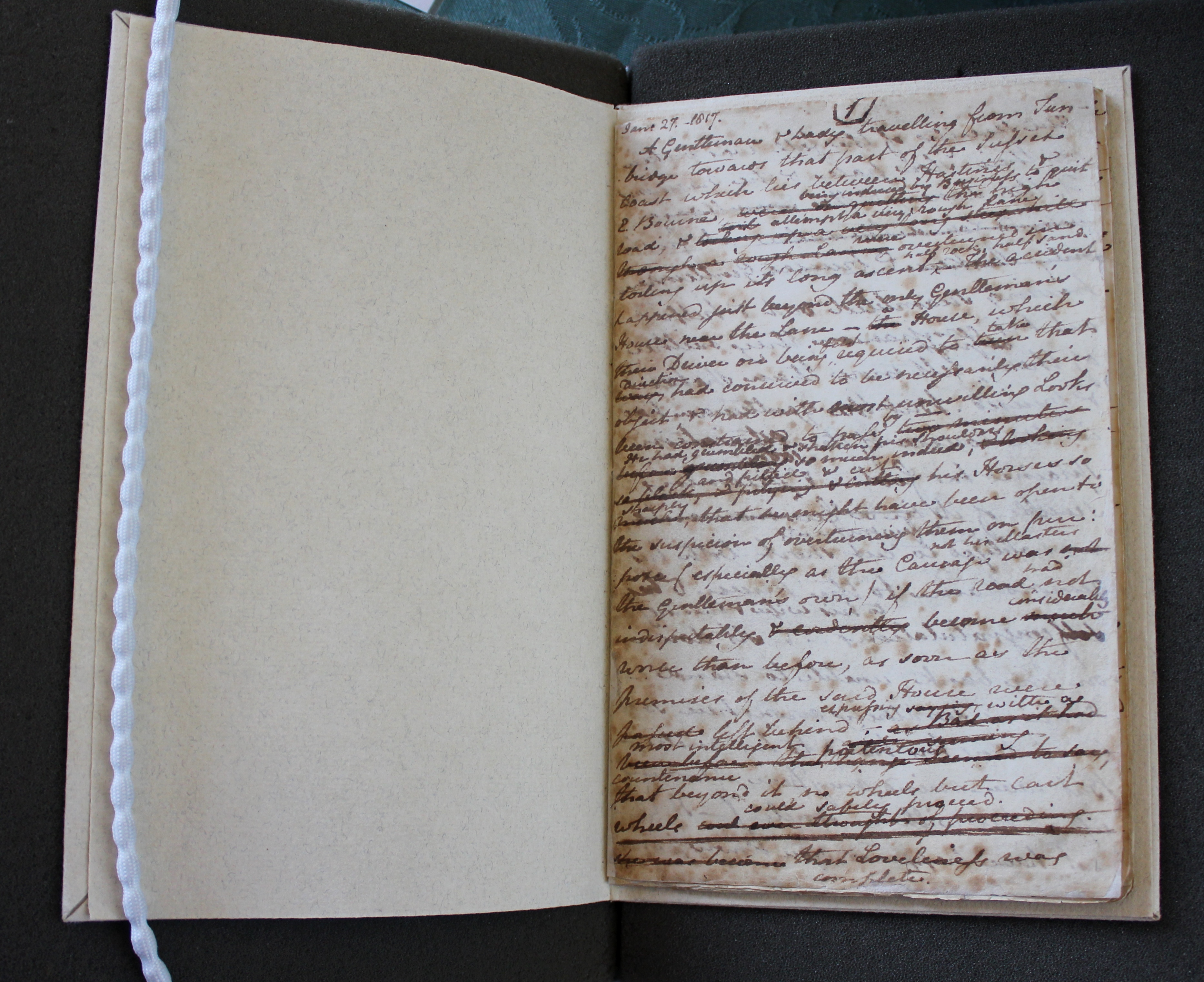
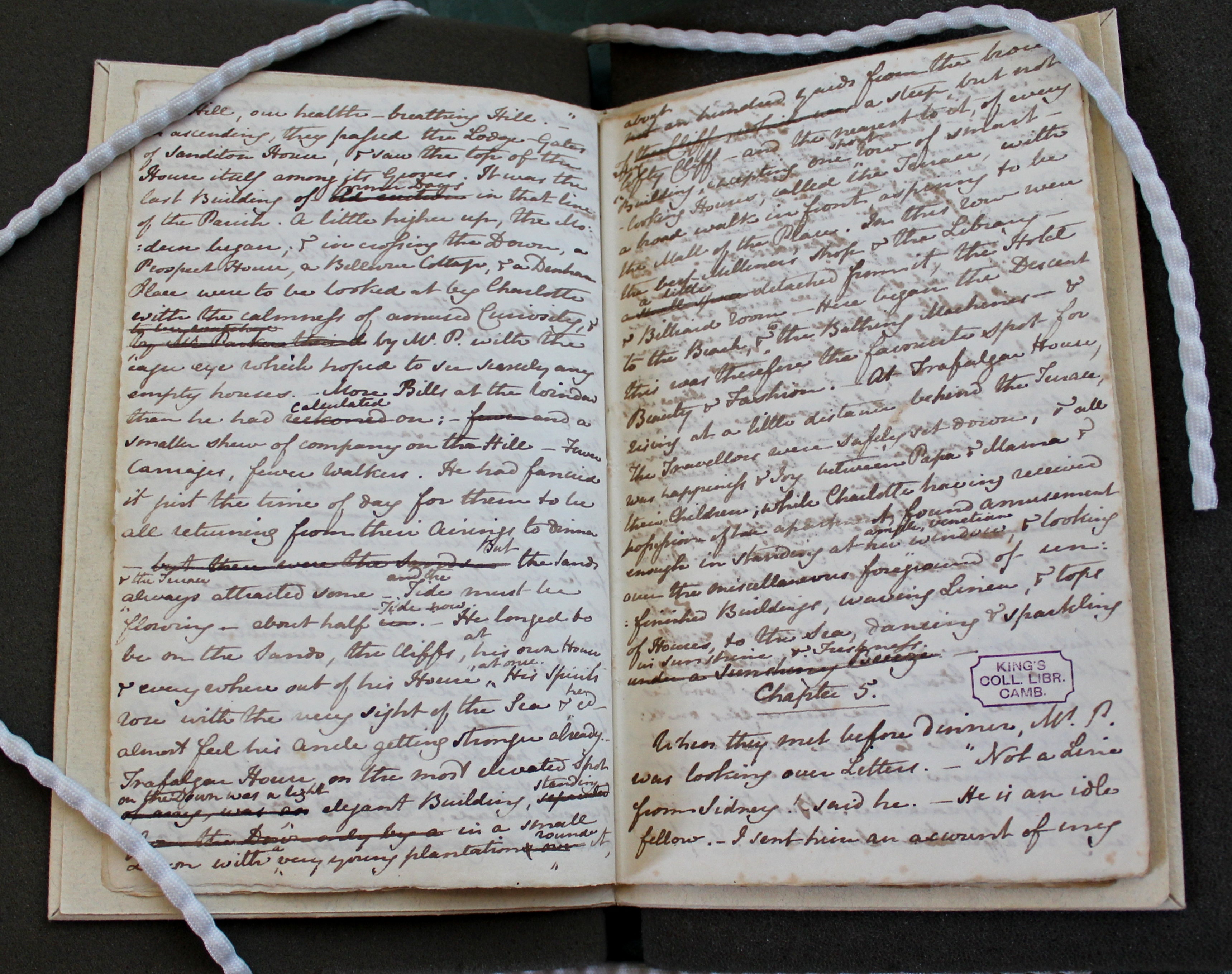
King’s College owns the manuscript of Jane Austen’s unfinished novel Sanditon, the last one on which she was working before she died on 18 July 1817. It is a rare surviving autograph manuscript of her fiction. It was given to King’s in 1930 by Jane’s great-great niece (Mary) Isabella Lefroy in memory of her sister Florence and Florence’s husband, the late Provost Augustus Austen Leigh who was a great-nephew of Jane. The booklets were made by Austen herself. The last writing is dated 18 March 1817. She died four months later.

The beginning of Sanditon

Below is the beginning of chapter 6, followed by the transcription in the printed version of Sanditon.

The beginning of chapter 6
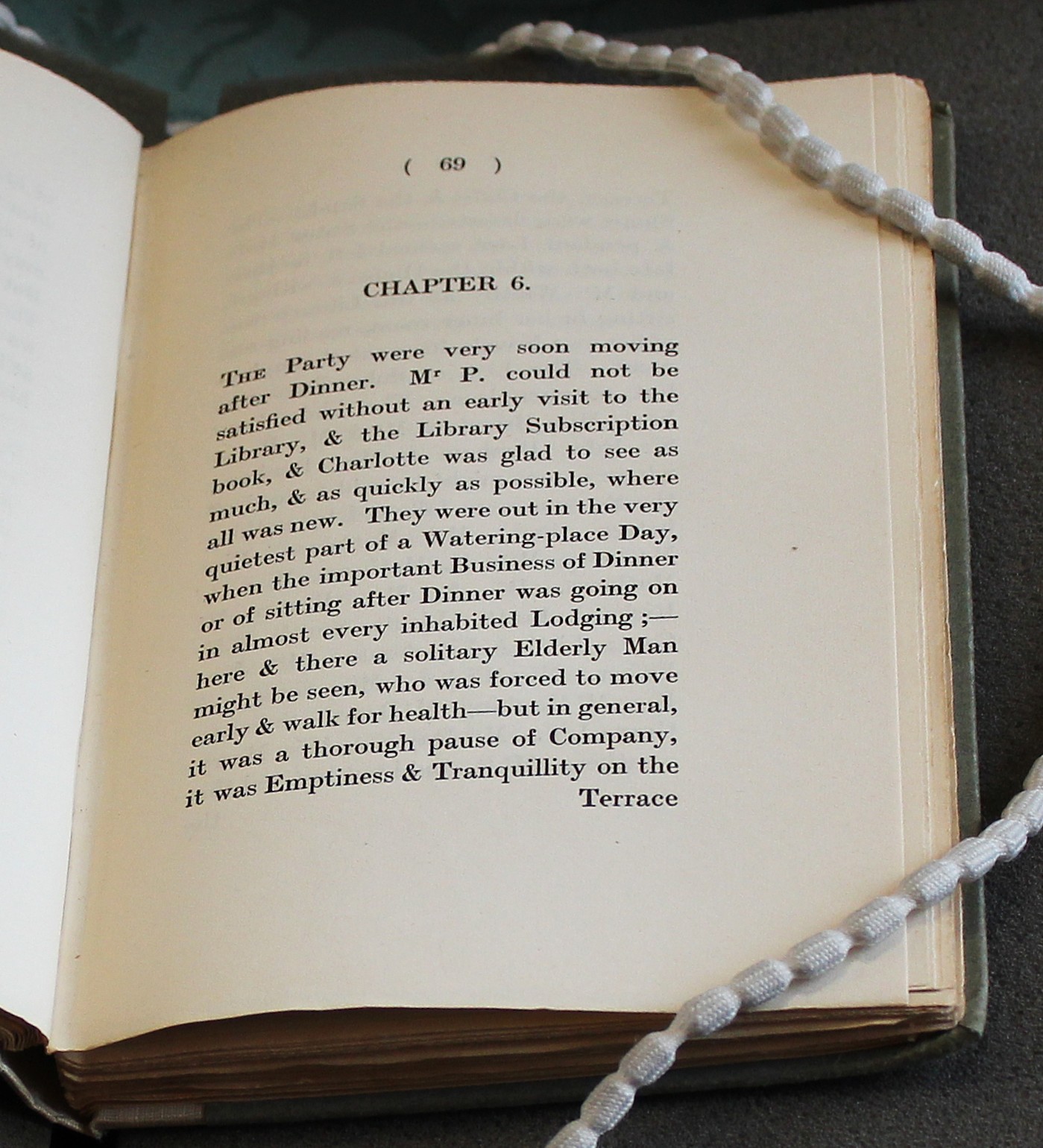
This copy of the first edition of Sanditon comes from the library of E. M. Forster.
Jane Austen, Fragment of a Novel (Oxford: Clarendon Press, 1925)
Gilson.A.Sa.1925a

During the summer, King’s College loaned one of the fascicles of Sanditon to Harewood House to be displayed there as part of their exhibition ‘Austen and Turner: A Country House Encounter’ where it occupied pride of place and was viewed and admired by thousands of visitors.

JC/IJ


The Waste Land at 100

This month marks the 100th anniversary of the publication of T. S. Eliot’s The Waste Land, one of the most influential poems of the twentieth century. To celebrate the occasion, we present a selection of images from first and early editions of the poem. King’s College is very fortunate in hosting one of the largest collections of manuscript and printed materials by Eliot thanks to the bequest of his close friend John Hayward (1905-65), who shared a flat with the poet from 1946 to 1957. Hayward read English and modern languages at King’s from 1923 to 1927 and went on to become an accomplished editor and critic. He met Eliot for the first time while still an undergraduate at Cambridge in 1926.

Eliot’s correspondence suggests that The Waste Land was written between late 1920 and early 1922. Though the drafts were lost during his lifetime, they resurfaced in 1968 and were published in a facsimile edition by his widow Valerie in 1971:

Eliot’s pencil draft of the beginning of the fifth section of the poem, “What the Thunder Said” (The Waste Land: A Facsimile and Transcript of the Original Drafts Including the Annotations of Ezra Pound, ed. Valerie Eliot [London: Faber, 1971], p. [70]; YIM ELI, ZWA 3XP 1).

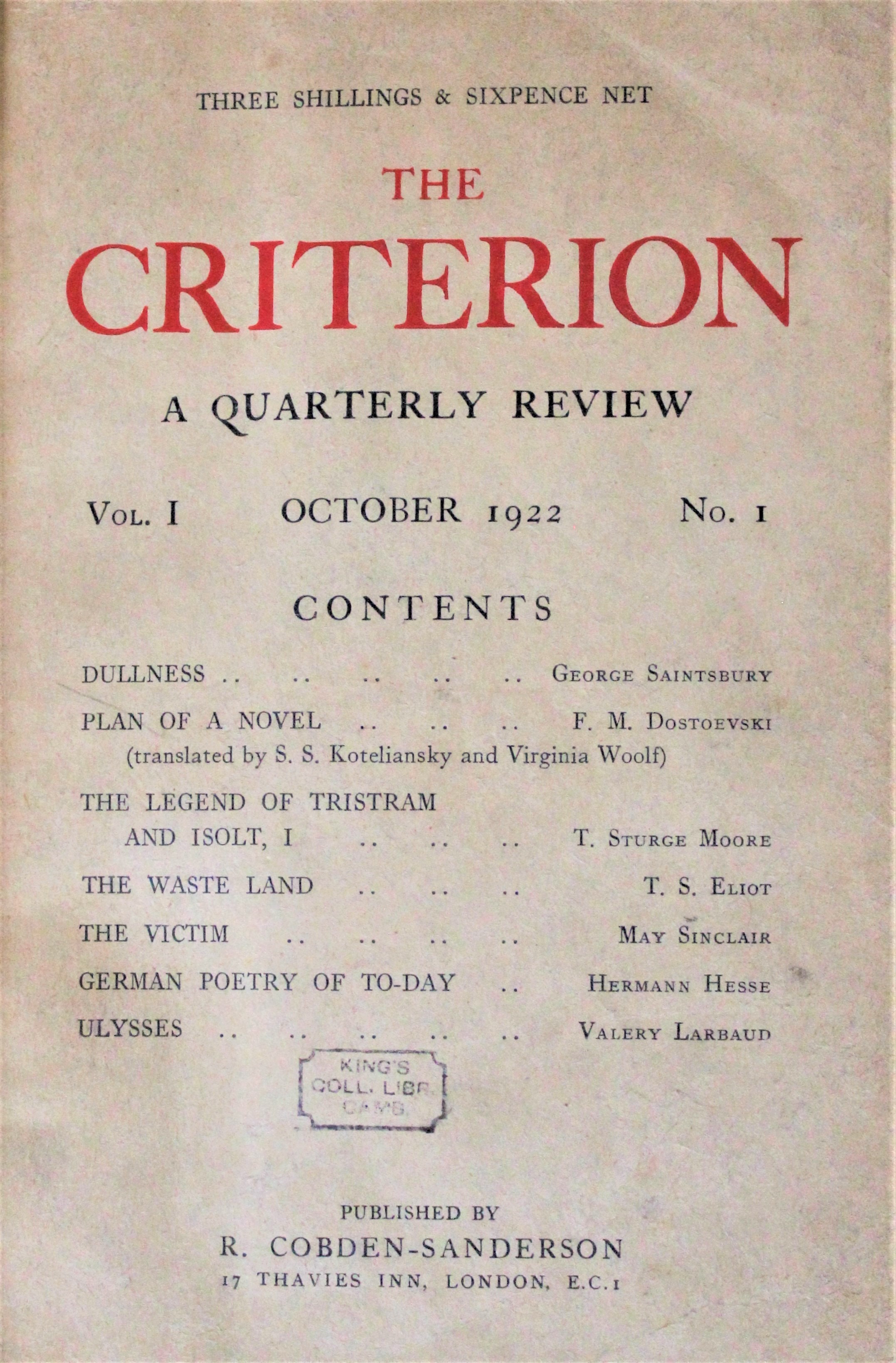
The poem was first printed in the inaugural issue of the literary journal The Criterion, edited by Eliot, which, according to his bibliographer Donald Gallup, appeared around 15 October 1922:

Front cover of the first issue of The Criterion, October 1922 (HC2.1.1 21).

The opening of The Waste Land from The Criterion, pp. 50-51. The poem was published almost simultaneously in America in The Dial, LXXIII.5 (Nov. 1922), pp. [473]-485.

It was then published in book form in New York on 15 December 1922 in a limited edition of 1,000 copies:

Dust jacket of The Waste Land (New York: Boni and Liveright, 1922). The colophon on p. [6] reads: “Of the one thousand copies printed of The Waste Land this volume is number 914” (Hayward.H.9.6).

It was in this volume that the epigraph and the “Notes” to the poem were first included. Eliot later reminisced in “The Frontiers of Criticism” (1956): “I had at first intended only to put down all the references for my quotations, with a view to spiking the guns of critics of my earlier poems who had accused me of plagiarism. Then, when it came to print The Waste Land as a little book – for the poem on its first appearance in The Dial and in The Criterion had no notes whatever – it was discovered that the poem was inconveniently short, so I set to work to expand the notes, in order to provide a few more pages of printed matter, with the result that they became the remarkable exposition of bogus scholarship that is still on view to-day” (The Complete Prose of T. S. Eliot: The Critical Edition, ed. Jewel Spears Brooker and Ronald Schuchard [Baltimore: Johns Hopkins University Press, 2019], vol. 8, p. 127):

First page of the “Notes” to The Waste Land (Hayward.H.9.6).

The first English edition appeared the following year on 12 September 1923: it was hand-printed by Leonard and Virginia Woolf at the Hogarth Press in Richmond. Virginia typeset the whole poem on her own between 23 June and 8 July 1923, writing to Barbara Bagenal on 8 July: “I have just finished setting up the whole of Mr Eliots poem [The Waste Land] with my own hands: You see how my hand trembles” (The Letters of Virginia Woolf, ed. Nigel Nicolson and Joanne Trautmann [New York: Harcourt Brace Jovanovich, 1978], vol. 3, p. 56):

Front cover of the first English edition (Richmond: Printed and published by Leonard and Viriginia Woolf at the Hogarth Press, Hogarth House, Paradise Road, 1923; Hayward.H.9.8A). The printed label at the top is known to exist in three states. This is the first state featuring a border of asterisks.

Title page of the first English edition of The Waste Land. This copy was bequeathed by another Kingsman, Dadie Rylands (1902-99), who worked for six months with Leonard and Virginia Woolf at the Hogarth Press in 1924.

In the copy of the first edition which Eliot presented to Ezra Pound, the dedication (For Ezra Pound / il miglior fabbro) appears as an autograph inscription. It was first printed in 1925 in the collection Poems, 1909-1925:

Title page of The Waste Land as printed in Poems, 1909-1925 (London: Faber & Gwyer, 1925, p. 63; Hayward.H.9.10).

To mark this momentous centenary, the BBC broadcast the radio drama “He Do The Waste Land in Different Voices,” as well as a programme on the importance of The Criterion, which is still available here. A documentary on the poem broadcast on BBC2 on 13 October can also be viewed here.

IJ

LGBT History Month in King’s Library

King’s Library and Archives were pleased to join the rest of the College in marking the start of LGBT history month by putting on an exhibition in the Library featuring items written by and relating to prominent LGBT King’s figures, including the novelist E.M. Forster and codebreaker Alan Turing, along with a display of borrowable LGBT-themed books. We are delighted to be able to share the exhibition here.

One of the earliest books about sexual practices to cover the subject of homosexuality, albeit in a negative way, was Psychopathia sexualis (1886), written by the Austro-German psychiatrist Richard von Krafft-Ebing (1840–1902). Here we see an English translation, by Kingsman Arthur Vivian Burbury (1896–1959).

Richard von Krafft-Ebing, Aberrations of sexual life (London, 1951) (Shelfmark: Store K Burb)

It was nearly thirty years later, in 1913, that novelist and Kingsman E.M. Forster (1879–1970) began his novel Maurice, which was ‘dedicated to a happier year’. He shared drafts with close friends and revised it throughout his life, taking their suggestions into account. It was published in 1971, shortly after he died. The 1987 Merchant Ivory adaptation of Maurice was partially filmed on location at King’s, and a number of Porters and Fellows appeared as extras in an early dining scene.

E.M. Forster, Carbon typescript of the 1932 version of Maurice. Penultimate page. (Reference: EMF/1/5/4)

E.M. Forster, Carbon typescript of the 1932 version of Maurice. Final page (Reference: EMF/1/5/4)

E.M. Forster, Carbon typescript of the 1932 version of Maurice. Opening (Reference: EMF/1/5/4)

Among E.M. Forster’s collection of books held in King’s College Library there is a copy of the first edition of Virginia Woolf’s fictional biography Orlando, given to him by the author herself. At the midpoint of the book the male Orlando goes to bed for several days and on awaking finds himself changed into a woman, remaining so for the rest of the book. Woolf dedicated Orlando to her great friend and lover Vita Sackville-West (1892–1962), who was the inspiration for the central character.

Virginia Woolf, Orlando: a biography (London, 1928) (Shelfmark: Forster.WOO.Orl.1928)

Some two decades later the now famous ‘Kinsey scale’ was created in order to demonstrate that sexuality does not fit into two discrete categories of homosexual and heterosexual. Instead, Alfred Kinsey (1894–1956) believed that sexuality was fluid and subject to change over time. The scale first appeared in his very influential work Sexual behaviour in the human male in 1948.

Alfred C. Kinsey [et al.], Sexual behaviour in the human male (Philadelphia, 1949) and Sexual behaviour in the human female (Philadelphia, 1953) (Shelfmarks: IKS Kin/1 and IKS Kin/2)

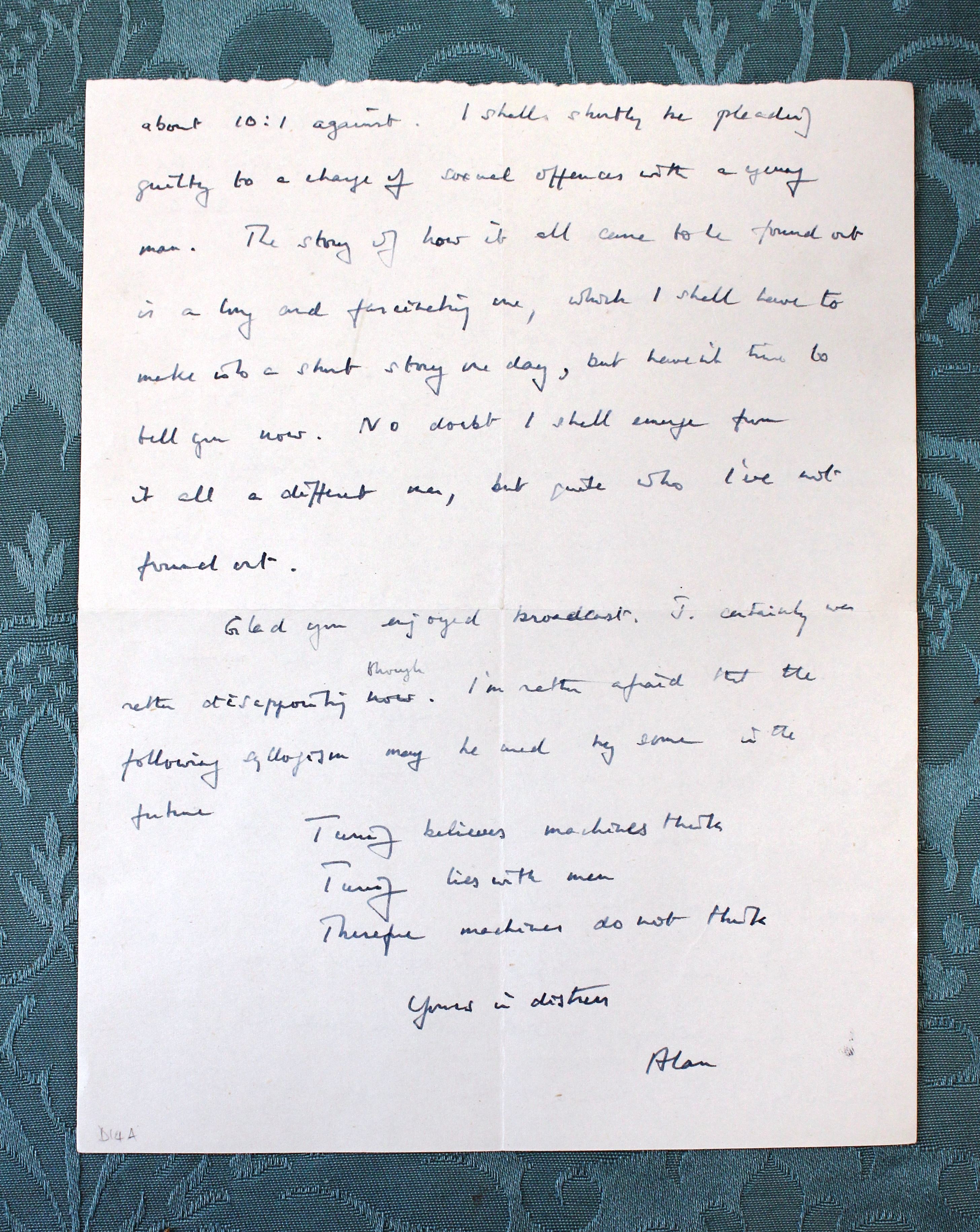
Famous WW2 codebreaker and Kingsman Alan Turing (1912–1954) sent this poignant letter to his friend Norman Routledge (1928-2013), also a Kingsman, shortly before his trial for gross indecency in 1952. To avoid prison Turing had to agree to hormonal treatment that amounted to chemical castration.

Letter from Alan Turing to Norman Routledge, February 1952 (Reference: AMT/D/14a)

                        Turing believes machines think
                        Turing lies with men
                        Therefore machines do not think
                                    Yours in distress

                                                                     Alan

This is E.M. Forster’s copy of a 1954 report by the Church of England issued for private circulation which advocated the legalisation of homosexual acts in private and the creation of a government commission on the subject. This appeared just two years after Turing’s tragically early death.

The problem of homosexuality: an interim report (London, 1954) (Shelfmark: Forster.CHU.Pro.1954)

In the same year Peter Wildeblood (1923–1999) was sent to prison for homosexuality along with Lord Montagu of Beaulieu and Michael Pitt-Rivers. He wrote an account of the infamous and high-profile trial and his time in prison which was published in 1955. He later gave evidence to the Wolfenden Committee. This is E.M. Forster’s copy of the book, showing Wildeblood’s description of what happened to him immediately after sentencing at the Winchester Assize Court.

Peter Wildeblood, Against the law (London, 1955) (Shelfmark: Forster.WILD.Aga.1955)

The ‘Committee on Homosexual Offences and Prostitution’, chaired by John Wolfenden (1906–1985), first met in September 1954. Its report, published in 1957, recommended that homosexuality should be legalised, but it was not until 1967 that this became law. This is E.M. Forster’s copy.

Parliamentary debates (Hansard), House of Commons, official report, 596/22 (26 November 1958) (Shelfmark: Forster.PAR.1958)

In addition to our exhibition of rare materials we also displayed a sample of modern books from the holdings of King’s Library which can be borrowed by members of College.

On the day of the exhibition launch, King’s College, along with many other Cambridge Colleges, the University Library and the Guildhall, flew the rainbow flag which has been the symbol of LGBT pride for some four decades.

The rainbow flag being flown from the Gibbs building in King’s College.

JC

Jane Austen Open Day: An Online Exhibition – Part 2

On 18 July 2017, the 200th anniversary of Jane Austen’s death, King’s College Library mounted an exhibition featuring first editions of all of Austen’s novels, the autograph manuscript of her unfinished novel Sanditon, a manuscript letter to her publisher, a book from her library, early translations of her novels, and other rare treasures. The event was a great success and was attended by over 1,000 people. Some of this material was used in our Open Cambridge exhibition which attracted over 1,400 visitors during the weekend of 8-9 September. We present below some highlights from the second part of the exhibition for those who could not visit in person.

Persuasion was first printed in French in 1821. This copy of the second French edition (1828), freely translated by the Swiss novelist and translator Isabelle de Montolieu (1751–1832), belonged to Sir Geoffrey Keynes, the younger brother of John Maynard Keynes.

Jane Austen, La Famille Elliot ou l’Ancienne Inclination
(Paris: Arthus Bertrand, 1828)
Gilson.A.PeF.1828/1

Routledge’s Railway Library, intended for ‘amusement while travelling’, began in 1849 as a shameless imitation of Simms and McIntyre’s Parlour Library. The inclusion of Pride and Prejudice in the series in 1850 is a testament to the popularity of the novel at the time.

Pride and Prejudice. By Miss Austen, ‘The Railway Library’
(London: Routledge, 1850)
Gilson.A.Pr.1850a

Chapman and Hall’s series ‘Select Library of Fiction’ was closely associated with W.H. Smith, who carefully sought out copyrights, or reprint rights, of popular novels in order to publish yellowback editions for sale on his railway bookstalls. The series, which ran from 1854 until it was taken over by Ward, Lock in 1881, included at least thirty novels by Anthony Trollope, who had strong views on the poor quality of much railway literature. This is one of the few known copies of Sense and Sensibility in yellowback.

Jane Austen, Sense and Sensibility
(London: Chapman and Hall, 1870)
Warren.A.Se.1870

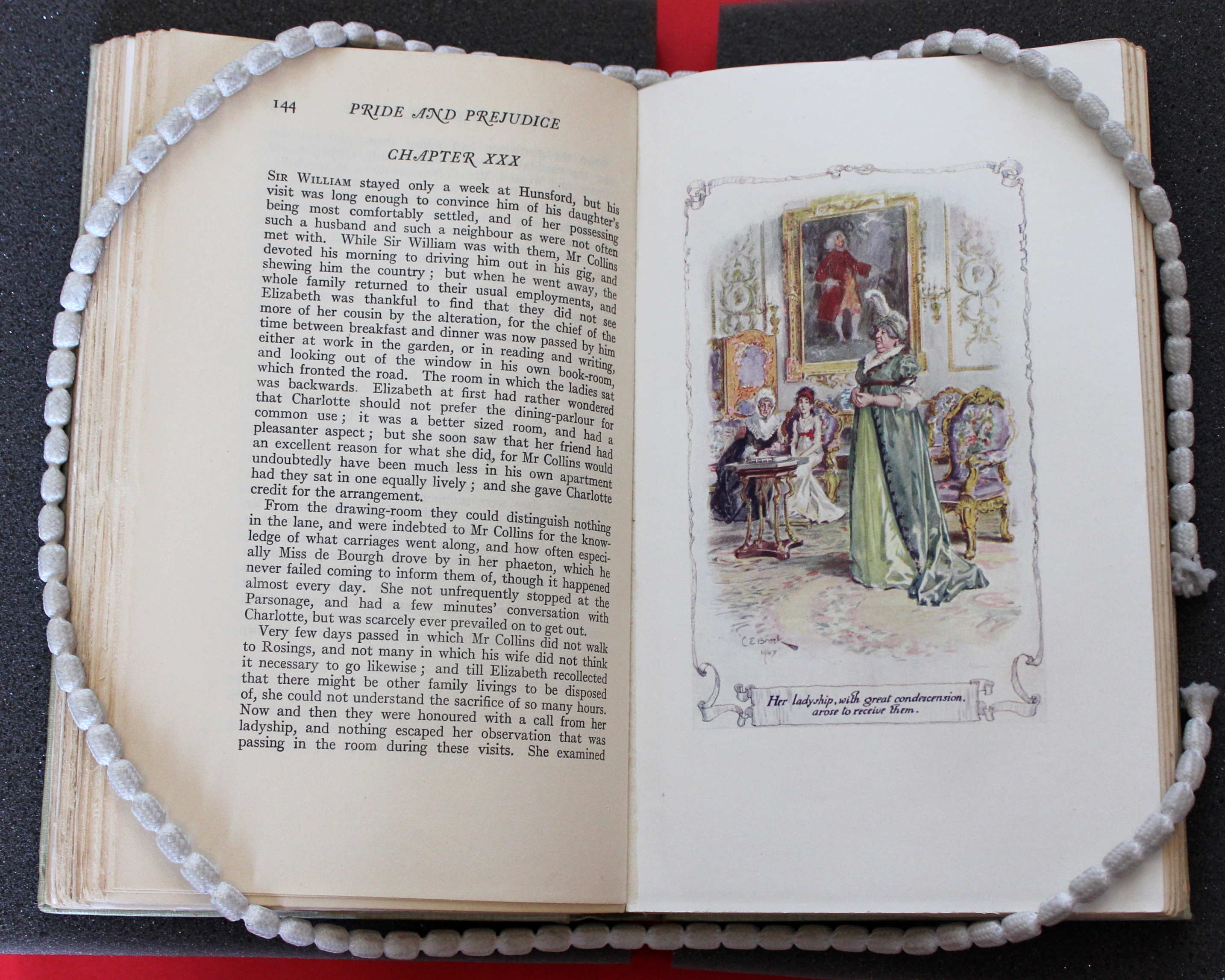
Lady Catherine is fully aware of her station in life and had no qualms in making others aware of this. This edition of Pride and Prejudice is illustrated by the Cambridge-based artist Charles Edmund Brock.

Jane Austen, Pride & Prejudice
with twenty-four coloured illustrations by C. E. Brock
(London: Dent, 1907)
Gilson.A.Pr.1907b

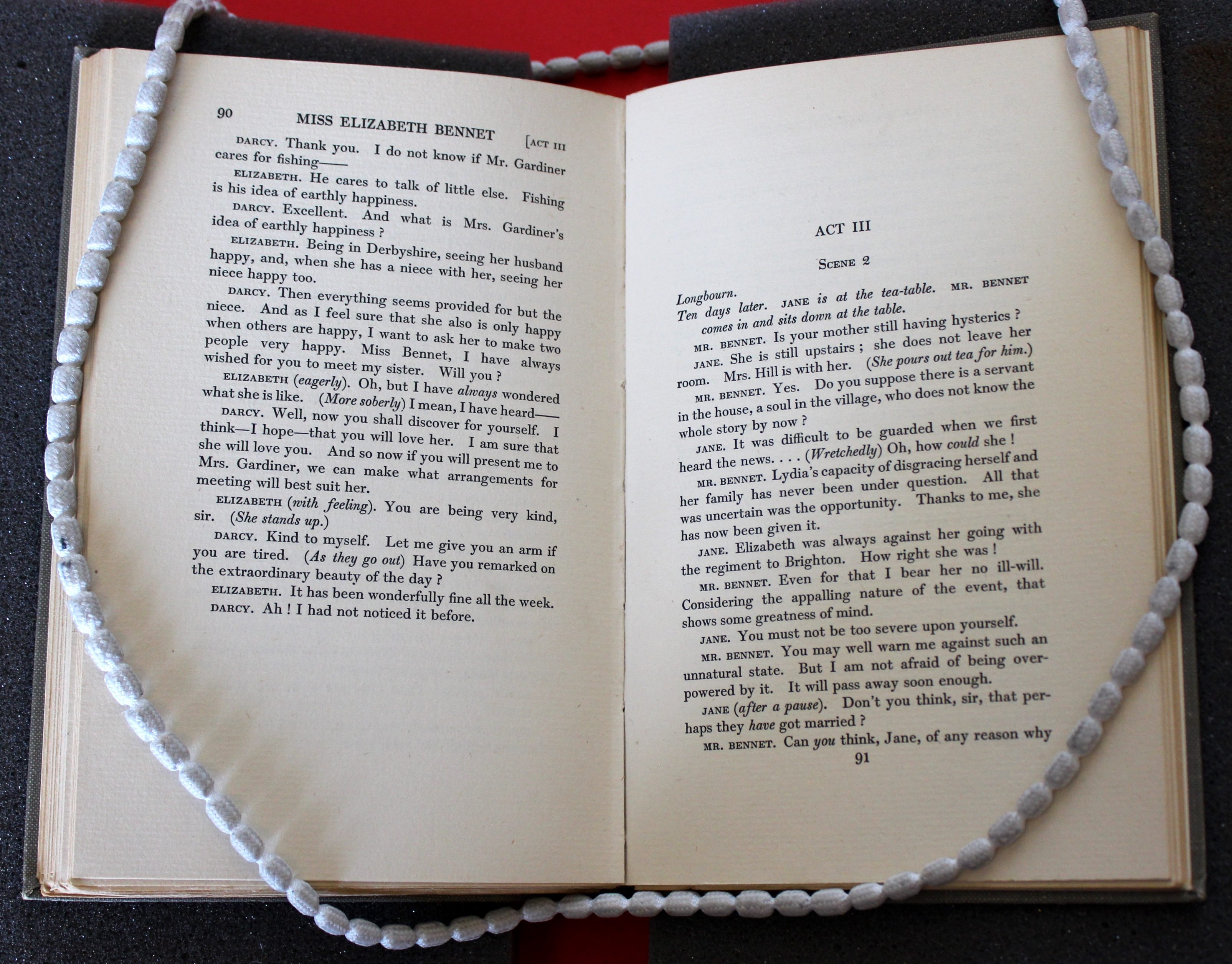
In this scene from A. A. Milne’s stage adaptation, Jane and Mr Bennet discuss Lydia’s elopement with Mr Wickham, fully aware of the social implications and prospects for the family as a result.

A. A. Milne, Miss Elizabeth Bennet: A Play from “Pride and Prejudice”
(London: Chatto & Windus, 1936)
Gilson.A.Pr.Z.Mil

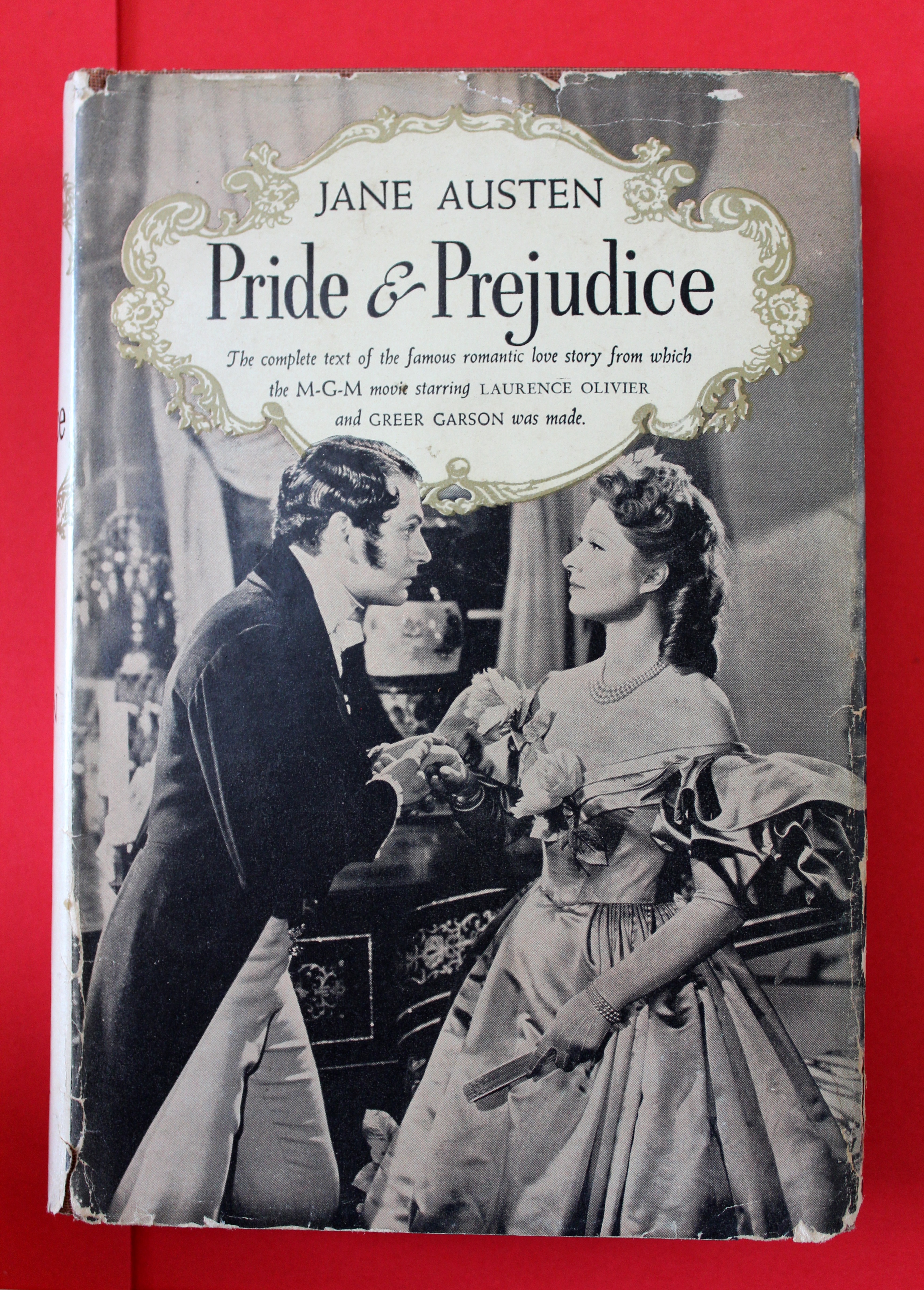
The 1940 film adaptation of Pride and Prejudice, starring Greer Garson and Laurence Olivier, is notorious for drastically diverging from the novel and being excessively ‘Hollywoodized’ — and for putting the women in clothes based on the styles of the late 1820s and 30s. This publication, which coincides with the release of the film, bears the subtitle: ‘The complete text of the famous romantic love story from which the M-G-M movie starring Laurence Olivier and Greer Garson was made’.

Jane Austen, Pride and Prejudice (New York: Triangle, 1940)
Gilson.A.Pr.1940

This Victorian edition of Mansfield Park was presented to E. M. Forster’s mother by his father, and was later inherited by Forster himself.

Jane Austen, Mansfield Park
(London: Routledge, 18—)
Forster.AUS.Man

One of the highlights in the exhibition was Jane Austen’s copy of Orlando furioso, signed by her on the fly-leaf, sold by the Austen-Leigh family, bought by Virginia Woolf, and inscribed by Woolf to John Maynard Keynes at Christmas 1936.

Ludovico Ariosto, Orlando furioso (trans. by John Hoole)
(London: Charles Bathurst, 1783)
Keynes.E.4.1

King’s College owns the manuscript of Jane Austen’s unfinished novel Sanditon, the last one on which she was working before she died on 18 July 1817. It is a rare surviving autograph manuscript of her fiction. It was given to King’s in 1930 by Jane’s great-great niece (Mary) Isabella Lefroy in memory of her sister Florence and Florence’s husband, the late Provost Augustus Austen Leigh who was a great-nephew of Jane. The booklets were made by Austen herself. The last writing is dated 18 March 1817. She died four months later.

The beginning of Sanditon

Sanditon, chapters 4-5

IJ/Harriet Alder/JC