Tag Archives: Thackeray bequest

Jane Austen at 250: An Online Exhibition

Today, 16 December 2025, marks the 250th anniversary of Jane Austen’s birth. Events have been held throughout the year to celebrate this occasion. As part of Open Cambridge on 17 September, King’s College Library mounted an exhibition featuring first editions of all of Austen’s novels, the autograph manuscript of her unfinished novel Sanditon, a manuscript letter to her publisher, a book from her library, early translations of her novels, and other rare items. The event was a great success and was attended by over 650 people who braved the wet weather to come and view the treasures on display, thus creating a “ceaseless clink of pattens” on the wooden library floor reminiscent of Lady Russell’s description of driving through Bath on a wet afternoon in Persuasion. We present below some highlights from the exhibition for those who could not visit in person.

One of the exhibition cases housing the treasures on display

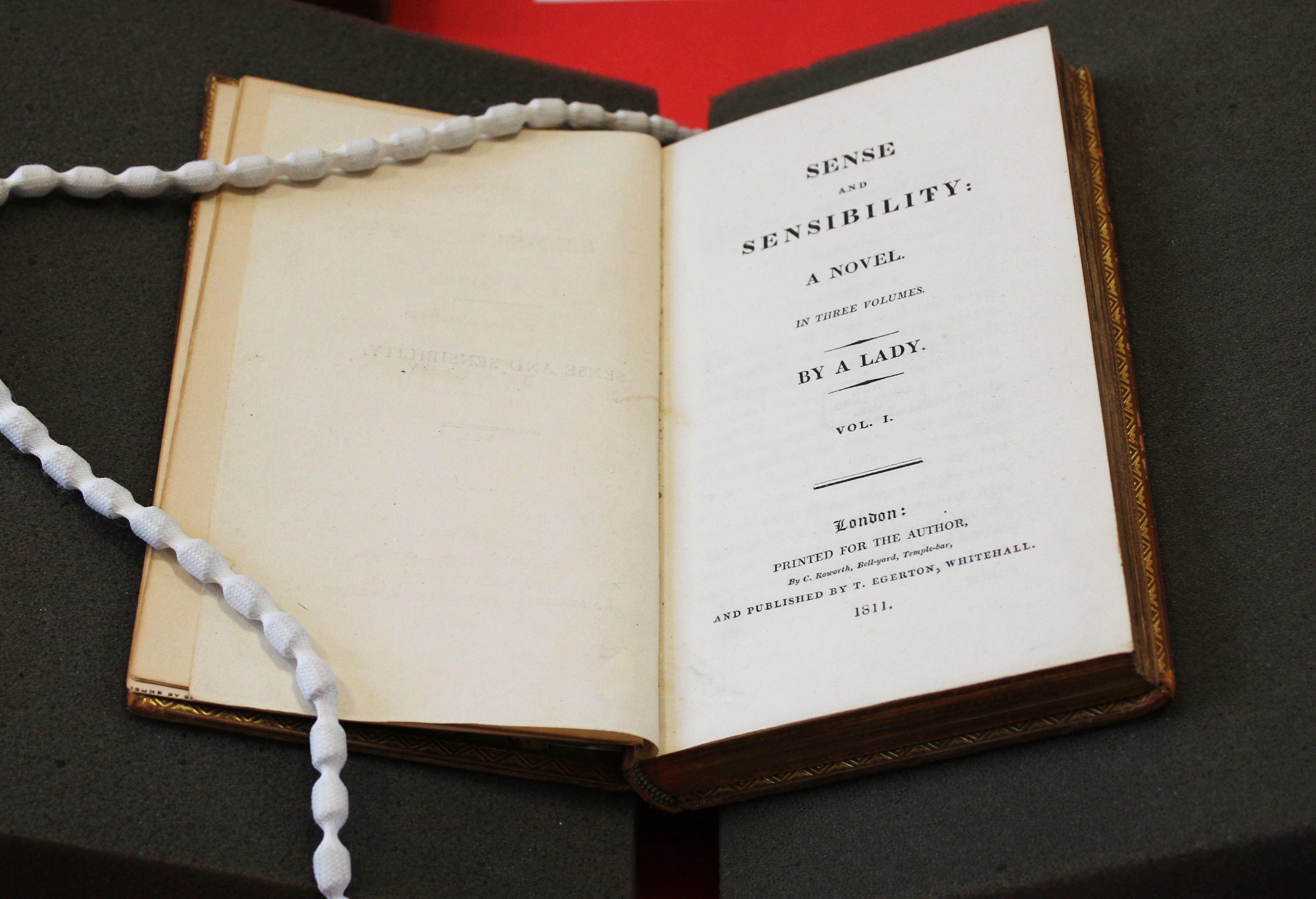
Sense and Sensibility, Austen’s first novel to be published, was written in epistolary form around 1795 in Steventon under the title Elinor and Marianne. It was begun in its present form in autumn 1797 and revised and prepared for publication in 1809-1811 when Jane was living in Chawton.

Jane Austen, Sense and Sensibility (London: Egerton, 1811), First edition
Warren.A.Se.1811/1-3

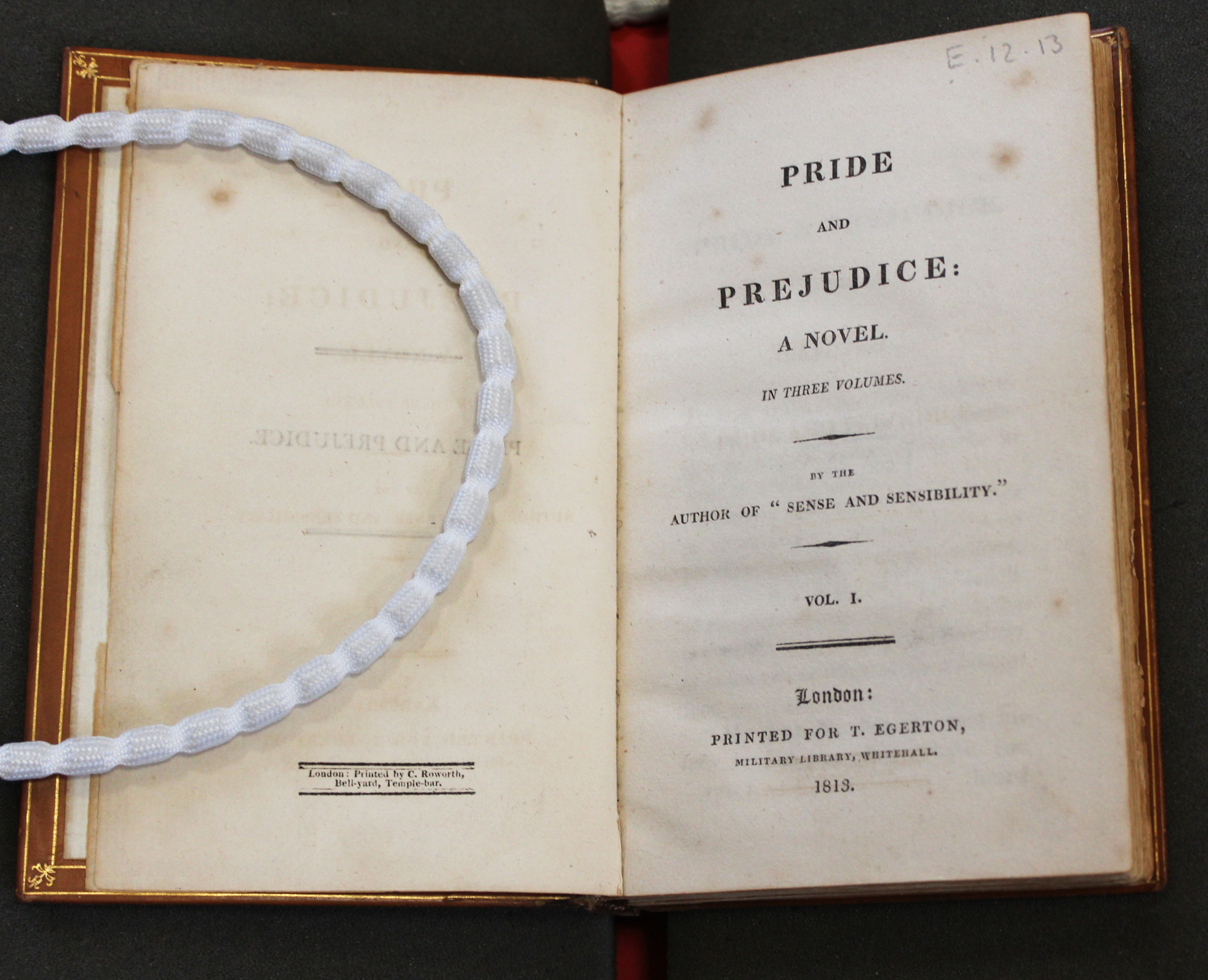
Pride and Prejudice, originally titled First Impressions, was offered for publication to the London bookseller Thomas Cadell, but the offer was declined by return post. The novel was subsequently published by Thomas Egerton under the revised title Pride and Prejudice. Upon receiving her copy of the first edition from the publisher, Jane wrote: ‘I have got my darling child from London’ (27 Jan 1813).

Jane Austen, Pride and Prejudice (London: Egerton, 1813), First edition
Warren.A.Pr.1813a/1-3

The Austen family lived in Bath between 1801 and 1806. Jane was familiar with the Pump Room, a venue for fashionable people, which is used as a setting in her novels Northanger Abbey and Persuasion. This image, from The New Bath Guide (1807), shows the Pump Room as it would have looked during Jane Austen’s time there.

Christopher Anstey, The New Bath Guide; or, Memoirs
of the B.N.R.D. Family in a Series of Poetical Epistles (Bath, 1807)
Warren.B.97.New.1807

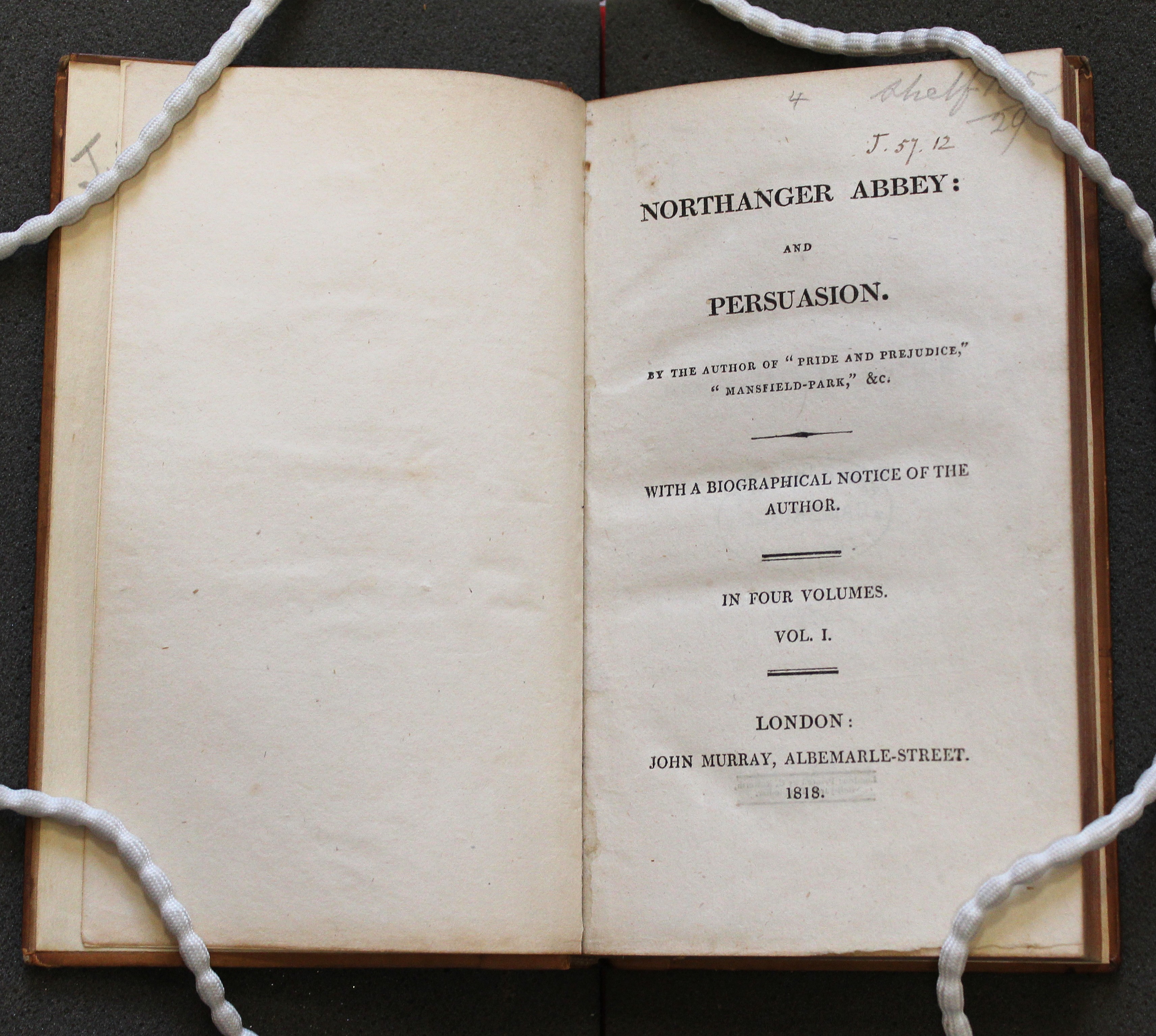
Austen’s novels Persuasion (written 1815-16) and Northanger Abbey (written 1798-99) both appeared posthumously in a four-volume set in December 1817, although the title page states 1818. They are prefaced by a ‘biographical notice’ written by Jane’s brother Henry Austen in which Jane’s identity is revealed for the first time. She appears to have intended to publish Persuasion in 1818 but did not live long enough to do so.

Jane Austen, Northanger Abbey, and Persuasion (London: Murray, 1818), First edition
Thackeray.J.57.12-15

In 1809 Austen’s brother Edward offered his mother and sisters a more settled life – the use of a large cottage in Chawton, near Alton in Hampshire. Whilst living in Chawton Jane published her first four novels. She also wrote Mansfield Park there between 1811 and 1813. It was first published by Egerton in 1814 and a second edition was published in 1816 by John Murray, still within Austen’s lifetime. It did not receive any critical attention when it first appeared.

Jane Austen, Mansfield Park (London: Egerton, 1814), First edition
Warren.A.Ma.1814/1-3

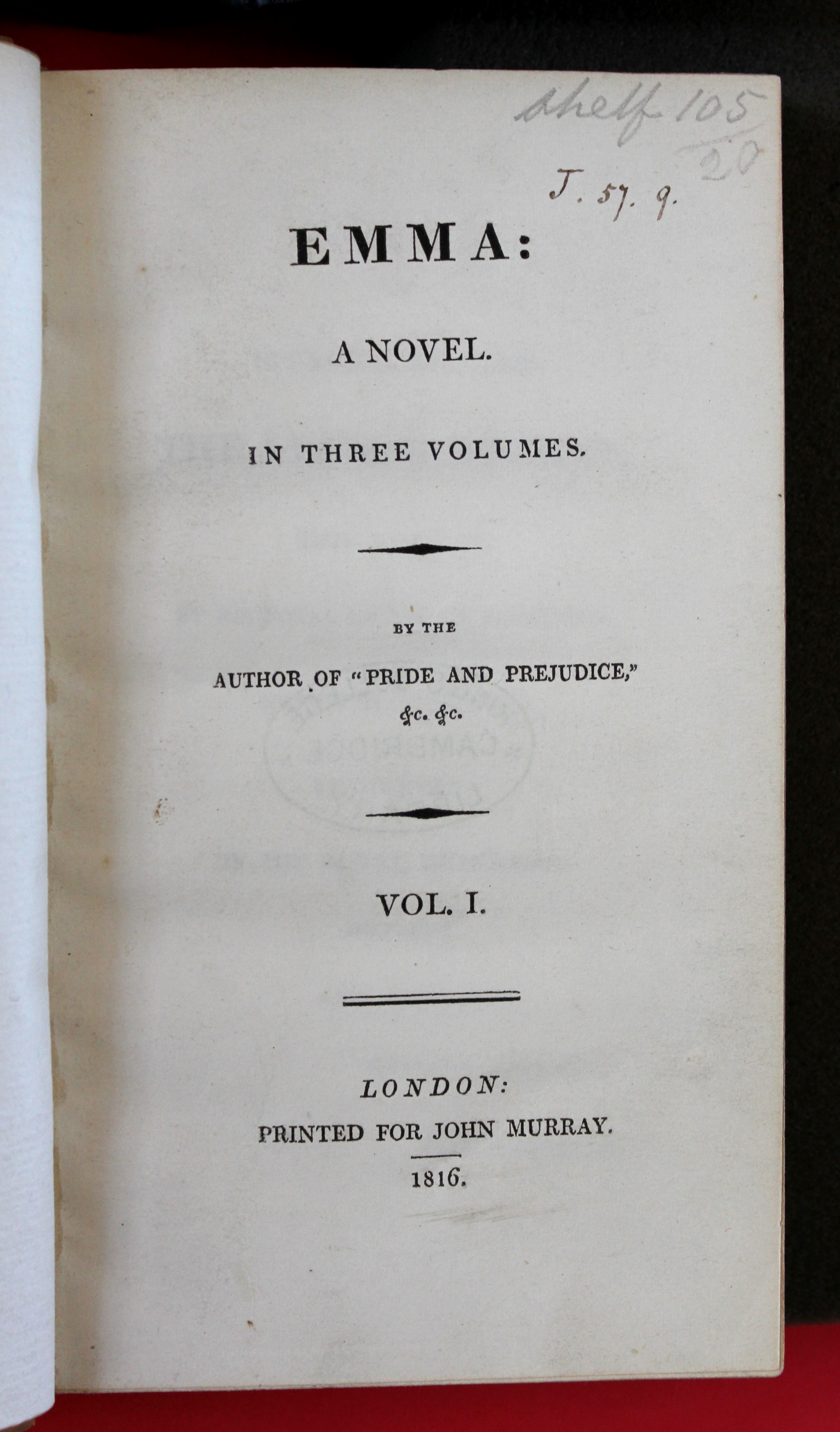
When Henry Austen was taken ill in London in October 1815, he was attended by his sister Jane and by one of the Prince Regent’s doctors who identified her as the author of Pride and Prejudice. The doctor reported that the Prince (later George IV) was a great admirer of her novels and she was invited to dedicate one of her future works to the Prince. Emma was the lucky work. Jane disapproved of the Prince’s treatment of his wife, but felt she couldn’t refuse, so she settled for a title page reading simply ‘Emma, Dedicated by Permission to HRH The Prince Regent’, though her publisher (John Murray) thought it ought to be more elaborate.

This copy of the first edition of Emma belonged to King’s Provost George Thackeray (1777–1850).

Jane Austen, Emma (London: Murray, 1816), First edition
Thackeray.J.57.9-11

Several months after the dedication of Emma, Jane wrote to John Murray and reported that the Prince had thanked her for the copy of Emma. In the same letter she notes that in a recent review of the novel, printed in The Quarterly Review (vol. XIV, 1816), the anonymous reviewer (later established as Sir Walter Scott) completely fails to mention Mansfield Park, remarking with regret that ‘so clever a man as the reviewer of Emma, should consider it as unworthy of being noticed’.

Jane Austen’s letter to John Murray, 1 April 1816 (NM/Austen/1)

Among the miscellaneous items on display was one of the few known copies of Sense and Sensibility in yellowback. Chapman and Hall’s series ‘Select Library of Fiction’ was closely associated with W.H. Smith, who carefully sought out copyrights, or reprint rights, of popular novels in order to publish yellowback editions for sale on his railway bookstalls. The series, which ran from 1854 until it was taken over by Ward, Lock in 1881, included at least thirty novels by Anthony Trollope, who had strong views on the poor quality of much railway literature.

Jane Austen, Sense and Sensibility
(London: Chapman and Hall, 1870)
Warren.A.Se.1870

One of the highlights of the exhibition was Jane Austen’s copy of Orlando furioso, signed by her on the fly-leaf, sold by the Austen-Leigh family, bought by Virginia Woolf, and inscribed by Woolf to John Maynard Keynes at Christmas 1936.

Ludovico Ariosto, Orlando furioso (trans. by John Hoole)
(London: Charles Bathurst, 1783)
Keynes.E.4.1

These Victorian editions of Mansfield Park, Emma, and Northanger Abbey were presented to E. M. Forster’s mother by his father, and were later inherited by Forster himself.

Copies of Mansfield Park, Emma and Northanger Abbey from the library of E. M. Forster (all London: Routledge, 18–)
Forster.AUS.Man; Forster.AUS.EMM; Forster.AUS.Nor

King’s College owns the manuscript of Jane Austen’s unfinished novel Sanditon, the last one on which she was working before she died on 18 July 1817. It is a rare surviving autograph manuscript of her fiction. It was given to King’s in 1930 by Jane’s great-great niece (Mary) Isabella Lefroy in memory of her sister Florence and Florence’s husband, the late Provost Augustus Austen Leigh who was a great-nephew of Jane. The booklets were made by Austen herself. The last writing is dated 18 March 1817. She died four months later.

The beginning of Sanditon

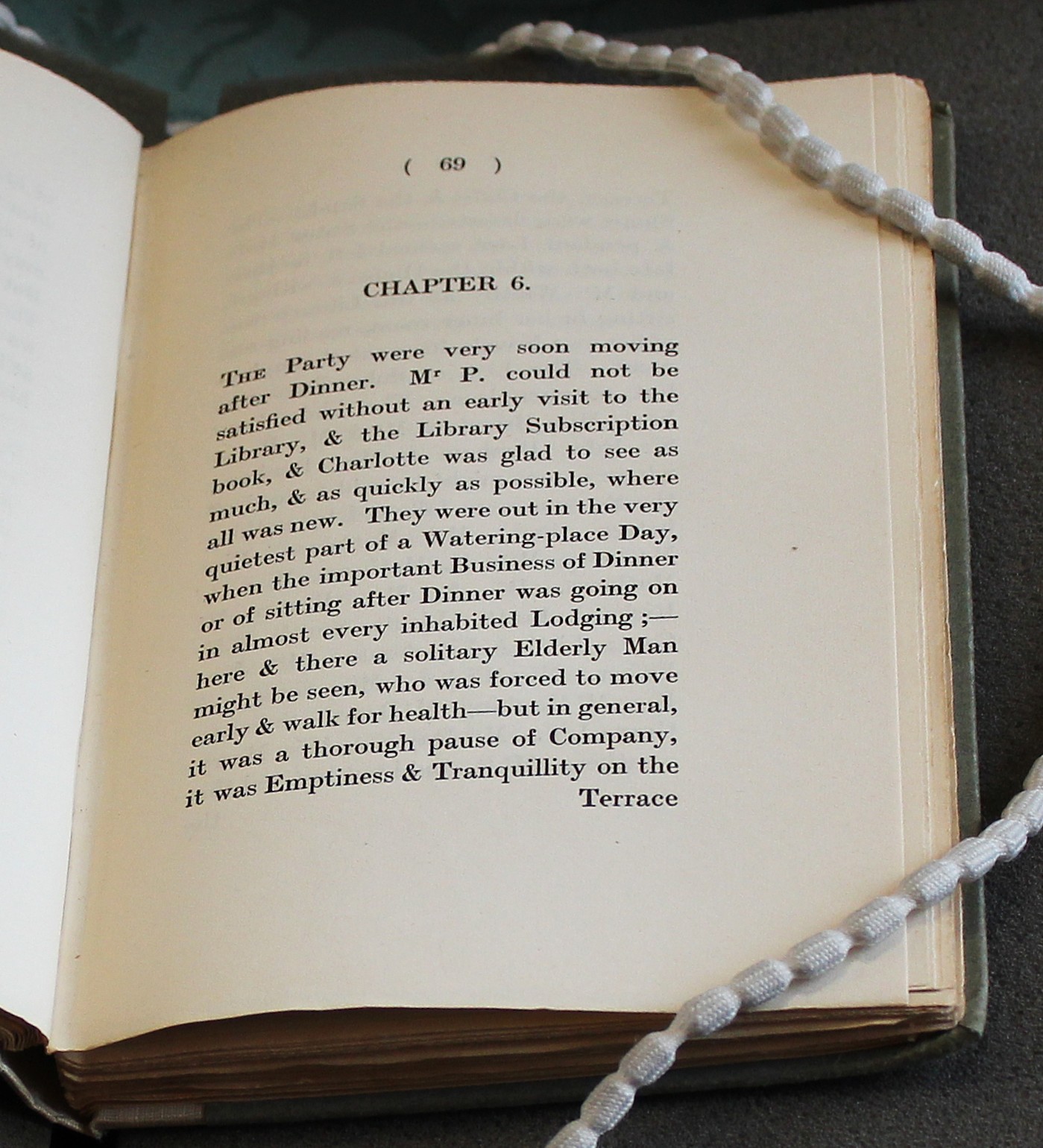
Below is the beginning of chapter 6, followed by the transcription in the printed version of Sanditon.

The beginning of chapter 6

This copy of the first edition of Sanditon comes from the library of E. M. Forster.
Jane Austen, Fragment of a Novel (Oxford: Clarendon Press, 1925)
Gilson.A.Sa.1925a

During the summer, King’s College loaned one of the fascicles of Sanditon to Harewood House to be displayed there as part of their exhibition ‘Austen and Turner: A Country House Encounter’ where it occupied pride of place and was viewed and admired by thousands of visitors.

JC/IJ


I Am Emperor of the French Still

While Ridley Scott’s biopic Napoleon has come and gone without too much fanfare or recognition during awards season, its release nevertheless reminded me that we have a volume in our rare-book collection that belonged to the French emperor, whose 255th birthday falls today (15 August 1769 – 5 May 1821):

Title page of Pierre Victor Jean Berthre de Bournisseaux, Histoire des guerres de la Vendée et des Chouans, depuis l’année 1792 jusqu’en 1815 (Paris: Claude Brunot-Labbe, 1819; M.37.116)

Napoleon’s ink signature is above the circular stamp: “l’Empereur Napoleon”. As he had been in exile on St Helena since October 1815, the book must have been shipped to him from France. The volume was sold at auction by Sotheby’s in June 1905 and was later donated to the College by Kingsman Alban Goderic Arthur Hodges (1893-1982):

Rear pastedown on which is stuck an advertisement for the Sotheby’s sale on 1-3 June 1905, including “Books from the library of the Emperor Napoleon I at St. Helena”. Next to it is a slip describing this book and its provenance: “Cachet of St. Helena and ‘L’Empereur Napoléon’ on title”.

While there are several items in King’s College’s collection that belonged to British monarchs, these are usually identified as such thanks to a royal cypher or a crest on the binding. This copy of the order of service performed at the coronation of George II (1727) belonged to his grandson George III (1738-1820), who was on the throne during Napoleon’s reign and exile:

The Form and Order of the Service that Is To Be Performed […] in the Coronation of their Majesties, King George II. and Queen Caroline (London: John Baskett, 1727; Thackeray.M.32.53)

The volume is bound in red morocco featuring an elaborate gilt panel design on front and rear boards with the crest of King George III at the centre and royal cyphers on each corner. This book did not come to King’s College as part of the large Thackeray Bequest, but was purchased in 1950. Though George III’s pre-1801 crest was identical to that of George II, the fact that Provost George Thackeray was chaplain in ordinary to George III suggests that he likely received it as a gift from the latter (who may have inherited it from his grandfather George II).

Gone are the days of gilt imperial bindings for the erstwhile French emperor: Napoleon can now only assert his ownership through a mere signature, like most other book owners. The contrast between the British monarch’s mark of ownership through this elaborate morocco binding and Napoleon’s ink inscription on the title page could not be starker.

One cannot help but draw a parallel between Napoleon’s predicament and that of the heroine in John Webster’s play The Duchess of Malfi (1623), loosely based on the life of Giovanna d’Aragona, Duchess of Amalfi (1478-1510):

Title page of the second edition of John Webster’s The Dutchesse of Malfy: A Tragedy (London: John Raworth and John Benson, 1640; Keynes.C.6.27)

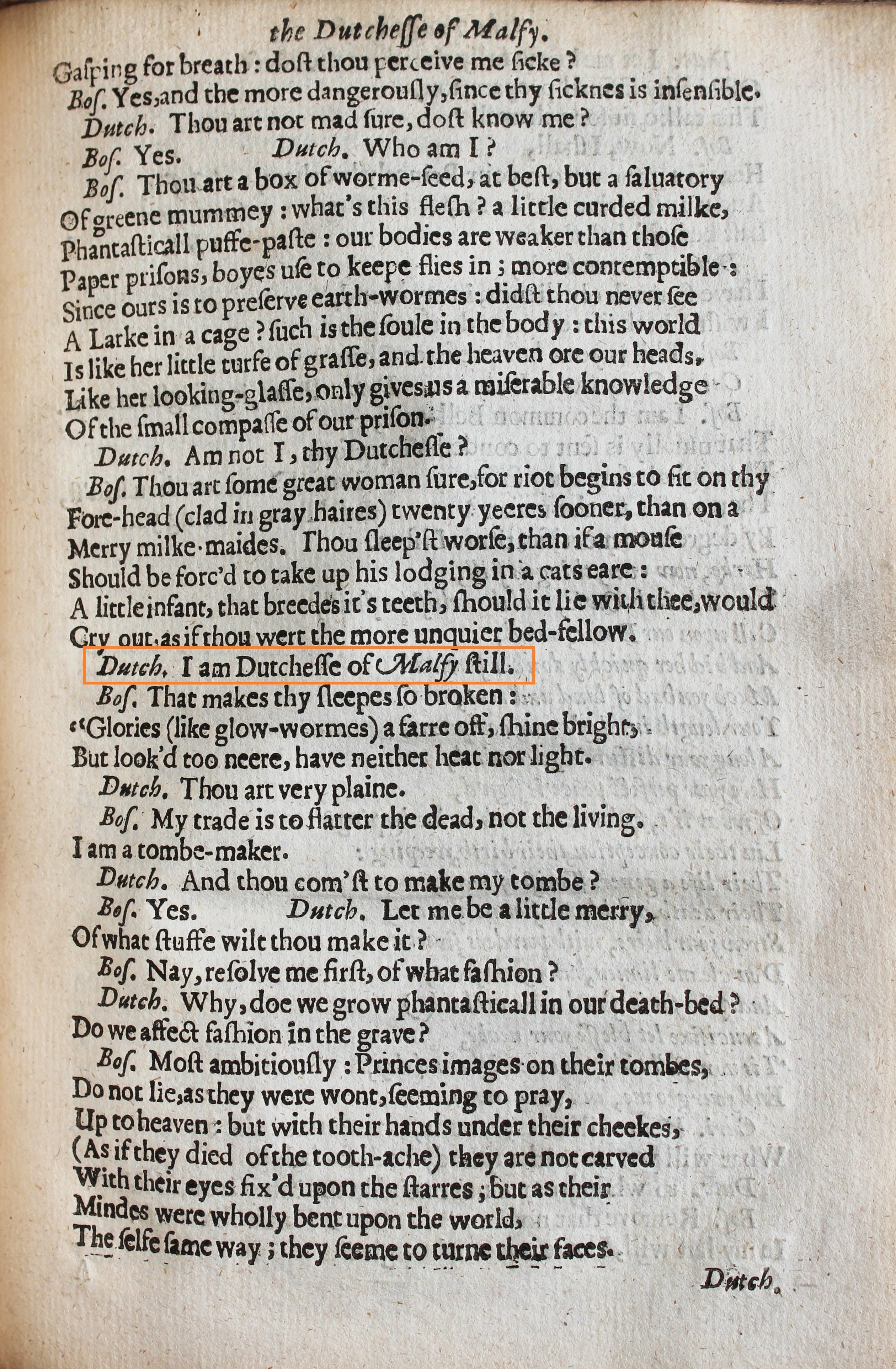
In the play, the widowed duchess secretly marries her lowly household steward Antonio and bears him three children, thus attracting the rage of her two brothers Ferdinand and the Cardinal who want to safeguard their inheritance. The duchess and her two younger children are murdered at Ferdinand’s behest in the fourth act. As she is about to be strangled by the executioners, she utters the famous words, “I am Duchess of Malfi still”:

Part of Act IV, scene ii (leaf G4 recto)

There is a sense of poignancy in the defiance shown by both the duchess and Napoleon as they cling to a former glorious past in the face of imminent death or a fall from grace. The difference is that Napoleon was technically no longer an emperor in 1819, while the duchess was still Duchess of Malfi, at least in name, when she died. In November 1818, Napoleon had been informed that he would remain a prisoner on St Helena for the rest of his life, and the island’s governor Sir Hudson Lowe had refused to recognise him as a former emperor. However, as this ownership inscription confirms, “Napoleon never considered forgoing ceremony or the recognition of his title. It was the only way he could assert his claim to being emperor in the face of the British insistence that he was a simple general. Much of his stay on St Helena was about constructing a space for himself in which he displayed his quality as an imperial sovereign”.[1]

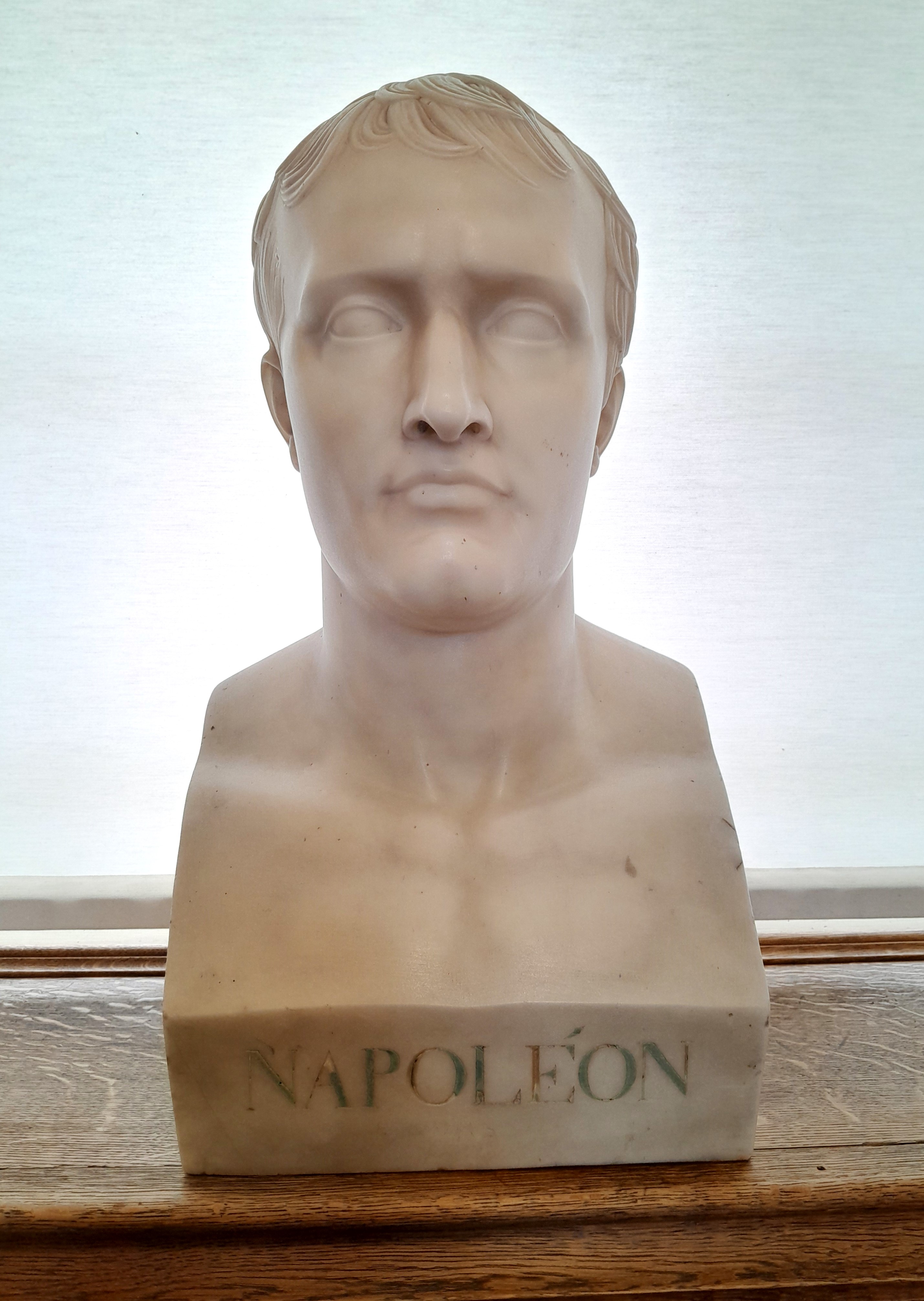
Bust of Napoleon in King’s College Library

IJ

Notes

[1] Philip Dwyer, Napoleon: Passion, Death and Resurrection, 1815-1840 (London: Bloomsbury Publishing, 2019, pp. 44-45)

Spooky Shakespeare: Macbeth

As the 400th anniversary year of Shakespeare’s First Folio reaches Halloween and the nights draw ever inward, our focus shifts to some of the spookier elements in Shakespeare’s plays, and particularly the witches and ghosts to be found in Macbeth. In addition, as we proceed, other witches and eerie creatures may swoop in from elsewhere in the Library’s collections.

The opening page of Macbeth in the First Folio (Thackeray.D.38.2)

The opening page of Macbeth in the First Folio (Thackeray.D.38.2)

Macbeth, believed to have been first performed in 1606, appears in print for the first time in the First Folio in 1623. It is thought that the Folio text was drawn from the latest version in theatres at the time, which incorporated revisions by the playwright Thomas Middleton (1580-1627).  One of Middleton’s revisions is thought to be the addition of two songs for scenes featuring the witches: “Come away, come away” and “Black spirits and white”. These songs are only mentioned by title in the Folio, but appear, complete with full lyrics, in Middleton’s own play The Witch (ca. 1613-1616). This expansion of the role of the witches reflected the continuing fascination of Jacobean audiences with witchcraft. This fascination was born partly out of the obsessions of King James I, whose book Dæmonologie was first published in 1597, and was then reprinted when he ascended the throne of England in 1603. James, who was convinced that he had almost met his death via witch-conjured storms in the North Sea, argued in his book that witchcraft arose from demons and humans working together to spread misery and destruction. Shakespeare is thought to have used Dæmonologie as one of his chief sources and inspirations in creating the play in the first place, likely with an eye on the King’s favour.  The plot’s focus on the murder of a King and its aftermath is also believed to reflect elements of the Gunpowder plot of 1605.

Image of a witch on a broomstick depicted in gilt decoration on a blue cloth book cover

Cover of The Blue Fairy Book, by Andrew Lang, London, 1897 (Rylands.C.LAN.Blu.1897)

Illustration of three witches flying through the sky on broomsticks, accompanied by black cats

Frontispiece of The Ingoldsby Legends, by Thomas Ingoldsby; illustrated by Arthur Rackham, London, 1907 (YHK BARH ZIN)


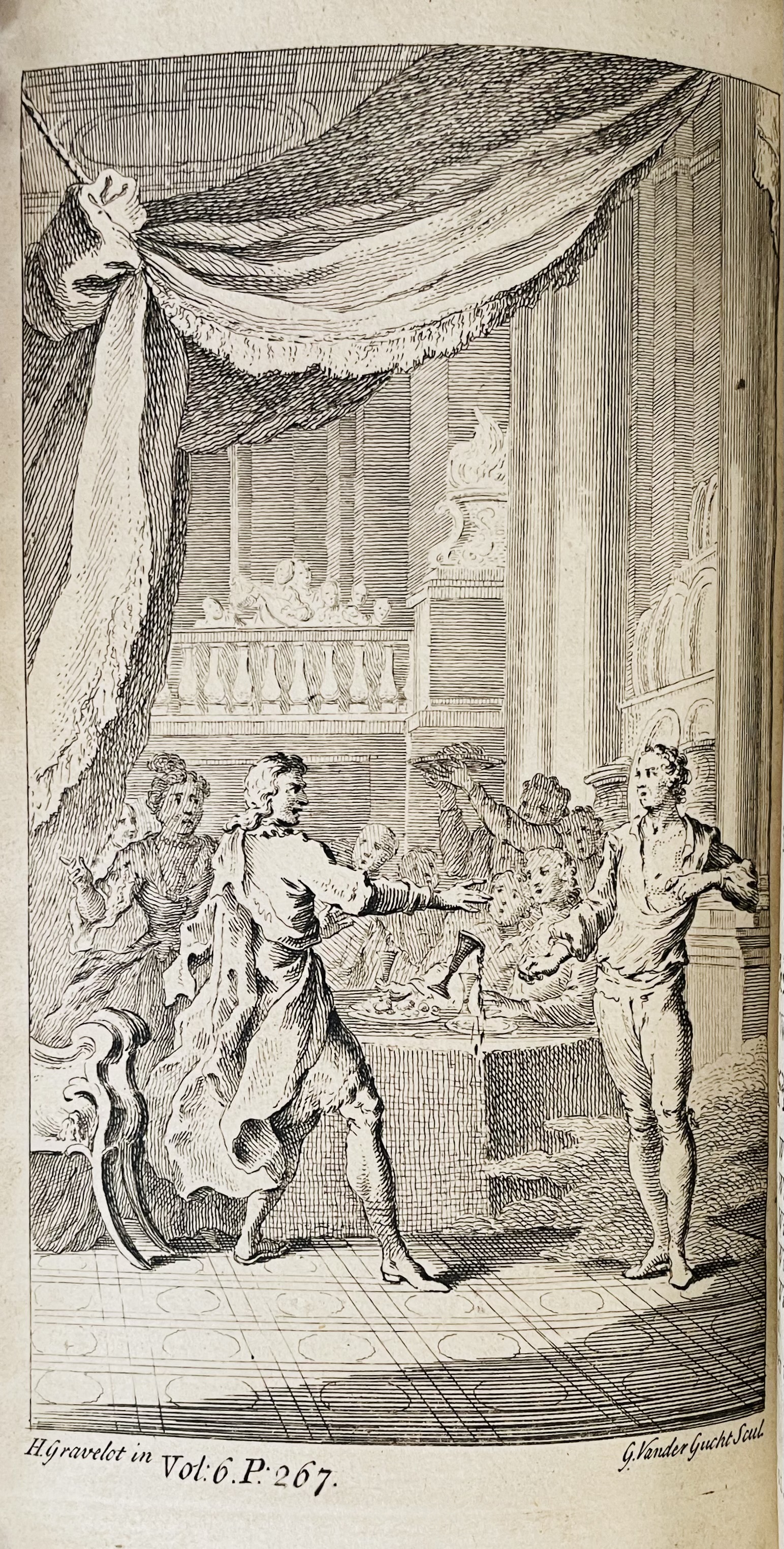
Next we turn to two eighteenth-century editions of the dramatic works of Shakespeare. The first, part of the Keynes Bequest, was edited by Lewis Theobald (ca. 1688-1744), who is a significant figure in Shakespeare scholarship. Theobald worked hard to correct errors and alterations that had crept into the plays through the work of earlier eighteenth-century editors, and surveyed as many surviving copies of the plays as he could in order to produce the most authoritative versions possible. His edition, originally published in 1733, was drawn upon heavily by subsequent major editors such as Edmund Malone (1741-1812), and thus continues to inform modern editions of the plays. Our set of Theobald’s Shakespeare dates from 1762. Macbeth appears in volume six, accompanied by an engraving by Hubert-François Gravelot (1699-1773), which depicts Macbeth confronting Banquo’s ghost during the feast scene (Act 3, scene 4).

Engraving of a feast scene in which Macbeth confronts the ghost of Banquo

Plate from The Works of Shakespeare, edited by Mr Theobald, London, 1762 (Keynes.P.13.24)


Title page of 1762 edition of the works of Shakespeare

Title page of volume six of The works of Shakespeare, [edited] by Mr Theobald, London, 1762 (Keynes.P.13.24)

First page of Macbeth.

First page of Macbeth from The works of Shakespeare, [edited] by Mr Theobald, London, 1762 (Keynes.P.13.24)


The second eighteenth-century edition is, like the First Folio, part of the Thackeray Collection. This fifteen-volume set, which dates from 1793, is an expanded version of an eight-volume edition of Shakespeare’s plays which originally appeared in 1765, and which was co-edited by the eminent writer Samuel Johnson (1709-1784).  Johnson had an abiding love of Shakespeare and had long wished to produce his own edition of the plays. He tested the waters in 1745 with the publication of his Miscellaneous Observations on the Tragedy of Macbeth, then spent the next twenty years working towards his goal. The preface to Macbeth in the 1793 edition includes Johnson’s ruminations on the supernatural themes of the play. He states:

A poet who should now make the whole action of his tragedy depend upon enchantment, and produce the chief events by the assistance of supernatural agents, would be censured as transgressing the bounds of probability … and condemned to write fairy tales instead of tragedies; but a survey of the notions that prevailed at the time when this play was written, will prove that Shakspeare [sic] was in no danger of such censures, since he only turned the system that was then universally admitted, to his advantage, and was far from overburdening the credulity of his audience.

Speaking of the prevailing atmosphere of the late 15th and early 16th centuries, he writes evocatively:

The Reformation did not immediately arrive at its meridian, and though day was gradually increasing upon us, the goblins of witchcraft still continued to hover in the twilight.

Having touched upon on James I’s preoccupation with witchcraft and its effect on the population, he goes on to say:

Thus the doctrine of witchcraft was very powerfully inculeated [sic]; and as the greatest part of mankind have no other reason for their opinions than that they are in fashion, it cannot be doubted but this persuasion made a rapid progress, since vanity and credulity co-operated in its favour.

Image of the title page of Johnson's edition of the plays

Title page of The Plays of William Shakspeare, edited by Samuel Johnson and George Steevens, London, 1793 (Thackeray.J.62.1)

Image of the first page of Macbeth from Johnson's edition of the plays

First page of Macbeth from volume 7 of The Plays of William Shakspeare, edited by Samuel Johnson and George Steevens, London, 1793 (Thackeray.J.62.7)

Black and white illustration of three witches huddled in an old shack

Three witches from a story called “The witches’ frolic”. Plate facing page 106 of The Ingoldsby Legends

An old bent-over woman with a black hat and a cat standing outside a hovel on a wild moor

“There’s an old woman dwells upon Tappington Moor”. Plate facing page 26 of The Ingoldsby Legends


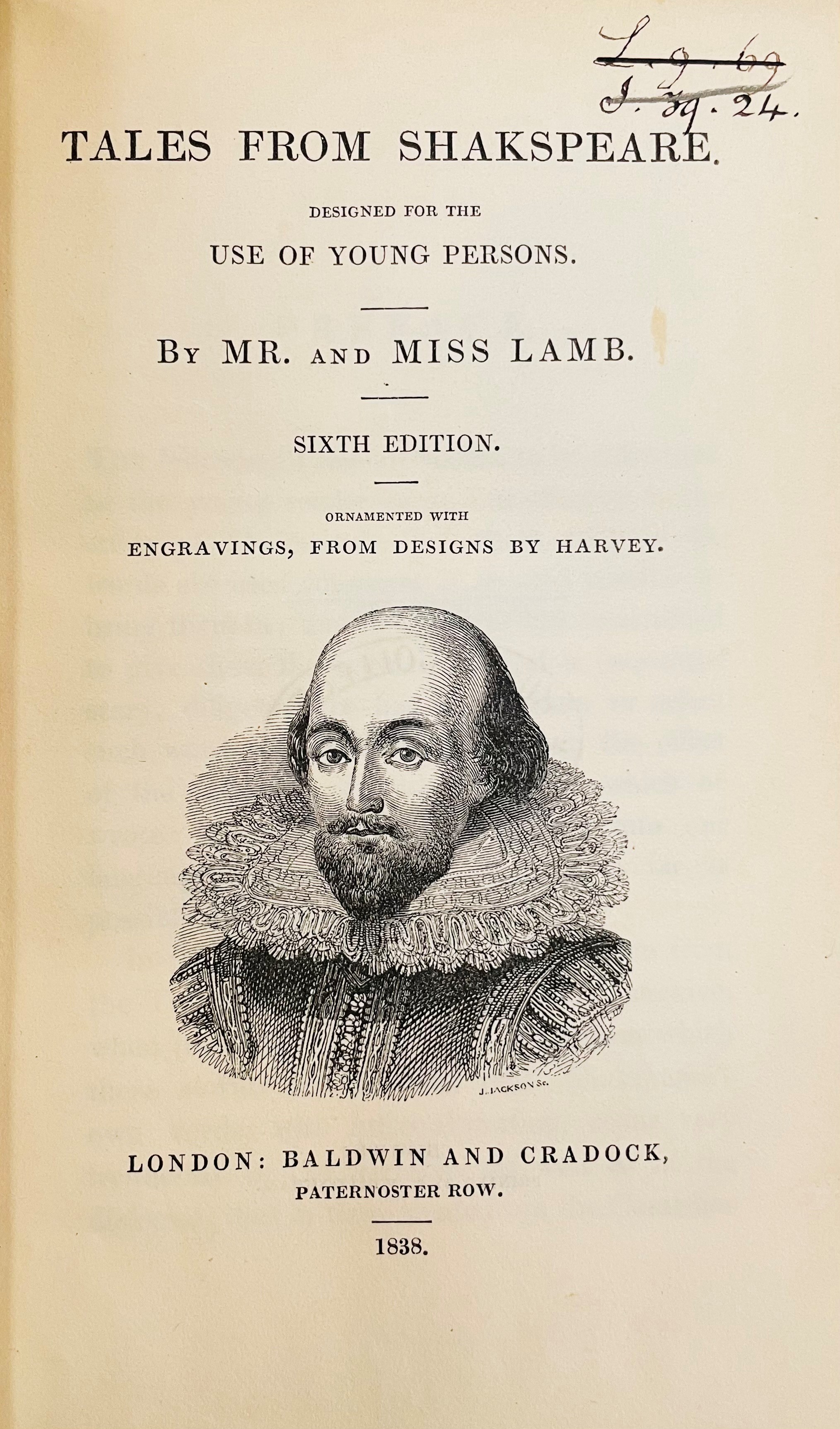
In 1807, Charles Lamb (1775-1834) and his sister Mary (1764-1847) produced a prose version of some of Shakespeare’s plays, modified to be suitable for children. More adult elements and complicated subplots were removed, but care was taken to adhere to the spirit of the originals, and to keep as much of the language as they could. The Library has a copy of the sixth edition, dating from 1838, which is the first edition to credit Mary Lamb on the title page. Macbeth appears in this volume, and the witches are described as follows:

… three figures like women, except that they had beards, and their withered skins and wild attire made them look not like any earthly creatures.

Title page of Tales from Shakspeare, which features an engraving of Shakespeare

Title page of Tales from Shakspeare, by Mr and Miss Lamb, London, 1838 (YHK LAM X 4)

First page of text from the prose version of Macbeth

Opening page of Macbeth from Tales from Shakspeare, by Mr and Miss Lamb, London, 1838 (YHK LAM X 4)


An illustration, pictured below, accompanies the tale, showing Macbeth and Banquo encountering these strange beings.

Macbeth and Banquo in armour, confronting three cloaked and bearded figures

Engraving of Macbeth and Banquo encountering the three witches. Plate from Tales from Shakspeare, by Mr and Miss Lamb, London, 1838 (YHK LAM X 4)

We leave you with a final dose of the supernatural via another wonderful  illustration by Arthur Rackham (1867-1939) from The Ingoldsby Legends. Originally serialised in the 1830s, the legends comprised ghost stories, myths and poems written by clergyman Richard Harris Barham (1788-1845) under the pen-name Thomas Ingoldsby. They were later published in book form and were hugely popular for decades. An edition featuring Rackham’s glorious illustrations was first published in 1898.

A gathering of witches, goblins and ghouls seemingly having a friendly chat amongst themselves

“Witches and warlocks, ghosts, goblins and ghouls”. Plate facing page 396 of The Ingoldsby Legends

Stay safe and watch out for whatever might be lurking out there in the dark this Halloween!

References

Julian Goodare, A royal obsession with black magic started Europe’s most brutal witch hunts   [accessed 10/10/23]

Emma Smith, The Making of Shakespeare’s First Folio, Oxford, 2015

You can browse King’s College’s First Folio on the Cambridge University Digital Library here and it also features on the First Folios Compared website where you can compare it side by side with other digitised copies of the First Folio.

AC

Celebrating “Folio Day”

Today marks the 407th anniversary of William Shakespeare’s death and, by tradition, the 459th of his birth. This day has also been designated as “Folio Day” and begins a season of celebratory events taking place around the world to commemorate the quatercentenary of the publication of the First Folio on 8th November 1623. Various libraries and other institutions will have their First Folios on display during this time, and King’s College Library will also be taking part in the commemorations by exhibiting the First, Second and Fourth Folios as part of Open Cambridge on Friday 8th September 2023 from 10.30am to 4.00pm. Save the date!

As it’s Folio Day, we thought it would be appropriate to provide some details about our volume and its provenance. King’s College’s First Folio is one of only 235 extant copies, most of which have been described in detail in Rasmussen and West’s The Shakespeare First Folios: A Descriptive Catalogue. Our copy has recently been digitised and can be viewed in its entirety on the Cambridge University Digital Library website (a post about the digitisation process will follow in due course).

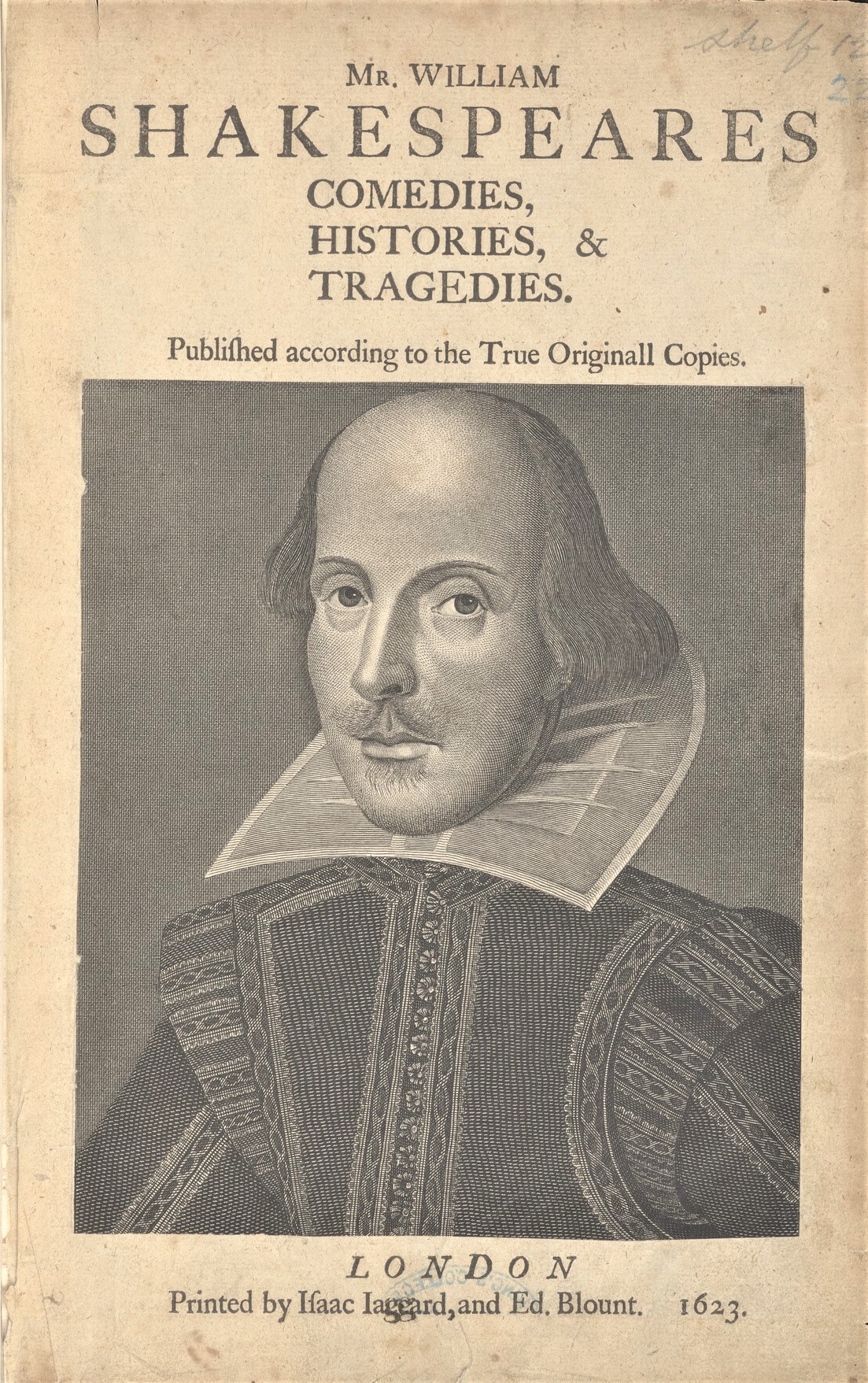
One of the most distinctive features of the book is the engraved title-page portrait of Shakespeare, which exists in two states: the earlier has lighter shading, while in the later state the shading is heavier, especially around the collar; there are also minor differences in the jawline and moustache. According to Rasmussen and West, the texture of the portrait suggests that the King’s College copy is an engraved facsimile copied from a state 2 original:

Title page of Mr. William Shakespeares Comedies, Histories, & Tragedies (London: printed by Isaac Iaggard, and Ed. Blount, 1623; Thackeray.38.D.2).

Spot the difference: the original state 2 portrait in the Bodleian Library’s First Folio (Arch. G c.7) (© Bodleian Libraries, University of Oxford).

As well as missing the original portrait, our copy also lacks the seven preliminary leaves containing the dedication, various celebratory verses by the likes of Ben Jonson, the list of actors and the table of contents. As is sometimes the case with rare books, the last two leaves are also wanting, though in this copy these have been supplied in manuscript so skilfully that you’d be forgiven for thinking they were the original:

Leaf 3b6r in the King’s First Folio supplied in facsimile.

Leaf 3b6r in the Bodleian First Folio (© Bodleian Libraries, University of Oxford).

As for its provenance, the First Folio is part of the collection of rare books bequeathed to the college by George Thackeray, who was Provost at King’s from 1814 to his death in 1850. In Shakespearean fashion, tragedy is said to have been at the heart of his love of books. Following the death of his first wife, Thackeray married his second wife Mary Ann Cottin in 1816. Two years later, on 13 February 1818, she was in labour with their first child, and the accoucheur in attendance, Sir Richard Croft (1762-1818), started showing signs of anxiety and distress and was therefore persuaded to lie down and rest in another room. At about 2am, Croft shot himself in the head with two pistols Thackeray was keeping for personal protection. A volume of Shakespeare was found lying on the dressing table, open at a page containing the line in Love’s Labour’s Lost, “Where is the Princess?”:

Act V, scene ii from Love’s Labour’s Lost as it appears in the First Folio, with the phrase “Wher’s the Princesse?” highlighted in the second column.

Mary Ann’s labour may have shown similarities to that of Princess Charlotte of Wales (1796-1817), who had died in childbirth the previous year; she was also attended by Sir Richard Croft. As pointed out by Jane Townley Pryme and Alicia Bayne, “It was supposed that he had never quite recovered from the shock occasioned by the Royal death, and that the anxiety of this case, combining with the coincidence of the passage in the play, which he had probably been reading, gave an impulse which he could not resist” (Memorials of the Thackeray Family, London, 1879, pp. 238-39).

Thackeray’s obituarist wrote that “this sad event threw an air of gloom and desolation about his house from which it never altogether recovered”. According to him, this early tragedy “threw him, for his general companionship, upon Erasmus and Propertius, black-letter Bibles, and odd books generally”. When he died in 1850, he bequeathed his black-letter books to King’s. His daughter, Mary Ann Elizabeth, lived into adulthood and left the rest of her father’s collection (including the First Folio), to the College when she died in 1879.

William Makepeace Thackeray, photographed here by Jesse Harrison Whitehurst, was a frequent visitor at the house of his second cousin Mary Ann. Another literary curiosity is that her unhappy love affair with Henry Kemble served as the plot for Henry James’s novel Washington Square (1880).

Our copy of the First Folio has a fascinating literary connection. George Thackeray, a cousin of William Makepeace Thackeray’s father Richmond Thackeray, was the novelist’s first cousin once removed. “After her father’s death Mary Ann Thackeray and her aunt lived in considerable state in London, where [William Makepeace] Thackeray was a frequent visitor to their home at 27 Portman Square” (The Letters and Private Papers of William Makepeace Thackeray, ed. Gordon N. Ray [London: Oxford University Press, 1945], vol. 1, p. 30, n. 11). It is therefore likely that William Makepeace Thackeray will have seen and consulted this copy of the First Folio at Mary Ann’s house.

More Shakespeare-related blog posts will follow in the course of this year, so watch this space!

IJ

Tyger, tyger, burning bright

Inspired by Chinese New Year, which this year heralds the year of the tiger, we sought out that ferocious beast within some of the many volumes of natural history which form part of the Library’s Thackeray collection and uncovered some wonderful illustrations, which roared out to be shared through this blog.

woodcut of tiger

Vol. 1, page 1060 of Historia animalium, 1551, Shelfmark F.4.1

We begin with this lovely woodcut illustration from the first volume of Conrad Gessner’s Historia animalium (History of the animals). Gessner (1516-1565) was a Swiss physician and naturalist. He produced several major works of zoology and botany and had a lasting influence upon the scientific world. Historia animalium, published in five volumes between 1551 and 1558, was a hugely popular and influential work. Gessner drew heavily on medieval and classical sources, building upon these with the latest zoological knowledge from his own time. These generously illustrated (for their time) volumes cover mammals, reptiles, fish and birds, detailing their diet, habits and physical attributes. 

A note in Gessner’s hand found in one copy of this work indicates that this tiger was modelled on a real life example from Florence. This may have been a beast housed in the menagerie of the Medici ruler of that city.

Early nineteenth-century works provide the rest of our illustrations, starting with a handsome colour engraving from Histoire naturelle des mammifères by Geoffroy-Saint-Hilaire and Frédéric Cuvier. The authors were both associated with the French National Museum of Natural History: the Muséum national d’Histoire naturelle. Frédéric Cuvier (1773-1838) was head keeper of the menagerie, and Geoffroy Saint-Hilaire (1772-1844)  was a professor there.

Colour engraving of tiger

Plate from Vol. 1 of Histoire naturelle des mammifères, 1824, Shelfmark F.1.20

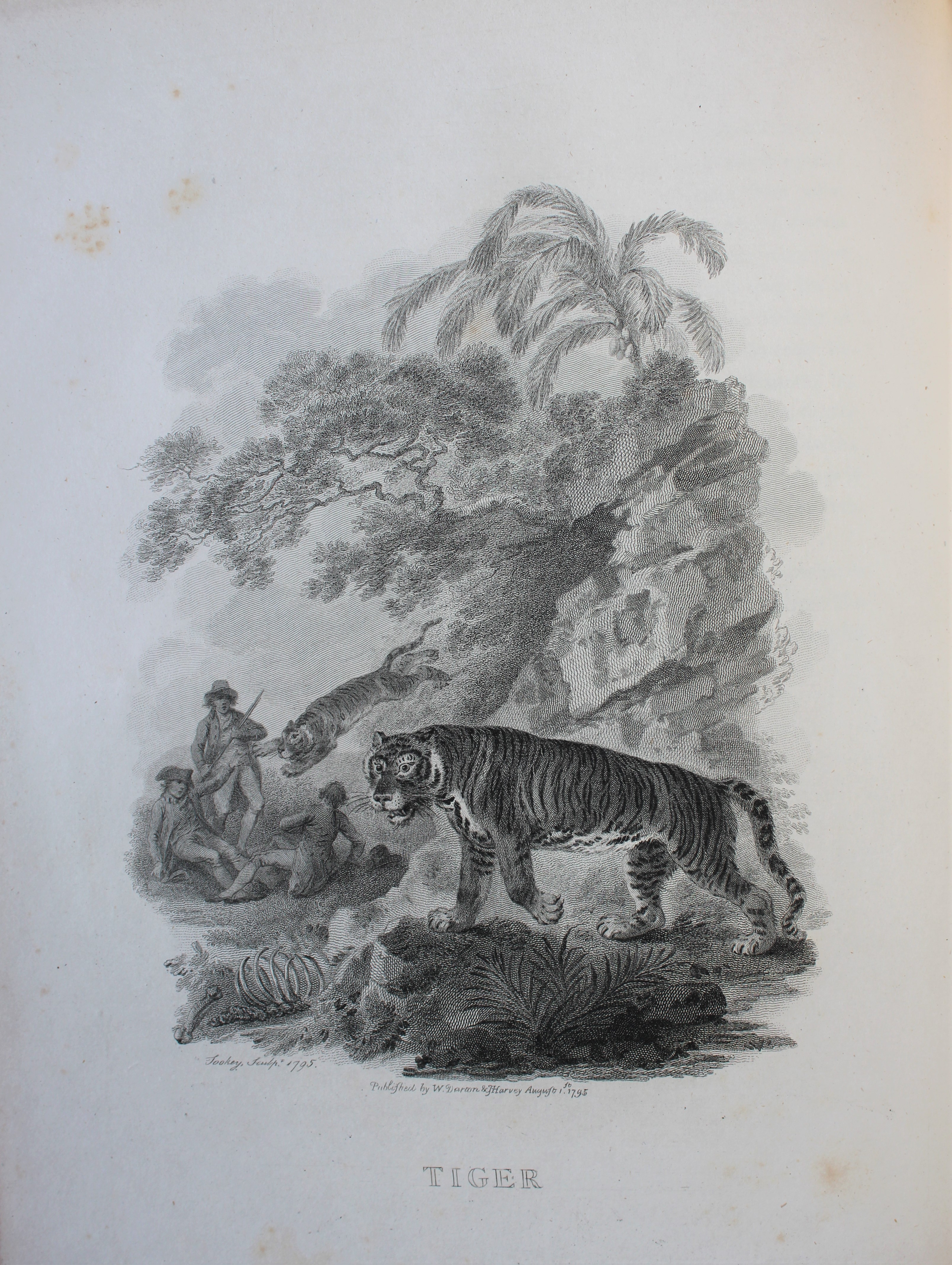
Frédéric Cuvier’s brother, Georges (1769-1832) was a naturalist of great renown and author of many works on this subject. The most famous of these was Le Règne animal or, The animal kingdom, which was first published in 1817. The Library holds an English translation of this work in which can be found attractive engravings of several different types of tigers, displayed below.
Tiger engraving

Tiger from Cuvier’s animal kingdom: The class mammalia, Vol. 2, plate facing p.440, 1827, Shelfmark F.6.3

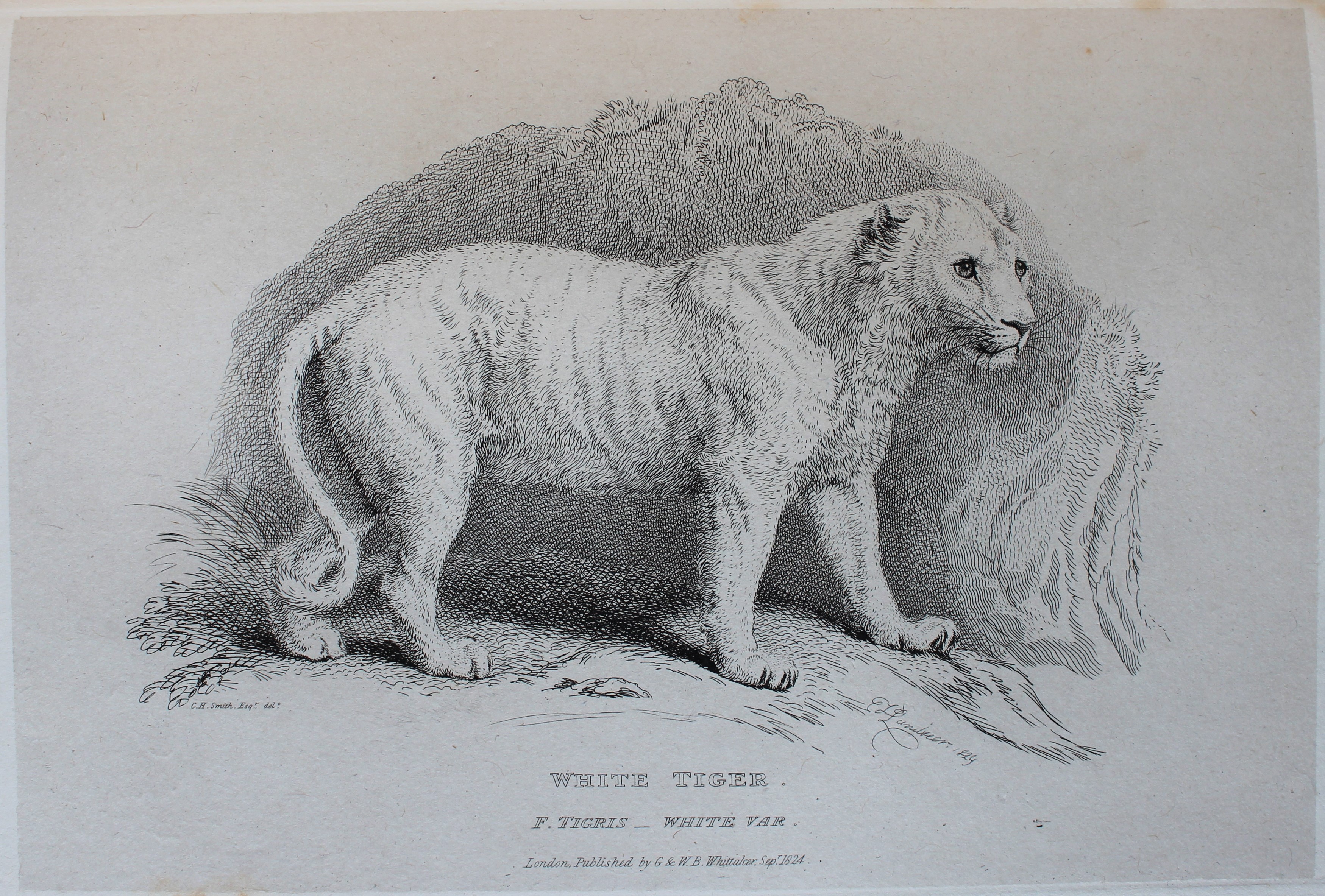
white tiger

White tiger from Cuvier’s animal kingdom: The class mammalia, Vol. 2, plate facing p.444, 1827, Shelfmark F.6.3

Clouded tiger

Clouded tiger from Cuvier’s animal kingdom: The class mammalia, Vol. 2 facing p.450, 1827, Shelfmark F.6.3

Fearsome tigers on the attack appear in an engraving (shown below) from John Church’s A Cabinet of Quadrupeds, which was published in 1805.

Tigers attacking men

Attacking tigers from Vol. 2 of A cabinet of quadrupeds: with historical and scientific descriptions, 1805, Shelfmark F.3.35

Our final image, aptly enough, depicts a tiger prowling away towards a deep dark forest. This is taken from a book of prints by English landscape and marine painter, William Daniell (1769-1837). Daniell travelled widely in India in his youth, so it is possible that he saw the beasts with his own eyes.

prowling tiger in woods

Plate from Vol. 1 of Interesting selections from animated nature, with illustrative scenery, [1809?], Shelfmark F.6.45

We hope this “ambush” of tigers has provided a stimulating start to your new year!

AC

References:

Marisol Erdman, Conrad Gesner: Illustrated Inventories with the use of Wonderful Woodcuts  [accessed 27/1/22]

Florike Egmond, 16th century ‘zoological goldmine’ discovered – in pictures [accessed 27/1/22]


Theology Books from George Thackeray’s Library: An Online Exhibition

The last exhibition as part of our HLF-funded project was mounted in the beautiful setting of King’s College Chapel in May and June 2018, and it featured books from the theology section of George Thackeray’s library. When he died in 1850, he left his black-letter divinity books, mostly printed between 1530 and 1580, to King’s in his will (some 165 volumes). His daughter Mary Ann Elizabeth bequeathed the rest of her father’s library to the College in 1879. Over 22,000 people visited the Chapel in May and June, but for those who did not have the opportunity to see the exhibition, we provide here some selected highlights.

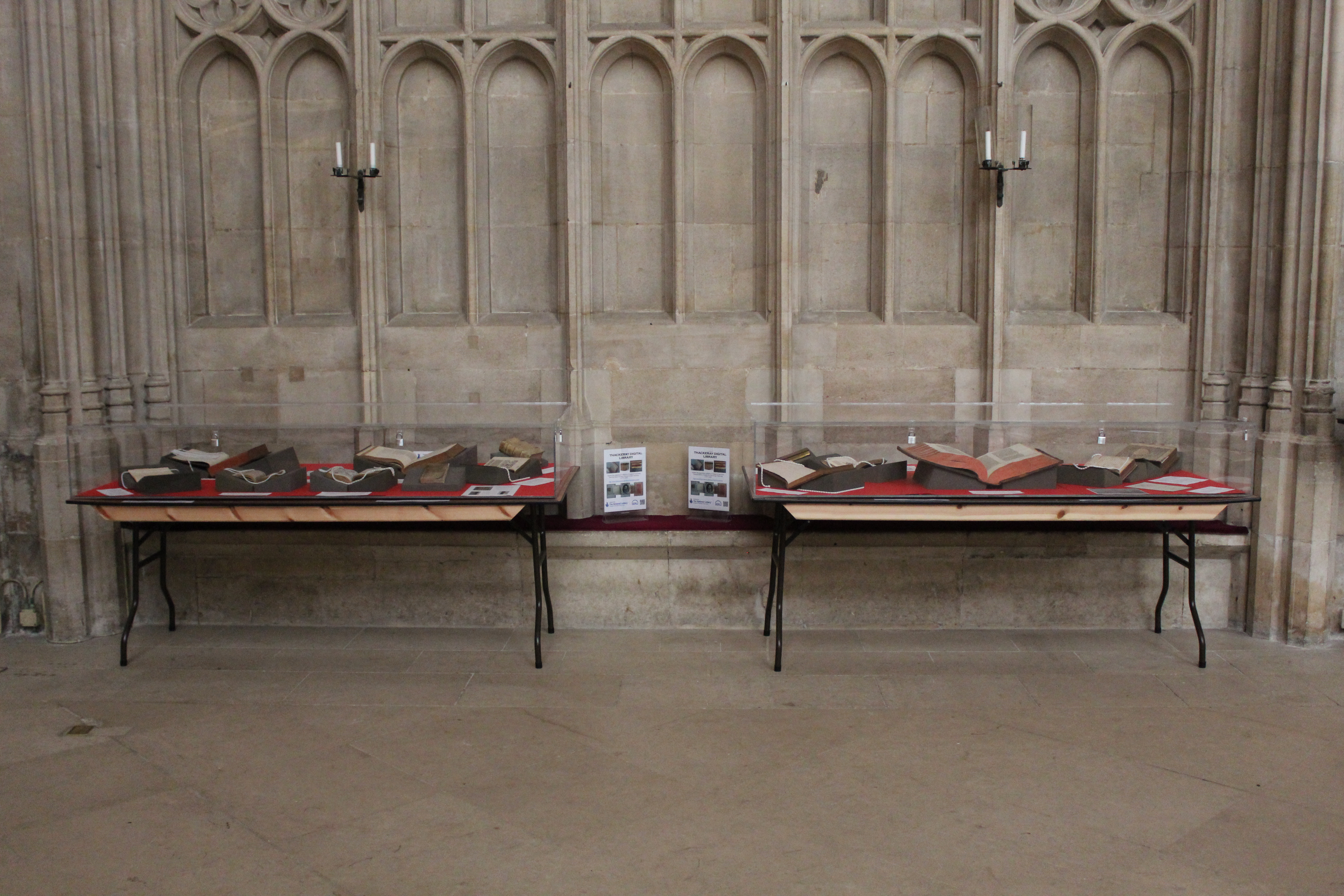
Two exhibition cases were set up in the Ante-chapel

If you look closely at the next two images, you’ll be able to see the reflection of the chapel wall and the stained glass windows on the cases. This is volume I of the first edition of Martin Luther’s collected works. The title within a historiated woodcut border shows Martin Luther and Frederick III of Saxony kneeling in front of Christ on the Cross:

Martin Luther, Tomus primus omnium operum reuerendi domini Martini Lutheri
Wittenberg: Hans Lufft, 1545
(Thackeray.A.37.5)

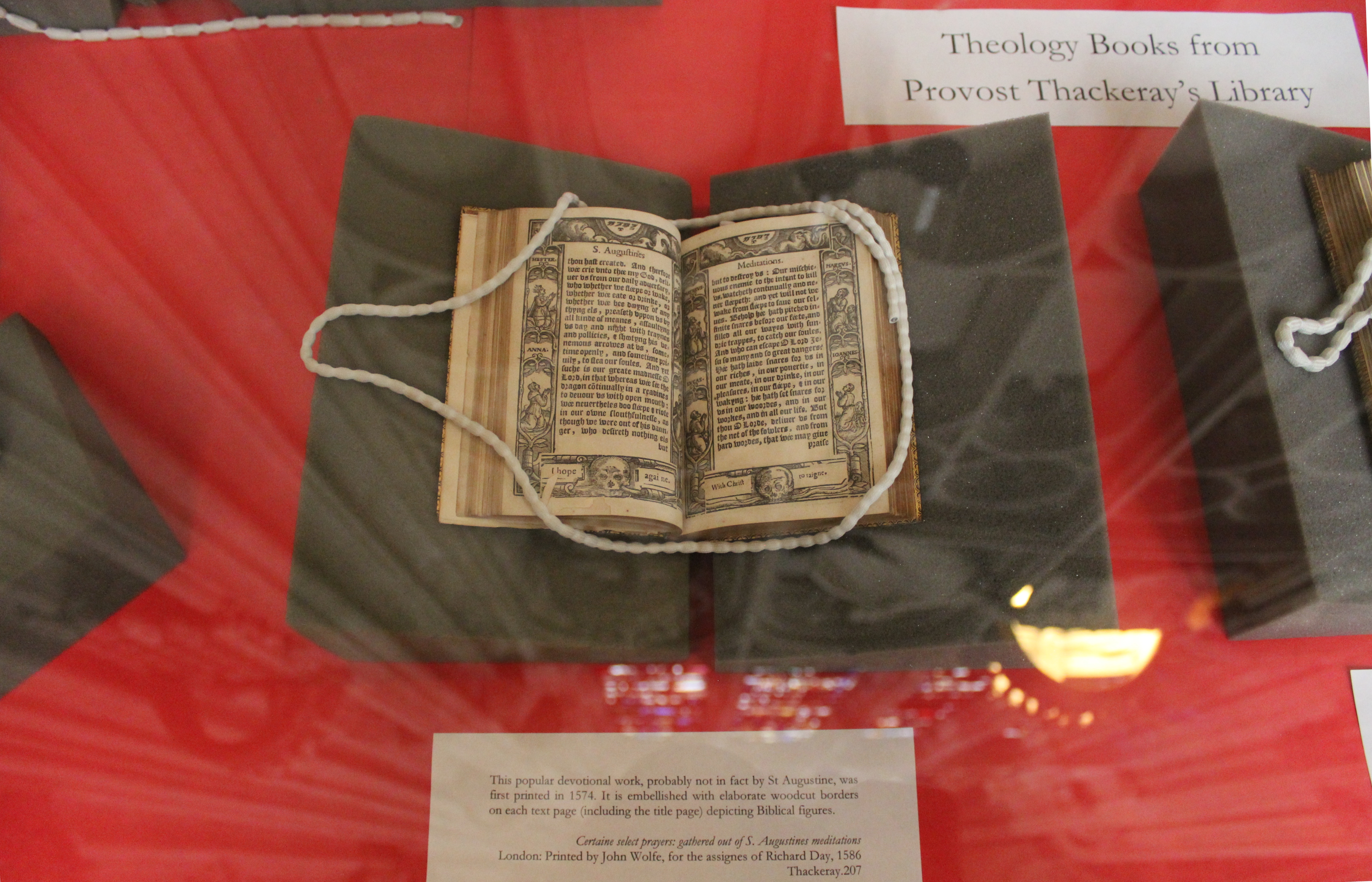
This devotional work, first printed in 1574, was likely not authored by St Augustine. Each page has elaborate woodcut borders depicting Biblical figures:

Certaine select prayers: gathered out of S. Augustines meditations
London: Printed by John Wolfe, for the assignes of Richard Day, 1586
(Thackeray.207)

One of the most prolific and influential of Germany’s early printers, Anton Koberger (ca. 1440-1513) printed fifteen editions of the Latin Bible at Nuremberg between 1475 and 1513. Dated 10 November 1478, Koberger’s fourth Latin edition contained several pointers for readers, for example the first table of contents indicating the folio number on which each book of the Bible begins:

Biblia latina
Nuremberg: Anton Koberger, 10 November 1478
(Thackeray.XV.1.10)

The grammarian Robert Whittington was best known for his elementary Latin school books. This 1517 edition of Declinationes nominum [The Declension of Nouns] was produced by the celebrated printer Wynkyn de Worde (died ca. 1534), who collaborated with William Caxton and took over his print shop in 1495. The title page has one of Caxton’s distinctive printer’s devices incorporating the words “wynkyn .de. worde”:

Robert Whittington, Editio roberti whittintoni … Declinationes no[m]i[nu]m ta[m] latinoru[m] [quam] grecoru[m]
London: Wynkyn de Worde, 1517
(Thackeray.41)

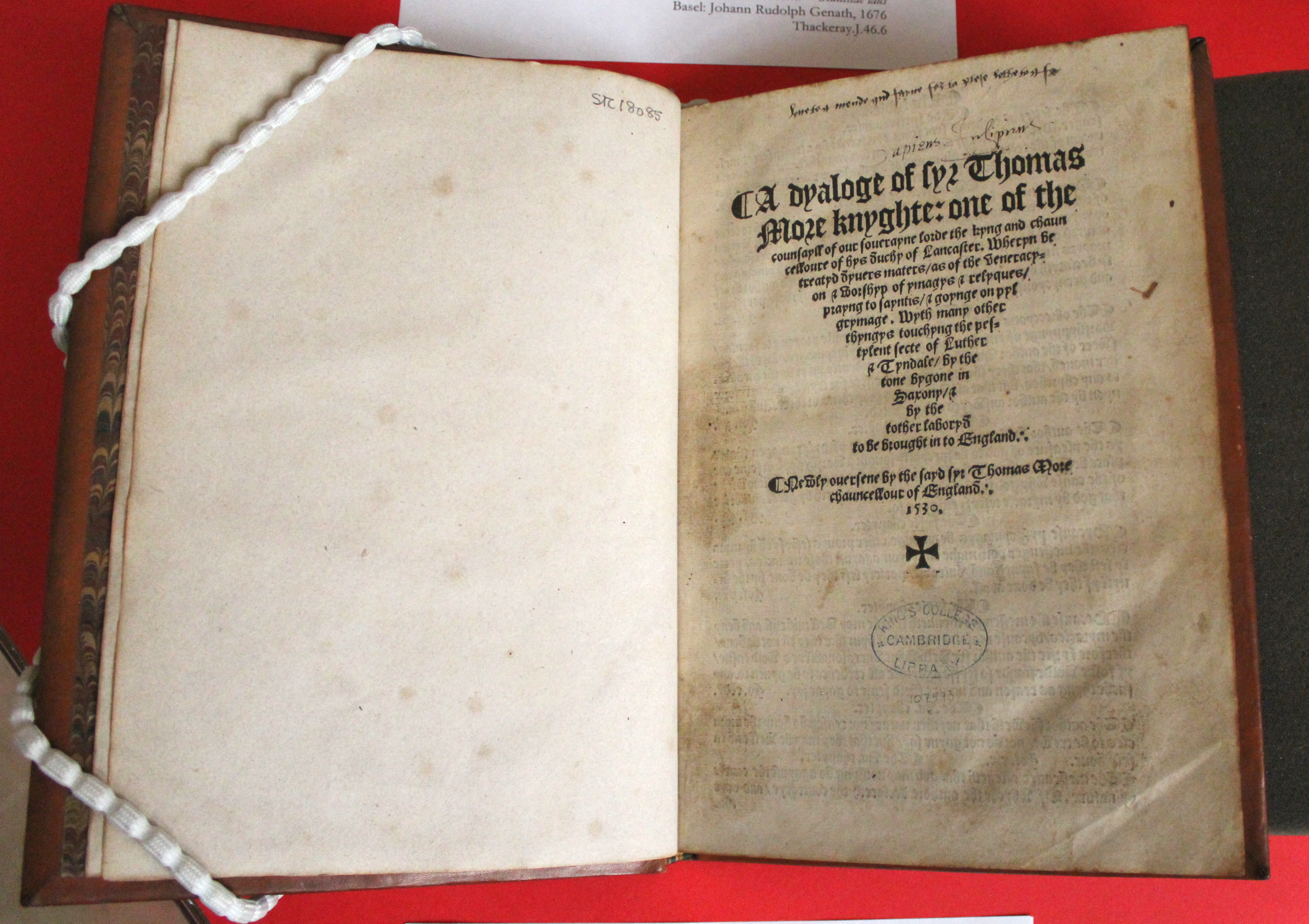
This second edition of Sir Thomas More’s Dialogue concerning Heresies, in which he asserts the Catholic Church as the one true church, contains a contemporary 16th-century inscription on the title page (uncertain reading): “lone to amende and fayne for to plese lothe to a[?]f”:

Sir Thomas More, A dyaloge of syr Thomas More knyghte
[London: William Rastell], 1531
(Thackeray.70)

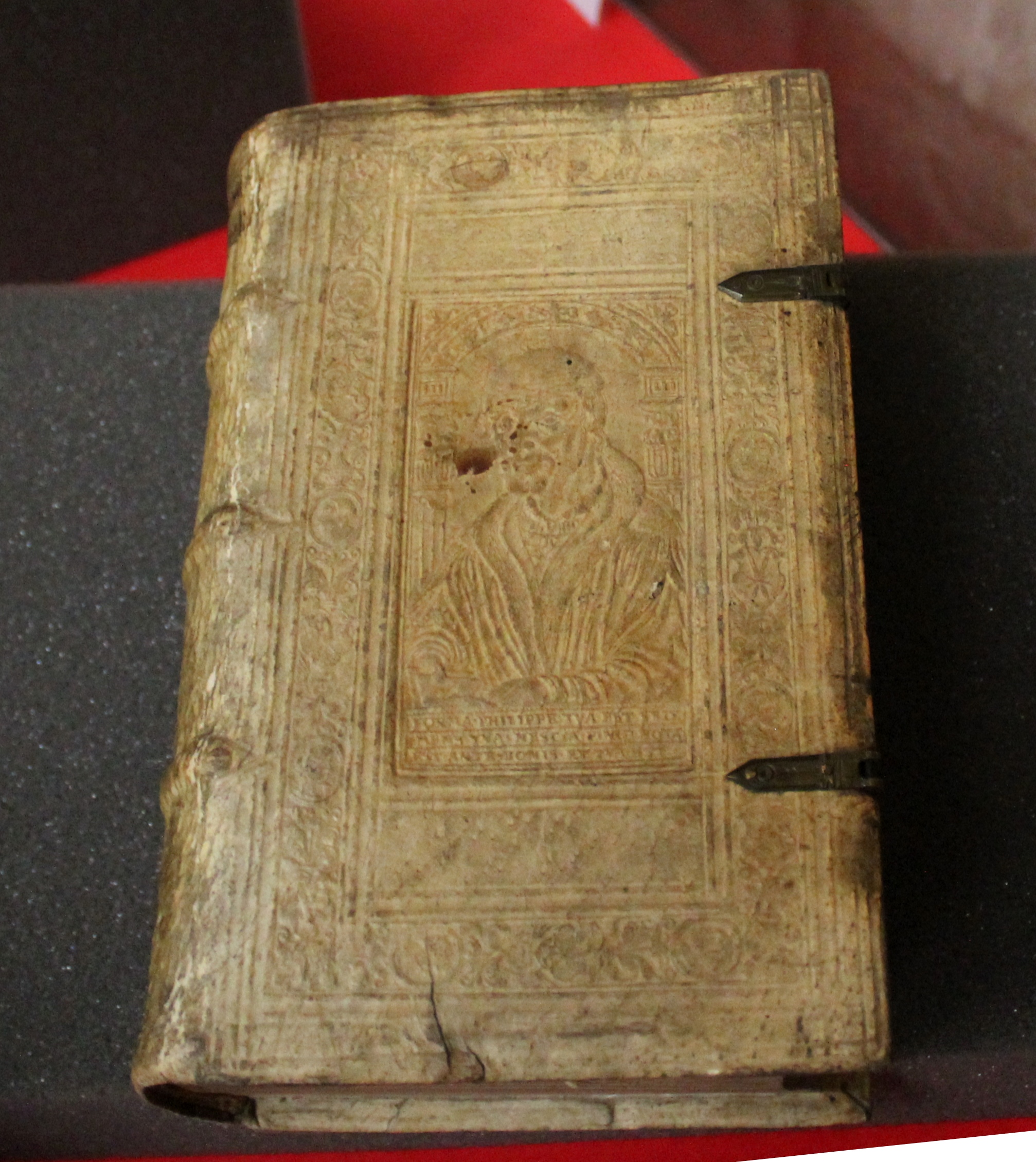
The exhibition also included a selection of books remarkable because of their bindings. This copy of Philipp Melanchthon’s Orationum (1572) features a characteristic 16th-century German blind-stamped alum-tawed pigskin binding over wooden boards. On the front board is a portrait of Melanchthon, with the lines: “Forma Philippe tua est sed mens tua nescia pingi nota est ante bonis et tua [scripta docent]” [Philipp, this is your likeness, but your mind remains unknown to good men without the teaching of your writings]:

Philipp Melanchthon, Orationum
Wittenberg: Clemens Schleich and Anton Schöne, 1572
(Thackeray.J.49.5)

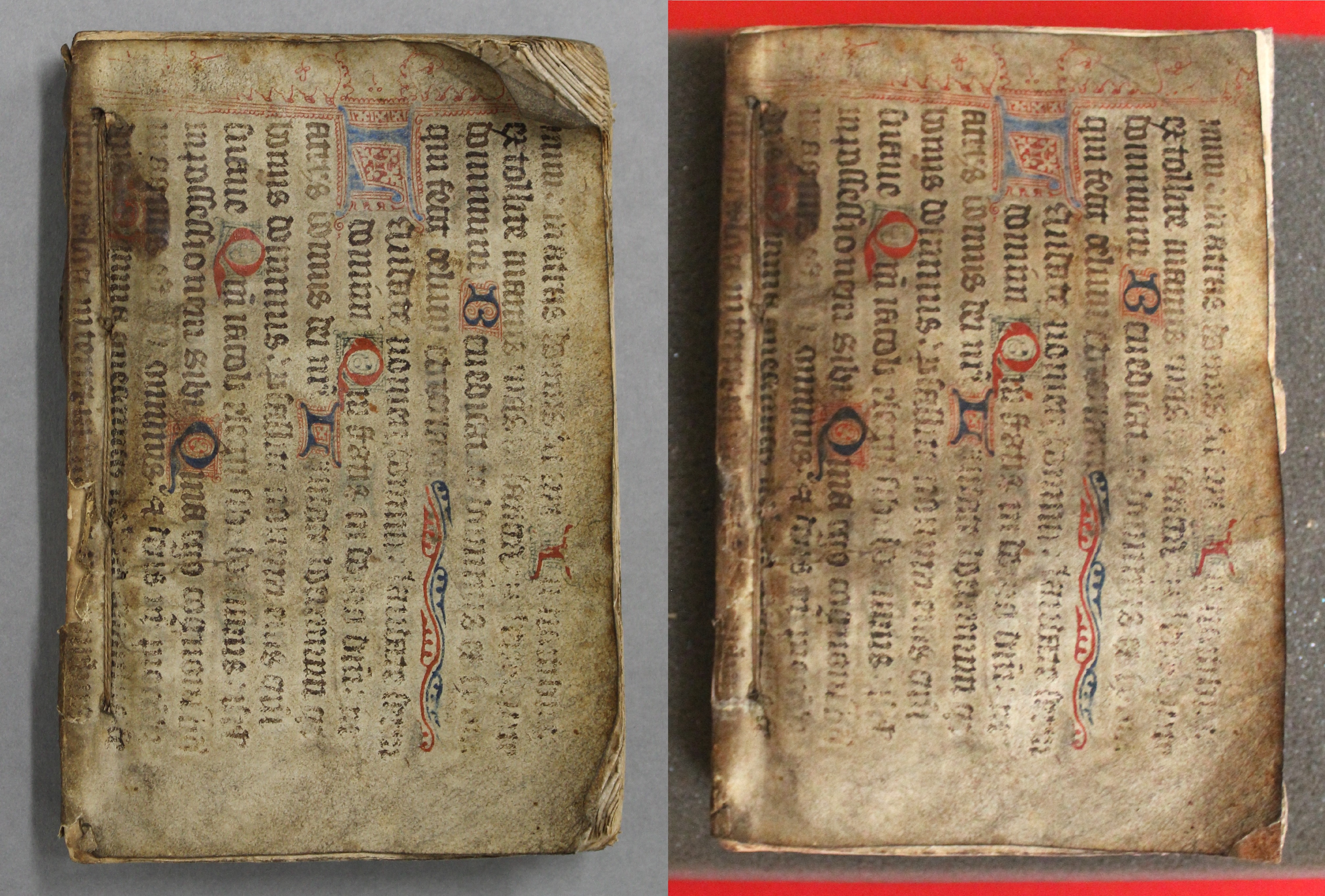
This small volume is bound in a parchment wrapper with manuscript writing on both sides and initials illuminated in red and blue. Recycling of manuscripts in book binding was a common practice. Thanks to the HLF grant, the binding has been repaired as shown in these images, before (left) and after (right) conservation:

William Fulke, A confutation of a popishe, and sclaunderous libelle
London: Printed by John Kingston, for William Jones, 1571
(Thackeray.182)

We would like to take this opportunity to thank the HLF for their generous support over the past two years, which enabled us to catalogue almost 2,000 books from the Thackeray Bequest, repair the volumes that required conservation, create a digital library, organise school visits, and mount numerous exhibitions which attracted thousands of visitors.

IJ

Video: Conserving Rare Books at King’s College, Cambridge

As part of our HLF-supported Thackeray Project, we have produced a video that looks at rare book conservation generally, before moving on to a case study of the repairs performed on a single book from the Thackeray Collection (Le rime di Francesco Petrarca, Thackeray.L.3.40).

Enjoy!


GB/JC/IJ

Volunteering at King’s

I joined the Thackeray Project at King’s College Library as a volunteer in June 2017 having found out about the project through an online newspaper article. I decided to take part in the project because I have a great passion for history and for books. I also believed that I would gain valuable experience at King’s which would be important for my long-term interests in museums, libraries and archives. As a member of the project I had a number of duties which included: phase boxing of rare books, preparing and invigilating the Jane Austen open days and editing on the King’s College website/blog.

Me standing next to a stack of phase boxes.

The boxing of the Thackeray collection books was central to the project. There were many books that were in need of archival-standard ‘phase boxes’ in order to protect them from further wear and tear. Although it took me a little time to learn and understand how the books were numbered and shelved (having only had experience with the Dewey Decimal system previously), I loved boxing the books because I liked handling them and studying their bindings and pages. I also enjoyed the fact that I was helping to preserve history for the future, something which I’m very passionate about.

Me with College Librarian, James Clements, awaiting visitors to the Jane Austen Open Day.

When the boxing stage of the Thackeray Project was coming to a close, I became involved in the preparation and the invigilation of the Jane Austen open days which we had over the summer of 2017. I really enjoyed both aspects of the open days. As with phase boxing, I loved being close to the volumes and learning about Jane Austen and her works; I’ve come away with more knowledge about Austen than I had before. A particularly memorable moment was seeing the Sanditon manuscript which took centre stage at the open days. After many weeks of preparation, i.e. selecting the books, writing the captions, preparing the posters and so on, we had our first Jane Austen open day on 18 July 2017, the bicentenary of her death. I took part in invigilating the event, monitoring the displays and assisting the general public with their enquiries. Although it was extremely exhausting, I had a wonderful time. It was especially pleasing when I found out that we had 1,061 visitors in total for that day which was an indication of the success of the event.

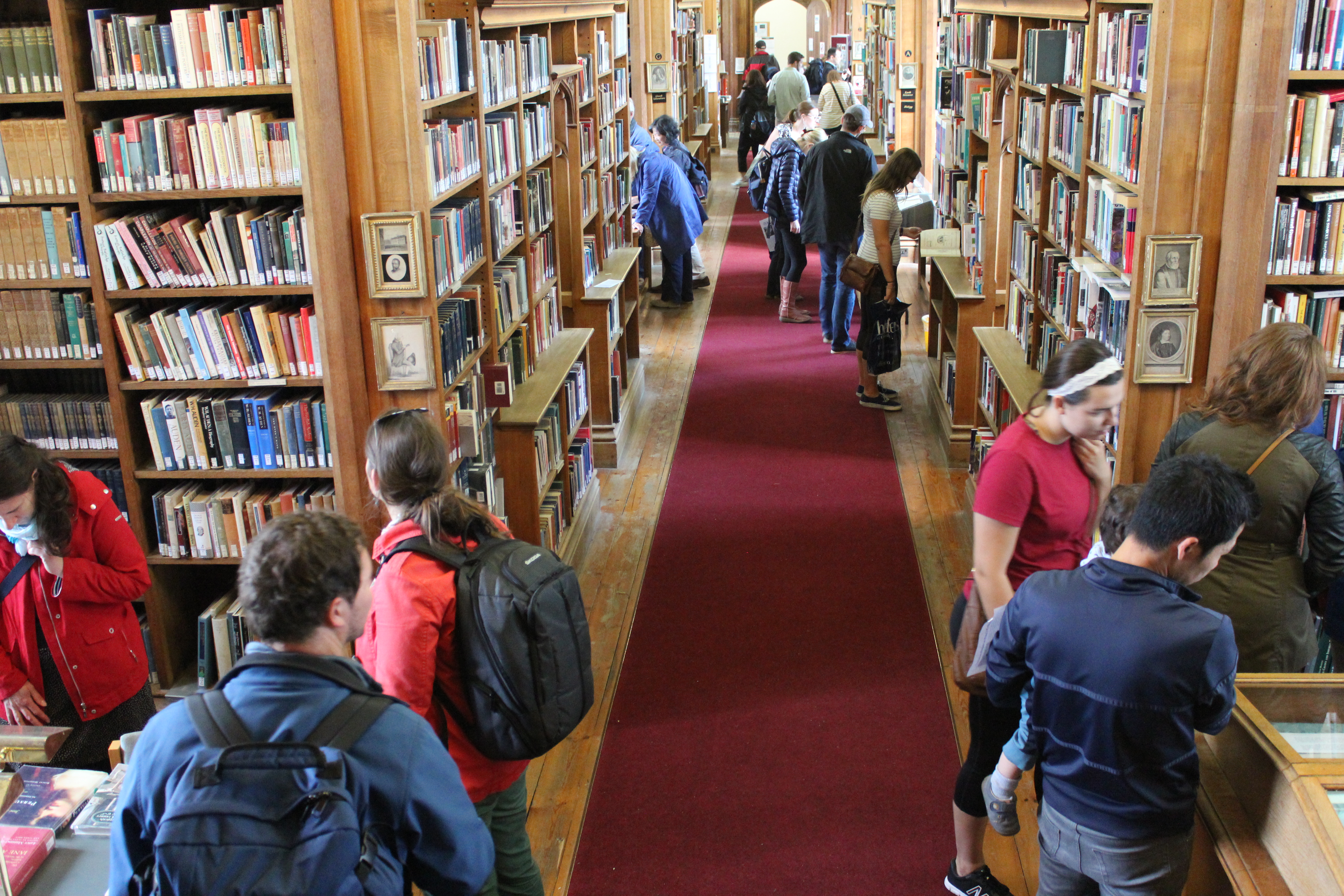
Visitors viewing the Jane Austen exhibition.

As part of the Jane Austen bicentenary events being run at King’s, we also created an online exhibition of the Austen books shown at the open days on our website and our blog. I took part in the planning of the posts and galleries and did the editing of the photos and text. It didn’t take me long to learn how a website and blog work. I enjoyed helping to edit them because I like knowing that when I look back at these posts, I will remember that I helped to put them there: this makes me feel that I have a personal connection with the Austen events. It also gave me useful IT skills which I feel will be helpful for the future.

King’s College webpage showing the Jane Austen section of the digital library.

I really enjoyed being part of the Thackeray Project. I fell in love with all of the books and with King’s College itself. I have enjoyed working with rare books so much that I have decided that I would like to specialise in this area in the future. I continue to volunteer in the library. In addition to my work in the library, I have recently started to volunteer in the Archives as well (as of November 2017).

Harriet Alder

John Sturt (1658-1730): Engraver, Illustrator, Calligrapher

One of the most extensive sections of the Thackeray Bequest is a collection of theology books, ranging from the Koberger Latin Bible printed in Nuremberg in 1478 to around 160 books in Gothic script published between 1530 and 1580 by such notable figures as John Calvin, Hugh Latimer, Philip Melanchthon, Sir Thomas More, William Tyndale, Luther and Erasmus. In this eclectic collection are two visually impressive books engraved by John Sturt (1658-1730), best known as the illustrator of Bunyan’s The Pilgrim’s Progress (1728).

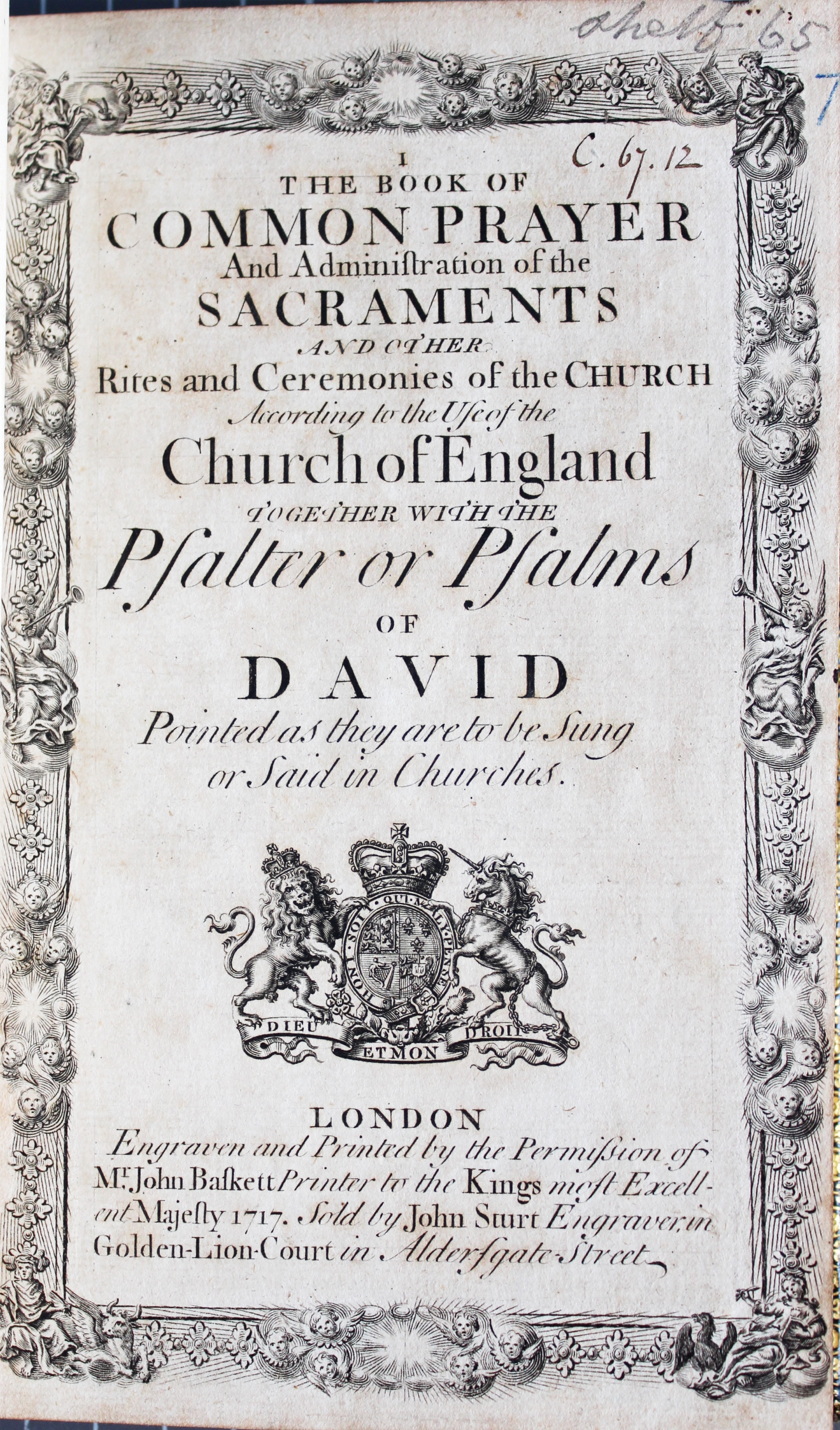
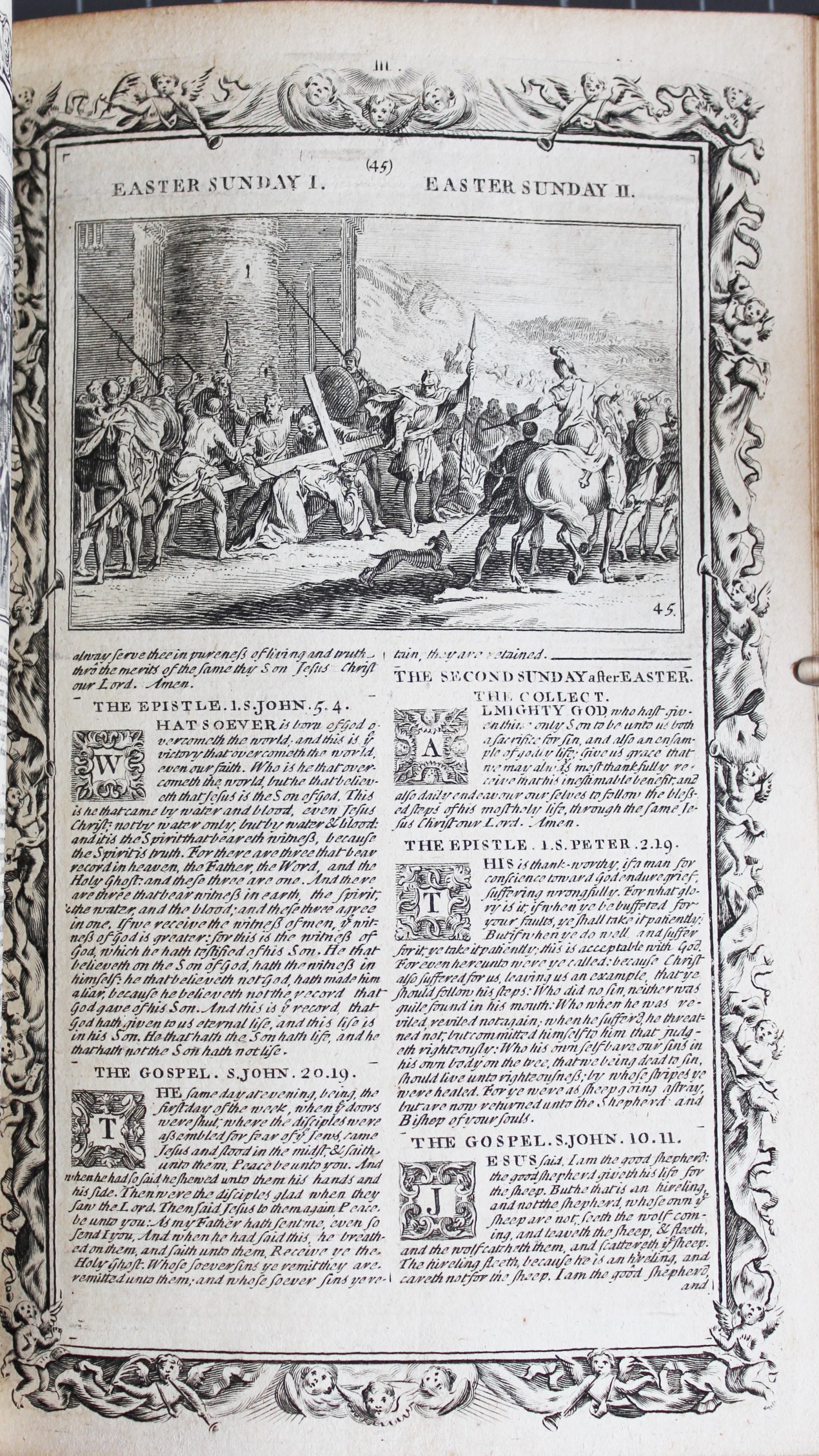
Title page of The Book of Common Prayer (London: John Baskett; sold by John Sturt, 1717) with engraved royal device (Thackeray.C.67.12)

One of Sturt’s most notable works is The Book of Common Prayer (1717), executed on 188 silver plates which include more than 100 illustrations depicting scenes from the New Testament:

Engraved vignette depicting one of the Stations of the Cross

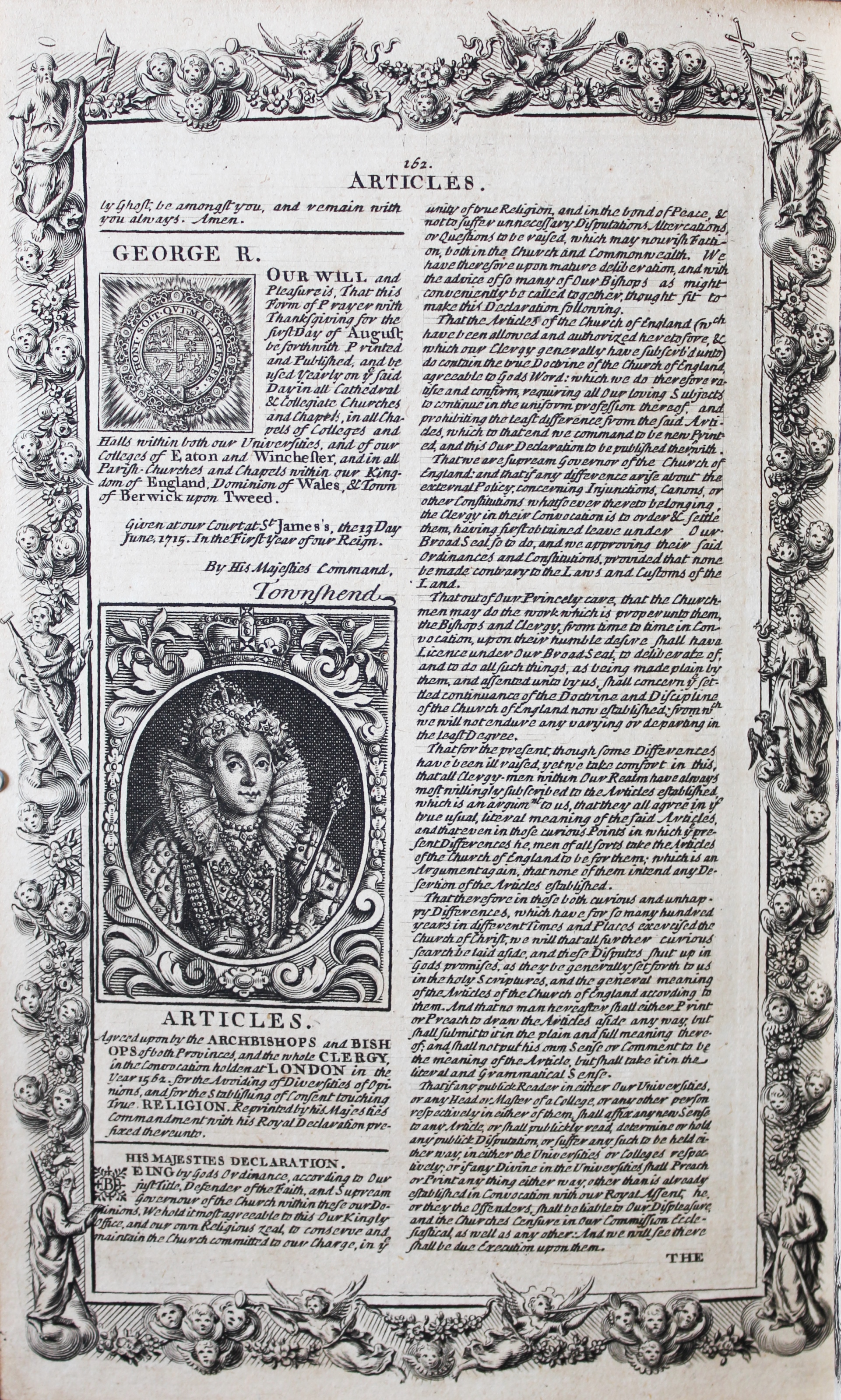
as well as portraits of Queen Elizabeth I, James I, Charles I, Charles II, and George I, among others:

Portrait of Queen Elizabeth I. Each page is set within an ornamental border

A remarkable feature of this book is the frontispiece portrait of King George I, on which Sturt inscribed in minuscule letters the Creed, the Lord’s Prayer, the Ten Commandments, a prayer for the King and the Royal Family, and Psalm 21:

Frontispiece portrait of King George I. Sturt’s skills as a calligrapher were such that he managed to engrave the Lord’s Prayer on a silver halfpenny

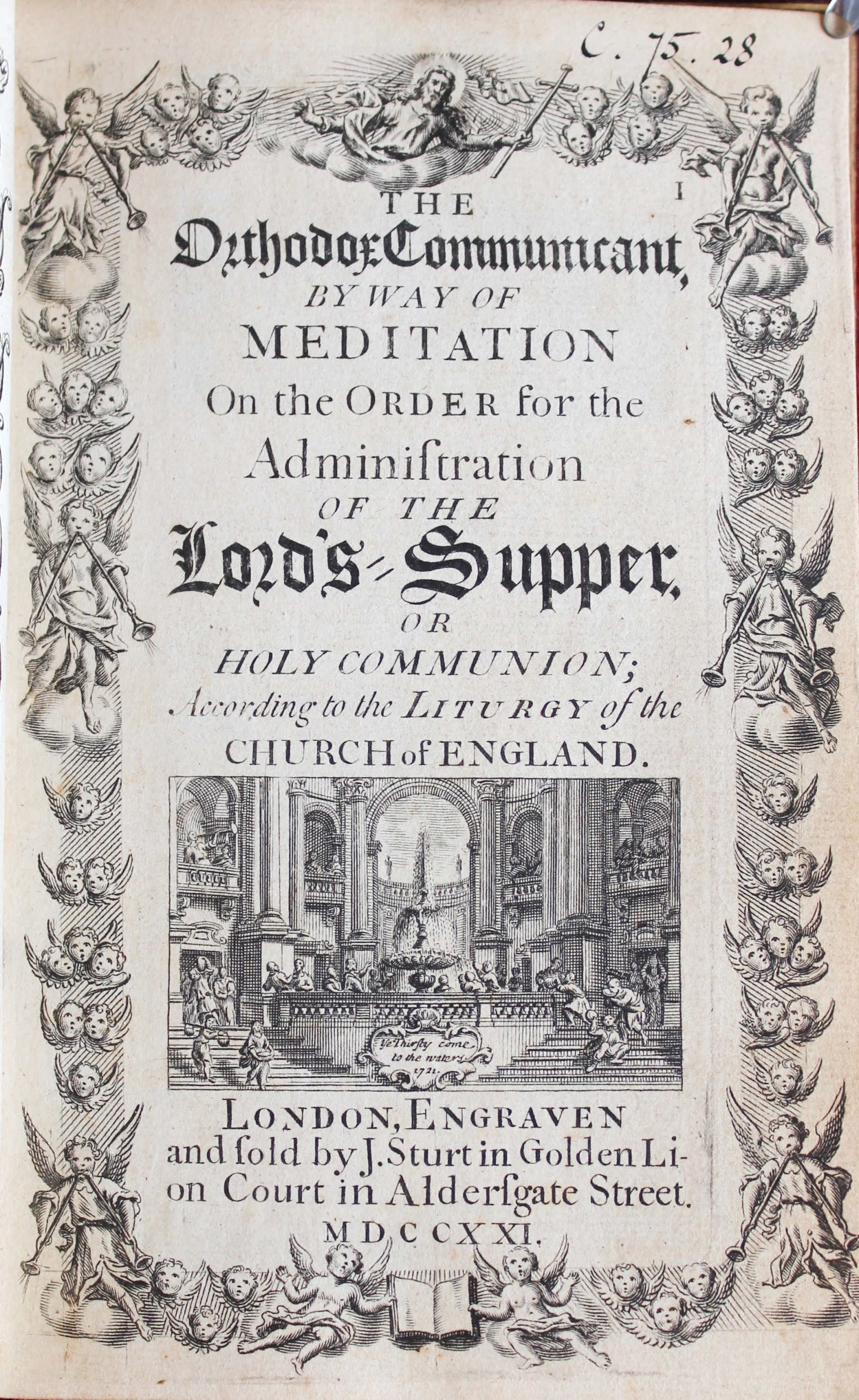
The book took three years to complete and was financed by subscribers, whose names appear in the volume. Sturt’s next project, providing the illustrations for Laurence Howell’s The Orthodox Communicant (1721), was published four years later and also features a list of subscribers at the end.

Title page of Laurence Howell’s The Orthodox Communicant (London: Sold by John Sturt, 1721); Thackeray.C.75.28

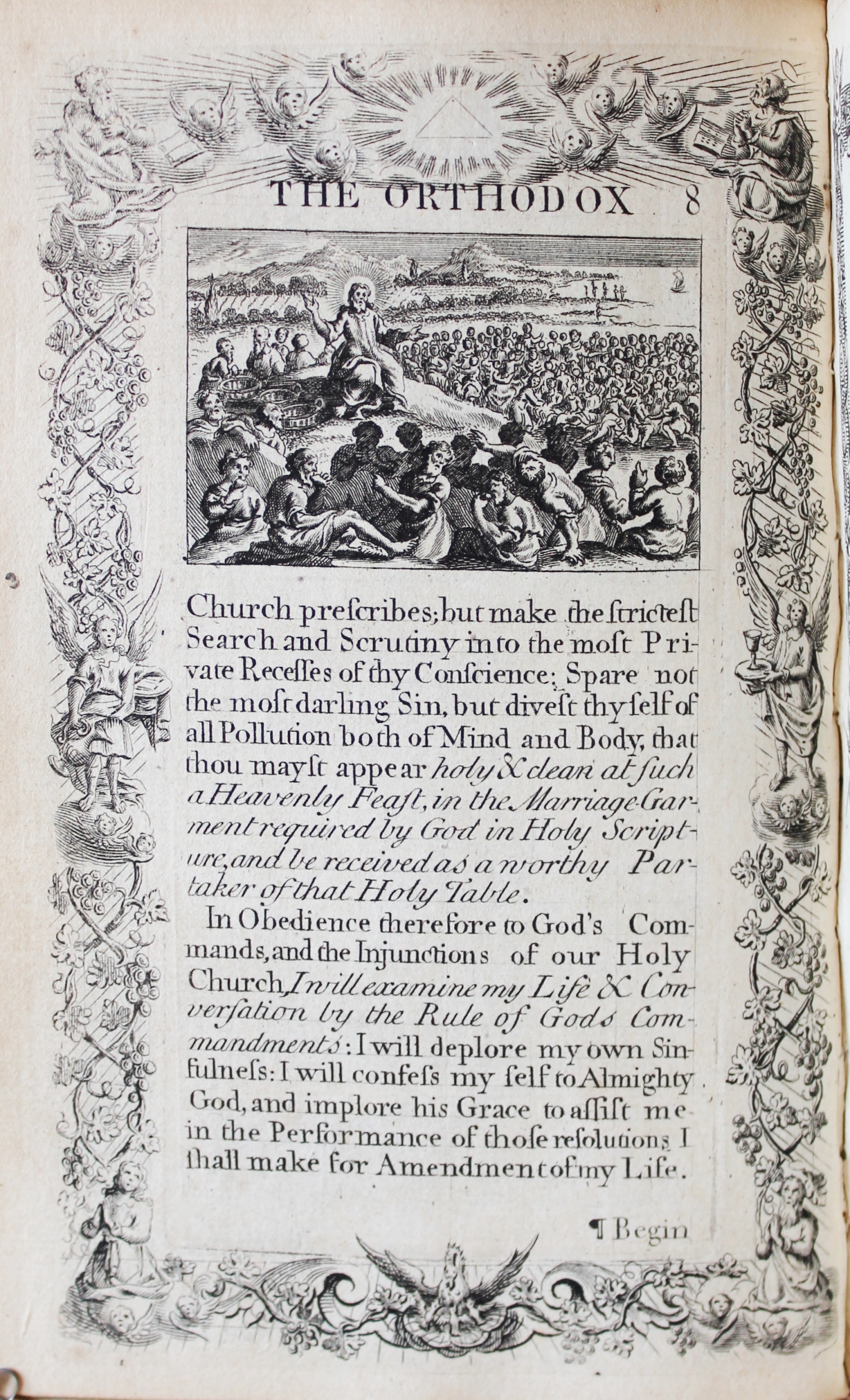
This volume further illustrates Sturt’s skills in miniature work. Each page has an engraved border enclosing engraved text with a vignette at the top of the page. The text and the borders were separately imposed, which means that copies may not always have the same border surrounding a particular page of text:

The Sermon on the Mount

The Flagellation

The Resurrection

Sturt was a very prolific engraver, and his work as a book illustrator includes Francis Bragge’s Passion of our Saviour (1694), Samuel Wesley’s History of the Old and New Testament in Verse (1704), Charles Perrault’s Treatise on the Five Orders of Architecture (1708) and Hamond’s Historical Narrative of the Whole Bible (1727). Though he died in poverty in 1730, John Sturt remains one of the most skilled and accomplished engravers and calligraphers of his generation.

Happy Easter from everyone at King’s College Library and Archives!

IJ


Pirate treasure (and other ill-gotten gains)

Interest in tales of outlaws, brigands and pirates is perennial, and recent cataloguing work has uncovered several volumes in the Thackeray bequest which provide early accounts of some of these fascinating and colourful characters, both real and fictional, including such luminaries as Blackbeard, Captain Avery and Robin Hood.

Perhaps most significant amongst these works is a large tome published in 1734, the title-page of which is pictured below.

Thackeray.Q.29.9 titlepage

Title-page of “A general history of the lives and adventures of the most famous highwaymen, murderers, street-robbers, &c : to which is added A genuine account of the voyages and plunders of the most notorious pyrates…” (London, 1734) Thackeray.Q.29.9

This book contains selections from one of the most famous early works about pirates: Captain Charles Johnson’s 1724 work: A general history of the robberies and murders of the most notorious pyrates. Interspersed with these piratical histories are selections from Captain Alexander Smith’s The history of the lives of the most noted highwaymen, which was originally published in 1714. The book, which delights in embroidering and exaggerating its accounts of criminality, is also full of wonderfully evocative engravings depicting pirates, highwaymen and other assorted villains going about their dastardly business.  Possibly the most striking illustration is this image of the notorious pirate Blackbeard.

Thackeray.Q.29.9 facing page 203 Blackbeard

Edward Teach (c. 1680–1718) alias Blackbeard. Illustration facing page 203 in Thackeray.Q.29.9

An accompanying description in the text elaborates upon his fearsome appearance.

Thackeray.Q.29.9 page 207 Blackbeard's beard

Description of Blackbeard. Extract from page 207 of Thackeray.Q.29.9

Captain Avery, a sailor who turned to piracy after taking part in a mutiny, is shown against a backdrop depicting one of his most famous exploits: the taking, in 1695, of the Ganj-i-Sawai, a treasure ship belonging to the Mughal emperor of India. Having secured a vast haul of silver and gold, Avery and his crew went their separate ways, and Avery’s eventual fate is unknown, although Johnson’s account suggests he died a penniless beggar, having frittered away his loot.

Thackeray.Q.29.9 facing page 197 Avery

Captain Avery (c.1659-1696?) Illustration facing page 197 from Thackeray.Q.29.9

One of the highwaymen featured in this book is James Hind (c.1616-52), a royalist sympathiser who once tried (and failed) to rob Oliver Cromwell. Hind had the reputation of being a gallant and generous thief, who went out of his way to avoid bloodshed wherever possible and “was distinguished by his pleasantry in all his adventures”. However, his penchant for targeting rich republicans during the Protectorate meant that when he was finally caught he was hanged, drawn and quartered for treason.

Thackeray.Q.29.9 facing page 89 Hind

Captain Hind engaged in robbing Colonel Harrison. Illustration facing page 89 from Thackeray.Q.29.9

Criminal women are not absent from these pages. Pirates Anne Bonny and Mary Read both get biographies, and there is a fascinating account of the exploits of Ann (or Nan) Holland, who robbed several families she worked for as a servant. After a spell as the wife of a highwayman, she teamed up with a hoodlum called Tristram Savage to rob an astrologer. The illustration below depicts this robbery. For reasons which are not explained in the text, Savage is dressed as a woman. Note the devil peeping out from beneath the tablecloth!

Thackeray.Q.29.9 facing page 372 Holland

Illustration facing page 372 from Thackeray.Q.29.9

Captain Johnson is a pseudonym. For many years, the true author was believed to be Daniel Defoe (1660-1731), the author of Robinson Crusoe, but more recently this theory has been disputed. However, Defoe did write several works about pirates, and the Thackeray bequest also contains a copy of the first edition (1720) of his novel:  The life, adventures, and pyracies, of the famous Captain Singleton. This contains numerous descriptions of the protagonist’s piratical activities. The title-page provides a neat summary of the novel’s plot.

Thackeray.VIII.11.11 titlepage

Title-page of “The life, adventures and pyracies, of the famous Captain Singleton …” (London, 1720) Thackeray.VIII.11.11

Singleton is kidnapped as a boy and eventually carried off to sea. After many adventures in the East Indies and Africa, he heads to the West Indies and takes up a life of piracy. This is done with great enthusiasm, as is related in the extract below.

Thackeray.VIII.11.11 page 182 extract

Extract from page 182 of Thackeray.VIII.11.11

Singleton and his piratical associates range far and wide, from the Indies to the coast of Africa and even into the Pacific ocean, taking ships belonging to a variety of nations and gleefully availing themselves of their valuables.

Thackeray.VIII.11.11 page 213 extract

Extract from page 213. Thackeray.VIII.11.11

So successful are they that in time their lust for treasure is sated, and Singleton and his crew trade piracy for the merchant life, using their ill-gotten gains as capital. Singleton eventually returns home to live a quiet life in England.

Thackeray.VIII.11.11 page 241 extract

Extract from page 241 of Thackeray.VIII.11.11

Finally, we have a two volume compilation of ballads, poems and songs about Robin Hood, dating from 1795. This includes attractive illustrations depicting scenes from the outlaw’s many adventures, like that pictured below, in which Robin tricks a bishop, and liberates him of his gold.

Thackeray.J.65.4 page 19

Page 19 of volume 2 of “Robin Hood: a collection of all the ancient poems, songs, and ballads, now extant, relative to that celebrated English outlaw …” (London, 1795) Thackeray.J.65.4

Perhaps George Thackeray’s habit of keeping two pistols at home to protect his household from thieves (see our earlier blog post “Who was George Thackeray?”) was fostered in part by reading sensational stories of crime and villainy like these!

AC