Tag Archives: Persia

Saddle up for the New Year!

Given the importance of horses in human history we were inevitably spoilt for choice when it came to selecting equine-related images to celebrate the Lunar New Year of the Horse. What follows, therefore, is a first instalment which focuses on working horses in spheres such as agriculture, transport and warfare. A future post will cast a spotlight upon horses as they have been depicted in myth, legend and fables.

To kick things off with a bang, we begin with a highly dramatic battle scene involving a close-quarters skirmish between two opposing cavalry forces. This vibrant illustration comes from an early nineteenth-century Persian manuscript edition of the complete works of the Persian poet Saʻdī (ca. 1200-ca. 1292). It was given to the Library by Kingsman Martin Bernal (1937-2013), who acquired it from his grandfather, the Egyptologist Sir Alan Gardiner (1879-1963). Gardiner likely purchased it in Cairo in the first decade of the twentieth century.
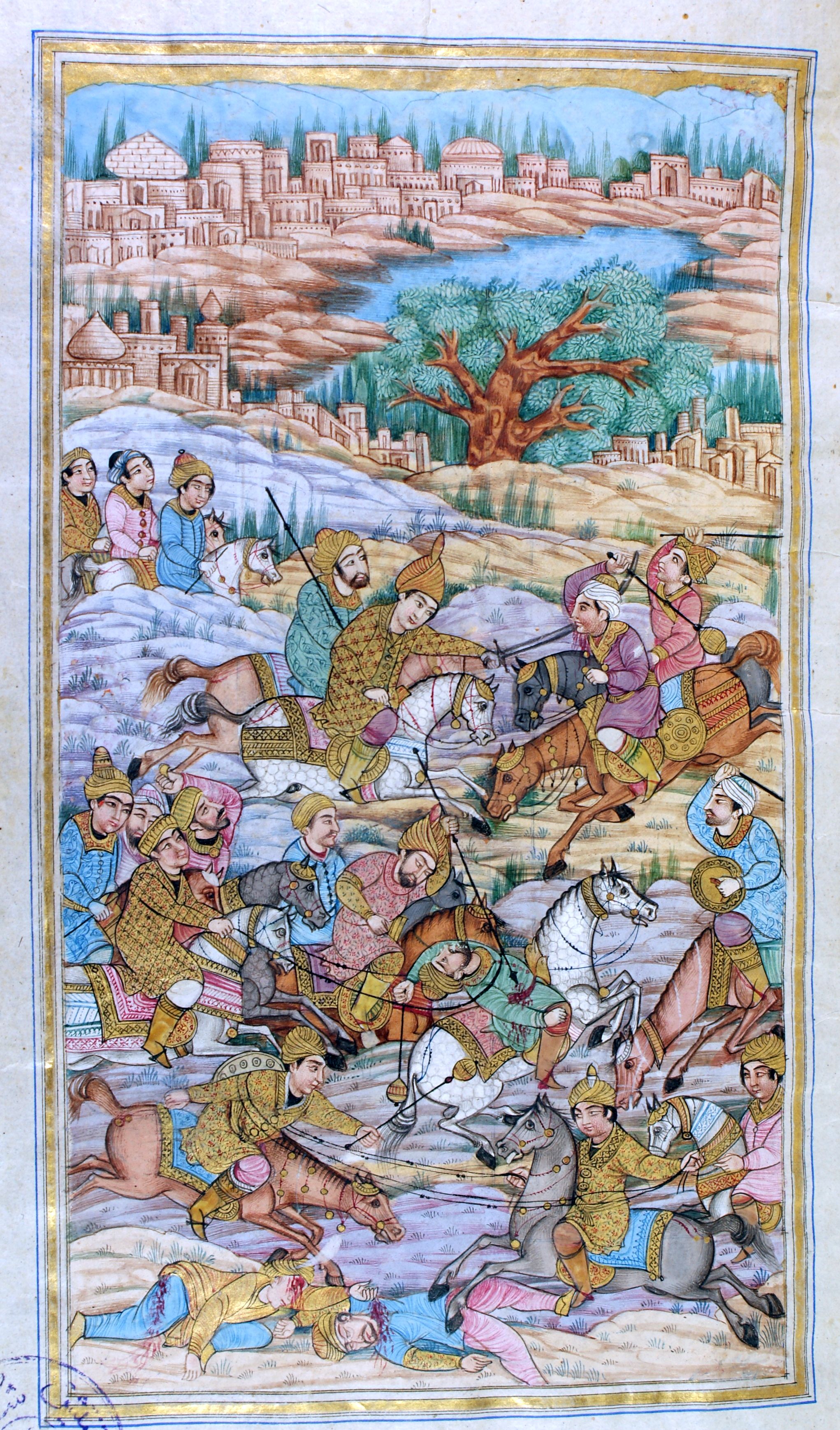
A highly colourful scene of clashing cavalry forces attacking each other with swords and spears. There are dead bodies in the foreground and a tree and houses in the background.

Battle scene from a manuscript edition of The Complete Works of Saʻdī, probably produced in Shiraz, Iran, in 1837. Classmark: MS.26.c.16

The manuscript also contains a lively illustration of a polo match, featuring more elegant and diversely coloured horses. The sport has Persian origins dating back to around the 6th century BCE.
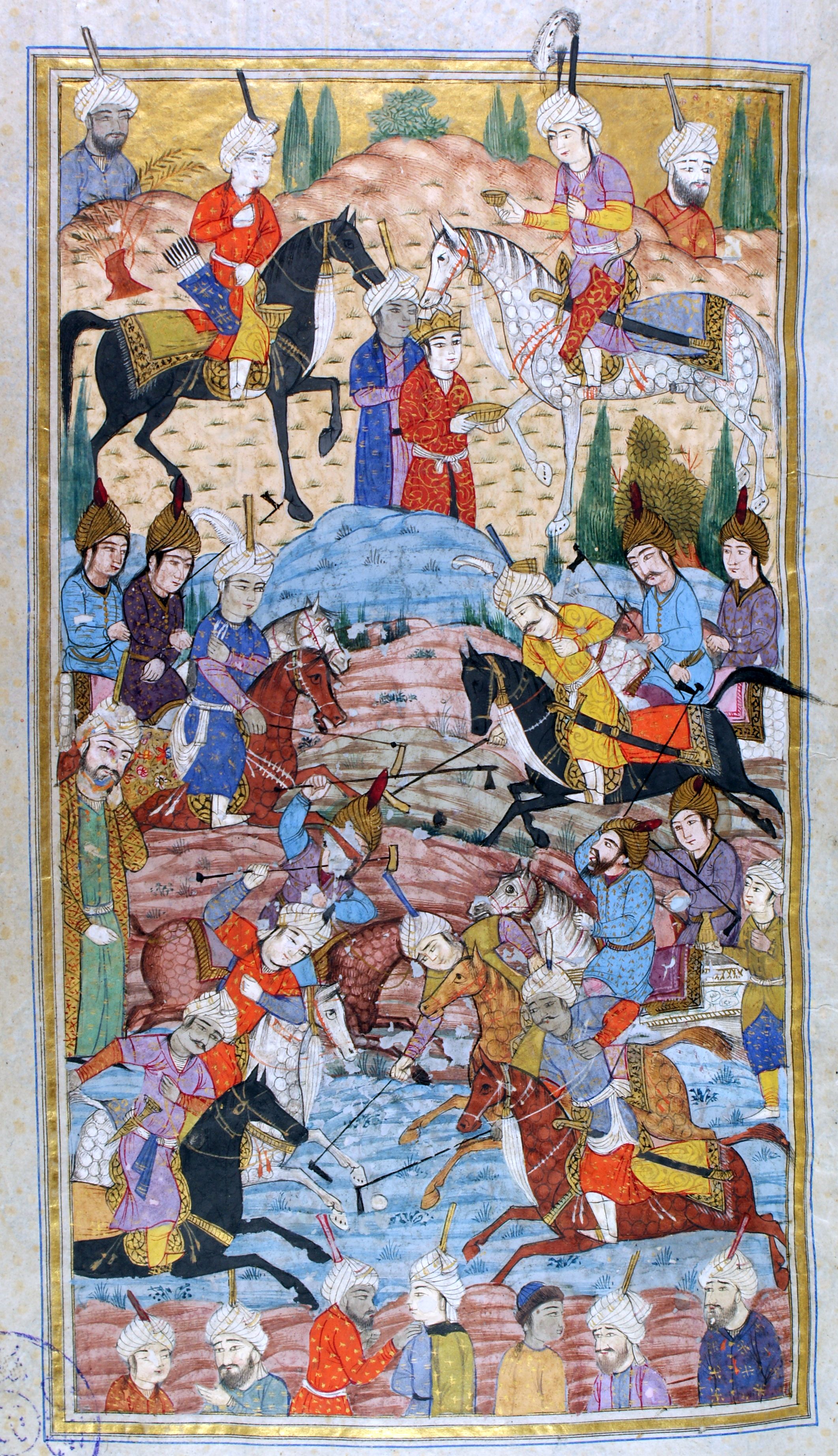
Two teams engage in a lively polo match, with spectators looking on.

Polo match from The Complete Works of Saʻdī

Returning from that sporting diversion to the more serious topic of warfare, we turn next to a much more regimented military scene, which comes from the second volume of Utriusque cosmi … historia, a primarily cosmological work by physician and occult scholar Robert Fludd (1574-1637). Horses are depicted here not only as cavalry animals, but also as a means of transporting cannons and baggage.
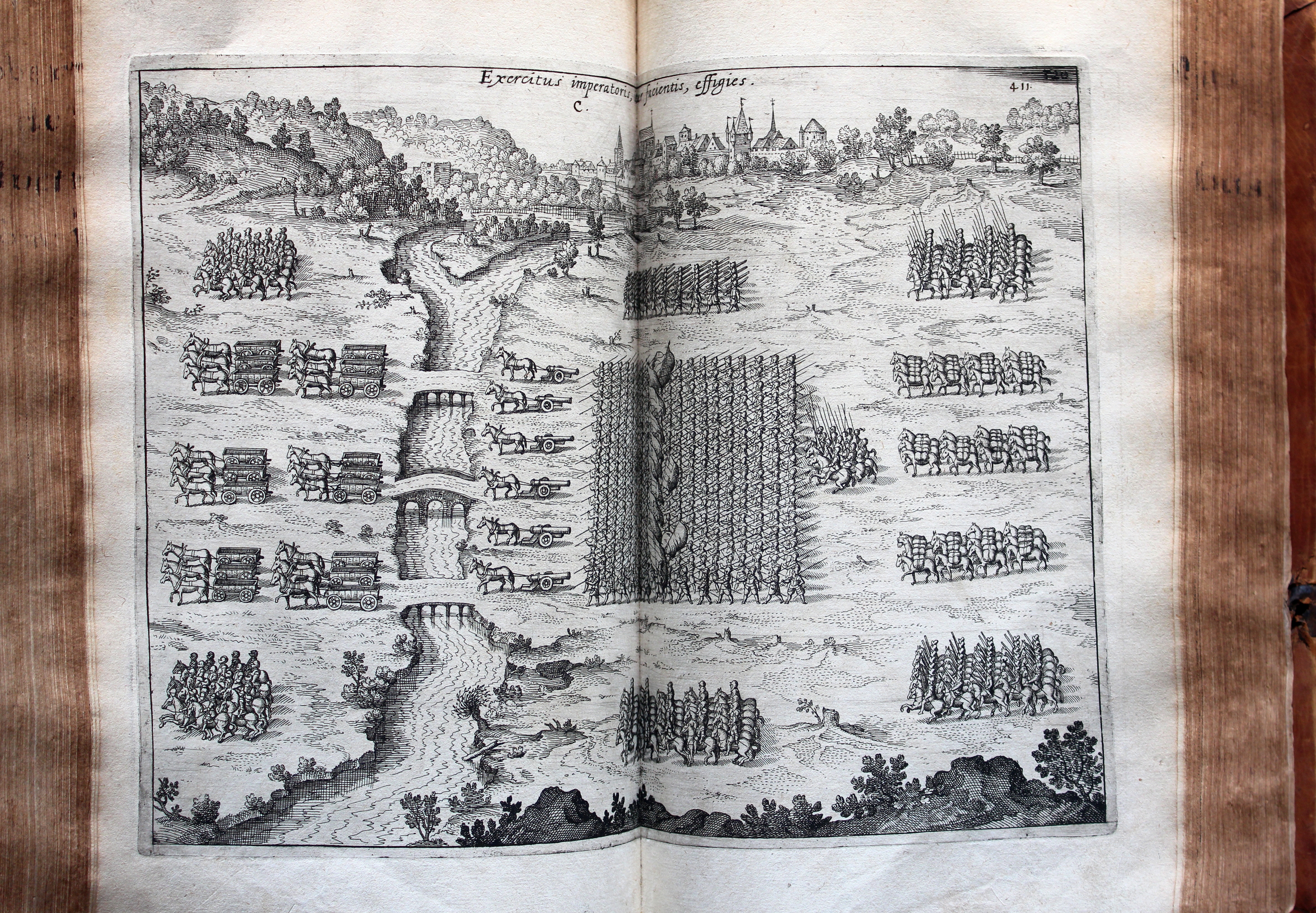
A top-down scene of assembled troops in formation, including infantry and cavalry, and horses pulling cannons and wagons

Plate from volume 2 of Utriusque cosmi maioris scilicet et minoris metaphysica, physica atque technica historia by Robert Fludd, Oppenheim, 1617. Classmark: F.27.04

Fludd travelled abroad in the years after finishing his education and may have acquired some military experience then. If not, he at least developed a deep interest in the subject. Amongst numerous designs for military fortifications and machinery in this work is a horse-driven mobile battery intended for breaking through enemy ranks. It is not clear whether such a machine was ever used on a battlefield, or how practical it would actually be.
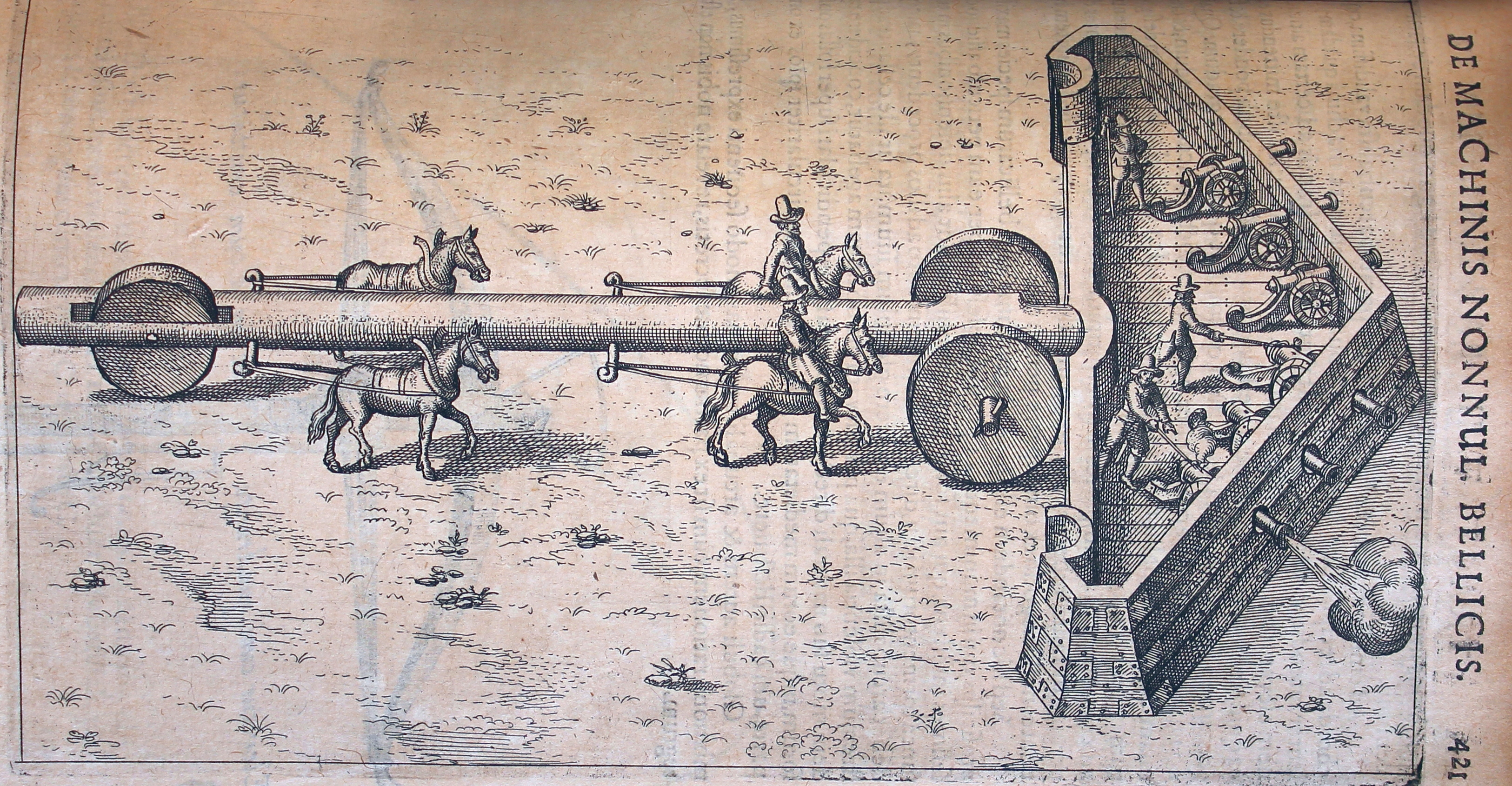
a long pole on wheels flanked by horses, attached to a wedge shaped battery, with room for people firing cannons

Image from page 421 of Utriusque cosmi maioris … historia

Heavily armoured horses pulling war chariots feature in an early eighteenth-century French translation of a twelfth-century work of Chinese history, the Zizhi Tongjian Gangmu. The translator was Joseph-Anne-Marie de Moyriac de Mailla (1669-1748), a Jesuit missionary to China who developed a great interest in Chinese history and learnt the Manchu language in later life. Accompanying illustrations in his text show both a large horse-drawn chariot carrying three soldiers and the slightly smaller but more embellished chariot of a General. The horses, resplendent in their elaborate head-pieces, look alert and well disciplined.
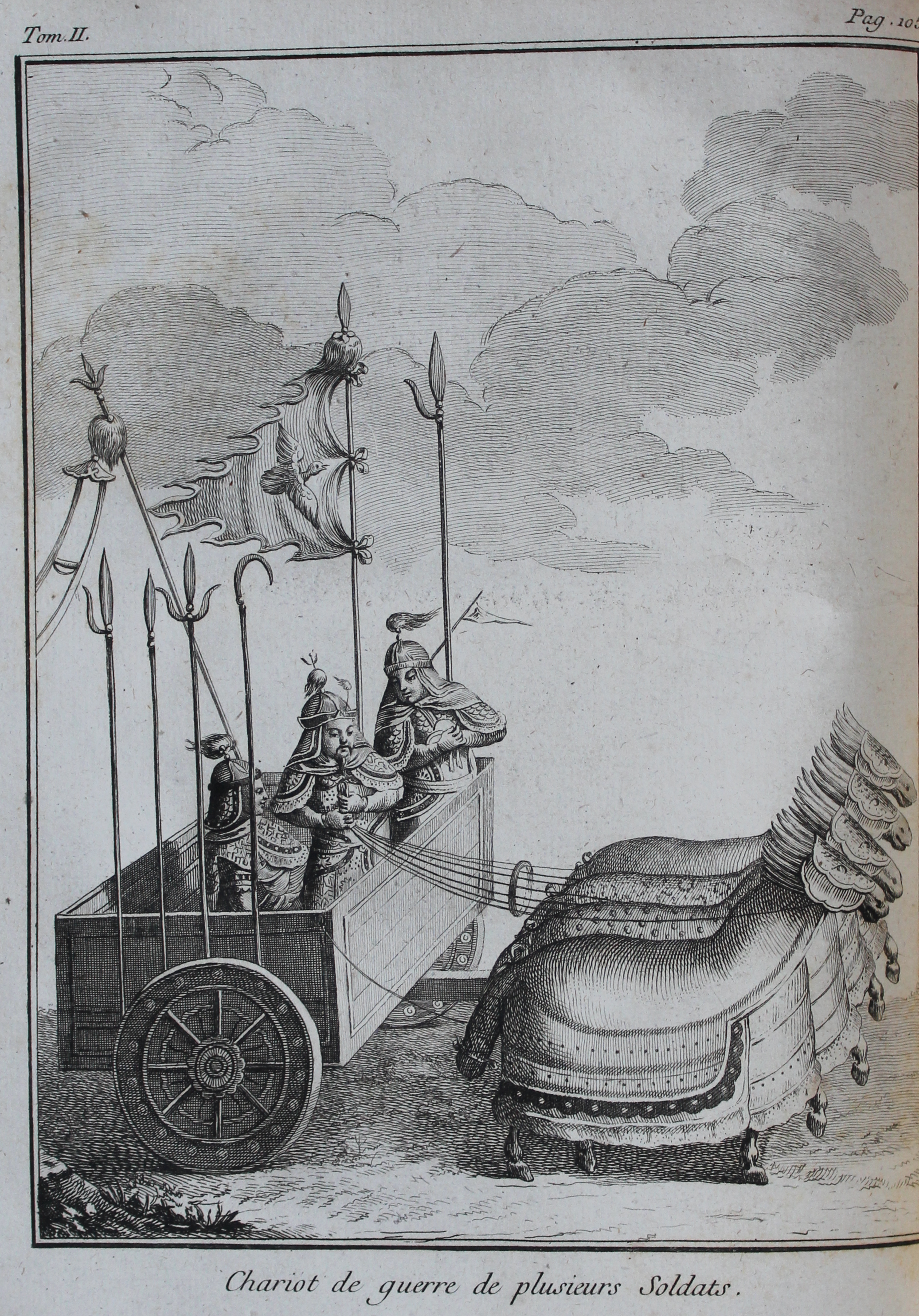
Three Chinese soldiers in a war chariot pulled by four armoured horses

Plate facing page 105 in volume 2 of Histoire générale de la Chine translated by Joseph-Anne-Marie de Moyriac de Mailla, Paris, 1777. Classmark M.44.30
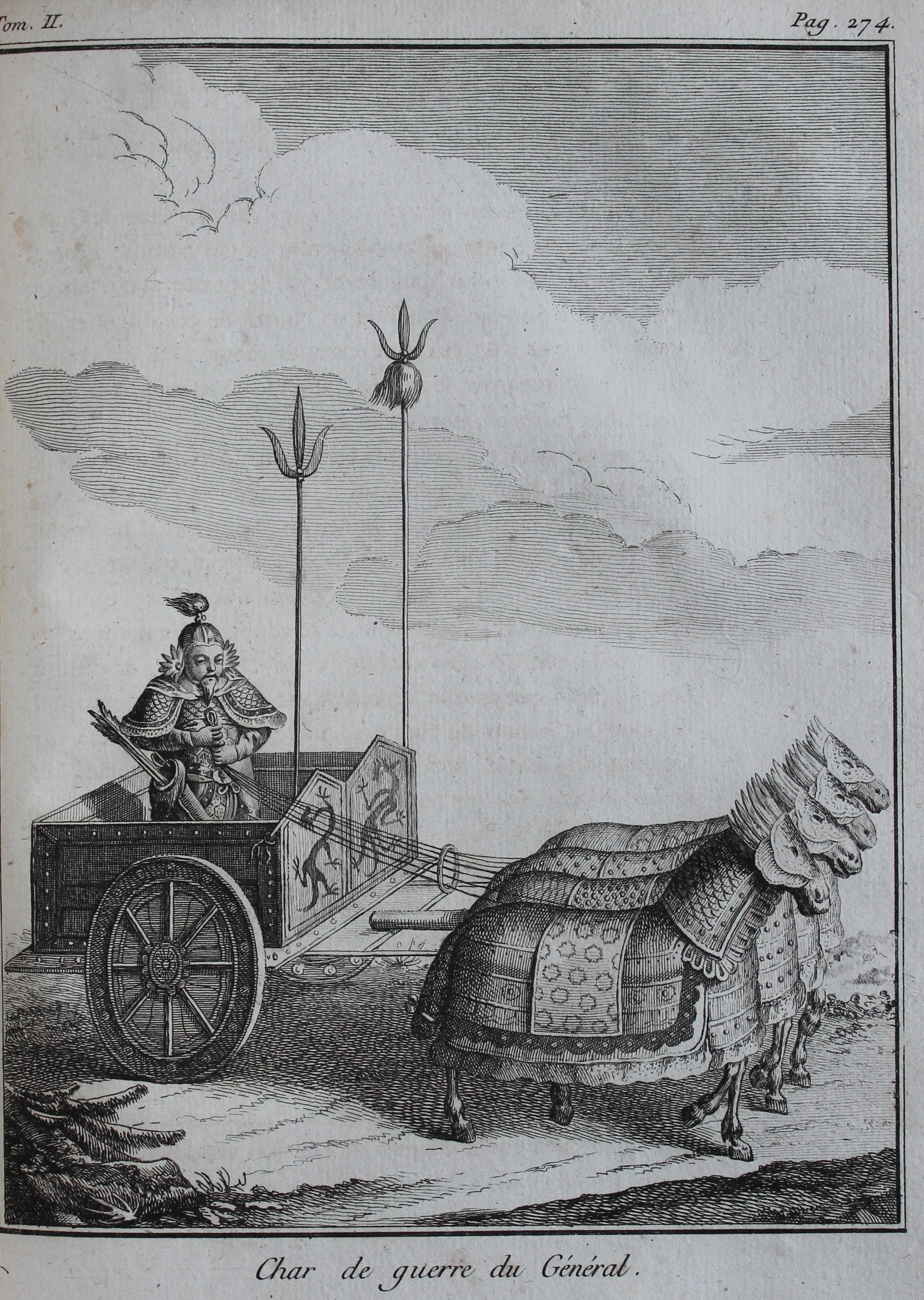
One soldier, a General, in a war chariot pulled by four armoured horses

Plate facing page 274 in volume 2 of Histoire générale de la Chine

The library holds a copy of The History and Art of Horsemanship by Richard Berenger (1719 or 20-1782), who was Gentleman of the Horse to King George III. It contains this amusing illustration of a Sarmatian rider and his horse, both completely covered in scale armour. The Sarmatian people were skilled equestrians who roamed the steppes of central Asia from the 5th century BCE to the 4th century CE. Whilst they did indeed use scale armour, it is hard to imagine that it can have been quite as form-fitting as this image suggests!
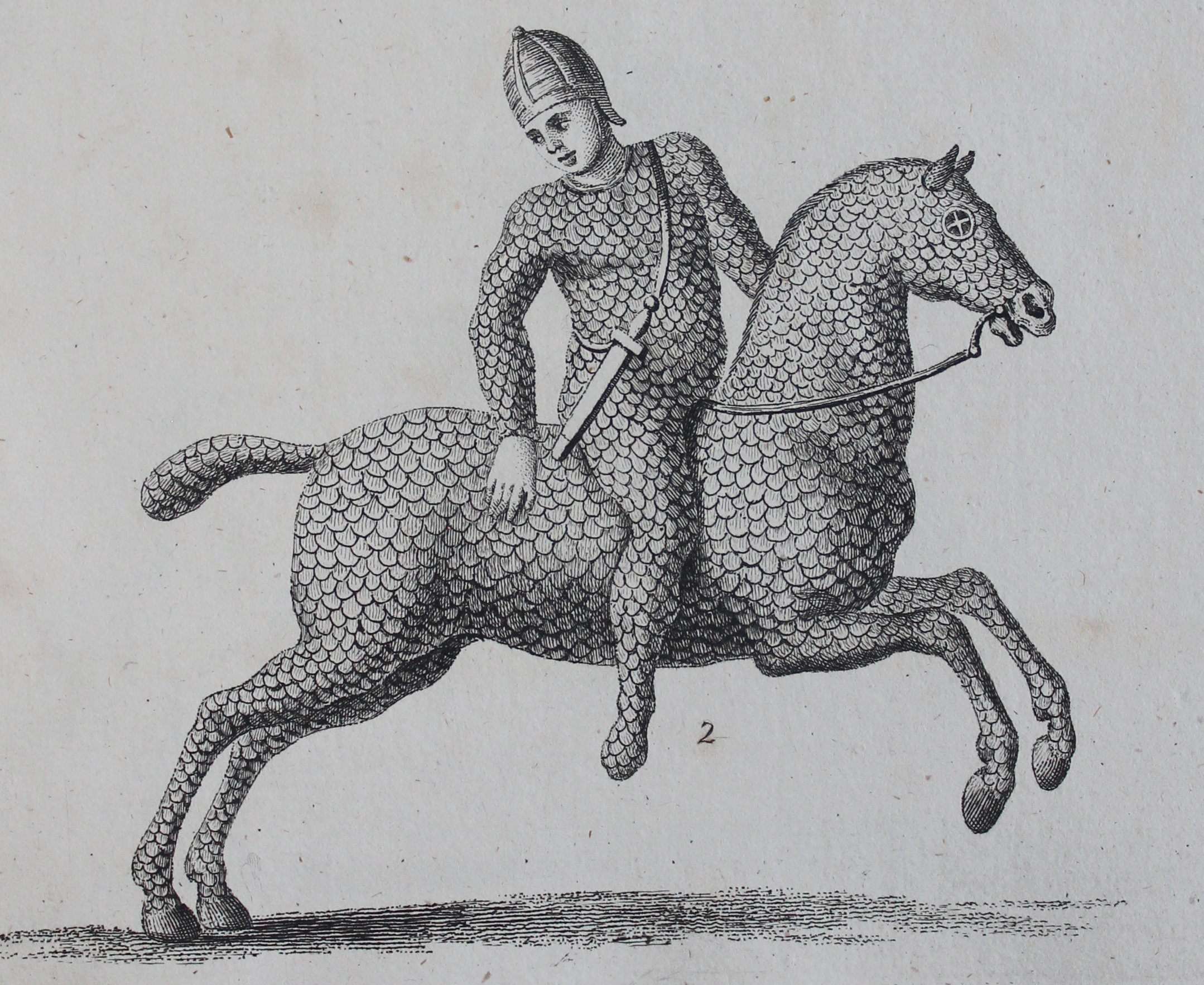
A helmeted warrior astride a horse. Both are covered in tightly-fitting scale armour

Sarmatian horse and rider from plate 2 of volume 1 of The History and Art of Horsemanship by Richard Berenger, London, 1771. Classmark: Bryant.M.10.17

Martial images of horses can also be found in the stained glass of the College Chapel. They include this roundel depicting Joshua, who, according to the Bible, was successor to Moses as leader of the Israelites and led the conquest of the land of Canaan. The horse is at full gallop and Joshua has his lance held ready for action. He might be hampered though by the fact that his helmet appears to be covering his eyes!
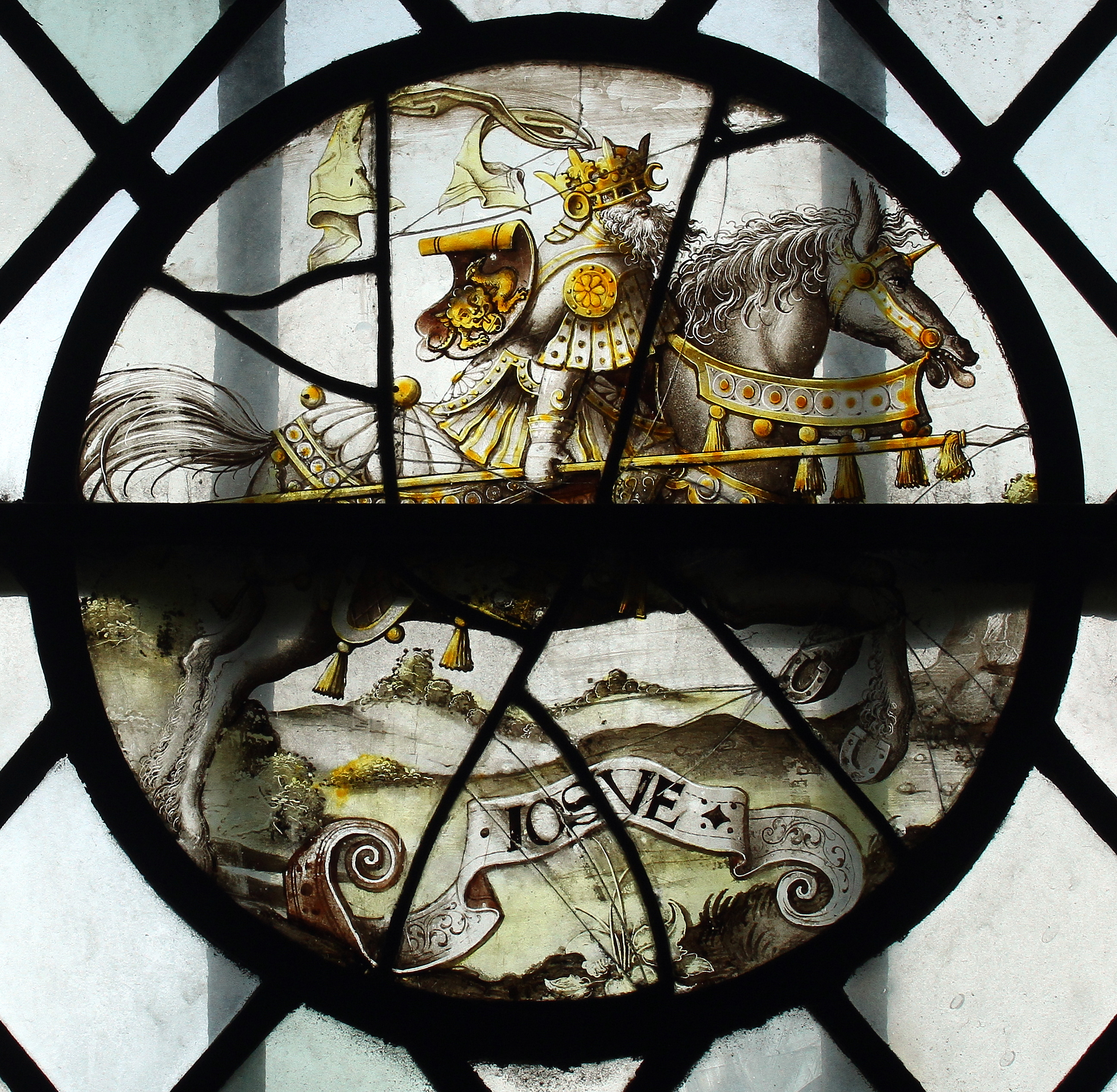
Round panel of stained glass showing Joshua in golden armour mounted on a white horse

Joshua. Roundel 40c4 from Side Chapel M. Photography: Mike Dixon ©2011 King’s College, Cambridge

At the very top of window 12.2 in the main part of the Chapel, two mounted warriors face off. The warrior on the left is rendered in the act of throwing his spear, whilst the horse of the one on the right is rearing back with what appears to be a spear or an arrow sticking out of its torso.
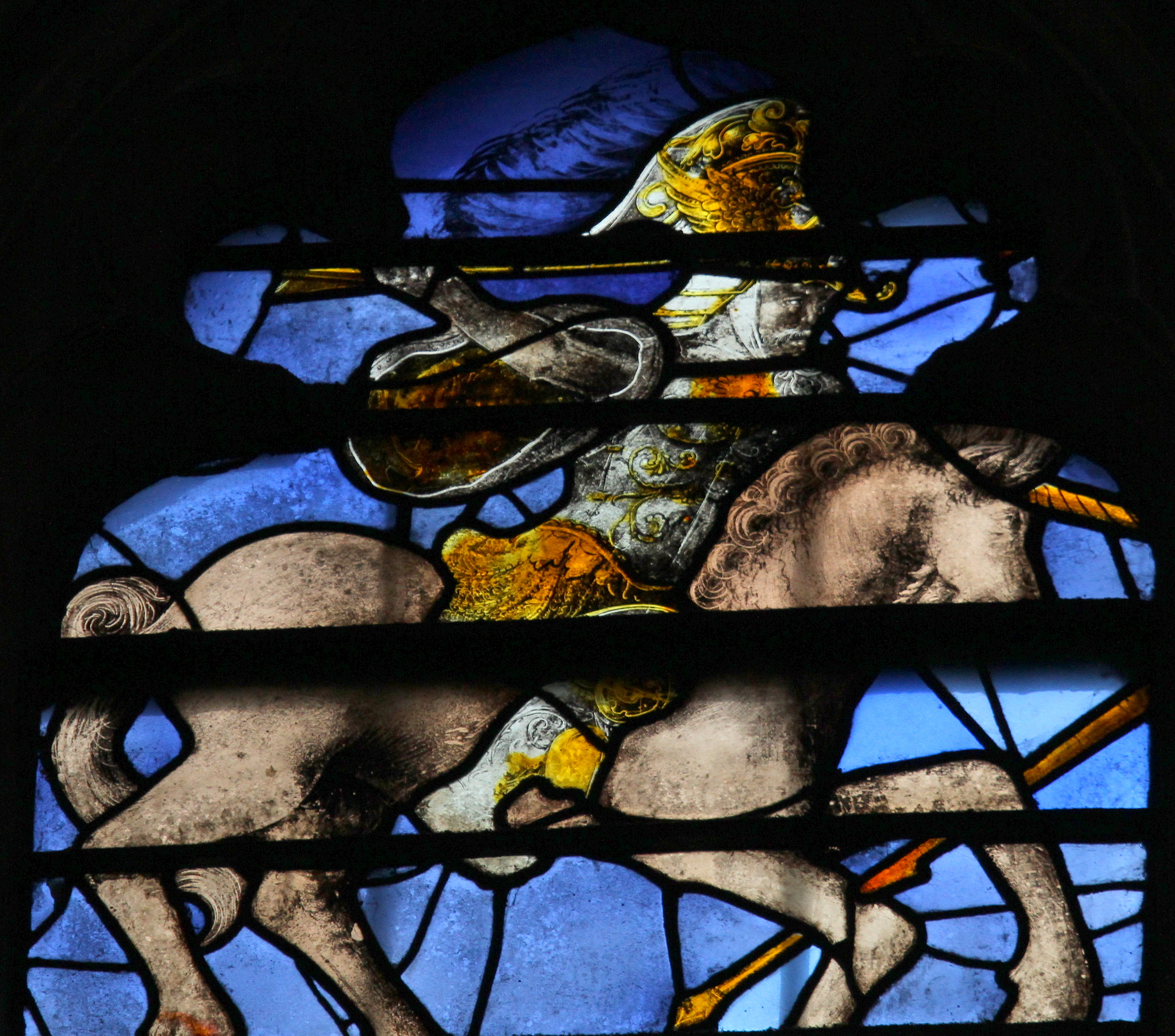
an armoured warrior on horseback

Detail from Window 12.2, Main Chapel. Photography: Mike Dixon ©2011 King’s College, Cambridge
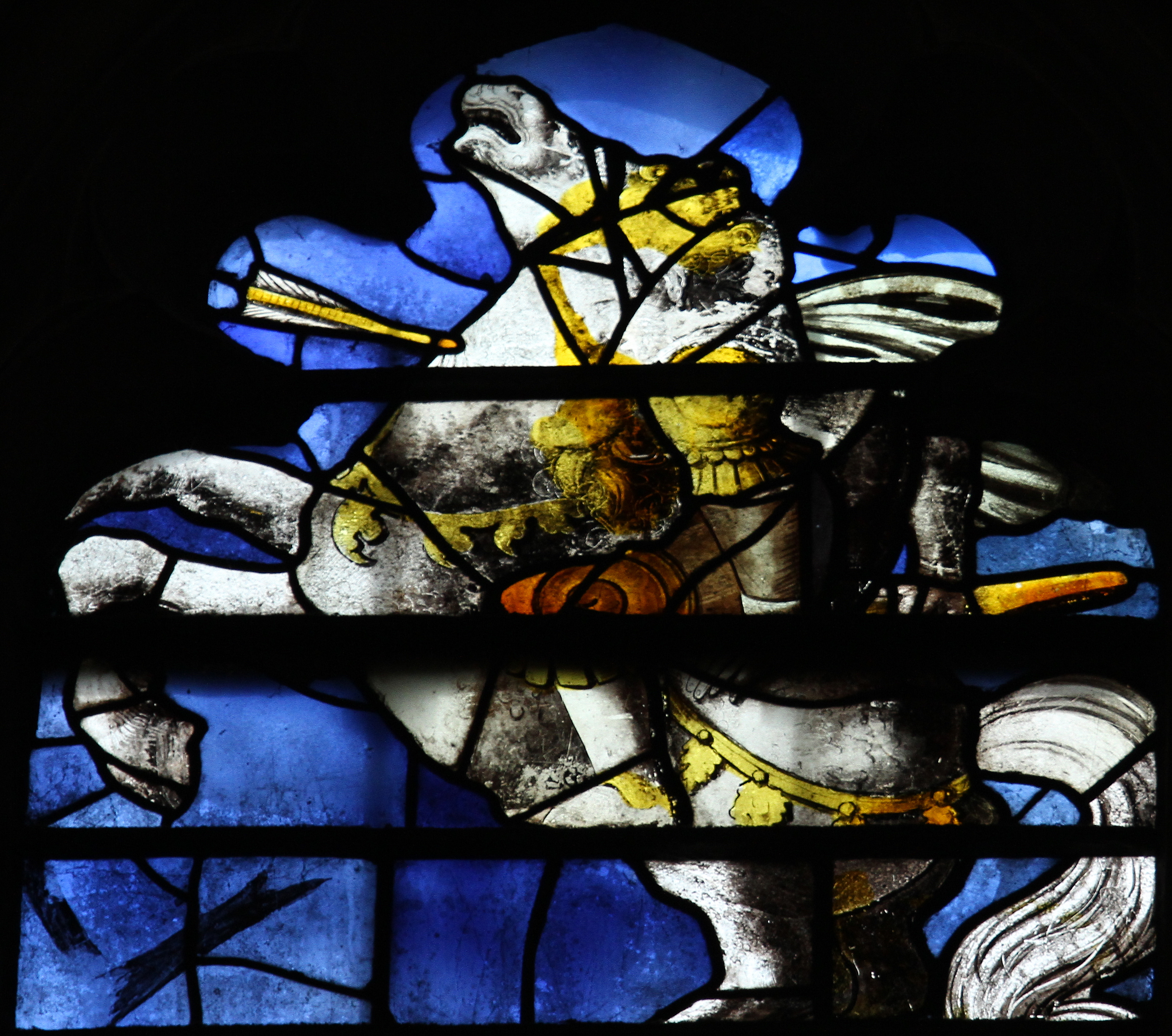
A white rearing horse with an arrow or lance sticking out of it

Detail from Window 12.2, Main Chapel. Photography: Mike Dixon ©2011 King’s College, Cambridge


Some lovely illustrations of jousting knights and prancing horses can be found in a seventeenth-century French book all about medieval tournaments, pageants and spectacles by Claude-François Menestrier (1631-1705). Menestrier was a Jesuit, a courtier and an expert on heraldry. He also had extensive experience of his own in organising celebrations, parades and festivities in his home city of Lyon. This included organising the festivities surrounding the visit of Louis XIV to the city in 1658.
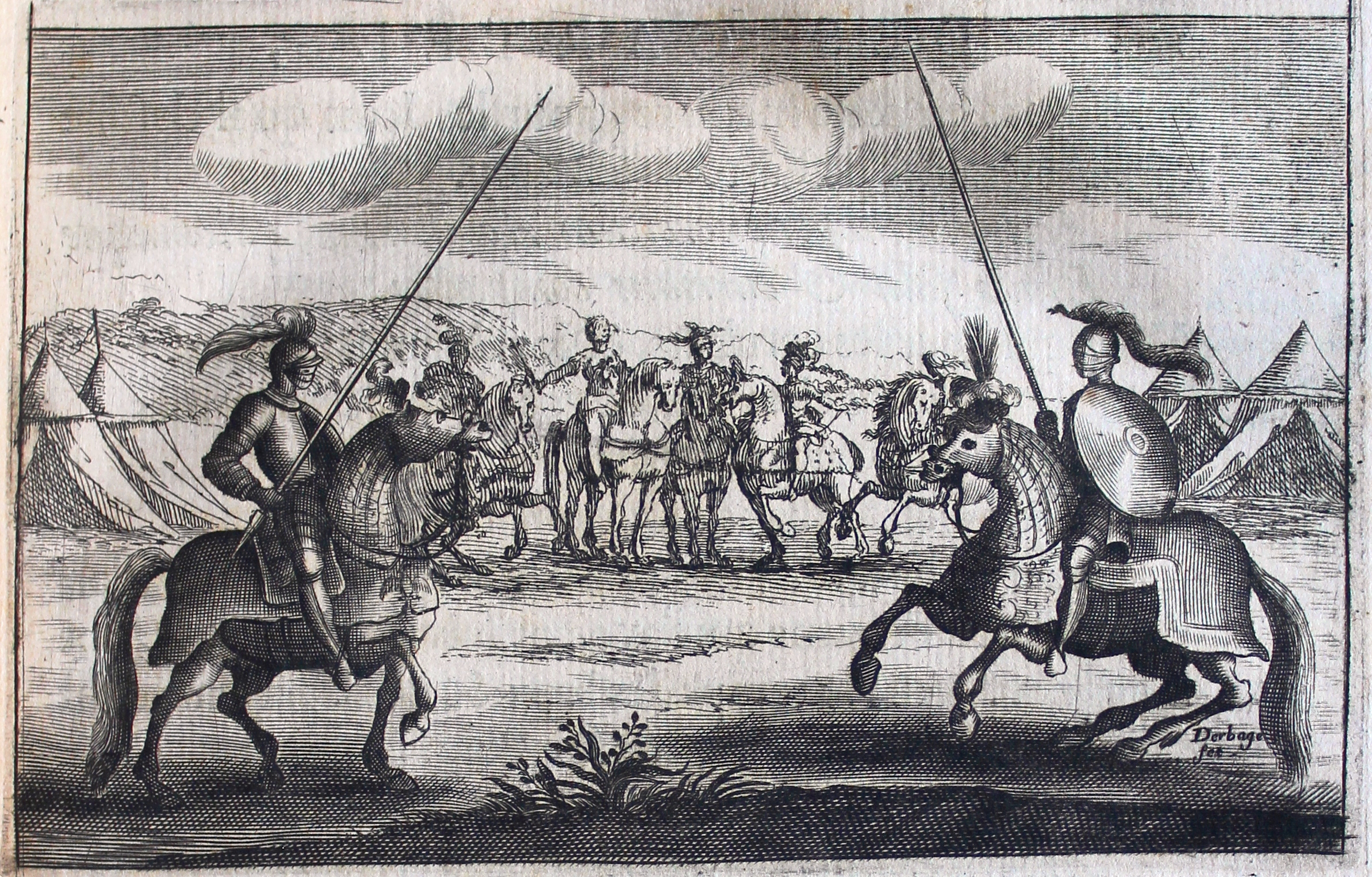
Two mounted knights carrying lances facing each other in the foreground, with mounted spectators watching in the background

Jousting knights from page 103 of Traité des tournois, ioustes, carrousels, et autres spectacles publics by Claude-François Menestrier, Lyon, 1669. Classmark: Thackeray.H.28.13
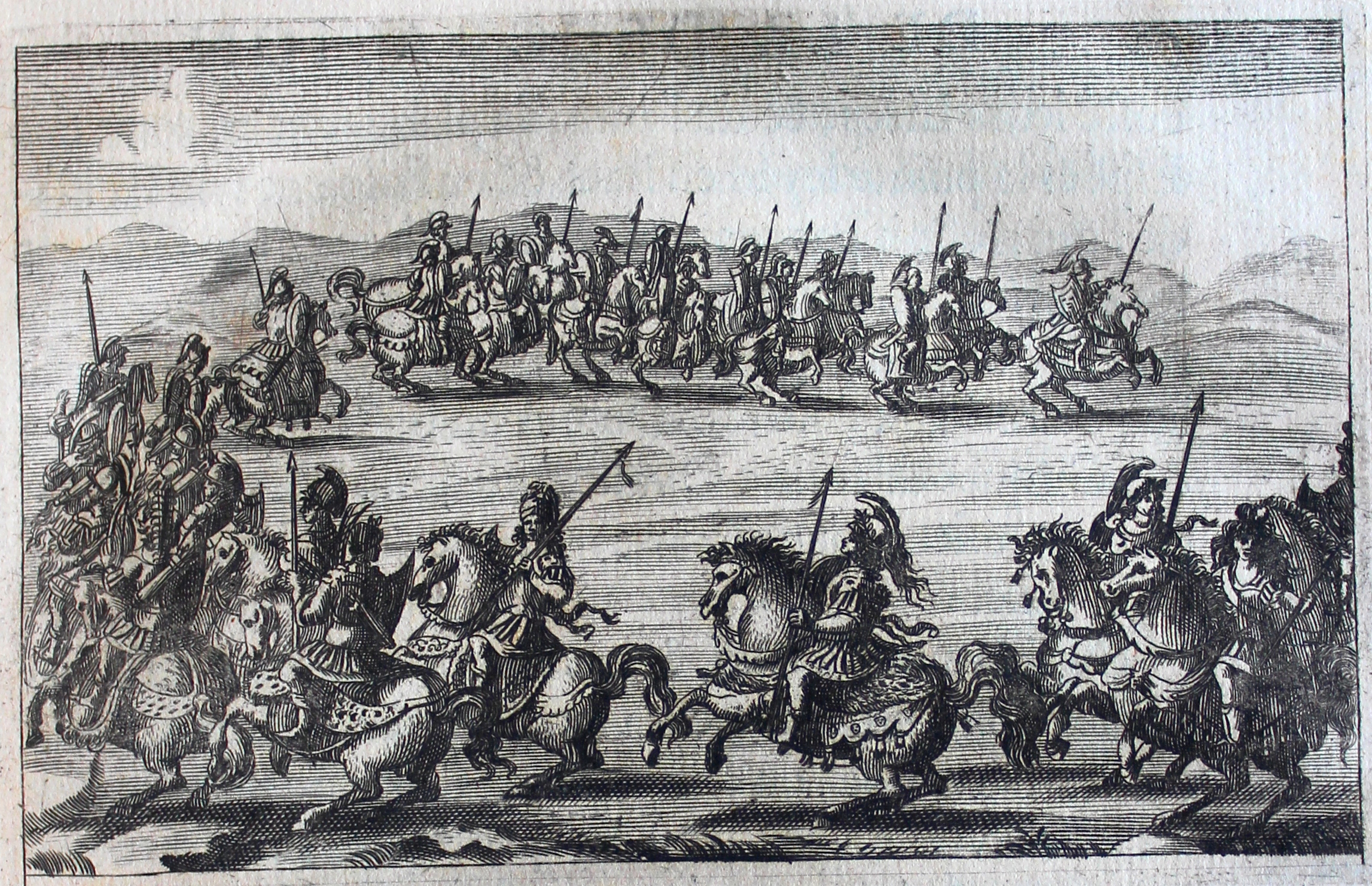
Mounted knights riding in a circle

Knights on prancing horses from page 91 of Traité des tournois, ioustes, carrousels …

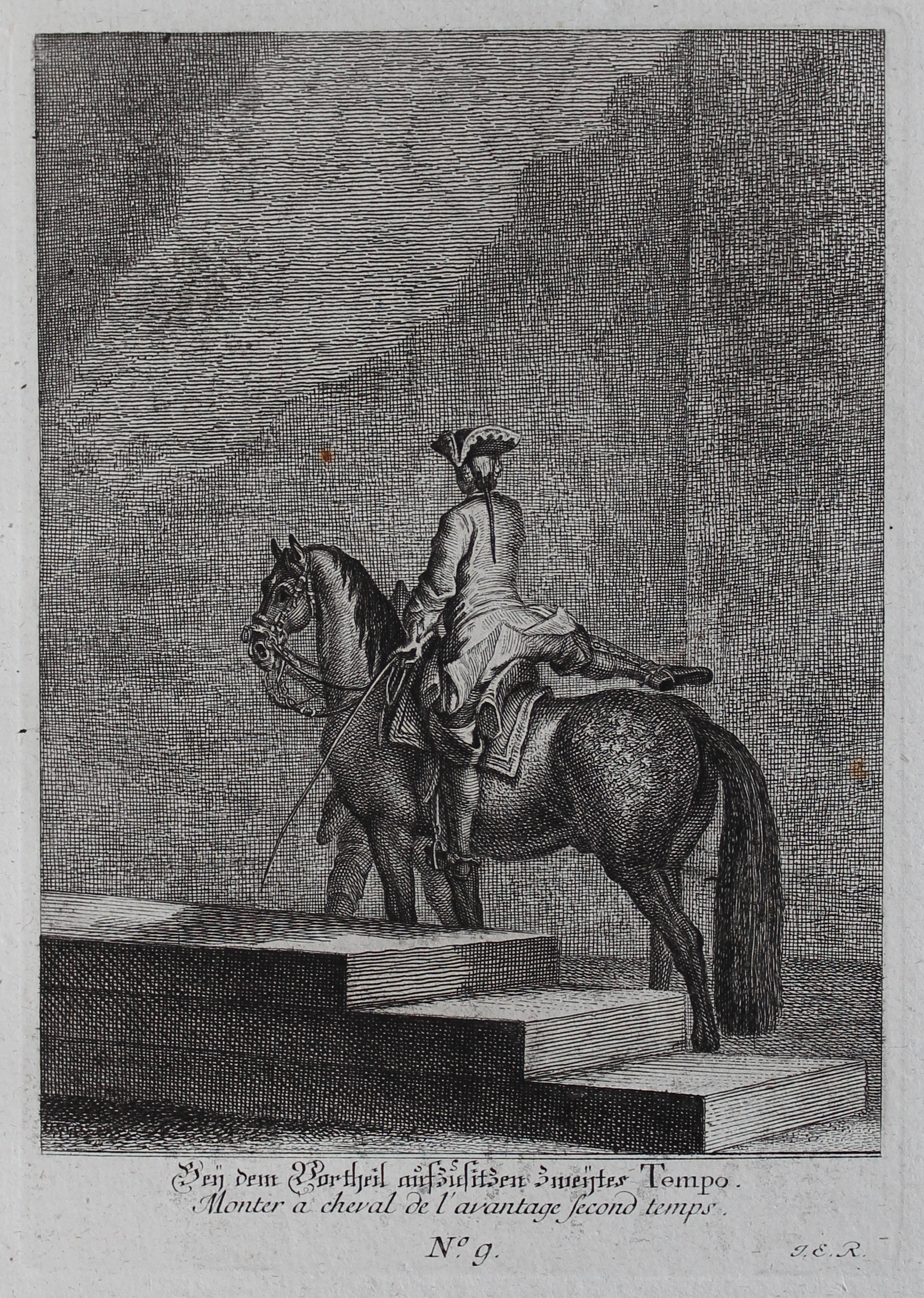
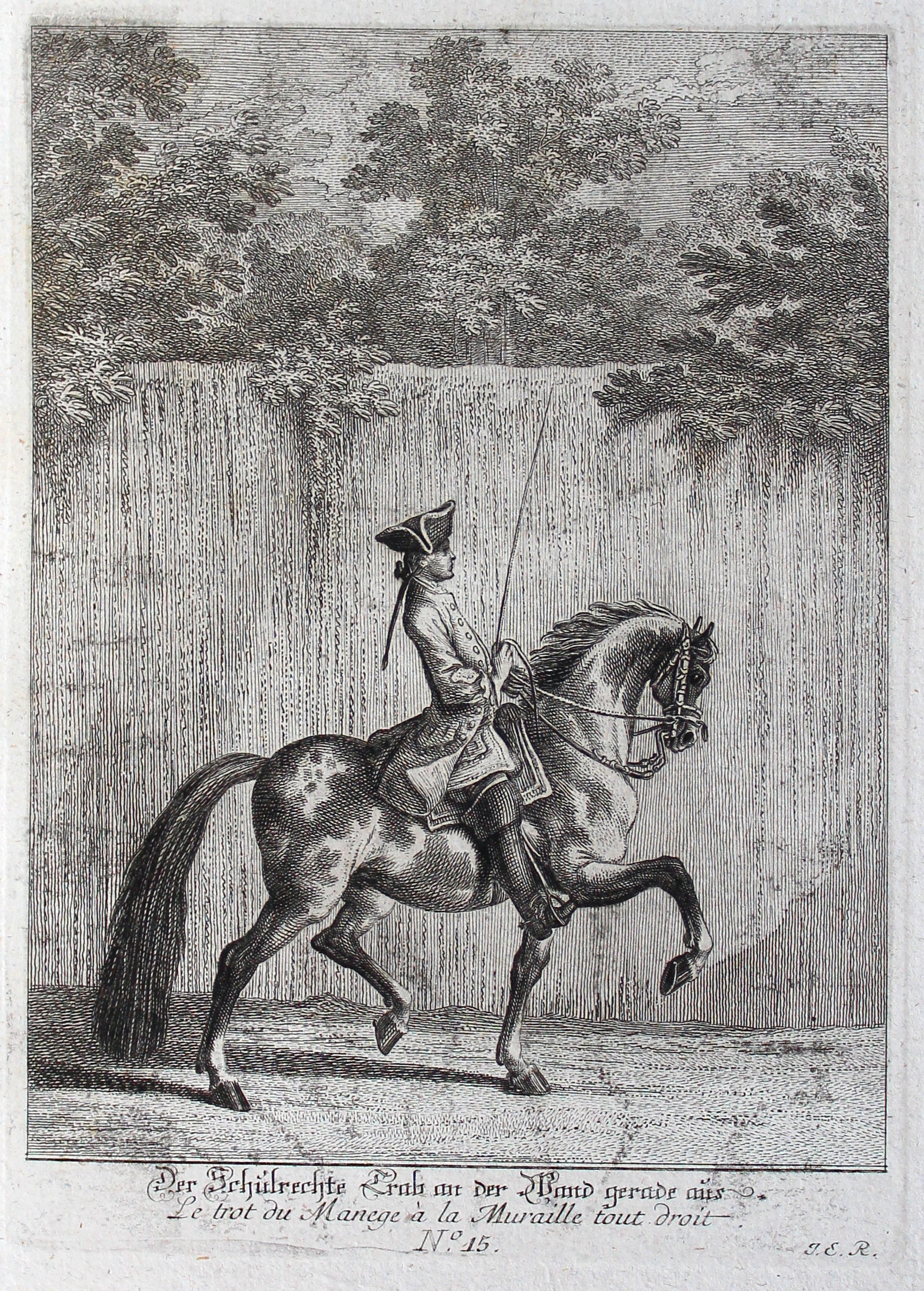
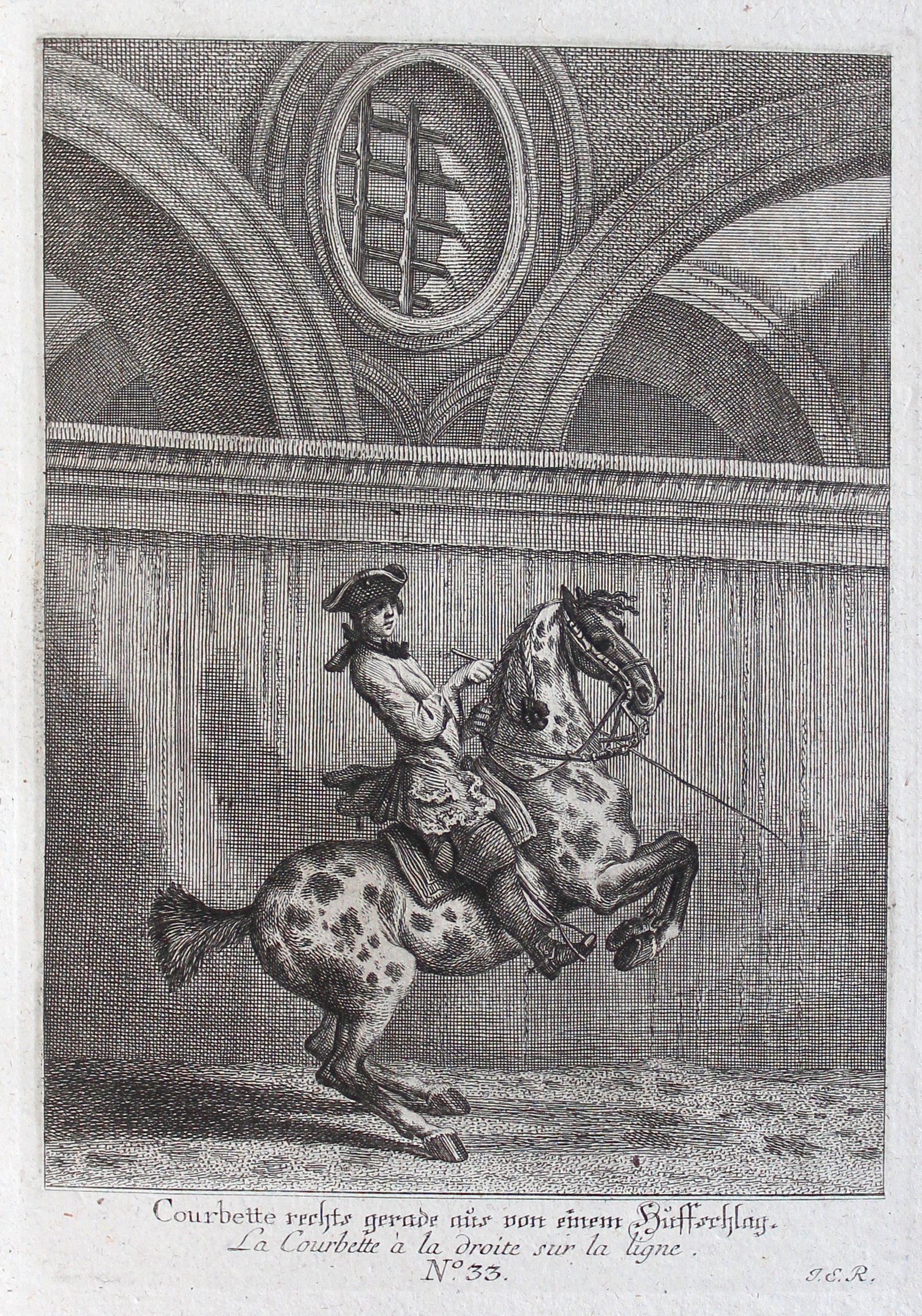
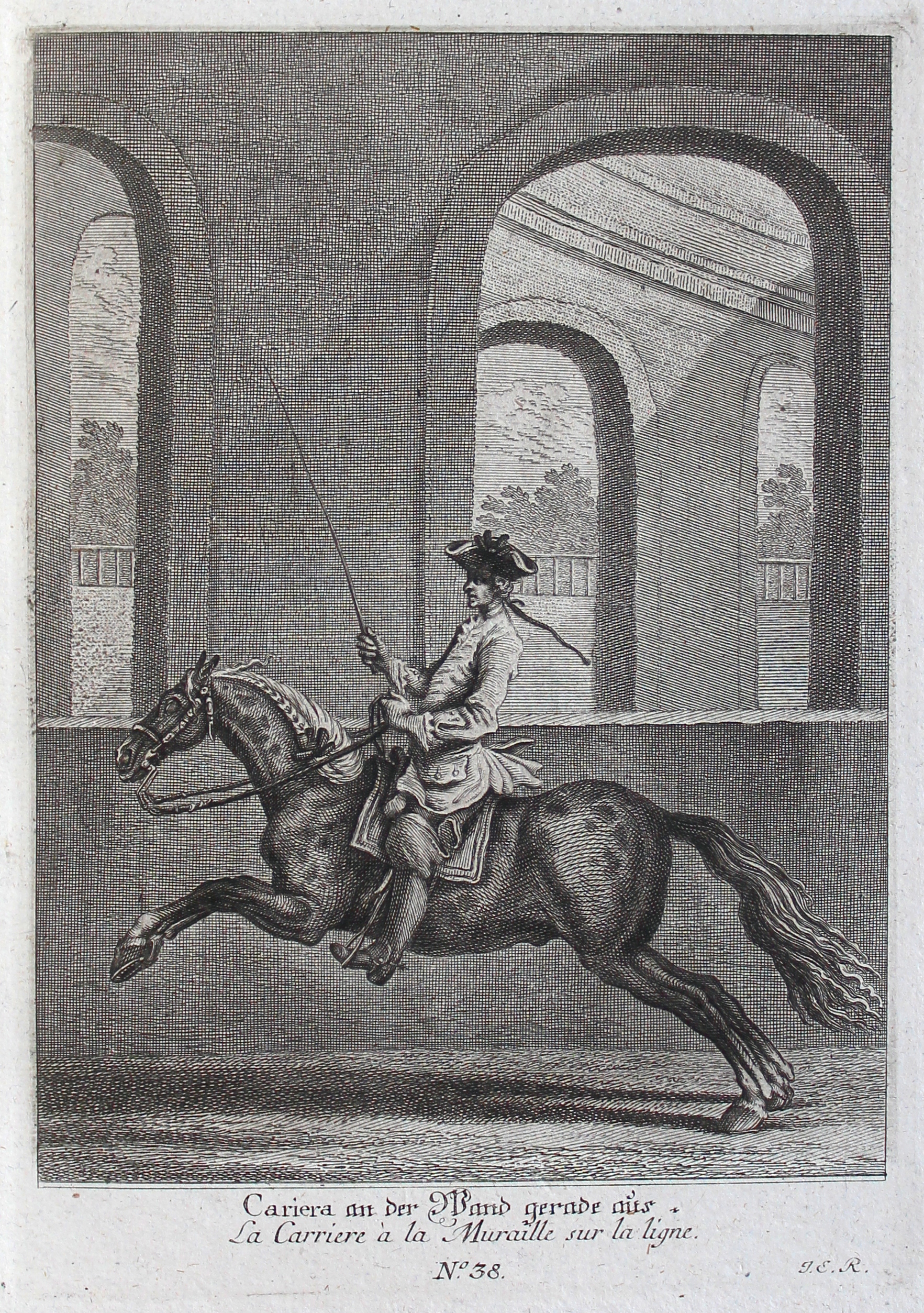
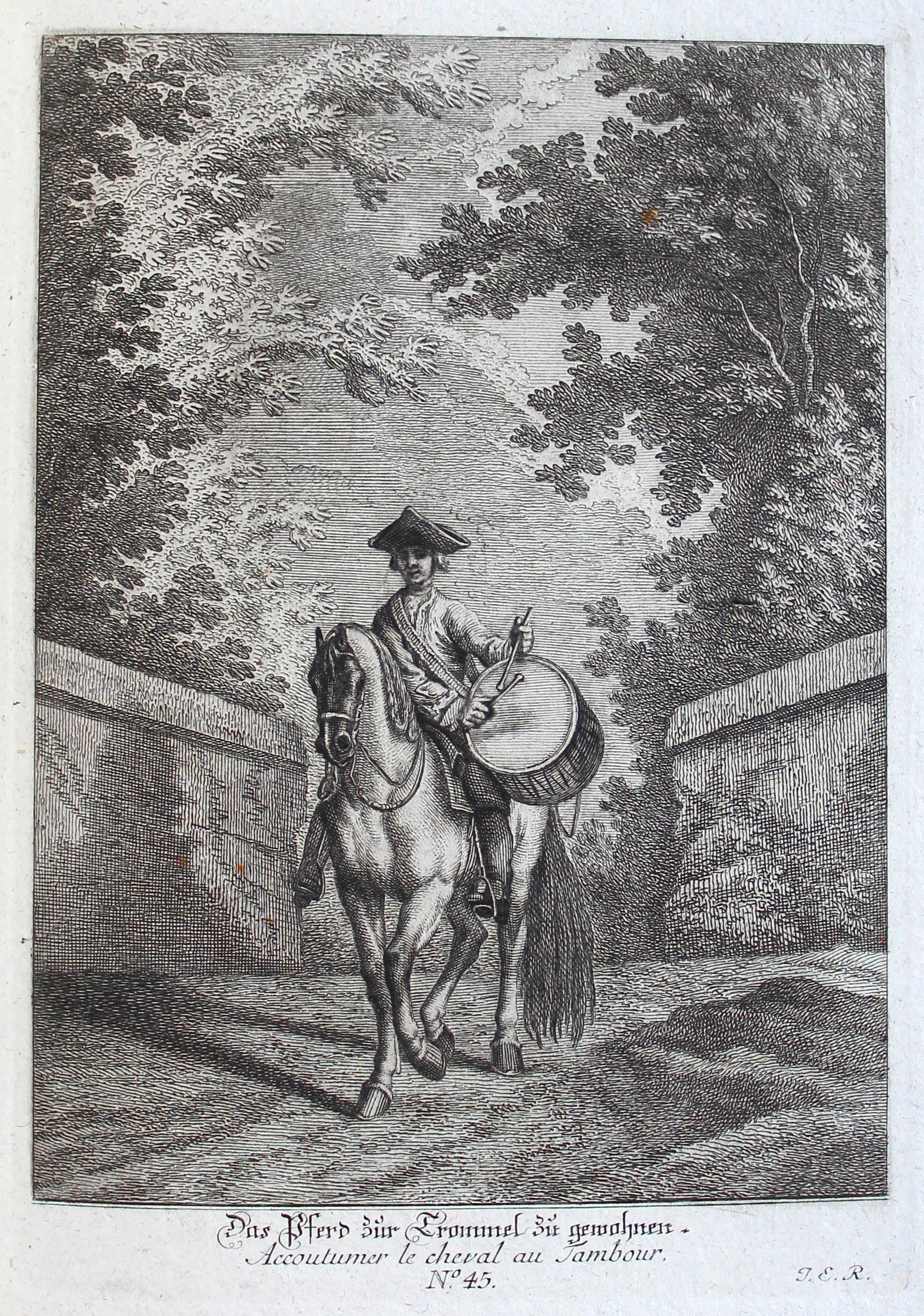
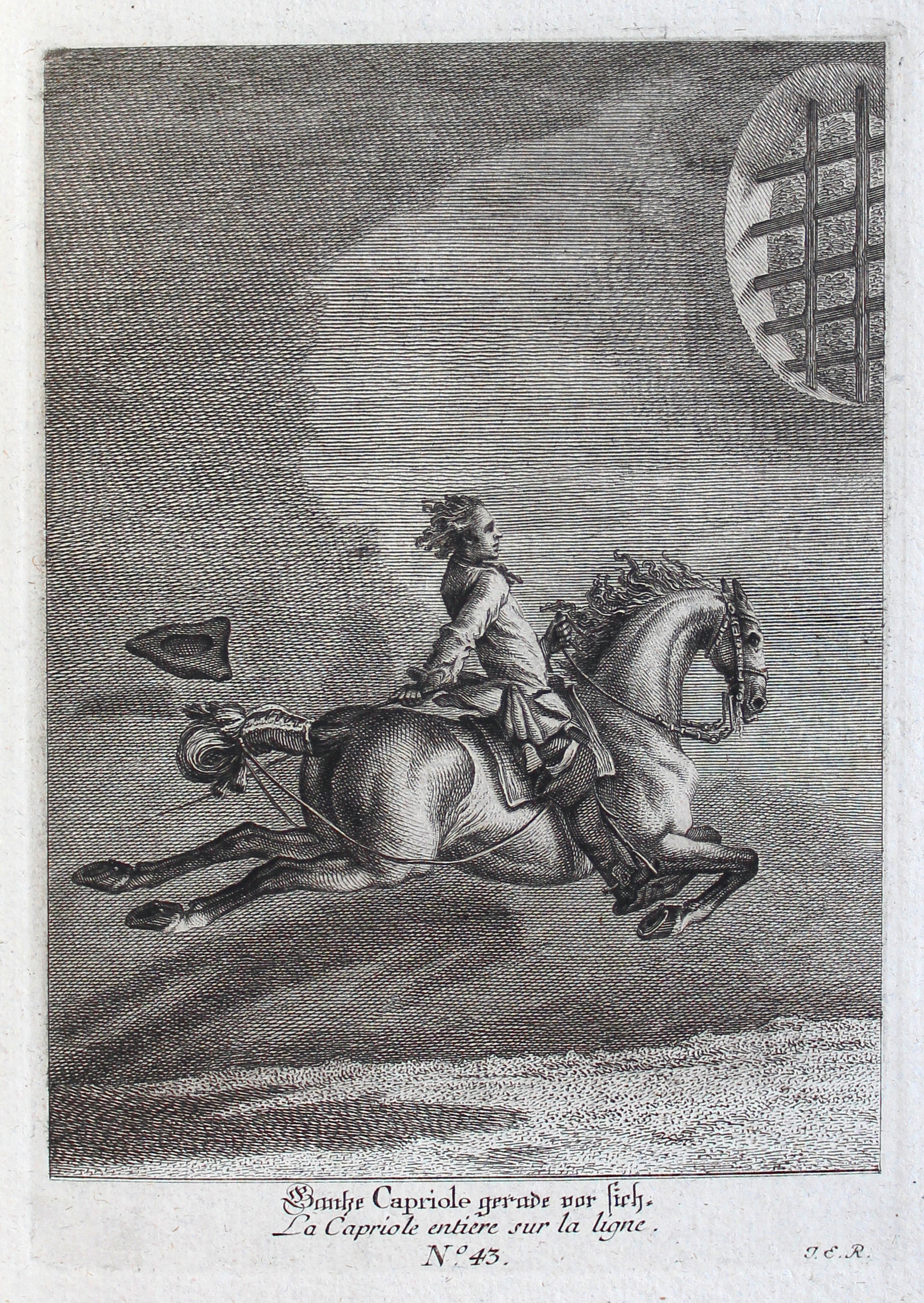
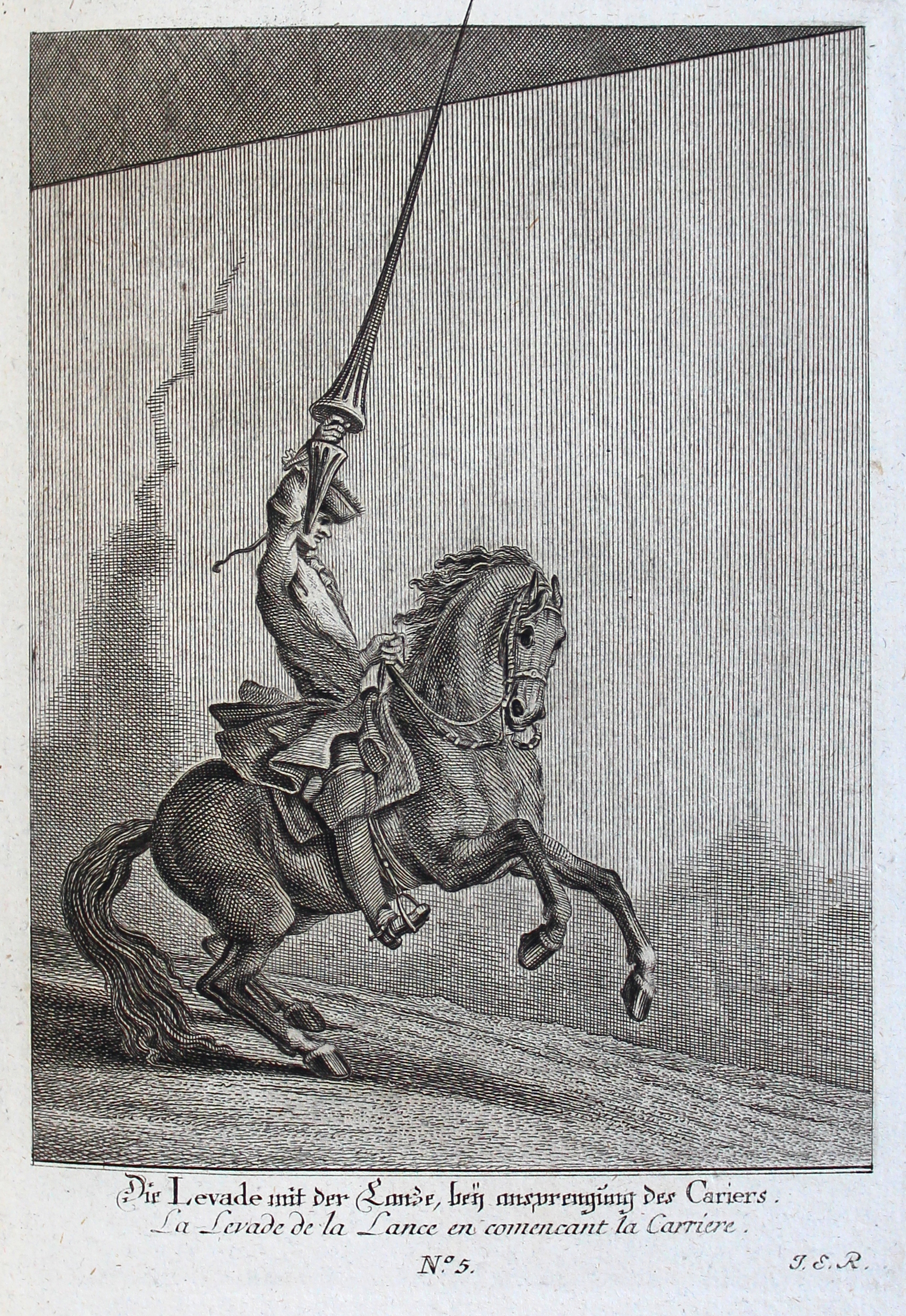
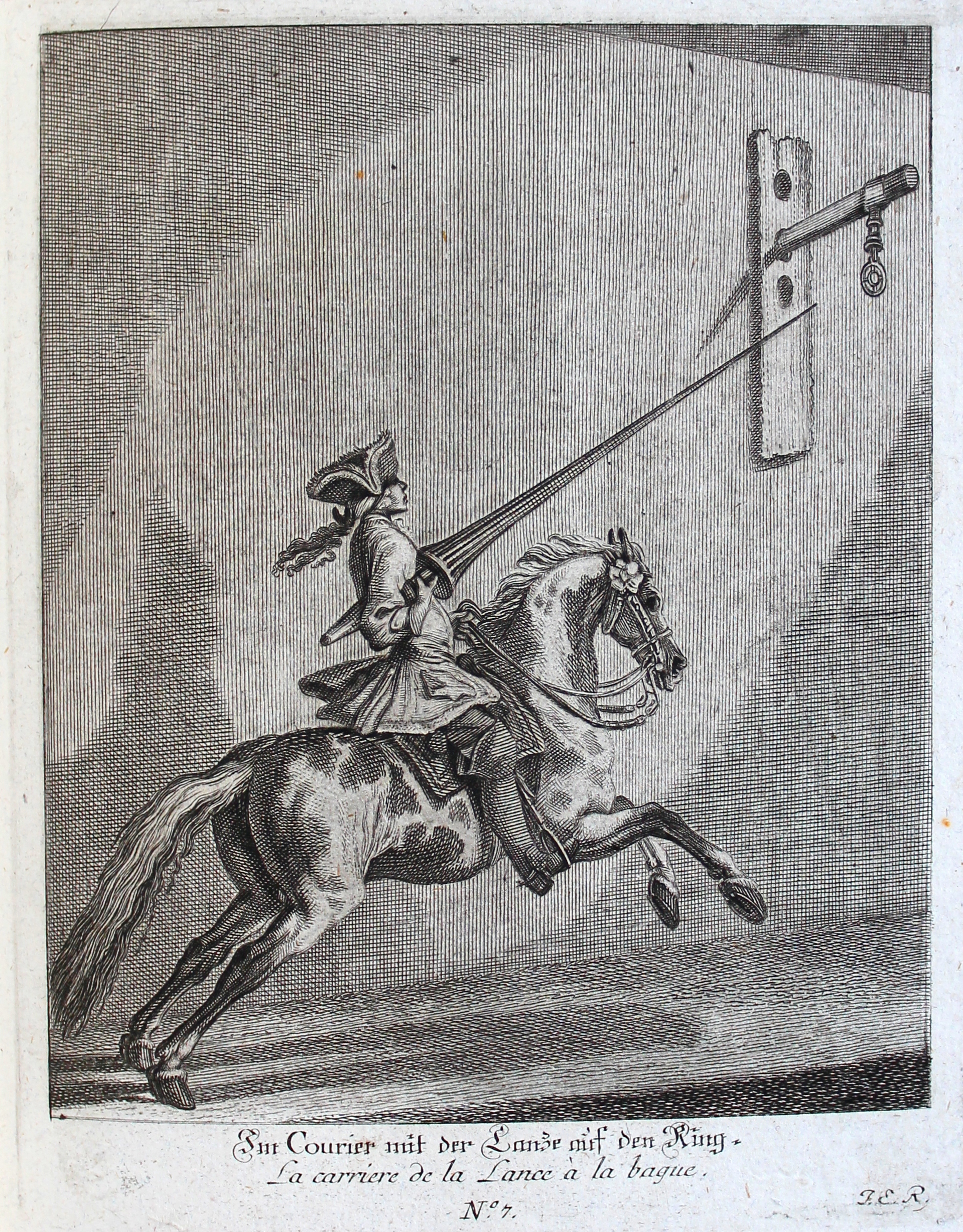
It would be remiss of us not to include a substantial helping of engravings from a wonderful volume by Johann Elias Ridinger (1698-1767), a noted German artist, who specialised in painting and sketching animals, especially horses. Ridinger spent three years observing and sketching at a riding school and this experience shines through in the quality and realism of his work. The engravings below illustrate many aspects of equestrian training, including learning the use of weapons and military drums on horseback.
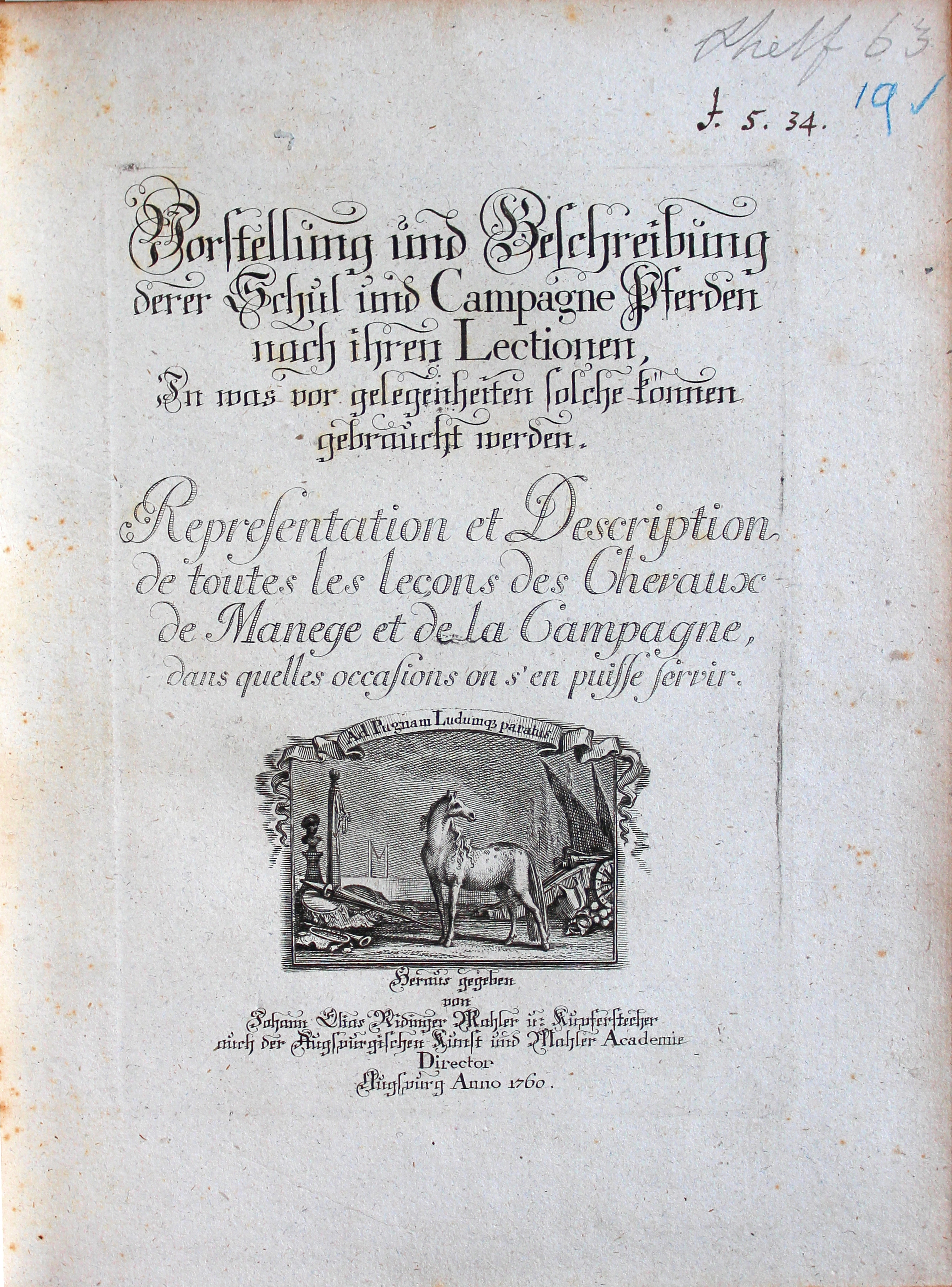
Ttitle page with a vignette of a horse

Title page of Vorstellung und Beschreibung derer Schul und Campagne Pferden nach ihren Lectionen, in was vor Gelegenheiten solche können gebraucht werden by Johann Elias Ridinger, Augsburg, 1760. Classmark: Thackeray.F.5.34/1

a trotting horse held by a trainer with a long lead

Plate 3 from Thackeray.F.5.34/1

a rider mounting a horse from steps

Plate 9 from Thackeray.F.5.34/1

Prancing horse

Plate 15 from Thackeray.F.5.34/1

A horse rearing back on its hind legs

Plate 33 from Thackeray.F.5.34/1

A leaping horse

Plate 38 from Thackeray.F.5.34/1

A horse and a rider with a drum

Plate 45 from Thackeray.F.5.34/1

a horse in mid-gallop, with all legs off the ground

Plate 43 from Thackeray.F.5.34/1

a horse rearing back and a rider holding a lance aloft

Plate 5 from Remarques du carousels by Ridinger (1661), bound at the end of Thackeray.F.5.34/1
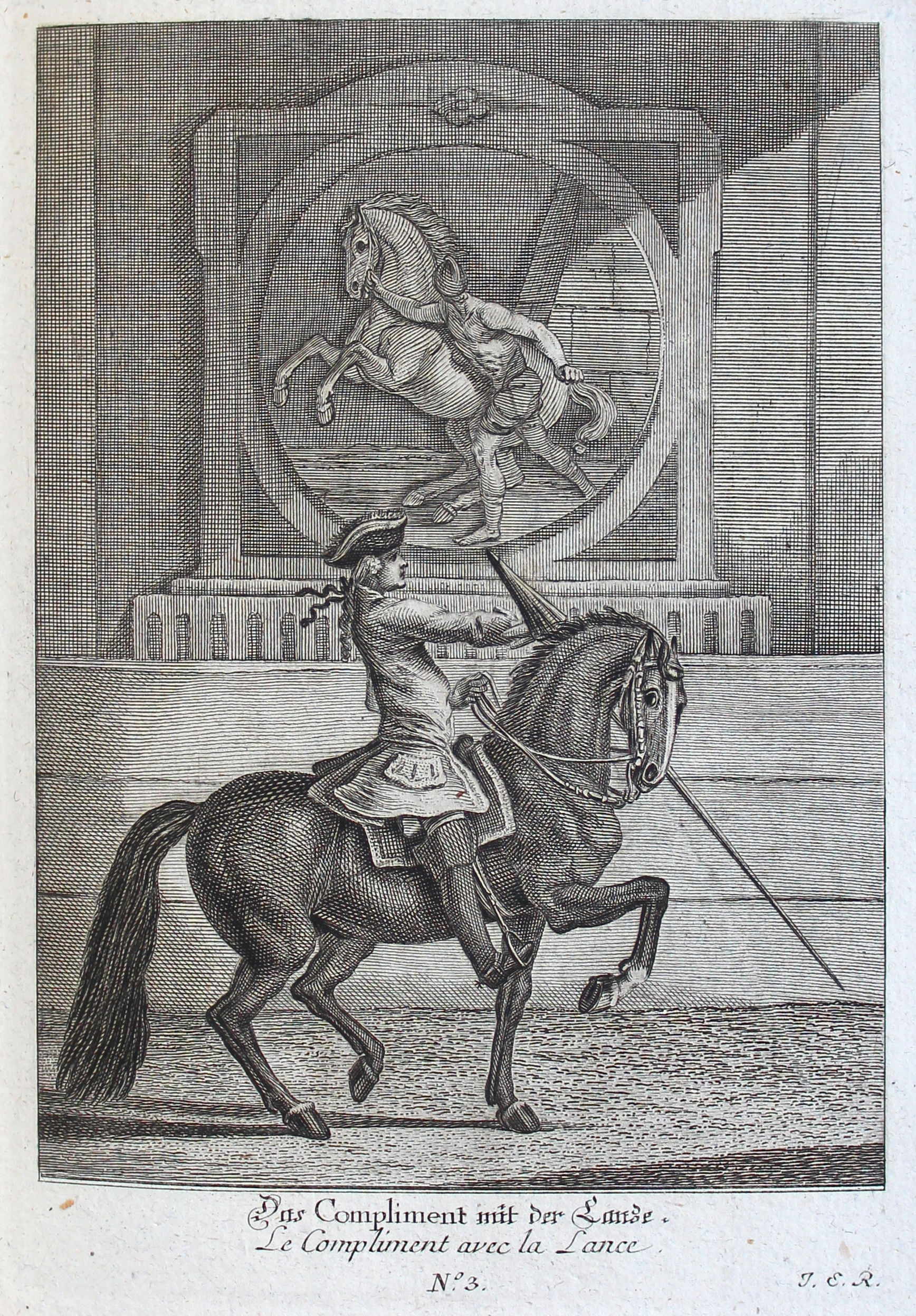
Horse and rider in front of a bas-relief of a horse

Plate 3 from Remarques du carousels

a horse with a rider attempting to get his lance in a hanging hoop

Plate 7 from Remarques du carousels

We transition now to the more peaceable occupation of agriculture, in which horses have also played an important role for centuries. The Keynes Collection includes a copy of The Horse-Hoing Husbandry: or, An Essay on the Principles of Tillage and Vegetation by agriculturist Jethro Tull (1674-1741). Tull’s innovative designs for agricultural machinery, including a horse-drawn seed drill and a horse-drawn hoe for tilling the soil, helped foster a major revolution in agricultural practices and productivity in eighteenth-century Britain. His book provides detailed instructions for building and using these machines, accompanied by useful diagrams, such as the one of the “Ho-Plow” which is included below.
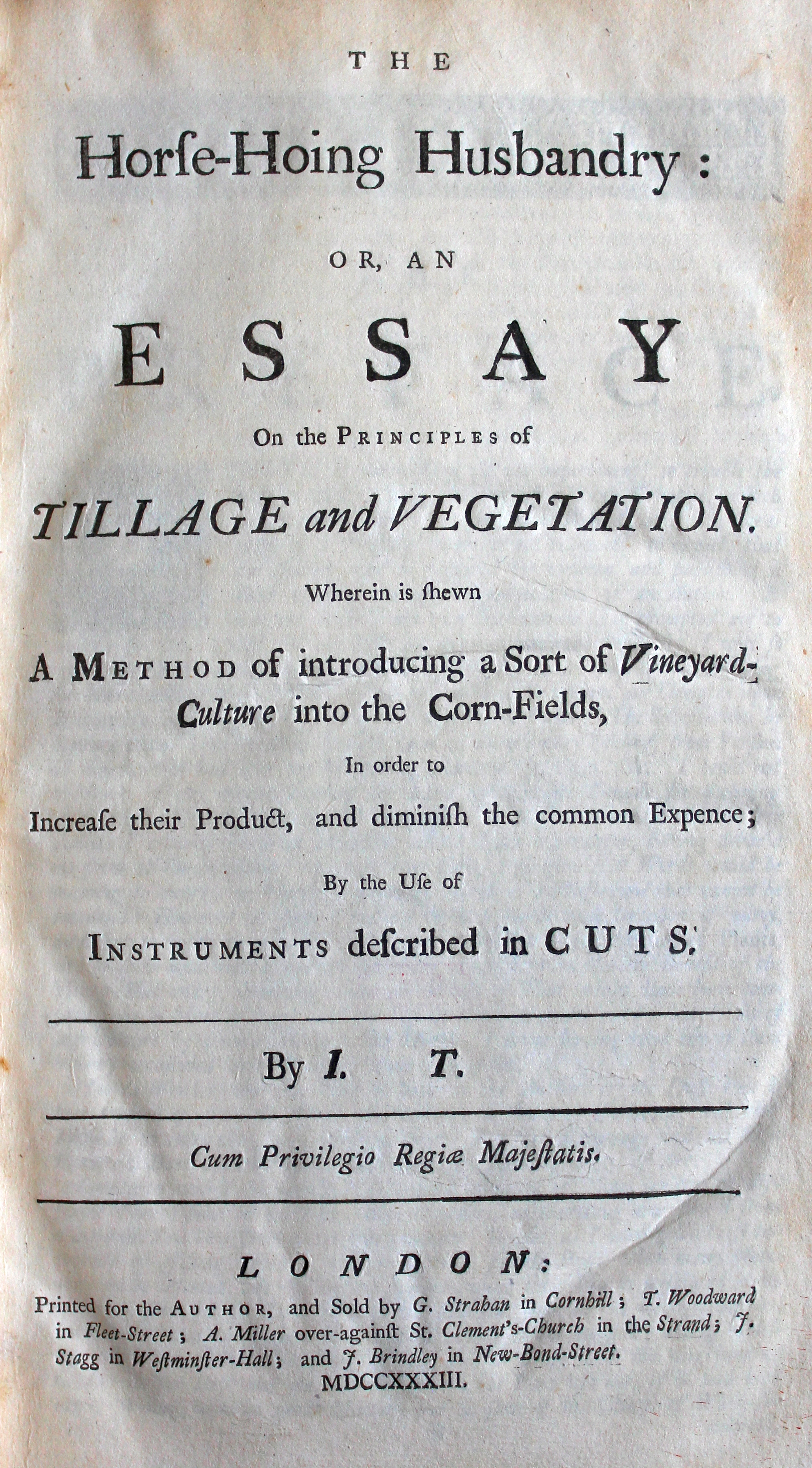
title page

Title page of The Horse-Hoing Husbandry: or, An Essay on the Principles of Tillage and Vegetation, by Jethro Tull, London, 1733. Classmark: Keynes.F.23.4
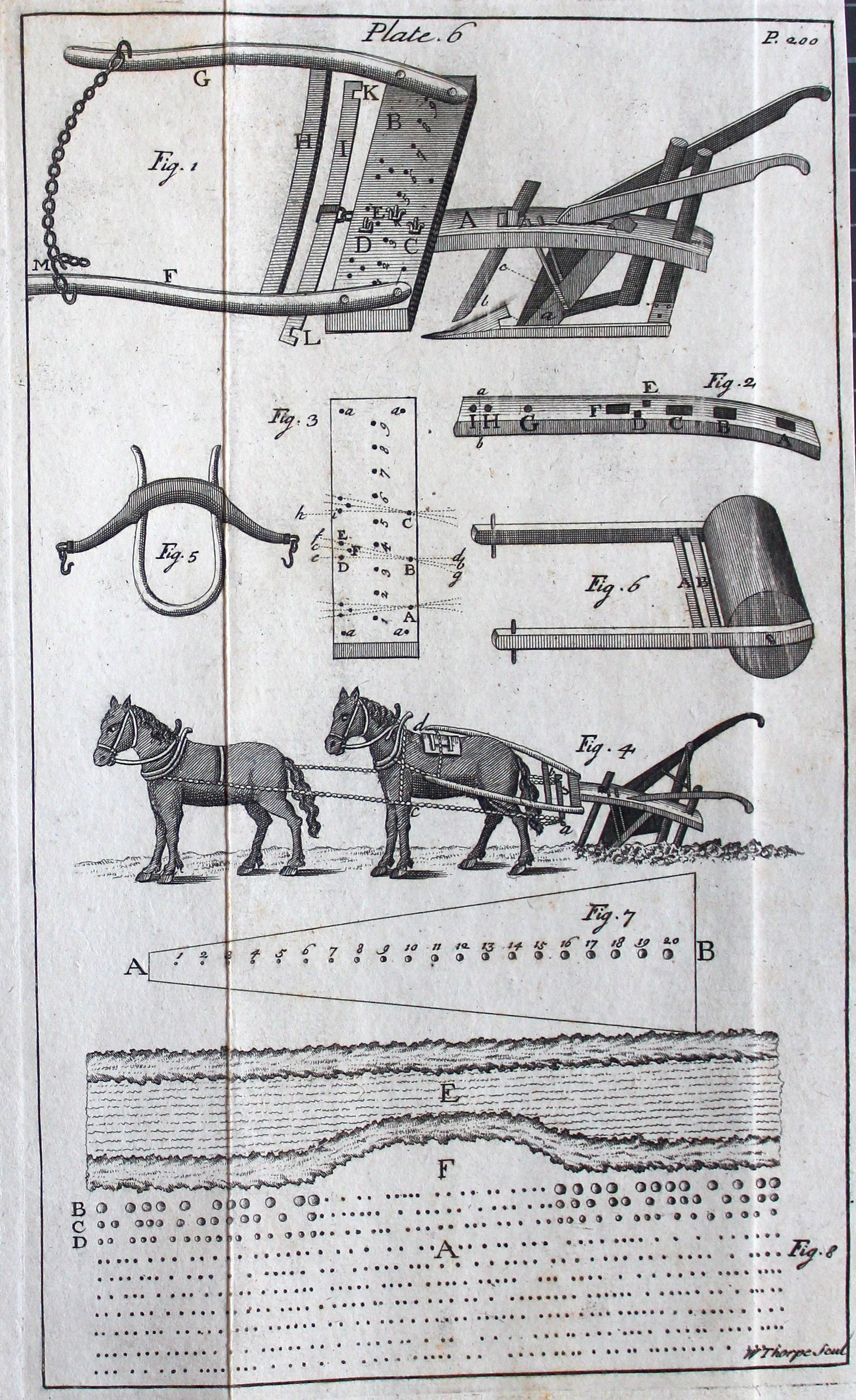
Diagram of a hoe or plough, with detail showing how horses are attached.

Plate six from The Horse-Hoing Husbandry … 

By the time Tull was writing it was common practice to use large, muscular draught or cart horses to pull farm machinery and other heavy loads. Prior to this period, agricultural yields of winter crops had not been high enough to provide the large amount of food such horses required to function. The poor horse pictured below is awaiting the task of pulling a wagon piled precariously high with wooden planks!
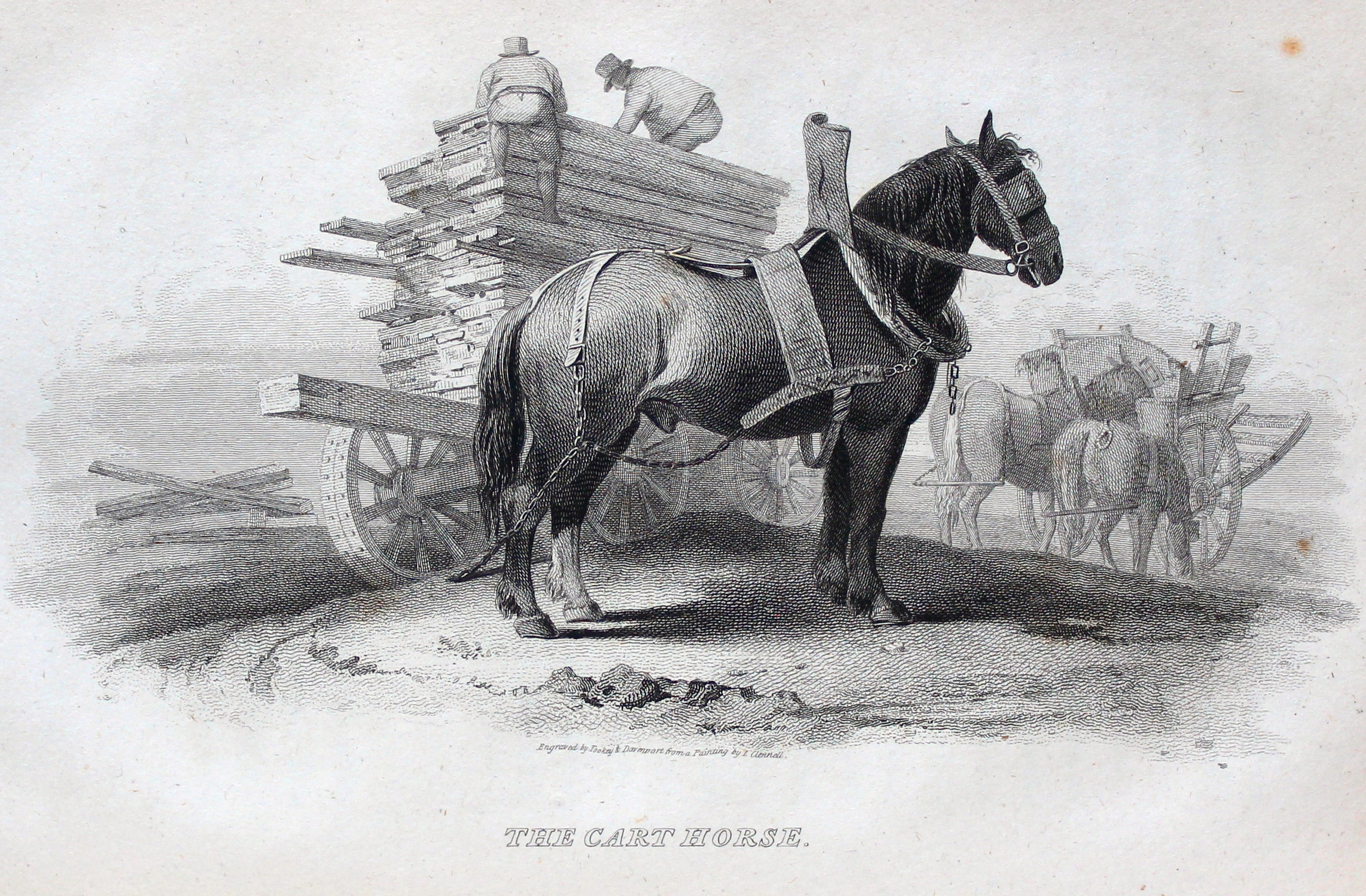
Plate facing page 165 of Recreations in Natural History; or, Popular Sketches of British Quadrupeds engraved by Luke Clennell, London, 1815. Classmark: Thackeray.IV.2.1

The use of horses for agricultural tasks is not entirely a thing of the past, and indeed, the glorious wildflower meadow on our College back lawn is harvested each August by a team of shire horses from the Waldburg Shires Stables in Huntingdon. The horses are later attached to a hay wain to remove the baled-up hay. This use of traditional methods helps to minimise the carbon footprint of the whole process. The photos below were taken during the very first harvest in the summer of 2021.
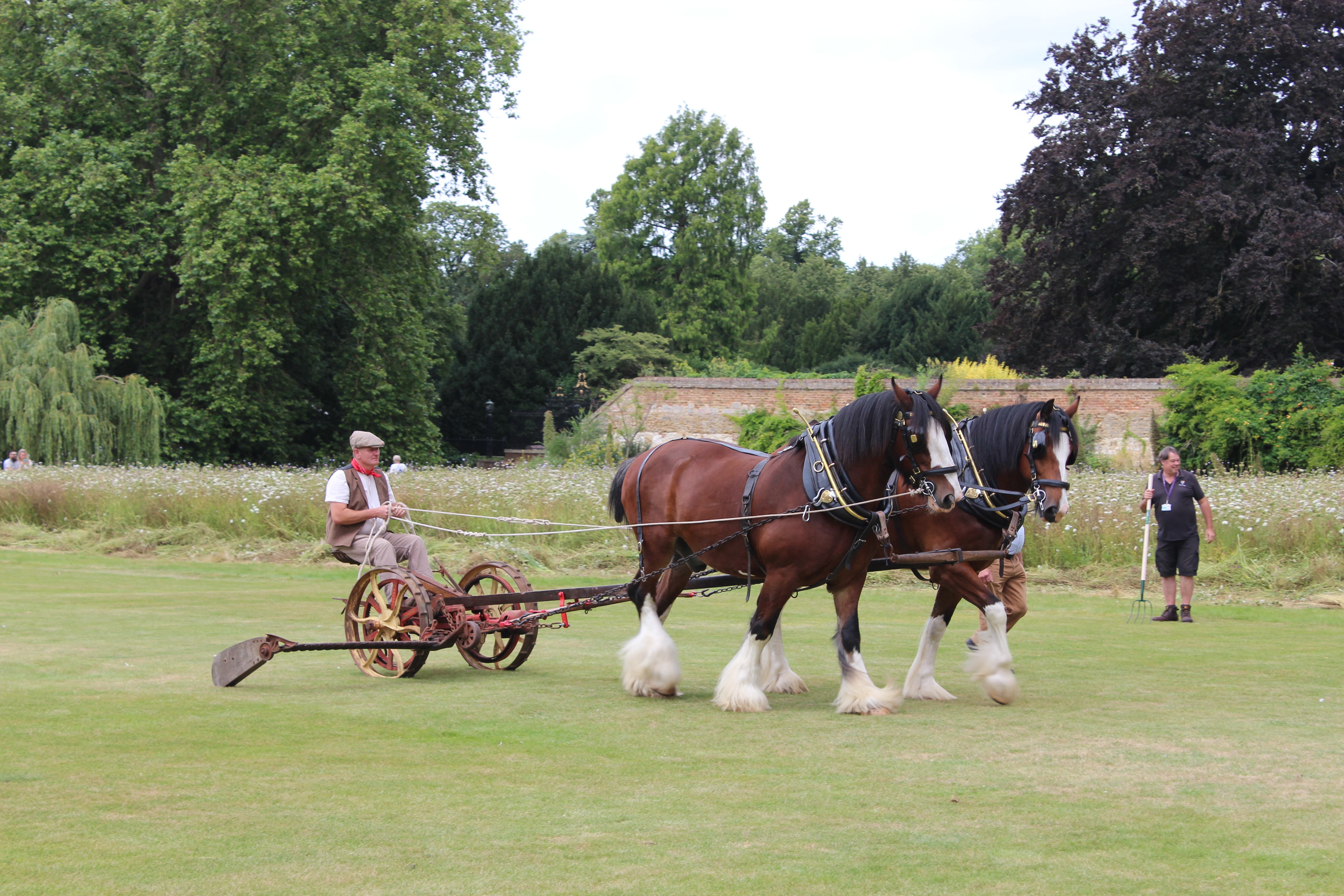
Photo of two brown shire horses attached to harvesting machinery, with the meadow in the background

Shire horses Cosmo and Boy harnessed up for the first harvest, Summer 2021
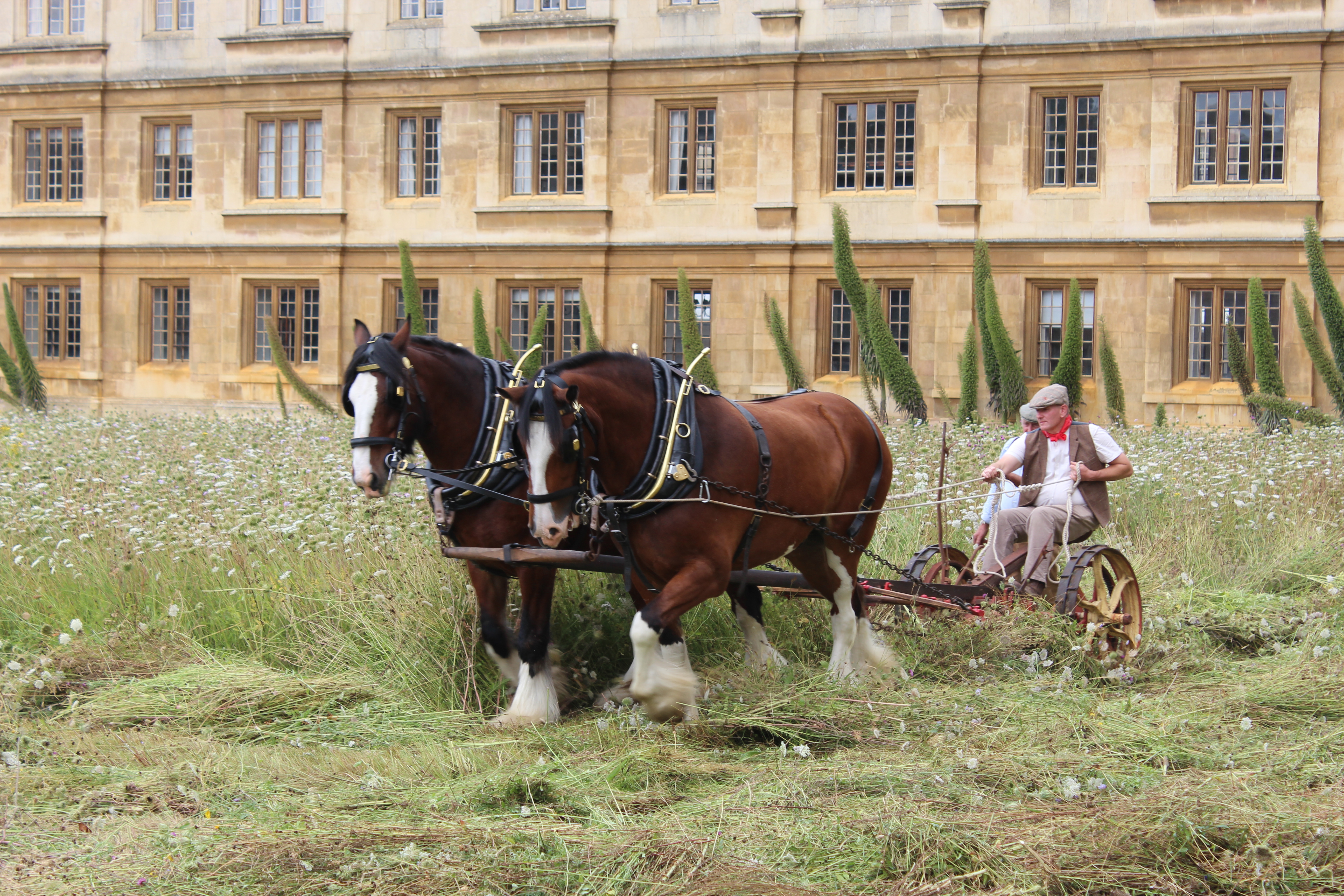
The horses engaged in cutting the meadow

The horses hard at work

Of course, in order for horses to be fit and strong enough to undertake all the many tasks that humans have found and still find for them, they ideally need a great deal of care and attention. Our final image is from a seventeenth-century veterinary text, Markhams Maister-Peece…, which is devoted to curing all the various ailments suffered by horses. The author, Gervase Markham (1568?-1637), was a poet and literary figure who also wrote on a wide variety of practical subjects, including equestrian matters. For this he drew upon his considerable experience as a horse breeder and farmer. The engraved frontispiece below illustrates various aspects of caring for horses, including diet, treating wounds and sores and tending to strained legs. The figure at the top-centre is intended to embody the ideal outcome of all this care: “The figure 1, a compleat horse-man showes, that rides, keepes and cures, and all perfections knows.”
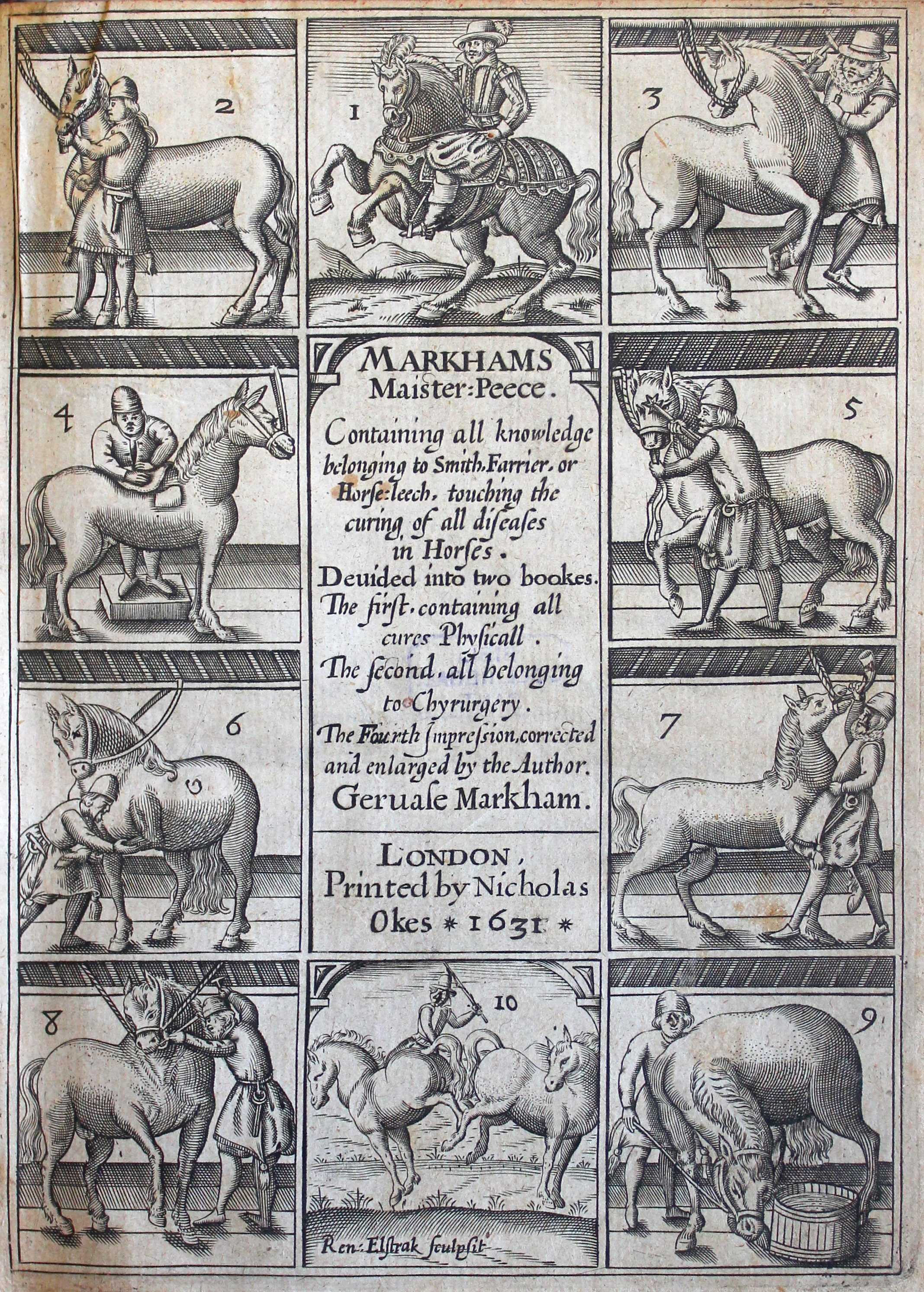
Ten small woodcuts of horses being treated for various ailments

Engraved frontispiece from Markhams Maister-peece: Contayning All Knowledge Belonging to the Smith, Farrier, or Horse Leech, Touching the Curing of All Diseases in Horses by Gervase Markham, London, 1631. Classmark: Chawner.A.6.29

We hope you have enjoyed this canter around our collections!

AC

References and further reading:

Juliet Clutton-Brock, Horse power: a History of the Horse and the Donkey in Human Societies, London, 1992

Hilary Wayment, The Windows of King’s College Chapel Cambridge, London, 1972

Hilary Wayment, King’s College Chapel Cambridge: the Side-Chapel Glass, Cambridge, 1988

Matthew Steggle, Markham, Gervase (1568?-1637) Oxford Dictionary of National Biography. 28 Sep. 2006 [Accessed February 2026]

BBC news story: Cambridge University’s King’s College meadow harvested with horses, 2 August 2021 [accessed February 2026]


A Persian-Indian crowning jewel at King’s

In 1788 a letter of benefaction was received by the Provost and Fellows of King’s from Patna in India. A Kingsman by the name of Edward Ephraim Pote (1750-1832) was announcing that he had ‘acquired a collection of Persian Manuscripts amounting to more than five hundred and fifty volumes’ and was arranging to have them shipped to England to be divided between the colleges of King’s and Eton. This, he said, was ‘to shew my gratitude to those Foundations to whose institutions I am indebted for my education’ (King’s College Archives: KCAC/6/2/23 or LIB/10.2).

Our recent research confirms what has long been suspected, that the Pote manuscripts had formed the bulk of the collection of Colonel Antoine-Louis Polier (1741–1795). As Henry Bradshaw noted, Polier’s seal appears on a large number of the manuscripts and his autograph is on several of them. Polier was an officer and agent of the East India Company, assimilated into the Mughal Courts, and, later in his career, an orientalist, collector and patron of the arts in Lucknow. The collection is dominated by Persian manuscripts, but it also contains codices in Hindustani and Arabic.

At the invitation of Professor Jean Michel Massing and with the support of the Apelles Art History Fund we have recently catalogued the half of the Pote Collection belonging to King’s and made the records globally accessible via the union catalogue of manuscripts in British collections from the Islamicate world known as Fihrist (www.Fihrist.org.uk). The Apelles Art History Fund was established by King’s in 2016 to support original research in the history of art at the College, patrimonial acquisitions and the restoration of art works owned by the College. It commemorates Professor Massing’s contribution to the field and encourages continued exploration and discovery in the arts. In the first years, one of the priorities of the Fund is research on the College’s works of art, including the Pote Collection of Islamic manuscripts and the Keynes Art Collection.

To help raise awareness of the little-studied Pote Collection, this post introduces one of its highlights: King’s Pote MS 186. This manuscript, comprising a collection of poems, is a feast for the eyes: the lyrical verses are arranged in a calligraphic layout, penned by the famous ‘Royal Scribe’ (Kātib al-Sulṭānī) Mīr ‘Alī Haravī (flourished 915–951/1509–1544), framed by exquisitely decorated margins, and enclosed in a beautiful lacquer binding and doublures (inside bindings).

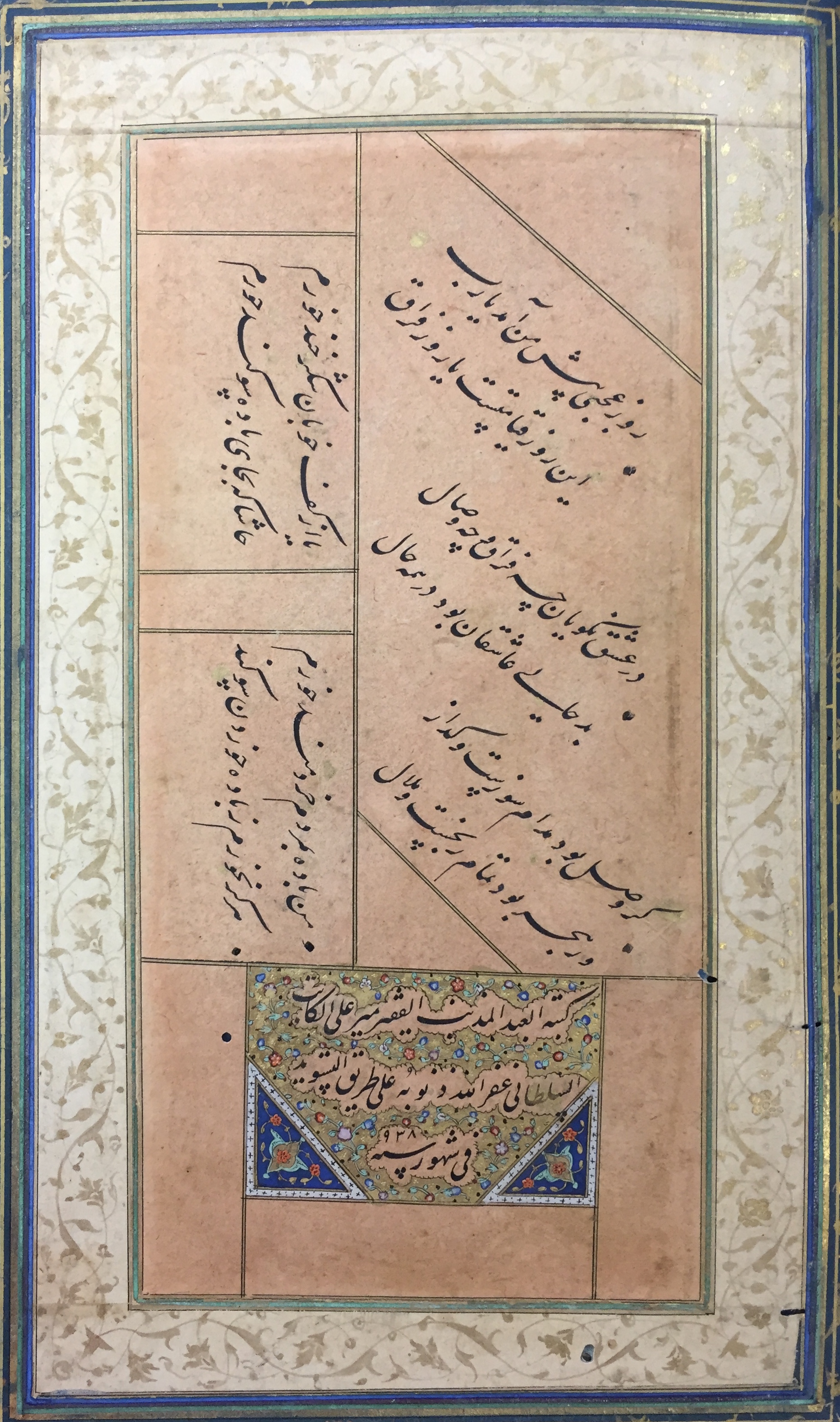
Left half of the double-page frontispiece, Dīvān of Hilālī, penned by Mīr ‘Alī Haravī, dated 938/1531-32 (King’s Pote MS 186).

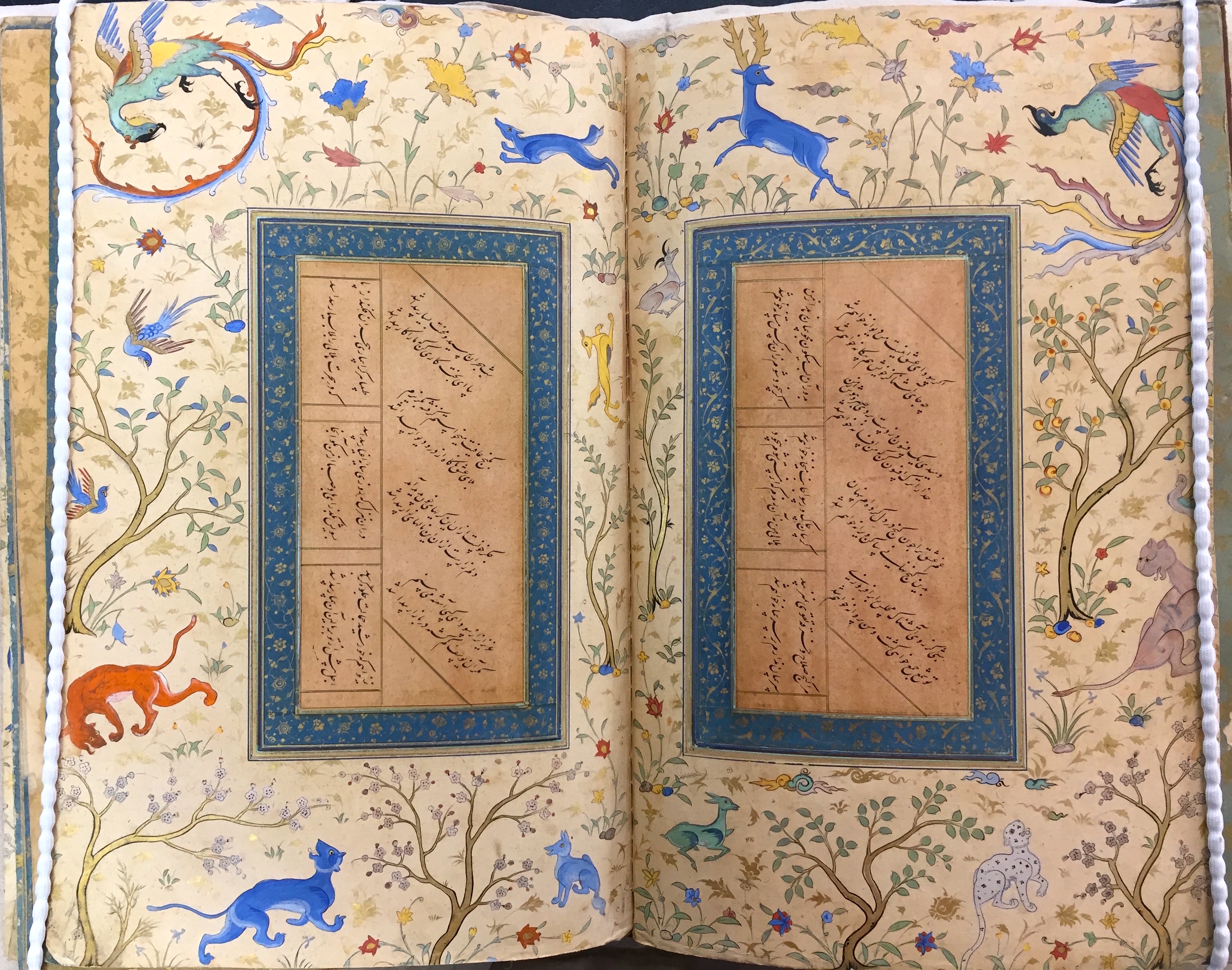
Each page consists of a central text block with a narrow illuminated border, mounted within a frame (passe-partout) decorated either with drawings of flora and/or fauna in gold or with multi-coloured paintings with charming depictions of animals. Based on the artistic style and type of paper, the remounting was very probably executed in Mughal India.

Illuminated margins, floral decorations in gold (King’s Pote MS 186).

Mīr ‘Alī was an acknowledged master of calligraphy, especially prominent in a script known as nastaʿlīq. He worked in Herat and was moved to Bukhara around 935/1528–29.[1] His calligraphy was much prized in later centuries, especially at the court of Shah Jahan in India, and it is probable that the manuscript was remounted and decorated (and rebound) at the latter’s command. Although further research is required, there are signs the manuscript was once in Shah Jahan’s Royal Library: it bears an inspection note and the seal impression of ‘Abd al-Ḥaqq Amānat Khān, who might well be the calligrapher of that name (d. 1054–55/1644–45)[2] who designed the calligraphy on the Taj Mahal, and whose seal impression appears in other manuscripts from the Mughal Royal Library.

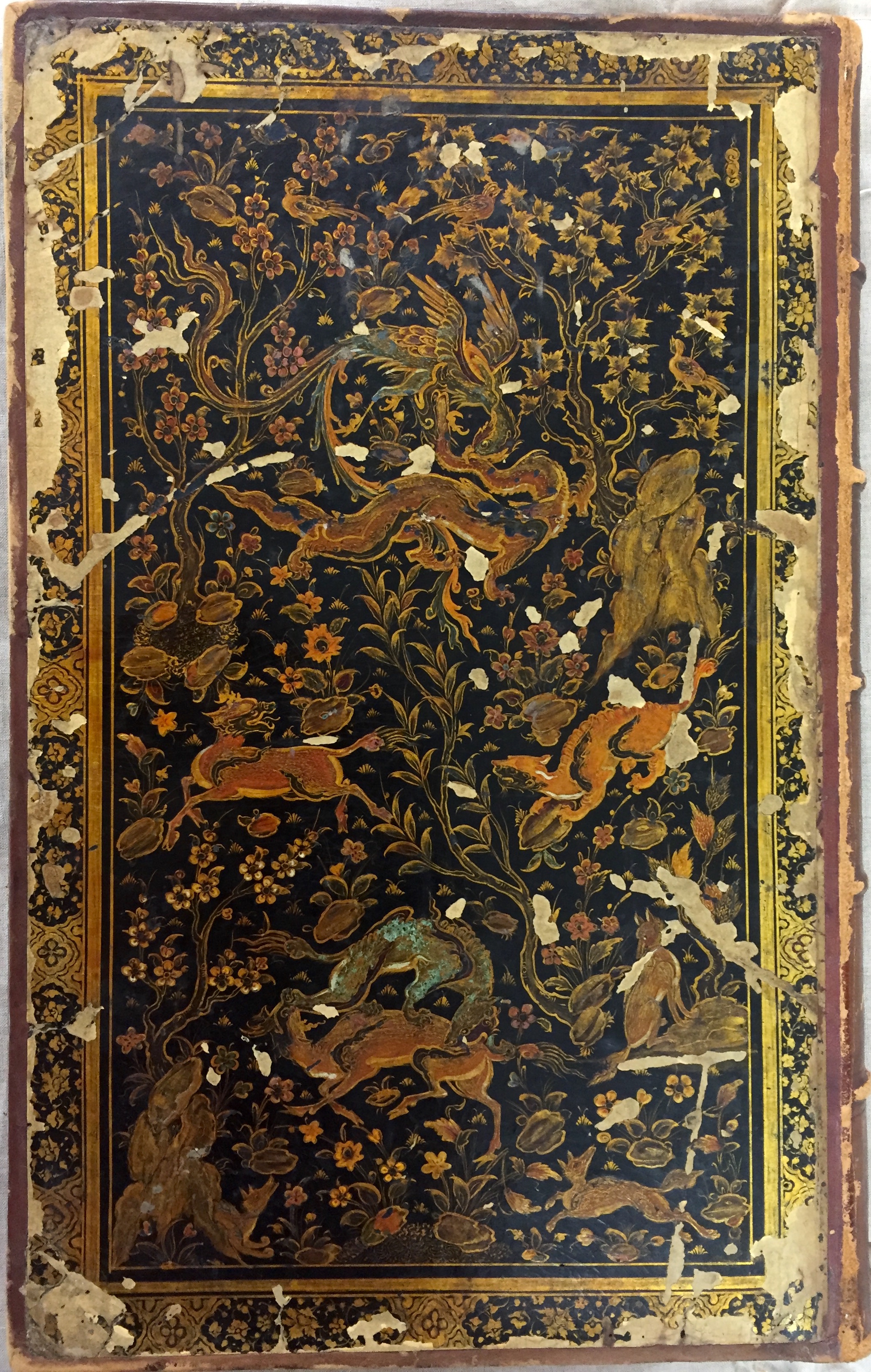
Lacquer binding showing fantastic landscape with dragon and simurgh (King’s Pote MS 186).

The manuscript has a lacquer-decorated binding depicting a hunt scene of fantastic and naturalistic animals, including a simurgh (a benevolent, mythical bird in Iranian mythology), a dragon, foxes, hares and birds of prey, all painted in glittering and bright colours on a blackground. The doublures, with a gold and ochre background, carry a diamond-shaped medallion (turanj) in black and gold, pendants in black and reddish brown, and corner pieces, all decorated with floral motifs. The ground depicts animals including a lion, a leopard, a fox, an antelope and a deer in a setting of sparse shrubs and flowers. The front and back covers and doublures are identical. The binding seems to be contemporary with the marginal illuminations and illustrations, and a product of the same Mughal royal atelier.

Lacquer doublure (inside front binding, King’s Pote MS 186).

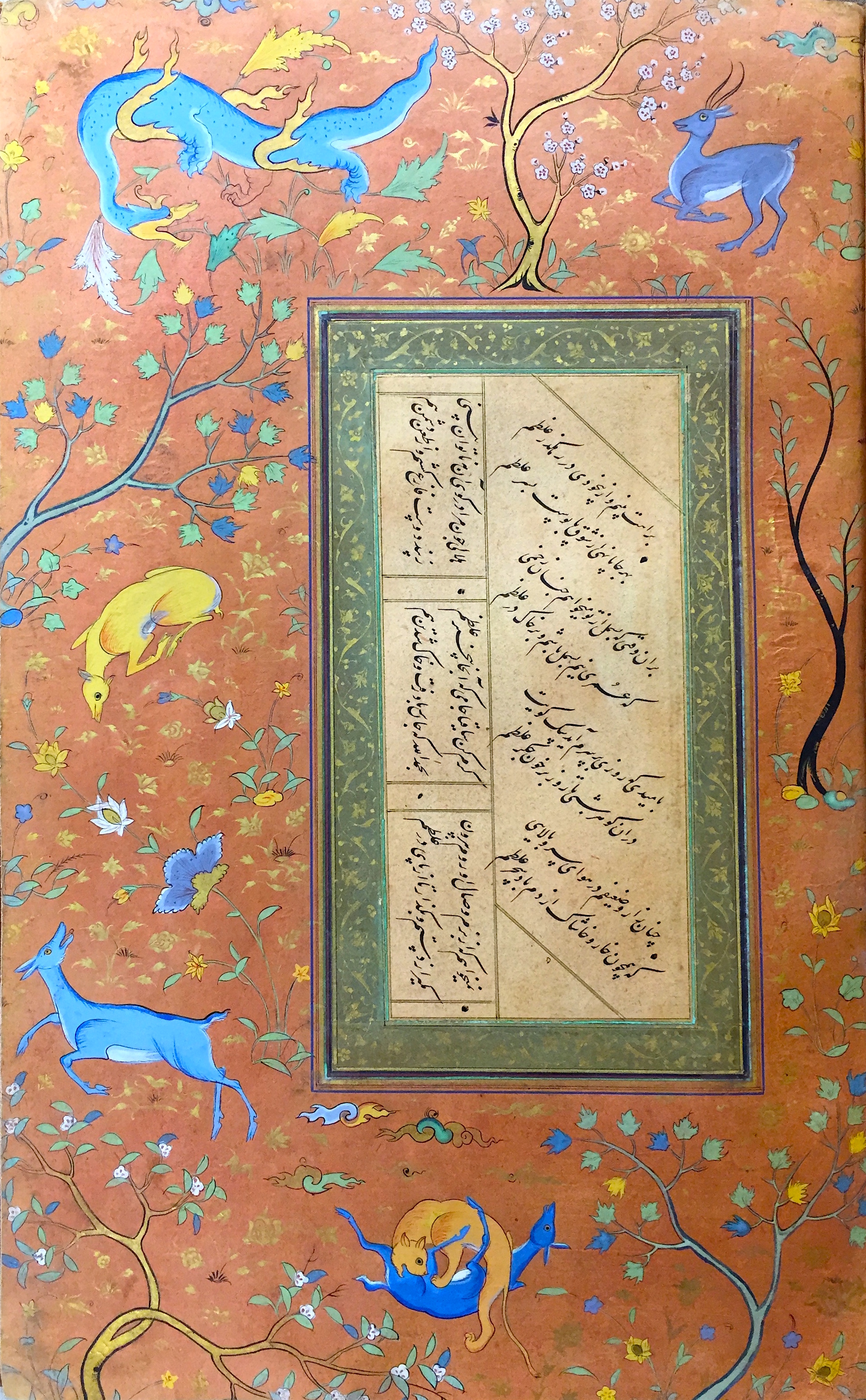
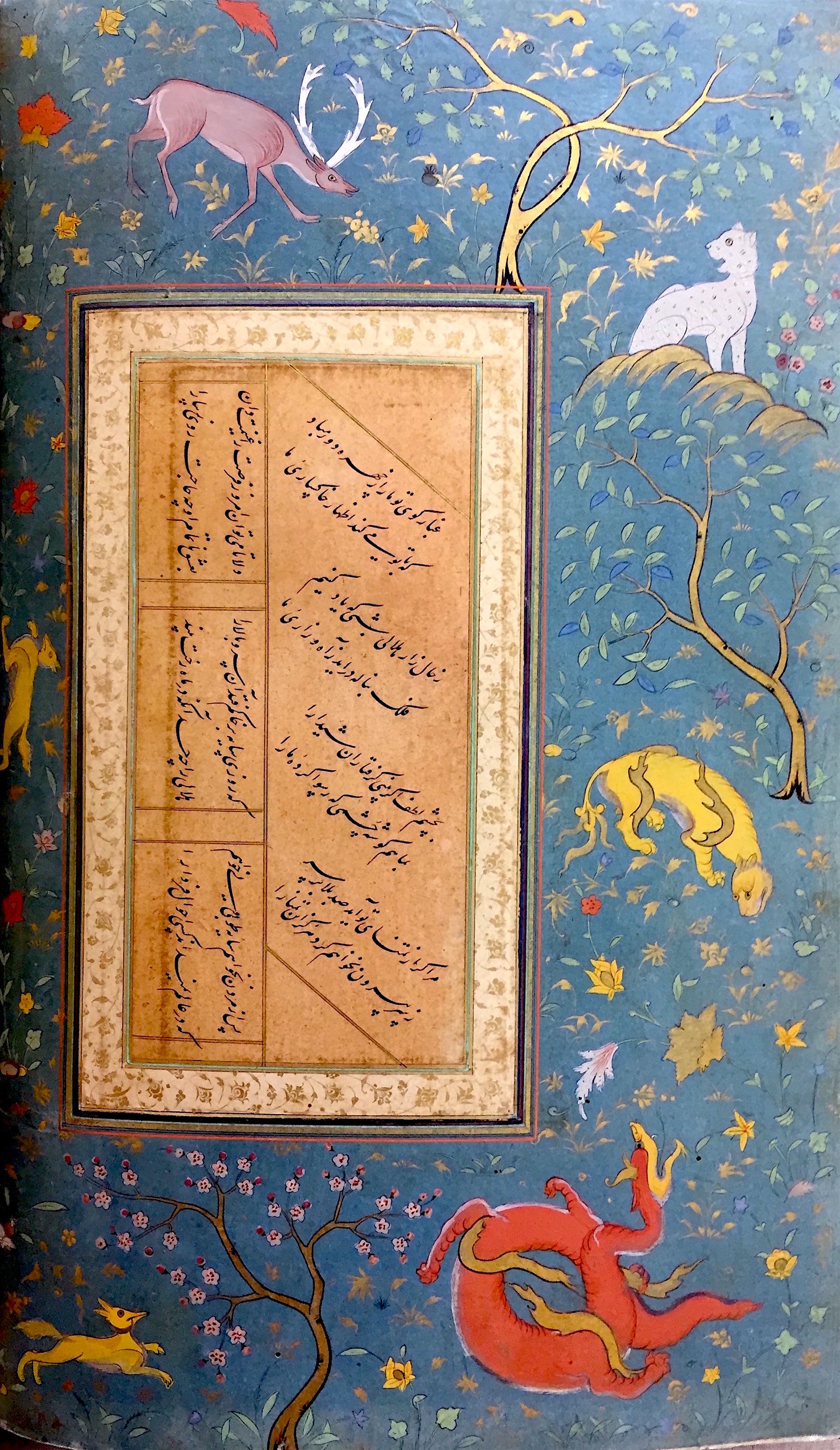
Similar animals, in different poses, are illustrated among trees and flowers in some of the margins on both dark and light grounds. The palette used in these illustrations includes gold and a variety of vivid colours.

Illustrated margins showing flora and fauna in rich palettes on tinted paper (King’s Pote MS 186)

Illustrated margins showing flora and fauna in rich palettes on tinted paper (King’s Pote MS 186)

Illustrated margins showing flora and fauna in rich palettes on tinted paper (King’s Pote MS 186)


The textual content is a selection of lyrical poems (ghazals) by a prominent poet, Badr al-dīn Hilālī of Astarabad (d. 936/1529–30 or 939/1532–33). Hilālī had been in the literary circle of the Timurid Sultan Ḥusayn Bāyqarā (842–911/1438–1506) as a protégé of his bibliophile vizier, ‘Alīshīr Navā’ī (1441–1501), in Herat. Our manuscript, completed in 938/1531–32, is the earliest copy of Hilālī’s poetry and the closest to his time. To my knowledge, the second oldest manuscript from the same poet is dated 957/1550 (now in the Tehran Majles Library), almost two decades later than the King’s manuscript. Our manuscript was penned by the most prominent calligrapher of the time, Mīr ‘Alī Haravī, the Royal Scribe. The borders were illuminated and illustrated under the Mughals.

Although the poet’s date of death is a matter of debate, it is possible that this was copied before the poet was put to death for his religious beliefs, in which case he could have been involved in selecting his poems for this collection. Unfortunately, the first folio (right half of the double-page frontispiece), with the heading and title inscription, which could have contained some clues about the poet, has been lost and was replaced in the Mughal era (the first extant ghazal, i.e. a form of lyrical poem, begins partway through). We do not find any indication in the colophon that the poet had recently passed away. We know that the poet and the scribe were once companions at the court of the last Timurid Sultan in Herat in the late fifteenth- and early sixteenth-centuries, before both were moved to Bukhara to serve an Uzbek khan. Whether the poet was alive or not when the manuscript was penned is a question that requires further investigation. However, there is no doubt the textual content remains a significant early source for future editions of the ghazals of Hilālī’s dīvān.

Signed by the scribe, Mīr ‘Alī al-Kātib al-Sulṭānī, the Royal Scribe (King’s Pote MS 186, colophon).

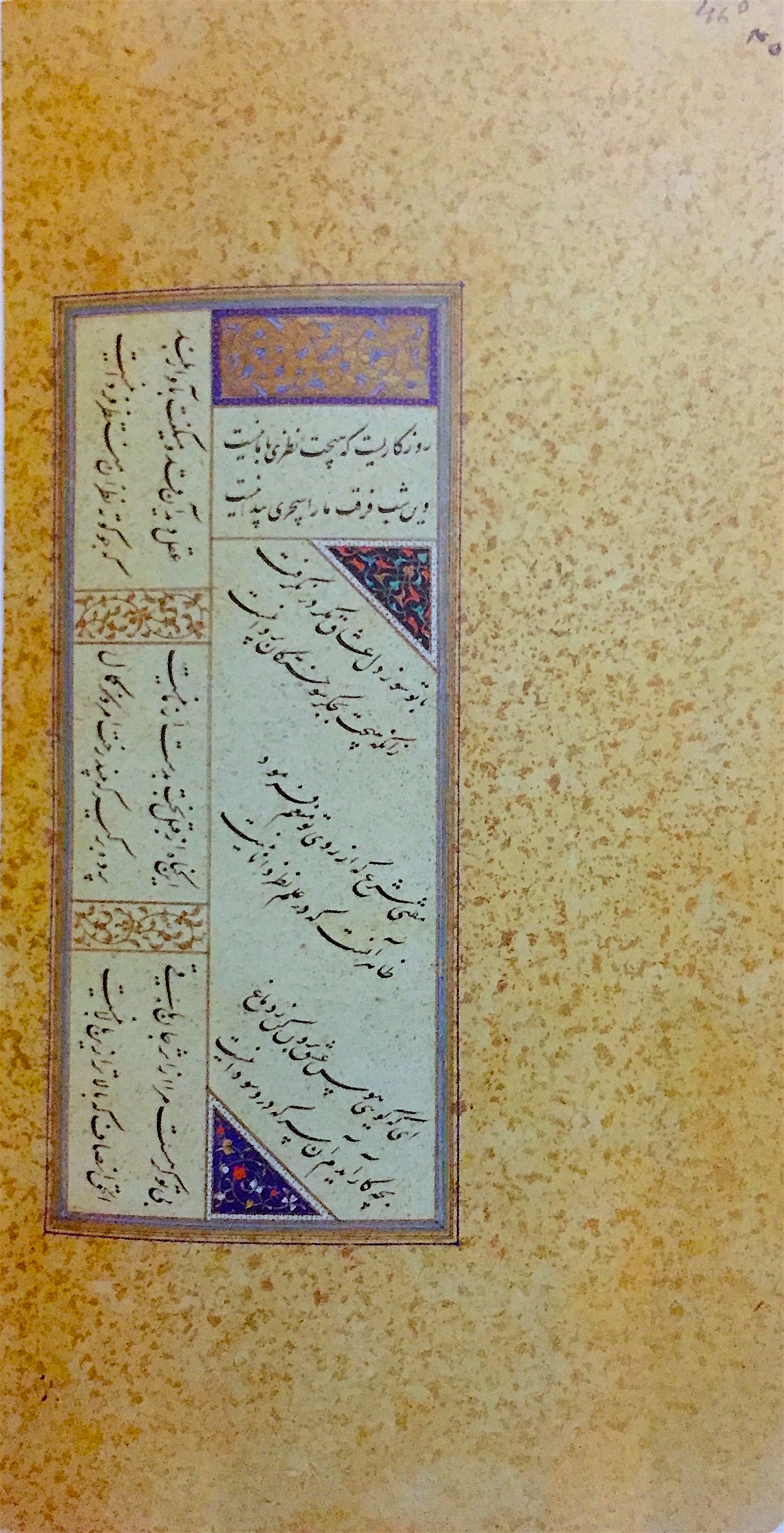
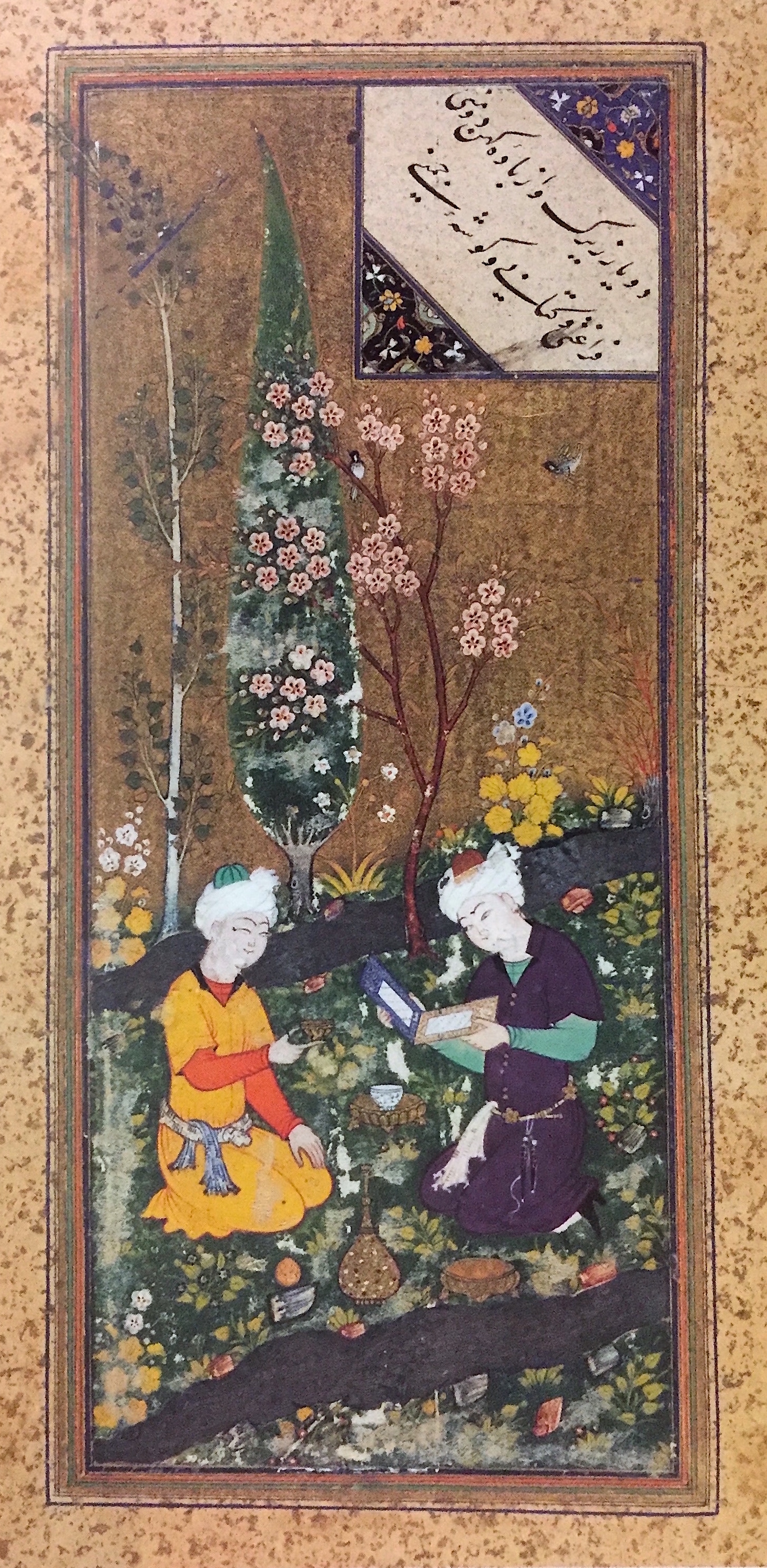
There is a closely-related manuscript, which was also penned and compiled by Mīr ‘Alī Haravī, in 935/1529 in Bukhara (two to three years prior to our manuscript), and which contains a selection of poetry by eleven poets from the same courtly circle. That is MS C-860 which is housed in the Russian Academy of Sciences in St Petersburg, and comprises 56 folios with seven verses per page, arranged in a similar format to King’s Pote MS 186.[3] In that anthology, the dimensions of the text panels are smaller and the margins are not illuminated or illustrated but simply gold speckled. However, it contains two subsequently added illustrations. ‘Judging by the poem in the colophon, written by the author of the compilation [Mīr ‘Alī Haravī], the copy was intended for the Uzbek sovereign of Bukhara, the Shaibānid ‘Ubaid-Allāh Khān (died in 1533 [actually 1539]), an avid bibliophile.’[4] Based on the fact that the scribe Mīr ‘Alī Haravī was moved to Bukhara by ‘Ubayd-Allāh Khān (c. 935/1528–29) and the completion date of the King’s manuscript (938/1531–32), it is very likely that the patron of Hilālī’s dīvān was the same Shaybānid ruler ‘Ubayd-Allāh Khān. There is little doubt that the unnamed place where our manuscript was copied is again Bukhara.[5]

Poetry anthology, penned by Mīr ‘Alī Haravī, dated 935/1529 (MS C-860 in the Russian Academy of sciences, St Petersburg).

Poetry anthology, penned by Mīr ‘Alī Haravī, dated 935/1529 (MS C-860 in the Russian Academy of sciences, St Petersburg).


King’s Pote MS 186 is the crowning jewel of the Pote collection at King’s. There is beauty in the masterful sixteenth-century penmanship from Bukhara, and in the exquisite decorated margins and binding that were probably added in a Mughal royal atelier around a century later. There is also great textual value in this early collection of verse by a noted contemporary poet. Of course, not all of Colonel Polier’s Lucknow manuscript collection was of this quality and value. But there are lesser treasures too, now in Cambridge, thanks to the efforts and generosity of Edward Pote.

Shiva Mihan

All manuscripts of the Pote Collection are on permanent loan at Cambridge University Library.

Endnotes
[1] O.F. Akimushkin listed a number of manuscripts in the hand of Mīr ‘Alī on p. 333 of his article on the Shaibānid library at Bukhara: ‘Biblioteka Shibanidov v Bukhare XVI veka’ in Bamberger Zentralasienstudien: Konferenzakten ESCAS IV, Bamberg 8-12. Oktober 1991, ed. I. Baldauf and M. Friederich (Berlin, 1994), pp. 325-41. See http://menadoc.bibliothek.uni-halle.de/iud/content/pageview/347600 .
[2] http://www.iranicaonline.org/articles/amanat-khan-sirazi-abd-al-haqq
[3] For more details and reproductions of the manuscript, see Y. A. Petrosan et al. Pages of Perfection: Islamic paintings and calligraphy from the Russian Academy of Sciences, St. Petersburg (Lugano, 1995), pp. 226–29.
[4] Ibid., p. 226.
[5]For information on the Shaybānids (or Abū al-Khayrids) see http://www.iranicaonline.org/articles/abul-khayrids-dynasty. For Bukhara see http://www.iranicaonline.org/articles/bukhara-viii.