Tag Archives: Alchemy

Soaring into the New Year on the back of a dragon

In honour of the Year of the Dragon, we went on a perilous mission into the Library’s treasure hoards of books to find out if any of those fearsome beasts might be lurking inside. Alas, no Chinese dragons were discovered, but we did encounter several of the European variety and bravely captured their images to share with you in this post.

Our first dragon however, is not to be found within the pages of a book. It is a much more solid beast; a sculpture which originally adorned the College Chapel, but which was removed and replaced during restoration work. For the last few decades it has stood guard over the upstairs entrance of our Library, somewhat worn and battered by time maybe, but fierce and stalwart nonetheless.

A stone dragon standing upright with mouth open

The dragon outside the upstairs entrance of the Library

Several sixteenth-century works from our collections proved to be harbouring dragons. The first image comes from a volume of natural history by Pierre Belon (1517?-1564), originally produced in 1553. This is a very early printed depiction of a dragon with wings. Belon, a French naturalist and traveller, claimed to have seen embalmed bodies of these creatures during his travels in Egypt.
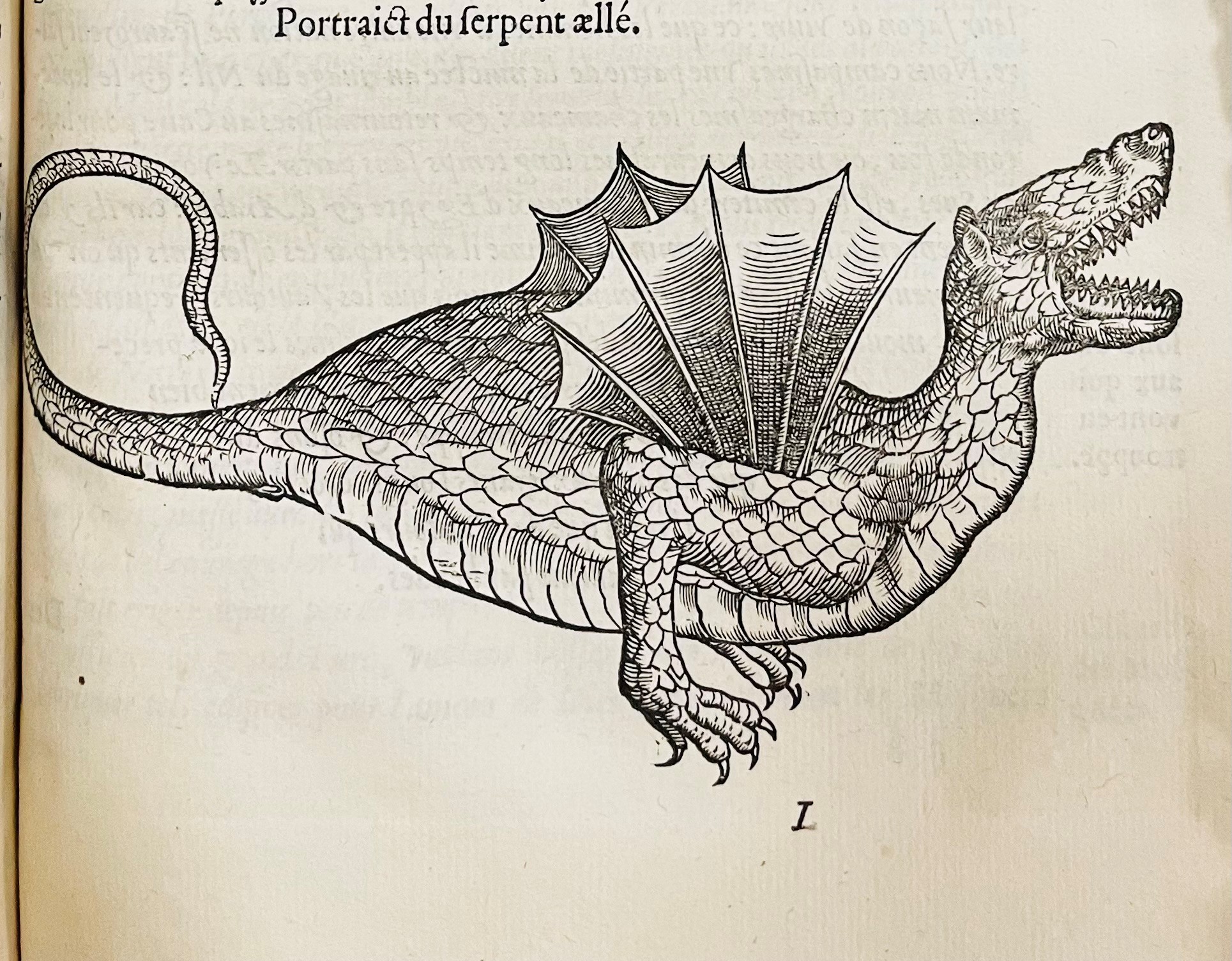
Woodcut of a two-legged winged dragon

Egyptian dragon from Les Obseruations de plusieurs singularitez & choses memorables by Pierre Belon, Paris, 1555 (T.16.20)

Secondly, we have an illustration depicting a very grand St George slaying a dragon, which adorns the title page of the 1527 edition of Polycronicon, by Benedictine monk, Ranulf Higden (ca. 1280-1364).  This was a very popular work of world history, written originally in Latin and later translated into English and added to over the following centuries.

Woodcut of St George on horseback with a dragon under the horse's hooves

St George and the dragon from the title page of Polycronycon by Ranulf Higden, London, 1527 (M.24.08)

Our last sixteenth-century image is from a 1590 edition of Edmund Spenser’s Faerie Queene. Here we have another knight, the Redcrosse Knight, killing a dragon in a very similar fashion. The Redcrosse Knight is very closely associated with St George.

Image of a knight on horseback with a dragon under the horse's hooves. The knight is running a spear through the dragon

The Redcrosse Knight from The Faerie Queene by Edmund Spenser, London, 1590 (Keynes.C.02.19)

Moving into the seventeenth century, a work of alchemy provides more images. Dragons in alchemy symbolize the unification of opposing forces like the sun and the moon or sulphur and mercury, and the change they produce when combined.  We therefore get these striking illustrations of entwined or two-headed dragons, as shown in the images below.

Two dragons perched atop a ring with their necks intertwined

Alchemical dragon symbol from page 212 of Theatrum Chemicum Britannicum edited by Elias Ashmole, London, 1652 (Keynes.C.4.2)

Upright two-headed dragon with a bird above and alchemists gathered around it

Two-headed dragon from page 213 of Theatrum Chemicum Britannicum edited by Elias Ashmole, London, 1652 (Keynes.C.4.2)

From our collection of children’s books comes a tale brimful of dragons. Snap-dragons: a Tale of Christmas Eve by Juliana Horatia Ewing (1841-1885) revolves around the parlour game of Snap-dragon, very popular in the nineteenth century, in which people took it in turns to snatch raisins from a bowl of flaming brandy.  This particular game conjures up a bevy of real dragons who draw a little boy into their boisterous and violent game of trading insults, or “snapping” at each other. It has some delightful illustrations.

Cover of the book showing a boy looking at a swirling group of dragons

Cover of Snap-dragons: a Tale of Christmas Eve by Juliana Horatia Ewing, London, 1888 (Rylands.C.EWI.Sna.1888a)

Text with a dragon illustration. The dragon is entwined with the initial B

Page 33 of Snap-dragons 

Text with an illustration of a dragon confronting a small boy

Pages 34 and 35 of Snap-dragons

Finally, we have this charming little dragon wrapped around an initial letter A in a volume of fairy tales, also by Ewing. Oddly enough, the tale it accompanies: “Knave and Fool”, features no dragons at all.

a dragon entwined around the initial A

Initial dragon from Old-fashioned Fairy Tales by Juliana Horatia Ewing, London, [1882?]  (Rylands.C.EWI.Old.1882)

Happy New Year!

References

Mythical creatures at the Edward Worth Library: Here be dragons! [accessed January 2024]

Jean Chevalier and Alain Gheerbrant, A Dictionary of Symbols. Oxford, 1994.

Lyndy Abraham, A Dictionary of Alchemical Imagery. Cambridge, 1998.

AC
Tales from the Script: Late Night Gothic Horror in the Library

Last weekend we put out an exhibition in King’s Library on the theme of gothic horror, marking two hundred years since the publication of the iconic novel Frankenstein by Mary Shelley (1797–1851) in 1818. We are delighted to share some of the treasures of that exhibition with you here.

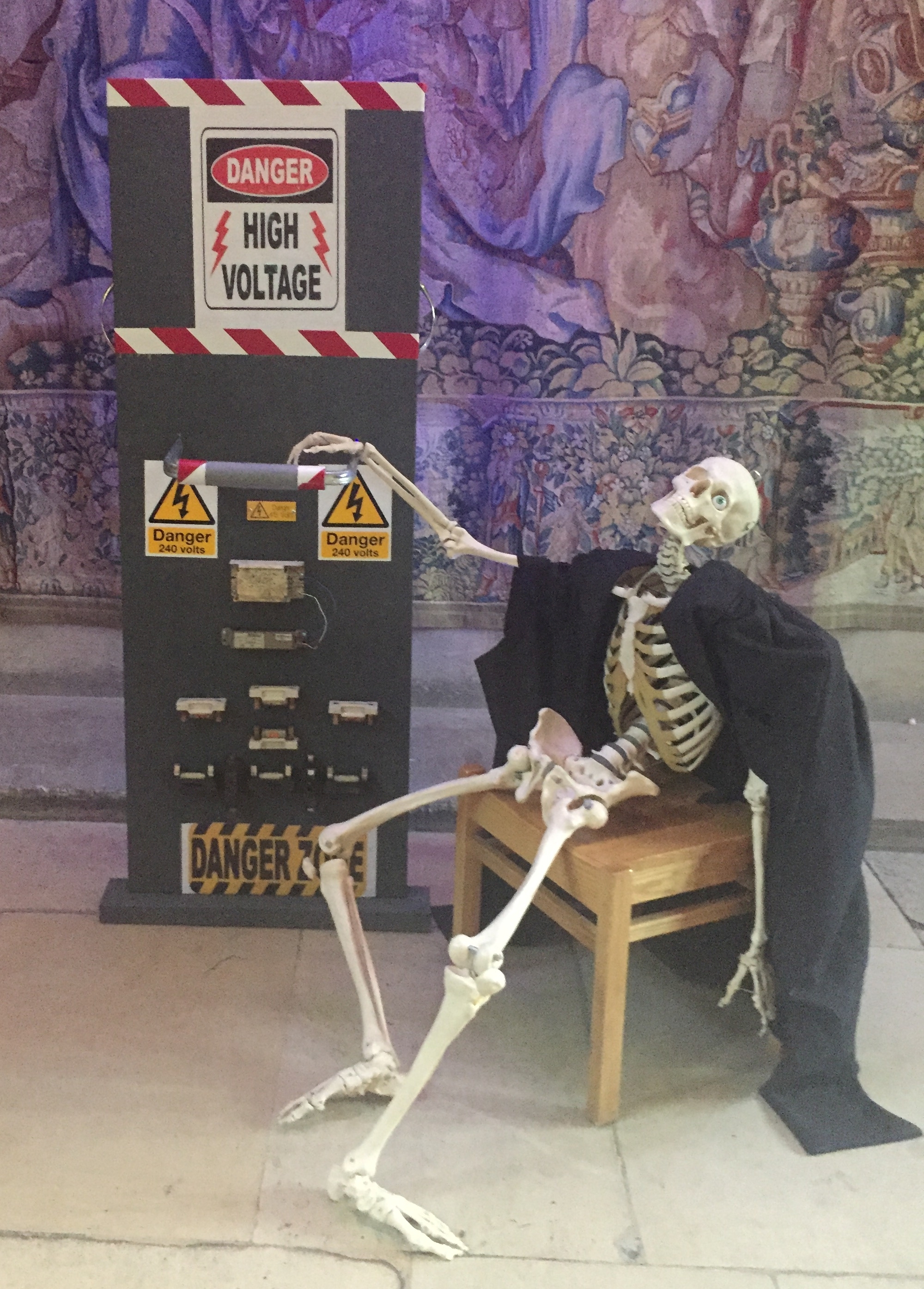
Bony Tony, King’s Library’s skeleton, let loose on the world at large . . .

It all started with Kingsman Horace Walpole  whose 1767 novel The Castle of Otranto is considered to be the first gothic novel. It initiated a genre which became extremely popular in the later 18th and early 19th century, inspiring authors such as Ann Radcliffe, Mary Shelley, Bram Stoker, Edgar Allan Poe and Robert Louis Stevenson. The aesthetics of the book continue to influence modern-day gothic books, films, art, music and the goth subculture.

Horace Walpole, The Castle of Otranto: A Gothic Story (Parma, 1791), sixth edition (Shelfmark: Keynes.E.3.23), title page and frontispiece

“The lower part of the castle was hollowed into several intricate cloysters; and it was not easy for one under so much anxiety to find the door that opened into the cavern. An awful silence reigned throughout those subterraneous regions,  except now and then some blasts of wind that shook the doors she had passed, and which grating on the rusty hinges, were reechoed through that long labyrinth of darkness.”

Horace Walpole, A Description of the Villa of Horace Walpole …at Strawberry-Hill, near Twickenham (Strawberry-Hill, 1786) (Shelfmark: Keynes.E.1.15), title page

Walpole was so interested in medieval history he began building a gothic-style castle in Twickenham in 1749 which he called Strawberry Hill. The world-famous house and gardens are open to the public today. In 1786 Walpole published a description of the villa which included an engraving of what it looked like at the time, as well as an inventory of the furniture, pictures and curiosities it contained.

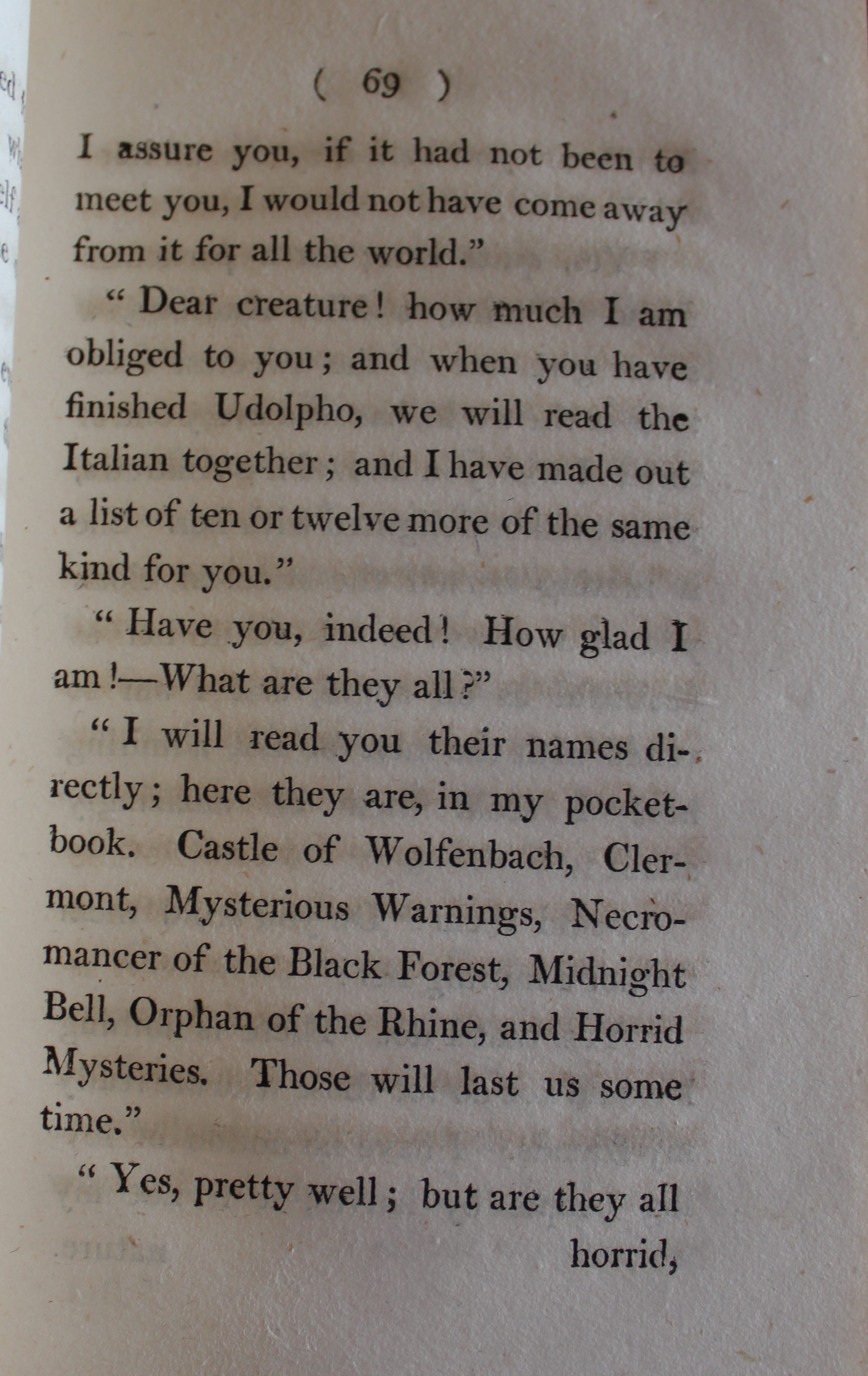
It is well known that Jane Austen’s novel Northanger Abbey (published just after Austen’s death in 1817) is a satire of gothic novels which were very popular in the late 1790s. The character Catherine Morland has a passion for reading gothic novels, but gets into difficulties when applying their concepts to everyday life. Here is the famous scene in which Catherine’s friend, Isabella Thorpe, reads to her the titles of the ‘horrid novels’:

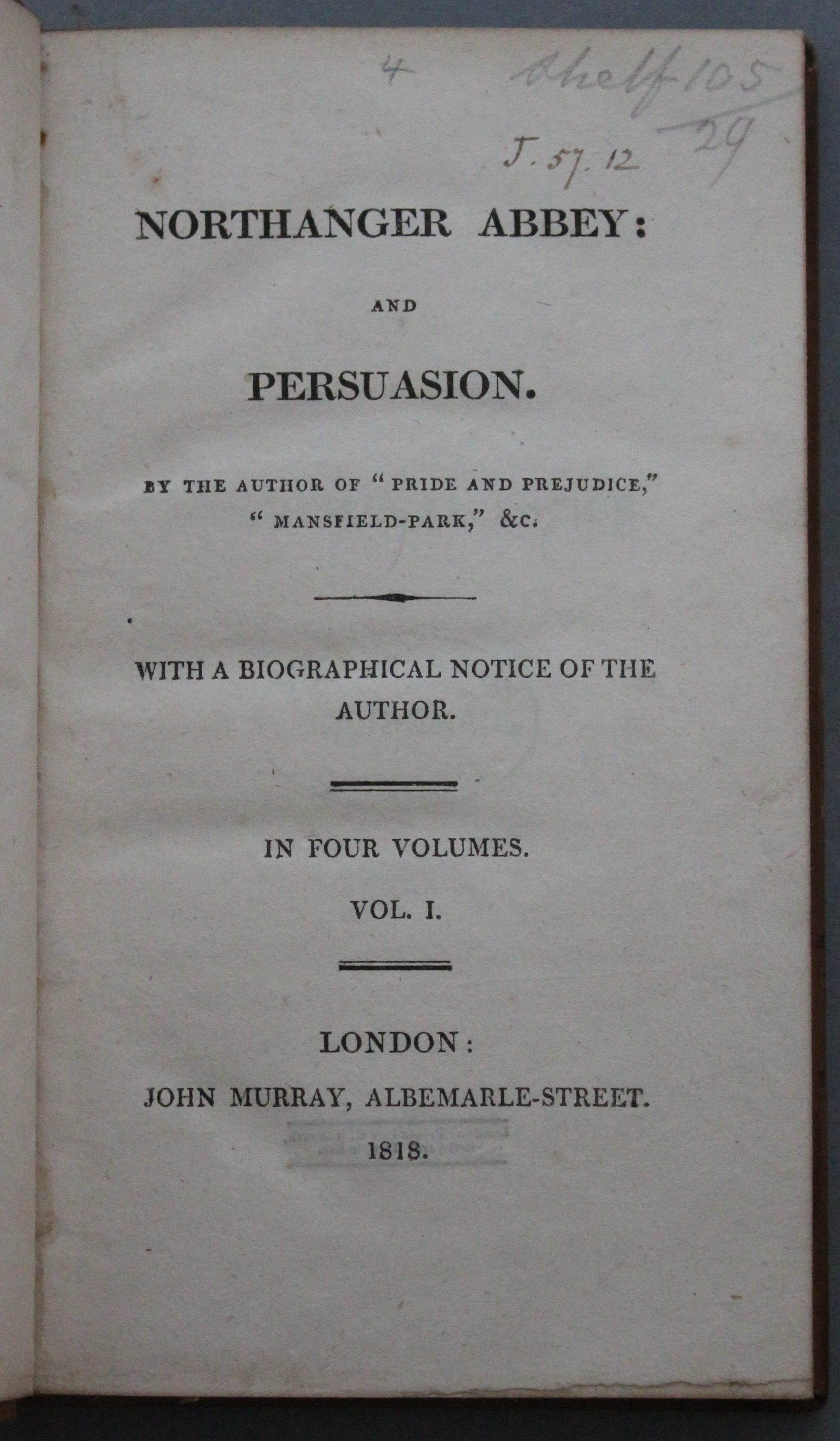
Jane Austen, Northanger Abbey (London, 1817) (Shelfmark: Thackeray.J.57.12-15)

Jane Austen, Northanger Abbey, title page


Regina Maria Roche, Clermont (Dublin, 1799) (Shelfmark: Warren.D.1.Roc.Cl/1-2), title page

One of those novels, Clermont, was written by Regina Maria Roche (1764–1845), who is considered today to be a minor writer of gothic novels, but she was a best-selling novelist during her life. Originally published by the sensationalist Minerva Press, Clermont first appeared in 1798. It tells the story of the beautiful Madeline, who lives in seclusion with her father (the Clermont of the title) until they are visited by a mysterious Countess from his past.


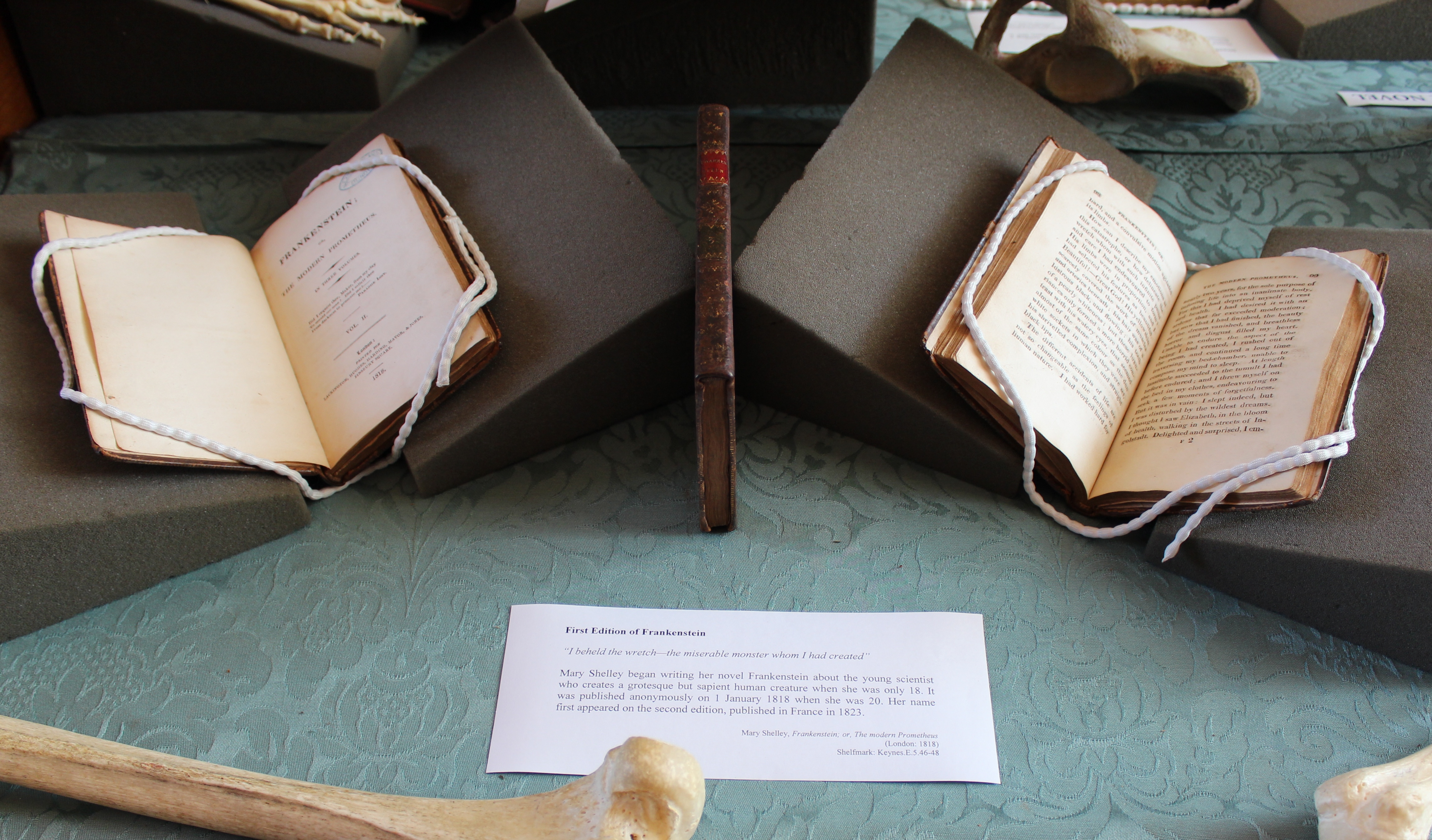
Just after Jane Austen’s death in 1817 arguably the most famous gothic horror story of all time was published: Mary Shelley’s Frankenstein. Shelley began writing her novel about the young scientist who creates a grotesque but sapient human creature when she was only 18. It was published anonymously on 1 January 1818 when she was 20. Her name first appeared on the second edition, published in France in 1823.

The three volumes of Mary Shelley, Frankenstein; or, The modern Prometheus (London, 1818) (Shelfmark: Keynes.E.5.46-48), first edition.

“I beheld the wretch—the miserable monster whom I had created”

Famously, the story of the monster had its origins in a horror-story competition held in the Villa Diodati near Geneva, where Mary, her lover and later husband Percy Bysshe Shelley, Lord Byron and others whiled away the evenings in 1816. Mary Shelley’s story has inspired countless comics, pop-up books, plays and films and continues to do so to this day.

Frankenstein, first edition, title page

Victor Frankenstein is repulsed by the monster he has created.


In 1832, Johann Wolfgang von Goethe (1749–1832) also included in Faust Part II the creation of an artificial man, a ‘homunculus’, created in the lab by Faust’s assistant Wagner. Goethe was tapping into an older science, that of alchemy, for his story. The ability to make this small human or homunculus was often discussed in alchemical writings of the seventeenth century. The homunculus can also be symbolic of the creation of a spiritual being or of the philosopher’s stone itself. Below we see Heinrich Khunrath, a Christian kabbalist and alchemist. On the left hand side he kneels in prayer in his Oratorium, on the right hand side is his Laboratorium. Khunrath described the making of the homunculus with the aid of malign spirits as ‘Desperatio.’ This copy was owned by John Ruskin.

Plate from Heinrich Khunrath, Amphitheatrum sapientiae divinae solius verae (Hanau, 1609) (Shelfmark: Keynes.Ec.3.1.1.)

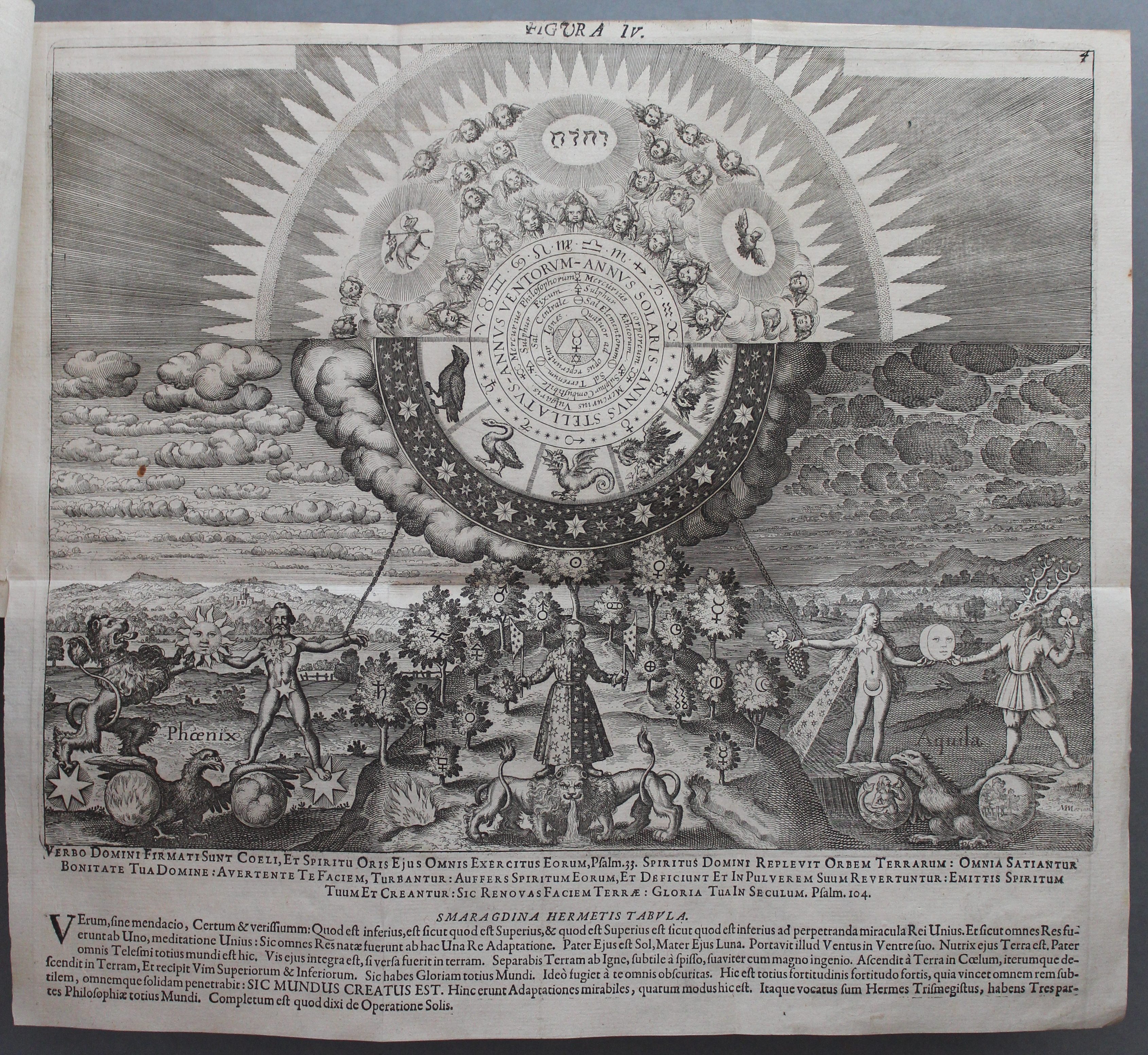
Below we see an engraving by Matthaeus Merian (1593–1650) which represents symbolically the text of the Latin Emerald Tables, a foundational work of transmutational alchemy attributed to the legendary Hermes Trismegistus. The layers of meaning in the Emerald Tables have been associated with the creation of the philosopher’s stone.

Musaeum Hermeticum reformatum et amplificatum (Frankfurt, 1678) (Shelfmark: Keynes.Ec.3.2.13), engraved plate

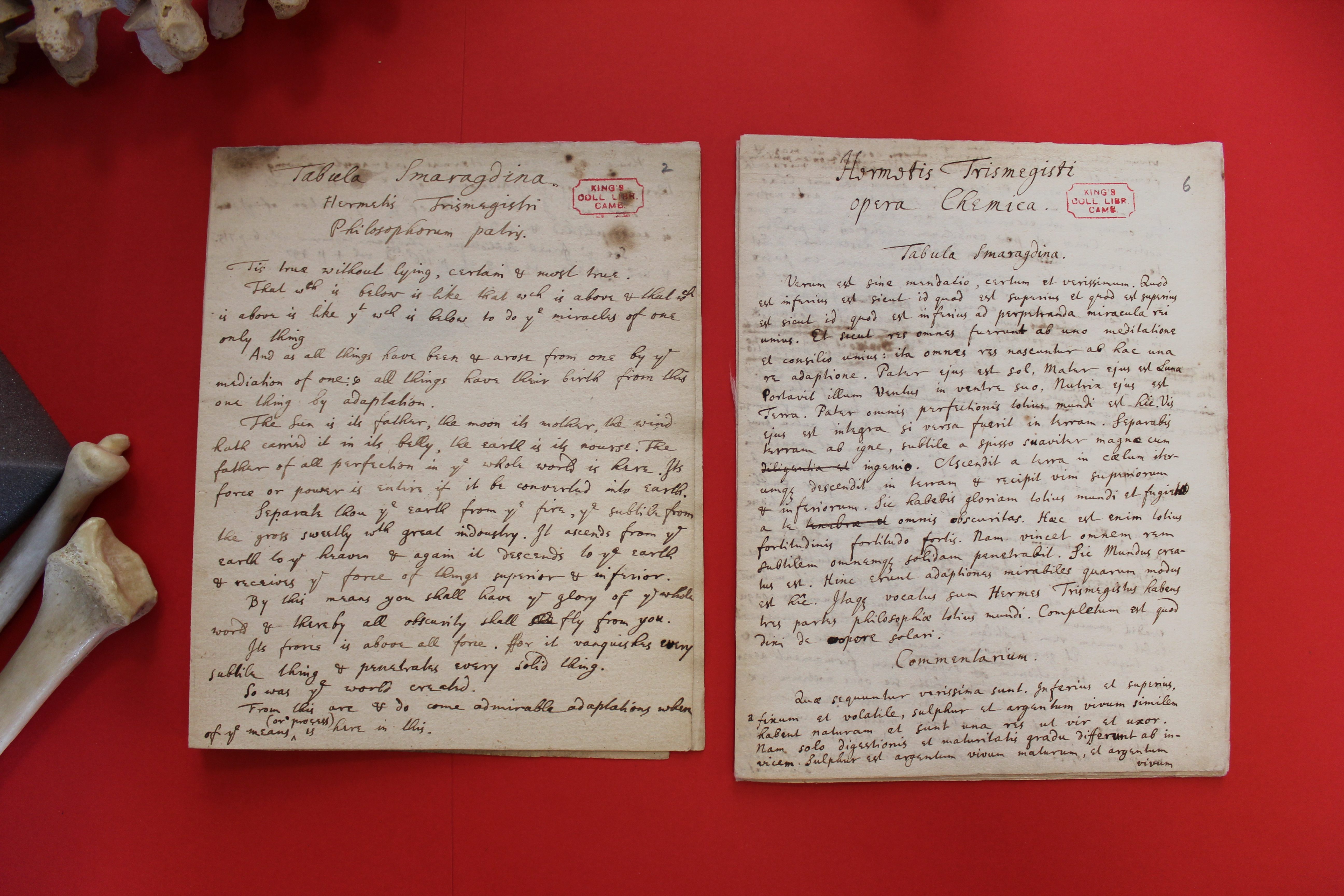
Probably the most famous alchemist was Isaac Newton (1642–1727), who had a laboratory in Trinity College, Cambridge. John Maynard Keynes (1883–1946) wrote a celebrated paper on Newton, ‘Newton the Man’, published only after Keynes’s death in 1946. In it he described Newton’s alchemical writings, of which he had formed the outstanding collection (now at King’s), and explained how historians had contrived to ‘hush up’ this side of Newton’s activities. Newton, said Keynes, was ‘the last of the magicians’.

Newton’s translation into English of the Emerald Tables, (c.1678) (Shelfmark: Keynes Newton MS 28)

Back at King’s we have our own twentieth-century tradition of horror stories, starting with former King’s Provost M. R. James (1862-1936), who is most famous to the wider public for his published ghost stories which he would read to students at Christmastime (a tradition reinstated by our current Provost). Tim Munby (who was Librarian at King’s from 1947 to 1974) continued along this path with his collection of ghost stories The Alabaster Hand.

A.N.L. Munby, The Alabaster Hand (London, 1949) (Shelfmark: KL MUN 1), first edition and photograph of Munby

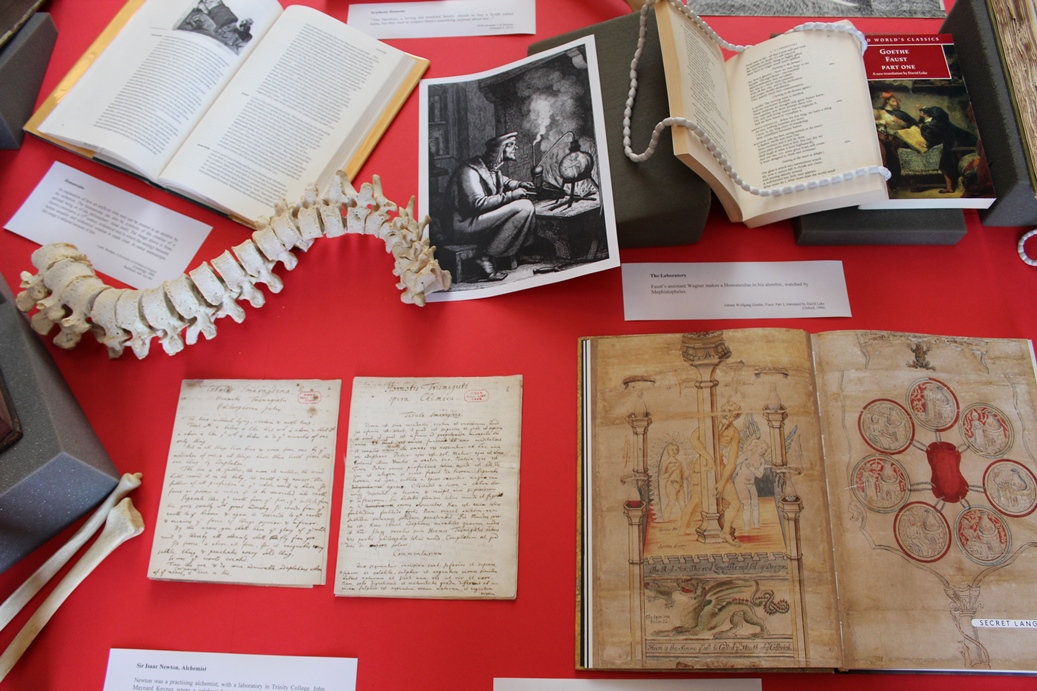
An overview of part of the exhibition

JC/PJ/AC